


What Rock Goth Music Really Is
When you hear the word "goth," you probably picture black eyeliner, Victorian lace, and maybe a fog machine. Fair enough. But rock goth music is something far more specific than an aesthetic or a vibe. It's a guitar-driven rock subgenre with its own sonic identity, rooted in the post-punk explosion of the late 1970s. Think less costume party, more cathedral made of reverb and bass.
Defining Rock Goth Music as a Rock Subgenre
Goth rock is a subgenre of rock music that emerged from the post-punk movement in the late 1970s, characterized by haunting minor-key melodies, heavily reverbed guitars, prominent bass lines, dramatic baritone vocals, and lyrical themes drawn from gothic literature, dark romanticism, and existential introspection.
That definition matters because the broader "goth" umbrella covers a lot of ground. Gothic music spans electronic darkwave, industrial noise, ethereal synth textures, and an entire cultural identity built around fashion, literature, and community. Gothic metal fuses doom-laden heaviness with orchestral drama. The difference emo goth debates never seem to end online. All of these threads connect back to the same dark tapestry, but they're not the same fabric.
Goth rock, specifically, is a rock genre. It lives and breathes through amplifiers, not just synthesizers.
Why the 'Rock' in Rock Goth Music Matters
Strip away the imagery for a moment and listen. What you'll notice in classic goth bands like Bauhaus, Siouxsie and the Banshees, and Sisters of Mercy is a sound built on electric guitar, bass-driven arrangements, and recognizable rock song structures. The bass doesn't just keep time; it carries the melody. The guitar doesn't just chug; it shimmers through layers of flange and chorus. These are rock records at their core, shaped by the same verse-chorus-verse DNA that powers every corner of the genre.
This lineage is exactly what separates gothic rock bands from their electronic and industrial cousins. Audios sampled from Bauhaus recordings still surface in modern productions precisely because those original tracks nailed a guitar-and-bass interplay that no synth patch can fully replicate. Understanding that rock foundation is the key to appreciating everything the genre became, and everything it continues to inspire.
So where did that foundation get poured? In dingy post-punk clubs, under flickering lights, by bands who had no idea they were building a genre.
Post-Punk Roots and the Birth of Gothic Rock
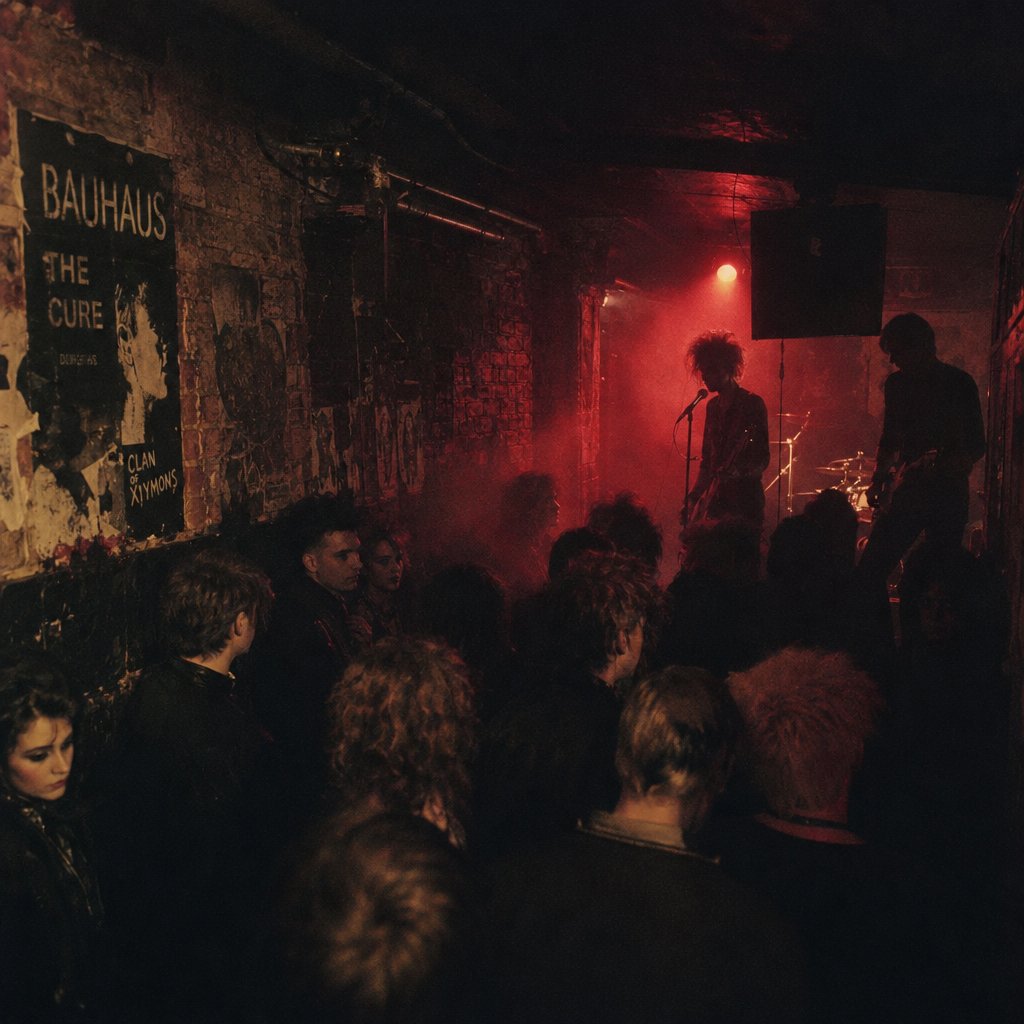
The year was 1979, and post-punk was fracturing into a dozen different directions. Out of that chaos, four musicians from Northampton, England, walked into a studio and recorded a nine-and-a-half-minute track that would accidentally define a genre. Bauhaus's "Bela Lugosi's Dead" arrived fully formed: ominous bassline, spectral guitar, Peter Murphy's foreboding baritone intoning over cavernous reverb. It was a requiem for the actor behind Dracula, and it became the founding document of goth rock.
Sure, David Bowie's glam theatrics and Joy Division's bleak intensity had laid the groundwork. But Bauhaus filtered all of it through gothic horror imagery and a mood that felt genuinely sepulchral. Other goth music bands were circling similar territory. Siouxsie and the Banshees and The Cure were both active in 1979, but they didn't fully commit to the darker sound until 1980 and 1981. Bauhaus got there first.
From Post-Punk Basements to the Batcave
A sound needs a scene, and goth rock found one on Wednesday nights in London's Soho. The Batcave, launched in 1982 by members of the band Specimen, started as a place for friends to play and hang out. It became something much bigger. The first night drew a queue stretching into the next street. Within weeks, the club was a hub for musicians, fashion designers, writers, and anyone drawn to the emerging goth aesthetic of DIY black clothing, dramatic presentation, and a playful relationship with darkness.
The Batcave wasn't just a venue. It was where sound fused with visual identity. Regulars like Siouxsie and the Banshees, the Birthday Party, and Flesh For Lulu rubbed shoulders with figures like Lemmy and Vince Clarke. Traditional goth makeup and teased hair weren't yet a uniform; as Batcave co-founder Sophie Chery recalled, "it was a mishmash of making up clothes" and the look was "quite free." The music spanned new wave, glam, and gothic rock, but the atmosphere was unmistakable. Bauhaus's sonic template, that interplay of dread-soaked bass and shimmering guitar, echoed through every act that took the stage.
The 1980s Golden Era of Gothic Rock
From that Soho basement, 80s goth exploded across the UK and beyond. Here's how the decade's key milestones stacked up:
- 1979 — Bauhaus releases "Bela Lugosi's Dead," establishing the goth rock blueprint. UK Decay's frontman Abbo jokingly coins the term "goth" in a Sounds magazine interview.
- 1980 — Bauhaus drops In The Flat Field, a debut album of precise, monochrome intensity that became a foundational text for the genre.
- 1981 — Siouxsie and the Banshees release Juju, reaching number seven in the UK and proving goth could be both transgressive and commercially viable.
- 1982 — The Cure's Pornography arrives as one of the decade's bleakest records. The Batcave opens in London, giving the scene a physical home.
- 1984 — The Cult's Dreamtime and Cocteau Twins' Treasure push the genre's boundaries toward tribal rhythms and ethereal textures.
- 1985 — The Sisters of Mercy release First and Last and Always, and The Damned's Phantasmagoria brings goth back into the UK Top 40.
- 1987 — Sisters of Mercy's Floodland towers over the scene with Wagnerian ambition, while Fields of the Nephilim's "Preacher Man" adds apocalyptic swagger.
By the late 1980s, goth rock had grown from a handful of post-punk outsiders into a fully realized movement with its own clubs, labels, and a catalog deep enough to reward years of exploration. But what exactly made these records sound the way they did? The answer lives in a very specific set of production choices and sonic signatures that gave the genre its unmistakable voice.
The Signature Sound That Defines Goth Rock
Imagine walking into a stone cathedral at midnight. Every footstep echoes. Every whisper carries. That's the sonic space goth music lives in, and it's not an accident. It's engineered through a very deliberate set of production choices and playing techniques that you can learn to hear once you know what to listen for.
Guitar Tone and the Wall of Reverb
The goth rock guitar doesn't roar. It shimmers, swirls, and cuts. Players like Robert Smith of The Cure and John McGeoch of Siouxsie and the Banshees built their tones around chorus and flanger pedals, creating that unmistakable metallic shimmer that sounds like a guitar playing inside a dream. Layer on long-decay reverb and analog delay, and individual notes bleed into each other, filling the mix with atmosphere rather than aggression.
As GuitarBomb notes, many guitarists in these gothic rock groups favored single-coil pickups on Fender Jaguars and Jazzmasters for their bright, jangly bite, while acts like Fields of the Nephilim reached for Gibson SGs and Les Paul Customs when they wanted more power and drive. The Roland Jazz Chorus JC-120, a solid-state amp with built-in chorus, became a secret weapon. Billy Duffy of The Cult used it in stereo to create a massive wall of sound on tracks like "She Sells Sanctuary."
Then there's the bass. In most rock genres, bass guitar sits in the background, locking in with the drums. In goth rock, it steps forward as a melodic lead instrument. Music journalist Simon Reynolds described the genre's signature as "high-pitched basslines that often usurped the melodic role." Think of Peter Hook's climbing bass lines in Joy Division or the prowling low end on Bauhaus's "Bela Lugosi's Dead," where Daniel Ash's guitar deliberately left space for the bass to carry the song's emotional weight. Space, in this genre, is as important as sound.
Rhythm, Vocals, and Mood
Where punk hammered you with speed and metal gothic music bludgeoned with volume, goth rock chose hypnosis. Drum patterns tend toward the tribal and repetitive, often built on tom-heavy beats that Reynolds called "hypnotically dirgelike." Several iconic gothic music groups leaned heavily on drum machines. The Sisters of Mercy famously replaced a human drummer entirely with a Roland TR-808 they nicknamed "Doktor Avalanche," and the machine's metronomic pulse became inseparable from their identity. Across the Leeds scene, bands like Ghost Dance and The March Violets built entire records around that clunky, mechanical rhythm.
Vocals sit at the other extreme of the frequency spectrum. You'll notice most goth rock singers favor a deep, dramatic baritone delivery, what Reynolds described as "deep, droning alloys of Jim Morrison and Leonard Cohen." Andrew Eldritch, Peter Murphy, Carl McCoy of Fields of the Nephilim: all of them sang from somewhere below the chest, projecting gravity and theatricality without ever tipping into metal's scream. The effect, paired with minor-key melodies and cavernous reverb, is unmistakable.
If you're trying to identify goth rock in the wild, here's your checklist of core sonic elements:
- Flanged and chorused guitar with long-decay reverb and delay
- Prominent, melodic bass lines that lead rather than follow
- Reverb-heavy production creating a cavernous, cathedral-like space
- Deep baritone or dramatically delivered vocals
- Minor-key melodies with a melancholic or brooding character
- Drum machine patterns or tribal, tom-heavy live drumming
Every one of these elements serves the same purpose: building atmosphere. Goth rock doesn't grab you by the collar. It pulls you into a room and lets the walls close in slowly. That atmospheric DNA is exactly what made the genre so fertile, spawning dozens of bands across multiple decades who each interpreted these building blocks in their own way.
Essential Goth Rock Bands and Albums You Need to Hear
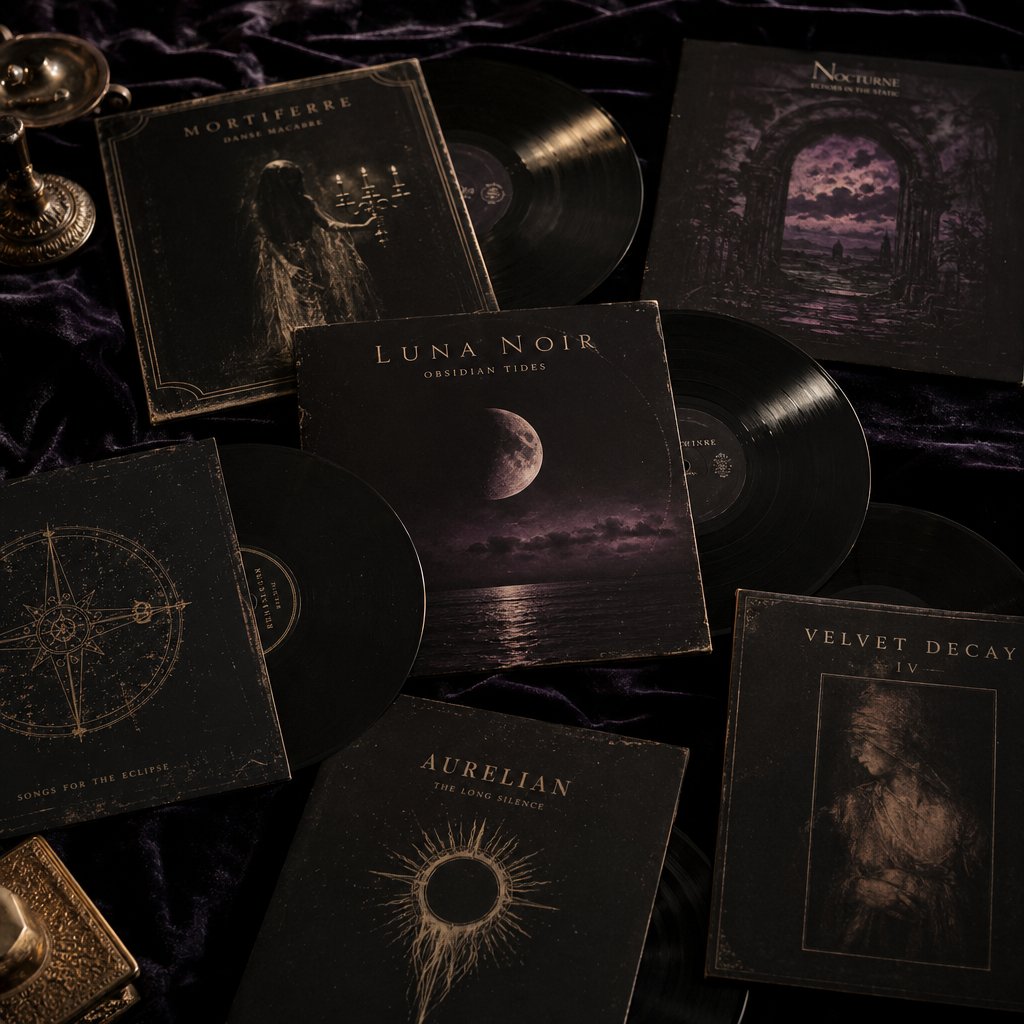
So you can identify the sound. You know the flanged guitar, the melodic bass, the cavernous reverb. The next question is obvious: where do you actually start listening? The genre's catalog runs deep, spanning over four decades and dozens of gothic bands across multiple continents. That depth is a gift, but it can also feel overwhelming. Consider this your discovery launchpad, organized from the essential pillars down to the records that reward deeper digging.
Foundational Acts Every Listener Should Know
Five acts form the bedrock. Each one shaped the genre's DNA in a distinct way, and you'll hear their fingerprints on virtually every 1980s goth record that followed. Here's a quick-reference guide to get oriented:
| Band | Key Album | Signature Sound |
|---|---|---|
| Bauhaus | Mask (1981) | Art-rock theatrics fused with dub rhythms, saxophone, and Daniel Ash's angular guitar. Their sophomore record is arguably their most cohesive, collaborative work. |
| Siouxsie and the Banshees | Juju (1981) | John McGeoch's innovative guitar playing front and center, driving tracks like "Spellbound" with nervous energy and hypnotic precision. |
| The Cure | Pornography (1982) | Relentless, claustrophobic darkness. Pummeling drum machines, distorted strings, thick bass, and dizzying washes of guitar pushed to the absolute extreme. |
| The Sisters of Mercy | Floodland (1987) | Wagnerian ambition meets a drum machine named Doktor Avalanche. Andrew Eldritch's baritone and Jim Steinman's rock opera production created something massive and deliberately over-the-top. |
| Joy Division | Closer (1980) | Martin Hannett's dark production and Ian Curtis's haunted vocals made this the first gothic masterpiece, a somber, synthesizer-laced farewell that cast a long shadow over everything that followed. |
Joy Division's inclusion sometimes sparks debate. They predated the goth label and never identified with it. But Closer, released two months after Ian Curtis's death, essentially wrote the emotional playbook: insular, mournful, and heavy with atmosphere. As Post-Punk.com put it, the record's darker shade of production cemented its place as "the first gothic masterpiece." Without it, the genre's trajectory looks very different.
Deep Cuts and Underrated Goth Rock Albums
Here's where casual listeners usually stop, and that's a shame. The genre's real richness lives beyond the five names everyone recognizes. Bands like The Chameleons built records so influential that their debut Script of the Bridge (1983) has been called a "forever favorite across multiple genres" that influenced almost every band in its wake. Clan of Xymox took 4AD by storm with a club-minded shade of The Cure's gloom, peaking on Medusa (1986) with shimmering guitars and synth textures that still give listeners chills. Fields of the Nephilim blended equal parts Pink Floyd, Black Sabbath, and Johnny Cash into a tribal goth sound drenched in desert dust and occult imagery. And Christian Death's Catastrophe Ballet (1984) pushed the goth punk origins of their earlier work into starker, more surreal territory, bridging raw West Coast deathrock with something more cinematic.
These aren't obscure for the sake of obscurity. They're records that expanded what the genre could be. If you're ready to go beyond the starter pack, here's a listening path worth following:
- Script of the Bridge — The Chameleons (1983): Dual-guitar atmospherics and world-weary paranoia that bridges post-punk and goth seamlessly
- Medusa — Clan of Xymox (1986): Warm synths, ambient interludes, and some of the era's most masterful darkwave-adjacent songwriting
- The Nephilim — Fields of the Nephilim (1988): Psychedelic, metal-tinged gothic rock recorded in a former courthouse where prisoners were once sentenced to hang
- Catastrophe Ballet — Christian Death (1984): The bridge between LA deathrock's raw fury and goth's more atmospheric ambitions
- Talk About the Weather — Red Lorry Yellow Lorry (1985): Pummeling drums, throbbing guitars, and monotone vocals from the Leeds scene that deserves as much credit as the Sisters of Mercy
- Virus Meadow — And Also the Trees (1986): Haunting, pastoral, and drenched in folklore, like Scott Walker fronting a post-punk band
- Pop — Tones on Tail (1984): Daniel Ash and Kevin Haskins's post-Bauhaus project, incorporating minimal electronics and experimental textures
What you'll notice exploring these records is how much variety hides under one genre label. Some lean toward white goth etherealism, others toward goth punk aggression, and still others toward psychedelia or industrial noise. That internal diversity isn't a weakness. It's what kept the genre alive and evolving, eventually splitting into a web of subgenres that each carried a different piece of the original DNA forward. Those subgenres, and how to tell them apart, deserve a map of their own. Much like the way grunge define itself against its predecessors, each goth offshoot carved out identity by emphasizing different elements of the same dark foundation.
Mapping the Goth Subgenres from Deathrock to Darkwave
That internal variety you just heard across those albums? It eventually crystallized into distinct subgenres, each one pulling different elements of gothic genre DNA in its own direction. Think of rock goth music not as a single road but as a roundabout with multiple exits. Every offshoot shares the same dark center, but the destinations sound remarkably different.
Goth Rock and Its Direct Descendants
Goth rock itself is the trunk of the tree: guitar-driven, reverb-soaked, bass-forward, rooted in the goth 80 sound of Bauhaus and Sisters of Mercy. Every subgenre below grew from that trunk, but each one bent toward a different light source.
Deathrock split off early and stayed close to punk. Originating on the West Coast of the US through acts like Christian Death and 45 Grave, it kept the raw energy and DIY ethos of hardcore while wrapping it in horror-film imagery and lo-fi production. If goth rock sounds like a cathedral, deathrock sounds like a haunted basement show.
Darkwave moved in the opposite direction, trading guitars for synthesizers and drum machines. Emerging in Europe alongside goth rock, it embraced slower tempos, lower pitches, and minor-key melancholy filtered through electronic textures. Clan of Xymox, Depeche Mode, and later She Past Away all occupy this space, where the mood stays dark but the instrumentation goes digital.
Ethereal wave took the reverb and ran with it into dreamier territory. Imagine layered, often wordless female vocals floating over shimmering guitar washes and ambient textures. Cocteau Twins and Dead Can Dance pioneered this sound, and it became the go-to style for anyone who wanted goth's atmosphere without its brooding weight. Every goth girl playlist on streaming platforms leans heavily on this subgenre, whether listeners realize it or not.
Coldwave carved out its own niche in France during the early 1980s. Minimal, synth-driven, and deliberately austere, it drew from the same post-punk roots but filtered them through a distinctly French sensibility. Bands like Clair Obscur and Opera Multi Steel described their music as new wave noire, and the stripped-back production gave it a colder, more detached feel than its British counterparts.
Where Gothic Metal and Industrial Goth Diverge
Two other branches deserve attention because they're the ones most often confused with goth rock proper. Gothic metal fuses goth's brooding atmosphere with heavy metal's distorted guitars, double-kick drumming, and operatic vocal arrangements. Think Type O Negative or Paradise Lost: the mood is unmistakably dark, but the volume and aggression come from a completely different lineage. Any band gothic rock fan will tell you the two genres feel different in a live setting, even when the aesthetics overlap.
Industrial goth, meanwhile, swaps organic instruments for harsh electronic textures, mechanical rhythms, and abrasive production. Acts like Skinny Puppy and early Nine Inch Nails built their sound on sequencers and samplers rather than guitar amps. The elements of gothic genre atmosphere are still present, the darkness, the drama, the introspection, but the delivery mechanism is fundamentally electronic and often confrontational.
Here's a reference table to keep these distinctions straight:
| Subgenre | Key Characteristics | Representative Acts |
|---|---|---|
| Goth Rock | Flanged guitar, melodic bass, reverb-heavy production, baritone vocals, post-punk song structures | Bauhaus, Sisters of Mercy, The Cure |
| Deathrock | Raw, punk-adjacent energy, horror imagery, lo-fi production, West Coast US origins | Christian Death, 45 Grave, Kommunity FK |
| Darkwave | Synth-driven, slower tempos, minor-key electronic melancholy, drum machines | Clan of Xymox, She Past Away, The Frozen Autumn |
| Ethereal Wave | Dreamy reverb-soaked guitars, layered or wordless vocals, ambient textures | Cocteau Twins, Dead Can Dance, Lycia |
| Coldwave | Minimal synths, austere production, French-influenced, detached vocal delivery | Clair Obscur, Opera Multi Steel, Trisomie 21 |
| Gothic Metal | Heavy distortion, double-kick drums, operatic vocals, orchestral arrangements fused with dark atmosphere | Type O Negative, Paradise Lost, Lacrimosa |
| Industrial Goth | Harsh electronic textures, mechanical rhythms, sequencer-driven, abrasive and confrontational | Skinny Puppy, KMFDM, London After Midnight |
Keep in mind that these categories overlap constantly. Clan of Xymox started as darkwave but released records that sound like pure goth rock. Fields of the Nephilim flirted with gothic metal years before the term existed. The boundaries here are guides, not walls, and the best bands have always ignored them. That fluidity is part of what makes navigating the genre so rewarding, and so confusing for outsiders who lump everything dark into a single box. The most common confusion of all? Mixing up goth with emo and punk, three scenes that share roots but grew into very different things.
What's the Difference Between Goth and Emo and Punk?
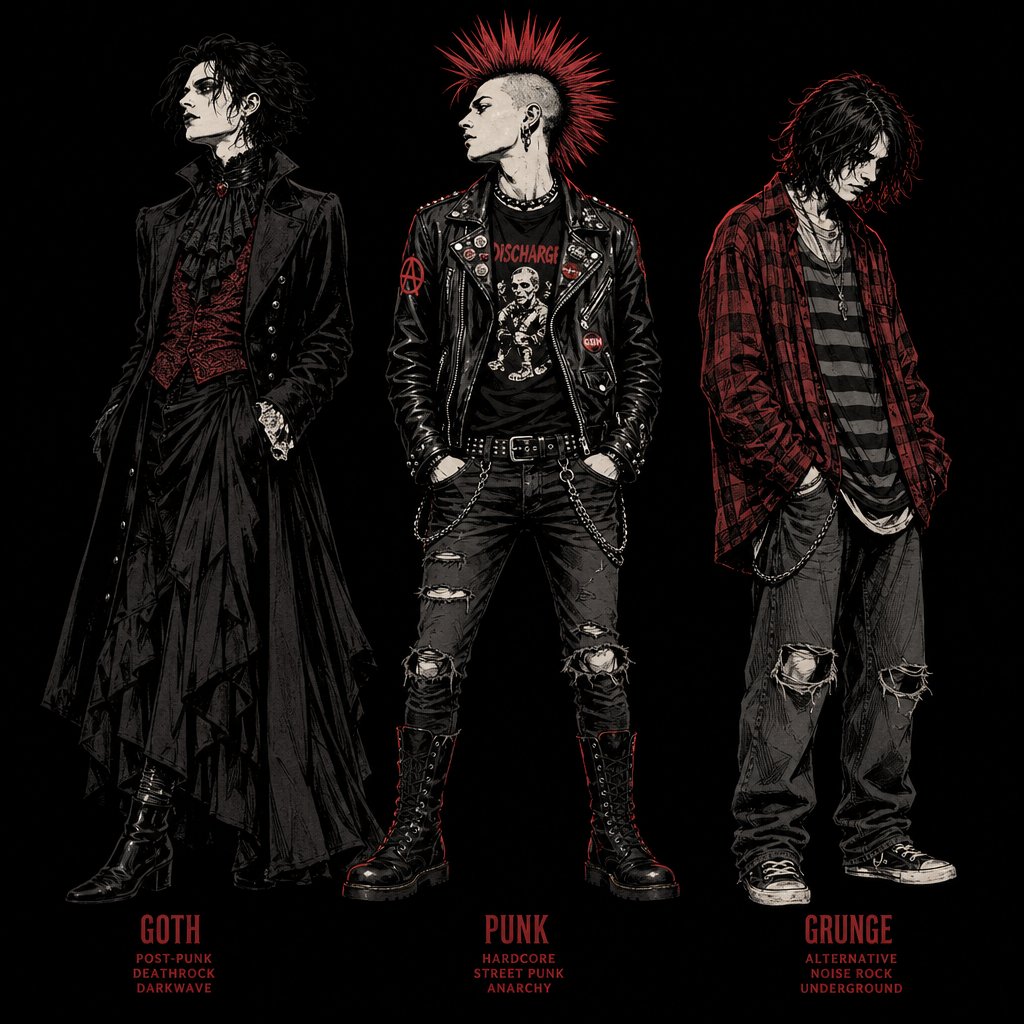
It's one of the most searched questions in music: what's the difference between goth and emo? Throw punk into the mix and the confusion triples. All three scenes wear black, all three emerged from the same post-punk soil, and all three have been lumped together by everyone from concerned parents to fast-fashion retailers. But spend five minutes listening to each, and the difference between goth and emo becomes impossible to miss.
Shared Roots but Different Branches
Goth and punk both grew out of the UK's late-1970s post-punk explosion. They share DNA: non-conformity, DIY ethos, and a rejection of mainstream culture. But they diverged almost immediately in sound and intent. Punk stayed raw, fast, and politically charged. As The Collector notes, punk drew its energy from "an anti-establishment political and societal base of the working class," channeling anger into three-chord aggression and slogans like "No Future." Goth took the opposite exit. It leaned into atmosphere, reverb, and literary darkness, pulling inspiration from romantic poetry, horror cinema, and Victorian aesthetics rather than political manifestos. Where punk wanted to tear the system down, goth wanted to explore the cave pit hall dark and darker corners of human emotion and mythology.
Why Goth and Emo Are Not the Same Thing
Emo didn't even come from the same scene. It emerged from the Washington, DC hardcore punk community in the mid-1980s, when bands like Rites of Spring and Embrace turned away from outward aggression and toward emotionally charged, confessional lyrics. The term "emotional hardcore" was born, shortened to emo, and the musicians who received the label mostly hated it. Embrace's members reportedly called the moniker "the stupidest thing" they'd ever heard.
Emo evolved through the 1990s into midwest emo, screamo, and eventually the pop-punk-inflected mainstream wave of the 2000s driven by My Chemical Romance and Fall Out Boy. Goth rock, meanwhile, was busy spawning darkwave, ethereal wave, and goth zombie songs about vampires and the undead. The lyrical worlds barely overlap: emo turns inward toward personal heartbreak and vulnerability, while goth looks outward toward death, the supernatural, and existential dread.
Here's a side-by-side breakdown to make the distinctions concrete:
| Goth Rock | Emo | Punk | |
|---|---|---|---|
| Musical Roots | UK post-punk (late 1970s) | DC hardcore punk (mid-1980s) | UK proto-punk and pub rock (mid-1970s) |
| Typical Sound | Reverb-heavy guitars, melodic bass, baritone vocals, drum machines | Dynamic shifts between quiet and loud, confessional vocal delivery, jangly or distorted guitars | Fast, raw, three-chord guitar, shouted vocals, minimal production |
| Lyrical Themes | Death, the supernatural, dark romanticism, existential introspection | Personal heartbreak, emotional vulnerability, self-reflection, relationships | Political dissent, anti-establishment anger, class struggle, social commentary |
| Key Bands | Bauhaus, Sisters of Mercy, Siouxsie and the Banshees | Rites of Spring, American Football, Sunny Day Real Estate | Sex Pistols, The Clash, Dead Kennedys |
The confusion is understandable. By the 2000s, mainstream fashion had blurred these lines almost beyond recognition, with Hot Topic selling goth, punk, and emo aesthetics side by side as if they were interchangeable. They're not. The music tells you everything you need to know, and it tells three very different stories.
What's encouraging is that all three scenes continue to evolve. And for goth rock specifically, the story didn't end in the 1980s. A new generation of artists is carrying the genre's sonic blueprint into entirely fresh territory, often reaching listeners who've never set foot in a club or flipped through a zine.
The Modern Goth Rock Revival You Should Know About
That new generation isn't hypothetical. It's already here, and it's global. While the original wave of rock gothic bands was concentrated in the UK and parts of Western Europe, the modern revival draws from Turkey, Belarus, Mexico, Greece, and beyond. These artists grew up absorbing the classic post-punk and goth rock canon, and they're filtering it through their own languages, cultures, and production tools in ways the Batcave generation never could have predicted.
The New Wave of Goth Rock Acts
She Past Away, formed in Bursa, Turkey in 2006, might be the revival's most important act. Volkan Caner sings entirely in Turkish over driving basslines and cold, reverb-drenched guitar, drawing direct comparisons to Joy Division and Sisters of Mercy while sounding like neither. Their debut album Belirdi Gece (2012) became a reference point for the modern darkwave and goth rock underground, and Disko Anksiyete (2019) proved they could push genre boundaries without losing their identity.
Twin Tribes, a duo from Brownsville, Texas, channel The Cure and Depeche Mode through a distinctly Latin American lens, incorporating influences from bands like Caifanes and Soda Stereo. Their single "Fantasmas" racked up over a million YouTube views, and their use of vintage synths like the Roland JX-3P gives their recordings an analog warmth that connects directly to the 80s template.
Drab Majesty, the Los Angeles project of Andrew Clinco, leans into a Cure-like alien stage persona and dreamlike synth textures that blur the line between goth rock and ethereal wave. Albums like The Demonstration and Modern Mirror earned the project a dedicated global following and festival slots alongside legacy acts.
Lebanon Hanover, the duo of Larissa Iceglass and William Maybelline, strip everything back to minimal arrangements, cold drum machines, and understated vocals. Their album Let Them Be Alien captures that stark, introspective quality that made punk goth's original minimalists so compelling. And Molchat Doma, a trio from Minsk, Belarus, broke through when their track "Sudno (Boris Ryzhy)" from the album Etazhispread rapidly across streaming platforms and social media, turning Soviet-era post-punk aesthetics into a global phenomenon almost overnight.
Streaming and Social Media as Goth Rock's New Underground
That Molchat Doma story is telling. The old discovery pipeline, zines, record shops, club nights, word of mouth, hasn't disappeared, but it's been supplemented by something far more powerful. TikTok videos tagged with goth aesthetics routinely pull millions of views, introducing classic and contemporary tracks to audiences who've never heard of the Batcave. Spotify's algorithmic playlists funnel listeners from a single She Past Away track into rabbit holes spanning darkwave, coldwave, and ethereal wave. YouTube channels dedicated to curating dark music function as the modern equivalent of a trusted record store clerk, building communities around taste rather than geography.
The result is a scene that's more internationally connected than goth rock has ever been. A band from Istanbul can build a European touring circuit through Bandcamp sales and Instagram engagement. A bedroom producer in Santiago can reach the same listeners as an established act in London. The gatekeeping that once defined underground scenes hasn't vanished entirely, but the barriers to entry are lower than they've ever been.
Here are key modern acts worth exploring, each bringing something distinct to the revival:
- She Past Away — Turkish-language goth rock with cold, driving basslines and post-punk intensity
- Twin Tribes — Synth-heavy darkwave from Texas with Latin American rock influences
- Drab Majesty — Dreamy, theatrical synth-goth from Los Angeles with a strong visual identity
- Lebanon Hanover — Minimal, stark coldwave built on drum machines and understated vocals
- Molchat Doma — Belarusian post-punk with Soviet-era synth aesthetics and viral reach
- Selofan — Greek dark wave duo blending analog synths, poetry, and theatrical performance
- Actors — Vancouver-based post-punk with polished production and strong melodic hooks
- Bootblacks — New York guitar-driven post-punk fused with darkwave electronics
What connects all of these artists isn't just a shared palette of reverb and minor keys. It's the proof that goth rock's sonic DNA is adaptable enough to thrive in any cultural context, in any language, on any platform. And that adaptability hasn't just kept the genre alive within its own borders. It's sent ripples outward into mainstream rock, metal, electronic music, and scenes that would never call themselves goth but owe the genre more than they'd probably admit.
How Goth Rock Shaped Music Beyond the Scene
Those ripples aren't subtle. Goth rock's atmospheric DNA has seeped into genres that, on the surface, seem to have nothing in common with Bauhaus or Sisters of Mercy. But listen closely to a shoegaze record, a grunge album, or a 2000s post-punk revival track, and you'll hear the same reverb-soaked, bass-forward, mood-first philosophy that defined the goth music genre from the start. The influence lines are specific, traceable, and far more pervasive than most music histories acknowledge.
Goth Rock's Fingerprints on Mainstream Music
Start with shoegaze. The genre's signature wall of guitar texture owes a direct debt to goth rock's love of chorus, flange, and cavernous reverb. Cocteau Twins, who straddled both worlds, were a bridge between ethereal goth and the layered noise of My Bloody Valentine's Loveless. As VICE noted, shoegaze itself was an offshoot of late-70s and early-80s new wave blended with emerging goth rock, and that fusion, when paired with straightforward rock, shaped an entire era of 90s alternative music. Without goth rock bands building that atmospheric template first, shoegaze's sonic vocabulary would have been far thinner.
The heaviness traveled a different route. Gothic metal acts like Type O Negative and Paradise Lost took goth's brooding mood and married it to distorted power chords and double-kick drumming. Nu-metal bands like Deftones absorbed that same darkness more indirectly, filtering it through layers of industrial goth texture and ambient space. Meanwhile, the electronic side of the family tree fed directly into synthwave and modern darkwave, genres that essentially rebuilt goth's emotional architecture using digital tools. Even the haunting cadence of "Bela Lugosi's Dead" lyrics continues to echo through ambient and electronic producers who sample or reference its atmosphere decades later.
From Grunge to the Post-Punk Revival
Grunge's relationship with goth is one of those open secrets nobody talks about enough. Bands like Alice in Chains and Soundgarden channeled the same brooding intensity and minor-key melancholy that goth rock perfected a decade earlier. The Smashing Pumpkins leaned even harder into it, with Billy Corgan openly citing Siouxsie and the Banshees and The Cure as formative influences. Grunge stripped away the theatricality but kept the emotional weight.
Then came the post-punk revival of the early 2000s, which didn't just borrow from goth rock. It went back to the source material and rebuilt from the ground up. Interpol's Turn on the Bright Lights (2002) sounded like Joy Division's Closer filtered through a Manhattan loft. Editors built their early records on the same driving basslines and baritone vocals that defined Sisters of Mercy. She Wants Revenge made the debt even more explicit, essentially updating goth rock's sonic palette for an indie-rock audience that had never heard the originals.
Here's a map of the key influence pathways, each with specific goth rock bands and the genres they shaped:
- Goth rock into shoegaze: Cocteau Twins and Siouxsie and the Banshees influenced My Bloody Valentine, Slowdive, and Ride's layered guitar atmospherics
- Goth rock into grunge: The Cure and Joy Division's emotional darkness fed into Alice in Chains, Smashing Pumpkins, and Soundgarden's brooding intensity
- Goth rock into gothic metal: Bauhaus and Fields of the Nephilim's heaviness evolved through Type O Negative, Paradise Lost, and Lacrimosa
- Goth rock into post-punk revival: Sisters of Mercy and Joy Division's templates were directly revisited by Interpol, Editors, and She Wants Revenge
- Goth rock into synthwave and darkwave: The electronic side of Clan of Xymox and Depeche Mode's crossover work shaped Perturbator, Carpenter Brut, and Cold Cave
- Industrial goth into alternative and electronic: Skinny Puppy and early Nine Inch Nails carried goth's confrontational edge into mainstream industrial rock and later electronic acts
What this map reveals is that goth rock was never the dead-end niche its critics claimed. It was a launchpad. Every genre it touched absorbed something different: shoegaze took the reverb, grunge took the mood, metal took the weight, and electronic music took the darkness. The original scene may have peaked in the 1980s, but its creative influence is still compounding. And for anyone inspired by that influence, whether as a listener or a creator, the question becomes practical: where do you go from here?
How to Explore and Create Your Own Rock Goth Music
Whether you've been nodding along since the Bauhaus chapter or just skipped straight here, the answer to "where do I go from here" splits into two paths: listen deeper, or start making something yourself. Both are more accessible than they've ever been.
Building Your Rock Goth Music Playlist
The genre's catalog spans over four decades and multiple goth music genres, so a structured approach saves you from drowning in reverb. Start with the foundations, branch into the subgenres that grab you, then follow the thread into the modern revival. Here's a listening path organized by era and style to keep things manageable:
- Start here (classic gothic rock): Bauhaus — "Bela Lugosi's Dead," Siouxsie and the Banshees — "Spellbound," The Cure — "A Forest," Sisters of Mercy — "Temple of Love"
- Go darker (deathrock and gothic and punk roots): Christian Death — "Romeo's Distress," 45 Grave — "Party Time," Kommunity FK — "Something Inside Me Has Died"
- Go electronic (darkwave and coldwave): Clan of Xymox — "A Day," Trisomie 21 — "The Last Song," The Frozen Autumn — "Pale Awakening"
- Go dreamy (ethereal wave): Cocteau Twins — "Cherry-Coloured Funk," Dead Can Dance — "The Host of Seraphim," Lycia — "Pray"
- Go heavy (gothic metal and metal gothique): Type O Negative — "Black No. 1," Paradise Lost — "Gothic," Lacrimosa — "Alleine zu Zweit"
- Go modern (revival acts): She Past Away — "Rituel," Twin Tribes — "Fantasmas," Drab Majesty — "Ellipsis," Molchat Doma — "Sudno"
You'll notice that goth artists across every era share a common emotional vocabulary even when their instruments differ. That's the thread worth following. Let your ears guide you from one subgenre to the next rather than trying to absorb everything at once. Plenty of goth girls and guys discovered their favorite bands by chasing a single track down a Spotify rabbit hole, and that's a perfectly valid way in.
Creating Your Own Goth Rock Tracks
Listening eventually sparks the urge to create. Maybe you want to write a brooding gothic rock track with that signature flanged guitar and cavernous reverb. Maybe you just want to hear what your lyrics sound like draped over a dark, driving bassline. Either way, the barrier to entry has collapsed.
If you're picking up a guitar, start with the basics: a chorus pedal, a long-decay reverb, and a clean amp. Tune down a half step if you want that extra weight. Practice playing bass lines that carry melody rather than just root notes. Study how goth artists like Daniel Ash and Robert Smith used space and restraint rather than speed and complexity.
If you want to experiment before investing in gear, tools like MakeBestMusic's AI Song Generator let you input a mood, era, or genre description and generate an original royalty-free track in seconds. Type in something like "dark 1980s goth rock with driving bass and reverb guitar" and you'll get a starting point you can study, remix, or use as a backing track for your own vocals. It's a low-barrier way to explore goth rock composition without needing a full studio setup, and it's genuinely useful for understanding how different production choices shape the genre's atmosphere.
The deeper truth is that rock goth music was never meant to be a museum piece. From the Batcave to Bandcamp, from post-punk basements to AI-assisted bedrooms, the genre has always rewarded people who showed up and made something. The darkness is there. The tools are there. The only thing missing is you.
