


What Are Dynamics in Music and Why They Matter
Imagine listening to someone tell a gripping story in a completely flat, unchanging voice. No whispers during the suspenseful parts, no raised voice at the climax. You'd lose interest fast. Music works the same way, and the element that prevents that flatness is called dynamics.
Dynamics in music refer to the variation of loudness and softness within a performance or composition. They indicate how quietly or powerfully a note, phrase, or passage should be played, shaping the emotional intensity of the music.
It's easy to confuse dynamics with related concepts. Tempo controls speed. Timbre describes tonal color — the quality that makes a flute sound different from a trumpet on the same note. Dynamics, on the other hand, govern volume and the expressive energy behind it. Together, these elements form the full picture of musical expression, but dynamics carry a unique weight: they're what make a listener lean in during a hushed music pianissimo passage or feel a physical jolt when the orchestra erupts.
Defining Dynamics Beyond Simple Volume
Dynamics go deeper than simply playing loud or soft. They encompass the intent, energy, and emotion a performer channels into every volume choice. A gentle piano marking isn't just "quiet" — it might mean tender, fragile, or distant, depending on context. Pair that with a staccato p direction, and the character shifts again: now those soft notes are also short and detached, creating an entirely different mood.
You'll notice that most dynamic markings — piano, forte, mezzo, crescendo — are Italian. That's no accident. Italy was the birthplace of opera, staff notation, and many foundational musical forms. As these innovations spread across Europe, Italian became the universal language of musical notation, and it remains so today. When you see dynamic markings on a score, you're reading a vocabulary that connects you to centuries of tradition.
Why Dynamics Are the Soul of Musical Expression
Think back to that monotone storyteller. A speech delivered with vocal variety — soft urgency here, a powerful declaration there — holds your attention and moves you emotionally. Dynamics do exactly this for music. They interact with articulation, phrasing, and tempo to build tension, deliver release, and guide a listener's emotional journey from the first note to the last. The expressive vocabulary they create is the opposite word of concise — it's vast, layered, and endlessly nuanced.
This article covers the full scope of that vocabulary: every standard dynamic marking and symbol, how graduated changes like crescendos and decrescendos work, how different instrument families produce dynamic contrast, and how dynamics function across genres from classical to electronic. Whether you're decoding your first set of dynamic markings or refining how you interpret "very" in music notation — where terms like pianissimo literally mean "very soft" and fortissimo means "very loud" — you'll find a complete reference ahead.
Every Dynamic Marking and Symbol Explained
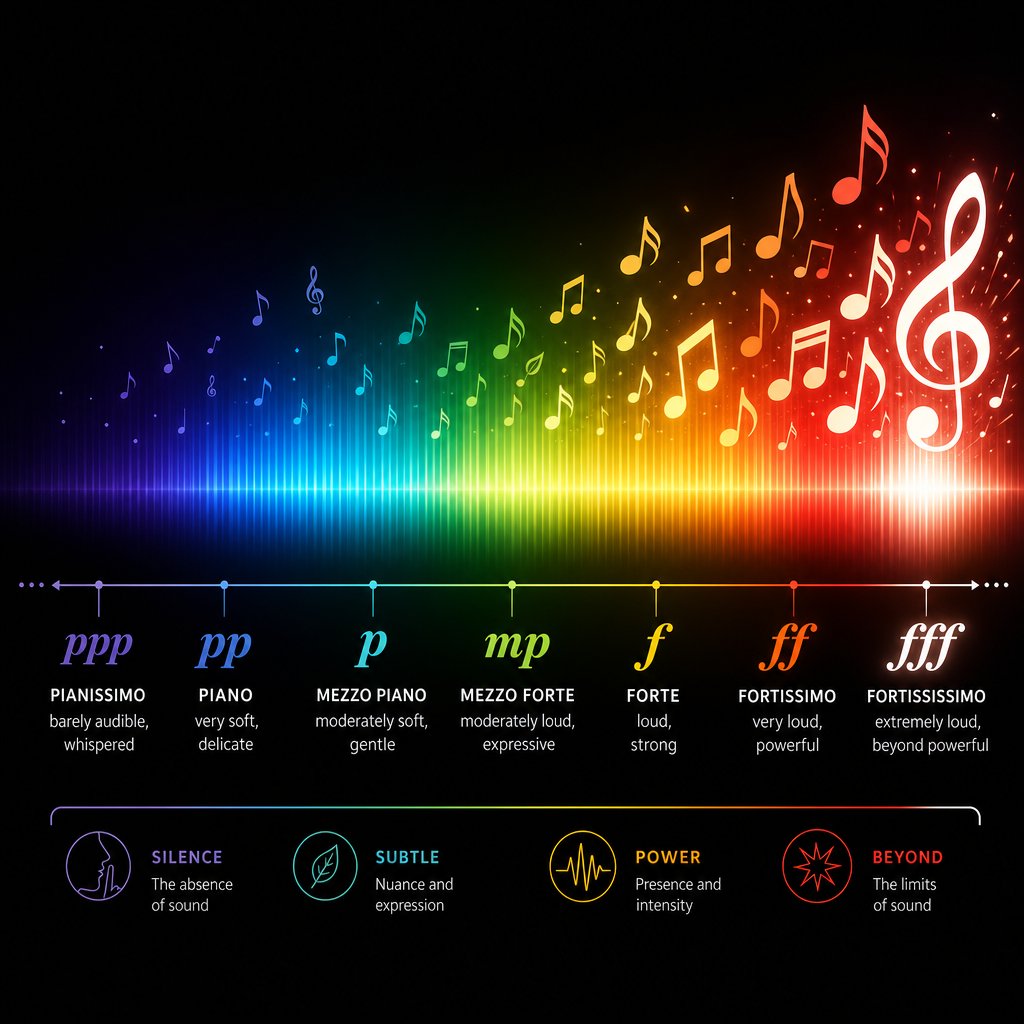
A complete vocabulary demands a complete reference. The table below covers every standard dynamic level you'll encounter on a score — from the barely audible to the overwhelmingly powerful. Bookmark it. You'll come back to it.
| Symbol | Italian Term | English Meaning | Approximate Volume Description |
|---|---|---|---|
| pppp | Pianissississimo | As soft as possible | Near-silent; a whisper of tone, barely perceptible |
| ppp | Pianississimo | Very, very soft | Extremely quiet but still musically controlled |
| pp | Pianissimo | Very soft | Noticeably quiet; hushed and delicate |
| p | Piano | Soft | Gentle and restrained, the standard "quiet" level |
| mp | Mezzo piano | Moderately soft | Soft with a touch of warmth; slightly held back |
| mf | Mezzo forte | Moderately loud | Moderate strength; conversational volume |
| f | Forte | Loud | Strong and confident; the standard "loud" level |
| ff | Fortissimo | Very loud | Powerful and commanding; full force |
| fff | Fortississimo | Very, very loud | As forcefully as possible while maintaining musical tone |
| ffff | Fortissississimo | As loud as possible | Overwhelming volume; sheer sonic force |
Standard Dynamic Levels from Pianissimo to Fortissimo
The core of everyday notation lives in six markings: pp, p, mp, mf, f, and ff. These are the f and p levels that appear in virtually every piece of written music, and understanding them is the first step toward being able to define forte music or any other dynamic term on sight.
Here's the critical point most resources skip: these markings are relative, not absolute. A mf played by a solo flute in a recital hall is a completely different absolute volume than mf played by a full orchestral tutti. A tuba at mp will likely overpower a guitar at f. Even low bass notes on a score marked p can carry surprising presence because of how low frequencies project in a room. Context — the instrument, the ensemble, the acoustic space — shapes what each marking actually sounds like in practice. As noted in standard music theory references, dynamic markings always require interpretation by the performer depending on the musical context.
This relative nature is also why dynamics shouldn't be confused with tempo. When someone asks "what is tempo in music," the answer involves speed and pace — beats per minute. Dynamics operate on a completely separate axis: energy and volume. A passage can be slow and loud, fast and soft, or any combination. The two elements are independent, even though they often work together to shape expression.
Extreme Dynamics Most Musicians Overlook
Beyond the standard six, composers have pushed the boundaries with markings like ppp, pppp, fff, and ffff — and sometimes far beyond. These extremes appear most often in Romantic and modern orchestral scores, where large ensembles make such ranges physically achievable. The opposite word of dynamic might be "static" or "flat," and these extreme markings exist precisely to prevent that — to stretch the expressive range as far as human performance allows.
Real compositional examples bring these extremes to life:
- Tchaikovsky's Pathetique Symphony — contains a bassoon solo marked pppppp (six p's), one of the softest markings in the standard orchestral repertoire.
- Holst's The Planets — uses ffff in both "Mars" and "Uranus," often punctuated by organ to achieve overwhelming force.
- Rachmaninoff's Prelude in C-sharp minor — features sffff, combining a sudden sforzando accent with quadruple forte.
- Mahler's Seventh Symphony — marks the celli and basses at fffff (five f's) with a footnote directing players to pluck so hard the strings strike the wood.
- Ligeti's Cello Concerto — opens with a passage marked pppppppp (eight p's), pushing the boundary of audible sound.
These aren't gimmicks. As orchestration specialists point out, extreme markings carry real consequences for performers — at ffff, timbral control and note shaping are sacrificed for sheer volume, while pppp demands extraordinary restraint where the instrument's tone nearly dissolves. Composers deploy them sparingly and intentionally, which is exactly what gives them their dramatic impact.
Reading the Forte and Piano Symbol System
The entire system follows a simple, stackable logic. Once you understand four building blocks, you can decode any dynamic marking you encounter:
- p = piano (soft)
- f = forte (loud)
- m = mezzo (moderately)
- Stacking letters = intensifying the marking
So pp (pianissimo) means "very soft" — literally doubling the softness. ff (fortissimo) means "very loud." Add another letter and you get ppp or fff, pushing further in each direction. The prefix m moderates: mp is moderately soft, mf is moderately loud. That's the entire decoding key.
This same Italian logic extends to gradual changes. The crescendo symbol — an opening hairpin wedge — tells you to get louder, while its mirror image signals a decrescendo. Text instructions like cresc. and dim. do the same job over longer passages. And when you see poco a poco before either term, the poco a poco meaning is "little by little" — a gradual, measured shift rather than a quick one.
With this decoding system in hand, every marking on a page becomes readable. But some of the most dramatic moments in music don't come from gradual shifts at all — they come from sudden, explosive changes that catch the listener completely off guard.
Accent Marks and Sudden Dynamic Changes
Those sudden, explosive moments — a single chord that hits like a thunderclap in an otherwise quiet passage — rely on a specialized set of markings that many musicians gloss over. If you've ever seen sfz, fp, or rfz on a score and felt unsure how they differ, you're not alone. These are among what are some difficult music notes to learn, not because they're hard to play physically, but because the distinctions between them are subtle and context-dependent.
Sforzando, Fortepiano, and Rinforzando Decoded
Each of these markings creates a different kind of surprise within a musical phrase. A sforzando isn't the same as simply playing loud, and a fortepiano isn't just "pick one." As pianist Robert Estrin explains, forte means loud throughout, while sforzando is a strong attack that fades away — and fortepiano sits between the two, delivering a loud onset followed by an immediate drop to soft. These differences matter enormously in performance, even when they're easy to miss on the page.
The table below lays out each sudden-change marking side by side so you can compare them at a glance — a useful reference to keep next to your music sheet music stand.
| Symbol | Italian Term | English Meaning | Performance Difference |
|---|---|---|---|
| sfz | Sforzando | Sudden strong accent | Sharp, forceful attack on a single note or chord; volume drops immediately after |
| fp | Fortepiano | Loud, then immediately soft | Sustained forte attack followed by a quick drop to piano; the note continues softly |
| sfp | Sforzando piano | Accented, then immediately soft | Similar to fp but with a sharper, more percussive initial attack |
| rfz | Rinforzando | Reinforced accent | A reinforced emphasis, often applied across a short phrase rather than a single note |
| fz | Forzando | Forced emphasis | A forced, accented note — slightly less explosive than sfz, more weighted than a standard accent |
| mfp | Mezzo forte piano | Moderately loud, then soft | A gentler version of fp; the initial attack is moderate rather than full forte |
These markings create dramatic punctuation — moments of surprise that interrupt the prevailing dynamic level and jolt the listener's attention. Composers use them the way a screenwriter uses a plot twist: sparingly, and for maximum effect.
Marcato, Tenuto, and Other Accent Types
Here's where confusion often creeps in. Sudden-change markings like the forte symbol sfz operate at the dynamic level — they override the current volume for a moment. Accent marks, on the other hand, modify individual notes within an existing dynamic level. You can play a marcato accent at pp just as easily as at ff. The accent adds emphasis relative to the surrounding notes, not relative to an absolute volume — think of it as a volume synonym for "stress" rather than "loudness."
Each accent type calls for a distinct performance approach. As violin pedagogue Meghan Faw details, accents can be created through volume, length, articulation, or even vibrato — and each type demands a different technique:
- Marcato (^) — The strongest standard accent. A wedge-shaped symbol above or below the note indicating heavy, forceful emphasis at the very start of the note. On strings, this means digging the bow into the string with fast bow speed.
- Standard accent (>) — Moderate stress. The note is played louder than its neighbors but without the aggressive bite of marcato. Achieved primarily through increased bow speed or air support.
- Tenuto (—) — A horizontal line above or below the note meaning "hold for its full value." This is an accent of length rather than volume — the note is sustained and given its complete rhythmic weight, often with a slight lean.
- Staccatissimo (▲) — The opposite of tenuto. A triangular dot indicating the note should be played as short as possible, creating emphasis through extreme brevity.
Students frequently conflate sforzando and marcato, but the distinction is clear once you hear it. Sforzando is a dynamic event — a sudden spike in volume that overrides the current level. Marcato is an articulation event — a strong emphasis at the beginning of a note that stays within the prevailing dynamic. A sforzando in a piano passage will momentarily sound forte; a marcato in a piano passage will still sound soft, just with a sharper edge. While timbre in music means the tonal color or quality of a sound, these accent types shape something different: the attack and weight of individual notes, adding rhythmic and expressive contour to a phrase.
Mastering these markings gives you a vocabulary for the moment-to-moment drama within a phrase. But music's emotional arc doesn't live only in sudden jolts — it also unfolds through slow, sweeping changes that carry a listener gradually from one intensity to another.
Crescendo, Decrescendo, and Hairpin Notation Mastered
Sudden accents and sforzandos deliver instant drama, but the slow burn of a crescendo building across eight measures — or the quiet ache of a passage fading to nothing — is where music and dynamics become truly cinematic. These graduated changes are the connective tissue between dynamic levels, and reading them correctly is essential to understanding what is dynamics of music in practice, not just in theory.
Hairpin Notation and How to Read It
You'll encounter graduated dynamic changes in two visual forms on a score. The first is the hairpin — a pair of angled lines that open or close like a wedge. An opening wedge (lines spreading apart from left to right) signals a crescendo: get louder. A closing wedge (lines converging from left to right) signals a decrescendo: lower volume gradually. These symbols are placed below the staff, and their physical length on the page tells you exactly how long the change should last.
The second form is a written text instruction — cresc., dim., or decresc. — often followed by a dashed line showing the span of the change. Here's the practical distinction most resources miss: hairpins typically indicate shorter, more localized changes lasting a beat or a few bars, while text instructions like cresc. with dashes tend to govern longer passages that may stretch across multiple lines or even pages. As standard notation references confirm, hairpins denote dynamic changes over a short duration, whereas word directions can extend with dashes to indicate a temporal span across multiple pages.
For more pronounced shifts, composers add molto — so what does molto mean in this context? Simply "much." A cresc. molto instruction calls for a dramatic increase in volume, while dim. molto demands a steep descent. Conversely, poco cresc. and poco dim. indicate gentler changes, and poco a poco crescendo or poco a poco diminuendo means the shift happens "little by little" — a measured, patient transition rather than a quick ramp.
Decrescendo vs Diminuendo and the Dim Marking
This is one of the most common questions in music theory: are decrescendo and diminuendo the same thing? In modern usage, yes — both mean "get softer," and composers choose one or the other based on personal or stylistic preference. The abbreviation dim. appears frequently in scores and functions identically to decresc.
Historically, though, a subtle distinction existed. As music glossary specialists note, diminuendo was sometimes interpreted as a broader reduction in energy, intensity, and presence — not just volume — while decrescendo referred more strictly to volume reduction alone. Some composers, particularly in the Romantic era, may have intended diminuendo to carry an emotional "dying away" quality that decrescendo didn't. For practical purposes today, treat them as interchangeable unless a specific composer's performance practice suggests otherwise.
How Long Should a Crescendo Last
This is where what are dynamics in music shifts from a reading exercise to a performance skill. A hairpin spanning two beats requires a quick, concentrated swell. The same symbol stretched across eight measures demands careful pacing — you can't arrive at the target volume in bar three and have nowhere left to go for five more bars. The music definition of forte as "loud" is simple enough, but reaching forte at precisely the right moment is the real challenge.
A crescendo should arrive at its target dynamic exactly where the hairpin ends or where a new dynamic marking appears — not before, not after. Pacing the change evenly across the notated span is what separates a musical crescendo from a clumsy one.
A useful practice approach: if a crescendo spans four bars starting at p and ending at f, aim for roughly mp at the halfway point and mf at the three-quarter mark. This mental roadmap prevents the common mistake of jumping too loud too early and flattening out the dramatic arc. Record yourself and listen back — you'll often discover that what felt like a gradual change in the moment was actually an abrupt leap followed by a plateau.
These graduated changes don't exist in a vacuum, of course. The way composers have used crescendos, diminuendos, and dynamic contrast has evolved dramatically over the centuries — shaped by the instruments available, the performance spaces of the era, and the expressive ambitions of each generation.
How Musical Dynamics Evolved Through History
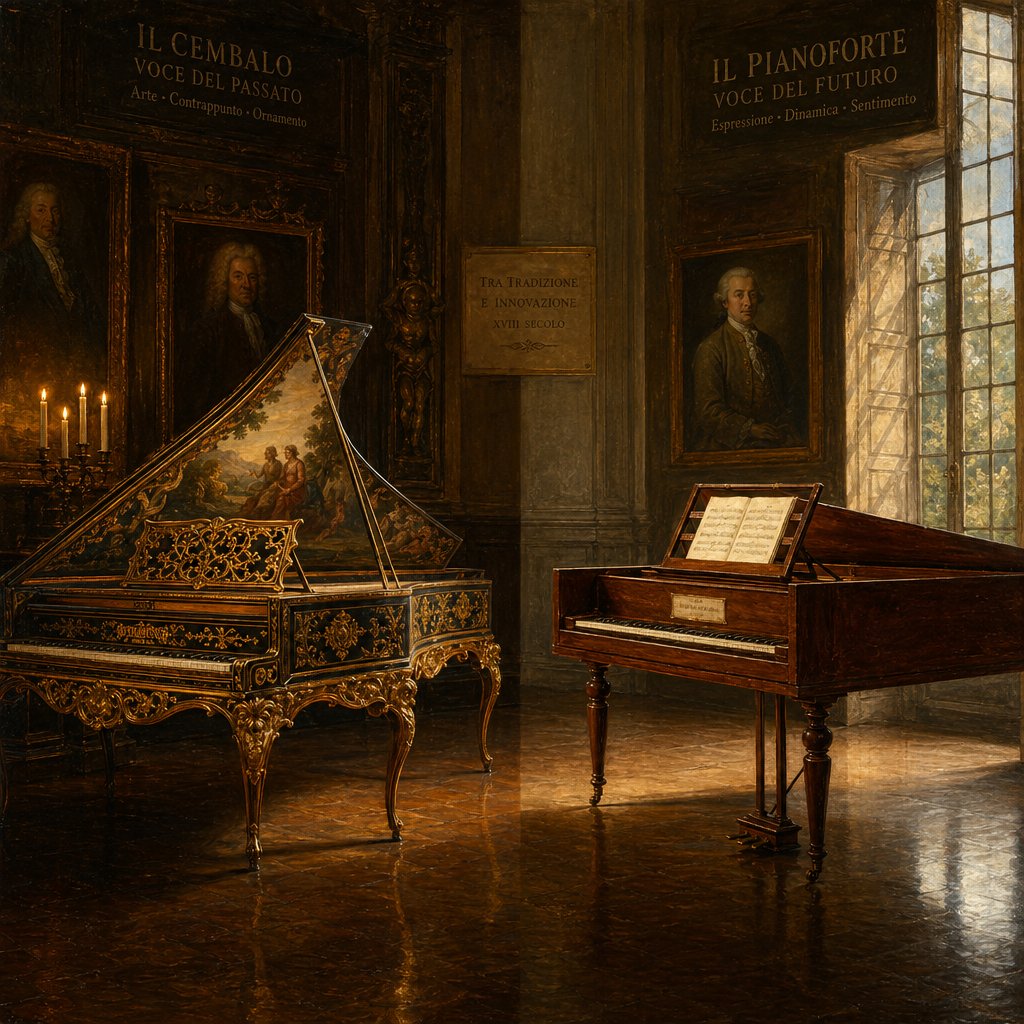
The instruments shaped the rules. For the first 150 years of notated orchestral music, the dominant keyboard instrument — the harpsichord — had no volume control whatsoever. That single mechanical limitation defined how an entire era handled loudness and softness, and the story of dynamics from that point forward is really a story of technology unlocking expression.
Terraced Dynamics in the Baroque Era
Baroque music (roughly 1600–1750) relied on what's called terraced dynamics: abrupt, block-like shifts between loud and soft with no gradual transition between them. Why? Because the harpsichord, the bedrock instrument of the era, couldn't get louder if you banged the keys harder or softer if you touched them gently. The sound you got was the sound you got.
Composers adapted. Instead of writing crescendos or decrescendos, Bach, Handel, and Vivaldi controlled dynamic contrast through orchestration — adding instruments to get louder, removing them to get softer. In Handel's Messiah, you can hear the full ensemble drop away to leave a solo voice exposed, then surge back in. Bach's Brandenburg Concertos alternate between the full orchestra (ripieno) and a small group of soloists (concertino), creating dramatic volume shifts through texture rather than gradation. The definition of forte music in this period was essentially "more players playing."
How the Pianoforte Changed Everything
The breakthrough came around 1700, when Bartolomeo Cristofori of Padua built an instrument he called a "gravicembalo col piano, e forte" — a harpsichord with soft and loud. That name eventually shortened to pianoforte, one of the most recognizable words starting with pf in any language. Cristofori's hammer mechanism replaced the harpsichord's plucking action, allowing a keyboard player to control volume through touch for the first time. Press gently, hear soft. Press firmly, hear loud. Everything in between was suddenly possible.
Classical-era composers seized on this. Mozart and Haydn began writing graduated dynamic changes — real crescendos and decrescendos — into their scores, exploiting the full range from p-mf and beyond. Music timing and dynamic pacing became compositional tools, not just performance afterthoughts. Then Beethoven arrived and pushed the extremes further than anyone before him, juxtaposing whisper-soft passages against explosive sforzando outbursts — sometimes within a single bar. His piano sonatas read like a catalog of dynamic possibility, from the ghostly opening of the Moonlight Sonata to the thundering chords of the Appassionata.
Romantic Expansion and Modern Extremes
The Romantic composers blew the doors open. Tchaikovsky, Mahler, and Brahms expanded the dynamic palette to markings like pppp and ffff, and they employed long, sweeping crescendos that could build across entire movements. Orchestras grew larger, concert halls grew grander, and the available dynamic range expanded with them. A prelude sf marking in a Chopin score carried a different dramatic weight than the same symbol in a Baroque suite — the instrument, the hall, and the aesthetic expectations had all transformed.
The 20th century pushed even further in both directions. John Cage's 4'33" explored the boundary between silence and sound itself, while composers like Xenakis and Stravinsky deployed overwhelming orchestral volume as a visceral, almost physical force. Shostakovich weaponized dynamic contrast — his Fifth Symphony shifts from near-inaudible string passages to full-orchestra explosions that feel like narrative plot twists.
What this history reveals is a clear trajectory: as instruments became more responsive and ensembles grew more capable, composers demanded ever-wider dynamic ranges. Each generation inherited the expressive tools of the last and stretched them further. That evolution didn't just change how music sounds — it changed how individual instruments produce dynamics in the first place, and the techniques involved vary dramatically from one instrument family to the next.
How Dynamics Work Across Instrument Families
A marking of pp on the page looks identical whether you're reading a piano score, a trumpet part, or a vocal line. But the physical actions required to produce that pianissimo are completely different for each instrument. To truly define dynamics in practice — not just on paper — you need to understand what your body actually does to move between soft and loud on your specific instrument. That gap between reading a marking and executing it is where real musicianship lives.
Piano and Keyboard Dynamics Through Touch
The piano is one of the most intuitive instruments for understanding dynamics because the relationship between touch and volume is direct: press a key faster, and the hammer strikes the string harder, producing a louder sound. Press slowly and gently, and the result is soft. Simple in concept, but the physical mechanics behind it are surprisingly layered.
At pp, a pianist relies primarily on finger weight alone — a controlled, almost feathery descent into the key using minimal arm involvement. The wrist stays loose, the shoulders relaxed, and gravity does most of the work. At ff, the entire arm engages. As piano pedagogy specialists explain, beginners should learn to transfer arm weight into the keys rather than pressing or pounding, using a relaxed drop from the shoulder through the elbow and into the fingertip. Key speed — how quickly the key travels from its resting position to the keybed — is the single variable that determines volume on a piano. Everything else (arm weight, finger firmness, wrist flexibility) serves to control that speed.
Pedaling adds another dimension. The sustain pedal doesn't make notes louder, but it allows strings to resonate sympathetically, creating a fuller, richer sound that feels louder. A skilled pianist uses the pedal differently at p than at f — lighter, more selective pedaling for soft passages to maintain clarity, and deeper pedaling for loud passages where the added resonance reinforces the power.
Organ players face an entirely different reality. Traditional pipe organs cannot vary volume through touch at all — pressing a key harder produces the same volume as pressing it gently. Instead, organists control dynamics by selecting different stops (which activate different sets of pipes with varying timbres and volumes) and by using swell pedals that open and close shutters around an enclosed division of pipes. It's a mechanical, architectural approach to dynamics rather than a tactile one, and it connects directly back to the terraced dynamics of the Baroque era when the organ was king.
String, Wind, and Brass Dynamic Techniques
String players have three primary tools for shaping volume: bow pressure, bow speed, and contact point. Pressing the bow more firmly into the string increases volume, but only up to a point — too much pressure chokes the vibration and produces a scratchy, crushed tone. Bow speed matters just as much: a fast bow stroke across the string displaces more air and generates more sound. The contact point — where the bow meets the string between the bridge and fingerboard — shifts the tonal character along with the volume. Playing near the bridge (sul ponticello) produces a glassy, intense sound that projects strongly, while playing over the fingerboard (sul tasto) creates a softer, more diffuse tone ideal for pianíssimo passages.
Balancing these three variables simultaneously is what makes string dynamics so expressive — and so difficult. A violinist playing a passage marked f ff f f across four bars isn't just pushing harder; they're coordinating faster bow strokes, slightly more pressure, and a contact point closer to the bridge, all while maintaining clean intonation and musical phrasing.
Wind and brass players operate on a different physical principle entirely. As brass acoustics research illustrates, the sound on a brass instrument is produced by the vibrating column of air inside the instrument, excited by the player's lip vibration (embouchure). To play louder, a brass player increases air speed and volume from the lungs while adjusting embouchure tension and the shape of the oral cavity. To play softer, they reduce airflow while maintaining enough support to keep the lips vibrating cleanly — a delicate balancing act.
This is why true pianissimo on brass instruments is one of the hardest technical challenges in all of music. Brass instruments have a naturally loud baseline. A trumpet or trombone at mf can easily overpower a flute at f. Pulling the volume down to pp or ppp requires extraordinary breath control and embouchure finesse — too little air and the note simply dies; too much and the quiet illusion shatters. Woodwind players face a similar challenge with air support, though the reed or embouchure mechanism gives them slightly more granular control at lower volumes. Flutists, who direct an airstream across an open hole, find that soft playing demands the most precise air angle and speed of any dynamic level.
Vocal and Percussion Dynamics
Singers are, in many ways, the most exposed dynamic performers. There's no instrument body to hide behind — every shift in volume is produced entirely by the body's internal mechanics. Vocal training programs emphasize that dynamic control begins with diaphragmatic breathing: the diaphragm and intercostal muscles regulate the steady airflow that passes between the vocal cords, and the pressure of that airflow (subglottic pressure) directly determines volume.
Singing loudly with proper technique means increasing subglottic pressure while keeping the throat open and relaxed — the power comes from the core, not from squeezing the throat. Singing softly with full support is widely considered one of the hardest vocal techniques to master. The exercise known as messa di voce — sustaining a single pitch while gradually swelling from pianissimo to fortissimo and back — is a cornerstone of classical vocal training precisely because it demands seamless control over that entire dynamic range without any wavering in pitch or tone quality.
Resonance placement also plays a role. Experienced singers shift where they "place" the sound — more forward in the mask of the face for projection and brightness, more toward the back of the head for a covered, softer quality. These adjustments interact with breath support to give vocalists a dynamic palette that's remarkably wide, even though the instrument itself is just air, tissue, and bone.
Percussionists control dynamics through a different set of variables: strike force, stick or mallet choice, and strike location. A snare drum hit dead center with a heavy stick at full force produces a sharp, loud crack. The same drum struck near the rim with a brush produces a whisper. Timpanists choose between hard and soft mallets depending on the dynamic context — a passage marked pp calls for a felt mallet that absorbs impact, while fff might demand a wooden-headed mallet for maximum attack. On instruments like the marimba or vibraphone, where the player might encounter markings ranging from ff ff f ff across a rapid passage, the wrist and arm mechanics shift constantly to deliver precise volume changes note by note. You might also wonder what does an x mean in music notation on percussion parts — it typically indicates a specific technique like a rim shot, a dead stroke, or a cymbal choke, each of which carries its own dynamic implications depending on execution.
Every instrument family, in short, arrives at the same expressive destination through completely different physical paths. Here's a quick-reference summary:
- Piano/Keyboard — Key speed controlled by finger, hand, and arm weight; pedaling for resonance
- Organ — Stop selection and swell pedals (no touch-based volume control)
- Strings — Bow pressure, bow speed, and contact point (sul tasto vs sul ponticello)
- Woodwinds — Air speed, air volume, embouchure adjustment, and oral cavity shaping
- Brass — Air support, embouchure tension, and oral cavity shape; naturally loud baseline makes soft playing especially demanding
- Voice — Diaphragmatic breath support, subglottic pressure, and resonance placement
- Percussion — Strike force, stick/mallet selection, and strike location on the instrument
These mechanics are the "how" of dynamics. But knowing how to produce a crescendo or a subito piano on your instrument is only half the picture. The deeper question — and the one that separates technicians from artists — is why a composer places a specific dynamic at a specific moment, and how those choices tell a story across an entire piece.

Dynamics as an Emotional Storytelling Device
Every great story has quiet moments and loud ones — scenes that simmer with tension and scenes that explode with resolution. Music works the same way, and dynamics are the narrative engine driving that arc. Strip away the music note background of melody, harmony, and rhythm, and what you're left with is a volume map that mirrors the emotional shape of a story: rising action, climax, falling action, resolution. The forte music definition might be "loud," but in compositional terms, forte is a dramatic decision — a choice about when the story should shout and when it should whisper.
Building Tension and Release with Volume
Think about how a verse sits differently from a chorus. In most songs, the verse pulls back — softer instrumentation, more space, a sense of restraint. The chorus opens up: fuller arrangement, higher energy, greater volume. That contrast between sections is what gives dynamics music its emotional gravity. Without it, every section carries the same weight, and nothing feels like an arrival.
Composers have exploited this principle for centuries. A long crescendo builds anticipation the way a slow camera zoom builds suspense in a film — you feel something coming, and the gradual increase in volume keeps you leaning forward. A subito piano after a fortissimo climax delivers the opposite: dramatic shock, like a sudden cut to silence after an explosion. The listener's nervous system responds to these shifts instinctively, before the conscious mind even processes what happened.
No piece illustrates this better than Ravel's Bolero. Ravel himself described it as "one long, very gradual crescendo." Over roughly 15 minutes, two melodies repeat with essentially no thematic development — yet the piece is riveting because the orchestration and volume build relentlessly from a near-silent snare drum and solo flute at ppp to the full orchestra roaring at fff. Each repetition hands the melody to a new instrument or combination, adding layers of color and power. The effect is hypnotic, almost mechanical — Ravel was reportedly inspired by factory rhythms — and when the crescendo finally reaches its breaking point with a massive harmonic shift, the release is visceral. It's a masterclass in how a single dynamic trajectory can carry an entire composition.
Dynamic Pacing Across an Entire Composition
Ravel's approach is extreme, but the underlying principle applies to any piece in any genre. Experienced composers and songwriters plan dynamic shape at the macro level before writing a single note. Where will the quietest moment fall? Where does the loudest peak land? How quickly or slowly does the music move between those poles? These decisions form the definition of music dynamics as a storytelling framework — not just a set of volume symbols on a page, but an intentional emotional blueprint.
Imagine mapping out a song's dynamic plan like a plot outline. The intro draws listeners in softly, establishing mood. The first verse stays restrained. A pre-chorus begins to swell. The chorus arrives at a higher dynamic plateau. A bridge drops back down — maybe to the quietest point in the entire song — before the final chorus erupts with everything the arrangement has to offer. That kind of macro-level thinking is what separates memorable compositions from forgettable ones. A sequence of notes marked ff f f f throughout, with no contrast or breathing room, exhausts the listener. A piece that moves thoughtfully between extremes keeps them emotionally invested from start to finish.
This is also where adjectives to describe music — words like "soaring," "intimate," "explosive," "haunting" — connect directly back to dynamic choices. A passage described as "haunting" almost certainly lives at a low dynamic level with careful restraint. One called "triumphant" probably peaks at fortissimo with full orchestration. The emotional vocabulary we use to talk about music is, in large part, a vocabulary of dynamics.
Understanding this structure is one thing. Applying it to your own writing is another challenge entirely. Many songwriters grasp the theory of dynamic pacing but struggle to translate it into actual musical ideas — the gap between knowing that a chorus should feel bigger and figuring out how to make it bigger can be frustrating. For readers looking to experiment with dynamic structure in their own melodies, tools like MakeBestMusic's Melody Maker offer a hands-on way to generate melodic ideas and explore how structural choices shape a piece. Being able to quickly produce and compare different melodic options makes it easier to test where a volume symbol like a crescendo hairpin should begin, where the peak should land, and how the energy should taper — bridging the gap between theory and real songwriting.
Dynamic storytelling doesn't stop at the composer's desk, though. How these principles play out varies wildly depending on the genre — and the tools available to shape volume in a classical concert hall, a jazz club, a pop recording studio, and an EDM festival are fundamentally different.
How Dynamics Function Across Modern Genres
A classical violinist shaping a phrase from pp to ff, a jazz saxophonist swelling into a solo based on pure instinct, a pop producer automating volume curves in a DAW — each is working with dynamics, but the rules, tools, and expectations couldn't be more different. So what is the definition of dynamics in music when the genre itself changes the game? The core concept stays the same — variation in loudness and softness — but how that variation is created, controlled, and experienced shifts dramatically depending on the musical context.
Classical and Jazz Approaches to Dynamic Range
Classical music preserves the widest dynamic range of any genre. Performers are expected to execute everything from pppp to ffff exactly as the composer notated, and mastering engineers working with classical recordings use compression sparingly — if at all — to maintain that full expressive spectrum. A good loudness target for classical masters typically stays below -9 LUFS short-term, leaving enormous headroom for the quietest and loudest moments to coexist. Every dynamic musician in a symphony orchestra is essentially a living volume controller, responding to the conductor's gestures and the score's f music notation in real time.
Jazz takes a fundamentally different approach. Dynamic changes are largely performer-driven and improvised rather than written on the page. A jazz trio might shift from a whisper to a roar within a single solo based on feel, interaction between players, and the energy of the room. The rubato meaning music carries in jazz — that flexible, breathing sense of time — extends to dynamics as well: volume ebbs and flows organically, shaped by the moment rather than by ink on paper. Mastering for jazz mirrors this philosophy, focusing on warmth and preserving the natural dynamic subtleties of a live performance rather than pushing loudness.
Pop, Rock, and the Loudness War
Pop and rock production operate in a different universe. Starting in the 1980s and accelerating through the CD era, record labels and engineers began pushing masters louder and louder to stand out on radio and in stores. As iMusician's analysis of the loudness war explains, engineers used aggressive compression and limiting to reduce the gap between the quietest and loudest parts of a track, making everything consistently loud — often at the expense of clarity and listener fatigue. Metallica's Death Magnetic became a notorious example: the 2008 master was so heavily compressed that fans preferred the less-processed Guitar Hero version of the same recordings.
Streaming platforms have started to reverse this trend. Spotify, Apple Music, YouTube, and others now use LUFS-based loudness normalization to automatically adjust all tracks to a consistent perceived loudness — typically around -14 LUFS for Spotify and YouTube, -16 LUFS for Apple Music. If your master is slammed to -6 LUFS, the platform simply turns it down, and the over-compressed track ends up sounding flat and lifeless next to a more dynamic master played at the same normalized level. The incentive to crush dynamics is fading, though some genres still favor aggressive loudness for energy and punch. Think of it this way: even a novelty item like an "i see the light 30-note wind-up music box" has more dynamic variation than some over-compressed pop masters from the peak of the loudness war.
Electronic Music and Film Scoring Dynamics
EDM producers rarely write dynamic markings on a score — most work entirely in a DAW. But the dynamic principles are identical, just executed with different tools. Sidechain compression, one of the most widely used techniques in electronic production, is essentially an automated volume relationship: when the kick drum hits, the bass or synth pad ducks in volume, creating a rhythmic "pumping" effect that functions as a modern crescendo and decrescendo cycle on every beat. Volume automation curves, filter sweeps that brighten or darken a sound, and build-up risers that swell into a drop — these are all dynamic storytelling tools dressed in electronic clothing.
Film scoring sits at the opposite end of the control spectrum, demanding the most extreme dynamic contrast of any modern genre. A scene might call for near-silence — a single sustained string note hovering at the edge of audibility — followed two seconds later by a full orchestral explosion. That contrast serves narrative and emotional storytelling directly: the quiet moment makes the loud one feel enormous, and the sudden shift mirrors the on-screen action. Composers like Hans Zimmer and John Williams treat dynamics as a cinematic language, and if you've ever tried to MuseScore play from a position in time in a film score, you'll notice the dynamic markings are often more detailed and extreme than in any other genre.
The table below compares how dynamics are controlled and experienced across these five contexts — a useful reference for anyone working across genres or trying to define epigrammatic differences between musical worlds.
| Genre | Primary Dynamic Control Method | Typical Dynamic Range |
|---|---|---|
| Classical | Performer interpretation of notated markings (pp to ffff); conductor-led ensemble balance | Very wide (~20+ dB); minimal compression in mastering |
| Jazz | Improvised, performer-driven; responsive to ensemble interaction and room energy | Wide (~15-20 dB); mastering preserves natural feel |
| Pop/Rock | Studio compression, limiting, and arrangement choices; loudness normalization on streaming | Narrow to moderate (~6-12 dB); loudness war reduced range historically |
| Electronic/EDM | Sidechain compression, volume automation, filter sweeps, and build/drop structure | Narrow to moderate (~6-10 dB); heavy limiting for club impact |
| Film Scoring | Notated orchestral dynamics combined with DAW automation; extreme contrast for narrative effect | Extremely wide (~25+ dB); silence to full orchestra within seconds |
What this comparison reveals is that dynamics aren't a classical-music concept that other genres abandoned — they're a universal principle that every genre reinvents using its own tools and traditions. The question isn't whether dynamics matter outside the concert hall. It's how you harness them within whatever musical world you inhabit — and that starts with turning all of this knowledge into deliberate practice.
Putting Your Dynamic Knowledge into Practice
Knowing what is dynamics in music — the full vocabulary of markings, the history, the genre-specific tools — only matters if you can translate that knowledge into sound. The gap between reading mf on a page and producing a convincing mezzo forte under your fingers, your breath, or your bow is where real musicianship lives. Closing that gap takes deliberate, focused practice.
Practicing Dynamic Control at Any Level
Dynamic control is a core assessment criterion in music education frameworks worldwide. Whether you're preparing for an ABRSM or Trinity graded exam at Grade 1 or polishing a diploma recital, examiners listen for audible, intentional contrast between dynamic levels — not just correct notes. Good use of dynamics and articulation is one of the first things that separates a passing performance from a memorable one.
Here are practical exercises you can start today, regardless of your instrument or level:
- Single-phrase dynamic ladder — Choose a short phrase (four to eight bars) and play it at every level from pp through ff. Can you hear a clear difference between each step? If mp and mf sound identical, that's your first target.
- Scaled crescendo practice — Play a crescendo (or its opposite of crescendo, the decrescendo) over 4 bars. Once that's comfortable, stretch it to 8 bars, then 16. The longer the span, the harder it is to pace evenly — this exercise builds the patience and control that a crescendo synonym like "swell" implies.
- Messa di voce — Sustain a single note and gradually grow from the softest sound you can produce to the loudest, then back again. Vocalists have used this messa all out attack-to-retreat exercise for centuries, but it works beautifully on any sustained instrument. Record yourself and listen back — you'll often discover jumps where you thought there were smooth curves.
- Accent isolation — Play a passage at a steady p, then add sforzando accents on specific beats. Can you spike the volume on one note and immediately return to soft? This builds the control needed for sudden dynamic changes.
As guitar pedagogy specialists point out, consistency is the real sticking point — playing a dynamic exercise flawlessly once is one thing, but doing it ten times in a row with equal precision is where the skill becomes reliable. Dynamics define music only when they're dependable enough to serve the phrase every single time, not just on a good day.
Turning Theory into Songwriting and Composition
If you write music, think about dynamics from the very start of the creative process — not as an afterthought layered on after the notes are finished. Before writing a single melody, sketch a dynamic plan: where will the quietest moment fall? Where does the loudest peak land? How does the energy move between those poles? This kind of intentional mapping — deciding in advance where the music breathes, punches, and whispers — is what gives a composition emotional shape rather than just harmonic content.
Experiment freely. Try writing a verse that never rises above mp and a chorus that lives at f. Try a bridge that drops to near-silence before the final section erupts. Play with rubato meaning music's natural breathing quality, letting tempo and dynamics flex together to create something that feels alive rather than mechanical. For readers ready to test these ideas hands-on, MakeBestMusic's Melody Maker provides a practical next step — generate melodies, explore musical structure, and hear how dynamic and structural choices shape a piece, turning the theory covered in this article into real songwriting ideas you can build on.
Dynamics are not just markings on a page — they are the difference between notes and music.
