


What Rhythm Really Means in Music
If you've ever searched "what is rhythm" and walked away more confused than when you started, you're not alone. Most explanations either drown you in jargon or oversimplify to the point of being useless. Let's fix that, starting with the basics and building from there.
A Simple Definition Anyone Can Understand
Rhythm is the pattern of sounds and silences organized in time. It's the element that makes music move forward and gives it a pulse you can feel in your body. Think of it this way: rhythm in music works like the cadence of your footsteps on a sidewalk or the steady thump of your heartbeat. Those patterns aren't random. They have a flow, a predictable push and pull that your brain locks onto almost instantly. That instinct to tap your foot or nod your head when a song plays? That's you responding to rhythm before you've even thought about it. Whether you spell it "rhythm" or accidentally type "rythem" into a search bar, you already know what it feels like. You just might not have had the right words for it yet.
The Deeper Musicological Meaning
The rhythm meaning goes deeper than "sounds in a pattern." Formally, rhythm encompasses the duration, accent, and grouping of sounds within a temporal framework. It governs how long each sound lasts, which sounds get emphasis, and how those sounds cluster together over time.
Rhythm, from the Greek rhythmos (derived from rhein, meaning "to flow"), is the organization of sounds in time — specifically, the patterns of duration that occur within a regular underlying pulse or beat.
That Greek root is revealing. "Flow" captures something that a rigid textbook definition often misses: rhythm isn't just mechanical counting. It's movement. This is why the concept extends well beyond music into poetry, painting, sculpture, and architecture. When you study rhythm poetry meaning, you find the same principles at work — stressed and unstressed syllables creating patterns that carry language forward. Rhythm in art follows a similar logic, using repeated visual elements to guide the eye across a composition. The underlying idea is universal: an ordered alternation of contrasting elements that creates a sense of motion.
Why Rhythm Is the Foundation of All Music
Here's something that surprises most beginners: rhythm is the one indispensable element of all music. You can have rhythm without melody — think of a drum circle or a hand-clap pattern — but melody cannot exist without rhythm. Every note in a melody needs a duration, a place in time. Harmony, too, depends on rhythm to determine when chords change and how musical tension builds and releases. Without a regular rhythm holding the temporal structure together, musicality and rhythm collapse into shapeless noise. That's why rhythm sits at the foundation of everything you'll encounter as a listener or a player.
Grasping this definition is just the starting point. The real confusion for most beginners kicks in when they try to separate rhythm from something it's constantly tangled up with: the beat.
Why Beat and Rhythm Are Not the Same Thing
Most beginners use "beat" and "rhythm" interchangeably, and it's the single biggest source of confusion in early music learning. They're deeply connected, but they play very different roles. Untangling them changes how you hear every song.
What a Beat Actually Is
The beat is the steady, recurring pulse underneath a piece of music — the part you instinctively tap your foot or nod your head to. It's constant and predictable, like a metronome click or the tick of a clock. No matter what's happening in the melody or the vocals, the beat keeps marching forward at the same pace. The speed of that beat is called tempo, measured in BPM (beats per minute). A slow ballad might sit around 60 BPM. A high-energy dance track could push past 130. But fast or slow, the beat itself stays even and unwavering. Understanding the meaning of beat music starts right here: it's the foundation that holds everything else in place.
How Rhythm Layers on Top of the Beat
Rhythm is the specific pattern of long and short sounds — and silences — that rides on top of that steady pulse. If the beat is a grid, rhythm is what you paint on it. Imagine a steady four-beat count:
- The beat: 1 - 2 - 3 - 4 (evenly spaced, never changing)
- Rhythm A: sounds on 1, the "and" of 2, and 4 — a syncopated, bouncy feel
- Rhythm B: sounds on every beat 1 - 2 - 3 - 4 — a rhythmic regular, driving pulse
- Rhythm C: sounds on 1 and 3 only — a spacious, half-time groove
Same beat, same tempo, three completely different feelings. That's the distinction in action. Rhythm is a synonym for "pattern" in this context — it's the arrangement that gives music its character, its groove, its personality. The same principle applies beyond music: rhythm principles of design use repeated and varied elements to create visual movement, and rhythm for poetry relies on stressed and unstressed syllables to carry language forward. The underlying concept is identical. Pattern over pulse.
Why This Distinction Matters for Listeners and Players
When you confuse beat with rhythm, counting music becomes frustrating. You might clap along to a song and feel "off" without knowing why — usually because you're locking onto a rhythmic pattern instead of the underlying pulse, or vice versa. Two songs can share the exact same tempo yet feel worlds apart, and the reason is always rhythm. The Song Room puts it well: beat and rhythm are how we organize sound into music, and without both working together, music is just noise. This isn't only a performer skill. As a listener, recognizing the steady beat beneath a complex rhythm is what lets you feel the groove instead of getting lost in it.
With beat and rhythm properly separated in your mind, the next question becomes: what are the specific building blocks that make up a rhythm? That's where elements like meter, syncopation, and subdivision come in.
The Essential Elements That Build Every Rhythm
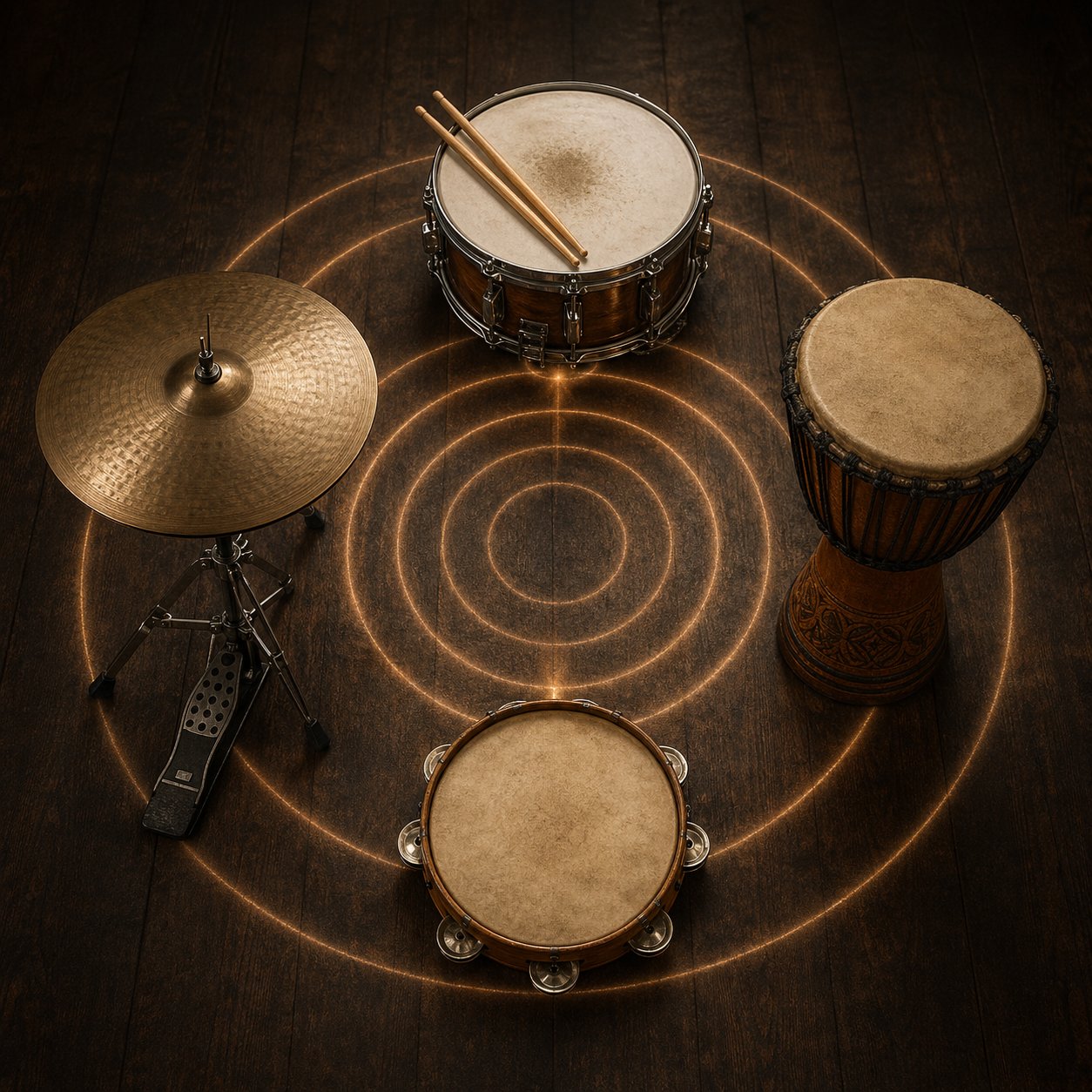
Knowing that rhythm is a pattern layered over a beat is a solid start. But what actually builds that pattern? Rhythm in music isn't one thing — it's a system of interlocking parts, each shaping how a piece feels and moves. When you can identify these parts individually, you stop hearing music as a blur and start hearing it as a structure you can decode.
Here's a quick-reference breakdown of every core element before we dig into each one:
| Element | Definition | Real-Song Reference |
|---|---|---|
| Beat | The steady, recurring pulse underlying the music | The kick drum pulse in "Stayin' Alive" by the Bee Gees |
| Tempo | The speed of the beat, measured in BPM | "Blinding Lights" by The Weeknd sits around 171 BPM |
| Meter | The recurring grouping of strong and weak beats | The strong-weak-weak waltz feel in "Moon River" |
| Time Signature | The notation that encodes meter (e.g., 4/4, 3/4) | "Take Five" by Dave Brubeck uses 5/4 |
| Subdivision | How each beat divides into smaller rhythmic units | The driving sixteenth-note hi-hat in "Billie Jean" |
| Syncopation | Emphasis on unexpected beats or offbeats | The offbeat guitar stabs in "Superstition" by Stevie Wonder |
| Polyrhythm | Two or more conflicting rhythmic patterns played simultaneously | The layered percussion in Fela Kuti's Afrobeat grooves |
| Accent | Emphasis placed on certain notes to create rhythmic shape | The snare crack on beats 2 and 4 in most rock and pop songs |
Beat, Tempo, and Meter Explained
You already know the beat is the pulse — the steady tick your body locks onto. Tempo is simply how fast that tick moves. A funeral march might crawl at 60 BPM; a drum-and-bass track could race past 170. Same concept, wildly different energy.
Meter is where things get more interesting. It's the pattern of strong and weak beats that repeats measure after measure. Think of it as the rhythmic grouping your ear naturally gravitates toward. A time signature is just the written code that tells musicians what that grouping looks like. In 4/4 time, you get four quarter-note beats per measure, with the strongest pulse landing on beat one. In 3/4, you get three — strong, weak, weak — and that's the lilting, swaying feel of every waltz you've ever heard.
Imagine marching in a straight line: LEFT-right-LEFT-right. That's duple meter, the backbone of 4/4. Now imagine a graceful dance: ONE-two-three, ONE-two-three. That's triple meter, the engine behind 3/4. Switch to 6/8 and each of those main beats subdivides into three eighth notes, creating a rolling, compound feel — the kind you hear in "Hallelujah" by Leonard Cohen. Each time signature fundamentally reshapes the artistic rhythm of a piece, even when the tempo stays the same.
Subdivision and Syncopation
Subdivision is how each beat splits into smaller pieces, and it's the secret ingredient behind groove and feel. A quarter-note beat can divide into two eighth notes, three triplets, or four sixteenth notes. You might not consciously notice subdivision, but you feel it. A hip-hop track built on sixteenth-note hi-hats has a completely different texture than a jazz tune swinging on triplet eighth notes — even at the same tempo. Subdivision is what lets you define the rhythm of a song at a granular level.
Syncopation flips expectations. Instead of placing emphasis where your ear predicts it — on the strong downbeats — syncopation shifts the accent to weak beats or the spaces between beats. As LANDR's rhythm guide explains, syncopated rhythms emphasize a measure's weak beats or offbeats, creating that sense of tension and forward pull. It's the reason funk music feels so urgent and jazz feels so slippery. When you count "1-and-2-and-3-and-4-and," syncopation lives on those "ands" — the offbeats that catch you slightly off guard and make you want to move.
Polyrhythm and Accent Patterns
Polyrhythm takes complexity up a level. It's what happens when two or more conflicting rhythmic patterns play at the same time, each with its own internal logic. The classic example is a 3-against-2 pattern: one hand taps three evenly spaced beats while the other taps two. Neither pattern is "wrong" — they coexist, creating a layered texture that's greater than the sum of its parts. Sweetwater's breakdown of polyrhythm notes that the term carries the connotation of different meters being felt simultaneously, even when the underlying time signature stays constant.
Accent is the final piece of the puzzle. It's the emphasis placed on specific notes to give a rhythm its shape and character. Without accents, every note would carry equal weight, and rhythm music would feel flat and lifeless. Here are some places you'll hear these elements at work:
- Polyrhythm: West African djembe ensembles, where multiple drummers each play a different repeating pattern that interlocks into a single groove
- Polyrhythm: The guitar and bass interplay in Tool's "Lateralus," where odd groupings overlap against 4/4 drums
- Accent: The backbeat snare on beats 2 and 4 in virtually every rock and pop song — the defining accent pattern of popular music
- Accent: The heavy "one" in James Brown's funk, where the downbeat accent drives the entire groove
Each of these elements — beat, tempo, meter, subdivision, syncopation, polyrhythm, and accent — is a building block. Alone, each one is simple enough to grasp. Combined, they produce the infinite variety of rhythmic feels across every genre and tradition. But knowing what these elements are raises a practical question: how do musicians actually write them down? That's where rhythm notation comes in, and it's far less intimidating than it looks.
Reading Rhythm Through Music Notation Basics
You can define rhythm all day long in conversation, but musicians needed a way to put it on paper. That's exactly what rhythm notation does — it translates the patterns of sound and silence you hear into a visual language anyone can learn to read. And the entire system is built on one beautifully simple idea: every note has a specific duration, and each duration is exactly half the length of the one above it.
Note Values From Whole Notes to Sixteenth Notes
Imagine a single note that rings out for an entire measure of 4/4 time. That's your whole note — four full beats of sustained sound. From there, every step down the hierarchy cuts the duration in half, doubling the number of notes that fit inside the same space. As Happy Note illustrates, the combination of these different note values is what creates musical rhythm in the first place.
Here's the full hierarchy from longest to shortest:
- Whole note — 4 beats (fills an entire measure in 4/4)
- Half note — 2 beats (two half notes equal one whole note)
- Quarter note — 1 beat (the standard "pulse" unit in most popular music)
- Eighth note — 1/2 beat (two per beat, counted "1-and-2-and")
- Sixteenth note — 1/4 beat (four per beat, counted "1-e-and-uh")
Notice the pattern: each level of subdivision doubles the number of notes per beat. One whole note equals 2 half notes, 4 quarter notes, 8 eighth notes, or 16 sixteenth notes. Once you see that clean doubling relationship, the entire system clicks into place. You're not memorizing random symbols — you're reading a proportional map of time.
Rests, Dots, and Ties
Here's something beginners often overlook: silence is just as rhythmically important as sound. Every note value listed above has a corresponding rest value — a symbol that tells you to stay quiet for exactly that duration. A quarter rest means one beat of silence. An eighth rest means half a beat. These gaps between sounds are what give rhythm its breathing room and shape. Without rests, music would be a wall of unbroken noise with no definition.
Dots and ties extend durations beyond the standard values. A dot placed after a note adds half of that note's original value to it. So a dotted quarter note equals a quarter note plus an eighth note — that's 1.5 beats total, or three eighth notes. As the Roger Williams University music theory textbook explains, a tie works differently: it's a curved line connecting two notes of the same pitch, combining their durations into one longer sound without re-striking the second note. A half note tied to a quarter note produces three beats of continuous sound — rhythmically identical to a dotted half note, just written differently.
Why have both? Ties let composers create durations that stretch across bar lines or produce lengths that no single note value — dotted or not — can express on its own. This flexibility is what allows notation to capture virtually any rhythmic idea a composer can imagine.
How Notation Captures Rhythmic Patterns
When you combine different note values and rests in sequence, you get the rhythmic patterns you actually hear in real music. Picture a simple four-bar phrase in 4/4 time:
- Bar 1: quarter, quarter, half (1, 2, 3-4) — a straightforward, grounded opening
- Bar 2: eighth-eighth, quarter, quarter rest, quarter (1-and, 2, [silence], 4) — a rhythmically active bar with a gap that creates tension
- Bar 3: dotted quarter, eighth, half (1-2-and, 3-4) — a lilting, slightly off-center feel
- Bar 4: whole note (1-2-3-4) — a long, sustained resolution
Even described in text, you can probably feel how each bar moves differently. That's the definition of music rhythm captured on paper — duration, silence, and accent working together to create forward motion. The notation doesn't just tell performers what to play; it gives listeners and students a way to decode and describe the rhythms they hear. You don't need to be a performer to benefit from understanding how note values, rests, and ties function rhythmically. When you can look at a pattern and hear it in your mind, you've crossed from passively listening to actively understanding what makes a groove tick.
Reading notation gives you the vocabulary of duration. But music is full of specialized terms that go beyond note values — words like "downbeat," "backbeat," "swing," and "groove" that musicians toss around constantly without always stopping to explain them.
Rhythm Vocabulary Every Music Lover Should Know
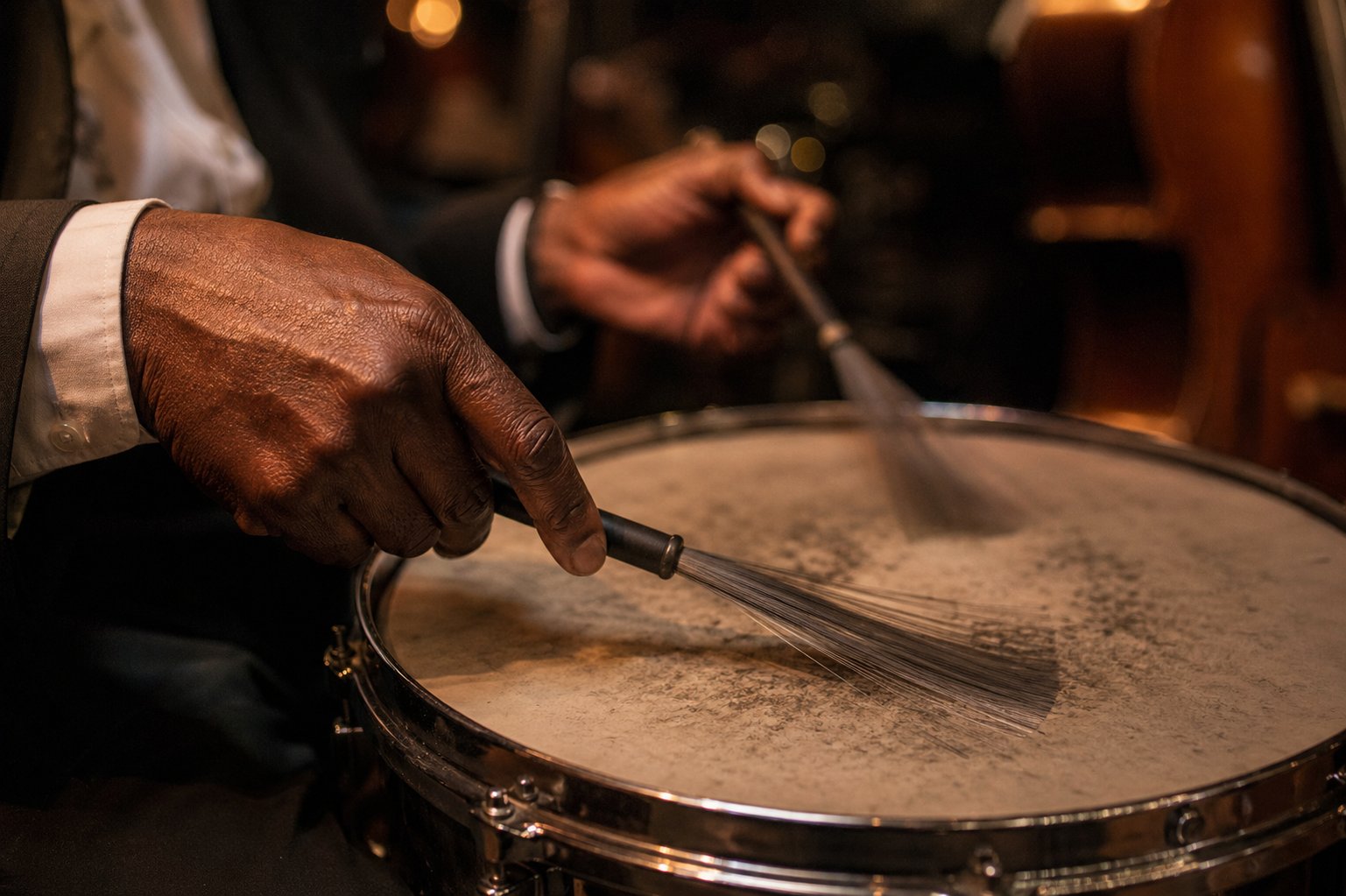
Music education is full of terms that get used as if everyone already knows them. Spoiler: most people don't. Whether you've been searching "rhythm or rythm" just to get the spelling right or trying to understand what a drummer means by "the backbeat," this glossary pulls together the essential rhythm vocabulary in one place.
Downbeat, Upbeat, and Backbeat
The downbeat is the first beat of a measure — the strongest pulse point in any bar. In a classical performance, it's the moment the conductor's baton sweeps downward, signaling the most accented note in the phrase. You feel it as the anchor, the rhythmic home base that everything else orbits around. As RouteNote's breakdown explains, the downbeat is also the very first pulse of a rhythm you hear at the beginning of a song and each time a new phrase begins.
The upbeat is the opposite: the beat or partial beat that comes just before the downbeat. In classical terminology, it's called the anacrusis or pickup. When a music teacher counts "1-and-2-and-3-and-4-and," those "ands" between the numbered beats are the upbeats — unaccented, lighter, and leading your ear forward toward the next strong pulse. Think of the upbeat as a rhythmic inhale before the downbeat's exhale.
The backbeat lands on beats 2 and 4 in 4/4 time, and it's the defining rhythmic signature of rock, pop, R&B, and most popular music. That sharp snare crack you hear in virtually every pop song? That's the backbeat. It creates a driving, propulsive energy by placing emphasis on the "weaker" beats of the measure — a controlled form of syncopation that feels natural because you've heard it thousands of times.
Offbeat, Swing, and Groove
The offbeat is any rhythmic position that falls between the main beats. It's a broader category than the upbeat — any note landing on an "and" or an "e" or an "uh" in your counting is technically offbeat. Reggae lives on the offbeat. So does ska. Placing emphasis here creates a lilting, bouncing quality that pulls against the steady pulse.
Swing is a rhythmic feel where pairs of notes are played with unequal duration rather than evenly. Instead of two eighth notes splitting a beat perfectly in half, the first note stretches longer and the second arrives late, creating a long-short, long-short pattern. A study published in Scientific Reports found that the swing ratio in jazz typically varies between 1:1 (straight eighths) and 3:1 (heavily swung), depending on tempo and the individual musician. That unevenness is what gives jazz its characteristic bounce — and it's something you feel more than you consciously analyze. Some might call strict metronomic time the antonym of freedom in musical expression, and swing is the remedy: a loosening of rigid timing that makes rhythm breathe.
Groove is the hardest term to pin down because it's the result of everything else working together. It's the overall rhythmic feel produced by micro-timing variations, accent placement, and the interaction between instruments — the quality that makes music feel good to move to. Research into what is sometimes called rythmnology — the deeper study of rhythmic perception — shows that groove is closely tied to both enjoyment and the physical urge to move. Swing and groove are related but not identical: there's no swing without groove, but groove can exist without swing, as anyone who's felt a tight funk pocket or a four-on-the-floor electronic beat can confirm.
Rubato and Tempo Flexibility
Every term above operates within a steady tempo. Rubato breaks that rule on purpose. Derived from the Italian for "stolen time," rubato is the expressive stretching and compressing of tempo within a musical phrase. A pianist might slow down through an emotionally charged passage, then subtly accelerate to catch back up — borrowing time from one moment and returning it to another.
Rubato is the deliberate, expressive bending of tempo — slowing down or speeding up within a phrase to heighten emotional impact, while preserving the overall musical structure.
In classical music, rubato is often conductor-driven. In jazz, it's more conversational — a soloist might float freely over a ballad while the rhythm section holds steady time underneath. Either way, rubato adds emotional depth that strict tempo can't achieve. It's storytelling through timing, not just notes. Understanding what is meter in music and how rubato temporarily loosens it helps you appreciate why a Chopin nocturne or a Bill Evans ballad intro can feel so deeply human.
Here's a scannable recap of every term covered:
- Downbeat — the first, strongest beat of a measure
- Upbeat (Anacrusis) — the beat or partial beat before the downbeat
- Backbeat — emphasis on beats 2 and 4 in 4/4 time
- Offbeat — any rhythmic position between the main beats
- Swing — unequal note durations creating a long-short rhythmic feel
- Groove — the overall rhythmic feel that makes music move; produced by timing, accents, and instrument interaction
- Rubato — expressive stretching and compressing of tempo within a phrase
You can define rhythm in a poem using stressed and unstressed syllables, and you can define it in music using these same concepts of emphasis, timing, and feel. The vocabulary is different, but the underlying logic is shared. With these terms in your toolkit, you're ready to hear how rhythm doesn't just change from song to song — it transforms completely across genres.
How Rhythm Transforms Across Music Genres
Knowing the vocabulary is one thing. Hearing how those concepts actually behave in the wild is another. The same rhythmic tools — syncopation, accent, subdivision, meter — get used in radically different ways depending on the genre. That's why two people can both answer "what is rhythm in music" correctly and still be describing completely different sonic experiences. Rhythm isn't just a universal foundation; it's the element that gives each genre its fingerprint.
Classical Precision and Jazz Swing
Classical music treats rhythm as something precisely composed and faithfully executed. Every note duration, rest, and accent is written into the score. The time signature of music in a classical piece isn't just a guideline — it's a structural blueprint that performers follow with exacting discipline. A Beethoven symphony in 3/4 time feels fundamentally different from one in 4/4, and that difference is baked into the notation. Where classical rhythm breathes is through rubato: conductors and soloists stretch and compress phrases for emotional effect while the underlying meter stays intact.
Jazz takes the opposite approach. The written page is a starting point, not a destination. Jazz transforms rhythm through swing feel, where pairs of eighth notes are played with unequal duration — long-short, long-short — creating that signature lilting bounce. Syncopation is constant, and improvised rhythmic variation means no two performances of the same tune sound alike. Jazz musicians also play "behind" or "ahead" of the beat intentionally, creating tension and release through micro-timing. The shuffle pattern — a triplet-based groove where the middle note is silent — is another hallmark. In a sense, jazz rhythm is closer to rhythm definition poetry than to classical notation: it follows a framework but lives in the expressive space between the rules.
Funk Syncopation, Hip-Hop Boom-Bap, and Electronic Pulse
Funk is built on heavy syncopation and an almost obsessive emphasis on "the one" — the downbeat of each measure. James Brown's bands made this famous: everything locks into that first beat with ferocious intensity, while the spaces between beats fill with offbeat guitar scratches, bass pops, and hi-hat chatter. The result is a groove so tight it practically forces your body to move.
Hip-hop inherits funk's rhythmic DNA but reshapes it. The classic boom-bap pattern is built on kick and snare placement: kick on beats 1 and 3, snare cracking on 2 and 4, with syncopated hi-hats adding texture and swing. What rhythms emerge from this foundation depend on the subgenre — trap pushes rapid-fire sixteenth-note hi-hat rolls over deep 808 bass, while lo-fi hip-hop relaxes the timing for a dusty, laid-back pocket. The beat definition music producers use in hip-hop is inseparable from the genre's identity.
Electronic dance music strips rhythm down to its most primal form. The four-on-the-floor kick drum pattern — a kick hitting every single beat in 4/4 time — is the engine of house, techno, and most EDM subgenres. It's relentless, hypnotic, and designed to synchronize a room full of bodies. Where hip-hop plays with rhythmic unpredictability, electronic music leans into repetition and builds energy through layering, filtering, and the tension between build and drop.
Latin Clave, Reggae Offbeat, and Global Patterns
Latin and Afro-Cuban music revolves around the clave — a two-bar rhythmic pattern that acts as the organizing spine for every other instrument. The 3-2 son clave places three accents in the first bar and two in the second, creating a syncopated framework with a relaxed, rolling feel. Flip it to a 2-3 clave and the energy shifts — slightly more modern, slightly more sophisticated. Understanding the time signature meaning in Latin music requires grasping that the clave operates as a rhythmic key that unlocks the entire arrangement.
Reggae takes a different path entirely. Its signature sound comes from the offbeat rhythm guitar — the "skank" — where chords land between the main beats rather than on them. Combined with the "one drop" drum pattern (kick on beat 3 instead of beat 1) and heavy, melodic bass lines, reggae creates a laid-back, spacious feel that sits around 60-90 BPM. It's proof that what makes a genre distinctive isn't tempo or complexity — it's where the accents land.
Here's a side-by-side comparison of how rhythm defines each genre:
| Genre | Signature Rhythm Pattern | Key Rhythmic Feature |
|---|---|---|
| Classical | Precisely notated durations within strict meter | Rubato for expressive flexibility |
| Jazz | Swing eighths with improvised variation | Playing behind/ahead of the beat |
| Funk | Syncopated patterns anchored to "the one" | Heavy offbeat accents and tight groove |
| Hip-Hop | Boom-bap kick-snare with syncopated hi-hats | Swing, ghost notes, and rhythmic sampling |
| Electronic/EDM | Four-on-the-floor kick drum | Repetition, layering, and build-drop energy |
| Latin/Afro-Cuban | Clave pattern (3-2 or 2-3) | Syncopated framework organizing all instruments |
| Reggae | Offbeat "skank" guitar with one-drop drums | Accent on offbeats and beat 3 |
Each of these genre-specific patterns didn't appear out of nowhere. They trace back to deeper cultural and geographic rhythm traditions — African polyrhythms, Indian tala cycles, Afro-Cuban clave roots — that have shaped how the world makes and feels music for centuries.
Global Rhythm Traditions That Shaped Modern Music
Every genre covered in the previous section owes a debt to rhythm traditions that stretch back centuries — and in some cases, millennia. The definition rhythm in music carries across Western pop, jazz, and electronic styles didn't develop in isolation. It was shaped by African drumming ensembles, Indian rhythmic cycles, Middle Eastern modal patterns, and Afro-Latin percussion traditions that most music education barely acknowledges. These aren't footnotes. They're the source code.
African Polyrhythmic Traditions
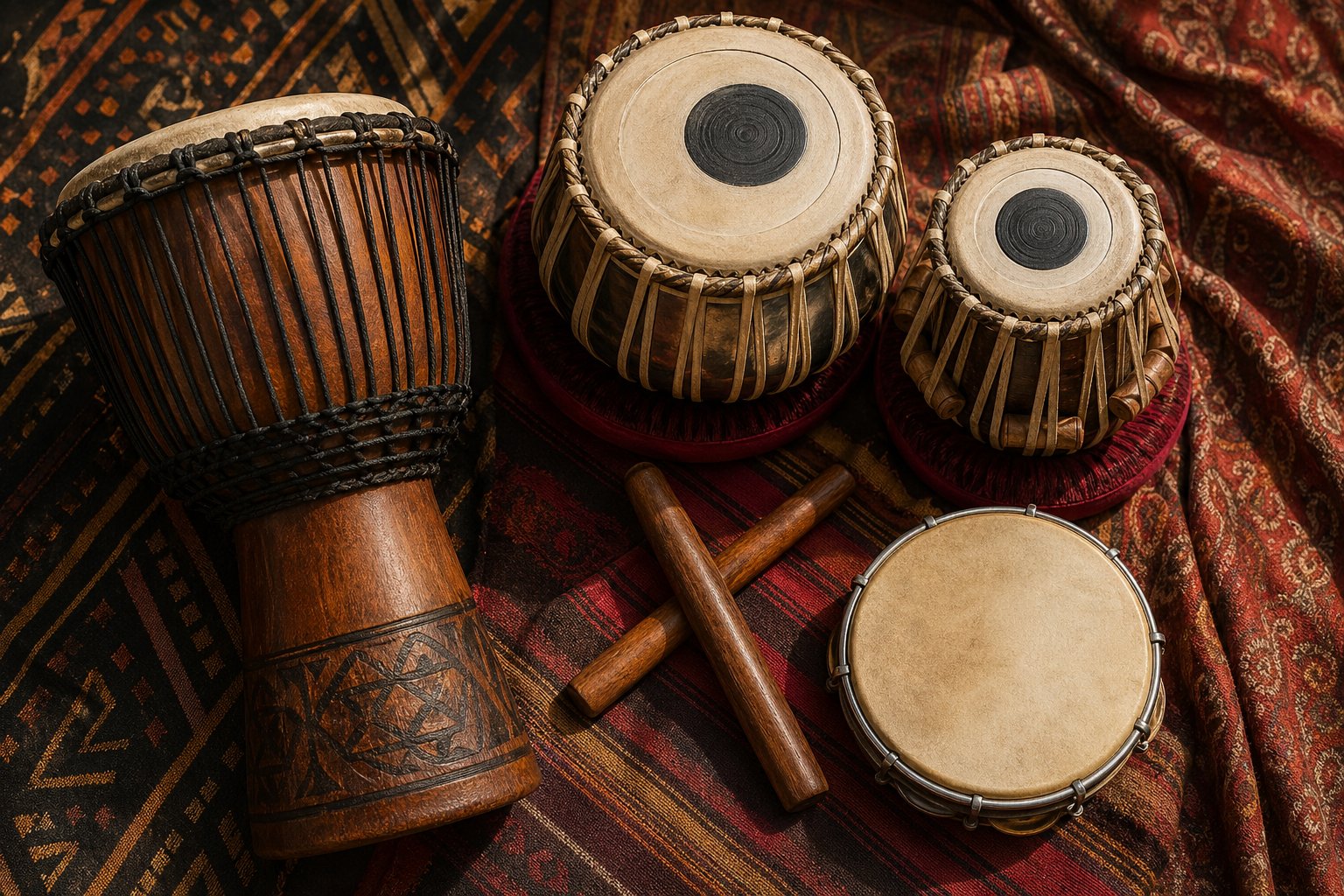
When you hear someone ask "what a rhythm is" in its most complex, layered form, the answer often starts in West Africa. Traditional drumming ensembles — built around instruments like the djembe, dundun, and talking drum — layer multiple independent rhythmic patterns simultaneously. Each individual part is relatively simple on its own. A single drummer might play a repeating two-beat or three-beat figure. But when five or six of those parts interlock, the composite texture becomes extraordinarily complex, producing polyrhythmic webs that shift depending on which layer your ear follows.
This concept of interlocking rhythms is foundational. As ML Percussions documents, African percussion directly influenced jazz, blues, funk, hip-hop, and virtually all popular music in the Americas. The polyrhythmic DNA of West African drumming traveled through the Atlantic slave trade and embedded itself in the musical cultures of the Caribbean, Brazil, and the United States. Every backbeat you hear in a rock song, every syncopated funk groove, every boom-bap pattern — all of it traces back to these traditions. In the most literal sense, rhythm is music in West African culture, where drumming serves as language, ceremony, storytelling, and communal identity all at once.
Indian Tala and Middle Eastern Iqa'at
Western time signatures organize rhythm into relatively simple groupings — 4/4, 3/4, 6/8. Indian classical music operates on an entirely different level. The tala system is a sophisticated framework of rhythmic cycles with specific accent patterns, internal subdivisions, and structural landmarks that can span 7, 10, 12, 16, or even more beats before repeating. A music definition of meter in the Western sense barely scratches the surface of what tala accomplishes. Tintal, one of the most common talas, cycles through 16 beats divided into four sections with prescribed clap and wave patterns that performers and audiences follow together — a level of rhythmic participation that Western concert culture rarely matches.
Middle Eastern music follows a parallel but distinct path. Iqa'at (singular: iqa') are named rhythmic modes — patterns of strong, intermediate, and weak beats separated by pauses of various lengths. Medieval theorists described six to eight basic modes, though many more have been used in practice. Each iqa' carries a specific character suited to a particular mood or context. What makes this system especially interesting is that the rhythmic accents don't necessarily align with the melodic stresses — the rhythm and melody operate as two independent but intertwined lines, united in the larger structure but free to clash on individual beats. These systems represent centuries of rhythmic theory development that Western music education rarely explores.
Afro-Cuban Clave and Brazilian Samba Rhythms
The clave pattern — introduced in the genre section — deserves deeper context here because its roots are African, not Cuban. The 3-2 and 2-3 clave patterns arrived in Cuba through enslaved West Africans and became the organizing principle of son, rumba, salsa, and mambo. As UJAM's Latin rhythm guide explains, the clave isn't just percussion — it's the structural law that every instrument in the ensemble follows. Align your parts with the clave and the music breathes; fight it and the groove collapses.
Brazilian samba tells a similar story of African rhythmic DNA evolving in a new environment. Samba's layered percussion patterns — surdo bass drums, tamborims, agogo bells, and shakers — create a propulsive, rolling energy built on interlocking parts. Unlike the Western four-on-the-floor approach, samba places its heaviest emphasis on the second beat, and the sixteenth-note percussion sits slightly ahead of the grid, giving the rhythm its characteristic urgency and forward lean.
Here's a quick reference of the major traditions and what defines each one:
- West African polyrhythm (Ghana, Nigeria, Mali) — multiple interlocking patterns creating composite complexity; the rhythmic ancestor of jazz, funk, and hip-hop
- Indian tala (India) — long rhythmic cycles with prescribed accent patterns and subdivisions; far more complex than Western meter
- Middle Eastern iqa'at (Arabic, Turkish, Persian traditions) — named rhythmic modes with strong, intermediate, and weak beats; rhythm and melody operate as independent lines
- Afro-Cuban clave (Cuba, rooted in West Africa) — 3-2 or 2-3 syncopated pattern that governs the entire musical arrangement
- Brazilian samba (Brazil, rooted in West Africa) — layered percussion with emphasis on beat two and ahead-of-the-grid sixteenth notes
What connects all of these traditions is a shared truth: rhythm isn't just a technical element to be measured and notated. It's a living, participatory force — something you feel in your body before you analyze it with your mind. That physical, felt dimension of rhythm is exactly what most beginners struggle to access, and it's something you can develop with surprisingly simple exercises.
How to Count and Feel Rhythm in Any Song
Knowing the definition of rhythm intellectually is one thing. Actually hearing it in a song you're listening to — and being able to describe what you hear — is a completely different skill. The good news? It's a skill you can build with a handful of simple exercises, no instrument required. All you need is a pair of ears and a willingness to tap along.
Counting Quarter Notes and Finding the Pulse
Every rhythmic awareness exercise starts in the same place: finding the pulse. Put on a song you know well — something with a clear, steady beat — and listen for the kick drum or bass pattern anchoring the track. That low, repeating thump is your entry point.
Once you hear it, count along: 1-2-3-4, 1-2-3-4. Don't rush. Let the music set the pace. As Hoffman Academy emphasizes, feeling the beat is something we already experience in daily life — our heartbeat, our walking pace — and the goal here is simply to reconnect that natural sense of pulse to what you're hearing in music.
Make it physical. Tap your foot on each count. Clap your hands. Nod your head. Piano teacher Jack Mitchell Smith recommends starting at 60 BPM — one beat per second — because it's slow enough to be deliberate but fast enough to feel musical. The point isn't just to count; it's to internalize the pulse so deeply that your body keeps time even when your mind wanders. That physical connection is the foundation everything else builds on.
Hearing Subdivision and Syncopation
Once you can lock onto the quarter-note pulse comfortably, it's time to zoom in. Between each of those main beats, there's a whole world of rhythmic activity happening — and learning to hear it is what separates passive listening from real rhythmic understanding.
Work through these exercises in order, spending as much time on each step as you need before moving on:
- Count eighth notes: Instead of just 1-2-3-4, count "1-and-2-and-3-and-4-and." Keep tapping your foot on the numbered beats, but now vocalize the "ands" between them. Listen for hi-hats, shakers, or guitar strums landing on those in-between positions — those are rhythmic examples of eighth-note subdivision in action.
- Spot the syncopation: Play a funk or pop track and listen for moments where accents land on the "ands" instead of the numbered beats. That pull you feel — the slight surprise, the forward lean — is syncopation. Try clapping only on the syncopated notes while your foot keeps the steady pulse underneath.
- Feel triplet subdivision: Count "1-trip-let-2-trip-let-3-trip-let-4-trip-let" over a jazz or blues track. The Musical U counting method uses syllables like "1-o-let" for the same purpose. Either way, you're training your ear to hear three subdivisions per beat instead of two — the foundation of swing feel and compound meter.
- Layer awareness: Go back to a song you used in step one. This time, count the main beats silently in your head while clapping the actual rhythm you hear the lead instrument or vocal playing. You'll notice the rhythm weaves around the beat — sometimes landing on it, sometimes between it, sometimes leaving space. That's the meaning of rhythm in music made tangible.
Describing Rhythm in Music You Hear
Hearing rhythm is half the battle. The other half is being able to put words to what you hear — and this is where all the vocabulary from earlier sections pays off. When someone asks "how do I know what the rhythm of a song is?" the answer is a simple four-step framework:
- Identify the meter: Is the song in groups of four (1-2-3-4) or three (1-2-3)? Your foot-tap pattern tells you.
- Notice the subdivision feel: Are the in-between notes even (straight eighths) or uneven (swung)? This tells you whether the groove is straight or swung.
- Spot syncopation or swing: Where do the accents land? On the beats, between them, or in unexpected places?
- Describe the overall groove: Is it driving and relentless? Laid-back and spacious? Bouncy and syncopated? Use the terms you've learned — backbeat, offbeat, shuffle, four-on-the-floor — to articulate what you feel.
Try this with three songs from completely different genres and you'll quickly see how the same rhythm definition music framework applies everywhere. A reggae track and a techno track both have a steady pulse, but the accent placement, subdivision, and groove are worlds apart — and now you have the language to explain exactly why.
If you want to take this a step further and move from identifying rhythmic examples to creating them, tools like MakeBestMusic's Melody Maker let you experiment with rhythmic ideas hands-on — bridging the gap between hearing a pattern and building one yourself. It's a practical way to test whether you truly understand a rhythmic concept by putting it into action.
Counting, feeling, and describing rhythm are listener skills. But they're also the exact same skills that feed directly into something bigger: writing music of your own.
From Rhythm Knowledge to Real Songwriting
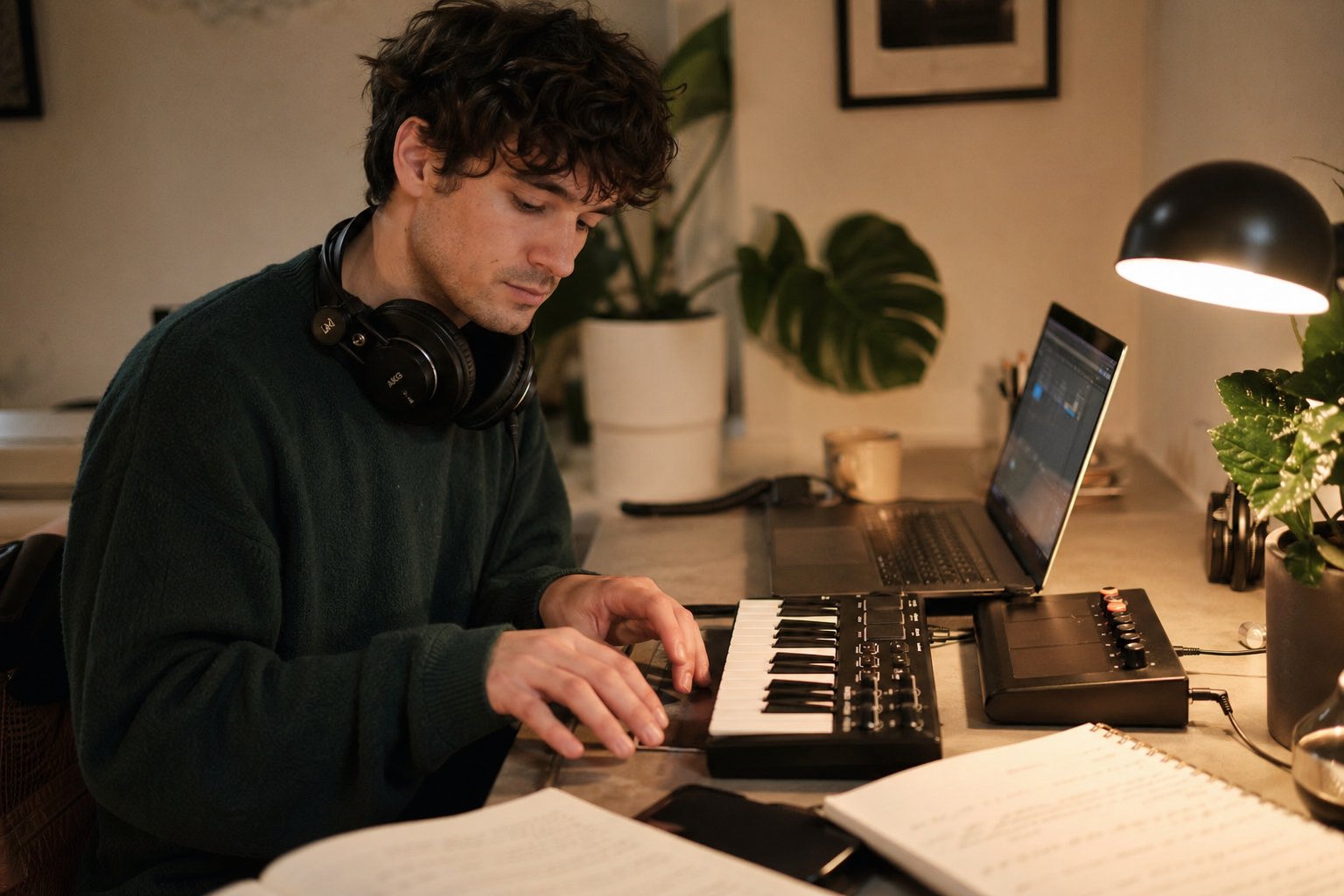
Listening and counting are where rhythm awareness begins. But the real payoff comes when you start making decisions with that awareness — choosing a music meter, shaping a groove, placing accents to control energy. That's the shift from understanding rhythm to using it, and it's where most beginners stall.
Why Understanding Rhythm Makes You a Better Songwriter
Every songwriting choice you make is, at some level, a rhythmic choice. Picking a 3/4 time signature over 4/4 changes the emotional gravity of your entire track. Dropping a syncopated vocal phrase over a straight backbeat creates tension that pulls listeners forward. Building a verse on sparse quarter notes and then flooding the chorus with sixteenth-note energy gives your song dynamic contrast without changing a single chord. As Musiversal's songwriting guide points out, rhythm is the heartbeat of a song — and understanding time signatures, syncopation, and rhythmic interplay gives you deliberate control over how that heartbeat feels. Here's what most people miss: rhythm is the first element listeners respond to. Before a melody registers, before lyrics land, the rhythm has already set the mood and told your body whether to sway, nod, or stay still. Songwriters who understand this have a massive advantage because they're shaping the listener's physical experience from the very first bar.
Turning Rhythm Concepts Into Real Music
Everything this article has covered — beat, meter, subdivision, syncopation, genre patterns, global traditions — becomes a practical ingredient the moment you sit down to write. Want a laid-back feel? Pull from reggae's offbeat accents. Need urgency? Borrow funk's syncopated sixteenth notes. Looking for something emotionally expansive? Try a compound 6/8 meter with rubato phrasing. The music definition rhythm provides isn't abstract theory — it's a menu of options you can mix, match, and make your own.
The gap between knowing these concepts and actually creating with them is where many learners get stuck. Interactive tools can close that gap fast. MakeBestMusic's Melody Maker is built for exactly this transition — it lets you take rhythm, melody, and structure concepts and turn them into real songwriting ideas you can hear and refine. Instead of wondering whether your rhythmic instincts are right, you can test them immediately and hear the results. It's a practical bridge between the theory on this page and music in the rhythm of your own making.
Your Rhythm Journey From Here
You started this article with a simple question about what rhythm means. You're leaving with a full toolkit: the vocabulary to describe what you hear, the framework to analyze musical elements across any genre, and the practical exercises to feel rhythm in your body. That's a genuine transformation — from someone who sensed rhythm instinctively to someone who understands why it works and how to shape it intentionally.
Keep building from here. Listen actively to genres outside your comfort zone and pay attention to how each one handles accent, subdivision, and groove differently. Practice the counting exercises until they become second nature. Experiment with creating your own patterns — even clapping a rhythm over a metronome click counts. What is rhythm in art, poetry, dance, and music all comes down to the same thing: organized movement through time. The more you engage with it — as a listener, a student, and a creator — the more rhythmic in music expression becomes something you don't just recognize, but own.
