

What 90 BPM Actually Means in Music
You've probably seen the number on a metronome app, a DAW tempo field, or scribbled above a line of sheet music. But what does 90 bpm really tell you about how a piece of music should feel?
Defining 90 Beats Per Minute
At its simplest, 90 beats per minute means exactly what it sounds like: 90 evenly spaced quarter-note pulses occurring within one minute. Each individual beat lasts roughly 0.667 seconds. Set a metronome to bpm 90, tap along, and you'll notice the pace feels like a purposeful walk, not a stroll and not a jog.
90 BPM is a musical tempo in which 90 quarter-note beats occur every 60 seconds, placing it in the upper range of Andante (walking pace) and just below Moderato, a sweet spot that feels neither rushed nor sluggish.
That in-between quality is exactly what makes this tempo so interesting. It carries enough momentum to feel intentional, yet enough space for notes and lyrics to breathe.
Where 90 BPM Sits on the Tempo Spectrum
Classical music organizes speed through Italian tempo markings that have guided performers for centuries. Imagine a ladder stretching from Largo (broad and stately, around 40-60 BPM) up through Adagio, Andante, Moderato, Allegro, and all the way to Presto at 168-200 BPM. Where does 90 land on that ladder?
Andante, traditionally described as "walking pace," spans roughly 76-108 BPM. Moderato picks up at around 108-120 BPM. That puts 90 beats per minute squarely in the upper half of Andante territory, close enough to Moderato that a slight push in energy can tip the feel from reflective to driving. It's a tempo that lives on a musical border, and that duality gives it remarkable versatility.
For context, consider the neighbors. Below 70 BPM, you're in Adagio's slow, expressive world. Above 120 BPM, Allegro's bright energy takes over. The zone around 90 sits right where calm confidence meets forward motion, which is why you'll find it across an unexpectedly wide range of genres, psychological states, and creative applications.
That cross-genre appeal isn't random. It's rooted in something far more personal than music theory: the rhythm your own body keeps every minute of every day.

Why 90 BPM Feels So Natural to the Human Body
The average adult resting heart rate falls between 60 and 100 beats per minute. That range probably looks familiar, and it should. A 90 bpm tempo sits right inside that physiological window, which means music at this speed pulses at roughly the same rate your heart does when you're sitting comfortably, reading, or having a calm conversation. Your body already recognizes this rhythm before your brain even registers the song.
The Heart Rate Connection
So what does 90 bpm feel like on a physical level? Tempo perception isn't purely an ear thing. It's partly somatic. Your breathing, your gait, even subtle muscle contractions tend to synchronize with external rhythmic stimuli, a phenomenon researchers call entrainment. When a beat lands close to your resting heart rate, that synchronization happens almost effortlessly. You don't fight the tempo; you settle into it.
A study published in the Journal of Physical Therapy Science compared groups walking to music at 90bpm versus 140 bpm and found no significant differences in heart rate or oxygen consumption between the 90 bpm group and a no-music control group. The slower tempo essentially mirrored the body's natural state, producing a comfortable, baseline-level experience. Faster music, on the other hand, pushed perceived exertion higher and drove greater walking speed.
This comfort-zone effect is exactly why you'll find 90 bpm heart rate music populating focus playlists, study soundtracks, and therapeutic settings. Music therapy research, including a systematic review in Alzheimer's Research & Therapy, has shown that rhythmic musical stimuli can improve cognitive functions like memory, attention, and verbal fluency. Tempos that feel natural and grounding, rather than agitating, are a key part of what makes those interventions effective.
Emotional Character of the Tempo
Beyond the physiology, there's an emotional fingerprint that comes with this tempo. Imagine the urgency of a 128 BPM dance track, all forward momentum and adrenaline. Then picture a 60 BPM ambient wash, beautiful but almost static. The 90 bpm tempo occupies the space between those extremes, carrying enough pulse to feel alive without demanding that you move faster than you want to.
That balance opens up a specific emotional palette. You'll notice it in the way a track at this speed can feel simultaneously introspective and assured, like a long walk where you're thinking clearly but not overthinking. Here are the core associations musicians and listeners tend to report:
- Calm confidence: steady enough to feel grounded, not so slow it drags
- Natural breathing rhythm: inhale and exhale patterns align comfortably with the beat spacing
- Head-nod groove: the tempo invites subtle physical engagement without demanding full-body movement
- Meditative focus: attention sharpens rather than scatters, making it ideal for deep listening or concentrated work
Understanding this feel isn't just trivia. It's a practical tool. When musicians and producers grasp why a particular tempo resonates on a body level, they stop picking speeds arbitrarily and start making intentional choices. And those choices play out very differently depending on the genre the tempo lands in.
Genres That Thrive at 90 Beats Per Minute
That intentional quality shows up across a surprisingly wide musical map. Some tempos belong to a single genre. This one doesn't. From gritty boom-bap loops to cinematic folk ballads, 90 bpm songs span styles that sound nothing alike on the surface yet share the same underlying pulse.
Hip-Hop and Rap at 90 BPM
If any genre owns this tempo, it's hip-hop. Traditional boom-bap and Golden Era production sit squarely in the 85-95 BPM range, and 90 bpm hip hop represents the dead center of that pocket. Think storytelling rap, conscious lyricism, and East Coast classics. Nas's "N.Y. State of Mind" clocks in right at this tempo, and that's no accident. The pace gives MCs enough room to stack dense, multisyllabic rhyme schemes without tripping over the beat, while still carrying enough forward momentum to keep a verse from dragging.
West Coast G-Funk leans on this zone too. The laid-back, funk-influenced production style that defined early-'90s Los Angeles rap typically ranges from 90 to 100 BPM, making it a natural home for melodic hooks and smooth vocal delivery. When you're building 90 bpm rap beats, you're tapping into a lineage that stretches from DJ Premier to Dr. Dre.
R&B, Lo-Fi, and Downtempo Grooves
R&B and neo soul don't always live at this exact tempo, with Spotify data showing averages closer to 113-116 BPM across the broader genre. But the lower end of that range dips comfortably into the low 80s, and plenty of intimate R&B ballads settle right around 90. The tempo creates a head-nodding, unhurried feel that suits breathy vocals and sparse, emotional arrangements.
Lo-fi hip-hop, which averages around 109 BPM but ranges as low as 75, frequently lands in this neighborhood. Those dusty, sample-heavy beats you hear on study playlists? Many of them pulse at or near this speed, relying on the tempo's natural calm to create a focused atmosphere. Trip-hop and downtempo electronic music use it as a canvas for atmospheric layering, stacking reverb-soaked textures and slow-burning basslines over a pulse that never rushes the listener.
Rock Ballads and Beyond
Rock might average 125 BPM as a genre, but power ballads and emotionally driven tracks regularly pull back to this range. The slower pace supports dynamic builds, giving a verse room to simmer before a chorus opens up. Songs at 90 bpm in folk carry a similar quality. Artists like Tom Waits, Paul Simon, and Bonnie Raitt all have tracks that sit at exactly this tempo, using it to frame storytelling vocals with space and weight.
| Genre | Typical Sub-Styles at 90 BPM | Characteristic Feel |
|---|---|---|
| Hip-Hop | Boom-bap, conscious rap, West Coast G-Funk | Head-nodding groove with room for complex lyricism |
| R&B / Neo Soul | Slow-burn ballads, intimate vocal tracks | Warm, breathy, emotionally exposed |
| Lo-Fi | Study beats, sample-based instrumentals | Dusty, calm, focus-friendly |
| Trip-Hop / Downtempo | Atmospheric electronic, cinematic soundscapes | Layered, moody, slow-building tension |
| Rock | Power ballads, alt-rock slow burns | Dynamic builds, emotional vocal delivery |
| Folk | Storytelling ballads, Celtic-influenced pieces | Spacious, narrative-driven, reflective |
What's striking is how differently each genre uses the same tempo. A boom-bap loop and a folk ballad share a pulse rate but inhabit completely different sonic worlds, proof that raw BPM is only part of the equation. The other part? How rhythmic subdivision and arrangement choices transform a single number into radically different musical experiences.
The 90-to-180 Double-Time Trick Every Producer Should Know
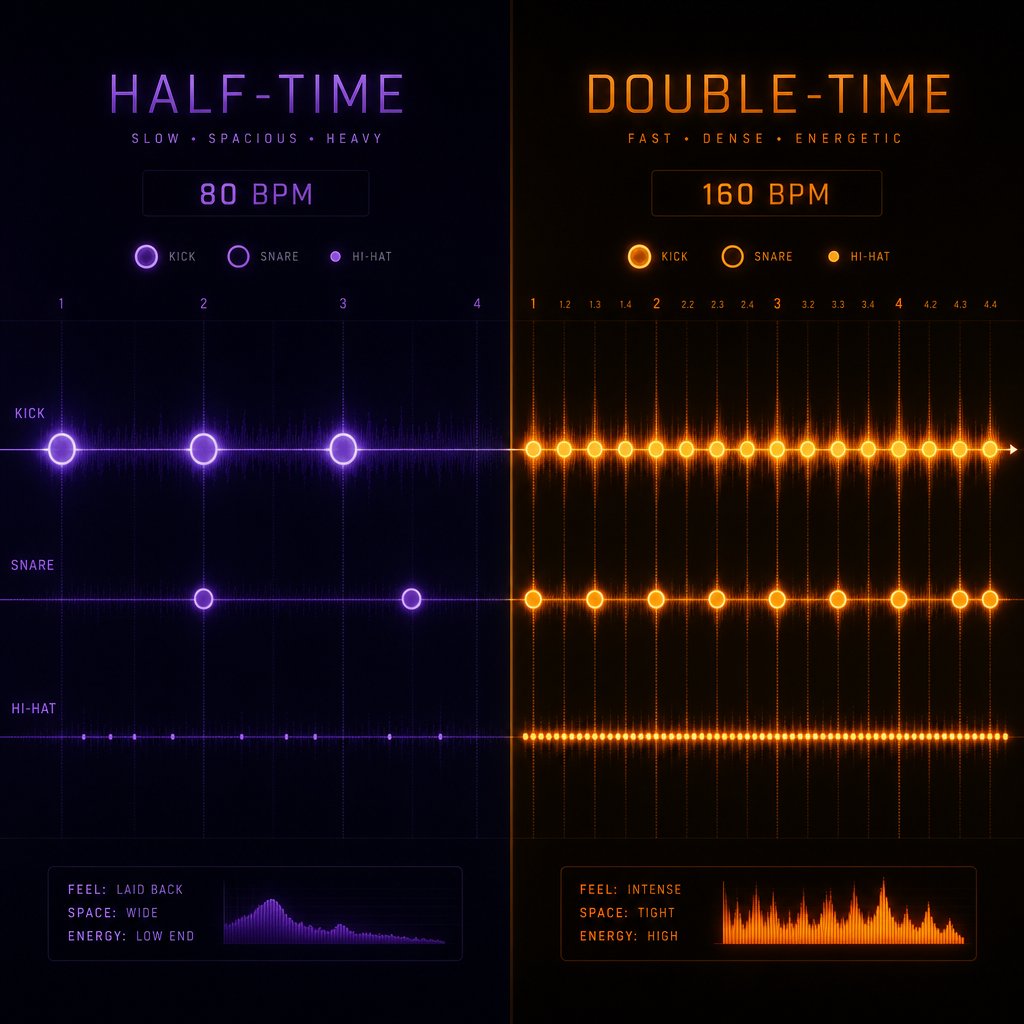
Rhythmic subdivision is where a single tempo number starts living a double life. Set your DAW to 90 bpm, and you might assume every track built at that speed will feel the same. It won't. Depending on how you program your drums, the listener could perceive the tempo as twice as fast, and that duality is one of the most powerful tools in modern production.
How Half-Time and Double-Time Transform the Feel
Here's the core idea. In a standard 90 bpm beat, the kick and snare follow a familiar pattern: kick on beats one and three, snare on beats two and four. The groove feels steady, mid-tempo, unhurried. But layer sixteenth-note hi-hats on top of that same kick-snare foundation, and suddenly the ear latches onto the faster rhythmic activity. The perceived tempo jumps to 180 BPM even though the underlying pulse hasn't changed at all.
This is exactly what happens in trap music. As Cole Mize Studios explains, trap instrumentals are essentially a hybrid of slow, melodic elements and fast rhythmic elements. The snares follow a half-time pattern, landing once per bar on beat three when counted in double time, while the hi-hats race at breakneck speed above them. The result is a beat that feels both slow and fast simultaneously.
The same principle works in reverse. A drum & bass track running at 180 BPM can feel halved to 90 when the bassline, melody, and vocal phrasing follow a half-time pulse. The genre literally called "halftime" emerged from neurofunk producers cutting their 160-175 BPM tempos in half, landing right around 80-85 BPM and creating a sound that blends D&B intensity with dubstep's weight. Push that half-time feel up slightly and you're sitting at 90, right in the pocket where hip-hop and electronic bass music overlap.
Practical Examples of the 90-180 Duality
Imagine you're building a 90 bpm trap beat in your DAW. You drop a deep 808 kick on beat one and a hard-hitting snare on beat three (counting in double time). So far, the groove breathes. It's spacious, heavy, and slow. Then you start programming hi-hats at sixteenth-note intervals, maybe adding rolls, triplet patterns, and quick open-closed variations. That percussion layer creates frenetic energy that sits on top of the slow foundation like a fast current over a deep riverbed.
This is why producers often debate whether a track is "really" at 90 or 180. The BeatStars trap BPM guide highlights this confusion directly: both the normal-time tempo and the double-time tempo are technically correct. A beat at 140 BPM in the DAW is actually 70 BPM in normal musical time. The same logic applies here. Your 90 bpm session is simultaneously a 180 BPM session, depending on which rhythmic layer you're counting.
The creative payoff is enormous. A verse can sit in the slow, spacious 90 BPM pocket, giving a vocalist room to deliver laid-back phrasing or intricate wordplay. Then the chorus hits, the hi-hat patterns double up, a rolling snare fill kicks in, and the energy explodes to a perceived 180 without anyone touching the tempo knob. That contrast between sections is what gives so many modern hip-hop and electronic tracks their dynamic range.
The same numerical tempo can produce radically different musical experiences. A 90 BPM beat and a 180 BPM beat can be the exact same track — the difference is entirely in the rhythmic subdivision choices layered on top of the pulse.
Understanding the 90 bpm vs 180 bpm relationship isn't just a production trick. It reframes how you think about tempo itself. The number on your metronome or DAW is a starting point, not a destination. What you build on top of that pulse, the subdivisions, the drum patterns, the rhythmic density, determines whether a track feels like a slow groove or a high-speed ride. And that flexibility becomes even more apparent when you compare this tempo directly against its closest neighbors.
How 90 BPM Compares to Neighboring Tempos
Flexibility is great, but it raises a practical question: why land on 90 specifically? What happens if you nudge the tempo down to 80 or push it up to 100? Those 10-BPM shifts sound small on paper. In practice, they reshape the entire character of a track.
80 BPM vs 90 BPM vs 100 BPM
Think of these three tempos as distinct emotional zones rather than minor variations of the same speed. At 80 BPM, the space between beats widens enough that the groove turns contemplative. Ballads, slow R&B, and ambient hip-hop live here. At 100 BPM, the pace tightens into walking-speed territory where pop, funk, and mid-tempo rock start to feel at home. The Orphiq BPM guide places 80-100 BPM in "head-nod territory," but the difference between the low and high ends of that range is anything but subtle.
Here's how the three stack up side by side:
| Dimension | 80 BPM | 90 BPM | 100 BPM |
|---|---|---|---|
| Emotional Feel | Slow, contemplative, introspective | Confident, grounded, purposeful | Upbeat, energetic, forward-moving |
| Typical Genres | Ballads, slow jams, ambient hip-hop, reggae | Boom-bap, G-Funk, lo-fi, trip-hop, folk ballads | Pop, funk, dancehall, mid-tempo rock |
| Common Time Signatures | 4/4, 3/4 (slow waltz) | 4/4, 6/8 (shuffle/swing) | 4/4, cut time |
| Use Cases | Emotional vocal showcases, meditation, cinematic scoring | Lyric-dense rap, study playlists, storytelling tracks | Radio pop, workout warm-ups, upbeat singer-songwriter |
| Physical Response | Swaying, deep breathing | Head-nodding, relaxed groove | Light toe-tapping, walking pace |
The 90 bpm vs 100 bpm gap is where most producers feel the biggest shift. At 100, a track starts pulling toward pop energy and dance-adjacent territory. Drop back to 90 and the same chord progression suddenly feels more reflective, more spacious. Meanwhile, the 85 bpm vs 90 bpm comparison reveals a subtler but equally important distinction: five fewer beats per minute can tip a groove from "purposeful" to "laid-back" in a way that changes how a vocalist phrases or how a listener moves.
The 85-95 BPM Tempo Neighborhood
Here's where things get granular, and genuinely useful. Most musicians default to round numbers when setting a tempo. But the range from 85 to 95 BPM is a neighborhood where every two or three clicks on the metronome shifts the vibe in a noticeable way. iZotope places hip-hop squarely at 85-95 BPM, and within that window, the character changes more than you'd expect.
Set an 88 bpm metronome and tap along. You'll feel a relaxed, slightly behind-the-beat quality that suits neo-soul, lo-fi, and reggae-influenced production. Bump up to 93 and the same pattern starts to lean forward, picking up a subtle urgency that works for more energetic rap verses or mid-tempo R&B. These aren't dramatic tempo changes, but they're the kind of micro-decisions that separate a beat that locks in from one that fights the vocal.
Here's a quick reference for what each increment tends to deliver:
- 85-86 BPM: Deeply relaxed, almost swaying. Ideal for reggae, slow dancehall, and downtempo grooves that prioritize atmosphere over momentum.
- 87-88 BPM: Laid-back but present. An 88 metronome click feels like the sweet spot for neo-soul keys, lo-fi sample chops, and mellow boom-bap. There's groove without any push.
- 89-90 BPM: The center of gravity. Confident and balanced, neither dragging nor driving. This is where classic hip-hop and storytelling rap feel most natural.
- 91-92 BPM: A slight forward lean appears. The groove starts to feel more intentional and rhythmically assertive, good for G-Funk-influenced tracks or uptempo R&B.
- 93-95 BPM: Noticeably more energetic. The pulse pushes toward moderate territory, suiting conscious rap with faster flows, funk-driven production, and tracks that need to bridge chill and upbeat playlists.
Testing plus or minus five BPM from your starting point is a habit worth building. As the Orphiq guide recommends, bouncing a rough mix at your chosen tempo and at five BPM above and below often reveals which version locks in without effort. The right tempo tends to announce itself when you hear all three back to back.
These fine-grained tempo choices matter, but they're still only half the picture. The other variable that transforms how any of these speeds actually feels to a listener? The time signature you pair them with.

Time Signatures That Change How 90 BPM Feels
Two tracks can share the exact same 90 bpm time signature readout on a metronome and feel like completely different worlds. One grooves with a straight, four-on-the-floor pulse. The other lilts and sways in circles. The difference isn't the speed. It's how the beats are grouped.
90 BPM in 4/4 Time
When most people picture 90 bpm in 4/4 time, they're imagining the default: four quarter-note beats per measure, each spaced about 0.667 seconds apart, with each measure lasting roughly 2.67 seconds. This is the groove behind hip-hop, pop, rock, and virtually every genre covered earlier in this article. The four-beat cycle creates a symmetrical, predictable framework that listeners lock into almost unconsciously. Kick on one, snare on three, and the pocket writes itself.
That predictability is a feature, not a limitation. In 4/4, the ear knows where every downbeat lands, which frees up everything else, melody, lyrics, production flourishes, to play against the grid without losing the listener. It's why 4/4 dominates popular music at nearly every tempo, and at 90 it delivers that balanced, head-nodding feel we've been exploring throughout this article.
90 BPM in 3/4 and 6/8 Time
Switch to 3/4 and the same 90 BPM takes on a completely different personality. Three beats per measure instead of four means each bar lasts about two seconds, and the rhythmic cycle becomes a waltz: ONE-two-three, ONE-two-three. That circular, flowing motion suits folk, classical, and cinematic scoring. A 90 bpm waltz carries enough momentum to feel graceful without rushing, which is why competitive American and International waltz tempos range from 84 to 96 BPM, placing 90 right in the sweet spot.
Then there's 6/8, and this is where things get really interesting. On paper, 6/8 has six eighth-note beats per measure. In practice, those six beats group into two clusters of three, creating what music theory calls a compound duple meter. You feel two main pulses per bar, but each pulse subdivides into three rather than two. The result is a rolling, lilting quality, part shuffle, part swing, that sounds nothing like a straight 4/4 groove at the same speed.
The 90 bpm 6/8 feel shows up in blues, Celtic music, gospel, and cinematic ballads. Imagine a slow Irish jig or a soulful 12/8 blues shuffle (which follows the same compound subdivision principle). The triplet undercurrent gives the rhythm a natural sway that straight eighth notes simply can't replicate. As The Open University's music theory course explains, 3/4 and 6/8 contain the same total number of eighth notes per bar, but the grouping changes everything: 3/4 divides into three groups of two, while 6/8 divides into two groups of three.
Here's how the same tempo transforms across all three time signatures:
| Time Signature | Beats Per Measure | Measure Duration | Feel Description | Typical Genres |
|---|---|---|---|---|
| 4/4 | 4 quarter notes | ~2.67 seconds | Straight, symmetrical, locked-in groove | Hip-hop, pop, rock, funk, lo-fi |
| 3/4 | 3 quarter notes | ~2.00 seconds | Circular, flowing waltz motion | Classical, folk, cinematic, waltz |
| 6/8 | 6 eighth notes (felt as 2 dotted quarters) | ~4.00 seconds | Rolling, lilting compound shuffle | Blues, Celtic, gospel, ballads |
The takeaway is simple but easy to overlook: BPM is only half the equation. A 90 bpm time signature setting tells you how fast the beats arrive, but the meter tells you how those beats are organized, grouped, and felt. Change the grouping and you change the entire musical experience without touching the tempo dial. A hip-hop producer working in 4/4 and a film composer writing a waltz in 3/4 might both set their metronome to 90, yet the music they create will move through the listener's body in fundamentally different ways.
That's the kind of insight that turns tempo from a number into a creative decision. And creative decisions only matter if you can execute them, which brings us to the practical side: how to actually practice and produce at this tempo with precision.
Practicing and Producing at 90 BPM
Precision starts with the click. Knowing that 90 bpm sits in a sweet spot between relaxed and driving is useful theory, but it only translates into better music when your hands, voice, or DAW can lock into that pulse consistently. Whether you're running scales on a guitar, programming drums, or rehearsing vocal phrasing, the metronome is where execution begins.
Using a Metronome at 90 BPM
A common mistake with metronome practice is jumping straight into playing. Before your fingers touch the instrument, spend 15 to 30 seconds just listening. Let the metronome 90 bpm click settle into your body. Tap your foot, nod your head, breathe with it. That initial sync matters more than most players realize, because once you internalize the pulse, staying locked in while playing becomes far less effortful.
The real depth comes from subdividing the beat. At a 90 bpm metronome setting, each click represents a quarter note. But between those clicks live eighth notes (effectively 180 pulses per minute), sixteenth notes (360), and triplets (270). Practicing these subdivisions mentally, counting "1-and-2-and" for eighths or "1-la-li-2-la-li" for triplets while the metronome only sounds the quarter note, trains your internal clock to feel the spaces between beats, not just the beats themselves. As Musicians Institute's timing guide emphasizes, counting out loud while playing builds a mind-body connection that silent counting alone can't match.
Here's a step-by-step warm-up routine you can use with any instrument:
- Set your metronome to 90 BPM and listen for eight full bars without playing. Tap along on your lap or a muted string to feel the pulse physically.
- Play a single sustained note or chord on each downbeat for four bars, focusing entirely on landing exactly with the click, not ahead of it, not behind it.
- Switch to eighth notes, playing two evenly spaced notes per beat for four bars. Count "1-and-2-and-3-and-4-and" aloud if needed.
- Move to a simple scale or chord progression, still at eighth-note density, for eight bars. Keep your foot tapping quarter notes throughout.
- Introduce triplet subdivisions over the same scale or progression for four bars, counting "1-la-li" to stay anchored.
- Return to quarter notes for a final four bars, checking whether the pulse still feels natural and centered after the subdivision work.
This routine takes roughly five minutes and builds rhythmic awareness from the ground up. The key is resisting the urge to skip the listening phase. Your body needs to absorb the tempo before your technique layers on top of it.
Building Tempo Confidence Around 90 BPM
Drilling a single tempo over and over has diminishing returns. Your internal clock gets sharper when it learns to navigate a range rather than memorize one fixed speed. The 85-95 BPM neighborhood we explored earlier isn't just a production concept. It's a practice framework.
Start a session at 80 BPM. Play through your material cleanly at that slower speed, then bump the metronome up by 2-3 BPM. Work through 83, 85, 88, 90, 92, and 95 over the course of a practice block. You'll notice that 88 BPM feels slightly more relaxed, almost behind the beat, while 92 BPM introduces a subtle forward lean. Training at both speeds alongside the target of 90 teaches your body to recognize and hold the center of that range instinctively, rather than relying on the click to do all the work.
Recording yourself during these incremental shifts is one of the most effective feedback tools available. Play back a take at 88 and compare it to one at 93. You'll hear where you tend to rush, where you drag, and which tempo feels most natural for the material you're working on. That self-assessment loop, highlighted as a core practice strategy by Musicians Institute, accelerates improvement faster than blind repetition ever will.
Online and app-based metronomes make this graduated approach accessible from anywhere. Free tools like The Metronome by Soundbrenner or built-in DAW click tracks let you dial in precise BPM values and even program accent patterns that emphasize specific subdivisions. But metronome practice alone has a ceiling. At some point, you need to apply that timing to real music.
This is where audio speed adjustment tools bridge the gap. Instead of practicing only against a sterile click, you can take an actual song, adjust its playback speed to hit exactly 90 BPM, and play along with a full arrangement. That workflow trains your ear to lock in with bass, drums, and vocals simultaneously, not just a single beep. MakeBestMusic's Vocal Remover supports this kind of practice by letting you control playback speed and pitch independently. You can slow a faster track down to your target tempo without pitch distortion, or speed up a slower one to push your comfort zone, all while optionally isolating the instrumental or vocal layer you want to practice against. It's a practical way to turn any recording into a custom practice track tuned to the exact BPM you're working on.
The combination of metronome drilling and real-music practice creates a feedback loop that pure click work can't replicate. You build precision with the metronome, then test that precision against the messy, expressive reality of recorded performances. Over time, the gap between the two shrinks, and your sense of tempo stops being something you think about and becomes something you simply feel.
Putting 90 BPM to Work in Your Music
Feeling the tempo and executing it consistently are two different skills, and the previous section's practice strategies bridge that gap. But all that rhythmic precision needs a destination. Whether you're starting a new beat from scratch, arranging a ballad, or choosing a tempo for a live set, the question is the same: is 90 bpm actually the right call for this particular piece of music?
Choosing 90 BPM for Your Next Project
The answer depends on four factors we've covered throughout this article: genre fit, emotional intent, subdivision plans, and time signature. A boom-bap track with dense lyricism? This tempo is practically built for it. A cinematic waltz in 3/4? Set your metronome 90bpm and you're in competitive waltz range with room for expressive phrasing. A trap beat where you want half-time weight under double-time hi-hats? 90 gives you the slow foundation while 180 handles the frenetic energy on top.
Rather than defaulting to a round number because it feels safe, test the 85-95 neighborhood. Bounce your rough idea at 88, 90, and 93. One of those will click, and it might not be the one you expected.
Here are the scenarios where this tempo tends to be the strongest choice:
- Lyric-heavy hip-hop or rap where the MC needs breathing room for complex flows
- Lo-fi or downtempo instrumentals designed for focus, study, or relaxation playlists
- R&B ballads and neo-soul tracks that prioritize vocal intimacy over rhythmic drive
- Film scoring and cinematic pieces that need forward motion without urgency
- Trap production using the 90-to-180 double-time framework for dynamic contrast
- Folk or acoustic storytelling songs where the tempo supports narrative pacing
- Therapeutic or wellness music that aligns with resting heart rate for a grounding effect
Workflow Tips for Tempo-Based Practice
For instrumentalists, the daily habit is straightforward: warm up with a 90 beats per minute metronome, run subdivisions (eighths, triplets, sixteenths), and then graduate to playing along with actual recordings. That progression from click to real music is where timing becomes musical rather than mechanical. Recording yourself at neighboring tempos, 88 and 93 alongside 90, sharpens your internal clock faster than drilling one speed ever will.
For producers, the workflow starts in the DAW. Set the session to 90 BPM, lay down a basic kick-snare pattern, then experiment. Program half-time snares for a heavy, spacious feel. Layer double-time hi-hats for trap energy. Switch the time signature from 4/4 to 6/8 and hear the same tempo transform into a rolling shuffle. Each of these moves changes the musical experience without touching the tempo dial, and that's the whole point.
Both workflows benefit from practicing against real recordings rather than just a click. MakeBestMusic's Vocal Remover fits naturally here: you can adjust a song's playback speed to land precisely on your target tempo, isolate the vocal or instrumental layer you want to practice against, and control pitch independently so nothing sounds warped. It turns any track in your library into a custom practice loop at exactly the BPM you need, whether that's a metronome 90 beats per minute session or a graduated run through the entire 85-95 range.
At the end of the day, tempo is more than a number on a screen. It's a physical sensation, an emotional signal, and a creative framework all at once. The producers and musicians who internalize that, who feel the difference between 88 and 93, who understand why a waltz and a boom-bap beat can share the same pulse yet move a listener in completely different ways, are the ones making intentional music instead of guessing. And that understanding starts the moment you stop treating BPM as a setting and start treating it as a decision.
