

What Makes a Song American Folk
Before anyone pressed record, before sheet music reached general stores, American folk songs traveled the only way they could: mouth to mouth, porch to porch, generation to generation. These songs are the nation's living memory, carrying the voices of people who never saw a recording studio but whose melodies still echo through every corner of American music.
So what actually qualifies as a folk song? The term gets tossed around loosely, but it has a real meaning. Scholars today define folk and traditional music as orally transmitted songs and instrumental expressions passed on in community settings that show a degree of stability over time. Think of it this way:
An American folk song is a song belonging to no single author, transmitted orally through a community, shaped by every voice that carries it, and rooted in shared experience rather than commercial intent.
That definition separates folk songs from pop hits, classical compositions, and even singer-songwriter material. It also helps explain why folk music examples like "Barbara Allen" or "John Henry" exist in dozens of regional variants, each one a little different, each one equally authentic.
Oral Tradition and Communal Authorship
Imagine a song with no copyright, no original demo, no credited writer. That is the nature of folk traditional songs. Someone, somewhere, sang a melody for the first time, but their name was lost to history almost immediately. The community took ownership. Lyrics shifted as the song crossed state lines. Melodies adapted to whatever instruments were on hand, whether a fiddle in Appalachia or a banjo in the Piedmont. A single folk song might exist in dozens of versions, and each performance could be unique, shaped by the singer's memory, creativity, and local tradition. This is what makes folk music a living process rather than a fixed product.
How Folk Differs From Country, Blues, and Bluegrass
You'll notice people often lump these genres together, and for good reason: they share roots. But the differences matter. Blues centers on individual emotion, built around a recognizable 12-bar chord structure. Bluegrass is defined by its acoustic instrumentation and virtuosic improvisation, a genre essentially launched by Bill Monroe in the 1940s. Country music, while born from folk traditions, became a commercially produced genre with named artists and studio recordings from the late 1920s onward. Folk is the shared root that fed all of them.
| Dimension | Folk | Country | Blues | Bluegrass |
|---|---|---|---|---|
| Origin | Multicultural oral traditions | Rural South, 1920s commercial recordings | African American Deep South, late 1800s | Kentucky, 1940s (Bill Monroe) |
| Authorship | Communal / anonymous | Named songwriters | Individual performers | Named bands and composers |
| Transmission | Oral tradition | Recordings and radio | Oral, then recordings | Live performance and recordings |
| Typical Instruments | Voice, fiddle, banjo, guitar | Guitar, steel guitar, drums, fiddle | Guitar, harmonica, piano | Mandolin, banjo, fiddle, upright bass, guitar |
| Primary Purpose | Community expression and function | Entertainment and storytelling | Personal emotional expression | Virtuosic musical performance |
Understanding these types of folk music and their boundaries matters because it reveals something essential: folk songs are not a genre defined by sound alone. They are defined by how they live, who owns them, and why they exist. That communal DNA stretches back centuries, woven from threads that reach across oceans and continents to the earliest communities that shaped this country's musical identity.
African-American Roots and Colonial Ballads That Built the Foundation
That communal DNA didn't emerge from a single source. American folk music was multicultural from its very first breath, shaped by people who arrived on this continent under radically different circumstances but whose musical traditions collided, merged, and transformed one another over centuries.
Spirituals, Field Hollers, and Work Songs
The deepest layer belongs to enslaved Africans, who carried rhythmic patterns, call-and-response structures, and pentatonic scales across the Atlantic. These traditions became the foundation of spirituals, field hollers, and work songs — arguably the most influential body of traditional songs in American history.
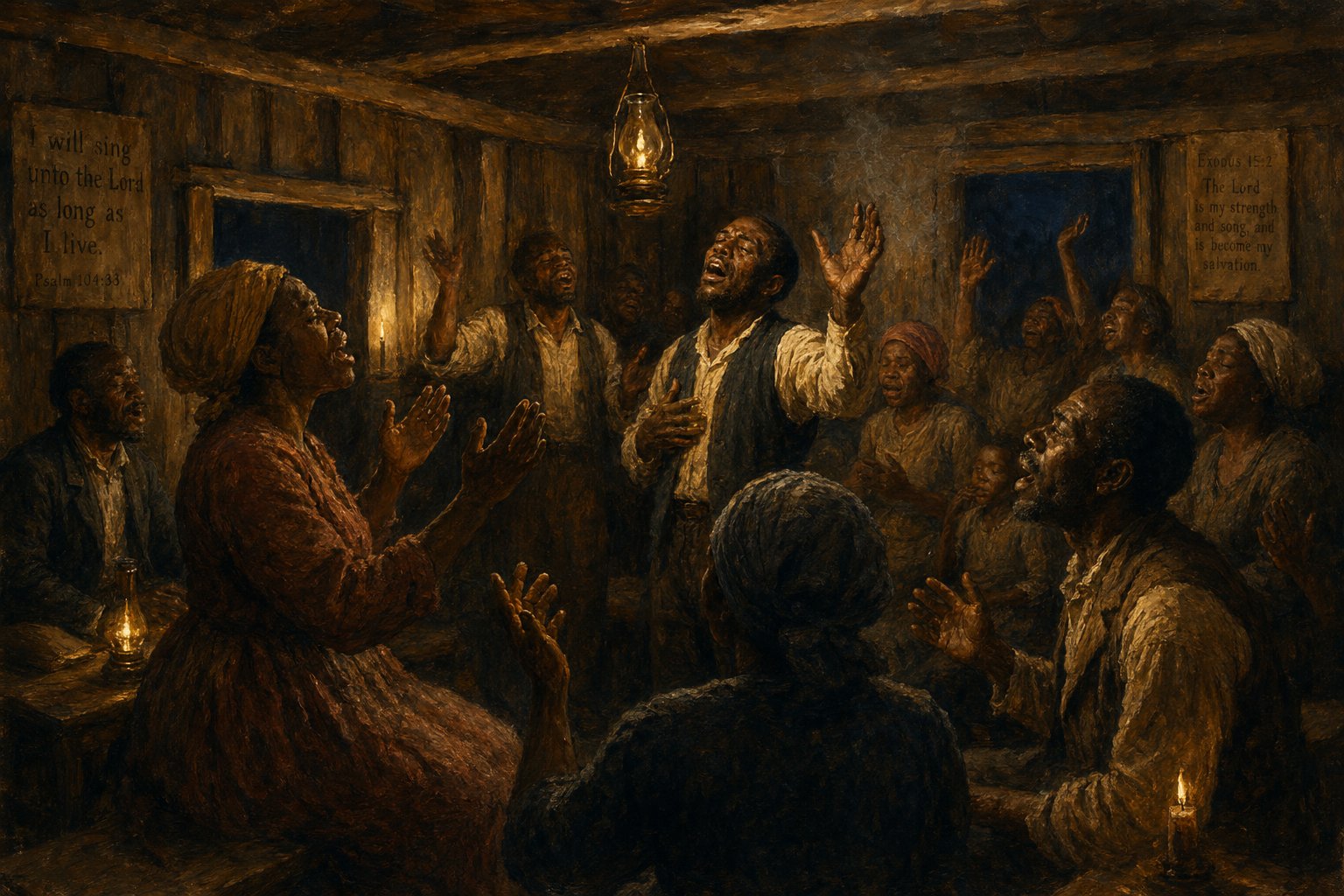
Spirituals like "Swing Low, Sweet Chariot" — "Swing low, sweet chariot, coming for to carry me home" — and "Go Down Moses" — "Go down, Moses, way down in Egypt's land, tell old Pharaoh to let my people go" — functioned on multiple levels at once. They were worship. They were coded communication, with references to the Jordan River and the Promised Land doubling as signals along the Underground Railroad. And they were acts of communal resistance, sung together in praise houses where enslaved people gathered outside the reach of formal church settings.
Work songs and field hollers served a different but equally vital purpose. These improvised songs coordinated the movements of workers, passed the time, and offered encouragement — while also providing a forum for criticizing those in positions of authority. The rhythm wasn't decorative; it was functional, syncing the swing of hammers or the pull of ropes so a group could labor as one body. This folk traditional music gave rise to blues, jazz, rock and roll, and arguably most of modern popular music.
Colonial Ballads and the British Isles Connection
While African traditions were taking root in the South, a parallel stream flowed into the mountains. English, Scottish, and Irish immigrants carried centuries-old ballads to Appalachia and New England, where geographic isolation did something remarkable: it preserved archaic song forms that had already disappeared in Britain itself. Harvard professor Francis James Child cataloged these old folk songs in his landmark ten-volume collection The English and Scottish Popular Ballads (1882-1898), and when collectors like Cecil Sharp ventured into Southern Appalachia in 1916, they found living versions of those same ballads still being sung — unaccompanied, in haunting modal scales, passed from parent to child as naturally as language. These old american songs had survived for generations in the hollows and ridges, untouched by the commercial music industry growing in the cities below.
Songs Born From War and Westward Expansion
War and migration added new chapters. The Civil War produced traditional american songs on both sides of the conflict. Military bands played popular tunes like "When Johnny Comes Marching Home" and "Battle Cry of Freedom" to inspire troops on long marches, while "Battle Hymn of the Republic" became a rallying anthem for the Union cause. Soldiers brought their own banjos, fiddles, and guitars into camp, and the songs they sang — sentimental ballads, comic numbers, patriotic anthems — blurred the lines between folk tradition and popular culture. As the frontier pushed westward after the war, cowboy songs, railroad ballads, and prairie lullabies emerged from the daily rhythms of new kinds of labor and longing.
Taken together, these layers stack into a rich chronological map of how American folk music actually formed:
- African roots — spirituals, field hollers, work songs, and call-and-response traditions (1600s-1800s)
- Colonial ballads — British Isles songs preserved in Appalachian isolation (1700s-1800s)
- Revolutionary-era songs — patriotic anthems and broadside ballads of the new republic
- Civil War anthems — songs from both Union and Confederate camps (1861-1865)
- Frontier and railroad songs — cowboy ballads, work chants, and westward migration music (1860s-1900s)
Every one of these streams fed into the river we now call American folk music. No single tradition owns it. A traditional folk song that became a civil rights anthem might trace its melody to a West African scale and its verse structure to a Scottish ballad. That layering — African, European, Indigenous, and everything that followed — is not a footnote in the story. It is the story. And as these traditions settled into distinct regional pockets across the country, they developed flavors so different from one another that a song from the Appalachian hills and a song from the Louisiana bayou barely sound like they belong to the same genre.
Regional Traditions From Appalachia to the Open Sea
Those regional pockets weren't random. Geography, climate, labor, and the specific immigrant communities that settled each area shaped folk melodies into something unmistakably local. A fiddle tune drifting out of a cabin in the Blue Ridge Mountains carries a completely different emotional weight than a sea shanty bellowed on a New England whaling ship, even though both belong to the same broad tradition. Understanding these regional ecosystems turns a flat genre label into a living map.
Appalachian Ballads and Mountain Music
The Appalachian Mountains created a natural time capsule. Steep ridges and narrow hollows kept communities isolated well into the twentieth century, and that isolation preserved Scots-Irish ballad forms that had already faded in the British Isles. Singers performed unaccompanied or with just a fiddle and banjo, favoring a high, nasal vocal style that could carry across a valley.
The folk ballad tradition here ran deep. "Barbara Allen" alone exists in almost 200 versions, each shaped by the singer's memory and local flavor. "Pretty Polly" — "Oh Polly, Pretty Polly, come go along with me" — told a grim murder story in spare, unflinching language. These weren't songs about fairies or distant kings. As Appalachian State University's research notes, mountain ballads replaced fantastical English subjects with serious, realistic themes drawn from the hard realities of rural life: love gone wrong, betrayal, violence, and the weight of poverty. Folk ballad songs like these were the community's newspaper, courtroom, and confessional rolled into one.
The tradition evolved with the region's economy. When logging and mining companies pushed into western North Carolina and Virginia in the late 1800s, worker camps became fertile swapping grounds for tunes. African American railroad crews introduced work songs like "John Henry" and "Swannanoa Tunnel," adding new rhythmic influences to the mountain sound. Appalachian traditional folk music was never static — it absorbed whatever walked through the door.
Southern Spirituals and Cajun Folk of the Bayou
Move south and the sound shifts dramatically. In the Deep South, African-American churches kept the spiritual tradition alive long after emancipation, developing it into gospel harmonies that would eventually shape soul and R&B. These trad songs carried the same call-and-response structures born in the fields, but the setting changed from forced labor to communal worship, and the emotional register expanded from endurance to celebration.
Along the Gulf Coast, a completely different tradition took root. French settlers helped craft the traditional Cajun music and zydeco of Louisiana, blending French-language lyrics with fiddle, accordion, and triangle. Cajun folk is one of the few American traditional folk music traditions that doesn't default to English, and its dance-driven rhythms — two-steps and waltzes — reflect a culture where music was inseparable from Saturday night gatherings and community celebration.
Sea Shanties, Cowboy Songs, and Prairie Lullabies
Head to the New England coast and you'll find trad folk songs built for a different kind of labor entirely. Sea shanties like "Blow the Man Down" and "Haul Away, Joe" were functional music, their rhythms timed to the pull of ropes and the turning of capstans on whaling ships. A good shantyman kept the crew synchronized the same way a field holler kept a chain gang in step — proof that work songs emerged independently wherever people labored together.
Out West, cowboy songs rose from the open range. "Home on the Range" — "where the deer and the antelope play" — painted an idealized frontier, while "Git Along, Little Dogies" captured the monotony and loneliness of cattle drives. Many of these cowboys were of Anglo-American ancestry, but others had Spanish and Mexican origins, weaving corrido influences into the Western folk ballad. Meanwhile, across the Great Plains, prairie lullabies and farming songs reflected the rhythms of planting, harvest, and the long winters in between.
| Region | Signature Style | Key Instruments | Representative Songs |
|---|---|---|---|
| Appalachia | Unaccompanied ballads, modal singing | Fiddle, banjo, dulcimer | "Barbara Allen," "Pretty Polly" |
| Deep South | Spirituals, gospel harmonies | Voice, hand claps, tambourine | "Swing Low, Sweet Chariot," "Go Down Moses" |
| Gulf Coast / Cajun | French-language dance tunes, zydeco | Accordion, fiddle, triangle | "Jolie Blonde," "Jambalaya" |
| New England | Sea shanties, whaling songs | Voice (unaccompanied), concertina, fiddle | "Blow the Man Down," "Haul Away, Joe" |
| Great Plains | Prairie lullabies, farming songs | Guitar, harmonica, voice | "Red River Valley," "Home on the Range" |
| West | Cowboy ballads, range songs | Guitar, harmonica, fiddle | "Git Along, Little Dogies," "Streets of Laredo" |
What this map reveals is that no single sound defines the genre. Each region developed its own folk melodies, instruments, and storytelling conventions based on who lived there and what kind of work they did. But these streams were never fully separate. Migration, railroads, and traveling musicians carried songs across regional lines constantly, cross-pollinating traditions in ways that blurred the boundaries almost as fast as they formed. A cowboy ballad might pick up a blues inflection in Texas. An Appalachian fiddle tune might absorb a Cajun rhythm after a family relocated to the Gulf. The geography shaped the music, but the music refused to stay put — and when certain songs and performers finally broke through to national audiences, the regional streams merged into something powerful enough to reshape American popular culture entirely.
Iconic American Folk Songs and the Stories Behind Them
Regional traditions gave these songs their flavor, but certain famous folk songs broke free of geography altogether. They crossed state lines, jumped class boundaries, and embedded themselves so deeply in the national consciousness that most people can hum them without knowing where they came from or what they really mean. What follows is not a catalog. It is a guided tour through some of the most important folk music songs ever sung on American soil — and the real stories that gave them life.
Protest Songs That Moved a Nation
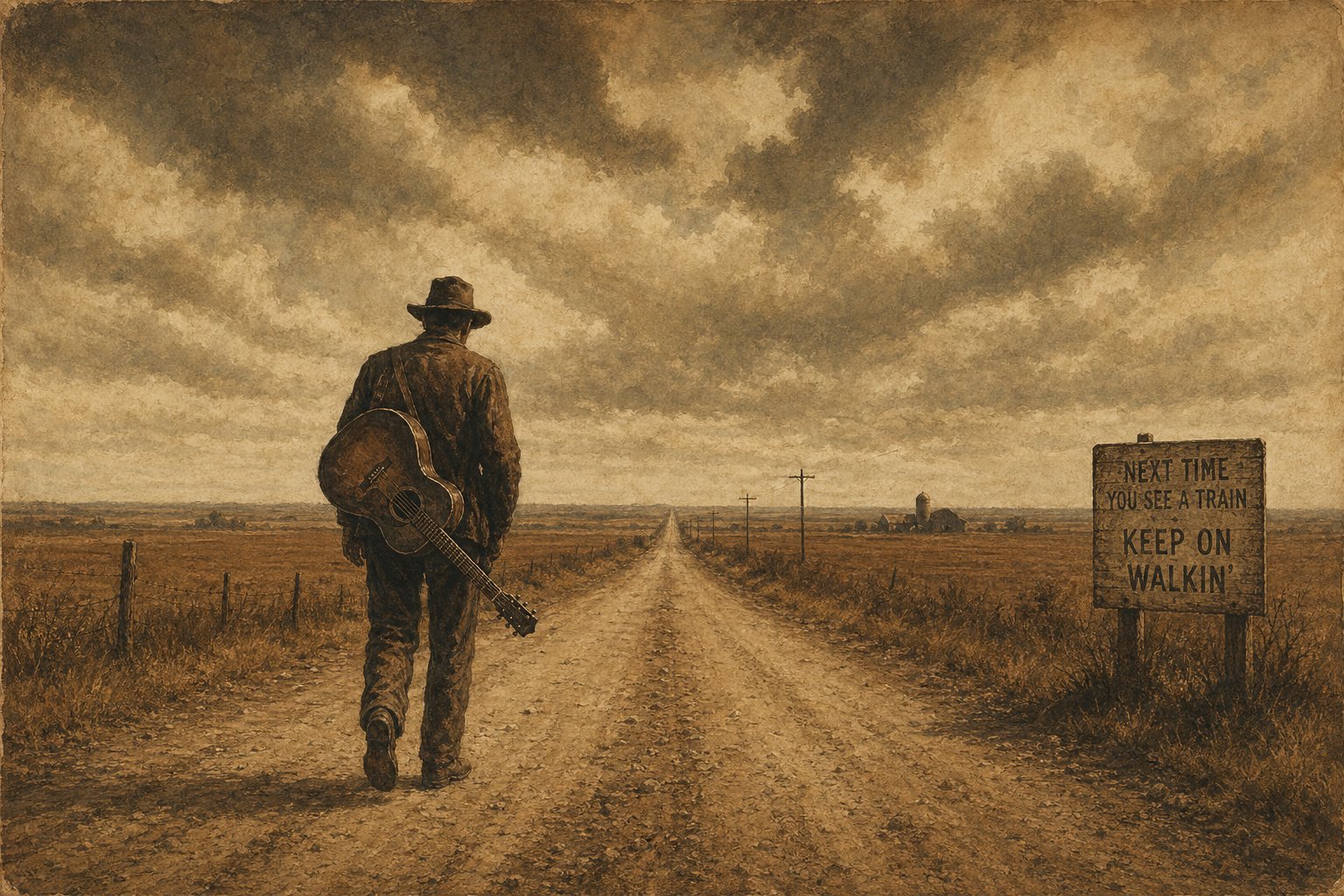
When Woody Guthrie scribbled down "This Land Is Your Land" in February 1940, he wasn't writing a patriotic singalong. He was furious. As the Kennedy Center documents, Guthrie was sick of hearing Irving Berlin's "God Bless America" on the radio — a song he felt was too sappy and too disconnected from the hard-knock reality of Depression-era Americans. He originally titled his response "God Blessed America For Me" and included verses most people have never heard:
As I went walking I saw a sign there, and on the sign it said "No Trespassing." But on the other side it didn't say nothing — that side was made for you and me.
Those radical verses — about private property, about hungry people lining up at relief offices — were dropped before the song reached mainstream audiences. What survived became one of the greatest folk songs in American history, but Guthrie's original vision was sharper, angrier, and more politically charged than the schoolroom version suggests. In 2009, Pete Seeger and Bruce Springsteen finally sang it from start to finish at President Obama's inauguration, restoring Guthrie's complete message to the national stage.
"We Shall Overcome" traveled an even longer road. It began as a hymn, passed through African-American church congregations, and was adapted by striking tobacco workers in the 1940s before becoming the anthem of the civil rights movement in the 1960s. "Which Side Are You On?" came from an equally specific place: Florence Reece, a coal miner's wife in Harlan County, Kentucky, wrote it during a bitter 1931 labor dispute, turning a Baptist hymn melody into a union rallying cry. These popular folk songs didn't just reflect social change — they organized it.
Narrative Ballads and Legendary Characters
Some of the most famous folk music songs are built around real people whose lives became larger than history. "John Henry" tells the story of a steel-driving man who raced a steam-powered drill through a railway tunnel and won — only to die with his hammer in his hand. As historian Richard Polenberg chronicles in Hear My Sad Story, the song is rooted in the real experience of railway tunnel workers, and it became a parable about labor, technology, and human endurance that still resonates.
"Casey Jones" is grounded in an equally specific event. The real Jonathan Luther "Casey" Jones was a railroad engineer with a reputation for speed who crashed his locomotive in Vaughan, Mississippi, in 1900. He stayed at the throttle to slow the train and saved every passenger's life at the cost of his own. The song turned him into a folk hero overnight.
Then there's "Tom Dooley," a murder ballad based on the real 1866 killing of Laura Foster in Wilkes County, North Carolina. Tom Dula was convicted and hanged, but the song lived on — eventually becoming the Kingston Trio's unlikely No. 1 hit in 1958, introducing millions of Americans to the folk ballad tradition for the first time.
Love Songs, Lullabies, and Songs of Home
Not every classic folk song carries a political edge or a body count. Some of the most enduring folk love songs are simply about longing, distance, and the ache of home. "Shenandoah" — "Oh Shenandoah, I long to hear you, away you rolling river" — began as a river trader's song and evolved into one of the most hauntingly beautiful melodies in the American repertoire. "Red River Valley" and "Down in the Valley" follow a similar emotional thread: someone is leaving, someone is staying, and the landscape itself becomes a character in the goodbye.
"Oh! Susanna" occupies more complicated ground. Stephen Foster published it in 1848, and it became a massive hit — but it was written for the blackface minstrel stage. The original lyrics included brutally racist language that has been scrubbed from every version sung today. Foster's legacy is tangled: he wrote melodies that became cornerstones of American folk music, but he did so within a tradition that caricatured and dehumanized Black Americans. Engaging honestly with that history is part of understanding these songs fully.
| Song Title | Category | Era of Origin | Key Associated Artist |
|---|---|---|---|
| This Land Is Your Land | Protest | 1940 | Woody Guthrie |
| We Shall Overcome | Protest / Spiritual | Early 1900s (adapted 1940s-60s) | Pete Seeger |
| Which Side Are You On? | Protest / Labor | 1931 | Florence Reece |
| John Henry | Work Song / Ballad | 1870s-1880s | Lead Belly |
| Casey Jones | Narrative Ballad | 1900 | Mississippi John Hurt |
| Tom Dooley | Murder Ballad | 1860s | The Kingston Trio |
| Shenandoah | Love Song | Early 1800s | Traditional |
| Oh! Susanna | Minstrel / Folk | 1848 | Stephen Foster |
| Red River Valley | Love Song | 1870s-1890s | Traditional |
| Down in the Valley | Love Song / Lullaby | 1840s (earliest versions) | Traditional |
What connects every song on this list — protest anthem, murder ballad, lullaby — is that none of them stayed where they started. Each one was picked up, reshaped, and carried forward by new voices in new circumstances. That process of reinvention is the heartbeat of the folk tradition. And in the mid-twentieth century, a generation of musicians would take these songs famous for their regional roots and project them onto a national stage so large that folk music would never be the same again.
The Folk Revival That Changed Popular Folk Music Forever
That national stage arrived faster than anyone expected. Songs that had lived quietly in rural communities for generations — passed along at kitchen tables and church gatherings — suddenly poured out of coffeehouses, college dorm rooms, and festival stages in the late 1950s and early 1960s. The folk revival wasn't just a musical trend. It was a cultural earthquake that dragged American folk songs out of the archives and into the mainstream, proving they still had the power to move millions.
From Greenwich Village to the National Stage
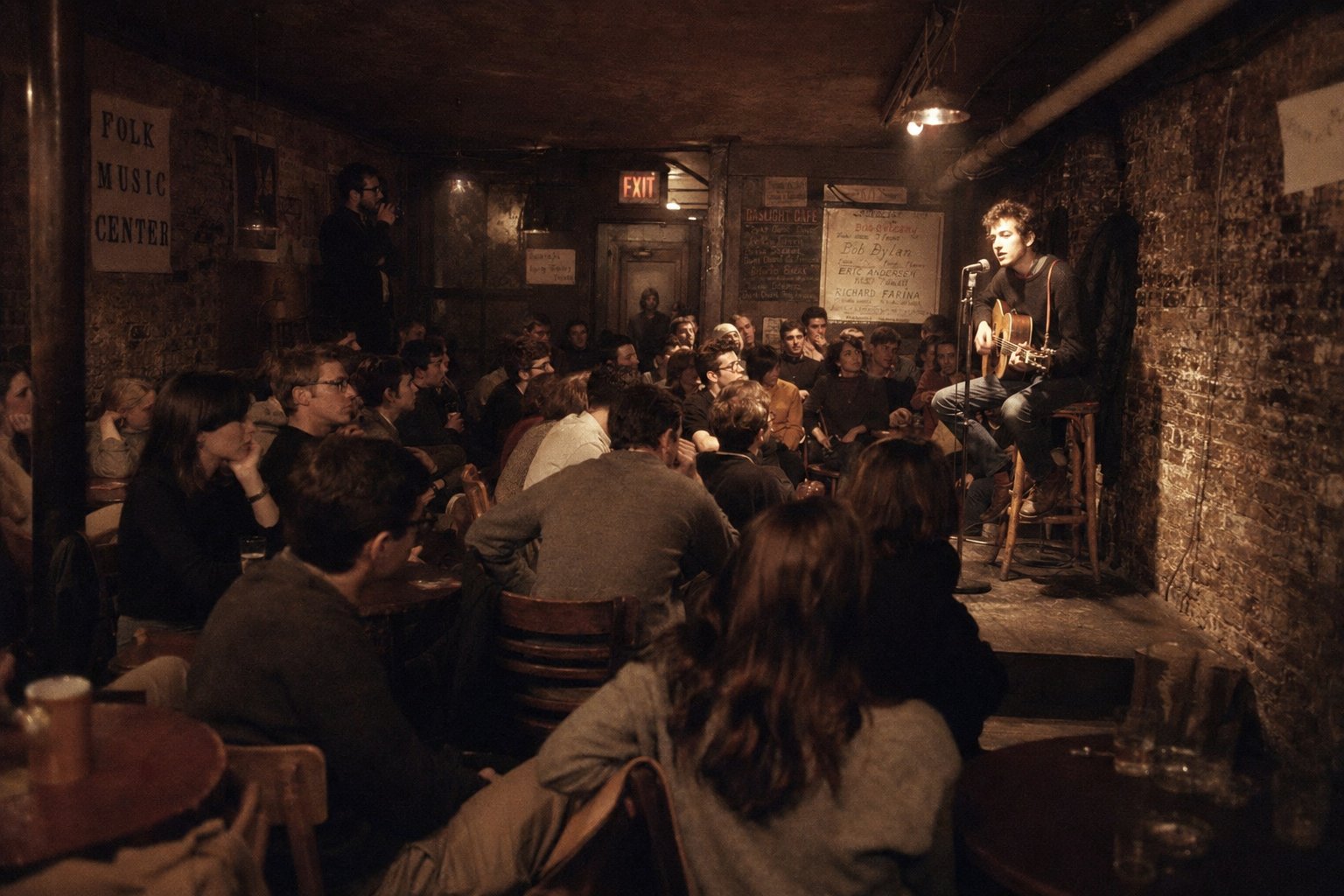
Imagine a cold January night in 1961. A twenty-year-old college dropout from Minnesota walks into Cafe Wha? on MacDougal Street in Greenwich Village and asks to play a few songs. His name is Bob Dylan, and within two years he'll reshape what a folk song can be.
The Village was already buzzing. Washington Square Park hosted weekly singalongs where anyone could join in. Clubs like the Bitter End, Gerde's Folk City, and the Gaslight Cafe lined Bleecker and MacDougal Streets, offering stages to unknowns and legends alike. Dylan had his first professional gig at Gerde's Folk City on April 11, 1961, opening for blues great John Lee Hooker. Peter, Paul and Mary debuted at the Bitter End that same year. Joan Baez, Odetta, Judy Collins, and Phil Ochs all passed through these rooms, trading songs and sharpening their craft in front of small, fiercely attentive audiences.
The groundwork had been laid a few years earlier. Pete Seeger and The Weavers had brought folk to pop charts in the early 1950s with songs like "Goodnight, Irene," and the Kingston Trio's 1958 recording of "Tom Dooley" sold millions of copies, introducing suburban America to the murder ballad tradition. Meanwhile, Folkways Records — founded by Moses Asch in 1948 — was making field recordings commercially available for the first time, giving urban musicians direct access to source material they'd never otherwise hear. By the time 1960s folk music exploded, the pipeline between rural tradition and urban performance was wide open.
Folk as the Soundtrack of Social Change
What made the revival more than a nostalgia trip was its collision with politics. As the Smithsonian Institution documents, folk music gave voice to a generation longing for equality and justice as the civil rights movement gained momentum. Songs became organizing tools. "Blowin' in the Wind" asked questions no politician would answer. "If I Had a Hammer" turned a simple metaphor into a call for solidarity. "Where Have All the Flowers Gone" made the cost of war feel personal and immediate. These weren't background music — they were sung arm-in-arm at marches, sit-ins, and rallies, binding strangers into a collective voice.
Peter, Paul and Mary performed at the March on Washington in 1963 and again at the Selma-to-Montgomery March in 1965. Joan Baez stood beside Martin Luther King Jr. "We Shall Overcome" — already decades old — became the anthem that held the movement together. The 60s folk songs that defined this era proved that folk music was not a museum piece but a living force, capable of shaping history in real time.
Key milestones of the revival tell the story in compressed form:
- 1959 — First Newport Folk Festival draws thousands to Rhode Island, establishing the genre's premier live stage
- 1962 — Bob Dylan signs with Columbia Records and begins recording original folk song material with literary ambition
- 1963 — Peter, Paul and Mary and Joan Baez perform at the March on Washington before 250,000 people
- 1965 — Dylan goes electric at Newport, splitting the folk world and igniting the folk-rock revolution
- 1965 — The Byrds release "Mr. Tambourine Man," fusing Dylan's lyrics with electric guitars and launching rock folk music as a genre
That last milestone mattered enormously. When Dylan plugged in and The Byrds electrified his songs, the boundary between folk and rock dissolved. Simon and Garfunkel — who had started as "Kane & Garr" playing Monday nights at Gerde's Folk City — rode the same wave to mainstream success. The folk-rock fusion injected social consciousness and poetic lyricism into popular music at a scale neither genre could have reached alone. And the ripple kept spreading: 70s folk songs by artists like Joni Mitchell, James Taylor, and Cat Stevens carried the singer-songwriter tradition forward, trading protest anthems for introspective storytelling while keeping the acoustic intimacy and lyrical honesty that 60 folk music had revived.
The revival generation didn't just perform old songs. They proved that the folk tradition could absorb new voices, new causes, and new sounds without losing its soul. Behind every performer who stepped onto those coffeehouse stages, though, stood specific individuals whose artistry and conviction made the whole movement possible.
Legendary Artists Who Shaped the Sound of Famous Folk Music
Every movement needs faces, voices, and stubborn personalities willing to carry the torch when the crowd thins out. The folk revival didn't happen in the abstract. It was driven by specific people who lived the tradition, fought for it, and in some cases sacrificed their careers to keep it alive. Here are the famous folk singers who mattered most — and why.
The Pioneers and Tradition Bearers
Woody Guthrie arrived from the Oklahoma dust storms with a battered guitar famously labeled "This Machine Kills Fascists." As a dust bowl balladeer, he wrote hundreds of songs — "This Land Is Your Land," "Pastures of Plenty," the sixteen-verse "Ballad of Tom Joad" — that turned the lives of migrant workers and the dispossessed into poetry. John Steinbeck reportedly sent him a postcard after hearing the Tom Joad ballad: "You sonofabitch! It took me 250 pages to get the Joads from Oklahoma to California, and you did it in two verses." Guthrie didn't just write folk best songs. He proved that ordinary experience deserved the same artistic attention as anything in a concert hall.
Lead Belly — Huddie William Ledbetter — was the King of the 12-String Guitar and, in Woody's own estimation, the most important folk singer of the twentieth century. His repertoire was staggeringly broad: blues, spirituals, protest songs, children's songs, love songs, ballads. His signature "Goodnight, Irene" became Life Magazine's Song of the Half-Century in 1950 after The Weavers' recording held the No. 1 spot for thirteen weeks. Lead Belly bridged African-American folk traditions and mainstream audiences at a time when that bridge barely existed.
Pete Seeger, dubbed "America's Tuning Fork," kept communal folk singing alive for over six decades. He co-founded The Weavers, taught "We Shall Overcome" to Martin Luther King Jr. (changing "will" to "shall" in the process), and almost single-handedly created the folk revival of the 1950s and '60s — all while enduring a seventeen-year blacklist for his political beliefs. From McCarthyism to civil rights to environmental conservation, Pete embodied the idea that a song could be a tool for change.
"The songs themselves had the infinite sweep of humanity in them... [Guthrie] was the true voice of the American spirit. I said to myself I was going to be Guthrie's greatest disciple." — Bob Dylan
The Revival Generation and Beyond
Bob Dylan took that discipleship and ran somewhere Guthrie never imagined. Arriving in Greenwich Village as a Guthrie imitator, he quickly evolved into something unprecedented: a folk songwriter with literary ambition and a rock and roll attitude. Songs like "Blowin' in the Wind" and "The Times They Are a-Changin'" gave the movement its sharpest lyrics, and when he went electric in 1965, he cracked open the genre's boundaries forever. Dylan remains the single most influential figure among popular folk music artists for a reason: he showed that the tradition could hold anything a writer dared to put into it.
Joan Baez was folk royalty from the moment she took the stage at Newport in 1959. Her clear soprano voice and fearless activism made her the moral center of the movement. She performed at the March on Washington in 1963, went to jail for protesting the Vietnam War, and lent her voice to every cause she believed in — from immigrant labor rights to environmental protection. Her self-titled debut album reached the Top 20, an improbable feat for an album of traditional folk ballads at the time.
Odetta Holmes — known simply as Odetta — is the artist who inspired both Dylan and King. Her deep, powerful voice and commanding stage presence earned her the title "The Voice of the Civil Rights Movement." She took spirituals, work songs, and blues and delivered them with an intensity that made audiences feel the weight of history in every note. Among the best folk artists of the era, Odetta remains one of the most underappreciated.
Peter, Paul and Mary brought folk singing into living rooms across America. Their polished harmonies on "If I Had a Hammer," "Blowin' in the Wind," and "Puff, the Magic Dragon" made AM radio a vehicle for social consciousness, introducing millions of casual listeners to songs and ideas they might never have encountered otherwise.
The thread didn't stop there. Joni Mitchell and James Taylor carried folk's introspective honesty into the 1970s singer-songwriter movement, while later acts from Ani DiFranco to Fleet Foxes have continued pulling from the same well — proving the tradition regenerates with every generation that picks it up.
| Artist | Active Era | Signature Songs | Primary Contribution |
|---|---|---|---|
| Woody Guthrie | 1930s-1950s | "This Land Is Your Land," "Pastures of Plenty" | Established the protest folk songwriter tradition |
| Lead Belly | 1930s-1940s | "Goodnight, Irene," "Bourgeois Blues" | Bridged African-American folk and mainstream audiences |
| Pete Seeger | 1940s-2010s | "If I Had a Hammer," "Where Have All the Flowers Gone" | Kept communal singing and activism alive for six decades |
| Bob Dylan | 1960s-present | "Blowin' in the Wind," "The Times They Are a-Changin'" | Brought literary depth and rock energy to folk songwriting |
| Joan Baez | 1959-2019 | "Diamonds & Rust," "We Shall Overcome" | Voice of the civil rights and anti-war movements |
| Odetta | 1950s-2000s | "Water Boy," "Sometimes I Feel Like a Motherless Child" | Fused spirituals and folk with civil rights power |
| Peter, Paul and Mary | 1961-2009 | "If I Had a Hammer," "Puff, the Magic Dragon" | Brought folk to mainstream pop radio |
These famous folk music artists didn't work in isolation. Every one of them drew from a deep reservoir of songs and recordings that someone else had painstakingly gathered, preserved, and made available. The artists got the spotlight, but behind them stood a quieter group of people without whom much of this music would have vanished entirely — the collectors and archivists who went looking for songs before they disappeared.
The Collectors and Archives That Preserved Traditional Folk Songs
Artists performed the songs. Audiences carried them forward. But someone had to find them first. Much of what we recognize as American folk music survived only because a handful of obsessive collectors loaded recording equipment into cars and drove thousands of miles down barely paved roads, chasing melodies that were one generation away from silence.
The Lomax Family and Their Field Recordings
No family did more to preserve folk songs from America than the Lomaxes. John A. Lomax, a Texas-born scholar with a passion for cowboy ballads, became the honorary curator of the Archive of American Folk-Song at the Library of Congress in 1933. He brought along his teenage son Alan, and together they set out across the American South with a 300-pound portable recording machine strapped to the back of their car.
They recorded in prisons, on sharecropper porches, in church halls, and at lumber camps — anywhere traditional music songs still lived in their raw, unpolished form. It was during a 1933 visit to Louisiana's Angola Prison that they encountered Huddie Ledbetter, better known as Lead Belly, whose vast repertoire became one of the most important samples of folk music ever captured on disc.
Alan Lomax carried the mission even further. By 1938, the Library of Congress had dispatched him — already a seasoned field worker at age 23 — on a folk song survey of the Great Lakes region. He traveled in a 1935 Plymouth sedan with a Presto disc recorder, returning months later with 250 instantaneous discs documenting an incredible range of ethnic diversity. His career eventually spanned fieldwork across the Bahamas, the Caribbean, Italy, Spain, and beyond, producing a collection of approximately 6,400 sound recordings, 5,500 graphic images, and 6,000 moving images. The result is the largest archive of traditional folk music songs in existence — a living catalog that revival-era musicians like Bob Dylan and Joan Baez mined for source material.
Smithsonian Folkways and the Library of Congress
The Lomaxes weren't working alone. In 1948, recording engineer Moses Asch founded Folkways Records with an unusual philosophy: document everything, sell nothing at a loss, and never chase a hit. His son Michael recalled him saying, "Capitalism is a wonderful, wonderful system — so long as you don't believe in the profit motive." Asch released roughly 2,200 albums before his death in 1986, averaging one new title per week. The catalog ranged from the foundational 84-track Anthology of American Folk Music to field recordings of spirituals, work songs, and regional traditions that no commercial label would touch. He also made Folkways a home for the marginalized — victims of the Red Scare, civil rights activists, and communities whose voices other labels refused to carry.
When the Smithsonian Institution acquired Folkways in 1987, one condition of the sale was that all 2,200 titles had to remain available in perpetuity. That commitment turned the archive into a permanent public resource — a browsable list of traditional folk songs and examples of folk music songs spanning nearly every regional and ethnic tradition in the country.
Meanwhile, the American Folklife Center at the Library of Congress — originally founded as the Archive of American Folk Song in 1928 — grew into the nation's most comprehensive repository of traditional culture documentation. Its holdings include multiformat materials in both analog and digital formats, covering folk traditions from across the United States and around the world.
Together, these institutions ensured that obscure regional songs became accessible to researchers, musicians, and anyone curious enough to listen. Here are the key archival resources that keep this music alive:
- Smithsonian Folkways Recordings — over 2,200 albums spanning folk, world music, spoken word, and field recordings, all available in perpetuity
- Library of Congress American Folklife Center — the nation's oldest and largest archive of folk culture, founded in 1928
- The Alan Lomax Archive — thousands of field recordings, manuscripts, photographs, and films from decades of global fieldwork
- The Association for Cultural Equity — Alan Lomax's nonprofit, dedicated to making his life's work freely accessible through digitization
The preservation work hasn't stopped. Digitization projects are steadily converting fragile acetate discs and deteriorating reel-to-reel tapes into freely accessible online collections, connecting new generations to source material that was once locked in climate-controlled vaults. A teenager with a laptop can now hear the same prison recordings that inspired Lead Belly's career or browse the same field recordings that shaped the entire folk revival. The gatekeepers are gone. The archive is open. And that accessibility raises a natural question: what happens when a tradition this deep meets a generation with entirely new tools for making music?
Carrying the Tradition Forward and Making It Your Own
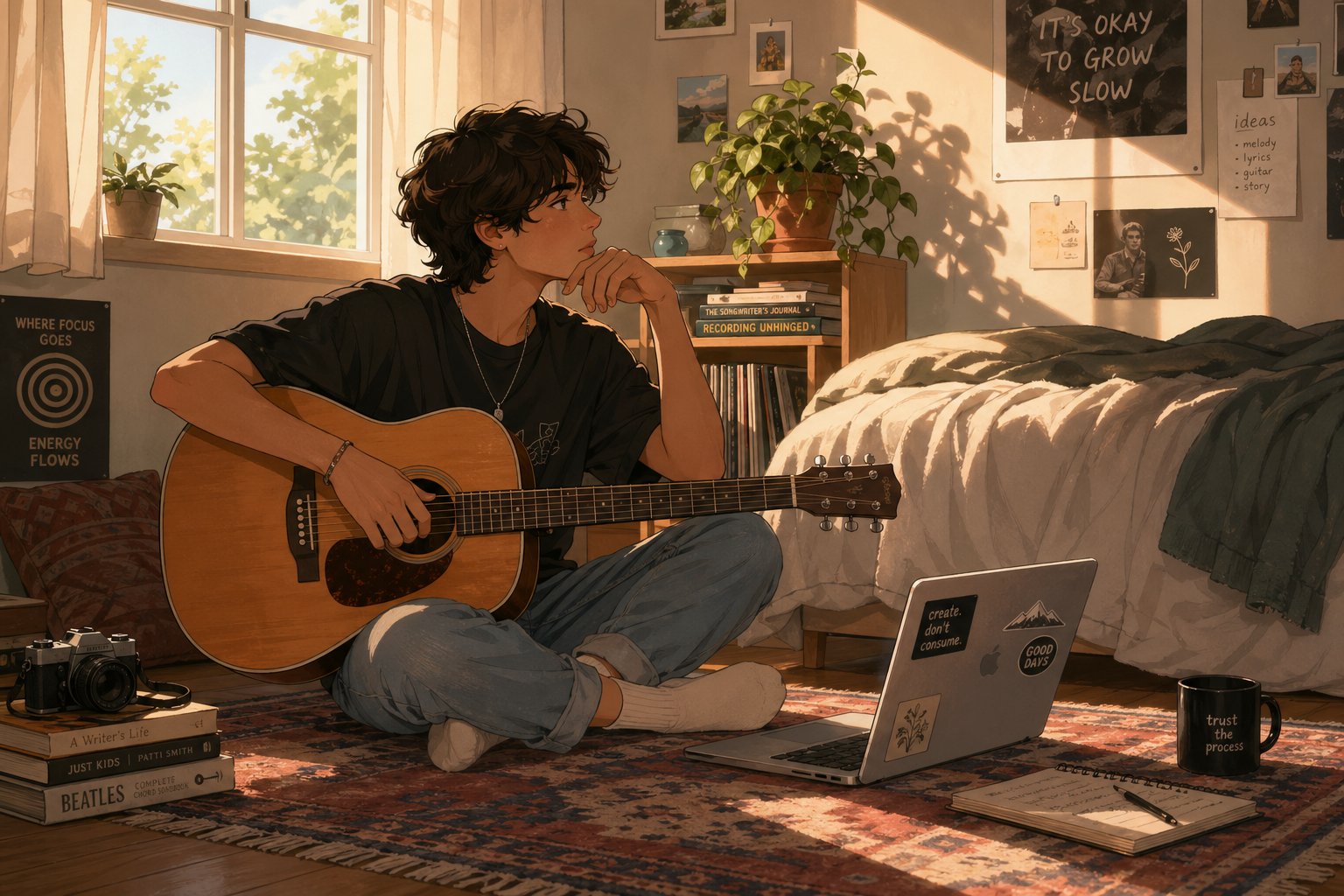
Open archives and digitized field recordings have done something remarkable: they've erased the distance between a 1930s prison yard and a bedroom producer's laptop. The raw material is available. The question is what this generation — and the next — will do with it.
Modern Folk and the Living Tradition
Folk music was never meant to be frozen in amber. The whole point of the tradition is that it moves, adapts, and absorbs whatever the current moment demands. Today's americana folk music scene reflects that restlessness. Indie folk acts like Fleet Foxes and Bon Iver blend Appalachian harmonies with ambient production. Artists like Rhiannon Giddens dig directly into African-American string band traditions and bring them to new audiences with scholarly precision and raw emotional power. The Americana format itself keeps expanding, welcoming blues-rock, soul, and string band music under a tent that grows wider every year.
What connects all of it — freak folk, neo-traditional balladeers, Americana singer-songwriters — is the same principle that defined the tradition from the start: ordinary people making music about their lives. You don't need a conservatory degree or a record deal. You need a story, a melody, and the willingness to share it. Many listeners exploring the best folk songs of all time through Smithsonian Folkways or the Lomax Archive discover something surprising: these songs feel accessible. They were built to be sung by anyone, and that invitation still stands.
Creating Your Own Folk-Inspired Music
Engaging with the american folk tradition doesn't have to mean passive listening. Some of the best ever folk songs started with someone picking up a guitar and reworking a melody they half-remembered. You can do the same. Learn "Shenandoah" or "John Henry" from a field recording and make it yours — change a verse, shift the tempo, sing it in your own voice. Write lyrics rooted in your community or personal experience. Experiment with regional styles that caught your ear earlier in this article, whether that's Appalachian modal singing or Cajun fiddle rhythms.
The barrier to entry has never been lower. For readers curious about hearing how folk elements translate into original compositions, tools like MakeBestMusic's AI Song Generator let you turn a folk style, mood, or lyric idea into a royalty-free original track in seconds. Want to hear what an Appalachian ballad sounds like with a bluegrass arrangement? Or how a protest song melody works over an Americana groove? You can explore those sounds without needing instruments or recording equipment — just a concept and a few clicks.
Here are practical ways to step into the tradition yourself:
- Learn a traditional song from a field recording or the Smithsonian Folkways digital archive and put your own spin on it
- Attend a local folk festival, singaround, or open mic — these are the modern equivalents of the porch sessions where folk music best songs were born
- Write a song about something real in your life or community, using simple chord structures and honest language
- Experiment with AI-assisted composition to hear folk styles brought to life and spark new creative directions
The top folk songs in the American canon weren't written by professionals trying to land a hit. They were made by people with calloused hands and something to say. That's still the only qualification. Whether you're learning "Barbara Allen" on a secondhand guitar, writing cool folk songs about your own town, or using digital tools to sketch out a melody you can't get out of your head, you're participating in the same process that built this tradition across four centuries. Folk music belongs to everyone. That is, after all, what makes it folk.
