

What Blues Music Really Means and Why It Still Matters
You've heard blues in every rock riff, every soul ballad, every hip-hop sample that makes you feel something. You just might not have known it. Among all music genres, blues stands apart not because it's old, but because it's foundational. Strip away the layers of nearly any popular song, and you'll find blues DNA at its core.
So what exactly is this genre, and why does it carry so much weight?
What Is Blues Music and Why Does It Matter
Blues music is a genre rooted in African American oral traditions, work songs, and spirituals, defined by expressive vocal delivery, blue notes, and repeating chord structures that convey deep emotional truth.
That definition covers the basics, but it only scratches the surface. Blues music emerged in the American South after the Civil War, shaped by work songs, field hollers, minstrel show music, ragtime, and church music. Its signature sound comes from a specific set of musical tools: the 12-bar chord progression, bent "blue" notes that sit between major and minor, call-and-response patterns between voice and instrument, and a rhythmic shuffle that swings rather than marches. These elements give the genre its unmistakable feel, a sound that's structured enough to learn in an afternoon yet deep enough to spend a lifetime exploring.
Blues as Music and Blues as Culture
Here's where things get interesting. Blues isn't just a musical form. It's a cultural tradition, an expression of the African American experience that, as PBS's landmark 2003 documentary series The Blues put it, "speaks of universal emotions." That seven-film series, executive produced by Martin Scorsese and directed by filmmakers like Clint Eastwood and Wim Wenders, traced the genre from its African roots through its role in shaping virtually every corner of modern music. Understanding both layers, the technical craft and the lived experience behind it, is essential for appreciating the many types of blues that branched out over the past century.
Willie Dixon, one of the genre's most prolific songwriters, said it best: "The blues are the roots; everything else is the fruits." In the sections ahead, you'll learn exactly how those roots took hold, what makes the music tick on a theoretical level, and how every major subgenre grew from the same soil.
The Origins of Blues From the Delta to the Great Migration
Those roots Willie Dixon talked about? They stretch back much further than the Mississippi Delta. To understand what is blues music at its deepest level, you have to cross an ocean.
From Field Hollers to the First Blues Songs
Long before anyone called it "the blues," the building blocks of the genre traveled from West Africa to the American South in the memories of enslaved people. The griot tradition is one of the clearest threads. In West African culture, a griot is a singer-historian who keeps oral histories alive through song, accompanying himself on a stringed instrument like the kora while others sit and listen. Unlike most West African music, which centers on group drumming and dance, the griot performs solo, telling stories layered with social commentary. Sound familiar? That's essentially the blueprint for a Delta blues singer with an acoustic guitar.
Alongside the griot tradition, enslaved Africans carried pentatonic scales, call-and-response vocal patterns, and a deep connection between music and daily labor. These elements fused with the realities of plantation life to produce field hollers, work songs, and spirituals, each one a survival tool wrapped in melody. By the late 1800s, these threads wove together in the Mississippi Delta, and the earliest recognizable types of blues music began to take shape: raw, personal, and built on repetition and emotional truth.
How the Great Migration Rewired Blues Forever
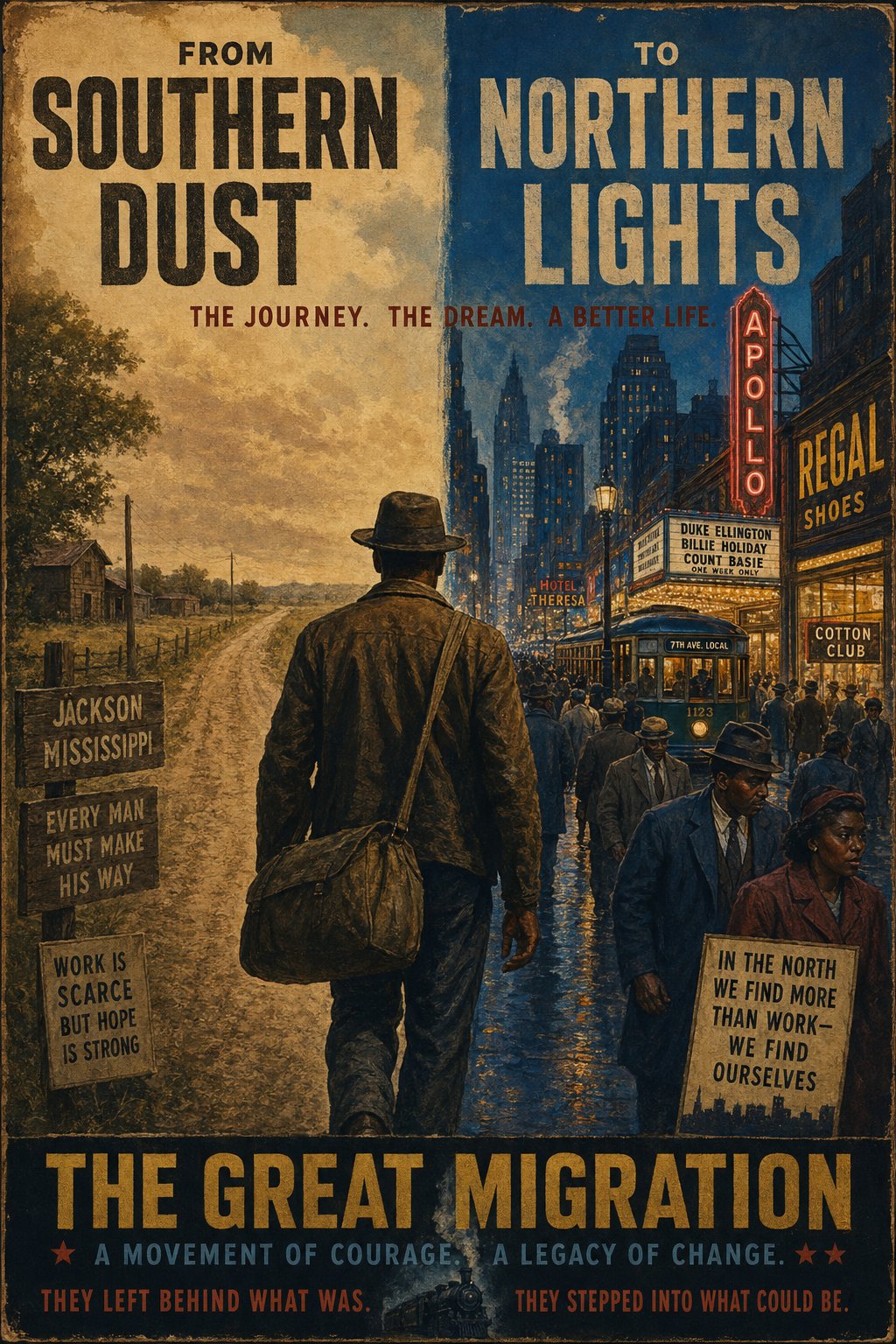
The blues might have stayed a regional folk tradition if not for one massive demographic shift. Beginning in the early 1900s and accelerating through the 1940s, more than six million Black Americans left the rural South for Northern and Midwestern cities, fleeing Jim Crow laws and seeking better opportunities. They brought their music with them, and the cities changed it forever.
Imagine trading the quiet of a cotton field for the steel and noise of industrial Chicago. Blues singers like Muddy Waters and Howlin' Wolf didn't just relocate. They plugged in, swapping acoustic guitars for electric ones, adding drums, bass, and amplified harmonica to cut through crowded club rooms. The migration didn't create one new sound. It created several:
- Mississippi Delta to Chicago — acoustic Delta blues became amplified, band-driven electric blues, recorded by labels like Chess Records
- Memphis to urban centers and the West Coast — rural blues absorbed jug band energy and R&B influences, eventually fueling jump blues
- Texas to regional touring circuits — a distinct style emerged emphasizing clean single-note guitar lines and jazz-inflected phrasing
Each migration path produced its own regional identity, its own roster of blues singers, and its own sonic fingerprint. The cultural upheaval of the Great Migration didn't just move people. It split one genre into an entire family of styles, from bright and brassy to dark blues drenched in minor keys and slow tempos.
But what exactly makes all of these styles sound like "blues" rather than something else entirely? That answer lives in a handful of musical building blocks that every subgenre shares.
The Sound of Blues and What Makes It Unique
Every blues subgenre, from raw Delta acoustic to polished Chicago electric, shares a common musical vocabulary. You don't need a music degree to hear it. Once you understand a few core building blocks, you'll start recognizing them everywhere, not just in the blues genre itself, but in rock, jazz, soul, and beyond.
The 12-Bar Blues Chord Progression Explained Simply
Think of the 12-bar blues as a repeating loop of twelve measures that gives a song its shape. It uses just three chords, labeled with Roman numerals: I (the home chord), IV (four steps up), and V (five steps up). This numbering system works in any key, which is part of why the form is so universal. In the key of A, for example, I is A, IV is D, and V is E.
Here's how those three chords lay out across twelve bars:
| Bars 1-4 | I | I | I | I |
|---|---|---|---|---|
| Bars 5-8 | IV | IV | I | I |
| Bars 9-12 | V | IV | I | I (or V turnaround) |
That's it. This progression usually loops for the entire song, and it underpins thousands of tracks across the blues music genre, rock and roll, and jazz. Chuck Berry's "Johnny B. Goode," Stevie Ray Vaughan's "Pride and Joy," and countless jazz standards all ride this same 12-bar frame. The form is lyrically divided into three four-bar phrases, too. Traditionally, the first two lines repeat the same lyric, and the third line delivers a resolution, a storytelling pattern as old as the genre itself.
Blue Notes and the Blues Scale
If the chord progression provides structure, blue notes provide feeling. These are the tones that make you wince, lean in, or feel a knot in your chest. Technically, blue notes are the flatted 3rd, 5th, and 7th degrees of the major scale, pitches that sit slightly outside the standard Western tuning system. Their origins trace back to West African musical traditions that frequently used microtones, intervals smaller than a half step that don't exist on a piano keyboard.
When a guitarist bends a string or a singer slides between pitches, they're reaching for those in-between tones, creating tension and emotional pull that straight notes simply can't deliver. That's the real fingerprint of the blues genre: not sadness exactly, but raw, unresolved feeling.
The blues scale itself is a practical tool built around these notes. It's a six-note scale, essentially a minor pentatonic with one extra chromatic note, the flatted 5th, wedged between the 4th and 5th degrees. In C, that gives you C, Eb, F, Gb, G, and Bb. Simple to learn, endlessly expressive to play. Different types of blues lean on this scale in different ways, but it's the common thread running through all of them.
Shuffle Rhythm and Call-and-Response
You know that swinging, lopsided groove that makes your head nod a little differently than a straight rock beat? That's the shuffle rhythm. Instead of dividing each beat into two equal eighth notes, the shuffle stretches the first note and shortens the second, creating a long-short, long-short feel that swings. This rhythmic DNA passed directly from blues into early rock and roll and remains one of the easiest ways to spot blues influence in any song.
Layered on top of that groove is call-and-response, a conversational pattern inherited from African musical traditions. A vocalist sings a phrase, and the guitar, harmonica, or piano "answers" in the gap. It's a dialogue, not a monologue, and it gives blues performance its sense of spontaneity and intimacy. Even in a tightly arranged band setting, you'll hear this back-and-forth exchange driving the music forward.
If the 12-bar progression is the skeleton of blues, blue notes are its soul.
Together, these elements, the 12-bar form, blue notes, the blues scale, shuffle rhythm, and call-and-response, form the shared musical language that connects every corner of the blues family. The differences between subgenres come down to how each regional tradition remixed these same ingredients with its own instrumentation, tempo, and attitude.
Major Types of Blues From Delta to Chicago and Beyond
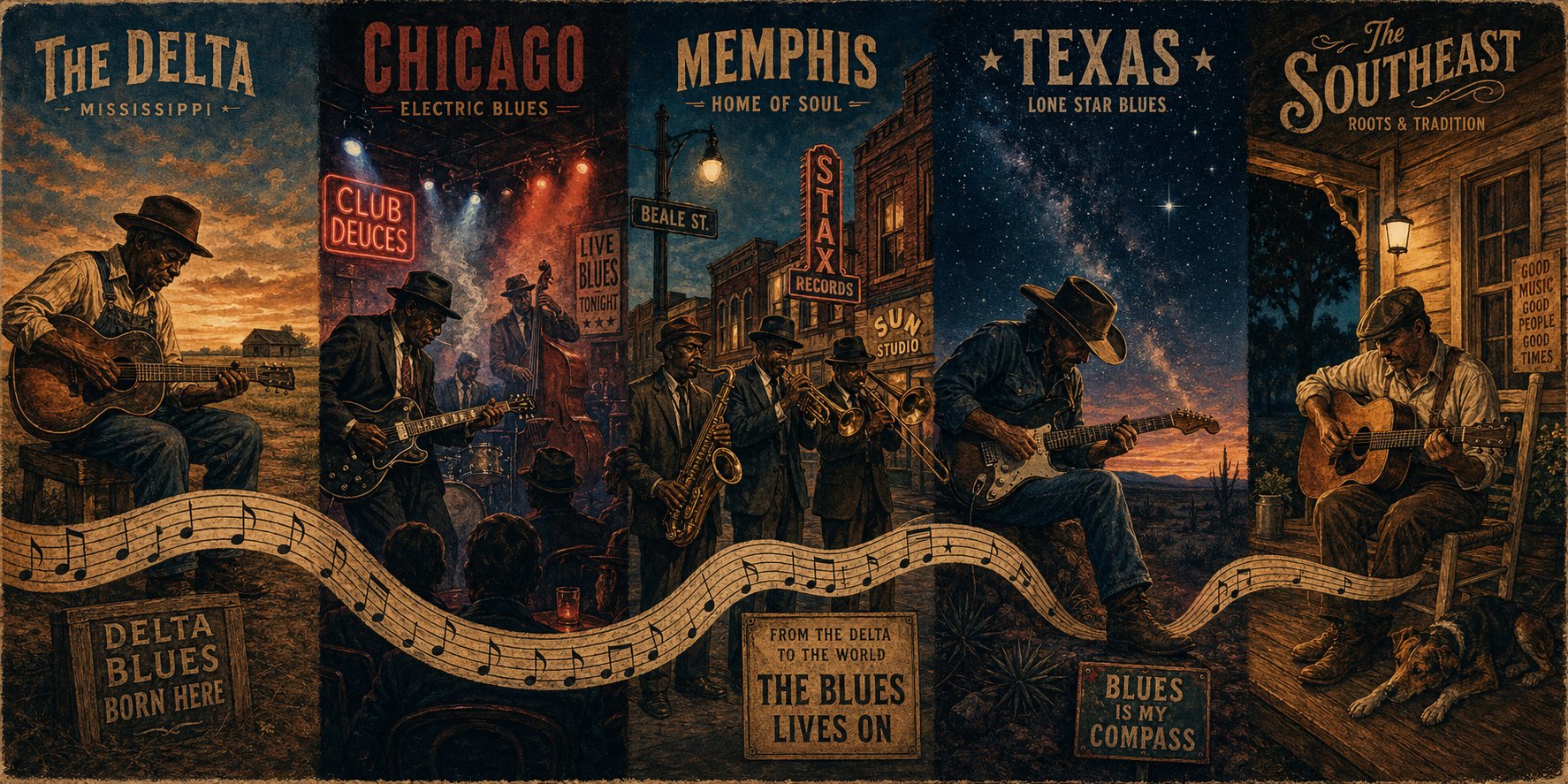
Instrumentation, tempo, attitude. Those are the variables that split one genre into a whole family of regional styles. Each major type of blues took the same musical building blocks, the 12-bar form, blue notes, shuffle rhythm, and shaped them around the geography, culture, and circumstances of the people playing them. Here's how the blues in music branched out across the American landscape.
Delta Blues and Country Blues
This is where recorded blues begins. Delta blues refers specifically to the acoustic style that emerged from the flat, cotton-growing lowlands of northwestern Mississippi, roughly the area between Vicksburg and Memphis. Picture a single performer, an acoustic guitar, a voice, and nothing else. The sound is raw, rhythmically complex, and deeply personal.
You'll often see the terms "country blues," "rural blues," and "Delta blues" used interchangeably, but they aren't quite the same thing. Country blues is the broader umbrella covering all early acoustic, rural-based blues styles across the South. Delta blues is the Mississippi-specific regional variant within that umbrella, distinguished by its heavy use of bottleneck slide techniques, driving rhythmic guitar patterns, and vocals that range from moaning to fierce.
Charley Patton is widely regarded as the father of Delta blues. A flashy, hard-living performer who was famous across the Delta, Patton laid out the blueprint with complex syncopated rhythms and a gravelly vocal delivery that influenced virtually everyone who followed. He recorded his classic sides between 1927 and 1934, during a brief window when record companies sent scouts to Mississippi searching for bluesmen to capture on wax.
Son House, tall and intense, played with extreme emotional ferocity and became the main inspiration for a young Robert Johnson, who saw him perform live. Johnson, despite recording only 29 songs before his death at 27, became the most mythologized figure in blues history. His intricate guitar work and haunting vocals refined what Patton and House had started, creating a template that later artists carried north to the cities. Skip James added another dimension entirely, playing in eccentric open tunings and singing in a thin, chilling style that stood apart from his Delta peers.
Delta blues peaked in the late 1920s and early 1930s. When the Great Depression hit and people could no longer afford records, the recording boom collapsed. Many of these artists were forgotten until the folk and blues revival of the 1960s brought them back to stages and studios.
Chicago Electric Blues and Memphis Blues
When Delta musicians migrated north to Chicago, they didn't just bring their songs. They brought an entire musical philosophy. The difference was volume. Rowdy South Side clubs demanded louder music, and acoustic guitars couldn't cut through the noise. So the blues got electrified.
Muddy Waters is the central figure in this transformation. Already recorded as a Delta musician by Alan Lomax in Mississippi, he moved to Chicago and translated that Delta style into a whole new type of blues. Distorted electric guitars, amplified harmonica, bass, drums, and piano came together in a sound that was still raw but unmistakably urban. His premier band, featuring Little Walter on harp, Jimmy Rogers on guitar, and Otis Spann on piano, essentially defined what a Chicago blues band should sound like. That template, established in the early 1950s on Chess Records, hasn't fundamentally changed since.
Howlin' Wolf brought his own ferocious energy to the Chicago scene, along with Otis Rush, Magic Sam, and Buddy Guy. The blues genre of music owes an enormous debt to this era. Chicago electric blues gave the genre its full-band identity and directly set the stage for rock and roll.
Memphis blues, meanwhile, developed its own personality about 300 miles south. Memphis already had a rich entertainment tradition on Beale Street, including vaudeville, jug band music, and jazz. When blues arrived, it absorbed all of those flavors. The result was a style that's harder to pin down than Chicago's straightforward power, more of a musical gumbo with horns playing a big part in both the instrumentation and the attitude.
B.B. King is the towering figure of Memphis blues. He came up from the Delta, landed steady work and a radio show on West Memphis station WDIA, and developed a guitar style that mixed blues feeling with urban jazz sophistication. Albert King also did much of his recording in Memphis for Stax Records, covering a wide range of stylistic ground. Where Chicago blues hits you with a fist, Memphis blues pulls you in with rhythm, call-and-response interplay, and a touch of something celebratory underneath the sorrow.
Texas Blues and Piedmont Blues
Texas blues covers a lot of ground, which makes sense for a state that size. The style shares DNA with Chicago blues but adds its own swagger: clean single-note guitar lines, jazz-influenced chord voicings, and an energy that borders on rock and roll.
The lineage runs deep. Blind Lemon Jefferson was among the very first blues artists ever recorded, laying early groundwork in the 1920s. T-Bone Walker pioneered the electric guitar as a lead instrument and brought jazzy sophistication to the sound. Freddie King, known as "The Texas Cannonball," played with explosive force. And then there's Stevie Ray Vaughan, whose seismic influence in the 1980s made Texas blues a household term. What connects all of them is attitude, a willingness to play with abandon and swing that feels distinctly Texan.
Piedmont blues sits on the opposite end of the spectrum, both geographically and sonically. Rooted in the Southeastern U.S. along the Piedmont plateau stretching from New York to Alabama, this style is defined by a fingerpicking technique where the thumb plays a steady bassline while another finger picks out a syncopated melody on top. The effect resembles ragtime piano translated to guitar, giving Piedmont blues a lighter, more uptempo feel compared to the heavy emotional weight of Delta or Chicago styles. Blind Blake and Reverend Gary Davis are the best-known practitioners, with Josh White and Blind Boy Fuller also carrying the tradition forward.
Seeing these blues genres side by side makes the regional differences click. Here's a quick comparison of the five major styles:
| Style | Region | Era | Key Instruments | Signature Sound | Notable Artists |
|---|---|---|---|---|---|
| Delta Blues | Northwestern Mississippi | 1920s-1930s | Acoustic guitar, slide, voice | Raw, rhythmic, deeply personal | Charley Patton, Robert Johnson, Son House |
| Chicago Electric Blues | Chicago South Side | 1950s-1960s | Electric guitar, harmonica, bass, drums, piano | Amplified, gritty, full-band power | Muddy Waters, Howlin' Wolf, Buddy Guy |
| Memphis Blues | Memphis, Tennessee | 1920s-1960s | Electric guitar, horns, piano, drums | Rhythmic, horn-driven, jazz-tinged | B.B. King, Albert King, Bobby "Blue" Bland |
| Texas Blues | Texas statewide | 1920s-present | Electric guitar, bass, drums | Clean leads, swing feel, high energy | T-Bone Walker, Freddie King, Stevie Ray Vaughan |
| Piedmont Blues | Southeastern U.S. | 1920s-1940s | Acoustic guitar (fingerpicked) | Ragtime-influenced, uptempo, melodic | Blind Blake, Reverend Gary Davis, Blind Boy Fuller |
These five styles represent the major branches, but they're far from the whole tree. Jump blues, boogie-woogie, swamp blues, and several other variations grew from the same roots, each adding its own twist to the shared musical language. The full family of blues subgenres runs wider and deeper than most listeners realize.
Blues Subgenres and the Complete Blues Family Tree
Five major styles only scratch the surface. The different kinds of blues that developed over the past century fill out an entire family tree, each branch shaped by a specific time, place, and musical appetite. Some of these subgenres launched whole new genres. Others stayed regional and underground. All of them deserve a closer look.
Jump Blues, Boogie-Woogie, and Swamp Blues
Ever wonder what blues sounds like when it wants to throw a party? That's jump blues. Emerging in the 1940s from the intersection of boogie-woogie piano, big band swing, and uptempo blues, jump blues is built for dancing. Horns punch through the mix, the rhythm section drives hard, and the energy is infectious. Saxophonist and vocalist Louis Jordan was the style's biggest star, and his recordings are widely considered a direct precursor to both R&B and rock and roll. If you've ever heard a blues song that made you want to move rather than brood, you were probably hearing jump blues DNA.
Boogie-woogie, one of the few kinds of blues led by piano rather than guitar, laid the groundwork for that energy. Pianists like Jimmy Yancey, Albert Ammons, and Meade Lux Lewis developed the style in Chicago during the 1930s and early 1940s. The signature move? A relentless, rolling left-hand bass pattern built on driving eighth notes while the right hand improvises melodies and rhythmic accents on top. That propulsive feel became the engine underneath jump blues and, eventually, early rock and roll piano.
Swamp blues takes the opposite approach. Born in the bayous of Louisiana, this style is laid-back, reverb-drenched, and hypnotic. Imagine blues filtered through Cajun and Creole musical traditions: slower tempos, heavy tremolo on the guitar, and a thick, humid atmosphere that feels like a late night on a back porch in Baton Rouge. Slim Harpo and Lightnin' Slim are the names most associated with the sound, and its influence echoes through Southern rock and roots music to this day.
Dark Blues, Soul Blues, and Modern Electric Blues
"Dark blues" is a term you'll see searched frequently but rarely explained well. It's less a formal subgenre and more a mood-driven category: minor keys, slow tempos, sparse arrangements, and lyrics that sit in the heaviest emotional territory the genre has to offer. Think of it as blues stripped down to its most brooding essence. No horns, no party energy, just weight. Artists who work in this space lean into dissonance, long pauses, and vocal delivery that sounds like it costs something to produce. If standard blues tells a story, dark blues makes you feel the silence between the words.
Soul blues occupies the opposite emotional register. This style fuses the raw instrumentation of blues with the vocal power and melodic warmth of Southern soul music. Bobby "Blue" Bland is one of the clearest examples, blending gospel-trained vocals with blues band arrangements in a way that influenced generations of R&B singers. The result is blues that's polished but never sterile, emotional but uplifting.
Modern electric blues picks up where Chicago electric left off, updating the tradition with contemporary production techniques while keeping the core identity intact. Artists like Gary Clark Jr. fold in elements of rock, funk, and even hip-hop, while players like Joe Bonamassa and Joanne Shaw Taylor stay closer to the classic electric template with modern studio clarity. The blues genre music scene today is broader than it's ever been, with room for purists and experimenters alike.
Blues Genre Family Tree
Seeing all of these styles listed out is useful, but understanding how they connect to each other is what really makes the picture click. Blues subgenres didn't appear in isolation. Each one grew from a parent style, and many of them gave birth to entirely new genres outside the blues family. Here's how the lineage maps out:
- African American Oral Traditions (work songs, field hollers, spirituals)
This family tree isn't exhaustive, but it captures the main evolutionary lines. Notice how certain branches, especially jump blues and Chicago electric, don't just stay within the blues family. They reach outward into rock, R&B, and soul, carrying blues elements into genres that most listeners wouldn't immediately associate with the tradition.
That outward reach is the real story. Blues didn't just diversify internally. It seeded nearly every genre of American popular music, and the connections are far more specific than most people realize.
How Blues Shaped Rock, Soul, Jazz, and Hip-Hop
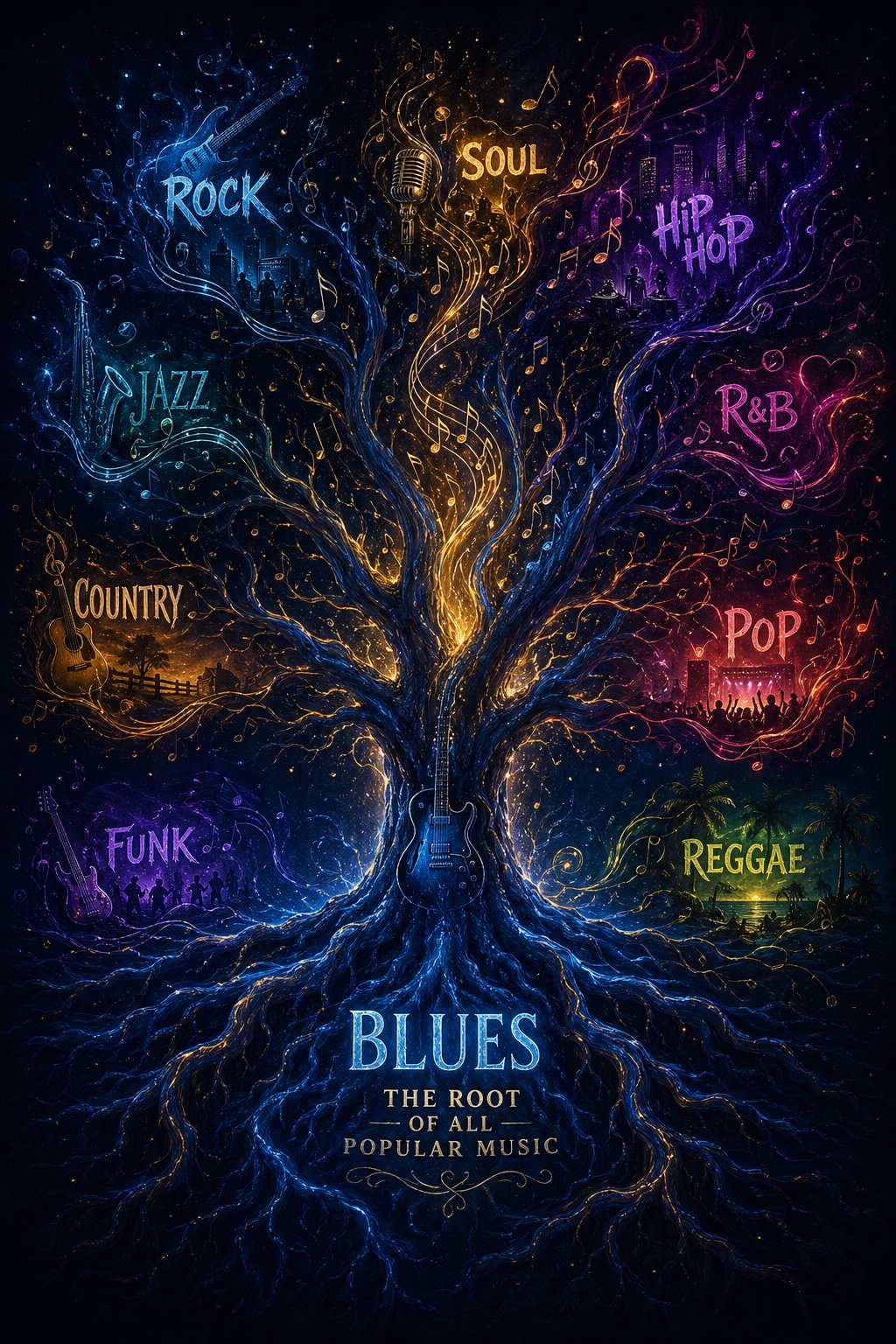
Those outward branches on the family tree aren't minor offshoots. They're the trunk lines of American popular music. Every different type of blues that evolved over the past century carried specific musical elements into new genres, and tracing those connections reveals just how deeply blues is embedded in the music most people listen to every day.
Blues to Rock and Roll and R&B
The path from blues to rock and roll isn't a metaphor. It's a direct lineage with names and dates attached. Jump blues artists like Louis Jordan, Big Joe Turner, and Roy Brown created the uptempo, riff-driven template that early rock musicians adopted almost wholesale. Brown's 1948 hit "Good Rockin' Tonight" has been categorized as jump blues, rhythm and blues, and rock and roll simultaneously, because at that moment in history, the boundaries between them barely existed. Elvis Presley and Jerry Lee Lewis both covered the song, carrying its energy into the rock mainstream.
The mechanics of the transfer are straightforward. Rock and roll took the 12-bar blues form, the shuffle rhythm, blue notes, and call-and-response interplay and layered them over louder amplification and a heavier backbeat. Chuck Berry built his entire catalog on blues chord progressions. The Rolling Stones named themselves after a Muddy Waters song. What are the blues if not the operating system that rock and roll installed on bigger, louder hardware?
Rhythm and blues followed a parallel track. The term "R&B" was coined by Billboard journalist Jerry Wexler in 1948 as a commercial replacement for the label "race music." But the sound itself was blues-based music repackaged for a broader urban audience. Jump blues stars like T-Bone Walker began their careers in that style but became far more famous as R&B pioneers, and by the 1950s, artists like Little Richard and Fats Domino had pushed the music into its own distinct lane.
Blues Roots in Soul, Jazz, and Hip-Hop
Soul music didn't just borrow from the blues. It fused blues emotion with gospel vocal intensity and R&B arrangements to create something that felt both sacred and secular at once. James Brown is the clearest example. As Giovanni Russonello wrote for Strathmore, Brown "combined the hard-charging, virtuoso ambitions of the jazz musician with the unaccommodating subjectivity of blues storytelling." That blend of personal narrative and musical ferocity is pure blues tradition, amplified through a soul framework.
The relationship between blues and jazz runs even deeper, though it's more tangled. Both genres share African-derived harmonies, bent notes, syncopation, and improvisation as a core value. The 12-bar blues form became one of the most common vehicles for jazz performance, a standard structure that musicians from Charlie Parker to Miles Davis used as a launching pad for exploration. Yet jazz also developed its own cosmopolitan identity, rooted in New Orleans brass bands and vaudeville as much as in Delta field hollers. The blues was jazz's nucleus, but jazz built an elaborate architecture around it.
Hip-hop's connection to the blues is less obvious but no less real. The storytelling tradition, first-person narratives of struggle, resilience, and self-assertion, runs in a straight line from Charley Patton to modern rappers. Russonello draws the parallel directly: hip-hop thrives in communities facing the same social and economic pressures that shaped the blues, and the poetry of both genres centers on what he calls "self-assertion and neutralizing limitations." Add to that the widespread sampling of blues records in hip-hop production, and the cultural lineage becomes unmistakable.
Every genre of American popular music carries blues DNA — the question is only how many generations removed.
Here's how those inherited elements map across each descendant genre:
| Genre | Blues Elements Inherited | Key Transitional Artists | Era of Divergence |
|---|---|---|---|
| Rock and Roll | 12-bar form, shuffle rhythm, blue notes, guitar-driven energy | Chuck Berry, Little Richard, Elvis Presley | Mid-1950s |
| Rhythm and Blues (R&B) | Blues song structures, call-and-response, emotional vocal delivery | T-Bone Walker, Louis Jordan, Ray Charles | Late 1940s |
| Soul | Blues emotion, personal narrative, instrumental rawness | James Brown, Bobby "Blue" Bland, Aretha Franklin | Early 1960s |
| Jazz | Blues scale, improvisation, 12-bar form as standard vehicle | Louis Armstrong, Charlie Parker, Miles Davis | Early 1900s (parallel evolution) |
| Hip-Hop | First-person storytelling, social commentary, blues sampling | Gil Scott-Heron, Grandmaster Flash, Kanye West | Late 1970s-1980s |
Blues music became popular not by staying in one place but by giving its core elements away to every genre that followed. The question for the genre itself is whether that generosity left anything behind, or whether the blues tradition still has a pulse of its own in the modern era.
The Modern Blues Scene Is Far From Dead
It left plenty behind. The blues tradition doesn't just have a pulse — it's putting out new records, selling out festivals, and pulling in listeners who weren't alive when Muddy Waters plugged in his first Telecaster.
Blues Singers Keeping the Tradition Alive
The idea that blues is a museum piece doesn't survive contact with the actual scene. Christone "Kingfish" Ingram, a Grammy-winning guitarist from Clarksdale, Mississippi, has become a bridge between Delta tradition and a younger generation of fans. Eddie 9V hit number one on the Billboard Blues chart with his album Capricorn, and Bobby Rush and Kenny Wayne Shepherd's collaborative project Young Fashioned Ways earned a Grammy nomination, proving that veterans and newcomers can push each other forward. Tab Benoit returned after a decade-long wait with I Hear Thunder, and emerging voices like Connor Selby and Southern Avenue are pulling from Memphis roots while folding in soul and gospel textures.
Blues festivals remain a vital gathering point for the community. Events like the Blues Music Awards continue to spotlight acoustic, contemporary, and rock-blues categories, giving recognition to artists who might never get mainstream radio play. As Buddy Guy has pointed out, FM stations rarely spin blues tracks, which means dedicated outlets like Blues Blast Magazine, American Blues Scene, and curated streaming playlists carry much of the weight in connecting artists with audiences. Digital platforms have quietly expanded the genre's reach, introducing the blues music style to listeners who discover it through algorithm-driven recommendations rather than jukebox culture.
Modern Blues Styles and Where the Genre Is Headed
What makes the contemporary scene so interesting is its refusal to stay in one lane. The blues music genre definition has always been flexible, and today's artists are stretching it further than ever. Gary Clark Jr. fuses blues with hip-hop and R&B, Fantastic Negrito blends in funk and gospel across three Grammy-winning albums, and Larkin Poe weave Americana and roots music into their lap-steel-driven sound. Marcus King shifts between heart-wrenching ballads and explosive Southern rock, while Samantha Fish crosses into pop and country territory without losing her blues core. Each of these artists represents a different blues type, yet all of them stay rooted in the same emotional vocabulary the genre has carried for over a century.
Preservation efforts run alongside the innovation. Organizations like the Piedmont Blues Preservation Society have spent decades keeping blues culture alive through education, community outreach, and programs like Blues in Schools that introduce the tradition to younger generations. As the society's board president Atiba Berkley puts it, preservation "means supporting a future for something as well" — not just archiving the past but actively building what comes next.
If you're ready to dig in, there's no shortage of entry points:
- Attend a live blues festival — regional events happen year-round across the U.S. and internationally
- Explore curated streaming playlists like Spotify's "New Blues" for current releases
- Follow blues society recommendations from organizations in your area for local shows and workshops
- Watch the PBS The Blues documentary series for deep cultural and historical context
The genre that seeded rock, soul, jazz, and hip-hop isn't waiting around for permission to keep evolving. It's already doing it. The real question isn't whether blues is alive — it's whether you're listening closely enough to hear where it's headed next.
Start Listening, Start Creating, and Make Blues Your Own
Hearing where the genre is headed is one thing. Knowing where to start as a listener, or even as a creator, is another. You've just walked through the full arc of blues history, from field hollers to modern electric fusion. You understand the 12-bar form, the blue notes, the shuffle rhythm, and the family tree of subgenres that branched out across a century. That's a lot of knowledge sitting in your head. The next step is putting it to use.
How to Start Exploring Blues Music Today
The meaning of blues music reveals itself differently depending on which branch of the family tree you explore first. Rather than diving in randomly, a structured listening path helps you hear how the genre evolved and why each type of blues sounds the way it does. Here's a progression that builds your ear from the roots outward:
- Start with Delta blues for the rawest, most unfiltered expression of the tradition. Robert Johnson's King of the Delta Blues Singers and Charley Patton's early recordings give you the foundation: one voice, one guitar, and nothing to hide behind.
- Move to Chicago electric blues for the full-band experience. Muddy Waters' The Best of Muddy Waters and Howlin' Wolf's Chess recordings show you what happened when that Delta sound got amplified and surrounded by a rhythm section.
- Explore Texas blues for guitar sophistication and swing. Stevie Ray Vaughan's Texas Flood and T-Bone Walker's catalog demonstrate how blues absorbed jazz phrasing and turned the electric guitar into a lead voice.
- Sample dark blues for emotional weight. Slow tempos, minor keys, and sparse arrangements strip the genre down to its most brooding core. This is blues that sits with you long after the song ends.
- Finish with soul blues for warmth and uplift. Bobby "Blue" Bland and contemporary artists like Southern Avenue show how blues emotion merges with gospel and soul to create something that heals as much as it hurts.
Each step in this progression introduces a different texture, a different era, and a different regional personality. By the time you've worked through all five, you'll hear the connections between subgenres instinctively, and you'll start noticing blues fingerprints in rock, soul, and hip-hop tracks you've listened to for years without realizing where they came from.
But here's the thing about music: listening and learning are fundamentally different experiences. Passive listening is enjoyable, but actively engaging with music, whether by playing, singing, or creating, builds a connection that goes deeper than any playlist can reach. Studies suggest that active musical participation engages multiple brain regions simultaneously, strengthening memory, creativity, and emotional processing in ways that passive consumption simply doesn't.
Turn Your Blues Inspiration Into an Original Song
You don't need to spend years mastering slide guitar or memorizing every turnaround lick to experience what it feels like to create blues music. That used to be the only path. Not anymore.
Modern AI song generators have made it possible for anyone, regardless of musical training, to turn an idea into a fully produced original track. The concept is straightforward: you select a genre, describe a mood or style, and the tool handles the composition, arrangement, and production. For blues specifically, this means you can experiment with the subgenres you just learned about and actually hear the differences between them in real time.
MakeBestMusic's AI Song Generator is a practical option for this kind of exploration. You feed it a genre and mood, and it produces a royalty-free original song in seconds. Want to hear what a slow, minor-key dark blues track sounds like compared to an uptempo Chicago shuffle? You can generate both and compare them side by side. Curious how a Delta-inspired acoustic piece differs from a horn-driven Memphis arrangement? Create one of each. For content creators who need original background music, hobbyists experimenting with songwriting ideas, or anyone who wants to hear their own blues-inspired composition come to life, it turns theoretical knowledge into something tangible.
The real value here isn't replacing musicianship. It's lowering the barrier between understanding a genre and experiencing it from the inside. You've spent this article learning what makes each type of blues distinct. Generating your own tracks lets you test that knowledge with your ears, not just your eyes.
Understanding blues theory is powerful, but hearing your own blues song come to life makes it real.
Whether you start by queuing up Robert Johnson on your headphones or by generating your first AI-assisted blues track, the point is the same: blues music rewards active engagement. The deeper you go, the more you hear. And the more you hear, the harder it becomes to listen to any popular song without recognizing the blues underneath it.
Why Understanding Blues Changes How You Hear All Music
Active engagement changes everything. But so does perspective. Once you understand the different types of blues music and the cultural forces that shaped them, you stop hearing popular music the same way. That shift is permanent, and it's the real takeaway from everything we've covered.
Blues Is the Root — Everything Else Is the Fruit
This article traced a single thread from West African griot traditions through slavery-era work songs, Delta field hollers, and the Great Migration that scattered blues across American cities. Each stop on that journey produced different styles of blues: raw Delta acoustic, amplified Chicago electric, horn-driven Memphis, jazz-inflected Texas, fingerpicked Piedmont, and a dozen variations in between. Those styles didn't stay contained. They gave birth to soul, jazz, R&B, rock and roll, and hip-hop, carrying the 12-bar form, blue notes, shuffle rhythm, and call-and-response into every corner of the American soundscape.
Knowing what is the blues genre of music isn't trivia. It's a lens. Any blues music description that stops at "sad songs with guitars" misses the point entirely. Blues is a complete musical and cultural system, one that taught American popular music how to feel, how to swing, and how to tell a story that matters.
The blues is not just a genre. It is the language that all of American popular music learned to speak.
Your Next Step With Blues Music
Pick one branch of the family tree and go deep. Queue up a Delta blues playlist and sit with it. Follow that thread into Chicago electric or swamp blues and notice how the same DNA reshapes itself in a new environment. The listening roadmap from the previous section gives you a clear path, but curiosity will take you further than any guide.
And if you want to move beyond listening, tools like MakeBestMusic's AI Song Generator let you experiment with different blues styles firsthand, turning what you've learned into original tracks you can actually hear and compare.
However you choose to engage, the reward is the same. The deeper you go into the blues, the more you understand about every song that came after it.
