

What Is Sacred Choral Music and Why Does It Matter
Sacred choral music is music composed for a group of voices singing in harmony for religious or spiritual purposes. It sits at the intersection of two ideas: choral music, which refers to any vocal work written for an ensemble of singers performing together in parts, and sacred music, the broad category of music composed for religious worship, devotion, or ceremony. When you combine the two, you get one of the oldest and most emotionally powerful art forms in human history.
What Sacred Choral Music Means
Music composed for religious purposes is called sacred music. A solo hymn sung by a cantor qualifies. So does an organ prelude played before a service. But sacred choral music specifically requires multiple voices blending in harmony, whether that means a four-part church choir, a monastic schola chanting in unison, or a gospel ensemble lifting a congregation to its feet. This distinction matters. A solo singer performing "Ave Maria" is delivering sacred vocal music. A choir performing Palestrina's Missa Papae Marcelli is delivering sacred choral music. The collective voice is the defining element.
Secular choral works, by contrast, set non-religious texts to choral arrangements. Think of madrigals about love or choral settings of folk poetry. The musical techniques may overlap, but the intent and text separate the sacred from the secular.
Why Sacred Choral Music Endures Across Centuries
Imagine standing inside a stone cathedral as forty voices rise together into a single chord. The sound fills the space from floor to vault, and for a moment, the boundary between listener and music dissolves. That experience helps explain why this genre has endured for over a thousand years.
There is something about massed voices that a single instrument or soloist cannot replicate. Choral harmony creates overtones, resonances, and textures that feel larger than the sum of their parts. Across centuries, composers and worshippers alike have recognized this power, using it to express awe, grief, praise, and longing in ways that words alone cannot.
From Gregorian monks chanting in medieval monasteries to gospel choirs in the American South, from Russian Orthodox basses resonating in candlelit cathedrals to Georgian villagers singing three-part polyphony older than Western harmony itself, every major spiritual tradition on earth has found its way to the choral voice.
This universality is no coincidence. As the Meditation Music Library notes, choral music created from a space of faith and devotion carries an amplified energy precisely because it is a collective experience, one that fosters unity and shared transcendence among both singers and listeners.
Sacred choral music also remains one of the most performed and recorded genres in classical music. Works like Bach's Mass in B Minor and Mozart's Requiem fill concert halls worldwide, often performed by secular ensembles for audiences who may hold no religious belief at all. The emotional and aesthetic power of these works transcends their liturgical origins.
Yet the full story of this tradition stretches far beyond the familiar European canon. Its roots reach back to the earliest days of Christian worship, when even the act of singing in harmony was considered controversial, and its branches extend across every inhabited continent. Understanding how it evolved, splintered into distinct forms, and continues to reinvent itself reveals a tradition far richer and more surprising than most listeners realize.
A Historical Journey From Gregorian Chant to the Baroque Era
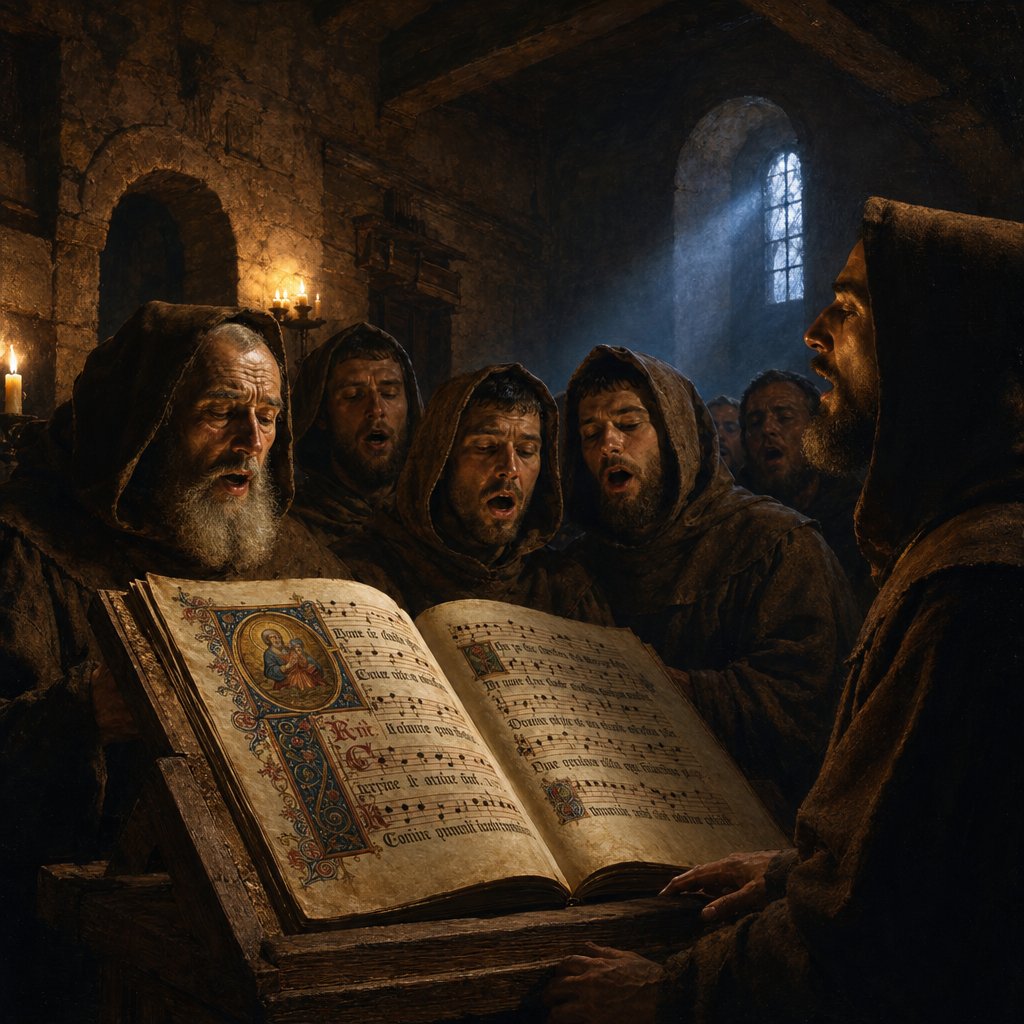
That thousand-year story begins in the quietest possible way: a single melodic line, sung by monks in a darkened chapel, with no accompaniment and no harmony. Gregorian chant, the earliest form of Western sacred music, emerged from the liturgical practices of the early Christian Church and was traditionally attributed to Pope Gregory I in the late 6th century. These monophonic melodies, flowing freely without fixed rhythm or harmony, were designed to serve one purpose: elevating the mind toward the divine while keeping the sacred text clearly audible.
From Gregorian Chant to Early Polyphony
For centuries, this single-line chant was the only music the Church permitted. Monasteries across Europe sang the same modal melodies for the Mass and the Divine Office, creating a shared musical language that unified Christian worship across vast distances. But sometime around the 9th and 10th centuries, singers began experimenting. They added a second vocal line to the existing chant, a practice called organum, initially moving in simple parallel motion beneath or above the original melody.
This was a quiet revolution. Organum introduced the concept of musical dialogue, where two voices could interact, complement, and contrast with one another. At the Notre Dame Cathedral in Paris, composers Leonin and Perotin pushed the idea further in the 12th and 13th centuries, expanding organum to three and four independent voices with structured rhythmic patterns. The texture of sacred choral music was growing richer by the decade.
By the 14th century, the Ars Nova movement brought even greater rhythmic and harmonic complexity. Out of this ferment emerged the motet, a polyphonic choral work set to a sacred Latin text, which became one of the most important and enduring forms in the entire tradition. If you have ever encountered the crossword clue "sacred choral music, 5 letters," the answer is motet, and for good reason. It was the form that proved polyphony could serve God as powerfully as plainchant.
The Renaissance Golden Age of Sacred Choral Writing
The Renaissance took that polyphonic promise and fulfilled it spectacularly. Between roughly 1400 and 1600, sacred choral composition reached a level of sophistication that many scholars consider unmatched in vocal music history. Imitative counterpoint, where a melodic idea passes from voice to voice in overlapping entries, became the defining technique, creating intricate tapestries of sound that were both intellectually rigorous and deeply moving.
Josquin des Prez, often called the master of Renaissance polyphony, set the standard. His Missa Pange Lingua demonstrated an extraordinary sensitivity to the emotional content of sacred texts, weaving complex polyphonic lines while maintaining a clear, expressive connection to the words. Giovanni Pierluigi da Palestrina carried this ideal even further. His Missa Papae Marcelli, likely composed in the 1560s, became the enduring symbol of how polyphony could achieve both harmonic richness and textual clarity. As recent scholarship from Carus-Verlag notes, the mass was written in a post-conciliar climate where the Church demanded that sacred words be heard and understood, and Palestrina's music answered that demand with elegance.
That demand came directly from the Council of Trent (1545-1563), the Catholic Church's sweeping response to the Protestant Reformation. Among its many reforms, the Council addressed concerns that overly elaborate polyphony was obscuring the liturgical text. The result was not a ban on polyphony but a call for greater restraint and intelligibility. Composers like Palestrina, Tomas Luis de Victoria in Spain, and William Byrd and Thomas Tallis in England each responded in their own way, producing sacred choral works that balanced contrapuntal complexity with devotional clarity. Byrd's Mass for Four Voices, composed in secret for England's persecuted Catholic community, remains a powerful example of faith expressed through musical craft under extraordinary pressure.
Baroque Expansion and the Rise of the Cantata
Around 1600, sacred choral music broke out of its purely vocal shell. The Baroque era introduced orchestral accompaniment, dramatic contrasts in dynamics and texture, and entirely new large-scale forms that transformed how congregations and audiences experienced religious music.
The cantata became a cornerstone of Lutheran worship. Johann Sebastian Bach composed over 200 church cantatas, multi-movement works that alternated between recitatives, arias, choruses, and chorale settings. Works like Wachet auf, ruft uns die Stimme (BWV 140) wove Martin Luther's congregational chorale tunes into elaborate musical architecture, allowing the congregation to participate in the music even as the choir and soloists carried the dramatic weight.
The oratorio offered an even grander canvas. George Frideric Handel's Messiah (1741), with its iconic "Hallelujah" chorus, brought sacred choral storytelling to the concert hall, performed without staging or costumes but with all the emotional force of opera. In Italy, pioneers like Giacomo Carissimi had established the genre decades earlier, while Antonio Vivaldi contributed his exuberant Gloria in D major, a work that still fills churches and concert halls worldwide. These composers did not abandon the polyphonic traditions of the Renaissance. They built on them, adding basso continuo, word painting, tonal symbolism, and the full color of the Baroque orchestra to create sacred music of unprecedented scale and emotional range.
| Era | Approximate Period | Representative Composers | Signature Works |
|---|---|---|---|
| Medieval Chant | 6th - 12th century | Anonymous (attributed to Pope Gregory I) | Gregorian Chant repertoire |
| Early Polyphony | 12th - 13th century | Leonin, Perotin | Notre Dame organum, Viderunt omnes |
| Ars Nova | 14th century | Guillaume de Machaut | Messe de Nostre Dame |
| Renaissance | c. 1400 - 1600 | Josquin des Prez, Palestrina, Victoria, Byrd, Tallis | Missa Pange Lingua, Missa Papae Marcelli, Spem in alium |
| Baroque | c. 1600 - 1750 | Bach, Handel, Vivaldi, Schutz | Mass in B Minor, Messiah, Gloria in D Major |
By 1750, sacred choral music had traveled an extraordinary distance, from a single unaccompanied voice in a monastery to a full orchestra and chorus performing before thousands. Yet this timeline only tells part of the story. Each era did not simply replace the last. It layered new forms on top of old ones, and many of those forms, the Mass, the motet, the anthem, the cantata, continued to coexist and evolve in ways that shaped distinct denominational identities across the Christian world.
Major Sacred Choral Forms and Genres Explained
Those layered forms, each born from a specific liturgical need and musical moment, can feel overwhelming when you first encounter them. What exactly separates a motet from an anthem? How does a cantata differ from an oratorio? And where do spirituals and gospel fit into a tradition rooted in medieval Latin texts? Breaking sacred choral music into its distinct genres reveals a surprisingly logical system, one where each form serves a clear purpose in worship, carries its own structural DNA, and belongs to a particular denominational lineage.
The Mass and Requiem
The Mass stands as the single most important form in the entire tradition. For centuries, it has been the backbone of sacred choral composition, and its structure is remarkably consistent. A full musical setting of the Mass Ordinary consists of five sections that recur at every celebration of the Eucharist, regardless of the liturgical season:
- Kyrie - "Lord, have mercy." Often the opening prayer, typically structured in a symmetrical ABA form reflecting the threefold repetition of the text.
- Gloria - A celebratory passage praising God the Father and Christ.
- Credo - A setting of the Nicene Creed and the longest text in the Mass.
- Sanctus and Benedictus - A doxology praising the Trinity, followed by a continuation that concludes with "Hosanna in excelsis."
- Agnus Dei - The "Lamb of God" litany, ending with the plea "dona nobis pacem" (grant us peace).
These five movements gave composers a fixed framework to work within, and the results span an astonishing range. A Missa brevis (short Mass) might set all five sections in compact, economical fashion, while a Missa solemnis calls for extended vocal and orchestral forces suited to festive occasions. Mozart, who composed under the strict time constraints of the Salzburg archbishop, described the challenge of fitting a full Mass with trumpets and drums into no more than three-quarters of an hour. Most settings use Latin, though a significant number exist in English and other vernacular languages, particularly within the Anglican tradition.
The Requiem Mass, composed for the dead, follows a different path. It draws from the Mass Proper rather than just the Ordinary, incorporating sections like the Introit, the Gradual, and the dramatic sequence hymn Dies Irae ("Day of Wrath"), whose vivid imagery of judgment and damnation has inspired some of the most powerful music ever written. The Lacrimosa, a subsection of the Dies Irae, is often the emotional climax. Over 2,000 Requiem compositions have been written to date, from the earliest surviving polyphonic setting by Johannes Ockeghem in the late 15th century to the concert-scale dramatic works of Berlioz, Verdi, and Dvorak that function more as oratorios than liturgical pieces.
Motets, Anthems, and Cantatas
If the Mass is the cathedral of sacred choral forms, the motet is its chapel: smaller, more intimate, and remarkably versatile. A motet is a polyphonic choral work set to a sacred text, most often in Latin and rooted in the Catholic tradition. If you have ever seen the puzzle clue "sacred choral music starts with mo" or "sacred choral music 5 letters," the answer in both cases is the motet. It earned that crossword fame honestly. From its origins in the 13th century through the Renaissance masterworks of Josquin and Palestrina, the motet became the go-to form for composers who wanted to set a specific scriptural passage, psalm verse, or devotional text outside the fixed structure of the Mass.
The anthem fills a parallel role in the English-speaking world. Born from the Anglican tradition after the Reformation, the anthem sets English-language sacred texts for choir, sometimes with organ accompaniment and solo verses. Early Canadian tunebooks from the 19th century reveal how quickly the anthem spread beyond England's cathedrals, becoming a staple of Protestant worship across North America. A "full anthem" is sung entirely by the choir, while a "verse anthem" alternates between solo passages and choral sections, creating a conversational texture between individual and collective voices.
The cantata operates on a larger scale altogether. Most closely associated with Lutheran worship and the towering legacy of J.S. Bach, a cantata is a multi-movement work that weaves together recitatives, arias, choruses, and chorale settings into a unified dramatic arc. Where a motet or anthem typically sets a single text, a cantata tells a story or develops a theological argument across multiple contrasting sections, often lasting fifteen to thirty minutes. Bach composed over 200 church cantatas, each designed for a specific Sunday or feast day in the liturgical calendar, making the cantata not just a musical form but a weekly act of theological commentary.
Oratorios, Psalms, Spirituals, and Gospel
When sacred choral music needed a truly epic canvas, it turned to the oratorio. Imagine an opera with all the dramatic elements, soloists, chorus, orchestra, arias, and recitatives, but performed without staging, costumes, or scenery. That is the oratorio in its essence. The form emerged in early 17th-century Italy from sacred dialogues performed in specially built prayer halls (oratories), and it grew rapidly as the Catholic Church's prohibition of theatrical spectacles during Lent drove audiences toward this concert alternative. Protestant composers drew their stories from the Bible, while Catholic composers also looked to the lives of saints. Handel's Messiah remains the most famous example, but the tradition stretches from Carissimi through Haydn's The Creation to Mendelssohn's Elijah and well into the modern era.
Psalm settings occupy a more flexible space. The Book of Psalms is the oldest song text collection still in active liturgical use, and composers have treated it in every conceivable way: as antiphonal chant, as motet texts, as full cantata-scale works, and as simple congregational hymns. After the Second Vatican Council introduced vernacular psalm singing into the Roman Catholic liturgy, interest in new psalm settings intensified across both Catholic and Protestant traditions.
African American spirituals and gospel choir music represent a distinct and vital branch of the sacred choral tradition. Spirituals emerged from the experience of enslaved people in the American South, blending African musical elements like call-and-response patterns, syncopation, and pentatonic melodies with Christian texts of suffering, hope, and deliverance. Works like "Swing Low, Sweet Chariot" and "Go Down, Moses" carry theological weight equal to any European motet. Gospel music, which developed in the early 20th century, amplified these roots with blues harmonies, improvisation, and an electrifying performance energy that transformed the choir from a liturgical ensemble into a vehicle for communal spiritual ecstasy.
| Form | Typical Language | Primary Denomination | Structure | Liturgical Use |
|---|---|---|---|---|
| Mass | Latin (also vernacular) | Catholic, Anglican, Lutheran | Five fixed movements (Kyrie, Gloria, Credo, Sanctus, Agnus Dei) | Eucharistic celebration |
| Requiem | Latin | Catholic (widely adopted) | Variable movements including Dies Irae, Lacrimosa, Libera Me | Funeral and memorial services |
| Motet | Latin | Catholic | Single movement, polyphonic, variable length | Offertory, devotional moments, Vespers |
| Anthem | English | Anglican, Protestant | Single movement; full (choir only) or verse (soloists + choir) | After the third collect at Evensong, festive services |
| Cantata | German, Latin | Lutheran | Multi-movement: recitatives, arias, choruses, chorales | Sunday and feast day worship |
| Oratorio | Various | Cross-denominational | Large-scale, multi-part dramatic work for soloists, choir, orchestra | Concert performance; Lenten seasons |
| Psalm Setting | Latin, Hebrew, vernacular | Cross-denominational | Highly variable: chant, motet, cantata-scale | Daily Office, congregational worship |
| Spiritual | English | African American churches | Strophic, call-and-response | Worship, communal gatherings |
| Gospel | English | African American churches, Pentecostal | Verse-chorus, improvisatory, choir-driven | Worship services, revivals, concerts |
Each of these forms did not develop in isolation. They borrowed from one another, competed for liturgical space, and evolved in response to theological debates, cultural shifts, and the practical realities of what a given congregation could actually sing. That interplay between form and faith becomes even clearer when you look at how specific Christian denominations shaped their own choral identities, choosing certain genres, rejecting others, and in the process creating musical traditions as distinctive as the theologies behind them.
How Different Denominations Shaped Sacred Choral Identity
Theology does not stay on the page. It sings. Each major Christian tradition made choices about language, instrumentation, congregational participation, and the very purpose of music in worship, and those choices produced choral identities as recognizable as the architecture of their churches.
Catholic Mass Settings and the Latin Tradition
The Catholic choral tradition orbits around one fixed point: the Mass Ordinary. Those five texts, Kyrie, Gloria, Credo, Sanctus, and Agnus Dei, have been set to music more often than any other words in Western history. Gregorian chant provided the melodic foundation, and for centuries composers built polyphonic settings on top of those ancient melodies, a technique known as the cantus firmus Mass. Palestrina refined this approach into something the Church could hold up as a model of devotional clarity. But the tradition did not freeze in the 16th century. Haydn and Mozart brought Classical elegance to the Mass, Beethoven pushed it toward symphonic grandeur in his Missa Solemnis, and 20th-century voices like Francis Poulenc and Arvo Part proved that the same Latin texts could still yield startlingly fresh music. The thread connecting all of them is the liturgical text itself, unchanged across five centuries of radically different musical languages.
Anglican Choral Evensong and the Cathedral Tradition
When the English Reformation severed ties with Rome, it also created a new musical world. Thomas Cranmer's first Book of Common Prayer in 1549 condensed the monastic hours into two services, Morning Prayer and Evensong, and crucially, it required them to be sung in English rather than Latin. That single decision reshaped sacred choral music for an entire tradition.
Choral Evensong, as the Cathedral Music Trust explains, is a service in which a choir sings composed settings of the responses, psalms, canticles, and anthems, with the congregation participating primarily through listening. The musical backbone consists of settings of the Magnificat and Nunc Dimittis, the two canticles that frame the scripture readings, plus an anthem chosen to reflect the day's theme. Psalms are sung in four-part Anglican Chant, a harmonized adaptation of the older plainchant tradition that developed in the 17th century, with early examples by Henry Purcell and his contemporaries.
This created a composer's tradition unlike any other. Tallis and Byrd wrote for the new English rite while secretly composing Latin Masses for Catholic worship. Purcell brought Baroque drama to the anthem. Charles Villiers Stanford and Herbert Howells, centuries later, produced canticle settings that remain in weekly rotation at cathedrals across England. The result is a living repertoire performed daily, not just on Sundays, in a continuous tradition that Tom Service, writing for the Guardian, called "a living tradition that costs precisely nothing to experience live."
Lutheran Chorales and the Bach Legacy
Martin Luther took a fundamentally different approach. Where the Anglican tradition gave the music to a trained choir, Luther wanted the entire congregation singing. He wrote hymns himself, composed melodies, and championed the chorale: a simple, sturdy, harmonized hymn tune designed so that ordinary people could sing it together in four-part harmony. "Ein feste Burg ist unser Gott" ("A Mighty Fortress Is Our God") became the anthem of the Reformation, and the chorale became the building block of Lutheran sacred music.
Johann Sebastian Bach transformed that building block into something monumental. His church cantatas used chorale melodies as structural scaffolding, weaving them through recitatives, arias, and elaborate choral movements. But the crowning achievement was the Passion. As Tafelmusik's program notes detail, the Lutheran Passion tradition stretched back to the fourth century, when the story of the Crucifixion was recited during Holy Week in a solemn chant divided between an Evangelist, the role of Christ, and the crowd. Bach's St. Matthew Passion, scored for two choirs and two orchestras, represents a summation of that entire history. The congregation's chorale hymns are woven directly into the dramatic fabric, so that worshippers were not merely listening to the Passion story but participating in it. There was no division between chorister and soloist: singers stepped directly out of the crowd choruses to reflect on the narrative in solo arias, blurring the line between performer and believer.
Orthodox A Cappella and Black Church Traditions
Eastern Orthodox worship strips away everything except the human voice. No organ, no piano, no guitar. Just voices offering the prayers and hymns of the liturgy. As St. Michael Antiochian Orthodox Church explains, this practice was inherited from the synagogue and maintained without interruption while Western Christianity gradually introduced instruments in the medieval period. The theological reasoning runs deep: Orthodox worship understands music as prayer, not performance. The melody serves the text, and instruments, in this view, can turn music into something you listen to rather than something you offer. The human voice is the most natural form of praise, the one that requires nothing but yourself.
This a cappella discipline produced its own rich choral tradition. Russian Orthodox composers like Bortniansky, Chesnokov, and Rachmaninoff wrote for unaccompanied voices of extraordinary range, exploiting the deep bass oktavist tradition to create a sonic palette unlike anything in Western choral music. Byzantine chant, the melodic foundation of Greek and Antiochian Orthodox worship, developed entirely as vocal music and remains so across every jurisdiction.
The Black church in America forged a choral identity from entirely different raw materials. Spirituals born under slavery fused African call-and-response patterns with Christian texts of liberation and hope. Gospel music, emerging in the early 20th century, amplified those roots with blues harmonies, rhythmic drive, and improvisation that made the choir not a background ensemble but the spiritual engine of the service. Where Orthodox tradition prizes stillness and contemplation, the Black church tradition prizes communal energy and spontaneous expression. Both, however, share a conviction that the singing itself is the worship, not a decoration added to it.
- Catholic: Latin texts of the Mass Ordinary as the compositional core; Gregorian chant as melodic foundation; instrumental accompaniment standard; trained choirs and scholas lead worship.
- Anglican: English-language canticles, psalms, and anthems; cathedral and collegiate choirs perform daily; organ accompaniment central; congregation participates primarily through listening.
- Lutheran: Congregational chorale singing in the vernacular; chorale melodies as building blocks for cantatas and Passions; integration of choir and congregation; orchestral accompaniment in larger works.
- Eastern Orthodox: Strictly a cappella; melody serves the liturgical text; Byzantine chant or Slavic choral traditions; no division between music and prayer; consistent across jurisdictions worldwide.
- Black Church (Spirituals and Gospel): English-language texts rooted in African American experience; call-and-response structure; improvisation and spontaneity; choir as communal spiritual force; rhythmic energy and emotional intensity.
These five streams do not account for every Christian musical tradition, but they represent the major tributaries that fed the global river of sacred choral music. And that river flows far wider than most Western listeners assume. Some of the oldest and most distinctive choral traditions on earth developed thousands of miles from Rome, Canterbury, or Leipzig, in places where polyphony predates the European Renaissance and where sacred singing follows rules that Western music theory cannot easily explain.
Global Sacred Choral Traditions Beyond Western Europe
Russia, Georgia, Ethiopia. These are not the places most people picture when they think of sacred choral music. Yet each developed a vocal tradition of extraordinary depth, some older than anything in the Western European canon, and each challenges the assumption that this art form belongs to cathedrals in Rome, London, or Leipzig.
Russian Orthodox Choral Splendor
The Russian Orthodox choral tradition is built on a single, uncompromising principle: no instruments. Voices alone carry the liturgy. Within that constraint, Russian composers created a sound world of staggering richness, anchored by the oktavist, a bass singer capable of producing notes a full octave below the standard bass range. When an oktavist drops to a low B-flat beneath a choir of tenors, altos, and sopranos, the effect is less like hearing music and more like feeling the floor vibrate beneath your feet.
Dmitry Bortniansky, who served as director of the Imperial Court Chapel in the late 18th century, established the foundations of the Russian sacred choral style by blending Western harmonic techniques with Orthodox liturgical texts. Pavel Chesnokov, a generation later, codified the art of Russian choral writing in his treatise The Choir and How to Direct It, producing hundreds of liturgical works that remain staples of Orthodox worship. But the tradition's crowning achievement belongs to Sergei Rachmaninoff.
His All-Night Vigil, premiered in Moscow on March 23, 1915, by the all-male Moscow Synodal Choir, is widely regarded as one of the greatest choral works ever composed. Rachmaninoff had loved Orthodox Church music since childhood, when he accompanied his devout grandmother to the churches of St. Petersburg and stood beneath the gallery to hear what he later called "singing of unrivalled beauty." Encouraged by the scholar Stepan Smolensky, who was leading a renaissance in Orthodox music through the Synodal School, Rachmaninoff eventually set out to create a work true to the spirit of those childhood memories.
The result is a 15-movement a cappella masterpiece lasting just over an hour. Ten of its movements draw on ancient chants from the Obikhod, the traditional collection of melodies used in Russian Orthodox worship, while the remaining five use original melodies Rachmaninoff described as "a conscious counterfeit of the ritual." The work falls into two broad halves: the Vespers (movements 1 through 6), which trace the world's history from Creation to Christ's birth, and the Matins (movements 7 through 15), which anticipate dawn as a symbol of resurrection. The fifth movement, the Song of Simeon, held a special place in Rachmaninoff's heart. Its basses descend to a tenebrous low B-flat, a sonic parallel to the sun sinking below the horizon during the evening service.
After the Russian Revolution of 1917, the Orthodox tradition Rachmaninoff had taken for granted was repressed, and the Vigil was scarcely heard for decades. Alexander Sveshnikov's pioneering 1965 recording, available strictly for export or educational purposes under Soviet restrictions, began its slow return to public consciousness. Today, scholars like Vladimir Morosan have recovered much of the performance tradition Rachmaninoff expected, and recordings by ensembles like Peter Jermihov's Gloriae Dei Cantores bring the work's full sonic grandeur to modern listeners, complete with seven basso profundo oktavists in the bass section alone.
Georgian Polyphonic Sacred Singing
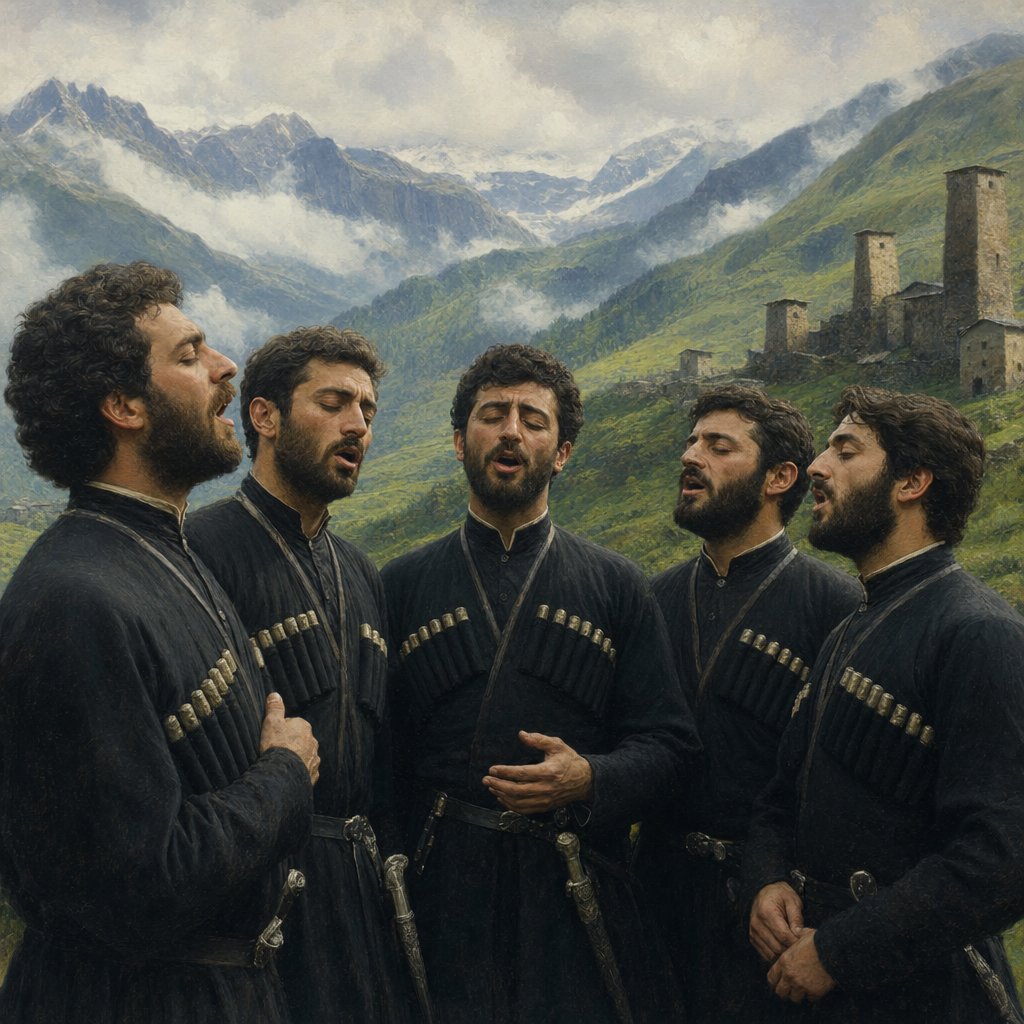
Travel south from Russia into the Caucasus Mountains, and you encounter a choral tradition that may be even older. Georgian polyphonic singing, inscribed on UNESCO's Representative List of the Intangible Cultural Heritage of Humanity in 2001, is one of the oldest continuous traditions of vocal harmony on earth. Some of its songs date back to the eighth century, meaning Georgians were singing in complex three-part polyphony while Western Europe was still centuries away from its first experiments with organum.
Three distinct regional styles define the tradition. In the mountainous Svaneti region, singers perform complex polyphony with tightly interlocking voices. In Kakheti, eastern Georgia's wine country, two melodic voices weave a polyphonic dialogue over a sustained bass drone. In western Georgia, three partially improvised vocal parts create a contrasted texture where each singer responds to the others in real time. The Chakrulo, a ceremonial song from the first category, features a striking vocal technique called the krimanchuli, a yodel-like ornament performed by a male falsetto singer, sometimes described as a "cockerel's crow."
What makes this tradition especially relevant to sacred choral music is how deeply it shaped Georgian worship. Byzantine liturgical hymns, when they arrived in Georgia, did not replace the local polyphonic style. Instead, the polyphonic tradition absorbed them. As UNESCO's documentation notes, Byzantine hymns "incorporated the Georgian polyphonic tradition to such an extent that they became a significant expression of it." The result is a sacred choral sound that predates and stands apart from the entire Western polyphonic lineage, a living reminder that harmony in worship did not begin with Leonin and Perotin at Notre Dame.
Ethiopian, Coptic, and Global Sacred Choral Voices
Move further south and east, and the picture grows even more diverse. Ethiopian Orthodox liturgical chant, known as zema, operates on principles that Western music theory struggles to categorize. According to Britannica, the tradition uses a notation system called melekket, codified in the 16th century, in which characters from the ancient Ge'ez language each represent a specific melodic formula, or serayu. The semantic meaning of the syllable and its musical meaning bear no relationship to each other. Performers learn the connection only through oral tradition, then embellish each formula with improvised ornaments during the service.
Three distinct manners of chanting define the Ethiopian system: ge'ez, the standard mode used for most melodies; araray, a higher-range style associated with cheerful texts; and ezel, reserved exclusively for Holy Week and periods of fasting and sorrow. Church tradition links each mode to a person of the Trinity, with ge'ez associated with the Father, ezel with the Son, and araray with the Holy Spirit. The entire body of hymns is attributed to Saint Yared, a sixth-century figure who is said to have received the three chanting styles through divine revelation. The debtara, the unordained singer who performs zema, trains for years to master the liturgical repertoire, copying the entire body of chants as a student before ultimately memorizing and improvising along the outlines of the basic melodic formulas.
Coptic Christian worship in Egypt follows a parallel path, preserving hymn traditions that trace their roots to the earliest centuries of Christianity and incorporating melodic patterns some scholars believe echo ancient Egyptian temple music. Indian Christian communities, particularly the Saint Thomas Christians of Kerala, developed their own liturgical chant traditions in Syriac and Malayalam, blending Middle Eastern melodic structures with South Asian vocal ornamentation. And in the 20th and 21st centuries, composers from Latin America, East Asia, and sub-Saharan Africa have increasingly contributed new sacred choral works that draw on indigenous musical languages rather than defaulting to European models. Composers like the Nigerian Laz Ekwueme, the Korean Hyo-Won Woo, and the Mexican Carlos Chavez have written choral works rooted in local harmonic and rhythmic traditions while addressing universal sacred themes.
Sacred choral music is not a European invention that the rest of the world adopted. It is a human impulse that surfaced independently across cultures, each one finding its own path from the spoken prayer to the sung harmony.
These global traditions do more than fill gaps in a Western-centered narrative. They reveal that the drive to worship through collective singing is genuinely universal, shaped by local languages, theologies, and vocal techniques into forms as varied as the cultures that produced them. That same creative energy did not stop at the borders of tradition. In the 20th century, a new generation of composers began drawing on these diverse roots, fusing ancient sacred impulses with modern harmonic languages to spark a renaissance that brought choral music back to mainstream audiences in ways no one predicted.
The Modern Sacred Choral Renaissance
That renaissance arrived from an unexpected direction. By the mid-20th century, the classical music establishment had largely turned its back on tonality, consonance, and anything that sounded remotely spiritual. Serialism, atonality, and the avant-garde dominated conservatories and concert programming. Sacred choral music, with its deep roots in melody and harmonic beauty, seemed like a relic. Then three composers, working independently in Estonia, Poland, and England, broke through the noise by doing something radical: they got quiet.
Holy Minimalism and the Return to Spiritual Simplicity
The label "holy minimalism" was never meant as a compliment. Critics coined it to group together composers whose music drew on religious faith and the stripped-down aesthetic of American minimalism, but who shared little else in common. As Interlude notes, these composers "disliked being grouped together," and each developed a distinctive voice. What they did share was a biography: all three explored the avant-garde early in their careers, grew frustrated with its limitations, and eventually found a purer, more contemplative mode of expression rooted in sacred tradition.
Arvo Part's journey is the most dramatic. In 1960s Soviet Estonia, he experimented with serialism, collage, and aggressive dissonance, styles that confirmed his modernist credentials but left him creatively exhausted. Frustrated with what he called the "dry children's games" of the avant-garde, Part entered a period of self-imposed creative silence. During those years, he immersed himself in Gregorian chant, Renaissance polyphony, and his Russian Orthodox faith. What emerged was tintinnabuli, a compositional method named after the Latin word for "little bells." The technique pairs a melodic voice moving stepwise with a second voice that sounds only the notes of a single triad, creating music that feels both ancient and startlingly modern. Works like Fur Alina, Fratres, Tabula Rasa, and the choral masterpiece Te Deum grew from this seed. Part's music sounds archaic and avant-garde at the same time, capturing the resonance of monastic chant in a framework of austere, almost mathematical rigor.
Henryk Gorecki followed a parallel path from a very different starting point. His early works drew on the uncompromisingly dissonant language of Webern, Stockhausen, and Boulez. But the folk music and religious traditions of Poland's Tatra region pulled him toward something simpler and more monumental. His Symphony No. 3, the "Symphony of Sorrowful Songs," written to commemorate victims of the Holocaust, sat largely unnoticed outside Poland until a 1992 recording by the London Sinfonietta became an unexpected bestseller, reaching the top of the pop charts in the UK. The work's power lies in its directness: consonant harmonies, slow-building intensity, and a soprano voice singing texts by a mother separated from her child. Gorecki himself sensed why it connected so deeply. "Perhaps people find something they need in this piece of music," he reflected. "Somehow I hit the right note, something they were missing."
John Tavener completed the trio. Trained in the white-hot furnace of 1960s London avant-garde, he grew friendly with The Beatles and recorded his early work The Whale on their Apple label. But Tavener, like Part and Gorecki, grew dissatisfied with complexity for its own sake. His reception into the Russian Orthodox Church in 1977 transformed his compositional voice. Works like The Lamb, a setting of William Blake's poem built from just seven notes, and Song for Athene, performed at the funeral of Princess Diana in 1997, layered liturgical chant with clean harmonies and Eastern rhythms. Tavener described music as "a window of sound on to the divine world," and his compositions pursue that vision with a mesmeric simplicity where, as Interlude observes, "the smallest gestures have great significance" and "one has the sense of something far greater stretching into the infinite."
Why did these three composers resonate so powerfully with mainstream audiences who had largely ignored contemporary classical music for decades? The answer may be timing. In a world accelerating toward digital overload, their music offered something increasingly rare: stillness, space, and an invitation to listen deeply. Sacred choral music, in their hands, became a form of sonic refuge.
The Contemporary Choral Renaissance
The door that Part, Gorecki, and Tavener opened has stayed open. A wave of composers born in the 1940s through the 1970s has carried sacred choral writing into the 21st century with a confidence and audience reach that would have seemed impossible a generation ago.
Morten Lauridsen's Lux Aeterna and O Magnum Mysterium became some of the most performed choral works of the late 20th century, their luminous harmonies and long-breathed melodic lines earning him a devoted following among choirs worldwide. Eric Whitacre built on that momentum with a different energy, combining lush, cluster-rich harmonies with a gift for digital-age community building. His Virtual Choir project, which assembled thousands of individual vocal recordings from around the world into a single performance, demonstrated that sacred-inspired choral music could thrive far beyond the walls of any church or concert hall.
Norwegian composer Ola Gjeilo has become a fixture in competition and concert programs globally. INTERKULTUR's analysis of choral repertoire trends lists his Ubi Caritas among the most frequently performed sacred works at international choral competitions, alongside pieces by emerging voices like Josu Elberdin and Kim Andre Arnesen. James MacMillan, Scotland's leading composer, has brought a grittier, more emotionally complex voice to the tradition. His sacred choral works draw on plainchant fragments and Scottish Catholic identity, breathing new life into ancient materials. As MacMillan himself has written, composers "have always taken fragments of material from elsewhere and breathed new life into them, creating new forms, new avenues and structures of expression."
Equally important are the ensembles that perform this music. Groups like The Sixteen, directed by Harry Christophers, and Tenebrae, led by Nigel Short, have built international reputations through recordings and tours that treat sacred choral repertoire not as museum pieces but as living, breathing art. Voces8 has taken a different approach, using social media, educational outreach, and crossover programming to introduce younger audiences to the genre. The result is a feedback loop: as audiences grow, composers write more, and as the repertoire expands, more ensembles form to perform it.
This renaissance is not limited to established Western names. INTERKULTUR's data reveals that modern works by young contemporary composers are on the rise in international competition programs, with emerging voices from Singapore, Canada, Slovenia, and the Baltics gaining visibility alongside their European and American counterparts. The choral world is becoming more global, more diverse, and more creatively adventurous than at any point in its history.
Sacred Choral Music in an Increasingly Secular World
Here is the paradox at the heart of the modern choral renaissance: as church attendance declines across much of the Western world, interest in sacred choral music is growing. Concert halls sell out for performances of the Faure Requiem. Streaming playlists labeled "sacred choral" and "contemplative classical" attract millions of listeners. Composers who set Latin liturgical texts find audiences that may never set foot in a church.
What explains this? Part of the answer lies in the music itself. Sacred choral works are designed to evoke transcendence, to create a sense of something larger than the individual listener. That emotional architecture does not require religious belief to be felt. You do not need to accept the theology of the Dies Irae to be shaken by Verdi's setting of it. You do not need to pray the Nunc Dimittis to be moved by Howells's setting at Evensong. The aesthetic power operates independently of the liturgical function.
Cathedrals and collegiate choirs play a crucial role in sustaining this tradition. Institutions like King's College Cambridge, Westminster Abbey, and Christ Church Oxford maintain daily choral services that keep centuries of repertoire in active performance. These are not concerts. They are acts of worship that happen to be open to anyone who walks through the door. For many visitors, attending Evensong is their first encounter with sacred choral music performed in the acoustic space it was written for, and the experience often proves transformative.
A tension does exist, though, between this inherited tradition and the contemporary worship music that dominates many modern churches. Praise bands with guitars, keyboards, and drum kits have replaced choirs in countless congregations, and the repertoire has shifted from composed polyphony to singable, repetitive choruses designed for congregational participation. Whether this represents a healthy evolution or a loss depends on whom you ask. What is clear is that the two traditions serve different purposes. Contemporary worship music prioritizes accessibility and communal energy. The older choral tradition prioritizes depth, complexity, and a particular kind of beauty that rewards repeated listening.
Irish composer Rhona Clarke captures this duality in her own work. Her 2020 setting of Hildegard of Bingen's O Vis Aeternitatis, commissioned for a concert series inspired by 17th-century German Abendmusik gatherings, was designed to be performed in either liturgical or concert contexts. Clarke sought a Latin text that did not feature in standard Mass settings but could speak to audiences regardless of their relationship to faith. The result merges plainchant quotation, dissonant contemporary harmonies, and extended vocal techniques like Sprechstimme into a work that sounds, as she puts it, "very definitely of our time" while maintaining "a nod to the tradition." It is a vivid example of how living composers navigate the space between sacred heritage and secular audience, drawing on the oldest materials in the choral tradition to create something unmistakably new.
That creative negotiation, between old and new, sacred and secular, tradition and innovation, is not a problem to be solved. It is the engine that has driven this music forward for over a thousand years. And for listeners approaching the tradition for the first time, the sheer volume of repertoire produced across all these eras and styles can feel daunting. Where do you actually start listening?
Essential Sacred Choral Works Every Listener Should Know
The answer is simpler than you might expect: pick an era, pick a mood, and press play. The repertoire spans over a thousand years, but a well-chosen handful of works from each major period will give you a map of the entire landscape. Think of the following as a starter collection, not a definitive ranking, organized chronologically so you can hear how the tradition evolved from bare Renaissance polyphony to full orchestral grandeur to the luminous stillness of contemporary writing.
Renaissance and Baroque Essentials
These are the foundational works, the pieces that defined what sacred choral music could be and set the standard for everything that followed. Start here if you want to understand the roots.
- Allegri: Miserere (c. 1638) - Written for the Sistine Chapel and kept secret by the Vatican for over a century, this setting of Psalm 51 features a soaring soprano line that climbs to a high C above the staff. Legend holds that the teenage Mozart transcribed it from memory after a single hearing. It remains one of the most ethereal pieces of choral music ever composed.
- Vivaldi: Gloria in D Major (1715) - A burst of Baroque joy from the opening bar. Classic FM calls it "joyous and magnificent, as much of a pick-me-up as any choral gem." The driving rhythms and bright trumpet-like vocal lines make it one of the most accessible entry points into the genre.
- Bach: St. Matthew Passion (1727) - A towering dramatic work for double choir and double orchestra that tells the story of Christ's crucifixion through the Gospel of Matthew. The aria "Erbarme dich, mein Gott" is among the most heartbreaking passages in all of Western music.
- Pergolesi: Stabat Mater (1736) - Composed in the final weeks of the young Italian's life, this intimate setting for two solo voices and strings is, as Classic FM puts it, "heart-wrenchingly moving, existential and compelling. Everything you want in fine sacred choral music."
- Handel: Messiah (1741) - The most famous oratorio ever written. Its "Hallelujah" chorus is a cultural landmark, but the quieter moments, like the soprano aria "I Know That My Redeemer Liveth," reveal the work's true emotional depth. Palestrina's Missa Papae Marcelli (c. 1562) and Victoria's Officium Defunctorum (1605) also belong on any serious Renaissance list, the former for its crystalline polyphonic clarity, the latter for what Classical Music magazine describes as "six parts slowly interweaving and arcing, filling the building with a truly celestial sound."
Classical Through Romantic Masterworks
The Classical and Romantic periods expanded sacred choral music beyond the church and into the concert hall. Orchestras grew larger, emotional stakes climbed higher, and composers began treating the Requiem and Mass as vehicles for personal expression as much as liturgical devotion.
- Mozart: Requiem in D Minor (1791) - Unfinished at the composer's death and completed by his student Sussmayr, this Requiem carries an almost mythic weight. The Lacrimosa, of which Mozart wrote only eight bars before dying, contains "incredible beauty but also an awe-inspired terror," as Classical Music magazine notes.
- Beethoven: Missa Solemnis (1823) - Beethoven's crowning choral achievement, composed alongside his Ninth Symphony. Grand in scale and technically demanding, it pushes the Mass form toward symphonic dimensions that few composers before or since have matched.
- Brahms: Ein deutsches Requiem (1869) - A Requiem with a difference. Brahms set German texts from the Luther Bible rather than the traditional Latin Mass, and the result is a work that looks more toward the bliss of the afterlife than the misery of getting there. The fourth movement, "Wie lieblich sind deine Wohnungen," is pure consolation.
- Coleridge-Taylor: The Song of Hiawatha (1898) - A three-part choral epic of enormous proportions by the British-Sierra Leonean composer Samuel Coleridge-Taylor, premiered at the Royal College of Music under Stanford's baton. It deserves far wider recognition than it currently receives.
- Faure: Requiem in D Minor (1888) - Where Verdi thunders, Faure whispers. His Requiem omits the Dies Irae entirely, choosing serenity and acceptance over terror. The closing "In Paradisum" lifts the listener into what feels like a state of perpetual peace.
- Verdi: Requiem (1874) - The polar opposite of Faure's gentle vision. Verdi's setting is operatic in the best sense: dramatic, visceral, and emotionally overwhelming. The Dies Irae, with its pounding bass drum and hair-raising choral outbursts, is one of the most thrilling moments in all choral literature. Critics have called it "Verdi's latest opera, though in ecclesiastical robes," and they are not entirely wrong.
Modern and Contemporary Must-Hear Works
The 20th and 21st centuries shattered any notion that sacred choral music had said everything it had to say. These works prove the tradition is not just alive but expanding in directions earlier centuries could not have imagined.
- Rachmaninoff: All-Night Vigil (1915) - The summit of Russian Orthodox choral writing. Fifteen movements for unaccompanied voices, drawing on ancient chant melodies and plunging to depths only an oktavist bass section can reach. If you listen to one work from this list, make it this one.
- Stravinsky: Symphony of Psalms (1930) - Not a symphony in any conventional sense, but a three-movement setting of Latin psalm texts for chorus and orchestra that strips away Romantic excess in favor of raw, rhythmic power. Stravinsky dedicated it "to the glory of God."
- Britten: War Requiem (1962) - Commissioned for the consecration of the rebuilt Coventry Cathedral after World War Two bombing, Britten's masterpiece interweaves the Latin Mass with the poetry of Wilfred Owen. The contrast between the grand liturgical choruses and the intimate, devastating settings of Owen's war poems makes it uniquely moving.
- Panufnik: Westminster Mass (1997) - Roxanna Panufnik's setting for treble soloist, choir, strings, harps, and tubular bells creates what Classic FM describes as "a hypnotising and expansive quality" through suspended harmonies and shimmering instrumental textures. A contemporary Mass setting that deserves a place alongside the canonical works.
- Part: Te Deum (1984, rev. 1992) - The fullest expression of Part's tintinnabuli method applied to a large-scale sacred text. Austere, radiant, and built from the simplest possible materials, it sounds like music arriving from a great distance.
- Lauridsen: Lux Aeterna (1997) - Five movements of luminous, slow-moving harmony that have made this one of the most performed sacred choral works of the past three decades. Lauridsen's gift for long-breathed melody gives the work an almost gravitational pull.
- Whitacre: Lux Aurumque (2000) - Originally a wind ensemble piece, it found its true voice as a choral work. Classical Music magazine notes that Whitacre "keeps listeners guessing with every chord, while dazzling with transcendent textures." The final chord is pure bliss.
This list barely scratches the surface. Bruckner's Mass in F Minor, Elgar's The Dream of Gerontius, Gorecki's Symphony No. 3, and Tavener's Song for Athene all belong in an expanded collection. So do works by Judith Bingham, Ola Gjeilo, and James MacMillan that are rapidly entering the standard repertoire. Use these recommendations as a starting point for building your own sacred choral playlist, then let each piece lead you to the next. The tradition rewards curiosity, and there is always another work waiting around the corner that you have never heard.
Knowing what to listen to is one thing. Knowing how to find it, how to organize your listening, and how to move from passive appreciation to active participation is another question entirely, and one that has never been easier to answer than it is right now.
How to Start Exploring Sacred Choral Music Today
A list of great works is useful, but it can also feel like standing at the entrance to a vast library with no idea which shelf to reach for first. The good news is that you do not need a music degree, a cathedral membership, or even a particular religious belief to dive in. All you need is a mood, a pair of headphones, and a willingness to let the music do its work.
Listening Pathways Organized by Mood and Tradition
The fastest way into this repertoire is to match the music to how you want to feel. Rather than working chronologically or by composer, try one of these three entry points and let each piece pull you deeper into the tradition:
- Contemplative and meditative: Start with Arvo Part's Spiegel im Spiegel or Da Pacem Domine, then move to Gorecki's Symphony No. 3 and Tavener's The Lamb. These works reward stillness. Put them on during a quiet evening, close your eyes, and let the slow-moving harmonies settle around you. Streaming playlists labeled "sacred choral" or "contemplative classical" on Spotify and Apple Music curate this mood well.
- Dramatic and powerful: Verdi's Requiem is the obvious starting point, with its thundering Dies Irae and operatic intensity. Follow it with Orff's Carmina Burana, Walton's Belshazzar's Feast, and Britten's War Requiem. These are works that grab you by the collar and do not let go.
- Joyful and uplifting: Handel's Messiah (especially the "Hallelujah" chorus), Vivaldi's Gloria, Rutter's Magnificat, and the gospel choir tradition all belong here. For pure communal energy, seek out recordings by gospel ensembles or listen to a live performance of Rutter's choral music. The effect is immediate and infectious.
Pick one pathway, listen to three or four works, and you will quickly develop a sense of what draws you in. From there, the repertoire opens up naturally.
Singing Sacred Choral Music Yourself
Listening is one thing. Singing is something else entirely. If the music stirs something in you that headphones alone cannot satisfy, consider joining a choir. You do not need formal training to start. As Love Soul Choir puts it, many people arrive with no experience at all and grow into confident singers simply by showing up and getting involved. Church choirs, community choruses, and cathedral volunteer choirs all welcome beginners. Most teach by ear and repetition rather than requiring you to sight-read from day one.
The benefits go beyond the music itself. Choral singing builds breath control, pitch awareness, and the ability to listen deeply to the voices around you. It also creates a sense of community that is hard to replicate elsewhere. If you are not ready to walk into a rehearsal room, online resources and tutorial videos on platforms like YouTube offer introductions to choral technique, vocal warm-ups, and basic sight-reading that you can practice at home before taking the next step.
Using AI Tools to Explore Sacred Musical Styles
For listeners and creators who want to understand what gives sacred choral music its distinctive sound, hands-on experimentation can be surprisingly effective. MakeBestMusic's AI Song Generator offers a practical way to explore that sonic palette. Enter a genre like "sacred choral" or a mood like "reverent" or "contemplative," and the tool generates an original royalty-free track in seconds, giving you an immediate feel for the harmonic textures, pacing, and tonal qualities that define the tradition.
This is not a replacement for listening to Palestrina or Rachmaninoff. Think of it as a creative sandbox. Worship leaders sketching ideas for a service, filmmakers searching for the right underscore, or curious listeners who want to hear how a hymn-inspired melody takes shape can all use it as a starting point. The ability to experiment with sacred moods and choral textures without needing years of compositional training makes the tradition more accessible, not less.
Whether you start by listening, singing, or experimenting with sound, the key is simply to begin. Sacred choral music has survived for over a thousand years because it meets people wherever they are. The only step that matters is the first one. And for those drawn not just to hearing this music but to understanding how it is made, the compositional techniques behind these works reveal a craft as fascinating as the sound itself.
Composing Sacred Choral Music From Tradition to Technology
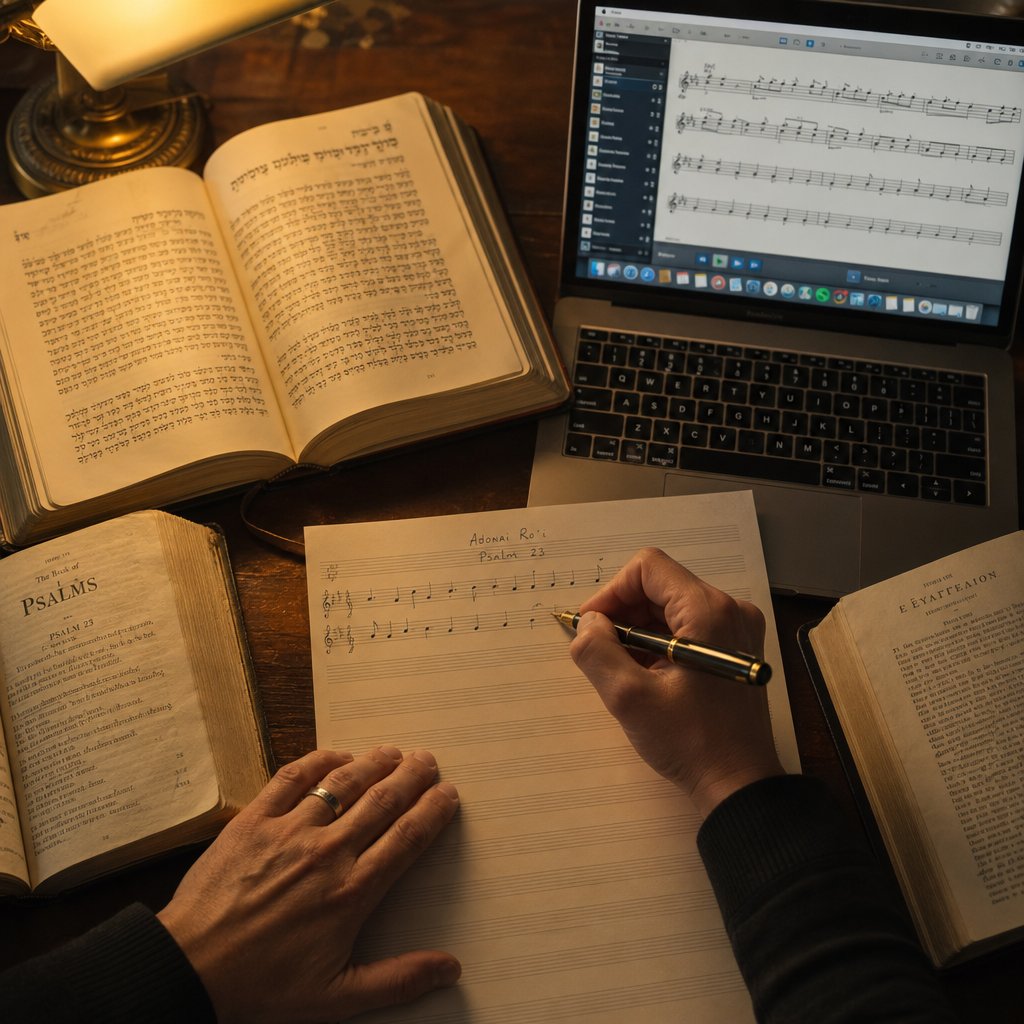
Every sacred choral work begins with a decision that has nothing to do with notes, rhythms, or voice parts. It begins with a text. A psalm verse, a liturgical prayer, a line of sacred poetry. The composer's first and most consequential task is figuring out how to make that text sing, how to let the music illuminate the words rather than compete with them. This relationship between word and music is the craft at the heart of the entire tradition, and understanding it changes how you hear everything from a Renaissance motet to a contemporary choral premiere.
Text-Setting and the Relationship Between Word and Music
Composer Libby Larsen, who has written over 100 choral works, put it plainly: "The human voice carries the spirit of our culture on its breath. That's why it's hard to compose well for the voice." The difficulty she describes is not technical. It is relational. When you set a sacred text to music, you are working with another person's creative and spiritual output, whether that person is a psalmist writing three thousand years ago or a living poet. The music must serve the words, not overpower them.
Two fundamental approaches define how composers handle this relationship. Syllabic text setting assigns roughly one note per syllable, keeping the words clear and the rhythm close to natural speech. Gregorian chant works this way much of the time, and so do Lutheran chorales, where the congregation needs to follow along without stumbling. Melismatic text setting takes the opposite approach, stretching a single syllable across many notes, sometimes dozens. Think of the long, flowing vocal lines in Allegri's Miserere or the ecstatic "Amen" passages in Handel's Messiah. Melisma slows the text down, drawing the listener's attention to a single word or idea and giving it emotional weight that syllabic delivery cannot achieve.
Most composers blend both techniques within a single work. A passage of syllabic clarity might set up a moment of melismatic release, the way a storyteller speaks plainly before pausing on the word that matters most. Dale Warland, founder of the Dale Warland Singers, describes the key question every composer must ask: "Will a musical setting enhance or will it diminish the impact of the text? Is the text better left alone?"
Word painting adds another layer. This technique uses musical gestures to mirror the literal or emotional meaning of specific words. When a Renaissance composer sets the word "ascendit" ("he ascended") to a rising melodic line, or writes a descending passage on "descendit" ("he descended"), that is word painting at its most direct. But subtlety matters. As Larsen cautions, "When you're word painting with a Shakespearean text, you can easily overdo it. You've got to be subtle. Just a little paint here and there." The same restraint applies to sacred texts. A composer who paints every word turns the music into illustration. One who paints selectively turns it into revelation.
Harmony and counterpoint serve the text in less obvious but equally powerful ways. In the motet tradition, imitative counterpoint, where a melodic phrase passes from voice to voice in overlapping entries, creates the effect of a community meditating on the same words from different angles. Palestrina's signature technique of placing consonant chords on strong beats and dissonant chords on weak beats gave his sacred texts a sense of gravitational pull, always resolving toward stability and peace. Modern composers like Morten Lauridsen and Eric Whitacre use cluster chords and suspended harmonies to achieve a different effect: the sense that a sacred word is hovering in midair, unresolved, inviting the listener to sit with its meaning rather than move past it.
The practical side of text-setting involves decisions that might surprise anyone who has not tried it. Two-syllable words landing on single notes, vowel sounds that do not project well in a large acoustic space, consonant clusters that trip up a choir at tempo: these are the granular challenges that separate effective choral writing from music that looks good on paper but falls apart in performance. Warland recalls working with a composer who set the word "power" from Isaiah on a single long note. The fix was simple but telling: substituting the word "might" from a different translation gave the singer a better vowel, a stronger beat placement, and a more singable line. Sacred choral composition lives in details like these, where the craft of matching sound to meaning operates at the level of individual syllables.
Creating Sacred-Inspired Music With Modern Technology
That centuries-old craft has not stopped evolving. The same creative impulse that drove medieval monks to add a second voice to a plainchant melody, that pushed Palestrina to refine polyphony until every word could be heard, and that led Part to strip music down to a single triad and a stepwise melody, continues to find new forms of expression. Technology is the latest chapter in that story.
For composers, worship leaders, and creators who want to explore sacred musical styles without years of formal training, AI-powered tools now offer a practical entry point. MakeBestMusic's AI Song Generator lets you turn a sacred mood, hymn idea, or liturgical theme into an original royalty-free track in seconds. Enter a description like "contemplative choral hymn" or "reverent organ-led worship piece," and the tool generates a composition that captures the harmonic textures, pacing, and tonal qualities associated with the tradition.
This is not a shortcut around the craft. It is a compass for navigating it. A worship leader preparing music for a service can use it to sketch a mood before bringing the idea to a choir. A filmmaker scoring a scene with sacred overtones can generate reference tracks that communicate the emotional tone they are after. A curious listener who has spent hours with Rachmaninoff's All-Night Vigil and wants to understand why those particular harmonies feel the way they do can experiment with similar textures hands-on, adjusting mood and genre parameters to hear how small changes reshape the sacred sound.
The bridge between tradition and technology is shorter than it appears. The core question has not changed since the 13th century: how do you take a sacred idea, a prayer, a feeling of reverence, a moment of awe, and give it a musical voice? The tools are different. The impulse is the same.
From monks adding a second voice to plainchant in a medieval scriptorium to composers entering a mood into an AI generator, the creative impulse behind sacred choral music has never been about the technology available. It has always been about the human need to make the inexpressible heard.
Whether you approach this tradition as a listener, a singer, a composer, or simply someone searching for a moment of stillness in a noisy world, the door is open. Sacred choral music has spent over a thousand years proving that collective voices raised in harmony can reach places that words alone cannot. That reach has not diminished. If anything, it is wider now than ever.
