

What Speedcore Is and Why It Exists
Imagine pressing play on a track and feeling your chest tighten before your brain even registers what it's hearing. A wall of distorted kick drums hammers at a pace so relentless it stops sounding like rhythm and starts sounding like a machine tearing itself apart. Your instinct says this can't be music. Your pulse says otherwise. That's your first encounter with speedcore music, and it's designed to provoke exactly that reaction.
Speedcore is an extreme subgenre of hardcore techno characterized by tempos exceeding 300 BPM, heavily distorted kick drums, and abrasive sonic textures. Emerging from the European hardcore techno scenes of the early-to-mid 1990s, it deliberately pushes electronic music to its most intense and uncompromising limits.
Whether you searched for speed core out of curiosity or stumbled across a track clocking in at bpm 300 and thought something had glitched, you're not alone. The genre thrives on that moment of disbelief.
Defining Speedcore Beyond the BPM Number
The 300+ BPM threshold is the common shorthand, but tempo alone doesn't tell the full story. Plenty of electronic tracks can be programmed at extreme speeds without capturing what makes this genre distinct. It's equally defined by attitude: a deliberate rejection of mainstream dance music conventions, a kinship with noise and aggression, and a refusal to make itself palatable. The distorted kicks, the abrasive textures, the sheer sonic hostility are all intentional choices. Producers aren't failing to make polished music. They're choosing chaos as an aesthetic. Even those who initially search for "sppedcore" by typo quickly discover a community that takes its extremity seriously, even when it doesn't take itself too seriously.
Why Extreme-Tempo Music Exists
So why would anyone create or listen to something this aggressive? The motivations run deeper than shock value. When hardcore techno emerged in the 1990s across Belgium, the Netherlands, and Germany, it already carried a rebellious streak against commercialized rave culture. Speedcore took that rebellion further, functioning as both protest and experiment. For some listeners, it's pure catharsis, a sonic pressure valve for tension that gentler genres can't touch. For others, it's humor and transgression rolled into one, the thrill of hearing something so extreme it becomes absurd and exhilarating at the same time. And for producers rooted in the DIY ethos inherited from punk and industrial music, it represents a community built around a shared appreciation for intensity, where the only rule is that there are no speed limits.
That spirit of escalation didn't stay contained at 300 BPM for long. It splintered into even faster, stranger territory, creating an entire spectrum of extreme-tempo genres that each redefined what rhythm could mean.
The Hardcore Continuum From Gabber to Extratone
That spectrum stretches wider than most people realize. From the dancefloor-friendly pulse of gabber to the frequency experiments of extratone, each genre along the hardcore continuum occupies a distinct zone of tempo and intensity. Think of it less as a ladder and more as an escalating dare, where every rung redefines what counts as rhythm. The table below maps out the full range of bpm techno music has explored at its most extreme.
| Genre | Typical BPM Range | Key Sonic Traits | Era of Emergence |
|---|---|---|---|
| Gabber | 150 - 200 BPM | Pounding four-on-the-floor kicks, Hoover synth stabs, aggressive but danceable energy | Early 1990s (Rotterdam) |
| Hardcore Techno | 160 - 200 BPM | Distorted basslines, warped vocal samples, dark and industrial textures | Early 1990s (Frankfurt, Netherlands) |
| Terrorcore | 200 - 300 BPM | Horror-themed samples, extreme distortion, abrasive and theatrical aggression | Mid-to-late 1990s |
| Speedcore | 300 - 600 BPM | Machine-gun kick drums, noise textures, deliberate sonic hostility | 1995 onward |
| Splittercore | 600 - 1,000 BPM | Kicks blurring into tonal frequencies, rhythmic perception breaking down | Late 1990s - 2000s |
| Extratone | 1,000+ BPM | Beats fully morphed into continuous tones, textural and frequency-based | Late 1990s - 2000s |
For context, most commercial pop and billboard singles sit between 118 and 122 BPM. Even a typical tech house tempo hovers around 124 to 128 BPM. The genres above occupy an entirely different universe of speed.
How Gabber and Hardcore Techno Set the Stage
The story starts in the early 1990s, when the European rave scene fractured into distinct communities. In Rotterdam, DJs and producers pushed hardcore techno past 160 BPM, leaning on the iconic Hoover sound of Roland Alpha Juno synths to build breakneck tracks. Rotterdam Records founder Paul Elstak is widely regarded as a central innovator behind the gabber wave that swept outward from the Netherlands. Meanwhile in Frankfurt, Marc Acardipane and his Planet Core Productions label were pioneering a darker, harder strain of hardcore techno, releasing tracks upward of 160 BPM that many Dutch artists later cited as direct inspiration for the speedcore movement.
Gabber gave the hardcore continuum its cultural infrastructure: the festivals, the labels, the dress code, the attitude. It proved there was a massive audience hungry for aggressive electronic music. Hardstyle, which crystallized later at around 150 BPM, took that energy in a more commercial and melodic direction. But the producers who wanted to go faster, not smoother, had a different destination in mind. By the mid-1990s, the hardstyle bpm range felt tame to those chasing pure intensity, and the race toward 300 BPM and beyond was already underway.
Splittercore and Extratone as Logical Extremes
Past the speedcore threshold, something strange happens to sound itself. Splittercore occupies the 600 to 1,000 BPM range, a zone where individual kick drums fire so rapidly they begin to blur together. Your ear stops hearing distinct hits and starts perceiving a buzzing, tonal texture instead. The relationship between speedcore, splittercore, and what lies beyond isn't just about adding more beats per minute. It's a fundamental shift in how the human brain processes rhythm.
The extratone genre takes this transformation to its logical conclusion. Once tempos cross 1,000 BPM, beats fully morph into continuous tones. As hardcore researcher Federico Chiari puts it, "Past 1000BPM, the sounds become frequencies. Humans are capable of discerning these sounds on a speculative level, but not on a listening level." The spaces between kicks become too minute for the brain to register as separate events. Rhythm, as you'd normally understand it, ceases to exist. What remains is pure frequency, a buzzing, textural experience closer to drone music or harsh noise than anything you'd associate with a dancefloor.
These aren't just faster versions of the same thing. Each jump along this continuum represents a genuinely different listening experience, a different relationship between sound and perception. And understanding where each genre sits on the spectrum makes it much easier to appreciate what happens inside the music itself, at the level of individual sounds and production choices.
What Speedcore Actually Sounds Like
Knowing where the genre sits on a tempo chart is one thing. Knowing what it does to your ears is something else entirely. Imagine a kick drum, the kind you'd hear anchoring a gabber track, now picture it overdriven until it distorts into a snarling burst of noise, then fired at you five times per second without pause. Layer on sheets of abrasive high-frequency static, samples chopped and pitch-shifted so aggressively they've lost all connection to their source material, and a low-end rumble that you feel in your sternum before you hear it in your headphones. That's the neighborhood you're in.
Distorted Kicks and Abrasive Textures
The kick drum is the genre's beating heart, though "beating" undersells the violence of it. Producers typically overdrive and clip their kicks until the original percussive transient dissolves into something closer to a bark of raw noise. At 300+ BPM, these hits stack so tightly they generate a relentless, almost physical wall of low-end energy that vibrates through your body rather than bouncing off your eardrums. Some tracks pair this onslaught with shrill, metallic textures, feedback-like tones that sit in the upper frequencies and grind against the distorted bass below.
Not every producer chases pure aggression, though. A strain of melodic speedcore weaves haunting synth lines and minor-key progressions through the chaos, creating an eerie contrast between beauty and brutality. You'll notice this especially in Dark Melodic Speedcore, where atmospheric pads and emotional depth coexist with punishing tempos. But even in its most melodic form, the distorted kick remains non-negotiable.
Structural Conventions and Song Architecture
If you're expecting a verse, a chorus, and a neat four-minute arc, you'll be waiting a long time. Most tracks abandon conventional song structure entirely in favor of escalating intensity curves, sudden tempo shifts, and collage-like arrangements that feel more like controlled demolition than composition. Some producers borrow gabber-style buildups only to detonate them into walls of noise. Others splice in samples from pop culture, cartoons, or horror films for ironic contrast, a technique that shares DNA with breakcore and its love of absurdist sample collage.
That cross-genre kinship runs deep. The abrasive textures connect directly to noise music and power electronics. The velocity and aggression mirror fastcore and grindcore from the punk and metal world. Even the highest bpm song in a producer's catalog often owes as much to these non-electronic traditions as it does to hardcore techno. The genre exists at a crossroads where electronic music, noise art, and extreme metal all blur together.
Here's a quick reference for the defining sonic characteristics:
- Massively distorted, clipped kick drums firing at machine-gun rates
- Abrasive high-frequency textures and metallic noise layers
- Samples chopped, pitch-shifted, and manipulated beyond recognition
- Non-linear, escalating arrangements that reject verse-chorus structure
- Walls of low-end energy that blur the line between rhythm and tone
- Cross-genre textures borrowed from noise music, power electronics, and grindcore
These sonic ingredients don't just define a sound. They define a philosophy of production, one that values impact over polish and intensity over accessibility. The producers who shaped that philosophy, and pushed it in wildly different directions across continents, deserve a closer look.
Pioneering Artists Who Shaped Speedcore
A philosophy of production only matters if someone is brave enough to act on it. The genre's identity wasn't forged by tempo settings alone. It was built by a handful of producers across Europe and Japan who each interpreted extreme speed through a radically different creative lens, turning a niche experiment into a global underground movement.
European Pioneers and the German-Dutch Foundation
Germany and the Netherlands didn't just provide the infrastructure for speedcore. They provided the personalities. The German scene, in particular, played a critical role in carving out a distinct genre identity separate from terrorcore, which shared similar aggression but operated at lower tempos and leaned harder into horror-themed theatrics. German producers pushed past that ceiling, treating raw velocity as the point rather than the backdrop.
The Dutch side brought its own ferocity. Noisekick became synonymous with uncompromising aggression, building a reputation through live performances that felt less like DJ sets and more like endurance tests for both performer and audience. His work helped cement the Netherlands as a hub for the genre's most punishing output. Meanwhile, collectives like the Disciples of Annihilation fostered a communal identity around extreme-tempo production, proving that even the most abrasive music could sustain a tight-knit creative community.
One name that consistently surfaces in early discussions is DJ Skinhead, whose tracks crossed over into mainstream hardcore awareness during the mid-1990s. Releases like "Extreme Terror" became reference points, not because they were the fastest or most distorted, but because they demonstrated that extreme tempo could carry genuine energy and identity rather than functioning as a novelty.
The Japanese Scene and Global Expansion
Across the Pacific, Japanese producers were developing a parallel tradition that sounded nothing like its European counterpart. Rooted in doujin music culture and deeply influenced by anime aesthetics, the Japanese strain introduced melodic complexity and technical precision that expanded the genre's emotional range far beyond pure aggression.
m1dy stands out as one of the most prolific figures in this movement. His output helped define a more melodic, J-core-influenced approach, weaving bright synth lines and energetic hooks through tracks that still hit well above 300 BPM. Where European producers often pursued darkness, m1dy proved the genre could be exhilarating and almost joyful without sacrificing speed. Kobaryo took that cross-pollination even further, bridging the gap between speedcore and rhythm game culture. His compositions became staples in franchises like Sound Voltex, introducing millions of players to extreme tempos through gameplay rather than raves. Kobaryo's work also overlaps heavily with breakcore music, borrowing its chaotic sample manipulation and rhythmic unpredictability to create something that sits at the intersection of multiple extreme genres.
That overlap matters. Many breakcore artists operate in adjacent tempo ranges and share audiences with speedcore producers, creating a porous boundary between the two communities. The break core aesthetic, with its love of chopped-up samples and frenetic energy, has fed directly into how Japanese producers approach composition. Even listeners searching for hypertone songs often land in this same ecosystem, where the lines between extreme-tempo subgenres blur into a shared culture of sonic maximalism.
Here's a structured look at the key figures and what they each brought to the table:
- DJ Skinhead — Dutch producer whose mid-1990s tracks like "Extreme Terror" brought speedcore into mainstream hardcore consciousness and established early genre benchmarks.
- Noisekick — Dutch artist known for relentless aggression and physically intense live sets that pushed the boundaries of what audiences could endure.
- Disciples of Annihilation — Collective that helped build communal infrastructure around extreme-tempo production in the European underground.
- m1dy — Prolific Japanese producer who pioneered a melodic, J-core-influenced strain, proving the genre could carry emotional range alongside extreme speed.
- Kobaryo — Japanese artist whose work bridges speedcore, breakcore, and rhythm game culture, introducing the genre to a massive global audience through gaming.
These artists didn't operate in a vacuum. Each one was shaped by the regional scene, the local distribution networks, and the cultural context surrounding them. The differences between a Rotterdam warehouse party and a Tokyo doujin event aren't just geographic. They produced fundamentally different creative philosophies, and those philosophies gave rise to distinct regional identities worth exploring on their own terms.
Regional Scenes and the Labels Behind Them
Those distinct regional identities didn't emerge by accident. They were shaped by specific infrastructure: the labels willing to press the records, the venues willing to host the events, and the distribution channels that got the music into listeners' hands. Each geographic hub developed its own creative DNA, and understanding those differences reveals just how much variety hides beneath a single genre tag.
Germany and the Netherlands as Ground Zero
The German and Dutch hardcore techno scenes of the 1990s provided the launchpad. Rotterdam already had a thriving gabber infrastructure, with labels, record shops, and a network of promoters experienced in booking aggressive electronic music. Germany's contribution ran parallel but darker. Frankfurt's industrial music traditions and Berlin's post-reunification club culture created fertile ground for producers who wanted to push past terrorcore into pure velocity. Labels like Force Inc. and its sub-imprints, while not exclusively speedcore-focused, helped normalize the idea that extreme, abrasive electronic music deserved proper releases and distribution. The broader ecosystem of European industrial and noise traditions gave producers a creative vocabulary that extended well beyond four-on-the-floor kicks, connecting the genre to a lineage of sonic confrontation stretching back decades.
Japan and the Doujin Music Underground
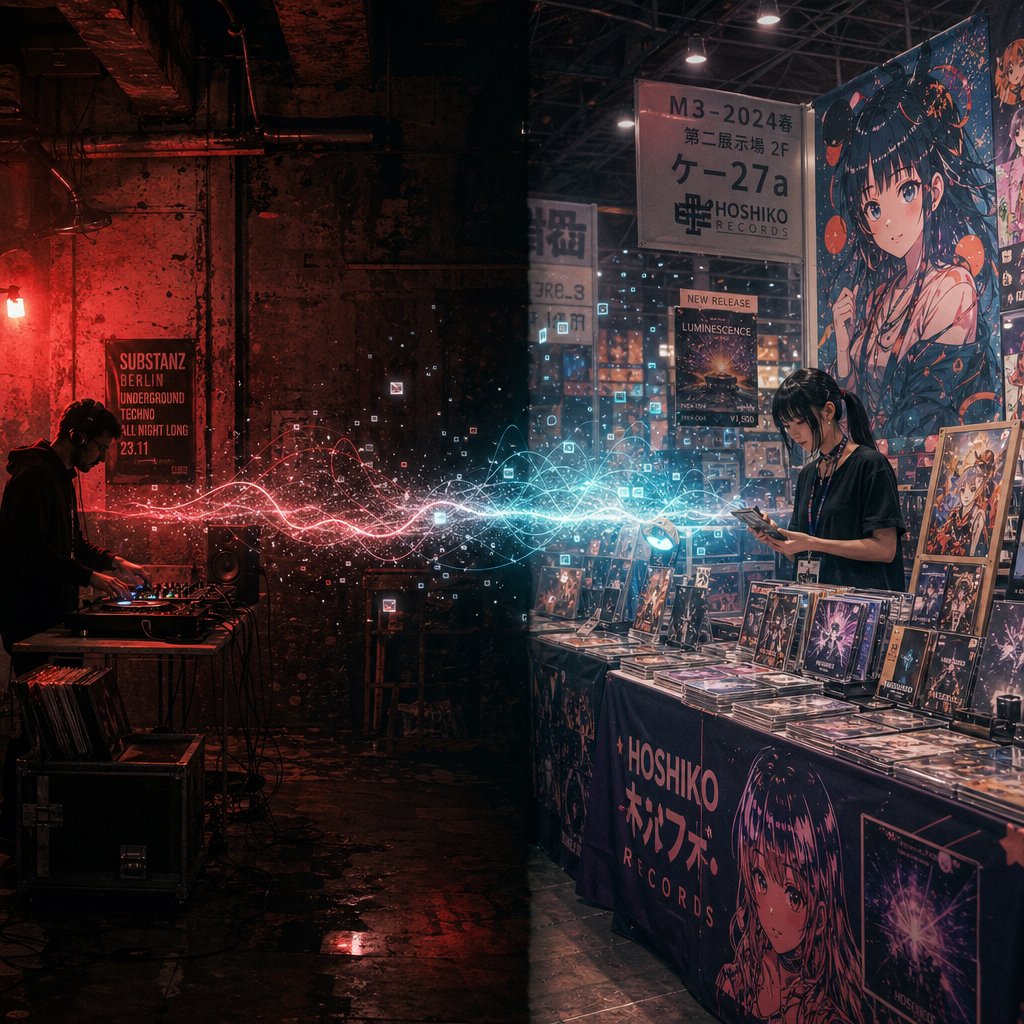
Japan's parallel tradition grew from entirely different soil. The doujin (self-published) music culture provided a ready-made framework for independent creators. Events like Comiket, the world's largest fan convention with estimated attendance exceeding 750,000 per event, and M3, a bi-annual market focused almost exclusively on independent music, gave producers physical spaces to sell CDs directly to fans. Many artists operated under "circles," small creative collectives that handled everything from composition to mastering to manually burning each disc at home.
This DIY ecosystem produced a strain of speedcore that leaned melodic and technically intricate. Bright synthesizers, anime-influenced artwork, and connections to the Touhou Project fan community gave the Japanese scene an aesthetic identity worlds apart from European aggression. Online storefronts like Bandcamp and platforms like SoundCloud later dissolved the geographic barrier, letting global listeners discover what had previously been a convention-hall phenomenon. For anyone asking what is breakcore music and how it relates to this world, the Japanese scene offers the clearest answer: many doujin producers moved fluidly between speedcore, breakcore, and adjacent styles, treating genre boundaries as suggestions rather than walls. The breakcore meaning in this context is less about a rigid definition and more about a shared ethos of chaotic sample manipulation and rhythmic experimentation that overlaps heavily with extreme-tempo production.
Eastern Europe and the Modern Global Network
Eastern European producers and event organizers have played an increasingly vital role in keeping the genre alive as a live performance culture. Countries like Poland, the Czech Republic, and Russia developed their own pockets of hardcore and extratone music activity, often driven by small collectives organizing warehouse events and online communities. These scenes tend to blend European aggression with a raw, lo-fi production aesthetic shaped by limited access to high-end studio equipment, which paradoxically reinforces the genre's DIY credibility.
The internet has been the great equalizer. SoundCloud, Bandcamp, and YouTube collapsed the distance between a bedroom producer in Moscow and a listener in Osaka. What was once a handful of isolated regional scenes is now a truly global network, with collaborations, split releases, and online festivals connecting artists who may never share a physical stage. The breakcore definition has similarly expanded in this borderless environment, absorbing influences from every regional tradition it touches.
| Geographic Focus | Sonic Style | Key Distribution Channels | Cultural Context |
|---|---|---|---|
| Germany & Netherlands | Raw aggression, industrial textures, noise-influenced distortion | Vinyl labels, hardcore festivals, record shops | Rooted in gabber infrastructure and European industrial/noise traditions |
| Japan | Melodic complexity, bright synths, technically precise compositions | Doujin events (Comiket, M3), online storefronts (Bandcamp, BOOTH) | Doujin self-publishing culture, anime aesthetics, Touhou fan community |
| Eastern Europe & Global | Lo-fi rawness blended with diverse regional influences | SoundCloud, Bandcamp, YouTube, underground warehouse events | Internet-native community, DIY ethos, cross-border collaboration |
These scenes didn't develop in isolation forever. The same internet infrastructure that connected producers across continents also introduced the genre to entirely new audiences, people who discovered extreme tempos not through raves or record shops, but through rhythm games, memes, and streaming platforms.
Speedcore in Internet Culture and Rhythm Games
For decades, discovering the genre meant knowing someone who knew someone, or digging through crates at a niche record shop. That gatekeeping dissolved almost overnight. A generation of listeners found their way in not through raves or underground labels, but through a game controller in one hand and a YouTube recommendation in the other.
Rhythm Games and the Gateway Effect
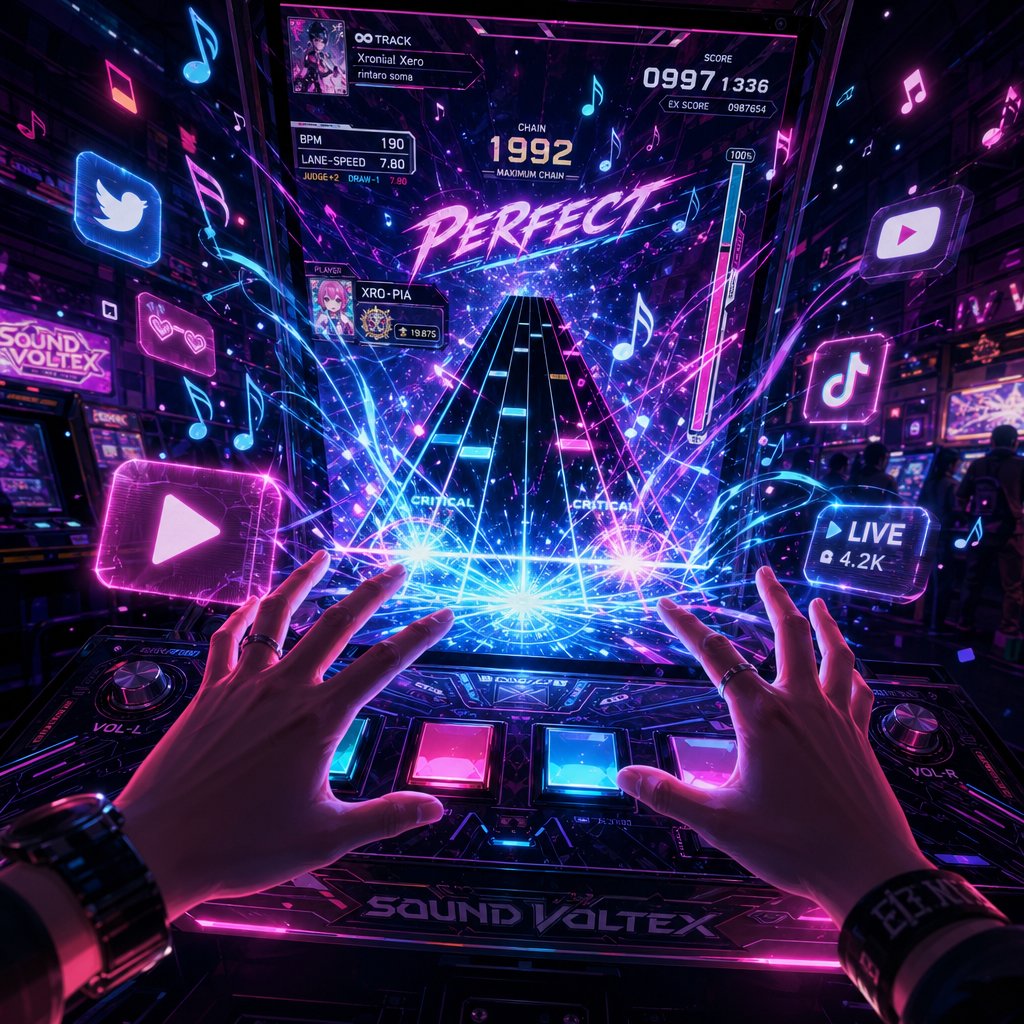
Franchises like beatmania IIDX and Sound Voltex have quietly become the single largest on-ramp into extreme-tempo electronic music. When Konami's BEMANI series features a track clocking in at 273 BPM and tagged as "CHAOTIC SPEEDCORE," millions of players encounter the genre without ever setting foot in a warehouse party. Kobaryo's SEITEN NO TERIYAKI, for example, debuted in REFLEC BEAT VOLZZA before crossing into beatmania IIDX 23 copula, exposing a massive arcade audience to the genre's signature aggression and tempo shifts.
The appeal goes beyond passive listening. Rhythm games turn extreme BPM into a physical challenge. Players compete to full-combo tracks that push well past 300 BPM, and the difficulty scaling creates its own competitive subculture. Clearing a speedcore chart becomes a badge of honor, a skill flex that gets clipped and shared across social media. Producers like Kobaryo and other HARDCORE TANO*C affiliates have built significant followings through this crossover, reaching audiences who might search for the song with the highest bpm in a game's tracklist long before they search for the genre itself. Even adjacent curiosities like nintendocore bpm comparisons pop up in gaming forums, as players try to map the intensity they feel in-game onto the broader world of extreme music.
Memes, SoundCloud, and the Streaming Era
Outside of arcades, the internet did what it does best: turned extremity into content. Speedcore's inherent absurdity, kick drums firing so fast they become a tone, tracks pushing past 1000bpm into territory where rhythm ceases to exist, makes it irresistible material for reaction videos, "fastest song ever" clickbait, and ironic meme sharing. Someone posts a splittercore track on TikTok with the caption "my alarm clock at 6am," it racks up a million views, and a percentage of those viewers genuinely stick around.
That paradox is real. Ironic discovery feeds genuine audience growth. Platforms like SoundCloud and Bandcamp transformed the genre from a physical-media underground into a globally accessible phenomenon, letting bedroom producers in any country upload a track and find listeners within hours. YouTube algorithm rabbit holes pull curious viewers from a gabber compilation into terrorcore into full-blown speedcore deep cuts. The genre's influence has even bled into hyperpop and other internet-native styles that borrow extreme tempo manipulation and distortion aesthetics without committing to the full sonic assault.
Here are the key platforms and cultural touchpoints driving modern discovery:
- Rhythm game franchises (beatmania IIDX, Sound Voltex, REFLEC BEAT) that feature extreme-tempo tracks as high-difficulty challenges
- SoundCloud and Bandcamp as primary upload and distribution hubs for independent producers worldwide
- YouTube algorithm recommendations and reaction content that funnel casual viewers toward increasingly extreme genres
- TikTok and meme culture, where the genre's absurd intensity becomes shareable, ironic content that paradoxically builds real fanbases
- Hyperpop and adjacent internet-native genres that borrow distortion and tempo aesthetics, creating crossover listener pipelines
All of this visibility raises a natural question: what actually goes into making a track that hits these extremes? The production side of the genre is just as unconventional as the listening experience, and more accessible than most people assume.
How Speedcore Tracks Are Actually Produced
Most electronic music production tutorials assume you're working somewhere between 120 and bpm 200. Speedcore throws that entire framework out the window. The tools are often the same, a laptop, a DAW, a pair of headphones, but the techniques required to make anything coherent at 300+ BPM demand a fundamentally different approach to sound design. Here's what that actually looks like in practice.
Building Kicks at Extreme Tempos
The kick drum is where everything starts, and where standard production logic breaks down. At typical dance music tempos, a kick has room to breathe: a punchy transient, a resonant tail, silence before the next hit. At 300 BPM, that silence vanishes. Kicks stack on top of each other so tightly that conventional drum synthesis produces nothing but a muddy blur.
Producers solve this by treating the kick less as a drum hit and more as a distortion event. Heavy overdrive, bitcrushing, and layered synthesis transform the sound into a short, aggressive bark of noise that cuts through even at extreme density. The transient gets shortened, the tonal body gets crushed, and what remains is a clipped burst designed to maintain impact when it's firing five or more times per second.
Push past 600 BPM into splittercore territory and the challenge shifts again. Individual hits blur together so completely that producers start thinking about kicks as tonal elements rather than percussive ones. At 1000 beats per minute, you're no longer programming a drum pattern. You're sculpting a frequency. The entire concept of "rhythm" gives way to pitch and timbre, which is why production at these extremes has more in common with noise synthesis than beat-making.
Nearly all of this work happens inside digital audio workstations. Software like Renoise, FL Studio, and Ableton Live dominates the scene, with most producers working entirely in the box. Hardware setups are rare. The genre's DIY roots mean a free DAW and a willingness to experiment can get someone surprisingly far.
Sampling, Arrangement, and the Art of Controlled Chaos
Beyond the kick, speedcore production relies heavily on aggressive sample manipulation. Producers use extreme time-stretching, pitch-shifting, and granular synthesis, a technique that slices audio into tiny fragments called grains and rearranges them independently, to warp source material beyond recognition. A vocal snippet might get granulated into a shimmering texture. A breakbeat might get compressed into a stuttering wall of rhythmic debris. The goal isn't fidelity to the original sample. It's transformation.
Arrangement follows its own logic too. Forget verse-chorus-verse. Most tracks build around escalating intensity curves, layering distortion and density until the mix reaches a breaking point, then either dropping into silence or pivoting into an entirely different tempo or texture. Some producers use collage techniques borrowed from noise music, stitching together unrelated sonic events into something that feels bpm like that of a controlled demolition: chaotic on the surface, deliberate underneath. Others build more linear progressions, stacking elements methodically until the track peaks.
The barrier to entry is genuinely low. The genre's punk-adjacent ethos means polish is optional and raw energy is the currency. A laptop, a free DAW, and a distortion plugin are enough to start. Here are the essential tools and techniques most producers rely on:
- A DAW (FL Studio, Ableton Live, Renoise, or free options like LMMS) for sequencing and arrangement
- Distortion and bitcrushing plugins to shape kicks into their signature overdriven sound
- Granular synthesis tools (such as Ableton's Granulator or Arturia Pigments) for deconstructing and reshaping samples into new textures
- Extreme time-stretching and pitch-shifting for warping source audio beyond recognition
- Sample libraries or self-recorded material as raw ingredients for manipulation
- Layered synthesis techniques to build kicks that maintain clarity at extreme tempos
Production knowledge only tells half the story, though. The other half lives on the dancefloor, where these tracks hit differently through a sound system than they ever could through headphones, and where the communal experience of extreme tempo takes on a physical dimension that no tutorial can replicate.
Experiencing and Creating Extreme-Tempo Music
There's a reason producers talk about the dancefloor as a separate medium. A speedcore track through earbuds is intense. That same track through a properly tuned sound system, with sub-bass rattling your ribcage at 300 beats per minute and a room full of people locked into the same controlled frenzy, is a fundamentally different experience. The physical dimension changes everything.
Experiencing Speedcore on a Sound System
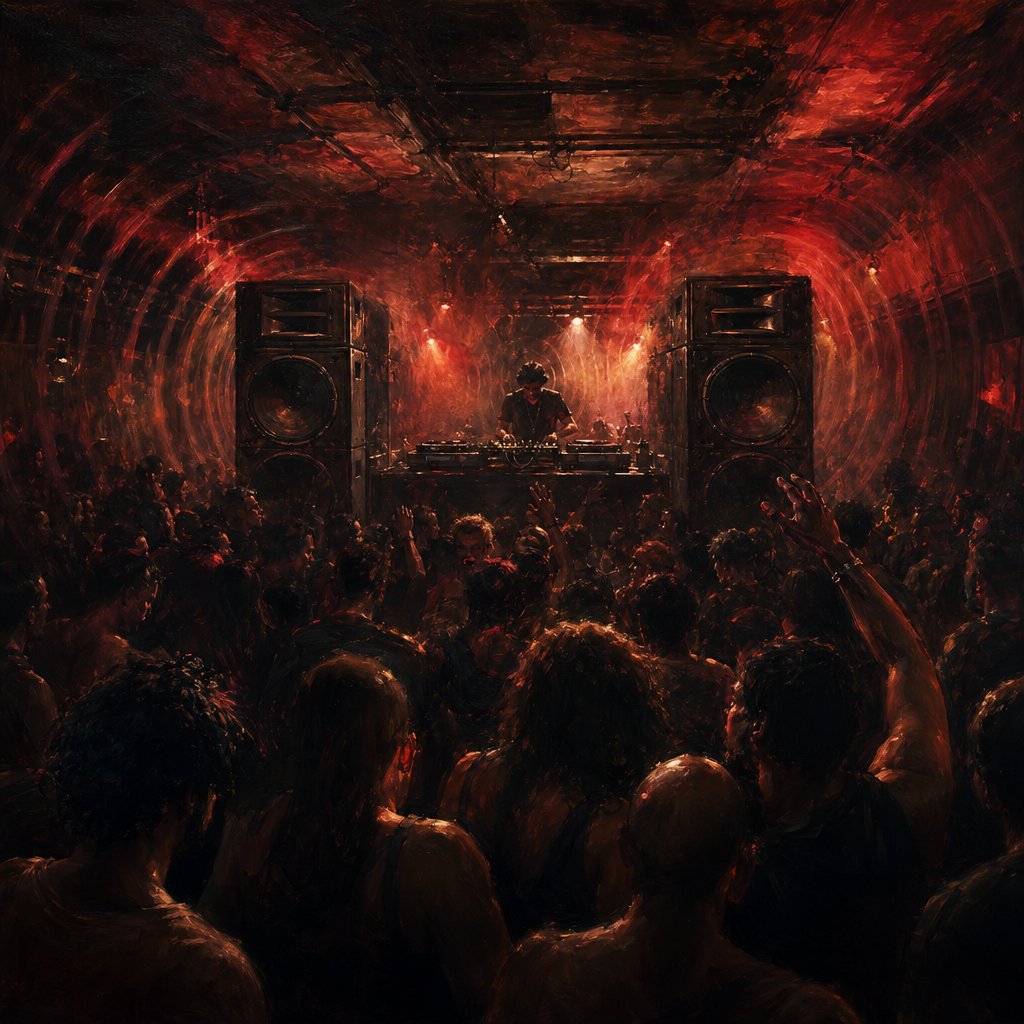
Picture a mid-sized club or warehouse space, not a stadium festival. The crowd is smaller than what you'd find at a mainstream EDM event, maybe a few hundred people, but the energy per square meter is off the charts. The sub-bass at these tempos doesn't thump in the way house music does. It vibrates. Your clothing moves. Your vision blurs slightly at the edges. As Boiler Room's 4:3 archive describes it, the beats at this severity "cease to function as rhythm at all, serving more as a vibratory gateway into a frightening quantum realm." That's not hyperbole when you're standing in front of the speakers.
DJ sets that push past 300 BPM create a strange communal dynamic. The music is too fast for conventional dancing, so the crowd develops its own physical vocabulary: rapid stomping, headbanging, or simply standing and absorbing the sonic pressure. There's a shared understanding in the room that everyone chose to be here, that this intensity is the point, not a side effect. It's closer to the energy of a noise show or a grindcore pit than anything you'd encounter at a festival where the typical set hovers around what bpm is house, somewhere in the 124 to 128 range.
These sets rarely headline their own standalone events. More often, they appear as late-night slots at broader hardcore techno festivals or as dedicated rooms within multi-genre events. The infrastructure mirrors the genre's underground DNA: smaller venues, independent promoters, word-of-mouth lineups. EDM festivals tend to invest heavily in massive LED stages and pyrotechnics. Speedcore events invest in sound systems. The spectacle is auditory, not visual, and the intimacy of a smaller room amplifies the physical impact in ways a stadium never could.
Exploring Extreme Tempo as a Creative Starting Point
Maybe you've read this far and you're curious. Not just about listening, but about making something. The good news is that the barrier between "interested" and "experimenting" has never been lower. The genre was built on DIY principles, and modern tools have pushed accessibility even further, letting anyone explore how extreme tempos and aggressive textures come together in a composition.
You don't need years of production experience to start. Whether you want to hear what music very quickly generated at 300+ BPM actually sounds like, or you're ready to get hands-on with a DAW, there's a path that fits your skill level. Here are four practical ways to get started:
- MakeBestMusic's AI Song Generator — Type in a genre like "speedcore" or a mood descriptor like "aggressive and chaotic," and the tool generates an original royalty-free track in seconds. It's the fastest way to hear how extreme-tempo conventions translate into a full composition without touching a single plugin. Useful for quick experimentation, reference tracks, or simply satisfying curiosity about what these tempos sound like when assembled into a structured piece.
- Free DAWs (LMMS, Audacity, or trial versions of FL Studio and Ableton Live) — For hands-on production, a free digital audio workstation gives you full control over tempo, distortion, and arrangement. Set your project to 300+ BPM, load a kick sample, add distortion, and you're already in the neighborhood. The learning curve is steeper, but the creative ceiling is limitless.
- Sample packs and preset libraries — Several independent producers and online communities share free kick drum samples, noise textures, and distortion presets specifically designed for extreme-tempo production. These give you pre-built sonic ingredients to arrange and manipulate without starting from scratch.
- Remix and collaboration communities — Platforms like SoundCloud and Bandcamp host active communities where producers share stems, invite remixes, and offer feedback. Jumping into a remix challenge is one of the fastest ways to learn by doing, with built-in support from people who've been making this music for years.
Each of these paths serves a different kind of curiosity. AI generation tools let you explore the genre's sonic palette instantly, which is especially valuable if you're still figuring out whether extreme-tempo production is something you want to invest time in. Free DAWs and sample packs reward patience with deeper creative control. And community involvement connects you to the same global network of producers and listeners that has kept this music alive for three decades.
Speedcore started as a handful of producers in European warehouses daring each other to go faster. It survived format changes, geographic isolation, and the kind of mainstream indifference that kills most underground genres. What it couldn't survive, thankfully, was obscurity. Between rhythm games, meme culture, streaming platforms, and tools that put production within anyone's reach, the genre has never been more accessible or more alive. The only question left is whether you're going to keep reading about it or press play.
