

What Is a Syncopated Rhythm
When you tap your foot to a song, your body locks onto a steady pulse. Beats one, two, three, four. Predictable. Comfortable. A syncopated rhythm deliberately breaks that expectation by shifting the emphasis away from those strong downbeats and placing it on weak beats or in the spaces between beats. The result is a rhythmic tension that makes music feel alive, unpredictable, and impossible to ignore.
The word itself traces back to the ancient Greek sunkope, meaning "leaving out." In rhythmic terms, syncopation leaves out the expected accent on a strong beat and moves it somewhere your ear does not anticipate. That displacement is what separates a flat, mechanical rhythm from one that grooves.
A Plain-Language Definition of Syncopation
Syncopation is the deliberate placement of rhythmic accents on weak beats or between beats, creating a sense of surprise against an established pulse. It only works because a steady beat exists for the displaced accent to push against.
This definition of syncopated rhythm highlights a critical point many beginners miss. Playing offbeat notes is not automatically syncopation. Imagine a drummer hitting random spots with no underlying pulse. That is chaos, not groove. Syncopation requires a steady foundation. The accent gains its power precisely because your brain expects it to land on a strong beat and it does not. Without that expectation, there is nothing to displace.
Here is a quick way to hear the difference. Count out loud in even eighth notes: "1-and-2-and-3-and-4-and." In a straight rhythm, you would accent the numbered beats: "1-and-2-and-3-and-4-and." A syncopated version shifts those accents to the "ands": "1-AND-2-AND-3-AND-4-AND." You feel the pull immediately. Your foot still wants to land on 1, 2, 3, 4, but the emphasis tugs against it.
Your First Syncopated Rhythm in Four Counts
Try clapping this pattern. Each slot represents one eighth note across a single bar of 4/4 time. "X" means clap, "." means silence:
. X . X . X . X
Your claps land on every "and" while the downbeats stay empty. Tap your foot on beats 1, 2, 3, and 4 while clapping the pattern above. You will feel the tension between your foot and your hands. That tension is syncopation at work.
This article is built so you can go as deep as you want regardless of your instrument or whether you read standard notation. Beginners will find plain-language counting systems and clapping exercises. Intermediate players get detailed breakdowns across genres. Advanced musicians will encounter sixteenth-note subdivisions, harmonic syncopation, and creative applications for songwriting. Every concept uses text-based grids and syllabic counting so you can internalize the feel before ever touching sheet music.
The real question is not just what syncopation is, but why it feels so irresistibly good when you hear it.
Why Syncopation Makes Music Feel So Good
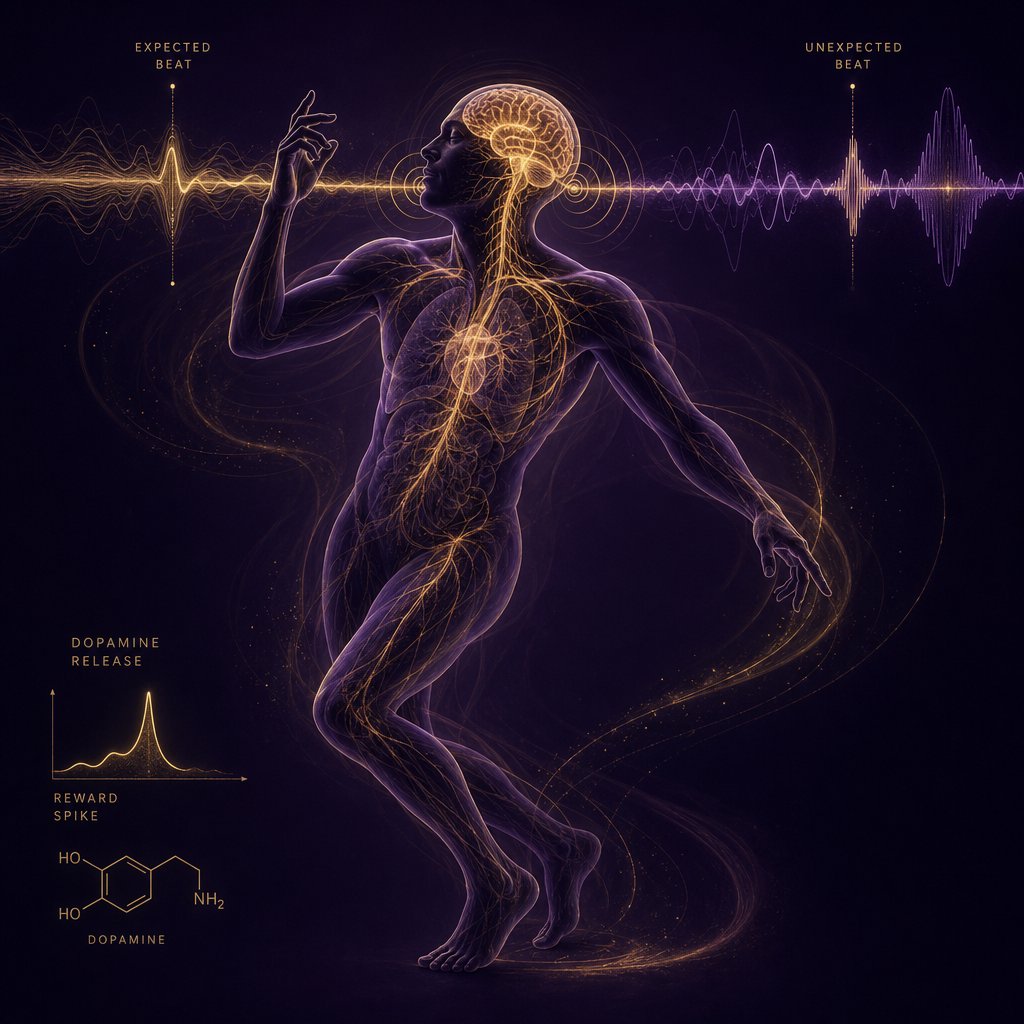
Your brain is a prediction machine. Every time you hear a steady beat, neural circuits lock onto that pulse and begin forecasting exactly when the next accent will arrive. When a syncopated rhythm lands an accent earlier or later than predicted, your brain registers a mismatch between expectation and reality. That mismatch is not frustrating. It is pleasurable, and understanding why reveals the deeper science behind groove.
How Your Brain Predicts the Beat
Imagine you are walking down a sidewalk and every crack is evenly spaced. After a few steps, you stop looking down because your brain already knows where the next crack will be. Rhythm works the same way. When you hear a repeating pulse, motor planning regions in your brain, including the premotor cortex, supplementary motor area, and basal ganglia, generate an internal timing signal that anticipates upcoming beats. This happens even when you are sitting perfectly still. A review in Frontiers in Human Neuroscience describes how the motor system produces predictive timing models aligned to the musical beat, helping the auditory system process rhythm through what researchers call the Action Simulation for Auditory Prediction (ASAP) hypothesis.
In plain terms, your brain builds an internal metronome. It couples sensory input with motor circuits so tightly that listening to a beat and moving to a beat share overlapping neural pathways. Neurons in auditory cortex entrain to metric periodicities, firing in sync with the pulse even when some acoustic information is missing. This is why you can still feel beat one of a measure even if no instrument actually plays on it. Your brain fills in the gap with its own prediction.
When a syncopated accent arrives on a weak beat or between beats, it violates that prediction. The brain registers a prediction error, a signal that says "something happened that I did not expect." That error propagates through the neural hierarchy, triggering an update to the internal model. The result is a brief spike of heightened attention and arousal, a tiny neurological surprise that keeps you engaged with the music.
Why Syncopation Feels Groovy
Here is where the syncopation definition connects to real listening experience. That prediction error is not just a neutral signal. Research shows it activates reward-related brain networks. A study published in PLOS ONE found an inverted U-shaped relationship between the degree of syncopation in funk drum breaks and listeners' ratings of both wanting to move and experienced pleasure. Medium levels of syncopation produced the highest desire to move and the most pleasure. Too little syncopation felt flat and predictable. Too much disrupted the pulse entirely and reduced enjoyment.
Why the sweet spot in the middle? Predictive coding theory offers an explanation. Your brain calculates what researchers call a precision-weighted prediction error, the product of how much the rhythm deviates from the expected meter and how confident the brain is in its prediction. With low syncopation, deviations are tiny, so there is little error to process. With extreme syncopation, the meter becomes so unclear that the brain loses confidence in its predictions altogether, reducing the weight of any error. But at moderate levels, the pulse remains strong enough for the brain to maintain high-confidence predictions while the syncopated accents generate meaningful violations. The weighted error peaks, and so does the pleasurable urge to move.
Syncopation derives its power entirely from the existence of a steady pulse it plays against. Without a clear beat to violate, displaced accents lose their groove and become rhythmic noise.
This is why syncopated rhythms make you want to tap your foot, nod your head, or get up and dance. Moving your body to the beat is one way the brain reduces prediction error. By generating its own periodic motor signal through tapping or swaying, the nervous system creates proprioceptive feedback that reinforces the internal model of the pulse. The urge to move is not just aesthetic preference. It is your brain's active strategy for resolving the tension that syncopation creates.
Think about the last time a funk bass line or a hip-hop beat made you involuntarily bob your head. That response was your motor system answering a call from your auditory system. The syncopated meaning embedded in those rhythms, the push and pull against the downbeat, generated just enough surprise to keep your attention locked in and just enough regularity to let your body synchronize. The music breathes because it alternates between tension and resolution on a cycle that repeats with every bar.
A common misconception is that syncopation equals chaos or randomness. The opposite is true. Randomness destroys the very framework that makes displaced accents meaningful. If there is no underlying pulse, there is no expectation to violate, no prediction error to generate, and no pleasure to release. The grooviest syncopated rhythms in funk, jazz, and electronic music all rest on rock-solid pulses. The complexity lives in what happens around the beat, never in the absence of one.
This tension-and-release cycle also explains why repetition matters. In groove-based music, syncopated patterns loop. You might expect the surprise to wear off after a few bars, but the body's motor engagement sustains the effect. Each repetition is another invitation to synchronize, another cycle of prediction, violation, and resolution that keeps the pleasure circuit active. The groove does not fade because your body keeps participating in it.
Knowing how your brain processes these rhythmic surprises is more than trivia. It changes how you listen, how you practice, and eventually how you create. The specific ways syncopation shows up in music, from off-beat accents to tied notes across barlines, each exploit this prediction mechanism differently.
Types of Syncopation Every Musician Should Know
Five distinct techniques produce that displaced-accent feeling, and each one exploits your brain's rhythmic predictions in a slightly different way. Some shift the accent by half a beat. Others erase a strong beat entirely or stretch a note across a barline. When you can identify what is syncopation in each category, you gain a vocabulary for describing grooves you already love and a toolkit for building new ones.
The categories below use the "1-and-2-and-3-and-4-and" counting system introduced earlier. Each "and" represents the upbeat eighth note between numbered downbeats. Tap your foot on the numbers, and you will feel exactly where each type pulls against the pulse.
Off-Beat and Missed-Beat Syncopation
Off-beat syncopation is the most common form you will encounter in popular music. It places accents on the "ands" rather than on the numbered beats. Think of it as stressing the moments between your foot taps. The syncopation music definition often starts here because the concept is immediately audible: you hear the note land where silence normally lives.
Count this pattern out loud while tapping your foot on the numbers:
1 and 2 and 3 and 4 and. X . X . X . X
Every accent falls on an upbeat. Your foot hits the floor on 1, 2, 3, 4, but your clap or voice lands between those points. That tug-of-war between foot and hand is off-beat syncopation in its purest form. Adele's "Rolling in the Deep" uses this technique in its opening guitar chords, shifting the chord change to the "and" of beat 1 instead of landing squarely on the downbeat.
Missed-beat syncopation takes a different approach. Instead of adding an accent on a weak beat, it removes the accent from a strong beat by replacing it with silence. The rest creates a gap that makes the preceding weak-beat note feel suddenly important. Your ear reaches for the expected downbeat, finds nothing, and retroactively assigns weight to whatever came before.
Here is a missed-beat pattern where beat 1 is silent:
1 and 2 and 3 and 4 and. . X . . . X .
Reggae drummers call this "drop-one" because the kick drum deliberately avoids beat 1. The silence on the strongest beat of the bar makes beats 2 and 4 feel heavier by contrast. Anyone who has listened to Bob Marley has felt this effect without necessarily knowing its name. The technique tells your ear that something dramatic is about to happen, like the stillness at the top of a rollercoaster just before the drop.
Suspension and Anticipated-Bass Syncopation
Suspension syncopation sustains a note that begins on a weak beat across the barline or across a strong beat, "suspending" the expected accent. You play on the weak beat and hold the note through the strong beat that follows. Because the strong beat never receives a fresh attack, your ear perceives the accent as displaced backward in time.
Imagine this two-bar pattern where a note starts on the "and" of beat 4 and ties into beat 1 of the next measure:
Bar 1: 1 and 2 and 3 and 4 andX . . . X . . X---Bar 2: 1 and 2 and 3 and 4 and--- . X . . . X .
The "X---" and "---" indicate a sustained note tied across the barline. Beat 1 of bar 2 never gets its own attack. Your foot still lands there, but the sound is already ringing from the previous upbeat. Trap and hip-hop producers use this constantly when an 808 bass note on the "and" of beat 4 rolls over into the next measure, blurring the boundary between bars.
Anticipated bass syncopation is closely related but works in the opposite direction. Instead of holding a note forward, you play the next chord or bass note slightly before the downbeat it belongs to. The accent arrives early, anticipating the strong beat rather than landing on it.
In Cuban son montuno, the bass typically lands on the "and" of beat 2 and on beat 4, anticipating beats 3 and 1 respectively. This pattern, known as the Afro-Cuban bass tumbao, gives Latin dance music its forward-leaning momentum:
1 and 2 and 3 and 4 and. . . X . . X .
The bass note on the "and" of 2 pulls your ear toward beat 3 before it arrives. The note on beat 4 pulls toward the next bar's beat 1. This constant anticipation creates a sense of perpetual motion, as if the rhythm is always leaning forward into the next phrase.
Even-Note Syncopation
Even-note syncopation works differently from the others. Rather than shifting a single accent, it groups notes into equal durations that conflict with the underlying meter. When you divide time into chunks that do not align with the bar's natural strong beats, the accents drift in and out of phase with the pulse.
The simplest example: play three evenly spaced notes across two beats. In 4/4 time with eighth-note subdivisions, two beats contain four eighth-note slots. Fitting three equal notes into that space means each note lasts roughly one-and-a-third eighth notes. The accents land on beat 1, then between the "and" of 1 and beat 2, then on the "and" of 2. None of the subsequent accents align with the meter. You can approximate the feel by counting:
1 and 2 and 3 and 4 andX . X . X . X .
In practice, the second and third notes in each group land slightly off the grid, creating a rolling, lopsided feel. This is the engine behind triplet-based grooves in shuffle blues and the three-against-two patterns (called tresillo) that define syncopath-ic Latin rhythms. The term syncopath itself is sometimes used informally to describe a musician obsessed with these displaced groupings, someone who cannot resist bending the meter.
Backbeat syncopation is a sub-type of even-note syncopation where beats 2 and 4 receive consistent emphasis instead of 1 and 3. Every rock and pop song with a snare on 2 and 4 uses this technique. Before blues-influenced music swept through America in the 1950s, stressing those weak beats was considered a novelty.
Here is a scannable reference that pulls all five types together:
| Type | Description | Counting Pattern | Common Genre |
|---|---|---|---|
| Off-Beat | Accents land on the "ands" between numbered beats | . X . X . X . X | Pop, funk, R&B |
| Missed-Beat | A strong beat is replaced with silence, giving weight to surrounding weak beats | . . X . . . X . | Reggae, dub, post-punk |
| Suspension | A weak-beat note is sustained (tied) across a strong beat or barline | . . . . X . . X--- (tied into next bar) | Hip-hop, trap, jazz ballads |
| Anticipated Bass | A chord or bass note arrives just before the downbeat it belongs to | . . . X . . X . | Latin, salsa, Afro-Cuban |
| Even-Note | Equal-duration note groups conflict with the meter (e.g., 3 notes across 2 beats) | X . . X . . X . (triplet grouping) | Blues shuffle, EDM, West African |
Each type is a different way to define syncopation in action. Off-beat and missed-beat techniques are the easiest to hear and practice first. Suspension and anticipated bass require you to think across barlines. Even-note syncopation demands comfort with polyrhythmic groupings. Together, they cover virtually every syncopath-ic groove you will encounter from a jazz standard to a modern trap beat.
Recognizing these categories by ear is one thing. Counting them accurately while you play is another challenge entirely, and it requires a systematic approach to subdivision that works even if you have never read a note of sheet music.
How to Count Syncopated Rhythms Without Reading Sheet Music
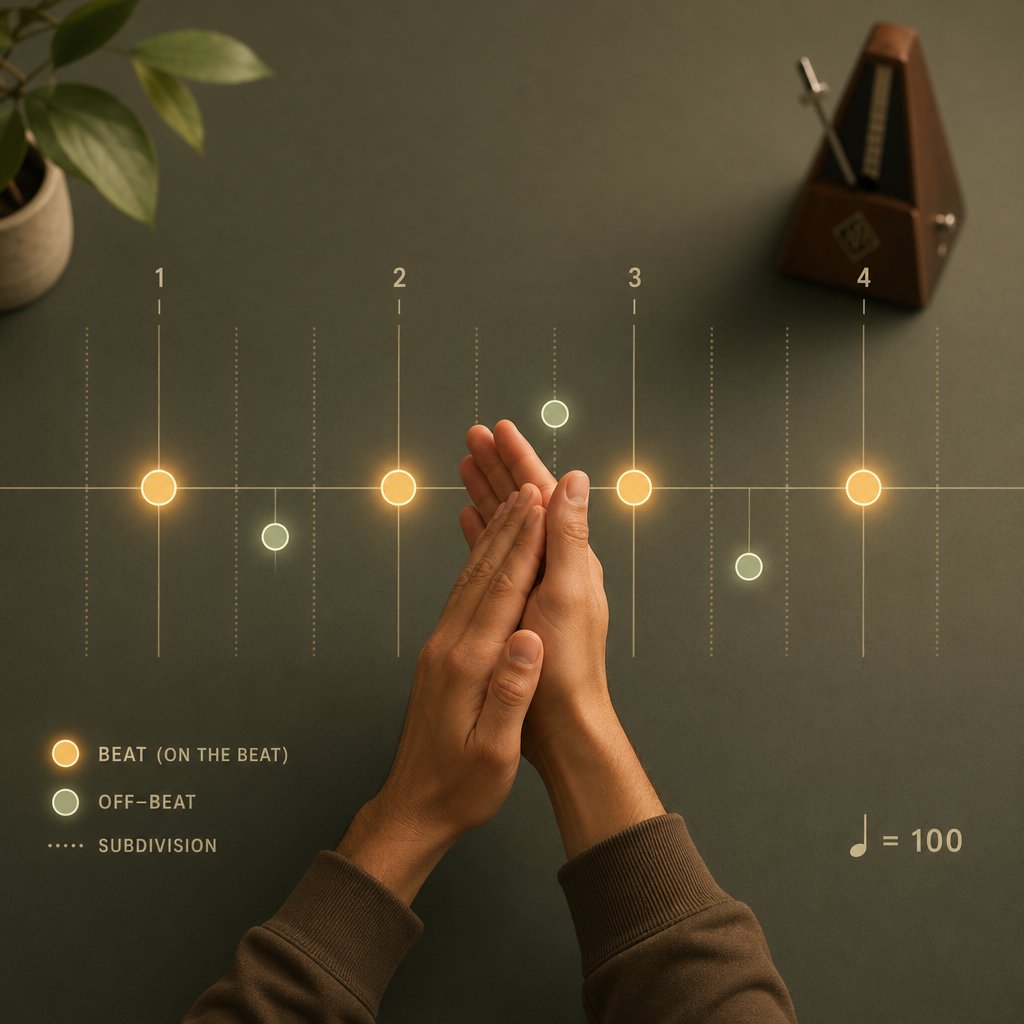
You do not need to read notation to count a syncopated rhythm accurately. What you need is a syllable system that maps sounds to subdivisions so your voice and body can lock onto the groove before your instrument ever enters the picture. Three tiers of counting will take you from clapping quarter notes to navigating sixteenth-note syncopations with confidence.
Beginner Counting With the Ta and Ti-Ti System
The Kodaly-inspired syllabic system assigns a spoken sound to each rhythmic value. A quarter note is "ta." Two eighth notes filling one beat become "ti-ti." And the classic syncopated figure, an eighth note followed by a quarter note followed by another eighth note, gets its own syllable group: "syn-co-pa." These syllables let you speak a rhythm before you play it, building an internal feel that no amount of silent reading can replicate.
Try this first pattern. Tap your foot on each beat while speaking the syllables:
Beat: 1 2 3 4Syllable: ti-ti syn --- co --- pa ta
The "syn" lands on the "and" of beat 2, "co" lands on beat 3, and "pa" lands on the "and" of 3. Your foot hits the floor on 3, but your voice is already past it. That pull between foot and voice is the syncopation you feel.
Here is a second beginner pattern that places the syncopated figure earlier in the bar:
Beat: 1 2 3 4Syllable: syn --- co --- pa ti-ti ta
Speak both patterns at a slow, steady tempo. Once they feel natural, you have internalized the simplest syncopation def anyone can offer: an accent that lands between the beats your foot marks.
Intermediate Counting With Eighth-Note Subdivisions
The "1-and-2-and-3-and-4-and" system gives you finer control. Each number is a downbeat, each "and" is the upbeat eighth note between them. This is where ties and rests on downbeats start to appear, and where you can define syncopation music patterns that go beyond the basic syn-co-pa figure.
Intermediate Pattern 1 ties a note from the "and" of beat 2 across beat 3, silencing the downbeat:
| X . . X | . . X . |1 + 2 + 3 + 4 +
You strike on beat 1, strike on the "and" of 2, hold through beat 3 (no new attack), then strike on the "and" of 4. The silence on beat 3 is what makes the preceding upbeat feel accented.
Intermediate Pattern 2 rests on beat 1 entirely, placing the first sound on the "and" of 1:
| . X . . | X . . X |1 + 2 + 3 + 4 +
Your foot still taps on 1, but your hands stay silent until the upbeat. That gap at the top of the bar creates the forward-leaning momentum you hear in funk guitar scratches and reggae skank chords. Practice both patterns with a metronome app set between 60 and 80 BPM. Only increase tempo once you can repeat the pattern four bars in a row without losing the foot tap.
Advanced Counting With Sixteenth-Note Subdivisions
Sixteenth notes divide each beat into four equal slots, counted as "1-e-and-a, 2-e-and-a, 3-e-and-a, 4-e-and-a." This level of subdivision reveals syncopations hiding inside a single beat, the kind you hear in gospel piano, trap hi-hats, and bebop lines.
Advanced Pattern 1 accents the "e" and "a" of beats 2 and 4:
1 e + a 2 e + a 3 e + a 4 e + aX . . . . X . X X . . . . X . X
The strikes on the "e" of 2 and the "a" of 2 land in slots your ear barely registers in straight time. They create a rapid-fire displacement that gives trap snare rolls their jittery energy.
Advanced Pattern 2 places accents on the "a" of beat 1 and the "e" of beat 3, creating a lopsided bounce:
1 e + a 2 e + a 3 e + a 4 e + a. . . X . . X . . X . . X . . .
This pattern never lands on a numbered downbeat. Every accent sits in a sixteenth-note slot between the main pulse points. Speak it slowly, exaggerating each syllable, before attempting it on your instrument.
Straight vs. swing feel at this level matters. In straight time, all four sixteenth-note slots within a beat are evenly spaced. In swing feel, the beat divides into a triplet-based grouping where the first note is longer and the second arrives late, as Yamaha's guide to swing vs. straight time explains. When you count "1-e-and-a" in swing, the "and" shifts slightly later, closer to the "a." This changes where your syncopated accents actually land in real time. A pattern that feels punchy in straight sixteenths can feel lazy and behind-the-beat in swing. Always decide which feel you are practicing before you start the metronome, and keep it consistent across the entire exercise.
Here is a step-by-step routine you can follow right now to build these skills progressively:
- Set a metronome to 60 BPM. Tap your foot on every click and count "1-and-2-and-3-and-4-and" out loud for eight bars without stopping.
- Speak Intermediate Pattern 1 while maintaining the foot tap. Repeat until you can do four bars without hesitation.
- Switch to "1-e-and-a" counting at the same 60 BPM tempo. Speak all sixteen syllables per bar for eight bars.
- Speak Advanced Pattern 1 while tapping your foot on the numbered beats only. Repeat for four bars.
- Increase the metronome by 5 BPM and repeat steps 2 through 4. Continue raising tempo in 5 BPM increments until accuracy breaks down, then drop back 10 BPM and solidify.
- Once you reach 100 BPM cleanly in straight time, reset to 60 BPM and repeat the entire sequence with a swing feel, letting the upbeat subdivisions shift toward a triplet placement.
This routine builds your internal clock from the ground up. The syllables give your voice something concrete to latch onto, the foot tap anchors the pulse, and the metronome keeps you honest. Within a few sessions, you will notice that syncopations you once found confusing start to feel like second nature, not because you memorized them visually, but because your body learned to expect and resolve the rhythmic tension in real time.
Counting is the skeleton. The next layer is hearing how these patterns come alive inside actual songs across wildly different genres, from a jazz swing tune to an electronic beat built entirely on a laptop.
Syncopation Across Genres From Jazz to Electronic Beats
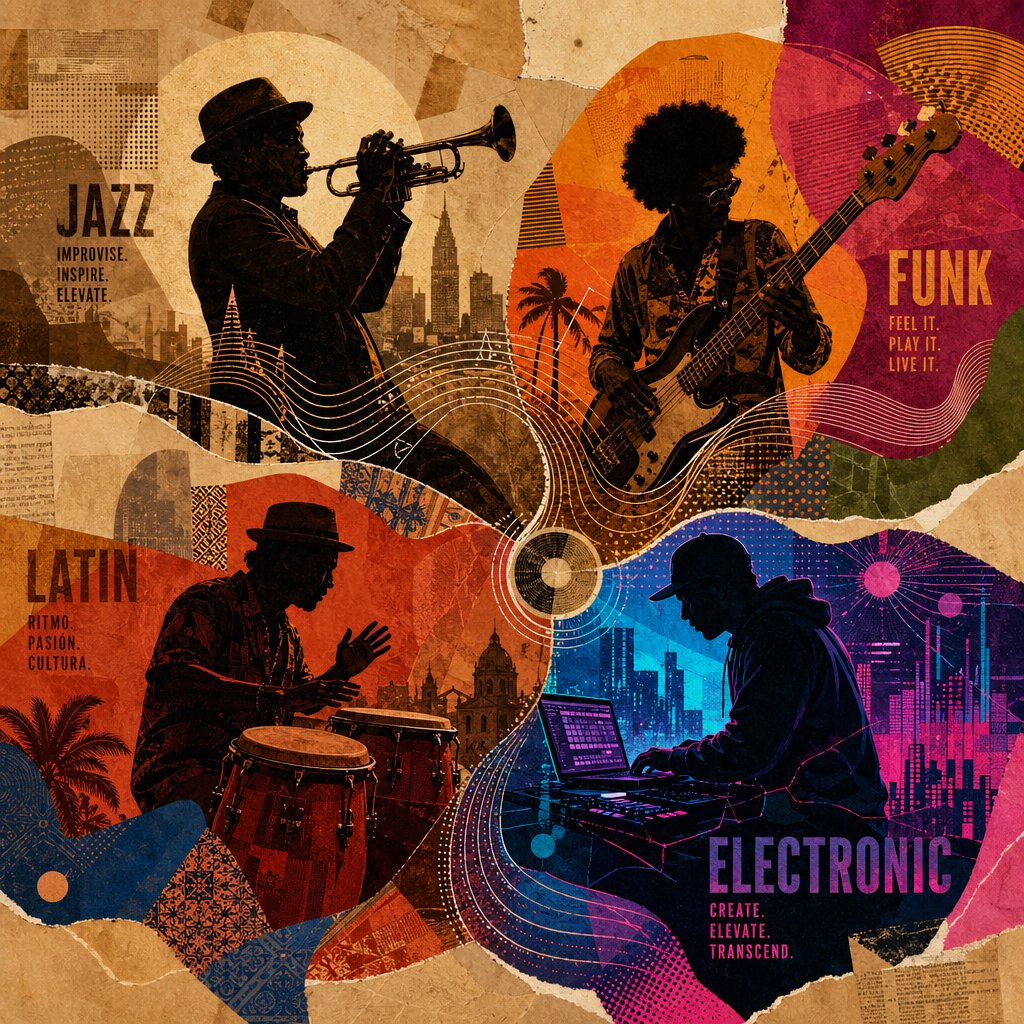
Every genre uses syncopation differently, yet the underlying mechanism is always the same: accents land where the listener does not expect them, creating groove through rhythmic surprise. What changes from genre to genre is which beats get displaced, how often, and through which instruments. Hearing these differences in songs you already know is the fastest way to internalize what is syncopation in music at a gut level rather than just an intellectual one.
Syncopation in Jazz and Swing
Jazz treats syncopation not as a spice but as a staple ingredient. From the earliest New Orleans brass bands to modern bebop, displaced accents are woven into the fabric of the music so deeply that removing them would leave the genre unrecognizable.
The swing feel itself is a form of built-in syncopation. When a jazz drummer plays ride cymbal patterns, the eighth notes are not evenly spaced. The first eighth note of each pair stretches longer while the second arrives late, closer to a triplet placement. This uneven division means that melodic lines landing on the short note naturally feel syncopated against the underlying pulse. Count it as "1...and, 2...and, 3...and, 4...and" with the "and" arriving later than halfway through the beat.
But swing feel alone is not explicit syncopation. It is a rhythmic context. True syncopation in jazz happens when a soloist or melody instrument places accents that contradict even the swung pulse. Listen to Miles Davis's phrasing on "So What" from the album Kind of Blue. His trumpet lines frequently begin on the "and" of beat 4, anticipating the next bar's downbeat and letting the note sustain across the barline. Using the counting language from earlier sections:
4 e + a | 1 e + a 2 e + a. . . X --- . . X . . .
That tied note across the barline is suspension syncopation in action. Davis rarely lands squarely on beat 1, which gives his melodies a floating, conversational quality.
Bebop takes this further. Charlie Parker's "Confirmation" layers rapid eighth-note lines where accents fall on weak sixteenth-note subdivisions, creating a constant push-pull against the rhythm section's steady pulse. The syncopation meaning in bebop is essentially this: the soloist and the rhythm section agree on the tempo but disagree on where the emphasis belongs, and that creative tension is what makes the music swing.
Duke Ellington's "It Don't Mean a Thing (If It Ain't Got That Swing)" is almost a thesis statement for the genre. The vocal melody accents the "and" of beat 2 on the title phrase, displacing the natural stress of the words to match the rhythmic feel. If you tap your foot on the downbeats and sing the melody, you will feel your voice pulling against your foot on nearly every phrase.
Syncopation in Funk, Latin, and Pop Music
Funk builds entire songs around syncopated bass lines and guitar scratches. The accent definition in music theory tells us that an accent is any emphasis that makes one note stand out from its neighbors. In funk, those accents almost never land on beat 1. James Brown's "Get Up (I Feel Like Being a) Sex Machine" features a bass line that hits on the "and" of 1, skips beat 2 entirely, and lands again on the "and" of 3. Counted out:
1 + 2 + 3 + 4 +. X . . . X . .
Bootsy Collins and Larry Graham pushed this further, slapping bass notes on sixteenth-note subdivisions that fall on the "e" and "a" of beats, creating a rubbery bounce that defines the genre. The guitar in funk often plays muted "chucks" on every sixteenth note but accents only the upbeats, turning the instrument into a percussive rhythm machine.
Latin music uses syncopation through clave patterns, rhythmic frameworks that organize the entire ensemble. The son clave is a two-bar pattern that places accents in a 3-2 or 2-3 grouping across eight beats. In 3-2 son clave, the first bar contains three hits and the second bar contains two, with several of those hits landing on upbeats. This creates a moderate but persistent syncopation that gives salsa, mambo, and son montuno their characteristic forward motion.
The anticipated bass pattern described in the previous chapter is standard in Latin genres. Bass players land notes on the "and" of beat 2 and on beat 4, pulling the harmony ahead of the downbeat. Tito Puente's "Oye Como Va" (later covered by Santana) rides this anticipation throughout the entire song. The organ riff accents the "and" of beats 2 and 3, never settling on a strong downbeat for more than a moment.
Pop music uses syncopation more selectively, often in vocal rhythms. Beyonce's "Crazy in Love" opens with a horn riff that accents the "and" of beat 1 and the "and" of beat 3, creating an instantly recognizable hook through displacement alone. Rihanna's "Umbrella" places the syllable "um-brel-la" so that "brel" lands on the "and" of beat 2 rather than on beat 3 where speech rhythm would naturally place it. These small shifts make pop melodies feel catchy and singable because they create just enough rhythmic surprise to hold attention without overwhelming the listener.
Syncopation in Hip-Hop and Electronic Production
Modern beat-makers use syncopation as a production tool, programming displaced accents into drum machines and DAWs with surgical precision. The accent definition in music applies here just as it does in acoustic genres, but the tools are different. Instead of a drummer choosing where to strike harder, a producer adjusts velocity values, nudges notes off the grid, or places sounds in unexpected rhythmic slots.
Hi-hat displacement is one of the most common techniques in trap and modern hip-hop. Rather than programming hi-hats on straight eighth or sixteenth notes, producers place open hi-hat hits on the "e" or "a" of a beat, creating a stuttering, syncopated texture. As beatmaking guides note, adding hi-hat hits on offbeats like the "and" of beat 2 introduces rhythmic tension that keeps patterns from sounding robotic. Travis Scott's "Sicko Mode" features hi-hat patterns that shift between straight sixteenths and displaced triplet groupings, creating a restless energy underneath the vocal.
Off-grid snare placement is another hallmark. In boom-bap hip-hop, producers like J Dilla became famous for placing snare hits slightly before or after the quantized grid position. This micro-timing displacement, sometimes just 10-30 milliseconds off the grid, creates a "drunk" or "loose" feel that sounds human and groovy rather than mechanical. The snare still functions on beats 2 and 4 in the broadest sense, but its exact placement wobbles, generating a subtle syncopation that listeners feel more than consciously hear.
Syncopated melodic loops in electronic production often use even-note syncopation. A producer might program a synth arpeggio in groups of three sixteenth notes over a 4/4 beat, causing the melodic accents to cycle through different positions in the bar before realigning. Daft Punk's "Around the World" uses a bass line that repeats a rhythmic cell slightly out of phase with the four-on-the-floor kick drum, creating a hypnotic tension that drives the entire track.
In house and techno, syncopation often lives in percussion layers rather than the kick or snare. Congas, shakers, and clap patterns accent upbeats while the kick stays locked to the downbeat. This division of labor, steady pulse on the bottom and displaced accents on top, mirrors the same principle that makes jazz and funk groove: a solid foundation for the syncopation to push against.
Here is a genre-by-genre reference you can scan quickly:
| Genre | Syncopation Technique | Song Example |
|---|---|---|
| Jazz / Swing | Suspension across barlines, swing eighth-note phrasing | Miles Davis - "So What" |
| Bebop | Rapid weak-beat accents in melodic lines | Charlie Parker - "Confirmation" |
| Funk | Bass and guitar accents on "ands" and sixteenth-note subdivisions | James Brown - "Get Up (I Feel Like Being a) Sex Machine" |
| Latin / Salsa | Clave-based patterns with anticipated bass notes | Tito Puente - "Oye Como Va" |
| Pop | Vocal rhythms displaced from natural speech stress | Rihanna - "Umbrella" |
| Hip-Hop / Trap | Hi-hat displacement, off-grid snare, micro-timing shifts | Travis Scott - "Sicko Mode" |
| Electronic / House | Melodic loops in odd groupings over four-on-the-floor kick | Daft Punk - "Around the World" |
Every genre in this table shares one trait: the syncopation meaning stays constant even as the instruments, tempos, and cultural contexts change. Displaced accents create groove by playing against a steady pulse. What differs is the degree of displacement, the frequency of syncopated events, and which layer of the arrangement carries the rhythmic surprise.
Listening to these examples with counting in mind trains your ear to spot displaced accents in any style. But recognizing syncopation is only half the challenge. Confusion often creeps in when related rhythmic concepts, like polyrhythm and hemiola, get tangled up with syncopation itself. Untangling those distinctions sharpens both your listening and your playing.
Syncopation vs Polyrhythm, Hemiola, and Cross-Rhythm
Syncopation in music often gets lumped together with every rhythmic concept that sounds "complex" or "off." Polyrhythm, cross-rhythm, hemiola — these terms float around rehearsal rooms and YouTube comment sections as if they all mean the same thing. They do not. Each describes a distinct rhythmic phenomenon, and confusing them leads to sloppy analysis and even sloppier playing. Clearing up these boundaries gives you a sharper ear and a more precise vocabulary for describing what you actually hear.
Syncopation vs Polyrhythm and Cross-Rhythm
A polyrhythm layers two or more rhythms with different pulses on top of each other simultaneously. The classic example is three against two: one hand taps three evenly spaced notes while the other taps two evenly spaced notes in the same time span. Each rhythm has its own internal logic and its own set of strong beats. Neither one is "wrong" or displaced — they simply coexist. As BBC Bitesize defines it, polyrhythm is "when two or more rhythms with different pulses are heard together, e.g., where one is playing in triple time and another is playing in quadruple time."
Syncopation, by contrast, operates within a single meter. It does not introduce a competing pulse. It displaces accents against the one pulse everyone already agrees on. When you accent the "and" of beat 2 in a 4/4 bar, you are not creating a second meter. You are deliberately misplacing emphasis within the existing one. That distinction matters: polyrhythm adds a layer, syncopation disrupts a layer.
Cross-rhythm is a specific type of polyrhythm where the conflicting pattern creates accents that cut across the main meter's beat groupings. The BBC's GCSE music guide describes cross-rhythm as "the effect produced when two conflicting rhythms are heard together." A common cross-rhythm in West African drumming places accents every three eighth notes over a 4/4 pulse, so the pattern's strong points shift through different positions in the bar with each repetition.
Here is where the overlap gets tricky. A cross-rhythmic pattern can produce a syncopated effect from the listener's perspective. If you hear only the cross-rhythm layer against the main pulse, those displaced accents feel like syncopation. But the mechanism is different. The cross-rhythm player is not intentionally displacing accents within the meter — they are following their own independent grouping that happens to conflict with the main beat. The definition of syncopation music theorists use requires intentional displacement within a shared meter, not the accidental byproduct of layered pulses.
Think of it this way: syncopation is one musician playing against the beat on purpose. Polyrhythm is two musicians each playing their own beat honestly, and the conflict emerges from the combination.
Syncopation vs Hemiola
Hemiola is a rhythmic device that regroups beats without changing the time signature. In its most common form, music in triple meter (three beats per bar) temporarily feels like it shifts to duple meter (two beats per bar). Two bars of 3/4 time, which contain six beats total, get regrouped into three groups of two instead of two groups of three. The tempo stays the same, but the accent pattern changes, creating a sensation of speeding up even though no actual acceleration occurs.
The word comes from the Greek hemiolia, referring to the ratio 3:2. As Sound Formation's rhythm theory resources explain, the traditional definition connects hemiola to this ratio and its various manifestations across rhythmic groupings — 3:2, 6:4, and 12:8 hemiolas all share the same underlying principle of regrouping.
Can a hemiola produce syncopation? Absolutely. When beats regroup from three to two, the new accent pattern conflicts with the established meter. A listener who has internalized the triple-time pulse will hear those regrouped accents as displaced — which is exactly what syncopation feels like. Handel's "And the Glory of the Lord" from Messiah uses hemiola near cadence points, and the effect is unmistakably syncopated to the ear.
But hemiola is not syncopation broadly. It is one specific technique that can create a syncopated effect. Syncopation encompasses dozens of techniques — off-beat accents, missed beats, ties across barlines, anticipated bass notes — while hemiola describes only the regrouping of beats in a particular ratio. Every hemiola produces syncopation, but most syncopation has nothing to do with hemiola. Confusing the two is like calling every rectangle a square.
Harmonic Syncopation Explained
Most discussions of syncopation focus on melody and rhythm: a note lands on a weak beat, a drum hits between pulses. But chord changes themselves can be syncopated independently of what any melodic line is doing. This is harmonic syncopation, and it is one of the least discussed yet most powerful tools in a songwriter's kit.
Imagine a four-bar progression where chords change on beat 1 of each bar. That is harmonically "straight." The chord change reinforces the strongest beat. Harmonic syncopation shifts that change to an off-beat — the chord arrives on the "and" of beat 4 in the previous bar, anticipating the new harmony before the downbeat. Your ear hears the harmonic shift early, creating a forward pull that is distinct from any melodic displacement happening above it.
Funk and gospel music use harmonic syncopation constantly. A keyboard player might land a new chord on the "and" of beat 3 while the bass does not change until beat 1 of the next bar. The harmonic rhythm and the melodic rhythm operate on different timelines, and the displaced chord change adds a layer of groove that you feel even if you cannot immediately name it. To define syncopation in music completely, you have to account for this harmonic dimension — otherwise you miss half of what makes certain progressions feel so alive.
Use this checklist to diagnose whether what you are hearing is actually syncopation or something else entirely:
- It IS syncopation when: an accent falls on a weak beat or between beats within an established meter
- It IS syncopation when: a note is tied across a strong beat so the downbeat receives no fresh attack
- It IS syncopation when: a chord change arrives before or after the beat it "belongs" to
- It IS syncopation when: a strong beat is replaced by silence, giving weight to surrounding weak beats
- It is NOT syncopation when: two independent rhythms with different meters play simultaneously (that is polyrhythm)
- It is NOT syncopation when: there is no underlying pulse for the accent to displace against
- It is NOT syncopation when: a rhythm simply sounds "complex" but all accents land on strong beats
- It is NOT syncopation when: a tempo change or rubato shifts the timing of the entire ensemble equally
These distinctions are not just academic. When you practice or compose, knowing exactly which tool you are using — syncopation, polyrhythm, hemiola, or harmonic displacement — lets you apply it with intention rather than stumbling into it by accident. And intentional application is what separates a musician who grooves from one who simply plays notes in unusual places.
With these concepts untangled, the path forward is practical: structured exercises that build your ability to feel, count, and execute displaced accents at progressively higher levels of complexity.
Practice Exercises for Syncopated Rhythms at Every Level
Knowing the definition of syncopation is one thing. Feeling it in your hands and feet is something else entirely. The exercises below use the same text-grid notation and counting systems from earlier sections, so you can practice without sheet music regardless of your instrument. Each level builds on the last, and none require anything more than your body, a metronome, and a flat surface to tap on.
Beginner Clapping and Tapping Exercises
These two exercises train your body to hold a steady pulse in one limb while placing accents on off-beats with another. That independence is the physical foundation of every syncopated rhythm you will ever play.
Exercise 1: Clap on the "ands"
Tap your foot on every numbered beat. Clap only on the "ands." Keep your foot absolutely steady — it is your metronome.
Foot: 1 . 2 . 3 . 4 .Clap: . X . X . X . X
Count out loud: "1-AND-2-AND-3-AND-4-AND," clapping on every capitalized syllable. Start at 60 BPM and repeat for eight bars without stopping. If your foot drifts toward your claps or your claps drift toward your foot, slow down. The goal is separation, not speed.
Exercise 2: Selective off-beat accents
This time, clap only on the "and" of beats 2 and 4 while your foot maintains all four downbeats:
Foot: 1 . 2 . 3 . 4 .Clap: . . . X . . . X
This pattern isolates the backbeat upbeats, the spots where funk guitar scratches and reggae skanks live. You will notice your brain wants to clap on 2 and 4 instead of after them. Resist that pull. The syncopation meaning in music lives precisely in that tension between where your body wants to land and where you actually place the accent. These exercises work for drummers, pianists, guitarists, singers — anyone with two limbs and a sense of pulse.
Intermediate Instrument-Agnostic Rhythm Drills
At this level, ties across beats and rests on strong beats enter the picture. You are no longer just accenting upbeats — you are erasing downbeats and sustaining notes across the bar's natural stress points. A metronome set between 60 and 80 BPM keeps you honest while you build accuracy.
Exercise 3: Tied note across beat 3
Strike on beat 1, strike on the "and" of 2, hold that note through beat 3 (no new attack), then strike on beat 4:
| X . . X | - . X . |1 + 2 + 3 + 4 +
The dash on beat 3 means the previous note is still ringing. Your foot hits the floor on 3, but your hands stay silent. That missing attack is what gives the "and" of 2 its weight. You are practicing suspension syncopation in its simplest form. Repeat for four bars, then rest for one bar, then repeat again. Only increase tempo by 5 BPM once you can loop the pattern cleanly for two full minutes.
Exercise 4: Rest on beat 1, accent the "and" of 1
This drill removes the strongest beat in the bar entirely:
| . X . . | X . X . |1 + 2 + 3 + 4 +
Your foot taps on 1, but nothing sounds until the upbeat immediately after. The silence on beat 1 creates a forward-leaning pull — the same sensation you feel in funk and Afro-Cuban grooves. Practice this with a metronome accent on beat 1 so you can hear the click land in your silence. That contrast trains your internal clock to stay locked even when your hands are not reinforcing the downbeat.
Advanced Syncopation Challenges
These exercises combine sixteenth-note subdivisions with swing feel and introduce harmonic syncopation. They demand the kind of rhythmic independence that separates a player who understands the syncopated definition from one who can actually execute it under pressure.
Exercise 5: Sixteenth-note displacement with swing
Count "1-e-and-a, 2-e-and-a, 3-e-and-a, 4-e-and-a." In swing feel, the "and" of each beat shifts slightly late, closer to the "a." Place your accents on the "e" of beat 1 and the "a" of beat 3:
1 e + a 2 e + a 3 e + a 4 e + a. X . . . . . . . . . X . . . .
In straight time, these accents feel punchy and precise. In swing, they feel lazy and behind-the-beat, almost dragging. Practice both feels at 65 BPM. The difference teaches you that the same written pattern produces entirely different grooves depending on the rhythmic context — a concept no syncopated synonym like "offbeat" or "displaced" fully captures, because those words do not specify the feel.
Exercise 6: Syncopated sixteenths across the barline
This pattern ties a note from the "a" of beat 4 in bar 1 into beat 1 of bar 2:
Bar 1: 1 e + a 2 e + a 3 e + a 4 e + aX . . . . . X . . . . . . . . X---Bar 2: 1 e + a 2 e + a 3 e + a 4 e + a--- . . X . . . . X . . . . . .
The tied note erases beat 1 of bar 2. Your foot lands, but no new sound arrives. This is the same technique trap producers use when an 808 bass slides across the barline. Speak the counting slowly before attempting it on any instrument, and use a metronome with sixteenth-note subdivisions audible so you can verify your placement.
Exercise 7: Harmonic syncopation (chord changes on off-beats)
Play or strum two chords — any two you know. Change from chord 1 to chord 2 on the "and" of beat 4, one eighth note before the downbeat where the change would normally land:
1 + 2 + 3 + 4 + | 1 + 2 + 3 + 4 +C . C . C . C G | G . G . G . G C
The chord change arrives early, anticipating the next bar. Your ear hears the new harmony before the downbeat confirms it. This is harmonic syncopation — the same device gospel and neo-soul keyboardists use to make progressions feel alive. A syncopated synonym for this technique in production circles is "pre-beat chord," but the mechanism is identical to anticipated bass syncopation applied to full harmony.
Here is a four-week plan that moves you from beginner through advanced systematically:
- Week 1: Practice Exercises 1 and 2 daily for 10 minutes at 60 BPM. Focus exclusively on keeping the foot tap steady while clapping off-beats. Do not increase tempo until you can complete eight consecutive bars without the foot and clap drifting together.
- Week 2: Add Exercises 3 and 4. Spend 5 minutes on the beginner exercises as a warm-up, then 10 minutes on the intermediate drills. Start at 60 BPM and increase by 5 BPM each day you achieve two clean minutes at the current tempo. Target 80 BPM by the end of the week.
- Week 3: Introduce Exercises 5 and 6 in straight time only. Spend 5 minutes warming up with Exercises 1-2, 5 minutes reviewing Exercises 3-4 at 80 BPM, then 10 minutes on the advanced patterns at 60 BPM. Count out loud on every repetition — silent counting hides timing errors.
- Week 4: Repeat Exercises 5 and 6 in swing feel, and add Exercise 7 (harmonic syncopation). By now your internal clock should hold steady enough to handle chord changes on off-beats without losing the pulse. Spend 5 minutes on each exercise, cycling through all seven in a single 35-minute session. Record yourself and listen back for any spots where the foot tap wavers.
Consistency matters more than marathon sessions. Ten focused minutes daily builds stronger rhythmic instincts than an hour of distracted practice once a week. And once these patterns live in your muscle memory, the natural next step is applying them creatively — turning exercises into actual musical ideas you can use in your own songs and productions.

Using Syncopation in Your Own Songwriting and Beats
Exercises build your internal clock. Songwriting puts that clock to work. The gap between understanding syncopation rhythm as a concept and actually weaving it into original music is smaller than most people think. You do not need to reinvent the wheel. You just need a straight idea and a willingness to move one or two accents off the downbeat.
Adding Syncopation to Melodies and Chord Progressions
Start with something deliberately plain. Write or hum a four-bar melody where every note lands squarely on a numbered beat. Here is a text-grid example of a straight melody in 4/4 time, where each "X" represents a note and "." represents silence:
Before (straight):
1 + 2 + 3 + 4 +X . X . X . X .
Every accent sits on a downbeat. It is stable, predictable, and — if you are honest — a little lifeless. This is the opposite of rhythm that grooves. It marches when it should dance.
Pick two of those downbeat notes and shift them to the "and" immediately before or after. Leave everything else untouched:
After (syncopated):
1 + 2 + 3 + 4 +X . . X X . . X
Beats 2 and 4 lost their notes. The "and" of 2 and the "and" of 4 picked them up. Tap your foot on the numbers and hum the new pattern. You will feel the melody pull against the pulse instead of sitting on top of it. That small displacement is enough to make a phrase feel memorable and alive — the same technique pop writers use when they shift a vocal syllable off the beat to create a hook that sticks in your head for days.
The same logic applies to chord progressions. If your chords change on beat 1 of every bar, try landing the new chord on the "and" of beat 4 in the previous bar. That single anticipation transforms a static harmonic rhythm into one that leans forward, pulling the listener into the next phrase before it officially arrives. You can define syncopated songwriting in one sentence: take what is expected and move it to where it is not.
Experiment with degree. Shifting one accent per bar produces a subtle groove that works well in ballads and singer-songwriter material. Shifting three or four accents per bar creates the dense, interlocking feel of funk or Afro-Cuban music. The syncopation examples from earlier chapters — James Brown's bass lines, Rihanna's vocal phrasing, Daft Punk's looping arpeggios — all started as straight ideas that someone chose to displace. The creative act is not inventing complexity from nothing. It is choosing which beats to vacate and which off-beats to fill.
Turning Rhythm Concepts Into Real Songs
Every counting system, genre breakdown, and practice drill in this article is a building block. The ta and ti-ti syllables teach you to feel where accents can move. The eighth-note and sixteenth-note grids show you how far they can travel. The genre examples prove that the same displacement principles work whether you are writing a jazz ballad or programming a trap beat. The question is how to channel all of that into a finished piece of music rather than an endless loop of exercises.
One practical starting point is MakeBestMusic's Melody Maker, a tool that helps you turn rhythm, melody, and structure concepts into real songwriting ideas. Instead of staring at a blank DAW session, you can use it to generate melodic starting points and test how syncopated variations change the feel of a phrase. It acts as a rhythm changer for your initial ideas — feed it a concept, experiment with displaced accents, and hear the results without needing advanced production software. For musicians moving from practice exercises to actual composition, it bridges the gap between theory knowledge and creative output.
Here are actionable ways to start incorporating syncopation into your songwriting workflow:
- Generate and test syncopated melody ideas using MakeBestMusic's Melody Maker as a starting point — it lets you experiment with rhythmic variations quickly and hear how displaced accents reshape a phrase before committing to a full arrangement.
- Write the straight version first. Compose your melody or chord progression with every accent on a downbeat. Then selectively shift one or two notes per bar to off-beats. Compare both versions and keep whichever feels more engaging.
- Use the "clap test." Clap your melody's rhythm without pitch. If every clap lands on a foot tap, the rhythm is straight. Move claps between taps until the pattern creates tension you can feel physically.
- Borrow a syncopation rhythm from a genre you admire. Take the displaced accent pattern from a funk bass line or a Latin clave and apply it to your own chord voicings or vocal melody. The rhythm is not copyrighted — only the specific melody and recording are.
- Displace the harmony, not just the melody. Change chords on the "and" of beat 4 instead of beat 1. This single adjustment can act as a rhythm changer for an entire section, making a verse feel like it breathes differently from a chorus.
- Layer straight and syncopated elements. Keep your kick drum on the downbeats while your hi-hats or melodic loops accent off-beats. The contrast between the steady foundation and the displaced layer is what produces groove, as every syncopation example in this article has demonstrated.
- Record yourself improvising over a metronome. Set a click at 80 BPM, play or sing freely, and listen back for moments where your phrasing naturally drifts off the beat. Those instinctive displacements are your ear telling you where syncopation wants to live in your music.
Syncopation is not a decoration you paste onto a finished song. It is a structural choice that shapes how a listener feels every bar. A single displaced accent can turn a forgettable melody into a hook. A chord arriving one eighth note early can make a progression feel urgent instead of predictable. The tools are simple — shift, sustain, silence — and you already know how to count them, feel them, and play them. The only step left is to open a session and start moving beats around until the music grooves the way you hear it in your head.
