

What Time Signatures Are and Why They Matter
Every time you tap your foot to a song or nod your head on a bus, you're locking into a time signature. You just might not have a name for it yet. That invisible pulse organizing every song you love? It has a system behind it, and once you see how it works, you'll hear music differently.
This guide starts where you already are — with what you feel — and builds toward what you'll see on the page. By the end, reading and recognizing meters will feel like second nature.
What Is a Time Signature
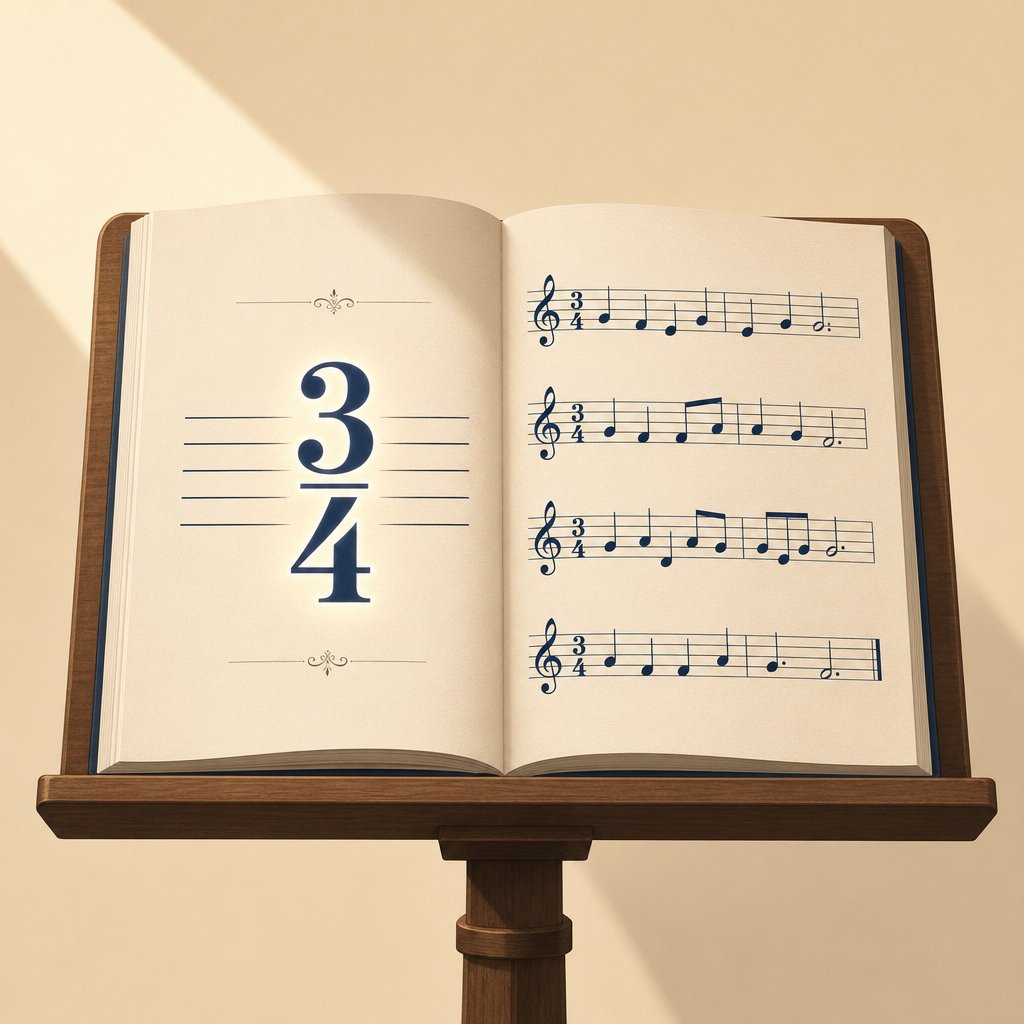
A time signature is a notation symbol at the beginning of a piece of music that tells you how many beats are in each measure and which note value receives one beat.
Picture two stacked numbers at the start of a staff. The top number is your count — how many beats repeat in each cycle. The bottom number identifies which note gets that beat, whether it's a quarter note, an eighth note, or a half note. Together, they create the rhythmic framework for everything a musician plays, sings, or writes. Even when you're picking songs for a bar playlist or counting along to a stadium anthem, a time signature is quietly running the show.
Why Every Musician Needs to Understand Meter
Meter is the invisible scaffolding behind every genre. A pop hit in 4/4, a jazz waltz in 3/4, a progressive rock epic shifting through 5/4 in meters that feel wonderfully lopsided — they all rely on time signatures to give rhythm its shape. Without that structure, notes would just float in space with no pulse to anchor them.
Understanding how meter works unlocks real creative freedom. You'll know why a 6 times 4 feel sounds expansive, why certain grooves swing, and how songwriters use rhythmic expectation to surprise you. Whether you're a listener, a beginner picking up an instrument, or a songwriter sketching ideas, grasping time signature music is the single most practical theory skill you can build.
So where do those two little numbers actually come from, and what does each one do? That's exactly where the reading starts.
How to Read a Time Signature Step by Step
Before you look at any sheet music, try this: play your favorite song and count along. Feel where the pulse repeats. That repeating cycle you're sensing? The two numbers in a time signature simply describe it on paper. Let's break each one down.
The Top Number and Beats Per Measure
The top number tells you how many beats fill each measure — each repeating rhythmic cycle. When you count "1-2-3-4" along to a pop track, you're feeling a top number of 4. Switch to a waltz and you'll naturally count "1-2-3." That top number is the count your body already knows.
Think of it this way: the top number answers the question "how many?" In 4/4, you get four beats per measure. In 3/4, three. In a 12/8 time signature, twelve eighth-note pulses group into four big beats — but the top number still tells you the total count inside each bar. Once you can tap along and land on "1" every time the pattern restarts, you've already internalized the top number.
The Bottom Number and Note Values
Here's where most beginners get tripped up. The bottom number does not tell you how many beats there are — the top number already handled that. Instead, it tells you which note value equals one beat. Imagine it as the unit of measurement for the pulse.
- 2 = the half note gets one beat
- 4 = the quarter note gets one beat
- 8 = the eighth note gets one beat
So in 4/4, four quarter notes fill a measure. In 6/8 — sometimes described as 6 8 simplified to two big beats — six eighth notes fill a measure, grouped in threes. And in cut timing (2/2), two half notes make up each measure, giving the music a brisk, marching energy. The bottom number changes the rhythmic weight of every note on the page, which is why the same melody can feel completely different in 3/4 versus 3/8.
Counting Out Loud as a Practice Tool
Reading the numbers is one thing. Feeling them in your body is another. Counting out loud bridges that gap, and it's simpler than you might expect.
For basic quarter-note beats, just count the numbers: "1-2-3-4." When eighth-note subdivisions appear, add "and" between each beat: "1-and-2-and-3-and-4-and." For triplet subdivisions — common in compound meters — try "1-la-li-2-la-li," giving each beat three equal syllables.
Here's a quick exercise you can try right now: set a metronome to 60 BPM, a comfortable one-beat-per-second pace. Clap on every click and count "1-2-3-4" out loud, emphasizing beat 1. Once that feels steady, switch to "1-and-2-and" and clap on every syllable — you're now subdividing into eighth notes at 4 times 8 claps over two measures. Finally, try "1-la-li-2-la-li" to feel how triplets reshape the same pulse. This progression from quarter notes to eighths to triplets trains your ear to recognize subdivisions in any song you hear.
With the mechanics of reading and counting in place, the real fun begins: hearing how different time signatures shape the music you already love.
Simple Time Signatures That Shape Popular Music
So what is a bar in music, really? It's a container — a repeating rhythmic box that holds a set number of beats. And the three simple time signatures below define the shape of that box for the vast majority of songs you'll ever hear. What makes them "simple" is straightforward: each beat divides cleanly into two equal parts. That even subdivision gives simple meters their steady, predictable pulse.
In simple time, every beat splits into two equal halves. Count it as "1-and-2-and" and you're feeling that two-part division in action.
Let's give each signature the dedicated breakdown it deserves.
4/4 Time and Why It Dominates Popular Music
If you've ever seen a "C" symbol at the start of a staff, you've met 4/4 in disguise. That C stands for common time — and the name fits. By some estimates, over 90% of popular Western music lives in 4/4.
The stress pattern runs strong-weak-medium-weak across four beats. Beat 1 carries the heaviest accent, beat 3 gets a secondary push, and beats 2 and 4 sit lighter — unless a backbeat flips that emphasis, which is exactly what rock, pop, and hip-hop drummers do when they slam the snare on 2 and 4. Count it: "ONE-two-Three-four."
From electronic dance music pounding four-on-the-floor kicks to country ballads and R&B grooves, 4/4 dominates because it feels natural. Your body settles into it without effort, which is why songwriters keep coming back to it. Think of virtually any chart-topping hit and you're almost certainly hearing common time at work.
3/4 Time and the Waltz Feel
Drop one beat from that four-count and the entire character shifts. 3/4 follows a strong-weak-weak pattern — "ONE-two-three, ONE-two-three" — and that three-beat grouping creates a lilting, dance-like sway that's impossible to mistake once you recognize it.
The waltz is the classic home for 3/4. That European ballroom dance, whose name literally means "to roll or revolve," built its elegance on this meter. But 3/4 reaches far beyond the ballroom. Folk songs, acoustic ballads, and film scores lean on it heavily. John Williams' Hedwig's Theme from the Harry Potter films carries that whimsical, almost mystical quality that 3/4 naturally produces — a timing synonym for "enchanting" in the hands of a skilled composer.
Compared to a 6/8 time signature, which also contains six eighth notes per measure, 3/4 feels fundamentally different. Here, three distinct beats each subdivide in two (1-and 2-and 3-and), rather than two big beats subdividing in three. Same math, completely different groove.
2/4 Time in Marches and Polkas
Strip the meter down even further and you get 2/4: two beats per measure, strong-weak, strong-weak. It's brisk, direct, and propulsive — the rhythmic engine behind marches, polkas, and certain Latin styles.
Imagine a military march: left-right, left-right. That "left, right" quality is the clearest way to feel how 2/4 differs from 4/4. Even though a bar of 4/4 could technically be heard as two bars of 2/4, the accent pattern changes the experience. In 2/4, every other beat is strong, giving the music a relentless forward drive that four-beat meters soften with their medium-weak third beat.
Finding modern pop examples in 2/4 is genuinely tricky — nursery rhymes, folk tunes, and traditional European dances are its natural habitat. But that focused, two-beat pulse shows up more than you'd expect in genres like samba and other Latin forms where rhythmic urgency matters.
These three simple meters cover an enormous range of musical expression, yet they all share that clean two-part beat division. Things get considerably more interesting when beats start splitting into threes — and that shift from even to uneven subdivision is exactly what separates simple time from compound time.

Compound Time Signatures and Their Flowing Feel
When a beat splits into three instead of two, the entire rhythmic personality of a piece changes. That even, marching quality of simple time gives way to something rounder — a rolling, swaying motion that feels more like ocean waves than a ticking clock. This is compound time, and it's responsible for some of the most emotionally rich grooves in music.
Understanding the Compound Feel
Here's the part that confuses almost everyone at first: the top number in a compound time signature doesn't tell you how many beats you actually feel. Instead, you divide it by three to find the real beat count. A 6/8 measure contains six music notes eighth in value, but you don't tap your foot six times. You tap twice — two big, rolling beats, each made of three eighth notes grouped together.
In compound time, divide the top number by three to find the number of felt beats. So 6/8 gives you two beats, 9/8 gives you three, and 12/8 gives you four.
The reason is structural. Each beat in compound time is a dotted note — typically a dotted quarter note in signatures with 8 on the bottom. A dotted quarter note equals three eighth notes, which is why the subdivision naturally falls into groups of three rather than two. Think of it as 1/3 times 2 groups per measure in 6/8: two clusters of three creating that signature lilt.
6/8 Time and How It Differs From 3/4
This is the distinction that trips up more musicians than almost any other. Both 3/4 and 6/8 contain six eighth notes per measure. Mathematically, same total. Musically, completely different worlds.
In 3/4, you feel three beats, each subdivided in two: "1-and 2-and 3-and." The accent pattern is strong-weak-weak — a waltz. In 6/8, you feel two beats, each subdivided in three: "1-la-li 2-la-li." The accent pattern is strong-weak-weak-medium-weak-weak, but what your body registers is just two swaying pulses. As Hampstead Piano Academy explains it, 3/4 gives you three quarter-note beats per bar while 6/8 gives you two dotted quarter-note beats — and that's why the feel changes so dramatically.
You can hear the 6/8 sway in songs like "We Are the Champions" by Queen and "Nothing Else Matters" by Metallica. That rocking, almost lullaby-like motion? It comes from those 3 times 6 eighth notes per two measures cycling in groups of three. Once you recognize the pattern, you'll start catching it everywhere — in Irish jigs, in power ballads, in film scores. The concept of 6/8 simplified down to its essence is just this: two big beats that breathe in triplets.
9/8 and 12/8 for Deeper Grooves
The same grouping principle scales up beautifully. In 9/8, nine eighth notes divide into three groups of three, giving you three felt beats with that same rolling subdivision. It's less common than 6/8 but shows up in folk traditions, some classical works, and progressive compositions where composers want a triple-meter feel with compound depth.
Then there's 12/8 — four groups of three eighth notes, producing four felt beats. Since 8 and 12 share a common multiple relationship with groupings of three, 12/8 is essentially the compound cousin of 4/4. It's the backbone of blues shuffles, doo-wop ballads, and slow jams. Songs like "Oh! Darling" by The Beatles and countless 12-bar blues tracks live in this meter.
Here's a practical detail worth knowing: many blues and rock songs written in 4/4 with a "shuffle" or "swing" indication are actually being performed in a 12/8 feel. The notation says 4/4, but the drummer and bassist are subdividing every beat into three — which is 12/8 in everything but name. When you see 8/12 simplified in a theory context, it's pointing back to this same relationship between the written signature and the felt groove.
Compound meters give music a breathing, organic quality that simple time can't replicate. But what happens when beats refuse to group evenly into twos or threes at all? That's where rhythm gets genuinely unpredictable — and where some of the most exciting music lives.
Irregular and Odd Time Signatures Worth Exploring
Simple meters divide beats into twos. Compound meters divide them into threes. Irregular meters? They refuse to play by either rule. These asymmetric time signatures combine groups of two and three within the same measure, creating rhythmic patterns that feel lopsided, unpredictable, and thrilling. If you've ever listened to a song and felt like the ground kept shifting under your feet, you were probably hearing an odd meter at work.
5/4 Time and Its Distinctive Lopsided Groove
Imagine counting "1-2-3-1-2" or "1-2-1-2-3" on repeat. That uneven split is the heartbeat of 5/4 — five quarter-note beats per measure, grouped as either 3+2 or 2+3. Unlike the balanced feel of 4/4 or the rolling sway of 6/8, 5/4 creates a rhythmic "limp" that's immediately recognizable once you know what to listen for.
The grouping choice shapes the character. A 3+2 split feels like a long stride followed by a short one — counted as "ONE-two-three-ONE-two." Flip it to 2+3 and the short step comes first, pulling the accent to a different place entirely. Most pieces stick with one grouping throughout, though that's a convention, not a hard rule.
You've almost certainly heard 5/4 without realizing it. The Mission: Impossible theme by Lalo Schifrin is a textbook example — that tense, driving groove owes its urgency to the asymmetric pulse. Radiohead's "15 Step" rides a 5/4 feel with electronic textures, while Gorillaz literally named their track "5/4" after the meter itself. Progressive rock and film scores lean on this signature heavily because it creates tension without sounding chaotic.
7/8 Time and Balkan Rhythms
Add two more eighth notes to a 5/8 bar and you land in 7/8 — a meter that feels like it's always rushing toward something. Seven eighth notes per measure can group in several ways, and each grouping produces a distinct rhythmic personality:
- 2+2+3 — short, short, long (the most common in Western rock)
- 3+2+2 — long, short, short (a pattern found in Bulgarian cetvorno dances)
- 2+3+2 — short, long, short (less common, but used for a lurching, off-center feel)
The Balkan folk tradition is where 7/8 truly thrives. In Bulgaria and Macedonia, dancers don't count individual beats — they think in patterns of "long" and "short" pulses. A cetvorno (3+2+2) becomes "long-short-short," or as one mnemonic puts it, "taking a long bath." That approach makes these rhythms far more intuitive than they look on paper.
In Western music, Pink Floyd's "Money" rides a 7/4 groove (same grouping principle, just with quarter notes instead of eighths), and Rush's "Tom Sawyer" shifts into 7/8 during its instrumental section. The uneven grouping creates a driving, urgent energy — like the rhythm is always slightly ahead of where your ear expects it to land. Even bar six of a 7/8 phrase can feel like a surprise because the asymmetry keeps resetting your expectations.
Going Further With Asymmetric Meters
The grouping principle behind 5/4 and 7/8 extends to even more exotic signatures. An 11/8 measure might split as 2+2+3+2+2 — essentially a kopanitsa dance rhythm from Bulgaria. A 13/8 bar could group as 2+2+2+3+2+2. No matter how large the top number gets, the approach stays the same: break it into clusters of twos and threes, find the accent pattern, and internalize the long-short sequence.
These meters are becoming increasingly common in modern genres. Math rock bands like Animals as Leaders routinely cycle through asymmetric passages — sometimes 4 times 24 eighth notes across a phrase before the pattern resolves. Djent, experimental electronic, and even some contemporary pop producers use odd meters to create rhythmic tension that keeps listeners engaged. When you encounter a fraction like 4/3 simplified in a theory discussion, it's often pointing toward these irregular groupings where standard division doesn't apply cleanly.
Here's a quick-reference list of common irregular signatures and their typical groupings:
- 5/4 or 5/8 — 3+2 or 2+3
- 7/8 or 7/4 — 2+2+3, 3+2+2, or 2+3+2
- 11/8 — 2+2+3+2+2 or 3+3+3+2
- 13/8 — 2+2+2+3+2+2 or other mixed groupings
The trick with any of these is the same: stop trying to count every single pulse and start feeling the pattern of long and short beats. Once that clicks, even a 12 times 4 subdivision spread across odd groupings becomes something your body can lock into rather than something your brain has to calculate.
Irregular meters prove that rhythm doesn't need symmetry to feel good — it just needs a pattern you can internalize. With simple, compound, and irregular categories all on the table, the natural question becomes: how do you quickly tell which type you're dealing with when you encounter a new piece?
Comparing Simple, Compound, and Irregular Meters
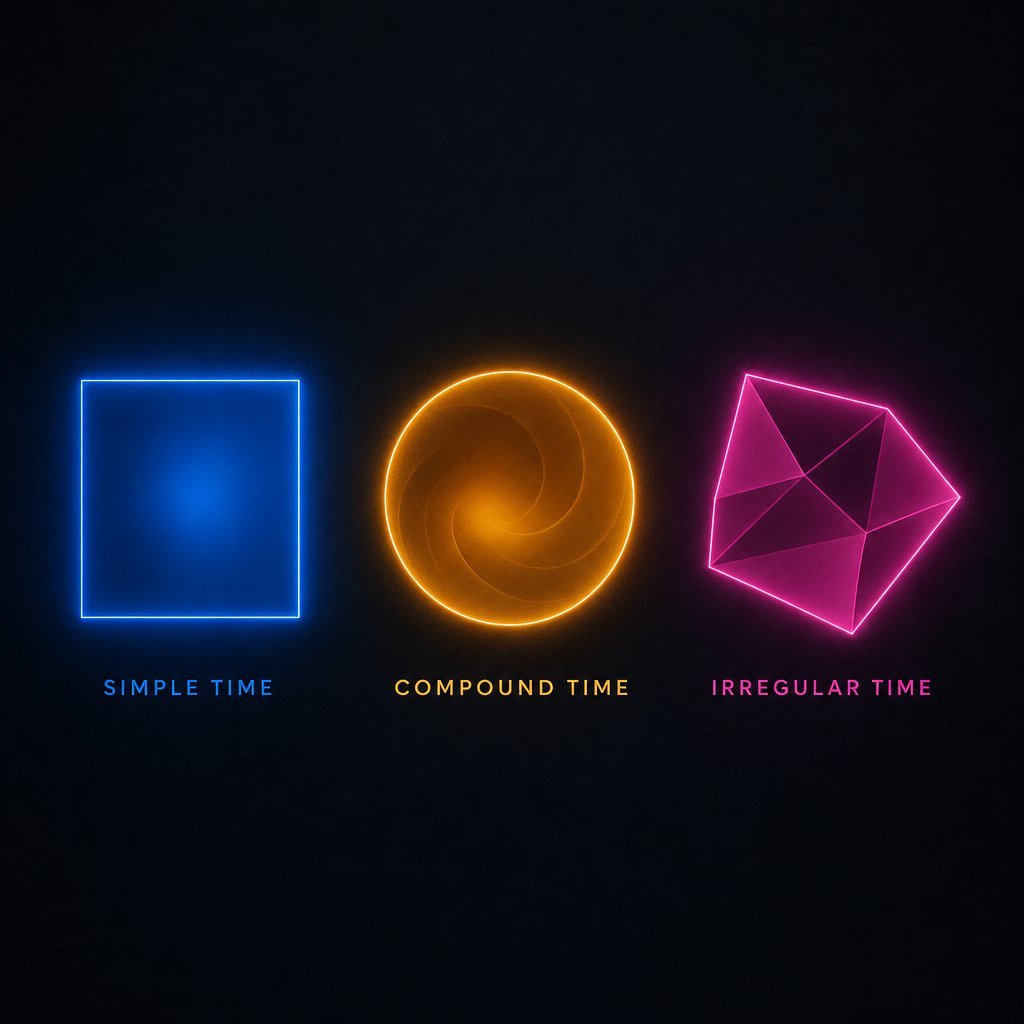
You've now seen all three families of time signatures in action. But when you're staring at a new piece of sheet music or trying to decode a rhythm synonym you've never encountered, having everything in one place makes the difference between confidence and confusion. The table below puts simple, compound, and irregular meters side by side so you can spot the differences at a glance.
Side-by-Side Comparison of All Three Categories
| Dimension | Simple Time | Compound Time | Irregular Time |
|---|---|---|---|
| Beat Division | Each beat divides into 2 equal parts | Each beat divides into 3 equal parts | Beats group into mixed clusters of 2s and 3s |
| Rhythmic Feel | Steady, even, predictable | Rolling, swaying, lilting | Asymmetric, lopsided, driving |
| Counting Method | "1-and-2-and-3-and-4-and" | "1-la-li-2-la-li" | "1-2-3-1-2" or "1-2-1-2-3" (varies by grouping) |
| Common Signatures | 4/4, 3/4, 2/4, 2/2 | 6/8, 9/8, 12/8 | 5/4, 7/8, 11/8, 13/8 |
| Genre Associations | Pop, rock, hip-hop, country, marches | Blues shuffles, folk, jigs, ballads | Progressive rock, math rock, Balkan folk, film scores |
| Well-Known Examples | "Let It Be" (4/4), "Valse d'Amelie" (3/4) | "Hallelujah" (6/8), "Perfect" (12/8) | "Take Five" (5/4), "Money" (7/4) |
Notice how the beat division column drives everything else. Whether a piece feels like a march or a lullaby or a rhythmic puzzle, it traces back to how each beat subdivides. A 4/4 time signature and a 12/8 signature both produce four felt beats per measure, but the internal subdivision — twos versus threes — gives them completely different personalities.
How to Tell Which Category a Time Signature Belongs To
When you encounter an unfamiliar meter, you don't need to memorize a chart. A simple decision tree gets you to the answer in seconds:
- Look at the top number. Is it 2, 3, or 4? If yes, the signature is simple. These small, straightforward counts divide each beat into two.
- Is the top number divisible by 3 and greater than 3? Numbers like 6, 9, and 12 signal compound time. Divide by three to find the actual felt beats — 6 becomes 2, 9 becomes 3, 12 becomes 4.
- Is the top number 5, 7, 11, or another number that doesn't fit neatly into the first two categories? You're in irregular territory. Break the total into groups of 2s and 3s to find the accent pattern.
A few common traps to watch for. The biggest one: assuming 6/8 is "just a fast 3/4." It isn't. The category determines the feel, not just the arithmetic. In 3/4, three beats each split in two. In 6/8, two beats each split in three. Same 6 times 9... no, same six eighth notes — but the grouping reshapes everything you hear. Similarly, a measurement like 5 3 in meters might look like a simple fraction, but in music, a top number of 5 always points to an irregular, asymmetric groove.
One more misconception worth clearing up: time signatures do not dictate tempo. A 3/4 waltz can be achingly slow or briskly fast. A 7/8 passage can feel relaxed or frantic. The signature tells you the rhythmic structure — how beats group and subdivide — while tempo controls how quickly those beats pass. Confusing the two is like mixing up the shape of a container with how fast you pour into it.
With this framework, you can classify any meter you encounter. The next skill is even more practical — learning to identify these signatures purely by listening, without ever looking at a score.
How to Figure Out a Time Signature by Ear
Classifying meters on paper is one thing. Picking them out of a living, breathing recording is where the skill really pays off. The good news? Your body already does most of the work — you just need to give it a system.
Listening for the Strong Beat
Every measure has a key bar moment: beat one. It's the strongest, most accented pulse in the repeating cycle, and finding it is your first job. Listen for the clues that signal the downbeat — a bass drum hit, a chord change, a melodic phrase restarting, or a bass note landing heavier than the ones around it. As Foundations of Aural Skills describes, you likely already move your body instinctively to this pulse. The trick is making that instinct conscious. Try nodding or tapping along until one beat consistently feels like "home." That's beat one.
Counting the Beats Between Accents
Once you've locked onto beat one, count every beat until the next strong accent arrives and the pattern resets. If you reach four, you're almost certainly in 4/4. If three, likely 3/4. If it feels like two large, swaying pulses with each one containing a triplet subdivision — "1-la-li 2-la-li" — you're probably hearing 6/8.
The second piece of the puzzle is the bottom number. According to Musical-U, the bottom number is almost always 4 or 8. Listen to whether your counted beats feel like relaxed quarter notes or quicker 8th note pulses. If the pace feels brisk and subdivided — like you're counting 3 times 8 quick pulses per measure rather than three leisurely taps — the bottom number is probably 8. Otherwise, go with 4.
Keep in mind that multiple valid interpretations can exist for the same recording. A shuffle and cut feel might make a 4/4 song sound like 12/8, or a fast 3/4 could be heard as a slow 6/8. You're looking for the most natural, comfortable way to notate what you hear — the interpretation a performer would find easiest to read.
Practice Exercises for Training Your Ear
Build this skill progressively rather than jumping straight to odd meters. Here's a practical sequence:
- Start with obvious 4/4 tracks — pop, rock, hip-hop. Count "1-2-3-4" and tap along until landing on beat one feels automatic.
- Move to 3/4 waltzes. Feel the "ONE-two-three" sway and notice how the cycle is shorter — 4 times 3 beats would span four full measures.
- Try 6/8 pieces next. Focus on feeling two big beats instead of six small ones. Irish jigs and power ballads are great starting points.
- Challenge yourself with 5/4 or 7 times 4 tracks like "Take Five" or Pink Floyd's "Money." Count the uneven groupings and notice where the pattern resets.
For each step, tap along and count out loud. Set a metronome to a slow tempo — around 60 BPM — and practice internalizing each meter before trying to detect it in full recordings. The goal isn't speed; it's consistency. When you can reliably feel where beat one lands and how many beats follow before the cycle repeats, you've trained your ear to decode time signature music in real time.
Hearing a meter is powerful on its own. But plenty of songs don't stay in one meter — they shift partway through, and knowing how to handle that transition is a skill worth developing separately.

Navigating Time Signature Changes in Songs
Most theory lessons treat time signatures as something you set once and forget. Real music doesn't work that way. Songs shift meters all the time — sometimes for a single bar, sometimes for an entire section — and those shifts are often what make a piece feel alive rather than mechanical.
What Happens When the Meter Shifts
A meter change occurs when a new time signature symbol appears partway through a score, replacing the original one from that point forward. On paper, it's simple: the old numbers disappear, new numbers take their place, and every musician adjusts. In practice, the effect on the listener is far more interesting.
Meter shifts disrupt rhythmic expectations. Your body has been locked into a groove — counting 3 times 4 beats across several measures of 3/4, for instance — and suddenly the pattern expands or contracts. That moment of surprise refreshes the ear. As Guitar Serious Fun illustrates, a song alternating between 4/4 and 2/4 lets vocal phrases breathe naturally, because the shorter bar creates a rhythmic pause that pure 4/4 would rush past. The melody guides the change, not the other way around.
These shifts aren't rare or experimental. The Stranglers' "Golden Brown" cycles through bars of 3/4 before landing on a bar of 4/4 — three waltz measures followed by one common-time measure, creating a hypnotic, slightly off-kilter loop. The Beatles used meter changes constantly. Even a 3/2 time signature — three half-note beats per measure, giving a broad, stately pulse — appears in classical and choral works when composers want a slower, weightier feel than 3/4 provides.
Cut Time as a Common Meter Shift
One of the most practical meter shifts you'll encounter is the move between 4/4 and cut time (2/2). On the page, cut time is marked with a "C" slashed by a vertical line. Mathematically, a measure of 2/2 holds the same total duration as 4/4 — so what's 2/2 if not just 4/4 repackaged?
The difference is feel. In 4/4, you sense four distinct pulses: strong-weak-medium-weak. In 2/2, those four quarter notes regroup into two half-note beats, and the music suddenly feels broader and lighter. Songtive's analysis puts it well: switching from a four-beat pattern to a two-beat pattern instantly changes an ensemble's approach — things lighten up and move forward more freely.
Tempo interacts with time signature to change perceived meter. A fast 4/4 passage often feels like 2/2 because the listener's ear groups four quick beats into two larger pulses.
This is why conductors "cut" their pattern from four gestures to two at faster tempos. The notation hasn't changed the notes — it's changed how performers and listeners organize them. Understanding this relationship between speed and grouping is one of the most useful insights in all of time signature music.
Recognizing and Counting Through Changes
Handling meter shifts in real time takes preparation, not guesswork. Here are practical strategies that work whether you're reading a score or playing by ear:
- Look ahead in the score. Spot the new time signature before it arrives so you're mentally ready for the shift.
- Internalize the new pulse early. If a piece moves from 4/4 to 3/4, start feeling the waltz pattern in your head a beat or two before the bar line.
- Isolate the transition point. Practice the last bar of the old meter and the first bar of the new meter as a loop until the handoff feels seamless.
- Let the melody guide you. As the Guitar Serious Fun approach emphasizes, the vocal or melodic line often makes the change feel natural — follow it rather than fighting the math.
Songs like "Happiness Is a Warm Gun" by The Beatles shift through multiple meters in rapid succession. Golden Brown, as mentioned, weaves 12 times 3 quarter-note beats across its four-bar phrase before the pattern resets. Even pop tracks occasionally slip a 2/4 bar into a 4/4 verse to accommodate a lyric that needs an extra breath. These aren't academic exercises — they're everyday musical moments that reward the prepared ear.
Recognizing meter changes turns you from a passive listener into someone who understands why a song feels the way it does. And that understanding is exactly what bridges the gap between analyzing music and actually creating it.
Turning Time Signature Knowledge Into Real Music
Knowing how to read, hear, and classify meters is valuable. But the real payoff comes when you use that knowledge to make something. Every song starts with a handful of creative decisions, and choosing a time signature is one of the very first — often before a single chord or lyric exists.
From Theory to Songwriting
Think of meter as a mood selector. A 4/4 groove feels grounded and familiar — perfect for a driving rock anthem or a hip-hop beat. Switch to 6/8 and the same chord progression suddenly sways with emotional weight, like a ballad pulling you closer. Try 7/8 or 5/4 and you introduce tension and intrigue that keeps listeners slightly off-balance in the best way. Even a 2 2 time signature can transform a sluggish 4/4 sketch into something lighter and more propulsive.
The Secrets of Songwriting site makes a great point: choosing an odd meter early in the writing process has interesting and positive effects on your melodies, chords, and lyrics. You don't need to master every irregular signature to benefit from this. Just pick a meter you haven't tried before, set a tempo — say, 8 times 60 BPM clicks across a few minutes of free experimentation — and see what emerges. A short 4 times 7 beat phrase in 7/4 might spark a melody you'd never find in common time. Even 12 times 9 eighth-note pulses cycling through a 9/8 groove can unlock ideas that feel fresh simply because the rhythmic container is unfamiliar.
The key is low-pressure experimentation. As songwriter Andrea Stolpe recommends, spend no more than 30 minutes sketching a verse and chorus over an unfamiliar rhythmic framework. Keep the stakes low and let the meter do the creative heavy lifting.
Tools That Help You Experiment With Rhythm and Meter
Not everyone has a band or a studio ready to go. That's where digital tools close the gap between understanding a concept and hearing it come alive. MakeBestMusic's Melody Maker is a practical option for anyone who wants to test how a melody feels in 3/4 versus 4/4 versus 6/8 without needing advanced production skills. You pick a meter, set a tempo, sketch a melodic idea, and hear the result immediately — which makes the difference between 3 times 12 beats across four bars of 3/4 and a single long 12/8 phrase something you can feel, not just calculate.
Whatever tool you choose, the process stays the same:
- Pick a time signature — start with one you haven't written in before
- Set a comfortable tempo so you can focus on feel rather than speed
- Sketch a short melody or rhythm, even just four bars
- Iterate — try the same idea in a different meter and notice how the mood shifts
Time signature music isn't just a theory topic to study and shelve. It's a creative tool that shapes every song you'll ever write or play. The 7 times 9 pulses in an unusual groove, the familiar comfort of common time, the rolling sway of compound meter — they're all waiting for you to put them to work. Pick a signature, press record, and start counting.
