

What Exactly Is a Violin Orchestra Song
You've heard it a hundred times — that sweeping, full-bodied wave of violin music rising over a film trailer, a concert hall, or a streaming playlist. But what actually makes a violin orchestra song its own thing? It's a question almost nobody in the music world bothers to answer clearly, so let's fix that.
A violin orchestra song is a composition in which massed violins carry the primary melodic and harmonic weight within a full orchestral arrangement, supported by the interplay of woodwinds, brass, and percussion to create a layered, emotionally rich sonic experience.
Defining the Violin Orchestra Song
Imagine 30 or more violins playing together on a single stage. That's the reality of a typical symphony orchestra, which features roughly 16 first violins and 14 second violins. First violins usually carry the melody — the line you walk away humming. Second violins provide harmonic support, counter-melodies, and rhythmic texture underneath. Together, they form the engine of the orchestra.
Why so many? The violin is a comparatively quiet instrument on its own. A single player simply cannot be heard over the power of the brass. But when dozens play in unison, something special happens. Because each instrument's vibration rate and bow movement varies slightly, the overlapping overtones produce a shimmering, lush texture no synthesizer can truly replicate. That collective richness is the defining fingerprint of violin compositions written for full orchestra.
What Sets It Apart from Solo and Chamber Violin Music
Scale is the clearest dividing line. A solo violin concerto spotlights one performer against the orchestra. A string quartet puts four players in an intimate conversation — one instrument per part, designed for smaller spaces rather than concert halls. Chamber music, broadly speaking, starts from two players and tops out around nine, with each musician handling a unique voice.
A violin orchestra song operates on an entirely different plane. Multiple players share each part, and the string section interacts with every orchestral family — flutes, clarinets, trumpets, timpani — to build a sound that fills large venues. That's why popular violin sheet music arranged for full orchestra feels so dramatically different from the same famous violin tunes played by a solo performer or small ensemble. The tonal depth, dynamic range, and sheer emotional weight multiply with every added player.
This distinction matters because it shapes how violin compositions land emotionally — and it explains why the violin rose to dominate the orchestra in the first place.
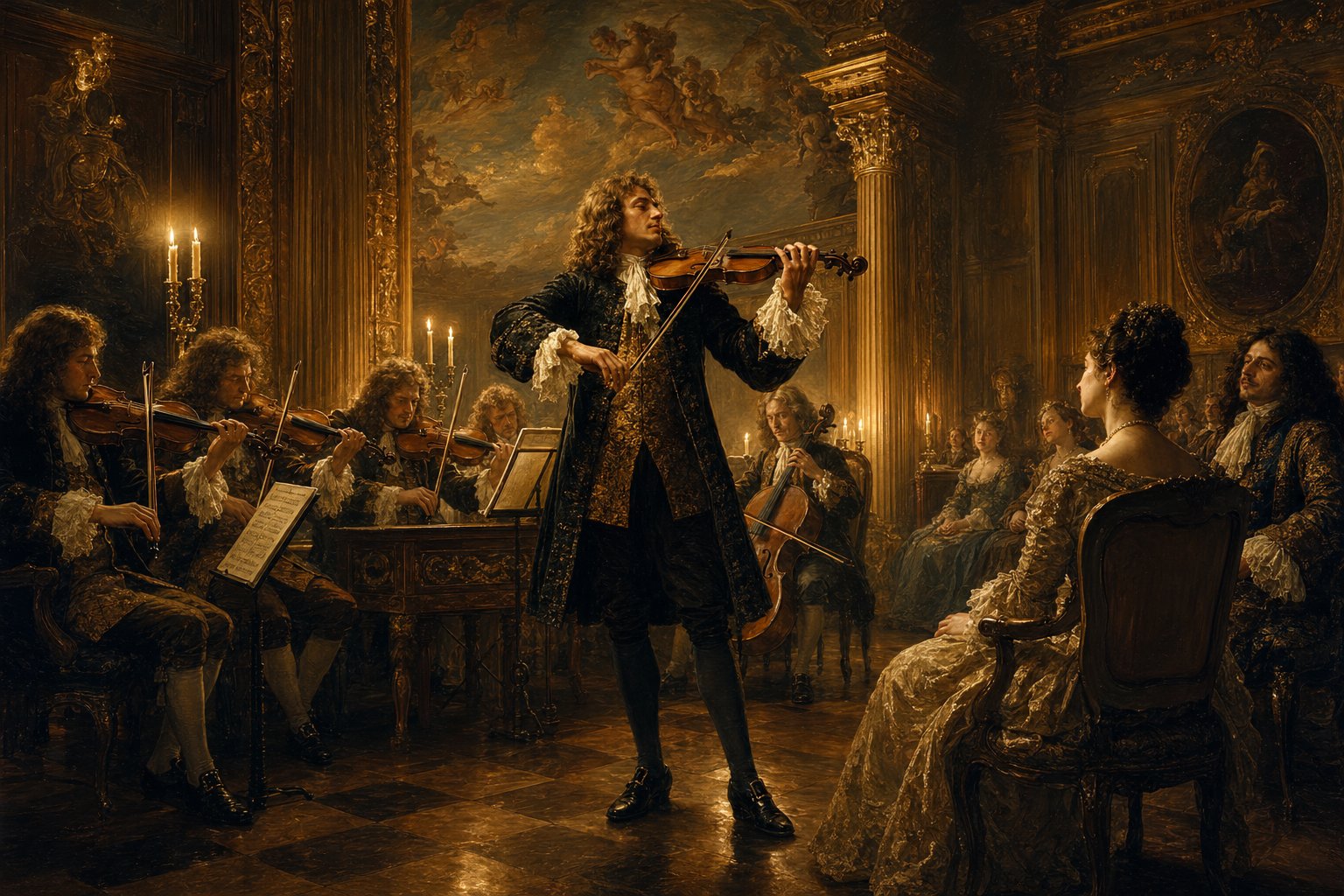
How the Violin Became the Soul of the Orchestra
That emotional weight didn't appear overnight. The violin's path to orchestral dominance stretches back nearly five centuries, and every era along the way reshaped how composers used its voice.
From Baroque Courts to the Modern Concert Hall
The violin emerged in 16th-century Italy, built by makers like Andrea Amati in Cremona. It quickly outpaced the older viol family for one simple reason: projection. Viols produced a gentle, intimate tone suited to small rooms. The violin, with its brighter timbre and expressive range spanning over four octaves, could cut through an ensemble and sustain lyrical melodies that carried across a hall. Composers noticed — and never looked back.
By the Baroque period, virtuoso composer-violinists like Corelli and Vivaldi were writing violin songs that defined an entire generation of orchestral music. Vivaldi alone composed over 200 violin concertos, establishing the instrument as the centerpiece of ensemble writing. During the Classical era, Haydn and Mozart formalized the symphony orchestra structure, dividing violins into first and second sections and giving them the lion's share of melodic material. Then the Romantic period blew the doors open. Brahms, Tchaikovsky, and Mendelssohn pushed the violin sound into deeply emotional territory — soaring themes, dramatic climaxes, and passages that still rank among the most popular violin songs in the concert repertoire. Into the 20th and 21st centuries, the violin anchored film scores and epic orchestral productions, carrying famous songs violin enthusiasts now discover through streaming rather than concert halls.
- Baroque (1600-1750): Violin replaces the viol family; solo concerto form established by Corelli and Vivaldi
- Classical (1750-1820): Haydn and Mozart formalize the symphony orchestra; first and second violin sections become standard
- Romantic (1820-1900): Expanded emotional range and virtuosity; Tchaikovsky, Brahms, and Mendelssohn write landmark concertos
- Modern (1900-present): Violin becomes essential to film scoring, trailer music, and digital-era orchestral productions
Why the Violin Leads Every Orchestra
Ever wonder why the concertmaster — the musician who tunes the orchestra, shakes the conductor's hand, and leads solo passages — is always a violinist? The answer is rooted in history and acoustics.
During the Baroque era, the most skilled violinist in the ensemble literally conducted while playing, using bow movements like a baton to keep the group in time. As orchestras grew larger and a dedicated conductor took over, the concertmaster retained leadership of the ensemble's musical execution — deciding bowings, cueing entrances, and serving as the bridge between conductor and players.
Acoustics reinforce this arrangement. String instruments produce a more focused sound than brass or woodwinds, so massed violins need sheer numbers to achieve balance. Seating them at the front of the stage, closest to the audience, maximizes their projection. First violins sit to the conductor's left, second violins nearby — a spatial layout that distributes the violin sound evenly across the hall and keeps the melodic core of the orchestra front and center.
This combination of historical precedent, acoustic logic, and raw expressive power is exactly why the violin doesn't just participate in the orchestra — it leads. And that leadership has produced a remarkably diverse landscape of styles and subgenres worth exploring on their own terms.
Violin Orchestra Subgenres and Styles Worth Knowing
That diversity can feel overwhelming when you're trying to figure out what you're actually listening to. Is it a concerto? A symphony? An epic trailer piece? The labels matter because they shape what you'll hear — and what to search for next. Here's a practical breakdown of the major categories.
Classical Concertos and Symphonic Works
Four core forms dominate the classical violin orchestra landscape, and each one treats the instrument differently.
A concerto pits a solo violinist against the full orchestra. The soloist stands at the front, carrying the main melodies and virtuosic passages, while the orchestra supports, complements, and sometimes competes with them. Concertos typically have three movements — fast, slow, fast — and they've produced some of the most famous violin songs in the repertoire, from Mendelssohn's Violin Concerto in E minor to Tchaikovsky's in D major.
A symphony, by contrast, is a standalone orchestral work with no featured soloist. The violins share melodic duties with the rest of the ensemble across four movements. Think Beethoven's Fifth or Brahms's Fourth — the violin sections carry enormous weight, but nobody steps out front for a star turn.
A sonata scales things down. The term originally meant any piece "sounded" by instruments rather than sung, and today it usually refers to works for one or two players — a solo violin, or violin with piano. Sonatas still follow the multi-movement structure but are built for intimate settings, not concert halls.
An orchestral suite is a collection of shorter movements, often drawn from ballet or opera scores. Tchaikovsky's Nutcracker Suite is a classic example — individual scenes stitched together into a standalone concert piece where the violins weave through contrasting moods and tempos.
Cinematic and Epic Orchestral Violin Music
This is the category that brought millions of new listeners to the genre. Film scoring and trailer music rely heavily on massed violin sections to create tension, triumph, and heartbreak on screen. You'll recognize the sound instantly — layered strings building in intensity, often paired with heavy percussion and brass hits.
Companies specializing in trailer music have turned this approach into an industry. Their tracks dominate streaming playlists and YouTube, and many of the most famous music for violin discoveries in the last decade came not from concert halls but from movie trailers and motivational video soundtracks. The aesthetic leans dramatic: big dynamic swings, driving rhythms, and melodies designed to hit hard in under three minutes.
Contemporary Crossover and Experimental Styles
The boundaries keep stretching. Artists like Black Violin blend classical training with hip-hop beats, performing on viola and violin over electronic production and DJ sets. Lindsey Stirling pairs violin with EDM and choreography. Producers like Henrik Schwarz have collaborated with chamber orchestras, stripping away synthetic effects entirely and letting acoustic instruments generate textures that feel electronic.
World music fusions add another layer — Indian raga-influenced violin, Celtic fiddle traditions scaled up to orchestral arrangements, and tango ensembles blending strings with Latin percussion. These crossover styles prove that the violin orchestra sound isn't locked in any single era or tradition.
Here's a quick-reference comparison of the major styles you'll encounter when exploring famous songs for violin and orchestra:
| Subgenre | Defining Characteristics | Notable Example |
|---|---|---|
| Classical Concerto | Solo violinist featured against full orchestra; three movements (fast-slow-fast) | Tchaikovsky — Violin Concerto in D major |
| Symphony | Full orchestral work with no featured soloist; typically four movements | Beethoven — Symphony No. 5 |
| Cinematic / Epic Orchestral | Massed strings with percussion and brass; dramatic builds designed for film and media | Hans Zimmer — Interstellar soundtrack |
| Orchestral Suite | Collection of shorter movements, often from ballet or opera; varied moods and tempos | Tchaikovsky — The Nutcracker Suite |
| Crossover / Experimental | Classical violin textures fused with electronic, hip-hop, or world music elements | Black Violin — "Stereotypes" |
Each of these styles has produced landmark works that endure across generations — and a closer look at the individual pieces reveals just how wide the violin orchestra catalog really is.
Famous Violin Orchestra Songs Every Listener Should Know
Knowing the categories is one thing. Knowing which pieces define them is where the real listening begins. Some violin orchestra songs have endured for centuries, while others broke through to mainstream audiences only in the last few decades. What they share is a quality that rewards repeated listening — layers you didn't catch the first time, emotional turns that hit differently depending on your mood.
This isn't a ranked list. It's a guided path through the repertoire, organized by era, designed to give you a foundation whether you're a first-time listener or someone looking to fill gaps in what you already know.
Timeless Classical Masterpieces
If you only ever listen to one Baroque violin orchestra work, make it Vivaldi's The Four Seasons. These four concertos, published in 1725, are brilliant, punchy, and concise — each with three short movements that paint vivid scenes of nature through the violin. The modern revival of these pieces, sparked by Nigel Kennedy's 1989 recording that sold 3 million copies worldwide, turned them into arguably the most recognizable classical violin music on the planet. They remain a gateway piece for good reason: you don't need any background knowledge to feel what Vivaldi is doing.
Moving into the Romantic era, the emotional stakes climb. Mendelssohn's Violin Concerto in E minor (1844) opens with a surging melody that, once heard, is never forgotten. It's one of those rare pieces where every movement delivers — a soulful slow section with operatic expressiveness, then a quicksilver finale full of energy. Tchaikovsky's Violin Concerto in D major (1878) takes a different approach: unabashed emotionalism, rhythmic drive, and a sackful of good tunes that make it the ideal violin orchestra song to hand someone who's never explored classical music. And then there's Barber's Adagio for Strings — technically a string orchestra piece without a featured soloist, but its slow-building grief and catharsis have made it one of the most emotionally devastating violin solos in the collective imagination, used in everything from funerals to film soundtracks.
Modern Iconic Violin Orchestra Tracks
The concert hall isn't the only place these pieces live anymore. John Williams' theme for Schindler's List, performed by Itzhak Perlman, brought the hauntingly beautiful violin sound to a global film audience — a piece so powerful it stands entirely on its own outside the movie. Hans Zimmer's Interstellar score used massed strings to evoke the vastness of space, while Ennio Morricone's work on The Mission and Cinema Paradiso featured touching violin passages that became inseparable from the films' emotional cores.
Then there's the digital-era phenomenon: Jorge Quintero's "300 Violin Orchestra," a track that racked up millions of plays and thousands of playlist saves on streaming platforms, introducing an entirely new audience to epic orchestral violin music through YouTube montages and motivational content. It proved that a violin orchestra track didn't need a concert premiere or a film release to find a massive audience.
Here's a listening sequence that moves through the full arc of the genre, from Baroque to modern:
- Vivaldi — The Four Seasons (1725): The foundational Baroque violin concerto cycle; vivid, programmatic, and endlessly listenable.
- Bach — Violin Concerto in A minor (c. 1717-23): One of classical music's most arresting openings, with a beautifully carefree finale.
- Beethoven — Violin Concerto in D major (1806): Serene and contemplative, capped by a joyous hunting-horn rondo.
- Mendelssohn — Violin Concerto in E minor (1844): The gold standard for Romantic lyricism and structural elegance.
- Bruch — Violin Concerto No. 1 (1866): A dramatic opening that builds into one of the most emotionally powerful slow movements in the repertoire.
- Tchaikovsky — Violin Concerto in D major (1878): High drama, soaring melodies, and the kind of energy that converts newcomers on first listen.
- Barber — Adagio for Strings (1936): Slow-building devastation; the piece that proved a string orchestra could break your heart without a single word.
- Sibelius — Violin Concerto in D minor (1905): Haunting, rhapsodic, and widely regarded as one of the finest violin concertos ever written.
- John Williams — Schindler's List Theme (1993): The violin solo that brought orchestral grief and resilience to a global film audience.
- Jorge Quintero — "300 Violin Orchestra" (2011): The viral track that defined epic orchestral music online and brought the genre to millions of new listeners.
Streaming platforms have given these pieces a second life. Curated violin orchestra playlists regularly accumulate thousands of saves — one popular collection on Spotify sits at over 3,552 — and real-time play counts show that centuries-old works by Vivaldi and Tchaikovsky compete for listens alongside modern cinematic tracks. The violin songs famous enough to appear on these playlists span every era covered above, which says something about the instrument's staying power.
Numbers tell part of the story. But the composers behind these works — their ambitions, rivalries, and creative breakthroughs — tell the rest.
The Composers Behind Iconic Violin Orchestra Music
A great violin orchestra song doesn't emerge from thin air. It comes from a specific person, working within a specific moment in history, solving a specific creative problem. Strip away the composer's story and you lose half the reason a piece resonates the way it does. So let's put faces and context to the music.
The Classical and Romantic Giants
Antonio Vivaldi didn't just write songs for the violin — he essentially invented the template everyone else followed. Working as a music teacher at a Venetian orphanage for girls, he composed over 500 concertos, many of them showcasing the violin as a dramatic storytelling instrument. His biggest contribution? Establishing the three-movement concerto form (fast-slow-fast) that became the blueprint for every violin concerto written after him.
Johann Sebastian Bach took a different path. Where Vivaldi was prolific and outward-facing, Bach was meticulous and architecturally minded. His Brandenburg Concertos demonstrated that orchestral writing could be both mathematically precise and deeply emotional — a combination that still defines the best classical violin sheet music studied by performers today. His solo violin partitas and sonatas, meanwhile, proved the instrument could sustain an entire musical world without any accompaniment at all.
Mozart and Beethoven each reshaped the symphony orchestra itself. Mozart refined the balance between sections, giving violins elegant melodic lines that felt effortless despite their complexity. Beethoven then shattered that elegance with raw emotional force — his Violin Concerto in D major (1806) starts with five quiet timpani strokes and builds into a work of serene grandeur that redefined what a concerto could express.
The Romantic era raised the emotional temperature dramatically. Tchaikovsky poured unrestrained feeling into his Violin Concerto in D major, creating one of the most popular songs to play on violin for advanced performers and a concert staple that still fills halls. Sibelius, composing from the frozen landscapes of Finland, wrote a Violin Concerto in D minor so rhapsodic and technically demanding that it's considered a symbol of Finnish national identity as much as a piece of music. And then there was Paganini — the showman who expanded violin technique so radically (harmonics, left-hand pizzicato, extreme leaps) that audiences genuinely suspected he'd made a deal with the devil. His 24 Caprices remain the ultimate benchmark for virtuosity.
Modern Composers Redefining the Genre
The violin orchestra sound might have stayed inside concert halls if not for film. John Williams changed that equation permanently. Drawing on influences from Wagner, Holst, and Strauss, he crafted scores where massed violins carried the emotional core of entire movies. The Schindler's List theme — a solo violin line over orchestral strings — became one of the most recognized pieces of the late 20th century, proving that cinematic writing could stand alongside the classical canon.
Hans Zimmer took a different approach, fusing classical orchestral textures with modern sound design. His scores for Interstellar and Inception used violin sections not as traditional melody carriers but as atmospheric engines — sustaining tension, building walls of sound, and creating emotional landscapes that feel both ancient and futuristic. Zimmer brought the violin orchestra into blockbuster territory and kept it there.
And then there's Jorge Quintero, who bypassed both the concert hall and the film studio entirely. His "300 Violin Orchestra" found its audience through YouTube and streaming — no movie tie-in, no record label push, just a track that resonated with millions of listeners searching for epic, driving orchestral music. Quintero represents a new model: the digital-era composer whose reach is built on algorithms and shares rather than premieres and reviews.
Here's a scannable reference connecting each composer to their defining contribution:
| Composer | Era | Signature Violin Orchestra Work |
|---|---|---|
| Antonio Vivaldi | Baroque (1678-1741) | The Four Seasons — established the violin concerto form |
| Johann Sebastian Bach | Baroque (1685-1750) | Brandenburg Concertos — fused mathematical precision with orchestral depth |
| Wolfgang Amadeus Mozart | Classical (1756-1791) | Violin Concerto No. 5 in A major — refined orchestral elegance |
| Ludwig van Beethoven | Classical/Romantic (1770-1827) | Violin Concerto in D major — expanded the concerto's emotional scope |
| Niccolò Paganini | Romantic (1782-1840) | 24 Caprices — redefined the limits of violin technique |
| Pyotr Ilyich Tchaikovsky | Romantic (1840-1893) | Violin Concerto in D major — peak Romantic emotionalism |
| Jean Sibelius | Late Romantic (1865-1957) | Violin Concerto in D minor — haunting Nordic lyricism |
| John Williams | Modern/Film (1932-present) | Schindler's List theme — brought orchestral violin to global cinema |
| Hans Zimmer | Modern/Film (1957-present) | Interstellar score — fused classical strings with modern sound design |
| Jorge Quintero | Digital Era (contemporary) | "300 Violin Orchestra" — viral epic orchestral phenomenon |
One name on that list — Quintero — deserves a deeper look. His single track didn't just chart well; it reshaped how an entire generation discovers and consumes violin orchestra music online.
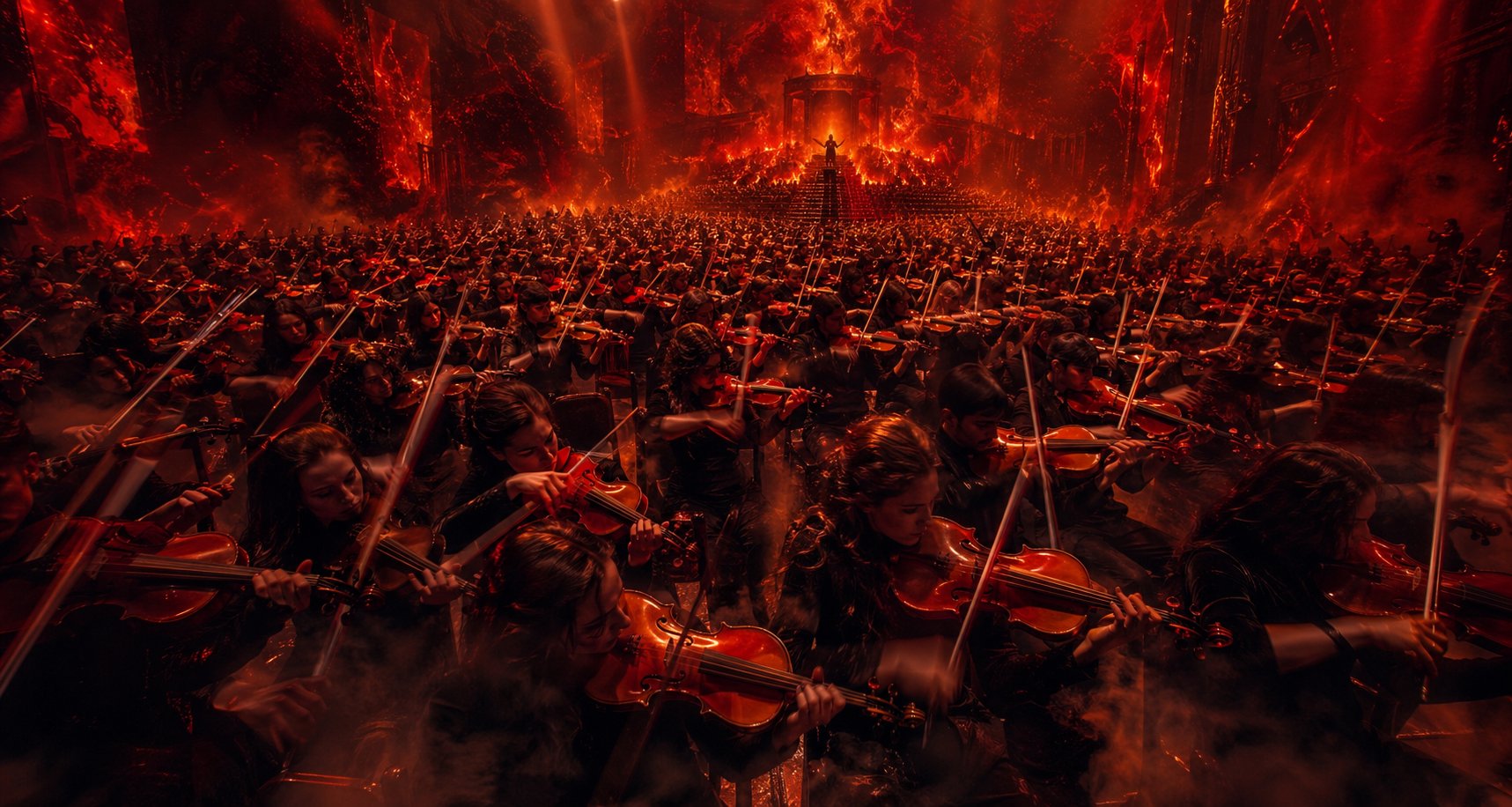
The 300 Violin Orchestra Phenomenon Explained
Search for "violin orchestra" on any streaming platform and one track consistently surfaces near the top: Jorge Quintero's "300 Violin Orchestra." It's not a classical concerto. It wasn't written for a film. Yet it became one of the most widely heard examples of violin in songs across the entire internet — and almost no editorial resource has bothered to explain why.
The Track That Defined Epic Violin Music Online
Quintero originally released "300 Violin Orchestra" as part of his Hip Hop and RnB Instrumentals album in 2008. The title nods to the visual aesthetic of the film 300 — that raw, cinematic intensity — but the track itself was never part of the official soundtrack. It didn't need to be. YouTube creators adopted it almost immediately, layering it under motivational speeches, sports highlight reels, workout montages, and trailer-style edits. The track's dramatic arc — quiet tension building into a full orchestral eruption — made it a perfect fit for content designed to pump adrenaline.
That organic adoption did something no marketing campaign could replicate. Millions of viewers heard the piece without ever searching for it, then went looking for the source. Quintero's verified artist profile on Apple Music lists it as his top song, and it remains his most-streamed work by a wide margin. The track essentially built his audience from scratch — proof that a single piece of best music violin writing can travel further through shares and algorithms than through traditional industry channels.
Why It Resonates and Its Lasting Influence
Strip the track down and you'll find a deceptively simple formula. It opens with sparse, tension-building string phrases — just enough to create anticipation. Then layered violin sections enter one on top of another, each adding harmonic density. Percussive hits punctuate the build, and by the climax, the full 300 violin orchestra effect is in play: a wall of strings driving forward with almost physical force. The structure mirrors how a great film trailer works — setup, escalation, payoff — compressed into a few minutes.
That blueprint didn't stay unique for long. The track's viral success spawned an entire subgenre of epic orchestral music built on the same principles: massed strings, cinematic percussion, and relentless forward momentum. Producers across YouTube and streaming platforms began creating tracks explicitly modeled on Quintero's approach. Remix culture picked it up too — you'll find hip-hop remixes, EDM mashups, and re-orchestrations that treat the original as a foundation to build on rather than a finished product.
"300 Violin Orchestra" didn't just go viral — it became the gateway track that introduced an entire generation of listeners to the emotional power of massed orchestral strings, proving that a violin orchestra song could thrive outside concert halls, film credits, and record label ecosystems entirely.
Quintero's phenomenon also revealed something broader about how audiences connect with orchestral music in the digital age. The track didn't succeed because of its pedigree or critical acclaim — it succeeded because it made people feel something visceral, and they wanted to share that feeling. That same emotional engine now drives the violin orchestra sound across film scores, video games, advertising, and social media content at a scale the classical world never anticipated.
Violin Orchestra Music in Film Scores and Modern Media
That visceral emotional engine — the one Quintero tapped into with a single track — is the same force Hollywood has been harnessing for decades. The difference is scale. Film scores, video games, advertising, and social media have collectively turned the violin orchestra sound into one of the most widely heard musical textures on the planet, reaching audiences who may never set foot in a concert hall.
Film Scores That Put Violin Orchestra Center Stage
Think about the moments in cinema that stay with you long after the credits roll. Chances are, a violin section was doing the heavy lifting. John Williams' theme for Schindler's List — a single violin line conveying the Holocaust's horror, starting fragile then gaining quiet urgency — remains one of the most devastating pieces of famous violin music ever written for screen. It didn't need words. It didn't need spectacle. Just Itzhak Perlman's bow and a string orchestra behind him.
Hans Zimmer pushed the format in a completely different direction. His Interstellar score used organ swells and relentless string climbs to mirror the vastness of space, blending pipe organ with massed violins for something that felt both cosmically enormous and deeply personal. Pirates of the Caribbean took yet another approach — driving, rhythmic string passages layered under brass fanfares that turned swashbuckling adventure into some of the best violin songs casual listeners had ever encountered without realizing it. Howard Shore's Lord of the Rings trilogy wove ethnic instruments with orchestral strings to build an entire world's emotional landscape, earning an Oscar for its cultural authenticity.
These scores did something remarkable: they made the music of violin accessible to billions of people simultaneously. A teenager watching Interstellar on a streaming service absorbs the same orchestral language that filled 19th-century concert halls — just delivered through a different door.
Trailer Music, Gaming, and the Streaming Era
The explosion didn't stop at film. Epic trailer music companies like Two Steps from Hell, Audiomachine, and Immediate Music built entire catalogs around massed violin sections paired with cinematic percussion — tracks designed to sell a movie in 90 seconds. These pieces now live on streaming playlists with millions of followers, and many listeners discover famous violin pieces through trailer compilations before they ever hear the original classical works that inspired them.
Video games deepened the connection further. Titles like Final Fantasy, The Legend of Zelda, Halo, and Genshin Impact use full symphony orchestras to create emotional depth, and symphony concerts based on these soundtracks routinely sell out — often drawing audiences younger than traditional classical programming. For Gen Z especially, orchestral violin isn't something old-fashioned. It's the sound of the worlds they grew up in.
Streaming algorithms and social media closed the loop. Classical music has become an emotional language on TikTok, with users pairing dramatic orchestral moments with story-based content, aesthetic edits, and emotional vlogs. Pieces by Tchaikovsky and Vivaldi have gone viral multiple times on the platform, and curated playlists labeled "Epic Classical" or "Orchestral Chill" align perfectly with how younger listeners use music for focus, mood regulation, and creative projects.
Here's how the violin orchestra sound functions across each major media category:
- Film: Carries primary emotional weight in dramatic scenes; often defines a movie's identity through recurring themes and leitmotifs
- Television: Used in title sequences and climactic moments to signal prestige production value (think HBO and streaming originals)
- Video Games: Creates immersive emotional landscapes that respond dynamically to player actions; drives engagement across hours of gameplay
- Advertising: Signals sophistication, urgency, or emotional depth in 30- to 60-second spots; luxury and automotive brands lean on it heavily
- Social Media: Short orchestral clips serve as emotional shorthand on TikTok and Instagram Reels, introducing famous violin pieces to audiences who discover them through content rather than search
The throughline across all of these contexts is the same: massed violins trigger an emotional response faster and more reliably than almost any other sound in a composer's toolkit. That reliability is exactly why the genre keeps expanding — and why new tools are emerging to let creators generate their own orchestral textures without booking a 60-piece ensemble.
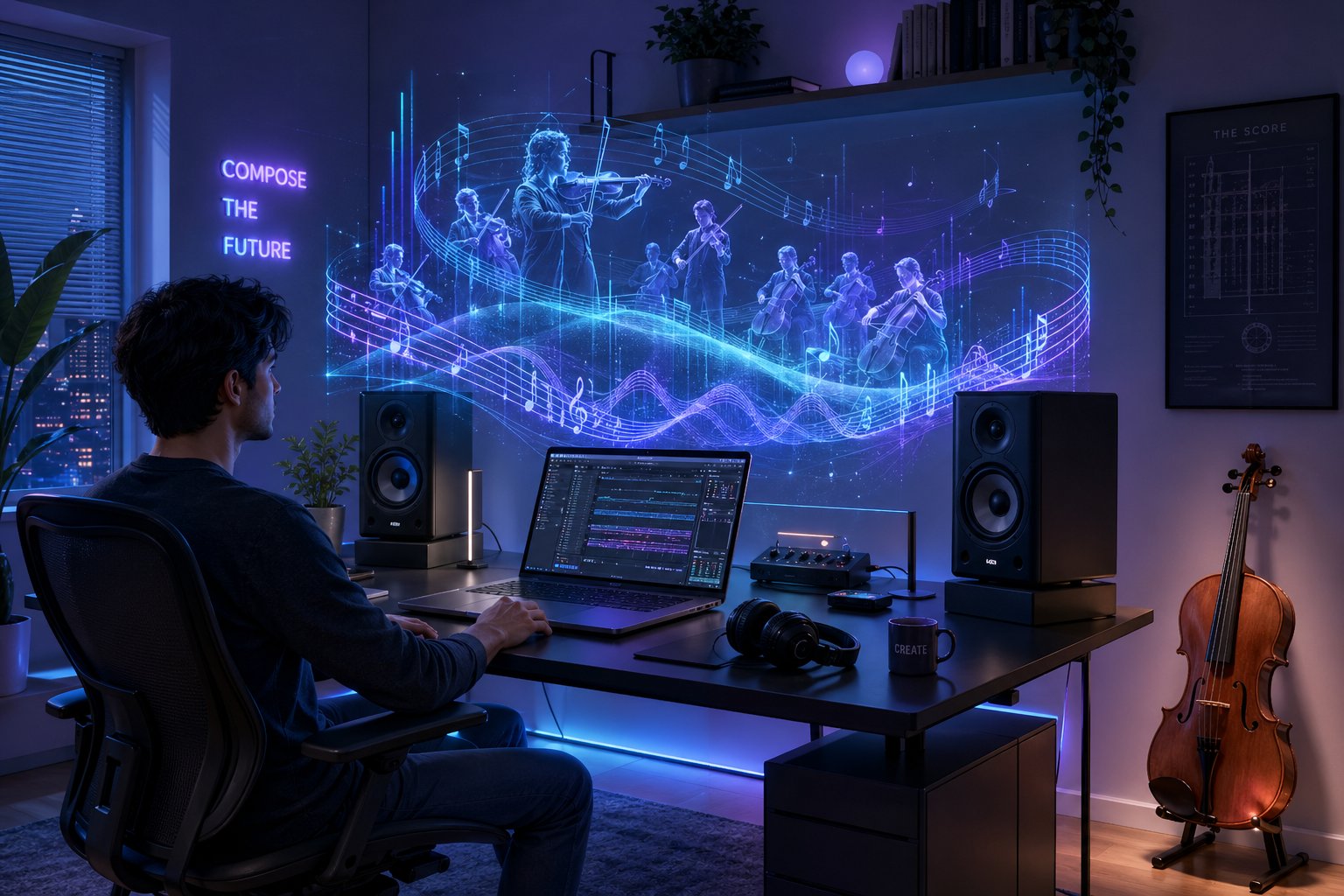
How AI Is Reshaping Violin Orchestra Music Creation
Booking a 60-piece ensemble isn't realistic for most people. But what if you could describe the violin orchestra track in your head — the mood, the tempo, the arc — and hear a fully arranged version seconds later? That's no longer hypothetical. AI music generation has reached a point where orchestral styles, including massed violin arrangements, are among the most convincing outputs these systems produce.
How AI Music Generation Works for Orchestral Styles
At the core, AI music generators are machine learning models trained on vast datasets of existing compositions. You provide a text prompt — something like "epic cinematic orchestral, building from solo violin to full strings and brass, 90 BPM, emotional and sweeping" — and the model generates an original audio track that matches your description. No notation software, no session musicians, no studio time.
What makes orchestral styles particularly interesting for AI is the complexity involved. A convincing classical violin arrangement requires proper instrument layering, dynamic balance between sections, and stylistic authenticity across forms that span centuries of tradition. Earlier AI tools struggled here — outputs from just a couple of years ago often sounded mechanical, with strings that felt flat and percussion that overwhelmed delicate melodic lines. The quality gap was obvious to anyone familiar with the most famous violin songs in the repertoire.
That gap has narrowed dramatically. Modern models trained on classical scores now understand orchestral hierarchy in ways that mirror how a conductor interprets a score — ensuring violins don't get buried under brass, woodwind passages breathe naturally, and dynamic range feels organic rather than compressed. Neural audio synthesis and spectral processing techniques have improved tonal richness and reverb replication, which are critical for simulating the acoustics of a live orchestra in a concert hall. The result is output that can genuinely serve as a working draft for film cues, podcast backgrounds, or personal creative projects.
The global AI in music market is projected to reach approximately USD 38.7 billion by 2033, up from USD 3.9 billion in 2023 — and orchestral generation is one of the fastest-growing segments driving that expansion. Content creators, indie filmmakers, and game developers who once had zero access to the most well known violin pieces' sonic palette can now experiment with it freely.
Creating Your Own Violin Orchestra Tracks with AI Tools
So how do you actually try this? The practical barrier is surprisingly low. Most AI music platforms work through simple text prompts where you specify genre, mood, instrumentation, and tempo. Imagine typing "dramatic violin orchestra, slow build, melancholic strings layered with soft percussion, cinematic feel" and receiving a usable track in under a minute.
MakeBestMusic's AI Song Generator is one tool built around exactly this workflow. You select a genre or describe a mood and song idea, and it generates an original royalty-free track — including orchestral and classical violin styles — in seconds. For content creators who need background music for a video project, filmmakers scoring a short, or music enthusiasts who simply want to hear what their idea sounds like with a full string section, it removes the need for music theory knowledge or access to live performers. The royalty-free output means you can use the result in YouTube videos, podcasts, or personal creative work without licensing headaches.
A few practical tips if you're experimenting for the first time:
- Be specific in your prompts — "orchestral" is vague, but "layered violin sections building over timpani with a triumphant brass climax" gives the AI much more to work with
- Specify "instrumental, no vocals" if you want a pure orchestral texture for background use
- Generate multiple variations from the same prompt and pick the strongest — the process is fast enough to make this painless
- Describe the emotional arc, not just the mood: "starts sparse and tense, builds to a full orchestral crescendo at the midpoint, resolves gently"
These tools aren't replacing the depth of a live classical violin performance or the nuance a trained composer brings to a score. Think of them as a creative starting point — a way to sketch ideas, prototype soundtracks, or simply explore what the violin orchestra sound can do when you're the one directing it. The most famous violin songs in history were written by people who heard something in their heads and found a way to make it real. The difference now is that the gap between imagining a piece and hearing it has collapsed to almost nothing — which changes who gets to participate in the genre entirely.
How to Start Your Violin Orchestra Listening Journey
Hearing what's possible is one thing. Knowing where to begin — and where to go next — is what turns casual curiosity into a lasting appreciation. Whether you're brand new to the genre or looking to push past the familiar violin pieces you already love, a structured listening path makes all the difference.
Building Your First Violin Orchestra Playlist
The trick is variety. Start with something immediately accessible, then let each piece pull you a little deeper into a different era or style. Here's a sequence designed to do exactly that:
- Vivaldi — The Four Seasons, "Spring": Bright, energetic, and impossible not to enjoy. The perfect first step into Baroque orchestral writing.
- Pachelbel — Canon in D: You've heard it at weddings, in films, even on hold. Now listen to it on purpose — its gentle repetition reveals why simplicity endures.
- Tchaikovsky — Violin Concerto in D major, first movement: This is where the emotional floodgates open. One of the best violin music experiences in the entire Romantic repertoire.
- Barber — Adagio for Strings: Slow, devastating, and unforgettable. Let it build without skipping ahead.
- John Williams — Schindler's List theme: The bridge between classical tradition and cinematic storytelling, carried entirely by songs with the violin at their emotional center.
- Jorge Quintero — 300 Violin Orchestra: The orchestra 300 violin track that launched a subgenre. Hear why millions of listeners found orchestral music through this single piece.
- Max Richter — Recomposed: Vivaldi's Four Seasons: A modern reimagining that loops back to where you started, proving the genre keeps evolving.
Play them in order during a single sitting if you can. The progression from Baroque clarity to Romantic intensity to cinematic power to digital-era reinvention mirrors the arc of the genre itself.
Resources for Discovering New Violin Orchestra Music
Once you've built that foundation, these resources will keep the discovery going:
- Apple Music Classical's "The Violin" playlist — 74 tracks spanning six and a half hours, from Bach partitas to contemporary works by Lera Auerbach and Max Richter
- Spotify's curated "Epic Classical" and "Violin Classics" playlists — algorithm-driven discovery that surfaces both canonical works and lesser-known gems
- Duke University's Violin Resources guide — a librarian-curated collection of online listening databases, score libraries, and repertoire guides for deeper research
- Classic FM's beginner guide — an approachable editorial starting point covering orchestral essentials from Handel to Stravinsky
- MakeBestMusic's AI Song Generator — for when you want to move beyond listening and try creating your own violin orchestra composition from a mood or idea, royalty-free
The best violin music isn't something you run out of. Five centuries of composers have made sure of that. Start with the playlist above, follow whatever pulls you in, and don't worry about listening "correctly." The violin has been making people feel things since the 1500s — it doesn't need your permission to do it again.
