

What Is Alt Pop and What Makes It Different
You've probably heard the term thrown around on Spotify playlists, music blogs, and artist bios without ever getting a straight answer about what it actually means. So what is alt music in the context of pop, and why does it feel like nobody can pin it down? Let's fix that.
A Clear Definition of Alt Pop
Alt pop sits at the crossroads of mainstream pop's melodic accessibility and alternative music's experimental instincts. Think catchy hooks paired with unconventional production, introspective lyrics, and influences that pull from electronic, indie, rock, and beyond. Merriam-Webster defines alternative pop as pop music with broad appeal produced by performers outside the musical mainstream, typically regarded as more original, eclectic, or intellectually challenging than most pop music. That's a solid starting point, but the lived experience of the genre goes deeper.
Alt pop is pop music that keeps the hooks but breaks the rules — blending mainstream songcraft with left-of-center production, genre-fluid influences, and emotionally direct storytelling that prioritizes authenticity over formula.
Where mainstream pop tends to optimize for mass-market appeal through polished, predictable structures, alt pop leans into texture, mood, and surprise. The melodies still stick in your head, but the sounds around them feel less like a boardroom decision and more like a creative risk. As Melodigging puts it, the genre blends mainstream songcraft with left-of-center production, aesthetics, and subject matter, spanning everything from hushed, minimal tracks to bright synth-led anthems.
Why the Genre Defies Easy Labels
So what is alternative music as a genre if it borrows from everything and belongs fully to nothing? That's exactly the point. Alt pop isn't defined by a single sound the way synth-pop centers on synthesizers or punk centers on speed and aggression. It's defined by an approach: take the emotional directness and hookcraft of pop, then filter it through whatever sonic palette feels honest to the artist. One track might layer lo-fi textures over a confessional vocal. The next might pair glitchy electronics with an arena-sized chorus. The common thread isn't a specific instrument or tempo. It's a willingness to break Top 40 conventions while remaining hook-centric and emotionally direct.
That flexibility is what makes the alternative music genre so hard to define on paper and so easy to recognize when you hear it. It sounds like pop music made by someone who listens to everything — and that restless, genre-fluid spirit is exactly what gave it a history worth tracing.
The Origins and Evolution of Alt Pop
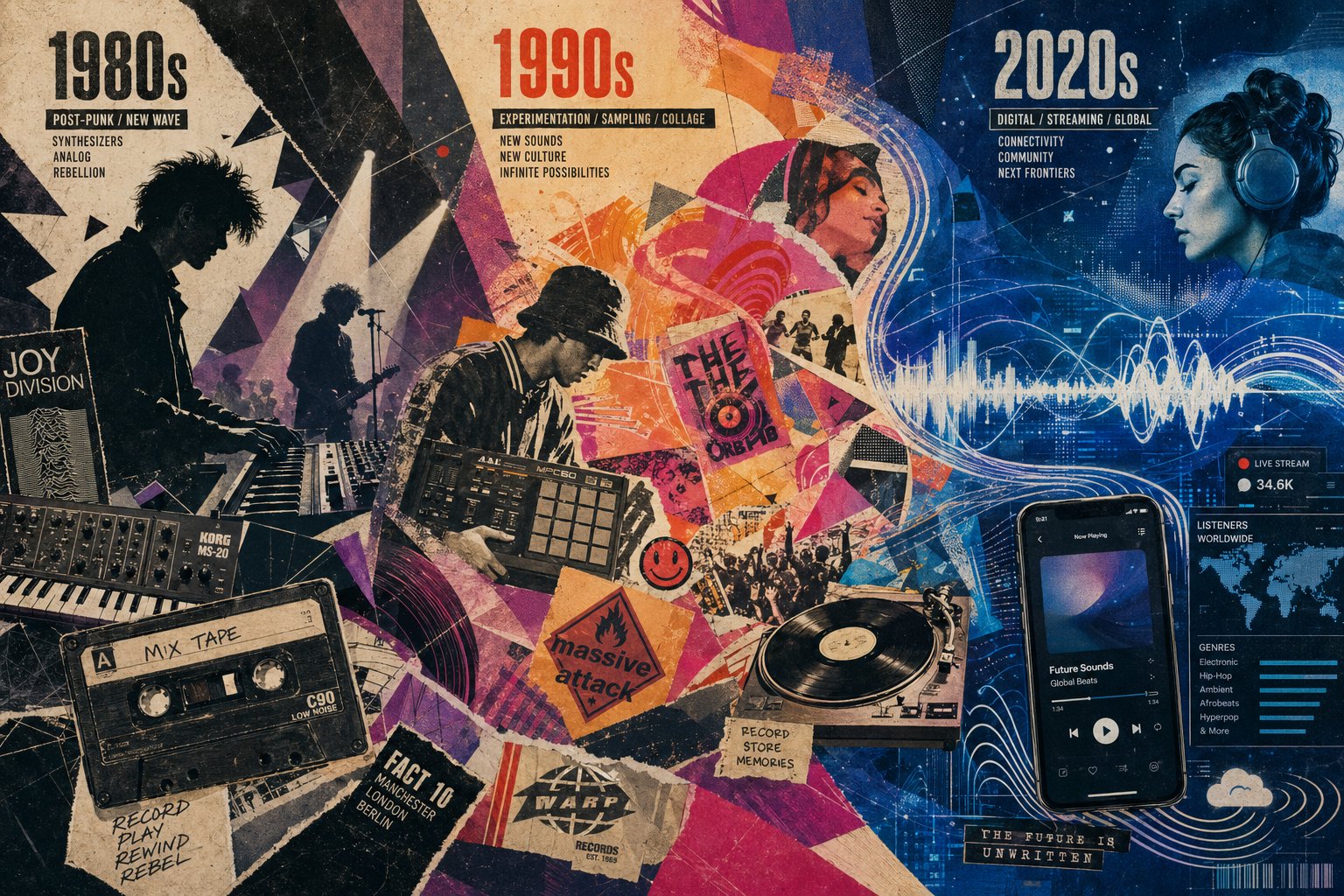
Every genre has an origin story, but alternative pop didn't arrive with a single manifesto or founding moment. It emerged gradually, shaped by artists who loved pop melody but refused to play by pop's rules. The alternative music meaning embedded in this genre has always been about tension — the pull between accessibility and experimentation — and that tension has looked different in every decade.
1980s and 1990s Roots in Alternative Experimentation
The seeds were planted in the 1980s UK alternative scene. Bands like The Cure, Depeche Mode, and Siouxsie and the Banshees wrote undeniably catchy songs, but wrapped them in dark atmospheres, synthesizer textures, and emotional weight that mainstream radio didn't quite know what to do with. AllMusic notes that this "left-of-center pop" largely failed to break through commercially during the decade, though acts like Siouxsie and the Banshees found notable success. Meanwhile, the Cocteau Twins were building something even more radical — Robin Guthrie's cascading, effects-drenched guitar and Elizabeth Fraser's otherworldly vocals created a sonic blueprint that would ripple through dream pop, shoegaze, and eventually alt pop itself for decades to come.
The 1990s pushed the experiment further. Bjork, who grew up obsessing over Cocteau Twins records at the only indie shop in Reykjavik, took the Sugarcubes' post-punk energy and launched a solo career that proved pop could be genuinely avant-garde. Radiohead, openly influenced by the Cocteau Twins' guitar work, bent rock and electronic music into shapes that still felt emotionally immediate. These alternative pop artists weren't rejecting pop — they were expanding what it could contain.
The Streaming Era and Alt Pop's Mainstream Breakthrough
The real tipping point came in the 2010s, when streaming platforms and social media dissolved the gatekeeping structures that had kept experimental pop on the margins. Lana Del Rey developed what Wikipedia describes as a "cult-like following" with her cinematic, beat-heavy sound, characterized by "alluring sadness and melodrama." Lorde topped global charts in 2013 and 2014 with a minimalist, anti-glamour aesthetic that felt nothing like the pop landscape around her. Digital recording tools and home production software meant artists no longer needed major-label studios to create layered, polished music — and streaming gave them a direct path to listeners worldwide.
Here's how that evolution breaks down era by era:
- 1980s Origins — UK acts like The Cure, Depeche Mode, Cocteau Twins, and Siouxsie and the Banshees blend pop songcraft with dark, atmospheric experimentation. Commercial success is limited, but the creative DNA is established.
- 1990s Expansion — Bjork, Radiohead, and Portishead push alternative pop into stranger, more ambitious territory, proving that experimental approaches can coexist with emotional directness and critical acclaim.
- 2010s Mainstream Breakthrough — Streaming erases genre barriers. Lana Del Rey, Lorde, and later Billie Eilish bring distinctly non-mainstream aesthetics to massive global audiences. In 2022, Eilish is credited with marking the "ascendance" of alt pop in the mainstream with her dark, downbeat sound.
- The Current Era — Bedroom producers and major-label acts coexist under the same umbrella. Artists like Grimes and Tame Impala use digital synthesizers and home recording setups to blur genre lines entirely, while social media gives emerging voices direct access to fans without traditional industry gatekeepers.
What's striking about this arc isn't just the music — it's how technology and culture kept meeting at exactly the right moments to push the genre forward. Each generation of alternative pop artists inherited a wider sonic palette and fewer barriers to reaching an audience. But the story of how the genre evolved only tells you so much. To really understand what makes it tick, you have to get inside the sound itself.
The Sonic DNA of Alt Pop Music
Any alternative music definition that stops at "pop but weirder" misses the point. The genre has a real sonic fingerprint — a set of production choices and structural instincts that show up across wildly different artists. You might not be able to describe it in a sentence, but you can hear it within seconds.
Production Techniques That Define the Sound
Imagine a vocal recorded with the intimacy of a whispered confession, then surrounded by reverb that stretches it into something vast and atmospheric. That tension between closeness and space is one of the genre's defining tricks. Billie Eilish and Finneas built "ocean eyes" around exactly this idea — a delicate vocal floating inside cavernous, shimmering production that feels both bedroom-small and stadium-wide at the same time.
This approach draws heavily from lo-fi recording traditions. As the lo-fi movement's history shows, artists have long treated technical imperfection as an aesthetic choice rather than a limitation — tape hiss, analog warmth, and grainy textures that make polished melodies feel lived-in. Alt pop artists absorb that philosophy and layer it over crisp, modern hooks. Phoebe Bridgers' "Scott Street" pairs a clean, folk-adjacent melody with subtle electronic haze and room noise that gives the track an almost documentary intimacy. Tame Impala's "Let It Happen" fuses psychedelic synths with organic drums and a production style that sounds simultaneously retro and futuristic.
The ethereal vocal processing techniques common in ambient music — long reverb tails, gentle pitch shifting, layered harmonics — show up constantly across the alternative genre, adapted to serve pop songwriting rather than pure atmosphere. The result is vocals that feel emotionally exposed yet sonically expansive, a combination that gives the music its distinctive pull.
Here are the core sonic traits that tend to define the sound:
- Genre-blending production — Electronic textures, organic instrumentation, and sampled elements coexist freely within a single track, often shifting mid-song.
- Atmospheric layering — Reverb-heavy spaces, ambient pads, and textural details create depth and mood behind the main melody.
- Lo-fi warmth over polished hooks — Grainy, imperfect textures sit alongside clean vocal melodies, creating a contrast that feels both raw and crafted.
- Lyrical vulnerability — Confessional, introspective writing that favors emotional specificity over universal pop platitudes.
- Electronic-organic fusion — Synthesizers and programmed beats blend with live guitar, piano, or strings rather than replacing them entirely.
How Alt Pop Subverts Traditional Song Structures
Beyond production, the alternative genre breaks from mainstream pop at the structural level. Where a typical Top 40 track follows a predictable verse-chorus-verse-bridge-chorus arc, alt pop artists treat song structure as something flexible — even expendable. Lorde's "Ribs" builds through repetition and layered intensity rather than a traditional chorus payoff. Radiohead's "Everything in Its Right Place" opens Kid A with looping, fragmented phrases that dissolve and reassemble instead of resolving neatly. As alternative arranging techniques emphasize, the goal is storytelling through surprise — using transitions, tension, and release at unexpected moments to keep listeners engaged without relying on formula.
Charli XCX pushes this even further on tracks like "Track 10," where abrupt tempo shifts and glitchy production interruptions become the structure itself. The song doesn't subvert expectations so much as refuse to set them in the first place.
All of these choices — the atmospheric production, the lo-fi textures, the structural unpredictability, the raw vocal delivery — work together to create music that hooks you the way pop always has, but surprises you in ways pop rarely does. And that combination is exactly what makes it so difficult to draw clean lines between this sound and its closest musical relatives.
How Alt Pop Differs From Indie Pop and Mainstream Pop
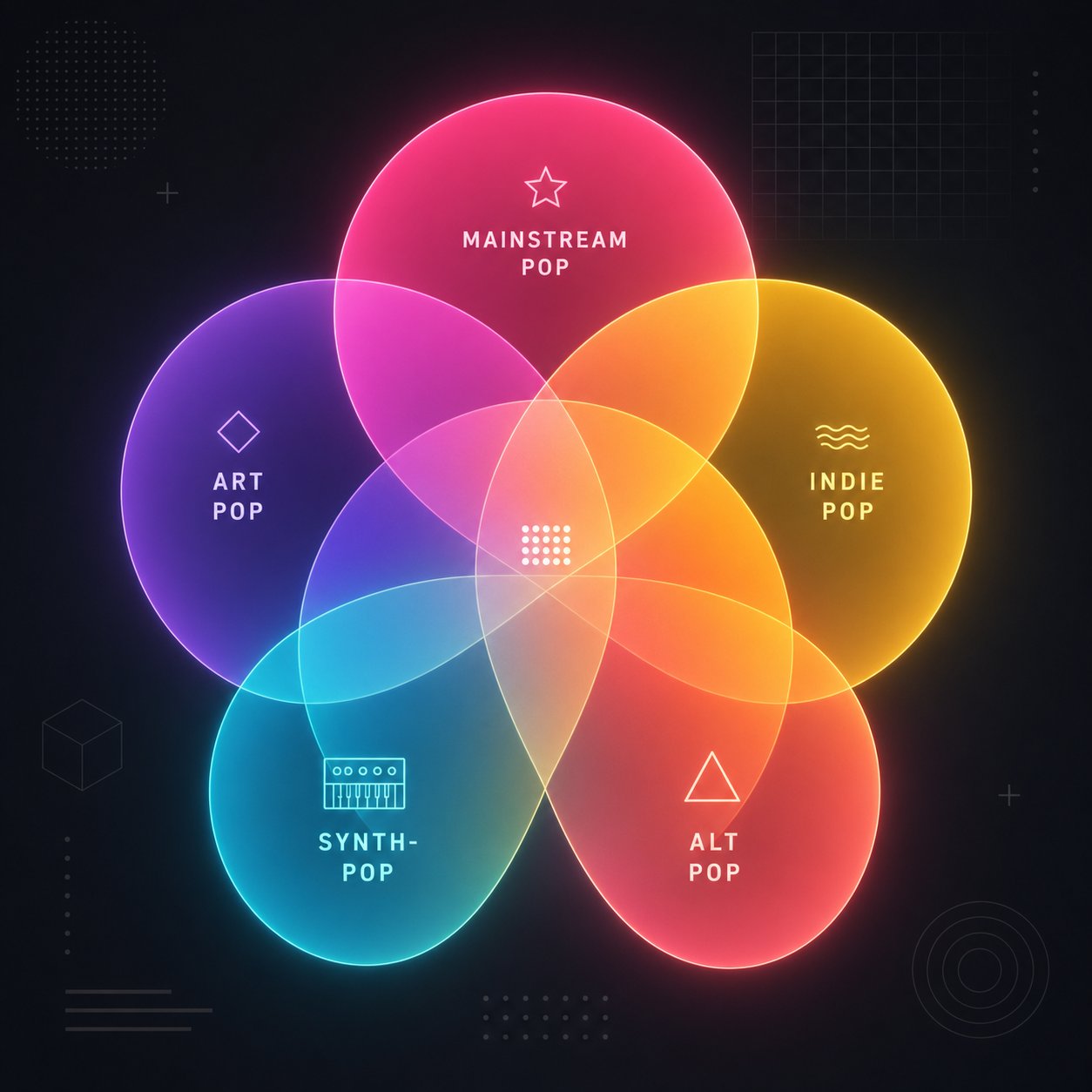
Drawing those clean lines matters, though — especially when so many genre labels get tossed around interchangeably. If you've ever wondered what's alternative music versus just "indie" or "pop" or "art pop," you're not alone. These categories overlap in real and confusing ways, and the meaning of alternative music shifts depending on who's using the term. But each genre does carry a distinct center of gravity, even when the edges blur.
Alt Pop vs. Mainstream Pop
The simplest distinction is intent. Mainstream pop is engineered for the widest possible audience. Its production is polished to a mirror shine, its song structures follow proven formulas, and its lyrical themes tend toward universality — love, heartbreak, celebration, empowerment. None of that is a criticism. Artists like Taylor Swift and Dua Lipa are extraordinary at what they do. But the creative decisions are filtered through commercial logic: will this hook test well? Will this sound fit current radio formats?
Alt pop flips that priority. The hooks are still there, but they serve the artist's vision rather than a market strategy. Billie Eilish's whispered vocals over sparse, bass-heavy beats wouldn't have passed a traditional A&R focus group — and that's precisely why they resonated. The alternative music description that fits best here is pop songwriting freed from the obligation to optimize for mass appeal, even when mass appeal follows anyway.
Alt Pop vs. Indie Pop and Art Pop
Indie pop and alt pop get confused constantly, and for good reason — they share DNA. Both value creative independence and tend toward introspective lyrics. The difference is largely one of scope and sonic ambition. Indie pop leans into a DIY ethos and lo-fi aesthetic as defining features. Think Belle and Sebastian's gentle jangle or early Camera Obscura — the charm is in the modesty, the handmade quality. Alt pop borrows that intimacy but isn't bound by it. An alt pop track might start with a bedroom recording and end up layered with orchestral synths and stadium-scale production.
Art pop, meanwhile, foregrounds conceptual ambition above all else. Artists like Kate Bush or St. Vincent build entire worlds around ideas, visual narratives, and avant-garde structures. The music can be challenging by design, sometimes prioritizing artistic statement over accessibility. Alt pop shares art pop's experimental instincts but keeps one foot planted in melodic immediacy. You'll notice the difference when a song makes you think and hum at the same time — that's the alternative space at work.
Synth-pop is the easiest to distinguish. It's defined by its instrument: the synthesizer sits at the center of everything, from Depeche Mode's early work to modern acts like CHVRCHES. Alt pop frequently uses synthesizers, but they're one color on a much wider palette rather than the defining feature.
Here's how these genres compare across key dimensions:
| Dimension | Mainstream Pop | Indie Pop | Art Pop | Synth-Pop | Alt Pop |
|---|---|---|---|---|---|
| Production Style | Highly polished, radio-optimized | Lo-fi, DIY, minimal | Conceptual, avant-garde | Synthesizer-driven, electronic | Genre-fluid, blends lo-fi warmth with layered production |
| Lyrical Themes | Universal (love, empowerment, fun) | Introspective, understated | Conceptual, narrative-driven | Romantic, futuristic, melancholic | Emotionally raw, confessional, often dark or anxious |
| Song Structure | Formulaic verse-chorus-bridge | Simple, often stripped-back | Experimental, non-linear | Verse-chorus with synth hooks | Flexible, subverts expectations while staying hooky |
| Typical Audience | Broadest mainstream market | Niche, DIY-oriented listeners | Culturally engaged, art-forward fans | Electronic music enthusiasts, nostalgia-driven listeners | Genre-fluid listeners, streaming-era discoverers |
| Commercial Reach | Maximum (radio, playlists, sync) | Limited, grassroots | Moderate, critically driven | Moderate to high | Growing rapidly, playlist-driven crossover |
| Key Artists | Taylor Swift, Dua Lipa, Ed Sheeran | Belle and Sebastian, Mac DeMarco | Kate Bush, St. Vincent, Bjork | Depeche Mode, CHVRCHES, Pet Shop Boys | Billie Eilish, Lorde, Lana Del Rey |
What the table makes clear is that alt pop doesn't occupy its own isolated lane. It sits at the intersection, borrowing indie pop's intimacy, art pop's creative ambition, synth-pop's electronic textures, and mainstream pop's melodic instincts — without fully committing to any single identity. That's what makes the genre so slippery to categorize and so magnetic to listeners who don't want to be boxed in either.
Labels and comparisons only take you so far, though. The real story of any genre lives in the artists who shaped it — the specific voices that turned a loose set of tendencies into something you can actually feel.
Essential Alt Pop Artists and What They Brought to the Genre
So what is alt pop when you strip away the definitions and comparisons? Ultimately, it's the sum of the artists who built it — each one adding something that didn't exist before they showed up. The alternative music genre wasn't designed in a boardroom. It was shaped, track by track, by musicians who heard pop's potential and refused to stop at its conventions.
Foundational Artists Who Laid the Groundwork
Before the genre had a name, a handful of artists proved that pop melody and genuine experimentation could coexist — and that audiences would follow if the music was honest enough.
- Bjork — After leaving the Sugarcubes, she launched a solo career that fused electronic production, orchestral arrangements, and avant-garde vocal techniques with undeniable pop instinct. Albums like Post and Homogenic showed that pop could be genuinely strange and still emotionally devastating. She gave future artists permission to treat the entire sonic spectrum as raw material.
- Radiohead — OK Computer and Kid A dismantled rock and pop structures in real time, replacing guitar-driven anthems with glitchy electronics, fragmented lyrics, and ambient textures. They proved a band could abandon what made them commercially successful and emerge more influential for it. Their willingness to alienate casual fans in pursuit of something truer became a template for every alt pop artist who followed.
- Siouxsie and the Banshees — One of the few UK alternative acts to achieve real commercial success in the 1980s, they bridged post-punk's darkness with pop's catchiness at a time when those worlds rarely overlapped. Their atmospheric songwriting laid groundwork that wouldn't fully pay off for decades.
Modern Voices Defining Alt Pop Now
The breakthrough generation took those experimental instincts and carried them into the mainstream — not by softening the edges, but by arriving at a cultural moment that was finally ready for them.
- Lana Del Rey — Her cinematic, beat-heavy sound built what Wikipedia calls a "cult-like following" through "alluring sadness and melodrama." She proved that melancholy, nostalgia, and slow-burn atmospherics could compete versus pop's upbeat, high-energy default. She made sadness commercially viable without cheapening it.
- Lorde — Topping global charts in 2013 with "Royals," she brought a minimalist, anti-glamour aesthetic to a pop landscape dominated by maximalism. Her writing treated teenage interiority as worthy of serious art, and her stripped-back production showed that restraint could hit harder than spectacle.
- Billie Eilish — Credited with marking the "ascendance" of alternative pop in the mainstream, she and her brother Finneas built a whispered, bass-heavy, ASMR-inflected sound entirely from a bedroom setup. Musician Chilly Gonzalez noted that Eilish "might be one of the first people to turn" ASMR-style vocal intimacy "into music." She redefined what a pop superstar could sound like.
- Phoebe Bridgers — Where Eilish brought darkness to pop, Bridgers brought devastating emotional precision. She has explicitly cited ASMR as an influence on her hushed, intimate vocal style, and her album Punisher demonstrated that quiet, confessional songwriting could generate the kind of cultural devotion usually reserved for arena acts.
- Charli XCX — After early mainstream hits, she pivoted dramatically. Her Vroom Vroom EP with producer SOPHIE and mixtapes like Pop 2 were, as one critic put it, "drastically different from her previous work" — adventuring with "mechanical sounds that weren't present in her mainstream hits." She mixes maximalist, robotic production with pop hooks in ways that keep redefining the genre's outer limits.
- Grimes — Operating at the intersection of electronic music, art pop, and DIY production, she built entire albums alone on her laptop, proving that one person with a vision and software could create something as sonically ambitious as any major-label release. Her work expanded the genre's relationship with technology itself.
- Tame Impala — Kevin Parker's psychedelic, synth-drenched production brought a retro-futuristic warmth that blurred the line between rock, electronic, and pop so thoroughly that genre labels stopped applying. His meticulous layering and analog-digital fusion gave the sound a new textural vocabulary.
What connects every name on this list isn't a shared sound — it's a shared refusal to choose between accessibility and ambition. Each artist inherited a slightly wider creative space than the one before and pushed it further. Their collective catalog is the best answer to anyone still asking what is alt pop: it's whatever happens when talented people stop treating "pop" and "experimental" as opposites. And the best way to understand that range isn't through descriptions — it's through the specific albums and songs where you can hear it for yourself.
Albums and Songs That Define Alternative Pop
Descriptions and artist profiles only get you so far. At some point, you need to press play. The albums and songs below aren't just good listens — they're the moments where the genre's identity crystallized, shifted, or expanded into something new. Each one illustrates a different facet of what is alternative pop in practice, not just in theory.
Albums That Shaped the Genre's Identity
Some records don't just belong to a genre — they redraw its boundaries. These albums represent turning points, each one arriving with a sound that felt both familiar and genuinely new.
- The xx — xx (2009): Three London teenagers stripped pop down to its skeleton — whispered dual vocals, sparse guitar, and cavernous negative space. Rated a perfect 100 on Album of the Year, this debut proved that silence could be as powerful as any hook. It bridged indie pop, dream pop, and indietronica into something that felt entirely its own.
- Lorde — Melodrama (2017): Where her debut was minimalist restraint, Melodrama was maximalist heartbreak. Lorde layered synthpop, electropop, and art pop into a concept album about a single house party, turning the mundane into the mythic. It also earned a perfect critical score, cementing her as one of the genre's defining voices.
- Billie Eilish — HIT ME HARD AND SOFT (2024): By her third album, Eilish had moved past the whispery darkness of her debut into something more expansive — weaving singer-songwriter intimacy, electropop textures, indie folk warmth, and pop rock muscle into a single cohesive statement. It showed how far one alternative person's bedroom-born aesthetic could stretch without losing its emotional core.
- Caroline Polachek — Desire, I Want to Turn Into You (2023): Polachek's second solo album fused art pop ambition with downtempo electronic production and a vocal performance that ranged from operatic to whisper-close. It's the kind of record that makes you rethink what pop vocals can do — and it pushed the genre's experimental edge further than most artists dare.
- twenty one pilots — Trench (2018): Blending alternative rock, pop rap, synthpop, and even trip hop into a dystopian narrative concept album, Trench demonstrated that genre-blending could serve storytelling, not just sonic novelty. It expanded the audience for left-of-center pop into rock and hip-hop communities simultaneously.
- Chappell Roan — The Rise and Fall of a Midwest Princess (2023): Dance-pop hooks, synthpop production, and confessional songwriting collided in a debut that became a slow-burn cultural phenomenon. Roan's unapologetic theatricality and emotional honesty captured exactly why the genre resonates with listeners who want pop that feels personal rather than manufactured.
Songs That Capture Alt Pop's Range
Albums tell the long story. Individual tracks capture the lightning-in-a-bottle moments — the songs where you hear the genre click into focus.
Sia's "Chandelier" from 1000 Forms of Fear is a masterclass in tension: a vocal performance that sounds like it's tearing itself apart, set against electropop production that's simultaneously dark and anthemic. It's a window into what is dark pop at its most visceral — pop melody pushed to an emotional breaking point.
Joji's SMITHEREENS tracks blend alternative R&B with dream pop haze and trap soul undertones, creating something that feels like heartbreak heard through a fog machine. On the opposite end, PVRIS brought industrial rock grit and dance-punk energy into their alt pop framework on EVERGREEN, proving the genre can absorb aggression just as easily as melancholy.
And then there's Blood Orange's Essex Honey, which folds sophisti-pop elegance and bedroom pop intimacy into alternative R&B — a reminder that the genre's borders keep expanding in every direction at once. Each of these records sounds nothing like the others, yet they all share that core impulse: pop melody filtered through a creative vision that refuses to stay in one lane.
Listening across these albums and songs, a pattern emerges. The genre doesn't just borrow from its neighbors — it actively reshapes the relationships between them. Understanding those relationships, and where the genre sits on the broader musical map, reveals why it functions less like a traditional category and more like a gravitational center pulling everything toward it.
The Genre Map of Alt Pop and Its Musical Neighbors
That gravitational pull is easier to feel than to chart. If you've ever tried to figure out whats alternative music by browsing genre tags on a streaming platform, you've probably noticed how quickly the labels multiply — dream pop, electropop, dark pop, hyperpop, shoegaze. They all orbit the same creative space, and they all bleed into one another. So what does alternative music mean in relation to these neighbors, and where do the boundaries actually fall?
Related Genres and Where They Overlap
The short answer: the boundaries don't fall cleanly anywhere. Each neighboring genre shares real DNA with alt pop while maintaining its own center of gravity. Dark pop, for instance, takes the same hook-forward songwriting but steers it into minor-key, shadowy territory — think sub-bass, sparse trap drums, and lyrics that explore vulnerability and unease. Electropop foregrounds synthesizers and programmed rhythms as the primary sonic architecture, where alt pop treats electronics as one ingredient among many. Hyperpop takes the experimental streak and cranks it to surreal extremes — pitch-shifted vocals, hard-clipping drums, and genre collisions that feel deliberately overwhelming.
You can think of it less like a set of boxes and more like a solar system. Alt pop sits near the center, and each related style represents a different orbital path — close enough to share warmth, distinct enough to cast its own shadow. Here's a reference map to help you orient:
| Genre | Key Sonic Traits | Overlap With Alt Pop | Representative Artists |
|---|---|---|---|
| Dream Pop | Lush reverb, shimmering guitars, ethereal vocals, hazy textures | Atmospheric production, mood-driven songwriting, intimate vocal delivery | Cocteau Twins, Beach House, Alvvays |
| Electropop | Synth-driven melodies, programmed beats, glossy production, anthemic choruses | Electronic textures, hook-centric writing, polished-yet-creative sound design | CHVRCHES, Robyn, Grimes |
| Dark Pop | Minor-key tonality, sub-bass, sparse drums, cinematic ambience, confessional lyrics | Moody atmospheres, emotional vulnerability, tension over euphoria | Billie Eilish, Banks, Lorde |
| Hyperpop | Pitch-shifted vocals, maximalist sound design, frenetic genre collisions, hard-clipping drums | Genre-blending instinct, experimental production, pop hooks pushed to extremes | Charli XCX, 100 gecs, SOPHIE |
| Synth-Pop | Synthesizer-centered arrangements, sequenced rhythms, warm analog timbres | Electronic instrumentation, melodic immediacy, retro-modern aesthetic | Depeche Mode, Pet Shop Boys, M83 |
| Shoegaze | Dense guitar layers, heavy effects processing, buried vocals, wall-of-sound textures | Textural depth, reverb-heavy production, emotional weight through sound rather than words | My Bloody Valentine, Slowdive, Nothing |
| Bedroom Pop | Home-recorded, lo-fi warmth, intimate vocals, soft beats, DIY aesthetic | Confessional tone, lo-fi textures over pop melodies, direct-to-listener distribution | Clairo, boy pablo, beabadoobee |
| Avant Pop | Conceptual ambition, collage techniques, unconventional structures, art-school sensibility | Experimental songwriting, willingness to challenge listeners while staying accessible | Bjork, Kate Bush, Arca |
Why Alt Pop Works as a Genre Umbrella
Look at that table long enough and a pattern clicks into place. Every genre listed shares at least two or three traits with alt pop, but none of them share all of them. Dream pop contributes atmosphere but not structural unpredictability. Hyperpop brings the experimental edge but often abandons melodic restraint. Bedroom pop offers intimacy but rarely the layered production ambition. Alt pop pulls from each of these without fully committing to any single identity — and that's precisely why it works as an umbrella rather than a box.
As Musicmap's research into genre genealogy demonstrates, music genres function less like rigid categories and more like "concentrations in the musical network" — clusters of shared traits that fade into one another at the edges. If you try to define alternative rock or avant pop as fixed, static things, you'll always find exceptions. Alt pop embraces that fluidity as a feature. It's the space where all these neighboring styles converge, trade ideas, and produce something that doesn't quite fit anywhere else.
That refusal to be pinned down isn't just a sonic quality — it reflects something deeper about why the genre connects with listeners the way it does.
Why Alt Pop Resonates Beyond the Music
That deeper connection has everything to do with timing. Alt pop didn't just arrive with the right sound — it arrived at the exact moment when technology, culture, and generational identity converged to make a genre like this not just possible, but inevitable.
How Streaming and Social Media Fueled the Genre
For decades, the question of what is alternative music was partly a question of access. Alternative meant "not on the radio," "not in the big record stores," "not backed by a major label's marketing budget." Streaming dissolved all of that. When every song lives on the same platform, the old gatekeeping structures — radio programmers, MTV playlist curators, retail shelf space — lose their power to decide what gets heard. Algorithms don't care whether a track was recorded in a professional studio or a bedroom closet. They care whether people keep listening.
Social media accelerated the shift even further. Rolling Stone reports that over 200 million TikTok videos were created using the Global Top 10 songs in 2024 alone, driving more than 8 billion Spotify streams. Artists like Gigi Perez went from posting stripped-down tracks on TikTok to generating over 900 million Spotify streams — without a traditional label push behind the initial breakout. As she put it when "Sailor Song" crossed 100 million streams: "I owe so much of this to TikTok and the people who shared their own stories through my songs."
This isn't just a distribution story. It's a creative one. Bedroom producers armed with little more than a laptop, a basic microphone, and software like Ableton or GarageBand are crafting pop alternative songs that compete with major-label releases. Billie Eilish and Finneas famously built early hits from a home studio. Clairo gained international recognition with "Pretty Girl," recorded on her laptop in her bedroom. The tools that once required thousands of dollars and studio access are now available to anyone with a Wi-Fi connection and a creative itch.
Alt pop's rise wasn't just a musical shift — it was the collision of affordable production tools, algorithm-driven discovery, and a generation that grew up treating genre boundaries as suggestions rather than rules.
Alt Pop as a Cultural Identity
The technology explains how the genre spread. It doesn't fully explain why it stuck. For that, you have to look at the listeners themselves.
Gen Z — the generation most responsible for the genre's current momentum — grew up in a world dominated by streaming, algorithms, and social media, where genre fluidity isn't a novelty but a default. They don't build their identities around a single musical tribe the way previous generations did. They hop between styles depending on mood, moment, and context. Alternate pop, with its refusal to commit to one sonic lane, mirrors that instinct perfectly.
But the resonance goes deeper than listening habits. Alternative pop bands and solo artists alike tend to center vulnerability, emotional complexity, and aesthetic nonconformity — values that align with a generation that prizes authenticity over polish. When Phoebe Bridgers whispers about grief or Gigi Perez writes a queer love ballad that becomes a vehicle for fans to share their own stories about mental health and identity, the music becomes more than entertainment. It becomes a shared emotional language. TikTok creators used "Sailor Song" to post queer poetry, reflections on loss, and personal confessions — turning a pop alternative song into a communal act of storytelling.
This is what makes the genre feel less like a category and more like a cultural posture: be melodic, be honest, be weird if you want to, and don't apologize for any of it. That posture doesn't just attract passive listeners. It inspires people to participate — to seek out new voices, build communities around shared taste, and even start making music of their own.
How to Discover and Create Alt Pop Music
Participation is the whole point. A genre built on bedroom recordings, DIY experimentation, and direct-to-listener distribution doesn't just invite you to listen — it invites you to dig deeper and, eventually, to make something yourself. Whether you're looking for your next favorite alternative pop music artist or itching to try your hand at the sound, the barriers to entry have never been lower.
How to Discover More Alt Pop Music
Streaming algorithms are your most obvious starting point, but they work best when you train them deliberately. Instead of passively accepting whatever your Discover Weekly serves up, try seeding your listening with specific alt pop bands and artists from different corners of the genre — queue up Phoebe Bridgers alongside Charli XCX alongside Tame Impala in the same session, and watch the recommendations start pulling from a wider, more interesting pool. Spotify's "Alternative Pop" and "Indie Pop" editorial playlists are solid jumping-off points, but the real gems tend to surface in user-curated playlists built around mood or aesthetic rather than strict genre tags.
Beyond algorithms, communities matter. Subreddits like r/indiepop and r/listentothis surface emerging artists daily, often months before they hit mainstream playlists. Music blogs like Stereogum, The Line of Best Fit, and Pitchfork's "Best New Music" column still function as reliable filters for quality across alternative music genres. And TikTok — for all its chaos — remains one of the fastest discovery engines for new voices. Artists like Myles Smith and Gigi Perez built massive followings there before traditional media caught on, as Playing for Change's 2025 roundup of rising rock and alternative artists highlights.
The key is variety. Follow multiple discovery channels simultaneously so you're not locked into a single algorithm's idea of what you like.
Tools for Creating Your Own Alt Pop Sound
Discovery eventually sparks a different question: what would my version of this sound like? The genre's entire history is built on artists who asked exactly that — and the tools available now make it easier than ever to find out.
Here are resources for both discovering and creating alternative pop music:
- MakeBestMusic's AI Song Generator — A practical starting point for creative experimentation. It lets you generate original songs based on specific styles, moods, and genre influences, which makes it a natural fit for exploring the genre-blending aesthetic that defines the sound. You can dial in a dreamy, melancholic vibe one moment and a glitchy, upbeat feel the next — a low-barrier way to test ideas before committing to a full production.
- Spotify and Apple Music editorial playlists — Search for "Alternative Pop," "Bedroom Pop," and "Dark Pop" playlists to map the genre's range and find new artists across its subgenres.
- Reddit communities (r/indiepop, r/listentothis, r/WeAreTheMusicMakers) — Discovery and creation live side by side here. You'll find new music recommendations alongside production advice and feedback from fellow creators.
- DAWs like GarageBand, Ableton Live, and BandLab — Free or affordable digital audio workstations that give you the same core toolkit bedroom producers use. As audio production guides emphasize, the arranging and jamming techniques behind great alternative tracks are learnable skills, not mysteries reserved for professionals.
- Independent music blogs (Stereogum, The Line of Best Fit, The FADER) — Curated editorial coverage that surfaces quality across alternative music genres with the critical context algorithms can't provide.
The spirit of alt pop has always been permission — permission to blend, to experiment, to sound like yourself rather than like a genre checklist. Every artist covered in this article started somewhere: a bedroom, a laptop, a single idea that didn't fit neatly into any existing category. The genre keeps evolving precisely because new listeners keep becoming new creators, feeding their own influences back into a sound that was designed to absorb them. That cycle isn't slowing down. If anything, it's the reason the genre stays so hard to define — and so easy to love.
