

Yes Bandcamp Banned AI Music and Here Is What That Means
The Short Answer to Bandcamp's AI Music Ban
Did Bandcamp ban AI music? Yes. In January 2026, Bandcamp announced a ban on all wholly AI-generated music uploads, making it one of the first major music platforms to draw a hard line against synthetic content. The policy is straightforward: music and audio generated wholly or in substantial part by AI is not permitted on the platform. Any use of AI tools to impersonate other artists or styles is also strictly prohibited.
The announcement came through both a blog post titled "Keeping Bandcamp Human" and a Reddit post directed at the platform's community. Bandcamp reserves the right to remove any music on suspicion of being AI-generated, and users can flag suspected content through the platform's reporting tools.
This isn't a soft guideline or a labeling requirement. It's a ban. If your track was generated by typing a prompt into Suno, Udio, or any similar tool and uploading the raw output, Bandcamp doesn't want it on their platform.
Why This Policy Matters for the Music Industry
Imagine you're an independent artist who spent months writing, recording, and mixing an album. You upload it to Bandcamp, only to compete for attention against thousands of tracks someone generated in seconds with a text prompt. That scenario is exactly what this policy aims to prevent.
Bandcamp's decision matters because it represents a philosophical stance, not just a content moderation tweak. While platforms like Spotify still host AI-generated tracks that rack up millions of streams on viral charts, Bandcamp chose to prioritize human creators over algorithmic output. As The Hollywood Reporter noted, this draws a clear line in the sand for the platform's values.
We want musicians to keep making music, and for fans to have confidence that the music they find on Bandcamp was created by humans.
The timing is significant. Deezer estimates roughly 50,000 AI-generated songs are uploaded to streaming platforms every day. AI acts like Sienna Rose and Breaking Rust have landed on Spotify's Viral 50 charts. The flood is real, and Bandcamp decided to build a wall rather than manage the water level.
But here's where it gets complicated. The policy bans music generated "wholly or in substantial part" by AI, which leaves a gray area wide enough to drive a tour bus through. What counts as "substantial"? Where does AI-assisted production end and AI-generated music begin? Those are the questions this article unpacks, along with how enforcement actually works, what other platforms are doing differently, and what working musicians need to do right now to stay compliant.
Why Bandcamp Took a Stand Against AI-Generated Music
Bandcamp's Artist-First Philosophy Behind the Ban
Bandcamp banning AI music wasn't a knee-jerk reaction to a trending headline. It was a logical extension of the platform's entire reason for existing. Since its founding, Bandcamp has operated on a simple premise: connect artists directly with fans, let fans pay artists fairly, and stay out of the way. That model only works if the artists on the platform are, well, actual artists.
The official blog post frames the decision in almost philosophical terms, positioning music as something deeper than a consumable product:
Music is much more than a product to be consumed. It's the result of a human cultural dialog stretching back before the written word.
That language tells you everything about the motivation. Bandcamp sees itself as a cultural institution, not just a storefront. When AI-generated tracks flood a marketplace, they don't just compete with human musicians for sales. They dilute the entire ecosystem. Fans scrolling through a genre page can't tell at a glance whether a track took someone six months to produce or six seconds to prompt. That uncertainty erodes trust, and trust is the currency Bandcamp's business model runs on.
The Songtradr acquisition in late 2023 raised questions about whether Bandcamp would drift from its indie roots. Instead, the new ownership doubled down. By articulating a clear generative AI policy, Bandcamp signaled that its identity as a human-first platform wasn't just legacy branding. It was active strategy. The blog post explicitly states that musicians are "vital members of our communities, our culture, and our social fabric" rather than mere producers of sound. That framing makes the ban feel less like a content moderation rule and more like a mission statement with teeth.
Industry Pressures That Accelerated the Decision
Bandcamp didn't make this move in a vacuum. The broader music industry was already in a slow-motion crisis over AI-generated content, and several high-profile events created the momentum for a decisive stance.
Consider the legal landscape. Major record labels filed copyright infringement lawsuits against Suno and Udio, two of the most popular AI music generators, alleging that these tools were trained on copyrighted recordings without permission. Those lawsuits put the entire AI music ecosystem on notice. Warner Music Group publicly stated its opposition to unlicensed AI training on artist catalogs. The message from the industry's biggest players was clear: AI-generated music built on human creativity without consent is not acceptable.
Then there's the discoverability problem. When tens of thousands of AI tracks hit streaming platforms daily, independent artists get buried. Bandcamp and AI music were always going to collide because the platform's value proposition depends on fans discovering real people making real art. If AI slop overwhelms the catalog, the platform loses what makes it special. A bedroom producer releasing their debut EP shouldn't have to compete with someone who generated 500 albums in a weekend using text prompts.
These pressures converged at exactly the right moment. The copyright lawsuits gave legal legitimacy to the concern. The flood of AI content on competing platforms demonstrated the practical threat. And Bandcamp's own community was already flagging suspicious uploads and asking for clarity. The ban wasn't just about protecting artists. It was about protecting the platform's identity before the wave became unmanageable.
Still, announcing a policy is one thing. Defining exactly what it covers, especially in the murky middle ground between "purely AI-generated" and "AI-assisted," is something else entirely.
The Complete Bandcamp AI Music Policy Breakdown
Defining what the Bandcamp AI music policy actually says shouldn't require reading a blog post, a Reddit thread, a terms-of-service update, and dozens of community comments. Yet that's exactly the situation most artists face. Here's everything consolidated into one reference.
What Bandcamp's Official Policy Statement Says
The policy, published on January 13, 2026 under the title "Keeping Bandcamp Human," lays out two core rules:
- Music and audio that is generated wholly or in substantial part by AI is not permitted on Bandcamp.
- Any use of AI tools to impersonate other artists or styles is strictly prohibited, in line with existing policies against impersonation and intellectual property infringement.
The language "wholly or in substantial part" is doing heavy lifting here. It means the ban doesn't only target tracks that are 100% machine-made. If generative AI produced the majority of a track's composition, arrangement, or performance, that track violates the policy regardless of whether a human added minor tweaks afterward.
Bandcamp also updated its Acceptable Use and Moderation policy to prohibit scraping, text and data mining, and any use of its catalog to train machine learning or AI models. This creates what Side-Line described as a hard enclosure: no generative outputs coming in, no training data going out.
Penalties and Consequences for Violating the Ban
What happens if you upload AI-generated music anyway? The consequences escalate, and Bandcamp has given itself broad discretion in how it responds. Here's what violators face:
- Content removal: Bandcamp reserves the right to remove any music on suspicion of being AI-generated. Note the word "suspicion" — takedowns do not require definitive proof or technical verification.
- Account deletion: Multiple violations or egregious cases can result in full account removal. Some creators have already reported having their entire catalogs wiped without advance warning.
- Revenue implications: When an account is removed, any pending earnings and sales history go with it. Bandcamp has not published a formal revenue clawback policy, but account deletion effectively cuts off all future and potentially pending payouts.
One detail that caught many sellers off guard: the enforcement standard is perception-based, not evidence-based. Bandcamp explicitly states it may act on suspicion alone. That's a lower bar than most platforms set, and it gives the moderation team significant latitude.
How the Policy Applies to Existing Uploads
You might wonder what happened to AI-generated tracks that were already on the platform before January 2026. The Bandcamp AI-generated music policy 2025 landscape was essentially unregulated — there were no explicit rules against AI content, and some creators openly tagged their releases with labels like "aimusic" or "ai music."
When the ban took effect, it applied retroactively. Existing AI-generated content became subject to the same removal standards as new uploads. Community members flagged older releases, and Bandcamp's team began reviewing and removing them. One affected creator, Fuzzy Cracklins, described the experience in the blog's comment section:
You might have given us a little notice before you began deleting our accounts. I thought my music was safely backed up on this platform only to find that it's gone forever.
This retroactive approach means the Bandcamp AI generated music policy 2026 isn't just forward-looking. If you uploaded AI content in 2024 or 2025 and it's still live, it's now in violation. There was no grandfather clause, no grace period publicly communicated, and no formal advance notice sent to affected sellers before removals began.
For artists who use AI tools as part of a larger creative process rather than as the entire process, the critical question becomes: where exactly does "substantial part" begin? That distinction between AI-assisted and AI-generated work is where the real confusion lives.
AI-Assisted Versus Purely AI-Generated Music Explained
Does Bandcamp allow AI music at all? The answer isn't a flat no. The ban targets music generated wholly or in substantial part by AI, but it doesn't prohibit every tool that has "AI" in its marketing copy. The distinction hinges on a single question: did a human make the creative decisions, or did a machine?
Think of it this way. A carpenter who uses a power drill is still building the table. But if a robot assembles the entire table from a blueprint while the carpenter watches, that's a different story. Bandcamp announced a new policy banning purely AI-generated music, not every piece of software that uses machine learning under the hood.
AI Tools That Are Still Allowed on Bandcamp
AI-assisted music, as RouteNote explains, is music created by a human artist who uses AI as a tool to support or enhance their creative process. The artist remains in control. AI is a collaborator, not the creator. You guide the process, make decisions, and shape the final product.
A clear example: The Beatles' "Now and Then" used AI-powered audio restoration to isolate John Lennon's vocals from old demos. That track won a Grammy. Nobody questioned its legitimacy because AI served a specific technical function within a deeply human creative project.
Here's a practical breakdown of what falls on each side of the line for ai music on Bandcamp:
| Workflow | Example Tools | Status on Bandcamp | Why |
|---|---|---|---|
| AI-powered mastering | LANDR, iZotope Ozone AI | Permitted | Human creates the music; AI optimizes the final mix |
| AI mixing assistants | iZotope Neutron, Sonible smart:EQ | Permitted | AI suggests settings; human approves and adjusts |
| AI stem separation | LALAL.AI, iZotope RX | Permitted | Technical processing tool, not a creative generator |
| AI-suggested chord progressions used as a starting sketch | Scaler, Captain Chords | Permitted (with caveats) | Human substantially reworks and performs the final composition |
| AI noise reduction and audio restoration | iZotope RX, Adobe Podcast | Permitted | Enhances existing human-created audio |
| Text-to-music generation uploaded as-is | Suno, Udio, MusicGen | Prohibited | AI is the creator; no meaningful human creative input |
| AI-generated full tracks with minor human edits | Suno output with added reverb or EQ | Prohibited | Tweaking parameters doesn't constitute substantial human authorship |
| AI voice cloning to impersonate artists | Various deepfake tools | Prohibited | Violates both AI policy and impersonation rules |
| AI-generated instrumentals with no human performance | Any generative model | Prohibited | The composition and arrangement are machine-made |
The pattern is clear. If AI handles a discrete technical task within a human-driven project, you're fine. If AI handles the creative heavy lifting — melody, structure, arrangement, lyrics — you're in violation.
Where the Line Gets Blurry for Producers
The real confusion lives in the middle. Consider these scenarios that Bandcamp's policy doesn't explicitly address:
You write lyrics, record your own vocals, and layer them over an AI-generated instrumental bed. Is that "substantial part" AI? The composition is machine-made, but the vocal performance and lyrical content are entirely human. Reasonable people disagree on where this falls.
Or imagine you use an AI tool to generate a melody, then reharmonize it, change the rhythm, rearrange the structure, re-record it with live instruments, and add your own bridge and outro. The seed was AI, but the final product is arguably a new human creation. As The Conversation notes, even the Grammy Awards face this same gray area — if AI generates the catchy hook and a human builds everything else around it, is the human contribution still "meaningful and significant"?
Then there's the electronic music problem. Producers in genres like ambient, techno, and generative music have used algorithmic and procedural composition techniques for decades. Some of these workflows look functionally similar to AI generation from the outside, even though they involve deep human intentionality at every step. Gearnews raised this concern directly, noting that intelligent mastering tools, synthesis processes, and mixing algorithms have long been part of production reality.
The phrase 'Music and audio that is generated wholly or in substantial part by AI' is open to interpretation, which is causing uncertainty in the community.
The honest answer is that nobody — including Bandcamp — has drawn a precise technical line. The policy relies on intent and proportion rather than a checklist. If your creative process involves AI as one ingredient in a recipe you're actively cooking, you're likely safe. If AI cooked the meal and you just plated it, you're not.
For producers working in that uncertain middle ground, the safest approach is documentation. Keep your project files, save your session history, and be prepared to demonstrate that a human made the substantive creative choices. Because while the policy's language is broad, enforcement depends on whether your work looks and sounds like it came from a person with something to say — and that's a judgment call that could go either way.
How Bandcamp Enforces the AI Music Ban
A policy is only as strong as its enforcement. Bandcamp banned AI music with clear language, but the platform has been far less transparent about how it actually identifies synthetic content. That gap between policy and practice is where most artists' anxiety lives. So what do we actually know about how enforcement works?
How Bandcamp Detects AI-Generated Uploads
Here's the honest truth: Bandcamp has not publicly detailed a technical detection system. Unlike Deezer, which launched a dedicated AI detection tool capable of flagging tens of thousands of tracks daily, Bandcamp hasn't announced any equivalent automated scanner. What we know from the official blog post is deliberately minimal: flag suspected content, and the team will review it.
That said, several detection methods are technically available and likely play some role in the process:
- Metadata analysis: AI generators like Suno and Udio embed identifiable metadata in exported files. Checking for these signatures is low-effort and highly reliable when present.
- Spectral artifact analysis: Research published at ISMIR 2025 demonstrated that AI generators leave microscopic fingerprints in the frequency domain. These architecture-dependent spectral peaks exist regardless of training data, and detection models have achieved over 99% accuracy identifying them in outputs from Suno, Udio, and open-source generators.
- Temporal quantization detection: Human musicians introduce micro-timing variations even in electronic music. AI generators tend to snap transients to a mathematically perfect grid. When inter-beat interval variance approaches zero, the likelihood of synthetic generation increases significantly.
- Account behavior patterns: An account uploading 50 albums in a week raises obvious red flags. Volume and velocity of uploads can trigger manual review even without audio analysis.
Whether Bandcamp uses all, some, or none of these methods internally remains unconfirmed. The platform's approach appears to lean heavily on human judgment rather than automated scanning at scale.
The Limits of Current AI Music Detection
Even the most sophisticated detection technology has blind spots, and artists should understand these limitations. A survey cited by Reuters found that 97% of listeners could not distinguish AI-generated songs from human recordings. If trained ears struggle, automated systems face their own challenges.
Research from ISMIR revealed several critical weaknesses in current detection approaches:
- Simply resampling audio to 22.05 kHz caused one commercial detector to misclassify all Suno samples and most Udio samples.
- Detectors trained on one platform often fail on others. Models trained on Suno performed well against Udio but collapsed to 6-24% detection rates when tested against Boomy.
- Post-processing AI output through a standard DAW, applying effects, or re-recording through analog hardware can fool detectors that identify production pipeline characteristics rather than genuine AI qualities.
This means a determined bad actor can likely evade detection. Run an AI-generated track through some analog processing, resample it, add a few live elements, and most automated systems will struggle. Bandcamp's reliance on "suspicion" as a removal standard partially addresses this gap — but it also creates the false-positive risk that worries legitimate artists.
Community Reporting and Manual Review
The enforcement mechanism Bandcamp actually emphasizes is community-driven. The blog post explicitly asks users: "If you encounter music or audio that appears to be made entirely or with heavy reliance on generative AI, please use our reporting tools to flag the content for review by our team."
This crowdsourced approach has both strengths and vulnerabilities. On the positive side, Bandcamp's community is deeply invested in the platform's identity. Fans and fellow artists who care about human-made music are motivated to report suspicious content. They notice things algorithms might miss — an artist with no social media presence, no live performance history, and an impossibly prolific release schedule. As BBC News reported, these behavioral signals were exactly how internet sleuths identified suspected AI acts like The Velvet Sundown on other platforms.
The vulnerability is equally obvious. Community reporting can become a weapon. As one commenter on Bandcamp's blog put it: once "suspicion is enough," anyone can be targeted. An artist whose production sounds too polished, whose output is too consistent, or who simply has enemies could face reports filed in bad faith. Electronic musicians working in minimal or algorithmic genres are particularly exposed, since their music can sound superficially similar to AI output even when every decision was intentionally human.
Bandcamp prohibits AI music with broad discretion, but the platform hasn't published details about how it adjudicates disputes, what evidence an accused artist can submit in their defense, or how long the review process takes. That opacity is the biggest open question in enforcement right now. Artists operating in good faith are left hoping their work "sounds human enough" to survive a report — a standard that feels uncomfortably subjective.
As detection technology matures and standards like C2PA metadata and Google's SynthID watermarking become more widespread, enforcement will likely grow more precise. The EU AI Act's transparency requirements, enforceable from August 2026, will require AI providers to embed machine-readable watermarks in generated content. That regulatory backstop could eventually give platforms like Bandcamp a reliable technical signal to work with. Until then, enforcement remains a patchwork of community vigilance, manual review, and educated guesswork.
The enforcement picture is incomplete, but the policy's existence still reshapes behavior. Knowing that Bandcamp announced a ban on all AI-generated music uploads — even imperfectly enforced — changes the calculus for anyone considering flooding the platform with synthetic content. The real question for most artists isn't whether they'll get caught. It's how the broader ecosystem of platforms handles AI music differently, and what that means for where they distribute their work.
AI Music Policies Across Every Major Platform Compared
Bandcamp's AI music ban is the most aggressive stance any major platform has taken. But it's not the only approach. Every streaming service and distributor has been forced to draw its own line, and the resulting landscape is a patchwork of bans, labeling requirements, quiet tolerance, and evolving gray zones. If you distribute music across multiple platforms, understanding these differences isn't optional — it determines where your work can live and how it gets treated.
How Major Platforms Handle AI Music Differently
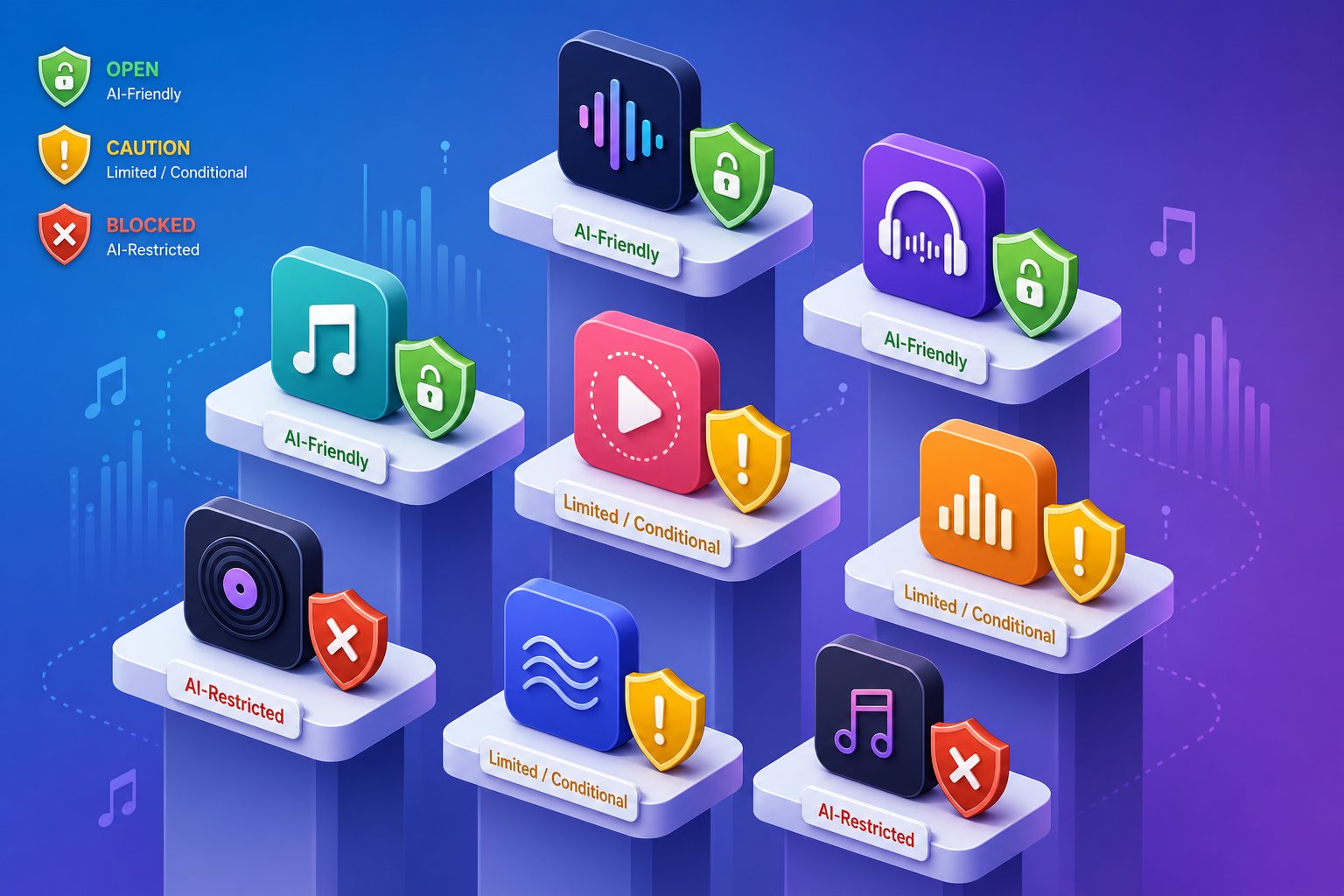
The spectrum runs from outright prohibition to open-armed acceptance. On one end, you have Bandcamp saying no to AI-generated content entirely. On the other, platforms like SoundCloud operate with almost no AI-specific restrictions. Most services land somewhere in between, requiring disclosure without banning the content itself.
Here's how the major players stack up:
| Platform | AI Music Policy | Labeling / Disclosure | Monetization | Enforcement Approach |
|---|---|---|---|---|
| Bandcamp | Banned — no music generated wholly or substantially by AI | Not applicable (content not allowed) | Not applicable | Community reporting, manual review, removal on suspicion |
| Spotify | Allowed with disclosure; bans unauthorized AI voice clones | Required via distributor metadata using DDEX standard | Same per-stream rates as human music | Spam filter for mass-produced content; takedowns for voice cloning |
| Apple Music | Allowed; transparency-focused approach | New metadata tags required from labels/distributors to disclose AI use | Standard royalty rates | Relies on distributor compliance; no public automated detection |
| YouTube Music | Allowed with conditions; raw AI audio with minimal human input treated as low-value | Disclosure of AI use required; "transformative human input" expected | Non-transformative AI content may be demonetized or removed | Content ID system; manual review for flagged content |
| SoundCloud | No specific ban; most permissive major platform | No formal AI disclosure requirement | Standard monetization through SoundCloud Premier | Standard content policies; commits to not training AI on user uploads without consent |
| Amazon Music | No detailed public policy; focuses on "catalog integrity" | No explicit disclosure requirement | Standard rates; integrated Suno into Alexa Plus | Quiet takedowns for IP-flagged content; partners with labels against voice cloning |
| Deezer | Allowed but tagged and deprioritized | Proprietary AI detection tool auto-labels AI tracks | AI tracks excluded from algorithmic and editorial recommendations; fraudulent streams filtered from royalties | Automated detection and tagging at scale |
| DistroKid | Accepts AI music for distribution to all platforms | Disclosure required during upload process | Standard pricing; unlimited uploads | Relies on downstream platform enforcement |
Notice the pattern. Most platforms aren't asking whether AI music should exist. They're asking how it should be labeled, tracked, and surfaced. Bandcamp is the outlier that rejects the premise entirely.
Labeling Requirements Versus Outright Bans
The fundamental philosophical split in the industry comes down to two camps: transparency versus prohibition.
Spotify, Apple Music, and YouTube Music represent the transparency camp. Their logic is pragmatic — AI music is coming regardless, so the priority is ensuring listeners and rights holders know what they're hearing. Apple's new metadata tags require labels and distributors to flag AI involvement in everything from the music itself to cover art. Spotify adopted the DDEX standard so AI-assisted tracks carry proper credits in their backend systems. YouTube demands "transformative human input" and penalizes content that doesn't meet that bar through demonetization rather than removal.
The Bandcamp AI music ban sits in the prohibition camp, alongside Deezer's more nuanced approach. Deezer doesn't ban AI content outright, but its proprietary detection tool identifies and tags fully AI-generated songs, then excludes them from recommendations and filters their streams out of royalty calculations. The effect is similar to a ban — AI tracks exist on the platform but can't earn money or gain visibility through editorial or algorithmic channels.
For artists, the practical difference is significant. On Spotify, you can release AI-assisted music, disclose it properly through your distributor, and earn the same per-stream rate as any other track. On Bandcamp, that same track might get you banned if the AI contribution crosses the "substantial part" threshold. On Deezer, it might live on the platform but never reach a single listener through recommendations.
SoundCloud occupies its own category entirely. With no AI-specific disclosure requirement and direct uploads that bypass distributor gatekeeping, it has become what some in the community call "the AI music haven." The platform's commitment is focused on protecting existing creators from having their uploads used as AI training data, not on restricting what new content gets uploaded.
Amazon Music presents perhaps the most contradictory position. The company hasn't published a detailed AI policy and has quietly taken down content that raises IP concerns. Yet it simultaneously integrated Suno directly into Alexa Plus, letting users generate songs on demand through the same ecosystem. That tension between hosting AI generation tools and maintaining catalog integrity remains unresolved.
What does all this mean for working musicians? If you're distributing across multiple platforms, your compliance obligations vary dramatically depending on where your music lands. A track that's perfectly acceptable on Spotify with proper disclosure could violate Bandcamp's policy entirely. And a track that Deezer's detection system flags as AI-generated might sail through SoundCloud without a second glance.
The landscape is fragmented, the definitions are inconsistent, and the enforcement mechanisms range from sophisticated automated detection to "we'll look into it if someone reports you." For artists navigating this patchwork, the safest strategy is understanding not just what each platform prohibits, but what each platform values — and aligning your distribution choices accordingly.
That cross-platform awareness matters most for the people actually making music every day. The policy differences aren't just academic — they shape real decisions about workflow, disclosure, and where to invest your creative energy.
What Working Musicians Need to Know and Do
Policy details and platform comparisons are useful context, but they don't answer the question most artists are actually asking: what do I need to change about how I work? Whether you're a solo bedroom producer running everything through plugins, an electronic musician whose entire genre lives in the gray zone, or a band that occasionally uses AI tools for pre-production sketches, the Bandcamp AI-generated music policy 2025 and 2026 shifts demand a practical response.
The good news: if you're a human making music with intention, you're almost certainly fine. The work is in proving it.
How to Audit Your Music Production Workflow
Think of this as a creative supply chain check. You need to trace every element of your track back to a human decision. Not every tool needs to be analog or AI-free — you just need to confirm that AI served you, not the other way around.
Here's a step-by-step checklist to audit your process before uploading to Bandcamp:
- List every AI-powered tool in your signal chain. This includes mastering services like LANDR, smart EQ plugins, AI-assisted stem separators, chord suggestion tools, and any generative features inside your DAW. Don't forget less obvious ones — some sample libraries now use AI to generate variations.
- Classify each tool's role. For every AI tool on your list, ask: did it make creative decisions, or did it execute technical tasks under my direction? A smart EQ adjusting frequency balance is technical. An AI generating a four-bar melody you kept unchanged is creative.
- Identify any generative content in your final mix. Did any AI tool produce audio, MIDI, lyrics, or arrangements that ended up in the released version without substantial human reworking? If yes, that element is a potential compliance risk.
- Assess the proportion. Bandcamp's threshold is "wholly or in substantial part." If AI-generated elements make up a backing pad in one section of a ten-track album, that's different from AI generating the entire harmonic and melodic foundation of every song. Proportion matters.
- Document your human contributions. Save DAW session files, version history, scratch recordings, handwritten notes, and demo takes. These create a paper trail showing iterative human decision-making throughout the production process.
- Store your original prompts and generation logs. If you used any generative tool during production — even as a brainstorming aid you later discarded — keep records of what was generated and what you actually used. As industry safety checklists recommend, storing original prompts acts as creative evidence in disputes.
- Run a final honest assessment. Could a reasonable person listen to your track, review your session files, and conclude that a human made the substantive creative choices? If the answer is yes, upload with confidence.
This process takes maybe thirty minutes per release. It's not burdensome, but it does require intentionality — especially for producers who've integrated AI tools so deeply into their workflow that the boundaries have blurred.
What Independent Artists Should Do Right Now
Different types of creators face different risks under this policy. Here's how it breaks down:
Solo bedroom producers who use AI plugins for mixing and mastering have the least to worry about. Your creative process — writing, performing, arranging — is human. The AI tools you rely on are production utilities, not content generators. Keep working as you are, but maintain session files as a precaution.
Electronic musicians and ambient artists face the most ambiguity. Generative synthesis, algorithmic composition, and procedural techniques have been part of electronic music for decades. If your workflow involves Max/MSP patches, modular synth randomization, or generative sequencing, you're not using "AI" in the way Bandcamp means it — but your output might sound indistinguishable from AI-generated content to a reviewer unfamiliar with your genre. Document your process thoroughly. A short video of your live patching session or a screenshot of your modular setup carries more weight than any written explanation.
Bands and singer-songwriters who occasionally use AI for inspiration — generating chord progressions to break writer's block, using AI to sketch arrangement ideas they then re-record live — are generally safe as long as the final recording reflects human performance and creative judgment. The seed doesn't matter as much as the harvest.
Artists concerned about false flags should take proactive steps. Since Bandcamp announced a ban on all AI-generated music uploads with enforcement based on suspicion and community reporting, anyone can be targeted. Human-made verification strategies are becoming essential — not because you've done anything wrong, but because the burden of proof can shift to you unexpectedly. Consider these protective measures:
- Maintain a public creative presence — social media posts showing works-in-progress, studio sessions, or live performances establish a pattern of human artistry.
- Keep metadata intact when exporting. Don't strip ID3 tags or session information that could help verify your production software and workflow.
- If you release prolifically, space out your uploads. An account dropping dozens of albums in rapid succession triggers the same behavioral red flags as actual AI spam, even if every note is hand-played.
- Engage with the Bandcamp community. Artists with fan relationships, comments, and purchase histories look fundamentally different from anonymous accounts uploading content with no engagement.
How the Ban Affects Discoverability for Human Musicians
For artists who welcome the policy, the practical benefit is straightforward: less noise in the catalog means more signal for your work.
Before the ban, Bandcamp's genre pages and search results were increasingly polluted with AI-generated content. Some creators were uploading hundreds of albums generated through text prompts, flooding niche tags and making it harder for fans to find genuine artists. The Bandcamp policy on AI-generated music 2026 directly addresses this by removing that content from the ecosystem entirely.
The discoverability improvement works on multiple levels. Fewer total releases in any given genre means each human-made album occupies a larger share of browsing real estate. Fans who previously abandoned genre exploration because of quality dilution may return. And Bandcamp's editorial team — which curates the Bandcamp Daily blog and featured collections — can focus entirely on human artists without needing to vet every recommendation for AI involvement.
There's also a trust dividend. When fans know that everything on Bandcamp is human-made, the platform becomes a quality signal in itself. Buying music on Bandcamp carries an implicit guarantee that a person created it — and for a growing segment of listeners who actively seek authentic human expression, that guarantee has real value.
The flip side is that enforcement imperfections create friction. If legitimate artists get caught in false positives, or if the community reporting system gets weaponized against competitors, the trust benefit erodes. The policy's long-term success depends on Bandcamp refining its review process to protect the artists it's designed to serve.
All of this applies specifically to selling and distributing music on Bandcamp. But many creators don't need to sell AI-generated music — they need AI music for their own projects. Video editors, podcasters, game developers, and social media creators have entirely different needs, and the ban doesn't affect their options nearly as much as it might seem.
Where Creators Can Still Use AI-Generated Music Legally
Here's a distinction that gets lost in the headlines: Bandcamp announced a ban on all AI-generated music uploads to its marketplace. It didn't ban the use of AI music everywhere. The policy targets sellers — people uploading AI-generated tracks to sell or stream on Bandcamp's platform. If you're a video producer who needs background music for a YouTube documentary, a podcaster looking for an intro theme, or a game developer building a soundtrack, Bandcamp's policy has zero bearing on your workflow.
The confusion is understandable. When people search whether Bandcamp banned AI music, they often conflate two very different use cases: distributing AI music as a product versus using AI music as a production tool. One is prohibited on Bandcamp. The other remains entirely legal and widely practiced across the creative industry.
So where does that leave content creators who genuinely need affordable, royalty-free music for commercial projects?
Options for Creators Who Need AI Music for Projects
You're editing a travel vlog at midnight. The deadline is tomorrow. You need a two-minute ambient track that fits the mood, won't trigger a copyright claim, and costs nothing. You're not trying to sell that track on any platform — you just need it in your video. This scenario plays out millions of times daily for creators across every medium.
The reality is that AI-generated music videos on Bandcamp were never the primary use case for most content creators anyway. They weren't buying AI tracks from Bandcamp sellers — they were generating their own production music or sourcing it from royalty-free libraries. Those options remain fully available:
- MakeBestMusic's Free Music Generator — A free AI music tool designed specifically for content creators who need royalty-free tracks for videos, podcasts, social media, and games. You generate music for your own commercial projects without licensing fees or attribution requirements, making it practical for creators on tight budgets who need quick turnaround.
- Soundraw — A subscription-based AI music platform popular with YouTubers and podcasters. Offers genre, mood, and tempo customization with full commercial licensing for generated tracks.
- AIVA — Specializes in orchestral and cinematic compositions. Offers both free and paid tiers, with commercial licensing available on subscription plans. Particularly useful for film and game scoring.
- Mubert — Generates adaptive, royalty-free music in real time. Its API integration makes it especially useful for app developers and live streamers who need dynamic soundscapes.
- Artlist.io — A curated library of human-composed royalty-free music with a simple universal license. Not AI-generated, but worth mentioning for creators who prefer human-made tracks with clear legal standing.
- Ecrett Music — Scene-based AI generation tailored for video creators. Select your content type — vlog, commercial, documentary — and the tool produces matching background music.
Each of these serves a different niche. Some creators want full control over generation parameters. Others just need something that sounds good and won't cause legal headaches. The key point: none of these tools require you to upload or sell anything on a music marketplace. You generate, you use, you move on.
Using AI Music Generators for Content Production
The legal landscape around AI music is complex when you're distributing it as a product. But when you're using it as a production element in your own content, the picture is considerably simpler. As the copyright analysis from Silverman Sound Studios explains, the primary legal risks around AI music center on ownership claims and copyright registration — issues that matter when you're selling music, not when you're scoring your own podcast episode.
That said, creators should still exercise basic due diligence:
- Check the licensing terms. Free doesn't always mean unrestricted. Some AI generators grant commercial use rights only on paid plans. Others restrict usage to specific platforms or content types. Read the terms before publishing.
- Understand what "royalty-free" actually means. It means you pay once (or nothing) and use the music without ongoing royalty payments. It doesn't necessarily mean you own the copyright to the generated track. For production use, this distinction rarely matters — but it's worth knowing.
- Avoid prompts that reference specific artists. Generating "a track that sounds like Drake" or "in the style of Taylor Swift" introduces infringement risk regardless of how you use the output. Keep prompts genre-based and mood-based rather than artist-based.
- Consider platform-specific rules. YouTube's policies on AI-generated audio content are evolving. Disclosing AI involvement in your video description is increasingly expected, even if the music is just background scoring.
For most content creators, AI music generators fill a practical gap that human-composed libraries can't always cover — particularly when budgets are tight, deadlines are immediate, and the music serves a supporting role rather than being the product itself. The distinction between ai-generated music videos on Bandcamp (prohibited for sellers) and AI-generated music in your videos (perfectly legal for creators) is the line that matters most.
Bandcamp's ban protects human musicians from being undercut by synthetic content in their own marketplace. It doesn't prevent you from using AI tools to score your content, build your brand, or enhance your creative projects. Those are two fundamentally different activities, and the sooner the conversation acknowledges that separation, the clearer the path forward becomes for everyone involved.
