

Why French Songs Captivate Listeners Worldwide
You don't need to speak a word of French to feel something when Edith Piaf's voice fills a room. That catch in her throat, the way a phrase curls upward and then drops — it bypasses translation entirely and lands somewhere in your chest. That emotional immediacy is exactly why French songs have held global audiences for decades, and why over 123 million listeners worldwide streamed French-language audio content on Spotify in 2024 alone.
"No, absolutely nothing. No, I regret nothing. Neither the good done to me, nor the bad — it's all the same to me." — Edith Piaf, Non, je ne regrette rien
This guide goes far beyond a simple top-10 playlist. From Piaf's chanson realiste to Aya Nakamura's Afro-pop fusion and the rap artists dominating French streaming charts right now, you'll find a genre-spanning, era-crossing map of one of the richest musical traditions on the planet.
What Makes French Songs So Universally Appealing
Part of the answer lives in the language itself. French phonetics are uniquely musical — its nasal vowels, smooth liaisons between words, and rhythmic cadence create a natural melodic flow that few other languages match. Research into French vocal technique highlights how features like nasalization add emotional depth and tonal color to sung performances, giving singers an expressive palette that ranges from intimate whisper to dramatic cry. These qualities make French equally at home in a slow chanson ballad, a pulsing electronic track, or a rapid-fire rap verse.
Who This Guide Is For
Whether you're a music lover hungry for sounds outside the English-language bubble, a language learner looking for immersive listening material, or a cultural enthusiast who wants the historical context behind the melodies, this article is built for you. Each section ahead covers a distinct genre or era — classic chanson, ye-ye pop, electronic pioneers, modern rap, and francophone music from Belgium to West Africa — so you can jump straight to whatever sparks your curiosity, or read front to back for the full story of how French songs evolved into the global force they are today.
How French Music Evolved Across the Decades
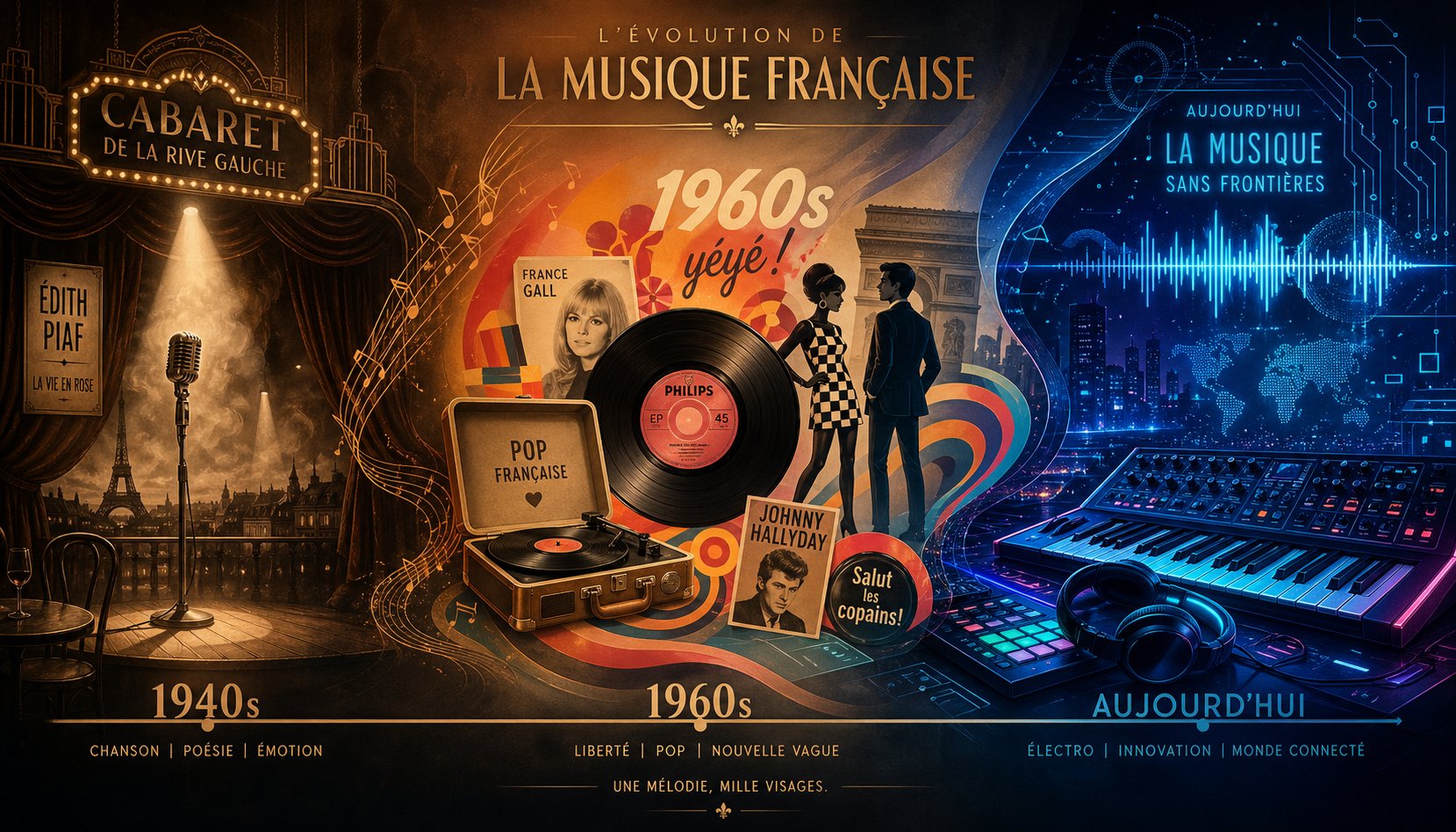
Every great musical tradition carries the fingerprints of the society that shaped it. French music is no exception — its shifts in sound, style, and attitude map almost perfectly onto the country's political upheavals, cultural revolutions, and generational identity crises. Understanding that timeline turns a scattered playlist into a coherent story.
Chanson Realiste and the Cafe Culture Era
Imagine Paris in the 1930s and 1940s: smoky cabarets, cramped music halls, street corners where a young singer could earn a few francs and a reputation. This was the world that produced Edith Piaf, Charles Trenet, and the tradition known as chanson realiste — songs rooted in the raw, unvarnished realities of working-class life. Piaf, born into poverty in 1915, rose to fame through the cabarets of Paris, her voice carrying the weight of love, loss, and wartime grief. Trenet, by contrast, brought a sunnier lyricism that earned him the nickname "the Singing Fool." Together, they established chanson as something more than entertainment — it was literary, confessional, and deeply tied to French identity. The golden age of chanson also gave rise to figures like Jacques Brel, Georges Brassens, and Leo Ferre, artists whose socially conscious lyrics and theatrical performances elevated the genre into a serious art form.
Ye-Ye, Nouvelle Chanson, and the Cultural Revolution
The 1960s hit France like an electric shock. American rock and roll crossed the Atlantic, and a generation of young French artists absorbed it, remixed it, and made it their own. The result was the ye-ye movement — named after the "yeah, yeah, yeah" refrain in the Beatles' "She Loves You" — a wave of upbeat, youth-driven pop primarily performed by women. Francoise Hardy wrote her own material and captivated listeners with introspective folk-pop, while France Gall rocketed to fame at just 17 when "Poupee de cire, poupee de son" won the Eurovision contest in 1965. Sylvie Vartan and Brigitte Bardot added glamour and cultural cachet to the scene.
Lurking behind the bubbly pop, though, was Serge Gainsbourg — a provocateur and genre-bender who wrote songs for nearly every major female artist of the era before becoming a star in his own right. His work pushed boundaries in ways that still feel daring. Then came May 1968. Student riots and a general strike shook France to its foundations, and the cultural fallout reshaped artistic expression across the board. Ye-ye's carefree optimism gave way to more politically charged, experimental songwriting — a shift you can hear in the darker, more complex music that followed. Much like how to make coffee requires the right balance of heat, timing, and grind, the best French music of this era found its power in the precise blend of rebellion and craft.
French Touch, Hip-Hop, and the Global Stage
Fast-forward to the 1990s, and France reinvented itself on the global music map once again. The "French Touch" electronic movement — led by Daft Punk, Air, and later Justice — fused house music with funk, disco, and cinematic textures. Daft Punk's albums Homework and Discovery became dance music landmarks, and their robot-helmeted mystique turned them into worldwide icons.
At the same time, hip-hop was taking root in the banlieues — the suburban housing projects ringing major French cities — where artists like MC Solaar, IAM, and NTM channeled the frustrations of immigrant communities into sharp, poetic rap. That underground energy has since exploded into the mainstream. Rap is now the top-selling genre in France, with artists like PNL, Nekfeu, and Jul regularly outperforming international acts on streaming platforms. Meanwhile, Stromae (Belgian, but singing in French) and Angele have proven that French-language pop can rack up hundreds of millions of streams globally. You don't need to set a 5 minute timer to grasp how fast this scene moves — a new wave of talent seems to emerge every few months.
The table below puts this entire arc into perspective:
| Era | Key Artists | Defining Genre | Cultural Context |
|---|---|---|---|
| 1930s-1950s | Edith Piaf, Charles Trenet, Georges Brassens | Chanson realiste | Wartime France, Parisian cafe and cabaret culture |
| 1960s | Francoise Hardy, France Gall, Serge Gainsbourg | Ye-ye pop, nouvelle chanson | Youth culture boom, American rock influence, May 1968 protests |
| 1970s-1980s | Jacques Brel, Leo Ferre, MC Solaar | Chanson, early French rap | Post-1968 artistic experimentation, immigration and banlieue identity |
| 1990s-2000s | Daft Punk, Air, IAM, NTM | French Touch electronic, hip-hop | Global dance culture, suburban social tensions |
| 2010s-present | Stromae, Angele, PNL, Aya Nakamura | Electro-pop, rap, Afro-pop fusion | Streaming era, global francophone identity, genre-blending |
The throughline here is constant reinvention. Each generation of French artists absorbed outside influences, filtered them through a distinctly French sensibility, and produced something the world hadn't heard before. This is not a museum tradition frozen in amber — it's a living, evolving musical culture where the past informs the present without constraining it. And the artists who defined each era? Their individual stories and signature tracks deserve a closer look.
Timeless Chanson Classics Everyone Should Know
The chanson tradition is where most English-speaking listeners first encounter French music — and for good reason. These aren't just old songs preserved out of nostalgia. They're performances so emotionally precise that they still stop people mid-scroll decades after they were recorded. To really appreciate them, though, you need more than a track name. You need the story behind the voice.
Edith Piaf and the Soul of Chanson Realiste
Piaf didn't just sing about heartbreak — she lived it in public. Born into poverty in 1915, abandoned by her mother, raised partly in her grandmother's brothel, and discovered singing on the streets of Belleville, she carried every ounce of that hardship into her performances. Academic research on French music biopics describes her as a figure whose extraordinary talent was inseparable from her suffering — a "tragic popular diva" whose pain became the raw material of her art.
"La Vie en Rose," written in 1945, is the song that made her an international icon. It paints love as a transformative force — roses, laughter, a world recolored by someone's presence. The song became so iconic that even Marlene Dietrich adopted it as part of her own repertoire. Then there's "Non, je ne regrette rien," released in 1960 when Piaf's health was already failing. It's a declaration of total emotional freedom — no apologies, no looking back. The fact that she recorded it while battling addiction and illness gives every note an almost unbearable weight. These two tracks alone explain why Piaf remains the first name most people associate with French songs, even generations later.
Jacques Brel, Serge Gainsbourg, and the Songwriter-Poets
If Piaf was chanson's emotional core, Brel and Gainsbourg were its intellectual and theatrical edges. Jacques Brel — Belgian by birth, a detail worth remembering when we explore the wider francophone world later — brought a theatrical intensity to the stage that few performers have matched in any language. Songs like "Ne me quitte pas" and "Amsterdam" aren't just sung; they're inhabited. Brel would sweat through his suits, his face contorted with feeling, turning every performance into something closer to a one-act play than a concert number.
Serge Gainsbourg operated in a completely different register. Where Brel was raw sincerity, Gainsbourg was provocation, wit, and genre-blending brilliance. Scholars have noted that Gainsbourg combined the aesthetics of chanson poetique with Anglo-American influences in a synthesis that was entirely his own — visionary, transgressive, and endlessly inventive. "Je t'aime... moi non plus" scandalized Europe upon release, while "La Javanaise" showed his capacity for delicate, almost painterly lyricism. Imagine trying to learn how to paint a room with only words and melody — that's essentially what Gainsbourg did with the French language, layering double meanings, literary references, and musical textures until every song felt like a world unto itself. Both artists elevated French songwriting from popular entertainment into a literary art form, earning comparisons to Baudelaire and Apollinaire.
Charles Aznavour and the Romantic Tradition
Charles Aznavour occupied yet another lane — the international ambassador. Over a career spanning more than seven decades, he wrote more than 1,200 songs and performed in multiple languages, carrying French chanson to audiences from New York to Tokyo. His voice — marked by a distinctive rasp caused by a paralyzed vocal cord — gave even his most polished ballads an undercurrent of vulnerability.
What set Aznavour apart was his willingness to tackle subjects other chanson artists avoided. "Comme ils disent" ("What Makes a Man") painted a tender portrait of a gay man's loneliness in the 1970s, written because he "could see things were different" for his gay friends. "La Boheme" became his signature — a wistful ode to the starving artists of Montmartre that he performed at nearly every concert, miming a painter dabbing at an invisible canvas. In a dandys world of carefully curated artistic personas, Aznavour stood out by being disarmingly direct. His influence on global pop balladry — from the storytelling detail of his lyrics to his willingness to blend languages — is hard to overstate.
Ready to start exploring? Here's a curated listening guide to essential chanson tracks, each one a doorway into a different corner of this tradition:
- "La Vie en Rose" — Edith Piaf (1947): The definitive French love song, transforming romantic devotion into something almost spiritual.
- "Non, je ne regrette rien" — Edith Piaf (1960): A fearless declaration of emotional independence, recorded as Piaf's own life was unraveling.
- "Ne me quitte pas" — Jacques Brel (1959): A desperate, theatrical plea against abandonment that remains one of the most covered songs in any language.
- "Amsterdam" — Jacques Brel (1964): A building, breathless portrait of sailors on shore leave — pure storytelling intensity.
- "La Javanaise" — Serge Gainsbourg (1963): Elegant wordplay wrapped in a gentle waltz, showcasing Gainsbourg's poetic side.
- "Je t'aime... moi non plus" — Serge Gainsbourg & Jane Birkin (1969): The song that shocked a continent and redefined what pop music could express.
- "La Boheme" — Charles Aznavour (1965): A nostalgic masterpiece about lost youth and the vanished artist's life of Montmartre.
- "Hier Encore" — Charles Aznavour (1964): A devastating meditation on wasted time, covered by artists from Bing Crosby to Shirley Bassey.
- "Les Feuilles Mortes" — Yves Montand (1946): Known in English as "Autumn Leaves," a chanson so beautiful it became a jazz standard worldwide.
These tracks represent chanson at its most powerful — but they're also just one chapter in a much larger story. The generation that followed took the emotional honesty of Piaf and the genre-bending ambition of Gainsbourg and pointed it in an entirely new direction: toward youth culture, pop hooks, and the dance floor.
French Pop, Ye-Ye, and Electronic Pioneers
Youth culture, pop hooks, and the dance floor — that's exactly where French music headed in the 1960s. While chanson artists were filling concert halls with poetic intensity, a parallel explosion of color, energy, and teenage rebellion was reshaping the country's musical identity from the ground up. And the ripple effects of that explosion are still shaping the French songs you hear on streaming platforms today.
The Ye-Ye Movement and France Gall's Legacy
Picture France in the early 1960s. The Beatles are dominating airwaves across the English Channel, and a generation of young French artists is absorbing every note. Their response? The ye-ye movement — a burst of vibrant pop that ran from roughly 1962 to 1968, combining French chanson sensibilities with British and American rock energy. The name itself came from the "yeah, yeah, yeah" refrain in "She Loves You," and the music carried that same infectious optimism.
France Gall became the movement's breakout star. Born Isabelle Gall in 1947, she was already charting hits like "Sacre Charlemagne" as a teenager before her song "Poupee de cire, poupee de son" won the Eurovision contest in 1965 — she was just 17. Her girlish, pop-oriented style stood in sharp contrast to the brooding maturity of Francoise Hardy, who wrote much of her own material and attracted admirers as varied as Bob Dylan, who printed a poem about her on the back of his 1964 album Another Side of Bob Dylan. Sylvie Vartan added rock-inflected glamour to the scene, while actresses like Brigitte Bardot and Anna Karina recorded hit singles that blurred the line between cinema and pop music.
What made ye-ye culturally significant went beyond catchy melodies. The movement served as a touchstone for a growing feminist consciousness in France — women dominated the genre as performers at a time when their employment opportunities were otherwise limited. Some tracks, like Pussy Cat's "Les temps ont change," contained openly feminist lyrics that were politically explosive for the era. The ye-ye spirit didn't vanish after the student riots of 1968 tamped down its initial energy, either. Directors like Wes Anderson and Quentin Tarantino have featured ye-ye tracks in their films, introducing the sound to entirely new audiences decades later.
French Pop in the Modern Era
The line connecting ye-ye's genre-blending ambition to contemporary French pop is shorter than you might think. Today's artists carry that same instinct for fusing influences — they've just expanded the palette dramatically.
Christine and the Queens is the clearest example. The Centre Pompidou describes the artist as someone who "disrupts convention with rare intensity," and that's not an overstatement. The bilingual debut album Chaleur humaine (2014) became an international phenomenon, selling over a million copies by blending electro-pop with deeply personal performance art. Each subsequent record has pushed further into raw, volatile emotional territory — a creative evolution that mirrors the restless spirit of Gainsbourg more than any ye-ye predecessor.
Angele, a Belgian artist often mistakenly assumed to be French, has carved out her own lane with feminist pop anthems that tackle everything from body image to toxic masculinity — all wrapped in irresistibly catchy production. Indila, meanwhile, brings a cinematic quality to French pop that draws on Middle Eastern and Indian musical textures, creating songs like "Derniere Danse" that feel like miniature film scores. What unites these artists is a willingness to sing in both French and English, expanding their global reach without abandoning the linguistic identity that makes their music distinctive. Much like assembling the right components when you learn how to build a pc, modern French pop is about selecting diverse influences and fitting them together into something that works seamlessly.
French Electronic Music and the French Touch
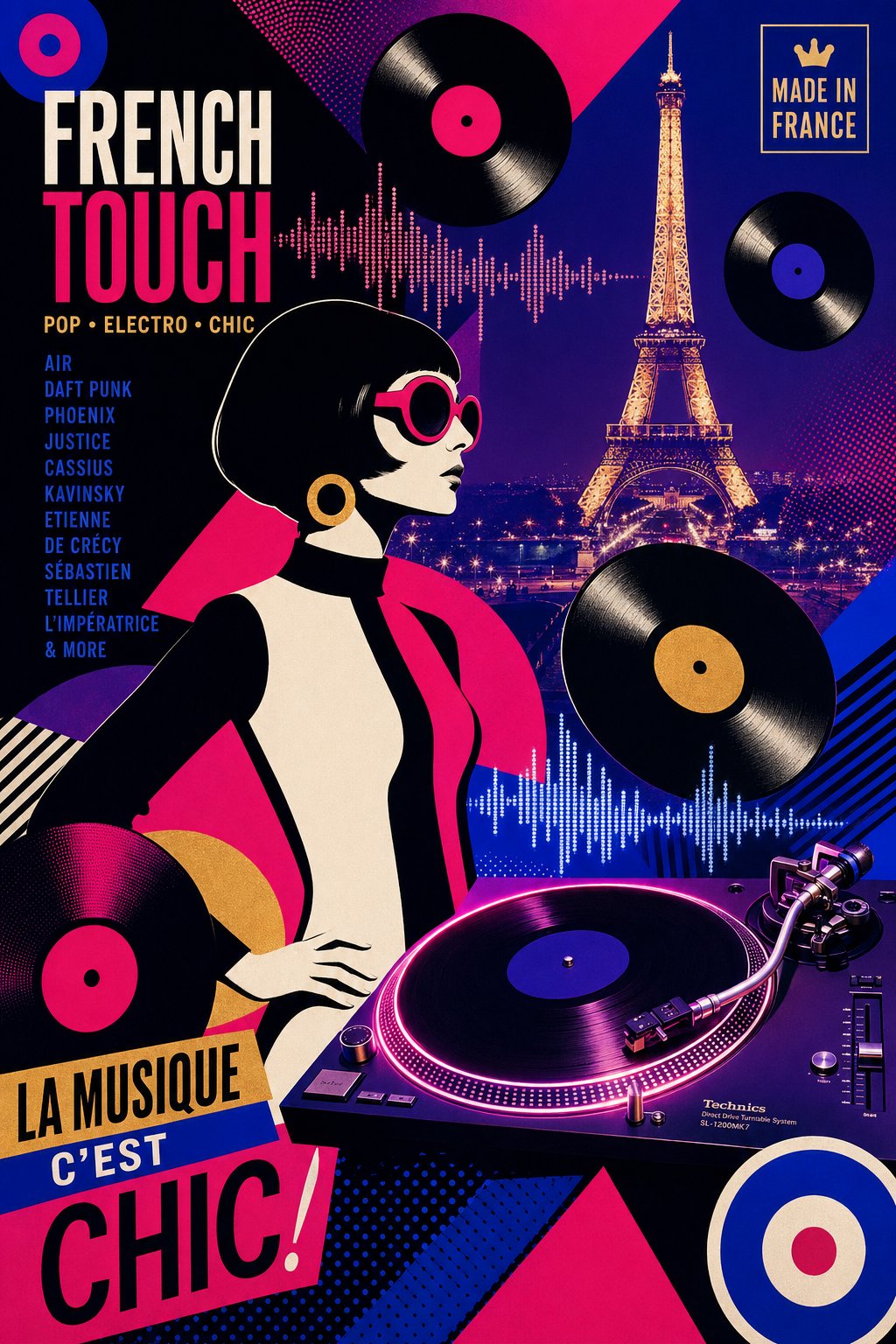
If ye-ye was France's answer to Beatlemania, the French Touch was its answer to Chicago house and Detroit techno — and arguably an even bigger global export. In the mid-to-late 1990s, a wave of Parisian producers fused house music with funk, disco, and cinematic textures, creating a sound so distinctive it earned its own label.
Daft Punk led the charge. Homework (1997) and Discovery (2001) weren't just dance albums — they were cultural events that redefined what electronic music could be. Air's Moon Safari (1998) offered a dreamier, more atmospheric counterpoint, while Justice brought a heavier, distorted edge in the mid-2000s. The movement's cultural impact was so profound that UNESCO inscribed French electronic music on its Intangible Cultural Heritage list, recognizing the French Touch as a living tradition shaped by artists including Daft Punk, Bob Sinclar, Air, Cassius, Modjo, Justice, and Stardust. President Emmanuel Macron endorsed the recognition, stating that France could legitimately claim to have invented electro.
That electronic DNA hasn't stayed confined to club music. You'll hear it in the production choices of nearly every contemporary French pop artist — the synth textures in Angele's tracks, the beat programming in Christine and the Queens' work, the atmospheric layering in Indila's arrangements. The French Touch didn't just put France on the global dance music map; it rewired how French pop sounds at a fundamental level. It's the kind of influence that works quietly in the background, like a good night routine — you might not always notice it, but it shapes everything that follows.
Ready to dive in? Here are the most influential French pop and electronic tracks, ranked as a starting playlist for new listeners:
- "Around the World" — Daft Punk (1997): A hypnotic, endlessly looping masterpiece that defined the French Touch sound and became a global dancefloor staple.
- "Tous les garcons et les filles" — Francoise Hardy (1962): The ye-ye anthem that launched Hardy's career — wistful, intimate, and still deeply affecting.
- "Poupee de cire, poupee de son" — France Gall (1965): The Eurovision winner that captured ye-ye's playful energy and made Gall an international name at 17.
- "Tilted" — Christine and the Queens (2014): The bilingual breakout single from Chaleur humaine that introduced a new kind of French pop to the world.
- "Sexy Boy" — Air (1998): Dreamy, cinematic French electronica that proved dance music could also be deeply atmospheric.
- "Derniere Danse" — Indila (2013): A cinematic pop ballad with Middle Eastern inflections that has amassed billions of views across platforms.
- "D.A.N.C.E." — Justice (2007): Crunchy, maximalist electro that carried the French Touch torch into a new decade.
- "Balance ton quoi" — Angele (2019): A feminist pop anthem wrapped in a deceptively breezy melody — sharp lyrics, massive streaming numbers.
- "Digital Love" — Daft Punk (2001): A love song filtered through vocoder and guitar riffs, blending pop emotion with electronic production in a way nobody had done before.
- "La femme d'argent" — Air (1998): A seven-minute downtempo journey that opens Moon Safari and remains one of the most beautiful electronic compositions ever recorded.
From ye-ye's teenage rebellion to the French Touch's dancefloor revolution, these genres share a common thread: they took outside influences and filtered them through a distinctly French creative lens. But there's one genre that has done this more aggressively — and more successfully — than any other in recent years. Rap now dominates the French charts in a way that no previous genre has managed, and its story starts in the concrete housing blocks of the banlieues.
French Rap and Hip-Hop Dominating Modern Charts
The concrete housing blocks of the banlieues didn't just produce a new genre — they produced the sound that defines contemporary France. If your image of French music still starts and ends with accordion melodies and chanson ballads, the streaming data tells a radically different story. Rap isn't just popular in France. It's dominant.
Why Rap Dominates the French Music Charts
Here's a number that reframes everything: 61.9% of France's Spotify Top 200 features French artists, and the overwhelming majority of those artists are rappers. Look at the top 20 most-streamed acts in France during 2024-2025 and you'll find names like Werenoi (4.1% chart share), Ninho (3.1%), Tiakola (2.0%), and KeBlack (1.8%) — all hip-hop. Of the international artists who crack that top 20, only Billie Eilish and Bruno Mars represent non-rap genres. France is, by most measures, the second largest hip-hop market in the world after the United States.
This didn't happen overnight. Hip-hop took root in France in the late 1980s and early 1990s, when pioneers like MC Solaar, IAM, and Supreme NTM adapted the genre to French language and culture. MC Solaar brought poetic wordplay and jazz-inflected production. IAM, based in Marseille, mixed Mediterranean and Middle Eastern influences into their beats. NTM channeled raw political anger from the banlieues — the suburban housing projects where immigrant communities faced systemic discrimination. As NTM's JoeyStarr once put it, their rap was "a cry of rage against the system." A crucial accelerant was France's 1994 Toubon law, which required radio stations to broadcast at least 40% French-language music during peak hours. Stations like Skyrock pivoted entirely to rap and R&B, giving homegrown hip-hop a visibility pipeline that artists in other European countries never had.
Essential French Rap Artists and Tracks
What separates French rap from its American counterpart isn't just language — it's a distinct sonic and cultural DNA. French rappers don't simply translate Atlanta trap or New York boom bap into French. They incorporate North African rai influences, Caribbean rhythms, Congolese rumba, and uniquely French wordplay including verlan, a backslang that reverses syllables to create an entirely coded vocabulary.
PNL — two brothers of Algerian-Sicilian descent from the Corbell-Essonnes projects — essentially invented their own genre. Their melancholic, Auto-Tune-drenched "cloud rap" drew on rai's long history with pitch alteration, creating something that felt atypically Parisian rather than derivative of American trends. They famously turned down a remix request from Drake, and their album Deux Freres (2019) achieved diamond certification — all without a single media interview or major label deal.
Orelsan brought French rap to a multigenerational audience by blending hip-hop with electronica, pop, humor, and introspection. His album Civilisation (2021) dominated the French charts for two consecutive years, and in 2022 he was named a Chevalier des Arts et des Lettres by the French Ministry of Culture — proof that rap had reached the highest institutional recognition. Nekfeu, a Parisian lyricist with a devoted following, drew 100,000 people to cinemas for a one-off screening of his film-album project Les Etoiles Vagabondes. Jul, based in Marseille, has become one of the most prolific artists in French music history, releasing albums at a pace that keeps him perpetually on the charts.
Then there's Aya Nakamura. Her Afro-pop and rap fusion — built on Malian musical roots, French lyrics, and irresistible hooks — made her the most-streamed French-speaking artist on the planet. If you're wondering how to start a conversation about modern French songs with someone who thinks the genre begins and ends with Piaf, play them "Djadja." It tends to settle the debate quickly.
French Underground Rap and the Next Wave
The mainstream success stories are only the visible layer. Beneath them, a thriving underground scene keeps pushing boundaries with experimental production, multilingual flows that weave French, Arabic, Wolof, and Creole into a single verse, and lyrical ambition that recalls the genre's politically charged origins. Artists like Youssoupha and Kery James maintain a tradition of conscious, socially engaged rap, while newer names blend drill, Jersey club, and electronic textures into something that doesn't fit neatly into any existing category. As Nekfeu has said, "Success should not make us forget where we came from and why we started rap."
The same year Chance the Rapper won a Grammy with his streaming-only mixtape Coloring Book, PNL were breaking French streaming records with their own self-released album — doubling Chance's first-week numbers and moving 800,000 units. That parallel tells you everything about where French rap stands: it's not a regional curiosity. It's a global force operating at scale.
Ready to explore? Here's a curated selection of French rap tracks organized by subgenre to help you find your entry point:
- Conscious Rap: "Lettre a la Republique" — Kery James | "Ecrire" — Nekfeu | "Banlieusards" — Kery James
- Cloud Rap / Melodic: "Au DD" — PNL | "Le Monde ou Rien" — PNL | "DA" — PNL
- Trap / Street Rap: "Tout faire a l'envers" — Ninho | "Bande organisee" — Jul ft. various | "DKR" — Booba
- Afro-Pop Fusion: "Djadja" — Aya Nakamura | "Pookie" — Aya Nakamura | "La Puissance" — MHD
- Pop-Rap / Crossover: "Basique" — Orelsan | "Civilisation" — Orelsan | "Desole" — Sexion d'Assaut
French rap's dominance is reshaping what "French songs" even means in the streaming age. But the story doesn't stop at France's borders. Some of the biggest names on those very charts — Damso, Hamza, GIMS — trace their roots to Belgium, Congo, and beyond. The francophone music world is far wider than a single country, and its most exciting sounds are flowing across borders in every direction.
Francophone Songs from Belgium, Quebec, and Africa
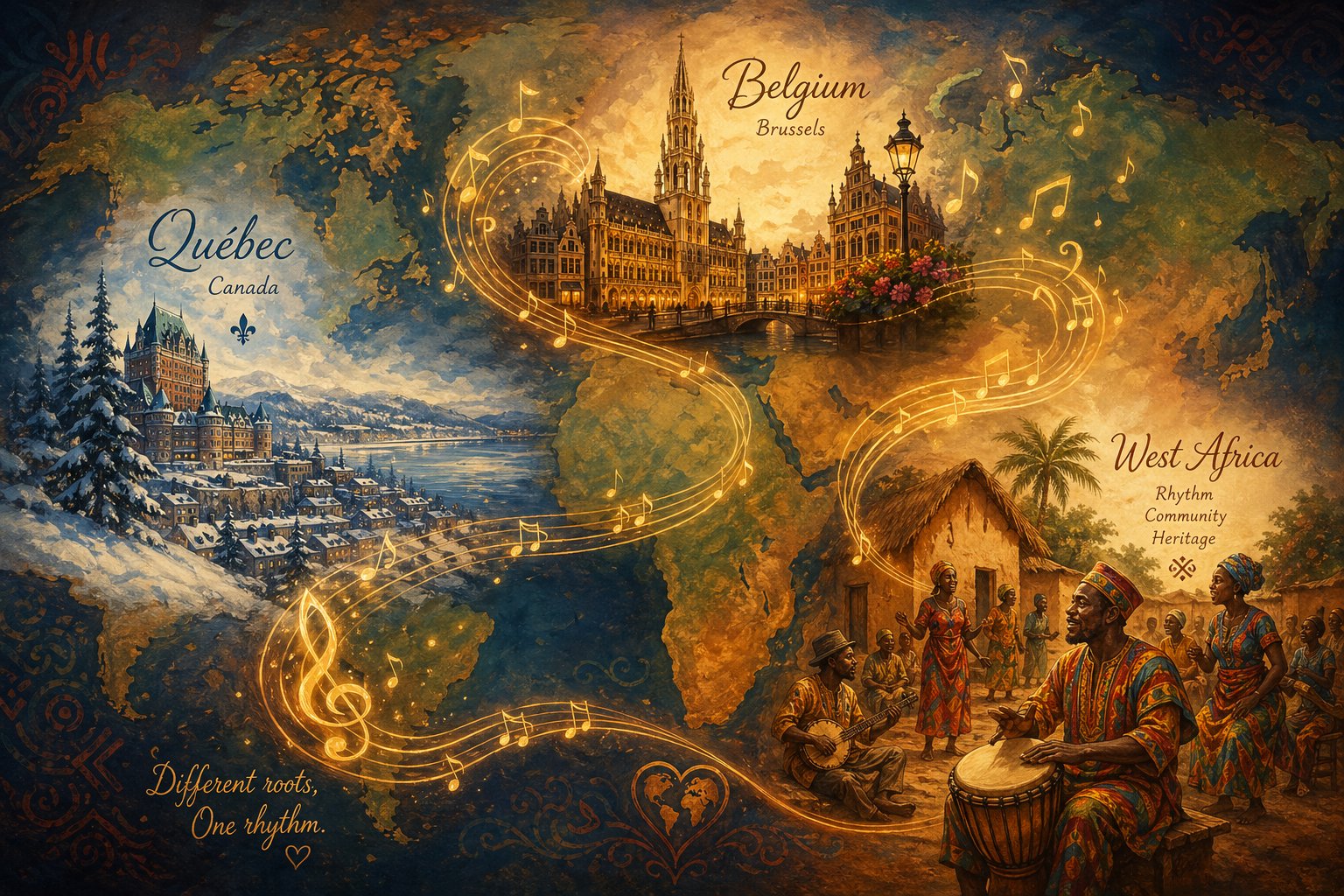
Damso is Congolese-Belgian. GIMS was born in Kinshasa. Stromae's father was Rwandan. The biggest names in French-language music have never respected national borders — and neither should your playlist. Limiting "French songs" to artists from France is like limiting English-language music to artists from England. You'd miss most of the story.
Belgian French-Language Icons
Belgium punches absurdly above its weight. Jacques Brel, discussed earlier among the chanson greats, was born in Schaerbeek, Brussels — a fact that surprises listeners who assume his theatrical intensity was purely Parisian. Decades later, Stromae picked up that torch and rewired it for the streaming age. "Alors on danse" (2009) became a number-one hit across Europe, and "Papaoutai" — a gut-punch meditation on absent fathers — has surpassed a billion YouTube views. His ability to fold electronic production, African rhythms, and deeply personal lyrics into pop structures that cross every demographic line is rare in any language.
Then there's Angele, who earned a primetime Coachella slot and even projected French lyrics on screen during her set as a playful language lesson for the American crowd. She's told interviewers she feels "most at home writing in French" and that she likes to "mix the languages" — a fitting approach for a multilingual pop star whose feminist anthem "Balance ton quoi" resonated far beyond the francophone world. Many listeners still assume she's French. She's not. She's Brussels through and through.
Quebec and the Francophone Americas
Cross the Atlantic and the sound shifts dramatically. Quebecois music blends North American folk, country, and rock traditions with French-language songwriting in ways that feel entirely distinct from anything coming out of Europe. Coeur de pirate — the stage name of Montreal singer-songwriter Beatrice Martin — built an international following with delicate indie pop sung in both French and English, her piano-driven melodies recalling a gentler, more intimate tradition than the electronic-heavy sounds dominating Parisian charts.
Les Cowboys Fringants represent something deeper. Widely considered the most popular and influential Quebec rock band of the 21st century, they sold over 1.3 million albums and won 19 Felix Awards across a career spanning nearly three decades. Their folk-rock sound tackled ecology, Quebec independence, and working-class life with a directness that made frontman Karl Tremblay a national figure — when he passed away in 2023 at age 47, the Quebec government held national funeral ceremonies at Montreal's Centre Bell. Understanding the statistics fundamentals of their impact — six "Best Group" awards, performances before 90,000 fans at the Festival d'ete de Quebec — helps explain why their loss was mourned as a cultural event, not just a music industry headline.
Francophone Africa's Booming Music Scene
The fastest-growing corner of the French-language music world isn't in Europe or North America — it's in Africa. Francophone African artists are reshaping global perceptions of what French songs can sound like, drawing on musical traditions that predate colonialism while singing in a language that connects them to a worldwide audience.
From Cote d'Ivoire, coupe-decale emerged in the early 2000s as a high-energy dance genre built on rapid percussion and call-and-response vocals. Artists like DJ Arafat became regional superstars. In Senegal, Youssou N'Dour had already proven decades earlier that French and Wolof could coexist in globally successful music, and a newer generation continues that multilingual tradition. The Democratic Republic of Congo — home to rumba, soukous, and a musical heritage that influenced genres across the continent — produces artists like Fally Ipupa, whose blend of Congolese rumba and contemporary R&B sung in French racks up hundreds of millions of streams. And the Afrobeats wave sweeping global charts increasingly includes French-language tracks from West and Central African artists, blurring the lines between anglophone and francophone pop in ways that would have been unimaginable a decade ago.
The table below maps this broader francophone music landscape:
| Region | Notable Artists | Signature Genre |
|---|---|---|
| Belgium | Jacques Brel, Stromae, Angele, Damso, Hamza | Chanson, electro-pop, hip-hop |
| Quebec (Canada) | Coeur de pirate, Les Cowboys Fringants, Lisa LeBlanc | Indie pop, folk-rock, neo-traditional |
| Cote d'Ivoire | DJ Arafat, Magic System, Josey | Coupe-decale, zouglou |
| Senegal | Youssou N'Dour, Wally Seck, Viviane Chidid | Mbalax, Afro-pop |
| DR Congo | Fally Ipupa, GIMS, Innoss'B | Rumba, Afrobeats, pop-rap |
| Cameroon / Gabon | Franko, Tenor, Petit Pays | Bikutsi, Afrobeats |
What this map reveals is that French-language music is a genuinely global phenomenon — not a single country's export but a shared creative language spoken across continents, each region adding its own rhythms, stories, and sonic identity to the mix. For listeners and language learners alike, that geographic diversity opens up a world of discovery far richer than any single national playlist could offer.
French Songs for Language Learners at Every Level
That geographic diversity isn't just good for your playlist — it's a goldmine for your French studies. Listening to artists from Paris, Brussels, Montreal, and Dakar exposes you to different accents, slang, and speech patterns that textbooks rarely cover. The trick is knowing where to start based on your current level, because picking the wrong song too early is like trying to learn how to surf in a hurricane — technically possible, but not the most productive approach.
Beginner-Friendly French Songs with Clear Pronunciation
When you're just starting out, you want slow tempos, clear enunciation, simple vocabulary, and repetitive structures. These features let your ear catch individual words instead of drowning in a blur of connected syllables. Classic children's songs like "Frere Jacques" and "Alouette" work precisely because their looping melodies drill basic vocabulary and pronunciation patterns into your memory almost effortlessly.
For something more contemporary, Francis Cabrel's "Petite Marie" is a standout. French language educators recommend it specifically because it's packed with present-tense regular -ER verbs — "tu brilles," "je parle" — delivered at a pace that lets beginners follow along without pausing every three seconds. Francoise Hardy's "Tous les garcons et les filles" offers a similar advantage: her diction is crystalline, her vocabulary accessible, and the emotional tone so direct that you'll grasp the meaning even before checking a translation. Slimane's Eurovision entry "Mon Amour" is another excellent pick — it features clear question structures like "Est-ce que tu m'aimes?" that mirror exactly what you'd encounter in a beginner classroom.
Intermediate and Advanced Listening Challenges
Once the basics feel comfortable, it's time to level up — and this is where things get interesting. Intermediate learners benefit from songs that introduce past tenses, conditional moods, and faster delivery. Pomme's cover of "Qui a tue grand'maman?" is ideal here, blending passe compose and imparfait in lyrics that are poetic but not impenetrable. Zaz's "Si" is a masterclass in conditional clauses, neatly organizing its verses into "if/then" structures that language instructors use as teaching tools. Celine Dion's "Pour que tu m'aimes encore" tackles the subjunctive mood — the grammatical mountain that separates intermediate learners from advanced ones.
For advanced learners, French rap is unmatched. The genre forces your ear to process rapid delivery, contemporary slang, and verlan — the French backslang that inverts syllables to create an entirely coded vocabulary. "Meuf" (from femme), "chelou" (from louche), "ouf" (from fou) — these aren't dictionary words, but they're everywhere in spoken French today. Listening to Orelsan, Nekfeu, or PNL is like getting a crash course in how young French people actually talk, complete with the wordplay, cultural references, and rhythmic complexity that make the language feel alive. As French educator Camille Chevalier-Karfis cautions, though, always research slang terms before dropping them into conversation — some expressions that fly in a rap verse would raise eyebrows at a dinner party.
How to Use French Songs as a Study Tool
Simply pressing play isn't enough. Turning any track into an effective language lesson requires a deliberate process — think of it less like passive background listening and more like a structured workout. You wouldn't expect landscaping ideas to materialize just by staring at a garden, and the same logic applies here: active engagement is what produces results.
- Listen to the song once without any lyrics in front of you. Just absorb the melody, rhythm, and whatever words you can catch naturally.
- Listen again with the French lyrics on screen. Highlight words or phrases you don't recognize.
- Read an English translation side by side with the French text. Note how expressions differ from literal translations — this is where you pick up idiomatic French.
- Sing along. Seriously. The French call it "chanter en yaourt" (singing in yogurt) when you mumble through sounds you don't fully know, and it's a legitimate pronunciation exercise. Mimicking a native singer's mouth movements trains your muscles for sounds that don't exist in English.
- Pull five to ten new vocabulary words from the lyrics and add them to a flashcard app like Anki or Quizlet. Include the full lyric line as context — isolated words are harder to remember than words embedded in a melody.
- Revisit the song a week later and test yourself. Can you follow the lyrics without reading them? Can you use the new vocabulary in a sentence of your own?
This method works whether you're dissecting a Piaf ballad or decoding a Nekfeu verse. The key is matching the song to your level so you're challenged but not overwhelmed — much like how to fix a running toilet, the solution is methodical, not magical. The table below gives you a structured starting point, organized by difficulty so you can pick tracks that match where you are right now and build from there. Think of it as a yummly curated menu for your ears — each selection chosen for a specific learning payoff.
| Difficulty Level | Recommended Songs | Why It Helps |
|---|---|---|
| Beginner | "Petite Marie" — Francis Cabrel; "Tous les garcons et les filles" — Francoise Hardy; "Mon Amour" — Slimane | Slow tempo, clear enunciation, present-tense verbs, simple question structures — ideal for building basic listening comprehension |
| Intermediate | "Qui a tue grand'maman?" — Pomme; "Si" — Zaz; "Hier encore" — Charles Aznavour | Past tenses, conditional mood, richer vocabulary, and poetic imagery that stretches comprehension without overwhelming |
| Advanced | "Pour que tu m'aimes encore" — Celine Dion; "Basique" — Orelsan; "Au DD" — PNL | Subjunctive mood, rapid delivery, verlan slang, cultural references, and complex wordplay that mirrors real contemporary spoken French |
The beauty of using music as a study tool is that it never feels like homework. A song you genuinely enjoy will do a barrel roll through your memory in ways a textbook drill never could — melodies stick, and the vocabulary sticks with them. But knowing which songs to study is only half the equation. The other half is knowing which songs match your broader musical taste, so the learning feels less like obligation and more like discovery.
Finding French Music That Matches Your Taste
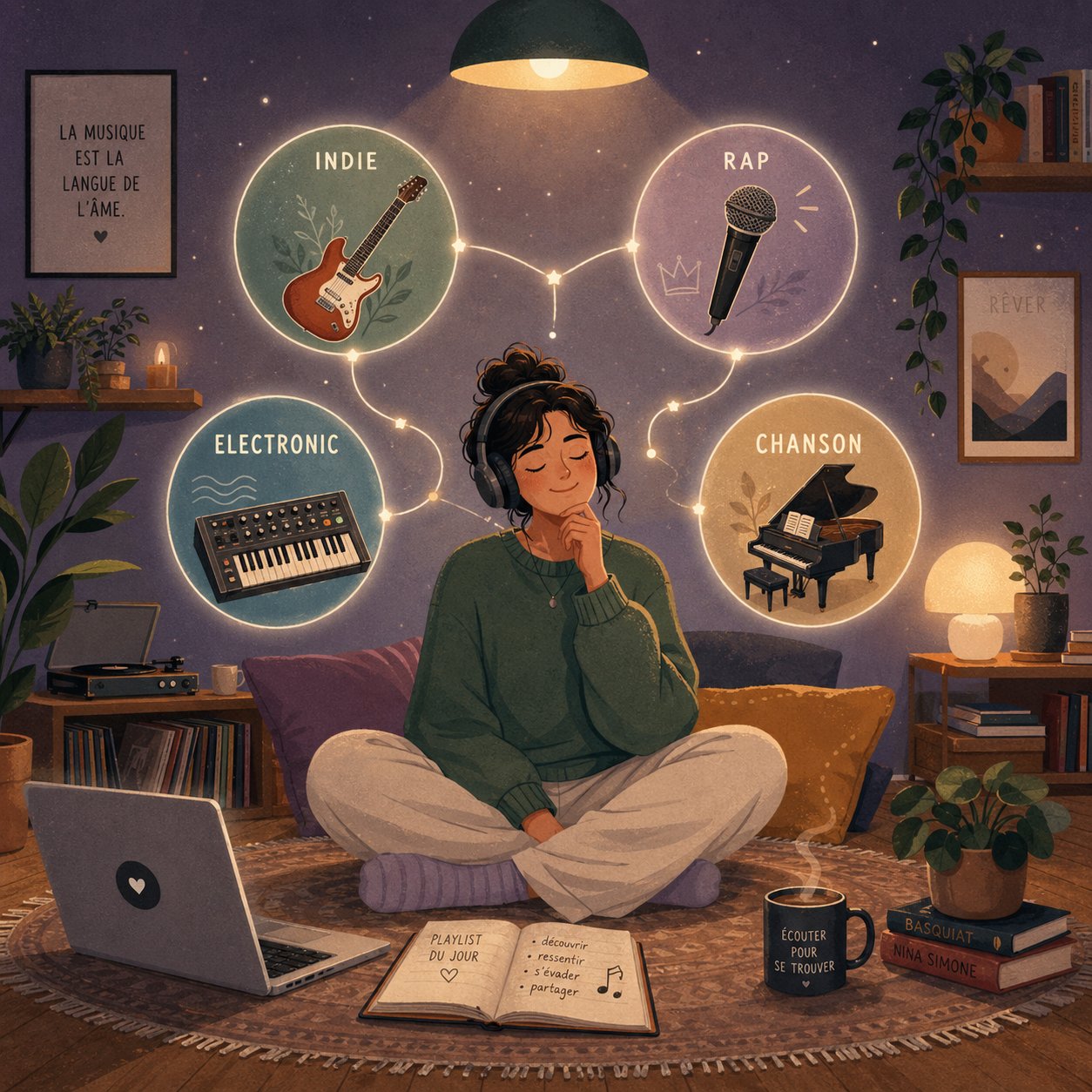
Knowing which songs suit your level is one thing. Knowing which ones suit you — your actual taste, the stuff that makes you hit repeat — is what turns casual curiosity into a genuine obsession. The biggest barrier to exploring French songs isn't language. It's not knowing where to start when the catalog spans everything from post-punk to Afro-pop. The simplest shortcut? Use what you already love in English as a compass.
Match Your English Music Taste to French Artists
Think of this as a translation layer — not for words, but for vibes. If you spend your commute listening to Radiohead or Arctic Monkeys, you'll feel right at home with La Femme's psychedelic art-rock or Feu! Chatterton's brooding, literary indie sound. If R&B and Afrobeats dominate your rotation, Aya Nakamura and Tayc are the obvious entry points — their production values and melodic instincts will feel immediately familiar, even before you catch a single lyric. Electronic music fans can trace a direct line from their favorite house and techno producers to Daft Punk, then follow the thread forward to Polo & Pan's sun-drenched tropical electronica or L'Imperatrice's retro synth-pop grooves.
Singer-songwriter listeners have arguably the richest options. Stromae's genre-defying storytelling, Pomme's intimate folk-pop, and Zaho de Sagazan's electro-chanson blend all reward the kind of close, lyric-focused listening that fans of Phoebe Bridgers or Bon Iver already practice. And if hip-hop is your world, the previous section gave you the roadmap — but Orelsan's witty, self-aware style makes him a particularly smooth bridge for listeners coming from Kendrick Lamar or Tyler, the Creator.
The table below maps common English-language preferences directly to French artists and a specific starting track for each, so you can go from reading to listening in about a 10 minute timer's worth of effort:
| If You Like (English Genre/Artist) | Try These French Artists | Start With This Song |
|---|---|---|
| Indie Rock (Radiohead, Arctic Monkeys) | La Femme, Feu! Chatterton, Noir Desir | "Mystere" — La Femme |
| R&B / Afrobeats (SZA, Burna Boy) | Aya Nakamura, Tayc, Dadju | "Djadja" — Aya Nakamura |
| Electronic / Dance (Disclosure, Bonobo) | Daft Punk, Polo & Pan, L'Imperatrice | "Ani Kuni" — Polo & Pan |
| Singer-Songwriter (Phoebe Bridgers, Bon Iver) | Pomme, Stromae, Zaho de Sagazan | "On brule" — Pomme |
| Pop (Dua Lipa, Billie Eilish) | Angele, Clara Luciani, Louane | "Balance ton quoi" — Angele |
| Hip-Hop (Kendrick Lamar, Tyler, the Creator) | Orelsan, Nekfeu, PNL | "Basique" — Orelsan |
| Folk / Acoustic (Iron & Wine, Fleet Foxes) | Coeur de pirate, Ben Mazue, Francoise Hardy | "Comme des enfants" — Coeur de pirate |
Building Your French Music Playlist
Once you've found a few artists that click, the algorithm becomes your best friend. Spotify's editorial playlists like "Hits France," "Rap Francais," and "Pop N' Fresh" are solid starting points — follow a couple and the platform's recommendation engine will start surfacing deeper cuts within days. Apple Music's "La Liste" and Deezer (a French-founded platform with particularly strong local curation) offer similar discovery pipelines. For more intentional digging, French music outlets like Les Inrockuptibles and the music section of Telerama function like a curated aldi weekly ad for new releases — they surface what's worth your attention each week so you don't have to sift through everything yourself.
Social media accelerates the process further. TikTok has become a launchpad for French artists the way radio once was — emerging talents selected by France's Le Fair program, which has previously supported artists like Christine and the Queens, Orelsan, and Pomme, are increasingly building audiences through short-form video before they ever land a traditional playlist placement. Following hashtags like #musiquefrancaise or #rapfr surfaces a constant stream of new discoveries. You'll notice that French music culture, much like world flags, represents a dazzling variety of identities and traditions all flying under one broad banner — and the more you explore, the more distinct each one becomes.
For listeners whose discovery journey sparks something beyond passive listening — maybe a particular genre, mood, or era inspires you to create something of your own — tools now exist to act on that impulse immediately. MakeBestMusic's AI Song Generator lets you channel a specific French style into an original royalty-free composition in seconds: feed it a genre like chanson or French touch, set a mood, and it produces a track you can actually use. It's one of several creative pathways worth exploring alongside playlist curation and music blogs — a natural next step for anyone who wants to go from appreciating French music to making something inspired by it. Even setting a 15 minute timer and experimenting with different genre inputs can yield surprisingly compelling results, much like how ash trevino and other independent creators have shown that accessible tools can lower the barrier between inspiration and output.
The real secret to building a French music habit, though, is treating it less like a research project and more like an ongoing conversation. Let one artist lead you to another. Let a playlist surprise you. Let a lyric you half-understand send you down a rabbit hole. That's how casual listeners become genuine fans — and how a single song can quietly reshape the way you hear music altogether.
Turning French Musical Inspiration into Something New
A single song can quietly reshape the way you hear music — and if you've made it this far, chances are several already have. The journey from Piaf's wartime chanson to PNL's cloud rap to Fally Ipupa's Congolese-French R&B isn't just a history lesson. It's proof that French songs belong to one of the most restless, genre-rich musical traditions on the planet — one that refuses to sit still.
French Music as a Living Tradition
Every generation covered in this guide built on what came before while breaking something open. Piaf channeled the raw emotion of Parisian street life into chanson realiste. Gainsbourg took that emotional honesty and detonated it with provocation and genre-blending ambition. The ye-ye artists absorbed American rock and made it unmistakably French. Daft Punk did the same with house music. And today's rap artists — raised on all of it — are producing the most-streamed music in France while folding in North African, Caribbean, and West African influences that earlier generations never had access to.
That's not a straight line. It's more like learning how to ski — each turn builds on the last, momentum carries you forward, and the terrain keeps changing beneath your feet. The thread connecting Brel's theatrical intensity to Stromae's electronic storytelling to Aya Nakamura's Afro-pop hooks isn't imitation. It's a shared creative instinct: take what moves you, filter it through your own experience, and make something the world hasn't heard before. Much like how to hang a picture requires finding the right spot and angle, each generation of French artists found exactly the right cultural moment to frame their sound.
So don't stop at the familiar classics. Dig into the rap section. Explore the Quebecois folk-rock. Follow the francophone African artists who are rewriting the rules in real time. The deeper you go, the more you'll realize that French songs aren't a niche curiosity — they're a living, breathing ecosystem where the past and present exist in constant conversation, like smiling friends who keep introducing you to someone new.
From Listener to Creator
For some listeners, discovery is the destination. For others, it's the spark that lights something bigger. If a particular genre, era, or mood from this guide left you thinking "I want to make something that sounds like that," the barrier between inspiration and creation has never been lower. Tools like MakeBestMusic's AI Song Generator let you channel a specific French style — chanson ballad, French touch electronic, modern pop, or anything in between — into an original royalty-free composition in seconds. Feed it a genre and a mood, and it produces a track that's yours to use however you want.
You don't need years of production experience to act on a creative impulse. The same way learning how to drive a manual car starts with understanding the basics before you hit the open road, making music inspired by what you love starts with a single experiment. Whether you use an AI tool, pick up a guitar, or just hum a melody into your phone, the point is the same: let what you've discovered here move you past passive listening. In a world where platforms like coomeet and countless other digital spaces connect people across languages and borders every day, music remains one of the most powerful bridges — and creating your own is the most personal way to cross it.
The best way to truly appreciate any musical tradition is to let it inspire your own creative voice — not as imitation, but as conversation.
