

What Does Homophonic Actually Mean?
When you search for the homophonic meaning, you'll run into two very different answers depending on whether you're studying music or language. That confusion is baked right into the word's ancient origins. So what is a homophonic texture, and why does the same term pop up in English class too? It all starts with Greek.
Homophonic (adjective): Derived from the Greek homos ("same") + phōnē ("sound" or "voice"), the term describes either a musical texture in which one melody is supported by harmonic accompaniment, or a linguistic relationship between words that share identical pronunciation but differ in meaning or spelling.
The Greek Roots Behind Homophonic
The Greek word homophonos originally meant "of the same sound or tone" and could even describe people speaking the same language or sounding in unison. That single root split into two distinct paths as it entered modern English. Musicians adopted it to define how voices and instruments move together under one dominant melody. Linguists, meanwhile, used it to label words that sound alike, such as "write" and "right." The homophonic pronunciation stays the same in both fields — hoh-muh-FON-ik — but the context changes everything about what it means.
A Quick Definition for Music and Language
If you're here as a music student, to define homophonic is straightforward: it refers to a texture where a single clear melody sits on top while chords and accompaniment support it from below. Think of a singer backed by piano chords — that's homophony in action.
If you landed here from a language search, the term points to words that share the same pronunciation but carry different meanings or spellings, like "flour" and "flower." You'll sometimes see the related adjective "homophonous" used interchangeably in linguistics contexts.
This article focuses primarily on the musical sense, since that's where the concept gets richest and most practical. Still, understanding both meanings helps you see how one Greek root branched into two modern worlds. The real depth, though, lives in how these two meanings diverge once you look closer at each one.
Musical Texture vs Linguistic Sound-Alikes
That divergence between music and language isn't just academic — it shapes how you'll encounter the word in real conversations, textbooks, and exams. Pinning down the full meaning of homophonic requires seeing both senses side by side, because each one operates in a completely different world.
Homophonic in Music Theory
The homophonic definition in music describes a texture where all voices or instruments rally behind a single dominant melody. The other parts don't compete for attention — they provide chordal or rhythmic support that reinforces the lead line. Imagine a vocalist singing over strummed guitar chords. That's the sound. You could use it homophonic in a sentence like this: "The hymn's homophonic arrangement let the congregation follow one clear melody together." The homophonically definition in a musical context, then, simply means "performed in a style where harmony supports one leading voice."
Homophonic in Linguistics
In language, the term — often swapped with homophonous — describes words that sound identical but carry different meanings or spellings. "Pair" and "pear" are a classic example. The related noun "homophone" refers to the words themselves, while "homophonous" and "homophonic" function as adjectives describing that shared-sound relationship.
| Aspect | Musical Meaning | Linguistic Meaning |
|---|---|---|
| Definition | A texture with one melody supported by harmonic accompaniment | Words sharing identical pronunciation but differing in meaning or spelling |
| Typical Context | Music theory, composition, performance | Grammar, phonetics, language learning |
| Related Terms | Homophony, chordal texture, homorhythm | Homophone, homophonous, homonym |
| Example in a Sentence | "The piano sonata opens with a homophonic passage before shifting to counterpoint." | "The words 'night' and 'knight' are homophonic — identical in sound, worlds apart in meaning." |
The distinction is clean once you see it laid out. In music, the term is about texture — how parts relate to a melody. In language, it's about sound — how words relate to each other's pronunciation. Both senses share that Greek core of "same sound," but the musical meaning carries far more structural depth. That depth becomes especially clear when you look at the two distinct subtypes that music theory carves out within homophonic texture itself.
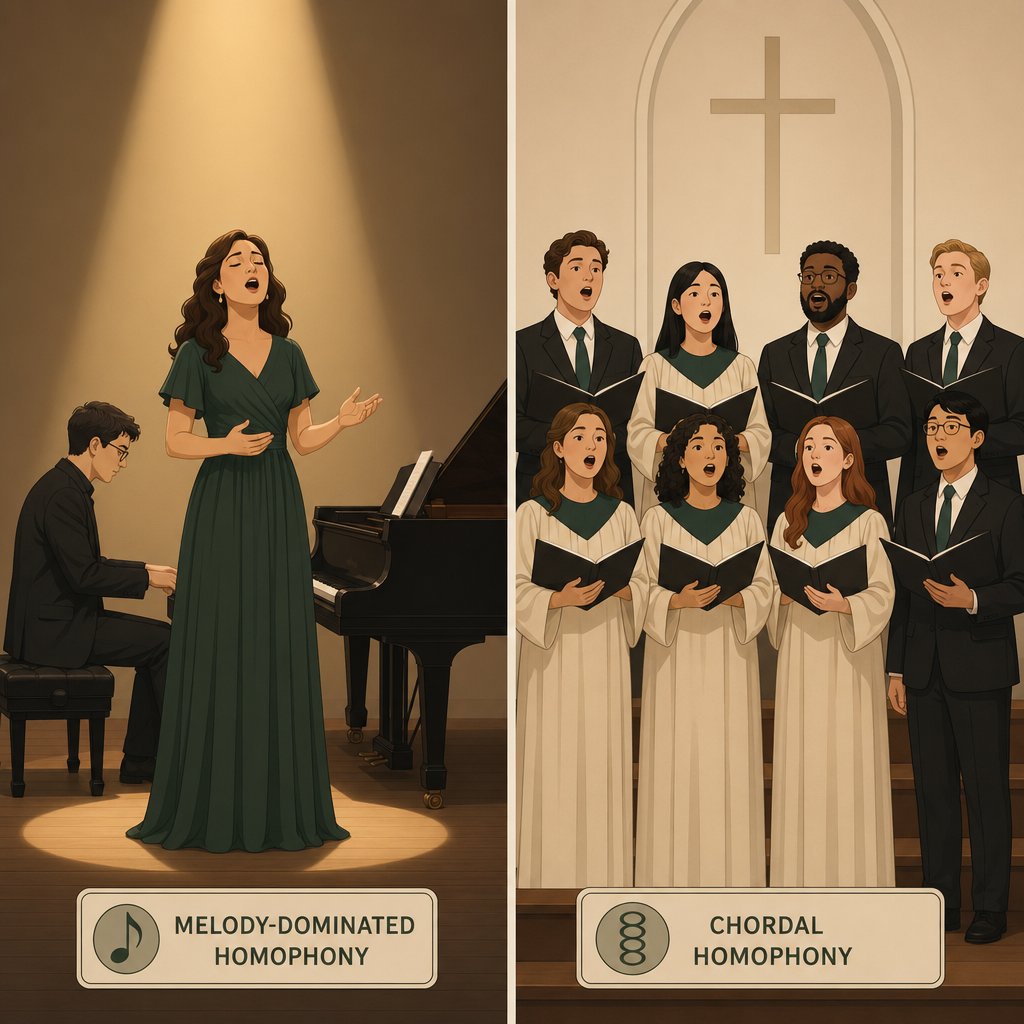
Two Types of Homophonic Texture in Music
Not all homophonic texture music sounds the same, and that's because the category splits into two distinct subtypes. Each one handles the relationship between melody and accompaniment differently, and recognizing the difference sharpens how you hear and analyze music across every genre.
Melody-Dominated Homophony
This is the form you encounter most often. A single melodic line takes the spotlight — carried by a voice, a violin, a synth lead — while the remaining parts provide chordal or rhythmic accompaniment underneath. Picture a singer performing over piano chords, or a guitarist strumming while singing a folk tune. The melody moves freely with its own rhythm and phrasing, while the accompaniment's overall purpose is to provide underlying harmony that supports without competing. Classical-period piano sonatas, where the right hand plays a lyrical theme over an Alberti bass pattern in the left hand, are textbook examples. So is virtually every pop song with a lead vocal over a band arrangement.
Chordal Homophony and Homorhythm
The second subtype works differently. In chordal homophony, all voices or parts move together in the same rhythm at the same time, producing what musicians call block chords. Think of a congregation singing a hymn — every voice changes notes simultaneously, creating a rich, unified wall of harmony. Handel's "Hallelujah" chorus and the opening of Queen's "Bohemian Rhapsody" both showcase this homorhythmic approach. The melody is still present, but it's embedded within the chord structure rather than floating independently above it.
Here's what separates the two subtypes at a glance:
- Rhythmic independence: In melody-dominated homophony, the melody has its own rhythmic profile distinct from the accompaniment. In chordal homophony, all parts share the same rhythm.
- Role of accompaniment: Melody-dominated writing uses accompaniment as a harmonic backdrop — broken chords, arpeggios, sustained pads. Chordal writing fuses accompaniment and melody into synchronized block chords.
- Typical voicing: Melody-dominated textures often feature one instrument or voice standing out clearly. Homorhythmic textures distribute the sound more evenly across all parts.
What both subtypes share is the defining trait of homophonic music texture: a single harmonic direction. Every part serves the same tonal center and supports the same melodic idea, whether that melody rides on top or lives inside the chords. This is exactly what separates homophonic musical texture from polyphonic writing, where multiple independent melodies each pull in their own direction. The homophony texture stays unified; polyphony deliberately fragments.
That contrast between unified and fragmented raises a bigger question — how does homophony actually stack up against the other three musical textures that theory recognizes?
Monophonic, Homophonic, Polyphonic, and Heterophonic Compared
Stacking homophony against polyphony only tells part of the story. Music theory actually recognizes four distinct textures, and understanding all of them gives you the full picture of how musical parts relate to each other. Let's define each one clearly, then put them side by side.
Defining Each Musical Texture
So what is monophonic music? The monophonic meaning is the simplest of the four: a single melodic line with no harmony or accompaniment whatsoever. Picture a lone voice singing a lullaby in an empty room, or a crowd chanting a stadium anthem in unison. That's monophony — the oldest type of music, stretching back to Ancient Greece and early Gregorian chant.
Homophonic texture, as we've covered, places one clear melody on top while other parts supply harmonic support beneath it. It's the dominant texture in Western music from the Classical period onward and the backbone of nearly every pop, rock, and folk song you know.
The polyphonic music definition flips that structure entirely. Instead of one melody ruling the arrangement, polyphony weaves two or more independent melodic lines together simultaneously. Each line holds equal importance, creating the intricate counterpoint you hear in a Bach fugue or a Palestrina mass. Monophony, homophony, polyphony — these three form a progression from simplest to most complex melodic independence.
Then there's heterophony. The heterophonic definition describes a texture where two or more performers play the same melody at the same time, but each adds their own variations, ornaments, or embellishments. It's an elaborated version of monophony and is most commonly heard in traditional Eastern music — Arabic classical traditions, Indonesian gamelan, and Japanese folk styles — though Western composers like Debussy and Britten have drawn on it too.
Side-by-Side Texture Comparison
Seeing all four textures in a single reference makes the differences click fast. Here's how they compare across the key dimensions:
| Texture Type | Definition | Number of Independent Parts | Typical Example | Musical Period Most Associated With |
|---|---|---|---|---|
| Monophonic | A single unaccompanied melodic line | 1 | Gregorian chant, an a cappella national anthem | Medieval / Ancient |
| Homophonic | One melody supported by harmonic accompaniment | 1 melody + supporting parts | A pop ballad, a hymn, a Classical piano sonata | Classical era through present |
| Polyphonic | Multiple independent melodies sounding simultaneously | 2 or more equal melodies | A Bach fugue, a Renaissance motet | Renaissance / Baroque |
| Heterophonic | Simultaneous variations of a single melody | 1 melody with embellished variants | Javanese gamelan, Arabic classical music | Traditional / non-Western (all eras) |
You'll notice the table reveals a spectrum. Monophony sits at one end with total melodic unity — one line, no competition. Polyphony sits at the other with full melodic independence. Homophonic and heterophonic textures fall between those poles, each blending unity and variation in its own way. Heterophony leans closer to monophony by keeping a shared melodic identity, while homophonic texture leans toward polyphony by introducing distinct harmonic parts — but those parts still serve a single lead melody.
These four textures represent a spectrum of melodic independence, not rigid categories. Most real music blends elements of more than one texture, often shifting between them within a single piece.
That blending is exactly what makes texture such a rich listening tool. A symphony might open with a monophonic theme, develop it polyphonically, and resolve in a homophonic chorale — all within a few minutes. Knowing where each texture sits on the spectrum helps you hear those shifts as they happen, especially once you start exploring real examples across genres and historical periods.

Homophonic Music Examples Across Genres and Eras
Textbook definitions only take you so far. The real way to internalize what homophonic texture sounds like is to hear it in action — and not just in classical concert halls. This texture shows up everywhere, from centuries-old hymns to the song stuck in your head right now. Let's walk through the most recognizable homophonic music examples across styles and time periods so you can start spotting the pattern yourself.
Classical and Choral Examples
If you've ever sat in a church pew and sung a hymn, you've participated in homophonic writing firsthand. Traditional Protestant hymns and chorales are some of the purest examples of chordal homophony — every voice moves together in block chords, with the melody riding along the top line. Bach's harmonizations of Lutheran chorales, while rich in voice-leading detail, still follow this fundamental structure: one tune, supported by synchronized harmony beneath it.
Classical-period composers leaned even harder into melody-dominated homophony. Mozart and Haydn, the two towering figures of the era, favored clear melodies over simpler harmonic textures as a deliberate stylistic choice. In a typical Mozart piano sonata, the right hand sings a lyrical theme while the left hand plays an Alberti bass — that familiar broken-chord pattern that rolls through the harmony without ever competing for attention. Haydn's symphonies work the same way on a larger scale: a melodic idea in the violins or winds floats above orchestral accompaniment that fills in the chords. This wasn't accidental. The Classical era prized clarity, elegance, and emotional directness, and melody-dominated homophony delivered all three.
Clementi's piano sonatas, Hummel's trumpet concerto, and Gluck's operatic arias all reinforce the same principle. The homophonic music definition in a Classical context essentially means: one voice leads, everything else supports. That formula proved so effective that it didn't stay confined to concert halls for long.
Homophony in Pop, Rock, Folk, and Beyond
Here's the thing most music theory resources understate: the vast majority of popular music is fundamentally homophonic. When you listen to a singer-songwriter strumming an acoustic guitar, a rock band with a vocalist over distorted power chords, or a pop track with a lead vocal riding above a produced beat — you're hearing homophony. The structure is always the same. One melodic line draws your ear while instruments provide harmonic and rhythmic support underneath.
Think about the standard band arrangement. A lead singer carries the melody. The guitarist plays chords. The bassist outlines the harmonic foundation. The drummer locks in the rhythm. Every element serves the vocal line. That's one of the most common musical structures in Western music, and it spans pop, rock, folk, jazz, and beyond.
"Let It Be" by the Beatles is a textbook homophonic example — a vocal melody over piano chords, with additional instruments layering in as the song builds, yet the texture remains homophonic because of the relationship of the melody to the accompaniment. A Scott Joplin rag like "Maple Leaf Rag" works the same way at the keyboard: a syncopated melodic line in the right hand over a steady chordal pattern in the left. Even a small jazz combo — bass, piano, drums backing a trumpet solo — fits the definition perfectly.
To see just how wide this texture reaches, here's a genre-by-genre breakdown of recognizable homophonic music examples:
- Hymns and chorales — Block chord singing where all voices move in the same rhythm, with the melody on top. Think of any traditional church hymn or barbershop quartet arrangement.
- Classical piano sonatas — A lyrical melody in the right hand over Alberti bass or broken-chord patterns in the left. Mozart's and Clementi's sonatas are go-to examples.
- Pop and rock — A lead vocal over guitar, keyboard, bass, and drums providing harmonic and rhythmic support. From Elton John ballads to Adele power tracks, the texture is the same.
- Folk music — A solo voice accompanied by strummed guitar, banjo, or another chordal instrument. The simplicity of the arrangement makes the homophonic structure especially transparent.
- Film scores — A sweeping melodic theme carried by strings or brass over full orchestral harmony. Imagine the main theme from any John Williams score — that soaring melody is always supported, never competing with the orchestra beneath it.
What connects every item on that list is the same underlying relationship: one melody leads, and everything else exists to support it. Whether the accompaniment is a strummed ukulele or a 90-piece orchestra, the texture stays homophonic as long as that hierarchy holds.
The sheer dominance of this texture across genres and centuries raises an obvious question. Why did homophony become the default? The answer isn't just about musical taste — it's rooted in centuries of cultural, philosophical, and technological shifts that reshaped how Western music was written, performed, and heard.
How Homophony Shaped Western Music History
For centuries, polyphony ruled European music. Renaissance composers like Palestrina and Josquin wove independent vocal lines into intricate tapestries of counterpoint, and Baroque masters like Bach and Handel pushed that complexity to its peak. If you wanted to define polyphony in music during those eras, you'd point to fugues, canons, and motets where every voice carried equal melodic weight. So what is homophony doing at the center of virtually all Western music today? The answer traces back to a cultural earthquake in the mid-1700s.
The Shift from Polyphony to Homophony
Even before Bach's death in 1750, tastes were already shifting. A newer "Gallant" style had taken hold, favoring simplicity and homophonic texture over the complex counterpoint of the late Baroque. The Enlightenment was reshaping every art form, and music was no exception. Ideals of clarity, balance, and emotional directness made intricate polyphonic layering feel heavy and outdated. Audiences wanted to hear a single expressive melody — something they could follow, feel, and remember.
This wasn't just an aesthetic preference. The shift had structural consequences. As music moved away from layered polyphony toward a style where the melody is played over a subordinate harmony, chords became a much more prominent feature. Tonal structure grew more audible. Haydn and Mozart built entire symphonic careers on this principle, crafting melodies that floated above clean harmonic support. The homophony definition crystallized during this period: one voice leads, everything else serves it.
Homophony in the Modern Musical Landscape
Opera accelerated the trend. Gluck's reforms in the 1760s stripped away ornamental excess and put dramatic melody front and center, and audiences responded. The development of functional harmony — where chord progressions create tension and resolution around a tonal center — gave composers a powerful toolkit for supporting a single melodic line. The progression from monophony, homophony, polyphony as coexisting options narrowed into a clear winner for public taste.
By the time popular music genres emerged in the 19th and 20th centuries, the definition of homophonic music had become the unspoken default for songwriting. Tin Pan Alley standards, blues, jazz vocals, rock, pop — all built on the same foundation of melody over chords. The homophony in music that Haydn pioneered in Viennese concert halls became the skeleton of a three-minute radio single two centuries later.
Homophony's dominance is not accidental. It aligns with how most listeners naturally process music — by latching onto a single melodic line and letting everything else recede into supportive background.
That cognitive reality explains why songwriting today remains overwhelmingly homophonic. Our ears are wired to track one melodic thread at a time, and composers across every era have instinctively leaned into that tendency. The historical shift wasn't just about fashion — it was about meeting listeners where their attention naturally goes.
Knowing why this texture dominates is one thing. Hearing it in real time — and telling it apart from polyphony or monophony on the fly — is a different skill entirely.

How to Recognize Homophonic Texture by Ear
Understanding the history is useful, but your ears are the real instrument here. Whether you're a music student prepping for an exam or just someone who wants to listen more deeply, learning what is homophonic texture in music comes down to training yourself to notice a few specific things in real time. The good news? It only takes three steps.
What to Listen For in Homophonic Music
The texture of music definition might sound abstract on paper, but in practice, identifying texture is about asking the right questions while you listen. Try this the next time you press play on anything:
- Identify whether there's one clear melody or several independent ones. Can you hum along with a single tune that stands out above everything else? If so, you're likely hearing a homophonic or monophonic passage — not a polyphony texture where multiple melodies compete for your attention.
- Check whether the other parts support that melody or compete with it. Listen to what the instruments beneath the lead line are doing. Are they filling in chords, keeping a rhythmic pattern, or outlining harmony? If they're serving the melody rather than presenting their own melodic ideas, that's the hallmark of homophonic writing.
- Notice whether the accompaniment follows the melody's phrasing. In homophonic texture, the supporting parts tend to breathe when the melody breathes. Chord changes align with the melodic structure. The whole arrangement feels like it's moving in one harmonic direction, even if the rhythms differ between parts.
Run through those three checks and you'll have a reliable answer within seconds. It becomes instinctive with practice.
Telling Homophonic Apart from Polyphonic and Monophonic
When you're comparing polyphonic vs homophonic passages — or sorting out homophony vs monophony — a quick mental checklist helps cut through the confusion. Ask yourself:
- Can you sing along with one obvious tune? That points toward homophonic texture. The melody is front and center, and everything else supports it.
- Do you hear two or more equally important melodies weaving around each other? That's likely polyphonic. No single line dominates — each voice has its own melodic identity and rhythmic independence.
- Is there only a single line with no harmony at all? You're hearing monophonic texture — one unaccompanied melody, pure and unadorned.
Here's the important nuance that a simple texture music def can't capture: real music rarely stays in one category for an entire piece. A song might open with a lone vocal line (monophonic), add guitar chords under the first verse (homophonic), and then layer in a counter-melody during the bridge that briefly creates polyphonic interplay. Composers combine and alternate textures freely — a single piece may shift rapidly from one to another for dramatic effect.
So think in terms of passages, not entire works. The question isn't "Is this song homophonic?" but rather "Is this section homophonic?" That shift in framing makes texture analysis far more accurate and far more interesting.
Recognizing these textures by ear is a listening skill. Putting them to work in your own music — deciding when to let a melody lead and how to build harmony beneath it — is a creative one. And that's where theory starts turning into practice.
Tips for Writing and Arranging Homophonic Music
Hearing the texture is step one. Creating it yourself is where things get rewarding. If you've ever wondered what is homophonic in music from a composer's perspective, the answer is surprisingly practical: it's a framework where melody leads and everything else falls into a supporting role. That clarity makes it one of the most approachable textures to write in, whether you're sketching your first song or arranging for a full band.
Core Principles of Homophonic Arrangement
Homophony is best described as a single melodic idea held up by harmonic scaffolding. The strength of the whole structure depends on how well each element does its job. Here are the foundational guidelines to keep in mind:
- Start with a strong, singable melody. The melody is the entire point of homophonic texture in music. If your lead line isn't memorable or easy to follow, no amount of harmonic dressing will save it. Write something you can hum away from the instrument.
- Build chords that support the melody's emotional arc. Your harmony should mirror the tension and release of the melodic line. A soaring phrase deserves open, resonant chords beneath it; a darker passage calls for minor or diminished harmony. The chords serve the story the melody tells.
- Keep accompaniment patterns consistent but not monotonous. Whether you're using block chords, arpeggios, or alternating bass patterns, pick a rhythmic approach and stick with it long enough to establish a groove — then introduce subtle variations to maintain interest. Switching patterns too often undermines the texture's cohesion.
- Apply voice-leading principles for smooth harmonic movement. When moving from one chord to the next, keep common tones where possible and move the remaining voices by the smallest intervals you can. This creates fluid, connected harmony rather than jarring leaps. In four-part SATB writing, good voice leading is what separates a polished arrangement from a clunky one — and the same principle applies to any instrument or production setup.
- Let rhythm unify the arrangement. Even in melody-dominated homophony where the lead line has rhythmic freedom, the accompaniment needs a steady pulse that anchors the whole piece. The rhythm section is the glue.
Turning Homophonic Theory into Songwriting Practice
Understanding the homophony music definition gives you more than vocabulary — it gives you a decision-making framework. Every arrangement choice becomes clearer when you know the hierarchy: melody leads, harmony supports, rhythm unifies. That's the homophony in music definition distilled into a creative workflow.
The gap most people hit is between knowing these principles and actually applying them. You understand what is homophonic music, but sitting in front of a blank screen or an empty staff can still feel paralyzing. This is where hands-on experimentation matters more than theory. Tools like MakeBestMusic's Melody Maker offer a practical bridge — you can generate melodic ideas, test them against different harmonic structures, and explore how accompaniment choices shape the feel of a piece. It's a low-pressure way to turn the arrangement principles above into real songwriting decisions without needing advanced production chops.
The core takeaway is simple. Homophonic writing isn't a limitation — it's a lens. Once you internalize the melody-first hierarchy, every creative choice has a clearer purpose. The chords you pick, the rhythm you set, the way voices move from one harmony to the next — all of it serves one goal: making that lead melody land as powerfully as possible.
