

What AI Music Prediction Actually Means
Defining AI Music Prediction
AI music prediction is the use of machine learning models to analyze streaming data, social signals, and audio features at scale, forecasting which songs, artists, genres, and sonic styles will gain traction before they break into the mainstream.
Imagine knowing a song will be a hit weeks before it charts. That's the promise behind ai music prediction, and it's no longer science fiction. Where traditional A&R relied on gut instinct and industry connections, intelligence analysis powered by machine learning processes millions of data points in real time, surfacing patterns no human could spot manually.
The scale of the challenge makes this kind of technology essential. Streaming platforms now receive close to 75,000 AI-generated tracks per day on Deezer alone, accounting for roughly 44% of daily uploads. Across all platforms, nearly 100,000 tracks land every single day. No team of scouts, however talented, can meaningfully listen through that volume. Music and artificial intelligence are converging precisely because the old model of discovery cannot keep pace.
Why Traditional Trend Forecasting Falls Short
For decades, A&R professionals shaped the industry by attending shows, reviewing demos, and trusting cultural intuition. That approach still carries weight, but it has a ceiling. Human analysts can track a handful of markets, a few hundred artists, maybe a few thousand songs at best. AI in the music industry operates without those constraints, scanning streaming velocity, playlist additions, social media momentum, and audio characteristics simultaneously across global catalogs.
The gap isn't just about speed. Traditional forecasting is reactive. By the time a trend is visible enough for a person to notice, it's often already peaking. Modern music solutions built on predictive models detect acceleration curves, the subtle uptick in saves, shares, and search queries, days or weeks before mainstream recognition.
This article breaks down the mechanics behind that process: the specific data signals these systems ingest, the algorithms that turn raw numbers into forecasts, and where the technology still falls short.
The Data Signals AI Systems Analyze to Forecast Trends
Every prediction starts with raw inputs. AI trend forecasting models don't operate on hunches. They consume structured data from dozens of sources simultaneously, looking for acceleration patterns that signal something is about to break. Think of it as a constant social signals check across the entire digital music ecosystem, running around the clock.
Streaming and Platform Engagement Metrics
Streaming numbers alone mean very little. What matters is the rate of change. AI systems track velocity curves, measuring not just how many streams a song accumulates but how quickly that number accelerates day over day. A track jumping from 5,000 to 15,000 daily streams tells a fundamentally different story than one holding steady at 50,000.
The specific platform signals these models ingest include:
- Save rate: Saves divided by streams. A save rate above 4% indicates strong listener resonance, and sudden spikes in this metric flag emerging momentum before it shows up in charts.
- Skip rate: How often listeners abandon a track before it finishes. Declining skip rates across a cluster of similar songs can signal a genre gaining traction.
- Streams-per-listener ratio: Repeat listens above 2.5 per unique listener suggest a track is sticky, a leading indicator of organic growth.
- Playlist addition velocity: The rate at which user-generated playlists pick up a song, distinct from editorial or algorithmic placements.
- First-week velocity: Streams and saves within seven days of release, benchmarked against similar artists and previous releases to detect outlier performance.
- Shazam search spikes: Sudden surges in people trying to identify a song represent real-world curiosity that hasn't yet converted to streams.
Each metric alone offers a partial view. AI behavior analysis combines them into composite signals, weighting each input based on how reliably it has predicted past breakouts.
Social Listening and Sentiment Signals
Streaming data captures what people do. Social data captures what people feel. Natural language processing tools like TextBlob and VADER scan music-related posts across platforms, scoring sentiment polarity and detecting enthusiasm before it translates into streams. When mentions of a song or artist shift from neutral to overwhelmingly positive, and the volume of those mentions accelerates simultaneously, that's a powerful early signal.
The intersection of artificial intelligence and social media goes beyond simple mention counts. These systems measure comment sentiment on YouTube videos, track hashtag velocity on TikTok, monitor lyric-quoting behavior on X, and identify emerging fan communities on Reddit and Discord. Cross-platform engagement metrics, where a song gains traction on multiple platforms simultaneously, carry more predictive weight than isolated spikes on a single channel.
Audio Feature Extraction at Scale
Here's where things get interesting for understanding media and consumption patterns. AI doesn't just watch the numbers. It listens. Audio analysis models extract spectral features, tempo, key, energy levels, vocal timbre, and production characteristics from tracks gaining momentum. When the system detects that multiple rising songs share a particular sonic fingerprint, say a specific BPM range combined with a vocal processing style, it flags an emerging sonic trend.
Tools that analyze video AI-style break down trending content on platforms like TikTok and Instagram Reels, identifying which audio segments get looped, which sounds accompany viral visual formats, and how audio usage migrates across creator communities. This ai behavior analysis of short-form video provides a uniquely early window into what sounds are gaining cultural traction, often weeks before those sounds translate into full-track streaming success.
These data signals, streaming metrics, social sentiment, and audio features, form the raw material. The real question is what happens when machine learning models start finding patterns across all of them at once.
Machine Learning Algorithms Behind Music Forecasting
Raw data becomes a forecast only when the right algorithm processes it. Different models excel at different prediction tasks, and the music prediction algorithms 2024 practitioners rely on span a wide range of complexity. Understanding which model does what clarifies how AI turns listening behavior into actionable foresight.
Regression and Time-Series Forecasting Models
The simplest and often most interpretable approach is regression. Linear and logistic regression models assign learned weights to each input feature, like save rate, tempo, or playlist additions, then output either a popularity score or a binary hit-or-miss classification. Research from Studio VI found that with advanced feature engineering and careful threshold tuning, a straightforward regression model achieved 75% accuracy in predicting hits based purely on audio content, no artist fame required.
Time series and regression models extend this logic into the temporal dimension. Instead of asking "will this song be popular?" they ask "what will streaming numbers look like next week, next month?" These forecasting models identify trends within sequential data, capturing patterns like weekend listening spikes or post-playlist boosts, then project those trajectories forward. Unbias notes that forecasting is inherently about dealing with uncertainty, useful as a guide for planning marketing efforts and release timing rather than an absolute certainty.
Neural Networks for Audio and Sequence Analysis
When patterns get too complex for traditional regression, neural networks step in. Three architectures dominate music trend prediction:
Convolutional Neural Networks (CNNs) process audio spectrograms, visual representations of sound frequency over time, to extract sonic features and predict popularity. A CNN-based model from Amirkabir University combined Spotify metadata with Mel spectrograms of audio waveforms and achieved a 97% F1 score in classifying track popularity. CNNs excel at musical note identification and timbral pattern recognition because they detect spatial hierarchies in spectrogram data the same way image recognition models detect edges and shapes in photographs.
Recurrent Neural Networks (RNNs) capture sequential listening patterns. Where CNNs look at a single snapshot of audio, RNNs process sequences: what a listener played before and after a track, how playlist engagement unfolds over days, how streaming velocity changes week to week. This sequential memory makes them well-suited for modeling the temporal measures in music consumption that indicate emerging momentum.
Transformer models take sequence analysis further. Originally built for language processing, transformers now predict playlist behavior by treating song sequences like sentences, learning which tracks are likely to follow others and identifying when new patterns break established norms. Their attention mechanisms can weigh distant signals, like a Shazam spike three weeks ago, against current streaming velocity to produce richer context-aware predictions.
Collaborative filtering rounds out the toolkit by clustering listeners with similar taste profiles. Rather than analyzing audio directly, it identifies that fans of Artist A also gravitate toward Artist B, surfacing connections invisible in the audio data alone. This quantitative descriptive analysis of taste networks helps platforms spot emerging artists gaining traction within specific listener communities before broader breakout occurs.
Hit Prediction vs. Genre Forecasting vs. Viral Detection
Not all prediction tasks are the same, and conflating them leads to confusion about what AI can actually do. Each task demands different measures in music data and different algorithmic strengths:
| Prediction Task | Primary Algorithm | Key Input Data | Prediction Horizon | Accuracy Strength |
|---|---|---|---|---|
| Individual Hit Prediction | CNN + Regression | Audio spectrograms, metadata, engagement ratios | Pre-release to first 30 days | Strong on incremental hits within known styles |
| Genre Trend Forecasting | Time-Series Models + Collaborative Filtering | Streaming velocity clusters, taste graphs, cross-platform adoption rates | 3-6 months | Reliable for detecting gradual shifts in listener preference |
| Viral Moment Detection | Transformer + NLP Sentiment Analysis | Social acceleration, short-form video audio usage, cross-platform mention spikes | 24-72 hours | Good at flagging momentum; poor at predicting which content triggers it |
Hit prediction zeroes in on a single track's potential. Genre forecasting zooms out, identifying broader sonic and stylistic movements gaining collective traction. Viral detection operates on the shortest timescale, spotting explosive social momentum in near real time but with the least ability to predict before the spark ignites.
Each algorithm type has a sweet spot. The practical question for anyone building or using these systems is how the models connect into a working pipeline, from raw data all the way through to a confidence-scored prediction that a human can actually act on.
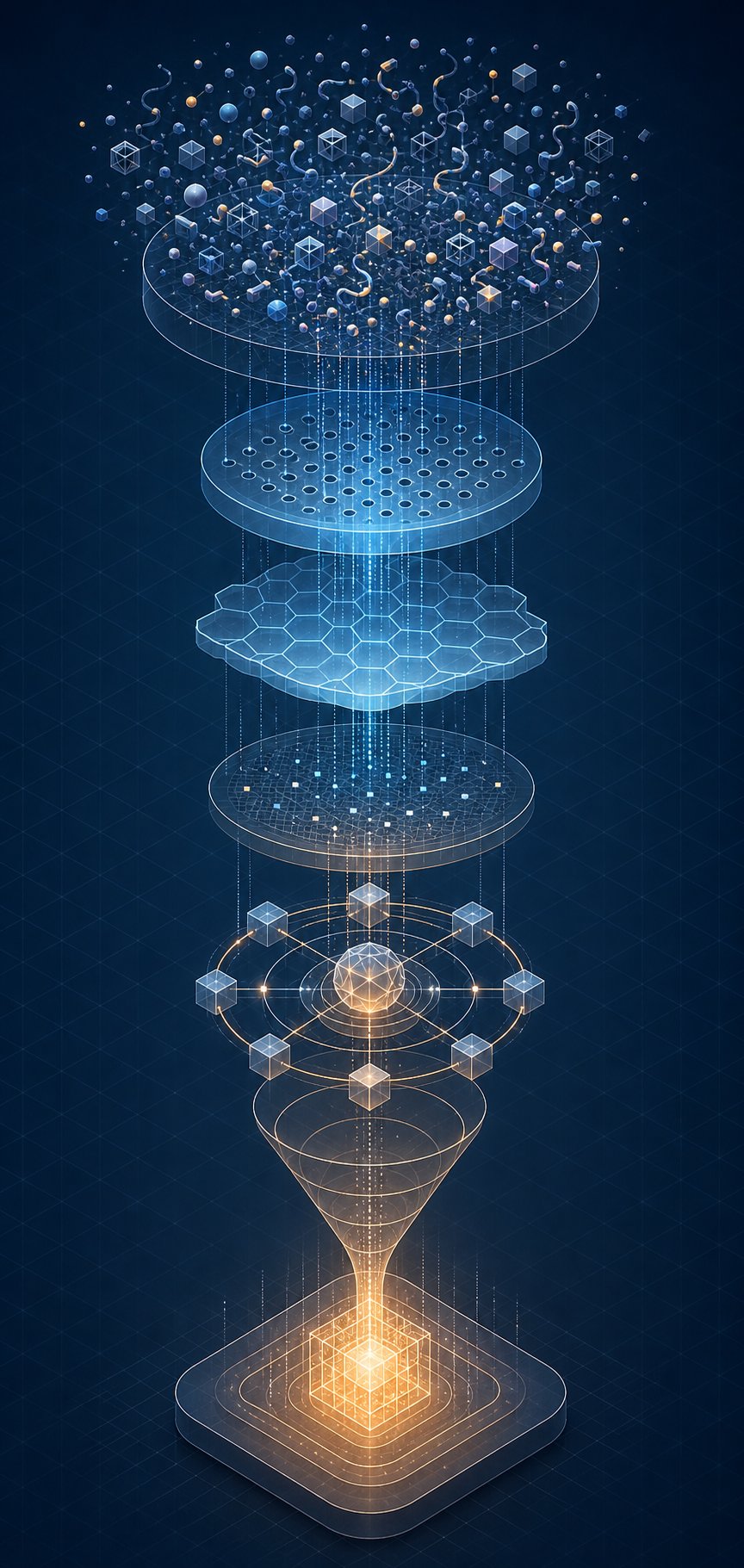
The Step-by-Step AI Trend Prediction Pipeline
Knowing which algorithms exist is one thing. Understanding how they fit together in a production system, from the moment raw data enters to the moment a human reads a confidence score, is where theory becomes practice. Most explanations of how AI predicts music trends stop at the model. The reality is that the model is just one stage in a much longer chain, and each link matters.
From Data Ingestion to Feature Engineering
Every prediction pipeline starts with collecting data, and in music, that means pulling from many sources simultaneously. APIs from streaming platforms deliver play counts, saves, and skip rates. Web crawlers scrape social media mentions and playlist additions. Audio fingerprinting services provide Shazam-style identification data. Video platform APIs surface sound usage metrics from short-form content.
Raw numbers straight from these sources are messy. Formats differ, timestamps conflict, and missing values are everywhere. The pipeline's next job is cleaning and normalization, standardizing everything into consistent formats so downstream models can process it reliably. As Domo's AI pipeline framework emphasizes, a well-designed ingestion layer abstracts source differences so downstream stages receive consistent inputs regardless of origin.
Feature engineering is where raw streams become predictive signals. This stage converts absolute numbers into the velocity metrics, ratios, and acceleration curves that actually carry forecasting power:
- Data collection: APIs and crawlers pull streaming counts, social mentions, playlist data, Shazam searches, and audio files from dozens of sources in batch and real-time modes.
- Cleaning and normalization: Duplicate entries are removed, timestamps standardized, missing values handled, and formats unified across platforms.
- Feature engineering: Raw streams become day-over-day velocity scores. Saves divided by streams produce engagement ratios. Social mention counts transform into acceleration curves. Audio files convert to spectral feature vectors.
- Model inference: Engineered features feed into trained algorithms, whether regression models, CNNs, or transformers, which output raw prediction scores.
- Confidence scoring: Model outputs are calibrated against historical accuracy, producing a probability estimate with an explicit uncertainty range.
- Human interpretation: Analysts review scored predictions, weigh them against cultural context the model cannot see, and decide whether to act.
Each stage produces a specific artifact. Feature engineering outputs curated datasets. Model inference outputs raw scores. Confidence scoring outputs calibrated probabilities. This mirrors broader trends in digital content management, where structured pipelines ensure reproducibility and auditability at every step.
Model Training and Confidence Scoring
You might wonder: how does the system know it's right? Training happens on historical data, where the model learns relationships between past input features and known outcomes (songs that actually broke through versus those that didn't). The system essentially asks, "When these engagement patterns appeared before, what happened next?"
Confidence scoring adds a critical layer of honesty. Rather than delivering a binary "this will be a hit" verdict, well-built systems output probabilities: "This track has a 73% likelihood of reaching 1 million streams within 30 days, with a confidence interval of plus or minus 12%." That nuance is what separates useful access intelligence from misleading certainty. Analysts working with digital analytics trends know that a prediction without a confidence range is just a guess wearing a suit.
The distinction between business intelligence vs artificial intelligence becomes clearest here. Traditional BI dashboards report what already happened. AI prediction pipelines project what's likely to happen next, then quantify how sure they are about it. Both serve decision-making, but the predictive pipeline introduces probability and uncertainty as first-class outputs rather than afterthoughts.
The Self-Fulfilling Prophecy Problem
Here's where things get philosophically tricky. When a prediction model flags a song as likely to break out, what happens next? Playlist curators at streaming platforms see that signal. Algorithmic recommendation engines pick up the momentum data. Marketing teams allocate budget. The song gets promoted, which generates the very streams the model predicted.
Did the AI predict the future, or did it create the future?
This feedback loop is a genuine concern in music forecasting. Platforms that use predictive data to influence playlist placement are essentially allowing the model's output to alter the conditions that generated the input. The prediction becomes self-validating, not because the model understood something true about listener preference, but because it triggered a promotional machine.
Responsible systems account for this by separating organic signals from platform-driven amplification. They track whether streams come from algorithmic playlists, editorial placements, or genuine listener-driven discovery. A song gaining traction purely through user-generated playlists and direct searches carries a different predictive weight than one being pushed by recommendation algorithms. The best pipelines flag this distinction explicitly in their confidence outputs.
This tension between prediction and influence sets the stage for understanding why different platforms, Spotify, TikTok, and Shazam among them, approach the same problem with fundamentally different architectures and incentives.

How Spotify, TikTok, and Shazam Predict Differently
Not every platform sees the same slice of listener behavior. Spotify watches what people choose to play. TikTok watches what sounds make people stop scrolling. Shazam watches what songs haunt people enough to pull out their phone and ask, "what is this?" Each perspective catches a different phase of a trend's lifecycle, which is why the ai music industry increasingly treats these platforms as complementary sensors rather than competing signals.
How Spotify Detects Emerging Artists Early
Spotify's recommendation engine combines collaborative filtering with deep audio analysis to surface artists before they hit mainstream awareness. The collaborative filtering layer, trained on roughly 700 million user-generated playlists, identifies emerging connections between tracks based on co-occurrence. When listeners consistently place an unknown artist alongside established ones on the same playlist, the system infers sonic or thematic similarity and begins recommending that artist to adjacent taste clusters.
The audio analysis side adds another dimension. Spotify extracts features from raw audio files, including tempo, energy, timbre, danceability, and valence, then maps tracks into a high-dimensional vector space. According to Music Tomorrow's breakdown of Spotify's system, audio features are passed into models as a 42-dimensional vector, capturing far more granularity than the public API exposes. This allows the platform to detect that a new release shares sonic DNA with tracks already gaining velocity in specific listener segments.
The result? Features like Discover Weekly and Release Radar function as early detection surfaces. Over one-third of all new artist discoveries on Spotify happen through "Made for You" recommendation sessions. The platform doesn't explicitly predict hits, but its recommendation architecture has the side effect of amplifying tracks that match emerging taste patterns, often weeks before those tracks appear on any chart.
TikTok as a Leading Indicator Engine
TikTok operates on an entirely different logic. It doesn't care what you've listened to before. It cares whether a sound makes you stop, watch, and share in the next three seconds.
The platform's algorithm prioritizes retention and engagement signals over follower counts or historical preference. A video with 10,000 views and 90% average watch time will outperform one with 100,000 views and 40% watch time in algorithmic distribution. For music, this creates a uniquely early signal: when a sound consistently drives high watch time and shares across multiple creators' videos, it's gaining cultural traction regardless of whether the artist has any streaming history.
The metric that matters most for ai and the music industry is sound page velocity, specifically how many new creators adopt a sound within a given window. Each creator using a sound exposes it to their audience, creating a compounding distribution loop. One hundred creators averaging 10,000 views each equals one million organic impressions of a song that didn't require a single playlist placement or ad dollar. This music marketing ai illustration shows why labels now monitor TikTok sound adoption rates as a leading indicator, often 2-7 days ahead of streaming spikes.
Shares predict virality better than likes on TikTok. A high like count with low shares suggests passive consumption, while shares indicate someone actively pushing the content outward. When AI systems track share-to-view ratios accelerating for a specific sound, that's one of the most reliable short-horizon trend signals available anywhere in the digital music ecosystem.
Why Labels and Platforms Predict Differently
Streaming platforms and record labels both use predictive intelligence, but their time horizons and goals diverge sharply. Spotify optimizes for immediate engagement, matching the right song to the right listener in the right moment. Its prediction window is essentially "what should this person hear next?" TikTok's window is slightly longer, identifying sounds that will sustain creator adoption over days or weeks.
Labels need something fundamentally different. They're making investment decisions with 12-to-18-month payoff timelines. Signing an artist, funding an album, planning a global release campaign: these require predictions about where listener taste will be in the future, not just where it is today. That's why labels layer platform signals with longer-range genre forecasting models, cultural analysis, and touring data that streaming platforms never touch.
The ai impact on music industry decision-making looks different at each level. A platform engineer cares about session retention in the next 30 minutes. A label A&R executive cares about whether a sound will still resonate 18 months from now when the album finally drops.
| Platform / Entity | Prediction Approach | Primary Data Sources | Prediction Horizon | Primary Use Case |
|---|---|---|---|---|
| Spotify | Collaborative filtering + audio vector analysis | 700M+ user-generated playlists, audio spectrograms, listening session feedback | Days to weeks | Personalized recommendation and emerging artist surfacing |
| TikTok | Retention-based algorithmic distribution + sound adoption tracking | Watch time, share rates, sound page velocity, creator adoption curves | Hours to days | Identifying sounds with viral compounding potential |
| Shazam | Audio fingerprint matching + search velocity analysis | Real-world audio identification queries, geographic clusters, time-of-day patterns | Days to weeks (pre-streaming) | Detecting songs gaining real-world curiosity before digital traction |
| Record Labels | Multi-source forecasting combining platform signals with cultural analysis | Cross-platform velocity, touring data, genre trend models, demographic shifts | 6-18 months | A&R investment decisions and long-range release strategy |
Shazam occupies a unique position in this landscape. It captures a signal no other platform sees: songs that exist in someone's physical environment, overheard in a store, playing at a party, featured in a TV scene, that generate enough curiosity to trigger a search. That intent signal arrives before streaming behavior because the person hasn't yet found the song on a platform. When Shazam searches for a specific track spike in a geographic cluster, it often precedes playlist adds and streaming growth by days, making it one of the purest early-stage trend indicators available.
Each platform's approach reveals a piece of the puzzle. Shazam catches curiosity. TikTok catches cultural adoption. Spotify catches taste alignment. Labels try to synthesize all three into investment-grade conviction. The proliferation of dedicated tools designed to pull these signals together, aggregate them, and generate actionable forecasts has created an entirely new category of music industry technology.
AI Trend Prediction Tools Reshaping the Music Industry
That proliferation of prediction-oriented platforms has matured into a distinct technology category. Today, ai music companies serve every layer of the industry, from independent artists tracking their own momentum to major label A&R teams managing rosters of hundreds. The tools differ in what they measure, who they serve, and how far into the future they look.
Dedicated Prediction Platforms for Industry Pros
Several platforms now specialize in turning raw streaming and social data into forecasts that inform real decisions. You'll notice they cluster around different signal types:
- Chartmetric aggregates cross-platform data, pulling streaming numbers, social follower growth, playlist placements, and radio airplay into a unified dashboard. Its strength is breadth: you see an artist's momentum across every channel simultaneously, with trend scoring that flags acceleration.
- Sodatone (acquired by Warner Music) focuses on A&R-grade artist evaluation, combining social media velocity with audience demographic clustering. It's built to answer the label question: "Is this artist worth signing?"
- Muso.AI specializes in credit-based discovery, mapping collaboration networks and identifying artists gaining industry connections before public visibility catches up.
- PlaylistAI and similar tools focus on playlist ecosystem intelligence, tracking editorial and algorithmic placement patterns to predict which curators and playlists will drive breakout momentum.
What differentiates these platforms is their predictive angle. Chartmetric excels at cross-platform visibility. Sodatone leans into demographic fit and signing potential. Others prioritize audio similarity matching, identifying tracks that share sonic DNA with currently trending songs. For industry professionals following generative ai music news and broader shifts in ai in music production, the choice depends on whether you need artist-level intelligence, song-level predictions, or genre-trend awareness.
As Music24 reports, AI's analysis of millions of private playlists detects emerging artists an average of three weeks before they surface on public charts. That lead time is the core value proposition these platforms sell: decisions made weeks earlier translate directly into competitive advantage, whether you're signing artists, timing releases, or allocating marketing budgets.
Generative AI Tools That Incorporate Trend Intelligence
Here's where prediction meets creation. A newer wave of tools doesn't just tell you what's trending. It helps you make music that aligns with those trends. This intersection has become a major storyline in generative audio news: prediction engines feeding directly into creation workflows.
How does ai music generation work in this context? These tools ingest the same trend signals, emerging BPM ranges, popular chord progressions, rising production styles, and use them to guide generation. When you input a style prompt, the system draws on its understanding of current sonic momentum to shape the output.
MakeBestMusic's AI Music Generator exemplifies this approach. Creators input style ideas, lyrics, or descriptive prompts, and the platform generates complete tracks that reflect current and emerging sonic patterns. Rather than spending weeks in a DAW trying to capture a sound you've identified as trending, you describe it in natural language and receive a finished composition within minutes. It's particularly useful for rapid prototyping: test whether a predicted trend actually sounds compelling before committing production resources.
The table below maps how these tool categories serve different user needs:
| Tool Type | Primary Function | User Type |
|---|---|---|
| MakeBestMusic AI Music Generator | Turn style prompts and lyrics into complete trend-aligned songs | Independent creators, producers, content makers |
| Soundverse DNA | Artist-trained AI generation with ethical licensing | Artists monetizing their sound, film/game composers |
| Chartmetric | Cross-platform analytics and artist trend scoring | A&R teams, managers, marketing professionals |
| Sodatone | Demographic clustering and signing potential evaluation | Label A&R executives |
| Muso.AI | Collaboration network mapping and credit-based discovery | Publishers, sync teams, A&R scouts |
The convergence of prediction and generation is significant. Discussions around ai music production companies stock audio human-made certification 2025 reflect the industry's push to distinguish AI-assisted content from fully human-created work, a direct consequence of generative tools becoming production-grade. Meanwhile, generative ai music news today consistently highlights how these platforms are moving beyond novelty toward genuine creative utility.
What these tools can't do, however, is replace the cultural judgment that separates a technically competent track from a genuinely resonant one. Prediction engines surface patterns. Generative tools execute on them. But deciding which patterns matter, which trends are worth riding, and which represent dead ends still requires human instinct, a reality that becomes painfully clear when you examine the specific ways AI prediction breaks down.

What AI Gets Wrong About Predicting Music Trends
Prediction tools surface patterns with impressive consistency, but patterns are not the whole story. AI forecasting models carry blind spots that are structural, not temporary. These aren't bugs that better data will fix. They're fundamental limitations baked into how machine learning works. Understanding where the technology fails is just as important as knowing where it succeeds, especially if you're making real decisions based on its outputs.
The Cultural Context Blindspot
Music doesn't exist in a vacuum. It responds to politics, social movements, collective grief, economic anxiety, and cultural shifts that no dataset can anticipate. Think about how protest music surges during political upheaval, or how culture songs tied to specific community experiences suddenly resonate nationwide when a social moment arrives. AI cannot predict these catalysts because they originate outside the musical data the model ingests.
A model trained on streaming velocity and audio features has no concept of what's happening in courtrooms, on college campuses, or in geopolitical negotiations. It can predict culture only in the narrow sense of projecting existing momentum forward. It cannot anticipate the sudden cultural ruptures that redirect listener attention toward entirely new emotional territories. As Orphiq's analysis of AI limitations puts it: "AI cannot take creative risk. It optimizes for patterns, predicting what should work based on what worked before. Artists innovate by breaking patterns."
The relationship between culture and music runs deeper than data can capture. Musical movements often emerge as responses to felt experiences within specific communities, experiences that don't register as data points until after they've already reshaped listening behavior. By then, the prediction window has closed.
Why AI Cannot Predict Revolutionary Sounds
This is the novelty problem, and it's perhaps the most fundamental limitation. Machine learning models learn from historical data. They identify relationships between past inputs and past outcomes, then project those relationships forward. When a truly new sound emerges, one that breaks from existing patterns rather than iterating on them, there's nothing in the training data for the model to learn from.
Consider this: no algorithm trained on pre-2010 data would have predicted the rise of SoundCloud rap. No model analyzing 1990s listening patterns would have flagged that lo-fi bedroom production would become a dominant aesthetic. These weren't incremental shifts. They were breaks from established cultural tenets about what professional music should sound like, driven by new communities with new values and new tools.
Research from Born and Diaz at the Knight First Amendment Institute frames this precisely: recommender systems "are constrained by the past behavior that the system has already observed," meaning "any novel trajectories of taste development, i.e., those that explore new 'horizons,' lie outside the 'imagination' of current recommender design." AI excels at predicting what comes next within a known trajectory. It fails at predicting when the trajectory itself changes direction.
The practical result? AI is reliable for forecasting incremental trends, a gradual rise in Latin pop influence within mainstream production, or a shift toward slower BPMs across electronic subgenres. It's unreliable for predicting the revolutionary moments that reshape the entire landscape. Music for culture, the kind that defines eras, tends to emerge from precisely the places algorithms aren't looking.
Algorithmic Bias and Homogenization Risks
When prediction models feed back into recommendation systems, a troubling cycle emerges. The algorithm surfaces what it predicts will perform well. Listeners hear what gets surfaced. Their behavior confirms the prediction. The model learns that similar content performs well. More of the same gets surfaced. Repeat.
This reinforcement loop drives homogenization. Born and Diaz describe how personalization in music recommendation "encourages fragmentation and atomization based on the recursive individuation to which users are subjected," while simultaneously narrowing the range of content that gets amplified. The same dynamic applies to prediction: models trained on engagement data learn to favor what already works, systematically undervaluing the unfamiliar.
Specific failure modes include:
- Genre bias: Prediction accuracy varies dramatically between genres. Pop and hip-hop, with high streaming volumes and clear engagement patterns, generate better predictions than jazz, classical, or regional genres with smaller digital footprints and different consumption behaviors.
- Geographic blindness: Models trained primarily on Western streaming data struggle to predict breakouts in markets with different platform ecosystems, like K-pop's emergence from Korean fan communities or Afrobeats' rise through diaspora networks.
- Meme-driven virality: Some viral moments have zero detectable precursor signal. A creator uses a song ironically, it catches on as a meme, and within 48 hours it has 50 million streams. No engagement curve preceded the spike. No audio feature predicted it. The trigger was pure cultural accident.
- Popularity reinforcement: Models consistently overweight signals from already-visible artists, making it harder to detect genuine grassroots breakouts from unknown creators whose early momentum looks statistically indistinguishable from noise.
- Demographic gaps: Listener segments underrepresented in training data, older audiences, listeners in developing markets, communities using alternative platforms, produce weaker predictions because the model has less signal to learn from.
As O'Leary notes in research published in Action, Criticism, and Theory for Music Education, algorithms "are not neutral" and users should ask whose rules are being followed, whose values they reflect, and what assumptions are embedded in the design. Prediction models inherit the biases of their training data and the priorities of the teams that build them.
None of this means AI trend prediction is useless. It means it's a tool with known boundaries, strong within established patterns, weak at the edges where culture songs break new ground and new communities reshape what music means. The question for anyone using these systems isn't whether to trust them. It's knowing exactly when to override them with human judgment, and having a strategy for acting on predictions while accounting for everything the model cannot see.
How Creators and Industry Pros Can Act on AI Predictions
Knowing where AI prediction fails is useful. Knowing how to act on it despite those limitations is what actually moves a career or campaign forward. The benefits of ai in music forecasting depend entirely on what you do with the outputs, and that looks different depending on whether you're releasing your own tracks, running marketing campaigns, or making signing decisions.
For Independent Artists and Producers
You don't need a label budget or enterprise analytics platform to use predictive signals. Independent creators can tap into the same underlying data, just at a smaller scale, and make smarter decisions about timing, sound, and positioning.
- Track your own velocity metrics weekly. Monitor your save-to-stream ratio, repeat listener count, and playlist addition rate through your distributor dashboard. A save rate climbing above 4% signals strong resonance. Use that momentum window to push promotion rather than waiting for arbitrary release schedules.
- Watch sound adoption on short-form video. Before committing to a production direction, spend time on TikTok's sound pages. When you see a sonic style, a specific BPM range, vocal texture, or production technique, gaining creator adoption across multiple niches, that's a trend signal worth acting on.
- Time releases to velocity windows, not calendar dates. If your pre-save numbers spike on a specific day or your social mentions accelerate after a particular post, release during that momentum rather than holding to a Friday-only schedule. AI and music production workflows increasingly reward flexibility over tradition.
- Use Shazam data as a validation signal. If people are actively searching for your music after hearing it in the real world, that's organic demand no algorithm manufactured. Prioritize contexts that generate Shazam activity: live performances, sync placements, and collaborations with creators whose audiences discover music aurally.
- Monitor genre-adjacent velocity. An ai music genre change rarely happens overnight. If artists adjacent to your sound are seeing streaming acceleration, that rising tide likely benefits you too. Position yourself within that cluster through collaborative playlists, features, and sonic alignment.
A survey of 1,200 music creators found that 87% have already incorporated AI into at least one part of their process. The artists gaining the most ground aren't necessarily using the most sophisticated tools. They're the ones who built a system around their releases, combining data awareness with creative instinct.
For Music Marketers and Label Teams
Marketing teams operate on tighter feedback loops. A campaign needs to launch at the right moment, target the right audience, and ride genuine momentum rather than manufacturing it from scratch. Every digital marketing trend in music now points toward the same conclusion: reactive marketing loses to predictive marketing.
- Use social signal acceleration as your campaign trigger. Don't launch a paid media push on release day by default. Wait for organic social mentions to hit an acceleration threshold, then amplify what's already working. This approach converts budget into momentum rather than spending money hoping momentum appears.
- Segment audiences by predictive taste clusters. Platforms like AI-driven marketing tools analyze streaming data and social media trends to identify fans most likely to engage. Target those segments first, let their engagement generate social proof, then expand reach.
- Monitor cross-platform convergence as a confidence signal. A song gaining traction on TikTok alone might be a flash. A song gaining traction on TikTok, Spotify discovery playlists, and Shazam simultaneously is a much higher-confidence bet for marketing investment.
- Track sentiment shifts, not just volume. Marketing analytics news september 2025 consistently highlighted a key finding: mention volume without sentiment context misleads. One thousand negative mentions look identical to one thousand positive mentions in a basic dashboard. NLP sentiment scoring separates genuine enthusiasm from controversy-driven visibility.
- Build campaign playbooks around prediction horizons. Short-horizon signals (24-72 hour viral detection) demand rapid-response ad creative. Medium-horizon signals (2-4 week genre acceleration) suit playlist pitching and influencer seeding. Long-horizon signals (3-6 month shifts) inform release calendar planning and A&R pipeline decisions.
Turning Trend Insights Into Creative Output
Here's where understanding how ai predicts music trends becomes genuinely powerful: you stop passively consuming algorithmic recommendations and start using prediction data as creative input.
Imagine you've identified that lo-fi jazz-influenced production with uptempo drums is gaining streaming velocity across multiple markets. Traditionally, acting on that insight meant weeks of production work, session musician bookings, and mixing iterations before you could even test whether the trend resonated with your audience. By the time you finished, the window might have closed.
AI-powered generation tools compress that timeline dramatically. MakeBestMusic's AI Music Generator lets you input style prompts reflecting the emerging sound you've identified, describe the tempo, mood, instrumentation, and vocal style, and receive a complete track within minutes. It's not about replacing the creative process. It's about prototyping at the speed predictions demand. How does ai create music in this workflow? You provide the creative direction informed by trend data, and the tool handles execution, giving you something tangible to evaluate before committing full production resources.
This rapid-prototype approach works across multiple scenarios:
- Trend validation: Generate a track in the predicted style and test it with your audience through social posts or private shares. If engagement confirms the trend's relevance to your fanbase, invest in full production.
- Pitch material: Create demo-quality tracks aligned with predicted sonic shifts for sync licensing pitches, playlist submissions, or label meetings where timing matters more than final polish.
- Content velocity: Produce trend-aligned audio for short-form video content at the pace platforms reward, without burning out your core creative capacity on every piece.
The strategic advantage isn't the tools themselves. It's the shift from passive to active engagement with algorithmic systems. Most creators and marketers receive recommendations and react. Understanding the prediction mechanics underneath those recommendations lets you anticipate where platforms will direct attention next, and position yourself there before the crowd arrives. Music and ai work best together when humans provide cultural judgment and strategic intent while machines handle pattern recognition and rapid execution.
