

Is AI Actually Taking Over the Music Industry
Is AI taking over the music industry? The honest answer is neither a simple yes nor a comfortable no. AI has already charted Billboard hits, gone viral with deepfake vocals, and landed record deals, but it hasn't replaced human artistry. What's actually happening is more complex: artificial intelligence is carving out a growing presence in music creation, distribution, and consumption, forcing every corner of the industry to adapt in real time.
Think of it less like a hostile takeover and more like a tectonic shift. The ground is moving beneath artists, labels, streaming platforms, and listeners alike. To understand where things stand, you need the full picture, one that connects the technology itself, the economic disruption, the legal battles now playing out in courtrooms, and the real impact on working musicians.
What the Headlines Get Wrong About AI Music
Most ai music news frames this as a binary debate: either AI will destroy music or it's just a harmless toy. Both takes miss the mark. The reality is that generative ai music news in 2025 tells a story of rapid, uneven disruption. Some roles in the industry face genuine existential pressure. Others are finding AI to be a powerful creative accelerator. And millions of hobbyists who never would have made a song are now flooding streaming platforms with AI-generated tracks.
The question "will ai take over the music industry" assumes a single outcome. In practice, AI is reshaping different parts of the ecosystem at different speeds. A sync music composer faces a very different threat than a touring vocalist. A bedroom producer has access to tools that didn't exist two years ago. The headlines rarely capture that granularity.
Key Milestones That Changed the Conversation
A handful of real events turned AI music from a curiosity into an industry-wide reckoning. Here's how the conversation shifted, fast:
- The AI Drake/Weeknd viral moment: In 2023, TikTok user Ghostwriter977 released "Heart on My Sleeve," a track generated by AI trained on Drake and The Weeknd's music. It racked up over 9 million views before Universal Music Group had it pulled from platforms, igniting a global debate about voice cloning and copyright.
- Breaking Rust hits Billboard #1: The AI-generated country persona's track "Walk My Walk" reached the top of Billboard's Country Digital Song Sales Chart, accumulating over 3.5 million Spotify streams and proving AI acts could compete commercially.
- AI acts get signed to labels: Hallwood Media signed imoliver, a "human music designer" who creates songs on Suno, marking the first time a record label formally signed an AI music creator. Timbaland also launched an AI-focused label in partnership with Suno.
- Xania Monet's mainstream breakthrough: The AI R&B artist landed on Billboard's Adult R&B Airplay chart and attracted national media coverage, with her human creator later revealing herself to emphasize the real emotion behind the lyrics.
Each of these milestones answered a different version of the same question: can ai make better music than humans, or at least music that audiences genuinely enjoy? The streaming numbers suggest listeners don't always distinguish, or care, whether a track was made by a person or a prompt. That indifference is what makes ai music news today 2025 so consequential for working musicians.
These milestones didn't emerge in a vacuum. Behind every AI-charting hit sits a sophisticated technology stack, one that most coverage glosses over entirely.
How AI Music Generation Actually Works
You've seen the headlines about AI tracks going viral and charting on Billboard. But how does artificial intelligence in music actually create a song from scratch? The technology is less mysterious than it sounds once you break it into its core components.
How AI Learns to Compose Music
Imagine showing a composer millions of songs across every genre, era, and mood. Over time, that composer internalizes patterns: which chords follow which, how a verse builds into a chorus, what makes a jazz progression feel different from a pop hook. AI music models work the same way, just with math instead of intuition.
The training pipeline starts with massive datasets of audio. These can include raw waveforms, isolated stems like drums or vocals, and metadata tags covering genre, tempo, and mood. The AI converts this audio into numerical representations and feeds it through deep neural networks that detect recurring elements: chord progressions, rhythmic motifs, song structures, and production techniques specific to certain genres.
Crucially, the model doesn't memorize songs. It learns statistical relationships between musical elements. When you ask it to generate something new, it constructs an original piece based on those learned patterns, not by stitching together copied fragments.
Generative AI predicts musical sequences the same way text AI predicts the next word in a sentence. Instead of guessing that "the cat sat on the..." ends with "mat," a music model predicts that a particular chord, rhythm, or melodic phrase is the most likely next step given everything that came before it.
Two primary architectures power most AI music tools today. Transformer models, similar to the GPT systems behind text AI, predict audio tokens in sequence. Platforms like Suno and Udio use proprietary transformer-based systems that generate melody, harmony, rhythm, and vocals in a single pass. Diffusion models, closer to how image generators like Stable Diffusion work, start with noise and gradually refine it into coherent audio. Both approaches can produce tracks that listeners struggle to distinguish from human-made music in blind tests.
Voice synthesis adds another layer. AI can now model vocal timbre, phrasing, and emotional delivery, generating sung performances that sound convincingly human. This is the technology behind those viral deepfake covers and AI-generated singers landing on streaming charts.
The Difference Between AI-Assisted and Fully Generative Tools
Not all AI in music production works the same way, and the distinction matters enormously for understanding where the industry is headed.
AI-assisted tools keep the human in the driver's seat. You might use AI to suggest chord progressions, generate drum loops as a starting point, master a finished mix, or separate stems from a recording. The artist makes every creative decision. A clear example: The Beatles' "Now and Then" used AI-powered audio restoration to isolate John Lennon's vocals from old demos. The technology served the human vision.
Fully generative tools create complete tracks from a text prompt or minimal input. You type "upbeat indie rock with female vocals about a road trip" and receive a finished song: structure, melody, instrumentation, vocals, and all. No musical training required. This is the category that raises harder questions about authorship, originality, and whether AI will get better at helping with making music to the point where traditional skills become optional.
The music and artificial intelligence landscape includes a third hybrid category too. Tools like AIVA combine generative capabilities with professional features such as MIDI export and stem separation, letting producers use AI output as raw material for further human refinement in a traditional DAW.
Understanding this spectrum matters because the economic and legal implications differ dramatically depending on where a tool falls. An AI mastering plugin that polishes your mix is a productivity boost. A system that generates thousands of complete tracks per day and uploads them to Spotify is something else entirely.

The Economic Impact on Artists and Labels
That distinction between AI-assisted tools and fully generative systems isn't just a technical curiosity. It maps directly onto the economic fault lines now splitting the music industry. When a single person can generate thousands of finished tracks per day without touching an instrument, the financial math changes for everyone involved, from bedroom producers to major label executives.
How AI Music Floods Streaming Platforms
Imagine you're an independent artist earning a modest living from streaming royalties. Your fans are still listening. Your play counts haven't dropped. Yet your monthly paycheck keeps shrinking. How?
The answer lies in how streaming royalties actually work. Under the pro rata payment model used by Spotify, Apple Music, and most major platforms, all subscription and ad revenue flows into a single monthly pool. Your share equals your percentage of total streams on the platform. When over 50,000 fully AI-generated tracks hit streaming platforms every single day, the denominator grows while your slice stays the same, or worse, shrinks.
On Deezer alone, AI content now accounts for roughly 44% of all daily uploads. That's nearly half of everything hitting the platform made by machines. Most of these tracks aren't competing for the same listeners as your music. They're accumulating low-engagement, often bot-driven plays that pull from the same royalty pool without creating new revenue.
The saving grace, for now, is that AI music captures less than 3% of actual listening on platforms like Deezer. But 3% of a billion-dollar royalty pool still represents tens of millions of dollars redirected away from human musicians. One high-profile case drove this home: a single individual created hundreds of thousands of AI songs, used bot networks to stream them billions of times, and collected over $8 million in fraudulent royalties before getting caught. Apple Music reported removing around 2 billion fraudulent streams in 2025 alone, preventing roughly $17 million from reaching bad actors. Spotify removed over 75 million spammy tracks in a single 12-month period.
These are staggering numbers, and they only account for what platforms actually caught.
The New Economics of Music Creation
The impact of AI on the music industry goes beyond royalty dilution. It's fundamentally rewriting the cost structure of making music. Tasks that once required expensive studios, trained engineers, and weeks of production time can now happen in minutes for a fraction of the cost.
| Category | Traditional Music Creation | AI-Assisted Creation |
|---|---|---|
| Production Time | Weeks to months per track | Minutes to hours per track |
| Studio Costs | $200-$500+/hour for professional studios | $10-$50/month subscription |
| Distribution Barriers | Label deal or distributor required, gatekeepers at every stage | Direct upload via aggregators, minimal gatekeeping |
| Skill Requirements | Years of instrumental training, production knowledge, mixing expertise | Basic text prompting, no musical training needed |
| Collaboration Needs | Session musicians, vocalists, engineers, producers | Single person with a laptop |
This cost collapse has created what Artefact's analysis identifies as a hobbyist economy. Millions of non-musicians are now creating and releasing tracks. Platforms like Boomy have enabled entirely new types of creators to produce instant songs, release them, and even earn royalty share income. Musical expression is no longer gated by years of training or access to expensive equipment.
The AI in music market reflects this explosion. Industry analysts project the sector to reach $38.7 billion by 2033, up from $3.9 billion in 2023. That tenfold increase signals widespread adoption across production, distribution, and consumption. Interestingly, artists themselves are more interested in AI-powered production and mastering tools (66%) than in pure AI music generation (47%), suggesting professionals still see AI as a creative enhancer rather than a replacement.
What This Means for Artist Revenue
For independent ai music artists earning $500 a month from streaming, even a 5% dilution from AI-generated content means $25 less per month, or $300 per year. That's real money for people making real music. Major labels can absorb small royalty fluctuations with legal teams and direct platform relationships. Independent musicians don't have that cushion.
Labels are responding by repositioning rather than resisting. Some are embracing AI acts outright. The emergence of the ai record label concept, where companies sign AI-generated personas or human "music designers" who create exclusively with generative tools, signals a strategic bet that AI content can be monetized alongside traditional rosters. Deloitte's analysis notes that AI has already started reshaping which artists get signed, how catalogs are monetized, and how fans discover music. The question facing labels is no longer whether to adopt AI but whether they're moving fast enough to capture value before competitors do.
Meanwhile, ai music labels are exploring catalog optimization, using AI to identify under-monetized tracks, match songs to sync opportunities, and predict which musical elements will resonate with specific demographics. A track recorded decades ago can find a new audience through AI-powered discovery, turning static archives into dynamic commercial assets.
Research from Luminate offers one reassuring data point: consumers are "net negative" toward AI-generated content, meaning more people feel uncomfortable with it than comfortable. The demand from listeners isn't driving this flood. It's driven almost entirely by people gaming the system for ai music royalties, not by audiences actively seeking out AI tracks.
The economic disruption, though, doesn't hit everyone equally. Different roles within the music industry face vastly different levels of exposure depending on how easily AI can replicate what they do.
Which Music Industry Roles Face the Biggest Threat
A session vocalist who records background harmonies for $200 per track faces a fundamentally different reality than a touring artist selling out arenas. AI doesn't threaten the music industry as a monolith. It pressures specific roles based on one key factor: how much of that job involves repeatable, pattern-based work versus irreplaceable human presence and creative judgment.
Roles Most Vulnerable to AI Disruption
Will AI replace musicians entirely? The evidence says no, but it will reshape which skills command a paycheck. Here's how current AI capabilities stack up against specific roles, ranked from most to least exposed:
- Session vocalists and background singers: AI voice synthesis can now replicate vocal timbre, phrasing, and emotional delivery with startling accuracy. As Reprtoir's analysis of voice cloning notes, the proliferation of this technology may directly reduce demand for session vocalists, limiting employment opportunities and income sources. A producer who once hired a singer for $300 to lay down harmonies can now generate convincing vocal parts in seconds. This is why ai is bad for artists in roles that depend on being hired for functional vocal work rather than star power.
- Sync and library music composers: Composers who write background music for ads, podcasts, YouTube videos, and corporate content face intense pressure. AI can generate mood-specific instrumental tracks on demand, and buyers who once paid $500 for a custom sync piece can now get something serviceable for free. The functional nature of this work makes it highly automatable.
- Mixing and mastering engineers: AI mastering tools have been on the market for over a decade, and LANDR's study found that 79% of producers already use AI for technical tasks like mixing, mastering, or audio restoration. These tools are now advanced enough to nearly match the output of a human mastering engineer for standard projects. Engineers handling complex, high-budget sessions still command premium rates, but the mid-tier market is compressing fast.
- Beat makers and loop producers: AI can generate drum patterns, chord progressions, and instrumental loops that serve as production building blocks. Producers who sell beats on marketplaces face growing competition from AI-generated alternatives priced at zero.
- Performing artists and singer-songwriters: Live performance, personal brand, and emotional authenticity remain difficult for AI to replicate. Touring musicians, ai generated singers notwithstanding, still hold the strongest position because audiences pay for presence, not just sound.
The pattern is clear: the more a role depends on delivering functional output without a personal brand attached, the more vulnerable it becomes. AI musicians and ai generated singers can fill gaps where "good enough" is the standard. They struggle where audiences demand a human story.
Where AI Enhances Rather Than Replaces
The same technology that threatens certain roles is actively empowering others. Famous musicians using AI aren't hiding it. They're integrating it as a creative accelerator.
Producers represent the clearest example. That same LANDR study found that 66% of producers use AI creatively for songwriting, melodies, instruments, or vocals. But only 13% used a tool to produce an entire song. The majority are generating parts, a drum loop here, a vocal harmony there, to complement their existing arrangements. AI fills skill gaps without replacing the producer's creative vision.
Composers use generative tools for rapid prototyping, sketching out ten variations of a theme in minutes rather than hours. The AI output isn't the final product. It's raw material that a skilled human shapes into something with intention and nuance. Songwriters use AI to break through creative blocks, generating melodic ideas they'd never have stumbled on alone.
Even vocalists are finding upside. Voice cloning technology lets artists create content in multiple languages, recover damaged recordings, or produce demos without booking studio time. The key difference: they're using AI on their own voice, with consent and creative control intact.
So will AI replace musicians? The more honest framing: AI will replace certain tasks that musicians currently get paid for, while creating new workflows that reward adaptability. The 65% of producers who say they're open to using AI generators at some stage in their workflow aren't surrendering their craft. They're evolving it. The roles that survive and thrive will be those that combine technical skill with something AI still can't deliver: taste, narrative, and the kind of creative risk that only comes from lived experience.
The question of who gets to make these decisions, though, isn't just playing out in studios and streaming dashboards. It's being fought in courtrooms, where lawsuits and new legislation are drawing the legal boundaries that will define AI music's future.
The Legal Battles That Will Decide AI Music's Future
Courtrooms are now the front line. While producers experiment with AI tools and labels sign AI-generated acts, a parallel fight is unfolding in federal courts and legislative chambers that will determine the actual rules of engagement. The music copyright ai news cycle has never moved this fast, and the outcomes of these cases will shape whether AI music operates as a licensed industry or an unregulated free-for-all.
Major Lawsuits Shaping AI Music Law
In June 2024, all three major record companies, Sony Music, Universal Music Group, and Warner Music Group, sued AI music generators Suno and Udio for what they called "mass infringement" of copyright. The core allegation: both platforms trained their generative models on copyrighted recordings without permission, then used those models to produce competing music.
The cases have since diverged in revealing ways. UMG settled with Udio in October 2025, followed by Warner in November 2025, both striking licensing deals for a new AI music platform. Sony Music, however, is pressing forward aggressively. After gaining access to Udio's training data during discovery, Sony moved to add over 30,000 copyrighted recordings to its complaint. A parallel case against Suno saw UMG and Sony seek to add over 61,000 recordings after discovery revealed Suno had trained on "millions" of their copyrighted tracks.
One critical admission changed the legal landscape: Udio acknowledged in court filings that it "obtained audio data from YouTube for use as training data" using YT-DLP, a stream-ripping tool. This triggered a Digital Millennium Copyright Act circumvention claim on top of the original copyright infringement allegations. Judge Alvin K. Hellerstein denied Udio's motion to dismiss that DMCA claim, finding the plaintiffs had plausibly alleged YouTube employs technological access controls that Udio circumvented.
Both Suno and Udio maintain their use constitutes "fair use" under US copyright law. Udio called its process "quintessential fair use" and accused Sony of "anticompetitive activities that extend an unlawful monopoly over the production and commercialization of music." The fair use question remains unresolved, and its answer will determine whether AI companies need licenses or can train freely on existing music.
Here's where the key cases stand:
- Sony Music v. Udio (S.D.N.Y.): Active. Sony seeking to add 30,442 copyrighted works after discovery. DMCA circumvention claim survived motion to dismiss. Fair use defense pending summary judgment.
- Major Labels v. Suno (D. Mass.): Active. UMG and Sony seeking to add 61,000+ recordings. Discovery revealed Suno trained on millions of copyrighted tracks.
- UMG/Warner settlements with Udio: Resolved via licensing deals. Udio's licensed platform "Starstruck" set to launch in 2026.
- Blanco Brown style emulation claim: A precedent-testing case exploring whether AI-generated music that mimics a specific artist's style, without copying actual recordings, constitutes infringement. This pushes beyond sampling law into uncharted territory around artistic identity.
Are Suno artists going to have to pay if the labels win? That depends on how courts define liability. If fair use fails, the platforms themselves face damages, but individual creators using those tools could face downstream consequences depending on how licensing frameworks get structured.
New Legislation Protecting Artists
Legislators aren't waiting for courts to sort this out. Tennessee moved first. In early 2024, Governor Bill Lee announced the Ensuring Likeness Voice and Image Security (ELVIS) Act, the first legislation in the nation to explicitly add "voice" to existing personal rights protections. Tennessee's music industry supports over 61,617 jobs and contributes $5.8 billion to the state's GDP, so the economic stakes were clear.
The ELVIS Act targets AI cloning models that enable unauthorized fake works in someone's voice. As Harvey Mason Jr., CEO of the Recording Academy, noted at the announcement, the bill "will protect Tennessee's creative community against AI deepfakes and voice cloning and will serve as the standard for other states to follow." The legislation received backing from over 20 industry organizations, including ASCAP, BMI, SAG-AFTRA, and the National Music Publishers' Association.
Beyond Tennessee, the federal landscape is evolving. The U.S. Copyright Office launched a formal AI initiative in 2023, receiving over 10,000 public comments. It has since released a multi-part report: Part 1 (July 2024) addressed digital replicas and recommended a federal digital replica law, Part 2 (January 2025) tackled copyrightability of AI outputs, and Part 3 (May 2025) examined generative AI training. These reports are shaping congressional thinking on potential federal legislation.
In Europe, the EU AI Act introduces transparency obligations for generative AI systems, including requirements to disclose when copyrighted material was used in training. For music, this means AI companies operating in Europe may need to provide detailed summaries of their training data, giving rights holders visibility they currently lack in US proceedings.
The Unresolved Question of AI Copyright
At the center of every lawsuit, every piece of legislation, and every copyright ai music news today story sits a cluster of questions no court has definitively answered:
If an AI model learns patterns from millions of copyrighted songs and produces something new that doesn't copy any specific recording, has infringement occurred, and who, if anyone, owns the result?
The U.S. Copyright Office has provided partial guidance. Its registration policy states that works generated entirely by AI without meaningful human creative control cannot receive copyright protection. The Thaler v. Perlmutter decision affirmed this: purely AI-generated works lack the human authorship required for copyright. But what about a song where a human writes lyrics, chooses the style, and curates the output from dozens of AI-generated options? That gray zone remains legally undefined.
The ai music rights news landscape reveals three distinct legal questions still in play. First, the training question: does ingesting copyrighted music to build a model constitute infringement, or is it transformative fair use? Second, the output question: when AI generates something that sounds similar to a copyrighted work without directly copying it, where's the line? Third, the ownership question: if a human uses AI as a tool to create music, who holds the copyright, the human, the AI company, or no one?
These aren't abstract debates. They determine whether AI music platforms owe billions in damages or operate freely, whether AI-generated tracks can be registered and monetized like traditional recordings, and whether artists have legal recourse when their voices and styles are replicated without consent. The answers will likely arrive piecemeal, through settlement terms, court rulings, and legislative action over the next several years.
While courts draw these boundaries, streaming platforms aren't standing still. They're building their own policies, detection systems, and content rules to manage the flood of AI music already hitting their servers.
How Streaming Platforms and Live Music Are Adapting
Courts and legislators are setting the legal boundaries, but streaming platforms face a more immediate problem: AI-generated music is already on their servers, already accumulating streams, and already pulling from royalty pools. They can't wait for a judge's ruling. They need policies now. The result is a patchwork of responses ranging from outright bans to cautious transparency requirements, each reflecting a different bet on where music industry ai news is heading.
How Streaming Platforms Are Responding to AI Floods
Every major platform is navigating the same tension. More content means more engagement and more time spent on the service. But unchecked AI floods dilute royalties for human artists, degrade listener trust, and attract regulatory scrutiny. Each platform has landed in a different spot on that spectrum.
Spotify removed over 75 million spammy tracks in a single 12-month period and rolled out a dedicated music spam filter that identifies mass-upload schemes and stops recommending flagged content. The platform also introduced a strict impersonation policy banning unauthorized AI voice clones and began supporting the DDEX industry standard for AI disclosure in music credits. As of April 2026, artists can voluntarily share how AI contributed to specific elements like vocals, lyrics, or production.
Apple Music took a transparency-first approach, rolling out metadata tags that require labels and distributors to disclose when AI was used in creating music or cover art. Rather than banning AI content, Apple leaves it to partners to define what counts as "AI content" while ensuring listeners have access to that information.
Some platforms went further. Bandcamp explicitly banned music produced entirely or mainly by AI, reserving the right to remove anything it suspects is wholly generative. Deezer built proprietary AI detection tools that tag fully AI-generated songs, exclude them from algorithmic recommendations, and filter fraudulent AI streams out of royalty calculations entirely. Qobuz released an "AI Charter" committing to 100% human-curated recommendations and excluding industrially generated AI content from playlists.
YouTube Music occupies a middle ground, treating raw AI audio with minimal human input as low-value content ineligible for monetization. The policy emphasizes "transformative human input," meaning AI-assisted tracks that include genuine performance, commentary, or storytelling can still earn revenue, but pure prompt-to-song outputs face demonetization or removal.
Here's how the major platforms compare on ai music regulation news and policy:
| Platform | AI Content Policy | Labeling Requirements | Royalty Treatment |
|---|---|---|---|
| Spotify | Allows AI-assisted music; bans unauthorized voice clones; spam filter targets mass uploads | Supports DDEX standard; voluntary AI disclosure in credits (beta launched April 2026) | All music treated equally based on listener engagement; spam filtered from royalty pool |
| Apple Music | Allows AI content with transparency focus | Metadata tags required from labels/distributors disclosing AI use | Standard royalty treatment; removed ~2 billion fraudulent streams in 2025 |
| YouTube Music | Raw AI audio ineligible for monetization; requires transformative human input | Disclosure of AI use required | Non-transformative AI content demonetized or removed |
| Bandcamp | Explicit ban on music produced entirely or mainly by AI | N/A (banned content removed) | AI content not eligible for sales |
| Deezer | AI detection tools tag fully generative tracks; excluded from recommendations | On-screen labels for detected AI content | Fraudulent AI streams filtered from royalty calculations |
| Qobuz | AI Charter; proprietary detection tool; excludes industrial AI content from playlists | AI-generated content tagged in catalog | 100% human-curated recommendations; AI content deprioritized |
| SoundCloud | AI-assisted uploads allowed; commits to not using creator uploads for AI training without consent | No mandatory labeling | Standard royalty treatment |
| Tidal | No hard ban on AI-assisted tracks; pledges not to use uploads for AI training | No mandatory labeling | Standard royalty treatment |
The pattern across these ai music updates is clear: platforms are converging on transparency and detection rather than blanket bans. Most recognize that AI-assisted creation exists on a spectrum, and drawing a hard line between "human" and "AI" music is increasingly impractical. The real enforcement energy targets fraud, impersonation, and mass-upload schemes that game royalty systems.
AI in Live Performance and Touring
Streaming isn't the only arena adapting. Live music, long considered AI-proof because it depends on physical human presence, is absorbing the technology in subtler ways. AI-generated visuals now power stage productions, creating real-time responsive graphics that react to tempo, crowd energy, and lighting cues. Sound engineers use AI-driven mixing tools that optimize live audio for venue acoustics on the fly.
Virtual performers represent the more provocative frontier. AI-generated artists can "tour" as holographic or screen-based acts, eliminating travel costs and physical limitations. While audiences still overwhelmingly prefer human performers on stage, the economics of AI-powered touring, especially for ai music licensing news around virtual acts, are attracting investment from promoters exploring hybrid event formats.
The live sector's advantage remains its irreplaceability. You can stream an AI-generated song, but you can't replicate the communal experience of a concert. That distinction is why touring revenue has become even more critical for artists whose recorded music income faces pressure from AI-generated content flooding platforms.
Platforms are building their defenses. Legislation is taking shape. But for creators trying to navigate this landscape right now, the practical question is more immediate: which AI music tools actually exist, what can they do, and which ones are worth your time?
AI Music Platforms and Tools Worth Knowing
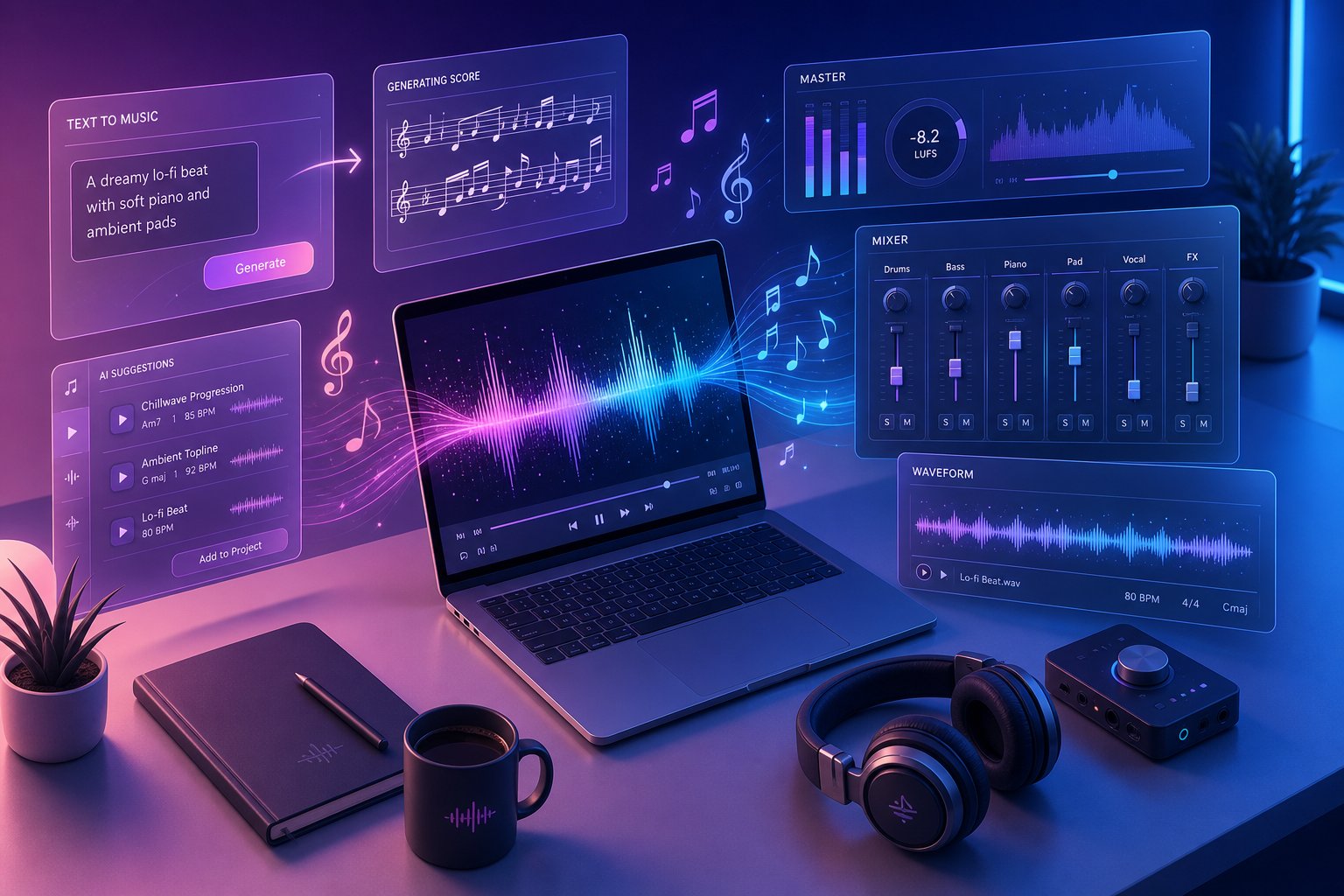
Knowing that AI is reshaping the industry is one thing. Knowing which tools actually deliver is another. The landscape of ai music companies has expanded rapidly, and each platform occupies a distinct niche. Some generate complete songs from a single sentence. Others hand you stems and MIDI files for professional refinement. Choosing the wrong one wastes time and money, so here's how the major players stack up for anyone exploring how to use ai in music production.
Major AI Music Platforms Compared
The differences between platforms come down to a few key variables: what you put in, what you get out, how much control you have, and whether you can use the result commercially. Here's a side-by-side look at the tools defining artificial intelligence for music production right now:
| Platform | Primary Use Case | Input Method | Output Quality | Accessibility |
|---|---|---|---|---|
| MakeBestMusic | Prompt-to-song creation with lyrics and style control | Text prompts, lyrics, style descriptions | Complete songs with vocals, ready for sharing | Beginner-friendly; no musical training needed |
| Suno | Full song generation with vocals | Text prompts, custom lyrics, uploaded audio | Professional-grade with v4.5/v5 models; up to 8-minute tracks | Very easy; free tier offers 50 credits/day |
| Udio | Producer-focused generation and remixing | Text prompts, lyrics, reference audio | High fidelity up to 48 kHz; stem downloads available | Moderate learning curve; 10 free credits/day |
| AIVA | Cinematic and orchestral composition | Style presets, MIDI/audio references, text prompts | Structured compositions up to 10 minutes; MIDI export | More complex interface; suited to composers |
| Boomy | Beginner creation and streaming distribution | One-click style selection | Functional tracks in under 30 seconds | Lowest barrier to entry; built-in Spotify distribution |
| Soundraw | Background music for video creators | Mood, genre, and instrument selection (no text prompts) | Loop-friendly instrumentals with adjustable blocks | Intuitive for non-musicians; no vocals |
Suno remains the default for most users who want a complete song fast. Its v4.5 model, now available on the free tier, handles everything from indie rock to Afrobeat with convincing vocals and coherent song structure. The trade-off: you get less granular control over individual elements.
Udio appeals to producers who want to pull tracks apart. Stem downloads, inpainting to fix specific sections, and ai music genre change through its remix feature make it the strongest option for anyone planning to bring AI output into a DAW for further editing. Following udio ai music news december 2025, the platform settled its UMG lawsuit and announced a licensed platform called Starstruck, signaling a shift toward legitimacy that should reassure creators concerned about downstream copyright risk.
AIVA targets a different audience entirely. Film scorers, game developers, and advertisers who need instrumental compositions with clear copyright ownership gravitate here. Its Pro plan grants full ownership of generated works, a distinction that matters enormously for commercial licensing.
Boomy and Soundraw occupy the functional end of the spectrum. Boomy lets complete beginners create and distribute tracks to streaming platforms in minutes. Soundraw skips text prompts altogether, letting video creators dial in mood and intensity through sliders rather than words. Neither produces the depth of a Suno or Udio track, but that's not their purpose.
Finding the Right Tool for Your Creative Goals
The right platform depends entirely on what you're trying to accomplish. A YouTuber needing background music has different requirements than a songwriter exploring ai and music production as a creative partner. Here's a quick decision framework:
If you want to turn a lyric idea or style description into a finished song without touching a DAW, MakeBestMusic offers the most direct path from concept to complete track. You describe what you want, paste lyrics if you have them, choose a style direction, and receive a fully produced song. It's an accessible entry point for anyone curious about what generative AI can actually do with music, without needing to learn a complex interface first.
If you're a producer who wants raw material to reshape, Udio's stem exports and inpainting give you the most post-generation flexibility. If you need orchestral scoring with ironclad commercial rights, AIVA is purpose-built for that workflow. And if you just want to experiment with zero commitment, Suno's generous free tier lets you generate roughly ten songs per day at no cost.
The broader takeaway: artificial intelligence for music production isn't a single tool. It's an ecosystem where different platforms serve different creative intentions. The best approach is to try several, understand their strengths and constraints firsthand, and decide where AI fits into your specific workflow rather than treating any single platform as a universal solution.
These tools represent where AI music stands today. But the technology is accelerating faster than most people realize, and the trajectory from novelty to Billboard chart-topper took less than two years. Where that acceleration leads next depends on forces far bigger than any single platform.
Where AI Music Is Headed Next
Two years. That's all it took for AI music to go from a viral curiosity on TikTok to a Billboard number-one hit. The acceleration pattern here isn't linear. It's compounding. Each milestone, the deepfake Drake track, the first AI act signed to a label, the first chart entry, arrived faster than the one before it. If that trajectory holds, the next two years will make the last two look like a warm-up.
The Acceleration Pattern and What It Signals
Consider the timeline. In early 2023, "Heart on My Sleeve" went viral as a novelty, something people shared because it was weird and impressive. By mid-2025, AI acts were getting signed to real labels and landing on Billboard charts. By late 2025, platforms like Deezer were receiving over 50,000 fully AI-generated tracks per day, accounting for roughly a third of all new uploads. The AI-generated band The Velvet Sundown racked up over a million monthly Spotify listeners before anyone realized it wasn't human.
This pace tells us something important: the technology isn't plateauing. Each generation of models produces more convincing output, handles longer compositions, and requires less human guidance. The generative ai music news today cycle reflects this. What was cutting-edge six months ago is now a free-tier feature. What seems impossible now will likely be standard by next year.
The stakeholder map has grown equally complex. Regulators are drafting legislation. AI companies are racing to build defensible platforms. Major labels are simultaneously suing and partnering with AI firms. Independent artists are split between fear and experimentation. Hobbyists are flooding platforms with content. Streaming services are building detection systems while quietly benefiting from the engagement that more content generates. Each group is pulling in a different direction, and no single actor controls the outcome.
Will Audiences Care Who Made the Music
This might be the most consequential question in the entire ai music debate. Technology and law can set boundaries, but listener behavior ultimately decides what survives commercially.
The research paints a fascinating picture. A study by Friedrichsen, Schwarz, and Clement found that listeners actually rated AI-generated songs as superior to human-made ones in blind tests. But when told a song was AI-generated, their desire to relisten and their willingness to pay dropped significantly. A separate Deezer and Ipsos survey found that 97% of respondents failed to accurately identify whether tracks were AI-generated or human-made.
So audiences enjoy AI music, they just don't want to know it's AI music. That paradox creates a strange incentive structure. Transparency, the thing regulators and platforms are pushing for, may actually reduce the commercial viability of AI-generated tracks. Meanwhile, undisclosed AI content can thrive precisely because listeners can't tell the difference.
Music curator Antonia Folguera captured this tension well in an interview for the Music Technology Group project: she wouldn't mind if her next favorite song was made by AI, but admitted she'd "get bored pretty fast" once she learned the author was a software program. The emotional connection to a human story behind the music still matters, even when the sound itself is indistinguishable.
The most likely future isn't AI replacing human musicians or humans rejecting AI entirely. It's a hybrid model where AI handles the functional and formulaic while human artistry commands premium value through authenticity, narrative, and live presence.
Will ai take over music completely? The evidence points toward coexistence rather than conquest. AI will dominate where music is treated as a commodity: background tracks, mood playlists, functional audio for content creators. Human artists will retain their hold where music is treated as culture: albums with stories, live performances with presence, voices tied to real lives and real emotions. The boundary between those two worlds, though, will keep shifting as the technology improves and audiences adapt.
The future of music won't be decided by technology alone. It'll be shaped by the choices that artists, creators, and listeners make right now, choices about which tools to adopt, which values to prioritize, and how to position themselves in a landscape that's still being drawn.
What Musicians and Creators Should Do Next
Knowing where ai in the music industry is headed matters less than knowing what to do about it today. The landscape is shifting fast, but the right moves depend on who you are and what you're trying to protect or build. Here's a concrete action plan for each group navigating this transition.
What Independent Artists Should Do Now
If you're a working musician, the worst response is paralysis. The artists who thrive will be those who lean into what AI can't replicate while understanding what it can. As Fast Company's analysis puts it: AI can write a song, but it can't build a career. Your humanity, your story, and your live presence are competitive advantages that compound over time.
- Double down on authenticity and personal brand. Share your creative process, your story, and the human context behind your music. Audiences crave connection that AI cannot deliver.
- Prioritize live performance and community. Touring revenue and direct fan relationships are AI-resistant income streams. Build a Discord, host livestreams, respond to comments personally.
- Learn the tools rather than fear them. Use AI for rapid prototyping, demo creation, or filling skill gaps in production. The 66% of producers already using AI creatively aren't surrendering their craft. They're expanding it.
- Diversify revenue beyond streaming. Sync licensing, merchandise, limited-edition releases, and personalized fan experiences all hold value that AI-generated content floods can't dilute.
- Stay informed on legal developments. Know your rights around voice cloning, style emulation, and training data consent. Opt out of AI training where platforms allow it.
For producers specifically, the benefits of ai in music are clearest when you treat generative tools as collaborators rather than replacements. Generate ten variations of a drum pattern in seconds, use AI to sketch chord progressions you'd never stumble on alone, then shape the output with your own taste and judgment.
How to Start Exploring AI Music Creation
For hobbyists and curious creators, the single best way to understand what music and ai can do together is to try it yourself. Reading about AI music is abstract. Generating your first track makes the capabilities and limitations immediately tangible.
- Generate your first song. Head to MakeBestMusic's AI Music Generator and turn a simple idea, a mood, a lyric fragment, a style description, into a complete track. No musical training required, just a concept and a few minutes.
- Write your own lyrics. Even rough, conversational words will make your output sound ten times more intentional than auto-generated defaults. Specificity beats polish every time.
- Iterate rather than judge the first result. Generate three to five versions, notice what changes when you adjust your prompt, and develop an intuition for steering the output toward your vision.
- Share what you make. Feedback from real listeners teaches you more than another dozen private experiments. Put your track out and see how people respond.
For music fans, your role matters too. Support human artists directly through merch, concert tickets, and platforms that prioritize transparent creator compensation. Your listening choices shape which economic model wins.
The question was never really whether AI would enter the music industry. It already has. The question that matters now is whether you'll shape how it integrates into your creative life, or let it shape you by default.
