

Yes, AI Music Is on Spotify
If you have ever wondered whether the lo-fi beat in your Discover Weekly or the ambient track in your sleep playlist was made by a human, you are not alone. Millions of listeners are asking the same question, and the answer is more layered than a simple yes or no.
The Short Answer About AI Music on Spotify
Yes, AI music on Spotify is real. AI-generated tracks exist across the platform in multiple forms — fully AI-created songs uploaded by third parties, human-AI collaborative productions, and AI-assisted compositions where algorithms handle parts of the writing or production process.
Spotify itself has acknowledged this reality. The platform has taken aggressive action against low-quality, artificially generated content, removing tens of millions of tracks it classified as spam — a figure widely reported to be around 75 million. That cleanup effort signals just how deeply AI-generated material had embedded itself into the catalog before intervention.
Yet not every AI artist on Spotify is a spammer. Some creators openly use AI as a production tool, blending machine-generated melodies with human vocals and instrumentation. Others upload entirely synthetic tracks under anonymous profiles, making it nearly impossible for the average listener to tell the difference. The spectrum is wide, and that is precisely what makes the topic so tricky to navigate.
Why This Question Matters for Every Listener
So why are so many people searching whether Spotify allows AI music? Three concerns keep surfacing. First, authenticity — listeners want to know if the artist they are streaming is a real person or a bot. Second, algorithm dilution — when thousands of AI spotify artists flood the platform with cheap tracks, genuine independent musicians can get buried in recommendation feeds. Third, the sheer pace of change — does Spotify allow AI music today under certain conditions, or is AI music allowed on Spotify only when specific guidelines are met?
These are not abstract industry debates. They affect what shows up in your playlists, where your subscription dollars flow, and whether the next song you save was crafted by a musician pouring emotion into a studio session or generated by software in seconds. This guide breaks down exactly what is happening, how big the problem really is, and what you can do about it as a listener.
The real story, though, starts with scale — and the numbers behind AI music on Spotify are staggering.
How Big the AI Music Problem on Spotify Really Is
Staggering is not an exaggeration. The volume of AI-generated content that has flooded Spotify's catalog in recent years is difficult to grasp without hard numbers — and even those numbers come with significant asterisks. Understanding the true scale of this spam challenge requires looking at what Spotify has disclosed, what independent observers have questioned, and what remains completely hidden from public view.
How Many AI Artists Are on Spotify Right Now
Here is the uncomfortable truth: nobody knows the exact count. Estimates from music industry analysts suggest that thousands of AI-generated artist profiles currently exist on the platform. Some reports place the figure much higher. The problem is that there is no mandatory disclosure requirement forcing creators to identify their work as AI-generated, so the real number stays buried beneath layers of anonymous uploads and generic pseudonyms.
Consider a case that drew widespread attention. The Guardian reported on an AI-generated band that quietly accumulated over 1 million plays before listeners even realized no human musicians were involved. That project was not an outlier — it was just one of the few that got caught. For every fake music artists profile that surfaces publicly, dozens more likely fly under the radar, collecting streams and blending seamlessly into curated playlists.
The lack of transparency creates a compounding issue. When you cannot reliably distinguish AI-produced tracks from human-made ones, the question of how many AI artists exist now becomes almost impossible to answer with precision. Some creators deliberately obscure their methods, while others genuinely blend AI tools into a broader human-driven workflow. The line between "AI artist" and "artist who uses AI" is blurry, and Spotify's current metadata systems were never designed to draw it.
The Scale of Spotify's Cleanup Efforts
Spotify has not ignored the flood. The platform moved aggressively to combat low-quality generative AI music content, and the headline number from that effort is eye-catching:
Spotify removed approximately 75 million tracks from its platform that it classified as spammy or fraudulent, many of which were AI-generated uploads designed to game the royalty system.
Seventy-five million sounds enormous — and it is. But context matters. Spotify's total catalog contains well over 100 million tracks. Critics, including analysts at Pragmatics Studio, have pointed out that measuring the 75 million figure against the platform's overall library raises important questions. How much of the remaining catalog still contains undetected AI content? Were all removed tracks genuinely low-quality, or did some legitimate AI-assisted music get swept up in bulk removals? And what happens when new AI tracks are uploaded faster than old ones are taken down?
What did Spotify do recently beyond raw removals? The platform also updated its policies, tightened distributor agreements, and introduced new fraud detection mechanisms. Spotify removed songs from playlist rotations when streaming patterns looked artificially inflated — a common tactic where bot-driven plays boost tracks into algorithmic recommendations. These cleanup efforts represent the largest content purge in the history of any 1m streaming platform, yet industry observers remain divided on whether they are enough.
The tension at the heart of this effort is real. Spotify wants to eliminate spam and protect royalty pools for human artists, but it also cannot afford to penalize legitimate creators who use AI as one tool among many. Drawing that line at scale — across millions of uploads per year — is the kind of enforcement puzzle that no platform has fully solved.
And behind every policy decision and bulk removal, individual stories highlight just how convincing AI-generated music has become. Some AI bands did not just slip through the cracks — they built genuine fanbases before anyone realized the truth.
Notable AI Artists and Bands Streaming on Spotify
Some of those fanbases were not small. AI bands have moved well past novelty experiments and into the territory of genuine streaming success — racking up plays, landing on editorial playlists, and attracting listeners who had no idea they were hearing machine-generated music. The stories behind these projects reveal just how convincing AI music artists have become and why the line between human and synthetic creation keeps getting harder to spot.
AI Bands That Fooled Spotify Listeners
The most widely reported case involved an AI-generated project that quietly amassed over 1 million plays on Spotify before journalists and listeners started asking questions. As covered by The Guardian and later picked up by Rolling Stone, the project featured tracks that sounded indistinguishable from indie or lo-fi artists already thriving on the platform. No live performances, no interviews, no social media presence beyond a minimal profile — yet the streams kept climbing.
That case was far from isolated. Listeners have increasingly turned to forums and social media to investigate suspicious profiles. Searches like "is Velvet Sundown an AI band" started trending as people tried to verify whether certain artists on their playlists were real. The ai band Velvet Sundown project, along with similar names like the violet opal band ai discussion threads, became flashpoints in a broader debate about transparency on streaming platforms. Whether these specific projects turned out to be fully AI-generated or human-AI hybrids, the mere fact that listeners could not tell sparked legitimate concern.
The playbook behind these AI generated bands typically follows a pattern. A creator uses generative tools to produce dozens or even hundreds of tracks in a short period. The music gets uploaded through a third-party distributor under a fabricated artist name. Generic but pleasant-sounding genres like ambient, lo-fi hip-hop, and chill electronic are favored because they blend into background-listening playlists where individual track scrutiny is low. By the time anyone investigates, the streams — and the royalty payments — have already been collected.
The Spectrum of AI Involvement in Music
One of the biggest misconceptions is that AI music is a single category. In reality, the level of artificial intelligence involvement varies dramatically from one project to the next. A track labeled as "AI" could mean anything from a fully synthetic composition with zero human input to a traditionally recorded song where AI simply assisted with mixing. Understanding this spectrum is essential for any listener trying to make sense of ai artists on Spotify.
The following table breaks down the four primary categories you will encounter:
| Level of AI Involvement | Description | Spotify Prevalence | Listener Awareness |
|---|---|---|---|
| Fully AI-Generated | No human performance whatsoever — melody, lyrics, vocals, and production are all created by AI algorithms. | Moderate and growing, especially in ambient, lo-fi, and background music genres. | Very low. These tracks are designed to sound human and rarely carry any AI disclosure. |
| AI-Assisted Composition | A human performs and records the music, but AI writes or co-writes the melodies, chord progressions, or lyrics. | Widespread. Many producers use AI composition tools as part of their creative workflow. | Low. Most listeners cannot distinguish AI-written songs from fully human-written ones. |
| AI-Enhanced Production | Human artists create and perform the music, but AI handles mixing, mastering, or sound design elements. | Very common. AI mastering services are used by thousands of independent artists. | Minimal. Listeners rarely notice or care about production-side AI use. |
| AI Voice Cloning (Deepfake Vocals) | AI replicates the voice of a real artist without authorization, creating tracks that sound like established musicians. | Low but high-profile. Notable cases have gone viral and triggered policy crackdowns. | High when exposed. These cases generate significant media attention and public backlash. |
Notice the pattern in that last column. The more deeply AI is embedded in the creative process, the less likely listeners are to detect it — unless the case involves a recognizable voice being cloned, which tends to make headlines fast. For the thousands of ai bands operating in ambient or instrumental spaces, detection remains almost nonexistent.
This spectrum also explains why platform-wide enforcement is so complicated. A blanket ban on AI involvement would sweep up producers who simply use AI mastering tools alongside fully synthetic spam accounts. The challenge for Spotify — and every other streaming service — is creating rules that address each category differently. And those rules, as it turns out, are still very much a work in progress.
Spotify's Official Rules on AI-Generated Music
Rules that are still a work in progress — but rules nonetheless. Spotify has not left the AI question unanswered. The platform has rolled out specific policies targeting AI-generated content, and understanding what is actually permitted versus prohibited is essential for anyone wondering whether you can upload AI music to Spotify or how the platform decides what stays and what gets pulled.
What Spotify's Terms of Service Say About AI Uploads
Spotify's policy framework around AI content has tightened considerably. The platform's newsroom announcements on artist protections outline several key positions that define how AI-generated material is treated on the service.
At the core, Spotify draws a hard line on one specific issue: impersonation. AI-generated content that mimics a real artist's voice, style, or likeness without authorization is explicitly prohibited. This policy emerged largely in response to viral deepfake tracks — think AI-cloned vocals of major artists appearing on the platform without consent. When those cases made ai copyright music news headlines, Spotify moved quickly to establish that unauthorized voice cloning violates its terms.
Beyond impersonation, the platform has introduced requirements around ai content tagging. Distributors uploading music to Spotify are now expected to disclose when a track involves AI-generated elements. This ai tagging requirement is not optional — it is baked into the updated agreements between Spotify and its distribution partners. The goal is straightforward: create a metadata trail that helps Spotify identify, categorize, and if necessary act on AI content before it reaches listeners' playlists.
Does Spotify allow AI upload from Riffusion, Suno, or similar generators? The answer is nuanced. Spotify does not ban AI-generated music outright. A track created with AI tools can exist on the platform as long as it does not impersonate real artists, does not involve streaming fraud, and is properly disclosed through the distribution chain. The distinction matters — Spotify's stance is not anti-AI, it is anti-deception.
Enforcement Challenges and the Distributor Bottleneck
Here is where policy meets reality, and the gap is significant. Spotify does not accept uploads directly from most creators. Instead, the vast majority of music — AI-generated or otherwise — reaches the platform through third-party distributors like DistroKid, CD Baby, TuneCore, EmuBands, and others. Some creators specifically seek out a spotify distributor free of charge, which lowers the barrier to entry even further.
This creates a bottleneck problem. Enforcement depends almost entirely on these intermediaries accurately flagging AI content during the upload process. If a distributor fails to ask the right questions, or if a creator simply does not disclose that their track was AI-generated, the content slips through untagged. Spotify then has to rely on after-the-fact detection — algorithmic pattern recognition, user reports, or manual review — to catch what the front gate missed.
Imagine the scale of that challenge. Tens of thousands of new tracks are uploaded to Spotify every single day. Expecting perfect AI disclosure from every distributor and every creator is unrealistic, and Spotify knows it. The result is a policy that looks strong on paper but faces persistent enforcement gaps in practice.
The key policy points, as they currently stand:
- No AI-generated impersonation of real artists — tracks using cloned voices or unauthorized likenesses are removed and may result in distributor penalties.
- Distributors must disclose AI involvement — failure to flag AI-generated content violates updated distributor agreements.
- Streaming fraud triggers immediate removal — artificially inflated play counts, whether on AI or human tracks, result in takedowns and potential account bans.
- Content must meet quality and originality standards — bulk-uploaded, low-effort tracks designed purely to game royalty pools are classified as spam regardless of how they were made.
Notice what is missing from that list: a requirement for listener-facing labels. Unlike some competing platforms that have begun marking AI content visibly for users, Spotify's current tagging system operates behind the scenes. Listeners scrolling through their Discover Weekly have no built-in way to see whether a track was flagged as AI-generated during upload. The metadata exists in the backend, but it has not yet surfaced to the consumer experience.
This enforcement architecture — strong distributor-facing rules paired with limited listener transparency — explains much of the ongoing confusion around copyright music ai news and platform accountability. The policies exist, but their effectiveness hinges on a chain of trust that starts well before a track ever appears in your feed.
That invisible enforcement layer raises a natural question: if listeners cannot see AI labels, and the platform's own AI features power everything from DJ mode to personalized playlists, where exactly does the line between Spotify's AI and uploaded AI content begin and end?
Spotify's AI Features vs AI-Generated Uploads
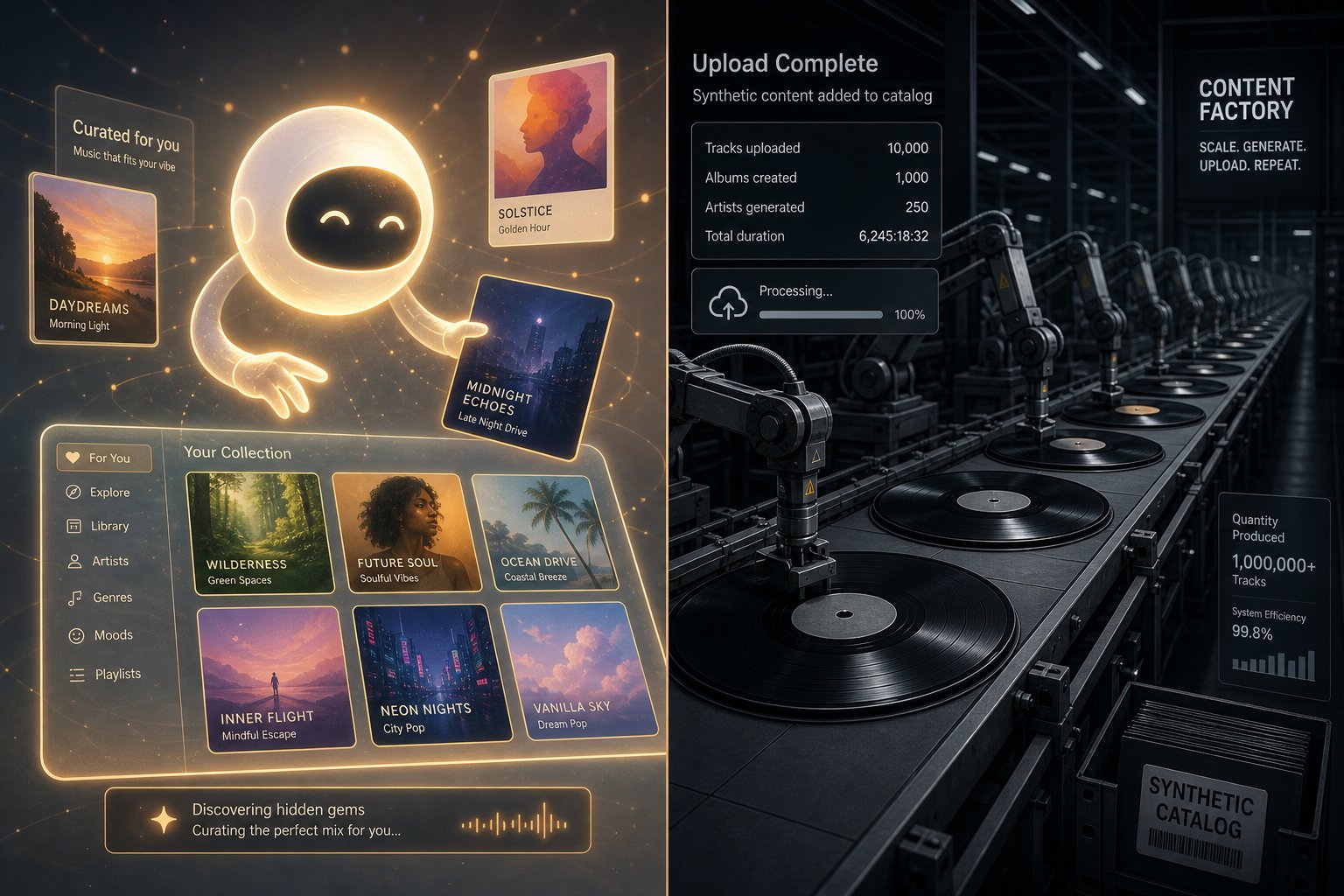
That line is far blurrier than most listeners realize — and the confusion is understandable. When someone searches for AI on Spotify, they could be asking about two completely different things. One is externally created AI music uploaded to the platform by anonymous producers. The other is Spotify's own suite of AI-powered tools designed to personalize your listening experience. These two categories share the same acronym but have almost nothing else in common, and conflating them leads to unnecessary alarm.
Spotify's Own AI-Powered Features Explained
Spotify has invested heavily in artificial intelligence — not to generate music, but to help you find it. The platform's AI role in music recommendation and personalization drives nearly every surface you interact with, from your home screen to your year-end Wrapped summary. If you have ever wondered how to use Spotify AI, you are probably already doing it without thinking about it.
The AI DJ, launched as a Premium feature, acts like a personal radio host. It uses a realistic synthetic voice to introduce tracks, explain why it picked them, and guide you through a mix based on your listening history. Daylist takes a different approach, generating hyper-specific playlist titles — think "cozy rainy-day indie Tuesday afternoon" — that update multiple times per day based on your mood patterns and time-based habits. Meanwhile, the core recommendation engine quietly powers Discover Weekly, Release Radar, and the suggested tracks that auto-play after your queue ends. Every time you let Spotify choose artists for a radio station or apply a music filter to narrow your search, algorithms are doing the heavy lifting.
Here is the critical distinction: none of these features create music. They curate, organize, and surface human-made tracks. The following table makes that separation concrete.
| Feature Name | What It Does | Does It Create Music? | Available To |
|---|---|---|---|
| AI DJ | Delivers a personalized listening session with a synthetic voice host that introduces songs and explains selections. | No | Premium |
| Daylist | Generates dynamic, mood-based playlists with quirky descriptive titles that refresh throughout the day. | No | Free and Premium |
| Discover Weekly | Compiles a weekly playlist of 30 tracks tailored to your taste profile using collaborative filtering algorithms. | No | Free and Premium |
| Release Radar | Surfaces new releases from artists you follow and artists the algorithm predicts you will enjoy. | No | Free and Premium |
| Smart Shuffle | Adds recommended songs into your existing playlists based on the tracks already included. | No | Premium |
Every entry in that "Does It Create Music" column reads the same way. Spotify's native AI is a curation engine, not a composition engine.
Third-Party AI Music vs Platform AI Tools
This distinction matters because public conversation frequently blurs the two categories into one. A viral ai spotify roast — where users share humorously brutal AI-generated summaries of their listening habits — is a fun personalization feature. It has nothing to do with synthetic tracks being uploaded by anonymous accounts to game royalty payments. Similarly, when newsroom ai tools news covers Spotify's latest algorithm updates, readers sometimes assume the platform itself is flooding its catalog with machine-made songs. It is not.
The controversy lives entirely on the upload side. Third-party creators use external generators to produce tracks and then push them onto Spotify through distributors. The platform's own AI, by contrast, rates Spotify's existing catalog to determine what you hear next — analyzing tempo, key, energy levels, and your behavioral patterns to serve personalized recommendations. One process adds questionable content to the library. The other helps you navigate a library that already holds over 100 million tracks.
Understanding this split changes how you evaluate the risks. Spotify's recommendation AI is not the problem — it is actually part of the solution, since its pattern-detection capabilities can theoretically flag suspicious uploads. The real vulnerability lies in the gap between platform-side intelligence and the flood of AI content arriving through distribution pipelines that were built long before generative music tools existed.
Knowing what Spotify's AI does — and does not — do is only half the equation, though. The practical question for most listeners is more immediate: when an unfamiliar track shows up in your feed, how can you actually tell whether it was made by a person or a machine?
How to Spot AI-Generated Music in Your Spotify Feed
The honest answer? You cannot always tell. No platform — Spotify included — currently offers a reliable, listener-facing label that flags AI-generated tracks. But that does not mean you are completely in the dark. Several red flags, when combined, can help you make an educated guess about whether the music in your queue was crafted in a studio or assembled by an algorithm. Think of it less like a definitive test and more like a checklist of suspicion.
Red Flags in Artist Profiles and Track Metadata
Imagine you are scrolling through a Discover Weekly playlist and an unfamiliar name catches your ear. The track sounds polished, maybe a lo-fi beat or an ambient wash that fits your taste perfectly. Before you hit follow, take thirty seconds to investigate the artist profile. What you find — or do not find — can reveal a lot.
Here are the most common warning signs that a track might be AI-generated:
- The artist has no social media presence or bio. Tap on the artist page. A legitimate musician almost always includes links to Instagram, Twitter, or a personal website. An empty bio with zero external connections is one of the clearest red flags. Human artists want to be discovered — fake music Spotify profiles do not.
- Hundreds of tracks released in a suspiciously short timeframe. Check the discography section. If an artist dropped 200 tracks across 15 albums in the span of three months, that output pace is virtually impossible for a solo human creator. Bulk releases at machine speed are a hallmark of AI-generated catalogs.
- Generic or unusual artist names with no public history. Search the artist name on Google. A real musician will typically have at least some digital footprint — a local news mention, a Bandcamp page, a YouTube video. If the name returns zero results outside of Spotify and a few auto-generated lyrics sites, that absence is telling.
- No credited songwriters or producers. Where available, check the song credits by tapping the three-dot menu on a track. Legitimate releases usually list writers, producers, and sometimes labels. Missing credits or a single anonymous name repeated across dozens of genre-diverse tracks suggests automated generation.
- Uniform production quality across wildly different genres. An artist who produces jazz, EDM, classical piano, and lo-fi hip-hop — all at the same competency level, all with a similar sonic sheen — is statistically unlikely to be one person. AI generators, however, handle genre-hopping effortlessly because they draw from the same underlying models regardless of style.
No single item on that list is definitive proof. Plenty of real independent artists have sparse profiles, especially early in their careers. But when three or four of these flags appear simultaneously, the probability shifts significantly toward AI origin.
Tools and Techniques Listeners Can Use
Beyond visual profile checks, a few practical steps can sharpen your ability to tell if a song is AI generated — or at least raise the right questions.
Start with the verification badge. Spotify grants verified status to artists who claim their profiles through Spotify for Artists. While verification alone does not guarantee a human creator, the absence of verification on a profile with thousands of monthly listeners is worth noting. Most serious musicians claim their pages to access analytics and promotional tools.
Next, look for what the industry calls made by tags — the small credits and metadata labels attached to individual tracks. These marking tags can include songwriter names, producer credits, and label information. Spotify surfaces some of this data in the track details view, though the depth varies. When every track under an artist name shares identical or missing tag information, the pattern stands out.
Cross-referencing outside Spotify is another powerful technique. Search the artist name plus keywords like "interview," "live show," or "tour" to see if any real-world activity exists. AI-generated profiles rarely have article tag mentions in music blogs, concert listings, or fan community discussions. A complete absence from the broader internet ecosystem is a strong signal.
Pay attention to your own recommendation patterns too. If Spotify suddenly starts surfacing multiple unfamiliar artists with suspiciously similar sounds — all with minimal follower counts and no verified status — the algorithm may be pulling from a cluster of AI-generated uploads that were optimized for the same listener profile as yours.
The bigger question hovering over all of this is what percentage of AI detection is acceptable at the platform level. Industry discussions around how much AI detection is acceptable remain unresolved. Some argue that even a 90% accurate detection system would still let thousands of synthetic tracks through given the volume of daily uploads. Others contend that imperfect detection is better than none at all — especially when listeners currently have zero built-in tools to make the distinction themselves.
And that last point is the critical gap. YouTube has already begun requiring creators to disclose AI-generated content, surfacing visible labels directly to viewers. Spotify, by contrast, collects AI disclosure data from distributors but has not yet pushed that information to the listener-facing experience. You can look up a list of ai artists on Spotify through independent community efforts and investigative reporting, but the platform itself does not offer one.
Until visible labeling arrives — if it arrives — the burden falls on listeners to stay alert. The red flags above will not catch everything, but they transform passive listening into informed listening. And as platform policies continue to evolve at different speeds, understanding how Spotify's approach compares to its competitors adds another essential layer of context.
How Spotify Compares to Other Platforms on AI Music
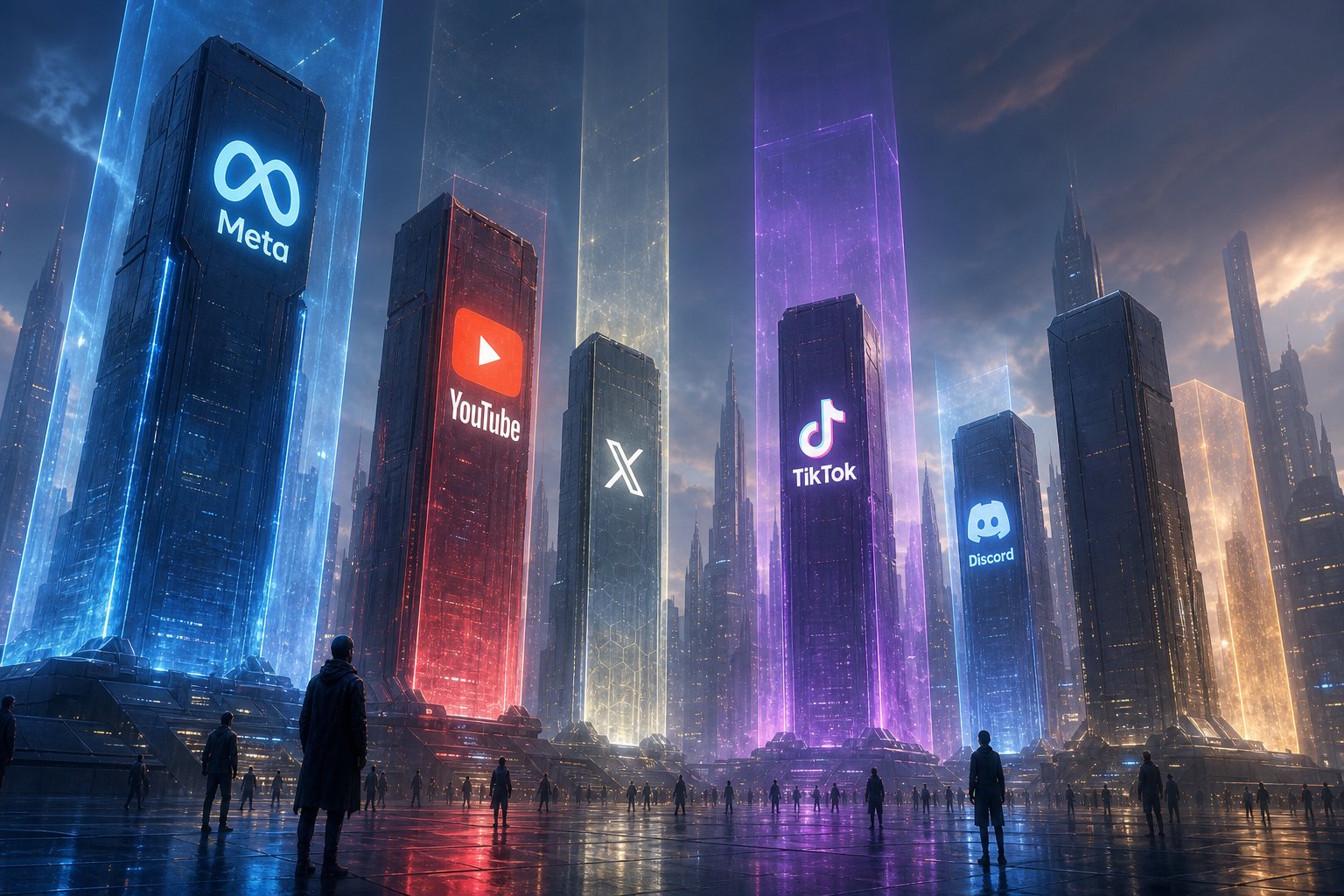
Different speeds, different priorities. Spotify is not the only platform grappling with AI-generated content — every major music and media service faces the same fundamental challenge. But the approaches vary widely, and understanding where Spotify sits relative to YouTube, Apple Music, TikTok, and Meta helps you gauge how much transparency you are actually getting as a listener. Some platforms have moved faster on labeling. Others have taken a harder line on removals. None have solved the problem completely.
Platform-by-Platform AI Music Policies
The landscape of ai music regulation news has accelerated considerably. YouTube made headlines with its requirement that creators disclose AI-generated or significantly altered content, including synthetic vocals and AI-produced visuals. Apple Music has taken a more conservative posture, tightly controlling what enters its catalog through its distributor relationships — to the point where some creators have encountered apple music content not authorized rejections when submissions raise red flags. TikTok and Meta, meanwhile, operate in a gray zone where short-form AI music clips circulate freely while longer-form policies remain less defined.
The following table lays out where each platform currently stands across the dimensions that matter most to listeners:
| Platform | AI Labeling Required | AI Upload Policy | Enforcement Method | Transparency to Listeners |
|---|---|---|---|---|
| Spotify | Partial (distributor-facing only) | Allowed with disclosure; no impersonation | Bulk removals, fraud detection algorithms, distributor agreements | Low — no visible labels for listeners |
| YouTube | Yes (creator must disclose) | Allowed with mandatory disclosure for realistic AI content | Creator self-disclosure, automated detection, community flagging | High — visible labels appear on videos with AI-generated content |
| Apple Music | No formal public system | Restrictive; tighter distributor gatekeeping | Distributor vetting, manual review for flagged content | Low — no listener-facing indicators |
| TikTok | Partial (for AI-generated avatars and voices) | Permitted for short-form; evolving restrictions on deepfakes | Automated content moderation, user reports | Moderate — some AI labels on effects and filters |
| Meta (Instagram/Facebook) | Yes (for AI-generated images; audio policies developing) | Permitted with emerging disclosure requirements | Metadata detection, industry partnerships for AI watermarking | Moderate — "AI Generated" labels on some visual content, less consistent for audio |
A clear pattern emerges from that comparison. Platforms built around video — YouTube, TikTok, Meta — have moved faster on visible labeling because their AI concerns extend to visual deepfakes that carry immediate political and social risks. Audio-first platforms like Spotify and Apple Music have focused more on backend enforcement and distributor-level controls, leaving the listener-facing experience largely unchanged.
The regulatory environment is pushing all of these platforms toward greater transparency. The EU AI Act deepfake labeling requirements rolling out through 2024 and 2025 mandate that AI-generated content be clearly identified to end users, regardless of platform. As these rules take effect across European markets, every streaming service will face pressure to surface AI disclosures — not just collect them internally. That shift represents one of the most significant pieces of ai music regulation news for listeners who want to know what they are hearing.
Where Spotify Leads and Where It Lags
Give Spotify credit where it is due: no other platform has executed content removals at the same scale. The 75 million track purge dwarfs anything YouTube, Apple Music, or Meta has publicly disclosed. When it comes to sheer volume of spam elimination, Spotify has been the most aggressive actor in the streaming space. Its fraud detection systems and updated distributor contracts represent a genuine investment in catalog integrity.
Where Spotify falls behind is listener empowerment. YouTube's approach — requiring creators to check a box disclosing AI involvement, then displaying that information directly to viewers — creates accountability that Spotify's system currently lacks. A YouTube viewer can see a label and make an informed choice. A Spotify listener scrolling through a playlist gets no equivalent signal. The data might exist somewhere in Spotify's backend metadata, but it never reaches the person pressing play.
This gap matters in the context of broader labels industry news. Major record labels have pushed hard for transparency mechanisms that protect their artists from AI impersonation and catalog dilution. Their lobbying efforts target every platform, but the visibility of enforcement varies. YouTube's public-facing labels give rights holders — and listeners — a tangible signal that policies are working. Spotify's behind-the-scenes approach, while arguably more aggressive in raw numbers, offers no such visible reassurance.
The ai music Instagram landscape adds another layer. Meta's decision to label AI-generated visual content has created user expectations that will inevitably spill over into audio. When listeners see "AI Generated" tags on Instagram Reels with synthetic music, they start wondering why their streaming platform does not provide the same clarity. Cross-platform consistency in labeling is not here yet, but regulatory pressure and user demand are pushing in that direction.
Apple music vs Spotify comparisons in this space often come down to philosophy. Apple's tighter gatekeeping means less AI content enters the catalog in the first place — fewer tracks to remove, but also less transparency about what slips through. Spotify's open ecosystem accepts more content by design, then relies on detection and removal after the fact. Neither approach is perfect, and both leave gaps that sophisticated AI uploaders can exploit.
What becomes clear from this cross-platform view is that policy alone — regardless of how strict — does not resolve the underlying tension. The real question is not just what platforms prohibit on paper, but what the presence of AI music means in practice for the people who create and consume it every day.
What AI Music on Spotify Means for Creators and Listeners
That tension between policy and practice does not stay abstract for long — not when you are an independent musician watching anonymous AI profiles siphon streams that could have reached your audience. The flood of synthetic content on streaming platforms creates real economic and creative consequences for human artists, but it also opens a parallel conversation that deserves honest attention: AI is not just a threat to creators. For many, it is becoming an indispensable tool.
The Impact on Independent Musicians and Producers
Picture yourself as an indie artist who just spent three months writing, recording, and mixing an EP. You upload it through your distributor, and it enters a catalog of over 100 million tracks — a growing percentage of which were produced by algorithms in minutes rather than months. Those AI-generated tracks cost virtually nothing to create, yet they compete for the same algorithmic real estate and generate the same per-stream royalty payments as your carefully crafted songs.
This is the core economic problem. When beats by ai flood playlist categories like ambient, lo-fi, and focus music, they dilute the pool of attention that Spotify's recommendation engine distributes. Every playlist slot occupied by a synthetic track is a slot unavailable to a human artist. Every fraction of a cent paid to a spam account is a fraction pulled from the royalty pool shared by legitimate ai musicians and traditional creators alike. For producers in a ecosystem already squeezed by low per-stream payouts, that dilution compounds quickly.
The discovery pipeline suffers too. Spotify's algorithms prioritize engagement signals — saves, repeat plays, playlist additions. AI-generated tracks optimized for passive listening in background playlists can rack up these signals efficiently, pushing human artists further down the recommendation queue. Independent musicians are not just competing with each other anymore. They are competing with software that never sleeps, never takes breaks, and never runs out of ideas.
Legitimate Uses of AI in Music Creation
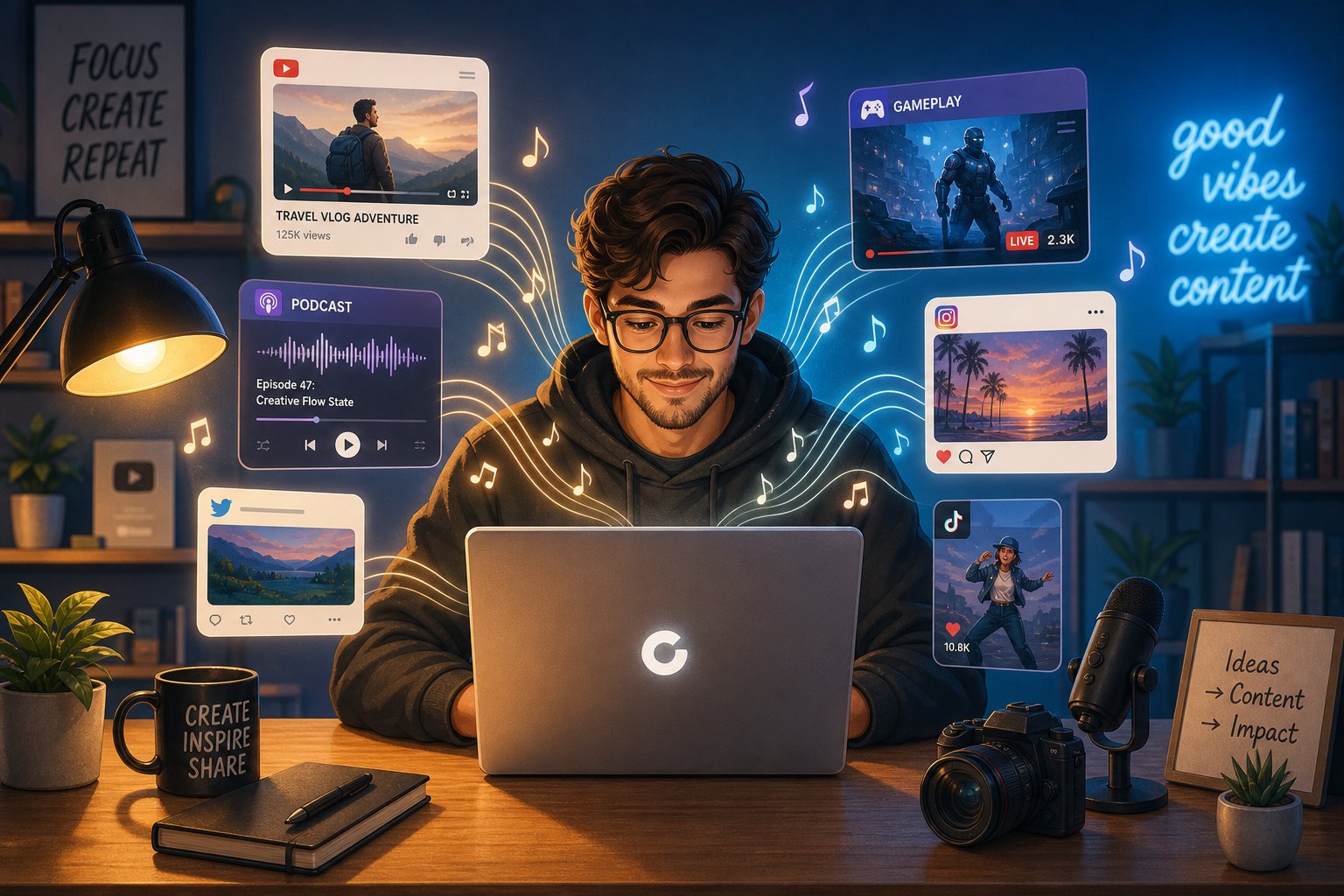
Here is where the conversation needs nuance. Condemning every application of AI in music would be both impractical and unfair. The same technology that enables spam also powers genuinely useful creative workflows. An ai producer might use generative tools to sketch chord progressions before adding live instrumentation. A podcaster might need a custom intro theme without the budget to hire a composer. A game developer might require hours of adaptive soundtrack material that no single human musician could deliver on deadline.
The legitimate use cases are broad and growing:
- Background music for video content — YouTubers, filmmakers, and course creators need royalty-free tracks that fit specific moods without licensing headaches.
- Podcast intros and outros — Short, branded audio signatures that set the tone for a show without recurring licensing fees.
- Game soundtracks — Interactive media often demands large volumes of adaptive music that responds to gameplay dynamics.
- Social media content — Creators on TikTok, Instagram, and YouTube Shorts need quick, original audio to avoid copyright strikes.
- Creative experimentation — Musicians exploring generative music as a compositional starting point, blending machine output with human artistry.
What separates these use cases from the spam problem is intent and transparency. A video creator generating a background track for their own project is not flooding Spotify with fake artist profiles or gaming royalty pools. They need music for a specific purpose, and AI tools designed for that workflow deliver real value.
This is exactly where tools like MakeBestMusic's Free Music Generator fit into the picture. Rather than uploading anonymous AI tracks to streaming platforms — contributing to the very catalog pollution discussed throughout this article — creators can generate free, royalty-free music directly for their videos, podcasts, games, and social content. The music serves a defined project instead of clogging a streaming ecosystem. It is ai for music production applied responsibly: transparent, purpose-driven, and entirely separate from the streaming royalty debate.
The broader AI music tool landscape offers various approaches. Platforms like Suno let users earn credits to generate tracks, and some creators look for an ai song generator that allows explicit lyrics for specific project needs. The common thread among responsible tools is that they empower creators to produce music for direct use rather than incentivizing mass uploads to streaming services.
The distinction is simple but important. Using generative music tools for your own content projects is creative empowerment. Uploading hundreds of synthetic tracks under fake names to collect streaming royalties is exploitation. The technology is identical — the intent and execution are what draw the ethical line.
And as that line continues to shift alongside evolving platform policies and regulatory frameworks, the final question becomes personal: what should you actually do with all of this information, whether you are a listener trying to support real artists or a creator navigating the new landscape?
The Bottom Line on AI Music and Streaming
That personal question deserves a clear, practical answer — not more ambiguity. Whether you are a casual listener who just wants to know what is playing in your headphones or a creator deciding how to integrate AI into your workflow, the landscape has shifted enough that staying passive is no longer an option. The good news? You do not need to become an industry expert to make informed choices. You just need to understand the essentials.
Key Takeaways About AI Music on Spotify
After examining platform policies, enforcement gaps, cross-platform comparisons, and the real impact on creators and listeners, a few core truths stand out above the noise:
AI-generated music is already on Spotify, policies are evolving but remain imperfect, listeners should stay informed and skeptical of anonymous profiles, and the technology itself is not inherently harmful — how it is used and whether it is disclosed transparently makes all the difference.
The ai music updates keep coming fast. New ai songs appear on the platform daily, some created responsibly as part of human-AI collaborations and others uploaded as anonymous spam designed to siphon royalties. Spotify has removed tens of millions of tracks and tightened distributor requirements, but enforcement still depends on a chain of trust that breaks down at multiple points. Viral ai songs have demonstrated that listeners often cannot distinguish synthetic tracks from human performances — a reality that is unlikely to change until platforms implement visible, consumer-facing labels.
The debate around ai vs real art is not going away. Neither is the question of does ai steal art when it trains on existing catalogs without explicit consent. These are legitimate concerns, and they deserve ongoing public attention. But reducing the entire conversation to fear misses what artists can do that AI cannot in 2025 and beyond — bring lived experience, emotional specificity, and cultural context that no algorithm replicates authentically. What is an ai artist, ultimately? A tool output. What a human artist creates carries intention, vulnerability, and meaning that listeners instinctively recognize, even when they cannot articulate why.
Making Informed Choices as a Listener and Creator
For listeners, the action steps are straightforward. Check artist profiles before following — look for social media links, a real bio, and a release history that reflects human creative timelines. Support verified artists whose work you enjoy by saving tracks, sharing playlists, and attending live events when possible. Understand that Spotify's algorithms may surface AI content in your recommendations, and use the red flags outlined earlier in this guide to filter your experience with intention rather than passivity.
For creators, the path forward requires a different kind of clarity. If you plan to upload AI-assisted music to streaming platforms, understand the policies thoroughly — disclosure is mandatory, impersonation is prohibited, and streaming fraud triggers removal. Transparency is not just an ethical choice; it is increasingly a legal one as regulations like the EU AI Act tighten labeling requirements across markets.
Many creators, though, do not need to navigate streaming platform complexities at all. If your goal is original music for a YouTube video, a podcast intro, a game soundtrack, or social media content, generating it directly for your project is simpler, faster, and completely sidesteps the ethical tangles of anonymous streaming uploads. Tools like MakeBestMusic's Free Music Generator exist precisely for this use case — free, royalty-free music you can create and use commercially without contributing to catalog pollution or wading through distributor policies. It is the difference between adding to the problem and solving your own creative need cleanly.
The ai songs 2025 landscape will continue to evolve as detection technology improves, regulations mature, and platforms compete on transparency. Staying informed is not a one-time exercise — it is an ongoing practice. Bookmark reliable sources for ai music updates, pay attention to policy announcements from Spotify and its competitors, and revisit your own assumptions as the technology and the rules around it change.
AI music on Spotify is not a crisis to panic over or a trend to ignore. It is a permanent shift in how music gets made, distributed, and consumed. The listeners and creators who thrive in this new reality will be the ones who understand what they are hearing, know what tools are available, and make deliberate choices about both.
