


AI Is Already Getting Better at Making Music and the Pace Is Accelerating
Will AI get better at helping with making music? Yes, and the evidence is not even close to ambiguous. Every measurable indicator — from audio fidelity and compositional complexity to sheer adoption speed — points in one direction. The tools available right now would have been unrecognizable just two years ago, and the trajectory suggests the next leap forward is already underway.
That said, this is not a hype piece. If you actually make music, you deserve a clear-eyed look at where things stand, where the gaps remain, and why the pace of improvement should genuinely matter to you.
A Direct Answer Backed by Evidence
Here is the thesis: AI music tools are improving rapidly across multiple dimensions, and reliable technological trends — larger training datasets, more powerful models, growing industry investment — make continued advancement highly predictable. Carnegie Mellon University research confirms that humans still lead in creativity, with AI-assisted compositions judged by listeners as less creative than purely human work. That finding is legitimate and worth taking seriously. But it captures a snapshot, not a trajectory. The same research team acknowledged that this field is just beginning its mode of inquiry, and that artificial intelligence in music is evolving in ways we are only starting to measure.
Throughout this article, you will find concrete evidence organized into categories: the historical improvement curve from primitive MIDI generators to full-song creation, the technical mechanisms that make progress predictable, the specific limitations that researchers are actively solving, a five-area framework for understanding where tools are getting better, and the investment signals from major industry players betting billions on this space.
Why This Question Matters to Every Music Creator
Whether you are a bedroom producer sketching out ideas at midnight, a songwriter hunting for the right chord progression, or a professional looking to streamline tedious production tasks, AI's trajectory directly shapes your creative future. This is not a question reserved for tech analysts or music executives. It is your question.
Consider the pattern. AI image generation went from producing blurry, disfigured faces to photorealistic artwork in roughly two years. AI text generation leaped from clumsy paragraphs to nuanced long-form writing in a similar window. Research from Harvard Kennedy School's Project on Workforce found that generative AI has been adopted faster than both personal computers and the internet — a pace that historically correlates with rapid capability improvement driven by user feedback and massive investment. AI music news consistently reflects this same acceleration: tools that sounded robotic months ago now produce tracks that 97% of listeners cannot reliably distinguish from human-made music.
AI creative tools have consistently improved in capability faster than even optimistic predictions suggested. The musicians who understand this trajectory early will be the ones best positioned to use it.
The real story is not whether these tools will improve. It is how fast, in which specific areas, and what that means for the people who actually sit down to make music. That is exactly what the evidence reveals.
From Simple MIDI Loops to Full AI-Generated Songs
The strongest argument that AI will keep getting better at music is the one staring us in the face: look at how far it has already come. The leap from primitive algorithmic experiments to tools that generate radio-ready tracks with vocals, instruments, and mixing is not a matter of decades-long, glacial progress. Much of it happened in sharp, dramatic jumps — each one making the previous generation sound like a toy.
Early Experiments in Algorithmic Composition
The intersection of music and artificial intelligence stretches back further than most people realize. In 1956, university professors Lejaren Hiller and Leonard Isaacson programmed the ILLIAC I — one of the first academic supercomputers — to compose the Illiac Suite (String Quartet No. 4). The machine did not "understand" music. It organized an array of algorithmic choices provided by Hiller, essentially following rule-based instructions to assemble notes into sequences. The result baffled audiences at the time, but it planted a seed: computers could participate in the act of composition.
Through the following decades, composers experimented with Markov chains — statistical models that predict what note or chord might come next based on probability. John Cage explored randomness and externalized decision-making as early as the 1950s with Music of Changes, using the ancient I Ching to assign musical parameters. Brian Eno pushed similar ideas in the 1970s with his Oblique Strategies cards, nudging musicians away from creative comfort zones. These were not computer-based systems, but they established a critical principle: creative decisions could be guided by systems outside the human mind. That principle would eventually find its fullest expression in neural networks.
The Neural Network Breakthrough
Rule-based systems could follow instructions, but they could not learn. That changed with the arrival of deep learning. David Cope's Experiments in Musical Intelligence (EMI) program in 1997 marked a pivotal shift. Rather than simply following preset rules, EMI analyzed existing compositions — recognizing patterns in chord structures, melodic contours, and arrangement choices — and then generated new pieces that mirrored those styles. EMI could replicate the intricacies of Bach and other classical composers convincingly enough to fool listeners. Computer-generated music was no longer a curiosity. It was becoming credible.
The next wave brought reinforcement learning and neural networks modeled loosely on the human brain. Platforms like AIVA built deep learning engines that drew from vast archives of music, identifying commonalities across thousands of compositions and using that knowledge to create new, stylistically coherent pieces. By the early 2020s, these AI-driven tools were producing music increasingly indiscernible from human-composed work. Meanwhile, tools like iZotope's Assistive Audio Technology and Zynaptiq's Adaptiverb applied machine learning directly to mixing and production tasks — analyzing source audio and making intelligent processing decisions in real time.
The Current Generation of Full-Song AI Tools
Imagine telling someone five years ago that you could type a sentence — "upbeat 80s synth-pop anthem about city lights" — and receive a complete song with vocals, harmonies, drum patterns, bass lines, and a polished mix within seconds. They would not have believed you. Yet that is precisely what the current generation of tools delivers.
Services like Udio and Suno generate full-band productions complete with lyrics, vocals, and instrumental solos from simple text prompts. Founded by alumni of Google's DeepMind division, Udio lets users specify style tags, allocate lyrics to verses and choruses, and extend or remix generated segments. Suno produces complete songs up to several minutes long with structured verses, choruses, and bridges. Most earlier text-to-music generators could only manage free-form instrumental compositions — the jump to structured, vocal-driven songs happened remarkably fast.
If you have been following generative ai music news today, you will notice a consistent pattern: each model release sounds noticeably better than the last, with improvements in vocal clarity, genre authenticity, and compositional coherence arriving in months rather than years. Some of the most popular ai songs circulating online were generated by tools that did not exist twelve months prior.
Here is how this trajectory looks when you lay out the key milestones:
- 1956 — The ILLIAC I composes the Illiac Suite, the first known computer-generated musical composition, using algorithmic rules.
- 1995 — David Bowie uses his Verbasizer software to shuffle and recombine lyric fragments, collaborating creatively with technology.
- 1997 — David Cope's EMI program generates compositions that convincingly emulate Bach and other classical masters.
- 2012 — The Continuator, a machine learning system first devised in 2001, demonstrates real-time musical improvisation alongside human performers.
- 2016 — iZotope and Zynaptiq release AI-driven mixing and production plugins that analyze audio and make intelligent processing decisions.
- 2020s — AIVA and similar platforms produce full AI-composed tracks across genres using deep learning trained on massive music libraries.
- 2024 — Udio and Suno launch text-to-song generators capable of producing complete songs with vocals, lyrics, and full arrangements from text prompts.
- 2025–Present — AI-generated artists appear on Billboard charts, accumulate millions of streams, and earn Grammy eligibility — milestones documented by CMU researchers tracking AI's growing impact.
Look at the gaps between those milestones. Decades separated the first few. Then the intervals compressed to years. The latest ai music updates show intervals shrinking to months. That compression is the pattern that matters most. Each generation of tools sounds better, handles more complex musical tasks, and gives creators more control — and the cycle is accelerating. If the history of generative ai music news today tells us anything, it is that the question is not whether improvement will continue. The evidence has already answered that. The real question is what exactly needs to improve next — and whether those specific problems are solvable.
How AI Music Generation Works Under the Hood
Those milestones are impressive, but appreciating that something improved does not tell you why it improved — or whether the improvement can continue. For that, you need at least a basic grasp of how does ai music generation work. The good news: you do not need an engineering degree. The core mechanism is surprisingly intuitive once you strip away the jargon.
Think about how a skilled musician actually composes. Over years of listening, practicing, and studying, they internalize thousands of songs. They absorb patterns — which chord naturally follows another, how a melody rises before a chorus, what makes a jazz groove feel different from a reggae one. When they sit down to write, they are not copying any single song. They are drawing on a vast internal library of absorbed musical knowledge and recombining it into something new. Artificial intelligence for music production works on a strikingly similar principle, just at a scale and speed no human can match.
Training Data and Why More Music Means Better Output
Every AI music system starts with a training phase. During this phase, the model is exposed to enormous quantities of music — tens of thousands of hours in some cases. Google's MusicLM, for instance, was trained on 280,000 hours of recorded music. Meta's MusicGen drew from 20,000 hours of licensed tracks. The model does not memorize these songs the way you might memorize a favorite lyric. Instead, it identifies statistical patterns: which notes tend to follow which, how different instruments interact rhythmically, what harmonic structures define specific genres, how energy builds across a song's sections.
Here is why this matters for predicting future improvement: the quality of AI-generated music is directly tied to the size and diversity of its training data. Feed a model only classical piano recordings and it will produce passable piano pieces but struggle with hip-hop beats. Expand that training set to include rock, jazz, electronic, folk, and R&B, and the model's output becomes more versatile and more convincing. Training datasets are growing rapidly — both in raw volume and in the range of styles they cover. This is a reliable, predictable trend. More data in means better music out.
From Text Prompt to Finished Track
So how does ai create music from a simple typed sentence like "melancholy acoustic folk song with fingerpicked guitar"? The process involves several layers working in sequence, each handling a different piece of the puzzle.
Imagine you type that prompt into a modern AI music tool. First, a language understanding layer interprets your words — mapping "melancholy" to emotional characteristics, "acoustic folk" to genre conventions, and "fingerpicked guitar" to specific instrumental techniques and timbres. This layer translates human language into a mathematical representation the system can work with.
Next, a generative model — typically built on either a Transformer architecture or a diffusion model — takes that mathematical representation and begins constructing music. Transformer-based systems, like those powering MusicLM, predict musical elements sequentially, deciding what comes next based on everything that came before. Diffusion models, like those behind Stable Audio and Riffusion, work differently: they start with random noise and gradually refine it into coherent audio, guided by your prompt. Both approaches have strengths, and researchers are actively combining them in hybrid frameworks to get the best of both worlds.
Finally, an audio synthesis layer converts the model's internal musical representation into actual sound you can hear — a playable audio file with waveforms, frequencies, and dynamics that come through your speakers as a finished track.
Here are the key components that make up a typical AI music generation system:
- Training corpus — the massive library of songs the model learned from, shaping its understanding of melody, harmony, rhythm, and genre
- Neural network architecture — the model's "brain," whether Transformer-based, diffusion-based, or a hybrid combining multiple approaches
- Audio synthesis layer — the engine that converts the model's internal musical decisions into high-fidelity audio waveforms
- User interface — the text prompt box, style selectors, or control panel where you communicate what kind of music you want
Each of these components is improving on its own independent track. Training corpora are growing larger and more diverse. Neural network architectures are becoming more sophisticated — recent hybrid models that combine symbolic music generation with audio generation are producing results with both structural coherence and rich timbral detail. Audio codecs are delivering higher fidelity at lower computational cost. And user interfaces are evolving from bare-bones text boxes to granular dashboards where you can adjust individual instruments, tempos, and section structures.
This is exactly why understanding the mechanism matters. Model size improvements and computational power increases are among the most reliable trends in all of technology — following patterns that have held true for decades. When every major component of a system is on its own upward trajectory, the combined output improves not just incrementally but compoundingly. You are not waiting on a single breakthrough. You are watching multiple parallel improvements converge, each one making the others more effective.
That predictability is reassuring — but it also raises an honest question. If the mechanism is this powerful, why does AI-generated music still fall short in certain areas? The answer reveals something encouraging: the current limitations are specific, well-understood, and actively being targeted.

Where AI Music Still Falls Short and Why That Is Changing
Specific, well-understood shortcomings are actually the most encouraging sign in any technology's development. Vague failures are hard to fix. Clearly defined ones become engineering targets. And right now, the gaps in AI music creation are anything but vague — they are precise enough that researchers and developers know exactly where to aim.
That distinction matters. When someone asks can ai make better music than humans, the honest answer is: not yet, and not across the board. But the areas where AI falls behind are narrowing, and each one has a clear path toward improvement.
Long-Form Song Structure and Emotional Arc
Ask an AI tool to generate a 30-second clip and the result can sound genuinely impressive. Ask it to sustain a compelling four-minute song — with verses that build tension, a chorus that delivers emotional release, a bridge that surprises, and an outro that resolves everything — and cracks start to appear. AI-generated tracks often feel like a collection of good moments stitched together rather than a single, intentional narrative.
Human songwriters intuitively understand dramatic arc. They know when a song needs to breathe, when to pull back energy before a climactic chorus, when to introduce a melodic callback that gives listeners chills. This kind of long-range compositional planning — where a decision in verse one pays off emotionally in the bridge — remains one of AI's most visible weaknesses. Current models excel at local coherence (this measure sounds good next to that measure) but struggle with global coherence (this entire song tells one emotional story from beginning to end).
A 2025 study published in PLOS ONE found that human-created music was perceived as significantly more familiar than AI-generated alternatives in audiovisual contexts. The researchers suggested this familiarity stems from established conventions in Western musical composition — patterns of tension, release, and structural logic that human composers have internalized through decades of cultural immersion. AI, by contrast, sometimes produces what listeners describe as an "uncanny" quality: technically competent but emotionally disorienting over longer durations.
Genre Authenticity and Cultural Nuance
Type "jazz" into an AI music generator and you will likely get something that sounds jazz-adjacent — the right instruments, a walking bass line, maybe some seventh chords. But seasoned jazz listeners will notice what is missing almost immediately: the subtle swing feel that sits just behind the beat, the conversational push-and-pull between soloist and rhythm section, the micro-decisions that make the difference between a jazz track and a track that wears a jazz costume.
This limitation extends across virtually every genre with deep cultural roots. Punk is not just distorted guitars and fast tempos — it is an attitude embedded in how a drummer rushes fills or how a vocalist snarls a lyric. Flamenco involves microtonal bends and rhythmic patterns (compas) that carry centuries of cultural weight. West African highlife, Brazilian bossa nova, Indian classical ragas — each tradition carries nuances that live in the spaces between notes, in timing variations too subtle for most training datasets to capture.
The same PLOS ONE research analyzed 118 available AI music generators and found that only 18 of them considered emotion as a factor in their generation process. When the vast majority of tools are not even accounting for emotional dimension — let alone cultural specificity — it is no surprise that genre authenticity suffers. Understanding why music creativity depends so heavily on cultural context helps explain this gap: the feel of a genre is not just a pattern in the notes. It is a pattern in the intent behind the notes.
Mixing, Mastering, and Production Polish
Even when AI nails the composition — a catchy melody, a solid chord progression, a well-structured arrangement — the final audio output often reveals a quality ceiling. Professional human production involves thousands of micro-decisions: surgical EQ adjustments, dynamic compression that responds to a song's emotional flow, spatial placement of instruments in the stereo field, subtle saturation that adds warmth without muddiness.
AI-generated mixes have improved dramatically. As one industry comparison noted, production quality from current AI tools rivals what you would expect from a competent home studio. But "competent home studio" is not the same as "world-class mastering engineer." Trained producers can still identify AI mixes by subtle tells: slightly mechanical timing in drum patterns, limited dynamic range, and a tendency toward safe, predictable mixing choices that avoid the bold, genre-defining production decisions human engineers make instinctively.
The gap is real. It is also closing fast. Each model generation delivers noticeably better audio fidelity, and dedicated AI mastering tools are already handling routine production tasks at a level that would have required expensive studio time just a few years ago.
A Side-by-Side Look at Current Capabilities
To give you a clear picture of where things stand, here is how AI and human capabilities compare across the core dimensions of music creation:
| Capability | AI Current Level | Human Level | Gap Closing? |
|---|---|---|---|
| Melody Generation | Strong | Strong | Yes — nearly competitive for pop and electronic genres |
| Lyric Writing | Moderate | Strong | Yes — improving with better language models |
| Arrangement | Moderate | Strong | Yes — hybrid models showing rapid gains |
| Mixing Quality | Moderate | Strong | Yes — AI mastering tools approach home-studio quality |
| Emotional Depth | Limited | Strong | Slowly — requires advances in long-range coherence |
| Genre Versatility | Moderate | Strong | Yes — expanding training data addresses this directly |
| Long-Form Structure | Limited | Strong | Slowly — active research target for next-gen models |
| Cultural Nuance | Limited | Strong | Slowly — requires culturally diverse, curated datasets |
Notice something about that table? Every single limitation falls into a category that researchers and developers are actively working on. None of these gaps represent fundamental, unsolvable problems. They represent engineering challenges — the kind that the AI field has repeatedly overcome in image generation, natural language processing, and video synthesis.
Creativity research news consistently reinforces this point. The CMU findings that humans still lead in music creativity are accurate today, but they describe a moving target. The same researchers noted that AI-generated music has already reached Billboard charts, accumulated millions of streams, and earned Grammy eligibility — milestones that would have seemed absurd even recently. The question of why music creativity remains a human advantage is shifting from "because machines cannot do it" to "because machines have not been optimized for it yet."
Acknowledging the negative effects of ai in the music industry — concerns about originality, job displacement, and cultural homogenization — is important and valid. But when you examine the specific technical shortcomings, what you find is a roadmap, not a dead end. Each limitation points directly to a solvable problem: longer context windows for better song structure, more diverse training sets for genre authenticity, more sophisticated audio processing for production polish. The problems are defined. The resources are flowing. And if history is any guide, defined problems with funded solutions do not stay problems for long.
Five Key Areas Where AI Music Tools Are Rapidly Improving
A roadmap is only useful if you can read it. Knowing that AI music has solvable problems is encouraging, but it does not tell you how the solutions are actually unfolding. To make sense of the rapid changes happening across ai and music production, it helps to organize them into a framework — five distinct areas where measurable progress is happening right now, each driven by specific technical breakthroughs.
Think of these as five lanes on the same highway, all moving forward simultaneously. Progress in any single lane would be noteworthy. Progress in all five at once is why the overall pace of improvement feels so dramatic.
Sound Quality and Audio Fidelity
If you tried an AI music tool in 2023 and walked away unimpressed, you heard the problem immediately: tinny vocals, muddy low-end, artifacts that sounded like audio glitching through a bad internet connection. The raw sonic output was the most obvious weakness, and it is also the area where improvement has been most visible.
Modern AI music systems use advanced audio codecs and multi-resolution rendering to produce tracks with dramatically cleaner separation between instruments. Current diffusion-based and transformer-driven models employ dynamic quantization control — selectively allocating computing power to preserve critical harmonic and transient details. Instead of rendering sound at a single frequency resolution, scalable models now generate multi-resolution audio layers and combine them during final output. The result is audio that retains timbral depth and mixing precision even across thousands of generations.
The leap from Suno's v4 to v5 illustrates this perfectly. Users described the upgrade as having a muddy filter lifted from their ears — vocals went from competent but robotic to authentically human-sounding, instrument separation became far cleaner, and overall production quality reached a level that genuinely impressed professional engineers. That kind of jump happened in less than a year.
Musical Understanding and Compositional Intelligence
Sounding good is one thing. Making musical sense is another. Early AI generators could produce pleasant-sounding textures, but the compositions themselves often felt aimless — chord progressions that wandered without purpose, melodies that repeated without development, arrangements that ignored the conventions that make specific genres feel authentic.
This is changing through advances in how models represent and process musical structure. Improved attention mechanisms — the mathematical systems that help a model understand how distant parts of a composition relate to each other — allow current tools to maintain harmonic consistency across longer stretches of music. A chorus can now reference the emotional setup of its verse. A bridge can introduce contrast that actually pays off when the final chorus arrives.
The underlying models are also getting better at what researchers call compositional intelligence: understanding not just which notes sound good together, but why certain arrangement choices work. Hybrid architectures that combine symbolic music understanding (notes, chords, scales) with raw audio generation are producing results with both structural coherence and rich timbral detail. The model is not just hearing patterns — it is beginning to grasp the logic behind them.
User Interaction and Creative Control
Imagine handing a professional chef a kitchen where the only tool is a single button labeled "cook." Even with the finest ingredients, the lack of control would be maddening. Early AI music tools felt exactly like that — you typed a prompt, crossed your fingers, and accepted whatever came out. If the verse was perfect but the chorus fell flat, your only option was to regenerate the entire track and hope for a better roll of the dice.
That frustration is dissolving rapidly. Interfaces for ai assisted music production are evolving from simple text boxes to granular creative dashboards. Suno Studio, launched in late 2025, introduced a multitrack timeline editor with BPM and pitch control, per-track volume and panning adjustments, and the ability to regenerate individual stems on the fly. Need a different drum pattern without changing your bass line? Just regenerate that single stem. Want to extend a bridge by four bars? Add it without touching the rest of the arrangement.
Metatag systems now let you control song structure directly within your lyrics — wrapping sections in tags like [Verse], [Chorus], [Bridge], and even [Building Pre-Chorus] to influence dynamics. Negative prompting lets you specify what to exclude: "no guitars, no acoustic instruments" or "clean mix, no harsh distortion." These are not minor interface tweaks. They represent a fundamental shift from "take what the AI gives you" to "direct the AI toward what you actually hear in your head."
Integration With Existing Music Production Tools
For experienced producers, the most exciting improvements are not happening inside standalone AI apps. They are happening at the intersection of AI and the digital audio workstations where real production work gets done. AI in music production is moving from a separate, isolated step to an embedded layer within existing workflows.
Stem extraction features now let you separate AI-generated songs into individual components — vocals, drums, bass, and other instruments — and export them as WAV files directly into your DAW session. From there, you can apply professional EQ and compression, adjust mix balance with surgical precision, layer in your own recorded instruments, and master to commercial loudness standards. This hybrid approach — AI for generation, DAW for production — is producing the best results available right now.
Established DAWs are also building AI features directly into their environments. Intelligent EQ, AI-driven stem separation, and generative composition assistance are becoming native capabilities rather than third-party add-ons. Plugin architectures are evolving to treat AI generators as just another instrument in the rack — summonable, controllable, and fully integrated into the signal chain you already know.
Accessibility and Lowered Barriers to Entry
Every improvement listed above benefits experienced producers, but the most transformative impact may be on people who have never opened a DAW in their lives. Music and ai are converging in ways that dismantle barriers that have stood for generations.
You no longer need years of instrument practice to hear your musical ideas realized. You no longer need formal theory training to construct a chord progression that moves people. You no longer need expensive studio equipment to produce a track that sounds genuinely polished. A person with a musical idea and a text prompt can now hear a complete realization of that idea in seconds — and iterate on it, refine it, and shape it into something personal.
This is not a hypothetical future. It is a present-tense reality driven by simplified UX design, browser-based tools that require zero installation, and free tiers that let anyone experiment without financial commitment. The accessibility gains are accelerating alongside every other dimension of improvement — as models get smarter and interfaces get more intuitive, the gap between "having a musical idea" and "hearing that idea come to life" continues to shrink.
The Technical Breakthroughs Driving All Five Areas
These five lanes of improvement are not advancing by coincidence. Each one is powered by specific, identifiable technical breakthroughs:
- Larger and more diverse training sets — expanding the range of genres, styles, and cultural traditions the model can draw from, directly improving genre versatility and compositional sophistication
- Improved attention mechanisms — enabling models to maintain coherence across longer musical passages, solving the structural problems that plagued earlier generators
- Better audio codecs and multi-resolution rendering — delivering higher-fidelity output with cleaner instrument separation and more natural dynamics
- Plugin and DAW integration architectures — embedding AI capabilities directly into professional production environments rather than keeping them siloed in standalone apps
- Simplified UX and browser-based interfaces — removing technical barriers so that creative intent, not software proficiency, becomes the only requirement
If this pattern looks familiar, it should. AI image generation tools followed an almost identical trajectory across these same five categories. Early image generators produced blurry, artifact-laden results with limited user control, no integration with professional design tools, and a steep learning curve. Within roughly two years, tools like DALL-E, Midjourney, and Stable Diffusion improved dramatically on every front — sound quality became image quality, compositional intelligence became visual coherence, and creative control expanded from simple prompts to detailed style and composition parameters. The parallel is not a loose analogy. It reflects the same underlying dynamics: growing datasets, improving architectures, expanding interfaces, deeper tool integration, and broadening accessibility.
AI music is following the same curve — just a couple of years behind on the timeline. The breakthroughs that drove image generation's rapid maturation are now being adapted, refined, and applied to audio. The trajectory is not speculative. It is a pattern already proven in adjacent domains, now repeating with music.
Of course, frameworks and technical trends are abstract until you ask a more personal question: what does all of this actually mean for you — wherever you happen to be on your own musical journey?
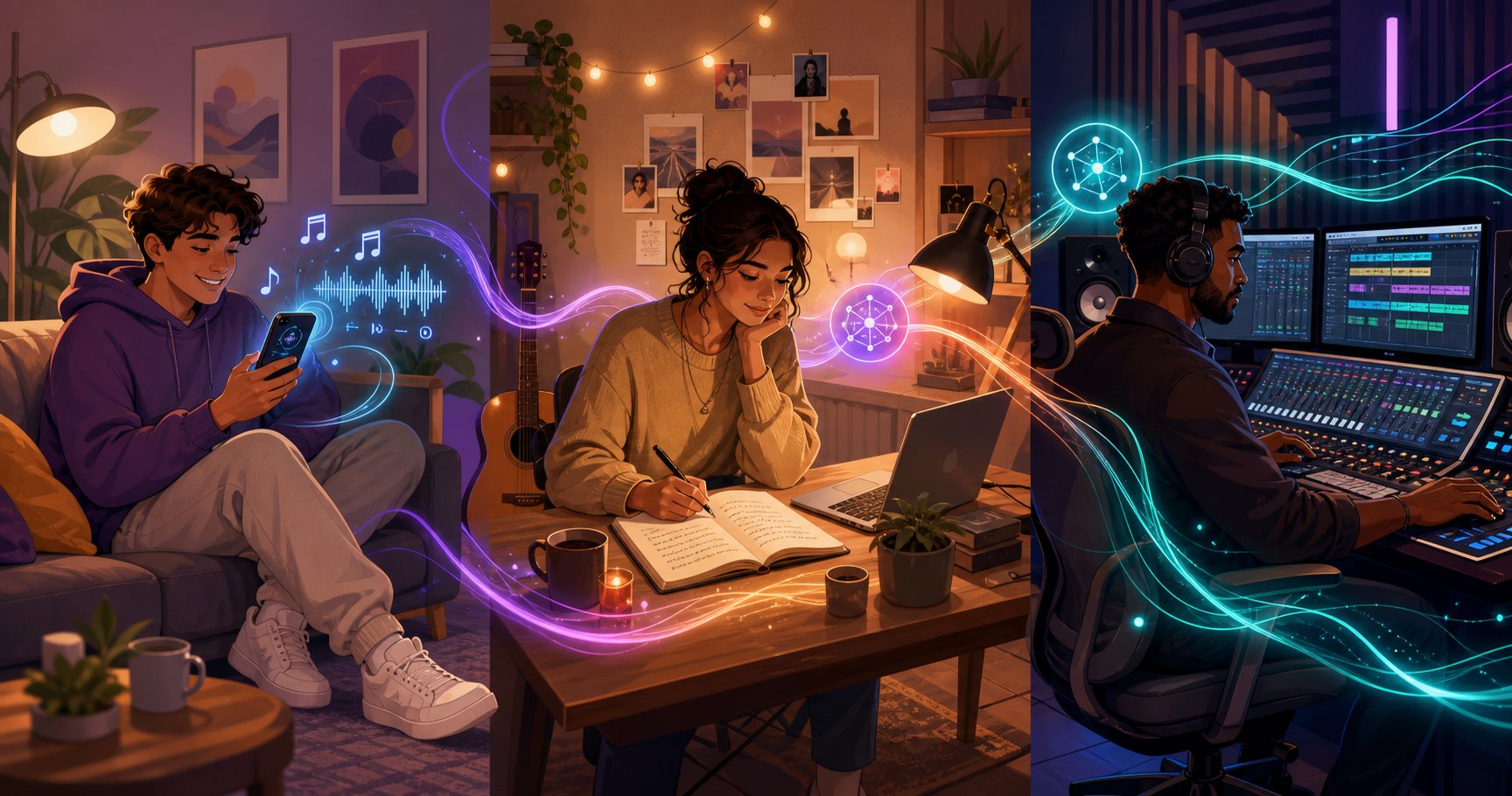
How Beginners, Hobbyists, and Pros Each Benefit Differently
Your skill level completely changes what "better AI music tools" actually means to you. A first-time creator and a seasoned producer look at the same tool and see entirely different things — different benefits, different frustrations, different possibilities. Understanding how to use ai for music production depends almost entirely on where you are starting from.
Complete Beginners Making Music for the First Time
Imagine you have had a melody stuck in your head for years but never learned an instrument. Traditionally, that idea stayed trapped — locked behind barriers of instrument proficiency, music theory knowledge, and expensive studio access. AI demolishes every one of those barriers.
Today, a complete beginner can type a description of the song they hear in their imagination and receive a fully produced track with vocals, instrumentation, and a polished mix. No chord charts. No finger calluses. No years of practice before the payoff. Tools like MakeBestMusic's AI Music Generator let you turn prompts, lyrics, and style ideas into complete songs — giving anyone with a musical vision an immediate way to hear it realized. As Berklee's Jennifer Hruska noted, new technologies start by making existing processes more efficient, then they start "doing new things — things you haven't already thought of." For beginners, the new thing is simply this: making music at all.
Hobbyists and Songwriters Seeking Inspiration
If you already write songs but hit creative walls — stuck on a second verse, unsure whether a chorus melody works, unable to hear how your acoustic sketch would sound with a full band — AI becomes something different entirely. It becomes a collaborator.
Berklee songwriting professor Ben Camp described using AI to rapidly prototype lyric ideas: generating ten verse variations, identifying the strongest lines, piecing together a direction, then iterating further. "AI gives me a very quick way to hear back lyric ideas and whether they're hitting or not," Camp explained. The benefits of ai in music for hobbyists are less about replacing skill and more about accelerating the feedback loop between idea and execution. You still bring the taste. The AI brings the speed.
Producers Accelerating Professional Workflows
Experienced producers already know how to use ai in music production in ways that look nothing like a beginner's workflow. They are not generating entire songs from scratch. They are using AI to eliminate tedious bottlenecks — spinning up drum pattern variations in seconds instead of programming them manually, generating scratch vocal tracks to test arrangement ideas before booking a singer, or exploring ten different harmonic directions for a bridge without spending an afternoon at the keyboard.
As mastering engineer Jonathan Wyner put it: "I could do things using AI I never could do before, and I can get better results." He described mastering sessions where he previously spent hours negotiating compromises between competing sonic goals. With AI, he can now independently adjust elements within a mix — boosting drum energy while tightening the chorus — achieving results that were physically impossible with traditional tools.
Here is how artificial intelligence in music production serves each creator differently, and where upcoming improvements matter most:
| Creator Type | Primary AI Use Case | Current Benefit Level | What Upcoming Improvements Unlock |
|---|---|---|---|
| Beginner | Full song generation from text prompts | High — creates music with zero prior training | Better genre accuracy and emotional depth make outputs feel more personal |
| Hobbyist / Songwriter | Creative collaboration and rapid prototyping | High — accelerates idea development dramatically | Granular section-level control lets you shape songs closer to your vision |
| Bedroom Producer | Workflow acceleration and stem generation | Moderate — useful for drafts, limited for final production | Improved audio fidelity and DAW integration close the gap to release quality |
| Professional | Specialized tasks: mixing assistance, arrangement exploration, reference generation | Moderate — powerful for specific tasks, not full replacement | Advanced compositional intelligence and plugin-native AI tools fit seamlessly into professional chains |
Notice how the benefit equation shifts as skill increases. Beginners gain the most from raw generation capability — the ability to go from nothing to a complete song. Professionals gain the most from precision and integration — AI that slots into an existing workflow without disrupting it. Every improvement across the five areas discussed earlier serves someone in this table, which is exactly why the development momentum is so broad. The market is not building for one persona. It is building for all of them simultaneously.
That breadth of demand is not lost on the companies funding these tools. When a technology serves beginners, hobbyists, and professionals alike — each with different needs but all driving adoption — it attracts the kind of investment that turns incremental progress into rapid leaps.
Industry Investment Signals That AI Music Will Keep Getting Better
That kind of investment is not hypothetical. It is already flowing — in enormous, trackable quantities — from venture capital firms, tech giants, DAW developers, and streaming platforms directly into AI music capabilities. When you follow the money, the trajectory becomes almost impossible to dispute. AI in the music industry is not improving because of wishful thinking. It is improving because billions of dollars are actively funding that improvement.
Technology does not advance in a vacuum. It advances when powerful players commit real resources to making it better. And right now, every major category of music industry player is doing exactly that.
DAW Developers Embedding AI Into Production Workflows
One of the clearest signals that AI music tools will keep improving is that established digital audio workstations — the professional environments where real music gets made — are racing to build AI directly into their core feature sets. This is not a fringe experiment. It is a competitive arms race among the most trusted names in music production.
Consider stem separation alone. A MusicRadar comparison of 11 leading stem separation tools found that Apple's Logic Pro, Steinberg's Cubase Pro 15, PreSonus Studio One, FL Studio, and Ableton Live all now include built-in AI-powered stem separation. Logic Pro's implementation scored highest in the roundup, with its AI accurately extracting vocals, drums, bass, guitar, and piano stems from mixed audio — a capability that did not exist in any consumer DAW just a few years ago. Steinberg's SpectraLayers Pro 12 can even learn the sound of a specific instrument from a solo recording and extract it from a full mix.
Stem separation is just the visible tip. DAWs are also integrating intelligent EQ that analyzes audio and suggests corrective adjustments, AI-driven composition assistants that generate melodic and harmonic ideas within your session, and smart mastering chains that adapt dynamically to your mix. Each DAW update brings new AI features, and each generation outperforms the last. As the MusicRadar reviewers noted: "The fact we can even rank these systems is a mark of how much the technology has progressed and proliferated in a very short time — we can only imagine how much better they'll be by the end of the decade."
Streaming Platforms and AI Music Content
Streaming services are not just passively receiving AI-generated music — they are actively building policies, detection tools, and content frameworks around it. That level of institutional engagement signals something important: the major platforms see AI music as a permanent, growing part of their ecosystems, not a passing novelty.
A Digital Music News survey of platform policies reveals that nearly every major streamer has established specific rules governing AI-generated content. Spotify adopted the DDEX metadata standard so AI-assisted tracks can be properly labeled in credits and launched a music spam filter targeting mass-produced or fraudulent content. Apple Music rolled out new metadata tags requiring labels and distributors to disclose when AI was used in creating music or cover art. YouTube treats raw AI audio involving minimal human input as low-value content, but encourages "transformative human input" — essentially distinguishing between lazy generation and genuine creative use.
Some platforms are drawing harder lines. Bandcamp explicitly banned music produced "entirely or mainly by AI." Deezer built proprietary AI detection tools that tag fully AI-generated songs, exclude them from algorithmic recommendations, and filter fraudulent AI streams from royalty calculations. Qobuz released an "AI Charter" committing to 100% human-curated recommendations while using its own detection system to identify and label AI content.
These are not the actions of an industry ignoring AI. They are the actions of an industry integrating it — establishing guardrails, building infrastructure, and creating the frameworks that will shape how AI music coexists with human-made content. Amazon even integrated Suno's AI song generator directly into Alexa Plus. When platforms invest in detection, labeling, and policy infrastructure at this scale, they are betting on a future where AI-generated music is a permanent and growing content category.
The Investment Landscape Driving Improvement
The venture capital numbers alone make the case. Suno raised $250 million at a $2.45 billion valuation in late 2025, led by Menlo Ventures with participation from Nvidia's venture arm, Lightspeed, and Matrix Partners. The company reports roughly $300 million in annual recurring revenue and 2 million paid subscribers. Udio, founded by former Google DeepMind researchers, raised approximately $70 million across seed and Series A rounds led by Andreessen Horowitz. ElevenLabs, whose audio AI increasingly extends into music, raised at a $3 billion-plus valuation.
Combined disclosed funding across AI music generation companies totals somewhere between $750 million and $1 billion through early 2026 — with Suno alone accounting for more than $375 million of that. These are not speculative seed-stage bets. These are growth-stage investments backed by enterprise-level revenue metrics.
Here are the categories of industry players actively pouring resources into AI music capabilities:
- Venture capital firms and generalist tech funds — Andreessen Horowitz, Menlo Ventures, Lightspeed, Matrix, Sequoia, and ICONIQ are writing the largest checks in music tech history
- Major tech company research labs — Google (Lyria and MusicLM), Meta (MusicGen), Apple (Logic Pro AI features), and Nvidia (investment arm backing Suno) are all building music AI capabilities
- DAW and plugin developers — Apple, Steinberg, Ableton, PreSonus, Image-Line, and iZotope are embedding AI directly into professional production tools
- Streaming platforms — Spotify, Apple Music, YouTube, Amazon Music, and Deezer are building AI content infrastructure including detection, labeling, and policy systems
- Major record labels — Universal Music Group and Warner Music have moved from litigation to licensing, signaling long-term engagement rather than resistance
That last bullet matters enormously. The copyright music ai news cycle dominated headlines through 2024 and into 2025, with the RIAA, UMG, and Warner filing major lawsuits against Suno and Udio over training data. But the resolution of those cases tells a more nuanced story. Warner settled with Suno and UMG settled with Udio, with UMG and Udio even announcing a joint platform. The labels pivoted from trying to shut AI music down to licensing their catalogs for AI training — creating a durable revenue stream for rights holders and a legally viable cost structure for AI platforms.
This shift in the ai copyright music news landscape is critical for understanding the trajectory. Legal uncertainty was arguably the single biggest risk factor for AI music development. A court ruling that training on copyrighted music was categorically illegal could have gutted the entire sector. Instead, the industry is moving toward a licensing framework — the same model that has governed radio play, sampling, and sync placements for decades. As regulatory clarity continues to emerge, it is far more likely to accelerate legitimate AI music tool development than to hinder it. Platforms that operate within licensed frameworks will have legal certainty, label partnerships, and access to the highest-quality training data — all of which feed directly into better output.
Historically, this combination — massive investment, broad industry adoption, and clearing legal pathways — correlates with rapid capability improvement. You saw it with cloud computing, with mobile apps, with AI image generation. Ai in music industry development is following the same well-worn pattern: early skepticism gives way to cautious experimentation, which gives way to serious funding, which gives way to an improvement curve that surprises even optimists. The funding is deployed. The legal framework is taking shape. The technical talent is hired and building. Every signal points in the same direction.

What This Means for Your Music-Making Journey
Every signal covered in this article — the historical improvement curve, the technical mechanisms driving progress, the clearly defined and actively targeted limitations, the five-area framework of simultaneous advancement, and the billions of dollars in industry investment — converges on a single conclusion. Will AI get better at helping with making music? It already has, dramatically, and the forces propelling that improvement are accelerating rather than slowing down.
But knowing the answer intellectually is different from acting on it. The more useful question now is: what do you do with this information?
The Evidence Points in One Direction
Consider what this article has laid out. AI music tools evolved from rigid algorithmic experiments in the 1950s to systems that generate full songs with vocals, harmonies, and polished mixes from a single sentence — and the sharpest portion of that leap happened in the last two years. The underlying technology follows predictable trends: training datasets are growing larger and more diverse, model architectures are gaining longer memory and deeper musical understanding, and computational power continues its decades-long upward trajectory. These are not speculative hopes. They are measurable, ongoing realities.
The limitations are real — long-form emotional arc, genre authenticity, production polish — but every one of them maps to a specific, fundable engineering challenge rather than an unsolvable mystery. Researchers are not guessing at what needs to improve. They know. And the investment landscape confirms that the resources to solve those problems are already deployed: nearly a billion dollars in disclosed funding across AI music companies, major labels pivoting from litigation to licensing partnerships, and every leading DAW embedding AI features into professional workflows.
The future of music is not a question of whether AI will play a role. That debate ended when AI-generated tracks started charting on Billboard and accumulating millions of streams. The question is how deeply you will integrate these tools into your own creative process — and how early you start building that skill.
Start Creating and Growing With the Technology
Here is what experienced creators across the industry keep saying, in different words but with the same meaning: learning to collaborate with AI is itself a creative skill, and like any skill, it rewards early practice. Berklee's Ben Camp put it directly — "If you don't have the taste to discern what's working and what's not working, you're gonna lose out to the people that do have the taste, because anybody can use AI to write songs." The differentiator is not access to the tool. It is your ability to guide it, evaluate its output, and shape raw generations into something that carries your artistic intent.
That ability does not develop by reading about AI music. It develops by using it. By typing prompts, listening critically to what comes back, refining your instructions, and gradually learning which creative decisions to delegate and which to keep firmly in your own hands. Every generation you evaluate sharpens your ear. Every prompt you refine teaches you how to communicate musical ideas more precisely. Every track you shape from raw AI output builds the hybrid creative instinct that will define music in the future.
The best time to start learning how to work with AI music tools is now — not because today's tools are perfect, but because developing creative judgment alongside a rapidly improving technology gives you a compounding advantage that waiting never will.
You do not need expensive equipment, formal training, or years of instrument practice to begin. If you have a musical idea — even a vague one — you can hear it realized today. Tools like MakeBestMusic's AI Music Generator let you turn prompts, lyrics, and style ideas into complete songs, giving you a hands-on way to experience exactly how far this technology has come. Try it. Type a description of the song you hear in your head. Listen to what comes back. Then ask yourself whether the result would have been possible two years ago — and imagine where it will be two years from now.
AI will not take over music. It will not replace the human spark that makes a song move someone to tears, or the lived experience that gives a lyric its weight, or the taste that separates a good mix from a great one. What it will do — what it is already doing — is hand every person with a musical idea the ability to hear that idea come alive. Whether you are a complete beginner with a melody stuck in your head, a songwriter seeking a faster path from concept to demo, or a professional looking to push your workflow further than traditional tools allow, the trajectory is clear and the opportunity is yours.
Music in the future will be shaped by the people who start experimenting today. The technology is moving fast. Your creative instincts, sharpened by practice, are what will make the difference. Start now.
