

What Is AI Generated Christian Music and Why It Matters
Imagine scrolling through a worship playlist on Spotify and hearing a gospel track so moving it gives you chills. The vocals are rich with emotion. The lyrics echo scripture. The arrangement swells like a Sunday morning altar call. Then you discover the artist never existed. No human voice sang those words. No songwriter wrestled with God over the lyrics. No musician touched an instrument. The entire song was built by artificial intelligence in under two minutes.
That scenario is no longer hypothetical. AI-generated artists like Solomon Ray have already climbed major Christian music charts, sparking intense debate among worship pastors, theologians, and everyday believers. As one worship pastor put it bluntly, these are "soul-less" songs "made in seconds by machines" — and yet real listeners are finding real spiritual meaning in them.
Welcome to the most fascinating collision of faith and technology since the electric guitar walked into a sanctuary.
AI generated christian music refers to hymns, worship songs, gospel tracks, and devotional pieces that are composed, arranged, or performed partially or fully by artificial intelligence systems — including AI-written lyrics, AI-produced melodies and instrumentation, and AI-synthesized vocals — rather than being created entirely by human musicians and songwriters.
Defining AI Generated Christian Music
To understand what makes christian AI music distinct, you need a basic grasp of the technology powering it. Two core systems work together behind the scenes.
First, large language models generate the lyrics. These AI systems have been trained on vast libraries of text, including hymns, worship songs, poetry, and scripture-adjacent language. When prompted with a theme like "hope in suffering" or "praise for God's faithfulness," they produce lyrics that mimic the patterns, vocabulary, and emotional tone of human-written Christian songs. The output can be remarkably convincing — theologically coherent, poetically structured, and emotionally resonant.
Second, audio generation models handle the music itself. These systems create melodies, harmonies, chord progressions, full instrumental arrangements, and even synthetic vocals that sound strikingly human. Tools like Suno can produce a fully polished, radio-ready track — complete with a choir-like vocal performance and layered instrumentation — in less than two minutes. As Tithely noted, these songs "sound pretty darn good, given that they're entirely AI-made."
Here is an important distinction, though. Digitally produced Christian music has existed for decades. Worship leaders have long used digital audio workstations, synthesizers, drum machines, and loop-based backing tracks. That music still originates from human creativity — a person writes the song, makes artistic decisions, and expresses genuine spiritual intent. AI-generated music is fundamentally different because the creative decisions themselves can be delegated to algorithms. The machine is not just a tool for recording human ideas. It is generating the ideas.
Why This Phenomenon Matters Now
Christian AI music is not a distant possibility people are speculating about. It is already reshaping the landscape in real time, and several converging forces explain the urgency.
Accessibility is the biggest driver. AI music creation tools are now available to anyone with an internet connection. A worship leader at a small rural church, a teenager in youth group, or a pastor with zero musical training can generate a complete worship song in minutes. The barrier to creating music has essentially vanished.
The streaming flood compounds the issue. AI-generated tracks are pouring onto platforms like Spotify, Apple Music, and YouTube — often without any label distinguishing them from human-created music. AP reported that Christian and gospel music saw the highest U.S. genre growth in on-demand audio volume at 18.5% in 2025, while global music streams reached 5.1 trillion. AI content is riding that wave, and algorithms do not care whether a song was born from prayer or from a prompt.
The deeper reason this matters, though, is theological. Christian music is not just entertainment. It carries worship, testimony, prayer, doctrine, and communal identity. When a congregation sings, they are offering something to God. Kenny Lamm, Worship Ministries strategist for North Carolina Baptists, captured the central question well: the core debate "centers on whether the tool enhances or distracts from the spiritual experience."
That question has no simple answer — and that is precisely why it demands a thorough exploration. The pages ahead offer a 360-degree view of this phenomenon, covering its historical roots, theological dimensions, ethical tensions, real-world industry impact, and practical guidance for worship leaders and churches navigating uncharted territory.
A Brief History of Technology and Christian Worship Music
The anxiety surrounding AI in worship might feel entirely new, but the church has been here before — many times, in fact. Every significant technological leap in Christian music history triggered the same fundamental question believers are asking today: does this tool bring us closer to God, or does it stand between us and authentic worship?
From Pipe Organs to Electric Guitars
You might assume the pipe organ has always been a beloved fixture of Christian worship. It hasn't. For centuries, church leaders fought bitterly over whether instruments of any kind belonged in a sanctuary. Pope Clement I once wrote, "Leave the flute to the shepherds; leave the flute to those who fear the gods and worship idols." It wasn't until the 15th century that organs began gaining a foothold in churches, and even then, resistance was fierce. As Christian Courier documented, the Synod of Dort in 1574 rejected organ use outright, arguing that pipe reeds constituted the "unknown tongue" Paul warned against in 1 Corinthians 14:19. By 1578, a National Synod tried to remove organs from churches entirely.
Sound familiar? The arguments echo almost perfectly in today's AI worship debates — the fear that a non-human element might corrupt genuine praise.
Eventually, the organ won its place. Congregations needed musical support to sing together, and the instrument proved indispensable. Martin Luther himself championed the union of word and music, welcoming choir, congregational singing, and organ playing into Lutheran services. Over time, the organ earned the title "king of instruments" and became inseparable from the worship experience for millions of believers.
That pattern repeated with striking consistency across the centuries. Here is a timeline of the major technological milestones that reshaped Christian music — and the resistance each one initially faced:
- Pipe Organs (15th–17th centuries): Considered worldly and even unscriptural by Reformed leaders; eventually embraced as essential for congregational singing.
- The Printing Press (15th–16th centuries): Enabled mass-produced hymnals, putting songs directly into the hands of congregants and democratizing participation in worship music for the first time.
- Hymn Writing Movement (18th century): Figures like Isaac Watts and Charles Wesley faced criticism for writing "human-composed" songs instead of singing only the Psalms — an early version of the authenticity debate.
- Amplified and Electric Instruments (mid-20th century): Electric guitars, bass, and drum kits in church sanctuaries horrified traditionalists who equated amplification with secular entertainment culture.
- Contemporary Christian Music and Synthesizers (1970s–1990s): The rise of CCM brought drum machines, synthesizers, and pop-influenced arrangements into worship, igniting the so-called "worship wars" between traditional and contemporary camps.
- Digital Audio Workstations and Backing Tracks (2000s–2010s): Churches began using pre-recorded loops, click tracks, and multitrack software to supplement or replace live musicians.
- AI-Generated Music (2020s): Artificial intelligence systems now compose lyrics, melodies, arrangements, and even vocals — raising the question of whether human involvement is still necessary at all.
Each entry on that list provoked genuine fear that something sacred was being lost. And each time, the church eventually found a way to integrate the technology while preserving what mattered most about worship.
The Digital Revolution in Worship Music
The most recent precursor to the AI moment — and the one that set the stage most directly — is the quiet digital revolution that transformed how churches produce and perform music over the past two decades.
Digital audio workstations made it possible for worship leaders to compose, arrange, and polish recordings on a laptop. Loop-based worship tracks gave smaller churches access to full-band sound without needing a full band. Services like MultiTracks.com and Worship Backing Band changed the economics entirely: a church could purchase individual instrument stems — acoustic guitar, electric guitar, bass, drums — and mute whichever parts their live musicians could already cover. For congregations without confident vocalists, some providers even included lead and backing vocal tracks.
Planning Center streamlined how worship teams organize setlists, rehearsals, and chord charts. The result was a professionalized worship infrastructure accessible to churches of nearly any size or budget. As Concordia Publishing House observed, many congregations unable to house or fund a pipe organ came to rely on electronics to deliver that instrument's sound through electronic alternatives — and digital platforms like Spotify and YouTube gave every believer access to virtually any worship recording with the tap of a finger.
These tools were broadly welcomed, but they also introduced a subtle shift that matters enormously for understanding the AI debate. Backing tracks already raised the question of where the line falls between a helpful tool and a replacement for human musicianship. When a church plays a pre-recorded vocal track instead of having a live singer lead worship, the congregation still sings, still prays, still worships. But something has changed in the equation. The human presence behind the music has been reduced by one degree.
AI-generated Christian music pushes that reduction to its logical extreme. It doesn't just supplement human musicians — it can eliminate them from the creative process entirely. The lyrics, the melody, the arrangement, the vocals: all of it can emerge from an algorithm rather than a person. That's the threshold the church is standing at right now, and it's the reason this particular technological moment feels different from every one that came before it.
Yet the historical pattern offers a crucial insight. The church has never been destroyed by adopting a new musical technology. It has, however, been enriched by the discernment process each adoption required — the theological reflection, the community conversations, and the willingness to distinguish between the tool and the worship it serves. The question facing believers today isn't simply whether to accept or reject AI. It's a more nuanced one: which specific uses of this technology honor the spirit of worship, and which ones risk hollowing it out?
Three Distinct Use Cases You Should Not Confuse
That nuanced question — which uses of AI honor worship and which risk hollowing it out — is nearly impossible to answer unless you first recognize a critical problem in the conversation. Most debates about AI generated christian music treat it as a single, monolithic phenomenon. It isn't. There are at least three fundamentally different use cases being lumped together, and confusing them leads to arguments where people talk past each other entirely.
A worship leader using AI to brainstorm a lyric idea is not the same thing as a faceless algorithm flooding Spotify with thousands of synthetic gospel tracks for ad revenue. And neither of those is the same as cloning a famous artist's voice without permission. Yet all three get filed under the same headline. Let's pull them apart.
AI as a Songwriting Aid for Human Worship Leaders
Imagine you're a worship leader at a 200-person church. You feel called to write an original song for your congregation — something that speaks to a season of grief your community is walking through. You have the theological vision and the emotional weight of the message, but you're stuck. The melody won't come. The second verse feels clunky. The bridge needs a stronger resolution.
This is where many Christian songwriters are turning to AI as a creative collaborator. They use tools like ChatGPT to brainstorm lyric ideas, explore rhyme schemes, or draft a rough verse they can then rewrite in their own voice. Some use AI melody generators to sketch chord progressions they refine at the piano. The key distinction here is that the human retains full creative and spiritual ownership. AI provides raw material. The songwriter shapes it, filters it through personal theology, and infuses it with genuine worship intent.
As Craig Dunnagan of 403 Music put it, these AI technologies "may serve as a tool like a thesaurus or rhyming dictionary but at a much higher, informed, complex, and predictive level." The best worship songs, he argued, still "come from a human Spirit and human emotions expressing praise and worship." In this model, AI functions the way a concordance or a rhyming dictionary always has — as a reference tool, not a replacement for the songwriter's soul.
This use case is the least controversial of the three, though it still invites honest reflection. Michael Bahn of River Valley Church cautioned that even using AI as a starting point can short-circuit the spiritual discipline of sitting before God and waiting for inspiration: "If you're going to create an original work that's a tool to facilitate an encounter with the Almighty, then start with the Almighty and not with technology." The tension is real, but the human heart remains at the center of the creative process.
Fully Autonomous AI Christian Music on Streaming Platforms
This second category is an entirely different animal. Here, no worship leader is involved at all. No human songwriter wrestles with a lyric. No musician touches an instrument. Instead, AI systems generate complete tracks — lyrics, vocals, melodies, harmonies, full production — and those tracks are uploaded to Spotify, Apple Music, YouTube, and other platforms under AI artist profiles or pseudonyms that give no indication the music is machine-made.
The scale of this phenomenon is staggering. HFP Music City reported that by 2026, streaming platform Deezer found 44% of all new music uploads were AI-generated — approximately 75,000 AI-created tracks every single day. Christian and gospel music, with its 18.5% streaming growth, represents a lucrative target for this content flood. One of the most talked-about examples is Solomon Ray, an AI-generated southern gospel persona who amassed hundreds of thousands of monthly Spotify listeners. Many fans had no idea they were listening to a christian AI artist that never existed.
The motivation behind most of these tracks isn't worship — it's revenue. AI music is cheap to produce at massive scale, and even tiny per-stream payments compound across thousands of songs. The creators behind these profiles often have no connection to Christianity at all. They're identifying profitable niches, generating content to fill them, and letting playlist algorithms do the rest. As HFP Music City noted, a survey cited by Deezer found that 97% of participants could not reliably tell the difference between AI-generated and human-made songs in blind listening tests.
This category raises the sharpest concerns. There is no spiritual intentionality. There is no testimony behind the music. There is no worshiper. And yet real listeners — people genuinely seeking God through music — are engaging with these tracks, adding them to prayer playlists, and sharing them with friends, completely unaware of their origin.
AI Voice Cloning and Style Transfer in Gospel and Worship
The third use case occupies its own ethical territory. Voice cloning technology can now replicate the vocal characteristics of well-known Christian artists — their tone, inflection, vibrato, even the emotional texture of their delivery — and use those synthetic voices to perform songs those artists never actually sang.
Think about what that means. Someone could generate an ai christian song that sounds like it's performed by a beloved gospel singer, upload it to streaming platforms, and attract listeners who believe they're hearing new material from that artist. The voice becomes a costume anyone can wear.
The ethical guidelines emerging around AI vocals emphasize three core principles: obtaining proper consent when replicating existing voices, maintaining transparency with audiences about synthetic vocal elements, and respecting artist rights in commercial applications. Using someone's distinctive vocal characteristics without consent can violate their right of publicity, and in many jurisdictions, voice is legally recognized as part of an individual's personality rights — similar to their name or likeness.
This differs sharply from the first two categories. The songwriting-aid model keeps the human in control. The autonomous streaming model generates original (if soulless) content. But voice cloning borrows the identity of a real person — a person whose voice carries years of ministry, testimony, and spiritual authority — and deploys it without their participation. For famous artists who view their vocal gift as a calling from God, the implications are deeply personal.
Even when voice cloning is used with good intentions — say, a small church creating a worship recording using a synthetic voice modeled on a popular worship leader's style — the practice raises questions about authenticity and identity that the other two categories simply don't.
Why the Distinction Matters
Treating all three use cases as identical guarantees confused and unproductive debate. Someone defending AI as a "creative tool" is usually thinking about use case one. Someone condemning AI music as "soulless" is usually reacting to use case two. And someone raising alarms about artist exploitation is usually focused on use case three. They're all right — about different things.
Here's a side-by-side comparison to make the differences concrete:
| Dimension | AI as Songwriting Aid | Fully Autonomous AI Tracks | AI Voice Cloning |
|---|---|---|---|
| Human Involvement | High — human writes, refines, and performs | None or minimal — AI generates entire track | Varies — may use AI voice without the real artist's participation |
| Spiritual Intent | Present — worship leader drives the creative vision | Absent — typically profit-motivated at scale | Ambiguous — intent may exist but identity is borrowed |
| Creative Control | Human retains full control over final output | Algorithm controls all creative decisions | Human may direct content, but voice belongs to someone else |
| Ethical Complexity | Low to moderate — similar to using any reference tool | High — deception risk, market flooding, no authenticity | Very high — consent, identity rights, personality rights at stake |
| Transparency Risk | Low — human authorship is clear | High — listeners often cannot identify AI origin | Very high — listeners may believe they hear a real artist |
These categories aren't just academic distinctions. They determine which theological arguments apply, which ethical frameworks matter, and which practical responses make sense. A church policy that bans "AI music" entirely would prevent worship leaders from using a helpful brainstorming tool. A policy that embraces "AI music" without qualification would open the door to replacing human musicians with anonymous algorithms.
The real challenge — and the one that will define how the church navigates this moment — is developing the discernment to evaluate each use case on its own terms. And that discernment starts with theology.

The Theological Debate Around AI Worship and Creativity
Discernment starts with theology — and this is exactly where the conversation gets uncomfortable. When AI disrupts secular music, the debate centers on economics and artistry. When it enters Christian worship, something far deeper is at stake. Worship is not a performance for an audience. It is an offering to God. And that distinction transforms a technology question into a profoundly spiritual one.
Can a song with no human heart behind it function as worship? Can an ai gospel song generated by pattern-matching algorithms carry the weight of praise, confession, or lament? Does God receive an offering that no soul actually made? These are not hypothetical questions anymore. They are urgent ones that churches, worship leaders, and individual believers are wrestling with right now — and scripture has more to say about them than you might expect.
What Scripture Says About Worship and Human Expression
The Bible does not address artificial intelligence directly, of course. But it speaks extensively about what worship is, who it comes from, and what makes it acceptable to God. Several passages have become central to the theological debate around ai gospel music, and each one pulls the conversation in a distinct direction.
Start with Psalm 150. This final psalm is essentially a crescendo of commanded praise: "Praise him with the sounding of the trumpet, praise him with the harp and lyre, praise him with timbrel and dancing, praise him with the strings and pipe, praise him with the clash of cymbals" (Psalm 150:3-5). The psalm celebrates the use of instruments — tools, technologies of their era — to glorify God. Some proponents of AI in worship point here and argue that if God welcomes trumpets, lyres, and cymbals as vehicles of praise, there is no inherent reason a new kind of tool cannot serve the same function. The instrument has never been the point. The praise is the point.
Yet the psalm does not end with instruments. It ends with a command directed squarely at the living: "Let everything that has breath praise the Lord" (Psalm 150:6). Breath. Life. The Hebrew word neshamah carries connotations of the life-breath God gave to humans at creation. This closing verse anchors praise in embodied, living beings — not in the tools they use. An algorithm does not breathe. It does not possess neshamah. For many theologians, this distinction is decisive.
Colossians 3:16 deepens the picture: "Let the message of Christ dwell among you richly as you teach and admonish one another with all wisdom through psalms, hymns, and songs from the Spirit, singing to God with gratitude in your hearts." Notice the layered human elements packed into a single verse — communal dwelling, mutual teaching, spiritual wisdom, heartfelt gratitude. The singing Paul describes is not merely an auditory event. It is relational, formational, and deeply personal. It requires hearts capable of gratitude and spirits capable of receiving Christ's message.
Romans 12:1 raises the stakes further: "Therefore, I urge you, brothers and sisters, in view of God's mercy, to offer your bodies as a living sacrifice, holy and pleasing to God — this is your true and proper worship." Paul frames worship not as something you produce but as something you are. Your body, your life, your will — these constitute the offering. Worship, in this framework, is inseparable from the worshiper.
These passages have led many church leaders to a firm conclusion. As artist Forrest Frank argued publicly during the Solomon Ray controversy, AI "does not have the Holy Spirit inside of it." Opening your heart to songs voiced by a system with no inner spiritual life, he contended, distorts what Christian worship is meant to be — a response from redeemed humans to a real God, rooted in testimony, repentance, and obedience. Many prominent worship voices have echoed this position, stressing that "costly worship" requires real people, not synthetic personas.
Others, however, draw a careful distinction between the creation of worship music and the reception of it. Their argument goes like this: even if no human spirit was involved in generating a song, a human spirit is very much involved in singing it, hearing it, and being moved by it toward God. When a believer hears an AI-generated hymn and genuinely worships — tears falling, heart turning, faith deepening — is that experience less real because the song's origin was algorithmic? A printed hymnal is an object. A pipe organ is a machine. Neither has a soul, yet both have facilitated centuries of authentic worship. Could AI music function similarly — as a vessel that humans fill with genuine devotion?
This counterargument has real force, but it also has limits. A hymnal does not compose the hymns. An organ does not choose what to play. These tools amplify and deliver human creative expression. Fully autonomous AI music, by contrast, originates the creative expression itself. The distinction matters because it determines whether the tool is serving human worship or substituting for it.
The Imago Dei Question and Creative Expression
Beneath the debate over specific Bible verses lies an even more fundamental theological question: what does it mean that humans are created in the image of God — and does delegating creative expression to machines diminish that image?
The doctrine of Imago Dei, rooted in Genesis 1:27, holds that human beings uniquely reflect God's nature. Christian thinkers across centuries and denominations have identified creativity as one of the most important ways this image manifests. God is the original Creator. Humans, made in God's likeness, are sub-creators — called to cultivate, build, and bring forth beauty that glorifies the One whose image they bear.
Renouncing creativity and surrendering our mental capacities and imagination to machines would mean burying the talents we have been given to grow as individuals in relation to God and others. — Pope Leo XIV
That statement, issued as guidance for Catholic priests resisting AI in homily writing, captures the theological concern at its sharpest. If creativity is a God-given reflection of divine nature, then outsourcing it wholesale to machines is not neutral. It is a form of abdication — burying the very talents the parable of Matthew 25 warns us to invest.
The Word on Fire Institute developed this argument in depth, drawing on the work of Catholic philosopher Bernard Lonergan. Human creativity, in Lonergan's framework, involves a dynamic process of experiencing, understanding, judging, and deciding — capacities grounded in self-awareness, moral reasoning, and intentional pursuit of the good. AI can simulate the outputs of this process, producing lyrics that look theologically accurate and melodies that sound emotionally compelling. But it cannot engage in the process itself. It has no experience of suffering that deepens a lament. It has no gratitude that overflows into praise. It has no encounter with God that demands expression.
This is why Dr. Steven Umbrello of Word on Fire describes sacred art — and by extension, sacred music — as "a participatory act in the divine economy, where the artist, inspired by grace, becomes a co-creator with God." The creation of worship music, in this view, is not merely about the product. It is itself an act of worship. The songwriter who wrestles with a lyric through prayer, who discards three drafts before the Holy Spirit breaks through on the fourth, is doing something that an algorithm structurally cannot do — regardless of how polished its output might be.
The Reformed tradition arrives at a similar place through a different route. As theologian writing for Reformed Worship emphasized, the cultural mandate of Genesis 1:28 — "be fruitful and multiply, and fill the earth and subdue it" — calls humans to cultivate creation in ways that glorify the Creator. When we "fill the earth" with AI-generated worship content, we risk what this theologian called "deceptive duplication" rather than "fruitful multiplication." Machine learning can simulate human activity, but it cannot fulfill the functional dimension of bearing God's image. Like the fig tree cursed by Christ in Mark 11, AI-generated worship music may appear alive while being unable to bear true fruit.
Not every Christian thinker draws the line so firmly, though. Some evangelical voices point out that God's sovereignty extends over all tools and technologies. If God can speak through a donkey (Numbers 22:28), cause stones to cry out in praise (Luke 19:40), and use pagan kings to accomplish divine purposes (Isaiah 45:1), then surely God can use AI-generated music to reach hearts. The question, they suggest, is not whether God can work through AI worship — of course God can work through anything — but whether Christians should routinely choose a tool that bypasses the very creative capacities God gave them to exercise.
Several denominational traditions are beginning to develop formal positions. The Catholic Church, through Pope Leo XIV, has urged resistance to AI in homily and liturgical writing. Reformed theologians writing for Calvin Institute publications have framed the issue through priestly intention and aesthetic stewardship, asking whether AI shortcuts the "hard but holy task" of wrestling with scripture. Evangelical leaders in the Southern Baptist and nondenominational world have responded with a range of perspectives, from cautious openness to sharp rejection — particularly after the Solomon Ray phenomenon demonstrated just how easily AI can top Christian charts without any human worshiper behind the music.
What emerges from this theological landscape is not a single verdict but a shared conviction: worship is not reducible to content. It is an act. A relationship. An offering from a living being to a living God. Whether AI-generated music can participate in that act — as a vessel, a catalyst, or a counterfeit — depends on the specific use case, the intentions behind it, and the theological framework through which a community evaluates it.
The honest answer is that faithful Christians will land in different places on this question. What matters is that they arrive there through serious theological reflection rather than technological convenience or reflexive fear. The strongest arguments on both sides deserve to be heard side by side — and that is exactly where the conversation turns next.
Arguments For and Against AI Generated Christian Music
Serious theological reflection demands honest engagement with both sides of a debate — not a straw man on one end and a champion on the other. The question of whether AI belongs in Christian music is not a simple binary. Thoughtful believers hold principled positions across the entire spectrum, and the strongest version of each argument deserves a fair hearing.
What follows is not a verdict. It's a framework. You'll notice that both sides raise genuinely compelling points, and many of them don't actually contradict each other — they simply prioritize different values. The goal here is to equip you and your faith community with the clearest possible picture so you can discern wisely rather than react hastily.
The Case for Embracing AI in Christian Music
Proponents of AI worship tools are not dismissing theology. Many of them care deeply about worship and see AI as a means of expanding access to it. Their core arguments include:
- AI democratizes music creation for under-resourced churches. Thousands of small congregations lack talented instrumentalists, vocalists, or songwriters. A rural church with 40 members and a single volunteer pianist faces real limitations every Sunday. AI tools can provide musical arrangements, backing tracks, and even original compositions that give these communities richer worship experiences than silence or a scratchy CD player ever could. As Ryan Panzer of Church Anew noted, AI has the potential to give worship planners access to "more" — more instrumentation, more vocalist backing, more original music — especially when human resources fall short.
- It helps non-musicians express their faith through song. Not every believer with a powerful testimony has the musical ability to turn it into a hymn. AI can bridge that gap, allowing a grieving widow, a recovering addict, or a teenager navigating doubt to articulate their spiritual journey in musical form. The technology lowers the barrier between feeling something sacred and expressing it.
- It provides affordable content for church media and outreach. Churches produce podcasts, YouTube devotionals, social media videos, and livestreams at increasing volume. Licensing worship music for these contexts is expensive. AI-generated background music — instrumental worship tracks for prayer segments, intro music for sermon series, or ambient soundscapes for meditation — can fill these needs without straining already tight budgets.
- It serves as a starting point for human creativity, not an endpoint. Many ai worship songs begin as AI drafts that a human songwriter then rewrites, reshapes, and infuses with personal theology. Tithely's exploration of AI in worship emphasized that these tools work best as creative catalysts — like a brainstorming partner who never gets tired. Used this way, AI doesn't replace human creativity. It jumpstarts it.
- Historical precedent favors adoption. The church has always eventually embraced beneficial technologies. Pipe organs, printing presses, electric guitars, synthesizers, digital audio workstations — every one of these innovations faced fierce resistance before becoming standard. The believers who warned that amplified instruments would corrupt worship were sincere, but history proved that the technology itself was neutral. What mattered was how it was used. Proponents argue that AI follows the same trajectory.
The Case for Caution and Resistance
Those urging restraint are not technophobes or Luddites. Many of them use digital tools daily in ministry. Their resistance is rooted in specific concerns about what gets lost when AI enters the most sacred dimensions of Christian life. Their core arguments include:
- Worship requires authentic human emotion and spiritual intention. A machine cannot repent. It cannot grieve. It cannot feel gratitude toward a God who saved it from something real. As CCM artist Forrest Frank stated bluntly, AI "does not have the Holy Spirit inside of it." Worship is not merely sound that matches a theological template — it is a human soul responding to a divine encounter. AI can mimic the product of that encounter, but it cannot participate in it.
- AI-generated content floods platforms and devalues human artistry. With an estimated 75,000 AI-generated tracks uploaded to streaming platforms every day, human Christian musicians are competing against an infinite supply of cheap, algorithm-friendly content. Ai worship music produced at scale dilutes the marketplace, making it harder for genuine artists to be discovered, supported, or sustained. The sheer volume threatens to drown out the very voices that carry authentic spiritual weight.
- It risks commodifying sacred expression. When worship music becomes a product that can be mass-manufactured for streaming revenue, something essential changes in how we relate to it. Sacred songs born from prayer, suffering, and spiritual breakthrough carry a different kind of weight than tracks assembled by pattern-matching software to maximize playlist placement. Treating worship as content to be optimized is a category error that cheapens what it means to praise God.
- It threatens the livelihoods of Christian musicians and worship leaders. Churches facing budget constraints may be tempted to replace paid musicians with AI-generated tracks. Session musicians, choir directors, worship pastors, and songwriters who view their work as a sacred calling face the real possibility of being displaced by a technology that costs almost nothing. The human cost is not abstract — it involves real families, real ministries, and real vocations.
- The profit motive behind much AI-generated worship contradicts the spirit of praise. Many fully autonomous AI gospel tracks on streaming platforms are not created by believers seeking to glorify God. They are created by entrepreneurs identifying profitable niches and generating content at industrial scale. The gap between a song born from genuine devotion and a song engineered to capture streaming revenue could hardly be wider — yet both appear side by side in the same worship playlist, indistinguishable to the algorithm and often to the listener.
The core tension is not whether AI can produce something that sounds like worship — it clearly can. The tension is whether something that sounds like worship but originates from no living soul can still serve the God who asked for our hearts, not just our songs.
Notice how these two lists don't simply cancel each other out. Several of the arguments for AI — democratizing access, assisting human creativity — apply most strongly to use case one (AI as a songwriting aid). Several of the arguments against — commodification, market flooding, profit motives — apply most forcefully to use case two (fully autonomous AI tracks). The debate becomes far more productive when you match the right arguments to the right scenarios instead of treating the entire phenomenon as a single yes-or-no question.
There's another layer worth acknowledging. Many believers hold both positions simultaneously — and that's not a contradiction. You can appreciate AI's ability to help a small church worship team find a chord progression while also feeling deeply uneasy about an AI-generated "artist" topping the Billboard gospel charts. You can see the practical value of affordable background music for a church podcast while also insisting that Sunday morning worship demands a human voice leading from a human heart. The most thoughtful responses to this moment aren't the loudest ones. They're the ones willing to sit with complexity.
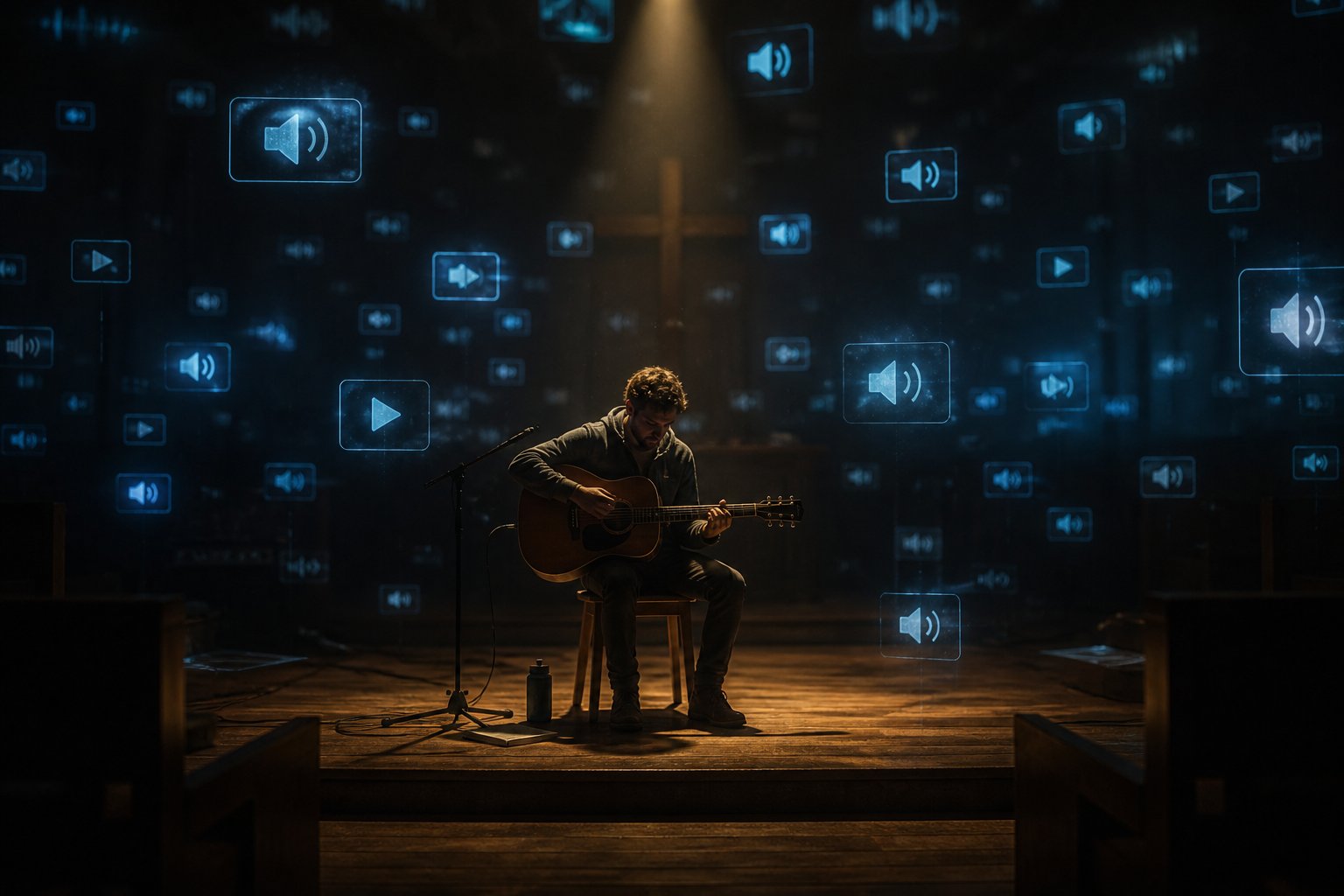
What neither side can afford to ignore, though, is the concrete impact this technology is already having — not in theory, but in the real-world economics and culture of Christian music. The arguments aren't just philosophical. They carry consequences measured in lost income, displaced artists, and shifting power dynamics across an entire industry.
The Impact on Christian Artists and the Music Industry
Those consequences are not speculative. They are already reshaping who gets heard, who gets paid, and who gets to make a living creating music for the church. The economic and cultural ripple effects of AI generated christian music extend far beyond a philosophical debate — they reach into the bank accounts and vocational identities of real people who have devoted their lives to leading others in worship.
How Streaming Algorithms Amplify AI Worship Content
Here's the structural problem: streaming platforms were never designed to distinguish between a song born from a worship leader's midnight prayer and one assembled by a prompt-fed algorithm in 90 seconds. To Spotify's recommendation engine, both are just audio files with metadata. Both carry genre tags like "Christian," "worship," or "gospel." Both compete for the same playlist slots. And the algorithm rewards what performs — click-through rate, completion rate, save rate — not what carries spiritual weight.
The numbers paint a stark picture. French streaming platform Deezer reported that 44 percent of all newly uploaded music was AI-generated, amounting to roughly 75,000 tracks per day. Apple Music executives estimated that more than one-third of new uploads were AI-made. While these tracks still account for less than 1 percent of total listening, the sheer volume creates a flooding effect. When thousands of AI worship tracks enter the ecosystem daily, they saturate recommendation queues, dilute search results, and edge out human artists who release music at the natural pace of creative work — one album every year or two, not one track every two minutes.
The economics make this flood nearly unstoppable. Producing an AI track costs almost nothing. No studio rental. No session musicians. No producer fees. No months of writing, rewriting, and arranging. A single person with access to a generative music tool can upload dozens of worship-style songs per day across multiple AI personas. Even at fractions of a cent per stream, the math works when you scale to thousands of tracks. Consider the case of Velvet Sundown, a fully AI-generated band that eclipsed 1.4 million monthly listeners on Spotify — complete with fabricated backstories and AI-generated images. Or Solomon Ray, the AI-generated Christian persona that topped both the number one and number two spots on the Christian iTunes chart, outranking genuine worship singles by Brandon Lake and Elevation Worship.
The labeling problem compounds the issue. Most listeners have no idea whether a worship song is human-made or machine-generated. The Recording Industry Association of America and the International Federation of the Phonographic Industry have proposed a new labeling system — similar to the parental advisory sticker for explicit lyrics — that would mark songs as either "AI-generated" (uppercase "AI") or "AI-assisted" (lowercase "ai"). As the joint statement noted, "Fans want to know whether and how generative A.I. has been used in the music to which they listen." Whether streaming platforms will actually adopt or enforce these labels remains an open question.
Impact on Human Christian Musicians and Worship Leaders
Behind every percentage point and streaming statistic stands a real person with a calling. An ai christian singer topping the charts isn't just a curiosity — it represents a structural shift in who the Christian music ecosystem rewards. And the people most vulnerable to that shift are rarely the headline-grabbing CCM stars. They're the working musicians, the part-time worship leaders, and the behind-the-scenes creatives who form the backbone of church music ministry.
Imagine you're a session guitarist who has spent 15 years building a reputation for quality worship recordings. You charge a fair rate. You bring musicianship, taste, and spiritual sensitivity to every session. Now a church media director can generate a complete instrumental worship track — guitar, keys, drums, pads — for free. Your phone rings a little less often. Multiply that across an entire industry, and you begin to see the scale of disruption.
The groups facing the most direct impact include:
- Session musicians and studio professionals — hired for worship recordings, church album projects, and background tracks. AI can now produce what they were paid to create, at a fraction of the cost and time.
- Worship leaders and music directors at small to mid-size churches — congregations with tight budgets may question whether they need to invest in live musicians when AI tracks can fill the auditory gap. The temptation to cut costs is real, especially for churches struggling financially.
- Independent Christian songwriters — artists who depend on streaming revenue and sync licensing income find their catalog buried under an avalanche of AI-generated content competing for the same keywords, playlists, and listener attention.
- Choir directors and ensemble leaders — as AI vocal synthesis improves, some churches may wonder whether they need a volunteer choir when synthetic voices can deliver polished harmonies without rehearsals, scheduling conflicts, or interpersonal drama.
- Christian music producers and engineers — professionals whose expertise in shaping sound, arranging compositions, and capturing emotion in a recording studio face displacement as AI tools collapse the entire production pipeline into a single prompt box.
The emotional toll goes beyond economics. Many Christian musicians don't view their work as a job — they view it as a vocation, a calling from God. When an algorithm can replicate the surface-level output of that calling in seconds, it raises existential questions about purpose and value that cut far deeper than a lost paycheck. As one folk musician wrote in Philadelphia Magazine, he discovered that recordings of his band's music had been stolen, slightly altered, and re-uploaded by another "artist" on Spotify — and those counterfeit tracks had thousands more streams than the originals.
CCM artist Colton Dixon captured the ambivalence many working musicians feel when he commented, "I'm honestly still wrestling with the whole AI music thing. Can it be a tool to speed up a rather long, tedious process — yes. But can it also be used as a crutch instead of finding inspiration and direction from Holy Spirit — also yes." That honesty is refreshing. It acknowledges both the utility and the danger without pretending the answer is simple.
This much is clear: the broader pattern unfolding across creative industries — visual art, writing, voice acting, illustration — is now reaching church music with full force. The Christian music world is not insulated from the same market pressures reshaping every creative profession. But it carries a unique additional weight, because the "product" being displaced is not just entertainment. It is ministry. And the people being displaced are not just workers. They are servants who believed their gift was meant to glorify God — and are now watching machines do a passable imitation of it for free.
Yet displacement is only half the story. Even as AI disrupts existing structures, it is simultaneously generating entirely new phenomena — AI gospel subgenres, synthetic worship personas, and grassroots community experiments — that are reshaping what Christian music even means in the streaming age.
Emerging Trends in AI Gospel and Worship Music
Those new phenomena are not abstract possibilities. They already have names, followings, and heated comment sections. Scroll through social media or streaming platforms and you'll encounter a growing constellation of AI-driven Christian music movements — each one raising fresh questions about authenticity, community, and what listeners actually want from faith-based music.
AI Gospel and the Rise of Niche AI Music Movements
AI-generated gospel has quietly evolved from a novelty into its own recognizable subgenre. Search terms like outlaw gospel ai and street gospel syndicate ai are gaining real traction as listeners discover — and fiercely debate — tracks that blend raw, roots-influenced gospel aesthetics with entirely synthetic production. These aren't polished CCM worship tracks. They lean gritty, soulful, and intentionally counter-cultural, drawing on the textures of southern gospel, blues-inflected spirituals, and outlaw country to create something that feels like it was recorded on a porch in Mississippi. Except nobody was on the porch.
The cultural dynamics here are genuinely complex. Some listeners report finding real spiritual comfort in these tracks — using them during prayer, driving, or moments of personal reflection. For them, the question of origin fades behind the question of experience. Others view the entire phenomenon as an unsettling imitation, a kind of spiritual uncanny valley where the music sounds close enough to authentic testimony to fool the heart but carries none of the lived suffering or redemption behind genuine gospel.
What makes this trend especially notable is the emergence of fully constructed AI personas that build loyal followings. Solomon Ray is the most prominent example — an AI-generated southern soul artist whose persona included a fabricated backstory as a "Mississippi-made soul singer" and who climbed to the number one spot on the iTunes Christian and gospel chart. The real person behind Solomon Ray, Christopher "Topher" Townsend, described the project as "an extension of my creativity" and argued that God can use any vehicle — even AI — to reach people. But the real human worship leader who actually shares the name Solomon Ray offered a sharper assessment: "If you're having AI generate it for you, the answer is zero. God wants costly worship."
That tension — between AI as a creative extension and AI as a spiritual shortcut — runs through every niche movement gaining steam. Labels like new path worship ai hint at communities actively exploring blended approaches, where human worship leaders curate, guide, and contextualize AI-generated elements rather than handing the entire process over to an algorithm. These projects sit in an intentional middle ground, treating AI as one instrument in the ensemble rather than the entire band.
New Worship AI Projects and Community Responses
Beyond individual artists and niche genres, a broader organizational reckoning is taking shape. Denominations and Christian music institutions are beginning to articulate where they stand — and their responses range from cautious openness to firm resistance.
Within the Southern Baptist world, worship leaders and seminary professors have pushed for measured discernment rather than blanket rejection. Jonathan Welch, assistant professor of worship at Southeastern Baptist Theological Seminary, framed the moment as an opportunity for churches to revisit their song selection process: "Maybe it's a wake-up call for some churches. What are the criteria for selecting music for congregational worship?" Kenny Lamm, Worship Ministries strategist for North Carolina Baptists, advocated for "slower, better-informed discernment rather than blanket fear," suggesting that churches hold a firm line that AI can assist the craft but cannot replace the heart of human worshipers.
That phrase — assist but not replace — has become something of a consensus position among the church leaders willing to engage publicly. Worship pastor Kevin Uhrich echoed it from his own ministry context: "AI can help to generate ideas and stir creativity, but it cannot be a final source for the music sung in worship." Jon Huff, a worship pastor in Georgia, drew a harder line, calling AI worship tracks "problematic" and committing to avoiding AI-generated content entirely in his services.
Meanwhile, the Catholic Church has spoken through papal guidance. Pope Leo XIV explicitly warned against surrendering creative and intellectual capacities to machines, framing such abdication as a failure to steward God-given talents. While this guidance targeted AI in homily writing rather than music specifically, its theological logic applies directly to worship composition.
What's missing so far is a unified, cross-denominational framework. No major Christian music organization has issued comprehensive guidelines addressing AI-generated content on streaming platforms, AI involvement in worship songwriting, or labeling standards for AI-assisted versus fully AI-created tracks. Individual churches and worship leaders are largely navigating these decisions on their own — which means the practical burden of discernment falls on the people who are least equipped to evaluate the technology and most responsible for protecting the integrity of congregational worship.
That gap between institutional silence and frontline urgency is perhaps the most important trend of all. The technology is moving faster than the theology, and the worship leaders making real-time decisions every Sunday need more than abstract principles. They need actionable guidance — and that's exactly what many are asking for.
Practical Guidance for Worship Leaders and Churches
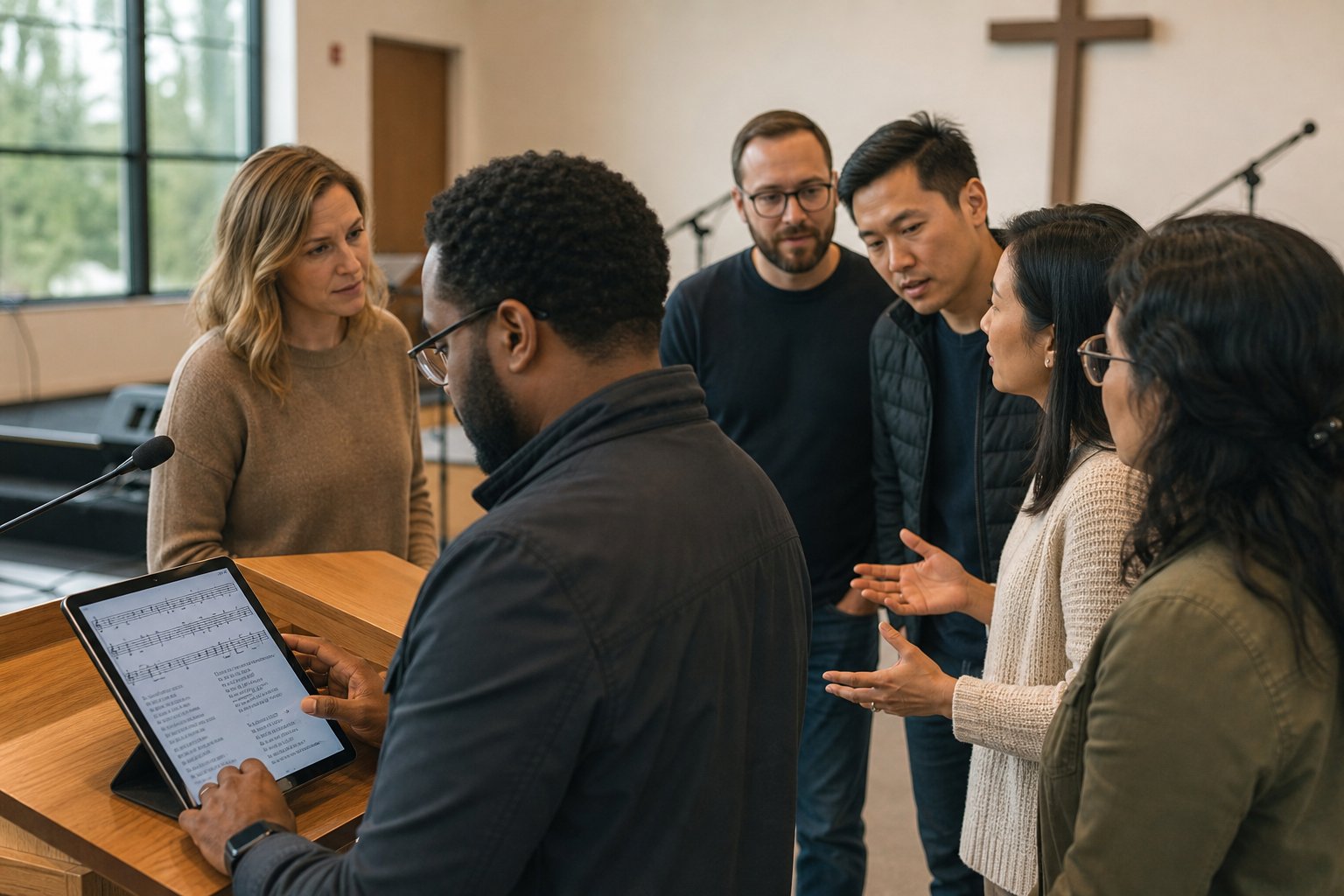
Actionable guidance is exactly where this conversation needs to land. The theology matters. The industry dynamics matter. But on any given Tuesday afternoon, a worship leader preparing Sunday's setlist doesn't need another think piece — they need a practical framework for making wise decisions about AI tools right now, this week, in their specific ministry context.
Whether you lead worship for 50 people in a storefront church or 5,000 in a multi-campus ministry, the same fundamental questions apply. The answers will look different depending on your congregation, your denomination, and your convictions — but the questions themselves are universal.
Guidelines for Worship Leaders Considering AI Tools
Before incorporating any AI-generated element into your worship planning, run it through a simple but honest evaluation. Think of these as five discernment questions you can ask yourself — or your team — every time an AI tool enters the conversation:
- Is this tool serving as an aid or a replacement? There's a meaningful difference between using AI to brainstorm lyric ideas you'll rewrite in your own voice and using AI to generate a finished worship song you'll play without modification. The first keeps you in the creative driver's seat. The second hands the wheel to an algorithm. Be honest about which one you're doing.
- Does a human heart remain at the center of this music? If the song your congregation sings on Sunday morning passed through a real person's prayer life, theological reflection, and spiritual intentionality before it reached the stage, AI involvement in the drafting process is a tool — much like a concordance or a rhyming dictionary. If no human spirit shaped the final product, you're asking your congregation to worship through a vessel that nobody actually filled.
- Am I being transparent with my congregation? Trust is the currency of pastoral leadership. If AI played a significant role in creating a song, a lyric, or an arrangement your church uses, your people deserve to know. That doesn't mean announcing it from the pulpit every Sunday. It means cultivating a culture where honesty about your creative process is the norm, not the exception.
- Could this displace a person whose musical gift is their calling? Before choosing an AI-generated track over hiring a local musician, consider the human cost. Budget constraints are real, but so is the vocational dignity of the guitarist, the vocalist, or the choir director whose gift was meant to serve the body of Christ. Stewardship includes stewarding people, not just dollars.
- What message does this send about what my church values? Your choices about music communicate theology whether you intend them to or not. A church that invests in human musicians signals that embodied creativity matters. A church that defaults to AI signals efficiency over incarnation. Neither is automatically wrong — but both carry weight.
For worship leaders at smaller churches — the ones without a full band, a dedicated music budget, or a songwriter on staff — AI tools can genuinely fill a gap that would otherwise go unfilled. Platforms like MakeBestMusic's AI Song Generator let worship leaders and small church teams generate complete song drafts with lyrics, vocals, and music as a creative starting point. You might use a tool like this to sketch out a melody for a theme you've been praying over, then refine the lyrics to reflect your congregation's specific theology and season. The draft becomes raw material, not the final product — and the human worship leader remains the one shaping, personalizing, and ultimately offering the music to God on behalf of their community.
That distinction between starting point and endpoint matters enormously. A worship leader who uses AI to overcome a creative block and then spends three hours rewriting lyrics at the piano is engaged in a fundamentally different activity than someone who copies an AI output directly into the set list. The tool is the same. The posture is completely different.
How Churches Can Develop an AI Music Policy
Individual discernment is essential, but it's not sufficient. Churches need shared frameworks — not rigid rulebooks, but clear, collaboratively developed principles that align the whole team around common values. The good news? You don't need a six-month committee process to create one. Research from Exponential.org found that while 91 percent of church leaders support AI use in ministry, only 7 percent have established any formal policy. That gap leaves well-meaning staff making ad hoc decisions without guardrails — and that's where problems emerge.
Here is a step-by-step process your church can follow to develop a thoughtful AI music policy:
- Form a discernment team. This doesn't need to be large. Include your senior pastor, worship leader, a tech-savvy staff member, and one or two congregation members who represent different generational perspectives. The goal is theological and practical diversity, not bureaucracy.
- Start with values, not rules. Before debating specific tools, agree on the theological principles that will guide your decisions. What does your church believe about the nature of worship? About human creativity as an expression of the Imago Dei? About transparency and honesty? Write two or three foundational statements that anchor everything else. As Subsplash's church AI policy guide advises, grounding your rules in scripture makes them durable rather than reactive.
- Audit your current AI usage. You may be surprised by how much AI is already embedded in your ministry workflows. Ask every team member — worship leaders, media directors, communications staff — what AI tools they currently use and for what purposes. List everything without judgment. You can't build boundaries around something you haven't mapped.
- Define approved and restricted use cases for music. Separate administrative uses (background music for social media clips, instrumental tracks for podcast intros) from congregational worship uses (songs the church sings together, music that accompanies prayer or communion). Your policy might welcome AI assistance in the first category while requiring fully human-created music in the second. Or it might allow AI-drafted songs only when a worship leader has substantially reworked them. The specifics depend on your values — but they need to be explicit.
- Establish transparency standards. Decide when and how your congregation should be informed about AI involvement in your music. A simple note on your website or in your bulletin — something like "Our worship team occasionally uses AI tools to assist with music drafting; all songs are reviewed, refined, and approved by our worship pastor before use" — builds trust proactively. As one ministry technology expert put it, "Our technology is always downstream from our theology." Let your congregation see that connection clearly.
- Commit to protecting human musicians. Include a principle affirming that AI tools will not be used to replace paid musicians or volunteer worship team members. If budget constraints are real, explore AI as a supplement — adding instrumentation your team can't cover — rather than a substitute for the people already serving.
- Schedule an annual review. AI technology evolves rapidly. A policy written this year may need updating next year as new tools emerge, denominational guidance develops, or your congregation's comfort level shifts. One leadership conversation per year keeps your framework current without creating bureaucratic overhead.
This process can happen in a single staff meeting. It doesn't require technical expertise or a theology degree. What it requires is intentionality — the willingness to make conscious decisions rather than drifting into patterns by default. The churches that will navigate this moment best are not the ones with the most sophisticated technology policies. They are the ones that asked the right questions before the technology made the decisions for them.
The goal here is not to build a wall against innovation. It's to build a filter — one shaped by your church's theology, your pastoral convictions, and your commitment to the people you shepherd. Technology will keep advancing. New tools will keep appearing. The filter ensures that every new tool passes through the same set of values before it reaches your congregation's ears and hearts.
Faithful Stewardship in the Future of Christian Music
A filter shaped by theology and pastoral conviction — that is what separates thoughtful engagement from either blind adoption or reflexive rejection. And it is the thread connecting every dimension of this conversation, from the medieval debates over pipe organs to the Solomon Ray controversy lighting up Christian Twitter. The question was never really about the technology itself. It has always been about what the church chooses to do with it — and who the church chooses to become in the process.
Stewardship Over Fear in the Age of AI
If you've followed this exploration from the beginning, one conclusion should feel unavoidable: AI generated christian music is neither an unqualified blessing nor an existential threat. It is a powerful capability that demands the same thing every powerful capability has demanded of God's people throughout history — stewardship rooted in wisdom, discernment, and theological grounding.
The church has been here before. Believers who feared the pipe organ would corrupt worship were sincere. Believers who resisted amplified instruments were sincere. Believers who warned about synthesizers, drum machines, and backing tracks were sincere. In every case, the church eventually discovered that the technology was not the enemy. The enemy was thoughtlessness — adopting tools without asking what they cost the soul, or rejecting tools without asking what they might offer the kingdom.
AI sits at that same crossroads, but with higher stakes. Unlike a pipe organ or an electric guitar, AI can generate the creative expression itself — lyrics, melodies, vocals, arrangements — without any human heart involved. That capability makes the stewardship question sharper and more urgent. As Kenny Jahng wrote for the National Association of Evangelicals, the best strategy for an AI-powered future is "not just adopting technology but doubling down on what makes the church irreplaceable: authentic relationships, transformative teaching and Spirit-led ministry." The technology serves the mission. It must never co-opt it.
The theological core remains firm across every tradition we've examined. Worship is an offering from a living being to a living God. Creativity reflects the Imago Dei — the divine image stamped on every human soul. Scripture calls for songs from the Spirit, gratitude from the heart, and bodies presented as living sacrifices. No update to an AI model changes any of that. The call to worship God authentically is not a feature that can be patched or deprecated. It is permanent.
What changes is the context in which that call is answered. And context demands practical wisdom — the kind that distinguishes between an AI tool that helps a worship leader draft a melody and an AI pipeline that floods streaming platforms with synthetic praise music for profit. Between a christian ai song refined through prayer and personal theology, and a mass-produced track designed to game an algorithm. The categories matter. The intentions matter. The human presence — or absence — matters.
Finding Your Path Forward
So where does that leave you? Whether you're a worship pastor, a church elder, a Christian songwriter, or simply a believer who cares about the integrity of the music you sing on Sunday morning, here is what faithful engagement looks like in practice:
- Explore rather than retreat. You cannot evaluate what you do not understand. Spend time with AI music tools — not to adopt them uncritically, but to develop firsthand knowledge of what they can and cannot do. Informed opinions carry more weight than inherited anxieties.
- Have honest conversations in your faith community. The gap between institutional silence and frontline urgency is real. Don't wait for a denominational memo. Bring the topic to your worship team meeting, your small group, your elder board. Ask the hard questions together. As one observer noted after visiting Christian fellowship gatherings across four states, ordinary believers are hungry for clarity — they are "asking the right questions" and "deserve answers grounded in Scripture, not reassurances borrowed from a tech press release."
- Support human Christian artists. Buy their albums. Attend their concerts. Pay for their services. Share their music. In an era when algorithms reward volume over soul, your intentional support is one of the most tangible ways to affirm that embodied creativity matters to the body of Christ.
- Hold space for both innovation and tradition. The church has always been at its best when it refuses false binaries. You can welcome AI as a brainstorming partner for worship songwriting while insisting that Sunday morning praise flows through living voices and beating hearts. You can appreciate technological possibility while guarding theological priority. These positions are not contradictions — they are the texture of wise stewardship.
For those who want to explore the creative possibilities firsthand, tools like MakeBestMusic's AI Song Generator offer an accessible way to experiment with generating complete songs — including worship-style tracks with lyrics, vocals, and full instrumentation. You can type in a theme, receive a draft, and then decide for yourself: does this feel like a useful starting point for something I want to refine and make my own, or does it feel like a shortcut around the sacred work of creative struggle? Forming your own informed opinion through direct experience is far more valuable than speculating from the sidelines.
Ultimately, the future of Christian music will not be determined by what AI can produce. It will be determined by what the church chooses to value. If we value efficiency above all else, AI will replace human musicians and no one will object until the silence of absent souls becomes deafening. If we value authenticity, community, and the irreplaceable weight of a human being offering their God-given creativity back to God, then AI will find its proper place — as a tool in the hands of worshipers, not a substitute for worship itself.
The printing press did not destroy preaching. The electric guitar did not destroy reverence. Digital audio did not destroy musicianship. And AI will not destroy worship — unless we let convenience quietly dethrone conviction, one default decision at a time.
The believers gathering under trees, in fellowship halls, and around kitchen tables to wrestle with these questions are doing exactly what the church has always done at inflection points: turning to scripture, to community, and to the Holy Spirit for guidance that no algorithm can supply. That instinct — to seek God before seeking efficiency — is the church's greatest asset in any technological era.
The tools will keep evolving. The platforms will keep shifting. But the call has never changed: let everything that has breath praise the Lord. Not everything that has bandwidth. Everything that has breath.
