

What Is an AI Metal Music Generator and Why Does It Matter
Imagine typing a few words into a text box and hearing a wall of distorted guitars, thundering double kicks, and guttural vocals pour out of your speakers seconds later. That scenario is no longer science fiction. AI-powered tools are now generating metal tracks from nothing more than a written description, yet the results swing wildly between jaw-dropping and cringe-worthy. Before you dive in, you need a clear picture of what these tools actually do, what they don't do, and why heavy music pushes artificial intelligence harder than almost any other genre.
What Exactly Is an AI Metal Music Generator
An AI metal music generator is a software tool that uses machine learning models to compose, arrange, and produce metal music based on text prompts, parameter selections, or reference audio, outputting original tracks that range from full instrumentals to isolated stems and vocal lines.
That core definition covers a lot of ground, so it helps to break the category into three distinct tool types. First, there are full-track generators — these act as a complete metal music maker, producing finished audio that includes drums, guitars, bass, and sometimes synthesized vocals. You feed them a prompt like "aggressive thrash metal at 190 BPM with palm-muted riffs," and they return a playable track. Second, lyrics-only tools function as a heavy metal text generator, creating song words themed around darkness, rebellion, mythology, or whatever mood you specify. Third, visual generators handle the aesthetic side — think AI-designed logos, album covers, and band artwork. Each category serves a different creative need, and confusing them leads to frustration fast.
The metal music creator landscape has expanded rapidly. Early experiments in AI-generated music between 2020 and 2022 focused on cleaner, more melodic genres. It wasn't until roughly 2024 that developers began training models specifically on heavy music, and the results have improved dramatically since then. Still, the gap between what AI delivers for a pop ballad and what it delivers for a death metal breakdown remains enormous.
Why Metal Is One of AI's Hardest Genres to Replicate
Metal isn't just loud rock with more distortion. It's a genre defined by sonic extremes that expose every weakness in a generative model. Heavy distortion, for instance, creates dense harmonic overtones that are far more complex for an AI to synthesize convincingly than a clean piano tone or an electronic synth pad. When a model gets distortion even slightly wrong, the output lands in an uncanny valley — recognizably guitar-like, yet hollow and artificial.
Speed compounds the problem. Thrash and death metal regularly push past 200 BPM with intricate picking patterns, while blast beats demand machine-gun precision from the drums. AI models trained primarily on mainstream datasets often lack sufficient exposure to these extreme tempos and rhythmic structures, causing generated tracks to sound stiff or rhythmically confused.
Then there's the issue of song structure. Pop music follows predictable verse-chorus-verse patterns that AI handles comfortably. Metal, on the other hand, thrives on deviation — unexpected time-signature shifts, extended instrumental passages, abrupt transitions from whispered clean sections to full-throttle aggression. These unconventional arrangements resist the pattern-based prediction that most generative models rely on. Add aggressive vocal styles like growls, shrieks, and screams — each demanding unique timbral modeling — and you'll understand why metal remains one of AI's toughest proving grounds.
This guide doesn't exist to hype a single product or pretend the technology is flawless. Instead, it walks you through the underlying tech, the subgenre knowledge that makes or breaks your prompts, real comparison criteria for choosing tools, and the honest limitations you should expect. The goal is simple: help you get the best possible results from an AI metal music generator while knowing exactly where human creativity still has to step in.
How AI Metal Music Generation Technology Actually Works
You type a prompt. A few seconds later, you hear guitars, drums, and bass — all synthesized from scratch. But what actually happens between pressing "Generate" and hearing that first crunchy riff? Most guides skip this part entirely, jumping straight to tool recommendations without ever explaining the engine under the hood. That's a problem, because understanding how these systems think directly affects how well you can steer them. And when you're trying to coax a machine into producing convincing heavy metal, every bit of understanding matters.
Transformer Models and Audio Synthesis Explained Simply
If you've interacted with a chatbot or used any text-based AI tool, you've already encountered transformer architecture — the same foundational technology that powers most modern metal gen systems. Transformers work by learning relationships between elements in a sequence. In language, that means predicting the next word in a sentence. In music, it means predicting what note, chord, rhythm, or sonic texture should come next based on everything that came before it.
Here's where it gets interesting for audio. A transformer trained on music doesn't read sheet music in the traditional sense. Instead, it processes massive datasets of audio — often broken down into either raw waveforms or spectrograms, which are visual representations of sound frequencies over time. The model learns statistical patterns: how a snare hit typically follows a kick drum pattern, how a power chord resolves into a melody, or how a verse transitions into a chorus. These aren't hard-coded rules. They're probabilities learned from exposure to thousands of hours of recorded music.
Neural audio synthesis then takes these predictions and converts them back into audible sound. Imagine the model has decided that the next quarter-second of audio should contain a palm-muted low E string at a specific dynamic level. The synthesis engine generates a waveform matching that prediction. Stack millions of these micro-decisions together, and you get a complete track. The quality of each decision — and the realism of the synthesis — determines whether the output sounds like a genuine heavy metal music maker or a cheap MIDI mockup with distortion layered on top.
How AI Learns Metal's Sonic Characteristics
Here's a question that rarely gets asked: what did the AI actually listen to before it tried to write your metal track? The answer shapes everything about the output quality, and it's the single biggest reason most generators produce mediocre heavy music.
Training data is the curriculum. A model's musical vocabulary is only as deep as the dataset it studied. If that dataset skews heavily toward pop, R&B, and electronic music — which most large-scale audio datasets do — the model develops a strong intuition for clean tones, quantized rhythms, and conventional song structures. It understands how a four-on-the-floor kick pattern works far better than it understands a blast beat. It recognizes auto-tuned vocals more readily than a guttural growl.
For a heavy metal maker to produce convincing output, its training data needs deliberate, genre-specific depth. The model must encounter:
- Drop-tuned guitars — the harmonic behavior of a guitar in Drop C sounds fundamentally different from standard tuning, and the model needs to learn those tonal relationships
- High-gain amp tones — distorted signals create dense overtone series that are sonically complex and easy to synthesize poorly
- Blast beats and double-kick patterns — these drumming techniques involve speed and precision that mainstream datasets rarely capture in sufficient quantity
- Growled, screamed, and shrieked vocals — each style occupies a unique timbral space that generic vocal models have little experience reproducing
- Unconventional song structures — metal tracks frequently abandon verse-chorus predictability in favor of extended instrumental passages, tempo shifts, and breakdowns
When training data covers these elements thoroughly, the difference in output is dramatic. The guitars gain body and grit. The drums hit with intention rather than sounding like a metronome. The overall production carries the raw intensity and textured dynamics that metal listeners expect. Without that exposure, even the most sophisticated model produces what amounts to generic rock with a distortion filter — technically heavy, but emotionally flat.
This training data gap also explains why some subgenres fare better than others. Melodic metal and power metal, which share more structural DNA with pop and classical music, tend to translate more cleanly through AI. Extreme subgenres like grindcore or technical death metal, where the sonic territory is far more niche and the available training material is scarcer, remain significantly harder to generate convincingly.
Diffusion Models vs. Autoregressive Approaches
Not all AI music generators process sound the same way. Two dominant approaches have emerged, and each handles metal's density and dynamics with different strengths and trade-offs.
Autoregressive models generate audio token by token, one small chunk at a time, in sequence. Think of it like writing a sentence word by word — each new token depends on every token that came before it. This approach excels at maintaining long-range coherence. A riff introduced in the first thirty seconds can be recalled and varied later in the track because the model "remembers" what it has already generated. For metal, this sequential memory is valuable. It helps preserve the thematic continuity that makes a song feel intentional rather than random. The downside? Autoregressive generation can be slower, and the sequential nature sometimes leads to safe, predictable choices — the model gravitates toward the most statistically likely next token rather than taking the kind of bold sonic risks that define great metal.
Diffusion models take a completely different path. They start with pure noise — a static-like audio signal — and iteratively refine it, step by step, until a coherent piece of music emerges. Imagine a sculptor chipping away at marble: the final form reveals itself gradually through removal of what doesn't belong. Diffusion-based generators can produce rich, textured audio with impressive tonal detail, which is a real advantage when synthesizing the layered harmonic complexity of distorted guitars. They also tend to handle dynamics well, capturing the contrast between quiet passages and explosive sections. The trade-off is that long-range structural planning — remembering that a chorus should return after a bridge, for instance — can be weaker compared to autoregressive methods.
In practice, many modern generators blend elements of both architectures to balance coherence and sonic richness. Some use autoregressive planning at a high level to sketch song structure, then hand off to diffusion-based synthesis for the final audio rendering. Others tokenize audio into compressed representations, apply transformer logic for sequencing, and then decode back into full-fidelity sound.
For you as a user, the practical takeaway is straightforward: a generator's underlying architecture influences whether its output sounds structurally tight but tonally thin, or sonically lush but compositionally meandering. Neither approach has "won" the heavy music challenge outright. The best results still depend on how well the model was trained on metal-specific audio and how intelligently the two approaches are combined.
Architecture and training data explain how these tools work. But the real leverage point for getting better output isn't the model — it's knowing exactly what to ask for. And that requires understanding the musical language of metal's wildly diverse subgenres, from the glacial sludge of doom to the precision gymnastics of djent.
Metal Subgenres Decoded for Smarter AI Prompts
Here's the thing most people miss: telling an AI metal music generator to "make something heavy" is like walking into a restaurant and saying "give me food." You'll get something, but it probably won't be what you wanted. Metal is not a single sound — it's a sprawling family of subgenres, each with distinct tempos, tunings, vocal techniques, and production philosophies. The difference between doom metal and thrash metal is as vast as the difference between jazz and country. If you want usable output, you need to speak the genre's language.
Think of this section as your cheat sheet. Every characteristic described below doubles as a prompt ingredient. The more precisely you can define what you're after, the closer the AI gets to delivering it.
Thrash, Death, and Black Metal Characteristics
These three subgenres represent metal's aggressive core — the branches that pushed the genre furthest from its blues-rock roots. Each one demands something different from an AI model, and mixing up their characteristics in a prompt is one of the fastest ways to get disappointing results.
Thrash metal exploded in the 1980s when bands like Metallica, Slayer, and Megadeth combined punk's raw aggression with metal's technicality. The tempo typically sits between 150 and 220 BPM, driven by rapid downpicking and tight palm-muted riffs. Vocals are shouted or barked rather than sung cleanly, and the lyrical territory often covers political rage, war, and societal critique. Tuning tends to stay in standard or Drop D — lower than classic rock but nowhere near the basement frequencies of death metal. When you're writing a prompt for thrash, specificity around picking technique and rhythmic tightness matters more than asking for extreme heaviness.
Death metal takes every thrash parameter and pushes it further. Guttural, growled vocals replace shouting. Tremolo picking — rapidly alternating between notes to create a buzzing, aggressive texture — dominates the guitar work. Blast beats, where the drummer alternates kick and snare at extreme speeds (often 180-240 BPM), form the rhythmic backbone. Tunings drop dramatically, with Drop B, Drop A, and even lower being standard. Florida and Sweden became early hotbeds for the style, and that geographic split produced distinct flavors: American death metal focused on sheer brutality, while melodic death metal from Gothenburg, Sweden layered clean guitar harmonies over the aggression. For AI prompts, specifying the death metal branch you want — melodic, technical, or brutal — prevents the generator from defaulting to generic heaviness.
Black metal is defined as much by its production aesthetic as its musical content. Tremolo-picked minor-key riffs create a wall of icy, atmospheric sound. Vocals are shrieked or rasped rather than growled. And here's what surprises people unfamiliar with the genre: the lo-fi, raw production quality is a deliberate artistic choice, not a budget limitation. Early Norwegian bands like Mayhem and Emperor shaped a sound that rejected studio polish in favor of an abrasive, cavernous atmosphere. BPM ranges from 130 to well over 200, and tunings often stay closer to standard or E-flat — black metal achieves its darkness through minor-key tonality and production texture rather than dropped tunings. Modern black metal has expanded considerably, with artists blending in shoegaze, post-rock, and even electronic elements, but the classic template remains the most recognizable.
Doom, Djent, and Progressive Metal Breakdown
If thrash, death, and black metal explore speed and aggression, these three subgenres prove that heaviness comes in many forms. Slow and crushing, mathematically precise, or intricately structured — each challenges an AI generator in unique ways.
Doom metal is the polar opposite of thrash. Tempos crawl between 50 and 80 BPM. Riffs are massive, sustained, and downtuned — often in C, B, or Drop A. The mood is bleak, atmospheric, and hypnotic. Black Sabbath's earliest recordings laid the foundation, and bands like Electric Wizard, Sleep, and Candlemass carried it to its heaviest extremes. The droning, sustained quality of doom riffs creates a unique challenge for AI: the model needs to generate musical interest within a narrow dynamic and tempo range without the output feeling monotonous. When prompting for doom, emphasize adjectives like "slow," "sludgy," "droning," and "sustained" rather than focusing on complexity.
Djent sits at the opposite end of the complexity spectrum. Named after the characteristic percussive guitar tone produced by heavily palm-muted, syncopated riffs on extended-range guitars, djent is all about polyrhythmic precision. Meshuggah pioneered the approach, while bands like Periphery and TesseracT popularized it further. Players typically use seven- or eight-string guitars in extreme drop tunings, producing staccato chugs that feel almost mechanical in their rhythmic tightness. Time signatures shift constantly. A single riff might cycle through 4/4, 7/8, and 5/4 before resolving. For AI generators, djent is notoriously difficult — the polyrhythmic interplay between guitar and drums demands a level of rhythmic sophistication that most models struggle to replicate without sounding robotic or losing the groove entirely.
Progressive metal prizes compositional ambition above all else. Songs regularly stretch past seven or eight minutes, weaving through multiple sections, key changes, and time-signature shifts. Odd meters like 7/8 and 11/8 appear constantly. The dynamic range is enormous — a track might drift from a whispered clean guitar passage into a full-band explosion within a single measure. Dream Theater, Opeth, and Tool are among the most acclaimed names in the genre. Tunings vary widely depending on the specific approach, and the BPM range spans from 80 to 180 because tempo itself becomes a compositional variable. Prompting an AI for progressive metal requires more structural guidance than any other subgenre — you need to describe the journey, not just the destination.
Metalcore, Symphonic, and Power Metal Essentials
These subgenres represent metal's more accessible edges — the zones where heavy music intersects with melody, orchestration, and mainstream appeal. They're also the subgenres where AI generators tend to perform best, precisely because their structures share more DNA with genres the models have been heavily trained on.
Metalcore fuses metal riffing with hardcore punk energy. The genre's signature move is the breakdown — a slow, rhythmically crushing section built on open-string chugs designed for headbanging and moshing. Vocal delivery alternates between harsh screams and clean singing, giving songs a built-in dynamic contrast that maps well to verse-chorus structures. Pioneering bands like Converge and Killswitch Engage shaped the foundation, while acts like Architects and Parkway Drive pushed metalcore into mainstream streaming success. Tunings typically sit in Drop C or Drop B, and tempos range from 120 to 160 BPM. If you're looking for a metalcore lyrics generator alongside your music tool, understanding the genre's emotional range — from anthemic defiance to introspective vulnerability — helps the AI capture the right vocal tone.
Symphonic metal brings the concert hall into the mosh pit. Orchestral arrangements, operatic vocals, and cinematic scope define the sound. Bands like Nightwish, Epica, and Within Temptation blend sweeping string sections and choir harmonies with heavy guitar riffs, creating a grandiose, theatrical experience. Tunings stay relatively standard (often standard or E-flat), and tempos range from 120 to 160 BPM. The genre's layered, multi-instrument arrangements give AI a lot to work with — and a lot to get wrong. Effective prompts specify the balance between orchestral and metal elements rather than leaving the model to guess.
Power metal is metal's most unapologetically uplifting branch. Fast tempos (140-180 BPM), soaring clean vocals with wide range, blazing guitar solos, and lyrics rooted in fantasy, mythology, and heroic themes. Helloween, Blind Guardian, and DragonForce exemplify the style. Unlike most metal subgenres, power metal leans into major-key melodies, giving tracks an exhilarating, almost triumphant energy. Tunings stay in standard or E-flat, and the production is polished and bright. For AI generation, power metal's relatively conventional structures and melodic emphasis make it one of the more reliable outputs — provided you specify the "epic" and "uplifting" qualities that separate it from generic melodic rock.
Wondering who invented heavy metal music? Most historians trace the origin to Black Sabbath's self-titled debut in 1970, where Tony Iommi's dark, downtuned riffs created a sonic template that every subgenre on this list eventually built upon. From that single root, the genre splintered across five decades into the diverse family tree you see below.
Here's a quick-reference summary of each subgenre's core characteristics — treat this as your prompt-building toolkit:
- Thrash Metal — BPM: 150-220 | Tuning: Standard/Drop D | Vocals: Shouted/aggressive | Defining technique: Rapid downpicking and palm-muted riffs
- Death Metal — BPM: 140-240 | Tuning: Drop B/Drop A/C | Vocals: Guttural growls | Defining technique: Blast beats and tremolo picking
- Black Metal — BPM: 130-200+ | Tuning: Standard/Eb | Vocals: Shrieked/rasped | Defining technique: Tremolo-picked minor-key riffs with lo-fi production
- Doom Metal — BPM: 50-80 | Tuning: C/B/Drop A | Vocals: Clean or growled (varies) | Defining technique: Slow, sustained, heavily downtuned riffs
- Djent — BPM: Varies widely | Tuning: Drop tunings on 7/8-string guitars | Vocals: Clean or screamed | Defining technique: Polyrhythmic palm-muted staccato chugs
- Progressive Metal — BPM: 80-180 | Tuning: Varied | Vocals: Clean, growled, or mixed | Defining technique: Odd time signatures and complex multi-section compositions
- Metalcore — BPM: 120-160 | Tuning: Drop C/Drop B | Vocals: Screamed and clean interplay | Defining technique: Breakdowns with open-string chugs
- Symphonic Metal — BPM: 120-160 | Tuning: Standard/Eb | Vocals: Operatic/clean | Defining technique: Orchestral arrangements layered over metal instrumentation
- Power Metal — BPM: 140-180 | Tuning: Standard/Eb | Vocals: Soaring clean with wide range | Defining technique: Major-key melodies with fast, uplifting energy
Each of these subgenres carries a distinct sonic fingerprint. A heavy metal text generator asked to produce death metal lyrics will deliver wildly different vocabulary than one prompted for power metal. The same principle applies to music generation — the more accurately you describe the subgenre's characteristics, the closer the output lands to what you actually hear in your head. Vague prompts produce vague results. Subgenre literacy is the difference between getting usable audio and getting a formless wall of noise that sounds like nothing and everything at the same time.
Knowing what to ask for is only half the equation, though. The other half is knowing how to ask — structuring your prompts with the right terminology, the right level of detail, and the right priorities to steer the AI where you want it to go.
Prompt Engineering Techniques for AI Metal Music
Subgenre knowledge gives you the vocabulary. Prompt engineering is how you deploy it. Most people type something like "heavy metal song, aggressive" into a generator and wonder why the output sounds like a rock demo with a distortion pedal cranked up. The problem isn't the AI — it's the instruction. Learning how to write metal music prompts effectively is the single biggest lever you have for improving output quality, and it costs nothing but a few minutes of thought before you hit Generate.
Anatomy of an Effective Metal Music Prompt
A strong metal prompt isn't a vibe check. It's a technical brief. Think of it as handing a session musician a chart instead of saying "play something cool." Based on tested prompt formulas, the most effective metal prompts stack six core components in roughly this order:
- Subgenre — "Melodic death metal" not "death metal," "Bay Area thrash" not "metal." The subgenre tells the model which sonic universe to operate in, including vocal harshness, rhythmic feel, and production style.
- Tempo/BPM — Use an actual number. A 70 BPM doom dirge and a 200 BPM thrash burner are both metal, and the AI cannot read your mind about which one you want.
- Tuning and guitar tone — This is the element that separates metal prompts from everything else. Name the tuning (Drop D, Drop C, Drop B) and the attack style ("tight chugging palm-muted riffs," "thick fuzzed-out downtuned guitars," "razor-sharp tremolo-picked guitars"). Tuning is what makes it heavy.
- Rhythm feel — "Blast beats," "galloping thrash drums," "relentless double-kick," "slow lumbering half-time" — each phrase steers the subgenre as much as the riffs do. Saying "heavy drums" tells the AI almost nothing.
- Vocal style — This is a hard fork. "Harsh guttural growl," "high black-metal shriek," "metalcore scream with clean choruses," or "powerful clean operatic vocals" each trigger fundamentally different outputs. Decide whether you want harsh, clean, or both — and say so explicitly.
- Production quality — The finisher. "Modern polished metal production," "raw lo-fi underground recording," "massive wall-of-sound mix," or "dry and brutal" aligns the overall mix density and low-end weight.
Here's what a complete thrash prompt looks like when you stack all six layers:
Bay Area thrash metal, 188 BPM, fast palm-muted downpicked riffs in Drop D, galloping double-kick drums, aggressive shouted male vocals, tight punchy modern production
Notice how every element carries specific musical meaning. The AI isn't guessing — it's receiving coordinates. Fewer than six descriptors and the output drifts toward generic distorted rock. More than seven or eight, and the model starts contradicting itself, producing a muddled compromise that satisfies none of your requests.
Subgenre-Specific Prompt Examples That Deliver Results
Templates are useful. Seeing them filled in for different subgenres is even better. Each example below targets a distinct metal style, and the reasoning behind the word choices matters as much as the words themselves.
Doom metal prompt:
Traditional doom metal, 72 BPM, crushing slow downtuned riffs in Drop B, sparse pounding drums, mournful clean baritone vocals, vast cavernous reverb-soaked production
Why it works: doom lives in the low end and the negative space between notes. Descriptors like "sparse," "slow," and "cavernous" tell the model to resist its default instinct to fill every moment with activity. Specifying "baritone" prevents the AI from generating a high-pitched vocal that clashes with the genre's gravity.
Melodic death metal prompt:
Gothenburg-style melodic death metal, 164 BPM, harmonized tremolo lead guitars over downtuned Drop C palm-muted rhythm, blast beats and relentless double-kick, harsh growled verses with soaring clean choruses, polished modern Scandinavian production
Why it works: "Gothenburg-style" is a recognized musical term that immediately narrows the output toward the dual-guitar harmony approach pioneered by bands like In Flames and At the Gates. Separating "growled verses" from "clean choruses" gives the model explicit permission to shift vocal delivery between sections rather than locking into one mode.
Djent prompt:
Djent metalcore, 138 BPM, tight palm-muted Drop A 8-string guitars, polyrhythmic syncopated chugs, precise double-kick, harsh screams with ambient clean vocal sections, crisp modern compressed mix
Why it works: naming the string count ("8-string") and the specific tuning ("Drop A") gives the AI tonal anchors. "Polyrhythmic syncopated" targets the rhythmic complexity that defines the style, while "ambient clean vocal sections" creates dynamic contrast without vagueness.
The underlying principle across all three examples is the same: AI models respond to recognizable musical terminology far better than they respond to subjective descriptors. "Make it angry" is subjective. "Aggressive shouted vocals over palm-muted riffs at 190 BPM" is a musical instruction the model can actually parse. A metal lyrics generator follows the same logic — feeding it subgenre-specific themes and vocabulary produces far more convincing words than a generic "write dark lyrics" request.
Common Prompt Mistakes That Ruin Metal Outputs
Even experienced users sabotage their results with avoidable errors. If your AI-generated tracks keep sounding flat, generic, or just wrong, one of these mistakes is almost certainly the culprit.
Being too vague. "Make it heavy" is the most common sin. Heavy how? Slow and crushing like doom, or fast and relentless like grindcore? Without specifics, the generator defaults to its safest interpretation — usually something resembling hard rock with extra distortion. If you're trying to ai generate grindcore text or music, you need to spell out the extreme tempo, blast beats, and raw vocal style that define the genre.
Contradictory instructions. Asking for blast beats at 60 BPM is like requesting a sprint in slow motion. Blast beats inherently live above 160 BPM. Pairing "brutal" with "clean and bright" fights itself. Pairing "lo-fi raw production" with "crystal-clear polished mix" asks the model to go in two opposite directions simultaneously. The result? A bland compromise that sounds like neither. As AI music prompt research consistently shows, conflicting descriptors are one of the top reasons generated tracks miss the mark.
Over-specifying details the AI can't control. Requesting a "sweep-picked arpeggio in E harmonic minor at the 2:47 mark" assumes a level of precision most current generators don't support. You can guide the general zone — "include a shred guitar solo after the second chorus" — but trying to micromanage every note leads to frustration. Structure tags like [Guitar Solo] or [Breakdown] placed in the lyrics field offer more reliable control over section placement than hyper-specific timing requests in the style prompt.
Stacking too many descriptors. More is not always better. Cramming ten adjectives into a prompt dilutes each one. The model tries to satisfy every request simultaneously, and the result is a muddy average of everything rather than a focused execution of anything. Six to seven descriptors is the sweet spot for most generators.
To prioritize your prompt-writing effort, here are the elements ranked by their impact on output quality:
- Subgenre — sets the entire sonic framework; getting this right matters more than any other single element
- Guitar tuning and tone — the defining characteristic that separates metal from rock in an AI's output
- Rhythm feel and drum pattern — blast beats, double-kick, gallop, or half-time groove each define the energy completely differently
- Vocal style — the harsh/clean fork shapes the track's identity and emotional character
- Tempo/BPM — locks the energy level and prevents the AI from drifting between speeds
- Production style — refines the final mix character but has less structural impact than the elements above
- Song structure cues — helpful for section-level control but less universally supported across all platforms
Start at the top of that list and work down. If you only have time to specify three things, make them subgenre, tuning, and rhythm. Those three alone will get you closer to authentic metal than a paragraph of vague adjectives ever will.
Strong prompts dramatically improve your results, but they don't eliminate the need to choose the right tool for the job. Not every generator handles metal equally — some excel at melodic subgenres while struggling with extreme styles, and their customization options vary wildly. Knowing which platform matches your specific goals saves you hours of trial and error.
Comparing the Best AI Metal Music Generators
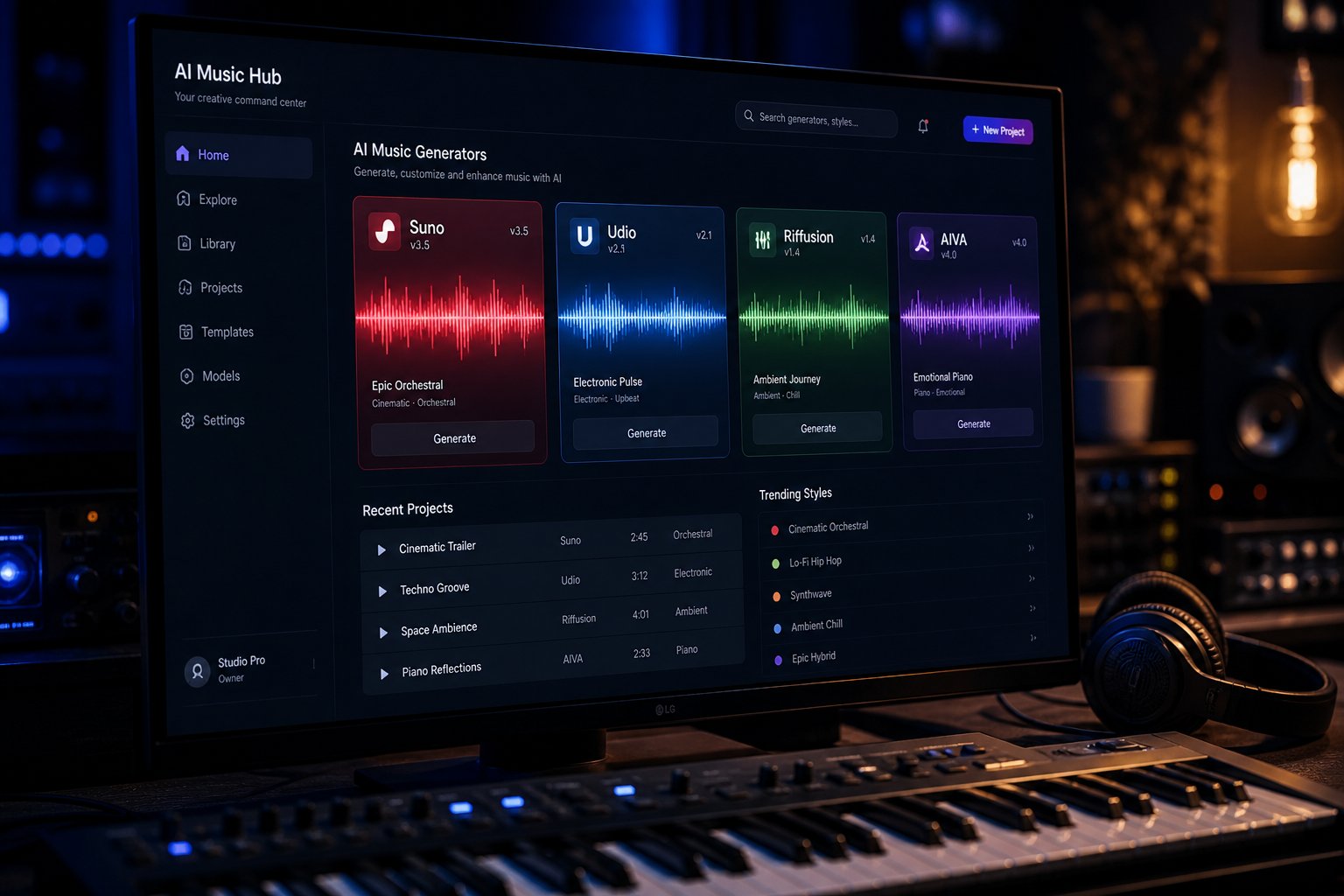
You've got the subgenre knowledge. You've got the prompt techniques. But even a perfectly crafted prompt can't save you if you feed it into the wrong tool. The problem? Nearly every "best AI metal music generator" list you'll find online is published by a platform promoting itself. Genuine side-by-side comparisons barely exist. That changes here. The goal isn't to crown a single winner — it's to help you match the right metal song generator to your specific creative needs, whether that's demoing a full track with vocals, generating atmospheric loops, or exploring heavy guitar-driven compositions from scratch.
How to Evaluate an AI Metal Music Generator
Before jumping into specific platforms, you need a framework. Not every metal song maker excels at the same things, and the criteria that matter most depend entirely on what you're trying to accomplish. Six dimensions consistently separate the tools that deliver from the ones that waste your time:
- Subgenre range — Can the tool handle death metal growls and doom sludge, or does it max out at generic hard rock? The wider the stylistic range, the more useful the platform becomes as your tastes evolve.
- Audio quality — Does the output sound like a produced track or a compressed demo with artifacts? Listen for clean separation between instruments, realistic distortion tones, and convincing drum hits.
- Customization depth — Can you specify BPM, tuning, structure, and vocal style, or are you limited to a text box and a "generate" button? More control means better results for anyone willing to invest a few extra minutes.
- Output length — Some platforms cap tracks at 30 seconds per generation. Others deliver full multi-minute compositions. Your use case determines which matters more.
- Licensing terms — Royalty-free doesn't always mean you can monetize freely. Commercial rights, attribution requirements, and retroactive ownership rules vary significantly across platforms.
- Ease of use — A powerful tool that takes hours to learn may not serve a content creator who needs background metal in five minutes. Conversely, a simple interface might frustrate producers who want granular control.
With those criteria in mind, here's how the major options stack up based on publicly available information:
| Platform | Best Metal Styles | Audio Quality | Customization Depth | Vocals | Ease of Use | Free Tier |
|---|---|---|---|---|---|---|
| MakeBestMusic AI Rock Generator | Hard rock, punk, classic rock, heavy guitar-driven styles | Good | Prompt-based with style selection | Varies by generation | Beginner-friendly | Check site |
| Suno AI | Broad metal range including thrash, metalcore, death metal | High (v5 model) | Prompt-based; custom lyrics mode; Suno Studio editing | Full AI vocals included | Very easy | 50 credits/day |
| Udio | Experimental, progressive, industrial metal | High (strong instrumentals) | Timeline editing, inpainting, stem export | Capable vocal generation | Moderate learning curve | 10 credits/day |
| AIVA | Symphonic metal, cinematic metal | Professional | Note-level editing, MIDI/sheet music export | Instrumental only | Moderate | Free for non-commercial |
| Riffusion | Metal riff loops, experimental textures | Variable | Text prompt only | Limited | Very easy | Fully free |
| Beatoven.ai | Doom-inspired, atmospheric, dark moods | Good | Mood-based selection | Instrumental only | Easy | Free trial |
| Loudly | Modern metal, industrial-leaning styles | Clean and polished | Genre/mood filters, customizable effects | Instrumental only | Easy | 25 generations/month |
| Boomy | Basic heavy/aggressive instrumentals | Moderate | Style selection only | Limited | Extremely easy | 25 saves/month |
A few things jump out from this comparison. First, no single platform dominates every category. Suno and Udio lead the pack for full-track generation with vocals, but they approach the task differently — Suno prioritizes speed and simplicity while Udio rewards patience with deeper editing control like inpainting and stem exports. AIVA occupies a unique niche for symphonic metal thanks to its orchestral composition strengths and MIDI export, but it won't generate a guttural vocal line. Riffusion remains the only fully free option and excels as a riff inspiration tool, though output quality can swing from impressive to unusable between generations.
Matching Generators to Your Specific Needs
Linear rankings miss the point. The best AI metal music generator for a YouTuber who needs a 60-second intro theme is completely different from the best option for a guitarist hunting riff inspiration. Instead of a numbered list, here's how to match platforms to use cases:
- Best for beginners exploring heavy music — MakeBestMusic's AI Rock Generator provides a low-friction entry point for creators who want to explore the spectrum from classic rock to heavier, metal-adjacent styles without wrestling with complex interfaces. Its straightforward approach makes it particularly well-suited for first-time users who aren't yet sure whether they want hard rock, punk energy, or something closer to full metal intensity.
- Best for full metal songs with vocals — Suno AI stands out here. Its v5 model generates complete tracks including harsh and clean vocals, and the custom lyrics mode lets you feed in your own words. The Suno Studio editing environment adds light DAW-style control for remixing sections after generation.
- Best for subgenre variety and experimental metal — Udio rewards more detailed prompts with stylistically diverse outputs. Its inpainting feature — the ability to fix specific sections without regenerating the entire track — is particularly valuable when one section nails the vibe but another falls flat.
- Best for symphonic and cinematic metal — AIVA dominates this niche. Its orchestral composition engine produces sweeping arrangements that pair naturally with metal instrumentation, and the ability to export MIDI means you can import the composition into a DAW and replace synth sounds with real orchestral samples or heavier guitar tones.
- Best free option for riff inspiration — Riffusion costs nothing, requires no account setup, and generates looping riffs from text prompts. Quality varies, but as a zero-commitment brainstorming tool for guitarists, it's hard to beat.
- Best for atmospheric and doom-inspired textures — Beatoven.ai specializes in mood-driven generation, making it a natural fit for dark, slow, atmospheric compositions that lean toward doom or post-metal territory.
What Sets the Top Tools Apart
Surface-level feature lists only tell part of the story. The real differentiators show up when you actually use these tools for metal-specific generation, and a few factors consistently separate the platforms that deliver from those that disappoint.
Prompt flexibility matters enormously. Some generators treat your text input as a rough suggestion, applying heavy stylistic defaults that override your specifics. Others parse your descriptors with genuine precision — if you write "Gothenburg melodic death metal, 164 BPM, dual harmonized leads," the output actually reflects those details rather than producing generic heavy rock. Suno and Udio tend to respond well to detailed metal terminology, which aligns with findings from AI music quality research showing that prompt alignment is one of the most critical dimensions of output quality. MakeBestMusic's approach focuses on guitar-driven styles specifically, which can be an advantage when you want heavy riffs without the model drifting toward electronic or ambient territory.
Editing and iteration capabilities create a sharp divide. A metal track that's 80% right but has a weak breakdown is either usable or not depending on whether the platform lets you fix just that section. Udio's inpainting and Suno's Studio editing represent the current frontier here — both let you target specific portions of a track for regeneration without starting from scratch. Most other platforms operate on a "generate and hope" model where your only option is to rerun the entire prompt and cross your fingers.
Licensing transparency is the hidden differentiator that most users overlook until it's too late. Both Suno and Udio settled major-label copyright lawsuits in late 2025, which adds legitimacy but also introduced new terms — Suno, for instance, only grants commercial rights to songs created while actively subscribed, with no retroactive ownership. Udio temporarily disabled all downloads during a licensing transition. These aren't minor details if you plan to use generated metal tracks in monetized content. Always verify the current licensing status before committing to a paid plan for commercial work.
Genre-specific tuning is perhaps the most underappreciated factor. A general-purpose AI music platform and a tool specifically trained or optimized for heavy guitar-driven music will produce noticeably different outputs from the same prompt. General tools spread their capabilities across dozens of genres, which dilutes their metal performance. Platforms that focus on rock and heavy music — or that offer genre-specific generation modes — tend to produce tighter distorted tones, more convincing drum patterns, and heavier overall mixes because their models have deeper exposure to the relevant sonic characteristics.
The honest takeaway? No single platform has "solved" AI metal generation. Each tool occupies a different point on the spectrum of ease, quality, control, and cost. The best approach for most creators is to experiment with two or three platforms using the same prompt and compare the results directly. Your ears are the final judge — and they'll quickly reveal which generator handles your preferred subgenre with the most conviction.
Comparing tools reveals what's possible, but it also raises an equally important question: where do all of these generators consistently succeed, and where do they consistently fall short? That honest reckoning — the unfiltered gap between AI potential and AI reality in metal — is something most tool comparisons conveniently leave out.
What AI Gets Right and Wrong About Metal Music
Every tool comparison eventually hits the same wall: a feature checklist can tell you what a platform offers, but it can't tell you what the output actually sounds like when you press play. And in metal — a genre where the difference between convincing and cringe-worthy lives in tiny details of tone, timing, and aggression — that gap between promise and reality matters more than anywhere else. So let's drop the marketing language and talk about what AI metal generators genuinely do well, where they consistently stumble, and what you should realistically expect based on your own skill level.
Where AI Metal Generators Genuinely Impress
It's easy to focus on failures, but that paints an incomplete picture. Current generators have made real strides in several areas that directly benefit anyone looking to create ai metal songs quickly.
Rhythm guitar patterns are arguably AI's strongest suit in metal. Palm-muted chugging, power-chord progressions, and basic riff construction — the backbone of most metal tracks — translate surprisingly well. Models have absorbed enough heavy music to understand that a Drop C palm-muted riff at 160 BPM should sound tight and percussive, not loose and jangly. The result won't replace a seasoned guitarist's feel, but it establishes a convincing foundation that sounds identifiably metal rather than "distorted pop."
Drum patterns and backing rhythms also land in convincing territory for straightforward styles. Double-kick patterns in metalcore, steady thrash beats, and standard blast beat sections come through with reasonable energy. The quantized precision of AI-generated drums — often a weakness in genres that prize human swing — actually works in metal's favor, where mechanical tightness is part of the aesthetic.
Ambient and atmospheric textures represent a genuine bright spot. Dark, droning soundscapes for doom or post-metal, eerie clean guitar arpeggios for black metal intros, and cinematic orchestral swells for symphonic metal all benefit from AI's ability to layer sounds without fatigue. If your goal is mood-setting background music or atmospheric scene-building, the technology delivers usable results with minimal prompt refinement.
Speed of iteration is perhaps the most underrated advantage. Generating five full backing tracks in ten minutes — each in a different subgenre — lets you explore creative directions that would take a human musician hours or days to demo. As a creative springboard, this pace is genuinely transformative.
Basic song structures hold together reasonably well for simpler arrangements. Verse-chorus-verse patterns, metalcore-style buildups into breakdowns, and power metal chorus hooks follow recognizable templates that feel intentional. The AI has internalized enough structural logic to avoid sounding completely random — at least when you keep the architecture conventional.
The Uncanny Valley Problem in AI Metal
And then there's the other side. If you've ever listened to an AI-generated metal track and felt something was off without being able to pinpoint exactly what, you've encountered what could be called the uncanny valley of heavy music. The output is close enough to sound like metal, but not close enough to feel like it.
Guitar solos expose the gap most brutally. A great metal solo isn't just the right notes at the right speed — it's vibrato that swells with emotion, bends that land with intention, pick attack that shifts from aggressive to delicate within a single phrase. These are expressions of human physicality and feeling. AI-generated solos tend to hit technically plausible note sequences that lack the push-and-pull tension of a real player. Research on AI-generated progressive metal found that listeners consistently identified compositions lacking "soul" and "deliberate musical choices" as AI-produced. The solos are where that absence hits hardest.
Distorted guitar tones remain stubbornly difficult to synthesize authentically. Distortion creates a dense web of harmonic overtones — the character of a tube amp pushed into saturation, the way different pickups interact with gain stages, the tactile crunch of a palm mute cutting through a wall of fuzz. AI models approximate this, but the result often sounds like a distortion filter applied to a clean tone rather than a genuinely overdriven amplifier. The difference is subtle on laptop speakers. On studio monitors or decent headphones, it becomes immediately apparent.
Complex time signatures trip up even the best models. Progressive metal and djent thrive on odd meters — 7/8, 11/8, alternating bars of 5/4 and 6/4. These demand that every instrument locks into unconventional rhythmic grids simultaneously. Current generators handle standard 4/4 time competently, but the polyrhythmic interplay that makes prog metal compelling often devolves into rhythmically confused passages where the drums and guitars seem to drift apart. That same listening study with progressive metal fans confirmed that rhythmic complexity — or the lack of it — was one of the primary features participants used to distinguish AI compositions from human ones.
Blast beats can sound mechanical in the wrong way. There's a paradox here: blast beats are already machine-gun fast, so you might expect AI to handle them well. But real blast beats have micro-dynamics — slight velocity variations between snare hits, kick drum accents that shift with the riff, a controlled chaos that keeps the pattern from feeling like a static loop. AI-generated blast beats often flatten those dynamics into a perfectly uniform wall of hits, which sounds less like a drummer playing at extreme speed and more like a drum machine set to "blast."
Vocal synthesis remains the weakest link for extreme styles. Clean vocals have improved dramatically — modern generators produce sung passages that sound impressively human. But guttural growls, black metal shrieks, and hardcore screams occupy timbral territory that most models have limited training data for. The result frequently sounds like a heavily processed voice attempting to mimic aggression rather than a vocalist channeling genuine intensity. A metal song lyrics generator can give you compelling words, and a heavy metal song lyrics generator can nail the thematic darkness, but delivering those lyrics through convincingly harsh AI vocals is a challenge the technology hasn't yet cracked for most extreme subgenres.
Long-range compositional coherence falters in extended tracks. A 90-second AI metal clip can sound impressively tight. Stretch that to four or five minutes, and cracks appear. Riffs introduced early get abandoned rather than developed. Transitions between sections feel arbitrary instead of earned. The sense that a composition is going somewhere — building tension, releasing it, circling back to a theme with variation — is a higher-order compositional skill that current models struggle to sustain beyond short-form outputs.
Realistic Expectations for Different Skill Levels
Here's where honesty becomes genuinely useful. Your experience level doesn't just change how you use AI metal generators — it changes what you should expect from them. A complete beginner and a professional producer will interact with the exact same output in fundamentally different ways, and calibrating your expectations prevents both disappointment and missed opportunities.
| User Type | Realistic Output Quality | Best Use Case | Recommended Workflow |
|---|---|---|---|
| Complete Beginner (no musical training or DAW experience) | Usable as-is for personal projects, social media clips, and background music. Expect occasional awkward transitions and artificial-sounding vocals in extreme styles. | Creating intro music for streams or videos, exploring what different metal subgenres sound like, generating mood playlists for personal enjoyment | Use the output directly. Focus on generating multiple variations and selecting the best one rather than trying to edit. Pair with a metal song lyrics generator if you want words to match. |
| Hobbyist Musician (plays an instrument, basic recording knowledge) | Strong as a demo or reference track. Rhythm sections and arrangements provide solid skeletons, but solos, vocals, and tonal details will likely need human replacement or refinement. | Breaking creative blocks, demoing song ideas before committing to full recording, exploring subgenres outside your playing comfort zone | Use AI output as a demo sketch. Identify the sections and riffs that work, then re-record key parts with your own instruments. Replace AI vocals with your own performance or remove them entirely for instrumental versions. |
| Professional Producer (DAW proficiency, mixing and mastering skills) | Valuable as raw material and compositional starting points. Individual elements like drum patterns or rhythm guitar ideas can be isolated and refined, but the full mix will rarely meet release-quality standards without significant post-production. | Rapid prototyping of arrangements, generating reference tracks for client communication, creating scratch tracks that session musicians can then perform over | Export stems where available. Import into your DAW (Reaper, Ableton, FL Studio, Cubase) and treat the AI output as a first draft. Re-amp guitar tones, replace drum samples, adjust mix balance, and layer human performances over the AI foundation. Hybrid AI-to-DAW workflows consistently produce the most professional results. |
The pattern is clear: AI metal generators are most powerful as creative catalysts rather than finished-product factories. A beginner gets a complete track they couldn't have made otherwise. A hobbyist gets a demo that saves hours of setup. A professional gets raw material that accelerates the ideation phase. None of them should expect a release-ready master straight out of the generator — but each gets genuine value calibrated to their skill level and workflow.
That distinction between starting point and final product also shapes who benefits most from these tools in practice. The answer goes far beyond musicians. Content creators, game developers, filmmakers, and multimedia producers are all finding ways to put AI-generated metal to work — often in ways the tools' own creators never anticipated.
Who Actually Benefits from AI Metal Music Generators
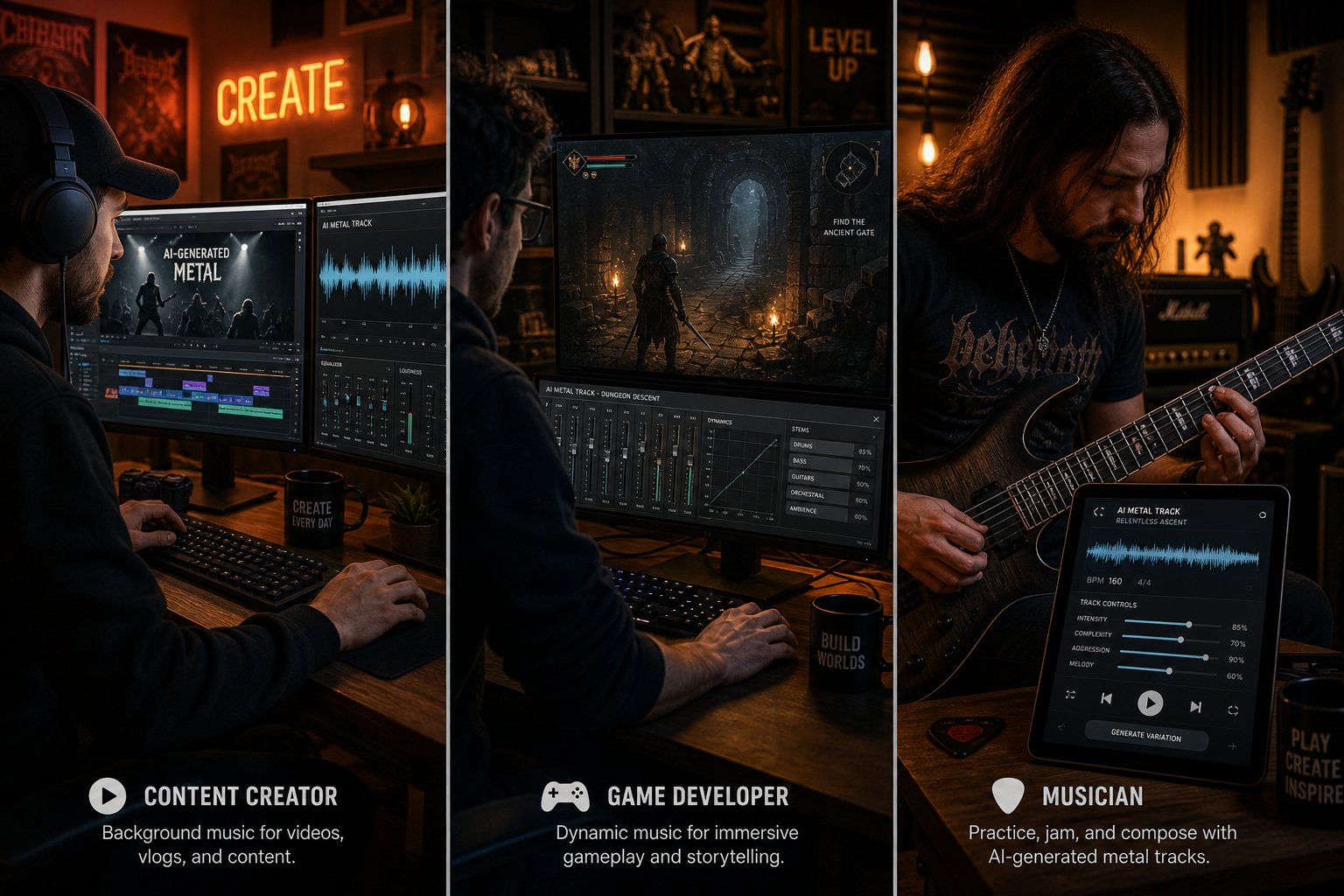
Picture a YouTuber who needs a menacing intro theme, a solo game developer hunting for a boss battle soundtrack, and a guitarist stuck in a creative rut — three completely different people, three completely different goals, yet all of them can pull real value from the same category of tool. The question isn't whether AI-generated metal is perfect. The previous section made clear that it isn't. The question is whether it's useful, and the answer depends entirely on what you're trying to accomplish. Here's how different creators are actually putting these generators to work in real-world projects.
Content Creators and Game Developers
If you produce videos, stream on Twitch, or run a podcast, you already know the audio licensing headache. Finding aggressive, high-energy background music that doesn't trigger a copyright claim — and doesn't sound like royalty-free elevator music — is a genuine production bottleneck. An AI metal music generator sidesteps that problem entirely. You describe what you need, generate a handful of variations, pick the best one, and drop it into your timeline. No sync licensing negotiations. No cease-and-desist surprises three months after upload.
Streamers use this workflow for channel intros, subscriber alert sounds, and intermission loops. Podcast producers generating true-crime or horror content find that dark, heavy instrumentals set a far more gripping tone than generic ambient beds. YouTubers covering gaming, tech teardowns, or extreme sports pair aggressive metal clips with fast-cut edits to keep viewer energy high. The output doesn't need to be album-quality — it needs to be distinctive enough that your channel sounds like yours rather than everyone else pulling from the same stock library.
Game developers represent one of the fastest-growing use cases. Indie studios building action RPGs, roguelikes, and dungeon crawlers need aggressive audio for combat sequences, boss encounters, and high-tension exploration zones. Traditionally, that meant hiring a composer — a cost that ranges from $500 for a short project to $50,000 or more for a feature-length score. For a solo developer or a three-person team burning through savings, those numbers are simply out of reach.
AI-generated metal fills that gap effectively. Imagine prompting for slow, crushing doom metal to underscore a poison swamp level, then switching to relentless thrash for a boss arena. The tracks don't need to be masterpieces — they need to match the on-screen energy and loop cleanly. Modern generators handle both requirements well enough for indie releases, and the adaptive music systems emerging in game audio even allow AI-generated loops to shift dynamically based on player actions. Tabletop RPG game masters use a similar approach, generating ambient metal playlists for session ambiance — a dark atmospheric track for dungeon exploration, an explosive thrash clip when initiative is rolled.
Musicians Using AI as a Creative Springboard
Here's where the conversation gets interesting — and a little counterintuitive. You'd think working musicians would be the last people to use AI generators. Why would a guitarist who can write their own riffs need a machine to do it? The answer isn't about replacing skill. It's about breaking through creative walls and exploring unfamiliar territory without the friction of learning everything from scratch.
Every songwriter hits the block. You've been writing metalcore for five years, and every riff you come up with sounds like a riff you already wrote. A metal band generator — used not as a replacement but as a brainstorming partner — can snap you out of that loop. Generate ten tracks in a style you've never written: doom, djent, symphonic, whatever sits outside your comfort zone. You won't use any of them as-is, but a single riff idea, a drum pattern you hadn't considered, or an unexpected chord progression can spark something entirely new in your own playing.
The practical workflow looks like this: generate an AI track as a rough demo or reference composition. Listen critically — not for what's good about the AI's performance, but for what musical ideas are worth stealing. Then import the reference into a DAW like Reaper, FL Studio, or Ableton and rebuild from there. Replace the AI guitars with your own performance through a real amp or amp sim. Swap out the synthesized drums for programmed samples or a live drummer. Keep the song structure if it works, or rearrange it entirely. The AI gave you the skeleton. You add the muscle, skin, and soul.
Lyricists follow a parallel track. A heavy metal lyrics generator can produce thematic starting points — verse concepts, rhyme schemes, imagery clusters — that a human writer then rewrites, refines, and personalizes. The AI doesn't write your lyrics. It gives you raw clay to shape. Songwriters who pair a metal lyric generator with a music generator can go from zero to a rough demo — music, words, and structure — in under an hour. That demo might be 60% disposable, but the 40% worth keeping would have taken days to reach through purely manual means.
Filmmakers and Multimedia Producers
Metal and film have a long, underappreciated relationship. Action sequences, horror scenes, fight choreography, dystopian worldbuilding — all of them benefit from aggressive, high-energy soundtracks. But indie filmmakers rarely have the budget to commission custom metal scores. AI generation changes the math entirely.
The most common filmmaker workflow mirrors what game developers do: generate AI metal tracks as temporary scores during the editing phase. Instead of cutting a scene to a copyrighted Slayer track that you'll eventually need to replace — risking attachment to a temp score you can't legally keep — you create original AI-generated metal that captures the energy you want. If the temp track is good enough, it becomes the final score. If it's not, it still served as a precise reference for whatever composer or sound designer you bring in later. Either way, you avoid the copyright risks that come with using unauthorized placeholder music in pitch decks or festival submissions.
Advertisers and social media creators work on shorter timescales but face similar needs. A 15-second Instagram reel showcasing extreme sports needs a metal clip that grabs attention immediately. A product launch video targeting a younger, edgier demographic benefits from aggressive audio that signals intensity without requiring a music licensing budget. AI-generated metal clips — especially short loops and stingers — serve these micro-content needs efficiently.
To help you match the right output type to your specific situation, here's a quick-reference pairing:
- YouTubers and streamers — Full tracks (2-4 minutes) for intros, outros, and background music; short loops (15-30 seconds) for transition stingers and alert sounds
- Indie game developers — Seamless loops for level backgrounds; full tracks for boss battles and cutscenes; atmospheric stems for layered adaptive audio
- Tabletop RPG game masters — Full atmospheric tracks for session playlists; ambient loops for sustained dungeon or combat ambiance
- Musicians and songwriters — Full demos for reference and ideation; stems for importing into DAWs; lyrics from a metal lyric generator for thematic starting points
- Indie filmmakers — Full tracks for temp scoring and final placement; loops for repetitive action sequences; stems for mixing into dialogue-heavy scenes
- Advertisers and social media creators — Short clips (10-30 seconds) for reels, ads, and product videos; stingers for transitions and brand audio signatures
The common thread across every use case is the same: AI-generated metal works best when treated as a creative accelerator rather than a finished deliverable. Content creators get usable audio in minutes instead of days. Musicians get inspiration instead of a blank page. Filmmakers get a legal, original temp score instead of a lawsuit waiting to happen. The value is real — it's just different from what most people expect when they imagine an AI replacing a human musician.
Of course, the moment any of these creators move from personal projects to commercial releases, a new set of questions surfaces — ones that have nothing to do with audio quality and everything to do with legal rights, ethical considerations, and how the metal community itself feels about machines generating its music.
Licensing, Ethics, and the Metal Community Debate
You've found a generator that nails your subgenre. You've crafted a prompt that produces a genuinely usable track. You drag it into your YouTube video timeline, hit publish, and move on. Three weeks later, a copyright claim lands in your inbox. Or worse — your entire channel gets flagged. Sound dramatic? It's already happening to creators who skipped the fine print. The legal and ethical landscape surrounding AI-generated metal is messier, more nuanced, and more consequential than most tool reviews will ever tell you. Ignoring it doesn't make it go away. It just means you find out the hard way.
Royalty-Free Does Not Mean Restriction-Free
This is the single most dangerous misconception in the AI music space, and it trips up creators across every genre — not just metal. "Royalty-free" sounds like a green light. It isn't. It means you won't owe per-use royalties within the scope of your license. That scope, however, varies wildly from platform to platform, and the restrictions hiding inside it can blindside you.
Here's the critical distinction most people miss: royalty-free and copyright-free are not the same thing. Royalty-free means the license waives recurring payments for each use. Copyright-free — in the literal sense — means no one holds copyright over the work at all, and that situation is far rarer than the term's casual usage suggests. Most AI platforms grant you a license to use generated tracks under specific conditions. Those conditions change based on your subscription tier, the platform's current terms of service, and sometimes even the country you're operating in.
Some platforms allow full commercial use on paid plans but restrict monetization on free tiers. Others require attribution — a credit in your video description, a link in your game's documentation. A few grant broad usage rights but explicitly prohibit registering the output with content identification systems like YouTube's Content ID. And here's the detail that catches people off guard: some platforms only grant commercial rights to tracks created while your subscription is active, meaning songs you generated last month could lose their commercial license the moment your plan lapses.
Before you use any AI-generated metal track in a commercial project — whether that's a monetized YouTube video, a Spotify release, a game soundtrack, or a client deliverable — verify these questions against the platform's current terms:
- Does your specific plan tier cover the intended use case (monetized video, streaming release, client work, paid product)?
- Are generated outputs exclusive to you, or can other users receive substantially similar tracks?
- Does the license survive if you cancel or downgrade your subscription?
- Are you permitted to register the track with Content ID or a music distributor?
- Can you sublicense or transfer rights if you're creating music for a client?
- Is attribution required, and if so, in what format?
- What happens if a third party files a copyright claim against your AI-generated track — does the platform offer any dispute support?
That last question matters more than you'd think. With human-composed royalty-free music, the composer can personally verify originality and support your dispute. With AI output, you're often on your own. The platform's terms of service typically shift liability entirely to the user, leaving you to fight copyright claims without any backing from the company whose tool generated the music in the first place.
Training Data and the Copyright Question
Beyond licensing, a deeper legal fault line runs beneath every AI-generated metal track: what music did the model learn from, and did anyone get permission?
This isn't a hypothetical concern. In 2024, all three major music labels — Universal, Sony, and Warner — launched coordinated lawsuits through the Recording Industry Association of America (RIAA) against both Suno and Udio, accusing them of mass copyright infringement through unauthorized use of copyrighted recordings as training data. Suno admitted to using copyrighted music for training and argued that it constituted fair use — a defense that remains legally untested at this scale.
The stakes are staggering. Potential statutory damages reach up to $150,000 per infringed track. By late 2025, Warner Music settled with Udio and pivoted toward a licensing partnership model, signaling that the industry is moving toward controlled collaboration rather than outright suppression. But the broader legal questions remain unresolved.
What does this mean for you as a user? Two uncomfortable realities. First, AI-generated riffs could inadvertently replicate copyrighted material. Models trained on thousands of metal recordings have internalized melodic fragments, rhythmic patterns, and tonal characteristics from those recordings. The output isn't a direct copy — it's a statistical recombination — but the line between "inspired by" and "derived from" is exactly what courts are still working to define. Second, the US Copyright Office has stated that fully AI-generated content cannot receive copyright protection, meaning your generated metal track may not be legally defensible if someone else copies or claims it.
The UK regulatory landscape has shifted as well. In early 2026, the UK government abandoned plans that would have allowed AI companies to train on copyrighted material without explicit permission, following overwhelming opposition from creators — over 10,000 consultation submissions, with 95% opposing the AI-friendly approach. The regulatory tide is moving toward requiring licenses for training data, which could reshape what future AI metal bands and generators sound like as companies either pay for training rights or switch to smaller, fully licensed datasets.
None of this means you should never use AI-generated music. It means you should treat the legal landscape as actively evolving — not settled — and document everything. Save your prompts, your generation timestamps, your subscription receipts, and your export files. If a dispute arises months or years from now, that paper trail may be the only evidence you have.
How the Metal Community Views AI-Generated Music
Legal questions are one thing. Cultural acceptance is another — and in metal, the cultural dimension carries enormous weight. Few genres are as deeply invested in authenticity, technical mastery, and the almost sacred relationship between artist and instrument. So when an ai metal band appears — tracks generated entirely by algorithms, no human hands on a fretboard — the reaction from the community tends to be visceral.
The skepticism is rooted in something real. Metal has always valorized the process of making music, not just the product. A blast beat isn't just a rhythmic pattern — it's a physical achievement. A sweep-picked arpeggio represents years of practice. A vocalist's growl is a trained, embodied skill. As engineer and musician Joseph Turmes observed in a widely shared essay on AI in heavy metal, artists "tend to value the process of making art, not only as a means to create their product, but by internalizing the process such that the process itself is deeply ingrained into the experience for the artist, greatly influencing the final product." Streamlining that process with AI doesn't just change the output — it fundamentally alters what the art means to both the creator and the audience.
High-profile controversies have amplified the tension. AI-generated album art for bands like Deicide, AI-assisted music videos, and even ai metal bands releasing fully synthetic tracks on streaming platforms have all drawn backlash. Over 200 prominent artists signed an open letter in 2024 specifically targeting AI music generators, warning against what they called "this assault on human creativity." When names like Billie Eilish and the estate of Bob Marley align on a position, it carries cultural gravity far beyond a policy debate.
But dismissing AI tools entirely ignores the other side of the argument — one that's quieter but equally valid. For creators who lack access to session musicians, who can't afford studio time, or who simply want to hear what a riff idea sounds like before investing hours of practice, these generators democratize a creative space that has always had steep barriers to entry. A bedroom songwriter in a town with no metal scene can now generate a backing track and write vocals over it. A metal band names generator can spark identity ideas for a project that doesn't have a lineup yet. A filmmaker can score an indie horror short with aggressive, original music instead of settling for generic stock audio or risking a copyright claim.
It's worth noting that this tension isn't new to metal. The genre has weathered similar authenticity debates before. When drum machines appeared in industrial metal, purists recoiled. When Pro Tools enabled pitch correction and sample replacement, accusations of "cheating" followed. When djent emerged as a subgenre defined partly by its production techniques — Turmes pointedly asked readers to imagine if Meshuggah had been able to copyright an entire genre — the debate over what counted as "real" metal flared again. Each time, the community absorbed the technology, redrew its boundaries, and moved forward. AI will likely follow the same arc, though the timeline and final shape remain genuinely uncertain.
The most productive stance for individual creators sits somewhere between uncritical adoption and blanket rejection. Use AI-generated metal where it adds value — demos, ideation, background audio, creative exploration. Be transparent about its role in your work. Don't present fully AI-generated output as the product of human musicianship. And respect that for many metalheads, the sweat on the fretboard isn't an inconvenience to be optimized away — it's the entire point.
These licensing realities and community dynamics don't exist in a vacuum. They directly shape how you should approach your first AI metal project — from choosing your platform and writing your prompt to deciding what role the generated output plays in your final creative product.

From First Prompt to Finished Metal Track
You've absorbed the technology, mapped the subgenres, studied the prompt techniques, compared the tools, and weighed the ethical landscape. All of that knowledge is useless if it stays theoretical. So let's put it to work. This section walks you through the complete process — from staring at an empty prompt box to holding a finished metal track you can actually use. Whether you're building a YouTube intro, demoing a song idea, generating a metal album cover generator concept alongside your music, or assembling an entire creative project from scratch, the workflow stays the same. The difference between a frustrating experience and a productive one comes down to process, not luck.
Your First AI Metal Track Step by Step
Forget overthinking it. Your first track isn't going to be perfect, and that's fine. The goal is to get something usable out of the machine as quickly as possible, then iterate from there. Here's the step-by-step approach that consistently produces the best results for first-timers.
Pick your subgenre before you touch the keyboard. This single decision shapes every other parameter. Saying "I want thrash metal" instantly narrows your BPM range to 150-220, your tuning to Standard or Drop D, your vocal style to aggressive shouting, and your production aesthetic to tight and punchy. Saying "I want metal" narrows nothing. Revisit the subgenre cheat sheet from earlier in this guide if you're unsure — even choosing between just two options ("metalcore or doom?") eliminates half the guesswork.
Define your parameters on paper first. Before writing a single word of your prompt, jot down five things: subgenre, BPM, tuning, vocal style, and mood. That's it. Five decisions. A sticky note works. This prevents the most common beginner mistake — opening the generator, typing stream-of-consciousness adjectives, and ending up with a prompt that contradicts itself. Your five parameters become the skeleton of your prompt.
Write your prompt using specific musical terminology. Translate those five parameters into the kind of language the AI actually responds to. Not "make it heavy and dark" but "doom metal, 68 BPM, Drop B tuning, slow crushing palm-muted riffs, mournful clean vocals, raw cavernous production." Every word carries musical meaning. Every word steers the output. If you're struggling with phrasing, revisit the prompt templates from the earlier chapter and adapt one to your chosen subgenre.
Generate multiple variations — never settle for the first result. This is the step most beginners skip, and it's the step that matters most. Generate at least three to five variations from the same prompt. AI output is inherently probabilistic — the same input produces different results each time. One generation might nail the guitar tone but fumble the drums. Another might reverse that. A third might surprise you with a structural idea you never would have written yourself. Treat generation like auditions: you're casting for the best performance, not accepting the first person who walks through the door.
Evaluate critically, then refine your prompt. Listen to your generations with honest ears. Does the output actually sound like the subgenre you requested? Is the tempo right? Do the vocals match your specification? If something's off, don't just regenerate blindly — adjust the prompt. Too fast? Lower the BPM explicitly. Vocals too clean for death metal? Add "guttural low growl" instead of just "harsh vocals." Each round of prompt refinement gets you closer to the target. Experienced AI music producers describe this iterative loop as the core skill that separates satisfying results from frustrating ones — generation is fast, but curation is where the craft lives.
Building a Complete Metal Project with AI Assistance
A single track is a starting point. A complete project — music, lyrics, visual identity, cohesive branding — is what turns a casual experiment into something that feels real. The good news? AI tools now cover nearly every piece of that puzzle, and assembling them into a unified creative workflow is more accessible than ever.
Music generation is the foundation. You've already covered this. But think beyond a single song. If you're building a concept album, a game soundtrack, or a content library, generate tracks in related but distinct subgenres to create variety within a cohesive sonic palette. A doom track for your opening, a thrash piece for the middle, and a progressive epic for the finale — each generated with consistent production-style descriptors ("raw underground recording" or "polished modern mix") to tie them together sonically even as the subgenres shift.
Lyrics deserve their own generation pass. Pair your music generator with a dedicated metal lyrics tool — or use a text-based AI — to create words that match the mood and theme of each track. Feed it subgenre-specific direction: "Write doom metal lyrics about isolation and decay, using slow imagery and sparse phrasing" produces dramatically different output than "Write power metal lyrics about a warrior's triumph using epic, soaring language." The lyrics don't need to be final drafts. They need to be strong enough starting points that a human writer can reshape them into something personal and authentic.
Visual identity completes the picture. An ai death metal logo generator can produce gnarled, illegible wordmarks that capture the aesthetic perfectly — or at least provide reference art for a human designer to refine. A metal album cover generator creates artwork concepts ranging from dark fantasy landscapes to abstract brutalist compositions. And a metal band name maker or name generator can spark identity ideas if you're building a fictional project, a game faction, or a streaming persona. None of these visual outputs need to be final production assets. Like the music, they're creative accelerators — rough drafts that compress hours of brainstorming into minutes of iteration.
Creators looking for a streamlined entry point into heavy guitar-driven music generation can start with platforms like MakeBestMusic's AI Rock Generator, which covers the spectrum from rock and punk to classic rock and harder-edged styles. Its accessible interface makes it a practical launchpad for metal-adjacent creation — especially if you're still exploring where your preferences land on the heaviness spectrum before committing to more specialized tools. From there, you can expand into dedicated metal generators, lyric tools, and visual AI as your project demands grow.
Next Steps for Serious Metal Creators
If you're treating AI metal generation as more than a novelty — if you want output that holds up in a professional context — the path forward leads through your DAW. Every experienced producer who works with AI-generated music says the same thing: the magic isn't in the generation. It's in what you do with it afterward.
Export and import. Platforms that offer stem separation or individual track exports (vocals, drums, bass, guitars) give you dramatically more control than a single mixed-down MP3. Import those stems into Reaper, FL Studio, Ableton, Cubase, or whatever DAW you're comfortable with. Now you can isolate the elements that work and replace the ones that don't.
Layer real instruments over AI foundations. This is the hybrid workflow that produces the most convincing results. Keep the AI-generated drum pattern if it grooves. Keep the bass line if the rhythm section locks. But re-record the guitars through your own amp or amp sim — real distortion tones are still measurably more convincing than synthesized ones. Record your own vocals. Add a real guitar solo. The AI gave you the architecture. You furnish the rooms.
Mix and master with human ears. AI-generated mixes frequently suffer from muddy low-end buildup, unnatural stereo imaging, and frequency clashes between distorted guitars and cymbals. Professional producers working with AI stems report that proper EQ, compression, and spatial processing transform a raw AI export from "interesting demo" into "genuinely competitive track." The gap between the two is enormous — and it's entirely bridgeable with standard mixing techniques.
Use AI as one tool in a broader toolkit. This is the mindset shift that separates creators who get lasting value from AI generators and those who bounce off them in frustration. An AI metal music generator isn't a replacement for musicianship, taste, or craft. It's a force multiplier. It compresses the ideation phase. It eliminates blank-page paralysis. It lets you hear ideas before you invest hours performing them. But the final product — the thing that carries your name — should always pass through human judgment, human refinement, and human creative intent.
Here's the complete workflow from first idea to polished output, condensed into a single actionable sequence:
- Choose your subgenre and define five core parameters: subgenre, BPM, tuning, vocal style, and production mood
- Write a detailed prompt using specific musical terminology — stack six descriptors maximum for focused results
- Generate three to five variations from the same prompt and listen critically to each one
- Refine your prompt based on what the first batch got right and wrong, then generate again
- Select your best output and export stems if the platform supports it
- Import into your DAW and separate usable elements from sections that need replacement
- Layer human performances — re-record guitars, add real vocals, play a live solo over the AI foundation
- Mix and master with proper EQ, compression, and spatial processing to bring the track to release quality
- Generate complementary assets — lyrics, album art, logo concepts — using dedicated AI tools for each
- Verify licensing terms before publishing, distributing, or monetizing any AI-generated content
That ten-step sequence takes you from a blank screen to a finished, legally vetted metal track. Steps one through five can happen in under thirty minutes. Steps six through eight take as long as your ambition demands — from a quick cleanup for a YouTube background track to a full production session for a release you're genuinely proud of. Step nine builds your project's identity beyond the audio. Step ten keeps you out of legal trouble.
The technology will keep evolving. Models will get better at distorted tones, extreme vocals, and complex time signatures. Training data disputes will settle into licensing frameworks. New tools will emerge that handle metal-specific generation with increasing sophistication. But the fundamental workflow won't change: describe what you want, generate options, curate ruthlessly, refine with human skill, and release with confidence. The AI handles the heavy lifting. You handle the heavy metal.


