

What an Art Song Really Is
You hear the word "song" dozens of times a day. It might refer to a pop hit on the radio, a folk tune passed down through generations, or a lullaby hummed at bedtime. So what is art song, and why does it occupy its own category in the world of classical music? The answer lies in a very specific combination of ingredients that sets this genre apart from every other kind of vocal music.
A Clear Definition of Art Song
An art song is a composed vocal work for solo voice and piano accompaniment, built on a literary text — typically a poem — and intended for concert or recital performance rather than the operatic stage. It represents the fusion of two independent art forms, poetry and music, in a collaboration between singer and pianist.
That definition of art song matters because it draws a clear boundary. Unlike a pop track written around a catchy hook, or an opera aria designed for theatrical spectacle, art songs begin with a pre-existing poem that already stands as a work of art on its own. The composer then gives that poem, as renowned Lieder accompanist Graham Johnson puts it, "a heightened existence through their own vision and imaginative skill." The result is something entirely new — not words plus music, but a third entity greater than the sum of its parts.
If you've ever wondered what is an art song or Lied, the German term Lied (plural Lieder) simply means "song," but in classical circles it refers specifically to this tradition of setting poetry to music for voice and piano. The art song definition stays consistent across languages and cultures: a composed, text-driven work for intimate performance.
Why Art Song Deserves Your Attention
Imagine a single voice, a single pianist, and a poem. No orchestra. No costumes. No staging. That stripped-down format is exactly what gives art songs their remarkable emotional intensity. Where opera fills a theater with spectacle, the recital stage offers something closer to a private conversation. The energy between singer and pianist envelops the audience, creating a space where performers and listeners respond to each other directly.
This intimacy is not a limitation — it's a superpower. A subtle shift in harmony can break your heart. A single word, colored by an unexpected piano texture, can change the meaning of an entire poem. Recital halls around the world continue to program these works precisely because no other genre delivers that kind of emotional precision at such close range.
The genre's power, though, didn't appear out of thin air. It grew from a very particular moment in history — one shaped by revolutions, rising literacy, and the arrival of a new instrument in middle-class living rooms.
How Art Song Emerged and Flourished
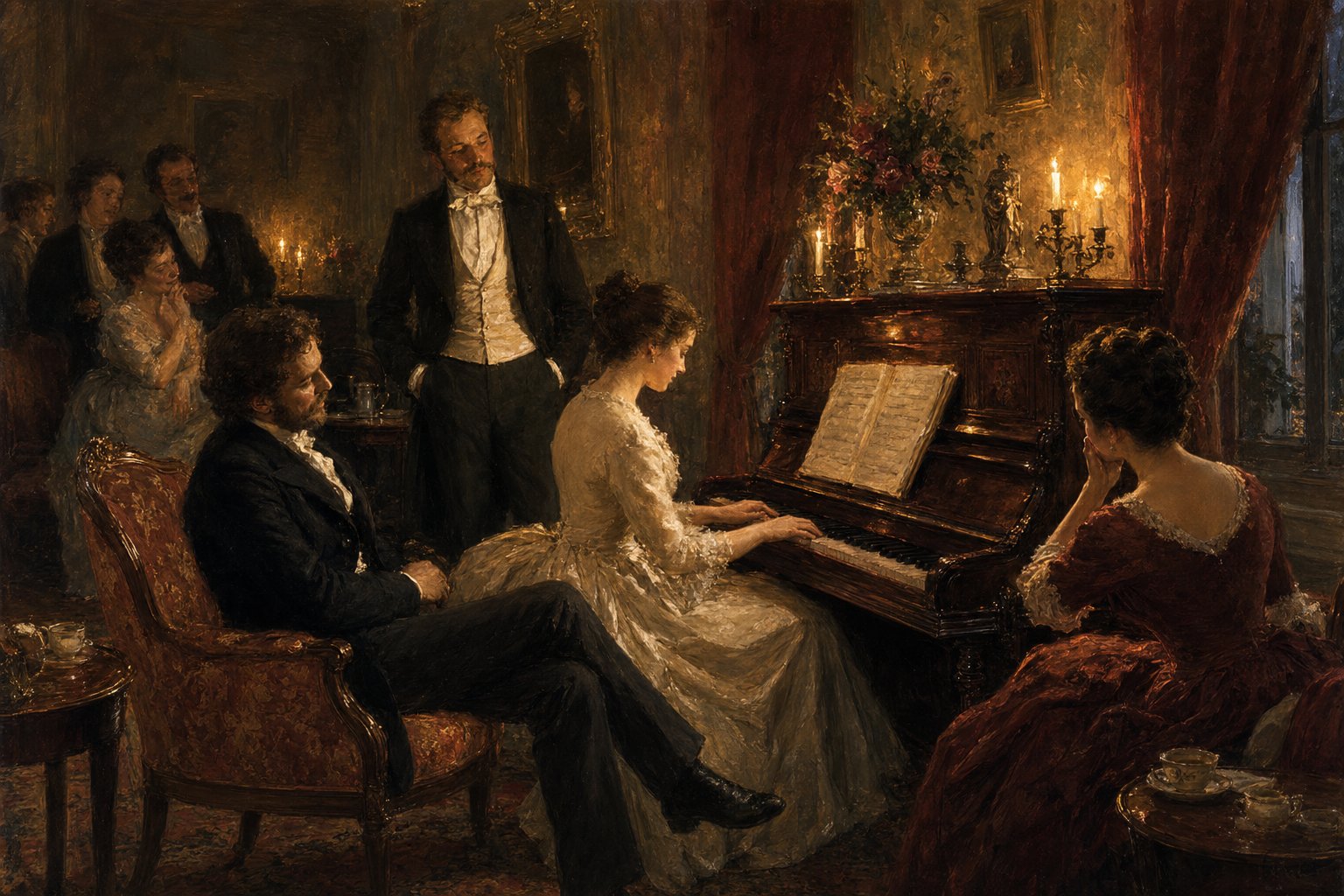
A genre this intimate doesn't spring from grand institutions. It grows in living rooms, around pianos, among friends. The conditions that made art song possible were as much social and economic as they were musical — a convergence of forces that turned early nineteenth-century Europe into fertile ground for a new kind of vocal music.
The Rise of the Middle Class and Domestic Music-Making
For centuries, serious music lived under aristocratic patronage. Composers wrote for courts, churches, and noble salons. The Industrial Revolution changed that equation. As a prosperous middle class expanded across Europe, cultural life shifted from palace halls to bourgeois parlors. Families eager to signal respectability and taste invested in the one instrument that could do both: the piano.
By the early 1800s, any household that could afford one was likely to possess a piano, and owning it communicated far more than musical interest. The instrument, the sheet music on the stand, and the skill of the player all visibly demonstrated a family's social standing. As pianos became affordable to families further down the social scale, demand surged for published music that could be performed at home — especially vocal pieces suited to a singer accompanied by a family member at the keyboard. This domestic market created the commercial ecosystem that art music songs needed to thrive: composers wrote, publishers printed, and middle-class households bought.
Salon Culture and the Birth of the Recital
Beyond the family parlor, a more intellectually charged setting was taking shape. Private salons in Vienna, Berlin, and Paris gathered poets, painters, and musicians in intimate rooms where new works could be heard, debated, and celebrated. These weren't formal concerts — they were conversations between artists and their closest listeners.
Franz Schubert's circle offers the most vivid example. Informal musical gatherings in the composer's apartment, dubbed Schubertiades by his friends, featured poetry readings, dancing, and premieres of new songs for audiences numbering from a handful to over a hundred. Schubert preferred this close-knit company of poets, painters, and intellectuals to the grand concert stage. In these rooms, the classical song for voice and piano found its ideal audience — attentive, literate, and emotionally engaged. The salon became the incubator where song art was tested, refined, and shared before it ever reached a publisher's desk.
From Romantic Poetry to Romantic Song
None of this would have mattered without the poetry. The late eighteenth and early nineteenth centuries saw an extraordinary literary flowering across German-speaking Europe. Goethe, Schiller, Heine, and Wilhelm Muller produced verse that was compact, emotionally vivid, and rich with imagery — exactly the qualities a composer needs to build a song.
These poets weren't writing for musicians. Yet their work practically invited musical art to meet it halfway. Schubert's early fascination with Goethe's verse is telling: the emotional and philosophical range of poems like Erlkonig and Gretchen am Spinnrade gave him raw material that demanded more than a simple melody. Literary and musical Romanticism fed each other in a cycle of mutual inspiration — poets pushed emotional boundaries, and composers found new harmonic and dramatic tools to match them.
Several key conditions converged to make this possible:
- The Industrial Revolution created a prosperous middle class with leisure time and cultural ambitions
- Mass production of affordable pianos turned private homes into performance spaces
- A booming sheet music publishing industry connected composers directly to domestic consumers
- Salon culture provided intimate venues where new art song songs could be premiered and critiqued
- The Romantic poetry movement supplied a vast library of emotionally rich, musically "settable" texts
- Shifting patronage from aristocracy to bourgeois audiences democratized who could hear and perform serious vocal music
Together, these forces didn't just create a market for a new genre — they shaped its character. The art song was intimate because the rooms were small. It was literary because the audiences were readers. And it gave equal weight to the piano because that was the instrument already sitting in the parlor. Every defining feature of the form traces back to the world that produced it.
With the social stage set and the poetry flowing, composers across Europe began building distinct national traditions — each one drawing on its own language, its own poets, and its own musical sensibility.
Major Art Song Traditions Around the World
So what are art songs like when you move from one language and culture to the next? The answer is surprisingly varied. While the core format — voice, piano, poem — stays constant, each national tradition developed its own sound, its own favorite poets, and its own way of balancing words and music. Think of it like regional cuisine: the ingredients overlap, but the flavors are unmistakable.
German Lied and the Schubert Legacy
The german term for the art song is Lied (plural Lieder), and it became so dominant that the word is used internationally, even when discussing non-German repertoire. There's a reason for that dominance. The German art song tradition produced the genre's founding masterpieces and its most celebrated composers.
It starts with Franz Schubert. Graham Johnson calls him "the Shakespeare of Lieder," and the numbers back it up: over 600 songs in a lifetime that ended at thirty-one, with more than 200 composed in 1815 alone. Schubert drew heavily on Goethe, Schiller, and Wilhelm Muller, transforming their verse into works like Erlkonig and the song cycle Die schone Mullerin that remain cornerstones of the repertoire.
After Schubert, Robert Schumann brought a deeper psychological intensity to the Lied, setting Heine's poetry with harmonic ambiguity that mirrored the poet's irony. Brahms favored folk-like simplicity and emotional warmth. Hugo Wolf — almost exclusively a Lieder composer — pursued an obsessive fidelity to poetic declamation, setting Morike and Goethe with a precision that left no syllable unaccounted for. Gustav Mahler and Richard Strauss carried the tradition into the twentieth century, expanding the piano part toward orchestral richness while keeping the intimate voice-and-text relationship intact.
French Melodie and the Sound of Symbolism
Cross the Rhine and the atmosphere shifts entirely. The French art song, known as the melodie, prizes nuance, understatement, and the natural music of the French language itself. Where German Lieder often build toward dramatic climaxes, the melodie tends to shimmer and suggest.
The Bru Zane Mediabase describes the melodie as "above all literary" — a genre whose fair assessment "requires deep understanding of poetry and an appreciation of detail." Launched by Gounod and Berlioz, the tradition found its undisputed master in Gabriel Faure, whose settings of Verlaine (La Bonne Chanson, Cinq Melodies de Venise) achieve an almost weightless elegance. Debussy pushed further into Symbolist territory, setting Baudelaire, Verlaine, and Mallarme with harmonies that dissolve conventional tonality. Poulenc, arriving later, brought wit and directness back into the melodie without sacrificing its refinement. Henri Duparc and Ernest Chausson round out a tradition that, while smaller in sheer volume than the German Lied, stands at what the Bru Zane foundation calls "the summit" of French Romantic repertoire.
English, Russian, Spanish, and Beyond
English art songs developed their own character in the early twentieth century. Ralph Vaughan Williams drew on English folk melody and the poetry of A.E. Housman and Robert Louis Stevenson. Benjamin Britten brought a sharper dramatic edge, setting Hardy, Donne, and Rimbaud with a modernist's ear. Gerald Finzi's settings of Hardy and Shakespeare offer a quieter, pastoral lyricism that remains deeply loved in the recital world.
Russia's romance tradition runs parallel. Tchaikovsky set Pushkin and Tolstoy with sweeping melodic generosity, while Mussorgsky's Songs and Dances of Death pushed the genre toward raw, almost operatic intensity. Rachmaninoff's Vocalise — often heard in the famous Rachmaninoff Vocalise piano arrangement — strips away text entirely, letting a wordless melody carry the full emotional weight. It's a fascinating outlier that tests the boundaries of what we call art song.
Spanish music classical traditions produced the cancion, with composers like Enrique Granados, Manuel de Falla, and Joaquin Turina setting Spanish and Catalan poetry to rhythms rooted in Iberian folk dance. Beyond Europe, the genre has continued to grow. Japanese art song (Nihon no uta) blends Western harmonic language with Japanese poetic forms, while Brazilian composers like Heitor Villa-Lobos created art songs drawing on Portuguese-language poetry and Afro-Brazilian musical traditions. These global branches prove the format's adaptability — wherever poetry and pianos meet, the genre finds new life.
| Tradition | Key Composers | Signature Poets | Representative Work |
|---|---|---|---|
| German Lied | Schubert, Schumann, Brahms, Wolf, Strauss | Goethe, Heine, Muller, Morike | Schubert, Erlkonig |
| French Melodie | Faure, Debussy, Poulenc, Duparc | Verlaine, Baudelaire, Hugo, Mallarme | Faure, Apres un reve |
| English Art Song | Vaughan Williams, Britten, Finzi | Housman, Hardy, Shakespeare | Britten, Serenade for Tenor, Horn and Strings |
| Russian Romance | Tchaikovsky, Rachmaninoff, Mussorgsky | Pushkin, Tolstoy, Tyutchev | Mussorgsky, Songs and Dances of Death |
| Spanish Cancion | Granados, de Falla, Turina | Garcia Lorca, Becquer | de Falla, Siete canciones populares espanolas |
| Japanese (Nihon no uta) | Yamada Kosaku, Takemitsu | Kitahara Hakushu, Miki Rofu | Yamada, Karatachi no Hana |
| Brazilian | Villa-Lobos, Nepomuceno | Bandeira, Drummond de Andrade | Villa-Lobos, Bachianas Brasileiras No. 5 |
Each of these traditions shaped its own relationship between words and music. Yet one thread connects them all: the poet came first. Understanding how composers chose their poets — and why certain poems practically demanded to be set to music — reveals the creative engine at the heart of every tradition on this list.
The Poet-Composer Partnership That Shaped Art Song
Goethe, Heine, Muller, Verlaine, Housman, Pushkin — these names appear again and again in recital programs, not because composers lacked options, but because certain poets write in a way that practically begs for music. The relationship between poet and composer is the creative engine behind every great art song, and understanding it changes how you hear the genre entirely.
You might assume the most famous poets attract the most settings. That's partly true — Goethe and Heine dominate the German repertoire, Verlaine the French. But the real surprise? A literary scholar counted over 1,600 musical settings of Emily Dickinson's poems by 1992, a number that grew dramatically through the following decade. Dickinson published only ten poems in her lifetime, yet her compressed, epigrammatic style proved irresistible to composers from Aaron Copland to modern minimalists.
Why Certain Poems Become Great Songs
So what makes a poem "settable"? Three qualities stand out: vivid imagery that music can illustrate, an emotional arc compressed into a short span, and language that leaves interpretive space for a composer to fill. Poems that spell out every feeling leave a composer with nothing to add. The best texts offer ambiguity — a gap between what the words say and what they mean — and music rushes in to occupy that gap.
Goethe's Erlkonig is a perfect case study. The poem tells a compact, terrifying story: a father rides through the night with his dying child, who sees a supernatural figure the father cannot. Four distinct characters speak within a single narrative, each with a different emotional register. That dramatic structure gave Schubert raw material for one of the most celebrated art song examples in the repertoire — a through-composed song where the piano's relentless triplets mimic galloping hooves while the vocal line shifts character, range, and mode with each speaker. The poem's compression of terror, tenderness, and loss into just eight stanzas is exactly what made it a song of art waiting to happen.
Dickinson's verse works differently but for similar reasons. Her poems are often just a few epigrammatic lines, yet they pack enormous emotional weight. As Copland discovered while composing his 12 Poems of Emily Dickinson, her "bareness, spareness, and rhythmic variety" made her especially attractive to musical modernists. The poems don't explain — they suggest — and that suggestiveness is what gives a composer room to create an artistic song that feels like a genuine collaboration between two minds.
When Multiple Composers Set the Same Poem
Nothing reveals the interpretive power of music more clearly than hearing different composers set the same text. Goethe's Erlkonig alone has been set by Schubert, Carl Loewe, Reichardt, Zelter, and others — even Beethoven attempted it before abandoning the effort. Each version treats the identical words in radically different ways.
Wer reitet so spat durch Nacht und Wind? Es ist der Vater mit seinem Kind. (Who rides so late through night and wind? It is the father with his child.)
Schubert opens with furious piano triplets that never relent, placing the listener immediately inside the galloping horse's rhythm. Loewe takes a different approach: his accompaniment uses flowing semiquaver groups in nine-eight time, creating what feels less like a headlong chase and more like the eerie rise and fall of wind. Where Schubert gives the Erlking seductive, melodic lines in major keys, Loewe's supernatural figure delivers only "insubstantial rising arpeggios" — barely there, as if the creature exists solely in the child's fevered imagination.
Same poem. Same story. Completely different songs about the arts of storytelling, drama, and musical characterization. That's the magic of the poet-composer partnership: the poem provides a fixed point, and each composer orbits it differently, revealing meanings the poet may never have consciously intended.
This interplay between text and music doesn't happen by accident. Composers developed specific techniques — text painting, harmonic word-painting, and carefully chosen formal structures — to translate poetic meaning into sound.
How Poetry Becomes Music Through Text and Tone
An art song is a musical composition for voice and piano, yes — but that description only tells you what's on the stage. The real craft happens in the space between the words and the notes, where composers use specific techniques to make you hear what the poem describes and feel what it implies. These techniques aren't decorative. They're the reason a great song can hit harder than the poem alone.
Text Painting and Musical Imagery
Text painting is the most immediately graspable of these tools. The idea is simple: the music literally illustrates what the words are saying. When a poem mentions flowing water, the piano ripples. When the text describes a galloping horse, the rhythm pounds. It's a technique as old as poetry itself — for as long as humans have combined words and music, they've used prosody to shape one according to the meaning of the other.
Schubert's Gretchen am Spinnrade offers one of the most famous examples in all of singing art. The poem, drawn from Goethe's Faust, places a heartbroken young woman at her spinning wheel. Schubert's piano part captures the wheel's rotation with constant sixteenth notes that rise and fall in the right hand, while the left hand's repeated figures mimic the foot pedal driving the treadle. You don't just hear Gretchen's grief — you hear the mechanical rhythm of her daily task grinding on beneath it. When she recalls Faust's kiss and the emotion overwhelms her, the piano stops dead. The wheel halts. Then, hesitantly, it starts again — a brief interlude of recovery before she succumbs once more to her anguish. Schubert composed this at seventeen, and it remains a masterclass in how music can dramatize a psychological state.
The technique extends across his entire output. In Die schone Mullerin, the piano's flowing arpeggios represent the brook that accompanies the young miller on his journey — cheerful at first, then darkening as the story turns tragic. Debussy took text painting in a different direction entirely, using shimmering whole-tone harmonies and fluid rhythmic patterns to evoke water, moonlight, and mist in his settings of Verlaine and Baudelaire. Where Schubert's imagery is vivid and specific, Debussy's is atmospheric and suggestive — two very different approaches to the same fundamental idea.
Beyond these literal illustrations, composers also use harmonic word-painting: placing an unexpected chord beneath a single word to signal an emotional shift the text only hints at. A sudden move from major to minor under the word "gone," or a dissonant chord beneath "love" that suggests the feeling isn't as simple as it sounds. The piano often establishes mood before the singer enters and lingers after the voice falls silent, framing the poem's emotional world in sound.
Strophic, Modified Strophic, and Through-Composed Forms
If text painting is about individual moments — a spinning wheel here, a galloping horse there — formal structure is about the big picture. How does a composer organize an entire song? The answer depends on the poem's shape, and three main approaches have defined the genre for two centuries. Understanding them is essential if you want to define strophic form and its alternatives clearly.
So what does strophic mean in practice? A strophic song uses the same music for every verse of the poem, much like a hymn or folk tune. It works beautifully when each stanza carries a similar emotional weight, because the repetition creates familiarity and allows the listener to focus on subtle changes in the text. Schubert's Das Wandern, the cheerful opening of Die schone Mullerin, is a classic example — the miller's excitement stays consistent from verse to verse, and the unchanging melody reinforces that steady optimism.
A modified strophic song keeps the vocal melody largely intact but alters the piano accompaniment, harmony, or dynamics beneath it to reflect shifts in the poem's mood. The definition of strophic in music assumes exact repetition, so this hybrid form bends that rule just enough to track a poem's evolving emotions without abandoning the structural anchor of a recurring tune. Schubert's Die Forelle (The Trout) is a well-known example: the melody stays recognizable across stanzas, but the accompaniment darkens dramatically when the fisherman muddies the water to trap the fish.
Through-composed songs abandon repetition entirely. Each section of the text receives fresh music, allowing the composer to follow every twist of the poem's narrative or emotional arc in real time. Schubert's Erlkonig — with its four distinct characters, shifting keys, and relentless piano triplets — is the textbook case. The poem's escalating terror demands music that never settles, never repeats, and never lets the listener feel safe.
| Form Type | Definition | Best Suited For | Famous Example |
|---|---|---|---|
| Strophic | Same music repeats for each verse of the poem | Poems with consistent mood and parallel stanzas | Schubert, Das Wandern |
| Modified Strophic | Vocal melody stays similar, but accompaniment or harmony changes between verses | Poems where mood shifts gradually across stanzas | Schubert, Die Forelle |
| Through-Composed | Continuous new music throughout; no repeated sections | Dramatic narratives or poems with rapidly changing emotions | Schubert, Erlkonig |
These three structures aren't rigid boxes — many songs blend elements of each. But recognizing them gives you a framework for hearing why a song unfolds the way it does. A strophic setting tells you the composer heard unity across the poem's stanzas. A through-composed setting tells you the composer heard a story that couldn't stand still. The form itself is an interpretation of the text.
Individual songs, of course, rarely exist in isolation. Many of the genre's greatest achievements come when composers group songs together into carefully ordered sequences — song cycles — where the whole becomes far more powerful than any single piece.
Song Cycles and Their Emotional Architecture
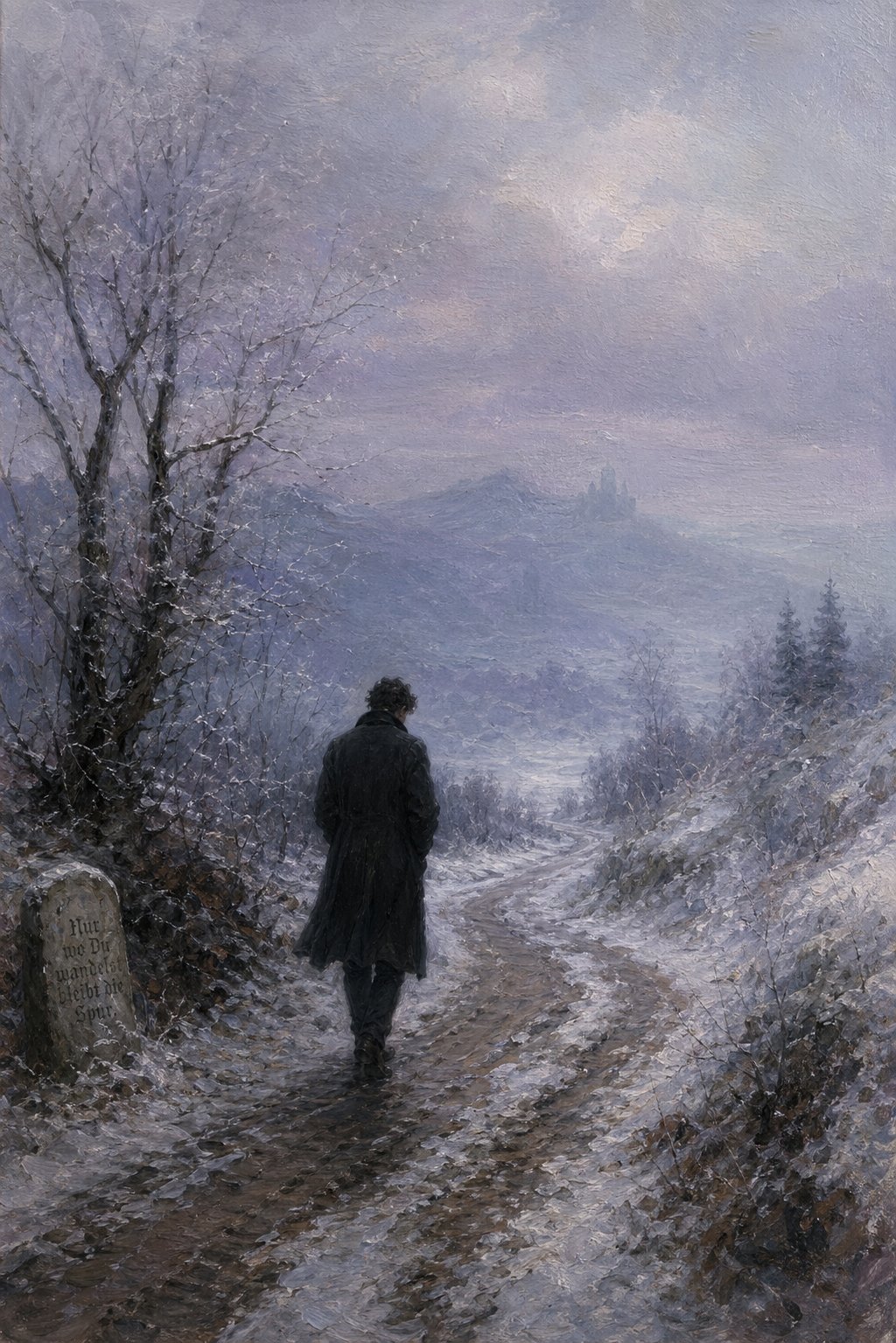
A single song captures a moment. A song cycle captures a life — or at least a chapter of one. When composers group individually complete songs into a carefully ordered sequence, unified by a shared poet, a narrative thread, or an emotional journey, the result is something with the dramatic weight of a symphony and the intimacy of a whispered confession. This format, the song cycle, represents some of the greatest achievements in all of art song music.
The concept is straightforward: each song stands on its own, yet gains new meaning from its position within the larger whole. Think of it like a short story collection where the stories share a narrator and build toward a cumulative emotional impact no single entry could deliver alone. A group of art songs composed to be performed together to form a narrative or dramatic whole — that's the standard definition, but it barely hints at the emotional power these works carry in performance.
Landmark Song Cycles Every Listener Should Know
If you're new to the genre, these cycles offer the most rewarding entry points. Each one creates its own self-contained world, and together they span nearly two centuries of songs with art at their most powerful:
- Schubert, Die schone Mullerin (1823) — A young miller falls in love, loses the girl to a huntsman, and surrenders to despair. Twenty songs trace his arc from hopeful wandering to devastating grief, with the brook as a constant musical companion.
- Schubert, Winterreise (1827) — Twenty-four songs of solitary winter wandering after a failed love affair. Bleak, hallucinatory, and widely considered the pinnacle of the Lied tradition. For nearly 200 years, these song cycles have fascinated musicians and audiences alike, inspiring countless recordings and performances.
- Schumann, Dichterliebe (1840) — Sixteen settings of Heine's bittersweet love poetry, where the piano's postludes often say what the singer cannot. Irony and tenderness coexist in every phrase.
- Schumann, Frauenliebe und -leben (1840) — Eight songs tracing a woman's emotional journey from first love through marriage, motherhood, and widowhood. Controversial for its perspective, yet musically ravishing.
- Britten, Winter Words (1953) — Eight Thomas Hardy poems set with spare, unsettling clarity. Britten's cycle proves the form thrives far beyond Romantic-era German poetry.
- Barber, Hermit Songs (1953) — Ten settings of anonymous Irish texts from the eighth to thirteenth centuries. Barber finds humor, devotion, and loneliness in these medieval fragments, creating one of the finest American contributions to the genre.
Art song was a popular repertory throughout the nineteenth century, but the song cycle elevated it from parlor entertainment to high art. Die schone Mullerin had to wait until 1856 for its first complete public performance — publishers and singers initially preferred to cherry-pick individual songs. Hearing the full cycle, though, reveals connections that vanish when performance songs are extracted from their sequence.
How a Song Cycle Builds Emotional Architecture
So how does a collection of short pieces achieve the dramatic weight of a much larger work? Composers use three primary tools: key relationships, recurring motifs, and narrative pacing.
Key relationships create a tonal map across the cycle. Schubert opens Die schone Mullerin in B-flat major — bright, optimistic, outward-looking. As the miller's hopes crumble, the keys drift toward darker, flatter territories. The final song settles into E major, a key so distant from the opening that it feels like arriving in a completely different emotional country. You don't need to identify the keys consciously; your ear registers the journey as a gradual shift from warmth to isolation.
Recurring motifs work like emotional callbacks. In Winterreise, certain rhythmic patterns and melodic shapes return across songs, connecting moments of despair separated by several numbers. Schumann takes this further in Dichterliebe, where the piano's postlude to the final song quotes material from earlier in the cycle — as if the instrument is remembering what the voice can no longer bear to sing. These echoes bind individual songs into a single emotional narrative.
Narrative pacing is perhaps the subtlest tool. Composers control the emotional rhythm of a cycle the way a novelist controls chapters — placing a quiet, reflective song after an intense outburst, or building tension across several consecutive numbers before releasing it. Schubert's placement of the eerily calm Der Leiermann (The Hurdy-Gurdy Man) at the end of Winterreise is a masterclass in this technique. After twenty-three songs of anguish, the cycle doesn't climax — it simply stops, frozen in a numb, repetitive drone that refuses resolution.
That refusal is the point. A song cycle doesn't just tell a story; it makes you live inside its emotional logic. And that experience depends entirely on two people — a singer and a pianist — whose interpretive choices can make the same cycle feel like a completely different journey from one performance to the next.
Art Song Compared to Opera, Folk Song, and Popular Music
Two people on a stage, a poem, and a piano — that's the entire apparatus. Yet listeners new to the genre often struggle to define art song against the vocal music they already know. Is it just a quieter version of opera? A fancier folk tune? The confusion is understandable, because all vocal music shares a common ancestor: the human impulse to sing words. The differences, though, are fundamental — and once you see them, you'll never mix these genres up again.
Art Song vs Opera Aria
An opera aria is a character piece. The soprano singing Mimi in La Boheme isn't expressing her own feelings — she's inhabiting a role within a staged dramatic narrative, supported by an orchestra, costumes, sets, and a cast of fellow performers. The aria exists to serve the story. As voice teacher Elise Levin-Guracar puts it, "a solo piece from an opera, oratorio, or cantata is an aria, while a stand-alone piece is a song." That distinction matters practically, too: arias often demand greater vocal stamina and dramatic projection to fill a theater, while art songs reward subtlety, textual nuance, and the kind of intimate communication that works best at close range.
Art Song vs Folk Song and Popular Song
Folk songs grow from oral tradition. They belong to communities rather than individual composers, and they change as they pass from singer to singer across generations. The Art Song Update notes that folk songs "are written down only infrequently, so through generations of oral transmission they are susceptible to changes in words and melodies." Art songs, by contrast, are fixed on the page — every note, every dynamic marking, every piano figure is the deliberate choice of a named composer responding to a specific literary text. The words and music resist casual alteration.
Popular songs occupy a middle ground. They're composed and published, but they prioritize melodic hooks, commercial appeal, and accessibility over the kind of text-music integration that defines the art song tradition. A pop songwriter builds a track around a chorus you can't forget. A Lied composer builds a miniature world around a poem you can't stop interpreting.
Where Art Song Meets Art Music
So what is art in music, broadly speaking? The term "art music" refers to the Western classical tradition — composed, notated works intended for attentive listening rather than dancing, worship, or background entertainment. A useful art music definition positions it as music created within a formal compositional tradition, preserved in written scores, and performed by trained musicians. Art song sits within this larger category as a specific chamber-vocal genre: the point where art music becomes its most personal and intimate.
Understanding this broader definition of art and music helps clarify why the genre carries the word "art" in its name. It isn't a value judgment — folk and popular music can be equally profound. The label simply signals that these songs belong to the composed, notated classical tradition rather than to oral or commercial ones. What is art music if not a framework for preserving and transmitting a composer's exact intentions? The art song is that framework at its most concentrated.
| Feature | Art Song | Opera Aria | Folk Song | Popular Song |
|---|---|---|---|---|
| Performing Forces | Solo voice + piano | Solo voice + orchestra (with full cast) | Solo or group voice, often a cappella or with guitar | Solo voice + band or produced track |
| Text Source | Published poetry or literary text | Libretto written for the dramatic work | Anonymous or communal, passed orally | Original lyrics by songwriter |
| Primary Venue | Recital hall or salon | Opera house or theater | Community gatherings, homes, ceremonies | Concerts, radio, streaming platforms |
| Compositional Approach | Text-driven; voice and piano share equal interpretive weight | Character-driven; serves a staged narrative | Melody-driven; evolves through oral transmission | Hook-driven; prioritizes memorability and commercial appeal |
| Audience Setting | Intimate, attentive listening | Theatrical, large-scale spectacle | Participatory, informal | Variable — casual to concert |
These distinctions aren't walls — they're guidelines. Britten arranged folk songs with piano accompaniments sophisticated enough to qualify as art songs. Some Baroque arias appear so frequently in recital programs that they've been absorbed into the art song repertoire. Genres bleed into each other at the edges. Still, the core identity holds: one voice, one pianist, one poem, and a shared commitment to making every word and every note count equally.
That equality between voice and piano is more than a structural feature — it's the interpretive heart of the genre. And the way singer and pianist negotiate that partnership in real time is what separates a competent recital from an unforgettable one.
The Singer-Pianist Duo and the Craft of Interpretation
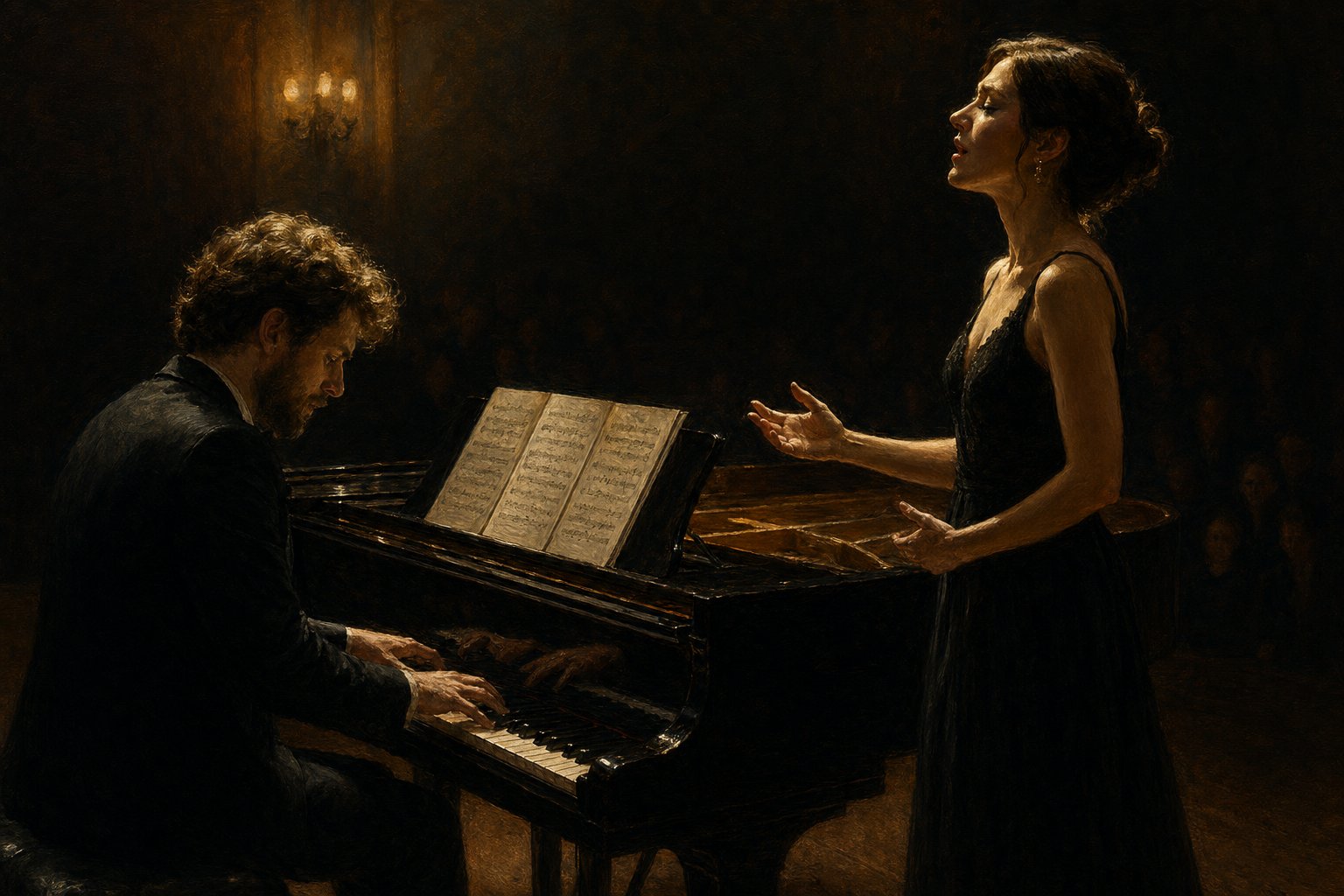
Walk into a recital and you'll see two people on stage. Not a soloist and a sidekick — a duo. The relationship between artist and singer in art song is fundamentally different from what you encounter in almost any other genre. Here, the pianist isn't providing background. They're carrying half the emotional argument.
The Piano as an Equal Partner
Think about Schubert's Erlkonig. Before the singer utters a single word, the piano has already placed you on a galloping horse in the dark. Those relentless triplets aren't accompaniment — they're the scene itself. In Wolf's Lieder, the piano part frequently contradicts the vocal line's surface meaning, hinting at emotions the singer's character can't or won't express. The instrument becomes a kind of psychological narrator, revealing what lies beneath the words.
This is why the old term "accompanist" has increasingly given way to "collaborative pianist." As Jean Barr of the Eastman School of Music puts it, "the pianist must play with conviction and imagination and individual expression. They shouldn't just follow. They need to have their own musical voice, not in contradiction to their colleague, but in union." Piano accompanists at the highest level are fluent in multiple languages, able to transpose on the spot, and ready to rescue a singer who loses their place mid-song — all while maintaining their own interpretive vision. Brian Zeger of Juilliard describes the pianist as "the rock," responsible for anticipating a singer's fatigue, concentration, and breathing needs in real time.
The expression of emotion through singing piano textures and vocal nuance in such an intimate setting places enormous demands on both performers. As Interlude notes, the degree of intimacy in artsong "seldom equaled in other kinds of music requires that the two performers communicate to the audience the most subtle and evanescent emotions."
What Makes a Great Art Song Recital
Competent singing gets the notes right. Exceptional interpretation makes you forget there are notes at all. The challenges unique to this genre are real: much of the repertoire is in German, French, or Russian, meaning the audience may not understand a single word. The performer's job is to make the meaning land anyway — through vocal color, physical presence, and the thousand micro-decisions that separate a reading from a revelation.
What distinguishes the great recitalists — a Dietrich Fischer-Dieskau, an Ian Bostridge, a Gerald Moore at the keyboard — is a combination of qualities that go far beyond vocal technique:
- Deep understanding of the poetry's language, meaning, and emotional subtext — not just pronunciation, but genuine literary comprehension
- The ability to balance vocal beauty with textual clarity, so that neither the sound nor the sense dominates
- Seamless communication between singer and pianist, built on rehearsal, trust, and real-time responsiveness
- Thoughtful recital programming that creates its own emotional narrative across diverse songs, languages, and moods
- A willingness to risk vulnerability — to inhabit a poem's emotional world fully rather than hiding behind polished tone
- Mastery of dynamic range, from the barest whisper to full projection, calibrated to the intimacy of the recital hall
Fischer-Dieskau embodied these qualities so completely that he became, as one critic observed, capable of "drawing the listener into the essence of song" through "seamless shifts in dynamics and infinite shadings of coloration and character." Bostridge, a generation later, brought a different gift: a deep consciousness of psychological implication and poetic nuance that made his performances feel less like concerts and more like acts of literary interpretation set to music.
These performers remind us that art song lives and dies in the moment of performance. The score is a blueprint. What the duo builds from it — night after night, audience after audience — is where the genre breathes. And that living, breathing quality is exactly what keeps the tradition evolving, as new voices and new composers carry it forward into the present.
Exploring Art Song Today and Creating Your Own Music
A tradition that depended on living-room pianos and handwritten manuscripts in the 1820s now reaches listeners through streaming platforms, digital scores, and art song transpositions available for every voice type online. The genre hasn't just survived the digital age — it's adapting to it. And the performers and composers carrying it forward are reshaping what we call art song in ways Schubert could never have imagined.
Art Song as a Living Tradition
Contemporary composers aren't simply imitating the Romantics. They're expanding the canon with texts by poets historically excluded from the recital stage — voices spanning languages, cultures, and identities that earlier generations overlooked. Organizations like Composers Now, under the leadership of founding artistic director Tania Leon, commission and premiere new works each season, pairing composers like Brittany J. Green and Allison Loggins-Hull with ensembles dedicated to amplifying diverse musical voices. Their Cheswatyr Commissions program and annual festival in New York City are proof that the state of the art song is anything but static.
Beyond commissions, the genre's geographic reach keeps widening. Composers in East Asia, Latin America, and Africa are writing for voice and piano in their own languages, blending Western harmonic traditions with local poetic forms and melodic sensibilities. Art song central to the European recital tradition for two centuries is becoming genuinely global — and digital platforms make these newer works accessible to anyone with an internet connection. What is art and music if not a living conversation between past and present? This genre embodies that conversation every time a new poem meets a new score.
How to Listen to Art Song for the First Time
Feeling ready to dive in but unsure where to focus your attention? You don't need formal training. You just need a framework. As musicologist Lawrence Kramer writes, the features that give music meaning "are all on the surface. All you need to do is listen with your imagination, not just with your ears." Here's a step-by-step approach for your first serious listen:
- Read the poem first — find a translation if it's in a foreign language, and sit with the imagery and emotional arc before pressing play.
- Listen to the piano introduction with fresh ears. What mood does it establish? What scene does it set before the voice enters?
- Follow the vocal line's relationship to the text. Notice where the melody rises on emotionally charged words, or where it drops to a whisper.
- Pay attention to harmonic shifts — moments where the piano suddenly darkens or brightens beneath the voice. These signal emotional turning points the poem may only hint at.
- Don't skip the postlude. After the singer falls silent, the piano's final bars are often the song's true emotional conclusion — a last thought the voice couldn't express.
- Listen again. Kramer's insight applies perfectly here: "even the same work can be heard differently many times over." A second hearing almost always reveals something the first one missed.
Creating Music Inspired by Art Song Traditions
Listening is the first step. But the fusion of mood, text, and musical intention that defines artistic music in this tradition can also inspire your own creative experiments. Modern tools have lowered the barrier between appreciation and creation, letting curious listeners explore the intersection of genre, emotion, and lyrical intent that makes this form so compelling.
Whether you want to deepen your understanding as a listener or try your hand at composing something new, here are practical next steps:
- Experiment with MakeBestMusic's AI Song Generator to create original royalty-free tracks inspired by the moods and styles you've discovered — select a genre, set an emotional tone, and explore how text and music interact from a creator's perspective.
- Attend a live recital. The intimacy of the format can't be fully replicated through speakers — even a small local performance will change how you hear the genre.
- Explore recordings by legendary duos: Fischer-Dieskau and Gerald Moore, Jessye Norman and Dalton Baldwin, Ian Bostridge and Julius Drake. Each partnership reveals different dimensions of the same repertoire.
- Read the poetry on its own. Collect translations of Goethe, Heine, Verlaine, and Housman — understanding the text independently makes the musical settings land with far greater force.
- Browse digital libraries offering art song transpositions for different voice types, making it possible to sing or study works originally written for ranges other than your own.
The genre that began in Viennese parlors two centuries ago is still growing, still finding new poets and new audiences. Its core promise remains unchanged: one voice, one piano, one poem, and the extraordinary things that happen when all three collide. That's artistic music at its most human — and it's waiting for you to listen.
