


What AI Lyric Generators Do and Why They Matter
What Is an AI Lyric Generator
An AI lyric generator is a software tool powered by large language models that produces structured song lyrics — verses, choruses, bridges — from a user's text prompts about mood, theme, genre, and style. These models have been trained on massive datasets of text, including published songwriting, and can be fine-tuned or prompted to follow rhyme schemes, syllable patterns, and genre-specific conventions. In plain terms, you describe the song you hear in your head, and the tool drafts words designed to fit that vision.
The technology behind these tools isn't magic. It's pattern recognition at scale. Large language models learn relationships between words, phrases, and structures, then generate new combinations that statistically "sound right" for a given context. Some tools are purpose-built for lyrics, baking in song-structure awareness and rhyme-scheme controls. Others, like general-purpose AI assistants, rely on the user to steer output through detailed prompting.
Why Songwriters Are Turning to AI
Imagine staring at a blank page for an hour, chasing a second verse that refuses to land. That frustration is one of the biggest reasons songwriters, rappers, and content creators are exploring AI-assisted writing. The practical drivers are straightforward: overcoming writer's block, generating rapid ideation when a deadline looms, and experimenting with unfamiliar genres without starting from zero.
AI lyric generators are best understood as creative co-pilots, not replacements for human artistry.
As Jeannie Gayle Pool of ASMAC noted, many composers haven't found a dedicated lyric-writing partner, and AI can fill that gap — not by handing you a finished song, but by giving you raw material worth sculpting. She emphasizes establishing a dialogue with the AI, feeding it draft lines, and using its suggestions to stimulate your own creative instincts. The best results come from treating the tool as a brainstorming collaborator you can push back on, not a vending machine that spits out hits.
That said, using AI to write song lyrics doesn't mean handing over creative control. The strongest lyrics still emerge from human revision — cherry-picking phrases, injecting lived experience, and shaping output until it sounds like you. An AI songwriter tool accelerates the drafting phase, but the editing phase is where real songs are born.
This article exists because most "best AI lyrics generator" roundups read like affiliate-link catalogs. You'll find no hype here. Instead, you'll get a transparent evaluation methodology, a clear taxonomy of tool categories, genre-by-genre performance analysis, an honest breakdown of limitations, and guidance on the copyright questions every songwriter should understand before publishing a single line. The goal is simple: help you pick the right lyrics AI tool for your specific creative needs — and know exactly what to expect from it.
How We Tested and What Makes a Great AI Lyric Generator
Claiming one tool is the best lyric generator without explaining how you measured quality is like naming a song-of-the-year winner without listening to it. Most roundup articles skip this step entirely. You deserve better than unsubstantiated star ratings, so here's the exact framework behind every evaluation in this article.
Evaluation Criteria for AI Lyric Quality
Effective AI music tools should produce output that is "not only technically sound and varied but also creatively compelling and emotionally resonant," as outlined in USC Libraries' research guide on evaluating AI music tools. That principle guided the six quality dimensions we scored each tool against:
- Rhyme accuracy and pattern control — Does the tool hit requested rhyme schemes (ABAB, AABB, internal rhyme) consistently, or does it default to predictable end rhymes regardless of your instructions?
- Syllable and meter consistency — Are lines singable? Lyrics that scan well on paper but trip over uneven syllable counts fall apart the moment you try to pair them with a melody.
- Emotional coherence across verses — A heartbreak verse that suddenly shifts into upbeat party language signals the model lost the thread. The best ai for writing lyrics maintains a steady emotional arc from opening line to final chorus.
- Metaphor quality versus cliche density — Fresh imagery separates memorable songwriting from filler. We tracked how often each tool leaned on overused phrases like "fire in my soul" or "dancing in the rain."
- Verse-chorus-bridge structural adherence — When you ask for a complete song, does the output actually follow standard song architecture, or does it deliver a wall of undifferentiated text?
- Genre-appropriate vocabulary — Country lyrics should feel distinct from hip-hop bars. We evaluated whether each tool adapted its word choices, slang, and thematic references to match the requested genre.
These six dimensions blend the subjective and objective sides of assessment. Rhyme accuracy and syllable counts can be measured precisely, while emotional coherence and metaphor quality require human judgment — a hybrid approach that research in AI music evaluation increasingly supports.
How Each Tool Was Assessed
Every tool was tested with the same set of genre-specific prompts to ensure a fair, apples-to-apples comparison.
Specifically, every platform received identical prompts across seven genres — pop, rap/hip-hop, country, rock, R&B, folk, and metal — covering a range of moods and themes. This controlled setup prevented any single tool from benefiting from a conveniently tailored prompt.
Beyond raw output quality, we assessed each tool's customization options: could you specify a rhyme scheme, set a point of view, choose a tone, or define a song structure before generating? We also compared free-tier output against paid results to determine whether upgrading delivers a meaningful quality jump. Finally, user interface intuitiveness mattered — a tool offering deep controls is only useful if you can actually find and use them without a tutorial.
When you're scanning top ai platforms for lyrics and writing, knowing why a tool earns its ranking matters just as much as knowing which one topped the list. The criteria above are the lens through which every recommendation ahead was filtered — no exceptions, no special treatment. The best ai for lyrics is the one that scores well across all six dimensions for your genre, not the one with the flashiest landing page.
Of course, criteria only tell you what to measure. Understanding the types of tools available shapes which category deserves your attention in the first place.
Three Categories of AI Lyric Tools You Should Know
Not every AI lyric tool works the same way, and picking the wrong category before you even evaluate individual products is the fastest route to frustration. The landscape splits into three distinct tiers, each built around a different philosophy of what "helping you write lyrics" actually means. Understanding where each type excels — and where it falls short — saves you from wasting hours inside a tool that was never designed for your workflow.
Dedicated AI Lyric Generators
These are purpose-built songwriting tools. Platforms like LyricStudio, LyricLab, and MakeBestMusic exist specifically to produce structured lyrics — verses, choruses, bridges — with controls you'd actually expect a songwriter to need. Think genre-specific templates, rhyme-scheme selectors, syllable-count awareness, and mood sliders. LyricStudio, for example, functions as a co-writing partner that suggests line continuations aligned with your rhyme and tone, while LyricLab adds chord suggestions and parody rewriting on top of its lyric engine.
The key advantage here is scaffolding. You're not starting from a blank chat window and hoping the AI understands song structure. These tools bake that understanding into the interface, so you spend less time prompt-engineering and more time writing. If you're searching for the top AI platform for songs lyrics and want something that speaks the language of songwriting out of the box, this category is your starting point.
General-Purpose AI Assistants for Lyrics
What AI platform like ChatGPT makes the best lyrics? It's a fair question, because tools like ChatGPT and Claude can absolutely produce compelling lyric drafts. ChatGPT excels at iterative, line-by-line refinement — you can ask it to tighten a rhyme, swap a metaphor, or rewrite a verse in a different point of view with natural conversational back-and-forth. Claude, meanwhile, handles long-form narrative lyrics exceptionally well, maintaining coherence across multi-section compositions like concept albums or musical theater pieces.
The flexibility is enormous, but so is the burden on you. Neither tool offers built-in song-structure guidance, rhyme-scheme selectors, or genre presets. You'll need to craft detailed prompts specifying everything from syllable count to emotional arc. Experienced writers who already know what they want often thrive here. Beginners wondering "is Google AI Studio good at lyrics for songs" or similar questions about general-purpose models should know that raw output quality depends almost entirely on prompt quality — and that learning curve can be steep.
AI Music Platforms With Lyric Features
Platforms like Suno and Udio take a fundamentally different approach: they generate complete songs — instrumentals, vocals, arrangement, and lyrics — from a single prompt. The appeal is obvious. You hear your words sung over a produced track within minutes, which reveals rhythm, syllable stress, and flow in ways text alone never can.
The trade-off? Lyric quality often takes a back seat to music generation. Suno follows your written lyrics more faithfully but offers limited control over individual lines once generation starts. Udio produces richer audio but sometimes rearranges or substitutes your words entirely, prioritizing melodic fit over lyrical accuracy. As the AI Tools for Kids comparison documented, Udio may even generate "gibberish that sounds like language but isn't." These platforms are outstanding for demos and prototyping, but if polished, editable lyrics are your primary goal, they're a complement rather than a replacement for the categories above.
The table below distills the core differences so you can self-select the right category before evaluating individual tools:
| Category | Best For | Key Strength | Main Limitation |
|---|---|---|---|
| Dedicated AI Lyric Generators | Songwriters who want structured, editable lyrics with genre and rhyme controls | Purpose-built songwriting scaffolding (structure, rhyme schemes, mood settings) | No music or audio generation — lyrics only |
| General-Purpose AI Assistants | Experienced writers seeking maximum flexibility and iterative refinement | Deep conversational editing and near-unlimited creative range | No built-in song-structure awareness — prompt quality determines output quality |
| AI Music Platforms With Lyric Features | Creators who want to hear lyrics performed over a full instrumental demo | End-to-end song production from a single prompt | Limited lyric editing control; text accuracy can be inconsistent |
Most songwriters searching for the top AI for lyrics for songs will find that dedicated generators hit the sweet spot between control and convenience. General-purpose assistants reward users willing to invest in prompt craft, while full-song platforms shine when you need to hear how words actually sound against a beat. Knowing which tier fits your needs narrows the field dramatically — and sets the stage for a meaningful side-by-side comparison of specific tools within each category.
Top AI Lyric Generators Compared Side by Side
Category knowledge only gets you so far. At some point, you need to stack individual tools against each other on the dimensions that actually affect your songwriting sessions — pricing, free-tier generosity, genre flexibility, and how much control you get over rhyme, structure, and tone. The table below does exactly that, using the same evaluation framework outlined earlier and real data gathered from hands-on testing.
Feature and Pricing Comparison Table
Pricing information reflects current published plans and may change, so always confirm on each tool's official site before committing.
| Tool Name | Category | Free Tier Limits | Paid Pricing | Genre Specialization | Customization Depth | Output Quality Rating |
|---|---|---|---|---|---|---|
| MakeBestMusic AI Lyrics Generator | Dedicated Lyric Generator | Free generations available | Freemium with paid upgrades | Multi-genre (pop, rap, country, rock, R&B, and more) | High — hook, theme, tone, and song-idea controls | Strong |
| LyricStudio | Dedicated Lyric Generator | Limited free plan | $5.99/month Pro | Multi-genre with line-by-line co-writing | High — rhyme scheme, syllable count, mood, topic | Excellent |
| LyricLab | Dedicated Lyric Generator | Free tier with basic features | Paid plans available | Multi-genre with chord and key integration | Medium-High — mood, genre, key, time signature | Good |
| Freshbots | Dedicated Lyric Generator | Fully free, no sign-up | Free | 20+ genres with dedicated rap and pop modes | Medium — emotional journey, genre, artist-style presets | Good |
| ChatGPT | General-Purpose AI Assistant | Generous free plan | $20/month Plus | Genre-flexible (prompt-dependent) | Unlimited but manual — no built-in song scaffolding | Good to Strong (varies by prompt quality) |
| Claude | General-Purpose AI Assistant | Free plan with standard models | $19/month Pro | Genre-flexible (excels in narrative and literary styles) | Unlimited but manual — strong long-context handling | Strong (narrative and literary lyrics) |
| Suno | AI Music Platform | Free trial with limited credits | $10/month Pro | Multi-genre with full audio output | Low for lyrics — medium for overall song generation | Fair (lyrics secondary to music) |
| Udio | AI Music Platform | Free plan with limited features | $10/month Pro | Multi-genre with strong style variation | Low-Medium — multiple lyric modes but limited line editing | Fair (audio quality strong, lyric consistency variable) |
| These Lyrics Do Not Exist | Dedicated Lyric Generator | Completely free, unlimited | Free | Basic genre and mood selection | Minimal — theme, style, mood only | Weak to Fair |
Key Takeaways From the Comparison
A few patterns jump out immediately when you scan the data. First, the most generous free tiers belong to tools at opposite ends of the quality spectrum. Freshbots and These Lyrics Do Not Exist both offer unlimited free generations with no account required, but Freshbots delivers noticeably better structure and genre awareness — making it the stronger free lyrics generator for anyone who wants usable output without spending a dollar. ChatGPT's free plan also handles lyric drafting well, though you'll shoulder all the structural work yourself.
For dedicated songwriting tools, LyricStudio earns the highest output quality rating thanks to its interactive, line-by-line co-writing approach and built-in rhyme engine — a finding consistent with MuseGen's independent ranking, which scored it at 9.4 out of 10 across lyric quality, structure control, and ease of use. MakeBestMusic's AI Lyrics Generator stands out as a strong dedicated option for songwriters and content creators who need fast hook development, thematic exploration, and structured lyric drafts across multiple genres — particularly useful if your workflow revolves around generating song ideas and refining them rather than writing from scratch line by line.
Customization depth varies dramatically. If you want granular control over rhyme schemes, syllable counts, and point of view, dedicated lyric generators and general-purpose assistants are your best bet. Anyone searching for a reliable rap lyric generator or ai rap lyrics generator should pay close attention to customization depth — rap demands precise control over internal rhyme, multi-syllable patterns, and flow that simpler tools can't deliver. An online rap lyrics generator with only a theme selector won't cut it for serious hip-hop writing.
The deepest customization and the highest raw lyric quality rarely live in the same tool — dedicated generators win on structure, while general-purpose assistants win on creative flexibility.
Full-song platforms like Suno and Udio occupy a different lane entirely. Their lyric output quality trails behind every dedicated tool in the table, but hearing your words performed over a produced track within minutes is a feedback loop nothing else replicates. Think of them as demo engines rather than lyric generators — valuable in a workflow, but not where you'll craft your final bars.
Pricing also reveals an interesting split. A capable rap lyrics maker or pop lyric tool doesn't have to cost much: LyricStudio's Pro plan runs just $5.99 per month, and several rap song lyrics generator options are entirely free. The expensive outlier is Writesonic at roughly $99 per month — priced for content marketing teams, not individual songwriters, which is why it didn't earn a row in this comparison despite producing decent first-draft lyrics.
Numbers and feature lists tell part of the story. The other part — which tools actually deliver when you specify "write me a country ballad" versus "give me aggressive trap bars" — requires testing across genres, where the real performance gaps reveal themselves.

Which AI Lyric Generator Wins for Your Genre
Feature lists and pricing tables only matter if the tool actually delivers when you specify a genre. A songwriter hunting for polished country storytelling has completely different needs than a rapper chasing multi-syllable internal rhymes — and most tools handle one far better than the other. Genre is the variable that separates a useful AI lyric tool from a frustrating one, yet almost no review bothers to test for it. Here's what we found.
Genre Performance Matrix
The matrix below rates each tool's lyric output quality per genre, based on the six evaluation criteria from our methodology — rhyme control, meter consistency, emotional coherence, metaphor freshness, structural adherence, and genre-appropriate vocabulary. Ratings reflect output from identical prompts across all platforms.
| Tool | Pop | Rap / Hip-Hop | Country | Rock | R&B | Folk | Metal |
|---|---|---|---|---|---|---|---|
| MakeBestMusic | Good | Good | Good | Good | Good | Fair | Fair |
| LyricStudio | Excellent | Good | Good | Good | Good | Good | Fair |
| LyricLab | Good | Fair | Good | Good | Fair | Good | Fair |
| Freshbots | Good | Good | Fair | Fair | Fair | Weak | Weak |
| ChatGPT | Excellent | Excellent | Good | Good | Good | Good | Good |
| Claude | Good | Good | Excellent | Good | Good | Excellent | Good |
| Suno | Fair | Fair | Fair | Fair | Fair | Weak | Weak |
| Udio | Fair | Fair | Weak | Fair | Fair | Weak | Weak |
Genre-Specific Observations
Pop is where nearly every tool performs at its best — and that's actually a problem. Many platforms default to pop-style phrasing regardless of the genre you select. You'll notice generic hooks, surface-level emotional language, and predictable ABAB rhymes creeping into country, rock, and R&B output because the training data skews heavily toward mainstream pop conventions. LyricStudio and ChatGPT both produced catchy, radio-ready choruses with balanced simplicity and emotional weight, consistent with genre-specific testing that found ChatGPT handles hook writing and syllable consistency particularly well for pop.
Rap and hip-hop are the most demanding genres for any AI rap generator, and it's not close. Credible rap lyrics require precise internal rhyme, multi-syllable patterns, cadence-aware line breaks, slang authenticity, and cultural context that generic models consistently struggle with. ChatGPT outperformed every other tool for rap — delivering stronger punchlines, tighter flow patterns, and more convincing wordplay — though even its output benefits from human refinement to avoid forced rhymes or stiff phrasing. If you're searching for an ai rap song generator that handles freestyle rap lyrics or complex bar structures, ChatGPT with a detailed prompt specifying sub-genre, rhyme density, and tone is the strongest current option. Dedicated tools like MakeBestMusic and Freshbots produced solid rap lyrics with their built-in hip-hop modes, but couldn't match the depth of a well-prompted general-purpose assistant for lyric freestyle complexity.
Country exposed a clear winner. Claude's natural storytelling instinct, plainspoken emotional phrasing, and knack for specific imagery — a dusty porch, a truck radio scanning static on a back road — made its country output feel authentically lived-in rather than assembled from cliches. Cross-genre testing confirmed that Claude and ChatGPT both handle country well, but Claude's narrative verses carried more weight when you asked for heartland storytelling or modern country with emotional nuance.
Rock and R&B landed in a middle ground across most tools. Rock lyrics came out competent but rarely gritty enough — AI tends to sand down the raw edges that make rock songwriting feel urgent. R&B fared similarly: smooth phrasing was easy for most platforms, but the sensual specificity and vocal rhythm awareness that define great R&B writing were consistently underdeveloped.
Folk and metal were the weakest categories across the board. Folk demands a particular simplicity — sparse, precise language carrying emotional weight without ornamentation — and most tools overcomplicated it. Claude was the exception, producing folk output with genuine restraint. Metal, meanwhile, exposed every tool's discomfort with extreme imagery, aggressive vocabulary, and unconventional song structures. No platform delivered metal lyrics that felt genre-authentic without heavy manual editing.
The pattern is unmistakable: general-purpose AI assistants dominate genre flexibility because they adapt to detailed prompts, while dedicated generators offer convenience but narrower stylistic range. A rapper looking for convincing bars and a folk singer chasing quiet specificity need fundamentally different tools — and this matrix gives you the shortcut to finding yours.
Strong genre performance, however, doesn't erase the weaknesses every tool shares. Even the top-rated options in this matrix exhibit recurring failure patterns that can quietly undermine your lyrics if you don't know what to watch for.
Limitations and Failure Modes Every Songwriter Should Know
Every tool in the genre matrix above — even the ones rated "Excellent" — shares a set of recurring weaknesses that no amount of clever prompting completely eliminates. Ignoring these patterns doesn't just produce mediocre lyrics; it trains your ear to accept generic output as good enough. The songwriters who get the most value from AI lyric tools are the ones who recognize failure modes instantly and know exactly where to intervene.
Repetitive Phrasing and Cliche Overload
Ask any AI lyric tool to write five different songs about heartbreak, and you'll notice the same handful of words circling back: shadows, echoes, fire, flames, broken, ashes, neon, dust. This isn't a bug in one particular platform — it's a structural tendency baked into how large language models work. As developer Manoranjan Xuseen documented, users across multiple songwriting communities report the same experience: "I've tried the big three and all three of them just produce the same lines."
Why does this happen? The models are trained on massive text datasets that skew toward popular, widely published song structures. The most common phrases in those datasets become the path of least resistance during generation. Telling the model to "avoid cliches" in your prompt buys you roughly one generation before it starts swapping synonyms — silhouettes for shadows, embers for fire, whispers for echoes. The vocabulary shifts an inch without genuinely changing.
This cliche gravity is especially dangerous for anyone using a random lyric generator or casually generating random rap lyrics without a clear editorial eye. The output looks polished on the screen. It rhymes, it scans, it follows a recognizable verse-chorus pattern. But sing it out loud and you'll hear how interchangeable every line feels — the words could belong to hundreds of songs without changing meaning. Jack Righteous' lyric-editing guide frames it precisely: the warning sign isn't one familiar word — it's a cluster of broad emotion, predictable rhyme, interchangeable imagery, and no detail proving the speaker actually lived the moment.
What should you watch for? Adjective stacks that pad lines without adding meaning. End rhymes that feel like the rhyme chose the thought rather than the other way around. And choruses where every line declares maximum emotion — devastation, destiny, triumph — with no restraint, contrast, or earned payoff.
Emotional Authenticity and Cultural Sensitivity Gaps
Imagine reading rap battle lyrics generated by a tool that has never stood in a cypher, never felt the competitive tension of a crowd waiting for a punchline to land. The words might rhyme. The structure might mimic real battle bars. But the stakes — the swagger, the street-level specificity, the willingness to be vulnerable through aggression — ring hollow. The same problem surfaces in diss track lyrics, where cultural fluency and personal edge are the entire point.
This is the most fundamental limitation of any AI lyric tool: it lacks lived experience. Sonarworks' analysis of AI's creative boundaries puts it plainly — personal storytelling represents the heart of meaningful songwriting, and your unique perspective, memories, and emotional responses to life events cannot be artificially generated. AI can mimic the form of emotional depth, but the authenticity that makes a listener stop scrolling and actually feel something comes from somewhere a model can't access.
Cultural sensitivity compounds the problem. Genres like rap, R&B, country, and folk carry deep cultural contexts — specific dialects, community references, shared histories, and unspoken rules about what language is earned versus borrowed. An AI model doesn't understand that certain slang carries weight, that referencing specific neighborhoods or experiences has social meaning, or that a gospel lyric's power comes from testimony rooted in communal faith rather than decorative spiritual language. The risk isn't just producing weak lyrics — it's producing lyrics that feel appropriative or tone-deaf, which can damage a songwriter's credibility far more than a simple bad verse.
Nonsensical Metaphors and Structural Drift
Short prompts — a single verse, a chorus — tend to produce AI's cleanest work. The trouble starts when you ask for a complete multi-section song. Over longer outputs, models frequently lose thematic coherence, mixing metaphors that started purposefully into contradictory tangles. A verse about ocean waves transitions into fire imagery that transitions into space metaphors, and suddenly the song has no grounding image holding it together.
Structural drift is the related problem. AI systems struggle to give each section a distinct job. As one community observation captured: a verse should set a scene, a hook should land a single phrase that survives being repeated four times, and a bridge should shift something — perspective, time, speaker. Most AI output delivers four stanzas at the same emotional temperature, all doing the same emotional work, with no escalation or contrast.
Here are the most common failure modes to watch for whenever you review AI-generated lyrics:
- Metaphor collision — Two or more unrelated image systems (water, fire, flight, machinery) competing within the same verse without any intentional connection.
- Emotional flatline — Every line operates at the same intensity level, leaving no room for dynamic contrast between quiet vulnerability and powerful release.
- Rhyme-driven meaning — The end rhyme dictates what the line says, producing sentences that sound musical but communicate nothing the songwriter intended.
- Theme abandonment — The song starts with a specific scenario (a late-night phone call, a goodbye at an airport) but drifts into generic emotional declarations by the second chorus.
- Filler padding — Throwaway connectors, redundant adjectives, and lines that restate the previous line's idea in slightly different words, inflating length without adding content.
- Section sameness — Verses, choruses, and bridges that read identically in tone, vocabulary, and emotional function, offering no structural variety.
None of these failure modes are reasons to abandon AI lyric tools. They're reasons to approach every output with an editor's eye rather than a consumer's acceptance. The songwriters who report the best results consistently describe rewriting 50 to 90 percent of what the AI produces — using the raw generation as a creative springboard, not a finished draft. Knowing where AI reliably stumbles transforms you from a passive user into an effective collaborator, one who prompts more precisely, edits more ruthlessly, and preserves the artistic voice that no model can manufacture.
Spotting these weaknesses is half the equation. The other half is building a workflow that systematically turns flawed AI output into lyrics that actually sound like you wrote them.
How to Use AI Lyrics in Your Actual Songwriting Workflow
Recognizing failure modes gives you a diagnostic eye. Turning that awareness into a repeatable process — one that consistently produces lyrics worth keeping — requires a different skill set entirely. Most songwriters and rappers who try AI lyric tools for the first time follow the same pattern: type a vague idea, read the output, feel underwhelmed, and close the tab. The problem isn't usually the tool. It's the workflow, or rather, the absence of one.
The difference between a throwaway AI draft and a genuine creative breakthrough almost always comes down to three stages: how you prompt, how you edit, and how you define the boundary between what AI contributes and what stays exclusively yours.
Prompting Strategies That Produce Better Lyrics
Think of your prompt as a creative brief you'd hand to a session musician. The more specific your instructions, the less guesswork the tool does — and the less generic the output feels. Vague prompts like "write a sad love song" give the model permission to default to every cliche in its training data. Detailed prompts force it into narrower, more interesting territory.
Here's a step-by-step prompting framework that consistently produces stronger first drafts:
- Anchor the genre and sub-genre first. Don't just say "rap." Specify boom-bap, melodic trap, conscious hip-hop, or lo-fi. Sub-genre signals tell the model which vocabulary pool, cadence patterns, and thematic conventions to draw from. If you want to generate a rap verse with authentic flavor, the sub-genre is your most powerful lever.
- Set the emotional target in concrete terms. Replace abstract moods like "sad" or "angry" with specific emotional scenarios: "the quiet frustration of watching someone you warned make the same mistake again" or "the adrenaline right before stepping on stage for the first time." Concrete emotion produces concrete imagery.
- Define the rhyme scheme explicitly. Specify AABB, ABAB, internal rhyme on every second beat, or multisyllabic end rhymes. Without this instruction, most tools default to safe, predictable patterns. Rappers looking for a capable rap line generator should pay special attention here — requesting specific rhyme density and internal rhyme placement dramatically improves flow quality.
- Declare the point of view and voice. First person confessional, second person accusatory, third person narrative — each produces a fundamentally different lyric. Add voice texture instructions like "conversational and unpolished" or "poetic but not pretentious" to shape diction.
- Specify structure before content. Tell the tool exactly what you need: two 16-bar verses, an 8-bar hook, and a 4-bar bridge. Or request a verse-prechorus-chorus-verse-chorus-bridge-chorus arc. Structural clarity prevents the shapeless text walls that plague unguided generations.
- Include vocabulary constraints. List words or phrases to avoid ("fire," "soul," "echoes," "rise above") and optionally include words or images you want woven in. This single step cuts cliche density by half.
- Iterate, don't regenerate blindly. Treat the first output as a rough take. Pull out the two or three strongest lines, feed them back into the tool, and ask it to build new verses around those anchors. This iterative loop is how experienced producers use AI to create a rap song that feels intentional rather than random — each round sharpens the focus instead of scattering it.
Iterative prompting is especially powerful for hip-hop workflows. Instead of hoping a freestyle rap lyrics generator nails everything on the first pass, use the initial output to identify which bars have real punch. Then prompt again: "Keep lines 3 and 7. Rewrite everything else to match their energy, rhyme density, and subject matter." This back-and-forth mirrors how human co-writers actually work — bouncing ideas, keeping what lands, discarding what doesn't.
Editing AI Output to Preserve Your Artistic Voice
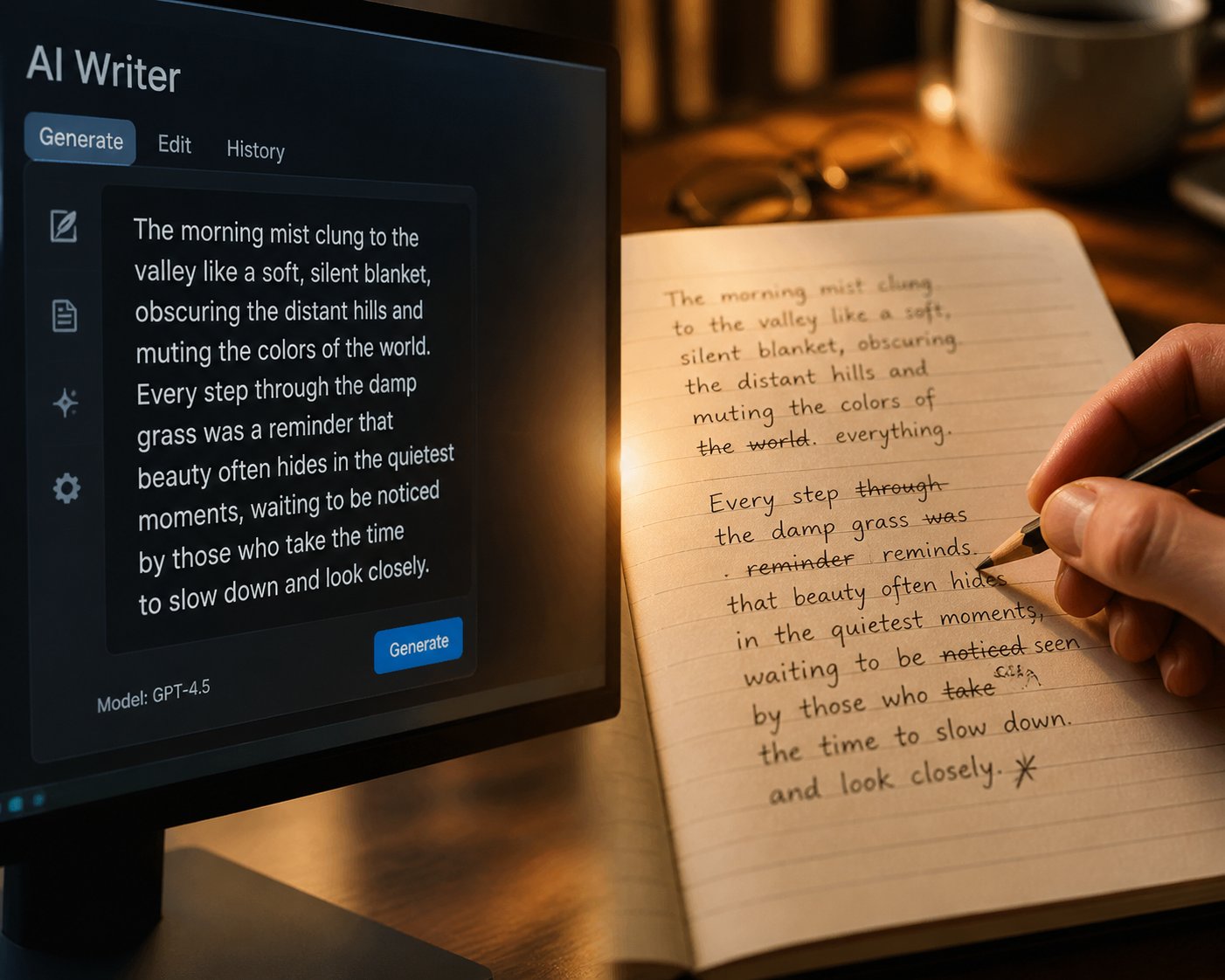
Here's the uncomfortable truth most AI tool marketing won't tell you: the best results come from rewriting the majority of what the model gives you. Raw AI output is clay, not sculpture. The editing phase is where your song actually gets written.
Start by reading the entire output aloud — not silently, aloud. Lyrics are meant to be heard. Lines that look clean on screen often stumble when spoken or sung. You'll catch unnatural syllable stress, awkward vowel sounds, and rhythmic hiccups that your eyes skipped right over. If you're trying to make a rap song with AI assistance, rapping the output over a beat immediately exposes which bars flow and which ones fight the pocket.
From there, apply this editing hierarchy:
- Cherry-pick standout lines. In a full AI-generated draft, you might find three or four lines that genuinely surprise you — an unexpected metaphor, a rhythmic phrase that locks into a groove, a word choice you wouldn't have reached for yourself. Pull those lines out. They're your seeds.
- Rewrite generic lines with personal specificity. Replace "I walked through the rain" with something only you could write — the street name, the shoes you ruined, the song playing in your headphones. Specificity is what separates a lyric someone remembers from one they scroll past. As Solmi's songwriting guide puts it, the strongest lyrics come from human edits on AI scaffolding — editing is where ownership and authenticity enter the picture.
- Inject lived experience. AI can approximate emotion. It cannot replicate your emotions. Swap the model's generic heartbreak imagery for the actual moment — the specific text message, the parking lot where you sat for twenty minutes, the song on the radio you can never hear the same way again. These details are unfakeable, and they're what make listeners trust a songwriter.
- Restructure for dynamic contrast. AI tends to keep every section at the same emotional temperature. Manually create dynamics: pull energy back in the verse so the chorus hits harder. Let the bridge shift perspective entirely. Give your listener a reason to stay through all three minutes instead of checking out after twenty seconds.
- Kill your darlings — including AI's darlings. If a clever rhyme doesn't serve the song's meaning, cut it. The model optimizes for pattern completion, not artistic intent. You're the one who decides what the song is about, and every line should earn its place against that standard.
Producers and beatmakers already understand this mindset intuitively. As MelodicPal's creator guide notes, you should treat AI generations like rough takes, not finished masters — keep the few that have a strong idea, then improve everything else before release. The same discipline applies to lyrics. A draft is a starting point, never a destination.
AI as Co-Writer, Not Replacement
The most productive way to think about AI lyric tools isn't as a ghostwriter you're outsourcing creativity to. It's as the fastest brainstorming partner you've ever had — one that never gets tired, never judges a half-formed idea, and can produce twenty variations of a chorus in the time it takes you to finish a cup of coffee.
AI excels at generating options. Rhyme alternatives you hadn't considered. Thematic angles that reframe a song's concept. Structural variations that break you out of habitual patterns. Need rap generator lyrics exploring five different angles on the same hook? You'll have them in minutes. Want to test whether your folk ballad works better in second person? Ask and compare. This volume of raw material would take hours to produce manually, and most of it will be discarded — but the one phrase you keep might be the line that unlocks the entire song.
The human songwriter provides everything AI can't manufacture: emotional truth drawn from actual experience, a narrative arc that builds toward something specific, cultural authenticity earned through participation rather than pattern-matching, and the editorial judgment to know when a lyric is done. A freestyle lyrics generator can spit out unlimited bars, but only you know which ones carry the weight of something real.
The ideal dynamic isn't human versus AI — it's AI for volume and variation, human for truth and taste. The songwriter who masters both sides of that equation writes faster without sacrificing authenticity.
This collaborative model also protects something less tangible but equally important: your creative identity. Over-relying on raw AI output risks homogenizing your voice into the same patterns every other user generates from the same model. The editing and rewriting phase isn't just quality control — it's the process through which your artistic fingerprint gets pressed into every line. Skip it, and you sound like everyone else. Invest in it, and AI becomes the most efficient creative accelerator in your toolkit.
Workflow mastery handles the craft side of AI-assisted songwriting. But before you publish, perform, or pitch a single lyric that started inside a model, there's a legal and ethical dimension that demands equal attention.
Copyright and Ethics of AI-Generated Lyrics
You've refined your prompts, edited ruthlessly, and produced lyrics you're genuinely proud of. The next question hits harder than any writer's block: do you actually own what you wrote? If you plan to release music on streaming platforms, perform live, or monetize songs that started inside an AI lyric generator, the legal landscape matters as much as the creative process. And right now, that landscape is shifting fast.
Who Owns AI-Generated Lyrics
The core legal principle is straightforward, even if its application gets complicated quickly. In the United States, the U.S. Copyright Office has made its position clear: purely AI-generated content — material created solely by a machine with no meaningful human authorship — cannot be copyrighted and falls into the public domain. The Supreme Court reinforced this in early 2026 by declining to hear Thaler v. Perlmutter, leaving the human-only authorship requirement firmly in place.
What does that mean for you in practical terms? If you type a one-line prompt into an AI rap lyric generator and publish the raw output without meaningful modification, that text likely has no copyright protection. Anyone can copy it, reuse it, or claim it as their own, and you'd have no legal recourse. As Rimon P.C.'s legal analysis of the January 2025 Copyright Office ruling explains, the phrase "meaningful human authorship" is central — and the Office cautions against equating minimal human input with actual authorship.
The gray area lives in between. A song where you wrote the lyrics from scratch, composed the melody yourself, and used AI only as a brainstorming aid or production tool retains full copyright protection. A song where you substantially rewrote, restructured, and personalized AI-generated output occupies murkier territory — Copyright Examiners evaluate these cases individually, weighing whether the human contribution determined sufficient expressive elements. The more you transform the raw output, the stronger your legal footing becomes.
Copyright protects the original expression in a work created by a human author, even if the work also includes AI-generated material. — U.S. Copyright Office
Outside the U.S., the picture varies. The UK's Copyright, Designs and Patents Act 1988 historically offered some protection for "computer-generated works," but the UK government scrapped plans in March 2026 that would have allowed AI companies to train on copyrighted material without permission — a move backed by 95% of the over 10,000 public consultation submissions. The broader regulatory direction across jurisdictions points toward tighter controls on AI-generated content, not looser ones. If you're writing ai rap lyrics or any genre of AI-assisted material for commercial release, assuming the rules will stay the same next year is a risky bet.
Platform Policies and Industry Acceptance
Even if the copyright question were fully settled, streaming platforms add their own layer of rules. Every major DSP now requires some form of AI disclosure, and the specifics differ enough to matter.
LabelGrid's 2026 policy survey maps the current landscape in detail. The DDEX metadata standard, now adopted across major platforms, carries AI declarations at three levels: audio, artwork, and — critically for lyric writers — composition and lyrics. If AI wrote a meaningful part of your melody, structure, or words, that gets its own disclosure field, separate from whether the recording itself used AI.
Here's how the major platforms break down:
- Spotify adopted DDEX disclosure and does not penalize or down-rank music for being AI-assisted. It does ban unauthorized voice clones and reported removing over 75 million spam tracks in the prior year.
- Apple Music launched Transparency Tags in March 2026 covering artwork, audio, composition, and music video. Labels and distributors decide what qualifies as material AI use — self-reported, with no visible automated enforcement yet.
- Deezer takes the firmest stance, deploying proprietary AI detection technology, keeping flagged AI-generated tracks out of algorithmic recommendations and editorial playlists, and reporting demonetization of up to 85% of streams on fully AI-generated music tied to fraud.
- YouTube requires disclosure whenever content contains realistic AI-generated elements a viewer might mistake for real.
- TikTok requires AI content labeling on uploads, consistent with its broader synthetic-media transparency framework.
The common thread? Honest, accurately disclosed AI-assisted music is welcome everywhere. Undisclosed or deceptive content is what triggers removals, demonetization, and account scrutiny. A songwriter using a rap ai generator to brainstorm hooks and then substantially rewriting the output faces no platform barriers — as long as they disclose accurately.
Plagiarism concerns add another dimension. AI models trained on existing songs can inadvertently reproduce protected phrases, melodic fragments, or distinctive lyrical turns. Silverman Sound's legal analysis highlights that Suno itself admits in its terms of service: "Due to the nature of machine learning, Suno makes no representation or warranty to you that any copyright will vest in any Output." Major labels have already filed coordinated lawsuits through the RIAA, and Warner Music and Universal have settled with AI music platforms — signaling an industry that's serious about enforcement. The risk for individual songwriters isn't theoretical; creators have already received copyright claims on content using AI-generated material.
None of this means you should avoid AI-assisted songwriting. It means you should approach it with the same diligence you'd apply to sampling, interpolation, or any other creative technique that intersects with intellectual property law. Here are the practical steps every songwriter using AI tools should build into their workflow:
- Check output against existing lyrics. Run AI-generated lines through a lyric search engine or plagiarism checker before finalizing. Accidental reproduction of a copyrighted phrase is still infringement, regardless of how it was created.
- Document your human creative contribution. Save your original prompts, edit histories, and draft versions. If your authorship is ever challenged, a clear paper trail showing substantial human modification is your strongest defense.
- Review each tool's terms of service regarding output ownership. Some platforms grant commercial use rights to paid subscribers but explicitly disclaim copyright guarantees. Know exactly what you're licensing before you build a release around it.
- Disclose AI involvement accurately in distribution metadata. Under-disclosing to avoid a platform skip is the worst available move — a later correction on a live release triggers re-review that can temporarily affect availability.
- Stay current with evolving regulations. Copyright law, platform policies, and international AI governance frameworks are changing rapidly. What's permissible today may require different disclosures or processes within months.
The bottom line is encouraging, not alarming. Songwriters who use AI as a creative tool — prompting, editing, injecting personal experience, and making meaningful artistic choices throughout the process — are on solid legal and ethical ground. The risk concentrates on those who publish raw, unedited AI output and assume ownership will follow automatically. It won't. But armed with awareness and a disciplined workflow, AI-assisted songwriting is not just viable — it's fully compatible with building a professional, monetizable catalog.
Legal clarity protects your work after it's written. The final piece is knowing which tool deserves your time in the first place — and that answer depends entirely on who you are as a songwriter and what you're trying to build.

Choosing the Right AI Lyric Generator for Your Creative Goals
Eight sections of testing, genre breakdowns, limitation analysis, workflow strategies, and legal guidance all point toward one practical question: which tool should you actually open first? The answer isn't universal. A rapper chasing multisyllabic internal rhymes, a hobbyist writing their first-ever chorus, and a content creator who needs usable lyrics in ten minutes flat all need fundamentally different things from an AI lyric tool. Instead of crowning a single winner, here's a decision framework that matches the right platform to your specific songwriting goals.
Matching the Right Tool to Your Songwriting Goals
Every user profile below maps to a tool category and specific standout options drawn from the genre performance matrix, feature comparison, and hands-on testing covered throughout this article.
- Hobbyists exploring songwriting for the first time. You want low friction, zero cost, and enough built-in guidance that you don't need to learn prompt engineering before writing your first verse. A dedicated lyric generator with genre presets and song-structure templates is your best starting point. MakeBestMusic's AI Lyrics Generator fits this profile well — it offers fast hook, theme, and lyric development without requiring you to manually specify rhyme schemes or structural conventions. These Lyrics Do Not Exist is another zero-barrier option for pure inspiration, though its output quality is less consistent.
- Working songwriters battling writer's block. You already know how to write lyrics — you just need the creative logjam broken. Tools that function as co-writers rather than full-draft generators serve you best. LyricStudio excels here with its line-by-line continuation suggestions and built-in rhyme engine, offering just enough AI input to restart your momentum without overwriting your voice. Claude is the strongest general-purpose alternative, especially for narrative-heavy or folk-oriented material where long-context coherence matters.
- Rappers seeking flow and rhyme assistance. Hip-hop demands more from AI than any other genre — multi-syllable rhyme patterns, cadence-aware line breaks, slang authenticity, and punchline density that generic tools rarely deliver. ChatGPT with a detailed, sub-genre-specific prompt remains the best ai for song lyrics in the rap category, based on our testing. For a quicker, more structured entry point, look for a free rap lyrics generator with a dedicated hip-hop mode — Freshbots offers exactly that at no cost, and MakeBestMusic provides solid rap lyric scaffolding through its genre-aware controls.
- Content creators needing quick lyric drafts. Speed and usability matter more than poetic depth when you're producing background vocals for a video, writing a jingle, or drafting a hook for social media audio. Dedicated generators with one-click workflows win here. You'll notice that MakeBestMusic and Freshbots both let you go from idea to structured draft within minutes. If you also need a produced audio demo, Suno generates a complete song — vocals, instrumentation, and arrangement — from a single prompt, though lyric quality takes a back seat to the music.
- Professional producers looking for co-writing support. Your needs are the most demanding: deep customization, iterative refinement, genre flexibility, and output that can survive professional editorial scrutiny. The best ai lyrics generator free option for this tier is ChatGPT's free plan combined with detailed prompting skills. For paid workflows, pairing LyricStudio's dedicated lyric tools with Claude's narrative depth gives you two complementary engines — one for structure, one for storytelling. If you need an online rap lyrics maker capable of handling complex bar structures alongside pop or R&B sessions, ChatGPT's genre flexibility across detailed prompts makes it the most versatile single tool in this tier.
Notice the pattern? What AI makes the best song lyrics depends almost entirely on your experience level, genre focus, and how much creative control you want to retain. There is no single best ai platform for song lyrics — there's a best fit, and that fit shifts as your skills and needs evolve.
Getting Started With AI-Assisted Songwriting
If you've read this far and you're ready to try your first AI-assisted session, here's a concise action plan that synthesizes everything covered in this article:
- Start with a dedicated lyric generator. The genre-specific controls, song-structure awareness, and built-in rhyme scaffolding eliminate the learning curve that makes general-purpose assistants frustrating for first-time users. MakeBestMusic's AI Lyrics Generator is a strong starting point if you want to quickly generate lyrics, hooks, themes, and song ideas without spending your first session figuring out how to prompt effectively — it's purpose-built for the songwriting use case rather than adapted from a general chat interface.
- Run your first generation with a specific genre and mood. Resist the urge to type "write me a song." Even a basic prompt like "melancholy country ballad about leaving a small town" produces dramatically better output than a generic request. Review the prompting framework from Section 7 to sharpen your instructions further.
- Read the output aloud before editing. Lyrics are meant to be heard. Lines that look polished on screen often stumble when spoken or sung. This single habit catches more problems than any other editing technique.
- Edit aggressively. Keep the two or three strongest lines. Rewrite the rest with personal specifics — real names, real places, real moments. This is where your artistic fingerprint enters the song and where copyright protection strengthens.
- Check for accidental plagiarism. Run your final draft through a lyric search engine before releasing. AI models can inadvertently reproduce copyrighted phrases, and catching them early saves you from takedown notices later.
- Disclose AI involvement in your distribution metadata. Every major streaming platform now expects accurate AI declarations. Transparent disclosure protects your release from retroactive review issues.
For users with different needs, alternative paths remain equally valid. If you're an experienced songwriter who already thinks in verse-chorus-bridge architecture, skip the dedicated generator and go straight to ChatGPT or Claude — your prompt-writing skills will unlock their full potential. If you want to hear your words performed immediately, Suno or Udio produce full audio demos that reveal flow and rhythm issues no text-based tool can surface.
The AI lyric landscape will keep evolving. Models will get better at genre awareness, cultural sensitivity, and structural coherence. Platform policies around AI-generated content will continue tightening and clarifying. New dedicated tools will launch, and existing ones will add features. What won't change is the fundamental dynamic this entire article has reinforced: AI generates options at speed, and you provide the lived experience, editorial judgment, and artistic identity that transform raw output into something worth hearing. Master that collaboration, and the specific tool you choose matters far less than how you use it.


