

Yes You Can Release AI Music But Here Is What You Must Know First
Can you release AI generated music on Spotify, Apple Music, or any other streaming platform? The short answer is yes. But the longer, more honest answer involves a tangle of platform policies, copyright rules, and tool-specific terms that can trip you up fast if you skip the fine print.
The Short Answer to Releasing AI Music
It is legal to release AI music. No law prohibits you from distributing a track that involved artificial intelligence in its creation. What matters is how much AI was involved, which tool generated the audio, and where you plan to publish it. A track you wrote, arranged, and produced using AI for specific tasks like mastering or stem generation sits in a completely different category than a song you prompted into existence with a single text input. That spectrum, from fully AI-generated to AI-assisted, shapes every decision downstream: whether you can copyright it, whether distributors will accept it, and whether streaming platforms will flag or remove it.
Releasing AI music is legal, but staying live on platforms requires understanding three layers of rules: copyright law, platform-specific policies, and your AI tool's terms of service.
Why the Rules Keep Changing
This space is evolving at an unusual pace. The US Copyright Office released definitive guidance confirming that purely AI-generated content cannot receive copyright protection. Major labels have filed lawsuits worth billions against AI music companies. Streaming platforms are updating disclosure requirements and anti-fraud systems in real time. The UK government recently reversed its position on allowing AI companies to train on copyrighted music without permission. Every few months, a new ruling or policy shift changes what creators can and cannot do.
This article covers the full picture in one place. You will learn how copyright applies to different levels of AI involvement, what each major streaming platform requires, which distributors accept AI tracks, what your AI tool's terms actually allow, and how to protect your music after release. Whether you want to release AI made songs commercially or simply use AI-generated audio in content projects, the rules for releasing AI music commercially are here, organized so you can act on them without second-guessing yourself.
Everything starts with one critical question: how much of your track did the AI actually create? That distinction between generated and assisted is the foundation every platform, distributor, and copyright office uses to make their call.
AI-Generated vs AI-Assisted Music and Why the Difference Matters
Imagine two creators. One types a single prompt into Suno and downloads the finished track. The other writes original lyrics, records their own vocals, and uses an AI tool to master the final mix. Both used artificial intelligence, yet their legal standing, distribution options, and copyright protections are worlds apart. The difference between AI generated and AI assisted music is not a technicality. It is the single factor that determines whether your release gets accepted, flagged, or pulled entirely.
Fully AI-Generated Music Defined
Fully AI-generated music is content where the AI handles nearly everything: composition, melody, lyrics, instrumentation, and arrangement. Your role is limited to writing a prompt, selecting a style, or pressing generate. The output requires minimal editing beyond basic trimming or fading.
Here are activities that fall into the fully AI-generated category:
- Using a text-to-music tool like Suno or Udio to create a complete song from a single prompt
- Generating both instrumentals and AI vocals without performing or writing anything yourself
- Downloading direct output with only minor trim, fade, or volume adjustments
- Prompting multiple generations and selecting the best one without restructuring it
This category faces the most restrictions. TuneCore explicitly blocks content that is 100% created by AI, copyright protection remains uncertain, and platforms apply higher scrutiny to these releases. The core issue: there is no clear human author, and copyright law across most jurisdictions requires one.
AI-Assisted Music and Human Creative Input
AI-assisted music flips the relationship. You are the primary creator. AI handles specific, bounded tasks within a larger human-driven workflow. You make the creative decisions that shape the final product.
Activities that count as AI-assisted music production include:
- Using AI-powered plugins for mixing, mastering, or vocal tuning
- Generating chord progression suggestions that you then perform and arrange yourself
- Creating AI reference tracks for inspiration without using the audio directly
- Using AI to separate stems from your own recordings for remixing purposes
- Employing AI beat generators as a starting layer while adding your own instrumentation on top
A real-world example: The Beatles' track "Now and Then" used AI-powered audio restoration to isolate John Lennon's vocals from old demos. The AI served a precise technical function while human musicians remained in full creative control. That track won a Grammy. Nobody questioned its legitimacy.
Where Your Project Falls on the Spectrum
Most creators land somewhere in the middle, in what the industry calls a hybrid approach. You might generate an AI instrumental but write your own lyrics and perform your own vocals. Or you might use AI to draft a melody, then rearrange, re-record, and produce it into something distinctly yours.
How much AI involvement changes music rights comes down to a practical question: did you make creative decisions that shaped the output, or did you simply select from what the machine offered?
| Creation Type | Human Role | Copyright Position | Distribution Access |
|---|---|---|---|
| Fully AI-generated | Prompting only | Uncertain or no protection | Limited (DistroKid, RouteNote) |
| Hybrid | Significant editing, vocals, or arrangement | Partial protection possible | Most distributors |
| AI-assisted | Primary creation with AI tools | Strong protection likely | All major distributors |
Even modest human additions shift your track from fully generated toward hybrid territory. Writing your own lyrics, recording a vocal take, or restructuring AI-generated sections into a new arrangement all count as meaningful creative input. These actions don't just improve your music. They open distribution doors and strengthen your legal footing in ways that pure prompting cannot.
This spectrum has direct consequences for whether you can register a copyright, earn royalties, or defend your work against disputes. Understanding where your project sits is the first step. The next is knowing exactly what copyright law says about each category and what protections you can realistically claim.
Copyright and Ownership of AI-Generated Music Explained
Knowing where your track falls on the AI spectrum is one thing. Knowing whether you can legally own it is another. Copyright determines who collects royalties, who can license the music for commercial use, and who has standing to fight back when someone rips your track. For AI music, the ownership question is far from settled, but the current rules are clear enough to guide your decisions.
US Copyright Office Guidance on AI Works
Can you copyright AI generated music? The US Copyright Office has answered this directly: works generated solely by AI, without human authorship, cannot receive copyright registration. This position was reinforced in January 2025 when the Office published Part 2 of its Copyright and Artificial Intelligence report, confirming that "prompts alone do not provide sufficient human control to make users of an AI system the authors of the output."
The legal foundation runs deep. The Copyright Act protects "original works of authorship," and U.S. courts have consistently interpreted "author" to mean a human being. In March 2025, the D.C. Circuit Court of Appeals affirmed this in Thaler v. Perlmutter, holding that the Copyright Act "requires all eligible work to be authored in the first instance by a human being." The court pointed to multiple statutory provisions, including copyright duration tied to "the author's death" and inheritance by an author's "widow or widower," as evidence that only humans qualify.
What does this mean commercially? If your track is purely AI-generated with no meaningful human creative input, you likely cannot:
- Register the work with the US Copyright Office
- File infringement claims if someone copies your track
- Collect performance royalties through a PRO like ASCAP or BMI
- License the composition for sync placements with full legal backing
Without copyright protection, you have no legal monopoly over the work. Anyone could theoretically use it without permission, and you would have limited recourse. This is the core reason AI music copyright ownership rules matter so much for anyone planning a commercial release.
What Sufficient Human Authorship Means for Musicians
The good news: the Copyright Office has not slammed the door on all AI-involved music. It has registered hundreds of works that incorporate AI-generated material where the human author's contribution was substantial enough to qualify. The key phrase from the Office's guidance is "creative control over the work's expression."
So what counts? The human authorship requirement for AI music copyright centers on whether you determined the expressive elements of the final work, not just the idea behind it. Copyright protects expression, not ideas. A prompt describing "a melancholy piano ballad in D minor" is an idea. Actually composing the melody, choosing specific chord voicings, structuring verses and choruses, and performing the piece is expression.
For musicians, sufficient human authorship in practice looks like:
- Writing original lyrics that you pair with AI-generated instrumentals
- Performing vocals or live instruments over AI-produced backing tracks
- Substantially rearranging, editing, or restructuring AI output into a new composition
- Combining AI-generated elements with original human-authored material in a creative selection and arrangement
The Copyright Office draws a clear line: if the AI "determines the expressive elements of its output," that material is not copyrightable. But if you use AI as a starting point and then exercise genuine creative judgment in shaping the final product, you may claim copyright over your contributions. Importantly, you must identify and disclaim the AI-generated portions when applying for registration. The overall work can be protected, but the purely AI-generated components within it likely cannot.
International Differences in AI Copyright Treatment
AI music copyright ownership rules vary significantly depending on where you are. If you plan to release globally, or if you are based outside the United States, these differences shape your strategy.
In the European Union, there is no unified copyright registration system, but the governing principle from the Court of Justice of the EU requires that a work be "the expression of the intellectual creation of their author." A December 2024 policy questionnaire showed EU Member States generally agree that AI-generated content could be eligible for copyright protection "only if the human input in their creative process was significant." The EU AI Act itself does not directly address copyright registration of AI-assisted works, but its transparency requirements for AI systems may influence how creators document their process.
The United Kingdom offers a unique wrinkle. Section 9(3) of the Copyright, Designs and Patents Act explicitly addresses computer-generated works, designating the author as "the person by whom the arrangements necessary for the creation of the work are undertaken." This provision potentially allows the person prompting an AI tool to be treated as the author, though courts have not yet tested this against modern generative AI.
China has moved furthest toward protecting AI outputs. In the 2023 case Li v. Liu, the Beijing Internet Court ruled that an AI-generated image qualified for copyright protection because the plaintiff demonstrated a trial-and-error creative process involving specific prompts, parameter adjustments, and iterative refinement. Japan takes a similarly pragmatic approach, with its 2024 guidelines recognizing copyrightability where the human author provides "creative contributions that surpass mere effort."
| Scenario | US Copyright Status | EU Position | UK Position | China/Japan Position |
|---|---|---|---|---|
| Fully AI-generated (prompt only) | Not copyrightable | Likely not protected | Potentially protected under Sec. 9(3), untested | Possible with demonstrated creative process |
| AI-assisted with human arrangement | Human contributions copyrightable | Protected if human input is significant | Protected as human-authored work | Protected |
| Human composition with AI production tools | Fully copyrightable | Fully protected | Fully protected | Fully protected |
These jurisdictional differences matter for commercial viability. A track that cannot be copyrighted in the US may still face challenges on global platforms, since most major distributors and streaming services operate under US-centric policies. Legal experts across multiple jurisdictions confirm that the distinction between AI-generated and AI-assisted work is the determining factor for commercial protection everywhere, even if the exact threshold varies.
The practical takeaway: if you want ownership that holds up across borders, build a documented workflow showing meaningful human creative decisions. Keep records of your process, edits, and creative choices. These become your evidence if ownership is ever challenged. Copyright status directly affects what platforms will accept your music and how distributors handle your release, which is exactly where policy enforcement happens in practice.
Streaming Platform Policies for AI Music You Need to Follow
Copyright determines whether you can legally own your track. Platform policies determine whether listeners ever hear it. Every major streaming service now enforces specific rules for AI generated songs, and these rules vary more than you might expect. Some platforms focus on transparency and labeling. Others actively filter or demote content they flag as low-quality AI output. Knowing the streaming platform rules for AI generated songs before you upload can mean the difference between a successful release and a sudden takedown.
Spotify AI Music Disclosure and Anti-Fraud Rules
Spotify takes a layered approach. The platform does not ban AI-assisted music outright, but it has built multiple systems designed to catch bad actors while giving transparent creators room to operate.
The most significant development: Spotify now supports the DDEX industry standard for AI disclosures in music credits. This allows artists and rights holders to indicate where and how AI played a role in creating a track, whether that means AI-generated vocals, instrumentation, or post-production. Starting in April 2026, Spotify launched a beta feature displaying these AI credits in Song Credits on mobile, letting artists who use AI tools share that process with listeners directly.
What Spotify strictly prohibits:
- Unauthorized AI voice clones or vocal impersonations of other artists
- Mass-uploaded content that triggers the platform's new music spam filter
- Fraudulent delivery of AI-generated tracks to another artist's profile
The spam filter, rolled out in late 2025, targets uploaders engaging in bulk uploads, duplicate tracks, SEO manipulation, and artificially short track abuse. In the 12 months following the generative AI explosion, Spotify removed over 75 million spammy tracks. That number alone tells you how seriously the platform treats volume-based AI abuse.
The Spotify AI music policy does not penalize legitimate artists who use AI responsibly. As the company states, all music is treated equally regardless of the tools used to make it, and disclosing AI use will not result in down-ranking. But failing to disclose when required, or uploading content that impersonates another artist, puts your entire account at risk.
Apple Music and Amazon Music AI Content Policies
Can you upload AI music to Apple Music? Yes, but transparency is becoming non-negotiable. Apple Music has begun rolling out metadata tags that labels and distributors must use to disclose when AI was involved in creating music, cover art, or related assets. Apple has left it to distribution partners to define what qualifies as "AI content," focusing its policy on labeling rather than imposing a blanket ban.
This means your AI-assisted track can live on Apple Music as long as your distributor properly tags it during submission. The risk comes from skipping that disclosure step. Apple's system relies on its partners to enforce compliance, so a distributor that fails to label your track correctly could create downstream problems if Apple tightens enforcement.
Amazon Music operates with less public detail. The platform does not maintain a comprehensive published AI policy, but it partners with labels to combat unlawful AI voice cloning and deceptive releases. Amazon focuses on what it calls "catalog integrity." Artists have reported quiet takedowns when content raises IP flags, even without a formal strike system. The waters are muddied further by the fact that Amazon integrated Suno's AI song generator into Alexa Plus, creating an internal contradiction between what the company promotes and what it allows from independent uploaders.
YouTube Music and Content ID Implications
YouTube Music AI content guidelines are among the strictest for creators relying heavily on generative tools. YouTube treats raw AI audio involving minimal human input as low-value content. This classification can make such tracks ineligible for monetization, limit their algorithmic reach, or trigger removal entirely.
The platform's policy hinges on two requirements: disclosure of AI use and "transformative human input." That second phrase is critical. YouTube expects something beyond prompting, such as commentary, performance, storytelling, or creative editing that adds genuine human value. Non-disclosed or non-transformative AI music faces demonetization or removal, which also affects YouTube Music streaming.
Content ID adds another layer. If your AI track contains elements similar to copyrighted material the model was trained on, you could receive automated copyright claims. Conversely, if you want to register your AI-assisted music with Content ID to protect it, you will need to demonstrate ownership, which circles back to the copyright question from the previous section.
Other Platforms Worth Knowing About
Several smaller platforms have taken definitive positions that affect where you can distribute:
- Bandcamp has explicitly banned music produced entirely or mainly by AI, reserving the right to remove content it suspects is heavily generative
- Deezer uses AI detection tools to identify and tag fully AI-generated songs, excludes tagged tracks from algorithmic recommendations, and filters fraudulent AI streams out of royalty calculations
- Tidal has not published a hard ban on AI-assisted tracks but commits to not using uploaded music to train AI models
- SoundCloud allows AI-assisted uploads but pledges not to use creator catalogs for generative AI training without opt-in consent
- Qobuz released an "AI Charter" with proprietary detection tools, committing to 100% human-curated recommendations and excluding industrially generated AI content from playlists
| Platform | AI Music Accepted? | Disclosure Required? | Key Restriction |
|---|---|---|---|
| Spotify | Yes (AI-assisted and generated) | Yes (DDEX credits) | No voice clones; spam filter active |
| Apple Music | Yes | Yes (metadata tags) | Labeling through distributors required |
| Amazon Music | Yes (limited clarity) | Not formally required | No deceptive releases or voice cloning |
| YouTube Music | AI-assisted only | Yes | Minimal-input AI content demonetized or removed |
| Bandcamp | No (fully AI banned) | N/A | Human-crafted music only |
| Deezer | Yes (tagged and filtered) | Auto-detected | AI tracks excluded from recommendations |
| Tidal | Yes (no hard ban) | Not required | Focus on catalog protection from AI training |
| Qobuz | Limited | Auto-detected | Industrial AI content excluded from playlists |
These policies shift frequently. What a platform allows today may tighten next quarter. The safest approach is to verify current rules directly before every release and always disclose AI involvement proactively. Platforms consistently reward transparency and punish deception, regardless of how their specific rules evolve.
Platform policies tell you where your track can live. But getting it there requires a distributor willing to deliver it, and not all distributors treat AI music the same way. Some actively welcome it. Others will terminate your account for uploading it without disclosure.
Which Music Distributors Accept AI-Generated Tracks
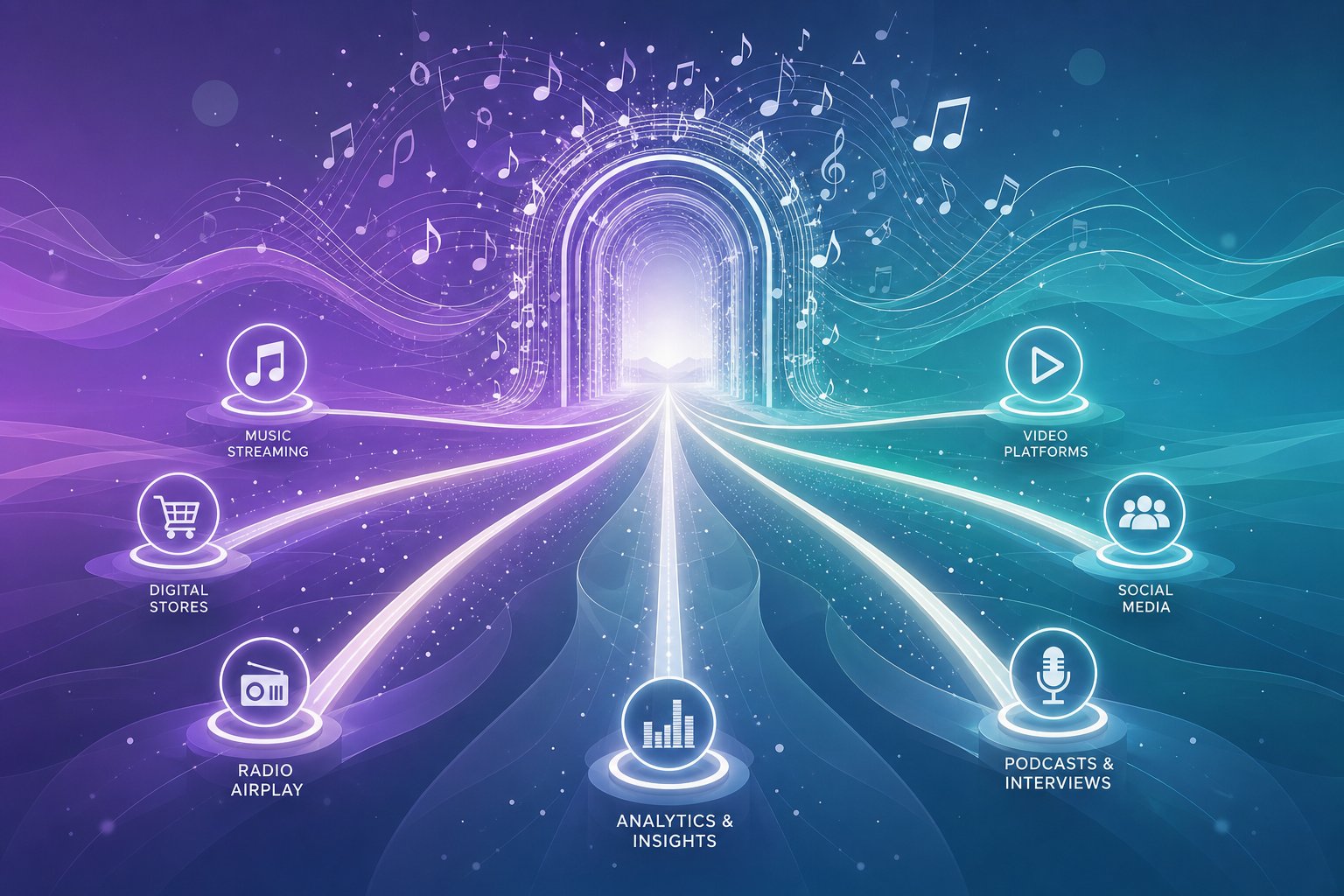
Your distributor is the gatekeeper between your finished track and every streaming platform. Choose one that aligns with your workflow, and your release goes live without friction. Choose wrong, and you risk rejection, delayed releases, or outright account termination. The landscape in 2026 ranges from distributors that openly welcome AI-generated content to those that reject it entirely, with several falling somewhere in between.
Here is how to distribute AI music to streaming platforms without running into walls.
TuneCore AI Music Requirements
The TuneCore AI music policy draws a hard line: works that are 100% AI-generated will not be distributed. TuneCore supports AI that "enhances human creation processes" but refuses to deliver content where an AI tool was the sole creative force. If your track was generated entirely by Suno or Udio with no meaningful human contribution beyond prompting, TuneCore will reject it.
For AI-assisted tracks where you contributed significant human creative input, TuneCore requires detailed transparency during upload. You need to specify which elements used AI (composition, lyrics, vocals, production, mastering) and which AI tools were involved. This goes beyond a simple checkbox. You are providing a full breakdown of AI involvement that gets passed to streaming platforms as metadata.
What happens if you skip disclosure? TuneCore's detection system flags tracks that appear AI-generated but were not declared. Rather than removing the content outright, TuneCore pauses your release and asks you to resubmit with proper attribution. This resubmission model is more forgiving than immediate rejection, but it adds time to your release timeline. Repeated violations can escalate to account penalties.
Pricing follows a per-release model: singles cost $9.99/year and albums start at $19/year, with a subscription plan available at $14.99/year for unlimited singles. For high-volume AI creators, these per-release costs add up fast compared to flat-rate alternatives.
DistroKid and Other Distributors Compared
Does DistroKid allow AI music? Yes, and it is currently the most permissive major distributor for AI-generated content. DistroKid's policy is straightforward: AI music is accepted with mandatory disclosure. During upload, you check a box indicating whether AI tools contributed to vocals, lyrics, melody, or instrumentation. That disclosure is passed through to streaming platforms, and your track enters the same distribution pipeline as any human-produced release.
DistroKid's rules are simple but non-negotiable:
- You must own 100% of the rights, including the legal right to distribute music created with AI tools
- No impersonation or voice cloning of another artist without permission
- No mass-generated spam designed to game streaming algorithms
- No infringement on anyone else's rights
At $22.99/year for unlimited uploads with 0% commission, DistroKid is the best music distributor for AI generated music if volume is part of your strategy. There is no cap on how many AI tracks you can upload, and no per-release fees eating into your margins.
Beyond the two biggest names, several other distributors have carved out clear positions:
- CD Baby takes the strictest stance among major distributors. Fully AI-generated tracks are rejected outright, with no resubmission pathway. Only AI-assisted content where a human led the creative process may be accepted. Pricing uses a one-time fee model ($9.95 for singles, $29.95 for albums) with a 9% commission on streaming revenue.
- Symphonic accepts both fully AI-generated and AI-assisted music, requiring disclosure of how AI was used during upload. They operate on a revenue-sharing model, typically 85/15 in the artist's favor.
- Ditto Music allows AI music with disclosure at $19/year for unlimited uploads. They have been explicit about viewing AI as a legitimate creative tool and do not penalize disclosed AI content.
- RouteNote accepts AI releases through both their free (15% revenue share) and premium tiers, but requires you to provide links to the AI tools used so their moderation team can verify legitimacy. Note that AI content may not be eligible for Content ID services through RouteNote.
- Amuse accepts AI music but limits uploads to 10 AI releases per rolling 7-day period, and excludes AI content from Meta and YouTube Content ID distribution.
- LANDR has the most detailed policy, accepting AI tracks with a 12-song monthly cap. However, they exclude AI content from YouTube Content ID, Meta, TikTok, Deezer, Pandora, and Tencent, which significantly limits your platform reach.
| Distributor | Accepts AI Music? | Disclosure Required | Volume Limits | Pricing |
|---|---|---|---|---|
| DistroKid | Yes (with disclosure) | Checkbox during upload | Unlimited | $22.99/year, 0% commission |
| TuneCore | AI-assisted only; 100% AI rejected | Detailed attribution form | Per-release pricing | $9.99-$19/release or $14.99/year subscription |
| CD Baby | AI-assisted only; fully AI rejected | Must prove human authorship | N/A | $9.95-$29.95 one-time, 9% commission |
| Symphonic | Yes (fully AI and AI-assisted) | Required in upload flow | Not stated | Revenue share (85/15) |
| Ditto Music | Yes (with disclosure) | Required | Unlimited | $19/year |
| RouteNote | Yes (with verification) | Must provide AI tool links | No stated cap | Free (15% share) or premium |
| LANDR | Yes (with restrictions) | Required during upload | 12 songs/month | Subscription-based |
| Amuse | Yes (discretionary) | Auto-detected | 10 releases per 7 days | Free tier or $24.99/year Pro |
How to Choose the Right Distributor for AI Music
Your decision comes down to three factors: how much AI is in your workflow, how many tracks you plan to release, and which platforms you need to reach.
If your music is fully AI-generated with minimal human input, your viable options narrow to DistroKid, Symphonic, Ditto, or RouteNote. TuneCore and CD Baby will reject it. If your workflow is AI-assisted with substantial human creative involvement, nearly every distributor will accept your work as long as you disclose properly.
Volume matters too. Creators producing dozens of tracks per month need unlimited upload models like DistroKid or Ditto. LANDR's 12-song monthly cap and Amuse's 10-release weekly limit become constraints fast for prolific AI producers.
Platform exclusions are the hidden variable most creators overlook. LANDR cuts your AI tracks off from YouTube Content ID, Meta, TikTok, Deezer, and Pandora. Amuse excludes Meta and YouTube Content ID. If social media monetization or Content ID revenue matters to your business model, these exclusions can significantly reduce your effective earnings. DistroKid and Symphonic deliver AI tracks to all platforms without documented exclusions.
One universal tip: always disclose AI involvement, even if you think your track might pass without it. Every major distributor now uses automated AI detection as part of their screening process. Getting caught without disclosure is consistently worse than being upfront. At minimum, you face resubmission delays. At worst, you lose your account and your entire catalog goes offline.
Choosing a distributor gets your music onto platforms. But there is another layer between you and a successful release: the terms of service of the AI tool you used to create the track. Those terms dictate whether you actually have the commercial rights to distribute what you made.
AI Music Tool Terms of Service and What They Let You Release
Your distributor might accept AI tracks, and your chosen platform might allow them. But none of that matters if the tool you used to generate the music does not grant you the right to distribute it commercially. Every AI music generator operates under its own terms of service, and the gap between what the marketing page promises and what the legal text actually allows can be significant. Free tiers almost universally restrict commercial use, paid tiers vary in what rights they transfer, and some platforms retain ownership stakes that could complicate your release down the line.
Here is the AI music generator commercial license comparison you need before uploading anything.
Commercial Rights by AI Music Tool and Pricing Tier
The most important line in any AI music tool's terms is the one that says whether you can monetize what you create. For most platforms, that line changes depending on how much you pay.
Suno draws the clearest distinction. Suno AI commercial use rights are locked behind a paid subscription. The Basic (free) tier explicitly prohibits commercial use, and Suno retains ownership of music created on free accounts. Both Pro ($10/month) and Premier ($30/month) grant full commercial rights, including streaming distribution, YouTube monetization, podcast use, sync licensing, and direct sales. Suno takes zero percent of your earnings. The key detail: rights persist permanently for songs created while you were subscribed, even if you cancel later. But songs created on the free tier do not retroactively gain commercial status when you upgrade.
Udio presents a more complicated picture. Can you sell music made with Udio? As of early 2026, the answer is effectively no for new content. Following its October 2025 settlement with Universal Music Group, Udio suspended all downloads and transitioned to a "walled garden" model. You cannot export audio from the platform. A new licensed version is expected later in 2026, but current terms make distribution impossible for anything created after the settlement. If you downloaded tracks before October 2025, those may retain commercial rights under the original terms, though verifying this requires checking the specific agreement that was in effect at the time of creation.
AIVA uses a tiered ownership model that is unusually clear about copyright. The free plan restricts output to non-commercial use. The Standard plan grants some commercial rights but may impose revenue caps. The Pro plan goes furthest: it assigns full copyright ownership to you, meaning AIVA retains no rights over the output. This makes AIVA Pro one of the few AI tools where your generated music may qualify for copyright registration, assuming sufficient human creative involvement in the process.
Soundraw operates as a royalty-free commercial music generator on its paid Creator plan. At $19.99/month, you get unlimited generation with full commercial rights for YouTube, ads, podcasts, and social media. Soundraw uses parameter-based customization rather than text prompts, which gives you more granular control over the output but means no vocals. The license is straightforward: pay, generate, use commercially. No revenue share, no caps.
Boomy offers the lowest barrier to entry for getting AI music onto streaming platforms. Its paid tier (from $9.99/month) includes built-in distribution to Spotify, Apple Music, and TikTok, with automatic royalty collection. You do not need a separate distributor. The tradeoff when comparing Boomy vs Soundraw terms of service for releasing music: Boomy handles distribution for you but gives you less creative control and potentially lower audio quality. Soundraw gives you more production control but requires you to handle distribution separately through a third-party distributor.
Ownership Clauses You Need to Read Before Releasing
Commercial use rights and ownership are not the same thing. A tool can grant you the right to monetize a track while still retaining underlying ownership or imposing restrictions on how you use it.
Here is where the major tools land:
| Tool | Free Tier Commercial Use | Paid Tier Commercial Use | Platform Retains Ownership? | Rights After Cancellation |
|---|---|---|---|---|
| Suno | No | Yes (Pro $10/mo, Premier $30/mo) | Free tier: Yes. Paid: No | Rights persist for songs made while subscribed |
| Udio | N/A (suspended) | N/A (downloads suspended) | Unknown under new terms | Pre-settlement tracks may retain rights |
| AIVA | No | Yes (Pro grants full copyright) | Free/Standard: Yes. Pro: No | Check current ToS |
| Soundraw | No | Yes ($19.99/mo) | No (royalty-free license) | Tracks created while subscribed remain licensed |
| Boomy | Limited | Yes ($9.99/mo) | Shared model (Boomy handles distribution) | Varies by agreement |
| Stable Audio | No | Yes (Creator tier) | No | Rights persist for content created while subscribed |
The critical pattern: almost every free tier either prohibits commercial use entirely or retains ownership of the output. Upgrading later does not fix tracks you already created on the free plan. If you generated a track you love on a free account, you may need to regenerate it after subscribing to a paid tier rather than assuming retroactive rights apply.
Audio Formats and Export Options That Matter
Beyond licensing, the practical question is whether your AI tool exports audio in a format your distributor can accept. Most distributors require WAV or FLAC files at 16-bit/44.1kHz minimum. Some AI generators only export compressed MP3 or AAC files on lower tiers, which can cause quality issues or outright rejection during the upload process.
Suno exports in WAV format on paid tiers, with stem separation available on Premier through Suno Studio. Soundraw provides WAV downloads. AIVA offers MIDI and WAV exports, which is particularly useful if you want to import stems into a DAW for further human arrangement. Boomy's built-in distribution handles format conversion internally, so you do not interact with raw files unless you specifically export them.
One practical tip: always download and back up your exported files immediately after generation. Udio's download suspension proved how quickly platform access can disappear. Suno's upcoming model transitions include download caps for paid users, meaning unlimited access to your creations is not guaranteed long-term. Treat every export as potentially your last chance to secure that file.
Always verify your AI tool's current terms of service before releasing. These policies change frequently, often without advance notice, and what was permitted six months ago may no longer apply.
Understanding your tool's terms tells you what you are legally allowed to release. The next challenge comes after your track goes live: protecting it from false claims, registering it properly, and turning streams into sustainable revenue.

Protecting Your AI Music After Release and Handling Disputes
Getting your track live on streaming platforms is only half the job. What happens next, from automated copyright claims to royalty collection, determines whether your release actually generates revenue or quietly bleeds money to someone else. Can AI music get Content ID claims? Absolutely. The system does not distinguish between human-produced and AI-produced audio. It matches fingerprints, and if yours triggers a match, you are in for a dispute regardless of how your track was made.
Registering AI Music with Content ID and PROs
Two registration paths exist for protecting your work after release: Content ID (which guards your recordings on YouTube) and Performance Rights Organizations (which collect royalties when your compositions are publicly performed).
Content ID registration works through your distributor. When you distribute a track to YouTube Music, many distributors automatically submit your audio fingerprint to the Content ID database. This means if someone else uses your track in their video, you receive ad revenue from that usage. The catch: some distributors exclude AI content from Content ID services. RouteNote, Amuse, and LANDR all restrict AI tracks from Content ID registration, so if this revenue stream matters to you, confirm your distributor's policy before release.
PRO registration is where the copyright question from earlier sections becomes financially real. ASCAP, BMI, and SOCAN announced in October 2025 that they now accept registrations of partially AI-generated musical works. The key word is "partially." All three PROs define an eligible work as one combining AI-generated elements with elements of human authorship. Fully AI-generated compositions remain ineligible for registration with any of the three societies.
What this means in practice:
- If you wrote original lyrics and paired them with AI-generated instrumentals, the lyrics portion is registrable with ASCAP, BMI, or SOCAN
- If you composed a melody, arranged sections, and used AI for production, the full composition is likely registrable
- If the entire composition was prompted into existence with no human authorship beyond the prompt, you cannot register it and will not collect performance royalties
Registration unlocks performance royalty collection from radio play, TV broadcasts, venue performances, and certain streaming contexts. Without it, that revenue simply does not flow to you, even if listeners are streaming your track thousands of times.
Handling False Copyright Claims on AI Tracks
YouTube's Content ID system generated 2.5 billion claims in 2024 alone. Many of those were false positives, and AI music creators are particularly vulnerable. Here is why: AI models sometimes produce output that coincidentally resembles copyrighted material in the Content ID database. The matching threshold is low. As little as 5 to 10 seconds of audio similarity triggers a claim in 94% of cases, roughly a 4-bar phrase.
Rights-management companies like HAAWK and AdRev register massive catalogs with Content ID. When your AI track fingerprint overlaps with anything in their database, an automated claim fires, even if no actual infringement occurred. The system favors claimants by design.
Here is how to protect AI generated music from copyright claims when a false positive hits:
- File a dispute through YouTube Studio by selecting "I own all rights to the content"
- Include the AI tool you used, the generation date, and a statement that AI-generated works without meaningful human creative input are not eligible for copyright protection under US Copyright Office guidance
- If your platform provides generation metadata or provenance watermarks, reference them in the dispute
- Wait 30 days. If the claimant does not respond, the claim auto-releases. Many automated claimants let disputes time out because they cannot substantiate false claims
- If the claimant rejects your dispute, escalate to an appeal. The claimant then has only 7 days to respond
Licensed content disputes with proper documentation win 89% of the time and resolve in about 7 days on average. Without paperwork, your success rate drops to 67% and resolution stretches to 28 days. The lesson: keep records of every generation. Screenshots of prompts, download receipts, tool subscription confirmations, and export timestamps all serve as evidence.
Split tracking and proper documentation help establish your rights if disputes arise. Maintain a folder for each release containing your AI tool receipt, generation parameters, any human stems or lyrics files, and your distributor's delivery confirmation. This paper trail is your defense.
Sync Licensing and Revenue Expectations for AI Music
Can AI-generated tracks land sync licensing deals for film, TV, ads, or games? Yes, and this is one of the cleaner revenue paths for AI music. Sync licensing is a negotiated contract between you and the licensee. The buyer cares about having permission to use the music, not about copyright registration status. If you hold commercial rights from your AI platform and can deliver the audio files, you can license the track.
Most sync deals involve both master and composition rights. For AI music, this collapses into a single payment to you since you typically control both sides. No label split, no publisher cut. That simplicity is actually an advantage in the sync market, where clearance speed matters.
How much money can AI music make on Spotify and other streaming platforms? Revenue expectations need grounding in reality. Streaming royalties are paid based on recording ownership and distribution agreements, not copyright registration. Your distributor collects from platforms and pays you regardless of whether the track is copyrightable. This means fully AI-generated tracks still earn streaming revenue, even though they may lack copyright protection.
The revenue breakdown for AI music creators looks like this:
| Revenue Stream | Works for AI Music? | Requirements |
|---|---|---|
| Streaming royalties (master) | Yes | Distribution agreement only |
| Performance royalties | Only if partially human-authored | PRO registration (ASCAP/BMI/SOCAN) |
| Mechanical royalties | Uncertain for fully AI works | Copyright registration |
| Sync licensing | Yes | Commercial rights from AI tool |
| YouTube AdSense | Yes | Monetized channel |
| YouTube Content ID | Yes (if registered) | Distributor must support it for AI tracks |
Streaming royalties remain the primary income source for most AI music creators. These work identically whether the track is human-made or AI-generated. Performance and mechanical royalties are where complications arise, and those complications only matter if your music gets enough traction to make them financially significant.
The practical focus: prioritize streaming revenue and sync opportunities, which function reliably. Avoid overclaiming rights you may not hold by attempting to register fully AI-generated compositions with PROs. And document everything, because the difference between winning and losing a dispute often comes down to whether you can prove what you created and when.
Not every creator needs this level of complexity. If your goal is commercially usable AI music for videos, podcasts, or content projects rather than full streaming distribution, there is a much simpler path that sidesteps Content ID, PRO registration, and platform disputes entirely.
Free AI Music Generators for Commercial Use Without Distribution Hassles
Picture this: you need a cinematic intro for your YouTube channel, a mellow loop for a podcast episode, or an upbeat track behind a product demo. You do not need the track on Spotify. You do not care about streaming royalties or PRO registration. You just need music you can legally use in your commercial project without worrying about takedowns, copyright claims, or licensing fees eating into your budget.
This is a fundamentally different use case from releasing AI music on streaming platforms, and it comes with a fundamentally simpler workflow. A free AI music generator for commercial use gives you exactly what you need: royalty-free output with a clear license that lets you monetize your content without navigating the maze of distributor policies, platform disclosures, and copyright uncertainty covered in previous sections.
When You Need Royalty-Free AI Music Instead of Distribution
Not every project demands a full release pipeline. Many creators work in contexts where the music supports other content rather than standing on its own as a distributed product. The distinction matters because the rules are dramatically simpler when you are sourcing background music rather than publishing an artist release.
Royalty-free AI music generators are the better path when your project involves:
- YouTube videos — Background music, intros, outros, and transition soundscapes where you need royalty free AI music for YouTube videos without risking Content ID claims from stock libraries
- Podcast intros and segments — An AI music generator no copyright for podcasts lets you brand your show with unique audio without recurring license fees
- Game soundtracks and interactive media — Indie developers who need ambient loops, menu music, or level themes without negotiating sync licenses
- Social media content — TikTok, Instagram Reels, and Shorts where you need free AI background music for content creators that will not trigger platform-level muting or removal
- Advertisements and product demos — Commercial video content where traditional stock music subscriptions add unnecessary costs
- E-learning and presentations — Corporate or educational material where budget constraints make premium music libraries impractical
In all these scenarios, the creator's goal is simple: get music that sounds professional, use it freely in monetized content, and move on without legal anxiety. You do not need copyright registration because you are not selling the music itself. You do not need a distributor because the track never hits streaming platforms as a standalone release. You do not need PRO registration because no one is performing your composition publicly as a musical work.
The entire complexity of distribution, disclosure, and ownership collapses into one question: does the tool's license allow commercial use of the output?
Free AI Music Tools for Commercial Projects
Several platforms now offer AI-generated music with clear commercial licenses at no cost, removing the financial barrier entirely. The key is choosing tools that explicitly grant royalty-free rights in their terms, meaning you can monetize content containing their output without paying royalties, attribution fees, or per-use charges.
MakeBestMusic's Free Music Generator is a strong option for creators who want royalty-free AI music they can use immediately in videos, social content, games, podcasts, and other commercial projects. It provides a straightforward workflow: generate a track, download it, and use it commercially without navigating subscription tiers or worrying about whether your free-tier output carries distribution restrictions. For content creators who need reliable background music without the overhead of managing licenses or reading dense terms of service, this kind of tool eliminates the friction between idea and execution.
When evaluating any free AI music generator for commercial use, check these factors before downloading:
- Commercial license clarity — The terms should explicitly state that output is royalty-free and cleared for commercial use, not just "personal projects"
- No attribution requirement — Some free tools require you to credit the platform in your video description or project credits, which may not suit all use cases
- No Content ID registration by the platform — If the tool registers its own output with Content ID, you could receive claims on your own videos even though you have a license
- Download format quality — Ensure output is available in at least 320kbps MP3 or lossless WAV for professional production standards
- No revenue caps — Confirm the license does not expire or restrict use after your content reaches a certain view count or revenue threshold
The advantage of this approach over traditional stock music is customization. Stock libraries offer pre-made tracks you browse and hope fit your project. AI generators let you describe what you need, whether that is a lo-fi hip hop beat for a study channel or an orchestral swell for a documentary intro, and produce something tailored to your vision in minutes.
For creators who want to skip the complexity of streaming distribution entirely, royalty-free AI music tools offer the simplest path from concept to commercially usable audio. No distributor accounts, no platform disclosure forms, no Content ID disputes. Just music that works for your project, cleared for commercial use from the moment you hit download.
Of course, some creators want both: royalty-free tracks for their content projects and properly distributed releases for streaming platforms. For those who choose the full release route, a clear step-by-step process keeps you compliant across every layer of rules while minimizing the risk of takedowns or disputes.

How to Release AI Music the Right Way Step by Step
Every section of this article has covered a piece of the puzzle: copyright, platform rules, distributor policies, tool terms, and post-release protection. This step-by-step guide to releasing AI music pulls those pieces together into a single actionable process you can follow from start to finish. Think of it as your AI music release checklist for beginners and experienced creators alike.
Step-by-Step Process for Releasing AI Music Legally
Here is how to release AI music without getting taken down, organized in the order you should tackle each decision:
- Choose your AI tool and read its terms of service. Confirm you are on a tier that grants commercial distribution rights. Free tiers almost always prohibit commercial use. If your plan is Suno, you need Pro or Premier. If it is Soundraw, you need the Creator plan. Do not generate on a free account and hope to sort rights later.
- Add meaningful human creative input. Write your own lyrics. Record original vocals or live instrumentation. Rearrange the AI output into a new structure. Edit melodies, swap sections, and layer human-produced elements over the generated material. The more visible your creative decisions, the stronger your copyright position and the fewer problems you face at every downstream step.
- Document your creative process. Save project files, MIDI exports, lyric drafts, screenshots of prompts, and version history. This paper trail becomes your evidence if a distributor questions your submission, a platform challenges your ownership, or a false Content ID claim lands on your track.
- Select a distributor that matches your workflow. If your track is fully AI-generated, DistroKid or Symphonic are your strongest options. If you added substantial human authorship, TuneCore and CD Baby become viable. Check each distributor's platform exclusions, especially around Content ID and Meta, before committing.
- Disclose AI involvement honestly during upload. Fill out every AI attribution field your distributor provides. Specify which elements used AI: vocals, instrumentation, lyrics, production. Proactive transparency is always safer than getting flagged by automated detection after the fact.
- Verify platform compliance before release day. Confirm current policies on Spotify, Apple Music, YouTube Music, and any other platform you are targeting. Policies shift quarterly. A quick check of each platform's creator documentation takes minutes and prevents weeks of dispute resolution.
- Register eligible works with a PRO. If your track includes human-authored composition elements, register with ASCAP, BMI, or your local PRO to collect performance royalties. Disclaim any AI-generated portions in your registration to stay compliant with their policies.
- Monitor your release post-launch. Watch for Content ID claims in the first 48 hours. If a false claim appears, dispute immediately with your documentation. Set calendar reminders to check monthly for new claims, especially on YouTube where automated matching runs continuously.
Transparency and human creative involvement are the two factors that most reduce risk across all platforms, distributors, and legal jurisdictions.
Ethical Considerations and Disclosure Best Practices
The ethical way to publish AI generated songs goes beyond minimum compliance. It means respecting the ecosystem you are releasing into. Avoid voice cloning without explicit consent. Do not reference specific artists in prompts to replicate their style. Disclose AI use even when platforms do not strictly require it yet, because norms are tightening and early transparency builds trust with listeners.
As industry experts emphasize, AI should enhance your unique voice and style rather than replace it entirely. Platforms and fans respond to originality. Keeping a human touch helps your work stand out and signals that you are a dedicated musician rather than someone automating content for algorithmic exploitation.
One final consideration: not every project needs the full distribution pipeline. If your goal is commercially usable music for videos, podcasts, or social content rather than a streaming release, tools like MakeBestMusic's Free Music Generator offer a simpler path. You generate royalty-free music, download it, and use it in your projects without navigating distributor accounts, disclosure forms, or Content ID registration. For many creators, that streamlined workflow is all they need.
Whether you choose full distribution or royalty-free generation for content projects, the principle stays the same: understand the rules before you press publish, add genuine creative value wherever you can, and document everything along the way. That combination keeps your music live, your accounts safe, and your revenue flowing.
