


What a Chord Progression Maker Actually Does
What Is a Chord Progression Maker
A chord progression maker is a tool — software, web app, or plugin — that generates sequences of chords based on music theory rules, user-selected keys, and genre preferences. Instead of staring at a blank project wondering whether a Bm chord should follow a G chord guitar players already know, you get a structured starting point that's musically sound. These tools range from simple browser-based generators to full-featured DAW plugins like Scaler 3 and Captain Chords Epic, which use MIDI data and harmonic logic to build progressions you can edit, audition, and export directly into your session.
Who Benefits from Chord Progression Tools
Imagine you're a songwriter chasing a mood — something that moves from a dark G minor chord verse into a brighter chorus, maybe even handling a g to c key change chord progression along the way. Or picture a producer sketching a lo-fi beat who needs chords fast and doesn't want to hunt for the right em chord piano voicing by trial and error. Maybe you're a beginner guitarist still getting comfortable with a chord guitar c m shape and want to hear how it connects to other chords in the key. A chord progression maker serves all three of these people. It gives experienced writers a spark of inspiration, helps producers build tracks quickly, and teaches beginners how chords relate to each other within a scale — whether that's C major or the scale Bb major.
Automated Generators vs. Interactive Builders
Not every tool works the same way. Fully automated generators output progressions with a single click — you pick a key and mood, and the algorithm does the rest. They're great for breaking creative blocks. Interactive builders, on the other hand, let you drag, drop, and rearrange chords yourself, giving you hands-on control over every harmonic choice. Many modern plugins blend both approaches, offering AI-generated suggestions you can then tweak note by note.
Understanding the theory behind a chord progression maker turns you from a passive user into an active creator.
That idea is the thread running through everything ahead. We'll break down the harmonic principles that power these tools, walk through building progressions from scratch, catalog genre-specific formulas, and show you how to refine raw output into polished, professional-sounding music. The goal isn't to replace your creativity — it's to sharpen it.
Why Certain Chords Sound Right Together
Every chord progression maker relies on the same hidden engine: harmonic function. Whether you're strumming an f chord guitar shape, picking banjo chords in a bluegrass jam, or voicing a Cmaj7 guitar chord in a jazz intro, the reason some chord moves feel satisfying and others feel aimless comes down to the role each chord plays inside its key.
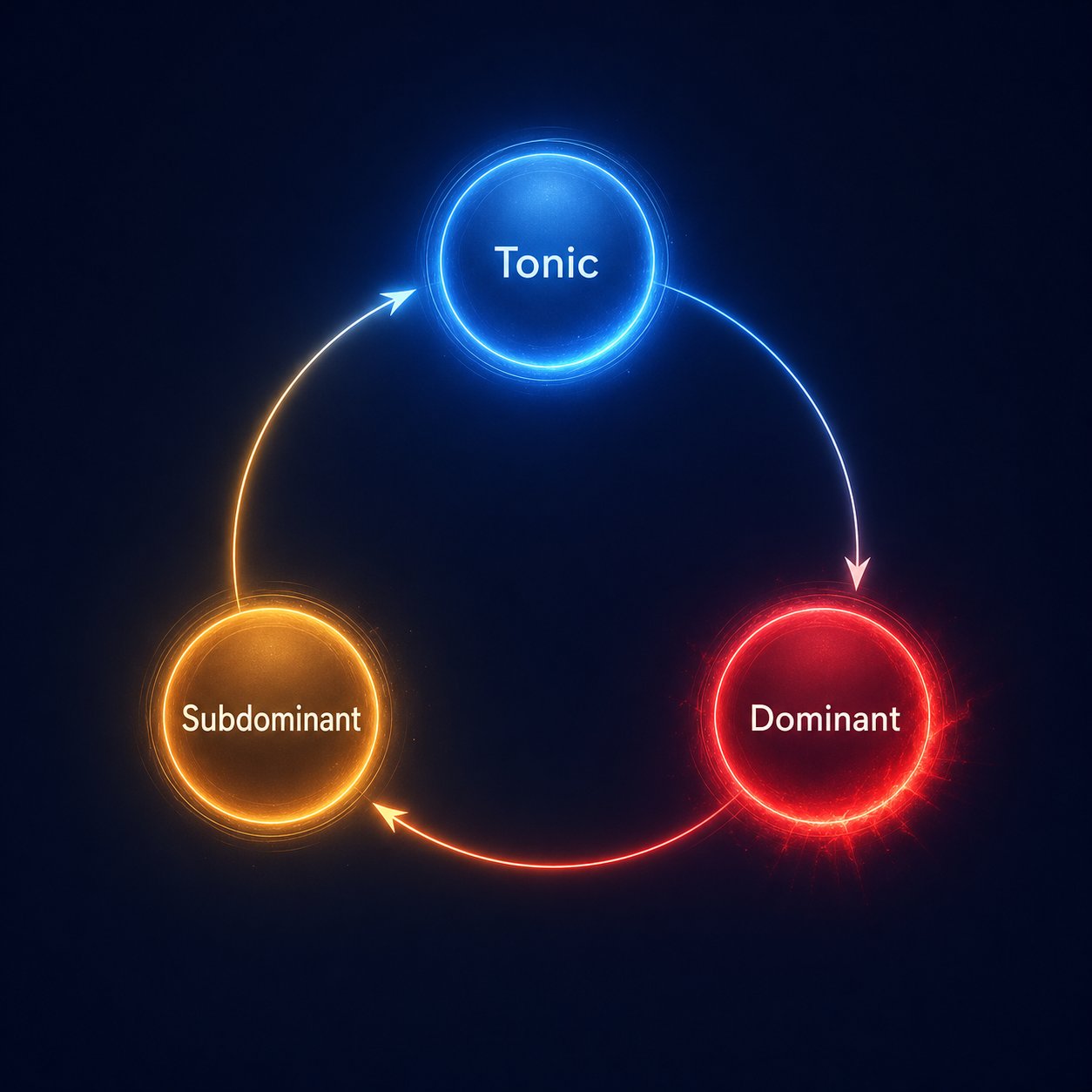
Tonic, Subdominant, and Dominant Explained
Every diatonic chord falls into one of three functional categories. Think of them as characters in a story:
- Tonic (I) — home base. It feels stable, resolved, at rest. In C major, that's the C chord. In G major, it's G.
- Subdominant / Pre-dominant (IV, ii) — the departure. These chords create gentle forward motion, like stepping away from home. In C major, F and Dm fill this role. In G major, it's C and Am.
- Dominant (V, vii°) — peak tension. These chords contain the leading tone, a note that sits just a half step below the tonic and practically begs to resolve upward. In C major, G and B° carry dominant function. In G major, D and F#° do the same work.
The remaining chords — vi and iii — act as tonic prolongation, extending the feeling of home before the harmony moves on. If you've ever looked up an am chord gitar diagram and noticed how naturally Am flows into F or Dm in the key of C, that's tonic prolongation handing off to the subdominant — a textbook harmonic relay.
How Tension and Release Drive a Progression Forward
Why does the V chord resolve so powerfully to I? The dominant chord contains the leading tone — B in the key of C — which is only a half step from the tonic note C. That tiny interval creates an almost magnetic pull. When G (V) moves to C (I), that leading tone resolves upward and the listener feels a satisfying click of arrival. This is the authentic cadence, and it's the strongest resolution in tonal music.
The plagal cadence — IV to I, like F to C — works differently. There's no leading-tone tension here. Instead, the move feels warm, gentle, and settled, like a soft exhale. You'll recognize it as the "Amen" cadence from hymns. It resolves, but without the urgency.
This tension-and-release cycle is the engine behind every effective progression. A chord progression maker generates sequences that sound "right" precisely because its algorithm follows this pattern: rest, departure, tension, resolution. Understanding that cycle means you can evaluate any tool's output and know instantly whether a suggestion works — or whether it needs a tweak. Even something as unexpected as a D#m chord on piano can make sense if it serves the right function in context.
Harmonic Function Mapped Across Two Keys
The beauty of harmonic function is that it's universal. The pattern doesn't change when you switch keys — only the chord names do. Whether you're playing chord chord ukulele voicings in C or full barre chords in G, the functional relationships stay identical. Here's how every diatonic chord maps to its role in both C major and G major:
| Scale Degree | Harmonic Function | C Major | G Major |
|---|---|---|---|
| I | Tonic | C | G |
| ii | Pre-dominant (Subdominant) | Dm | Am |
| iii | Tonic Prolongation | Em | Bm |
| IV | Pre-dominant (Subdominant) | F | C |
| V | Dominant | G | D |
| vi | Tonic Prolongation | Am | Em |
| vii° | Dominant | B° | F#° |
Notice how C is the tonic in one key and the subdominant in the other. The chord itself hasn't changed — its function has. That single insight is what separates someone who picks chords at random from someone who builds progressions with intention. And it's exactly the kind of knowledge that turns a chord progression maker from a slot machine into a precision tool.
With these functional roles in mind, the next logical question is practical: how do you actually use them to build a progression from a blank page?
How to Build a Chord Progression from Scratch
You don't need software to write chords that work. All you need is a key, a short list of diatonic chords, and the harmonic function principles covered above. The five steps below will take you from an empty page to a playable progression — and once this process is second nature, every chord progression maker you touch becomes dramatically more useful because you can judge and reshape its output on the fly.
Choosing a Key and Writing Out Diatonic Chords
- Choose a key and decide on a mood. Major keys tend to feel bright and open; minor keys lean darker and more introspective. If you're writing an upbeat pop track, a major key like C, G, or D is a solid starting point. For something moodier, try A minor or E minor. Don't overthink this — you can always transpose later.
- Write out the diatonic chords. Using the scale of your chosen key, list every chord from I through vii° with both Roman numerals and actual chord names. In C major, for example, that gives you: C (I), Dm (ii), Em (iii), F (IV), G (V), Am (vi), and B° (vii°). Every note of the C major scale produces a chord you can use — from the bright C chord on the first degree to the tense B° on the seventh. Having this list in front of you is like having a palette of colors before you paint.
- Pick a starting chord. Most progressions begin on the I chord to establish the key right away, though starting on vi creates a more reflective, minor-tinged opening even within a major key. As Tabletop Composer notes, beginning with the tonic chord helps establish your key at the very start of the progression.
Applying Harmonic Function Step by Step
- Create movement using harmonic function. Follow the tonic-subdominant-dominant cycle: start at rest, build gentle tension, push to peak tension, then resolve. Move from your tonic chord to a subdominant-function chord (IV or ii), then to a dominant-function chord (V), and back home. This pattern — T, SD, D, T — is the backbone of functional harmony and the same logic every chord progression tool uses under the hood.
- Test, listen, and refine. Play the progression on guitar, piano, or even a virtual instrument. Sing a simple melody over it. Does it feel like it moves forward? Does the ending resolve? If a chord feels flat, swap it for another chord in the same functional family — try ii instead of IV, or vi instead of I. Small changes shift the color without breaking the harmonic logic.
A Worked Example in D Major
Let's put this into practice. You've chosen D major — a bright, guitar-friendly key where the D chord rings wide open and every shape sits comfortably on the neck. The diatonic chords are:
| Degree | Roman Numeral | Chord Name | Function |
|---|---|---|---|
| 1st | I | D | Tonic |
| 2nd | ii | Em | Subdominant |
| 3rd | iii | F#m | Tonic Prolongation |
| 4th | IV | G | Subdominant |
| 5th | V | A | Dominant |
| 6th | vi | Bm | Tonic Prolongation |
| 7th | vii° | C#° | Dominant |
Start on D (tonic). Move to Bm (vi) — still tonic function, but with a more reflective color. Step to G (IV, subdominant) to create forward motion. Land on A (V, dominant) for peak tension that demands resolution back to D. The result: D – Bm – G – A (I – vi – IV – V). This is the same progression behind Men at Work's "Land Down Under" and countless other hits in D major, as Musiversal's analysis highlights.
Try it yourself with a d chord guitar voicing at the second fret, an open Bm barre shape, a familiar G, and an open A. You'll hear how naturally the harmonic function cycle pulls each chord into the next. If you wanted to explore the same logic in C major, you'd get C – Am – F – G — the am chord stepping in for vi, the F chord handling subdominant duty, and G driving the resolution home. Same formula, different key, same satisfying result.
This is the real payoff of building progressions by hand. When you understand why D – Bm – G – A works — not just that it works — you can open any chord progression tool, hear its suggestions, and instantly know whether to keep, edit, or scrap them. You can spot when a b chord piano voicing might substitute for a standard Bm, or when swapping the IV for a ii would better serve the mood. The theory doesn't replace the tool; it makes you the one in control of it.
Essential Chord Progressions Every Musician Should Know
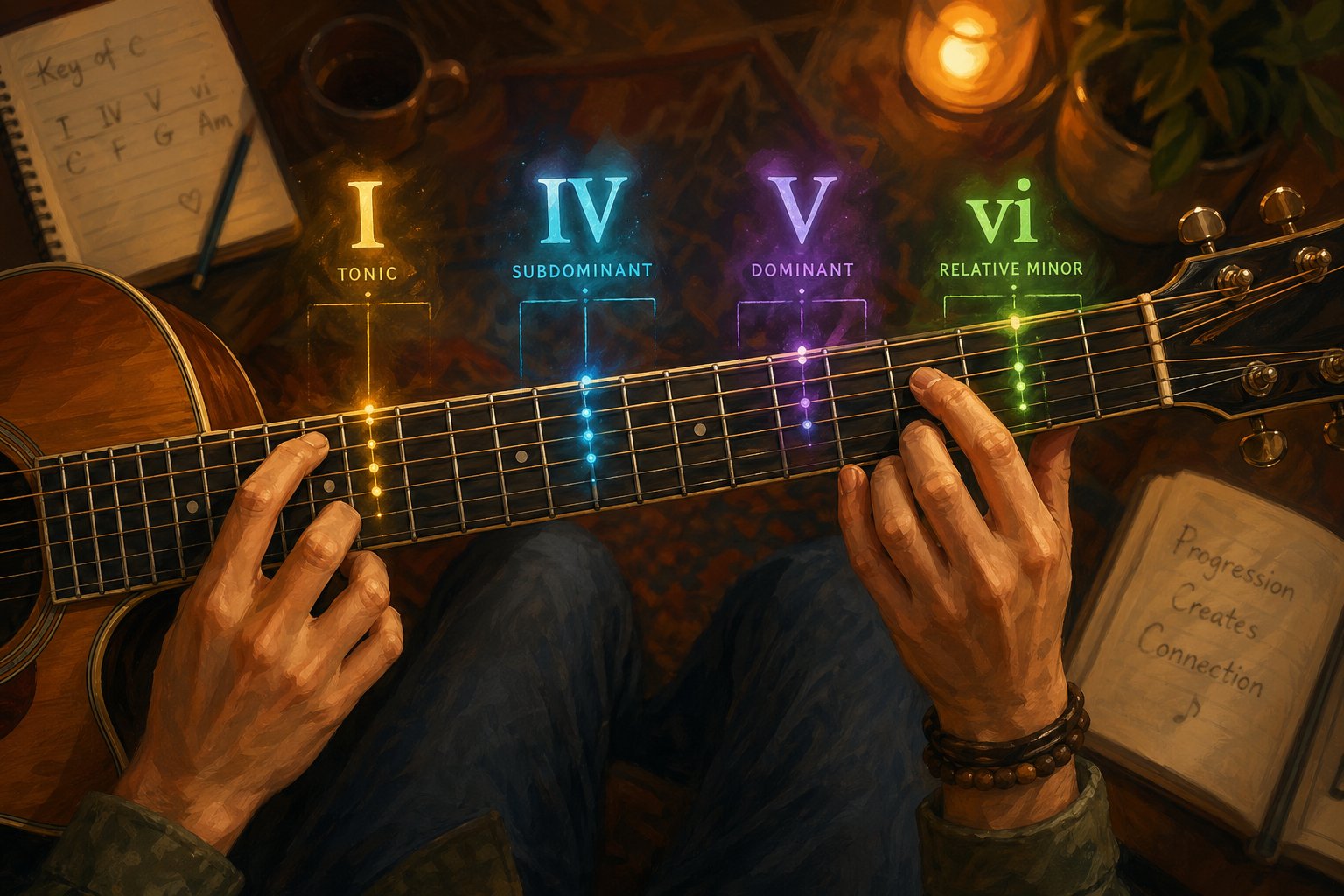
Knowing how to build a progression from scratch is powerful — but you don't have to reinvent the wheel every time you sit down to write. Certain chord formulas have appeared in thousands of songs across decades and genres. They work because they follow the harmonic function principles we've already covered, and they're the exact templates that every chord progression maker draws from when it generates output. Recognizing these patterns by ear means you can customize, combine, and twist any tool's suggestions instead of accepting them blindly.
Below is a genre-organized catalog with each progression spelled out in two keys so you can see the pattern and the actual chord names side by side.
Pop and Rock Progressions
These four formulas dominate modern pop, rock, and singer-songwriter music. Whether you're playing an accord piano C voicing or strumming open chords on an acoustic, you'll hear these everywhere.
| Progression Name | Roman Numerals | Example in C | Example in G | Typical Genre | Mood / Feel |
|---|---|---|---|---|---|
| Pop/Rock Anthem | I – V – vi – IV | C – G – Am – F | G – D – Em – C | Pop, Rock, Indie | Uplifting, anthemic, and universally satisfying |
| Pop Ballad | vi – IV – I – V | Am – F – C – G | Em – C – G – D | Pop Ballad, EDM | Emotional, reflective, builds from vulnerability to hope |
| Doo-Wop / 50s Pop | I – vi – ii – V | C – Am – Dm – G | G – Em – Am – D | Doo-Wop, Retro Pop | Nostalgic, warm, and sweetly romantic |
| Classic Rock Cycle | I – IV – V – IV | C – F – G – F | G – C – D – C | Classic Rock, Blues-Rock | Steady, driving, and laid-back confident |
You'll notice the I – V – vi – IV and its rotation vi – IV – I – V use the same four chords in a different order. Starting on the e minor chord (vi in G major) instead of the tonic completely shifts the emotional center from bright optimism to something more introspective — same ingredients, different story. That's why a single chord progression maker can generate dozens of variations from one set of chords just by reordering them.
Jazz and Blues Formulas
Jazz and blues rely on fewer chords but squeeze more expression out of each one through extensions and rhythmic phrasing. If you've ever grabbed an em7 guitar chord shape to add color to a simple progression, you've already touched on this approach.
| Progression Name | Roman Numerals | Example in C | Example in G | Typical Genre | Mood / Feel |
|---|---|---|---|---|---|
| Jazz Standard | ii – V – I | Dm7 – G7 – Cmaj7 | Am7 – D7 – Gmaj7 | Jazz, Neo-Soul, R&B | Sophisticated, resolved, and triumphant |
| 12-Bar Blues | I–I–I–I / IV–IV–I–I / V–IV–I–V | C–C–C–C / F–F–C–C / G–F–C–G | G–G–G–G / C–C–G–G / D–C–G–D | Blues, Blues-Rock, R&B | Gritty, soulful, and cyclically hypnotic |
The ii – V – I is the most important progression in jazz harmony. As Native Instruments notes, the ii chord acts as a stepping stone between the tonic and dominant, creating a uniquely jazzy tonality — especially when you stack seventh and ninth extensions on top. Try voicing that Dm7 as a chord gitar em7 shape moved to the fifth fret, and you'll hear the jazz flavor instantly.
The 12-bar blues is a 12-measure cycle built on just three chords — I, IV, and V — repeated throughout the entire song. In the key of C, that's C, F, and G. In Eb, you'd use an Eb chord, Ab, and Bb. The structure stays identical regardless of key: four bars on I, two on IV, two on I, then V – IV – I – V to turn the cycle around. Its simplicity is deceptive — the form has powered everything from Robert Johnson to Prince.
Minor Key and Modal Progressions
Minor key progressions tap into darker, more complex emotions. When you want tension that doesn't fully resolve or a mood that sits somewhere between melancholy and power, these are your go-to formulas.
| Progression Name | Roman Numerals | Example in Am | Example in Gm | Typical Genre | Mood / Feel |
|---|---|---|---|---|---|
| Minor Key Pop | i – iv – VII – III | Am – Dm – G – C | Gm – Cm – F – Bb | Minor Pop, Indie, Alt-R&B | Bittersweet, searching, with moments of light |
| Dramatic Minor | i – VII – VI – VII | Am – G – F – G | Gm – F – Eb – F | Power Ballad, Cinematic, Rock | Intense, emotionally charged, and building |
The Gm chord in the minor key examples opens up a whole different palette. In the dramatic minor progression, the Gm chord as the tonic creates a brooding foundation, while the Eb chord on the VI degree adds a dark, cinematic weight before the VII lifts back toward tension. Adele's "Rolling in the Deep" is a textbook example of the i – VII – VI – VII formula — that relentless emotional intensity comes directly from the VII chord building and rebuilding without ever fully resolving to a major tonic.
These formulas aren't creative shortcuts — they're starting frameworks. The real artistry begins when you modify them: swap a triad for a seventh chord, borrow a chord from a parallel key, or change the voicing to shift the texture. That's exactly where the next section picks up — turning these reliable templates into something that sounds unmistakably yours.
Same Progression in Every Key
Before you start swapping chords and adding extensions, there's a more fundamental skill that unlocks every formula in the previous section: transposition. A progression only becomes truly useful when you can move it into whatever key the song — or the singer — demands. The good news? If you understand scale degrees, transposition is almost instant.
I–V–vi–IV in Every Common Key
The concept is straightforward. Roman numerals describe a chord's position in the scale, not a fixed pitch. I is always the first chord of the key, V is always the fifth, and so on. When you switch keys, the Roman numerals stay the same — only the chord names change. You just need to know the major scale of your target key and build triads on each degree.
Here's the I–V–vi–IV progression — the pop/rock anthem formula — spelled out across seven common keys. Use the C major scale, G major scale, F major scale, and Bb major scale as your reference points, and the rest follow the same logic.
| Key | I | V | vi | IV |
|---|---|---|---|---|
| C major | C | G | Am | F |
| D major | D | A | Bm | G |
| E major | E | B | C#m | A |
| F major | F | C | Dm | Bb |
| G major | G | D | Em | C |
| A major | A | E | F#m | D |
| Bb major | Bb | F | Gm | Eb |
Look at the D major row: the G chord sits on the IV and the A chord on the V. In E major, the same V position is filled by B — and if you're on electric guitar, a powerchord E on the low strings followed by a B5 power chord gives you the I–V movement in its rawest form. Meanwhile, the vi chord in D major is Bm. If you're working at a keyboard, that b minor chord piano voicing — B, D, F# — is the same shape you'd use whether you're playing pop or a folk ballad. The Roman numeral system makes all of this predictable.
ii–V–I Transposed for Jazz Players
The ii–V–I is the backbone of jazz harmony, and Free Jazz Lessons recommends making it a goal to play this progression instantly in all 12 keys. Here it is in the most common keys, with seventh chords included since that's how jazz players actually voice them:
| Key | ii | V | I |
|---|---|---|---|
| C | Dm7 | G7 | Cmaj7 |
| D | Em7 | A7 | Dmaj7 |
| F | Gm7 | C7 | Fmaj7 |
| G | Am7 | D7 | Gmaj7 |
| A | Bm7 | E7 | Amaj7 |
| Bb | Cm7 | F7 | Bbmaj7 |
| Eb | Fm7 | Bb7 | Ebmaj7 |
Notice the key of D: Em7 – A7 – Dmaj7. That A chord — now voiced as A7 — carries dominant function, pulling hard toward the Dmaj7 resolution. In the key of F, the ii chord is Gm7, and the I is Fmaj7. If you're at the piano, the d minor chord piano voicing (D, F, A) is the ii in the key of C — the same Dm7 that kicks off the most common ii–V–I in all of jazz. Seeing these relationships across keys turns what feels like memorization into pattern recognition.
Why Manual Transposition Still Matters
Yes, most chord progression maker tools handle transposition with a single click. Select a new key from a dropdown, and every chord updates automatically. That's convenient in the studio — but it won't help you on stage when a vocalist asks to move the song down a whole step, or in a jam session when someone calls out a tune in Bb instead of C.
Manual transposition is a real-time skill. A guitarist who knows that the I–V–vi–IV in G is G – D – Em – C can shift to A (A – E – F#m – D) without pausing. A pianist who has internalized the ii–V–I across keys — even using inversions like a Dm/A chord voicing to smooth out the bass line — can follow a singer into any key without breaking the flow. As jazz educator Steve Nixon notes, practicing transposition through harmonic analysis rather than counting half steps builds a deeper, faster understanding that eventually becomes spontaneous.
Bookmark the tables above. They're a quick reference you can pull up at a rehearsal, a writing session, or while evaluating output from any chord generation tool. And once you can move a progression into any key effortlessly, the next frontier is making it sound less like a template and more like your music — which is where extensions, substitutions, and borrowed chords come in.

Adding Color with Extensions and Substitutions
A four-chord loop can carry a song — but it can also sound like a hundred other songs. The difference between a generic progression and one that stops a listener mid-scroll often comes down to a single added note or a well-placed chord swap. Extensions, substitutions, and borrowed chords are the tools that transform a solid harmonic skeleton into something with personality, and they're exactly the kind of refinements you should be making after any chord progression maker hands you a starting point.
Seventh Chords and Extensions That Add Depth
The simplest upgrade is a seventh chord. You take a basic triad — three notes stacked in thirds — and add one more third on top. That fourth note changes the entire emotional texture. A plain C major triad (C-E-G) sounds bright and resolved. Turn it into Cmaj7 (C-E-G-B) and it suddenly feels lush, dreamy, almost jazzy. A G chord becomes G7 (G-B-D-F), and that added minor seventh injects a restless tension that demands resolution — which is why G7 pulls so hard toward C in the key of C major. An Am becomes Am7 (A-C-E-G), softening the minor quality into something more wistful and open.
Extensions go further. A ninth chord adds the 9th scale degree above the root — Cmaj9 (C-E-G-B-D) sounds expansive and airy, while G9 (G-B-D-F-A) intensifies the dominant pull. Eleventh chords introduce a suspended, open quality, and thirteenth chords are among the densest standard voicings in jazz and neo-soul. You don't need to use all of them at once. Even swapping a single chord in your progression for its seventh-chord version can shift the mood dramatically. Try replacing a standard F with an Fmaj7 guitar chord voicing — that added E note on the first fret creates a shimmering quality that a plain F barre chord can't touch.
If you're sketching ideas in an online sequencer or a DAW, experiment by toggling between triads and seventh chords on the same progression. You'll hear how each extension reshapes the harmonic color without changing the underlying function.
Chord Substitutions and Borrowed Chords
Substitutions replace one chord with another that shares a similar harmonic role but brings a different flavor. There are several approaches worth knowing:
- Relative major/minor swaps — Replace a major chord with its relative minor (or vice versa). Instead of C – F – G, try C – Dm – G. The Dm shares two notes with F (D and A vs. F and A) and fills the same subdominant function, but with a darker shade.
- Tritone substitution — A jazz staple. Replace a dominant V chord with a dominant 7th chord whose root is a tritone (six half steps) away. In the key of C, G7 can be swapped for Db7. Both chords share the same tritone interval (B and F), so the resolution to C still works — it just arrives from an unexpected harmonic angle.
- Diminished passing chords — Insert a diminished chord between two diatonic chords to create chromatic bass movement. Between C and Dm, a C#dim acts as a smooth stepping stone, pulling the ear upward by half step.
- Borrowed chords (modal interchange) — This is where things get really interesting. You "borrow" a chord from the parallel minor key and drop it into a major progression. In C major, the parallel key is C minor, and its most useful borrowed chords include Fm (iv), Ab (bVI), and Bb (bVII). Piano With Jonny's guide to modal interchange highlights that replacing a standard IV chord with IVm — swapping F major for F minor in the key of C — produces a distinctly nostalgic, bittersweet mood. That single flattened note (A becoming Ab) is enough to make a listener's breath catch.
Borrowed chords work across every key. In Bb major, the diatonic IV chord is Eb. Borrow the iv from the Bb major scale's parallel minor, and you get Ebm — a chord that adds an unexpected shadow to an otherwise sunny progression. If you're a guitarist searching for a kord gitar b minor voicing to use in a D major progression, that Bm is already diatonic (vi). But borrow the iv from D minor — a Gm chord — and suddenly your D major progression has a melancholy twist it didn't have before.
Before and After Modification Examples
Theory is useful, but hearing the difference is what makes it stick. Here are three common progressions shown in their basic form and then with modifications applied:
| Technique | Before | After | What Changed |
|---|---|---|---|
| Add seventh chords | C – Am – F – G | Cmaj7 – Am7 – Fmaj7 – G7 | Every triad gains a seventh, adding warmth and sophistication |
| Borrowed iv chord | C – F – G – C | C – Fm – G – C | F becomes Fm (borrowed from C minor), creating a bittersweet pull before resolution |
| Tritone substitution | Dm7 – G7 – Cmaj7 | Dm7 – Db7 – Cmaj7 | G7 is replaced by Db7, adding chromatic bass descent (D – Db – C) and a sophisticated jazz color |
| Diminished passing chord | C – Dm – G – C | C – C#dim – Dm – G – C | C#dim bridges C and Dm with half-step bass movement, smoothing the transition |
| Suspension before resolution | G – D – Em – C | G – Dsus4 – D – Em – C | A Dsus4 guitar chord delays the major third, building anticipation before D resolves |
Notice a pattern: every modification either preserves or creatively subverts the tension-and-release cycle that makes progressions work. A tritone sub still resolves to the tonic — it just takes a more colorful path. A borrowed iv chord still functions as a subdominant — it just carries an emotional weight the diatonic IV doesn't. Extensions don't change a chord's function; they enrich its voice.
This is what separates a polished composition from a four-chord loop. And it's why understanding these techniques matters even if you rely on a chord progression tool for your starting ideas — the tool gives you the skeleton, but extensions and substitutions give it skin, muscle, and expression.
There's one more layer of refinement that can make an even bigger difference than which chords you choose: how you connect them. The smoothness of the transition between two chords — the way individual notes move from one voicing to the next — is a craft all its own.
Voice Leading for Polished Progressions
Two people can play the exact same four chords and sound completely different. One version feels choppy and disconnected, like a robot switching between shapes. The other flows like a single, breathing phrase. The difference isn't the chords themselves — it's how the individual notes inside each chord move to the notes of the next one. That craft is called voice leading, and it's the single biggest factor separating raw chord progression maker output from something that sounds genuinely musical.
What Voice Leading Means in Practice
Voice leading treats each note in a chord as an independent voice — soprano, alto, tenor, bass — rather than thinking of the chord as one block of sound. The goal is to move each voice to the nearest available note in the next chord, minimizing leaps and keeping common tones stationary whenever possible. As Piano With Jonny puts it, notes in a chord are like little magnets drawn toward the nearest resolution whenever the harmony changes.
Here's a concrete example using the C major scale. When you move from C major (C-E-G) to F major (F-A-C), the brute-force approach jumps all three notes to entirely new positions. But look closer: the note C already exists in both chords. Keep it stationary. Then move E up a half step to F, and G up a whole step to A. Two small movements, one shared tone — and the transition sounds seamless instead of jarring.
This principle applies everywhere. Moving from G to Am in the G major scale? Both chords share the note B (in G) and... actually, they share no common tones — G-B-D to A-C-E. In that case, classical voice leading practice recommends simply stepping each note to the nearest scale tone, keeping the motion as small as possible. Whether you're voicing a Bm piano chord or shaping a B7 chord at the end of a blues turnaround, the principle stays the same: small moves, smooth sound.
Using Inversions for Smoother Movement
Inversions are voice leading's best friend. Instead of always playing a chord from its root, you rearrange the notes so a different pitch sits in the bass. Playing F major as F/C (C-F-A) instead of root position (F-A-C) keeps the bass note C stationary when you're coming from a C chord — the transition practically disappears.
Think of it this way. In root position, every chord change forces the bass to leap to a new root. Those leaps create a bouncy, disconnected feel — fine for a strummed acoustic guitar part, but awkward on piano or in a produced track where you want a flowing bass line. Inversions let you create stepwise or static bass movement, which is exactly what professional arrangers do. Even instruments like the omnichord, which trigger full chord voicings with a single button press, sound more polished when the underlying voicings use inversions rather than root-position blocks.
A practical shortcut: whenever two adjacent chords share a common tone, try placing that shared note in the bass or keeping it in the same voice. When moving through chords built on the f minor scale — say Fm to Db to Ab — inversions like Db/F and Ab/C create a descending bass line that sounds intentional and composed rather than random.
Comparing Root Position vs. Voice-Led Progressions
The difference becomes obvious when you see the same I-IV-V-I progression in C major voiced three different ways. Each version uses identical chords — C, F, G, C — but the note arrangement changes everything.
| Approach | I (C) | IV (F) | V (G) | I (C) | Result |
|---|---|---|---|---|---|
| Root Position (all roots in bass) | C-E-G | F-A-C | G-B-D | C-E-G | Choppy — bass leaps C to F to G to C; all voices jump |
| Voice-Led with Inversions | C-E-G | C-F-A | B-D-G | C-E-G | Smooth — C stays stationary into IV; B resolves up by half step to C |
| Close-Position Piano Voicing | E-G-C | F-A-C | F-G-B | E-G-C | Polished — each voice moves by step or stays put; minimal hand movement |
In the root-position version, every chord change is a full reset — your hand (or the MIDI data) jumps to an entirely new shape. In the voice-led version, the C note threads through the first two chords like an anchor, and the B in the V chord resolves up by just a half step to C when you return home. The close-position piano voicing takes it further: the top voice barely moves at all (C stays, then B resolves back to C), while the lower voices shift by the smallest possible intervals.
This is exactly why output from a chord progression maker can sound stiff even when the chord choices are harmonically perfect. The tool picks the right chords but voices them in root position by default. You add the voice leading — choosing inversions, holding common tones, guiding each voice by step — and suddenly the same four chords breathe.
Voice leading is what turns a chord chart into a performance. The chords tell you where to go; voice leading decides how you get there.
With your chords chosen, colored with extensions, and connected through smooth voice leading, you have a complete harmonic foundation. The natural next question is bigger: how do you turn that foundation into an actual song — with verses, choruses, a bridge, and a melody that lives on top of it all?
Turning a Chord Progression into a Full Song
A great four-chord loop isn't a song — it's a single scene. Songs need contrast, arc, and surprise. That means different sections need different harmonic energy, even when they share the same key. The way you distribute your progressions across verses, choruses, and bridges is what gives a song its shape and keeps a listener engaged from the first bar to the last.
Matching Progressions to Song Sections
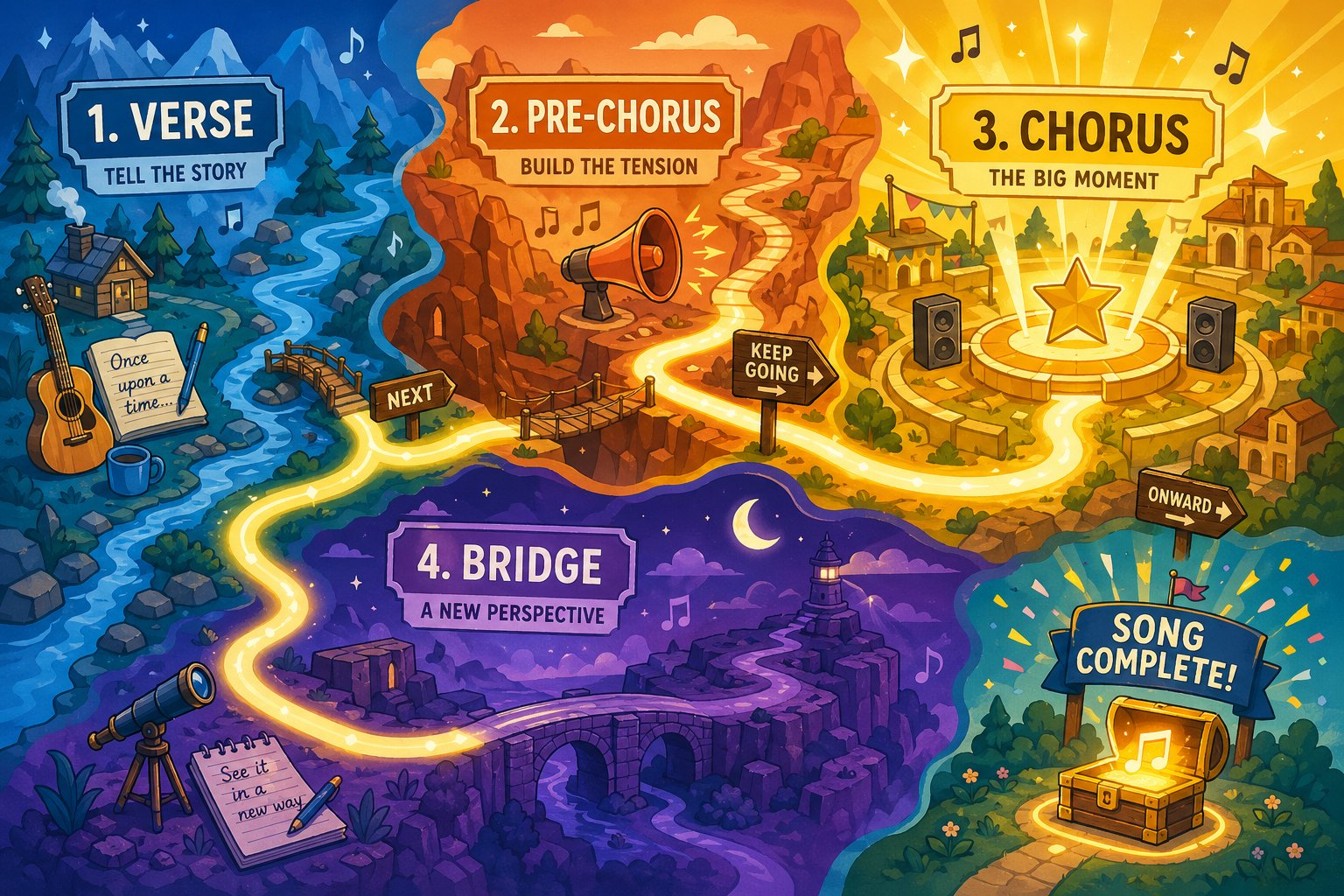
Each section of a song has a job, and the chord progression you assign to it should match that job's emotional weight. Here's a practical song map to use as a starting framework:
- Verse — Keep things restrained. Use progressions that sit in tonic and subdominant territory, building gentle tension without giving everything away. A Dm chord moving to Am to Bb guitar chord to C in the key of F works well — it circles without fully resolving, leaving room for the story to unfold.
- Pre-chorus — Ramp up the energy. Shorten the chord rhythm (two chords per bar instead of one) and lean on dominant-function chords to create anticipation. A simple IV–V or ii–V pushes the ear toward the chorus like a runway.
- Chorus — Resolve with force. This is where your strongest, most anthemic progression lives. The I–V–vi–IV or I–IV–V–IV formulas land here because they deliver the emotional payoff the verse has been building toward. As MusicRadar's arrangement guide demonstrates, even doubling the harmonic rhythm — changing chords twice as often as the verse — makes a chorus feel more impactful without introducing a single new chord.
- Bridge — Break the pattern. Introduce a borrowed chord, shift to a relative key, or start on a chord you haven't used yet. In a song built around the f major scale, dropping in the chords of Cm (borrowed from F minor) instantly signals to the listener that something different is happening. Bridges thrive on surprise.
Songwriter Andrea Stolpe at Berklee highlights a deceptively simple tool that many writers overlook: instead of hunting for brand-new chords, try changing the frequency with which you change chords between sections. A verse with one chord per bar and a chorus with two chords per bar creates instant contrast from rhythm alone.
How Melody and Chords Work Together
Chords set the emotional landscape; melody is the path a listener walks through it. The two are deeply connected. Notes that belong to the underlying chord — chord tones — anchor the melody and make it feel grounded. When you sing the note D over a D chord, it locks in. When you sing an E over that same D chord, you've introduced a passing tone — a moment of gentle tension that adds movement and color before resolving to a chord tone.
Rhythmic phrasing is the third ingredient. A melody that lands on chord tones right when the chord changes feels stable and hooky. One that anticipates the chord change — arriving a beat early — creates a sense of urgency. Picture a verse melody built over an e minor chord piano voicing: if the melody lingers on B (the fifth of Em) and then steps down to A just as the chord shifts to Am, that single-note movement mirrors the harmonic shift and makes both elements feel intentional.
Hooks live at the intersection of rhythm and chord tone placement. Short, rhythmically distinctive phrases — think of the vocal hook in any song you can't get out of your head — almost always land squarely on a chord tone at a rhythmically strong beat. As Stolpe notes, thinking rhythmically about melody is one of the most powerful and overlooked tools in a songwriter's kit.
From Chords to a Complete Musical Idea
So you've mapped your progressions to sections and you understand how melody rides on top of harmony. The practical challenge is generating those melodic ideas — especially when you're staring at a chord chart and nothing is coming. This is where a b7 guitar chord turnaround at the end of a verse can spark a vocal phrase you didn't expect, or where shifting a chorus progression up a whole step for the final repeat suddenly opens up a new melodic contour.
If you want to accelerate that process, tools like MakeBestMusic's Melody Maker can generate melodic ideas directly over your chord progressions, giving you singable phrases built from the same harmonic logic you've been learning throughout this article. Feed it your verse chords, audition a few melodic options, and use the results as a launchpad — not a finished product, but a creative spark you can shape, edit, and make your own.
The real workflow looks like this: build your progression (by hand or with a chord progression maker), assign variations to each song section for contrast, then layer melody on top using chord tones as anchors and rhythm as your hook-writing engine. That's the path from a blank page to a complete musical idea — and it's a path where theory and tools work together rather than replacing each other.
Fixing Common Chord Progression Problems
Even with solid theory, the right formulas, and a polished voice-leading approach, every songwriter hits walls. The progression sounds flat. The chords feel disconnected. You've been looping the same four bars for an hour and nothing clicks. These frustrations are universal — and almost always fixable once you diagnose the actual problem. Think of this section as a quick-reference troubleshooting guide you can return to whenever a progression isn't working.
Fixing Boring or Repetitive Progressions
The symptom: Your chords are technically correct, but the progression sounds like background music for an elevator. Nothing grabs the ear.
- Add extensions. Swap plain triads for seventh or ninth chords. A basic G – C – D in the key of G becomes Gmaj7 – Cmaj9 – D7, and suddenly the same three chords carry warmth and movement they didn't have before. Even a single d7 guitar chord voicing at the end of a turnaround can inject enough tension to wake up a stale loop.
- Change the rhythm, not the chords. Berklee's Andrea Stolpe points out that songwriters often blame the chords when the real issue is how they're played. Try syncopation, arpeggiate instead of strumming in blocks, or shift from quarter-note changes to half-bar changes. A bb piano chord voiced as a rolling broken chord sounds nothing like the same Bb played as a stiff block.
- Apply inversions for voice-leading variety. As we covered earlier, root-position chords played back to back sound choppy. Invert one or two chords so the bass line moves by step instead of leaping. That small change adds a sense of direction that plain triads lack.
- Borrow a chord from the parallel minor. Music Composition Lessons recommends this as one of the easiest fixes for bland progressions: if you're in C major, drop in an Ab or Fm from C minor. One unexpected chord recolors the entire sequence.
When Your Chords Sound Random or Disconnected
The symptom: Each chord sounds fine on its own, but the progression doesn't feel like it's going anywhere. It wanders.
- Check that every chord belongs to the same key. Write out the diatonic chords of your key and verify. If you're working in E minor and your e minor chord guitar shape flows into C and D but then you've dropped in an F# major, that chord isn't diatonic — it's pulling the ear into a different tonal center. Remove it or replace it with a chord that shares the same key signature, like the e flat major scale's diatonic set if you've shifted keys without realizing it.
- Follow harmonic function flow. Jumping from dominant to dominant (V to vii°, for example) creates tension without release — the ear keeps waiting for a resolution that never arrives. Map each chord to its function (tonic, subdominant, dominant) and make sure you're cycling through them rather than stacking the same type back to back.
- Audit the bass movement. Random-sounding progressions often have bass lines that leap unpredictably. Rearrange voicings so the bass moves by step or by common tone, and the sense of randomness usually disappears.
Getting Unstuck and Moving Forward
The symptom: You've been circling the same loop for an hour. Every chord you try sounds wrong, and the creative momentum is gone.
- Start from a different chord. If you always begin on the I, try opening on the vi or the ii. A gm chord guitar voicing as your starting point in Bb major gives you a completely different emotional launchpad than starting on Bb itself.
- Switch keys entirely. Transpose your loop up or down a whole step. The new fingerings or voicings force your hands into unfamiliar shapes, which often triggers ideas your muscle memory wouldn't have found. A capo on the second fret, a new tuning, or simply rewriting the progression in a less familiar key like Db can jar the brain out of its rut.
- Use a tool to generate unexpected starting points. This is where a chord progression maker earns its keep — not as a replacement for your creativity, but as a key maker that unlocks doors you didn't know were there. Generate five or six random progressions, listen for a single chord move that surprises you, and build from that fragment.
- Layer melody on top. Sometimes the chords aren't the problem — you just can't hear their potential without a melodic context. Tools like MakeBestMusic's Melody Maker can generate singable phrases over your existing chords, and hearing a melody ride the harmony often reveals that the progression was stronger than you thought.
Most chord progression problems boil down to one of these four categories: too predictable, too disconnected, wrong genre fit, or creative fatigue. The fixes are almost always small — a single extension, a borrowed chord, a rhythmic shift, or a fresh starting note. You rarely need to scrap everything and start over.
That's the thread running through this entire article. Understanding harmonic function, knowing the classic formulas, hearing how voice leading smooths transitions, and recognizing when an extension or substitution serves the song — this theoretical foundation makes every tool in your workflow dramatically more effective. A chord progression maker gives you raw material. A melody generator gives you singable ideas over that material. But it's your ear, trained by the principles covered here, that decides what stays, what gets cut, and what turns a sequence of chords into something that actually feels like music.
