


What Crooning Actually Means
When you hear someone described as "crooning," you might picture a singer swaying gently behind a microphone, voice low and warm, delivering a love song like it's meant for one person alone. That picture is pretty accurate. But the crooning definition goes deeper than just "singing softly." It describes a specific vocal approach built on intimacy, restraint, and emotional closeness — qualities that set it apart from every other way a human voice can carry a melody.
Crooning is the act of singing softly, smoothly, and sentimentally, typically in a low, intimate voice close to a microphone.
That single-sentence definition captures the core of what crooning means, but there's more to unpack beneath it.
The Complete Definition of Crooning
The word works in two forms, and understanding both is key to grasping the full croon meaning definition. As a verb, "to croon" means to sing or speak in a sweet, low voice full of emotion — a definition echoed by the Cambridge English Dictionary. It can be used with or without an object: you croon a lullaby, or you simply croon. As a noun, a "crooner" is a singer who performs in this gentle, smooth style, particularly one associated with the popular music of the mid-twentieth century. Think Bing Crosby, Frank Sinatra, Nat King Cole. The crooner definition carries a cultural weight that the verb alone does not — it evokes an entire era of music, fashion, and romance.
Crooning as a Vocal Technique vs. a Genre Label
Here's where many people get tripped up. The crooning dictionary definition points to a way of using the voice: soft volume, warm tone, sentimental phrasing, and a conversational delivery that feels personal rather than performative. That's the technique. But "crooning" also functions as a genre label, a shorthand for the romantic pop ballads and jazz-inflected standards that dominated American music from the 1930s through the 1960s. A singer can use the crooning technique in country, R&B, or indie pop without ever being called a crooner in the cultural sense. Recognizing this distinction — technique versus tradition — is what separates a surface-level definition of crooning from a truly complete one.
Yet neither the technique nor the tradition appeared out of thin air. Both trace back to a word with a surprisingly wild origin story, one that sounds nothing like the soft singing it describes today.
The Surprising Etymology of Croon
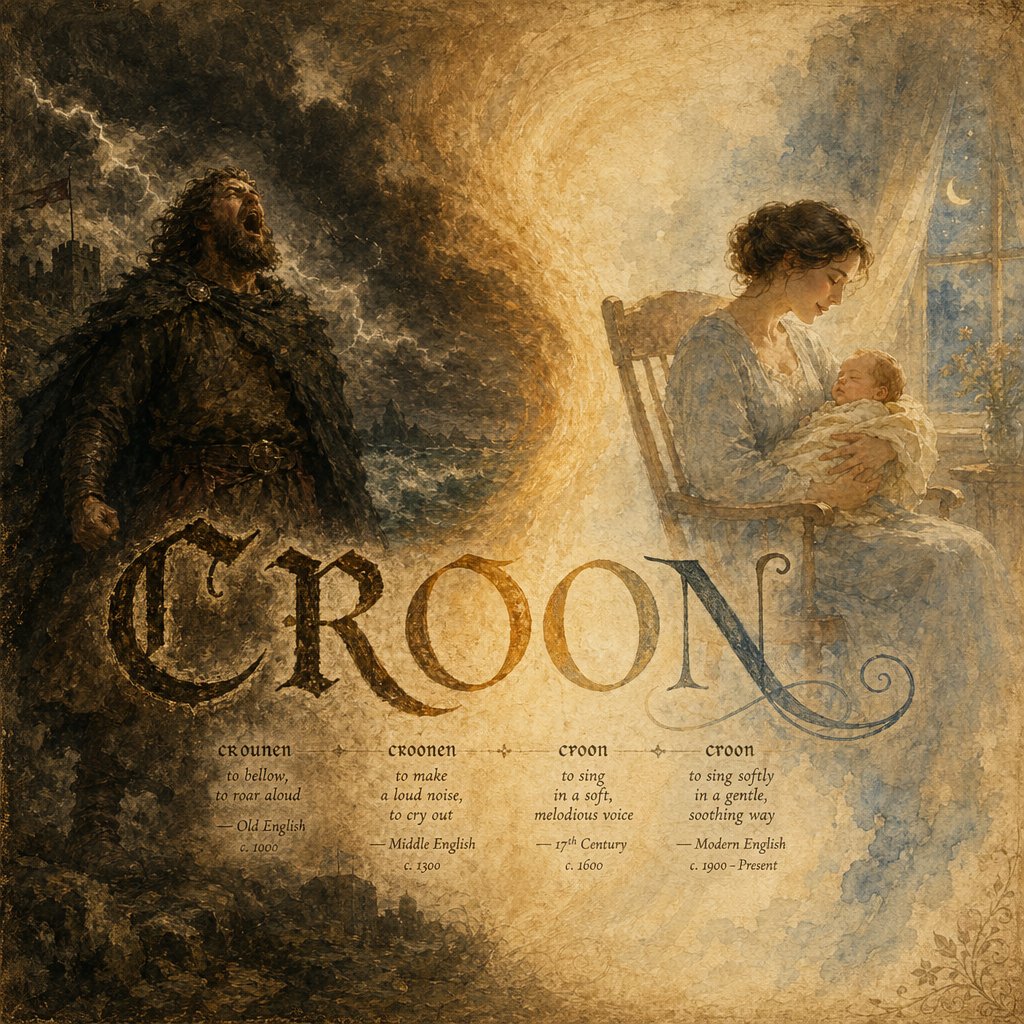
Imagine a word that once described the roar of a bull and now describes a lover whispering a ballad. That's the croon definition and etymology in a nutshell — a complete 180-degree reversal over roughly six centuries.
The word "croon" originally meant to bellow, roar, or groan loudly — the exact opposite of the soft, intimate singing it describes today.
The trail starts with Middle Dutch kronen, meaning "to lament" or "to mourn," and Old High German kronen, meaning "to babble." By the time the word surfaced in English around 1400, it carried a dual personality. In Scotland, it could refer to a low, deep, loud, steady sound. In broader northern English dialect, it described a low murmuring sound or quiet singing. And in some Middle English uses, "croon" still meant "to bellow like a bull" — a far cry from any croon definition Oxford or modern dictionaries would recognize today.
From Bellowing to Whispering — How the Meaning Inverted
So how did a word for groaning become a word for gentle singing? The shift likely followed an emotional thread: from lamenting loudly, to lamenting softly, to singing softly and sadly. By the 1800s, the murmuring crooning definition had won out, especially in Scottish dialect where mothers would croon lullabies to their children. Robert Burns helped popularize this softer sense in his poetry, anchoring "croon" firmly in the territory of tender, hushed vocalization. The crooned definition we use today — that past tense describing someone who sang sweetly and low — had fully replaced the old bellowing meaning.
When Croon Entered the Musical Vocabulary
The word's croon definition history took its final turn in the late 1920s and early 1930s. Radio broadcasting and electric recording technology flooded American living rooms with a new kind of singer — one whose soft voice arrived with startling intimacy through the speaker. Rudy Vallee, widely considered the first famous crooner, proved that a gentle voice could captivate millions without ever raising its volume. The crooner definition etymology came full circle: a word born in groans and bellows now belonged entirely to the quietest, most personal form of singing imaginable.
That transformation wasn't just linguistic, though. It depended on a specific piece of hardware that changed what the human voice could do in front of an audience.
The Technology That Made Crooning Possible
Before the mid-1920s, a singer who tried to croon in a packed theater would have been drowned out before finishing the first phrase. There were no amplifiers, no speakers, no way to make a soft voice carry past the front row. Performers like Al Jolson had to belt with full-body force just to reach the back of the house. Watch any footage of Jolson and you'll notice his posture at the end of a song — leaning forward, arms wide, channeling every ounce of physical power into sheer volume. That wasn't showmanship alone. It was survival.
Recording studios posed the same problem. Early acoustic recording relied on a large metal horn that funneled sound waves onto a vibrating glass sheet connected to a stylus, which etched grooves into a wax disk. Only a narrow frequency range — roughly 250 to 2,500 Hz — could be captured. Baritone voices were often too low to register clearly, and singers had to rush in front of the funnel, project at full volume, then step away so the instruments could be heard. Soft, intimate singing wasn't just impractical in this environment. It was physically impossible.
How the Electric Microphone Changed Singing Forever
Everything shifted around 1925, when crystal and condenser microphones became viable for music recording and broadcasting. For the first time, sound could be captured and electrically amplified before being committed to a recording medium. A singer no longer needed the lung power of an opera tenor to be heard — the microphone did the heavy lifting.
Rudy Vallee appears to have been the first major star to use a microphone for live singing in a ballroom, around 1930. Bing Crosby made his first recording that same year and quickly became America's most recognized crooner. In early footage of Crosby performing at the Cocoanut Grove in 1931, the microphone is clearly visible in front of him — and his relaxed, conversational delivery would have been completely inaudible without it. The microphone enabled a gentler, more intimate delivery in public that previously would have been suitable only in the privacy of someone's living room.
This is the piece most definitions miss. The crooning definition music historians use isn't just about a vocal style that happened to coincide with new technology. The technology literally created the style. Without the electric microphone, there is no crooning — period.
Why Microphone Technique Is Central to the Crooning Definition
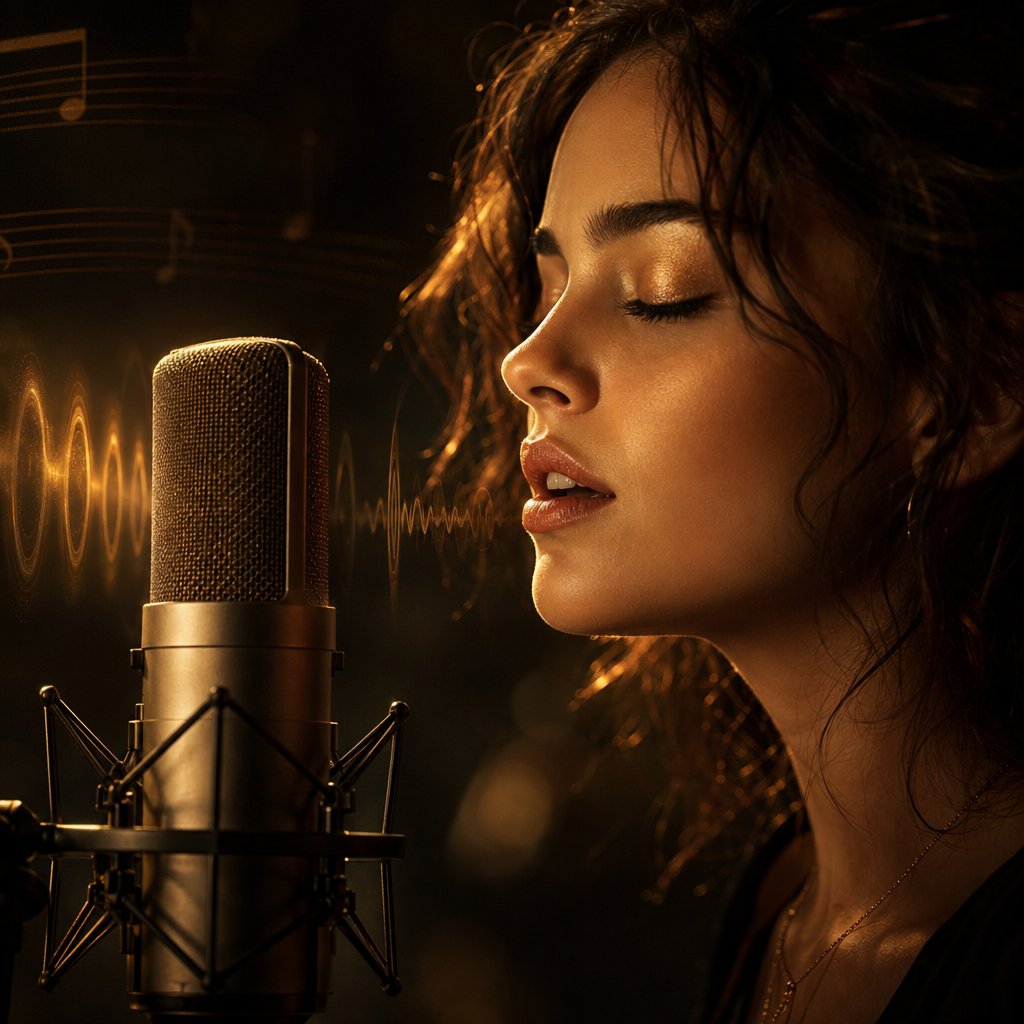
You'll notice something specific when you watch a crooner work: they stay close to the microphone. That closeness isn't just habit. It triggers a natural acoustic phenomenon called the proximity effect — the shorter the distance between a sound source and a directional microphone, the more low frequencies are registered. In plain terms, singing close to the mic makes a voice sound fuller, warmer, and richer in bass. For crooners, this effect became a defining tool. It added depth and velvet to voices that might otherwise sound thin, and it reinforced the intimate quality that separates a croon from ordinary singing.
Frank Sinatra took this relationship even further. He would lean in close during quiet passages to create a sense of whispered closeness, then pull back during louder phrases to avoid distortion. He tilted his head to dodge plosive sounds on words like "poured" and "pat." These weren't random gestures — they were deliberate microphone technique, and they became standard practice for every crooner who followed.
When you break down the crooner music definition into its technical components, a clear set of characteristics emerges — all of them made possible by the microphone:
- Soft dynamic range — singing at low-to-medium volume, relying on amplification rather than projection
- Proximity effect warmth — using close-mic positioning to enhance bass frequencies and create a rich, velvety tone
- Conversational phrasing — delivering lyrics with the natural rhythm of speech rather than rigid musical meter
- Breath control for sustained smooth lines — maintaining legato phrasing where the voice glides between notes without breaks
- Intimate emotional delivery — performing as though singing to a single listener, not a crowd
These five traits are not optional extras. They are the technical backbone of what crooning actually is. Strip away the microphone, and every one of them disappears — replaced by the forceful projection that dominated popular singing for decades before.
The technology gave crooners their sound. But sound alone doesn't explain why listeners fell so hard for the style. That had everything to do with what the voice itself was doing — and what it was deliberately holding back.
Defining Characteristics of the Crooning Style
Knowing the history and the technology is useful, but it doesn't help much when a song comes on and you're wondering: is that crooning? The crooning style definition becomes far more practical when you can identify it by ear — not through trivia, but through a short set of vocal traits that show up every single time.
The Signature Sound — Identifying Crooning by Ear
Picture a singer standing close to a microphone in a dimly lit room, delivering a love song as if the only audience is the person sitting across the table. That image captures the feel, but the crooning voice definition also has concrete, identifiable markers. Here are the six core traits to listen for:
- Soft, low-to-medium volume delivery — the singer never pushes toward full power. The voice stays relaxed, almost conversational in its dynamic range.
- Smooth legato phrasing with minimal vocal breaks — notes connect fluidly, one gliding into the next without sharp stops or sudden shifts. The melody feels like a single unbroken ribbon.
- Warm, rounded tone often enhanced by microphone proximity — that rich, bass-heavy quality created by singing close to the mic. It's the velvety texture people associate with late-night radio.
- Sentimental or romantic material — crooners gravitate toward love songs, ballads, and emotionally tender lyrics. The content matches the delivery.
- Conversational rhythm rather than strict metered singing — phrasing follows the natural cadence of speech. A crooner stretches a syllable here, pauses there, treating the lyric more like a spoken confession than a musical exercise.
- Controlled vibrato used sparingly for emotional effect — unlike operatic singing, where vibrato is constant and wide, a crooner keeps it subtle. It appears at the end of a held note or during a particularly emotional phrase, then recedes.
When you hear all six of these traits working together, you're hearing crooning. Not just soft singing, not just a ballad — but a specific, deliberate vocal approach with its own internal logic.
What Separates a Crooning Voice from Ordinary Singing
Here's the part that surprises most people: the crooner voice definition is built almost entirely on restraint. It's not about what the singer does. It's about what they hold back.
A belter reaches for the rafters. An opera singer fills a hall with unamplified power. A rock vocalist pushes into grit and distortion. A crooner does none of that. The mellow croon definition hinges on a voice that stays deliberately under its own capacity — never straining, never shouting, never trying to impress with sheer force. Jack Smith, one of the earliest crooners, understood this instinctively. As Concertzender noted, "it sounded as if he was singing for one person, and everyone thought that they were that one person." That's the illusion at the heart of the style.
Imagine someone singing to you across a small table in a quiet room. They're not performing — they're confiding. The volume is low enough that you lean in slightly. The phrasing is unhurried, almost lazy in its ease. There's warmth in the tone but no urgency, no demand. That mellow, unhurried quality is what separates a croon from a belt or a wail. A crooner sounds intimate even when performing for thousands, because the voice never breaks the illusion of closeness.
These traits combine into something almost hypnotic. The soft dynamics lower your guard. The legato phrasing keeps you suspended in the melody. The conversational rhythm makes the lyrics feel personal, like they were written for you specifically. And the restrained vibrato adds just enough emotional tremor to remind you that a real human being is behind the microphone, feeling every word.
That's the crooner style definition in practice — not a checklist of things a singer adds, but a discipline of things they choose to leave out. The power of crooning lives in the space between what the voice can do and what it actually does.
Of course, a definition only goes so far on paper. The real proof is in the voices that brought it to life — and each of the great crooners shaped the style in a slightly different way.
Famous Crooners Who Shaped the Definition
A definition written on paper only tells you so much. The real answer to "what is the definition of a crooner?" lives in the voices that gave the word its weight. Each of the great crooners emphasized a different facet of the style, and together they built the template that still defines the term.
Bing Crosby and the Birth of the Modern Crooner
If you had to point to one person who turned crooning from a curiosity into a cultural force, it would be Bing Crosby. Born in Tacoma, Washington in 1903, Crosby launched his career in the late 1920s at a time when singers were expected to belt with vaudeville-level power. He went the other direction entirely. As Jim Carroll's Blog describes it, Crosby "regarded the microphone as his instrument. He leaned into it, caressed his notes and purred his lyrics." He could be laid back and conversational, pleading and emotional. He could be intimate.
The results spoke for themselves: ten of the top 50 records of 1931 featured his relaxed bass-baritone. Fellow singer Dinah Shore once said, "Bing Crosby sings like all people think they sing in the shower." That effortless quality was the whole point. Crosby proved that a singer didn't need an operatic instrument to captivate millions — he just needed a microphone and the discipline to stay soft. His voice became the old crooner definition in its purest form: warm, easygoing, and impossibly personal.
Frank Sinatra, Dean Martin, and the Expanding Definition
Crosby built the foundation. Frank Sinatra turned it into architecture. Where Crosby was casual and breezy, Sinatra brought emotional precision — stretching phrases, bending rhythms, and treating every lyric like a short story with its own arc. His phrasing elevated the definition crooner from "a guy who sings softly" to "an artist who communicates feeling through vocal restraint." He didn't just croon. He acted through song.
Dean Martin took a different path. His delivery was looser, almost lazy in its charm — a glass of bourbon translated into vocal form. Where Sinatra was meticulous, Martin made it sound like he'd wandered up to the microphone by accident and happened to be brilliant. Perry Como pushed the style even further toward stillness. His ultra-smooth delivery was so relaxed that critics joked he could fall asleep mid-song and nobody would notice. Together, these American crooner voices showed that the definition of a crooner wasn't a single sound but a spectrum — united by softness, warmth, and intimacy, but varied in personality and emotional texture.
Female Crooners and the Gendered History of the Term
Here's a question worth asking: can a woman be a crooner? The vocal technique itself — singing softly, close to the microphone, with sentimental warmth — has no gender requirement. Artists like Peggy Lee, Julie London, and Rosemary Clooney used the exact same intimate microphone approach that defined their male counterparts. Lee's rendition of "Fever" is as close to a textbook croon as anything Sinatra ever recorded.
Yet the term "crooner" was historically applied almost exclusively to men who sang sentimental songs on radio and recordings beginning in the late 1920s. The female crooner definition exists in practice but barely in language. Women who used the same technique were more often labeled "torch singers" or simply "vocalists." The distinction says more about mid-century gender norms than about any real difference in vocal approach. The technique is the technique — regardless of who's behind the microphone.
For a clearer crooner definition and examples of how each artist shaped the style, this comparison helps:
| Artist | Era | Signature Vocal Trait | Contribution to the Crooning Definition |
|---|---|---|---|
| Bing Crosby | Late 1920s - 1950s | Relaxed bass-baritone with effortless warmth | Established the male crooner definition as the archetype; proved soft singing could dominate popular music |
| Frank Sinatra | 1940s - 1990s | Emotionally precise phrasing with dramatic dynamics | Elevated crooning into a sophisticated art form; added narrative depth to the vocal style |
| Dean Martin | 1950s - 1970s | Casual, effortlessly charming delivery | Showed that crooning could be playful and loose, not just romantic and polished |
| Peggy Lee | 1940s - 1970s | Cool, understated intimacy with rhythmic subtlety | Demonstrated that the crooning technique transcends gender, even if the label did not |
Each of these voices answered the question differently, yet all of them shared the same core traits: low volume, microphone closeness, emotional warmth, and the illusion of singing to one person alone. That consistency across such different personalities is what makes the crooning definition so durable.
Still, knowing what crooning sounds like raises another useful question — what doesn't it sound like? The style becomes even sharper when you hold it up against the other ways a voice can work.
How Crooning Differs from Other Vocal Styles
Crooning occupies a very specific corner of the vocal landscape, and the easiest way to understand that corner is to see what surrounds it. When you place the croon singing definition next to belting, opera, jazz scatting, and torch singing, the boundaries become impossible to miss.
Crooning vs. Belting, Opera, and Jazz Scatting
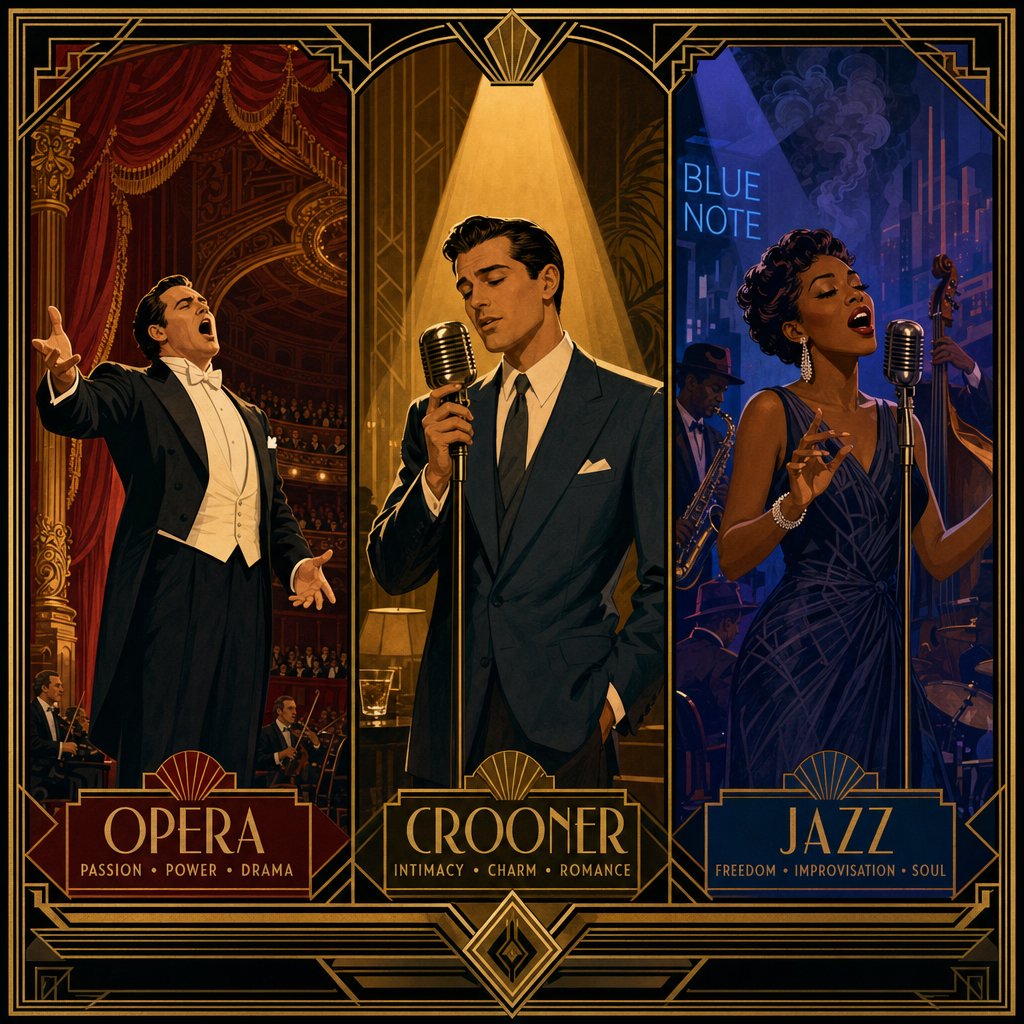
Each of these vocal styles uses the same instrument — the human voice — but the technique, intent, and relationship to amplification couldn't be more different. Before the 1930s, singers in American concert halls fell into two camps: classically trained "legit singers" who projected with operatic resonance, and "belters" who used their voice in the manner of powerful speaking or shouting, like an announcement in a marketplace. Crooners carved out a third path entirely — one that leaned on the microphone instead of lung power.
This table breaks down the key technical differences:
| Style | Volume Level | Tone Quality | Phrasing Style | Emotional Register | Microphone Dependence |
|---|---|---|---|---|---|
| Crooning | Low to medium | Warm, smooth, bass-rich | Conversational, relaxed | Sentimental, romantic, intimate | High — the style cannot exist without it |
| Belting | High | Bright, powerful, chest-dominant | Dramatic, sustained | Urgent, triumphant, defiant | Low — belters can fill a room unaided |
| Classical / Opera | Projected, full | Resonant, vibrato-heavy, dark or bright depending on tradition | Metered, ornamental | Grand, tragic, heroic | None — designed for unamplified halls |
| Jazz Scatting | Varies | Bright, agile, percussive | Improvised, rhythmically complex | Playful, virtuosic, spontaneous | Moderate — amplification helps but isn't essential |
| Torch Singing | Low to medium | Smoky, raw, emotionally exposed | Slow, deliberate | Heartbroken, longing, vulnerable | Moderate to high |
You'll notice that torch singing sits closest to crooning in volume and microphone use, which is why the two are often confused. The difference is emotional temperature. A crooner wraps you in warmth. A torch singer lets you feel the burn. The definition of crooning in singing centers on comfort and closeness, while torch singing leans into pain and exposure.
The contrast with opera is especially revealing. Classical vocal technique demands a vertically opened mouth, a low larynx position, and enough resonance to carry over an entire orchestra without amplification. A crooner singer definition requires the opposite: a relaxed jaw, a natural speaking-voice position, and total reliance on the microphone to do the carrying. You could train for years in bel canto and still not be able to croon convincingly, because the skills don't transfer — they actually conflict.
Is Crooning the Same as Singing
Short answer: all crooning is singing, but not all singing is crooning. The broadest croon verb definition — to sing softly and sentimentally — already tells you it's a subset, not a synonym. Singing is the whole ocean. Crooning is one very specific current within it.
A singer becomes a crooner when they make a deliberate set of choices: move close to the microphone, lower the volume, soften the tone, and deliver lyrics with conversational intimacy rather than theatrical projection. The definition of croon always points back to those choices. A vocalist belting a power ballad is singing. A vocalist scatting over a jazz trio is singing. But neither is crooning, because neither adopts the restrained, microphone-dependent, emotionally intimate approach that defines the style.
Think of it this way — every definition crooner singer descriptions share comes down to a single idea: closeness. Close to the mic. Close to the listener. Close to the emotional core of the lyric. That's what separates a croon from every other vocal style on the spectrum, and it's why the word exists at all. "Singing" tells you someone is using their voice musically. "Crooning" tells you exactly how.
That precision in vocal delivery also gives the word a life well beyond the recording studio. Writers, poets, and everyday speakers have borrowed "croon" for centuries to describe any voice that carries that same quality of tender, hushed warmth — whether or not a melody is involved.
Crooning Beyond Music and in Everyday Language
Open any novel with a tender scene and there's a good chance you'll find the word "crooned" doing quiet work on the page. The crooning literature definition extends well past microphones and music charts. In fiction, poetry, and daily conversation, "croon" describes any soft, soothing vocalization — a murmur meant to comfort, persuade, or lull. It's one of those rare words that carries its own sound inside it.
Crooning in Literature and Everyday Speech
Writers have leaned on "croon" for generations because no synonym quite matches its texture. "Whisper" is too secretive. "Murmur" is too neutral. "Croon" implies warmth, melody, and emotional intent all at once. That's why it shows up across so many literary contexts — from lullabies to seduction scenes to descriptions of nature itself.
Here are a few croon definition example sentences that show the word's range beyond music:
- "She crooned softly to the baby, rocking the cradle with one foot while the house settled into silence." (parenting / domestic life)
- "He leaned close and crooned promises she knew he couldn't keep." (romantic persuasion / fiction)
- "The wind crooned through the pines, low and steady, as if the forest were singing itself to sleep." (metaphorical / nature writing)
- "Daisy's voice crooned on, drawing them all closer to the lamplight." (literary fiction, echoing Fitzgerald's style)
That last croon definition sentence nods to F. Scott Fitzgerald's The Great Gatsby, where voice and intimacy are central to the novel's emotional architecture. Fitzgerald describes Daisy Buchanan's voice as something people lean toward — "full of money," yes, but also full of a low, compelling warmth that pulls listeners in. The word "croon" fits naturally into Gatsby's world of seduction and illusion, and Fitzgerald's contemporaries used it freely. Langston Hughes, writing in the same era, placed the word at the heart of "The Weary Blues": "Rocking back and forth to a mellow croon" and later, "And far into the night he crooned that tune." In Hughes' hands, the definition croon carries is both musical and deeply human — a sound born from weariness, solitude, and the need to keep going.
How the Word Is Used in Modern Conversation
You'll hear "croon" in casual speech more often than you might expect. Someone describes a friend "crooning along to the radio" on a road trip. A parent says they "crooned the kids to sleep." A music reviewer writes that a singer "croons a ballad" without meaning to invoke Bing Crosby or any specific tradition — they're simply reaching for the most accurate verb to describe soft, emotionally warm singing.
That's the staying power of this word. Whether it appears in a croon definition in a sentence from a twentieth-century novel or in a casual text message, the core meaning holds: gentle, melodic, intimate vocalization directed at someone or something with care. The context shifts — a literary drawing room, a nursery, a car with the windows down — but the emotional signature stays the same.
And that consistency is exactly what keeps the word alive. Crooning didn't freeze in the 1950s alongside vinyl records and supper clubs. The technique, the sound, and the impulse behind it keep resurfacing — in new genres, new voices, and new tools that would have astonished the original crooners.

Modern Crooning and Exploring Vocal Styles Today
The supper clubs closed. The vinyl era faded. But the vocal technique that Bing Crosby pioneered and Sinatra perfected never actually disappeared — it just changed addresses. The definition of crooner in music has quietly expanded over the past few decades, stretching far beyond the mid-century pop standard and into genres that the original crooners never would have predicted.
Neo-Crooners and the Modern Revival
When Michael Buble released his self-titled major-label debut in 2003, critics weren't sure what to make of a young Canadian singing Sinatra-era standards to an audience raised on grunge and hip-hop. Turns out, the audience was ready. Buble's warm baritone and easy charm proved that the crooner sound still had commercial power — he just needed to deliver it with modern production and a personality that felt current rather than nostalgic. As music writer Petter Wallace observed, Buble "is one of the few singers today that can interpret some of Sinatra's best songs impeccably," and his ability to move between pop originals and classic standards keeps the tradition breathing.
Harry Connick Jr. took a jazzier route, grounding his crooning in New Orleans piano traditions and big-band arrangements that felt lived-in rather than museum-piece. Together, these two artists anchored what many call the neo-crooner movement — a new crooner definition that honors the original vocal approach while refusing to be trapped by it.
The revival didn't stop with artists who openly claimed the crooner label. Elements of the crooning technique — that soft, microphone-close intimacy, the conversational phrasing, the emotional warmth — started showing up in places you wouldn't expect. R&B artists like D'Angelo and Frank Ocean adopted the hushed, confessional delivery that sits at the heart of the definition of crooner singer traditions. Indie pop acts like Iron & Wine built entire catalogs around whispered, intimate vocals. And country music has its own deep crooner lineage: think of the smooth, unhurried delivery of Jim Reeves or Glen Campbell, voices that fit the country crooner definition as comfortably as any Rat Pack recording. Even Tor Miller, a young American singer-songwriter, blends traditional crooning with 1970s influences from Billy Joel and David Bowie, proving the style croons its way into unexpected musical territory.
What connects all of these artists across genres and decades? The same core principle that has defined crooning since the 1920s: restraint, closeness, and the illusion of singing to one person. The definition of a crooner has expanded to include anyone who adopts that intimate, smooth vocal delivery — regardless of whether they're backed by a jazz orchestra, an acoustic guitar, or an electronic beat.
Exploring Crooning Styles with AI Vocal Tools
Here's something worth considering: the microphone made crooning possible in the 1920s. A century later, technology is reshaping vocal styles again — this time through artificial intelligence. Just as the electric microphone gave singers permission to be soft, AI vocal tools are giving everyday listeners permission to experiment with styles they've only admired from a distance.
Modern AI singing generators can now replicate vocal characteristics that once required years of training and studio experience. Want to hear what a lyric sounds like delivered in a smooth, crooning-style voice? Want to experiment with the warm, intimate tone that defines the style? Tools like MakeBestMusic's AI Singing Generator let you explore AI-generated vocals, create cover-style renditions, and test different vocal approaches — including that signature crooner warmth — without needing a recording studio or a voice coach. It's a natural extension of learning what crooning means: you read the definition, you listen to the classics, and then you hear the style applied to something new.
If you've made it this far into the crooning definition and want to take your understanding beyond the page, here are a few practical ways to put it into action:
- Listen to classic crooner recordings with fresh ears — pay attention to the six vocal traits from earlier in this article and try to identify each one in real time.
- Try singing softly close to a microphone yourself, even a phone mic — notice how the proximity changes the texture and warmth of your voice compared to singing at arm's length.
- Use an AI vocal tool to experiment with crooning-style delivery on a song you love — hearing the technique applied to familiar material makes the definition click in a way that reading alone can't.
- Compare the same song performed in a belting style versus a crooning style — the contrast will sharpen your ear for what makes the crooner approach unique.
Crooning started as a roar, became a whisper, and evolved into one of the most enduring vocal styles in popular music. Its definition has stretched across centuries of language, decades of technology, and countless genres — yet the core has never changed. A voice, close and warm, singing as if no one else is in the room. That's what crooning meant when Bing Crosby leaned into his first microphone, and it's what it still means when a new voice picks up the tradition today.
