

Does AI Generated Music Have Copyright Protection
The Direct Answer to AI Music Copyright
So, is AI music copyrighted? The short answer: not automatically. AI-generated music does not receive copyright protection by default. The one thing it depends on is whether a human being contributed meaningful creative authorship to the work.
Think of it this way. If you type a prompt into an AI tool and it spits out a fully formed track with no further input from you, that output likely has no copyright protection at all. But if you use artificial intelligence in music as one tool among many, making creative selections, arranging elements, and shaping the final piece yourself, the result may qualify for protection just like any other composition.
Copyright law protects original works of human authorship. A machine, no matter how sophisticated, cannot be an author under current U.S. law.
This principle was reinforced in March 2025 when the U.S. Court of Appeals for the D.C. Circuit affirmed in Thaler v. Perlmutter that human authorship is a bedrock requirement for copyright registration. The court made clear that the Copyright Act, taken as a whole, requires authors to be humans, not machines.
The real question, then, isn't a simple yes or no. It's a spectrum. On one end sits fully AI-generated music with zero human creative input. On the other end, you'll find music where AI handled only technical tasks like mixing or mastering while a human wrote every note. Most creators today fall somewhere in between, and that middle ground is where copyright ai music news gets complicated.
Why This Question Matters Now
This isn't a hypothetical legal debate anymore. A 2023 survey by PRS for Music found that nearly 30% of its members were already using AI in their creative process, with 55% planning to adopt AI tools in the future. The most common applications? Music production, mixing, and mastering.
When roughly a third of professional songwriters and composers are integrating AI into their workflow, the ownership question stops being abstract. It affects royalty collection, licensing deals, and whether your next release can even be registered with a performing rights organization.
The line between AI-assisted and AI-generated music shapes everything from who can claim authorship to whether a track qualifies for copyright protection at all. PRS itself now distinguishes between these two categories in its registration policy: AI-assisted works created through a human-led process can be registered, while AI-generated works with no sufficient human contribution cannot.
Understanding where your creative process falls on this spectrum is no longer optional. It determines your legal rights, your revenue streams, and your standing as a creator. The sections ahead break down exactly how courts, copyright offices, and platforms draw that line, and what you can do to land on the right side of it.
The Spectrum of AI Involvement in Music Creation
Not all AI-generated music is created equal in the eyes of the law. A producer who uses AI to master a track they composed from scratch occupies a completely different legal position than someone who typed "upbeat pop song" into Suno and downloaded the result. The copyright status of any given piece of music depends entirely on where it falls along the spectrum of human-to-machine creative contribution.
Imagine a sliding scale. At one extreme, a machine handles everything. At the other, a human does all the creative work and AI merely executes technical tasks. Your position on that scale determines whether your music can be copyrighted, who owns it, and what rights you can enforce.
Here's how the spectrum breaks down in practice:
- Fully AI-generated (no copyright): A user enters a text prompt and the AI produces a complete track with no further human creative input. Under current U.S. law, this output falls into the public domain. No one owns it, and no one can register it for copyright protection.
- AI-assisted composition with human creative selection: A human uses AI to generate raw material, then selects, arranges, edits, and combines elements into a final work. The human's creative choices in shaping the output may qualify for copyright protection, depending on how substantial those choices are.
- AI as a production or mixing/mastering tool: A human composes the melody, writes the lyrics, and arranges the song. AI handles technical tasks like EQ balancing, compression, or stem separation. The human retains full copyright because the expressive elements remain entirely human-authored.
- AI voice cloning and vocal synthesis: This raises separate legal issues beyond copyright, including right of publicity, personality rights, and potential violations of state-level deepfake laws. The underlying composition may still be copyrightable, but the use of a cloned voice introduces additional legal exposure.
The critical takeaway? Can AI music be copyrighted? Only when a human has contributed enough creative decision-making to qualify as the author of the expressive elements. The AI itself cannot hold that role.
Fully AI-Generated Music and Its Legal Status
When a platform like Suno or Udio generates a complete song from a text prompt alone, the legal position is stark. The U.S. Copyright Office has stated clearly that outputs of generative AI can only be protected where a human author has determined sufficient expressive elements. A prompt, no matter how detailed or clever, does not constitute authorship.
This was confirmed in Thaler v. Perlmutter, where the court held that copyright protection is reserved for works of human creation. Writing "a melancholic jazz ballad with brushed drums and a walking bass line in the style of late-night club music" might be creative language, but it doesn't make you the author of whatever the machine produces in response.
The practical consequence is significant. As Suno's own terms of service acknowledge: "Due to the nature of machine learning, Suno makes no representation or warranty to you that any copyright will vest in any Output." The platform itself cannot guarantee you'll own what it generates. Anyone can copy, redistribute, or claim that output, and you have no legal recourse to stop them.
AI-Assisted Composition and Human Creative Input
The picture changes when humans actively shape the creative output. Using AI to write song lyrics or generate melodic fragments becomes legally defensible when you treat those outputs as raw material rather than a finished product.
Consider a producer who generates twenty different AI loops, selects three, chops them into smaller phrases, rearranges those phrases into a new structure, layers original instrumentation on top, and writes a vocal melody. That producer has made dozens of expressive creative decisions. The selection, arrangement, and transformation of AI-generated elements can constitute the kind of meaningful human authorship that copyright law recognizes.
A user study from Politecnico di Milano found that music producers working with text-to-music models frequently adapted their creative process around AI outputs, making deliberate choices about which generated material to keep, modify, or discard. One participant noted that AI "created a good foundation for work to continue but gave space for me to build something of my own." That kind of iterative, human-led workflow is exactly what strengthens a copyright claim.
The line sits at creative decision-making. If you're selecting, arranging, and transforming, you're building a case for ai generated music ownership rights. If you're simply clicking "generate" until something sounds good and then downloading it unchanged, you're not.
Composition Copyright vs. Sound Recording Copyright
Here's a distinction many creators overlook: copyright law treats musical compositions and sound recordings as two separate works, each with its own protections and ownership structure.
A musical composition covers the underlying creative work: the melody, harmony, rhythm, and lyrics. Think of it as the song itself, independent of any particular performance or recording. A sound recording covers the specific fixed audio: the particular performance, production choices, and sonic characteristics captured in a recording.
Why does this matter for AI music? Because the copyright status of each layer can differ:
- If you write original lyrics and melody but use AI to generate the instrumental backing track, your composition (lyrics and melody) may be copyrightable while the AI-generated portions of the sound recording may not be.
- If you perform and record a human-composed song but use AI only for mastering, the sound recording retains full copyright protection because the expressive performance is entirely human.
- If AI generates both the composition and the recording, neither layer receives protection.
The U.S. Copyright Office defines a musical composition as a song's underlying melody, rhythm, and harmony, along with any accompanying lyrics. The rights attached to that composition, including the right to make copies, prepare derivative works, distribute, and publicly perform, belong to the human author. AI-generated material that lacks human authorship simply cannot carry those rights.
This dual-layer structure creates both risk and opportunity. A creator who writes their own lyrics but uses AI for everything else can still protect the lyrical component. Suno's own help documentation confirms this: lyrics written by a human can be copyrighted even when the accompanying music cannot. Understanding which elements of your work are human-authored, and documenting that clearly, becomes essential for protecting whatever rights you do hold.
The spectrum isn't just theoretical. It directly shapes how the U.S. Copyright Office evaluates registration applications, what courts consider protectable, and how platforms decide whether your music qualifies for monetization. Those specific requirements and legal precedents are where the rubber meets the road.
What the U.S. Copyright Office Actually Requires
The spectrum of AI involvement only matters if you understand how the gatekeepers apply it. In the United States, the Copyright Office is the federal agency that evaluates every registration application, and its policies determine whether your AI-assisted music receives legal protection or gets rejected outright.
The Office's position is grounded in a single, non-negotiable principle: copyright exists to protect human creativity. Everything else flows from that foundation.
The Human Authorship Requirement Explained
Can you copyright AI music? The Copyright Office says yes, but only when the work embodies meaningful human authorship. This isn't a vague standard. The Office published formal registration guidance in March 2023 laying out exactly how it evaluates works containing AI-generated material.
The core test asks whether the work is "basically one of human authorship, with the computer merely being an assisting instrument, or whether the traditional elements of authorship in the work were actually conceived and executed not by man but by a machine." In plain terms: did a human determine the expressive elements, or did the AI?
The outputs of generative AI can be protected by copyright only where a human author has determined sufficient expressive elements.
Register of Copyrights Shira Perlmutter reinforced this position when the Office released Part 2 of its AI Report in January 2025, stating: "Where that creativity is expressed through the use of AI systems, it continues to enjoy protection. Extending protection to material whose expressive elements are determined by a machine, however, would undermine rather than further the constitutional goals of copyright."
The Office also confirmed that using AI to assist in the creative process does not automatically disqualify a work. Including AI-generated material within a larger human-generated work doesn't bar copyrightability either. The question is always about who shaped the final expressive output.
Registration Requirements and AI Disclosure
If you're submitting a work that contains AI-generated content, the us copyright office ai music policy requires specific disclosures. You can't simply upload a track and hope no one asks questions. Here's what the Office expects:
- Use the Standard Application: Works containing AI-generated material must be filed using the Standard Application form, which includes fields for disclaiming unprotectable content.
- Identify human authorship: In the "Author Created" field, describe what the human author actually contributed. For a musical work, this might be "melody, lyrics, and arrangement of musical elements created by the author."
- Disclaim AI-generated content: Any AI-generated material that is more than de minimis must be explicitly excluded in the "Limitation of the Claim" section under "Material Excluded." You'd enter something like "instrumental backing track generated by artificial intelligence."
- Do not list AI as an author: The AI tool or the company behind it should never appear as an author or co-author on the application.
What happens if you've already registered a work without disclosing AI involvement? The Office requires you to correct the record through a supplementary registration. Failing to do so carries real consequences. The Office can cancel registrations where essential information was omitted, and courts can disregard a registration in infringement litigation if the applicant knowingly provided inaccurate information.
What Counts as Meaningful Creative Input
This is where most creators get stuck. You know human authorship is required, but what actually qualifies? The Copyright Office evaluates ai music copyright claims on a case-by-case basis, but its guidance and decisions reveal clear patterns.
Activities that do support a copyright claim:
- Selecting and arranging AI-generated elements into a new, cohesive work
- Modifying AI outputs to such a degree that the modifications themselves constitute original expression
- Writing original lyrics, melodies, or harmonies that are combined with AI-generated material
- Making creative decisions about structure, instrumentation choices, and arrangement that shape the final composition
Activities that do not support a copyright claim:
- Providing a text prompt, no matter how detailed or creative the prompt itself may be
- Iterating through multiple prompts until the AI produces a satisfactory result
- Selecting one output from several AI-generated options without further modification
The Office draws a sharp distinction here. A prompt functions "more like instructions to a commissioned artist," identifying what the user wants depicted, but the machine determines how those instructions get implemented. Even iterative feedback through additional prompts doesn't change this analysis, because the AI technology is still what determines how to execute those instructions in the final output.
For musicians, this means the creative bar sits at active shaping of expressive content. Composing a melody over an AI-generated chord progression? That's human authorship. Telling an AI to "make a sad piano ballad" and downloading the result? It's not. The distinction isn't about how much effort you put into prompting. It's about whether you determined the musical expression that listeners actually hear.
These registration standards don't exist in a vacuum. They've been tested and reinforced through a series of legal decisions that give the Office's policies real teeth in courtrooms.
Legal Precedents Shaping AI Music Rights
Registration standards only carry weight when courts enforce them. Over the past few years, a series of legal decisions and active lawsuits have built the framework that determines whether AI-generated music receives copyright protection. These cases don't just interpret the law. They're actively writing the rules that every musician, producer, and AI platform will live by going forward.
If you're following ai music copyright news today, these are the cases that matter most.
Thaler v. Perlmutter and the Authorship Question
The foundational case is Thaler v. Perlmutter. Computer scientist Stephen Thaler created a generative AI system called the "Creativity Machine," which autonomously produced a visual artwork titled "A Recent Entrance to Paradise." Thaler filed a copyright registration listing the AI as the sole author and himself as the owner. The Copyright Office refused the application because it "lacked the human authorship necessary to support a copyright claim."
Thaler challenged the refusal in federal court. On August 3, 2023, District Judge Beryl A. Howell ruled that the Copyright Office acted properly, stating that copyright law "has never stretched so far as to protect works generated by new forms of technology operating absent any guiding human hand. Human authorship is a bedrock requirement of copyright."
The D.C. Circuit Court of Appeals affirmed that decision in March 2025. Circuit Judge Patricia A. Millett wrote that "the Creativity Machine cannot be the recognized author of a copyrighted work because the Copyright Act of 1976 requires all eligible work to be authored in the first instance by a human being." Critically, Millett also addressed a concern many musicians share: this ruling does not prevent copyright protection for works made with AI. "The rule requires only that the author of that work be a human being, the person who created, operated, or used artificial intelligence, and not the machine itself."
Thaler petitioned the Supreme Court, asking whether "works outputted by an AI system without a direct, traditional authorial contribution by a natural person could be copyrighted." On March 2, 2026, the Court denied the appeal without comment, ending the case definitively.
The takeaway for musicians is clear. AI cannot be an author. But you can still be the author of a work you created using AI, as long as you contributed the expressive elements.
Zarya of the Dawn and Partial Protection
If Thaler drew the outer boundary, the Zarya of the Dawn decision mapped the territory inside it. This case shows what happens when a human does contribute creative authorship alongside AI-generated material.
Kris Kashtanova created a graphic novel called "Zarya of the Dawn" using MidJourney to generate images, combined with a human-written storyline. The Copyright Office initially granted full protection. After learning about the AI involvement, it initiated a secondary review and issued a split decision: copyright protection was granted for the text and the arrangement of images, but denied for the individual AI-generated images themselves.
Why? The Office found too much "distance" between the user's input and MidJourney's output for the images to qualify as Kashtanova's creative expression. It likened using MidJourney to hiring a visual artist whose work a patron could not claim as their own. However, the selection and arrangement of those images into a cohesive narrative, combined with the original text, did constitute protectable human authorship.
For music creators, this decision establishes a powerful principle. You can receive copyright protection for the human-authored elements of a work that also contains AI-generated material. Write your own lyrics over an AI-generated beat, and the lyrics are protectable. Arrange AI-generated loops into an original structure with human-composed melodies layered on top, and that arrangement and those melodies may qualify. The AI-generated components themselves remain unprotected, but the human creative layer built around them can still be yours.
MidJourney's General Counsel Max Sills called the decision "a great victory," noting it demonstrated a willingness to reward the efforts of those who utilize AI in their creative process. The same logic applies directly to AI music platforms.
Pending Litigation That Could Change Everything
The cases above settled the authorship question. The next wave of litigation targets something different: whether AI music platforms violated copyright law by training their models on protected recordings in the first place.
In June 2024, the RIAA filed landmark lawsuits against Suno and Udio on behalf of Sony Music Entertainment, UMG Recordings, and Warner Records. The complaints allege that both platforms copied "decades worth of the world's most popular sound recordings" without permission to train their generative models. The cases were filed in the U.S. District Court for the District of Massachusetts (Suno) and the Southern District of New York (Udio).
These ai music legal cases 2024 aren't about whether users can copyright AI outputs. They're about whether the platforms themselves committed mass infringement by ingesting copyrighted music to build their systems. As RIAA Chief Legal Officer Ken Doroshow stated, "These are straightforward cases of copyright infringement involving unlicensed copying of sound recordings on a massive scale."
Recording Academy CEO Harvey Mason jr. framed the industry's position clearly: "To maintain the trust of artists and fans alike, AI companies must properly gain permission from and compensate creators when using their works." This reflects a broader consensus across music organizations, from the National Music Publishers' Association to the American Federation of Musicians, that training on copyrighted material without consent crosses a legal line.
Here's a chronological view of how these developments have unfolded:
- November 2018: Thaler files copyright application listing AI as sole author of "A Recent Entrance to Paradise."
- August 2019: U.S. Copyright Office refuses the application for lacking human authorship.
- February 2023: Copyright Office issues split decision on "Zarya of the Dawn," granting partial protection for human-authored elements.
- March 2023: Copyright Office publishes formal registration guidance for works containing AI-generated material.
- August 2023: District court rules against Thaler, affirming human authorship as a bedrock requirement.
- June 2024: RIAA files copyright infringement lawsuits against Suno and Udio for unauthorized training on copyrighted recordings.
- March 2025: D.C. Circuit Court of Appeals affirms Thaler ruling, holding the Copyright Act requires human authors.
- March 2026: U.S. Supreme Court denies Thaler's appeal, ending the case.
The Suno and Udio cases remain active and could reshape the entire landscape of music copyright ai news. If the courts rule that training on copyrighted music without a license constitutes infringement, every AI music platform will need to either license training data or rebuild their models from scratch. If the courts accept a fair use defense, the floodgates open for AI-generated music built on the backs of existing catalogs.
Either outcome will ripple far beyond these two companies. It will determine whether the copyrighted recordings used to train AI models give original artists any legal claim over what those models produce, a question that sits at the heart of the fair use debate.
Training Data and the Fair Use Debate
The authorship question determines whether you can own what AI creates. But there's a separate, equally explosive legal battle happening upstream: did AI music platforms break the law by using copyrighted recordings to build their models in the first place? This is the ai music copyright training question, and it could reshape the entire industry regardless of how the authorship rules settle.
Every generative AI music tool learned to produce music by studying existing music. Suno has admitted to using "essentially all music files that are accessible on the open Internet" as training data. The major labels argue this constitutes mass copyright infringement. AI companies counter that it's protected under fair use. Who's right? Courts are still deciding, but the legal framework they're applying is already clear.
Fair Use and AI Training on Music Catalogs
Fair use is a legal doctrine that permits limited use of copyrighted material without permission under certain circumstances. It's codified in 17 U.S.C. Section 107, and courts evaluate it through four factors. Here's how each one applies to AI companies training models on copyrighted music:
- Purpose and character of the use: Is the use "transformative"? AI companies argue that ingesting music to learn patterns and generate entirely new compositions is fundamentally different from simply copying songs. A recent ruling in the Anthropic case found that training large language models on lawfully purchased works is "spectacularly" transformative. However, the U.S. Copyright Office's May 2025 report pushed back, stating that where a model is trained to produce content that "shares the purpose of appealing to a particular audience," the use is "at best, modestly transformative."
- Nature of the copyrighted work: Music is highly expressive and creative, which generally weighs against fair use. Unlike factual databases or reference materials, songs are the kind of original expression copyright was designed to protect.
- Amount and substantiality of the portion used: AI models typically ingest entire recordings, not snippets. Copying whole works ordinarily weighs against fair use, though courts have allowed it when the use is sufficiently transformative, as in the Google Books case.
- Effect on the market: This is likely the deciding factor for music. Do AI-generated songs compete with and substitute for the original recordings used in training? The Copyright Office's report identifies three forms of market harm: lost sales from direct substitution, market dilution from AI-generated works competing in the same genre, and lost licensing opportunities.
The Copyright Office's 108-page report released in May 2025 concluded there won't be a single answer to whether AI training constitutes fair use. It depends on the specifics. On one end of the spectrum, noncommercial research that doesn't reproduce original works in outputs is likely fair use. On the other end, copying expressive works from pirated sources to generate content that competes in the marketplace, when licensing is reasonably available, "goes beyond established fair use boundaries."
The Derivative Works Question
Beyond reproduction, there's a deeper question: are AI models themselves derivative works of the music they consumed? This matters because copyright holders have the exclusive right to authorize derivative works based on their creations.
The Copyright Office's report addressed this directly. Where AI-generated outputs are substantially similar to training data inputs, there is a "strong argument" that the model's weights themselves infringe the reproduction and derivative work rights of the original works. The report drew an analogy to digital files that encode or compress content using mathematical representations. Those files are still copies of the underlying content, even though the content isn't directly perceivable in the raw data.
AI companies push back hard on this point. They argue that model weights are just strings of numbers, statistical patterns that bear no resemblance to any individual song. Courts remain split. In Kadrey v. Meta Platforms, the judge called the idea that a model itself could be infringing "nonsensical." But in Andersen v. Stability AI, a different court found it plausible that copies or protected elements of original works remained "in some format" within the model.
For fair use ai generated music analysis, this distinction is critical. If courts determine that AI models are derivative works, then every output they produce could carry a taint of infringement, regardless of how different the output sounds from any specific training example. If models are deemed non-infringing tools, then the focus shifts entirely to whether individual outputs are substantially similar to copyrighted works.
What Pending Lawsuits Mean for Creators
The tension between these positions plays out in real courtrooms. The RIAA's lawsuits against Suno and Udio, combined with music publishers' claims against Anthropic, represent the front lines of copyright music ai news. Recent developments reveal how both sides are positioning themselves.
In October 2025, U.S. District Judge Eumi Lee ruled that Universal Music Group, Concord, and ABKCO could continue pressing claims that Anthropic enabled users to infringe copyrights by reproducing lyrics through its chatbot without permission. The judge found the publishers plausibly argued that Anthropic could have known of its users' alleged infringement and profited from allowing it. This secondary liability theory opens another avenue for rights holders beyond direct infringement claims.
Meanwhile, the major labels suing Suno and Udio have begun quietly negotiating licensing agreements even as litigation continues. They're seeking damages for past usage, future licensing fees, and potential ownership stakes in the AI companies. This tactical shift reflects a practical reality: even if courts ultimately favor AI companies on fair use, licensing deals give rights holders guaranteed revenue and ongoing control.
Recent rulings from Judge William Alsup and Judge Vince Chhabria suggest that plaintiffs must provide concrete evidence of market harm, not just hypothetical arguments. Judge Chhabria rebuked authors in the Meta case for not doing enough to show their markets would be impacted, calling their arguments "clear losers." His suggested "potentially winning argument"? Plaintiffs should demonstrate that AI-generated content dilutes the market with similar works, shrinking demand for originals, rather than focusing solely on lost licensing or exact reproductions.
What does all this mean if you're a creator?
- If your music was used for training: You may have legal claims against AI platforms, but proving market harm will be essential. If you've previously licensed your music to third parties, that history strengthens your position by establishing an existing licensing market. The Copyright Office recommends allowing the voluntary licensing market to develop without government intervention.
- If you use AI tools to create: The legality of the platform's training data is a separate issue from your ownership of outputs. Even if a court finds that Suno or Udio infringed copyrights during training, that ruling wouldn't automatically strip you of rights in works you created using those tools. However, it could affect the platform's ability to operate, potentially leaving your distribution channels in limbo.
The legal landscape is moving fast. Licensing agreements between AI companies and rights holders are becoming more common, with the Copyright Office noting that this market should continue developing organically. For individual musicians, the practical advice emerging from these cases is straightforward: whether you recorded it, composed it, or are using it, try to license it. Clear licensing relationships protect everyone involved and reduce the legal uncertainty that currently hangs over AI-generated music.
These macro-level legal battles determine the rules of the game. But for creators working day to day, the more immediate question is often simpler: what rights does your specific AI music platform actually grant you under its terms of service?
AI Music Platform Terms of Service Compared
Copyright law tells you whether a work can be protected. But the platform you used to create it tells you whether you actually own anything. In practice, the terms of service you agreed to when you signed up often matter more than abstract legal principles. They dictate whether you can sell your tracks, distribute them commercially, or even claim them as your own.
Most creators never read these agreements. That's a problem, because the differences between platforms are significant, and the gap between free and paid tiers can mean the difference between owning your music and having no commercial rights at all.
What Major AI Music Platforms Promise Users
Among the top ai platforms for lyrics and writing music, each takes a different approach to ownership and licensing. Some assign full rights to paid users. Others retain ownership of the underlying composition and only grant you a license to use it. A few split the difference with shared ownership models.
Here's how the major platforms compare across the dimensions that matter most:
| Platform | Ownership Rights | Commercial Use | Free Tier Limitations | Exclusivity Terms |
|---|---|---|---|---|
| Suno | Full ownership assigned to Pro/Premier subscribers | Yes (paid tiers only) | Personal, non-commercial use only; must credit Suno | Non-exclusive; same output may be generated for other users |
| Udio | Terms in transition following 2025 settlements; previously granted commercial rights on paid tiers | Paid tiers only (terms pending as of 2026) | Limited generations; no commercial rights | Non-exclusive |
| AIVA | Full copyright ownership on Pro plan; AIVA retains rights on free/Standard tiers | Pro plan only | Free: non-commercial, must credit AIVA; Standard: monetization allowed but AIVA retains copyright | Non-exclusive |
| Soundraw | Soundraw retains ownership of tracks; users receive perpetual license. Artist plans: 50/50 composition ownership | Yes (all paid plans) | No free tier available | Non-exclusive; cannot register with Content ID |
| Boomy | Boomy retains ownership; users receive royalty share (typically 80% of streaming royalties) | Yes, through Boomy's distribution | Limited releases per month on free tier | Must distribute through Boomy's platform |
Notice the pattern? No platform guarantees that copyright will vest in any output. Suno's terms state this explicitly: "Due to the nature of machine learning, Suno makes no representation or warranty to you that any copyright will vest in any Output." You might receive an assignment of rights, but if those rights don't exist under copyright law, you're receiving an assignment of nothing.
Free Tier vs. Paid Tier Rights
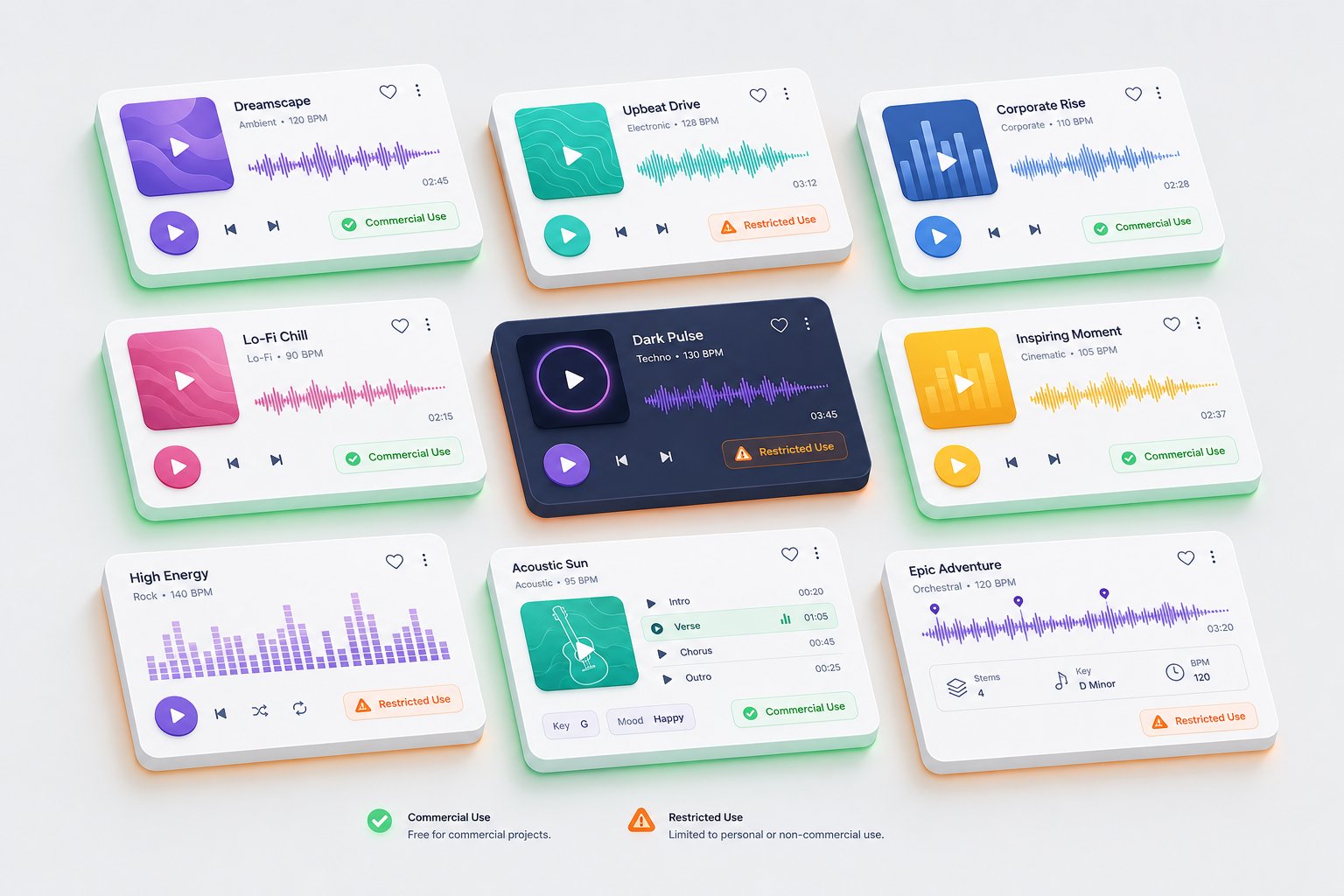
The divide between free and paid access follows a nearly universal rule across AI music generators:
- Free tiers: Personal experimentation only. No commercial use. No distribution. Often requires attribution to the platform.
- Paid tiers: Commercial rights granted. Distribution allowed. Attribution requirements relaxed or removed.
This isn't just a suggestion. It's contractually binding. According to distribution research from Dynamoi, songs created on Suno's free tier cannot be distributed commercially even if you later upgrade to a paid plan. The track itself remains locked to non-commercial terms based on the tier active at the time of creation.
Suno's free tier gives you 50 credits per day (roughly 10 songs) for personal use only. Upgrading to Pro at $10/month unlocks commercial rights and assigns ownership of outputs generated during your subscription. Premier at $30/month provides the same rights with higher volume (10,000 credits monthly). Soundraw skips the free tier entirely, starting at $16.99/month for its Creator plan, which grants a perpetual license for background music use in commercial projects.
AIVA's tiered model adds another wrinkle. Its Standard plan ($15/month) allows monetization of content containing AIVA music, but AIVA retains the copyright. Only the Pro plan ($49/month) transfers full copyright ownership to the user. That's a meaningful distinction: you can earn money from a track without actually owning it, which limits your ability to enforce rights against copiers or license the composition to third parties.
Ownership Clauses You Need to Read
Beyond the headline promises, several clauses buried in platform agreements deserve close attention:
- Non-uniqueness disclaimers: Suno and most other platforms warn that the same or similar output may be generated for other users who provide similar prompts. You might "own" your track, but someone else could receive an identical one. This undermines exclusivity even when ownership is assigned.
- Broad license grants: When you upload submissions or create content on Suno, you grant the platform a "worldwide, non-exclusive, fully paid-up, sublicensable, assignable, royalty-free, perpetual, irrevocable" license to use your content for improving their services, marketing, and more. Your ownership doesn't prevent the platform from using your work.
- Composition ownership splits: Soundraw's Artist plans involve a 50/50 split on composition ownership. You keep 100% of recording royalties, but publishing royalties are shared equally. If your song generates significant sync licensing or performance royalties, half goes to Soundraw.
- Distribution lock-in: Boomy requires you to distribute through its own platform, taking a percentage of royalties as a distribution fee. Soundraw's annual Artist plan offers distribution but retains 10% of royalties. These aren't optional add-ons. They're structural requirements of the business model.
- No Content ID registration: Soundraw explicitly prohibits registering its tracks with any Content ID system. This means you cannot use YouTube's automated copyright enforcement to protect or monetize those compositions, even on paid plans.
The practical reality? Platform terms of service function as a parallel legal system that operates alongside, and sometimes overrides, copyright law. You might have a strong human authorship claim under federal law, but if your platform's ToS restricts commercial use or retains ownership, those contractual limitations control what you can actually do with your music.
Tools like Sonoteller and Loudme.ai offer different approaches to AI music creation, each with their own licensing structures. Before committing to any platform, read the full terms, not just the pricing page. The ownership clause that matters most is rarely the one highlighted in marketing copy.
Ownership on paper means little if you can't actually get your music in front of listeners. The next challenge creators face is navigating how streaming and distribution platforms handle AI-generated content once it leaves the tool that created it.
Distribution Platforms and AI Content Policies
You've created a track with AI assistance, confirmed your platform's terms allow commercial use, and you believe you hold meaningful human authorship. The next hurdle? Getting that music onto streaming services and monetizing it without running into policy walls, content flags, or outright removal.
Streaming platforms and video services are writing their own ai music streaming platform rules in real time. These policies don't always align with copyright law, and they don't always align with each other. What Spotify allows, YouTube may flag. What Apple Music accepts today, it may reject tomorrow. For creators asking "can I publish a song written by AI," the answer depends as much on platform policy as it does on legal ownership.
Streaming Platform Policies on AI Music
Spotify, Apple Music, and other major streaming services have each taken distinct approaches to AI-generated content. None of them outright ban AI music, but all of them have drawn lines around how it can appear on their platforms.
Spotify's position centers on three priorities: fighting spam, preventing impersonation, and increasing transparency. The platform removed over 75 million spammy tracks in a single 12-month period during the generative AI explosion. Its policies target bad actors who mass-upload AI-generated content to game the royalty pool, not legitimate creators using AI as a creative tool.
Here's what each major platform currently enforces:
- Spotify: Does not ban AI-generated music outright. Treats all music equally regardless of tools used to make it, as long as it meets quality standards and isn't spam. Rolled out a music spam filter that identifies mass-upload tactics, duplicates, and artificially short tracks. Introduced an impersonation policy specifically targeting AI voice clones. Requires that vocal impersonation only appear when the impersonated artist has authorized it. Began displaying AI disclosure credits in Song Credits on mobile as of April 2026.
- Apple Music: Requires that all uploaded content have a valid rights holder. Distributors must confirm that submissions meet copyright standards before delivery. Apple has not published a standalone AI music policy, but its existing rules effectively require human involvement since you need a legitimate copyright claim to distribute.
- Amazon Music and Deezer: Both platforms rely on distributor-level gatekeeping. If your distributor accepts your AI-assisted track and delivers it with proper metadata, these services will host it. Deezer has been more vocal about separating "functional" AI music from artist-driven content in its recommendation algorithms.
Spotify's approach is worth examining closely. The platform explicitly states: "We support artists' freedom to use AI creatively while actively combating its misuse by content farms and bad actors." It doesn't create or own music. It pays royalties based on listener engagement, and all music is treated equally regardless of the tools used to make it. The issue isn't AI itself. It's deception, spam, and impersonation.
The AI disclosure system Spotify launched in beta uses the DDEX industry standard for credits, developed alongside distributors like DistroKid, CD Baby, Believe, and EMPIRE. Artists can now indicate where AI played a role, whether in vocals, instrumentation, lyrics, or post-production. This isn't punitive. Tracks aren't down-ranked for disclosing AI use. But the absence of a credit doesn't mean AI wasn't used, since not all distributors have enabled disclosure yet.
YouTube Content ID and AI-Generated Tracks
YouTube operates differently from pure streaming services because its Content ID system creates a unique intersection between AI music and copyright enforcement. Content ID scans uploaded videos against a database of reference files submitted by rights holders. When it finds a match, it can block the video, mute the audio, or redirect ad revenue to the claimant.
For AI-generated music, this creates two scenarios:
Scenario 1: Your AI track triggers a false Content ID claim. If an AI model produced something that sounds similar enough to a copyrighted recording in the Content ID database, your video could receive a claim even though no actual copying occurred. Disputing these claims requires demonstrating that your audio is original or properly licensed, which gets complicated when the copyright status of AI-generated material is itself uncertain.
Scenario 2: You want to register AI music with Content ID to protect it. This is where platform policy and copyright law collide. Content ID registration typically requires proof of ownership. If your AI-generated track lacks copyright protection because it doesn't meet the human authorship threshold, you may not have standing to register it. Soundraw, for example, explicitly prohibits users from registering its tracks with Content ID systems.
YouTube has also introduced tools that lean into AI as a solution rather than a problem. A feature launched in May 2026 lets creators who receive Content ID claims replace the flagged audio with AI-generated instrumental tracks directly within YouTube Studio. Hit the "Create" button in the Replace Song tool, and YouTube generates four royalty-free instrumental options to swap in, releasing the claim and keeping the video monetizable.
This sits alongside YouTube's earlier "Music Assistant" tool, which lets YouTube Partner Program members generate copyright-free backing tracks via text prompts through Creator Music. Both tools are powered by Google DeepMind's Lyria model and produce royalty-free outputs, sidestepping the ownership question entirely by granting creators clear usage rights regardless of copyright status.
Commercial Licensing Without Clear Ownership
The copyright uncertainty around AI music creates real friction in commercial contexts. When a brand wants to license a track for an advertisement, a filmmaker needs a score for their project, or a game developer wants background music, the first question any legal team asks is: "Who owns this, and can they grant us the rights we need?"
If the answer is unclear, most commercial buyers walk away. Here's why:
- Advertising: Brands require clean chain-of-title documentation before using any music in campaigns. An AI-generated track with uncertain copyright status represents unquantifiable legal risk. If a competitor uses the same AI-generated output (remember those non-uniqueness clauses), the brand has no exclusivity and no recourse.
- Film and TV scoring: Production companies need to clear music rights for global distribution across multiple formats and territories. Unclear ownership makes it impossible to issue the standard sync licenses that distributors and broadcasters require.
- Streaming revenue: Performing rights organizations like ASCAP, BMI, and SESAC collect royalties on behalf of songwriters and publishers. If a work can't be registered because it lacks human authorship, those royalty streams simply don't flow. PRS for Music has already stated it will not register AI-generated works that lack sufficient human contribution.
- Production music libraries: Companies like Epidemic Sound built their business providing pre-cleared music to creators. YouTube's new AI replacement tools now compete directly with this model by offering free, royalty-free alternatives generated on demand.
The commercial implications extend beyond individual creators. Spotify's total music payouts grew from $1 billion in 2014 to $10 billion in 2024. That royalty pool attracts bad actors who mass-upload AI-generated content specifically to siphon streaming revenue. Spotify's spam filter and impersonation policies exist precisely to prevent this dilution, protecting the earnings of professional artists and songwriters who play by the rules.
For creators navigating this landscape, the practical lesson is straightforward: platforms care less about whether your music was made with AI and more about whether you can demonstrate legitimate rights, avoid spam behavior, and provide transparency about your creative process. The tools and policies are evolving fast, but the underlying principle remains consistent. Clear ownership and honest disclosure open doors. Ambiguity closes them.
Knowing the rules is one thing. Building a workflow that keeps you on the right side of them, with documentation that proves your human authorship if challenged, is where theory becomes practice.
How to Protect Your AI-Assisted Music
Understanding the legal landscape is valuable. But if you're a musician or producer actively using AI in your workflow, you need more than theory. You need a system that proves your human authorship if it's ever questioned, whether by the Copyright Office during registration, a distributor reviewing your submission, or an opposing party in a dispute.
The good news? Protecting your AI-assisted compositions doesn't require a law degree. It requires discipline in how you document your creative process and intentionality in how you shape AI outputs into something that's genuinely yours.
Documenting Your Creative Process
Think of documentation as your insurance policy. If someone challenges your copyright claim two years from now, you'll need evidence showing exactly what you contributed. Memories fade. Files get lost. Platforms change their interfaces. The time to build your paper trail is while you're creating, not after a dispute arises.
Legal advisors recommend keeping records of prompts, edits, drafts, and decisions that can prove ownership if later challenged. For musicians, this translates into specific, actionable habits:
- Save every iteration: Export and label each version of your project. If you generated twenty AI loops and selected three, keep all twenty plus notes on why you chose those specific ones. The selection process itself is evidence of creative judgment.
- Screenshot your prompt history: While prompts alone don't establish authorship, they show the starting point of your creative process. The contrast between what you prompted and what you ultimately produced demonstrates the human transformation that happened in between.
- Record your DAW sessions: Screen recordings of your editing, arranging, and production work create timestamped proof of human creative input. Tools like OBS or built-in screen capture make this effortless.
- Maintain a creation log: A simple text file or spreadsheet noting dates, tools used, what was AI-generated versus human-composed, and what modifications you made. This doesn't need to be elaborate. It needs to be consistent.
- Preserve contributor data and tool disclosures together: As the RightsDocket registration guide advises, keep contributor information, AI usage details, timestamps, and evidence attachments in one place so the story you tell in a copyright application is consistent with your project record.
The strongest documentation tells a clear story: here's what the AI produced, here's what I did to it, and here's why the final work reflects my creative vision rather than the machine's default output.
Building a Strong Human Authorship Claim
Documentation proves what you did. But what you did needs to actually qualify as meaningful human authorship. Not every modification strengthens your legal position equally. Understanding which creative actions carry the most weight helps you work smarter, not just harder.
The U.S. Copyright Office organizes protectable human contributions into three buckets:
- Original human-authored expression in the finished work: Lyrics you wrote, melodies you composed, vocal or instrumental performances you recorded, arrangement decisions you made.
- Creative selection, coordination, and arrangement: Assembling multiple AI-generated elements in an original way rather than accepting a tool's default output as-is.
- Protectable modifications to AI output: Revisions that add enough human-authored expression to create a claim over the new human contribution.
The practical lesson from the Copyright Office's decisions is simple: don't frame your claim around time spent prompting. Frame it around the lyrics you wrote, the musical structure you arranged, the performance you recorded, and the substantive edits that changed what the audience hears.
Here's a step-by-step process to protect ai assisted music legally and build the strongest possible claim:
- Separate your layers clearly. Before you begin, decide which elements will be human-authored and which will come from AI. Write your own lyrics and melody. Use AI for backing instrumentation or production polish if needed. This separation makes your registration application straightforward.
- Treat AI output as raw material, not a finished product. Generate multiple options, then select, edit, rearrange, and combine them with your own compositions. The more transformation between the AI's raw output and your final track, the stronger your position.
- Add perceptible human expression. Record your own vocals or instruments over AI-generated backing. Write original counter-melodies. Restructure the arrangement so the form reflects your creative decisions, not the AI's default structure.
- Document the before and after. Save the unmodified AI output alongside your final version. The contrast between these two files is your strongest evidence of human creative contribution.
- Use Copyright Office language in your records. Instead of describing your work as "co-created with Suno," note that the claim covers "original lyrics, vocal melody, and arrangement" while excluding "AI-generated instrumental material." This aligns your documentation with how examiners evaluate applications.
- Register your copyright with accurate AI disclosure. File using the Standard Application. Describe your human contribution in the "Author Created" field. Exclude AI-generated material in the "Limitation of the Claim" section. Never list AI as an author or co-author.
- Preserve your records indefinitely. Copyright lasts for the life of the author plus 70 years. Your documentation needs to survive long enough to support your claim if challenged at any point during that period. Use cloud backups and multiple storage locations.
How to copyright AI music effectively comes down to this: the more human creative DNA visible in the final work, the more defensible your claim. A track where you wrote the lyrics, composed the melody, performed the vocals, and arranged the structure, using AI only for instrumental textures underneath, is far more protectable than one where AI handled everything except a few EQ tweaks.
Reducing Legal Risk When Using AI Music
Not everyone creating with AI intends to register copyrights. Many creators simply need music for videos, podcasts, or commercial projects without getting tangled in legal disputes. If that's you, the risk calculus looks different, but it's no less important.
The cost for music copyrights album ai registration is relatively low, currently $65 for a single work through the Copyright Office's electronic system, or $85 for a group of unpublished works. But the real cost isn't the filing fee. It's the risk of building a commercial project on a foundation that might not hold up.
Here's what creators using AI music commercially should keep in mind:
- Verify your platform's terms match your intended use. If you're monetizing content, confirm your subscription tier grants commercial rights. Remember that tracks created on free tiers may remain locked to non-commercial terms permanently, even if you upgrade later.
- Avoid prompts referencing specific artists or songs. "Make something like Drake" or "in the style of Taylor Swift" dramatically increases the risk that the output resembles copyrighted material closely enough to trigger infringement claims.
- Understand that ownership doesn't equal exclusivity. Even on paid tiers, most platforms warn that similar outputs may be generated for other users. If exclusivity matters for your project, AI-generated music may not be the right choice.
- Plan for platform instability. What happens if the AI service you used shuts down, changes its terms, or loses a major lawsuit? Can you prove the provenance of your music if challenged three years from now? Keep local copies of everything, including the platform's terms of service at the time you created the work.
- Don't overstate human authorship. Registering copyrights with inaccurate information about AI involvement can backfire. The Copyright Office can cancel registrations where essential information was omitted, and courts can disregard a registration in litigation if the applicant knowingly misrepresented the creative process.
The safest position for commercial use? Either create enough human-authored content to establish a legitimate copyright claim, or use music from sources that provide explicit commercial licenses regardless of copyright status. Clear licensing terms eliminate the need to prove authorship in the first place, which is exactly why royalty-free alternatives have become increasingly attractive to creators who can't afford legal ambiguity.
Royalty-Free AI Music as a Practical Alternative
Clear licensing terms eliminate the need to prove authorship in the first place. That's the key insight for creators who don't want to navigate copyright registration, document every creative decision, or worry about whether their background music will trigger a dispute two years from now. When a platform grants you an explicit commercial license upfront, the underlying question of whether AI-generated music holds copyright protection becomes largely irrelevant to your day-to-day work.
Why Royalty-Free AI Music Bypasses the Copyright Question
Here's the logic. Copyright determines who owns a creative work and who can control its use. But when a platform issues you a royalty-free license for commercial use, you don't need to own the copyright. You need permission to use the music, and the license provides exactly that. Whether the track qualifies for copyright registration under the human authorship standard doesn't change your right to use it in your project.
Think of it like renting versus buying a house. You don't need to hold the deed to live there legally. You need a valid lease. Royalty-free licensing works the same way. The platform holds whatever rights exist in the music and grants you a license to use it commercially. No ownership disputes. No registration headaches. No ambiguity about whether your prompt constituted meaningful creative input.
This approach is especially valuable given the legal uncertainty still surrounding AI-generated outputs. As legal analysis from industry experts has noted, even platforms like Suno admit they cannot guarantee copyright will vest in any output. Royalty-free licensing sidesteps that entire problem by granting usage rights directly, regardless of copyright status.
Choosing Platforms With Clear Commercial Licenses
Not every AI music tool offers the same licensing clarity. Some bury restrictions in their terms. Others make commercial rights contingent on paid tiers that lock you into specific distribution channels. The platforms worth using are the ones that state plainly: you can use this music commercially, in these contexts, without additional fees or royalty obligations.
When evaluating any royalty-free AI music platform, look for these signals:
- Explicit language granting commercial use rights without per-project fees
- No Content ID registration by the platform that could trigger claims against your videos
- Clear terms covering the specific use cases you need: social media, YouTube, podcasts, client work
- No requirement to prove human authorship or register the output with a copyright office
- Transparent policies that don't shift liability entirely onto the user
The difference between a platform that says "you own this" (while admitting copyright may not exist) and one that says "you're licensed to use this commercially" is significant. The second statement is a contractual guarantee that doesn't depend on unresolved legal questions about AI authorship.
Practical Solutions for Content Creators
For creators working on tight deadlines across multiple projects, the copyright debate is academic. What matters is whether you can use a track without legal risk. Royalty-free AI music eliminates that risk across a wide range of project types:
- MakeBestMusic's Free Music Generator: Provides free, royalty-free music for commercial use across videos, social content, games, and podcasts. No subscription required to access royalty-free tracks, making it a practical starting point for creators who need music without copyright uncertainty.
- Rightsify: Offers an AI-powered catalog with pre-cleared licensing for commercial projects, including advertising and broadcast use.
- MusicFlow: Generates royalty-free tracks with licensing terms designed for content creators who need quick turnaround without legal review.
- Soniva Music: Provides AI-generated music with clear commercial licensing for video producers and social media creators.
- Loudly: Combines AI music generation with built-in distribution, granting users full commercial rights and 100% royalty payouts on streams.
Each of these platforms takes a different approach, but they share a common principle: the licensing terms do the heavy lifting so you don't have to prove authorship or navigate copyright registration.
The types of projects where royalty-free AI music eliminates legal exposure entirely include:
- YouTube videos and shorts where Content ID claims could demonetize your work
- Podcast intros, outros, and background music across all episode formats
- Social media content on TikTok, Instagram Reels, and Facebook
- Indie game soundtracks and interactive media
- Corporate presentations, training videos, and internal communications
- Advertising and promotional content for small businesses
- Livestream background music on Twitch or YouTube Live
In each of these contexts, what you need isn't copyright ownership. You need a clear, enforceable license that lets you use the music without fear of takedowns, claims, or legal challenges. Platforms that provide that license upfront, with no ambiguity and no hidden restrictions, offer the most practical path forward for creators who want to focus on making content rather than managing legal risk.
The copyright landscape around AI-generated music will continue evolving as courts issue rulings and legislatures pass new laws. But creators who build their workflow around clear licensing terms today won't need to scramble when those changes arrive. The music is licensed. The terms are set. The work continues.
