

The Sound That Stopped the World and Started a Movement
Imagine hearing a melody that feels like it should resolve, like a note hanging in the air waiting to land, but it never quite does. The voice bends and quivers with ornamentation you can't place. The rhythm limps forward in an asymmetrical pulse that somehow makes perfect sense to your body before your brain catches up. That unresolved, aching, hypnotic quality is what hits you the first time you encounter Ethiopian music.
Ethiopian music is a vast tradition built on pentatonic scales and unique modal systems called kiñit, shaped by over 80 ethnic groups across one of Africa's oldest civilizations, producing a sound unlike anything else on the planet.
Why Ethiopian Music Sounds Like Nothing Else
The secret lies in the scales themselves. Where Western pop and rock lean on seven-note patterns, Ethiopian melodies are constructed from five-note pentatonic scales with large intervals between certain notes, creating that signature feeling of suspension and intensity. As one writer put it, it's like waiting for a stone to hit the bottom of a well and never hearing it. Layer in vocal techniques passed down through centuries of sacred chant, and you get something that can feel closer to soul music than to anything else coming out of the African continent.
Each of Ethiopia's many ethnic communities, from the Amhara highlands to the Oromo lowlands, contributes its own rhythms, instruments, and vocal styles to this mosaic. The result is not one tradition but dozens, all sharing that unmistakable pentatonic DNA while sounding wildly different from one another.
What This Guide Covers
This guide traces the full arc of that sound. You'll explore the ancient sacred chants that gave Ethiopian melody its foundation over 1,500 years ago, then follow the story into the smoky nightclubs of 1960s Addis Ababa, where musicians fused those old modes with jazz, funk, and soul to spark a golden age. From there, you'll meet the genre called Ethio-jazz and the compilation series that introduced it to the world, discover every major genre from tizita ballads to the shoulder-shaking energy of eskista, and land in the present day, where streaming platforms and a global diaspora are carrying these sounds further than ever before.
Whether you're a lifelong music explorer or someone who just stumbled onto a strange, beautiful track and needs to know more, this is where the journey starts.
Ancient Roots and Sacred Sounds That Still Echo
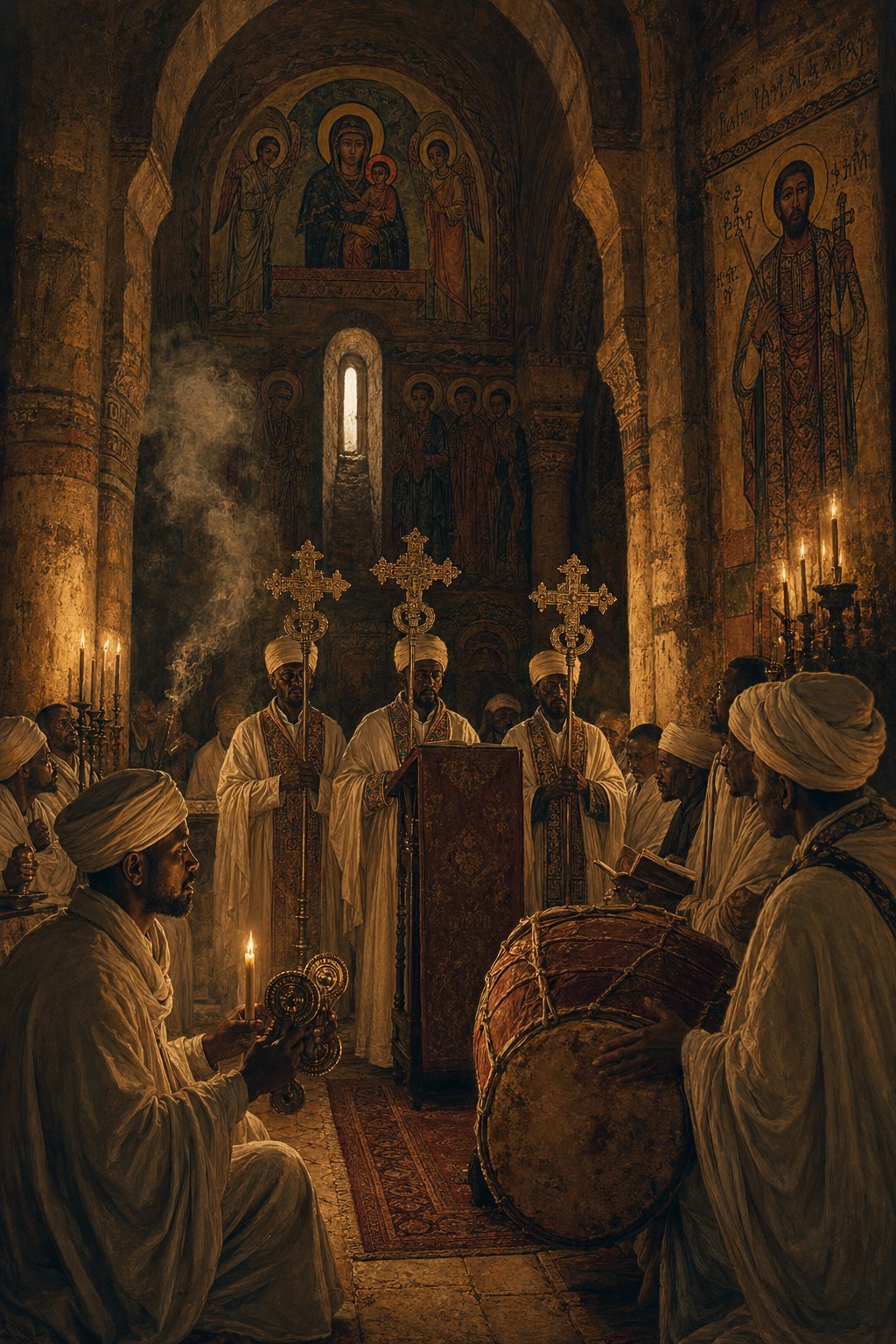
That journey begins not in a recording studio or a nightclub, but inside the stone walls of a church. The oldest layer of Ethiopian music lives in the Ethiopian Orthodox Tewahedo Church, where a liturgical chant system called Zema has been performed continuously for roughly 1,500 years. Walk into an Orthodox service today, anywhere from Aksum to Addis Ababa, and you'll hear it: voices rising and falling in modes that predate Western staff notation by centuries, accompanied by the rattle of sistra and the pulse of drums. This is not a relic. It's a living, breathing tradition that still marks every fast, feast, and funeral in the Ethiopian liturgical calendar.
Saint Yared and the Origins of Ethiopian Sacred Music
Every tradition has its origin story, and Ethiopian sacred music traces its lineage to one person: Saint Yared, a 6th-century scholar born in the ancient city of Aksum around 501 A.D. Church tradition holds that Yared received the gift of sacred song through divine revelation, but the historical reality is just as remarkable. Raised by his uncle, a priest-scholar at the Church of Aksum Zion, Yared composed the entire body of Zema chants that the church still uses, organizing them into five major volumes covering holidays, fasting seasons, funeral rites, and daily worship.
What makes Yared's contribution extraordinary is the system he built around those chants. He developed three foundational musical modes, Ge'ez (hard and imposing), Izil (gentle and melodic), and Araray (melancholic and somber), each suited to different spiritual occasions. He also created ten musical notations, a written system for encoding melody long before Western notation standardized into the forms we know. Trained singers called debteras still memorize and perform these chants, improvising along the outlines of melodic formulas while adding their own ornamentation. Mastering the full repertoire once took decades of oral study.
From Church Chants to Folk Traditions
Yared's modes didn't stay locked inside church walls. Over centuries, the melodic sensibility of Zema seeped into the secular folk traditions of Ethiopia's many ethnic communities. Farmers, herders, and traveling musicians adapted those pentatonic patterns to songs about love, harvest, war, and celebration. Each region developed its own flavor, but the instruments that carried these melodies became shared cultural touchstones across the highlands and lowlands alike.
You can't understand Ethiopian music without knowing the instruments that give it texture:
- Masinko — A single-stringed fiddle made from horsehair, rawhide, and wood, played with a bow. Its raw, vocal quality makes it the perfect companion to the powerful Amharic singing voice, and it remains the instrument of choice for wandering minstrels called azmaris.
- Krar — A five or six-stringed lyre with ancient roots, traditionally associated with love songs and secular celebration. Think of it as the acoustic guitar of Ethiopian folk music.
- Washint — A bamboo flute whose finger-hole placement varies from player to player, making each washint unique to its owner. Performers often carry multiple flutes to match the pitch of different songs.
- Kebero — A large, cylindrical double-sided drum central to Orthodox church ceremonies, where it beats alongside sistra during Zema performances. Its deep pulse anchors both sacred chant and secular dance.
These instruments aren't museum curiosities. Azmaris still roam Addis Ababa's music houses with a masinko tucked under one arm, improvising praise songs and sharp-witted commentary for their audiences. The krar still rings out at weddings. The kebero still thunders in churches every Sunday. What Saint Yared set in motion over a millennium ago didn't fossilize; it evolved, branching into dozens of regional folk styles while keeping its pentatonic core intact.
That core, those five-note scales and the emotional modes built on top of them, would eventually get a name: kiñit. And understanding kiñit is the key to hearing why every genre of Ethiopian music, from ancient chant to modern pop, shares the same unmistakable sonic fingerprint.
Understanding the Pentatonic Scales Behind the Sound
Kiñit. Say it out loud: kee-nyit. It's the single most important word for understanding why Ethiopian music sounds the way it does. Think of kiñit as the emotional operating system running beneath every melody, whether it's a centuries-old church chant or a track released last week on Spotify. Where Western music leans on major and minor keys to toggle between happy and sad, the kiñit system offers four primary modes, each one a distinct emotional world with its own color, weight, and gravity.
Sounds complex? It's actually simpler than Western harmony. Each mode uses just five notes, a pentatonic framework. But the intervals between those notes shift from mode to mode, and those shifts are what make a tizita ballad feel like heartbreak while a bati groove makes you want to move. You don't need to read sheet music to hear the difference. You just need to know what to listen for.
The Four Modes That Define Ethiopian Melody
Each of the four core kiñit modes carries a specific emotional identity, almost like a personality. When an Ethiopian listener hears the first few notes of a song, they can often name the mode instantly, the same way you'd recognize a minor key in a Western ballad. Here's the map:
| Mode Name | Emotional Character | Common Usage Context |
|---|---|---|
| Tizita | Nostalgia, longing, bittersweet memory | Slow love ballads, reflective instrumentals, songs of separation and remembrance |
| Bati | Energy, vitality, celebration | Faster-paced folk songs, dance music, festive and communal gatherings |
| Ambassel | Contemplation, heroism, spiritual depth | Highland storytelling, devotional songs, music from the Amhara regions of Gonder and Wollo |
| Anchihoye | Brightness, playful solemnity, danceable grace | Liturgical-influenced melodies, slow but lively ceremonial pieces, north and central Ethiopian traditions |
Notice something? These aren't just technical labels. Each mode is a tonal "space" rather than a fixed harmonic grid, giving performers room to improvise, ornament, and bend notes in ways that Western equal temperament doesn't easily allow. That's why two songs in the same kiñit can sound dramatically different while sharing the same emotional DNA.
Why Tizita Is Ethiopia's Answer to the Blues
Of the four modes, tizita is the one that grabs most newcomers first. The word itself means "memory" or "nostalgia" in Amharic, and the feeling it evokes has been compared to the Portuguese concept of saudade, a deep, soulful yearning for something lost or just out of reach. Imagine the ache of the blues, but filtered through a completely different melodic vocabulary.
Tizita comes in both major and minor versions. The major form (C-D-E-G-A) shares its notes with the Western major pentatonic scale, yet it doesn't sound Western at all. The difference is in how performers use it: the ornamentation, the vocal quiver, the way a singer lingers on a note until it almost breaks. The minor version flattens the third and fifth, pulling the mood deeper into shadow. Mahmoud Ahmed is hailed as "The King of Tizita," while Bezawork Asfaw carries the title of "The Queen," and artists like Aster Aweke and Mulatu Astatke have all built iconic performances around this single mode.
When you hear a tizita song, you'll notice it doesn't resolve the way a Western pop ballad does. It lingers. It circles. It sits inside the feeling rather than moving through it. That quality, that willingness to stay in an emotional space without rushing toward resolution, is what makes the kiñit system feel so foreign and so magnetic to ears raised on chord progressions that always want to go home.
These four modes didn't develop in isolation, of course. They evolved alongside the folk traditions and sacred chants explored earlier, and they became the raw material that a generation of adventurous musicians would eventually fuse with something entirely unexpected: Western jazz, funk, and soul. That collision happened in a very specific place, at a very specific time, and it changed everything.
Swinging Addis and the Golden Era That Changed Everything
The place was Addis Ababa. The time was the mid-1960s. And the collision sounded like nothing the world had heard before.
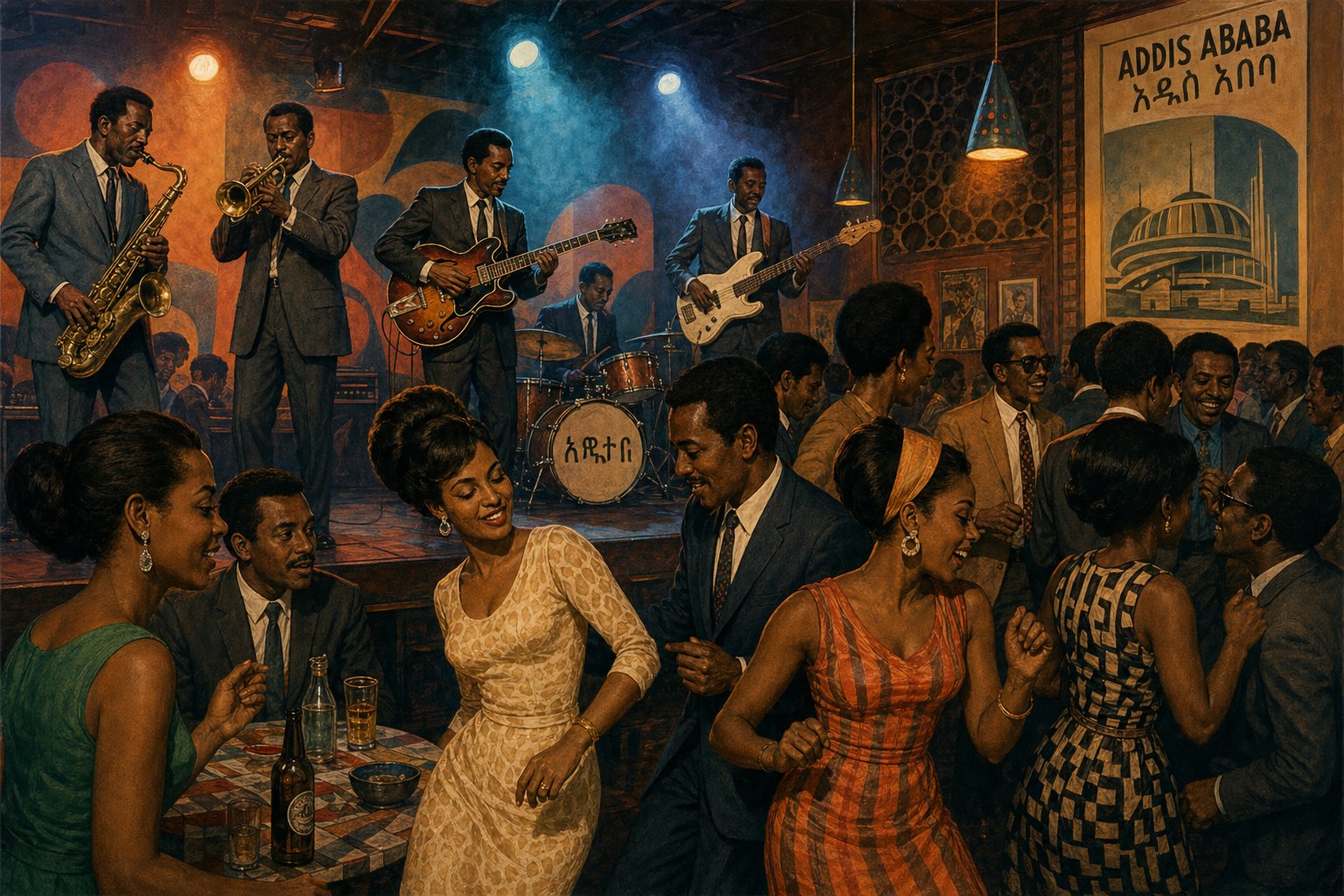
Picture a highland capital at 2,400 meters above sea level, buzzing with a generation that had grown up under the long, loosening grip of Emperor Haile Selassie's reign. Nightclubs and hotel banquet halls dotted the city from the old Piassa quarter down to Nefas Silk. Bands with names like Roha, Venus, Dahlak, and the All-Stars performed nightly, blending those ancient kiñit modes with electric guitars, brass sections, and rhythms borrowed from American soul and funk. As Addis Fortune described it, "music echoed and ricocheted in Addis Abeba" from one end of the city to the other. Young crowds packed underground taverns near the National Theater on Sundays, sporting Afro hairdos and bell-bottom pants, dancing to sounds that were equal parts James Brown and the Amhara highlands.
How did it happen? The roots go back further than you'd expect. In 1924, the future emperor brought forty Armenian orphan musicians from Jerusalem to Addis Ababa, where they became the Royal Imperial Brass Band. That single act planted the seed for institutional orchestras, and by the 1950s, every imperial institution of note, from the army and the police to the Imperial Bodyguard and the Haile Selassie Theatre, had its own orchestra staffed with disciplined musicians trained by foreign bandleaders. American big-band jazz filtered in after World War II. Then came the baby boomers, the Peace Corps volunteers carrying rock and soul records, and an American military radio base in Asmara broadcasting everything from John Coltrane to country music. The ingredients were all in the pot. Ethiopian musicians just turned up the heat.
Addis Ababa's Nightclub Revolution
The real explosion came when singers broke free from those institutional bands and stepped into the nightclub spotlight. Mahmoud Ahmed, a young man working odd jobs at a venue where the Imperial Bodyguard Band played, talked his way onto the stage one night when the regular singer didn't show. The band heard his voice and pulled him in permanently. Francis Falceto, the French musicologist who later compiled the landmark Éthiopiques series, described the era as "swinging Addis," a scene of "unimaginable parties, incredible fun, where everybody was mixed — the royal family, the nobles, the rich merchants, the bourgeois, the prostitutes, the beauties."
Tlahoun Gèssèssè became the voice of the era, a singer with such raw, towering power that he earned the status of a national icon. Alemayehu Eshete channeled James Brown's showmanship through a distinctly Ethiopian lens, becoming the first artist to release an independent 45 RPM single through the pioneering producer Amha Eshèté in 1969, a move that cracked open the state's monopoly on recorded music. Seyfu Yohannes brought a smoother, more soulful sensibility, while arrangers like Mulatu Astatke and the underappreciated pianist Girma Beyene shaped the harmonic language behind the singers.
What made these musicians remarkable wasn't just talent. It was stubbornness. Ethiopian audiences, as Falceto noted, were "so proud of their culture, so nationalist, so chauvinistic sometimes" that they demanded any Western influence be filtered through a deeply Ethiopian identity. You could hear James Brown in Alemayehu's delivery, but the modes underneath were pure kiñit. The melodies resolved, or didn't resolve, according to rules that no American soul singer would recognize. Even the lyrics carried a tradition of layered meaning called sem-enna-werq, "wax and gold," where a love song could double as political protest if you knew how to listen. Tlahoun himself landed in jail after the failed 1960 coup because his ballad "Altchalkoum" — "I Can't Stand Any More" — sounded like heartbreak on the surface but rang like dissent underneath.
By the early 1970s, independent bands and private labels had multiplied. The city hummed with creative competition. It felt, to those who lived through it, like a gift from the gods.
How the Derg Silenced and Transformed Ethiopian Music
Then, in 1974, the gods took it back.
A Marxist military junta called the Derg overthrew Haile Selassie and imposed a regime that would last eighteen years. The new government disbanded the imperial orchestras, imposed strict curfews that gutted nightlife, and required exit visas that made international touring nearly impossible. The young musicians from upper-class families, the ones who had brought electric guitars and fresh ideas into the scene, fled to Europe and America. The legends who stayed, artists like Tlahoun and Mahmoud Ahmed, found themselves performing under the watchful eye of a state that viewed artistic freedom as a threat.
The Derg didn't just close nightclubs — it severed the living connection between musicians and audiences that had made the golden age possible, replacing creative ferment with cheap Russian-imported keyboards and a culture of artistic caution that took decades to undo.
A flood of synthesizers arrived through the regime's Soviet alliance, and the lush horn arrangements that had defined the golden era gave way to thinner, more electronic textures. Recording an album required navigating bureaucratic approval. Leaving the country to perform meant risking never being allowed back. Falceto himself experienced this firsthand in the late 1980s when he tried to bring Alemayehu Eshete and other musicians to record in Paris: the Derg allowed the singers to leave but refused exit visas to the guitarist and saxophonist, forcing Falceto to fill in with French session players.
Yet the music didn't die. It went underground, into private gatherings and diaspora living rooms. It survived on cassette tapes passed hand to hand. And it waited. When the Derg finally collapsed in 1991 with the fall of the Soviet Union, the golden age couldn't simply be restarted. As the Ethiopian-American singer Meklit put it, "You can't actually pick up where you left off." Too much had changed, too many musicians had scattered, and an entire generation had grown up without ever hearing those bands play live.
What could be done, though, was preservation. And that effort would come from an unlikely source: a French concert promoter who heard a single Mahmoud Ahmed LP at a party in 1984 and decided to find out if it was an exception or the tip of an iceberg.
Ethio-Jazz and the Genius That Reached the World
That French concert promoter was Francis Falceto, and the iceberg he uncovered turned out to be enormous. But before the world could hear what Falceto found, someone had to build the bridge between Ethiopian modes and Western jazz harmony in the first place. That someone was Mulatu Astatke.
Mulatu Astatke and the Birth of Ethio-Jazz
Mulatu's path was unusual from the start. Born in Jimma in western Ethiopia, he left home as a teenager to study music abroad, first at Lindisfarne College and the Trinity College of Music in England, then at Berklee College of Music in Boston, where he became one of the first African students to enroll. At Berklee, he absorbed jazz harmony, Latin percussion, and big-band arranging. But instead of assimilating into the American jazz tradition, he did something no one had tried before: he fed those Western techniques back through the kiñit modes he'd grown up hearing, layering jazz chord voicings and Latin rhythms over the pentatonic scales of tizita, bati, and ambassel.
The result was Ethio-jazz, a hybrid form that Harvard's Radcliffe Institute describes as "a blend of Ethiopian traditional music and Latin jazz." A multi-instrumentalist who plays vibraphone, conga, and keyboards, Mulatu gave the genre a shimmering, percussive texture that set it apart from both straight-ahead jazz and traditional Ethiopian sounds. His landmark recordings from the late 1960s and early 1970s, particularly the instrumental sessions that would later appear on compilations, became the sonic blueprint for an entirely new category of music. In 1972, he toured extensively with Duke Ellington, a collaboration that placed Ethiopian melodic ideas directly alongside one of the greatest harmonic minds in American music history.
What made Ethio-jazz so striking wasn't just the fusion itself. It was the refusal to compromise either side. The jazz harmonies didn't flatten the Ethiopian modes into Western-friendly shapes, and the pentatonic melodies didn't dissolve into generic world-music smoothness. The tension between the two systems, the places where they almost aligned but didn't quite, is exactly what gives the music its magnetic pull.
How the Éthiopiques Series Sparked a Global Revival
For decades, though, almost nobody outside Ethiopia and its diaspora heard any of this. The golden-age recordings existed on scratchy vinyl and degrading cassette tapes, scattered across private collections and forgotten warehouses. That changed when Falceto launched the Éthiopiques series through the French label Buda Musique. Starting in the late 1990s, the series systematically remastered and released the music of the Swinging Addis era, volume by volume, artist by artist, genre by genre. It was an act of cultural archaeology that doubled as one of the great reissue projects in music history.
Then came the Hollywood moment. In 2005, director Jim Jarmusch featured several of Mulatu's recordings in his film Broken Flowers, starring Bill Murray. Suddenly, millions of Western viewers were hearing those vibraphone-driven pentatonic melodies over scenes of suburban American ennui, and the contrast was electrifying. As KQED noted, "There is no sound on Earth quite like the music of Mulatu Astatke," and the film proved it by dropping that sound into the most unexpected context imaginable. Interest in Ethio-jazz surged. The Éthiopiques volumes started selling to audiences who had never heard of Addis Ababa's nightclub scene, and Mulatu, by then in his sixties, found himself touring internationally to crowds that treated him like a rediscovered legend.
The cross-pollination ran deeper than one film, though. Ethiopian musicians had been absorbing American soul and funk since the 1960s, and now American and European producers were sampling Ethiopian records, building new tracks around those haunting modal phrases. The influence flowed both ways, a feedback loop that continues to accelerate. If you want to hear where it all started, these Éthiopiques volumes are the essential entry points:
- Éthiopiques Vol. 1: Golden Years of Modern Ethiopian Music 1969-1975 — The broadest overview of the era, perfect for a first listen.
- Éthiopiques Vol. 4: Éthio Jazz & Musiques Instrumentales — Mulatu's instrumental masterwork and the definitive Ethio-jazz document.
- Éthiopiques Vol. 7: Eré Mèla Mèla — Mahmoud Ahmed at his most soulful, widely considered one of the greatest Ethiopian albums ever recorded.
- Éthiopiques Vol. 9: Alèmayèhu Eshèté — The Ethiopian James Brown in full flight, raw and electrifying.
- Éthiopiques Vol. 10: Ethiopian Blues & Ballads — A deep dive into the tizita tradition, ideal for anyone drawn to the melancholic side of the sound.
- Éthiopiques Vol. 13: Ethiopian Groove — Funk-heavy instrumentals that showcase the danceable side of the golden age.
Ethio-jazz opened the door, but it was only one room in a much larger house. The full range of Ethiopian genres, from the aching intimacy of tizita ballads to the kinetic energy of eskista dance music to the beat-driven experiments of a new generation, tells a story that no single genre can contain.
Every Ethiopian Music Genre You Need to Hear
That larger house has more rooms than most listeners realize. Ethio-jazz may be the genre that opened the door for international audiences, but it represents just one thread in a fabric woven from dozens of regional, generational, and stylistic traditions. If you've ever tried to explore Ethiopian music beyond a single playlist and felt overwhelmed, this is your map.
Each genre below carries its own emotional gravity, its own relationship to the kiñit modes, and its own cultural context. Some are centuries old. Others are barely a decade into their evolution. All of them share that unmistakable pentatonic DNA.
From Tizita Ballads to Ethio-Electronic
Start with tizita ballads, the emotional heart of the tradition. You already know the mode — that aching, nostalgic pentatonic scale built for longing. Tizita as a genre takes that mode and wraps it in slow, vocal-driven performances where the singer's ornamentation does most of the heavy lifting. Mahmoud Ahmed, Aster Aweke, and Bezawork Asfaw are the voices most associated with the form. When Ethiopians gather at weddings or holidays and someone requests a tizita, the room goes quiet. People close their eyes. It's that kind of music.
Ethio-jazz, as covered earlier, fuses those same modes with jazz harmony, Latin percussion, and Western instrumentation. Mulatu Astatke remains the towering figure, but artists like Hailu Mergia and Emahoy Tsege Mariam Gebru have expanded the genre's range considerably — Mergia through accordion-driven grooves, Emahoy through solo piano compositions that sound like Ethiopian church music filtered through Debussy.
Ethio-pop emerged in the 1980s and 1990s as synthesizers replaced horn sections and a younger generation began singing in Amharic, Oromo, Tigrinya, and other languages over electronic production. Artists like Aster Aweke (who bridges tizita and pop effortlessly), Teddy Afro, and Tilahun Gessesse in his later career shaped a sound that dominates Ethiopian radio and streaming playlists. The kiñit modes are still there, but the arrangements lean toward polished, keyboard-heavy production with drum machines and layered backing vocals.
Ethio-electronic pushes further into experimental territory. Producers in Addis Ababa and across the diaspora sample traditional instruments — a masinko phrase here, a kebero pattern there — and rebuild them inside electronic frameworks. The result sits somewhere between ambient, house, and the deep grooves of the golden age, attracting listeners who might never seek out a traditional recording but respond instantly to a familiar mode wrapped in a new texture.
Eskista and the Shoulder Dance Tradition
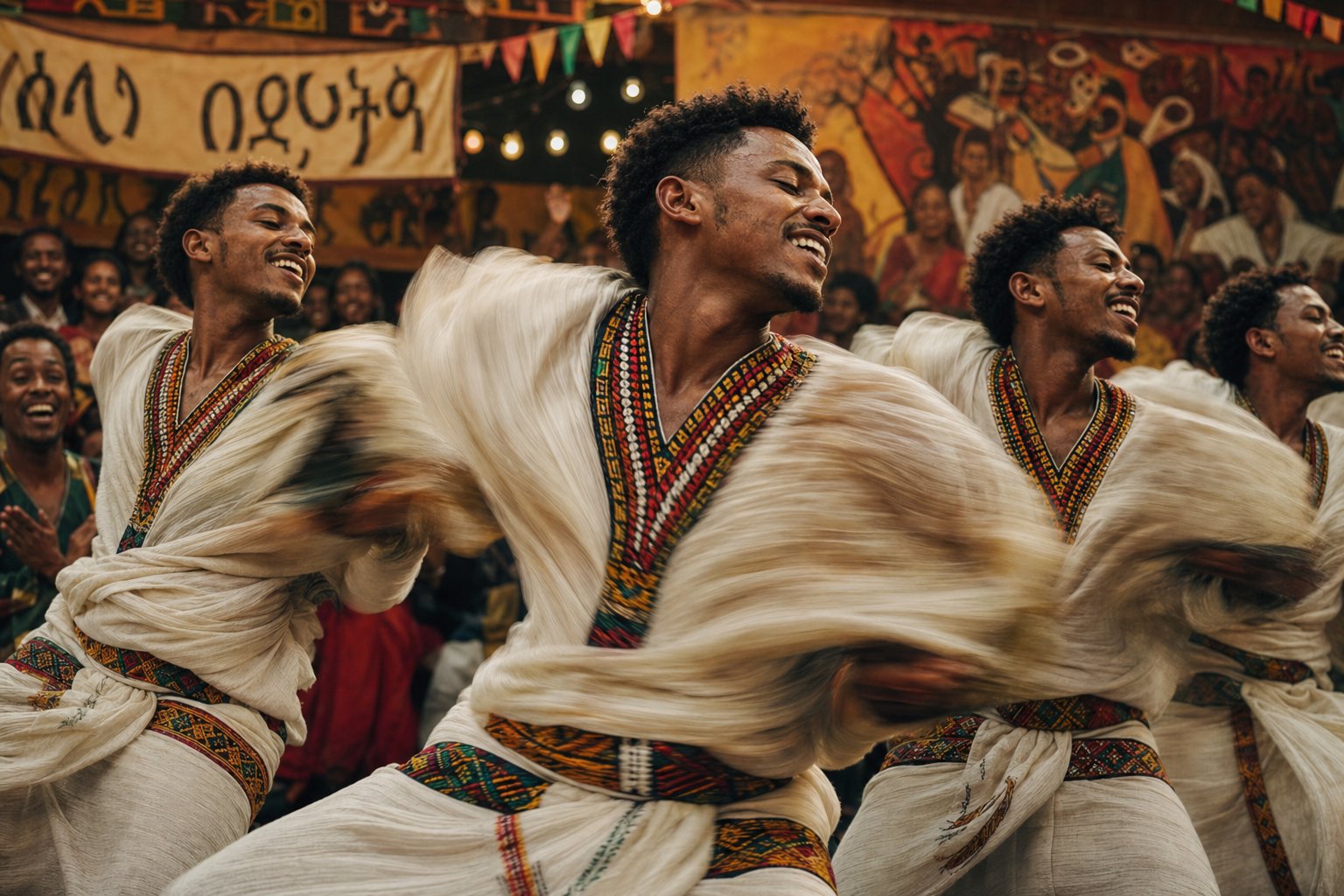
Then there's eskista, and you can't talk about it without talking about the body. The word itself means "dancing shoulders" in Amharic, and that's exactly what it looks like: rapid, rhythmic movements of the shoulders, chest, head, and neck that seem to defy the limits of human articulation. Originating with the Amhara people of the Ethiopian highlands, eskista is arguably one of the most technically demanding forms of traditional dance on the African continent.
Here's what makes eskista different from other dance-music genres: the choreography isn't a response to the music. It's inseparable from it. Composers write with the shoulder movements in mind, building rhythmic accents and tempo shifts that only make full sense when a dancer's body completes the phrase. At weddings and celebrations, spectators reward the best dancer with shilimat — cash pressed onto the performer's forehead as a sign of admiration. Men, women, and children all participate, and regional variations across the Amhara highlands each carry their own rhythmic personality, many rooted in the physical rhythms of farming life.
Eskista has also gone global. The dance has become a viral phenomenon on social media, introducing millions of viewers to Ethiopian movement vocabulary without them ever hearing the word "kiñit." Modern music videos regularly incorporate eskista choreography, proving that the tradition adapts as easily to pop production as it does to a village gathering.
Ethiopian Hip-Hop and the New Urban Sound
The newest branch on the tree is Ethiopian hip-hop, a scene that's been building momentum in Addis Ababa and diaspora cities for over a decade. Young MCs rap in Amharic, Oromo, and English, often over beats that sample golden-age recordings or interpolate kiñit melodies into trap and boom-bap frameworks. The lyrical tradition of sem-enna-werq — that "wax and gold" double meaning explored by earlier generations of singers — finds a natural home in hip-hop's love of wordplay and layered messaging. Artists use the form for everything from party anthems to sharp political commentary, continuing a long Ethiopian tradition of music as social mirror.
Here's how all these genres stack up side by side:
| Genre | Key Characteristics | Notable Artists | Mood / Energy Level |
|---|---|---|---|
| Tizita Ballads | Slow, vocal-driven, heavy ornamentation, pentatonic nostalgia mode | Mahmoud Ahmed, Aster Aweke, Bezawork Asfaw | Melancholic, reflective, intimate |
| Ethio-Jazz | Ethiopian modes fused with jazz harmony, vibraphone and horn textures | Mulatu Astatke, Hailu Mergia, Emahoy Tsege Mariam Gebru | Sophisticated, groovy, contemplative |
| Eskista Music | High-tempo rhythms built for shoulder dance, call-and-response energy | Various traditional and modern performers | Explosive, celebratory, physically demanding |
| Ethio-Pop | Synthesizer-heavy, polished production, sung in multiple Ethiopian languages | Teddy Afro, Aster Aweke, Gossaye Tesfaye | Upbeat, radio-friendly, emotionally versatile |
| Ethio-Electronic | Traditional samples rebuilt in electronic frameworks, ambient to club-ready | Diaspora and Addis-based producers | Atmospheric, experimental, hypnotic |
| Ethiopian Hip-Hop | Amharic/Oromo rap over sampled or kiñit-influenced beats, wordplay-heavy | Emerging urban artists in Addis and diaspora | Energetic, lyrical, politically charged |
What connects every row in that table is the same pentatonic foundation laid down centuries ago. The modes shift, the instruments evolve, the production technology leaps forward — but the melodic DNA persists. That persistence is part of what makes this tradition so resilient, and it helps explain how it has traveled so far from its highland origins. Because these genres don't just live in Ethiopia anymore. They thrive in diaspora communities scattered across the globe, carried by musicians and audiences who refuse to let distance dilute the sound.
The Global Diaspora Keeping Ethiopian Music Alive
Those diaspora communities aren't just passive audiences replaying old cassettes in faraway living rooms. They're active engines of musical evolution, funding artists, filling concert halls, and blending the sounds of home with whatever city they've landed in. When the Derg scattered a generation of musicians and listeners across the globe in the 1970s and 1980s, it accidentally planted seeds in some of the world's most culturally fertile cities. Those seeds have grown into full ecosystems.
Washington D.C. and the Ethiopian Music Diaspora
Washington D.C. is the undisputed capital of the Ethiopian diaspora, home to the largest concentration of Ethiopians outside Africa. Walk through the Adams Morgan or U Street neighborhoods and you'll find restaurants where live masinko players perform for dinner crowds, record shops stocking new releases from Addis Ababa, and venues hosting touring artists who treat D.C. as a second hometown. The city doesn't just preserve the tradition — it shapes it, with D.C.-based musicians creating hybrid sounds that feed back into the scene at home.
But D.C. is only one node in a much wider network. As UK-based writer Rahel Aklilu describes, growing up in London with an Ethiopian mother meant being raised on the "mellow sounds of Ethiopian singers" alongside Western pop and hip-hop — a dual identity where music served as "the warm embrace of home" in a country that often felt unwelcoming. That experience of music as cultural anchor repeats itself across every major diaspora hub:
- Washington D.C. — The largest Ethiopian community outside Africa, supporting a thriving live music circuit, Ethiopian-owned venues, and a steady market for new and classic recordings.
- London — A growing scene where second-generation artists like Raheaven fuse Eritrean and Ethiopian musical elements with British pop and R&B, creating sounds that bridge continents.
- Tel Aviv — Home to a significant Ethiopian-Israeli community whose musicians blend traditional modes with Middle Eastern and electronic influences, producing a distinct regional hybrid.
- Toronto and Melbourne — Smaller but vibrant communities that host annual cultural festivals and support touring artists, extending the music's reach into new audiences.
What ties these cities together is a shared emotional current. Rahel Aklilu captures it perfectly: the diaspora experiences "a tension between physically being in one place but mentally being somewhere else," and music is the bridge that holds both worlds together. Artists like Aster Aweke, who lived in the United States for over fifteen years before returning to Ethiopia, embody that bridge. As Aklilu writes, Aster "is not simply a star of Ethiopian music; she is Ethiopian music" — a figure whose voice connects grandmothers in Addis Ababa to their grandchildren in London with equal force.
How Streaming Reshaped Ethiopian Music Distribution
For decades, the economics of the scene ran on physical media. Cassette tapes were the dominant format well into the 2000s, sold in small shops and market stalls across Addis Ababa and diaspora neighborhoods. An artist's reach was limited by how many tapes a distributor could physically move. International exposure depended almost entirely on reissue labels like Buda Musique or the rare festival booking.
Streaming changed that equation completely. Platforms like Spotify, Apple Music, and YouTube gave Ethiopian artists direct access to global listeners without needing a Western label deal or a physical distribution network. Record companies have increasingly invested at a local level in Africa to develop music cultures and boost emerging artists through digital services, and Ethiopian musicians have been among the beneficiaries. A new track released in Addis Ababa can reach listeners in D.C., Stockholm, and Sao Paulo within hours. YouTube, in particular, has become the primary discovery platform — music videos routinely rack up millions of views, and the comment sections read like a roll call of the global diaspora.
The shift hasn't been entirely smooth. Royalty structures on streaming platforms often undervalue artists from smaller markets, and internet access in Ethiopia itself remains uneven. But the directional change is unmistakable: the cassette-tape bottleneck is gone, and the audience is no longer bounded by geography.
That expanded reach has also amplified something Ethiopian musicians have always done — use their platform to speak truth to power. Teddy Afro, arguably the country's biggest living star, has built a career on exactly this tension. His 2017 album Ethiopia topped the Billboard World Albums chart but had its official release blocked by authorities during a period of massive anti-government protests. His latest track, "Das Tal," references a traditional mourning tent and laments a country he says has been lost: "In the place that raised me, in the village where I grew up, I have become a stranger, like someone with no country." The song drew over seven million YouTube views within days of its release — proof that in a nation where criticizing the authorities has often landed people in trouble, music remains the safest and most powerful form of dissent.
Back in Addis Ababa itself, the live scene is experiencing a genuine renaissance. Contemporary music now mirrors the globalized life lived by a growing Ethiopian middle class, with artists like DJ and EDM musician Rophnan remixing distinctly Ethiopian beats — Gurage percussion, highland melodies — within electronic and experimental frameworks. Jano became the country's first mainstream rock band. Oromo and Gurage-language songs now share broadcast airtime alongside Amharic pop, reflecting the country's linguistic diversity in ways that mainstream media historically never did. New venues, festivals, and a generation of young artists with internet access and global ambitions are pushing the sound forward at a pace the golden age never imagined.
All of this momentum — the diaspora networks, the streaming pipelines, the political courage, the creative experimentation — raises an obvious question for the curious listener: where do you actually start? With so many genres, eras, and artists competing for attention, the journey from casual interest to genuine appreciation needs a roadmap.

Essential Albums and How to Start Your Ethiopian Music Journey
Here's the roadmap. With decades of recordings spread across dozens of genres, regional styles, and reissue labels, knowing where to begin can feel like standing at the base of a mountain with no trail markers. The good news? A handful of albums and compilations function as reliable entry points, each one opening a different door into the tradition. Pick the mood that calls to you and press play.
Don't try to understand Ethiopian music all at once. Pick one album, live inside it for a week, and let the modes teach your ear before you move on. The pentatonic scales will start to feel like home faster than you expect.
Essential Éthiopiques Volumes for Beginners
The Éthiopiques series from Buda Musique remains the single best gateway. With over twenty volumes and counting, it can feel daunting, but you don't need all of them. As Pitchfork noted, the series has "earned every scrap of its legendary status," and even a best-of compilation only scratches the surface of what's inside. Start here:
- Éthiopiques Vol. 1: Golden Years of Modern Ethiopian Music 1969-1975 — The broadest snapshot of the Swinging Addis era. Singers like Mahmoud Ahmed, Gétatchèw Kassa, and Sèyfu Yohannès perform against the smoky backdrop of Addis Ababa's coolest nightclubs. If you only buy one volume, make it this one.
- Éthiopiques Vol. 7: Erè Mèla Mèla — Mahmoud Ahmed's 1975 masterwork of psychedelic soul. Songlines calls it a record with "shades of James Brown and a bag load of groove." This is the album that inspired Francis Falceto to launch the entire series.
- Éthiopiques Vol. 4: Éthio Jazz & Musiques Instrumentales — Mulatu Astatke's instrumental blueprint for Ethio-jazz. Vibraphone, congas, and pentatonic modes in perfect tension.
- Éthiopiques Vol. 21: Ethiopia Song — Piano Solo — Emahoy Tsegué-Maryam Guèbrou's solo piano compositions, drawing on Orthodox hymns and the textures of the krar and begena lyres. Her style has been compared to the watercolor tones of Debussy and Chopin — utterly unlike anything else in the series.
Golden Era Albums Every Music Fan Should Own
Beyond the Éthiopiques compilations, several standalone albums deserve a permanent spot in any collection:
- Mulatu Astatke — Mulatu of Ethiopia (1972, remastered 2017) — The album where Ethio-jazz fully crystallized. A remastered classic that blends post-bop, Afro-Latin percussion, and Ethiopian melodic modes into something no other musician has replicated.
- Gétatchèw Mèkurya & The Ex — Moa Anbessa (2006) — A collision between Ethiopia's greatest saxophonist, who developed his technique by imitating the masinko, and Dutch post-punk band The Ex. The result is positively headbanging — proof that these modes can power any genre.
- Aster Aweke — Aster (1989) — Her international debut and the album that made her the first big Ethiopian world music star. The production hasn't aged perfectly, but the sheer force of her voice transcends any era.
Modern Ethiopian Music Worth Exploring
The tradition didn't stop evolving after the golden age. These recordings capture where the sound has traveled since:
- Mikael Seifu — Zelalem (2016) — A landmark of the Ethiopiyawi Electronic movement, blending dark, brooding downtempo house with samples from masinko, krar, and Ethio-jazz classics. If you respond to electronic music, start here.
- Eténèsh Wassié & Mathieu Sourisseau — Yene Alem (2018) — A fully-fledged azmari singer paired with bass guitar and cello, moving between chamber music, free jazz, and abstract sound sculpture. Intense, challenging, and deeply rewarding.
- Shewandagne Hailu — Sitotash (2013) — The sound actually playing in Ethiopian cafés and taxis right now: pop with reggae and R&B inflections that still carries an unmistakably Ethiopian feel.
- Ethiopie: Musiques Vocales et Instrumentales (Ocora, 1994) — A double album of field recordings from the 1960s spanning over 80 ethnic groups. Interlocking flute ensembles, polyphonic singing, thumb pianos, and the raucous atmosphere of a tej bet honey-wine parlor. This is the deep root.
These albums aren't a checklist to rush through. Each one rewards repeated listening as your ear adjusts to the modes and your body starts anticipating the rhythmic patterns. Give yourself permission to sit with a single record before moving to the next.
And if all this listening sparks something creative — if you find yourself wanting to hear what a tizita-inspired melody might sound like over a beat you've imagined, or what an eskista rhythm could do inside an electronic arrangement — you don't have to be a trained musician to experiment. Tools like MakeBestMusic's AI Song Generator let you turn a genre, mood, or musical idea into an original royalty-free track in seconds, bridging the gap between discovering these sounds and actually playing with them. It's one way to move from passive listening into active exploration, channeling the modes and rhythms that caught your ear into something entirely your own.
Whether you start with Mahmoud Ahmed's soulful grooves or Mikael Seifu's electronic experiments, the deeper you go, the clearer something becomes: this music isn't just surviving — it's gaining momentum, reaching new ears, and shaping the global sound in ways that are only beginning to be understood.
Why Ethiopian Music Matters More Than Ever
That momentum isn't slowing down. It's compounding. What started as a niche reissue project on a French label has grown into a genuine force in global music, one that producers, DJs, and songwriters across genres now treat as essential source material.
Ethiopian Music's Growing Influence on Global Sound
The sampling trail alone tells the story. Nas and Damian Marley built "As We Enter" around Mulatu Astatke's "Yegelle Tezeta." Kanye West chopped up Seyfu Yohannes' tizita melody for Common's "The Game." K'naan, Madlib, and Cut Chemist all dug into the Éthiopiques catalog for raw material. Oh No, Madlib's younger brother, went further than anyone — he made an entire album called Dr. No's Ethiopium using nothing but Ethiopian samples. These aren't obscure deep cuts. They're records by some of hip-hop's most respected names, all drawing from the same well of pentatonic gold.
Beyond sampling, the influence runs subtler and wider. Ethio-jazz has become a staple of curated playlists on every major streaming platform, sitting comfortably alongside modal jazz, Afrobeat, and ambient music. Film and television composers reach for those unresolved pentatonic phrases when they need a sound that feels emotionally specific but culturally unfamiliar. And a new generation of Ethiopian and diaspora artists — producers blending kiñit modes with electronic textures, singers weaving Amharic lyrics into R&B frameworks, bands like Krar Collective and Ethio Cali reimagining traditional instruments for global stages — are proving that the tradition doesn't need to be preserved in amber. It's alive, and it's hungry.
Where Ethiopian Music Goes From Here
The trajectory points in one direction: outward. Technology has removed the distribution barriers that kept this music confined to cassette shops and diaspora living rooms. The Éthiopiques series cracked the door open; streaming blew it off its hinges. Young artists in Addis Ababa now release music with a global audience in mind from day one, and diaspora musicians in D.C., London, and Tel Aviv are creating hybrid sounds that didn't exist a decade ago. The cross-pollination that defined the Swinging Addis era hasn't stopped — it's just gone worldwide.
Ethiopian music matters because it proves that the most powerful sounds on earth aren't the ones that conform to dominant systems — they're the ones that refuse to, and make you hear the world differently because of it.
So where do you go from here? Start with the albums listed above and let the modes rewire your ear. Seek out a live performance in your city — if there's an Ethiopian community nearby, there's almost certainly a venue where a masinko player or a full band performs regularly. Explore the diaspora scenes that keep these traditions evolving in real time. And if the sounds spark something in you, act on it — whether that means picking up an instrument, experimenting with a tool like MakeBestMusic's AI Song Generator to sketch out your own Ethiopian-influenced composition, or simply sharing a track with someone who's never heard anything like it. The scales the West never learned are waiting. All you have to do is listen.
