


What Is Falsetto and What Does It Really Mean
Falsetto is the upper register of the human voice, produced when only the thin edges of the vocal folds vibrate rather than their full mass. It creates a distinctive high-pitched, breathy, and lighter tone that sits above a singer's normal chest voice range. If you have ever heard a male vocalist float effortlessly into airy high notes that seem to hover above the rest of the song, you have heard this technique in action.
A common misconception is that the word itself implies something fake or illegitimate. The term comes from the Italian word "falso," meaning "false" or "feigned," and was originally used in Italian vocal pedagogy to describe a voice that differs from the singer's full, modal speaking tone. Britannica notes that the Italian term literally translates to "false soprano" and has traditionally described the adult male's head voice. But calling it "false" does not mean it is fake singing. It simply refers to a phonation switch, a shift in how the vocal apparatus operates to produce sound in a higher range.
Falsetto Meaning and Origin
The term entered English through centuries of Italian operatic and choral tradition. Italian singing masters needed a word to distinguish this lighter, higher production from the robust chest voice used in lower registers. The label stuck, and it carried over into English-language vocal pedagogy by the 18th century.
So what does falsetto actually sound like when you cannot press play on an audio example? Imagine a voice that feels weightless, almost transparent. Compared to chest voice, it has fewer harmonic overtones, which gives it a thinner, purer quality. There is a noticeable breathiness because the vocal folds do not close completely during each vibration cycle. The tone floats rather than punches. Think of it as the difference between a full brushstroke of paint and a delicate watercolor wash across the same canvas.
Why Falsetto Matters in Music
This vocal register has served as an expressive tool for centuries. In Renaissance and Baroque music, countertenors sang in falsetto to fill alto and soprano roles when women were banned from performing in churches and on certain stages. English cathedral choirs still maintain this tradition, with adult male altos providing the upper harmony lines in hymns and anthems.
In modern music, the technique spans nearly every genre. Soul, pop, R&B, rock, indie, and K-pop artists all rely on it to convey vulnerability, ecstasy, or emotional intensity. It is not a relic of the past but a living, evolving part of how singers connect with listeners.
Falsetto is the upper vocal register produced when only the ligamentous edges of the vocal folds vibrate, creating a breathy, high-pitched tone above the singer's chest voice range. It is not fake singing but a distinct and legitimate phonation mode used across centuries of music.
This article serves a dual purpose. You will walk away understanding the science and history behind this fascinating register, and you will also gain practical steps to develop it in your own voice. Whether you are curious about what is falsetto from a listener's perspective or you want to learn how to produce it yourself, the sections ahead cover both sides in detail.
The mechanics behind that airy, floating quality involve a precise coordination of muscles, cartilage, and airflow deep inside the larynx, and that is exactly where the story goes next.
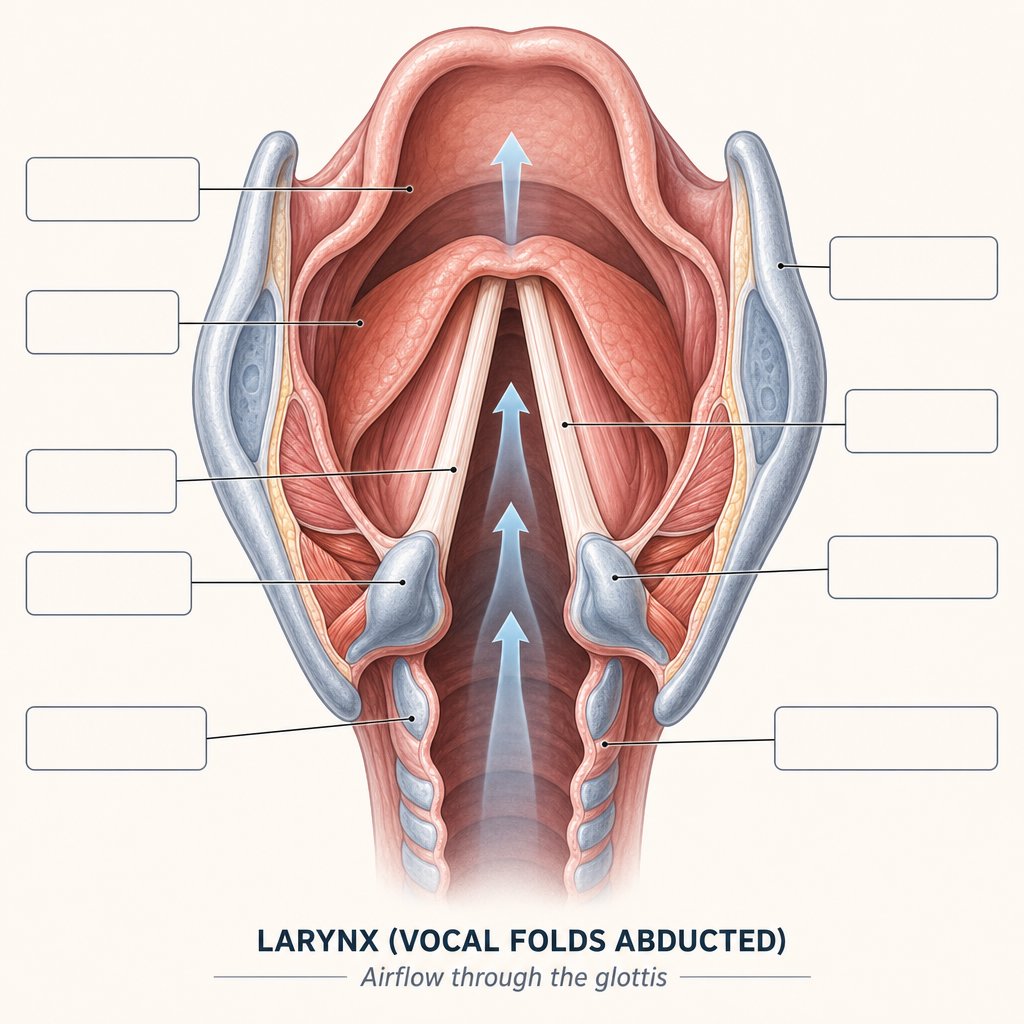
How Falsetto Works Inside Your Throat
That weightless, floating quality described above is not magic. It is the result of a very specific muscular coordination happening inside your larynx. Understanding the physiology helps demystify the falsetto voice and gives you a clearer mental map for developing it.
How Your Vocal Cords Produce Falsetto
When you speak or sing in chest voice, your thyroarytenoid (TA) muscles shorten and thicken the vocal folds so they vibrate along their full depth and width. The folds slam together firmly with each cycle, producing a rich, resonant tone packed with harmonic overtones. You feel that characteristic buzz in your chest because the thick, full-contact vibration transfers energy downward.
Falsetto flips this arrangement. The cricothyroid (CT) muscle, which connects the cricoid and thyroid cartilages at the front of your larynx, contracts and tilts the thyroid cartilage forward. This stretches and thins the vocal folds significantly. Research published in the Journal of Voice confirmed through high-speed videoendoscopy that cricothyroid contraction directly alters fold vibration patterns, increasing amplitude while changing the fundamental frequency. In practical terms, the CT muscle is the primary engine driving your voice into this upper vocal register.
Here is the key difference: in falsetto, only the thin ligamentous edges of the folds vibrate while the muscular body stays relatively slack and loose. The arytenoid cartilages at the back of the larynx position themselves so the folds do not close completely during each vibratory cycle. That small gap allows a steady stream of air to escape, which is exactly why the tone sounds breathy and airy rather than full and punchy.
This incomplete closure also means you need less subglottic pressure, the air pressure building up below the vocal folds, compared to belting or powerful chest singing. Less pressure, less collision force, lighter sensation. That is why falsetto feels effortless when produced correctly, almost like the sound is happening on its own.
The Phonation Switch Explained
You have probably experienced the "break" or "crack" when your voice flips unexpectedly between registers. That moment has a name: the passaggio, an Italian term meaning "passage." It describes the zone where your laryngeal muscles reorganize their balance of power.
According to the laryngeal mechanism framework developed by Roubeau, Henrich, and Castellengo (2008), vocal production operates in distinct modes: M1, where the thyroarytenoid muscle dominates and the folds vibrate with full contact (chest voice), and M2, where the cricothyroid takes over and contact area is reduced (head voice and falsetto). The passaggio is the transition between M1 and M2, a phonation switch where dominance shifts from one muscle group to the other.
This is not a flaw in your instrument. It is a built-in biomechanical feature, like shifting gears in a car. Echternach et al. (2017) used high-speed videoendoscopy to document discrete oscillation pattern changes at the passaggio in professional singers, confirming that the transition reflects a genuine, observable shift in how the folds vibrate rather than a failure of technique.
The confusion between falsetto vs head voice often starts here, because both live in the M2 territory above the passaggio. The difference lies in how completely the folds close within that lighter mode. Here is how the three main registers compare physiologically:
- Fold thickness: Chest voice uses full, thick folds. Head voice uses thinner folds with complete closure. Falsetto uses the thinnest edge vibration with incomplete closure.
- Airflow: Chest voice has moderate, controlled airflow. Head voice has steady, efficient airflow. Falsetto has higher airflow due to the persistent gap between the folds.
- Resonance placement: Chest voice resonates in the chest and throat. Head voice resonates in the head cavities and sinuses. Falsetto resonates higher but with less intensity due to fewer overtones.
- Muscular engagement: Chest voice is TA-dominant with active fold thickening. Head voice is CT-dominant with maintained fold closure. Falsetto is CT-dominant with relaxed TA and reduced fold contact.
- Collision force: Chest voice has high fold collision. Head voice has moderate collision. Falsetto has minimal collision, making it the gentlest mode on the vocal folds.
Think of these three registers as points on a spectrum rather than completely separate instruments. Many falsetto singers blend these modes fluidly, sliding between chest, head, and falsetto within a single phrase. The passaggio is simply the doorway between rooms, and with practice, you can learn to walk through it without stumbling.
Knowing the mechanics is one thing. Recognizing the difference in real time, especially between head voice and falsetto, is where most singers get stuck. The two registers share a pitch range and a similar muscular setup, yet they produce distinctly different sounds and sensations.
Falsetto vs Head Voice and How to Tell Them Apart
Both registers live above your chest voice. Both feel lighter and easier than belting. Both resonate somewhere around your head. So what is a falsetto, really, compared to head voice? The distinction comes down to one physical detail: how completely your vocal folds close during each vibration cycle.
Key Differences Between Falsetto and Head Voice
In head voice, the vocal folds thin out and stretch under cricothyroid dominance, but they still make full contact with each other on every vibratory cycle. The Thyroarytenoid (TA) and Cricothyroid (CT) muscles work together, maintaining enough medial compression to produce a clear, connected tone. You feel resonance buzzing in your head cavities, behind your eyes, or across your forehead, and the sound carries a fullness that can fill a room.
Falsetto operates differently. The TA muscles largely disengage, leaving the CT muscles to do most of the work. The folds stretch extremely thin and never fully close, allowing air to escape freely between them. That persistent gap is what creates the breathy, airy texture. The tone is beautiful but inherently softer, with fewer overtones and less projection power.
Here is a side-by-side breakdown of how these two registers compare across the dimensions that matter most for singers:
| Dimension | Falsetto | Head Voice |
|---|---|---|
| Vocal fold closure | Incomplete, air escapes between folds | Complete, folds meet fully each cycle |
| Tone quality | Breathy, airy, flute-like | Resonant, clear, connected |
| Volume potential | Softer, limited dynamic range | Louder, capable of crescendo and decrescendo |
| Vibrato ease | Harder to sustain natural vibrato | Easier, vibrato occurs naturally with relaxation |
| Typical use cases | Stylistic color, intimacy, emotional effect | Sustained high singing, powerful climaxes, mixed belt |
| Muscle engagement | CT-dominant, TA largely disengaged | CT and TA working together |
| Transition to chest voice | Abrupt break or "clunk" | Smooth, blended connection |
Why Singers Confuse the Two
The confusion is understandable. Both registers operate in a similar pitch range above the passaggio, and both resonate in the same place: the head cavities. They can even feel similarly easy and light, especially for singers who have not yet trained themselves to notice the subtle difference in fold engagement. Many vocalists blend the two without realizing it, sliding between connected and disconnected tone mid-phrase.
Adding to the confusion, vocal pedagogues themselves disagree. Some treat falsetto as a subset of head voice, arguing that both belong to the same laryngeal mechanism (M2) and differ only in degree of fold closure. Others consider them entirely distinct registers with separate neurological coordination patterns. This is a legitimate academic disagreement, and neither camp is definitively wrong. The falsetto definition you encounter will depend on which pedagogical tradition your teacher follows.
For practical purposes, though, you do not need to resolve the academic debate to know which register you are using. Here is a simple test anyone learning how to sing falsetto can apply:
- Try to crescendo. Sustain a note above your break and gradually increase volume. If you can get louder without the tone falling apart or flipping, you are in head voice. If the note stays soft and breathy no matter how much support you add, that is falsetto.
- Check for vibrato. Relax your jaw and throat while holding the note. If a natural vibrato emerges with ease, head voice. If the tone remains straight and still regardless of relaxation, falsetto.
- Descend into chest voice. Slide the sustained note downward on an "oh" vowel. If it blends smoothly into your chest register, you were in head voice. If there is a noticeable clunk, break, or sudden shift in quality as it reconnects, you were in falsetto.
These tests work because they exploit the fundamental physical difference: connected folds can modulate dynamics and blend across other registers such as falsetto cannot. A disconnected tone has a ceiling on volume and a gap it must jump across to rejoin chest voice.
None of this means one register is better than the other. Falsetto is a powerful stylistic tool, a color that head voice simply cannot replicate. The breathy intimacy of a well-placed falsetto phrase can communicate vulnerability in ways that a full, resonant head tone never would. The goal is not to eliminate one in favor of the other but to know which you are using and choose it intentionally.
That choice becomes easier when you understand how your specific voice type interacts with these registers. A tenor's experience of the passaggio is quite different from a baritone's or a bass's, and factors like age and training history shape how accessible each register feels on any given day.
Falsetto Across Voice Types and Experience Levels
A tenor sliding into a high, breathy phrase at E4 has a very different experience from a bass attempting the same thing at C4. Your voice classification, your age, and your training history all shape how the register transition feels and where it happens. This is something most guides overlook, treating vocal falsetto as a one-size-fits-all phenomenon when it is anything but.
Falsetto for Tenors, Baritones, and Basses
Every male voice type has access to this upper register, but the doorway sits in a different place depending on your classification. The reason is straightforward: your natural speaking and singing range determines how close you already are to the passaggio, the point where the phonation switch occurs.
Tenors typically find the transition most intuitive. Their modal range already sits higher, with a comfortable chest voice extending up to around C5, which means the register break happens in a zone they visit frequently. For most tenors, the shift into falsetto begins somewhere around E4 to G4. Because they spend so much time singing near this boundary, the head voice falsetto difference often feels subtle and manageable. The flip is less dramatic, more like stepping through a doorway than jumping off a ledge.
Baritones experience a more noticeable shift. Their chest voice generally spans G2 to G4, placing the register transition around D4 to F4. The gap between their comfortable speaking range and the upper register is wider, which can make the break feel more abrupt. You might notice a sudden loss of power or a clunky flip rather than a smooth glide. This does not mean baritones cannot develop a beautiful, controlled upper register. It simply means the coordination takes more deliberate practice to smooth out.
Basses face the most dramatic distance between their everyday voice and the lighter register above. With a chest range typically spanning E2 to E4, the transition zone sits around C4 to E4. Singing high a note in this register can initially feel foreign, almost like discovering a part of your instrument you did not know existed. The shift tends to be more pronounced, and the resulting tone may start out thinner or less stable than what a tenor produces at the same pitch.
A few important caveats: these pitch ranges are approximate starting points, not rigid rules. Individual anatomy, training background, and even daily vocal condition shift where the break occurs. A well-trained baritone might navigate the transition as smoothly as an untrained tenor. A bass who has spent years in choral music may access the upper register more easily than a baritone who has never explored above his speaking range. Voice type gives you a general map, but your personal experience is the territory.
How Falsetto Changes with Age and Training
Your relationship with this register is not static. It evolves across your lifetime as your body changes, your larynx matures, and your training accumulates.
During puberty, the larynx undergoes rapid growth. Cleveland Clinic's Dr. Claudio Milstein explains that the voice box moves lower in the neck while the vocal folds thicken and enlarge, causing the voice to drop about an octave in boys and roughly three tones in girls. This process typically occurs between ages 12 and 16 for boys and 10 and 14 for girls. During this window, the upper register becomes temporarily unpredictable. Cracks, squeaks, and sudden flips are common because the laryngeal muscles are adjusting to a rapidly changing instrument. The falseto quality may disappear entirely for weeks or months before stabilizing. This is normal and temporary.
With aging, the opposite problem emerges. The vocal folds gradually lose muscle tone, flexibility, and elasticity. The joints of the larynx may stiffen, and the cartilage can calcify. Dr. Milstein notes that the muscles of the larynx can atrophy, becoming thinner and weaker over time. For the upper register specifically, this means the already-thin edges of the folds become even less robust, potentially making the tone airier and harder to sustain. Some older singers find their upper register thins out or becomes less reliable, while others maintain it well into their later decades with consistent practice.
For transgender singers undergoing hormone therapy, the changes can be significant. Trans masculine singers on testosterone experience vocal fold thickening similar to what happens during puberty, with an average pitch drop of about one octave. Voice teacher and trans singer Eli Conley, who has over 20 years of experience on testosterone, explains that the upper register may disappear completely during the most intense phase of voice change before gradually returning as the voice stabilizes. Research by Peter Fullerton identifies five distinct stages of voice change on testosterone, with the most chaotic period typically lasting one to two months. After the voice settles, usually within two to five years, singers can regain access to their upper register, though it will sit in a different pitch range than before.
The encouraging thread running through all of these scenarios is that consistent, patient training makes a measurable difference at every stage. A teenager whose voice is cracking can gently explore the upper register with light exercises. An older singer can maintain fold flexibility through regular, low-pressure vocal practice. A trans singer navigating hormone-related changes can work with a knowledgeable teacher to rebuild access to higher registers once the voice stabilizes.
Here is personalized guidance based on where you are right now:
- If you are a beginner: Focus on simply finding the register rather than perfecting it. Use gentle slides from your comfortable range upward until you feel the voice lighten and become breathy. Do not worry about tone quality yet. The goal is awareness and familiarity.
- If you are a tenor: Your advantage is proximity. Spend time smoothing the transition zone between E4 and G4 with slow, connected scales. Work on blending your head voice and falsetto so you can choose between them intentionally rather than flipping unpredictably.
- If you are a baritone or bass: Expect the shift to feel more abrupt at first. Practice light, hooty sounds in the D4 to F4 range (baritones) or C4 to E4 range (basses) to build coordination gradually. Patience matters here. The muscles need time to learn a coordination pattern they may rarely use in everyday singing.
- If you are an older singer: Prioritize gentle, consistent practice over intensity. Short daily sessions of five to ten minutes exploring your upper register will maintain flexibility better than occasional long sessions. Stay hydrated, warm up thoroughly, and stop if anything feels strained.
- If you are navigating hormone-related voice changes: Give yourself grace during the transition period. Avoid forcing high notes during the chaotic phase. Once your voice begins to stabilize, reintroduce upper register exercises slowly, starting with breathy, relaxed sounds and building from there.
Regardless of voice type or life stage, the principle remains the same: vocal falsetto is a skill that responds to regular, mindful practice. The register does not belong exclusively to tenors or young singers. It belongs to anyone willing to explore it with patience and proper technique.
Understanding how your own voice accesses this register is one thing. Hearing how the world's most celebrated singers have wielded it as an artistic tool across genres, from Motown to K-pop, reveals just how versatile and expressive the technique can be.

Famous Falsetto Singers and How Genres Shape the Sound
A vocal technique only becomes legendary when artists push it beyond mechanics and into emotion. The best falsetto singers do not just hit high notes. They use the register as a storytelling device, a way to signal vulnerability, ecstasy, longing, or pure joy depending on the genre and the moment. What separates a good singer from an iconic one is often how they wield that breathy, elevated tone to make listeners feel something specific.
Iconic Falsetto Singers in Pop, Soul, and Rock
The difference between head voice and falsetto becomes strikingly clear when you listen to how different artists deploy the technique. Smokey Robinson, for instance, built his entire vocal identity around a silky, featherlight upper register that floated above Motown arrangements like a whispered confession. His tone stayed intimate and controlled, never pushing volume, always pulling the listener closer. That restraint gave songs like "Ooo Baby Baby" their aching tenderness.
The Bee Gees took a completely different approach. Barry Gibb discovered his falsetto by accident during the recording of "Nights on Broadway" in 1975, when producer Arif Mardin asked someone to harmonize while screaming in the background. "I was thinking, my god, where is this coming from? I can do this. My whole life I never knew I could do this," Barry recalled. That discovery transformed the group's sound entirely, giving disco its most recognizable vocal texture: bright, nasal, almost electric in its energy. Maurice Gibb acknowledged the tradition they were building on, citing The Stylistics, The Spinners, and The Delfonics as influences, noting that "the falsetto is very much a Black tradition" that the Bee Gees translated into their own interpretation of soul.
Prince wielded the technique as a tool of seduction and defiance. His upper register was thinner and more piercing than the Bee Gees' warm harmonies, cutting through dense funk arrangements with an almost androgynous quality. Songs like "Kiss" used it to blur gender expectations, making the voice itself a statement of artistic freedom.
Jeff Buckley brought a different emotional palette entirely. His version was raw, exposed, and drenched in vibrato that teetered on the edge of breaking. On "Grace" and his legendary cover of "Hallelujah," the upper register communicated grief and spiritual yearning in a way that full-voiced singing simply could not replicate. Where Prince used it to provoke, Buckley used it to surrender.
Falsetto in K-Pop, Indie, and Modern R&B
Contemporary genres have expanded the technique's emotional vocabulary far beyond what earlier decades explored. K-pop vocalists like Jimin of BTS and Baekhyun of EXO deploy the register strategically at emotional climaxes, using it for ad-libs that punctuate choruses or bridge sections with sudden, soaring phrases. The effect is dramatic contrast: a full, powerful verse gives way to a delicate, airy peak that signals the song's emotional turning point. K-pop production often layers these moments with reverb and delay, amplifying the ethereal quality.
Indie artists take the opposite approach. Singers like Bon Iver's Justin Vernon and Radiohead's Thom Yorke use a breathy, understated upper register to create intimacy and vulnerability. Vernon built entire albums around a fragile, processed tone that sounds like a voice reaching you from across a frozen lake. The quietness is the point. It draws you in rather than pushing outward.
Modern R&B singers falsetto in yet another direction. Artists like The Weeknd and Frank Ocean blend the register with atmospheric production, layering it beneath reverb, pitch effects, and ambient textures until the voice becomes part of the sonic landscape rather than sitting on top of it. The Weeknd's upper register on tracks like "Blinding Lights" carries a cool detachment, while Ocean's on "Ivy" communicates raw nostalgia. Both use studio production to extend what the natural voice can do, creating a hybrid between organic singing and electronic texture.
Here is how the technique functions differently across major genres:
| Genre | Typical Falsetto Usage | Emotional Effect | Representative Example |
|---|---|---|---|
| Soul/Motown | Sustained melodic lines, gentle ad-libs | Tenderness, romantic longing | Smokey Robinson |
| Rock | Climactic phrases, raw emotional peaks | Vulnerability, spiritual intensity | Jeff Buckley |
| Pop/Disco | Lead melodies, layered harmonies | Joy, energy, danceability | Bee Gees |
| K-Pop | Climax ad-libs, bridge highlights | Dramatic contrast, emotional release | Jimin (BTS) |
| Indie | Entire vocal approach, whispered phrasing | Intimacy, fragility, introspection | Bon Iver |
| R&B | Blended with production, atmospheric layering | Cool detachment, nostalgia, sensuality | The Weeknd |
| Classical | Countertenor repertoire, sustained legato lines | Purity, otherworldliness, devotion | Andreas Scholl |
What this genre-spanning view reveals is that the technique itself is neutral. It carries no inherent emotion. The genre, the production, the lyrical context, and the singer's intent determine whether it sounds joyful, heartbroken, seductive, or transcendent. The same physiological mechanism, those thin fold edges vibrating with incomplete closure, becomes a completely different artistic statement depending on who is singing and why.
This versatility raises an interesting question that surfaces repeatedly in vocal pedagogy: if the technique is so universal across genres and voice types, does it work the same way for all singers regardless of gender? The answer is more complicated than most guides admit.
Do Women Have Falsetto and Why Experts Disagree
Every discussion of falsetto male singers eventually leads to a question that divides vocal experts: can women produce a true falsetto, or is their head voice already doing the same thing? The answer depends entirely on which school of thought you ask, and both sides have legitimate scientific reasoning behind their positions.
The Pedagogical Debate Around Female Falsetto
Classical vocal pedagogy has traditionally held that women do not possess a distinct falsetto register. The reasoning goes like this: male falsetto is defined by thin-edge vocal fold vibration with incomplete glottal closure. But in women, head voice already involves that same thin-edge vibration pattern. Singwise's vocal glossary states it plainly: "It is not standard practice to say that a female singer is using a falsetto voice, because when a woman's vocal folds are not fully approximated, her tone merely sounds breathy." Under this view, the female instrument is incapable of producing an upper-range timbre that is radically different from its full head voice qualities, making the distinction between falsetto and head voice functionally meaningless for women.
Richard Miller, whose 1986 book The Structure of Singing remains a standard reference in classical pedagogy, largely framed the register in the context of men's voices, treating it as a light, breathy mechanism lacking firm closure at lower pitches. This male-centered framework dominated vocal training for decades.
The opposing camp draws from speech-language pathology and modern vocology. Johan Sundberg's research in The Science of the Singing Voice (1989) presents data showing that women can and do produce a distinct register characterized by incomplete glottal closure and increased breathiness above their modal head voice. However, Sundberg also found that female falsetto tends to be less breathy than male falsetto because women's vocal folds can achieve more complete closure even in the light, high register. The difference between head voice and falsetto in women is subtler, with the two often overlapping in practice.
This is where the debate gets interesting. Sundberg treats female head voice and falsetto as overlapping but distinct. Manuel Garcia Jr., using the early laryngoscope he invented in 1854, observed that what many teachers called "head voice" in women was often actually a light, flute-like vibration with reduced power and fewer harmonics. In other words, the greatest falsetto singers among women may have been using the register all along without anyone labeling it as such.
Contemporary vocal pedagogues like those in the Complete Vocal Technique (CVT) framework sidestep the gendered terminology entirely. They define the register by its acoustic and physiological characteristics rather than by the singer's sex, arguing that any voice can produce a tone with incomplete fold closure, thinner vibrating mass, and increased breathiness regardless of gender.
What Female Singers Should Know
Regardless of which terminology you prefer, the practical reality is clear: female singers can access a breathy, light register above their normal head voice that functions similarly to what male singers call falsetto. You might notice it as a wispy, hollow quality that appears when you sing very high and very softly, letting go of the muscular engagement that keeps your head voice resonant and full.
Female pop and indie artists use this register constantly for emotional effect. When a singer like Billie Eilish whispers through a high phrase with almost no vocal weight, or when Imogen Heap floats into an airy, detached tone above her normal singing range, they are accessing exactly this quality. The difference between falsetto and head voice in these moments is audible: the connected, resonant head tone gives way to something deliberately fragile and transparent.
A related question surfaces often in vocal training: does this register "count" as part of your vocal range? The answer is nuanced. While the register extends the pitches a singer can produce, it is typically listed separately from modal range in formal vocal assessments. Classical voice classification focuses on the "singable compass," the range of tones that can be rendered with consistent timbre and projection. Since the breathy upper register lacks the tonal consistency and dynamic control of head voice, most pedagogues exclude it from a singer's official performable range, even though it remains a valuable and legitimate tool for stylistic expression.
This does not diminish its worth. Plenty of the most memorable vocal moments in popular music happen in exactly this register, regardless of the singer's gender. The question is not whether it is "real" singing but whether you are using it intentionally and safely.
The label matters less than the skill. Whether you call it falsetto, light mechanism, or disconnected head voice, the ability to access a breathy, thin-edged register above your modal voice is available to singers of all genders and worth developing safely and expressively.
Understanding the terminology debate clears up confusion, but it does not teach you how to actually produce the sound. The next step is practical: specific exercises that help you find, strengthen, and control this register in your own voice, starting from wherever you are right now.

How to Sing Falsetto with Step-by-Step Exercises
Knowing the science and hearing your favorite artists use the technique is inspiring, but at some point you need to feel it in your own throat. Learning how to sing with falsetto is less about forcing something new and more about discovering a coordination your voice already knows how to do. The key principle, reinforced by vocal coaches across traditions, is simple: tension kills tone. Relaxation and steady airflow unlock the register far more effectively than effort or volume ever will.
Warm-Up Exercises to Find Your Falsetto
Before you try to control the register, you need to find it. These three beginner-friendly exercises help you locate the sensation without strain. Think of them as exploration rather than performance.
- The Siren Slide. Start on a comfortable note in your chest voice using an "oo" vowel (like in "food"). Glide upward slowly and continuously, like a siren rising in pitch. Do not try to stay in chest voice as you ascend. Let the voice lighten and flip into the breathy upper register naturally. You will feel the moment the folds release their full contact and the tone becomes airy and thin. Slide back down the same way. Repeat three to five times, making the glide smoother each round. The goal is not to eliminate the break but to become familiar with where it lives.
- The Gentle Hoot. Imitate the soft, hollow sound of an owl: a light "hoo" on a pitch above your speaking range. Keep it quiet and relaxed, as if you are calling across a still room rather than projecting across a stage. This sound naturally engages only the thin edges of the vocal folds. You should feel almost no effort in your throat. If it feels strained, you are too loud or too low. Move the pitch up until the hooty quality appears effortlessly. The cuckoo clock variation works the same way: mimic a soft "koo-koo" to activate that light, hollow engagement.
- Breathy Descending Scales. Start on a note you know is already in your upper register, somewhere that feels light and airy without reaching. Sing a slow five-note descending scale on "ooh" or "ah," keeping the tone breathy and soft the entire way down. As you descend, notice where the voice wants to flip back into chest voice. That transition point is your passaggio. Do not fight it. Just observe where it happens and try to extend the light quality one note lower each time you repeat the exercise.
Spend five to ten minutes on these warm-ups before moving to anything more demanding. Falsetto singing thrives on a relaxed instrument, so if your throat feels tight or your jaw is clenched, pause and do a few yawn-and-sigh stretches before continuing.
Strengthening and Controlling Your Falsetto
Finding the register is step one. Building consistency and control is where the real development happens. These intermediate exercises train your breath support, dynamic range, and tonal stability.
Sustained tones with steady airflow. Pick a comfortable note in your upper register and hold it on an "oo" vowel for as long as you can maintain a consistent, even tone. Focus on keeping your airflow steady from the diaphragm rather than pushing from the throat. Imagine a thin, continuous stream of air passing through a narrow straw. If the tone wobbles or cuts out, you are either using too much air or too little. Aim for eight to twelve seconds of clean, stable sound before moving to the next pitch.
Adding gentle vibrato. Once you can sustain a steady tone, introduce vibrato by consciously relaxing your larynx and jaw while maintaining diaphragmatic support. Vibrato in this register is subtle and delicate. It should emerge from relaxation, not from pulsing your abdomen or shaking your jaw. If it does not come naturally yet, do not force it. Return to sustained straight tones and let the vibrato develop over weeks of consistent practice.
Dynamic control. Practice singing a sustained note softly, then gradually increasing volume by a small degree, then returning to soft. The challenge is growing slightly louder without flipping back into chest voice or head voice. This trains the cord compression needed for a more controlled, less breathy tone. Try the "goo" exercise: sing "goo-goo-goo" on ascending pitches in your upper register, feeling the "g" consonant encourage gentle fold engagement while the "oo" vowel keeps the tone narrow and focused.
Breath support from the diaphragm is the foundation beneath all of these exercises. Without steady, controlled airflow from below, the thin fold edges have nothing consistent to vibrate against. Think of your breath as the fuel and your folds as the engine. A sputtering fuel supply produces a sputtering tone.
Here is where to focus based on your current level:
- Beginners: Your only job is finding and holding the register. Use the siren slide and gentle hoot daily for one to two weeks before worrying about tone quality or control. Expect breathiness, cracks, and inconsistency. That is normal and temporary.
- Intermediate singers: Focus on smoothing the passaggio. Practice slow glides that cross the break without an audible clunk. Work on sustaining notes for longer durations and introducing the falsete quality intentionally rather than accidentally flipping into it.
- Advanced singers: Your goal is blending the register seamlessly with head voice to create a "mixed" quality. Practice narrowing the gap between connected head tone and disconnected breathy tone until you can slide between them at will. This gives you maximum expressive flexibility in performance.
One critical warning applies to every level: never push volume in this register. Falsetto singing should always feel easy, free, and almost effortless. If you find yourself straining to be louder, you are either forcing chest voice mechanics into a register that does not support them or singing beyond your current range. Volume in the upper register develops gradually through improved cord compression and breath efficiency, not through muscular force. As 30 Day Singer's vocal coaches emphasize, think of it as balancing on a tightrope: the key is gentle, steady energy rather than brute strength.
With consistent practice, the register that once felt fragile and unpredictable becomes a reliable, expressive part of your instrument. But reliability also means knowing when to rest. Pushing any vocal technique past the point of comfort carries risks, and understanding the relationship between this register and vocal health is essential for long-term singing.

Falsetto and Vocal Health
Any technique that involves your voice naturally raises a concern: could this hurt me? The worry is especially common with falsetto singing because the register feels so different from normal speech. That unfamiliar lightness, the breathy quality, the sense that your voice is doing something unusual can make singers wonder whether they are putting their instrument at risk. The short answer is reassuring. The longer answer requires some nuance.
Is Falsetto Bad for Your Voice
No. Properly produced falsetto is one of the gentlest things you can do with your vocal folds. Remember the physiology from earlier: in this register, only the thin ligamentous edges of the folds vibrate, and they never fully close. That incomplete closure means the folds experience significantly less collision force per cycle compared to chest voice or belting, where the full mass of the folds slams together hundreds of times per second.
Research supports this. A study published in PLoS ONE analyzing the biomechanical conditions for falsetto voice onset demonstrated that the subglottic pressure required to initiate and sustain this register is lower than what modal voice demands. Less pressure, less collision, less mechanical stress on the tissue. The vocal folds are essentially doing less work per vibration cycle, which is why the register feels so light and effortless when produced correctly.
Think of it this way: if belting is sprinting at full speed, falsetto is a gentle walk. Your legs are still moving, but the impact on your joints is dramatically reduced. Vocal exercises for deep voice development often involve heavy fold engagement and high subglottic pressure. The upper register operates on the opposite end of that spectrum, making it inherently low-impact.
Problems arise not from the register itself but from how singers misuse it. Three common mistakes turn a safe technique into a harmful one:
- Forcing volume. The register is designed to be soft. Pushing air pressure to make it louder forces the folds into a hybrid state where they are too thin to handle the collision force being demanded of them. Over time, this can cause swelling or irritation at the fold edges.
- Straining beyond your range. Every voice has an upper ceiling, even in the lightest register. Reaching for pitches that sit above your current capability forces the cricothyroid muscle into extreme contraction, creating tension throughout the larynx. That tension radiates into surrounding muscles and can lead to fatigue or strain.
- Compensating for poor technique elsewhere. Some singers retreat into the breathy upper register to avoid dealing with a weak or strained chest voice. If you are using it as an escape hatch rather than an intentional choice, you may be masking an underlying problem that needs direct attention.
The register itself is not the villain in any of these scenarios. The issue is always excessive force, inadequate preparation, or avoidance of a deeper technical problem.
Warning Signs and Safe Practice Habits
How do you know if something has gone wrong? Your body gives clear signals when vocal tissue is under stress. UT Southwestern Medical Center identifies persistent hoarseness, vocal fatigue, and throat pain during voice use as the three primary indicators of vocal cord damage. These same warning signs apply specifically to upper register practice. Pay attention if you notice any of the following:
- Persistent hoarseness after singing. A raspy or rough quality that lasts more than a few hours after practice suggests the folds are swollen or irritated. Occasional mild hoarseness after a long session can happen, but if it persists for two weeks or more, UT Southwestern recommends seeing a laryngologist.
- Throat pain or tightness during the register. What is falsetto singing supposed to feel like? Easy and free. If you feel a squeezing sensation, a burning quality, or sharp pain while producing the tone, something is wrong. You may be engaging muscles that should stay relaxed, or you may have existing inflammation that the singing is aggravating.
- Loss of access that was previously available. If you could comfortably reach certain pitches in your upper register last week but cannot today, your folds may be swollen enough to prevent the thin-edge vibration pattern from engaging. This is your body telling you to rest.
- A scratchy or crackling quality that was not there before. Healthy upper register tone is smooth and clean, even if breathy. A new crackling, popping, or gritty texture suggests the fold edges are not vibrating freely, possibly due to swelling, mucus buildup, or early nodule formation.
None of these signs mean permanent damage has occurred. They are early warnings, your instrument asking for rest and care before a minor issue becomes a serious one. The key is responding promptly rather than singing through discomfort.
Safe practice habits keep you in the healthy zone:
- Limit upper register practice to 10-15 minutes when starting out. As your coordination improves and the folds adapt, you can gradually extend this window. But in the early stages, short sessions prevent fatigue from accumulating before you notice it.
- Always warm up before accessing higher registers. Cold vocal folds are stiffer and less pliable. Gentle humming, lip trills, and mid-range scales prepare the tissue for the stretch and thinning that the upper register demands.
- Stay hydrated. The vocal folds need a thin layer of mucus to vibrate efficiently. Dehydration thickens that mucus and increases friction between the fold surfaces. Drink water consistently throughout the day, not just during practice.
- Stop immediately if anything hurts. Pain is never productive in singing. If you feel discomfort, stop, rest for at least 10 minutes of vocal silence, and reassess. If the pain returns when you resume, end the session entirely.
- Follow the 60/10 rule for extended sessions. UT Southwestern's voice specialists recommend 10 minutes of vocal rest for every 60 minutes of voice use. This applies to all singing, but it is especially important when working on registers that require precise, delicate coordination.
Singers recovering from vocal injury, whether nodules, polyps, hemorrhage, or surgery, should consult a laryngologist or speech-language pathologist before reintroducing upper register work. The thin-edge vibration pattern places less stress on the folds than belting, but even minimal stress on healing tissue can delay recovery. A qualified professional can evaluate your fold condition through videostroboscopy and advise when it is safe to resume, and at what intensity.
Falsetto singers male and female alike benefit from treating their voice the way an athlete treats their body: warm up before intensity, cool down after, rest between sessions, and never ignore pain. The register is safe, expressive, and worth developing, but only when approached with the same respect you would give any other physical skill.
With healthy habits in place and a clear understanding of your limits, the next question becomes practical: what tools and resources can help you continue building this skill beyond the exercises you have already learned?
Tools and Next Steps to Explore Your Falsetto
Exercises build the foundation, but the singers who improve fastest are the ones who pair practice with feedback. Your own ears can only tell you so much, especially when you are focused on the physical sensation of producing a new register. External tools close that gap by giving you objective data, recorded playback, and creative reference points that sharpen your awareness far beyond what muscle memory alone can achieve.
Practice Tools for Developing Your Falsetto
Three categories of tools support upper register development in distinct ways. Each addresses a different part of the learning process, and combining them creates a well-rounded practice routine.
Pitch-tracking apps let you see your voice in real time. When you are working on register transitions, visual feedback reveals whether your pitch stays stable through the passaggio or dips and wobbles as the folds reorganize. Apps like Singing Carrots Pitch Training display your sung pitch against a target note on a piano layout, turning green when you are accurate and yellow when you drift. This kind of instant visual confirmation is especially useful for beginners who are still learning what the definition of falsetto feels like in their own throat versus what it sounds like from the outside. Erol Singer's Studio adds a personal range detector and animated posture guidance, making it one of the more complete options for singers who want warm-up structure alongside pitch monitoring.
Recording software for self-evaluation is the simplest and most underrated tool available. Record yourself performing the exercises from the previous section, then listen back with fresh ears. You will catch breathiness patterns, pitch inconsistencies, and tonal qualities that you cannot perceive while singing. Even a basic voice memo app on your phone works. The key is creating a habit of recording, listening, and comparing across sessions so you can track your progress over weeks and months.
AI-powered vocal tools open a newer and increasingly useful dimension of practice. Rather than only analyzing your own voice, these tools let you hear how different vocal styles and registers sound when applied to songs you already know. MakeBestMusic's AI Singing Generator is a practical resource for this purpose. You can experiment with AI-generated vocals across different registers and singing styles, hearing how a breathy upper register tone sits within a full arrangement. For singers still developing their own technique, this bridges the gap between understanding what falsetto should sound like and actually producing it. You can generate reference tracks in various styles, compare your own tone against different approaches, and explore vocal textures you are working toward before committing to them in live performance. It is a low-pressure way to experiment with everything from airy indie phrasing to soulful ad-libs without the stakes of a recording session.
Some singers also search for guidance using alternate spellings like "falsado," which appears in Spanish-language vocal discussions and occasionally surfaces in English searches as a common misspelling. Regardless of how you arrive at the topic, the tools and techniques remain the same. What matters is consistent, informed practice supported by feedback you can trust.
Keep Building Your Vocal Range
This article started with a simple question: what does falsetto mean? The answer turned out to involve vocal fold physics, centuries of musical tradition, genre-spanning artistry, and a set of practical skills anyone can develop. That dual nature is what makes the topic so rewarding. It is both a fascinating window into how the human voice works and a hands-on skill that responds to regular, patient effort.
Revisit the exercises from the earlier sections regularly. Treat them the way an athlete treats stretching: not as a one-time event but as an ongoing part of your routine. Use pitch-tracking tools and recordings to measure your progress objectively. Explore AI vocal tools to expand your ear for different styles and registers. And above all, respect your instrument by following the vocal health guidelines that keep your practice sustainable for years to come.
Here are the key takeaways from everything covered in this guide:
- Falsetto is a legitimate vocal register, not fake singing. It is produced when only the thin ligamentous edges of the vocal folds vibrate with incomplete closure, creating a breathy, high-pitched tone.
- The cricothyroid muscle drives the register by stretching and thinning the vocal folds, while the thyroarytenoid muscle largely disengages. Less subglottic pressure is needed compared to chest voice or belting.
- Falsetto and head voice are not the same thing. Head voice involves complete fold closure and a resonant, connected tone. Falsetto involves incomplete closure and a breathier, softer quality. Both operate above the passaggio, which is why singers often confuse them.
- Voice type affects where the register begins. Tenors typically transition around E4-G4, baritones around D4-F4, and basses around C4-E4. Age, hormones, and training all influence access and control.
- Famous falsetto singers across genres use the technique as an emotional tool, not just a pitch-reaching mechanism. From Smokey Robinson's tenderness to Bon Iver's fragility, the register communicates what full-voiced singing cannot.
- Women can access a functionally similar register, though experts disagree on whether to call it falsetto. The label matters less than learning to use it safely and expressively.
- Step-by-step exercises like the siren slide, gentle hoot, and sustained tones build the coordination needed to find, strengthen, and control the register at any experience level.
- The register is safe when produced correctly. Problems arise from forcing volume, straining beyond your range, or compensating for poor technique. Stop if anything hurts, warm up before every session, and limit practice to 10-15 minutes when starting out.
- Tools accelerate your progress. Pitch trackers, recording apps, and AI vocal generators each address a different aspect of development, from accuracy to self-evaluation to stylistic exploration.
Your voice already knows how to do this. The folds, the muscles, the airway: they are built for it. All you need to add is awareness, patience, and consistent practice. Start with the exercises, support yourself with the right tools, and give the register the same respect and attention you would give any other part of your singing. The breathy, floating tone that once felt accidental will become something you can call on whenever a song asks for it.
