

What Is Group Rap and Why Does It Matter
Everyone can name a favorite rapper. Fewer people stop to think about why some of hip-hop's most groundbreaking music came not from a single voice, but from several voices working as one. That distinction matters more than most listeners realize, because group rap is not just rappers who happen to share a stage. It is a deliberate creative format with its own rules, its own energy, and its own history.
Group rap is a hip-hop format in which two or more MCs operate under a shared identity, using verse interplay, contrasting vocal tones, collective branding, and shared creative ownership to build music that no single member could produce alone.
Despite how central this format has been to hip-hop's evolution, almost no major resource actually defines it. Lists of the greatest rap groups exist everywhere, yet the group rap definition and meaning as a distinct artistic structure gets overlooked entirely. That gap is worth filling.
Defining Group Rap as a Format
Think of it this way. A solo rapper builds a world around one perspective, one delivery, one persona. Group rap multiplies those dimensions. Members trade verses, layer ad-libs over each other's lines, and create internal contrast that gives a track texture and unpredictability. As writer Nate Marshall put it, hip-hop is "deeply collaborative and multivocal by design," rooted in the collective routines of early crews long before the solo-artist model took hold. The format is not a novelty. It was the original blueprint.
How Group Rap Differs From Solo Hip-Hop
So what are the real group rap vs solo rap differences? It comes down to creative architecture. Solo artists control every variable. Groups thrive on productive friction, the push and pull between members with different flows, different worldviews, and different strengths. One MC might bring raw aggression while another delivers laid-back wit. That interplay is the engine. It is also why rappers form groups in the first place: the collective sound becomes something bigger than any individual contribution.
Commercial forces have long favored solo acts because, frankly, fewer people mean fewer splits and fewer variables. But that efficiency comes at a cost. The ensemble, when it works, produces a bigger, richer, more dynamic sound. Understanding that tradeoff is the key to understanding why this format shaped an entire genre, and why its decline left a gap that hip-hop is still trying to fill.
Of course, not every collective in hip-hop operates the same way. The differences between a tight-knit rap group, a loose creative collective, a duo, and a supergroup are real and meaningful, and those distinctions deserve their own closer look.
The Taxonomy of Rap Groups, Duos, and Collectives
Hip-hop throws around words like "group," "crew," and "collective" as if they all mean the same thing. They don't. Each label describes a different creative structure with its own dynamics, level of commitment, and artistic identity. Even Billboard's ranking of the 50 Greatest Rap Groups acknowledged the challenge, noting that the editorial team "tried to walk the line between what constitutes a group versus a collective or a crew, though at times that was not entirely clear." If the industry's own historians struggle with these boundaries, a clear breakdown is overdue.
Groups, Duos, and Collectives Explained
The difference between a rap group and a collective comes down to identity. A rap group operates as a single permanent act under one name. Members share creative ownership, release albums together, and are recognized as a unit first. A Tribe Called Quest is a group. De La Soul is a group. You don't think of individual members before you think of the name on the album cover.
A duo follows the same logic but with only two members, and that pairing often creates a sharper dynamic. Think of OutKast's contrast between Big Boi's realism and Andre 3000's experimentation, or Eric B. & Rakim's DJ-and-MC partnership that defined an entire era. The rap duo vs rap group distinction is mostly about scale, but duos tend to develop a tighter creative shorthand.
Collectives are looser. Members maintain their own solo identities and release individual projects, but they orbit a shared creative universe. Odd Future operated this way. So does Griselda. The collective is a home base, not a binding contract.
Supergroups and Crews in Hip-Hop
Then there are supergroups, formed when already-established solo artists join forces for a specific project. The Firm, which brought together Nas, AZ, Foxy Brown, and Nature under Dr. Dre's production, is a textbook example. Supergroups carry built-in expectations because every member arrives with their own reputation.
Crews sit at the widest end of the spectrum. These are broad affiliations, sometimes dozens deep, that function more as extended families or business networks than recording acts. Wu-Tang Clan's wider affiliate circle is the classic case: the core nine members form the group, but the larger Wu-Tang umbrella includes solo artists, producers, and collaborators who share a brand without sharing every track.
Here's how these types of rap groups and collectives break down side by side:
| Format | Definition | Key Characteristics | Examples |
|---|---|---|---|
| Rap Group | Permanent act under a shared name | Joint albums, shared identity, collective branding | A Tribe Called Quest, De La Soul, Migos |
| Duo | Two-member partnership | Tight creative interplay, complementary styles | OutKast, Eric B. & Rakim, Clipse |
| Collective | Loose affiliation with individual solo identities | Shared aesthetic, independent releases, flexible membership | Odd Future, Griselda, Dungeon Family |
| Supergroup | Formed from established solo artists | High expectations, limited output, built-in fanbases | The Firm, Black Star, Watch the Throne |
| Crew | Broad network or extended affiliation | Dozens of members, brand identity, mix of group and solo work | Wu-Tang affiliates, Roc-A-Fella, Ruff Ryders |
These categories aren't always airtight. Some acts shift between them over time, and a hip-hop supergroup can dissolve into solo careers just as easily as a crew can tighten into a proper group. But the framework helps explain why certain formations produce certain kinds of music, and why the creative chemistry inside each structure sounds so different on record.
That chemistry didn't emerge in a vacuum. It grew out of a specific moment in the late 1970s and 1980s when hip-hop itself was a collective art form by default, and the idea of a solo rapper barely existed yet.
Origins and Early Pioneers of Group Rap
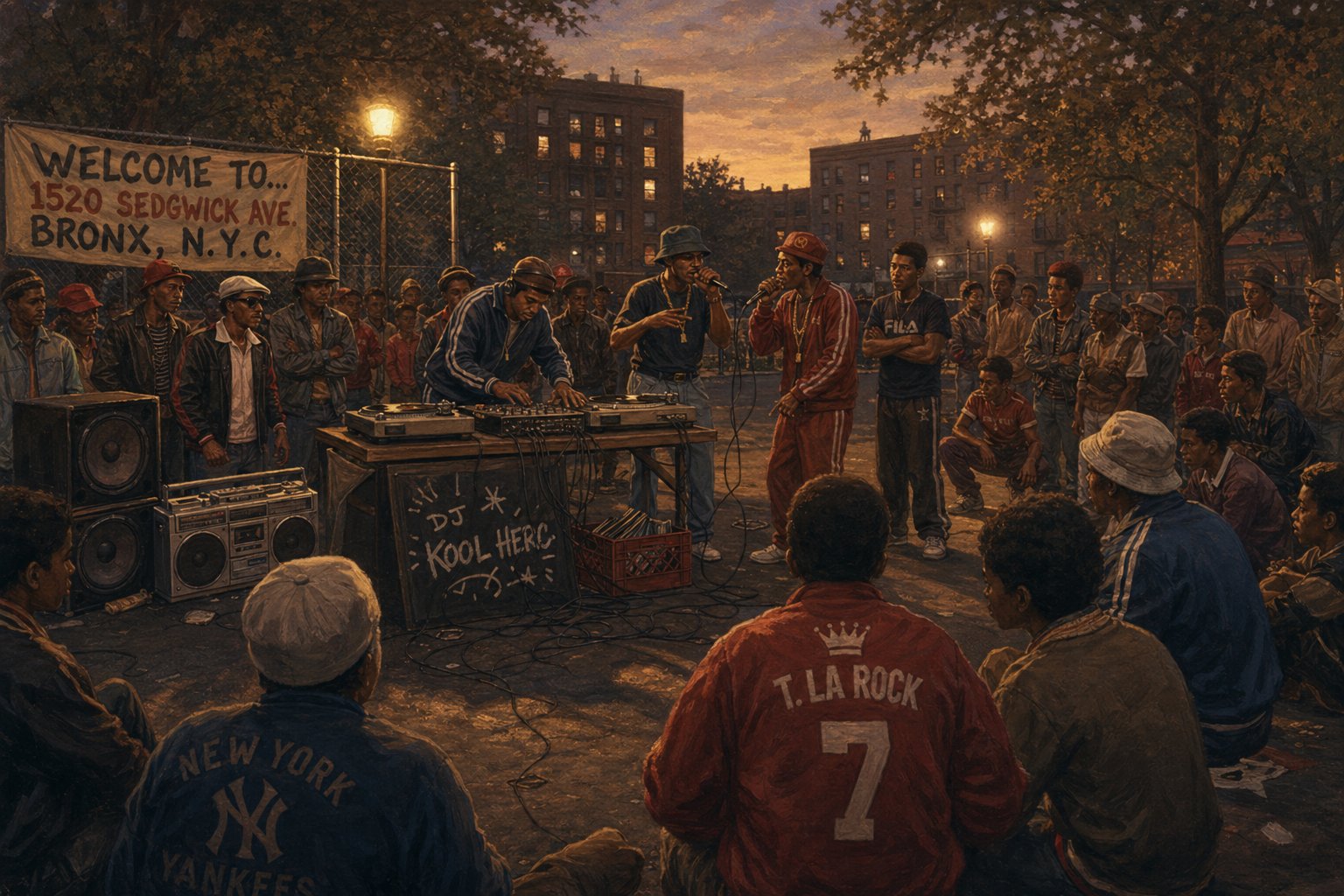
Hip-hop was never a solo act at the start. Before record deals, before music videos, before anyone even used the word "rapper" as a job title, the culture ran on crews. DJs, MCs, breakers, and graffiti writers moved as units through the parks and community centers of the Bronx. The origins of group rap in the 1970s trace directly back to this communal DNA. If you wanted to rock a block party, you showed up with your people. The idea of one MC carrying an entire show alone would have seemed strange, maybe even a little lonely.
The Birth of Collective MCing
So how did rap groups begin as a recorded format? It started when that block-party energy hit wax. In 1979, The Sugarhill Gang, a trio assembled by Sugar Hill Records founder Sylvia Robinson, released "Rapper's Delight", the genre's first commercially successful single. Three MCs trading verses over a borrowed groove from Chic's "Good Times" introduced the world to what hip-hop sounded like, and that sound was inherently collective. The record climbed to No. 36 on the Billboard Hot 100, becoming the first hip-hop single to crack the Top 40.
Around the same time, crews like the Cold Crush Brothers were developing elaborate vocal routines in live settings, building a reputation for choreographed call-and-response patterns that turned performances into events. The Funky 4 + 1, one of the first rap groups in hip-hop history to include a female MC in Sha-Rock, made their own landmark in 1981 by becoming the first hip-hop group to appear on national television with a performance on Saturday Night Live. Meanwhile, the Treacherous Three were pioneering fast-rap cadences that would ripple through the genre for decades.
Each of these acts reinforced the same principle: hip-hop was a team sport. Members had distinct roles. One MC might hype the crowd while another delivered the punchlines. The DJ held the foundation. That division of labor wasn't a limitation. It was the architecture.
How 80s Rap Groups Built the Blueprint
The 80s rap groups that started it all didn't just perform together. They built templates that every generation since has borrowed from. Grandmaster Flash and the Furious Five, formed in the Bronx in 1976, were among the earliest multimember rapping crews to translate live energy into studio recordings. Their 1982 single "The Message" did something radical: it proved that rap could carry social weight, depicting the harsh realities of ghetto life with an urgency that party records never attempted. They became the first rap group inducted into the Rock and Roll Hall of Fame in 2007.
Run-D.M.C. pushed the format further by stripping away disco-era production and replacing it with hard beats and aggressive delivery, bridging rap and rock in ways that expanded the audience dramatically. Whodini brought a smoother, more melodic sensibility that proved groups could occupy different sonic lanes within the same genre. And the Beastie Boys, originally a hardcore punk band, released License to Ill in 1986, rap's first No. 1 album, demonstrating that the group format could cross racial and genre boundaries entirely.
By the late 1980s, the transition from party-oriented raps to socially conscious content was fully underway. Public Enemy, formed on Long Island, became the most powerful example. Chuck D's commanding voice delivered politically charged lyrics while Flavor Flav's eccentric energy provided a dynamic counterbalance, and The Bomb Squad's layered production created dense sonic collages that matched the urgency of the message. Chuck D famously called rap "the Black CNN," and Public Enemy's multi-role structure, where each member served a distinct function, became a model for how groups could be greater than the sum of their parts.
Here's a chronological look at the key milestones that shaped early group rap:
- 1976 - Mercedes Ladies form in the Bronx as the first all-female rap group
- 1978 - Cold Crush Brothers emerge with pioneering vocal routines and choreographed performances
- 1979 - The Sugarhill Gang releases "Rapper's Delight," hip-hop's first mainstream hit
- 1981 - Funky 4 + 1 perform on Saturday Night Live, the first hip-hop group on national TV
- 1982 - Grandmaster Flash and the Furious Five release "The Message," pioneering socially conscious rap
- 1984 - Run-D.M.C. drops their self-titled debut, fusing rap with rock energy
- 1986 - Beastie Boys' License to Ill becomes rap's first No. 1 album
- 1987 - Public Enemy debuts with Yo! Bum Rush the Show, launching politically driven group rap
- 1988 - Boogie Down Productions releases By All Means Necessary, helping kickstart hip-hop's Stop The Violence Movement
Every one of these milestones came from a group, not a solo artist. That's the part of the story that often gets lost. The solo rapper didn't create hip-hop and then step aside for groups to form. It happened the other way around. Collective MCing was the default, and solo careers were the departure. By the time the 1980s ended, these pioneering crews had built a foundation sturdy enough to support what came next: a full decade where the group format would reach heights that neither the artists nor the industry could have predicted.
The Golden Era When Rap Groups Ruled Hip-Hop
The foundation those 80s pioneers laid didn't just hold. It exploded. The 1990s became the undisputed peak of group rap, a decade when the format reached commercial heights and artistic depths that haven't been matched since. If you're looking for the best rap groups of the 90s, you're really looking at the most creatively fertile period in hip-hop history, a stretch where it felt like a new crew was rewriting the rules every few months.
Why the 90s Were the Peak of Group Rap
Why were 90s rap groups so popular? Several forces converged at once. Label economics played a huge role. Major labels were pouring money into hip-hop for the first time, and they had the budgets to sign and develop acts with four, five, even nine members. A group like Wu-Tang Clan, with its sprawling roster and complex business structure, would be nearly impossible to greenlight under today's leaner deal structures. But in the mid-90s, labels saw the upside: more members meant more personalities, more potential solo spinoffs, and more ways to keep a brand alive across multiple release cycles.
The culture itself rewarded lyrical variety. Audiences weren't just listening for one flow or one perspective. They wanted the contrast, the interplay, the surprise of hearing a different voice pick up where the last one left off. A Tribe Called Quest gave you Q-Tip's abstract cool alongside Phife Dawg's streetwise wit. Wu-Tang Clan offered nine distinct personas, each capable of carrying a solo album but collectively producing something no individual member could replicate. That kind of depth kept listeners coming back, dissecting verses, picking favorites, debating who had the best bars.
The media landscape amplified everything. MTV and BET were at the height of their cultural influence, and music videos gave groups a visual identity that solo artists had to manufacture alone. Imagine the Wu-Tang Clan's "Triumph" video or The Fugees performing "Killing Me Softly" without that visual platform. Research on hip-hop's crystallization in mainstream America between 1995 and 1998 points to this exact window as the moment the genre locked into the cultural mainstream, and groups were at the center of that shift. The East Coast-West Coast rivalry, for all its tragedy, also created a narrative tension that crews thrived within. Mobb Deep's gritty Queensbridge anthems and Tha Dogg Pound's G-funk swagger weren't just music. They were flags planted in a larger story that fans followed like a serialized drama.
Iconic 90s Rap Groups and Their Legacy
The sheer volume of talent is staggering when you lay it out. Wu-Tang Clan redefined what a hip-hop ensemble could be. A Tribe Called Quest fused jazz and rap into something timeless. De La Soul proved that playfulness and depth could coexist. Bone Thugs-N-Harmony introduced rapid-fire melodic flows that nobody had heard before. Mobb Deep painted Queensbridge street life with cinematic precision. The Roots built a live-instrument foundation that turned every performance into an event. Goodie Mob gave the Dirty South a philosophical voice. Three 6 Mafia pioneered a dark, Memphis-born sound that would quietly influence mainstream rap for decades. The Fugees blended Caribbean rhythms with hip-hop storytelling and produced one of the most treasured albums of the decade. And that's before you even get to Gang Starr, Black Star, Souls of Mischief, Boot Camp Clik, or UGK.
What made this golden era hip-hop groups list so remarkable wasn't just the names. It was the range. These acts didn't sound alike. They didn't share a single aesthetic. They represented different cities, different philosophies, different sonic palettes, all operating under the same collective format and proving how flexible it could be.
The iconic 90s rap group albums that defined the era tell that story better than any summary can:
- Wu-Tang Clan, Enter the Wu-Tang (36 Chambers) (1993) - the gritty, martial-arts-infused debut that became the measuring stick for all rap ensembles
- A Tribe Called Quest, Midnight Marauders (1993) - the culmination of jazz-rap perfection, with unforgettable bars and production still sampled today
- De La Soul, De La Soul Is Dead (1991) - a sharp, edgier evolution that proved the trio was far more than hip-hop hippies
- Mobb Deep, The Infamous (1995) - one of the most defining boom-bap albums ever, swinging the pendulum back toward the East Coast
- The Fugees, The Score (1996) - a cinematic, genre-blending triumph featuring some of the most recognizable singles in hip-hop history
- OutKast, Aquemini (1998) - a Southern masterpiece that married hip-hop with 60s soul and cemented the duo as legends
- Bone Thugs-N-Harmony, E. 1999 Eternal (1995) - rapid-fire flows woven with harmonies that no one has successfully replicated
- Goodie Mob, Soul Food (1995) - a deeply grounded portrait of Southern life, both its beauty and its thorns
- Gang Starr, Moment of Truth (1998) - jazzy production and Guru's conversational flow at their absolute peak
- Black Star, Mos Def & Talib Kweli Are Black Star (1998) - conscious rhymes over jazz-inflected beats, like A Tribe Called Quest for a new generation
Every one of these records pushed the genre forward, and every one was the product of collective chemistry rather than individual genius alone. The 90s didn't just produce great groups. The decade proved that the ensemble format could carry hip-hop's most ambitious artistic statements while simultaneously dominating the charts.
That dominance, though, didn't look the same everywhere. The crews coming out of New York sounded nothing like the ones rising in Atlanta or Houston or Los Angeles, and those regional differences shaped the format in ways that deserve their own map.
Regional Styles That Shaped Group Rap's Sound
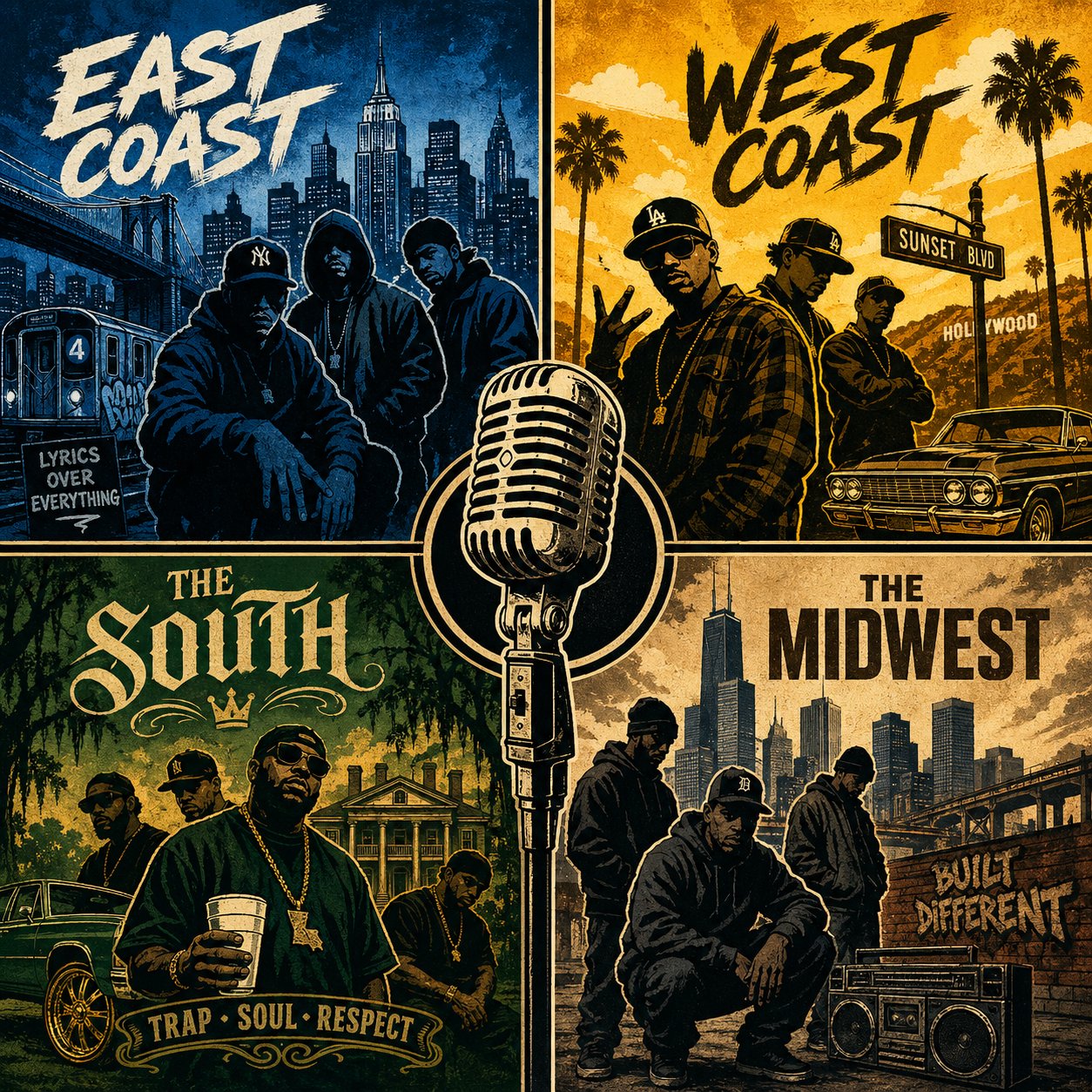
Name a city, and odds are local rappers took the elements of hip-hop and made them their own. That principle applies doubly to the ensemble format. The same creative structure, multiple voices sharing a single identity, produced wildly different results depending on where those voices grew up. Understanding east coast vs west coast rap groups, or how a Memphis crew differed from a Cleveland one, isn't just trivia. It's the key to understanding why the format stayed vital for so long. Geography gave each group a distinct sonic fingerprint, and those fingerprints collectively mapped the full range of what hip-hop could sound like.
East Coast and West Coast Group Traditions
East Coast crews built their reputation on lyrical density and raw, sample-heavy production. Wu-Tang Clan layered grimy kung-fu aesthetics over boom-bap beats, turning Staten Island slang into its own mythology. De La Soul brought playful wordplay and jazz-inflected grooves from Long Island. The Lox delivered street narratives with a Yonkers edge that cut through every verse. What connected these acts wasn't a single sound but a shared obsession with bars, the belief that what you said and how cleverly you said it mattered above everything else. This era of East Coast hip-hop was marked by an elevation in the art of lyricism that produced classic after classic.
West Coast groups operated on a different frequency entirely. N.W.A channeled the realities of Compton street life into confrontational records that essentially invented gangsta rap as a commercial force. Their storytelling was blunt, cinematic, and unapologetic. After the group dissolved, the sonic template evolved: Dr. Dre's G-funk production, all smooth synths and deep bass, became the backbone for acts like Tha Dogg Pound on Death Row Records. Meanwhile, Cypress Hill carved out their own lane with a Latin-influenced, hazy style that proved West Coast crews weren't monolithic. Further north, the Bay Area's Souls of Mischief and The Pharcyde brought jazzy, left-field energy that had more in common with East Coast bohemians than with their Southern California neighbors.
Southern, Midwest, and International Group Rap
The southern rap groups that changed hip-hop did so by refusing to play by anyone else's rules. OutKast fused funk, soul, psychedelia, and rap into something that defied easy categorization. Goodie Mob grounded Atlanta's sound in spiritual and political consciousness. UGK, the Port Arthur, Texas, duo of Pimp C and Bun B, delivered classics like Ridin' Dirty that gave the Gulf Coast its own voice. And Three 6 Mafia built a dark, lo-fi Memphis aesthetic that quietly became one of the most influential sonic blueprints in modern rap. Andre 3000's famous declaration at the 1995 Source Awards, "The South got something to say," was a rallying cry, and the groups that followed proved it wasn't an exaggeration.
Midwest rap groups and their style tend to get overlooked, but the region produced some of the format's most distinctive sounds. Bone Thugs-N-Harmony out of Cleveland pioneered a rapid-fire, melodic flow that blended singing and rapping in ways nobody had attempted before. Chicago's Do or Die shared that fast-paced delivery and player-culture sensibility. Nappy Roots, from Kentucky, brought a country-fried, introspective approach that expanded what Southern-adjacent hip-hop could feel like. As AURN's regional breakdown notes, Midwest artists often found individual success without building a unified regional identity, which made the groups that did break through all the more distinctive.
The conversation doesn't stop at U.S. borders, either. International hip-hop groups outside the US have built thriving scenes shaped by local culture and language. In the UK, grime collectives like Boy Better Know and Roll Deep turned London's council estates into creative incubators, with MCs trading rapid-fire bars over electronic beats that owed as much to garage and jungle as to American rap. French rap has become the dominant genre in France, with duo PNL's rallying cry "Le monde ou rien" spilling from speakers into the streets of Paris during protests, and their album Deux freres outselling every artist in Atlanta combined. France's radio quota laws, which mandate that 40% of songs played must be in French, have unintentionally boosted local rap by forcing stations to diversify playlists toward the genre most popular with younger listeners. French-language hip-hop also connects with audiences across nearly 30 African nations where French is the dominant language, giving these artists a global reach that English-speaking scenes sometimes underestimate.
Here's how these regional traditions break down at a glance:
| Region | Signature Groups | Sonic Characteristics | Thematic Focus |
|---|---|---|---|
| East Coast | Wu-Tang Clan, De La Soul, The Lox, Mobb Deep | Sample-heavy boom-bap, jazz loops, dense layering | Lyricism, street narratives, abstract wordplay |
| West Coast | N.W.A, Cypress Hill, Tha Dogg Pound, Souls of Mischief | G-funk synths, deep bass, laid-back grooves | Gangsta storytelling, street life, Latin and countercultural influences |
| South | OutKast, Three 6 Mafia, Goodie Mob, UGK | Funk, soul, lo-fi darkness, genre-bending experimentation | Regional pride, spirituality, hustler narratives, sonic innovation |
| Midwest | Bone Thugs-N-Harmony, Do or Die, Nappy Roots | Rapid-fire melodic flows, harmonic layering, soulful beats | Struggle, everyday life, player culture, introspection |
| UK | Boy Better Know, Roll Deep | Grime electronics, garage-influenced tempos, aggressive energy | Urban life, class tension, local identity |
| France | PNL, Suprême NTM, IAM | Trap-influenced, cinematic, melodic | Social inequality, immigration, racial identity, protest |
What this map reveals is that the collective format wasn't just flexible enough to survive in different environments. It actively thrived because of those differences. Each region's culture, slang, musical traditions, and social pressures gave local crews raw material that solo artists could access too, but that groups could refract through multiple perspectives at once. A single MC can tell you what a city sounds like. A group can show you how it argues with itself, celebrates itself, and contradicts itself, all on the same track.
That internal tension, the creative friction between members with different voices and viewpoints, is exactly what makes the format so artistically rich. And the mechanics of how groups actually harness that friction, from dividing verses to building contrasting personas, reveal a craft that's far more deliberate than most listeners realize.
Inside the Creative Dynamics of a Rap Group
Listeners hear the finished product: voices weaving in and out, energy shifting mid-track, a verse that hits harder because of the one that came before it. What they don't hear is the architecture behind it. The creative dynamics inside a rap group involve a set of deliberate techniques that turn multiple voices into a single cohesive experience, and understanding those mechanics reveals why the format produces music that solo artists simply can't replicate on their own.
Verse Division and Vocal Interplay
So how do rap groups split verses? There's no single formula, but a few approaches have become standard. Some groups assign a fixed verse order, where each member takes a full 16 bars in rotation. Others trade couplets, passing the mic every two or four lines to keep the energy unpredictable. Wu-Tang Clan tracks like "Protect Ya Neck" famously let members fire off short bursts in rapid succession, creating a relay-race intensity that no single rapper could sustain alone. A Tribe Called Quest often alternated between Q-Tip handling the melodic hooks and Phife Dawg punching in with punchline-heavy verses, giving each song a built-in dynamic shift.
Beyond verse structure, the texture between the lines matters just as much. Ad-libs, those background shouts, echoes, and reactions layered underneath a lead verse, act as a kind of sonic glue. Think of how Flavor Flav's interjections gave Public Enemy tracks a chaotic, live-wire feel, or how the overlapping "Wu!" shouts on 36 Chambers made every track feel like a cypher in progress. Call-and-response, borrowed directly from African American oral traditions, turns a verse into a conversation rather than a monologue.
Here are the most common rap group verse trading techniques and collaborative tools that define the format:
- Rotating verses - each member takes a full verse in sequence, building momentum across the track
- Trading couplets or bars - members swap lines rapidly, creating a back-and-forth energy
- Ad-lib layering - background vocals, shouts, and reactions that add depth and personality beneath the lead voice
- Call-and-response - one MC sets up a phrase, another answers it, pulling the listener into the exchange
- Relay storytelling - members narrate different chapters or perspectives of the same story across their verses
- Point-counterpoint - MCs deliberately take opposing viewpoints on the same topic within a single track
Persona Contrast and Creative Tension
Technique alone doesn't explain why certain groups sound electric together. The real magic comes from persona contrast, the friction between members who bring fundamentally different energies to the same record. Imagine A Tribe Called Quest without the tension between Q-Tip's abstract, jazz-inflected cool and Phife Dawg's blunt, everyman delivery. Or Wu-Tang Clan without the gap between Method Man's magnetic charisma and Inspectah Deck's surgical precision. Those contrasts aren't accidents. They're the reason you can listen to the same album dozens of times and notice something new depending on which voice you follow.
This dynamic extends to storytelling in ways solo records rarely achieve. On a track like The Fugees' "Ready or Not," three distinct perspectives circle the same theme, each member refracting it through their own lens. Relay-style narratives, where one MC picks up the story exactly where the last one left off, create a cinematic quality that a single narrator would struggle to match. The listener isn't just hearing a song. They're hearing a conversation, an argument, a collaboration unfolding in real time.
Of course, the same friction that makes the music compelling can tear a group apart offstage. The business side of collective creation is where things get complicated. Revenue splits, songwriting credits, and creative control have to be negotiated among multiple people with different contributions and different ideas about what's fair. Industry data shows a 30% increase in music collaborations since the 90s, yet the infrastructure for managing those splits remains a persistent pain point. Common arrangements range from equal shares, like a four-member band each taking 25%, to percentage-based splits reflecting individual contributions. Without clear agreements, misunderstandings over royalties and credit become almost inevitable.
That's a big part of why rap groups break up. The Fugees dissolved amid disputes over creative direction and individual ambitions. A Tribe Called Quest's original run ended with tensions between members who wanted different things from the music. Even Wu-Tang Clan, whose innovative business model allowed solo careers alongside group work, navigated constant internal friction over money and priorities. The pattern repeats across decades: the same creative tension that produces great records eventually becomes personal tension that pulls members apart. Splitting revenue fairly is hard enough in a duo. Scale it to five or nine members, add ego and fame, and the math gets brutal.
These internal pressures didn't just affect individual groups. They helped reshape the entire industry's relationship with the collective format, contributing to a broader shift that would push ensemble acts from the mainstream spotlight toward the margins.

Why Did Rap Groups Decline in the 2000s and What Brought Them Back
Internal friction was only part of the story. By the early 2000s, the entire music industry was reorganizing itself around forces that made the collective format harder to sustain, and easier to ignore. The decline wasn't sudden. It was a slow squeeze from multiple directions at once, each one favoring the solo artist over the ensemble.
Why Group Rap Faded From the Mainstream
Picture the mid-2000s. Cellphones were everywhere, and ringtones were selling in the billions. A 30-second clip of a catchy hook could launch a career overnight, and that economy rewarded simplicity: one voice, one hook, one brand. Rap completely dominated the ringtone charts, with acts like Soulja Boy, T-Pain, and Hurricane Chris thriving on songs built for pocket-sized speakers. The format didn't leave much room for the layered interplay that made groups compelling. Labels noticed. Why sign nine people when one artist with a viral single could generate the same revenue at a fraction of the overhead?
The blog era that followed doubled down on individual discovery. Sites like 2DopeBoyz and Nah Right became tastemakers, and their format, a single track embedded with a single artist's name in the headline, trained a generation of listeners to follow solo acts. Social media accelerated the shift even further. Instagram, Twitter, and eventually TikTok rewarded personal brands, curated personas, and direct fan relationships. A group's shared identity became a liability when every platform was optimized for individual engagement. Streaming algorithms compounded the problem by surfacing music based on single-artist profiles, making it structurally harder for multi-member acts to build and maintain visibility.
Label economics sealed the deal. Signing a group meant splitting advances, negotiating multiple egos, and managing the ever-present risk of a breakup derailing the investment. A solo deal was cleaner, cheaper, and easier to control. By the 2010s, the major-label pipeline had largely stopped developing new rap ensembles altogether.
The Modern Collective Revival
The format didn't die, though. It adapted. And the blueprint for that adaptation was drawn decades earlier on Staten Island.
Wu-Tang Clan's "Freedom of Movement" contract, which allowed each member to sign solo deals with competing labels while the group remained signed to Loud Records, became the most influential business model in hip-hop history. RZA traded a low group advance for long-term individual leverage, effectively turning rival labels into partners in the Wu-Tang brand.
That Wu-Tang business model for rap groups, what RZA called "controlled decentralization," proved prophetic. By strategically placing Method Man at Def Jam, GZA at Geffen, and ODB at Elektra, the Clan flooded the market without cannibalizing their own sales. The solo careers fed the collective brand, and the collective brand elevated every solo release. It was a federation, not a traditional group, and that distinction matters because it's exactly the structure modern rap collectives and groups today have adopted.
Look at Griselda. Westside Gunn, Conway the Machine, and Benny the Butcher each maintain thriving solo careers while the Griselda brand functions as a shared launchpad, complete with its own label roster that has expanded to include Boldy James, Armani Caesar, and Rome Streetz. Dreamville, founded by J. Cole, operates on a similar principle: artists like JID, Ari Lennox, and EarthGang release individual projects while collaborative albums like Revenge of the Dreamers III debut at No. 1. TDE's Black Hippy, the quartet of Kendrick Lamar, ScHoolboy Q, Ab-Soul, and Jay Rock, followed the same playbook, with each member building a distinct solo identity that made the collective stronger by association.
The rap group resurgence in the streaming era is also driven by economics working in the opposite direction from the 2000s squeeze. Recording costs have plummeted. Distribution is essentially free. A crew in Buffalo or Atlanta can release a collaborative project without waiting for a label to greenlight a group deal. Nostalgia cycles have helped too, with reunion tours and anniversary reissues from classic acts reminding younger listeners what the ensemble format sounds like at its best. Wu-Tang Clan's own farewell tour underscores the point: the appetite for collective hip-hop never disappeared. It just went underground for a while.
The key difference between the modern collective model and the traditional group format is flexibility. Classic groups lived or died as a unit. If one member left, the identity fractured. Today's collectives are built to absorb departures and additions without collapsing. Members come and go. Solo projects coexist with group releases. The brand outlasts any single roster. It's a more resilient structure, one that sidesteps many of the creative and financial tensions that broke apart earlier generations.
That resilience has opened doors for voices that the traditional model often shut out. Some of the most important stories in the collective format's history belong to women and mixed-gender acts who had to fight harder for visibility, and whose contributions reshaped what the ensemble could be.
Women and Mixed-Gender Acts in Group Rap
The barriers were double-layered. Women who pioneered group rap didn't just navigate the usual tensions of splitting verses and revenue. They did it inside an industry that routinely questioned whether female MCs belonged on the mic at all. Their success didn't just add names to the roster. It fundamentally expanded what the ensemble format could represent and who it could reach.
Pioneering Women in Group Rap
Any conversation about female rap groups in hip-hop history starts with Salt-N-Pepa. Formed in 1985 at Queensborough Community College in New York, the trio of Cheryl "Salt" James, Sandra "Pepa" Denton, and DJ Spinderella became the first all-female rap act to achieve gold and platinum status and the first women to win a Grammy for Best Rap Performance by a Duo or Group, for "None of Your Business" in 1995. Their hit "Push It" sold over a million copies and cracked the Billboard Pop Top 20, proving that an all-female crew could compete commercially at the highest level. What made them matter beyond the sales figures was their willingness to own topics like sexuality and independence at a time when the genre's gatekeepers expected women to stay in a narrow lane. Their influence rippled outward to TLC, Lil' Kim, Nicki Minaj, Cardi B, and City Girls, among many others.
They weren't alone in those early years. J.J. Fad, the Los Angeles trio behind the 1988 hit "Supersonic," earned a Grammy nomination and showed that female crews could thrive on the West Coast too. BWP (Bytches With Problems) took a more confrontational approach, flipping the explicit content that male groups traded in and daring the industry to apply the same standards equally. And when you look at the best all-female rap groups of all time, the through line is consistent: each act had to be undeniably good just to get a fraction of the opportunity their male counterparts received.
Mixed-Gender Groups and Expanding the Audience
Mixed-gender formations created a different kind of creative tension, one that broadened hip-hop's emotional and sonic range. Digable Planets, the trio of Butterfly, Doodlebug, and Ladybug Mecca, won the 1994 Grammy for Best Rap Performance by a Duo or Group with "Rebirth of Slick (Cool Like Dat)," beating Dr. Dre and Snoop Dogg, Naughty By Nature, and Cypress Hill. As the group reflected in interviews, Ladybug Mecca's presence wasn't a calculated move. It was organic. "It was just about the music," she said, though the industry constantly tried to force a gender-based lens onto her role. Digable Planets effectively set the template for mixed-gender rap groups and duos, laying groundwork that The Fugees would build on with even greater commercial impact.
TLC, led in part by Lisa "Left Eye" Lopes's sharp rap verses alongside T-Boz and Chilli's vocals, blurred the line between hip-hop and R&B in ways that pulled millions of new listeners into the culture. Gangsta Boo made history as the first female member of Three 6 Mafia, holding her own inside one of the most aggressive crews in Memphis with penetrative lyrics and unapologetic energy. These women didn't soften the groups they joined. They sharpened them, adding perspectives and vocal textures that made the collective sound richer and harder to ignore.
Here's a look at key female and mixed-gender acts that shaped the format across different eras:
- Salt-N-Pepa (1985-2002) - first platinum all-female rap act, Grammy winners, commercial trailblazers
- J.J. Fad (1987-1992) - Grammy-nominated West Coast trio behind "Supersonic"
- BWP / Bytches With Problems (1990-1993) - confrontational duo who challenged double standards in explicit rap
- Digable Planets (1992-1995) - Grammy-winning mixed-gender trio who fused jazz, Afrofuturism, and hip-hop
- TLC (1991-present) - Left Eye's rap verses anchored one of the best-selling girl groups in music history
- The Fugees (1994-1997) - Lauryn Hill's lyricism and vocals helped produce one of the decade's defining albums
- Three 6 Mafia with Gangsta Boo (1991-2001) - first female voice in Memphis's most influential crew
- Arrested Development (1988-1996) - mixed-gender collective blending Southern roots, spirituality, and conscious rap
The pattern these acts reveal is telling. Female and mixed-gender ensembles consistently expanded hip-hop's audience by reaching listeners who didn't see themselves reflected in all-male crews, yet the industry rarely rewarded that expansion with proportional support or investment. Collaboration among women in rap continues to evolve through features, joint projects, and informal creative partnerships, but a dedicated all-female crew with the cultural footprint of a Salt-N-Pepa or TLC remains rare. The infrastructure has changed. The opportunity gap hasn't fully closed.
Still, the creative principles these artists championed, contrasting voices, shared identity, collective storytelling, are more accessible now than at any point in hip-hop's history. The tools for building on that tradition look radically different than they did in 1985, and the barriers to entry have never been lower.
Creating Group Rap Tracks in the Modern Era
Verse interplay, persona contrast, relay storytelling, the creative architecture that Salt-N-Pepa, Wu-Tang Clan, and A Tribe Called Quest built over decades hasn't disappeared. It's just waiting for new voices to pick it up. And for the first time in the format's history, you don't need a full crew in the same room, or even the same city, to start experimenting with those dynamics.
Keeping the Group Rap Tradition Alive
The collective principles that defined every era of this format are fundamentally about contrast and conversation. Two voices hitting the same beat from different angles. A verse that lands harder because the one before it set up the tension. Those ideas aren't locked behind studio budgets or label deals anymore. AI-powered music tools have lowered the barrier to the point where a single creator can sketch out a multi-voice arrangement, test different flows against each other, and hear how contrasting rap personas interact on a track, all before involving another human collaborator. Think of it as a creative sandbox for the techniques this article has been breaking down.
Tools for Creating Collaborative Rap Tracks
If you're looking for a practical way to create rap music with multiple voices, MakeBestMusic's AI Rap Generator is built for exactly that kind of exploration. It generates complete rap tracks, lyrics, beats, vocals, and customizable rap styles included, which means you can prototype the kind of verse-trading and tonal contrast that define the ensemble format without needing a full roster on day one. Want to hear how an aggressive delivery sounds against a laid-back flow on the same beat? You can test that in minutes.
Here's how to make a group rap track using modern tools for making group rap songs:
- Start with a concept that benefits from multiple perspectives, a story with two sides, a theme that invites contrast
- Write or generate verses with distinct personas in mind, varying tone, vocabulary, and delivery style for each voice
- Use an ai rap generator for collaborative tracks to produce vocal performances in different styles, experimenting with how they interact over the same beat
- Layer the voices deliberately, applying the techniques covered earlier: verse rotation, ad-lib textures, call-and-response patterns
- Refine the arrangement until the contrast between voices feels intentional, not random
The format that built hip-hop from the ground up was never really about headcount. It was about the creative friction between different voices committed to a shared vision. The crews that pioneered it didn't have AI tools or home studios. They had park jams and four-track recorders. What they understood, and what still holds true, is that multiple perspectives on the same beat produce something a single voice can't touch. The technology has changed. That principle hasn't.
