

Public Opinion on AI Music Is More Divided Than You Think
Here's a paradox worth sitting with: AI-generated tracks now make up roughly 44% of daily uploads on at least one major streaming platform, yet those songs account for less than 3% of actual listening. Supply is exploding. Demand is not following. So how do people feel about AI music, really?
The answer resists a clean headline. Public opinion on AI generated music is not a simple split between enthusiasts and skeptics. It is a tangle of context, generation, disclosure, and use case that shifts depending on which question you ask and who you ask it to.
A nationally representative survey of 2,244 U.S. adults found that just over half of Americans are not interested in listening to AI music, even if their favorite artist made it. Yet 32% are perfectly fine getting their tunes from AI-generated sources.
Why AI Music Sparks Such Strong Reactions
The tension is real. Adoption keeps climbing among creators — roughly 1 in 4 producers now use AI tools in their workflow — while listener sentiment research shows comfort levels actively declining. Luminate's consumer survey tracked overall interest dropping from -13% to -20% net negative in just six months. People are not simply for or against AI music. They are reacting to something deeper: questions of authenticity, fairness, and what music is even supposed to mean when a machine can produce it on demand.
What This Analysis Covers
This article synthesizes academic research, nationally representative polls, streaming platform data, and unfiltered community voices into one place. Rather than flattening this conversation into a binary, you will find the full spectrum of AI music listener sentiment — broken down by who is listening, what they know about the music's origin, and why one single detail can flip someone's opinion entirely.
The Disclosure Effect Changes Everything
Imagine you hear a sweeping orchestral piece — layered, emotionally intense, building to a climax. You enjoy it. Then someone tells you it was composed by an algorithm. Does knowing music is AI change how you feel about it? Research says yes, and the shift is measurable in ways that go beyond mere preference.
The Blind Test Phenomenon
Multiple consumer studies have explored what happens when listeners evaluate AI-generated tracks without knowing their origin. The pattern is consistent: in blind listening tests across pop and electronic genres, AI-generated songs perform similarly to human-created tracks — and sometimes score even higher based purely on sound. Listeners rate replay interest, emotional engagement, and overall quality at levels that match or exceed human-made compositions.
The shift comes the moment disclosure enters the equation. Once participants learn a song was generated by AI, replay interest drops and willingness to pay decreases. A lab-in-field experiment at Amsterdam's NEMO Science Museum demonstrated this clearly: 372 participants listened to an identical orchestral piece, but half were told it was AI-composed while the other half believed it was performed by a human orchestra. Same music. Completely different reactions.
| Measure | Told "Human-Made" | Told "AI-Generated" | Difference |
|---|---|---|---|
| Music Appreciation (1-7 scale) | 5.33 | 4.57 | -0.76 |
| Emotional Response (1-7 scale) | 4.62 | 3.96 | -0.66 |
| Physiological Stress (RSA decline) | No significant change | Progressive vagal withdrawal | Measurable stress response |
That last row is particularly striking. Participants told the music was AI-generated did not just report feeling less moved — their bodies showed signs of cardiovascular stress. The effect was involuntary, operating below conscious awareness.
How Labels Shape Listener Experience
The AI music disclosure effect on listeners is not universal, though. A study conducted in Singapore found something unexpected: university students rated pop songs labeled as AI-generated higher in positive emotions — happiness, interest, awe, and energy — compared to identical tracks labeled as human-composed. Genre and cultural context appear to matter. Orchestral and classical music, where human craftsmanship carries deep cultural weight, triggers stronger negative reactions to AI disclosure. Pop and electronic music, already associated with digital production, may face a lower authenticity threshold.
This creates a strange landscape for listeners. Can people tell the difference between AI and human music on sound alone? The research suggests most cannot — at least not reliably. The distinction lives almost entirely in the label, the context, the story attached to the song. When artists remain ambiguous about their creative process, or when tracks surface on playlists without attribution, listeners engage freely. The moment that context arrives, it rewrites the experience retroactively.
Authenticity Bias in Music Consumption
Why does a simple label carry so much weight? Researchers describe two competing explanations. The first is motivated reasoning — listeners consciously downgrade AI music to protect their belief that true creativity requires a human mind. The second goes deeper: an embodied threat response where AI authorship triggers genuine physiological anxiety, particularly among people who hold strong beliefs that creativity is uniquely human. The Amsterdam study found evidence for both, but the physiological data suggests something more than rational skepticism is at play. People are not just deciding to dislike AI music. Their nervous systems are reacting to it as a kind of existential challenge.
This distinction between what listeners hear and what they know points to a broader question: just how widespread are these reactions, and do they hold across different populations? The answer depends heavily on which survey you read and who was asked.
What Research and Surveys Actually Reveal
Individual studies tell compelling stories, but they also tell incomplete ones. A single poll or experiment captures one population at one moment. To understand the full picture of AI music survey results and statistics, you need to see these data points side by side — where they agree, where they contradict, and what the gaps between them reveal.
What Academic Research Shows
Academic research on AI music perception has produced a fascinating split. A mixed-methods study from MIT Media Lab exposed participants to both AI-generated and human-composed music under various labeling conditions and emotional contexts. The results surprised even the researchers: participants were significantly more likely to prefer AI-generated music in direct comparisons, yet simultaneously rated human-composed music as more effective at eliciting target emotional states like calm or uplift. In other words, people chose the AI track — but felt the human track worked better on them emotionally.
Qualitative feedback from the same study underscored this tension. Participants associated human-made music with qualities like imperfection, natural flow, and "soul" — attributes they valued even when their listening choices pointed elsewhere. Preference and perceived emotional authenticity, it turns out, are not the same thing.
Industry Surveys and Musician Adoption Data
Musician attitudes toward AI music tools paint a different angle. A survey by music distribution company Ditto, cited by Berklee, found that nearly 60% of surveyed artists use AI in their music projects, while 28% say they would not use AI for music purposes at all. That leaves a small middle group still undecided — experimenting cautiously or watching from the sidelines. AI music adoption statistics suggest creators are more open than their audiences, though a meaningful minority draws a hard line.
On the listener side, Luminate's consumer tracking found net sentiment dropping from -13% to -20% in just six months, signaling that as awareness grows, so does discomfort. The more people know about AI music, the less comfortable they become with it.
Community Polls and Informal Sentiment
Reddit threads and online polls tend to skew younger and more tech-literate than nationally representative samples, which is precisely why they matter. These communities represent early adopters and vocal critics alike. Recurring informal polls in music production subreddits consistently show a three-way split: roughly a third enthusiastic about AI tools, a third opposed on ethical or quality grounds, and a third whose opinion depends entirely on context — what the music is for, whether artists were credited, and whether a human guided the creative process.
Stacking these sources together reveals a pattern no single study captures alone:
| Source | Population | Key Finding |
|---|---|---|
| MIT Media Lab Study | General listeners (mixed-methods) | Listeners preferred AI music but rated human music as more emotionally effective |
| Ditto/Berklee Survey | Musicians and artists | 60% use AI in projects; 28% refuse entirely |
| Deezer-Ipsos Survey | General consumers | 97% cannot distinguish AI from human music by sound alone |
| Luminate Consumer Tracker | U.S. adults (representative) | Net comfort with AI music dropped to -20% |
| Reddit/Community Polls | Tech-literate music fans and producers | Three-way split: enthusiastic, opposed, or context-dependent |
What percentage of people like AI music? The honest answer is that it depends on whether you are measuring sonic preference, ethical comfort, or willingness to support AI-generated artists financially. These are three different questions, and the data shows they produce three different answers. Someone can enjoy an AI track, feel uneasy about its existence, and still refuse to stream it — all at the same time.
These averages, though, flatten an important variable. Not everyone reacts the same way, and the differences between groups — age, musical training, listening habits — turn out to be just as revealing as the overall numbers.
Who Likes AI Music and Who Rejects It
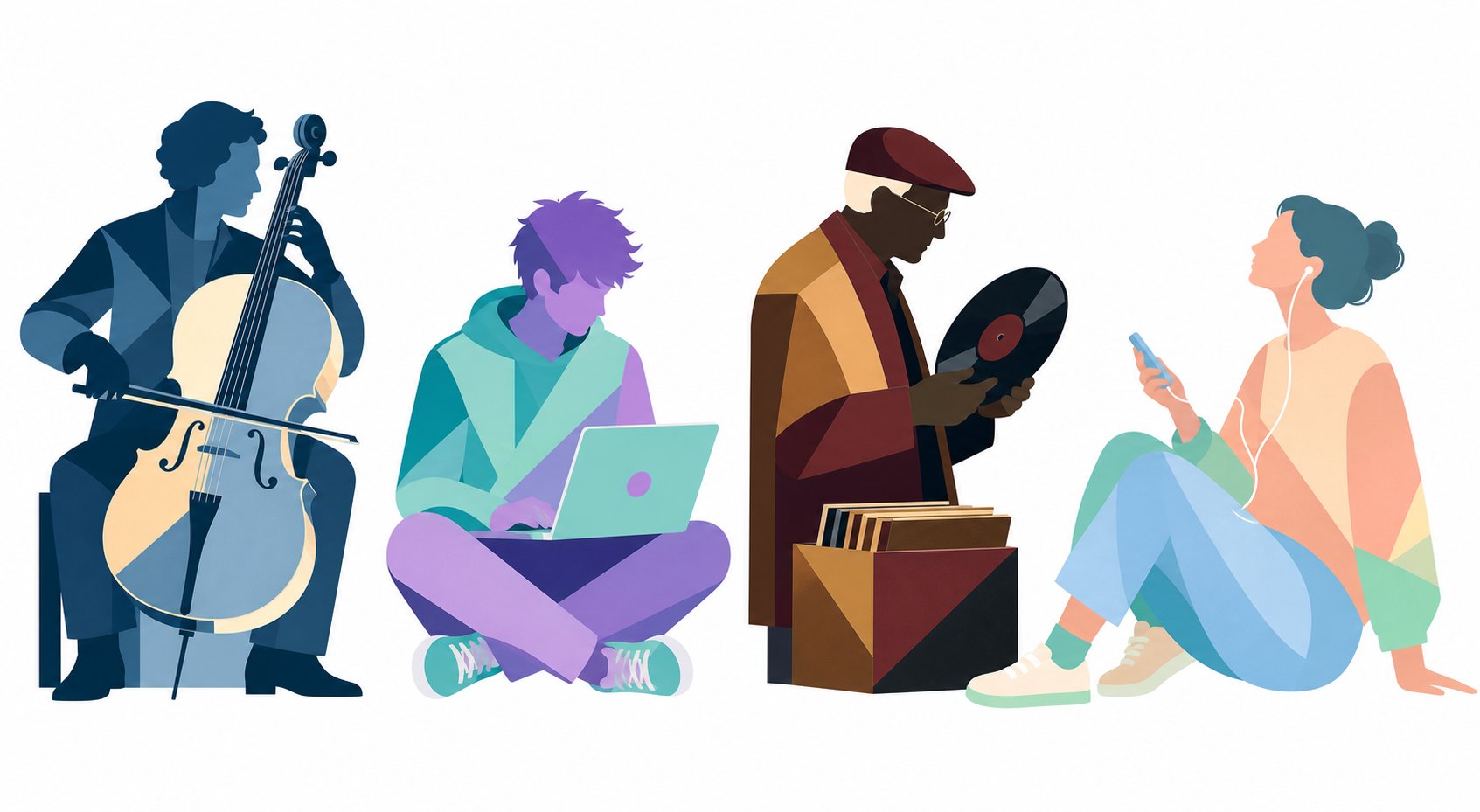
Treating "the public" as a single block is one of the biggest blind spots in conversations about AI-generated music. A 22-year-old bedroom producer experimenting with AI melody generators and a professional cellist with two decades of conservatory training are both "people" — but their reactions to AI music come from entirely different places. The generational divide in AI generated music acceptance, the split between creators and passive listeners, and even genre preferences all shape whether someone sees AI music as exciting, irrelevant, or threatening.
Musicians vs. Non-Musicians
The gap here is not just about taste. It is about livelihood, identity, and what music means as a craft. Research from the University of Twente's empirical study found that respondents who scored higher on music practice frequency were more critical of AI-composed pieces. The open-ended responses in that study tell the story plainly: 14 out of 67 participants specifically cited a lack of human emotion, and 8 pointed to a lack of originality as their core objection.
Musicians vs listeners opinions on AI music break down along predictable lines once you understand the stakes involved:
- Professional musicians tend to view AI as an existential threat to compensation, artistic identity, and the value of skill built over years. R&B singer SZA captured this viscerally when she told i-D she feels "at war" with AI, particularly over what she describes as stereotypical representations of Black music being generated without consent.
- Hobbyist producers and beatmakers are more likely to embrace AI as a creative accelerant — a way to prototype ideas, generate backing tracks, or overcome creative blocks without hiring session musicians.
- Casual listeners with no musical training are the most indifferent group overall. For them, the question is simple: does the song sound good? The University of Twente study noted that its general respondent pool (averaging 7.3 out of 10 on listening frequency but only 2.9 on music practice) evaluated AI music primarily on sonic quality rather than origin.
- Trained audiophiles and music scholars tend to land somewhere between professionals and casual listeners — appreciating AI's technical capabilities while remaining skeptical about its capacity for genuine artistic expression.
Generational Divides in AI Music Acceptance
You might assume younger listeners accept AI music more readily. The data tells a more surprising story. Luminate's consumer tracking found that Gen Alpha and Gen Z showed the most notable declines in interest between May and November 2025 — with shares rising among those less interested (+6 percentage points) and falling among those more interested (-4 points). Their discomfort levels reached parity with Boomers and Gen X, erasing the generational gap that existed just months earlier.
Why the shift? Luminate's analyst Audrey Schomer points to two factors. First, younger listeners are more likely to follow artists who have been vocal in anti-AI campaigns, and those parasocial connections influence opinion. Second, Gen Z carries disproportionate anxiety about AI's impact on job markets — and music hits close to home for a generation that grew up with creator-economy aspirations.
- Gen Alpha and Gen Z: Showed double-digit increases in discomfort across every AI use case in music creation. Early adopters in theory, but increasingly resistant in practice.
- Millennials: Remain the most evenly split demographic — comfortable with AI as a production tool but uncomfortable with fully AI-generated artists or performances.
- Gen X and Boomers: Consistently the least interested in AI-generated music, though their positions have been stable rather than shifting dramatically.
Genre and Listening Context Matter
Not all music carries the same expectations of human authorship. A lo-fi beats playlist designed for studying triggers far less resistance to AI involvement than, say, a singer-songwriter album built on personal narrative. The context of listening — and the genre attached to it — acts as a filter on acceptance.
- Electronic, ambient, and lo-fi: Highest acceptance. These genres already blur the line between human performance and digital production, so AI involvement feels like a natural extension rather than an intrusion.
- Pop and hip-hop: Mixed responses. Listeners enjoy AI-generated beats but react negatively to AI-generated vocals or lyrics, especially when they mimic a specific artist's style.
- Classical and jazz: Strong resistance. The University of Twente study used classical piano pieces and still found statistically significant lower scores for AI compositions — a genre where technical mastery and emotional nuance carry deep cultural weight.
- Traditional and folk music: The highest resistance of all. Research on Irish Traditional Music (ITM) practitioners found that community members rated pieces they believed were AI-composed far more harshly than those attributed to humans — a "conscious prejudice" rooted in cultural preservation instincts.
Geographic and cultural variation adds another layer. Listeners in regions with strong oral or folk music traditions — Ireland, West Africa, parts of South and East Asia — tend to view AI music as culturally inappropriate in ways that transcend mere preference. Meanwhile, a study conducted with university students in Singapore found that AI-labeled pop tracks actually scored higher on positive emotions, suggesting that tech-forward cultures with less emphasis on artisanal music-making may be more receptive.
What emerges from all of this is a simple truth: who is most likely to enjoy AI music depends less on any single trait and more on a combination of musical identity, generational context, genre expectations, and cultural background. The question is never just "do you like this sound?" It is "what does this sound mean to you, and who do you believe should be making it?" That distinction — between aesthetic enjoyment and ethical comfort — is where the real complexity lives.
Beyond Love and Hate Toward a Spectrum of Feeling
That gap between aesthetic enjoyment and ethical comfort is not a binary. It is a gradient — and most people sit somewhere in the middle rather than at either extreme. Nuanced opinions on AI generated music rarely fit into "love it" or "hate it" boxes. Instead, they cluster around conditional positions: acceptable under certain circumstances, unacceptable under others.
When you map real community discussions, survey responses, and interview data together, a clear spectrum emerges. Here it is, ordered from most accepting to most resistant:
- Fully embracing: AI music is a creative revolution. Anyone should be able to make songs regardless of training, and the output is valid art. This position is most common among hobbyist creators and tech enthusiasts.
- Acceptable for functional use: Is AI music acceptable for background listening? Absolutely — for study playlists, podcast intros, video game soundtracks, and ambient work environments. But not for albums meant to express something personal or emotionally complex.
- Valid as a creative tool, not a replacement: AI belongs in the studio the way a synthesizer does — assisting human vision, not substituting it. Musicians in the Springer interview study frequently landed here, welcoming AI as an "assistant" while rejecting it as a standalone creator.
- Interesting as novelty, not for repeated engagement: Worth trying once to hear what it sounds like, but not something listeners return to. The emotional connection fades because there is no story, no artist journey, no human vulnerability behind the sound.
- Ethically unacceptable regardless of quality: Even if the track sounds indistinguishable from human-made music, it was trained on artists' work without consent or compensation. For this group, ethical concerns about listening to AI music override any sonic enjoyment.
Background Music vs. Artistic Expression
The dividing line between positions two and three is where most of the public conversation actually lives. People readily accept AI-generated music when it serves a utilitarian purpose — filling silence, setting a mood in a commercial space, providing royalty-free audio for content creators. The resistance kicks in when AI music asks to be taken seriously as art. As one musician in the Springer study put it, background music for YouTube channels is where AI "would definitely end up being the go-to," while the "thirst for the human touch and emotional trajectory" would keep listeners seeking human artists for meaningful listening.
AI as Tool vs. AI as Replacement
The AI music as creative tool vs replacement distinction turns out to be the single most common framework people use to sort their own feelings. The same person might use an AI harmonizer in their production workflow and simultaneously oppose fully AI-generated albums on streaming platforms. The Springer researchers documented this tension extensively — composers who celebrated using AI to prototype ideas but condemned the use of the same technology to replace hiring a human performer. Context of use, not the technology itself, determines whether it feels acceptable.
The Ethical Dimension of Listener Choice
Position five — ethical rejection regardless of quality — is smaller in raw numbers but disproportionately loud in shaping public discourse. These listeners frame their choice as a form of solidarity with human artists. Geoff Wilkinson of Us3 captured the moral dilemma concisely: AI might enhance creativity, but "is it ethical or moral to use a model when you don't know what it's been trained on?" For ethically motivated listeners, streaming an AI track is not a neutral act — it is a vote for a system they believe exploits creators.
What makes this spectrum useful is that most people do not hold a single fixed position. They slide along it depending on the situation. The same listener might occupy position two on a Monday morning work playlist and position five when choosing what album to buy. Sentiment is not just divided between people — it is divided within them. And that internal tension points to something deeper than opinion: the psychological machinery that makes AI music feel fundamentally different from human-made music, even when it sounds identical.
The Psychology Behind Strong Reactions to AI Music
That internal divide — enjoying a sound while rejecting its source — is not just a matter of opinion. It is rooted in measurable psychological and physiological processes. Understanding why AI music feels wrong to some people requires looking beyond preference surveys and into how the brain processes creative origin, emotional connection, and sonic familiarity.
The Uncanny Valley in Sound
You have probably encountered the uncanny valley in robotics or animation — that eerie discomfort when something looks almost human but not quite. A similar phenomenon exists in music. A biometric study published in PLOS One found that AI-generated soundtracks produced wider pupil dilation in listeners compared to human-composed music, suggesting the brain works harder to decode them. Participants also rated AI tracks as significantly less familiar, even when they could not consciously identify them as machine-made.
The uncanny valley effect in AI generated music operates subtly. It is not that AI tracks sound bad — they often sound technically polished. But something in the phrasing, the micro-timing, or the emotional arc triggers a sense that the music is simultaneously competent and hollow. Researchers have noted that AI-generated content across domains — images, text, music, video — often produces an "uncanny" aesthetic, an eeriness that listeners feel before they can articulate it. The familiarity gap is measurable: human-composed music scored 3.31 on perceived familiarity versus 2.99 for AI-generated tracks in the same study, even though listeners had never heard any of the specific pieces before.
Why Authenticity Feels Essential to Music
Authenticity bias in music listening runs deeper than a simple preference for "real" over "fake." Music is one of the few art forms where audiences routinely care about the creator's lived experience. A breakup song hits differently when you know the singer actually went through it. A protest anthem carries weight because someone risked something to write it.
When listeners learn a piece was composed by AI, their preference tends to decrease even when its objective quality is high — suggesting that musical perception is shaped not only by sonic content but by the context of authorship.
This finding from research on authenticity in AI-era pop music points to a core psychological truth: listeners do not just hear notes. They hear intention. They hear struggle. They hear a human choosing to be vulnerable through sound. AI can replicate the sonic output of that vulnerability, but it cannot replicate the vulnerability itself — and on some level, listeners sense the absence.
Parasocial Bonds and What AI Cannot Replicate
Imagine your favorite artist. You have probably followed them through albums, interviews, maybe a difficult public moment. That connection — one-sided but emotionally real — is a parasocial relationship, and it forms one of the strongest psychological reasons for rejecting AI music. Listeners do not just consume songs. They invest in artists as people, tracking their growth, their failures, their evolution.
AI has no biography. It has no creative arc. It cannot disappoint you or surprise you with a reinvention after years of silence. This absence strips away a layer of meaning that many listeners rely on without realizing it. The emotional weight people assign to creative struggle — the years of practice, the rejected demos, the personal cost of making art — functions as a kind of proof that the music matters. When that proof disappears, the music might still sound right, but it no longer feels earned.
This is why visceral discomfort with AI music persists even among people who cannot reliably identify it in blind tests. The reaction is not about detecting flaws in the audio. It is about a deeper need: the need to believe that the sounds moving through you originated in another consciousness, that someone felt something and turned it into music for you to find. Whether that need is rational or not, it shapes how millions of listeners engage — and it explains why the conversation about AI music keeps circling back to emotions that no algorithm can generate on its own.
What Reddit and Online Communities Really Say
Those psychological undercurrents — the parasocial bonds, the authenticity bias, the uncanny valley discomfort — play out in real time across Reddit threads, Discord servers, and music production forums. These spaces are where unfiltered opinions about AI music surface daily, unmediated by editorial framing or survey design. What do people on Reddit think about AI music? The picture is messier, louder, and more revealing than any formal study can capture.
Recurring Themes in Community Debates
Spend any time in subreddits like r/WeAreTheMusicMakers, r/AImusic, r/SunoAI, or r/musicproduction, and you will see the same arguments cycling through with striking regularity. The debates shift in specifics — which platform sounds better this month, which feature dropped — but the core tensions remain fixed. Online community debates about AI music quality circle around a handful of recurring positions:
- Quality is improving faster than critics admit. Community members frequently post comparisons between outputs from six months ago and today, noting that what once sounded like obvious AI slop now passes casual listening tests. The MIDiA Research observation that tracks on platforms like Suno now "sound convincing enough to the average listener" echoes what hobbyist creators have been saying in these forums for months.
- Ethics dominate the loudest threads. Posts about training data consent, artist compensation, and whether AI companies profited from copyrighted material without permission consistently generate the highest engagement. The moral dimension runs hotter than the aesthetic one.
- "It is just a tool" versus "it replaces us." This framing war appears in nearly every thread. Creators who use AI for production assistance push back against those who see any AI involvement as a step toward replacing human musicians entirely.
- Disclosure norms are contested. Should you tell listeners your track used AI? Reddit AI music subreddit common opinions split sharply here — some argue transparency is mandatory, others insist the final product is all that matters.
- Flooding and discoverability anxiety. Musicians worry that AI-generated tracks will bury human-made music on streaming platforms through sheer volume, making it harder for independent artists to get heard regardless of quality.
Creators vs. Listeners in Online Discussions
One of the most telling patterns in these communities is the gap between people who create AI music and people who only consume it. Creators tend to be more forgiving of current limitations and more excited about the trajectory. They post workflows, share prompt strategies, and discuss which tools produce the most convincing results — from vocal clarity to arrangement complexity.
For many hobbyist creators, the appeal is personal. As MIDiA Research documented, a growing number of people now see making music as personal entertainment rather than chasing dreams of multi-platinum success. These users want song creation to feel as effortless as snapping a photo on their phone. They gravitate toward tools that let them turn a prompt, a lyric idea, or a style description into a finished track without years of training. Platforms like MakeBestMusic's AI Music Generator fit this use case directly — community members recommend them for quickly converting text prompts and lyrics into complete songs when the goal is creative exploration rather than commercial release.
Listeners who do not create, on the other hand, tend to arrive in these threads with a different energy. Their comments focus on how AI music makes them feel as an audience member — and the response skews more critical. Common refrains include "it sounds fine but I would never add it to a playlist" and "knowing it is AI ruins it for me." The disclosure effect discussed earlier in this article plays out in real time: someone posts a track, the comments are positive, then the creator mentions it was AI-generated, and the tone shifts immediately.
One AI music creator documented the experience of facing Reddit backlash after sharing AI-generated work — describing how quickly enthusiasm curdled into hostility once the community learned the music's origin. The lesson was clear: reception depends less on the audio itself and more on the narrative attached to it.
How Community Sentiment Has Shifted Over Time
Reddit opinions on AI generated music have not stayed static. Early threads from 2023 and 2024 were dominated by novelty and curiosity — people sharing bizarre outputs, laughing at failures, marveling at unexpected successes. The tone was experimental and largely amused.
That phase gave way to a more polarized landscape. As AI music tools improved and began producing genuinely listenable output, the stakes rose. Professional musicians entered the conversation in larger numbers, bringing economic anxiety and craft-based objections. Simultaneously, the creator community expanded rapidly — gen AI music users grew to represent 10% of all music creators by 2025, with the number paying for AI creation tools doubling in a single year. The forums reflected this growth: more tutorials, more workflow posts, more people treating AI music creation as a serious hobby rather than a joke.
The current moment feels like a consolidation phase. The most extreme positions — "AI will replace all musicians within a year" and "AI music will never be more than a toy" — have both faded. In their place, a pragmatic middle ground has emerged in many communities. The conversation increasingly centers on specific use cases, ethical guardrails, and quality benchmarks rather than broad ideological battles. Threads about whether AI music should exist have been gradually replaced by threads about how it should be labeled, distributed, and compensated.
This shift from existential debate toward policy-level questions mirrors a broader pattern. Individual listeners have strong feelings, communities process those feelings into shared norms, and eventually those norms begin to pressure the platforms where the music actually lives. Streaming services have been watching these conversations — and responding with policies that attempt to reflect what their users want.
How Streaming Platforms Reflect Listener Sentiment
Streaming platforms do not make policy changes in a vacuum. Every labeling requirement, every spam filter, every royalty adjustment is a response to pressure — from artists, from regulators, and from the listeners whose engagement drives the entire business model. When you look at how streaming services handle AI music labeling and enforcement, you are really looking at a mirror of public feeling translated into platform economics.
Platform Labeling and Transparency Policies
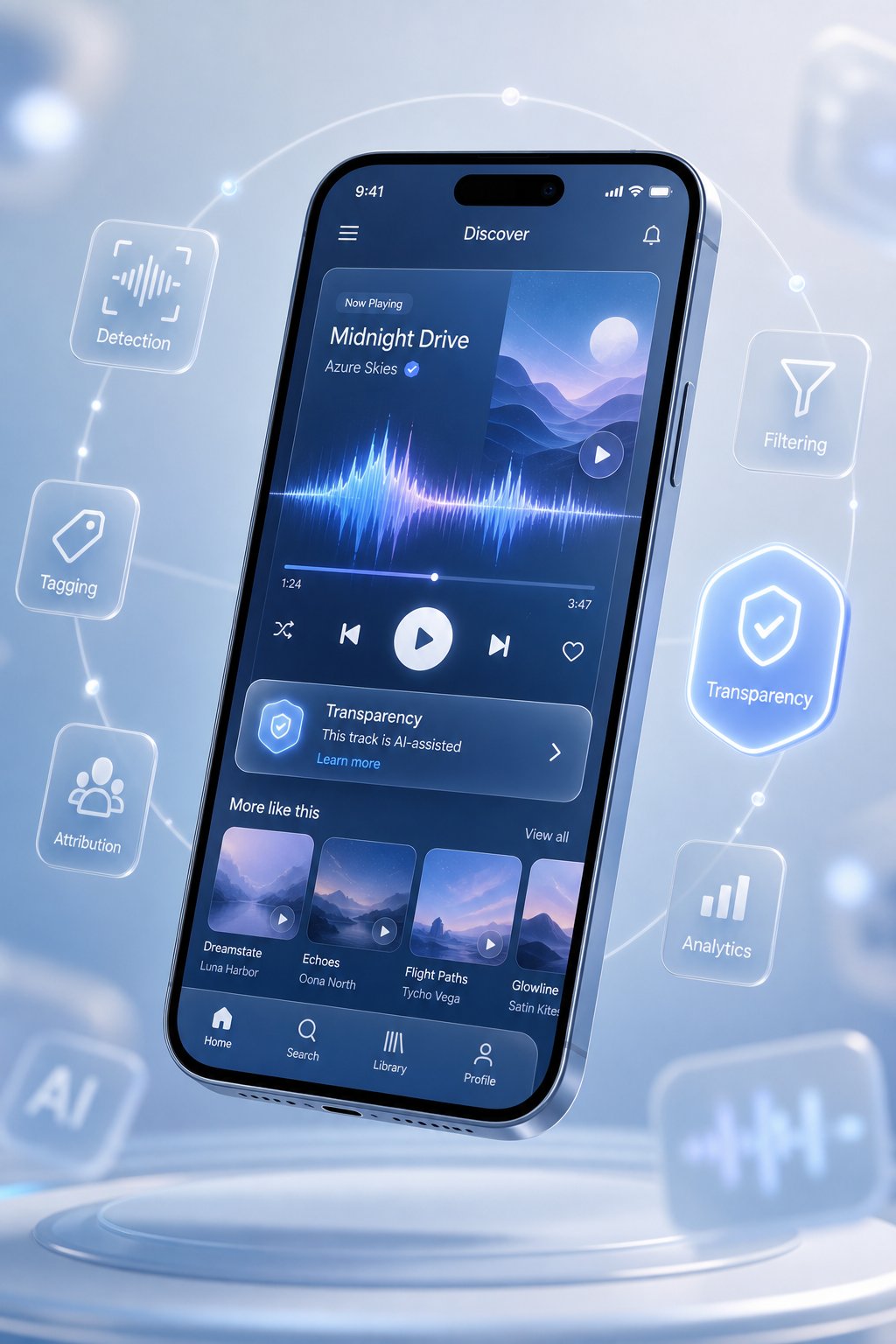
The push for transparency has become the industry's clearest signal that listeners want to know what they are hearing. Spotify announced in late 2025 that it would support an industry-standard AI disclosure system developed through DDEX, allowing artists and rights holders to indicate where AI played a role in a track — whether in vocals, instrumentation, or post-production. By April 2026, Spotify launched a beta feature displaying these credits in Song Credits on mobile, giving listeners visibility into a track's creative process for the first time.
Spotify's policy on AI generated music explicitly frames this as a trust-building measure, not a punitive one. Tracks are not down-ranked for disclosing AI involvement. The platform acknowledges that AI use in music is "increasingly a spectrum, not a binary" — echoing the nuanced positions listeners themselves hold.
Deezer took a more aggressive approach. Its AI detection tool automatically analyzes uploaded content and tags AI-generated tracks without relying on creator self-disclosure. The system, backed by two patents, identifies content from major AI music generators as it emerges. Tagging is mandatory — creators cannot opt out. Deezer positions the labels as a transparency measure rather than a judgment on artistic merit, but the practical implications are significant: AI-tagged tracks are excluded from algorithmic recommendations while remaining searchable on the platform.
How Royalty Structures Signal Listener Priorities
The royalty question reveals something deeper about streaming platform rules for AI music. Consider this data point from NPR's reporting on Deezer's findings: AI-generated tracks now represent approximately 44% of daily uploads, yet account for less than 3% of total streams — and a majority of those streams were flagged as fraudulent bot activity. Listeners are not choosing this content. Bots are.
Spotify responded to this dynamic by rolling out a music spam filter designed to identify uploaders engaging in mass-upload tactics, duplicate content, and artificially short tracks. In the 12 months prior to the announcement, the platform removed over 75 million spammy tracks. The reasoning is straightforward: left unchecked, AI-generated spam dilutes the royalty pool that pays human artists. Artists' rights groups made this case publicly with the "Say No To Suno" open letter, and platforms acted.
Here is how the major platforms compare in their approaches:
| Platform | AI Labeling Method | Detection Approach | Impact on Recommendations | Royalty Treatment |
|---|---|---|---|---|
| Spotify | Voluntary disclosure via DDEX credits (beta) | Spam filter targeting mass uploads and manipulation | No down-ranking for disclosed AI; spam-tagged tracks removed from recommendations | Equal streaming rates; spam tracks demonetized |
| Deezer | Automatic detection and mandatory tagging | Patented AI detection tool (analyzes content characteristics) | AI-tagged tracks excluded from algorithmic recommendations | Normal royalties continue; fraudulent streams demonetized |
| Apple Music | No public AI labeling system announced | No disclosed detection tool | Not publicly specified | Standard pro rata model |
| YouTube | Requires disclosure of AI-generated or altered content | Community guidelines enforcement | Labels displayed to viewers; removal possible for undisclosed deepfakes | Standard Content ID and monetization rules apply |
The Industry Response as a Mirror of Public Feeling
These policies did not materialize from corporate goodwill. They reflect real market pressure. Luminate's data showed listener comfort actively declining. Artists mobilized publicly. Communities like the ones discussed in the previous section debated disclosure norms and flooding anxiety loudly enough to reach platform executives. Spotify's own framing makes the connection explicit: "Many listeners want more information about what they're listening to and the role of AI technology in the music they stream."
The pattern is clear. Listeners expressed discomfort with undisclosed AI content. Platforms responded with labeling. Listeners expressed concern about royalty dilution. Platforms responded with spam filters and demonetization. Listeners expressed anger about voice cloning. Spotify introduced a dedicated impersonation policy requiring authorization from the impersonated artist before AI voice clones can remain on the platform.
What the platforms have not done is equally telling. No major service has banned AI music outright. No platform treats disclosed AI content as second-class in royalty calculations. The industry response mirrors the spectrum of listener opinion rather than its extremes — transparency yes, prohibition no. Listeners who want information get labels. Listeners who want protection from fraud get spam filters. Listeners who simply want good music regardless of origin still get an open catalog.
This careful balancing act signals that platforms believe most users are not absolutists. They are conditional — fine with AI music existing, uncomfortable with deception, and unwilling to have their attention hijacked by bot-driven content farms. The policies reflect a public that has opinions but not a consensus, preferences but not a mandate. And that leaves room for the landscape to keep shifting as listeners continue forming their own conclusions through direct experience.
Try It Yourself Before Deciding How You Feel
Policies, surveys, and community debates all matter. But they are other people's conclusions. The most reliable way to figure out where you land on this spectrum is to stop reading about AI music and start hearing it — or making it — for yourself.
The Trajectory From Curiosity to Normalization
Public sentiment has already moved through distinct phases. Early reactions centered on novelty and amusement — the "wow, a robot did this" response that first-time users still describe. Then came backlash as quality improved and economic concerns became real. Luminate's data captured that shift in hard numbers: net interest dropping month over month, especially among younger listeners.
Will AI music become more accepted over time? The trajectory suggests a third phase is already underway — selective normalization. AI music is finding its footing in specific contexts (background audio, content creation, rapid prototyping) while remaining contested in others (artistic albums, live performance, artist identity). The technology is not going away. The question is which niches it fills and which remain reserved for human hands.
Forming Your Own Opinion Through Experience
Here is what the research consistently shows: people who have actually tried generating AI music hold more nuanced opinions than those who have only read about it. Direct experience tends to collapse the extremes. Skeptics discover that the output is better than they expected. Enthusiasts discover that "good enough" still falls short of deeply meaningful. Both groups walk away with a more calibrated view than they started with.
If you want to experience AI generated music firsthand without installing software or learning production tools, MakeBestMusic's AI Music Generator lets you turn a prompt, a lyric idea, or a style description into a complete song in seconds. Type a few words about the mood or genre you want, paste in lyrics if you have them, and listen to what comes back. That is all it takes to move from theory to personal experience.
The point is not to be impressed or horrified. It is to notice your own reaction — the gap between what your ears enjoy and what your gut tells you about where the music came from. That gap is exactly where this entire conversation lives.
People who generate even one AI track report that their opinion shifts — not uniformly toward acceptance or rejection, but toward specificity. They stop asking "is AI music good or bad" and start asking "what is this actually useful for, and what does it lack?"
That is the question worth sitting with. Not whether AI music will be accepted by everyone — it will not — but which version of it earns a place in your own listening life. The only way to answer is to try it yourself and decide.
