

Why Knowing If Music Is AI Matters More Than Ever
Imagine scrolling through a playlist and wondering: is this song ai, or did a real person pour their heart into it? That question used to feel hypothetical. It no longer is. AI-generated tracks are flooding streaming platforms at a pace that would have seemed absurd just two years ago, and telling them apart from human-made music has become a genuine challenge for anyone who listens, curates, or creates.
The numbers paint a stark picture. Streaming service Deezer now receives nearly 75,000 AI-generated tracks every single day, representing 44% of all new music uploaded to the platform. That is over 2 million synthetic tracks per month on just one service. The growth has been explosive: from 10,000 daily uploads in early 2025 to 75,000 now, a 650% increase in roughly 16 months. And Deezer is one of the few platforms transparent enough to share these figures. Other major services have yet to disclose comparable data.
A Deezer-commissioned study found that 97% of listeners could not tell the difference between AI-generated and human-made music in blind tests, yet 80% of people agree that fully AI-generated music should be clearly labeled.
That gap between what people want (transparency) and what they can actually detect (very little) is exactly why learning how to tell if music is ai generated has shifted from niche curiosity to practical necessity. Among online music communities, the sentiment that ai music is cooked keeps growing louder as listeners realize how much synthetic content surrounds them without any clear labeling.
Why AI Music Detection Is Now a Critical Skill
Detection matters because the consequences are real. AI-generated content dilutes royalty pools for human artists under the pro-rata payment models used by Spotify, Apple Music, and others. When synthetic tracks accumulate streams, even fraudulent ones, they siphon revenue from musicians who spent months writing and recording. Artists' rights groups worldwide have raised alarms, and research from CISAC and PMP Strategy estimates that nearly 25% of music creators' revenues could be at risk by 2028, an impact potentially reaching 4 billion euros.
Meanwhile, listener attitudes are shifting. A Luminate study covered by NPR found that overall interest in AI music dropped from -13% to -20% between May and November 2025, with Gen Z and Gen Alpha showing the steepest decline. People are increasingly uncomfortable with AI-created songs, especially those mimicking existing artists. The appetite for knowing how to know if music is ai is growing alongside that discomfort.
Who Needs to Identify AI-Generated Tracks
This is not a single-audience problem. Several groups face it daily:
- Casual listeners who want to know whether the tracks in their playlists come from real artists worth supporting
- Playlist curators and A&R professionals screening hundreds of submissions, many now generated in seconds by tools like Suno and Udio
- Independent musicians concerned about AI-generated clones of their style or voice appearing on the same platforms
- Educators and music students trying to understand how to tell if music is ai versus human-performed
Here is the honest truth: some AI music is genuinely difficult to detect, especially as generators improve with each update. No single trick catches everything. But a layered approach, combining audio analysis, contextual signals, platform clues, and dedicated detection tools, catches the vast majority of synthetic tracks. This guide walks through that approach systematically, from the quickest checks you can do in seconds to deeper analysis techniques that reveal what the full mix hides.
The Spectrum of AI Involvement in Music Production
Before you can spot AI-generated music, you need to understand that AI involvement is not a simple yes-or-no question. It exists on a spectrum, and how a song is made determines how detectable it is. A track created entirely from a text prompt leaves very different fingerprints than a human-written song that was mastered with an AI plugin. Knowing where a track falls on this spectrum shapes which detection methods actually work.
Fully AI-Generated Tracks and What Defines Them
So how does ai music generation work at the fully automated end? Tools like Suno and Udio let users type a short prompt, select a genre, and receive a complete song in seconds. The AI handles everything: melody, harmony, instrumentation, vocals, lyrics, mixing, and structure. Human involvement is limited to writing the prompt and maybe trimming the output. No one performs, no one records, no one makes creative decisions beyond that initial instruction.
This is where detection tends to be most feasible. Fully AI-generated tracks carry the heaviest concentration of artifacts because every element passes through the same generative model. There is no human performance to anchor the realism, no session musician adding micro-variations that algorithms struggle to replicate.
AI-Assisted Music vs Pure Human Creation
The middle of the spectrum is where things get interesting. AI-assisted music keeps the human as the primary creator while using AI tools to support specific tasks. Think of a songwriter who uses an ai songwriting app to brainstorm chord progressions but writes and performs the final track themselves. Or a producer who runs their mix through AI-powered mastering software like LANDR. The creative core remains human; AI handles peripheral tasks.
As RouteNote explains, the key distinction is control. In AI-assisted workflows, the artist guides the process, makes decisions, and shapes the final product. The Beatles' Grammy-winning track "Now and Then" is a well-known example: AI-powered audio restoration isolated John Lennon's vocals from old demos, but humans wrote, arranged, and produced the song.
Detection difficulty drops significantly here because the human performance and creative decisions mask whatever AI processing occurred in the background. A music analysis ai tool scanning such a track would find genuine human vocal characteristics, natural instrumental dynamics, and organic timing variations throughout.
Where the Line Gets Blurry
Between these poles sits a hybrid category. Imagine someone generating an instrumental bed with AI, then writing original lyrics and recording their own vocals over it. How are ai songs made in this middle ground? Part machine, part human, with meaningful creative contribution from both sides. Can ai make better music than humans in these collaborative scenarios? The question almost stops making sense because the output is neither purely one nor the other.
This spectrum matters practically because platforms are developing tiered policies around it. Spotify's AI disclosure framework, developed through the DDEX industry standard, allows artists to indicate where and how AI played a role, whether in vocals, instrumentation, or post-production. Distributors like TuneCore block content that is 100% AI-created but welcome AI-assisted tracks, while DistroKid accepts AI music broadly with disclosure requirements.
| Category | Human Involvement Level | Common Tools Used | Detection Difficulty |
|---|---|---|---|
| Fully AI-Generated | Minimal (prompting only) | Suno, Udio, Boomy | Moderate to Low |
| Hybrid | Significant editing and performance | AI instrumental + human vocals/lyrics | High |
| AI-Assisted | Primary creation is human | LANDR, AI mixing plugins, AI chord suggesters | Very High |
| Fully Human | 100% | Traditional instruments, DAWs | N/A |
Understanding how does ai create music across these tiers is the foundation for everything that follows. Detection methods that catch a fully generated Suno track will completely miss an AI-assisted production, and vice versa. The layered detection approach works precisely because it targets different points on this spectrum with different tools. The audio-level tells that reveal a purely synthetic track are the logical starting point, and they reward careful, trained listening.

Audio Telltale Signs You Can Train Your Ears to Catch
When you ask yourself "does this sounds like ai?" while listening to a track, your instincts are picking up on something real. AI-generated music leaves measurable acoustic fingerprints that trained ears can learn to recognize. A peer-reviewed analysis of 12,400 tracks published in the Journal of the Audio Engineering Society identified three statistically significant anomalies correlated with AI generation. These are not subjective impressions. They are repeatable, measurable deviations that appear regardless of genre, tempo, or loudness normalization.
The key to learning how to detect ai music through listening is understanding that AI models simulate human performance without experiencing the physical constraints that shape it. Human bodies fatigue, fingers slip, vocal cords tense. AI skips all of that, and the absence leaves traces.
Vocal Artifacts That Give AI Away
Vocals are where AI struggles most to sound convincingly human. When figuring out how to tell if a voice is ai generated, focus on these specific markers:
- Vibrato decay inconsistency: Human vibrato amplitude decreases naturally over sustained notes because the diaphragm fatigues. AI vocals often maintain constant vibrato depth or cut it off abruptly. In a spectrogram, human vibrato shows decreasing peak amplitude in the 5-7 Hz band, while AI output shows flat or stepped curves.
- Mechanical breathing patterns: Breaths are either missing entirely or placed at metronomic intervals with identical volume and duration. Real singers breathe irregularly, with depth reflecting emotional intensity.
- Overly consistent sibilance: Every "S" sound hits with the same harshness and duration. Human sibilance varies with mouth position, energy, and phrasing.
- Emotional flatness beneath surface expression: The voice may technically perform dynamics, but the micro-variations that convey genuine feeling (slight cracks, tonal shifts mid-phrase, subtle pitch drift on emotional words) are absent or formulaic.
- Identical vibrato on repeated notes: When the same lyric appears in different verses, AI often reproduces nearly identical vibrato patterns. Human singers never repeat themselves exactly.
If you are wondering how ai does this sound so close to real, the answer is statistical modeling. These systems learn average vocal behavior from millions of recordings but miss the outlier moments that make a performance feel alive. An ai lyric detector can flag suspicious text patterns, but your ears remain the best tool for catching these vocal tells.
Instrumental and Production Red Flags
Beyond vocals, instruments carry their own set of giveaways. Here is what to listen for when trying to how to spot ai music at the instrumental level:
- Transient smearing on drums: Real snare hits and hi-hats produce sub-10ms transient spikes with rich high-frequency harmonics above 8 kHz. AI models frequently blur these attacks, producing softened hits that lack harmonic sharpness.
- Harmonic series truncation in bass: Acoustic basses and pianos generate strong odd-order harmonics (3rd, 5th, 7th) below 200 Hz. AI models trained on compressed streaming data often truncate harmonics above the 3rd order, resulting in thin low-end texture.
- Guitar strings with unnatural decay: Real guitar notes fade according to string gauge, pick attack, and body resonance. AI-generated guitar often decays at uniform rates regardless of playing dynamics.
- Stereo field that never shifts: Human-produced tracks have instruments that subtly move in the stereo image as performers shift position or engineers automate panning. AI mixes tend to lock every element in a fixed position throughout the entire song.
- Too-perfect mixing balance: Everything sits at a suspiciously consistent level. Real mixes breathe, with elements pushing forward and receding as the arrangement evolves.
These production anomalies are how to tell if a song is ai when the vocals alone are not conclusive. The combination of softened transients, truncated harmonics, and static stereo imaging creates a cumulative impression of something slightly off, even before you consciously identify the individual issues.
Song Structure Patterns That Feel Off
Zoom out from individual sounds and listen to how the track moves through time. AI-generated songs often follow structurally correct templates (verse-chorus-verse-bridge-chorus) while missing the emotional logic that connects those sections:
- Verses that do not build: Each verse delivers the same energy level without the gradual intensification that pulls listeners toward the chorus.
- Bridges that feel disconnected: The bridge exists because the formula says it should, not because the song emotionally requires a departure before the final chorus.
- Harmonic progressions using formulaic patterns: Chord changes follow statistically common sequences without the surprising choices that give human songwriting personality.
- Transitions that are mechanically precise: Section changes happen at exact intervals without the slight push-and-pull of a human arrangement responding to its own momentum.
No single indicator on this list proves AI origin by itself. Heavily quantized pop music can trigger some of these flags, and sophisticated AI output might avoid the most obvious tells. The reliable approach is combining multiple signals. When you hear flat vibrato decay alongside smeared drum transients and a bridge that goes nowhere emotionally, the evidence stacks up quickly. Train your ears on these patterns, and the question shifts from whether you can detect synthetic music to how many layers of evidence you notice in a single listen.
Audio analysis, though, has limits. These tells grow subtler with every model update, and some tracks simply will not reveal themselves through listening alone. That is where contextual and platform-level signals pick up the trail.
Platform and Contextual Signals Beyond the Audio
You do not always need to dissect frequencies or analyze vibrato patterns to figure out whether a track is synthetic. Sometimes the fastest clues live outside the music itself, in the artist's profile, their release history, and the digital footprint (or lack thereof) surrounding them. For playlist curators screening hundreds of submissions weekly, these contextual signals are often the first filter applied, long before anyone presses play.
Think of it this way: a real musician leaves traces everywhere. Years of social posts, grainy live videos, collaborations, interviews, credits on other people's tracks. AI music artists, by contrast, tend to appear fully formed with no backstory. That absence tells a story of its own.
Artist Profile Red Flags on Streaming Platforms
The case of The Velvet Sundown in 2025 illustrates this perfectly. The band racked up hundreds of thousands of monthly Spotify listeners after releasing two albums just weeks apart, yet internet sleuths noticed something telling: no record of live performances, no concert photos or videos, no individual social media accounts for band members, and no interviews. Their promotional images featured airbrushed faces against nondescript backgrounds with a warm orange filter. The band was eventually confirmed as a synthetic project composed and voiced with AI support.
When you are trying to determine if a mysterious new artist is real, check these profile-level indicators:
- No social media presence: Real artists almost always maintain at least one active social account. AI-generated projects rarely invest in building a convincing social history stretching back months or years.
- No live performance history: Search for concert listings, venue tags, fan-shot videos, or festival appearances. Their absence is a strong signal.
- No interviews or press coverage: Even small independent artists accumulate blog features, podcast appearances, or local press mentions over time.
- Generic or AI-generated profile images: Look for overly smooth skin, inconsistent lighting, backgrounds that lack identifiable locations, or that uncanny uniformity across all promotional photos.
- No "About" section or artist bio with verifiable details: Vague descriptions without mention of a hometown, musical influences, or career milestones suggest a fabricated identity.
These checks take seconds and immediately narrow the field. How many ai musicians are there operating without any of these real-world anchors? The number is growing rapidly, but their profiles share a conspicuous emptiness that stands out once you know what to look for.
Release Patterns and Metadata Clues
Release cadence is one of the most reliable behavioral signals. A human artist might release an album every one to three years, with singles spaced weeks or months apart. AI-generated catalogs operate on an entirely different timeline. The Michael Smith streaming fraud case involved hundreds of thousands of AI-generated songs uploaded to platforms, each streamed just enough to generate royalties without triggering suspicion. That volume is physically impossible for a human creator.
Watch for these release pattern red flags:
- Dozens of tracks released within days or weeks: Even prolific human artists cannot write, record, mix, and master at this pace.
- Multiple albums dropping simultaneously: Professor Gina Neff of Cambridge's Minderoo Centre described one suspected AI artist who dropped multiple soundalike albums at the same time, resembling "really classic rock hits that had been put in a blender."
- Generic or formulaic track titles: Names like "Lo-Fi Study Beat 47" or "Chill Ambient Mood 12" follow patterns consistent with bulk AI generation.
- Distributor names associated with AI music farms: Certain smaller distributors have become known for processing high volumes of AI-generated content with minimal screening.
- Writer credits not registered with any performing rights organization: Legitimate songwriters register with ASCAP, BMI, PRS, or equivalent bodies. AI-generated tracks often list unregistered names or no writer credits at all.
According to Chartlex's research on the 2026 detection stack, metadata anomalies including bulk-allocated ISRC codes, artwork matching AI-image generation templates, and generic genre tags combined with rapid upload behavior are among the strongest signals that distributors use to flag suspicious content before it even reaches streaming platforms.
Social Proof and Collaboration Signals
Music is inherently collaborative. Real artists accumulate a web of professional relationships: featured vocalists, credited producers, mixing engineers, session musicians, co-writers. AI generated bands and solo projects typically show none of this. Their credits section is either empty or lists a single name across every role.
Here is a platform-specific checklist for screening across major services:
- Spotify: Check the "Credits" section on any track. Look for producer names, mixing engineers, and mastering credits. Examine whether the artist appears on other artists' tracks or has playlist saves proportional to their stream count.
- Apple Music: Review the artist page for linked social accounts, verified biography content, and whether Apple's Transparency Tags (launched May 2026) flag the track as AI-assisted or AI-generated.
- YouTube: Look for official music videos with real performance footage, behind-the-scenes content, or live session recordings. Check comment sections for fan interactions that reference real-world encounters with the artist.
Streaming anomalies add another layer. An artist with 500 tracks but almost zero playlist saves, minimal social engagement, and no follower growth pattern consistent with organic discovery is exhibiting what is a ai artist profile in behavioral terms. Real listeners save songs, share them, add them to personal playlists, and follow artists they enjoy. When stream counts exist in isolation without these engagement signals, something is off.
These contextual checks complement audio analysis and often work faster. A curator can scan a profile in thirty seconds and decide whether deeper listening is warranted. But for tracks that pass both the audio and contextual tests, a more targeted approach exists: identifying which specific AI generator produced the music based on its unique sonic signature.

How Different AI Generators Leave Distinct Fingerprints
Every AI music generator processes audio differently under the hood, and those architectural differences leave sonic fingerprints as distinctive as a painter's brushstrokes. If you can fingerprint every ai song to identify it by its source platform, you have moved beyond asking "is this AI?" to answering "which AI made this?" That specificity strengthens your detection confidence considerably.
The two dominant platforms, Suno and Udio, use fundamentally different generation architectures. According to spectral analysis research from Authio, these are not cosmetic differences. They create artifacts that persist regardless of post-processing or format conversion. Smaller platforms like Boomy and AIVA carry their own tells. Learning to recognize each generator's signature is like learning to identify a specific recording studio by its room tone.
Recognizing Suno-Generated Tracks
Suno uses a diffusion-based architecture that produces several characteristic artifacts detectable through careful listening and spectral analysis. If you have ever followed a suno ai tutorial and listened critically to the output, you may have noticed some of these patterns already:
- 32kHz sampling signature: Suno operates at a native 32kHz sample rate, then upsamples to 44.1kHz for output. This creates a hard spectral cutoff at 16kHz that differs from the natural high-frequency rolloff of acoustic recordings. Human-produced music tapers gradually; Suno's output drops like a cliff.
- Digital haze in the 8-16kHz range: The diffusion process introduces a characteristic noise pattern with uniform energy distribution that natural audio never produces. Earlier Suno versions (v3 and v3.5) exhibited more obvious "phasey" or "metallic" artifacts, particularly where hi-hats clashed with vocal sibilance, creating what engineers call "spectral mud."
- Temporal consistency: Suno-generated audio has unusually consistent energy levels across time segments. Real recordings contain micro-dynamics, tiny variations in energy and spectral content that result from physical performance. Suno smooths these out into an almost eerie evenness.
- Low-mid frequency buildup: Suno v5 output often exhibits congestion in the 200-500Hz range, leading to a slightly muddy quality that experienced producers notice immediately.
- Polished pop production bias: Suno gravitates toward radio-ready pop aesthetics with specific reverb characteristics and vocal processing that sound professional but generic. The reverb tail and vocal compression follow predictable patterns across genres.
Suno's newer v5 model has reduced many of the most obvious tells from earlier versions, particularly the metallic vocal quality and high-frequency clashing. But the 32kHz upsampling signature and temporal over-consistency remain structural limitations of the architecture itself.
Udio Signatures and How They Differ
Udio takes a transformer-based approach to generation, which creates an entirely different set of identifiable patterns. Discussions across ai generated music reddit communities frequently note that Udio tracks "feel" different from Suno output, and spectral analysis confirms why:
- Periodic spectral patterns: The transformer architecture processes audio in fixed-length windows, creating periodic ripples in the spectral envelope that align with the model's attention window size. These ripples are subtle but measurable.
- Artificially clean instrument separation: In real recordings, instruments bleed into each other. A kick drum excites sympathetic resonance in nearby strings, room reflections create spectral smearing. Udio's output lacks this natural interaction, producing unnaturally isolated frequency bands.
- Phase coherence that is too consistent: Real stereo recordings contain complex phase information from room acoustics, microphone placement, and mixing decisions. Udio produces stereo audio with mathematically regular phase relationships that no physical recording environment would create.
- Different harmonic layering approach: Where Suno tends toward a wall-of-sound production style, Udio builds harmonic layers with cleaner separation but less natural interaction between elements.
Udio is generally harder to detect than Suno because its artifacts are more subtle. However, that artificial separation quality, the sense that every instrument exists in its own sealed bubble, provides a reliable detection signal once you train your ears to notice it.
Other Generators and Their Telltale Patterns
Beyond the two dominant platforms, several other generators produce new ai songs with their own characteristic signatures. Boomy targets casual users who want quick results, producing simpler arrangements with limited instrumentation that often sound like stock music library tracks. AIVA focuses on orchestral and cinematic composition, generating technically correct but emotionally predictable classical arrangements.
The first song sung by ai to chart in Europe was generated using Suno, and since then multiple platforms have pushed their capabilities forward. Each model update shifts the sonic fingerprint slightly, which is why staying current with ai music updates matters for anyone doing serious detection work. Communities on aimusic reddit threads regularly document new artifacts and share spectral comparisons as platforms release new versions.
| Generator Name | Typical Genre Strengths | Common Artifacts | Detection Difficulty |
|---|---|---|---|
| Suno | Pop, Rock, Hip-Hop, broad genre coverage | 32kHz cutoff, digital haze, temporal over-consistency, low-mid buildup | Moderate |
| Udio | Electronic, Indie, experimental genres | Periodic spectral ripples, artificial separation, phase regularity | Higher |
| Boomy | Lo-fi, simple pop, background music | Limited arrangement complexity, stock-library production quality, repetitive structures | Low |
| AIVA | Orchestral, cinematic, classical | Predictable dynamic arcs, uniform articulation across sections, mechanical phrasing | Moderate |
One critical point: these signatures evolve with each model update. Suno's jump from v4 to v5 eliminated several previously reliable tells while introducing new ones. Detection knowledge requires ongoing attention to how these platforms develop. What works today may not work six months from now, which is exactly why the most resilient detection approaches combine platform-specific audio analysis with the broader toolkit of dedicated detection software.
AI Music Detection Tools and How They Actually Work
Knowing what to listen for is valuable, but your ears can only carry you so far. When you need to verify suspicions at scale or confirm what manual listening suggests, dedicated detection tools enter the picture. The ai music detector landscape has matured rapidly, with multiple platforms now offering automated scanning that analyzes tracks across several technical dimensions simultaneously.
How do these tools actually decide whether a track is synthetic? The answer involves layered analysis that mirrors what trained listeners do, only faster and across dimensions humans cannot perceive directly.
How AI Music Detectors Analyze Audio
Most ai song detector platforms rely on a combination of five core methods running in parallel:
- Spectral analysis: The primary weapon. Detection systems convert audio into spectrograms and scan for the unnaturally smooth frequency distributions, grid-like high-frequency patterns, and abrupt spectral cutoffs that AI generators produce. Research into platform detection methods confirms that spectral analysis catches the most tracks because it targets fundamental characteristics of how AI synthesizes audio rather than surface-level features.
- Metadata inspection: Every audio file carries embedded data in its headers, ID3 tags, and encoding parameters. AI generators leave fingerprints here: specific encoder signatures, sample rate configurations, and codec settings that match known generator profiles. Some platforms now embed C2PA provenance data or SynthID watermarks directly into the audio waveform.
- Timing pattern analysis: Human performers cannot keep mathematically perfect time. Detection systems measure micro-timing deviations in drum hits, vocal phrasing, and instrumental attacks. AI output tends toward either too-perfect quantization or artificially randomized timing that follows statistical distributions rather than human groove patterns.
- Noise floor analysis: Real recordings carry environmental noise from microphones, preamps, and room acoustics. AI-generated audio either drops to near-digital silence between notes or adds synthetic noise with statistical properties that differ from genuine ambient sound.
- Pattern matching against training data: Ensemble models trained on tens of thousands of labeled tracks (both human and AI-generated) learn to recognize generator-specific signatures. Systems like Authio's 12-model ensemble process each track through multiple specialized neural networks, each tuned to different AI platform signatures, then combine results through weighted voting.
No single method is reliable enough on its own. A track might pass spectral analysis due to heavy post-processing but fail timing pattern checks. It might have clean metadata but carry unmistakable noise floor anomalies. The strength of modern detection lies in running all five methods simultaneously and cross-referencing results.
Top Detection Tools and Their Accuracy
The ai song checker market now includes several established solutions, each with different strengths. Some focus on raw detection accuracy, others on processing speed for large catalogs, and still others on complementary analysis approaches that help users hear the evidence themselves.
One particularly practical approach is stem separation. Rather than giving you a binary yes-or-no verdict, isolating a track into its individual components (vocals, drums, bass, instruments) lets you hear AI artifacts that the full mix obscures. MakeBestMusic's Audio Separator serves this function well. By splitting a suspect track into stems, you gain direct access to the individual elements where AI tells are most audible: the vocal with its mechanical vibrato exposed, the drums with their too-perfect timing laid bare, the bass with its truncated harmonics no longer masked by other instruments. This makes it a practical complement to automated detectors, especially for curators and educators who want to understand why a track is flagged rather than just accepting a confidence score.
Among dedicated ai music identifier platforms, the landscape breaks down by use case and budget:
| Tool Name | Method | Accuracy Range | Price |
|---|---|---|---|
| MakeBestMusic Audio Separator | Stem separation for manual artifact inspection | Depends on listener skill (complementary tool) | Free |
| Authio | 12-model neural ensemble with platform attribution | 99.42% (under 0.6% false positives) | From 12 EUR/month |
| IRCAM Amplify AI Music Detector | Spectral fingerprinting optimized for batch processing | 99% (under 1% false positives) | Enterprise pricing (contact sales) |
| ACRCloud | Full track + separated vocal/accompaniment analysis | Not publicly disclosed | Contact sales (14-day free trial) |
| Deezer Detection | Proprietary spectral + behavioral analysis | Claims 100% on Suno/Udio output | Licensed via business partnerships |
| Pex AI Song Detector | Real-time content identification and rights matching | Not publicly disclosed | Enterprise (not published) |
The ircam amplify ai music detector stands out for sheer throughput, capable of scanning over 250,000 tracks within a single hour, making it the go-to for large-scale catalog audits. Authio publishes the highest verified accuracy figure at 99.42% and offers transparent pricing with a 14-day free trial. Deezer's system has real-world validation at massive scale, having tagged over 13.4 million AI tracks on its own platform.
Free vs Paid Detection Options
If you are looking for an ai music detector online free, options exist but come with trade-offs. Authio offers 20 free analyses during its trial period. ACRCloud provides full API access for 14 days. Tools like remusic ai music analyzer and similar browser-based scanners offer limited free scans but typically restrict file length, number of daily checks, or the depth of analysis provided.
For anyone seeking a.i. detector for music free without committing to a subscription, the stem separation approach offers genuine value at no cost. Splitting a track into its components and listening critically to each one requires no paid software license, just a separation tool and trained ears. This is where MakeBestMusic's Audio Separator fits naturally into a detection workflow: upload the track, separate it, and listen to what the full mix was hiding.
The honest reality is that no single tool achieves perfect accuracy across all generators and all production styles. Authio's 99.42% is impressive but still means roughly 6 out of every 1,000 tracks get misclassified. False positives hit heavily processed electronic music hardest, while false negatives tend to occur with sophisticated AI output that has been deliberately post-processed to evade detection. The most reliable approach combines automated scanning with manual listening, using stem separation to verify what algorithms flag. Tools give you speed; your ears give you certainty.
That combination of automated detection and hands-on inspection raises a natural question: what exactly do you hear when you isolate individual stems from a suspect track? The artifacts hiding beneath the full mix tell a story that no confidence score can fully capture.
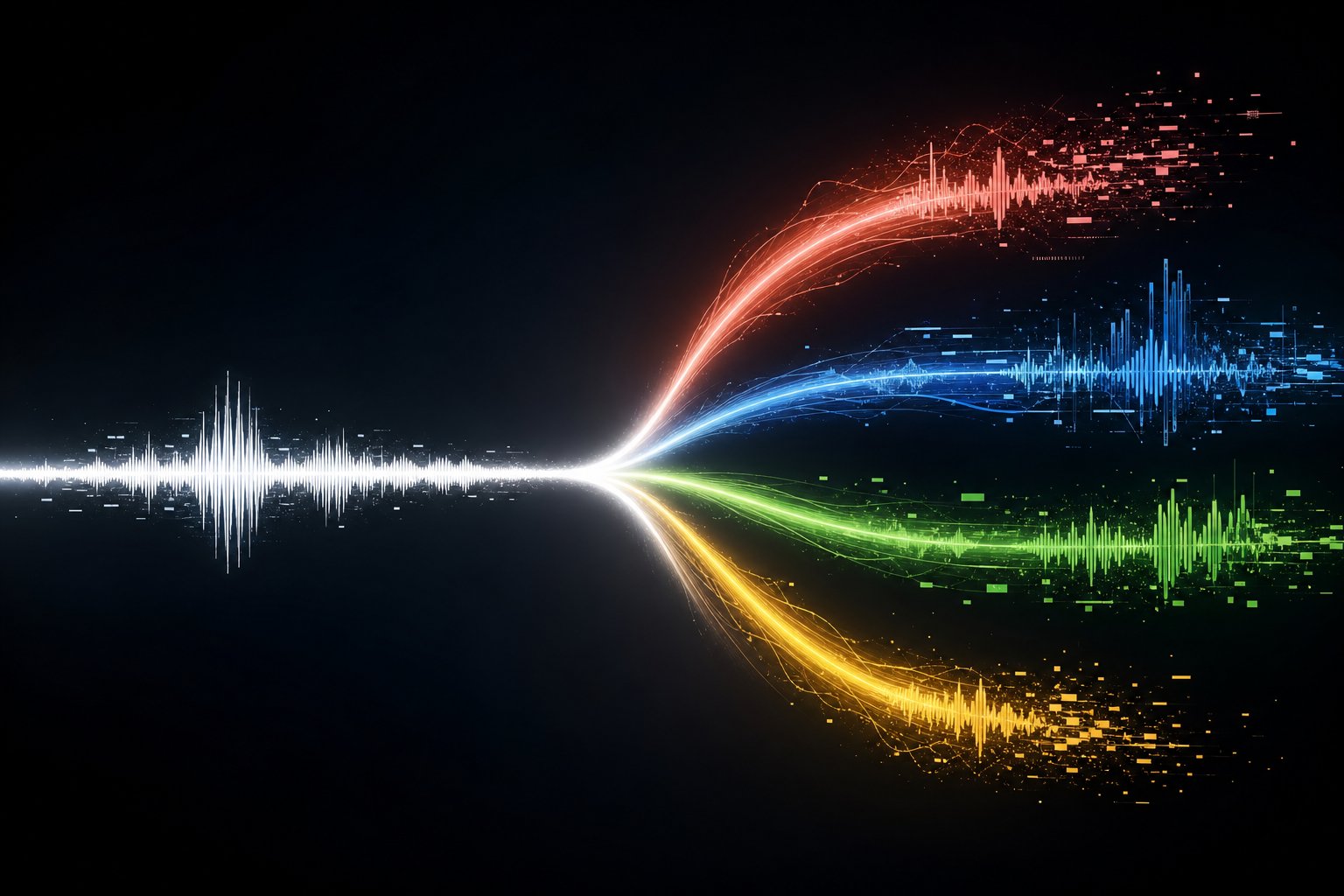
Separating Tracks to Expose What the Full Mix Hides
A polished mix is designed to make everything sound cohesive. That same cohesion works in AI's favor. When vocals, drums, bass, and instruments play simultaneously, subtle artifacts mask each other through frequency overlap and psychoacoustic masking. Isolating each element into its own stem strips away that cover and forces every imperfection into the open. This is why stem separation has become one of the most effective ways to check if song is ai generated, especially when automated detectors return ambiguous confidence scores.
Why Stem Separation Reveals Hidden AI Artifacts
Think of a full mix like a crowded room where everyone talks at once. You might sense something odd about one voice, but you cannot pinpoint it until that person speaks alone. The same principle applies to song analysis ai workflows. AI-generated tracks often sound convincing in their complete form because the generators optimize for the summed output. They do not optimize each individual layer to withstand isolated scrutiny.
When you separate a track into stems, typically vocals, drums, bass, and accompaniment, you expose artifacts that the full mix conceals:
- Vocal formant transitions that jump unnaturally: In a full mix, a brief formant glitch disappears behind reverb and instrumentation. Isolated, it sounds like the voice momentarily belongs to a different person.
- Bass lines with physically impossible fingering: Notes that would require a human bassist to teleport across the fretboard become obvious when the bass stem plays alone, without drums and guitars covering the transitions.
- Drum hits lacking micro-variation: Real drummers produce slightly different timbres on every hit due to stick angle, velocity, and head position. AI drums often repeat near-identical waveforms, and this repetition becomes unmistakable in isolation.
- Accompaniment layers with synthetic noise profiles: The "other instruments" stem frequently reveals a noise floor that behaves nothing like microphone or preamp noise, instead showing the statistical fingerprint of a generative model.
Modern AI stem separation technology uses neural networks trained on millions of tracks to identify and isolate each component with impressive fidelity. The process converts the mixed audio into a spectrogram, applies pattern recognition to classify frequency regions by instrument type, then reconstructs separate audio files for each predicted stem. This ai powered approach delivers isolation quality that rivals having access to the original multitrack session.
What to Listen for in Isolated Vocals and Instruments
Once you have stems in hand, targeted listening becomes far more productive than scanning the full mix. Here is what to focus on in each layer when you want to check if a song is ai:
- Vocals: Listen for formant shifts that happen too quickly between syllables, vibrato that resets identically on every sustained note, and consonant sounds (especially "L" and "R") that lack the tongue-position variation of real speech. Breaths, if present, often have identical spectral shape regardless of where they fall in the phrase.
- Drums: Play the drum stem and focus on hi-hats. Real hi-hat performances contain constant timbral variation from open-to-closed transitions, stick angle changes, and velocity dynamics. AI hi-hats frequently cycle through a small set of nearly identical samples. Snare ghost notes, if they exist at all, tend to be perfectly quantized rather than slightly ahead or behind the beat.
- Bass: Listen for slide artifacts between notes. Human bassists produce audible string noise during position shifts. AI bass lines often jump between notes with no transitional sound, or add synthetic slide sounds that do not match the implied playing technique.
- Accompaniment: This catch-all stem often reveals the most. Guitar strums with uniform pick attack across all six strings, piano chords where every note releases at exactly the same moment, or synth pads with mathematically perfect filter sweeps all point toward generation rather than performance.
A sound recorder detector or spectral analyzer can visualize these issues, but honestly, trained ears catch most of them without visual aids once you know what to listen for. The isolation itself does the heavy lifting by removing the masking that makes full-mix listening unreliable.
A Practical Workflow for Track Inspection
Whether you are a curator screening submissions, an educator teaching students about AI detection, or simply a curious listener running an ai music check on a suspicious track, this step-by-step workflow turns stem separation into a systematic detection method:
- Upload the suspect track to a stem separation tool. MakeBestMusic's Audio Separator is purpose-built for this. Upload the file, and the tool splits it into individual stems without requiring any DAW expertise or technical setup.
- Listen to the vocal stem first. Vocals carry the densest concentration of AI artifacts because human voice production is the hardest thing for generators to replicate convincingly. Focus on sustained notes, consonant transitions, and breathing patterns.
- Move to the drum stem. Check for micro-timing variation and timbral diversity across repeated hits. Loop a four-bar section and listen for whether each snare or hi-hat hit sounds genuinely different or suspiciously identical.
- Examine the bass in isolation. Play the bass stem and listen for note transitions. Are there realistic string noises, fret buzzes, or slide artifacts? Or do notes appear and disappear cleanly with no physical performance evidence?
- Scan the accompaniment stem for interaction artifacts. In real recordings, instruments bleed into each other and interact acoustically. AI-generated accompaniment layers often sound hermetically sealed, as if each instrument was generated in a vacuum.
- Cross-reference your findings. A single anomaly in one stem is not conclusive. But when the vocals show formant jumps, the drums lack variation, and the bass has impossible transitions, the cumulative evidence becomes compelling. Use an ai music checker tool to confirm what your ears detected.
This workflow functions like a sample finder ai process in reverse. Instead of searching for known samples within a track, you are searching for the absence of human performance characteristics across isolated layers. The approach works regardless of genre, tempo, or production style because it targets fundamental differences between generated and performed audio.
MakeBestMusic's Audio Separator makes this accessible to anyone, not just audio engineers with expensive DAW setups. Upload, separate, listen. The entire process takes minutes and gives you direct evidence rather than an opaque confidence percentage. For curators processing dozens of submissions, it provides the "why" behind a detection verdict, something no automated score alone can deliver.
Stem separation is powerful, but it is not infallible. As AI generators improve and detection methods sharpen in response, the arms race between creation and identification continues to escalate. Understanding where current detection approaches succeed and where they break down is essential for anyone relying on these techniques long-term.
Why Detection Is Getting Harder and What Still Works
Every detection method described so far has an expiration date. That is not a flaw in the approach. It is the nature of the problem. AI music generators improve with each version, and the artifacts that made detection straightforward six months ago may vanish in the next model update. Researchers at KTH Royal Institute of Technology describe this dynamic as an "arms race" where detection systems must constantly adapt to identify the outputs of updated generators. Understanding where current methods fail is just as important as knowing where they succeed.
Why Detection Methods Have an Expiration Date
Consider what happened with Suno's evolution from v3 to v5. Early versions produced obvious metallic vocal artifacts and aggressive spectral phasing that anyone with trained ears could catch. By v5, those tells had largely disappeared. The 32kHz upsampling signature persists for now, but there is no architectural reason it must. If Suno shifts to native 44.1kHz generation, one of the most reliable spectral indicators vanishes overnight.
This pattern repeats across the field. Detection systems trained on today's AI output learn features specific to current generation pipelines, not universal markers of synthetic origin. Research testing detectors against out-of-sample platforms demonstrates this starkly: classifiers trained on Suno and Udio data identified only 9-18% of tracks from Boomy as AI-generated, despite Boomy being an AI platform. Even the commercial IRCAM Amplify detector caught just 36% of Boomy tracks before being specifically retrained on that platform's output.
The core issue is that ai music detectors are not detecting "AI-ness" in some abstract sense. They are detecting the specific processing artifacts of particular generation pipelines at particular points in time. When those pipelines change, detection breaks. This is the Collingridge dilemma applied to music: methods that work well in controlled environments struggle to adapt when the underlying technology shifts beneath them.
False Positives and When Human Music Looks Like AI
The flip side of missed AI tracks is human music incorrectly flagged as synthetic. This problem is not hypothetical. A Cyanite survey found that over 70% of artists fear being wrongly labeled as AI-generated, and that fear has practical basis. Several categories of human-made music trigger false positives regularly:
- Heavily processed electronic music: Genres like EDM, synthwave, and hyperpop use software synthesizers, tight quantization, and aggressive processing that produce spectrograms nearly indistinguishable from AI output. The timing patterns, spectral smoothness, and noise floor characteristics that detectors flag as synthetic are deliberate aesthetic choices in these genres.
- AI-mastered human recordings: A singer-songwriter who records genuine performances but runs the final mix through AI mastering software may inherit enough processing artifacts to trip detection thresholds.
- Lo-fi and bedroom productions: Ironically, low-budget recordings with limited dynamic range and simple arrangements can resemble the output of generators like Boomy, which targets exactly that aesthetic.
- Vocal processing and Auto-Tune: Heavy pitch correction, vocoder effects, and formant shifting create vocal characteristics that overlap with AI vocal generation artifacts.
The consequences of false positives are severe. Platforms purging AI content could inadvertently remove legitimate human art. An artist wrongly flagged faces reputational damage, lost revenue, and the burden of proving their humanity, a reversal of the presumption of innocence that feels deeply unfair. Even IRCAM Amplify's detector, which achieves 95.3% recall on human-made music, still misclassifies roughly 4.7% of non-AI tracks. Scaled to catalogs exceeding 100 million items, that translates to millions of potential errors.
Any ai song rater or detection system that claims zero false positives should be treated with skepticism. The honest reality, as Cyanite's research team emphasizes, is that a track should only be labeled AI-generated when there is strong and consistent evidence supporting that conclusion. Conservative thresholds protect artists at the cost of letting some AI content through.
Which Detection Approaches Are Most Durable
Not all detection signals degrade at the same rate. Audio-level artifacts are the most fragile because they depend on specific generation architectures that evolve rapidly. The spectral cutoff at 16kHz disappears the moment a platform upgrades its sample rate. The periodic spectral ripples from transformer attention windows vanish when architectures change. These are useful today but unreliable as long-term anchors.
Contextual and behavioral signals, by contrast, prove far more durable. An artist with no social media history, no live performances, and 200 tracks released in three weeks will still look suspicious regardless of how good the audio quality becomes. Release cadence, collaboration patterns, and engagement metrics reflect fundamental differences between human creative processes and automated content generation that no model update can eliminate.
A song analyzer ai tool that combines spectral analysis with behavioral metadata will outperform one that relies on audio alone, precisely because the behavioral layer remains valid even as audio artifacts evolve. The most resilient detection stacks layer multiple signal types:
- Most fragile: Specific audio artifacts (spectral cutoffs, phase patterns, noise floor anomalies). These change with every model version.
- Moderately durable: Structural and timing patterns (quantization signatures, arrangement formulas, dynamic consistency). These improve more slowly because they require fundamental architectural changes.
- Most durable: Contextual and behavioral signals (release patterns, social proof, collaboration history, metadata anomalies). These reflect the economics and logistics of AI generation rather than its audio quality.
Layered detection that combines audio analysis, contextual signals, and tool-based scanning remains the most resilient approach even as individual methods become obsolete. No single technique survives every generator update, but the combination adapts because different layers fail at different times.
This layered philosophy also explains why the detect music ai challenge will never have a permanent solution. It is not a problem to solve once but a practice to maintain. The specific tells change, the tools update, the generators evolve. What persists is the methodology: combine multiple independent signals, weight durable indicators more heavily than fragile ones, and accept that certainty exists on a spectrum rather than as a binary verdict.
For anyone trying to how to identify ai music reliably over time, the practical takeaway is clear. Do not anchor your detection confidence to any single artifact or tool. Build a habit of checking audio, context, and metadata together. When one layer becomes obsolete, the others still hold. And stay current with how generators evolve, because the arms race does not pause.
Detection limitations raise a deeper question beyond technique. If identifying AI music is this difficult and this impermanent, why does it matter enough to keep trying? The answer lives in the economic, legal, and cultural stakes that make transparency worth fighting for.

The Bigger Picture of Why AI Music Detection Matters
Knowing how to tell if a song is ai generated is not just a parlor trick for audiophiles. It connects directly to who gets paid, who owns what, and whether human creativity retains its value in a market increasingly saturated with synthetic content. The stakes are financial, legal, and cultural, and they affect everyone from independent songwriters to the listeners who support them.
Royalties, Copyright, and Who Gets Paid
Streaming royalties operate on a pro-rata model: the total payout pool gets divided by total streams. Every AI-generated track that accumulates plays shrinks the per-stream value for human artists. Forbes reports that platforms increasingly integrate AI-generated music to cut costs, further shrinking royalty streams for human creators. Why license a costly catalog when AI can generate something "good enough" for free?
Copyright law is scrambling to keep pace. The major label lawsuits against Suno and Udio seek up to $150,000 per infringed work, and settlements are already reshaping the landscape. Warner Music settled with both platforms in late 2025, structuring deals around ongoing licensing partnerships rather than one-time damages. These agreements signal where the music industry ai news is heading: toward a framework where AI-generated content requires licensed training data and transparent attribution. But until that framework is universal, knowing how to know if a song is ai remains the listener's best tool for making informed choices about what they stream and support.
Supporting Human Artists in an AI-Saturated Market
Detection is not gatekeeping. It is informed listening. When you can how to tell ai music from human-made tracks, you gain the power to direct your attention and your streams toward artists who actually perform, write, and record. That choice matters economically. Every stream is a micro-vote for what kind of music ecosystem you want to exist.
Platforms are responding to this demand. Does spotify allow ai music? Yes, but with restrictions. Spotify's updated policy adopts the spotify ai ddex standard for labeling AI-assisted tracks in credits, bans unauthorized voice clones, and runs a spam filter targeting mass-produced content. Bandcamp has gone further, explicitly banning music produced entirely or mainly by AI. Deezer tags AI tracks and excludes them from algorithmic recommendations entirely. The no ai music stance varies by platform, but the trend toward mandatory disclosure is clear across the industry.
The Future of Transparency and Labeling
Apple Music now requires metadata tags disclosing AI involvement in creation. YouTube treats raw AI audio with minimal human input as ineligible for monetization. The EU AI Act begins enforcement in August 2026, bringing regulatory weight to what has so far been voluntary policy. These developments point toward a future where transparency is not optional but structural, embedded in the metadata and distribution pipeline itself.
Here is what you can do right now:
- Apply layered detection: combine audio listening, contextual checks, and tool-based scanning rather than relying on any single method
- Check artist profiles for social proof, live performance history, and collaboration credits before assuming authenticity
- Use stem separation to inspect suspicious tracks at the component level where artifacts are most exposed
- Support platforms with clear AI labeling policies and favor artists with verifiable human creative histories
- Stay current with detection developments, because generator updates constantly shift what to listen for
The ability to identify synthetic music will co-evolve with the technology that creates it. Detection tools will sharpen, labeling standards will mature, and legal frameworks will solidify. But the foundation remains the same: understanding what you are hearing empowers better choices about what you support, share, and celebrate. That is not about rejecting technology. It is about ensuring human artistry retains its place in a landscape where the line between created and generated grows thinner every month.
