

What Happens When You Hit Generate in Suno
You type seven words: "upbeat pop song about summer road trips." Fifteen seconds later, you're listening to a full track with vocals, drums, guitar, and a catchy chorus. The user experience feels almost absurdly simple. But between that sentence and the finished audio, a sophisticated AI pipeline performs millions of calculations, translating human language into music theory, music theory into digital tokens, and tokens into the waveform hitting your speakers.
So how does Suno AI create music from something as brief as a single sentence? This article pulls back the curtain on every stage of that journey.
The Gap Between a Prompt and a Song
Imagine handing a sticky note to a producer that reads "dreamy indie track, female vocals, rainy mood." A human musician would interpret that brief, draw on years of listening experience, and start sketching chords. Suno, developed by Suno, Inc. in Cambridge, Massachusetts, replicates a version of that creative interpretation at machine speed. The platform, which has been publicly available since late 2023, processes text or audio prompts and returns complete songs featuring vocals and instrumentation. What is Suno music at its core? It's the output of a generative AI system that treats songwriting as a sequence prediction problem rather than a set of hard-coded rules.
The suno AI name meaning itself reflects this mission — "suno" derives from the Hindi word for "listen," signaling the platform's focus on audio output that's meant to be heard, not just read as notation.
Why Understanding the Process Matters for Better Results
Knowing how Suno works behind the scenes isn't just technical curiosity. When you understand what the model extracts from your prompt, how it encodes musical features, and where it makes creative decisions autonomously, you gain leverage. You can write prompts that guide the system more precisely, recognize why certain outputs fall short, and iterate faster toward the track you actually want. Think of it like learning how a camera's sensor processes light — you don't need to be an engineer, but the knowledge makes you a better photographer.
The Seven Stages of AI Music Creation
The generation pipeline moves through distinct phases, each handling a different transformation of your input. Here's the full sequence from prompt to playback:
- Prompt interpretation — extracting genre, mood, tempo, and instrumentation from natural language
- Audio tokenization — converting continuous sound representations into discrete units the model can process
- Neural generation — a transformer network predicting music tokens one at a time
- Structure assembly — organizing output into verses, choruses, bridges, and outros
- Vocal and instrumental synthesis — generating singing and instruments as a unified audio stream
- Prompt refinement — using the knowledge above to craft better inputs
- Quality evaluation — understanding the system's limits and choosing the right tool for the job
Each stage builds on the previous one. A weak prompt leads to vague tokenization targets, which leads to generic output. A precise prompt gives the neural network clear constraints, producing tracks that feel intentional rather than random. The sections ahead break down every step so you can see exactly where your words become sound — and where you have the most creative control.
Step 1 – How Suno Interprets Your Text Prompt
Every song starts as a sentence, a phrase, or a handful of descriptive tags. The system's first job is to read that text and extract something it can act on musically. This stage works a lot like natural language processing in chatbots — except instead of producing a text reply, the model maps your words onto a set of musical parameters: genre, mood, tempo, instrumentation, energy level, and lyrical theme.
Think of it as a translation layer. You speak in human language. The model needs to think in musical dimensions. The gap between those two is where prompt interpretation lives.
How Natural Language Becomes Musical Parameters
When you type something like "cinematic orchestral piece, slow build, strings and brass, epic mood," the system doesn't process those words as a flat string of text. It parses them into categories. "Cinematic" and "epic" become mood and energy signals. "Orchestral" sets a genre context. "Strings and brass" narrow down the instrumentation palette. "Slow build" provides a tempo and dynamic arc hint.
A human producer receiving a creative brief from a client does something remarkably similar. They read "I want something that sounds like a film trailer" and mentally translate it into chord voicings, reverb-heavy production, and layered percussion. The AI replicates this interpretive step by drawing on patterns it learned during training — associations between words and the musical features those words typically describe.
If you understand how to use Suno AI effectively, you'll notice that specificity matters enormously. The model identifies genre cues ("lo-fi hip hop," "baroque pop"), mood descriptors ("melancholic," "triumphant"), tempo hints ("uptempo," "slow ballad"), and instrumentation requests ("acoustic guitar," "808s"). Each recognized keyword shifts the probability distribution of what the model generates next. Vague inputs leave more to chance. Precise inputs constrain the output toward your intention.
Tags vs. Free-Form Descriptions
Suno offers two primary ways to communicate your intent: structured metatags and free-form style descriptions. Tags are bracketed keywords like [Verse], [Chorus], [Female Vocal], or [Piano] that the model parses as direct instructions. Free-form descriptions are natural sentences — "dreamy synthwave track with airy pads and a driving beat."
Both approaches work, but they behave differently under the hood. Tags tend to produce more predictable, genre-accurate results because they compress your intent into short, unambiguous tokens the model has seen frequently in its training data. Free-form descriptions allow for more nuance and creative blending, but they also introduce room for misinterpretation — especially if you use poetic or abstract language that lacks concrete musical meaning.
The suno meaning behind this distinction is practical: tags are like giving a session musician a chord chart, while free-form descriptions are like painting a mood board. Both communicate intent, but the chord chart leaves less room for interpretation. Experienced users often combine both — placing genre and instrumentation in the style tags field while using section markers and vocal direction within the lyrics field itself. According to prompt engineering best practices documented by Musci.io's tag reference guide, front-loading your most important tags in the first 20-30 words produces the strongest effect on the output.
What the Model Extracts From Your Words
Here's where things get interesting. The same musical idea phrased two different ways can produce substantially different results, because the model weights certain vocabulary more heavily than others.
Prompt A: "Sad piano ballad, slow tempo, male vocals, rainy day feeling." — Expected output: sparse arrangement, legato meaning long sustained notes, intimate vocal delivery, minor key.
Prompt B: "Emotional cinematic piece, piano-driven, melancholic, male singer." — Expected output: fuller production with strings or pads layered beneath the piano, more dynamic range, potentially building toward a climax.
Both prompts describe a sad piano song with male vocals. But "ballad" plus "slow tempo" constrains the model toward simplicity and restraint, while "cinematic" plus "emotional" invites orchestral layering and dramatic structure. The word "cinematic" alone carries strong associations with lush production, tension-and-release dynamics, and multi-instrument arrangements — much like how a calliope instrument evokes carnival imagery instantly, or how mentioning a cor anglais oboe immediately signals a warm, reedy woodwind color in orchestral writing.
The practical takeaway: choose your descriptors based on what musical outcome they imply, not just what emotional state they name. The model doesn't feel sadness — it matches your words to patterns of instrumentation, tempo, key signature, and arrangement density that correlate with "sad" in its training data. The more musically specific you are, the closer the output aligns with what you actually hear in your head.
This interpretive stage determines everything downstream. If the model reads your prompt as "upbeat pop" when you meant "indie folk with energy," no amount of neural network sophistication will recover your original intent. The tokens it generates, the structure it builds, and the final audio all flow from this first translation — which is why the next stage, tokenization, depends entirely on how cleanly your musical parameters were extracted here.
Step 2 – Turning Sound Into Tokens the AI Can Read
Musical parameters extracted from your prompt give the system a target — a destination. But the neural network that actually generates audio doesn't think in terms of "sad piano" or "120 BPM." It thinks in tokens: small, discrete chunks of information it can predict one after another, like words in a sentence. The bridge between your interpreted prompt and the model's creative engine is audio tokenization — and it's the single design choice that makes AI music generation possible at this scale.
From Continuous Waveforms to Discrete Tokens
Sound, in its natural form, is continuous. A waveform is an unbroken stream of air pressure changes — or, in digital audio, tens of thousands of amplitude values sampled every second. CD-quality audio captures 44,100 samples per second. That's an enormous amount of raw data, and neural networks aren't efficient at predicting individual samples one at a time.
Audio tokenization solves this by compressing that continuous signal into a sequence of discrete units — tokens — each representing a small chunk of spectral and temporal information. Imagine taking a long, flowing river and breaking it into a series of distinct pools connected by gates. Each pool captures the essential character of that stretch of water without needing to model every molecule. The AI model then predicts the sequence of pools rather than every individual water molecule.
The process works through a neural audio codec — a specialized encoder-decoder network. The encoder compresses raw audio into latent representations, and a quantizer maps those representations to entries in a learned codebook. Research published through arXiv's comprehensive survey on discrete audio tokens shows that systems like EnCodec and SoundStream use residual vector quantization (RVQ) to achieve compression ratios of up to 20x compared to mel-spectrograms, with minimal perceptual quality loss. The decoder can later reconstruct audio from these tokens, but during generation, only the token sequence matters.
Why Tokenization Makes Music a Language Problem
Here's the conceptual leap that makes everything click. Once audio is broken into discrete tokens, music generation becomes a sequence prediction problem — fundamentally the same type of problem that text-based AI models solve. Instead of predicting the next word in a paragraph, the model predicts the next audio token in a song.
This is radically different from how older synthesizers and music notation software work. Traditional approaches generate waveforms directly from mathematical functions — a saw wave is computed from a formula, a reverb is modeled as a series of reflections, and every sound is assembled from explicit signal processing rules. A midi player reads note-on and note-off events and triggers pre-programmed samples. These systems follow instructions; they don't learn patterns.
Tokenization flips the paradigm. By converting audio into discrete symbols, the AI can learn statistical relationships between tokens the same way a language model learns that "once upon a" is likely followed by "time." It learns that certain chord progressions follow others, that drum patterns in hip-hop differ from those in jazz, and that a vocal melody tends to resolve in specific ways depending on genre context. None of this requires hand-coded music theory. The patterns emerge from training data at scale.
The analogy to text processing makes this clearer:
| Dimension | Text Tokenization | Audio Tokenization |
|---|---|---|
| Input signal | Written language (characters, words) | Continuous audio waveform (amplitude over time) |
| Token unit | Subword or word fragment | Spectral frame (pitch, timbre, rhythm encoded together) |
| Encoding method | Byte Pair Encoding or similar | Neural codec with residual vector quantization |
| Sequence length | ~100-500 tokens per paragraph | ~50-150 tokens per second of audio |
| What the model learns | Grammar, meaning, style patterns | Harmony, rhythm, timbre, production patterns |
| Prediction task | Next word/subword | Next audio token |
This table reveals something important: audio tokenization is far denser than text tokenization. A one-minute song might require thousands of tokens, compared to a few hundred for a paragraph of text. That density is why generating music demands serious computational resources — and why the model's ability to maintain coherence over long sequences is such an engineering challenge.
How Audio Features Get Encoded
A single audio token doesn't just carry one piece of information. Unlike a musical note on a staff — the kind you'd see in a notation app android users might download to read sheet music — an audio token encodes multiple dimensions simultaneously: pitch, timbre, rhythm, dynamics, and even spatial characteristics like stereo positioning.
This multidimensional encoding happens through the codec's layered quantization process. In residual vector quantization, the first codebook captures the most salient, coarse-grained features — the broad shape of the sound. Each subsequent codebook refines the residual error, adding finer detail: the brightness of a cymbal hit, the breathiness of a vocal, the specific harmonic overtones that distinguish a nylon-string guitar from a steel-string one. Research from the Emergent Mind audio tokenization overview describes how semantic tokens capture high-level structure (phonetic content, musical phrasing) while acoustic tokens preserve fine perceptual details needed for high-fidelity reconstruction.
This layered approach means the model doesn't need separate systems for melody, harmony, rhythm, and timbre. Everything lives in one token stream. When the model predicts the next token, it's simultaneously making decisions about all these musical dimensions — which is why the output sounds like a coherent piece of music rather than isolated elements playing over each other.
The trade-off is that this compression is lossy. Some subtle details get smoothed over during quantization. Very quiet nuances, complex transients, and unusual timbral combinations can lose fidelity in the tokenization step. But the efficiency gain is massive: instead of predicting 44,100 raw audio samples per second, the model works with roughly 50-150 tokens per second — a reduction that makes real-time generation feasible while preserving enough musical information for the output to sound convincing.
With audio now translated into a language the neural network can read, the actual creative generation begins. The model takes these tokens — plus the conditioning information from your prompt — and starts predicting what comes next, one token at a time, assembling a song from statistical patterns learned across its entire training dataset.
Step 3 – The Neural Network Writes Music
A stream of discrete tokens and a set of musical parameters from your prompt — that's what the neural network receives. Its job? Predict what comes next. Token by token, the model assembles a song by asking the same question thousands of times in sequence: "Given everything that's happened so far, what's the most musically coherent thing to generate next?"
This is the creative core of how Suno AI creates music. Everything before this point is preparation — translation and encoding. Everything after is assembly and rendering. The transformer network is where raw statistical patterns become melody, rhythm, and arrangement.
Predicting Music One Token at a Time
The generation process is autoregressive. That means the model produces one token, appends it to the sequence, then uses the updated sequence to produce the next token. Repeat this thousands of times, and you get a complete song.
If you've used a chatbot that writes text, you've seen this exact mechanism in action — just applied to words instead of audio. A large language model predicts the next word based on all previous words. A music transformer predicts the next audio token based on all previous audio tokens plus the conditioning signal from your prompt. The Sequence-to-Music Transformer Framework published in academic research describes this approach: an encoder extracts musical features while a decoder generates the sequence token by token in an autoregressive manner, with each new token conditioned on all previously observed tokens.
The critical difference from text generation? Music tokens carry multidimensional information. When a text model predicts the word "sunset," it's making a single semantic choice. When a music model predicts the next audio token, it's simultaneously deciding pitch, timbre, rhythm, dynamics, and stereo position — all compressed into that one discrete unit. Every prediction is a multi-layered musical decision, which is why generating convincing music requires substantially more computational depth than generating readable text.
How Attention Keeps the Song Coherent
Imagine you're listening to a song and the chorus melody reappears after an eight-bar verse. That return feels natural because the melody refers back to something you heard 30 seconds ago. For a neural network generating one token at a time, maintaining that kind of long-range coherence is the hardest problem to solve.
The mechanism that makes this possible is called self-attention. In a transformer architecture, every token in the sequence can "attend to" every other token — weighing how relevant past tokens are when predicting the current one. Research from Google on the Music Transformer demonstrated that self-attention is particularly well-suited to music because musical structure relies heavily on repetition across multiple timescales: motifs repeat within phrases, phrases repeat across sections, and entire sections recur throughout a piece. The researchers introduced a relative attention mechanism that enables the model to generate minute-long compositions with compelling structure — thousands of steps where earlier approaches lost coherence after just a few seconds.
In practical terms, attention is what prevents the output from drifting into randomness. Without it, a model might generate a beautiful four-bar phrase and then wander into unrelated harmonic territory. With attention, the network "remembers" the melodic contour, the chord progression, and the rhythmic feel it established earlier — and actively maintains consistency as it generates forward. You'll notice this when Suno produces a chorus that actually sounds like a return rather than an unrelated section.
This same mechanism handles genre consistency. If the first few seconds establish a lo-fi hip-hop texture — muted drums, jazz chords, vinyl crackle — attention ensures that subsequent tokens maintain those production characteristics rather than suddenly shifting into heavy metal. The model weighs its early output heavily when predicting later tokens, which creates stylistic stability across the full duration.
What the Model Learned From Training Data
A transformer doesn't ship with built-in knowledge of music theory. It doesn't know what a chord progression "is" in the way a trained musician understands functional harmony. Instead, it learned statistical patterns from vast amounts of musical data during training. Those patterns happen to encode the same relationships that music theory describes — dominant chords tend to resolve to tonic chords, verse melodies tend to sit in a lower range than chorus melodies, and drum patterns in 4/4 time tend to place kicks on beats one and three.
Research on controllable chord generation using transformer models shows that these networks can maintain key consistency above 80% across generated progressions — even without explicit music theory rules programmed in. The model internalized tonal structure purely from exposure to examples. It learned that certain chord movements sound "resolved" and others sound "tense" because those patterns appeared consistently across thousands of training samples.
This extends beyond harmony. The model absorbed genre conventions — what makes synthwave sound like synthwave rather than country. It learned production aesthetics — how reverb behaves in a stadium rock mix versus a bedroom pop track. It picked up arrangement patterns — when to introduce a new instrument, when to thin out the texture for contrast. Much like how the best composers of all time developed their craft by absorbing and recombining influences, the AI built an internal representation of musical possibility by processing enormous volumes of existing music.
Traditional music software like SynthV or Synthesizer V follows explicit rules: if note C4 is triggered, play this sample at this velocity with this envelope. A transformer does something fundamentally different — it generates audio from learned statistical relationships, not programmed instructions. The output isn't a rule being followed; it's a pattern being continued.
This distinction matters because it explains both the model's strengths and its quirks. Rule-based systems always produce predictable, correct output within their programmed boundaries — but they can't surprise you. Learned-pattern systems can produce genuinely creative combinations they were never explicitly told to create — a chord voicing that blends jazz and electronic aesthetics, a rhythmic pattern that sits between genres — because they operate on probability distributions rather than if-then logic. The flip side is that they can also produce nonsensical output when the probability distribution doesn't have a strong "best answer" for a given context.
The neural network's output at this stage is still a raw sequence of audio tokens — musically coherent moment to moment, with attention maintaining consistency over longer spans. But a sequence of coherent moments doesn't automatically produce a well-structured song. Verse-chorus form, dramatic builds, and satisfying endings require a different kind of organization — one that operates at the level of sections rather than individual tokens.
Step 4 – Building Verse, Chorus, and Bridge Automatically
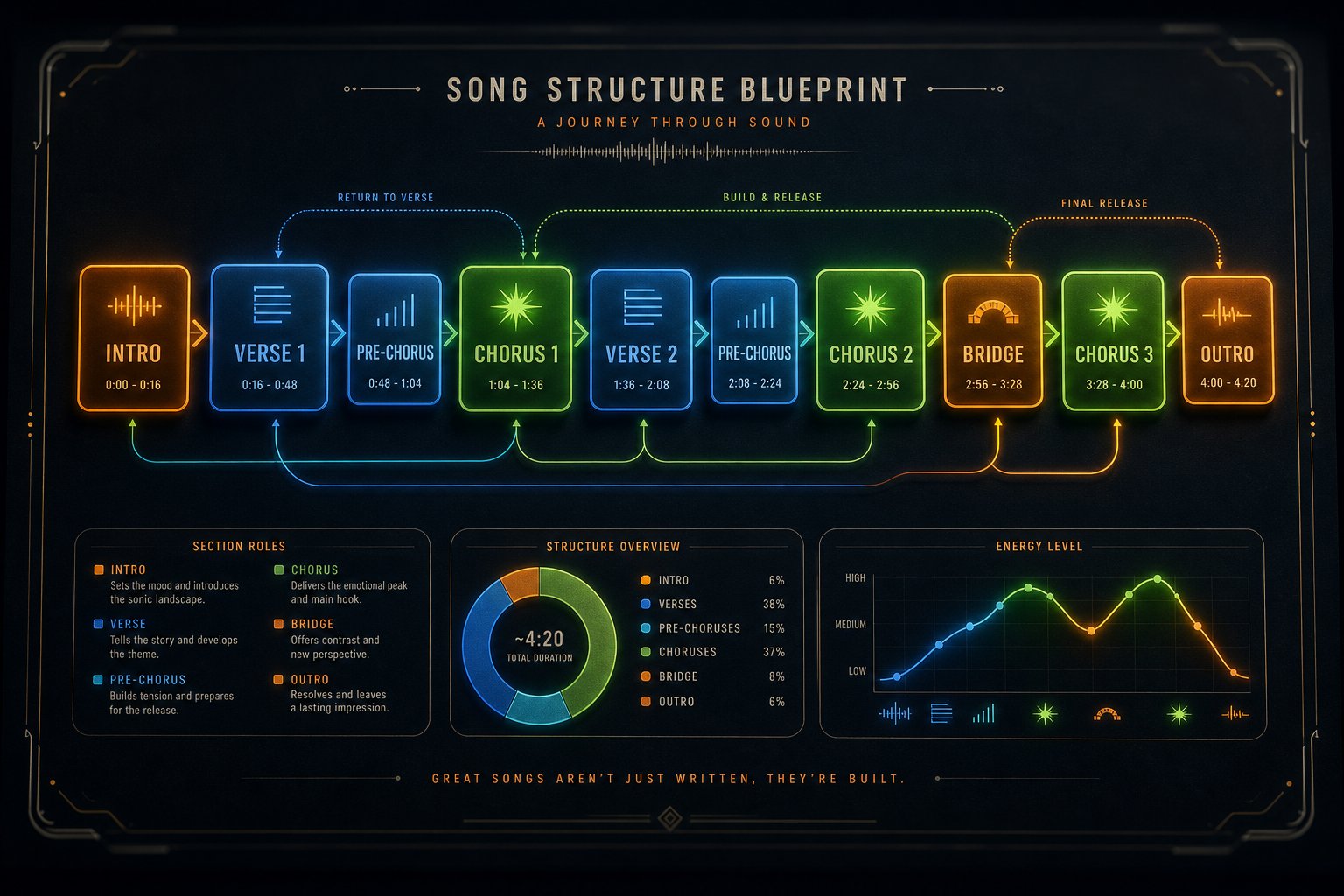
A coherent four-bar phrase is one thing. A full song with an intro that sets the mood, verses that build narrative, and a chorus that delivers an emotional payoff — that's an entirely different challenge. The model doesn't just generate a stream of pleasant-sounding audio. It organizes that audio into recognizable sections, creating the architecture listeners expect from a real track.
How the Model Learns Verse-Chorus Patterns
Human songwriters plan structure deliberately. They sketch out a roadmap — verse one here, pre-chorus building tension there, chorus landing with a sforzando burst of energy — before filling in the details. The AI arrives at structure differently: through statistical patterns absorbed from training data. After processing thousands of songs, the model internalized that verses tend to be sparser and lower in energy, choruses are louder and more harmonically rich, and bridges introduce contrast before a final return.
Users can reinforce these learned patterns by formatting their lyrics with section markers. According to SunoPrompt's guide to music form, placing tags like [Verse], [Chorus], and [Bridge] directly in the lyrics field tells the system when to shift its musical energy. The AI understands that a [Verse] should sit lower dynamically than a [Chorus], creating a natural ebb and flow without any manual mixing. Combine structural tags with style cues — [Intro] [Soft Piano] or [Chorus] [Upbeat Pop] — and you're essentially underscoring each section with explicit production direction.
Without these markers, the model still attempts structure based on statistical priors. But results become less predictable, sometimes looping a single section's energy level or failing to differentiate verse from chorus. The tags act as guardrails, ensuring the model's learned patterns activate at the right moments.
Long-Range Coherence and Musical Memory
Bringing back a chorus melody after an eight-bar verse — making it feel like a return rather than a coincidence — is one of the hardest problems in generative music. The attention mechanism discussed in the previous stage handles this at the token level, but structural coherence demands something broader: the model must "remember" that a chorus melody was established sixty seconds ago and reproduce its essential character when the section tag recurs.
In practice, this works the same way a melody might be transposed to a different key in a bridge section before returning to the original key for the final chorus. The model tracks melodic contour and harmonic context across long spans, maintaining consistent tempo and re-establishing thematic material when the sequence of structural cues calls for repetition. Research on song generation coherence, including work from systems like SongBloom, shows that maintaining structural alignment over 60-150 seconds remains one of the most demanding aspects of full-length song generation — with models specifically evaluated on Structural Error Rate (SER) to measure how well detected patterns match target structure.
The result, when it works well, is genuine musical tension and release. Verses hold energy back, pre-choruses build anticipation, and choruses deliver the payoff — all emerging from learned probability distributions rather than hand-coded compositional rules.
Where Structure Can Break Down
The model handles conventional song forms reliably, but certain situations push it past its comfort zone. Here's how common structures rank in terms of generation reliability:
- Structures the model handles well: Standard verse-chorus-verse-chorus-bridge-chorus pop form; verse-chorus with a simple intro and outro; repeated AABA patterns common in classic songwriting; straightforward verse-hook structures in hip-hop and EDM
- Structures that challenge it: Progressive rock forms with irregular section lengths and no repeating chorus; songs that shift time signatures mid-track (moving from 4/4 to 7/8, for example); tracks exceeding three minutes where the model may begin repeating sections redundantly; genre transitions within a single song (starting as acoustic folk and ending as electronic); through-composed pieces with no recurring section at all
The pattern is clear: repetition and familiarity favor the model. Conventional pop, rock, and electronic structures appear thousands of times in training data, so the AI has strong priors for how they unfold. Unusual forms — the ones that break expectations or avoid repetition — lack sufficient training examples, so the model falls back on generic patterns or loses coherence entirely.
Building section by section using the "Extend" feature can mitigate some of these issues. Instead of asking for a full three-minute track in one generation, you produce the intro and verse first, evaluate the result, then extend with a chorus tag and its lyrics. This incremental approach gives you control over each structural boundary — effectively collaborating with the model rather than leaving all architectural decisions to probability alone.
Structure gives a song its shape, but shape alone doesn't explain why the output sounds like a finished record rather than a rough demo. The next piece of the puzzle is how the system generates vocals, instruments, and production quality as a single unified output — and why that approach creates both impressive polish and frustrating limitations.
Step 5 – Generating Vocals and Instruments as One
Traditional music production is an assembly process. A vocalist records takes in a treated room. A guitarist lays down parts through an amp simulator like AmpliTube. A producer programs drums on a Maschine MK3 controller, loads orchestral libraries through Native Access, tweaks synth patches in u-he Diva, and maybe sculpts resonances with Soothe2. Each element lives on its own track. Then a mix engineer spends hours balancing levels, panning instruments, applying EQ, and shaping dynamics before a mastering engineer polishes the final stereo file.
Suno skips all of that. The model generates vocals, instruments, and production characteristics as a single unified audio stream. There is no separate vocal track. There is no drum bus. There is no mixing stage. The output arrives as a finished stereo file where everything already sits together — vocals placed in the mix, instruments panned across the stereo field, dynamics already managed, and reverb tails already blended into the arrangement.
Unified Generation vs. Multi-Track Production
This unified approach is what makes generation so fast. The model doesn't produce MIDI data that needs to be rendered through sample libraries like Kontakt 8. It doesn't output isolated stems that require mixing. It predicts audio tokens that already represent the combined sound of every element playing together — because that's what its training data looked like. The model learned from finished, mixed, mastered recordings, so it reproduces that "finished" quality directly.
Imagine the difference between painting a portrait on a single canvas versus assembling it from separate transparent layers for skin, hair, clothing, and background. The single-canvas painter works faster and produces a cohesive result, but you can't easily swap the background afterward. That's exactly the trade-off here.
According to AudioShake's analysis of generative AI workflows, most generative music tools today output single-track audio, creating a friction point: the content is fast to make but slow to refine. Stem separation technology can partially recover individual elements after generation, but the results are never as clean as true multitrack recordings because the AI's output was never separated to begin with.
| Dimension | Unified Generation (Suno) | Traditional Multi-Track Production |
|---|---|---|
| Speed | Seconds to minutes per full track | Hours to weeks per full track |
| Output quality | Polished and radio-ready sounding | Quality depends on engineer skill and tools |
| Editability | Very limited — cannot isolate individual elements cleanly | Full control over every track, bus, and effect |
| Flexibility | Re-generate or remix the entire track; no granular adjustments | Change any single element without affecting others |
| Required expertise | None — prompt-based workflow | Recording, mixing, and mastering knowledge needed |
| File output | Single stereo audio file | Separate stems, multitracks, and a master file |
Why You Cannot Separate the Stems Easily
In traditional production, if you want to remove background music from video or isolate a vocal for a remix, you go back to the original session and solo that track. The elements were never blended at the data level — they simply played back simultaneously through a mixer.
Suno's output works differently. The tokens the model generates already encode all instruments and vocals as a combined signal. There was never a "vocal track" inside the model's generation process — only a sequence of audio tokens that represent the full mix at each moment in time. As iZotope's explanation of stems versus multitracks makes clear, true stems are submixes of related tracks printed from an actual session. What AI stem separation tools recover from Suno's output are approximations — useful for basic adjustments, but not equivalent to source-separated recordings.
This matters practically. If the vocal sits slightly too high in the mix or you want to re-pan the guitar, your options are limited to re-generating the track with an adjusted prompt or running the output through third-party separation tools like Mixea or iZotope's RX Music Rebalance. Neither gives you the surgical precision of a proper DAW session with isolated multitracks.
The Trade-Off Between Polish and Control
The unified generation approach optimizes for a specific outcome: a finished-sounding track produced instantly from a text prompt. For content creators who need background music quickly, for songwriters sketching demo ideas, or for marketers producing campaign audio, this trade-off is overwhelmingly positive. You get professional-sounding results without needing a studio, an engineer, or mixing expertise.
For producers who want granular control — adjusting a vocal's reverb send, sidechain-compressing the bass to the kick, or replacing a synth patch — the unified output becomes a limitation. The polish comes at the cost of flexibility. You're hearing what the model thinks a finished mix should sound like based on its training data, and you're accepting that interpretation wholesale.
The raw output from Suno's generation pipeline already sounds remarkably close to what you hear on playback. The platform may apply light normalization or loudness targeting before delivery, but the core mix character — the balance between vocals and instruments, the stereo width, the dynamic range — comes directly from the model's predictions. It's not a rough draft that gets polished by a separate system. It's the model's best guess at a finished record, delivered in one pass.
This all-in-one approach explains why the system can go from prompt to playback in seconds. But it also explains why improving your results depends heavily on getting the prompt right the first time — because post-generation editing options are narrow. That reality makes prompt engineering less of a nice-to-have and more of the primary creative skill for anyone using the platform seriously.
Step 6 – Crafting Better Prompts With This Knowledge
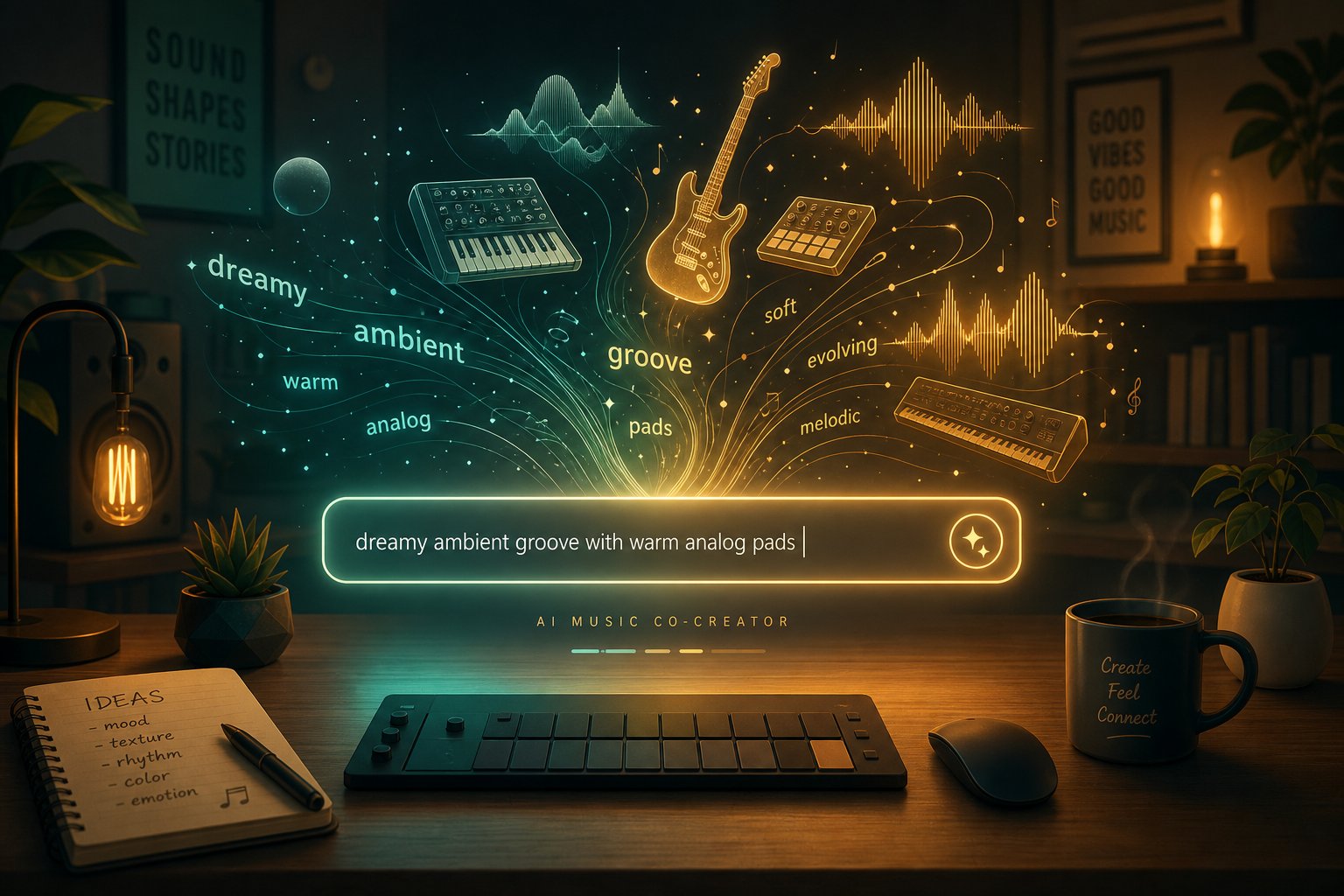
Getting the prompt right the first time isn't just convenient — it's the primary creative lever available to you. Since the unified output limits post-generation editing, your words are your mixing board, your arrangement notes, and your creative direction all rolled into one sentence or paragraph. Understanding how does Suno AI work at each pipeline stage transforms prompt writing from guesswork into a repeatable skill.
Writing Prompts That Match How the Model Thinks
The model doesn't interpret your prompt the way a human collaborator would. It maps words to learned statistical associations between language and audio features. That means writing effective prompts requires thinking in the model's terms — genre labels it has seen frequently, instrumentation names that appear in its training data, and structural cues it recognizes as section boundaries.
Great composers have always communicated musical ideas through precise vocabulary. A conductor doesn't say "play it sadder" — they say "più espressivo, pull back to pianissimo by bar twelve." You can adopt the same precision. Instead of "a chill song," try "lo-fi hip hop, 78 BPM, Rhodes piano, brushed drums, vinyl texture, D minor." Each specific term narrows the probability space the model explores, pushing output closer to your intent.
Here are high-impact prompt techniques drawn directly from how the generation pipeline processes information:
- Name the sub-genre, not just the genre. "Midwest emo" is more targeted than "rock." "Dark ambient" is more useful than "electronic."
- Specify BPM and key explicitly. Without these, the model picks from a wide distribution — and consecutive generations may land at different tempos entirely.
- List instruments by name. "Acoustic guitar, upright bass, brushed snare" gives the model a concrete palette. Vague terms like "band" leave everything open.
- Use section markers in your lyrics. Tags like [Verse], [Chorus], [Bridge], and [Outro] activate the structural patterns the model learned. Omitting them invites formless output.
- Describe energy and dynamics. "Soft verse building to explosive chorus" tells the model where to place contrast. A flat energy description produces a flat track.
- Reference vocal character. "Breathy female vocal, alto range" or "raspy male vocal, baritone" gives the synthesis stage a concrete target rather than a generic default voice.
- Add production cues. Terms like "reverb-heavy," "lo-fi tape saturation," or "crisp modern pop production" shape the mix character the model aims for.
According to the 7-Step Suno Prompt Engineering Pro Method, prompts built with this layered specificity achieve roughly 80% hit rates compared to around 25% for vague two-line descriptions. The methodology recommends decomposing your prompt into independent layers — vocal character, style, instrumentation, BPM/key, structure, and dynamics — so each dimension can be tuned without disturbing the others.
Using Musical Vocabulary for Precision
The model recognizes a surprisingly wide range of musical terminology. You don't need a conservatory degree, but borrowing from the vocabulary of professional musicians pays off. Tempo markings like "andante" or "allegro," dynamic markings like "pp" or "ff," and articulation terms like "staccato" or "legato" all carry meaning within the system because they appeared consistently in the training data alongside specific audio characteristics.
Instrumentation requests work best when you use standard names. "English horn" or the equivalent cors anglais instrument designation both point the model toward that distinctive warm, reedy timbre — the same double-reed sound sometimes written as english horn cor anglais in orchestral scores. Similarly, specifying "bassoon fagotto" tells the system exactly which low woodwind voice you want rather than leaving it to guess from a vague "deep woodwind" description. Even less common instruments like the celesta percussion instrument — that bell-like keyboard sound familiar from Tchaikovsky's "Dance of the Sugar Plum Fairy" — can be requested by name with reasonable results.
The principle is straightforward: the more precisely your language maps to terms the model encountered during training, the less room there is for misinterpretation. Musical vocabulary acts as a shortcut to specific sonic outcomes.
Iterating Strategically With Extend and Remix
A single generation rarely nails everything. The real skill is knowing how to iterate based on what the model produced. If the verse landed perfectly but the chorus drifted, use the Extend feature to regenerate from the chorus boundary with adjusted lyrics or a different energy tag — rather than discarding the whole track and starting over.
According to Soundverse's guide on extending songs with Suno AI, the extension feature analyzes the existing audio's tempo, key, and style to produce continuations that match. This means you can build a song section by section, evaluating each part before moving forward. It's collaborative rather than all-or-nothing.
Practical iteration strategies include:
- Re-roll the same prompt when the composition direction feels wrong — each generation samples differently from the probability distribution.
- Extend from a good starting point when the opening works but the track went somewhere unexpected after 30 seconds.
- Remix with adjusted style tags when the structure and melody are right but the production or instrumentation needs a different flavor.
- Edit only the problem lyrics rather than rewriting everything — pinpointing the failing section keeps what already works intact.
Users comparing prompt approaches across different AI music generators can explore curated Suno AI alternatives to understand how each platform interprets prompts differently. What is Suno app's strength — fast unified output from minimal input — may not suit every workflow. Testing the same prompt across multiple tools reveals which generation pipeline best matches your creative intentions, since each model weights style cues, structural markers, and instrumentation requests with different priorities.
The gap between a mediocre AI track and a genuinely useful one almost always comes down to prompt precision and strategic iteration. But even with perfect technique, the system has boundaries. Certain requests consistently produce artifacts, some genres resist accurate generation, and commercial usage raises questions that prompt skill alone can't answer.

Step 7 – Knowing the Limits and Exploring Alternatives
Perfect prompt technique still won't overcome the system's hard boundaries. Every generation pipeline has a ceiling — places where the technology consistently falls short regardless of how well you communicate your intent. Recognizing these limits saves you hours of frustrated re-rolling and helps you decide when a different tool or workflow makes more sense.
The Quality Ceiling and Why It Exists
If you've spent time with tracks made with Suno, you've likely noticed recurring quirks. Some are subtle — a slight warble in sustained vocals, cymbals that sound slightly smeared. Others are obvious enough to break immersion entirely. These aren't random glitches. Each limitation traces back to a specific technical cause in the pipeline:
- Vocal artifacts and warble — The audio tokenization step compresses spectral detail through vector quantization. High-frequency sibilants and sustained vowels lose fidelity during this compression, producing the characteristic "chirp" or metallic edge on vocals.
- Repetitive patterns — The transformer's attention mechanism favors repeating what worked earlier in the sequence. Without strong structural cues, the model can loop a melodic phrase or drum pattern well past the point of interest.
- Genre-specific weaknesses — Genres underrepresented in training data produce less convincing results. Jazz improvisation, complex polyrhythmic African percussion, and technical metal suffer because the model has fewer statistical patterns to draw from.
- Instrumentation specificity limits — Requesting a rare instrument (a specific vintage analog synth, an Armenian duduk, a prepared piano) often yields an approximation rather than an accurate reproduction. The codebook may not have enough distinct tokens to differentiate niche timbres.
- Dynamic range compression — According to MuseGen's sound quality analysis, many generations arrive "pre-squashed," flattening the energy difference between verse and chorus because the model learned from loudness-normalized masters.
- Extension inconsistency — Extending a track beyond its initial generation sometimes introduces tonal drift or tempo fluctuation, because the model's context window can't perfectly maintain coherence across very long sequences.
None of these are bugs that a software update will trivially fix. They're consequences of the fundamental architecture — lossy tokenization, finite attention windows, and training data distributions. Since when did Suno AI come out in late 2023, the platform has improved generation quality with each version, but the underlying trade-offs between compression efficiency and audio fidelity remain inherent to the approach.
Copyright, Ethics, and Commercial Usage
Technical quality isn't the only boundary. The legal landscape around AI-generated music is still unsettled, and it raises practical questions for anyone planning to distribute or monetize their output.
The core tension: Suno's model learned musical patterns from existing recordings. The specifics of that training data remain undisclosed, and Suno has faced legal challenges regarding alleged infringement — a fact widely documented across the Suno AI wiki and help documentation. For creators, this means commercial usage carries residual uncertainty even when your subscription grants commercial rights. A track that inadvertently mirrors an existing melody could trigger Content ID flags on platforms like YouTube or Spotify.
Ownership rules split clearly by plan tier. Free-tier outputs are typically owned by Suno and restricted to non-commercial use. Paid subscribers (Pro and Premier) receive commercial rights to their generations. But here's the nuance: in many jurisdictions, fully AI-generated works may not qualify for copyright registration without meaningful human authorship. Organizations like the Mechanical-Copyright Protection Society and similar collection bodies are still developing frameworks for how AI-created compositions fit into existing royalty structures.
Questions about provenance compound the issue. Is there copyright on Soundcloud uploads made with Suno? Technically, the platform allows uploads, but enforcement and rights claims depend on whether the content qualifies as a copyrightable work under local law — a question courts haven't fully resolved. The unified-output approach makes this harder to navigate because you can't point to specific human-authored stems within the final mix.
For commercial projects — ad campaigns, film placements, or tracks distributed on streaming services — many professionals still prefer sources with clear licensing chains. Libraries like Premium Beat or platforms like audio.com offer human-composed music with unambiguous commercial licenses. AI-generated tracks work well for low-stakes content, rapid prototyping, and personal projects, but high-visibility commercial use currently demands extra legal diligence.
Choosing the Right Tool for Your Project
Understanding how Suno's pipeline works — and where it breaks — puts you in a position to choose the right approach for each project rather than defaulting to one tool for everything. Different AI music generation methods excel at different tasks:
| Approach | Best For | Limitations | Example Tools |
|---|---|---|---|
| Curated AI alternatives comparison | Evaluating multiple platforms side-by-side to find the best fit for commercial music needs | Requires testing across platforms | MakeBestMusic Suno AI Alternatives |
| Text-to-music (full song) | Complete tracks with vocals from a single prompt; content creation, demos, rapid ideation | Limited editability, potential artifacts, copyright uncertainty | Suno, Udio |
| Music continuation | Extending an existing melody or arrangement; collaborative composition where you provide a starting idea | Requires initial audio input; continuations can drift from source style | Google MusicLM, Meta MusicGen |
| Style transfer | Applying the production aesthetic of one genre or era to existing musical material | Can produce uncanny results; limited control over which elements transfer | Stable Audio, AIVA |
| MIDI/stem generation | Producers who need editable individual tracks for DAW-based production | Requires mixing and production expertise; slower workflow | MuseGen, Soundful |
Readers evaluating which generation approach and platform best fits their commercial music needs — especially given the copyright considerations above — can explore MakeBestMusic's curated comparison of Suno AI alternatives for a practical side-by-side breakdown of features, licensing terms, and output quality across the current landscape.
The right choice depends on your end goal. Need a finished track in thirty seconds for a social media video? Text-to-music delivers. Building a commercial release that requires stem-level control and clear licensing? A multi-track approach with human oversight makes more sense. Sketching melodic ideas that you'll develop further in a DAW? Music continuation or MIDI generation gives you the flexibility to refine.
What ties all of this together is the knowledge you now carry about the pipeline itself. You understand how prompts become parameters, how tokenization enables pattern learning, how attention maintains coherence, and how unified output trades control for speed. That understanding makes you a better user of any AI music tool — not just Suno — because the core principles apply across the field. Experiment with what you've learned, test your prompts against different platforms, and let the technical reality guide your creative decisions rather than marketing promises.
