What Copyrighting Suno AI Music Actually Means
You just generated a killer track on Suno. It sounds professional, it feels original, and you want to protect it. So you ask: can you copyright Suno AI music? Simple question, right? Not exactly. Most creators treat this as a single yes-or-no issue, but it actually breaks down into three entirely separate legal questions, each with its own answer. Mixing them up is where the real trouble starts.
The Three Legal Questions Creators Confuse
When people ask about suno ai copyright, they're usually tangling together three distinct concerns without realizing it:
- Ownership under Suno's Terms of Service: Does Suno's platform agreement grant you rights to use, sell, or distribute the music you generate? This is a contractual question between you and Suno.
- Federal copyright registration eligibility: Can you register that track with the U.S. Copyright Office and receive a formal copyright certificate? This is a question of federal law, and it hinges on whether a human being contributed enough creative authorship.
- Practical enforcement rights: If someone copies your AI-generated song, can you actually sue them for infringement and win? This depends heavily on whether you hold a valid registration and whether the copied elements qualify as protectable expression.
Imagine scrolling through a thread about a music ai creator without copyright restrictions reddit users are debating. You'll notice most of the confusion stems from people answering one of these questions while thinking they've answered all three. Someone says "are Suno songs mine?" and gets a reply about Suno's paid plan granting commercial rights. That's accurate for question one, but it says nothing about questions two or three.
Why Platform Rights and Copyright Law Are Not the Same
Here's the distinction that changes everything:
Owning the rights to a song under a platform's Terms of Service does not automatically mean that song qualifies for federal copyright registration. Platform ownership is contractual. Copyright registration is a matter of statutory law requiring human authorship.
Think of it this way. Suno can grant you full commercial ownership of an output through its subscription agreement. You can sell it, stream it, and put your name on it. But if you walk that same track into the U.S. Copyright Office and try to register it, the Office asks a completely different question: did a human being make the creative decisions that shaped this work? If the answer is "an AI did most of the heavy lifting," registration may be denied regardless of what Suno's terms say about suno copyright and ownership.
The legal landscape around AI-generated content is evolving fast, with federal court rulings, Copyright Office guidance documents, and high-profile lawsuits all shaping the boundaries in real time. To copyright multiple original songs created with AI tools, you need a strategy that accounts for all three layers: platform terms, federal eligibility, and real-world enforceability. This article synthesizes those layers into a clear, actionable framework, starting with what Suno's own subscription tiers actually promise you.
Suno Subscription Tiers and Your Ownership Rights
Your rights over a Suno-generated track depend entirely on which plan you're using when you create it. Is Suno free? Yes, there is a free tier, but "free" comes with significant strings attached. Is Suno AI free for commercial purposes? Absolutely not. The Suno terms of service draw sharp lines between what each subscription level allows, and misunderstanding these lines can cost you.
Free Tier Limitations on Ownership
On the free plan, Suno retains ownership of every track you generate. You can listen, share casually, and experiment, but your outputs remain non commercialized under the agreement. You cannot sell them, license them, or use them in any revenue-generating project. Whether you're subscribed or not subscribed to a paid plan fundamentally changes your legal relationship with the platform. Think of the free tier as a sandbox: you can build whatever you want inside it, but you can't take anything out for profit.
Pro and Premier Commercial Rights Breakdown
Upgrading to the Suno Pro plan flips the ownership equation. Under the paid tiers, Suno's terms assign ownership of outputs to you and grant suno commercial use rights, meaning you can monetize the tracks you create. The Premier tier extends this further with higher generation limits and priority access, while maintaining the same core commercial rights. Here's how the tiers compare:
| Tier Name | Monthly Cost | Commercial Use Allowed | Ownership of Outputs | Key Restrictions |
|---|---|---|---|---|
| Free | $0 | No | Suno retains ownership | Non-commercial use only; limited daily credits |
| Pro | ~$10 | Yes | User owns outputs | Credit cap per month; standard generation queue |
| Premier | ~$30 | Yes | User owns outputs | Higher credit cap; priority generation |
| Enterprise | Custom pricing | Yes | User owns outputs | Custom terms negotiated directly with Suno |
What Commercial Use Actually Means Under Suno's Terms
How do we define commercial use in this context? It covers any activity where the music generates revenue: streaming on Spotify, syncing to a YouTube video, selling downloads, or licensing tracks for advertisements. The Suno Pro plan and higher tiers grant you this right contractually. You're allowed to profit from your creations.
But here's the critical nuance most guides skip over entirely. Contractual ownership granted by Suno is not the same thing as federal copyright protection. Suno can say you own the output, and that agreement is legally binding between you and Suno. It means no one at Suno will come after you for selling the track. It does not, however, mean the U.S. Copyright Office will grant you a registration for that same track. Federal copyright eligibility depends on human authorship, a standard that exists completely outside Suno's terms of service.
So you might own a track commercially, earn revenue from it, and still lack the legal standing to sue someone who copies it note for note. That gap between platform rights and statutory protection is exactly where the real legal questions begin, and the answers hinge on how the Copyright Office evaluates AI-generated works.
U.S. Copyright Office Rulings on AI-Generated Works
Federal copyright law doesn't care what Suno's terms say about ownership. It asks one question: did a human being create this? The U.S. Copyright Office and federal courts have been answering that question through a series of landmark decisions that directly shape whether your AI-generated music can receive statutory protection. Understanding these rulings is essential to knowing how do you know if music is copyrighted, or more precisely, whether it even qualifies for copyright in the first place.
Thaler v. Perlmutter and the Human Authorship Requirement
In August 2023, the U.S. District Court for the District of Columbia handed down its decision in Thaler v. Perlmutter. Stephen Thaler attempted to register a visual artwork generated entirely by his AI system, listing the AI itself as the author. The Copyright Office refused, and the court agreed. The ruling was unambiguous: copyright law requires a human author. An AI system cannot be listed as the creator of a work, and outputs produced autonomously by a machine, without meaningful human creative input, fall outside the scope of copyright protection.
What does this mean for Suno users? If you type a simple prompt like "upbeat pop song about summer" and Suno generates a complete track, that output mirrors the Thaler scenario. The AI made the creative decisions about melody, harmony, rhythm, and arrangement. You provided a direction, but the court's logic suggests a direction alone isn't authorship.
Zarya of the Dawn and Partial Copyright Protection
The picture gets more nuanced with the Zarya of the Dawn registration decision from early 2023. Kris Kashtanova created a graphic novel using Midjourney-generated images alongside their own original text and creative arrangement. The Copyright Office granted partial registration: the human-written text and the overall selection and arrangement of images received protection, while the individual AI-generated images did not.
This case introduced a critical framework. It acknowledged the music and song difference, so to speak, between the parts a human creates and the parts an AI produces within the same work. Are lyrics copyright-eligible when paired with AI-generated instrumentation? Under this logic, yes. If you write original composition song lyrics and use Suno to generate the accompanying melody and production, your lyrics likely qualify for protection independently. The AI-generated musical elements, standing alone, likely do not.
Think of it as a layer cake. Each layer gets evaluated on its own merits. The human-authored layers receive protection. The AI-generated layers don't, even when they're part of the same finished product.
Current Copyright Office Disclosure Requirements
In February 2023, the Copyright Office issued formal guidance establishing a new requirement: applicants must disclose AI involvement in their works. This wasn't a suggestion. Failing to disclose can lead to cancellation of an existing registration. The Office's position rests on a foundational principle:
Copyright protects only material that is the product of human creativity. Works generated by artificial intelligence without sufficient human authorship cannot be registered.
The disclosure requirement means you can't quietly submit a Suno-generated track and hope no one asks questions. The Office expects transparency. When filing, you need to identify which elements were AI-generated and which reflect your own human creative contribution. Attempting to register a purely AI-generated work without disclosure risks not just denial but potential legal consequences for misrepresentation.
So where does this leave Suno creators practically? The pattern across all three rulings points in one direction. A pure prompt-to-output track, where Suno handles melody, arrangement, instrumentation, and even lyrics, likely fails the human authorship test. But a track where you wrote the lyrics yourself, made deliberate arrangement choices, or substantially edited the output in post-production occupies stronger ground. The degree of human involvement isn't just a philosophical question. It's the single legal detail that determines whether your work qualifies for registration at all, and the specifics of that involvement spectrum deserve a closer look.
How Human Involvement Levels Affect Copyright Eligibility
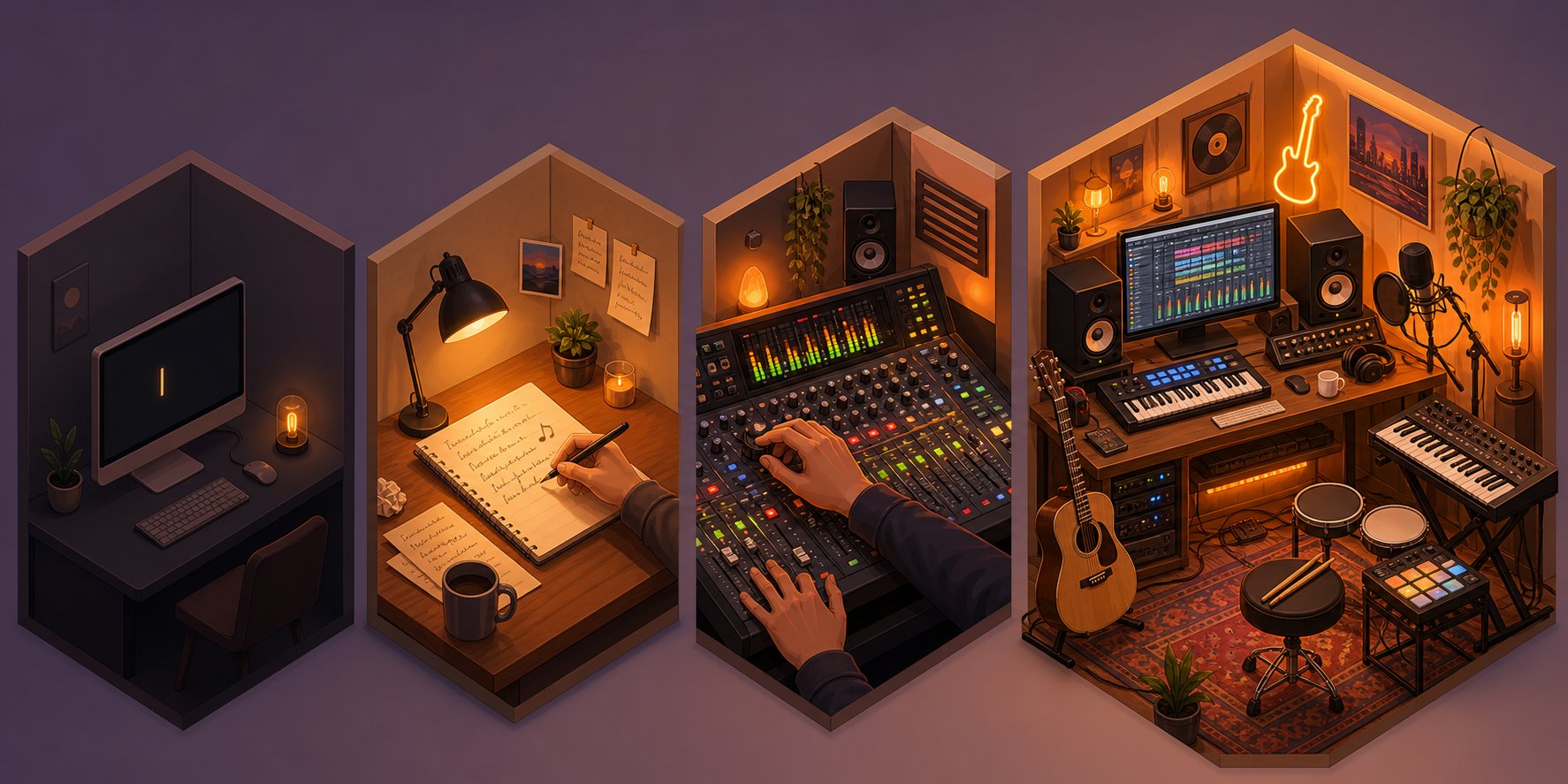
The Copyright Office rulings paint a clear picture: human authorship is the threshold. But how much human involvement is enough? If you're wondering how do you make music with AI tools and still retain legal protection, the answer lives on a spectrum. Not every interaction with Suno carries the same legal weight. A one-line prompt and a fully arranged composition built around AI-generated stems sit at opposite ends of that spectrum, and their copyright outcomes differ dramatically.
The framework below maps four distinct levels of human creative contribution to their likely legal outcomes. Use it as a practical gauge for your own workflow.
| Level of Human Involvement | Example Activity | Likely Copyright Outcome |
|---|---|---|
| Prompt only | Typing "sad acoustic ballad about heartbreak" and downloading the result | Likely no copyright protection; AI made all expressive decisions |
| Original lyrics with AI music | Writing complete verses and chorus yourself, using Suno to generate melody and instrumentation | Lyrics copyrightable; AI-generated melody and production likely not protected |
| Extensive post-production editing | Taking a Suno output into a DAW, restructuring sections, replacing instruments, adjusting harmonies, adding original vocal takes | Stronger copyright claim on human-modified elements; original AI-generated portions still unprotected |
| AI as one tool in a larger composition | Composing a song from scratch, using Suno for a single textural layer or reference, then building the rest with live instruments and original arrangement | Strongest copyright position; the work is predominantly human-authored with AI as an assistive tool |
Prompt-Only Generation and Its Legal Weakness
Imagine typing a short phrase into Suno and receiving a polished two-minute track. You provided the concept, sure. But who chose the chord progression? Who decided the tempo, the instrumentation, the vocal style, the song structure? The AI made every one of those expressive choices. Under the logic of Thaler v. Perlmutter and the Copyright Office's human authorship standard, providing a prompt is closer to giving an instruction than creating a work. You directed, but you didn't author.
This matters because many creators asking how do I make music with AI assume the prompt itself constitutes songwriting. Legally, it almost certainly doesn't. A prompt is an idea, a direction, a wish. Copyright protects expression, not ideas. The gap between "make me a lo-fi hip-hop beat" and the actual notes, rhythms, and textures in the resulting track is where authorship lives, and in a prompt-only scenario, the AI fills that gap entirely on its own.
Writing Your Own Lyrics with AI-Generated Music
The calculus shifts when you bring your own original lyrics to the table. If you're looking for help writing a song and use Suno to generate the instrumental bed while crafting every word yourself, you land in Zarya of the Dawn territory. Your lyrics are human-authored expression. They reflect your creative choices about word selection, rhyme scheme, narrative structure, and emotional arc. Those elements qualify for copyright protection independently.
The AI-generated melody underneath? Still likely unprotected on its own. But you haven't lost anything you created. Your song writing help came from an AI tool for the music, and your own brain produced the protectable content. For creators with strong ideas for songwriting lyrics who lack production skills, this is a viable path: write the words, let the AI handle the sounds, and register the lyrics as your copyrightable contribution.
One practical note: document the separation clearly. Save your lyric drafts with timestamps. Keep versions showing your writing process independent of the AI generation. This evidence matters if the Copyright Office questions which elements are yours.
Post-Production Editing as Human Authorship
Here's where the strongest case-building happens. You generate a base track on Suno, then import it into a DAW like Ableton, Logic, or FL Studio. You restructure the arrangement. You replace the AI's drum pattern with your own programmed beat. You re-harmonize the chorus. You record an original vocal performance over the top. You add effects processing that transforms the sonic character. Each of those decisions is a creative choice made by a human being.
The more extensively you reshape the AI output, the more the final product reflects your authorship rather than the machine's. You're not using free song lyrics to use or relying on AI for everything. You're treating Suno's output as raw material, the way a sculptor treats a block of marble. The marble didn't sculpt itself. Your hands did the work that matters.
This approach creates what copyright lawyers call "sufficient human authorship" in the derivative elements. The original AI generation might not be protectable, but your arrangement choices, your added performances, your structural edits, and your creative modifications all strengthen your registration claim. The key is that your contributions must be more than trivial or mechanical. Moving a volume slider isn't authorship. Recomposing a bridge section is.
Across all four levels, one principle holds constant: the more substantive human creative decisions you can document, the stronger your copyright position becomes. It's not about checking a box or hitting a minimum threshold. It's about building a body of evidence showing that a human mind made the expressive choices that give the work its character. And when it comes time to actually file for registration, knowing exactly how to present that evidence to the Copyright Office makes all the difference.
How Pending Lawsuits Impact Your Copyright Claims
Your individual copyright position doesn't exist in a vacuum. A massive legal battle is playing out between the world's largest record labels and Suno itself, and the outcome could reshape the entire landscape for AI-generated music. If you've followed suno ai reddit discussions or kept up with suno news, you've likely seen the anxiety: are Suno artists going to have to pay for tracks they've already created? Will the platform survive? The answers depend on understanding what the lawsuit actually claims and what it doesn't.
What the Major Label Lawsuit Alleges
In June 2024, Sony Music, Universal Music Group, and Warner Music Group filed suit against Suno, alleging massive-scale copyright infringement. The core claim: Suno trained its AI model on copyrighted sound recordings without obtaining licenses or permission from the rights holders. The labels argue that Suno ingested their catalogs, learned from the structure, melodies, production styles, and vocal characteristics of protected works, and now generates outputs that compete directly with the originals.
The suno ai lawsuit seeks statutory damages of up to $150,000 per work infringed. Given the scale of major label catalogs, the potential liability runs into the billions. The labels aren't targeting individual users who generate tracks. They're targeting the company itself and its training practices. Who owns Suno? It's a private company founded by former Meta researchers, backed by venture capital. The lawsuit puts that funding and the platform's long-term viability squarely on the line.
Suno's Fair Use Defense Explained
Suno hasn't stayed quiet. The company has mounted a fair use defense, arguing that its AI model creates entirely new, transformative outputs rather than reproducing or remixing copyrighted source material. Their position boils down to a key claim:
Suno's outputs do not contain copies or samples of existing recordings. The model learns musical concepts and generates novel audio that does not replicate any specific copyrighted work.
This argument leans on the transformative use prong of fair use analysis. Suno contends that learning patterns from music is fundamentally different from copying it, similar to how a human musician absorbs influences without infringing. Whether courts accept this analogy is the central unresolved question. No precedent squarely addresses whether training an AI on copyrighted works constitutes fair use, which makes this case potentially precedent-setting for the entire industry.
Practical Implications for Individual Creators
So what does the suno ai lawsuit mean for you personally? A few things are already clear, and a few remain uncertain.
What's settled now: The lawsuit targets Suno's corporate training practices, not individual users. You are not being sued for generating or distributing tracks. Your existing outputs are not retroactively illegal. The labels are going after the company, not its customers.
What's pending: If Suno loses, the company could face crippling damages that threaten its operations. That might mean service disruptions, changes to subscription terms, or in a worst-case scenario, the platform shutting down. Your tracks would still exist, but the tool that created them might not be available going forward.
What may change: A ruling against Suno could establish that AI training on copyrighted material requires licensing. This would likely increase costs for AI music platforms across the board, potentially raising subscription prices or limiting output capabilities. It could also lead to new terms requiring users to indemnify the platform, shifting some risk downstream.
One practical concern worth addressing: could someone file a copyright strike against your Suno-generated track on a platform like YouTube? Yes, and this already happens. Understanding the difference between a copyright claim vs strike matters here. A claim typically means a rights holder asserts ownership and may monetize your video. A strike is more severe, carrying penalties against your channel. Neither scenario depends on the Suno lawsuit itself. Any rights holder who believes your AI output sounds substantially similar to their work can initiate a claim independently of the corporate litigation.
The safest position right now is practical awareness without panic. Your tracks aren't at legal risk from the lawsuit. But the platform's future stability is genuinely uncertain. Diversifying your workflow, documenting your human contributions, and understanding exactly how to register protectable elements with the Copyright Office gives you a foundation that doesn't depend on any single platform's legal fate.
Step-by-Step Guide to Registering AI-Assisted Music
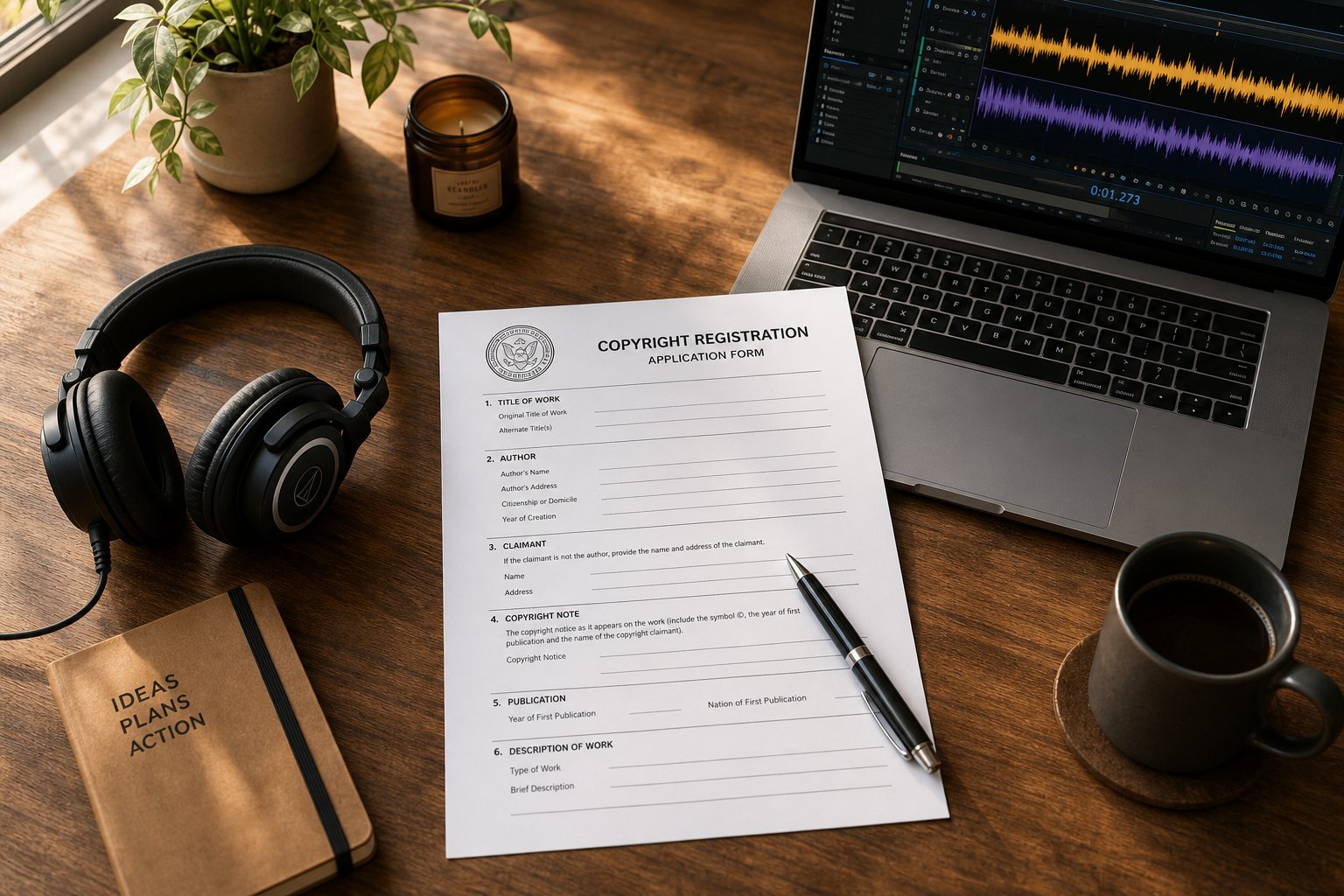
Knowing your human contributions strengthen your copyright claim is one thing. Actually filing the paperwork with the U.S. Copyright Office is another. Most creators asking how do I get a song copyrighted have never navigated the registration system before, and AI-assisted works add a layer of complexity that standard guides don't address. Here's the exact process, broken down into concrete steps you can follow today.
Choosing the Right Copyright Office Form
The Copyright Office uses different forms depending on what you're registering. For AI-assisted music, two forms matter:
- Form PA (Performing Arts): Use this when you're registering the underlying musical composition, meaning the melody, harmony, song structure, and lyrics as a written work. If you wrote original lyrics over a Suno-generated instrumental, Form PA covers those lyrics and any compositional elements you authored.
- Form SR (Sound Recordings): Use this when you're registering the actual recorded audio, the specific sonic performance captured in a file. If you recorded your own vocals, added live instruments, or substantially reworked the production in a DAW, Form SR protects that recorded expression.
You can register both simultaneously using Form SR if you own the composition and the recording. Many creators wondering how do you get a song copyrighted don't realize these are separate protectable layers. Choosing correctly ensures you're covering the elements where your human authorship actually lives.
One note on cost for music copyrights album ai creators often ask about: a single online registration currently runs $65 for one work. If you're registering an album of multiple tracks, a group registration for unpublished works can reduce per-track costs significantly. Budget this into your release planning.
How to Disclose AI Involvement Properly
This is where most people get nervous, and where getting it wrong carries real consequences. The Copyright Office requires you to be transparent about AI-generated content. Here's the step-by-step process for filing:
- Identify your human-authored elements. Before you open the registration portal, make a clear list. Did you write the lyrics? Compose the melody by hand? Arrange the song structure? Record original vocals? Each of these is a protectable human contribution.
- Select the appropriate form. Choose Form PA for compositions or Form SR for sound recordings through the Copyright Office's online registration system at copyright.gov.
- Complete the "Author Created" field carefully. Describe only what you personally created. For example: "Lyrics, vocal melody, vocal performance, and arrangement of musical sections." Do not claim authorship of elements the AI generated autonomously.
- Disclose AI involvement in the "Limitation of Claim" or "Other" field. State clearly which elements were generated by AI. Example: "Instrumental backing track, including drum patterns, bass line, and synthesizer textures, generated by Suno AI." This isn't an admission of weakness. It's a legal requirement that protects your registration from future cancellation.
- Upload your deposit copy. Submit the audio file or lead sheet representing the work. For sound recordings, this is the final audio. For compositions, a written transcription or audio rendition works.
- Pay the filing fee and submit. Processing times vary, but you'll receive confirmation of your application immediately.
Attempting to register a purely AI-generated track without disclosing Suno's role is not a gray area. The Copyright Office has explicitly stated that failure to disclose AI involvement constitutes material misrepresentation. This can result in cancellation of your registration, even after it's been granted, leaving you with no enforceable rights and a potential credibility problem if you ever litigate.
Documenting Your Human Creative Contributions
Registration is stronger when supported by evidence of your creative process. If the Copyright Office or a court ever questions whether your contributions meet the human authorship threshold, documentation becomes your proof. Think of it as building a paper trail that demonstrates your creative decisions weren't trivial.
Practical documentation strategies include:
- Save lyric drafts with timestamps. Use Google Docs, Notion, or any tool that tracks revision history. Multiple drafts showing evolution of your lyrics prove human creative labor.
- Export DAW session files. If you edited a Suno output in Ableton, Logic, or FL Studio, save the project file. It shows exactly which tracks, edits, and additions are yours.
- Screenshot your Suno generation history. Capture the prompts you used and the outputs you received. This establishes the baseline AI contribution versus your modifications.
- Record screen captures of your editing process. A time-lapse of your DAW session shows active human decision-making in real time.
- Maintain version history. Save the raw Suno output as version one and your final edited track as the finished version. The delta between them represents your authorship.
Many creators wonder how to copyright a song for free, and it's worth noting that copyright technically exists the moment you fix an original work in tangible form. You don't need to pay anything for basic protection to attach. But without federal registration, you can't file an infringement lawsuit or claim statutory damages. Registration is what transforms passive ownership into active legal power.
For creators distributing through streaming platforms, keep in mind that obtaining isrc music codes for your tracks is a separate process from copyright registration. An ISRC (International Standard Recording Code) identifies your recording for distribution and royalty tracking, but it doesn't confer or replace copyright protection. Both serve important but distinct functions in your release workflow.
The registration process isn't complicated once you understand the disclosure requirements. The real challenge comes after filing, when you need to defend your rights against other creators who might generate something strikingly similar using the same AI tool you did.
When Two Users Generate Similar AI Music
Two creators, different countries, same Tuesday afternoon. Both type "ethereal ambient track with piano and soft synth pads" into Suno. Both receive outputs that sound remarkably alike. One publishes to Spotify. The other uploads to YouTube. A listener notices the similarity and flags it. Who infringed on whom? The answer might surprise you: possibly neither.
The Duplicate Output Problem in AI Music
AI music generators work from learned patterns. Feed similar inputs into the same model, and you'll get outputs that share structural DNA: comparable chord progressions, related timbres, similar tempos, overlapping melodic contours. This isn't a bug. It's how neural networks function. They map prompts to probability distributions over musical features, and similar prompts naturally cluster toward similar outputs.
This creates a scenario traditional copyright law never anticipated. When two humans independently write similar songs, we assume each exercised separate creative judgment. When two users receive similar AI outputs from identical or near-identical prompts, neither user made the expressive decisions that produced the similarity. The AI did. And if neither output qualifies for copyright due to insufficient human authorship, the entire infringement question collapses. You can't infringe a work that isn't copyrightable in the first place.
For creators wondering how can you tell if music is copyrighted when it came from an AI tool, the honest answer is: it might not be. If the track is a pure prompt-to-output generation with no substantial human modification, it likely sits outside copyright protection entirely, which means no one owns it exclusively.
Why Independent Creation Defeats Infringement Claims
Even in cases where both users did add significant human elements, making their respective versions potentially copyrightable, there's a complete legal defense available: independent creation. Unlike patent law, copyright does not grant a monopoly over a particular expression. If two people independently create similar works without copying from each other, neither has infringed.
How can you tell if a song is copyrighted and being infringed versus independently created? Copyright infringement requires proof of two things: access to the original work, and substantial similarity resulting from that access. When two Suno users generate tracks from similar prompts without ever hearing each other's output, the access element fails entirely. They didn't copy. They simply asked the same machine a similar question and got a similar answer.
This makes enforcement between AI music users extraordinarily difficult in practice. If someone asks how can I find out if a song is copyrighted and potentially infringing on mine, the usual tools for checking don't account for parallel AI generation. Platforms like YouTube use Content ID to detect matching audio, but a match between two AI-generated tracks doesn't establish who copied whom. Many creators searching how to check if a song is copyrighted on YouTube discover that automated systems flag similarity without distinguishing between infringement and coincidence.
Protecting Yourself When Similarity Is Inevitable
You can't prevent someone else from typing a prompt similar to yours. But you can take steps to differentiate your work and strengthen your legal position if disputes arise. To check music for copyright conflicts and safeguard your creative output, focus on these practical measures:
- Document your creative process from the start. Save prompts, timestamps, DAW sessions, and revision history. If similarity is ever questioned, your timeline proves independent creation.
- Add distinctive human elements that no AI would replicate. Original vocal performances, hand-played instruments, unique arrangement choices, and personal lyrical content all create separation between your track and anyone else's AI output.
- Register early. Federal registration establishes a public record of your claim date. It doesn't prove you were first, but it creates a presumption of validity that strengthens your position.
- Maintain version history showing the gap between raw AI output and your final product. The wider that gap, the more clearly your work reflects human authorship rather than machine generation.
The duplicate output problem highlights a broader reality: protection strategies that work within one country's legal system may look completely different elsewhere. For creators with a global audience, understanding how different jurisdictions treat AI-generated music isn't optional. It's a strategic advantage.

International Copyright Treatment of AI Music
Suno's user base spans dozens of countries, and copyright law is territorial. A track that's unprotectable in Washington, D.C. might enjoy full legal protection in London. If you're distributing AI-generated music globally, the question of whether you can copyright Suno AI music doesn't have a single universal answer. It depends on where you file and which country's law governs your claim.
The differences aren't subtle. Some jurisdictions explicitly accommodate computer-generated works. Others refuse protection unless a human mind produced the creative expression. Here's how the major markets compare:
| Jurisdiction | AI Music Copyrightable? | Duration | Key Legal Basis |
|---|---|---|---|
| United States | Only human-authored elements | Life of author + 70 years (for human-authored portions) | Copyright Act; Thaler v. Perlmutter; Copyright Office guidance requiring human authorship |
| United Kingdom | Yes, even without human authorship | 50 years from creation | CDPA 1988, Section 9(3): "computer-generated" works protected |
| European Union | Generally no, unless human intellectual creation is present | Life of author + 70 years (human-authored works only) | EU copyright directives requiring author's own intellectual creation |
| China | Evolving; some courts have granted protection | 50 years for works of legal entities | Beijing Internet Court rulings recognizing AI-assisted outputs under certain conditions |
| Japan | No, for purely AI-generated works | N/A for unprotected works | Copyright Act requires human creative expression |
The UK Exception for Computer-Generated Works
The United Kingdom stands out as arguably the most favorable jurisdiction for AI music creators. Under Section 9(3) of the Copyright, Designs and Patents Act 1988 (CDPA), the author of a "computer-generated" work is defined as "the person by whom the arrangements necessary for the creation of the work are undertaken." In practical terms, this means the person who set up and directed the AI tool, not the AI itself, is treated as the legal author.
What makes this remarkable is that UK law doesn't require the same threshold of direct human creative expression that the U.S. demands. You don't need to prove you personally composed the melody or chose the chord voicings. Making the "arrangements necessary" for the work's creation, selecting the tool, providing the prompt, initiating the generation, can be enough. The resulting work receives 50 years of protection from the date it was made, shorter than the standard life-plus-70 term for human-authored works, but protection nonetheless.
For Suno users, this is a significant strategic consideration. A pure prompt-to-output track that would almost certainly fail registration in the U.S. could potentially qualify for copyright protection under UK law. It's worth noting that the UK provision was drafted in 1988, long before modern generative AI existed. Legal scholars debate whether Parliament intended it to cover today's AI outputs, and future reform is possible. But as the law currently reads, it offers a level of protection that no other major jurisdiction matches.
EU Approach and the Human Creativity Requirement
The European Union takes a position closer to the U.S., though through a different legal framework. EU copyright law, shaped by directives like the InfoSoc Directive and interpreted through Court of Justice of the European Union (CJEU) case law, requires that a work reflect "the author's own intellectual creation." This standard, established in cases like Infopaq International, demands that the work express the author's free and creative choices.
Purely AI-generated music doesn't meet this test. If Suno made the creative decisions and the user merely provided a prompt, the output lacks the personal intellectual stamp EU law requires. Unlike the UK, the EU has no special carve-out for computer-generated works. The 27 member states generally follow the same principle: no human creativity, no copyright.
However, the EU is actively debating AI regulation more broadly through the AI Act and related legislative proposals. While the AI Act focuses on safety and transparency rather than copyright, the ongoing regulatory attention means the framework could evolve. For now, EU-based creators need to apply the same human involvement strategies discussed earlier: write your own lyrics, edit substantially in post-production, and document your creative contributions. Those human-authored elements can qualify for protection under existing EU law, even when AI-generated components sitting alongside them cannot.
When you define attributions in the context of international copyright, it becomes clear that different legal systems attribute authorship based on fundamentally different criteria. The U.S. looks at who performed the creative act. The UK looks at who made the necessary arrangements. The EU looks at whose intellectual personality is stamped on the work. Each definition leads to a different outcome for the same AI-generated track.
Choosing Where to Register for Maximum Protection
International creators have options, and understanding them can shape your strategy. Copyright registration is territorial, meaning you can seek protection in multiple jurisdictions independently. A Suno user in Germany could register human-authored lyrics with the U.S. Copyright Office while potentially claiming broader protection for the full track under UK law.
A few strategic considerations worth weighing:
- If your primary market is the U.S., focus on maximizing human authorship in your workflow. U.S. registration remains the gold standard for enforcement, especially for statutory damages and attorney's fees in infringement cases.
- If you distribute globally, explore UK copyright protection as a complementary layer. The CDPA's computer-generated works provision may cover elements that U.S. law leaves exposed.
- If you're in the EU, treat the human creativity requirement as your baseline. Your protectable contributions, the lyrics, arrangements, and performances you personally create, travel well across borders through international treaties like the Berne Convention.
Songs in the public domain, like famous public domain songs used in countless commercial projects, illustrate what happens when copyright expires or never attaches. Purely AI-generated tracks that fail the human authorship test in a given jurisdiction effectively exist in a similar legal space: anyone can use them, and no one can claim exclusive rights. Understanding how to define copyright free in this context matters, because popular songs that are copyright free aren't just old classics whose terms expired. They may increasingly include AI outputs that never qualified for protection in the first place.
Jurisdictional strategy is a powerful tool, but it only works in combination with the practical steps that make your music protectable and commercially viable in the first place.
Practical Strategies for Protecting and Monetizing AI Music
Jurisdictional knowledge gives you options, but options without action don't protect anything. Whether you're looking to sell music through streaming platforms, license tracks for commercial projects, or build a catalog that generates long-term income, your strategy needs to combine legal protection with smart commercial decisions from day one.
Maximizing Your Copyright Position
Every tactic discussed throughout this article converges into a short list of non-negotiable habits. If you want to sell my music confidently and defend it against copycats, these are the moves that matter:
- Add substantial human creative elements to every track. Write your own lyrics, record original vocals, rearrange sections in a DAW, or layer live instrumentation. The more your fingerprint shapes the final product, the stronger your copyright claim.
- Document everything obsessively. Save timestamped drafts, DAW project files, prompt histories, and screen recordings of your editing sessions. This paper trail is your proof of authorship if challenged.
- Register early and disclose AI involvement honestly. File with the U.S. Copyright Office before disputes arise. Transparent disclosure protects your registration from cancellation and positions you for statutory damages if someone infringes.
- Treat AI outputs as raw material, not finished products. The creators who build the strongest legal positions are those who use AI as a starting point and human creativity as the finish line.
These habits don't just protect you legally. They also produce better music, because human creative decisions are what give a track personality and emotional depth that pure AI generation lacks.
Choosing the Right AI Music Platform for Commercial Use
Platform choice directly affects your rights. Not every AI music tool offers the same commercial licensing terms, and some leave significant ambiguity around what you can actually do with your outputs. If you're asking how to make money with music generated by AI, start by evaluating whether your platform's terms clearly grant you ownership and unrestricted commercial use.
Creators looking for royalty free commercial music they can monetize without licensing headaches should compare platforms carefully. Resources like MakeBestMusic's Suno AI alternatives comparison help creators identify tools with transparent commercial licensing terms, which directly affects both copyright strategy and monetization potential. When your platform's rights are clear, you spend less time worrying about legal exposure and more time creating.
Key factors to evaluate when choosing a platform for music licensing for business or personal commercial projects include: explicit ownership transfer in the terms of service, permission for all revenue-generating uses, absence of revenue-sharing requirements back to the platform, and clarity around training data liability.
Building a Sustainable AI Music Strategy
What does monetize mean in the context of AI-generated tracks? It means converting your creative output into revenue, whether through streaming income, sync licensing, direct sales, or music for business use in advertising and media. YouTube royalties, Spotify streams, and sync placements all require you to have clear commercial rights and, ideally, registered copyright protection to enforce those rights against unauthorized use.
A sustainable strategy looks like this: generate with AI, transform with human creativity, document every step, register the protectable elements, and distribute through channels that respect your ownership. That cycle, repeated consistently, builds a catalog with genuine legal standing rather than a library of legally ambiguous files you can't defend.
The legal landscape around AI music will keep evolving. Court rulings, Copyright Office guidance, and platform terms will all shift. But the core principle won't change: human authorship is the single legal detail that determines whether your work is protectable. Build your workflow around that principle, and your music stays protected regardless of how the rules develop around it.