

Why Spotting AI Music Matters and What Makes It So Difficult
You're scrolling through a playlist, and a track catches your ear. The vocals are smooth, the production is polished, but something feels slightly off. Maybe the phrasing is too perfect, or the emotion doesn't quite land. You wonder: is this even a real person singing? Figuring out how to tell if music is AI has become one of the trickiest challenges facing anyone who listens to, curates, or licenses music today.
Why Detecting AI Music Is Harder Than You Think
In a blind listening test commissioned by Deezer and conducted by Ipsos across 9,000 participants in eight countries, 97% of respondents failed to distinguish fully AI-generated tracks from human-made music.
That number should give you pause. It means that nearly everyone, from casual fans to dedicated music lovers, struggles to detect AI music by ear alone. More than half of those surveyed felt genuinely uncomfortable once they learned they couldn't tell the difference. The question of whether can AI make better music than humans may still be debatable, but AI can clearly produce music that sounds convincingly human to almost everyone.
This difficulty exists because modern generative models have moved far beyond robotic-sounding output. Platforms like Suno and Udio now produce tracks with realistic vocal inflections, dynamic instrumentation, and professional-grade mastering. Deezer reports receiving over 50,000 fully AI-generated tracks every single day, accounting for roughly 34% of all daily uploads to the platform. The sheer volume means you're almost certainly encountering AI music already, whether you realize it or not.
Who Needs to Identify AI-Generated Tracks
The stakes of detection vary depending on who you are:
- Playlist curators need to protect editorial integrity. Deezer already removes all detected AI-generated songs from algorithmic recommendations and editorial playlists to prevent dilution of the royalty pool.
- Licensing professionals and sync agents face real legal risk. Pitching an AI-generated track to a brand with strict AI policies can damage relationships and create compliance headaches.
- Musicians need to identify unauthorized voice clones and protect their artistic identity from being replicated without consent.
- Casual listeners simply want transparency. The Deezer-Ipsos survey found that 80% of respondents believe fully AI-generated music should be clearly labeled, and 45% of streaming users would prefer to filter it out entirely.
Each of these groups benefits from knowing how to tell if music is ai generated, but they need different levels of certainty and different tools to get there.
The Spectrum of AI Involvement in Music
One reason detection is so complex is that AI involvement isn't binary. Think of it as a spectrum:
- Fully AI-generated: A track created entirely by a generative model with no human performance or editing. These are the easiest to detect with current ai music detectors.
- AI-assisted production: A human artist uses AI for specific elements, maybe generating a chord progression, creating backing vocals, or designing a synth patch, then builds around it. Detection becomes much harder here.
- AI-mastered or AI-mixed: The composition and performance are entirely human, but AI tools handle post-production. This sits at the far edge of the spectrum and is nearly impossible to flag with current methods.
As Cyanite's Chief AI Officer Roman Gebhardt puts it, the question "is this AI-generated?" already assumes a clean category that doesn't exist in practice. Their detection system focuses on signal strength and confidence rather than a simple yes-or-no answer.
No single method will give you a definitive answer across this entire spectrum. But combining contextual investigation, trained listening, stem analysis, and dedicated detection tools dramatically improves your accuracy. The systematic approach that follows will walk you through each layer, starting with the clues you can uncover before you even press play.
Step 1 – Investigate Contextual Red Flags Before You Listen
Sometimes the strongest evidence that a track is AI-generated has nothing to do with how it sounds. Before you even press play, the artist's digital footprint, or lack of one, can tell you a lot. This investigative step is where playlist curators, licensing professionals, and curious listeners often catch what their ears might miss.
Investigate the Artist Profile and History
Imagine you find an artist with 200,000 monthly listeners on Spotify, a catalog of 80 tracks, and zero presence anywhere else on the internet. No Instagram. No live shows. No interviews. No features with other musicians. That pattern alone should raise your antenna.
AI music artists typically share a set of profile characteristics that real musicians almost never exhibit together. Here's what to look for:
- Account age vs. catalog size: A profile created three months ago with 50+ releases spanning jazz, lo-fi, metalcore, and country is physically impossible for a human artist or band.
- Follower-to-catalog ratio: Hundreds of thousands of listeners but almost no followers, saves, or playlist adds from real users suggests algorithmic or bot-driven streams rather than genuine fandom.
- No live performance history: Real musicians leave traces. Tour dates, venue tags, festival lineups, even open mic nights. AI artists music profiles have none of this.
- No social media beyond streaming platforms: A legitimate artist almost always has at least one social channel with behind-the-scenes content, fan interaction, or personal posts. A complete absence is a major red flag.
- No collaborative credits: Human musicians collaborate. They feature on each other's tracks, get tagged in studio photos, and show up in liner notes. AI-generated acts exist in total isolation.
As The Week reported, fake artists on Spotify "all fit a certain pattern, with monthly listeners in the hundreds of thousands, zero social media footprint, and some very ChatGPT-sounding bios." These ai generated bands cover popular songs across wildly different genres on the same album, something no real group would do without an obvious creative reason.
Spot Release Pattern Anomalies
Release cadence is one of the easiest tells to verify. A human songwriter working full-time might release an album every year or two, or maybe a single every few weeks if they're prolific. What they won't do is drop 30 tracks in a single week across five different genres.
Watch for these patterns:
- Burst uploads: Dozens of tracks appearing within days of each other, especially if they span unrelated styles. According to the 2026 AI detection stack analysis, uploading 50+ tracks in a single batch is one of the strongest signals that triggers platform-level scrutiny.
- Genre incoherence: A single artist releasing ambient study beats, metalcore covers, and country ballads in the same month. Real artists evolve, but they don't shapeshift overnight.
- Cover-heavy catalogs with no originals: Some fake profiles consist entirely of covers of popular songs, each slightly different in pitch or arrangement, designed to siphon streams from fans searching for the originals.
Read Metadata and Credits Like a Detective
Does Spotify allow AI music? Technically, Spotify does not ban AI-created content outright, as long as it doesn't violate impersonation or deceptive content policies. But the platform has silently removed millions of AI tracks over the past year. The clues often hide in the metadata.
Here's what to check:
- Missing songwriter and producer credits: Legitimate releases list writers, producers, and publishers. AI-generated tracks frequently have no registered credits with performing rights organizations like ASCAP or BMI.
- Generic or AI-written bios: Descriptions that read like ChatGPT output, vague, overly polished, and saying nothing specific about the artist's background or influences.
- Stock or AI-generated profile images: Look closely at artist photos. AI-generated images often have telltale artifacts: hands with extra fingers, backgrounds that blur inconsistently, skin with unnaturally uniform texture, or jewelry that melts into clothing.
- No DDEX distributor information: The Spotify AI DDEX metadata pipeline is how legitimate distributors communicate release details to platforms. Tracks missing proper distributor credits or using bulk-allocated ISRC codes from unknown sources are worth questioning.
- Generic titles: Names like "Chill Vibes Beat 23" or "Relaxing Piano Study Music" combined with the other red flags above strongly suggest automated catalog generation.
None of these signals alone proves a track is AI-generated. A new artist might legitimately have a small online presence. But when multiple red flags stack up, you're looking at a pattern that warrants deeper investigation. The contextual picture you build here sets the stage for the next step: training your ear to catch what the metadata can't tell you.
Step 2 – Train Your Ear to Catch Vocal Artifacts
Metadata and profile red flags can point you in the right direction, but eventually you need to press play. And when you do, the vocals are where AI music reveals itself most clearly. Human singing is an intensely physical act. It involves breath control, muscle memory, emotional impulse, and micro-decisions that happen faster than conscious thought. AI generators can approximate the result, but they struggle to replicate the process, and that gap leaves audible traces if you know where to listen.
When you're trying to figure out how to tell if a song is AI, vocals should be your first focus. Here's a structured listening sequence you can follow while a track plays:
- Listen for breath placement. Where does the singer breathe? Human breaths are phrase-driven, appearing at natural linguistic breaks and sometimes in slightly unexpected spots when a singer runs out of air. AI-generated breaths tend to appear at metrically perfect intervals, like a metronome click, or they're missing entirely. As vocal production specialists note, AI vocals are conspicuously breath-free, and that absence is one of the fastest tells your ear can catch.
- Check sustained notes for pitch behavior. Hold your attention on any note the singer sustains for more than a second. Human voices exhibit subtle pitch drift, a gentle wavering that reflects the physical effort of maintaining airflow. AI vocals often hold sustained notes with either zero micro-pitch variation (unnaturally flat) or a fluttery digital wobble that sounds like auto-tune artifacts rather than organic vibrato.
- Evaluate consonant attacks. Pay attention to how the singer hits P, B, T, and K sounds. Real vocalists attack these consonants with varying intensity depending on the lyrical emphasis and emotional context. AI tends to soften consonants uniformly, producing plosives that lack natural transient sharpness. Sibilant sounds like S and Sh often come out with a metallic, crystalline quality rather than the varied texture of a real mouth shaping air.
- Assess emotional arc across the track. Does the vocal intensity build organically through a chorus, or does it maintain a consistent energy level from verse to bridge to hook? Human singers naturally crescendo, pull back, crack slightly on emotional peaks, and breathe harder during intense passages. AI tends to deliver with flat emotional dynamics, sounding technically competent but emotionally vacant.
- Notice stereo placement. Where does the vocal sit in your headphones? Human vocals recorded in a real space have subtle stereo movement and room interaction. AI-generated vocals often feel unnaturally locked to dead center with no spatial variation, as if pasted onto the mix rather than existing within it.
Listen for Breath and Timing Imperfections
If you're just starting to develop your detection ear, breath patterns and micro-timing are the most accessible entry points. You don't need production experience or expensive headphones. Just ask yourself: does this singer sound like they're physically exerting themselves?
Real vocalists rush slightly into exciting phrases and drag behind the beat on emotional ones. Their timing is consistently 5 to 30 milliseconds off the rhythmic grid in natural, human patterns. AI-generated vocals, by contrast, land phrases with metronomic precision. Every syllable sits exactly where the algorithm placed it. That perfection is the tell. When you're wondering is this song AI, listen for whether the vocal feels like it's riding the beat or locked rigidly to it.
This is also where an ai lyric detector can complement your ear. These tools analyze not just the words themselves but the rhythmic delivery patterns, flagging phrases that land with statistical perfection no human singer would produce consistently across an entire track.
Evaluate Emotional Dynamics and Vocal Texture
Human voices convey emotion through subtle, often unconscious variations. A singer's voice might thin out slightly on a vulnerable lyric, gain a raspy edge during an intense bridge, or crack almost imperceptibly at an emotional peak. These aren't flaws. They're the texture of genuine performance.
Research into neurological responses shows that human brains process real and synthetic voices differently, even when listeners can't consciously identify which is which. Real voices activate memory and empathy centers, while AI voices trigger error-detection regions. Your gut feeling that something sounds "off" may be your brain detecting what your conscious mind hasn't yet articulated.
When evaluating emotional dynamics, focus on transitions. How does the singer move from a quiet verse into a loud chorus? Does the intensity shift feel earned and gradual, or does it flip like a switch? AI generators tend to treat dynamic changes as binary states rather than organic progressions. The voice goes from soft to loud without the physical buildup, the slight strain, the breath management adjustments that a real singer's body demands.
Advanced Vocal Tells for Trained Ears
Experienced listeners and producers can push detection further by evaluating two additional dimensions:
- Formant consistency: Human vocal formants (the resonant frequencies that give a voice its unique character) shift naturally as a singer moves between vowel sounds, registers, and emotional states. AI vocals sometimes exhibit what producers call a "formant plateau," where long vowels sound frozen in place rather than evolving organically. This is one of the hardest AI tells to fix and one of the most reliable for how to detect ai generated voice content.
- Vibrato regularity: Natural vibrato varies in speed and depth depending on the musical context, the singer's breath support, and emotional intensity. AI vibrato tends to be mathematically regular, oscillating at a fixed rate and amplitude that doesn't respond to the musical moment. Listen especially to the ends of held notes, where human vibrato typically widens and slows as breath runs out.
An ai lyric detector paired with careful listening gives you coverage across both the textual and performative dimensions of a vocal. But vocals don't exist in isolation. They sit within a mix of instruments and production choices that carry their own set of detection signals, which is exactly where the investigation moves next.
Step 3 – Analyze Instrumental and Production Cues
Vocals may be the most revealing element, but they're not always present. Instrumental tracks, lo-fi beats, ambient soundscapes, and electronic productions all lack a voice to scrutinize. Even in vocal-heavy songs, the backing instrumentation carries its own set of fingerprints. When you're conducting ai music analysis, the instruments and production choices often tell a story the vocals alone can't.
The core issue is this: human musicians interact physically with their instruments. A pianist presses keys with varying force depending on emotion and phrasing. A drummer's sticks hit the snare at slightly different angles every time. A guitarist's pick scrapes strings between chord changes. These micro-events are the sonic DNA of human performance, and AI generators consistently struggle to reproduce them.
Spot Unnatural Instrument Behavior
Each instrument family has its own set of tells. Here's what to listen for across the most common ones:
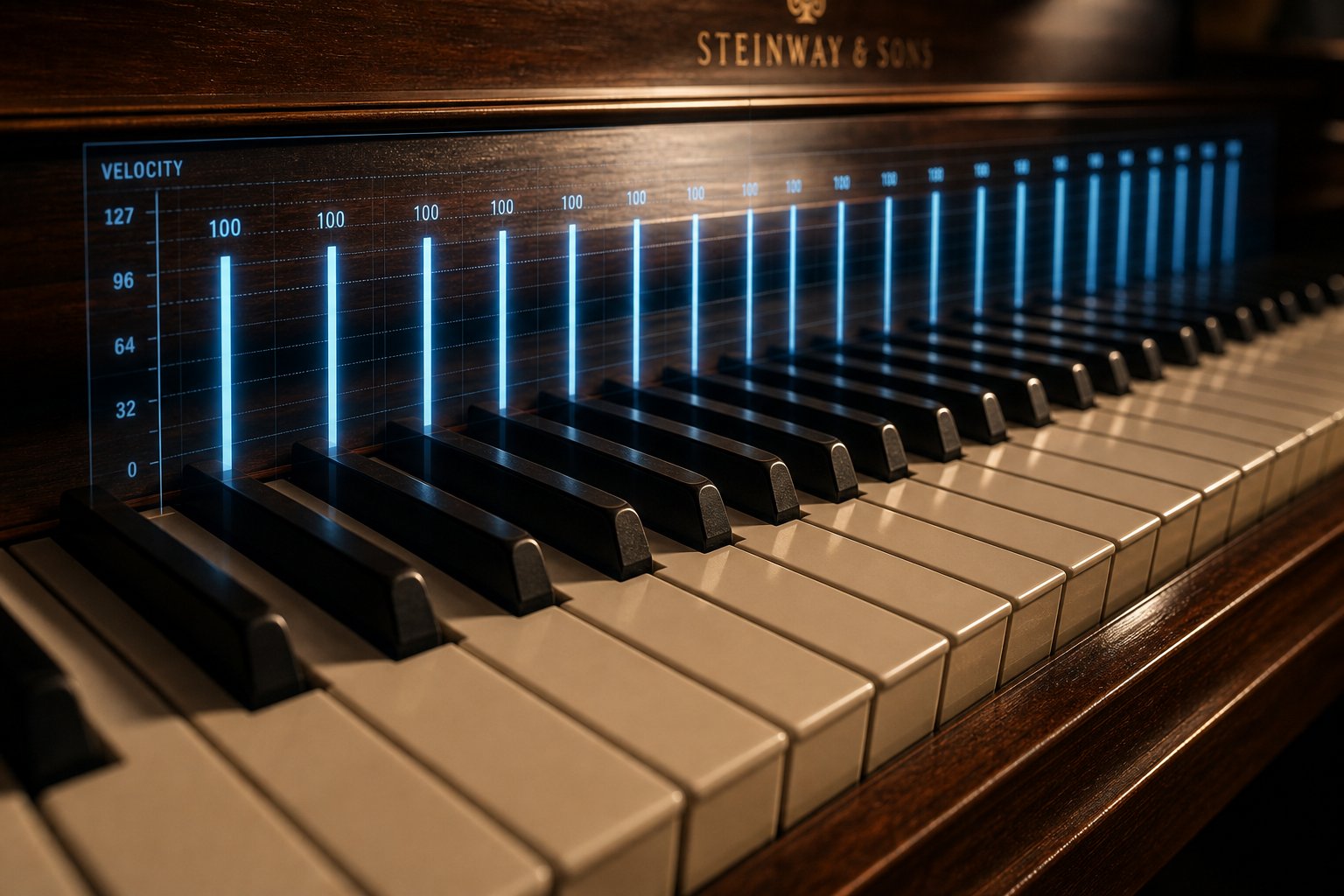
Piano and keys: Play close attention to velocity, the loudness variation between individual notes. A human pianist naturally emphasizes melodic notes and softens passing tones. They press harder during emotional peaks and lighten their touch in delicate passages. AI piano often delivers uniform velocity across entire phrases, making every note sound equally important. The result is technically clean but musically flat, like reading a sentence where every word gets the same emphasis.
Drums and percussion: Human drummers produce ghost notes, those barely audible snare taps between main hits that give a groove its feel. They also produce subtle flamming, where the stick bounces slightly and creates a micro-double hit. AI drums frequently lack both. Every snare hit arrives at identical velocity, every hi-hat sounds like the same sample triggered repeatedly. As detection research notes, AI drums and percussion often sound "mechanically flat and perfectly quantized," missing the slight variations in timbre that come from a human hitting cymbals or drums at different spots.
Guitar: This is where AI struggles most visibly. Real guitar playing produces incidental noise: string squeaks during chord transitions, fret buzz on lower strings, the percussive click of a pick hitting the string before it vibrates. AI guitar tends to deliver clean, isolated notes with no physical artifacts. Bends lack the slight pitch overshoot that happens when a human finger pushes a string past the target note before settling. Slides sound like pitch automation rather than a finger dragging across wound metal.
Acoustic instruments generally: Pay attention to sustain and decay. When a real piano note fades, it interacts with sympathetic resonance from other strings. A real violin note decays with subtle bow-pressure variation. AI-generated acoustic instruments often sustain with unnatural smoothness, holding steady and then dropping off abruptly rather than fading through the complex physical interactions that define real instrument behavior.
Analyze Production and Mix Characteristics
Beyond individual instruments, the overall production carries detection signals that a song analysis ai approach can reveal. These are subtler and often require decent headphones or monitors, but they're powerful once you know what to look for.
Spectral rolloff: Every recording has a frequency point where energy drops off sharply. Human recordings exhibit natural, slightly irregular rolloff curves shaped by room acoustics, microphone characteristics, and analog processing. AI-generated tracks often produce unusually smooth spectral rolloff patterns or abrupt high-frequency cutoffs that betray their synthetic origin. Detection systems specifically measure this as a key forensic signal.
Phase relationships: In a real recording, the phase relationships between instruments are naturally chaotic. Sound waves bounce off walls, arrive at microphones at slightly different times, and interact in complex ways. AI-generated mixes sometimes exhibit what researchers call "anomalously low phase entropy," where the relationships between frequency components are impossibly coherent. Your ear perceives this as a mix that sounds hyper-clean but somehow lifeless, as if every element was generated in a vacuum rather than captured in a physical space.
Stereo field behavior: Real instruments move subtly in the stereo image. A guitarist shifts weight, a drummer's hi-hat bleeds into the overhead mics at varying levels, a bassist's amp interacts with room reflections. AI-generated elements often sit in fixed stereo positions with no movement or interaction. The mix feels like a collage of isolated objects rather than a group of musicians sharing acoustic space.
Mastering artifacts: AI-mastered or AI-generated tracks frequently sound hyper-polished in a way that lacks the subtle character of analog processing. Real mastering chains introduce tiny harmonic distortions, gentle saturation, and frequency interactions that give a track warmth and cohesion. AI output can sound clinically perfect, like a photograph with every pore airbrushed away.
Understanding Rhythmic Quantization as a Detection Signal
Rhythmic quantization is perhaps the single most reliable instrumental tell, and it doesn't require trained ears to notice once you understand the concept.
In plain terms: quantization means snapping every note to an exact rhythmic grid. When you tap your foot to a song, you're feeling the beat. Human musicians play around that beat, sometimes slightly ahead (pushing), sometimes slightly behind (dragging). These micro-timing deviations, typically 5 to 30 milliseconds, are what give music its groove and feel. Jazz musicians swing. Rock drummers push. Soul bassists lay back. Even in tightly produced pop, human performers introduce subtle timing variation that your brain registers as "alive."
AI generators, unless specifically programmed to humanize timing, produce notes that land with mathematical precision. Every kick drum hits at exactly the same point relative to the grid. Every piano chord arrives at precisely the calculated moment. Detection systems measure this as Inter-Beat Interval variance: when that variance approaches zero, the probability of synthetic generation increases significantly.
Here's the practical test: listen to the drums and bass together. Do they feel like two humans locking in with each other, with tiny push-pull interactions? Or do they feel like two machines triggered by the same clock signal? Even highly skilled session musicians playing to a click track introduce 10 to 15 milliseconds of natural drift. AI tracks often have less than 1 millisecond of variation, a level of precision that's physically impossible for human performers.
An ai song analyzer can quantify this precisely, but your ears can catch it too. If a track feels metronomically rigid across its entire duration, with no sections where the groove loosens or tightens in response to musical energy, that's a strong signal worth noting alongside the vocal and contextual evidence you've already gathered.
These instrumental and production cues become even more powerful when you can hear them in isolation, stripped away from the full mix where they hide behind each other. That's exactly what the next step addresses: separating a track into its individual parts to expose artifacts the full arrangement conceals.
Step 4 – Separate the Track and Inspect Individual Stems
A vocal that sounds perfectly convincing sitting inside a dense mix can fall apart the moment you strip everything else away. That's the principle behind stem-based inspection: isolation removes the masking effect of layered instruments, reverb tails, and production polish, exposing artifacts that your ears simply can't catch in a full arrangement. Professional audio forensics teams have used this technique for years to verify authenticity in copyright disputes and licensing audits. You can apply the same logic to check if a song is AI generated.
Why Isolating Stems Reveals Hidden Artifacts
Think of it like examining a painting under UV light. The surface looks flawless at a normal viewing distance, but ultraviolet reveals brushstroke inconsistencies, touch-ups, and material differences invisible to the naked eye. Stem separation does the same thing for audio.
When instruments play together, they occupy overlapping frequency ranges. A vocal's breath artifacts get buried under a hi-hat pattern. The unnatural sustain of an AI piano disappears behind a pad synth filling the same midrange. Rhythmic quantization perfection in the bass goes unnoticed because the drums are masking the timing relationship. Separate those elements, and each one stands exposed.
This matters because AI generators produce each element independently and then combine them. The individual parts often carry telltale signs of synthetic origin that the final mix smooths over. An ai audio identifier tool might flag a track as suspicious, but hearing the isolated vocal confirm those breath-pattern irregularities yourself gives you a much higher confidence level.
How to Separate a Track Into Individual Parts
Modern AI-powered stem separation tools use deep learning models trained on massive datasets of multitrack recordings. They analyze a stereo mix's spectrogram, identify the frequency and amplitude signatures of each instrument type, and reconstruct individual stems with near-studio-quality isolation. The technology has matured significantly, with current models capable of splitting a track into vocals, drums, bass, guitar, and accompaniment layers within minutes.
Tools like MakeBestMusic's Audio Separator let you upload any track and split it into individual stems for closer analysis. This makes it practical to apply the vocal and instrumental detection techniques from previous steps without needing access to the original multitrack session. You upload the suspicious track, receive separated stems, and then listen to each one in isolation using the same checklist you've already learned.
The workflow for a stem-based AI detection inspection looks like this:
- Upload the full mix to a stem separation tool and split it into at least four parts: vocals, drums, bass, and other instruments.
- Solo the vocal stem first. Listen for the breath-pattern irregularities, consonant smearing, and formant inconsistencies described in Step 2. Without the instrumental bed masking these artifacts, they become dramatically more obvious.
- Solo the drum stem. Check for ghost note absence, identical hit velocities, and the metronomic quantization discussed in Step 3. Tap along with the groove and notice whether it feels human or machine-locked.
- Solo the bass. Listen for timing interaction with the drums. In human performances, bass and drums have a push-pull relationship. AI-generated bass often locks rigidly to the same grid as the drums with zero timing drift between them.
- Solo remaining instruments. Check piano, guitar, or synth stems for unnatural sustain, uniform velocity, and missing physical artifacts like string noise or pedal mechanics.
- Compare stems against each other. Do the phase relationships and reverb characteristics suggest these elements were recorded in the same space, or do they sound like isolated objects pasted together?
What to Listen for in Each Isolated Stem
Each stem type reveals different categories of AI artifacts when heard alone:
Isolated vocals are the highest-value target. In a full mix, reverb and delay effects smooth over the gaps between phrases where breaths should appear. Strip those away, and you'll hear whether breaths exist at all, whether they fall at natural linguistic breaks, and whether the singer's formants shift realistically between vowel sounds. You'll also catch the "consonant smearing" effect where plosives and sibilants blend into each other rather than arriving with distinct transient attacks.
Isolated drums expose quantization with brutal clarity. Without melodic instruments providing rhythmic context, you hear exactly how each hit relates to the grid. Human drummers produce subtle flamming, velocity curves that follow musical phrases, and hi-hat patterns that breathe with the song's energy. AI drums often sound like a sample library triggered by a sequencer: clean, precise, and lifeless.
Isolated melodic instruments reveal sustain and decay behavior. A real piano note interacts with sympathetic string resonance. A real guitar string buzzes against frets during transitions. When you hear these instruments alone, the absence of those physical interactions becomes unmistakable. You're essentially using the ai music identifier approach at its most granular level, examining each sonic layer for signs of synthetic generation.
Professional workflows that handle 50 stems, mix edits, and music through an AI process or AI-powered pipeline rely on exactly this kind of granular inspection. The difference is that you don't need a forensics lab to do it. A stem separation tool and a pair of decent headphones give you the same investigative capability that licensing teams and platform trust-and-safety departments use internally.
Stem inspection won't always deliver a definitive verdict on its own. Some AI-generated stems are remarkably clean, especially from newer models. But combined with the contextual red flags from Step 1, the vocal analysis from Step 2, and the instrumental cues from Step 3, isolated stem listening adds a powerful layer of evidence. The next step introduces purpose-built detection tools that can quantify what your ears are hearing and assign measurable confidence scores to your suspicions.
Step 5 – Run the Track Through AI Music Detection Tools
Your ears and your stem analysis have given you a gut feeling. Maybe you've spotted breath irregularities, metronomic quantization, or contextual red flags that don't add up. The next question is: can a machine confirm what you're hearing? Dedicated ai music detector platforms exist specifically for this purpose, and understanding what they actually measure helps you interpret their results intelligently rather than treating a percentage score as gospel.
What AI Detection Tools Actually Measure
Every ai song detector on the market analyzes some combination of the same core signals. Here's what's happening under the hood, in plain terms:
- Spectral fingerprints: AI generators leave microscopic patterns in the frequency domain. Research published at ISMIR 2025 demonstrated that deconvolution layers in neural audio generators produce systematic spectral peaks at predictable frequency intervals. These peaks are architecture-dependent, meaning they exist regardless of what the model was trained on. A simple classifier achieved over 99% accuracy detecting these artifacts in both open-source and commercial generators like Suno and Udio.
- Phase entropy: Human recordings have naturally chaotic phase relationships between frequency components. Sound bounces off walls, arrives at microphones at different times, and interacts unpredictably. AI generators often produce audio with anomalously low phase entropy, creating impossibly ordered phase patterns that don't occur in real acoustic environments. Detection systems use the Hilbert Transform to extract instantaneous frequency and compute Shannon Entropy on phase information to flag these anomalies.
- Vocal texture flatness: Human voices produce constant micro-variations in timbre, tiny shifts in resonance, breathiness, and harmonic content that change from syllable to syllable. AI vocals tend to maintain unnaturally consistent timbral characteristics across phrases, producing what detection systems measure as low spectral flux in the vocal frequency range.
- Rhythmic quantization scores: Detection tools measure Inter-Beat Interval variance, essentially how much timing drift exists between rhythmic events. When that variance approaches zero across an entire track, the probability of synthetic generation increases significantly. Human performers, even in tightly produced music, introduce 5 to 30 milliseconds of natural timing variation.
- Noise floor analysis: Real recordings carry a noise floor from microphones, preamps, and room acoustics. AI tracks either drop to suspiciously clean digital silence or add synthetic noise with mathematical distributions that don't match real-world recording environments.
Most public tools analyze two or three of these signals, not all five. Knowing which signals a particular ai music checker emphasizes helps you understand why different tools sometimes give conflicting results on the same track.
Major Detection Platforms and Their Strengths
The detection landscape has matured rapidly. Here's how the major platforms compare when you need to run an ai music check on a suspicious track:
| Tool | Detection Approach | Accuracy | Access | Known Limitations |
|---|---|---|---|---|
| IRCAM Amplify | Multi-signal analysis; batch processing at scale (250,000+ tracks/hour) | 99% claimed, <1% false positives | REST API/SDK; enterprise-focused, pricing not public | No self-serve option; limited transparency on methodology |
| SubmitHub AI Checker | Custom model trained on Suno/Udio outputs; curator-facing | ~98% (stated informally by creator) | Free 2 checks per session; login wall after | Default model can be outdated unless you click Reanalyze; bias toward Suno/Udio signatures; flags processed electronic music at 60%+ |
| AHA Music (ACRCloud) | Spectral fingerprinting + metadata; identifies specific generator used | Not publicly disclosed | 5 free checks/day, no signup required | CAPTCHA on every check; 20MB file limit |
| LetsSubmit | MERT transformer embeddings (bAbI v2 model) | 87.67% (published holdout accuracy) | 5 free checks/day; €5/mo for 100/day | Smaller training set (~1,900 songs); less confident on edge cases |
| MatchTune (DeepMatch) | Multi-model ensemble; audited on 8,000-track benchmark | 95% with 0.01% false positives | Enterprise-only; requires sales call | No self-serve access; not available to individual creators |
| authio (Forward Digital) | 12-model neural ensemble; weighted voting meta-classifier | 99.42% claimed | 5 free/day; paid from €12/mo; REST API with SDKs | Accuracy claim is vendor-internal with no published benchmark dataset |
The IRCAM Amplify ai music detector stands out for catalog-scale operations. Its processing speed makes it practical for labels and distributors scanning thousands of releases daily. For individual creators or curators looking for an ai music detector online free option, AHA Music offers the strongest free tier because it names the specific generator (Suno v3.5, Udio v1.5) rather than just returning a binary score. That attribution matters when you need evidence, not just a probability.
SubmitHub's ai song checker deserves special mention because it's what many playlist curators actually use to vet submissions. If you're an artist wondering whether your track will pass curation screening, testing against SubmitHub tells you what gatekeepers are seeing. Just remember to click Reanalyze to get results from their current v3.0 model rather than a stale cached score.
For those who want an a.i. detector for music free of charge, the combination of AHA Music (spectral-focused) plus LetsSubmit (transformer-based) gives you two fundamentally different detection approaches at no cost. If both return clean results, you've cleared two independent analytical methods.
Understanding False Positives and Tool Limitations
Here's the uncomfortable truth: false positives are an epidemic in the current detection landscape. Hybrid producers, electronic artists, and heavily mastered pop productions get flagged at 80%+ AI confidence on their own original work. This happens because the models are trained predominantly on Suno and Udio outputs, and they over-trigger on production patterns that overlap with those generators' characteristics.
Three genres cluster the most false positives:
- Electronic music (synthwave, EDM, techno) where tight quantization and synth-heavy textures look statistically similar to AI output
- Heavily mastered modern pop where loudness flattening and compression create the same dynamic profile AI generators produce
- Hybrid singer-songwriter productions where AI assisted with mixing, arrangement, or specific instrumental layers
There's also a fundamental gap between public checkers and platform-side detection. Passing every web-based tool doesn't guarantee a track will survive Spotify's or Deezer's internal catalog sweeps. Those platforms run different models with different training data and different confidence thresholds. They also re-scan catalogs over time with updated detection systems, meaning a track that passed screening six months ago might get flagged today.
The practical takeaway: treat any single ai song detector result as one data point, not a verdict. A tool reporting 85% AI confidence is useful information, but it's not proof. Combine it with your contextual investigation, your vocal and instrumental analysis, and your stem inspection findings. When multiple independent methods converge on the same conclusion, your confidence is justified. When they conflict, acknowledge the uncertainty rather than defaulting to whichever answer you prefer.
Detection tools are improving rapidly, but so are the generators they're trying to catch. This creates a moving target where accuracy varies not just by tool but by genre, by AI platform, and by how much post-processing a track has undergone. The next step addresses that variability head-on: how detection strategies need to shift depending on what genre you're evaluating.
Step 6 – Apply Genre-Specific Detection Strategies
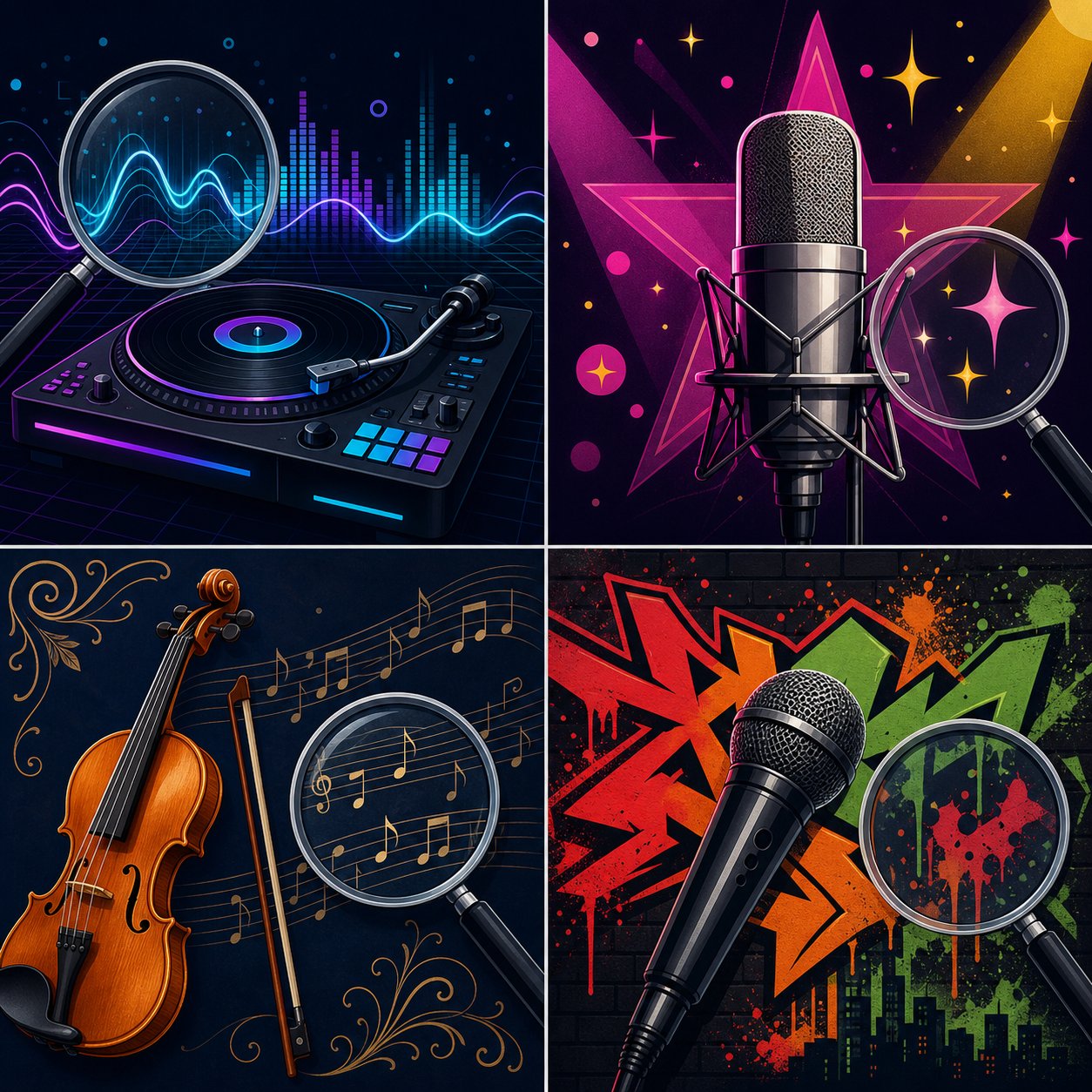
A detection method that works perfectly on a singer-songwriter ballad might completely fail on a techno track. That's because the signals you're looking for, quantized timing, synthesized textures, metronomic precision, are intentional design choices in some genres and red flags in others. Knowing how to spot AI music means calibrating your expectations to the genre you're evaluating. An ai music genre detector approach requires different benchmarks for different styles.
Electronic Music vs. Vocal Pop Detection Differences
Electronic music is the hardest genre to assess for AI generation. Why? Because the very characteristics that betray AI in other genres, tight quantization, synthesized timbres, repetitive structures, are the defining aesthetic of electronic production. A human-made techno track is supposed to sound metronomically precise. A synthwave producer intentionally uses digital sounds with no acoustic imperfections.
So what do you look for instead? Shift your focus to these alternative signals:
- Structural development: Does the track evolve meaningfully over its duration? Human electronic producers build tension through filter sweeps, layering, breakdowns, and subtle textural shifts. AI-generated electronic music tends to loop sections with minimal variation, cycling through the same 8-bar pattern without genuine progression.
- Sound design originality: Are the synth patches unique, or do they sound like default presets from a sample library? AI generators pull from training data and produce sounds that feel generic rather than crafted. A human producer's signature is often in their sound design choices.
- Mix evolution: Does the stereo field, EQ balance, and spatial depth change across sections? Human producers automate these parameters to create movement. AI mixes often remain static from start to finish.
Vocal pop, by contrast, is much easier to evaluate. Human vocal imperfections are well-documented benchmarks: breath placement, pitch drift, consonant variation, emotional dynamics. When you hear a pop vocal that lacks these qualities, you have clear reference points for comparison. The detection techniques from Step 2 apply most directly to this genre because the gap between AI-generated and human-performed vocals is widest in styles that demand emotional nuance and physical expressiveness.
Classical and Hip-Hop Genre-Specific Tells
Instrumental classical music presents a unique detection challenge. There are no lyrics to analyze and no vocal artifacts to catch. But AI-generated orchestral music consistently fails in three areas that human ensembles handle naturally:
- Room acoustics: A real orchestra exists in a physical space. You hear the hall's reverb characteristics, the way sound reflects differently off walls depending on instrument placement. AI classical tracks often sound like instruments were generated in isolation and placed into a synthetic reverb, lacking the coherent spatial signature of a real recording environment.
- Bow pressure and articulation variation: String players constantly adjust bow pressure, speed, and contact point. These variations create timbral richness that shifts phrase by phrase. Genre analysis research confirms that while AI handles harmonic logic and orchestration well, it still approximates rather than reproduces the expressive phrasing that defines human string performance.
- Ensemble timing drift: When 60 musicians play together, they don't lock to a grid. Sections breathe together, rushing slightly into climaxes and relaxing into quiet passages. AI orchestral music often sounds like a MIDI mockup: perfectly synchronized but lacking the organic push-pull of a real ensemble.
Hip-hop detection requires a completely different ear. The genre's vocal delivery is rhythmically complex, and the tells are specific to rapid-fire articulation:
- Flow irregularity: Great rappers vary their rhythmic patterns unpredictably, switching between triplet flows, double-time, and laid-back phrasing within a single verse. AI-generated rap tends to lock into one rhythmic pattern and maintain it with mechanical consistency.
- Ad-libs and vocal layers: Human rappers punctuate verses with spontaneous ad-libs, yeah, uh, let's go, that respond to the energy of the beat. AI ad-libs often feel placed rather than spontaneous, appearing at predictable intervals rather than organic moments.
- Breath management during rapid delivery: Fast rap requires athletic breath control. You should hear the rapper running out of air at the end of long phrases, catching quick breaths in gaps, and occasionally sacrificing clarity for speed. AI rap delivers complex syllable patterns with no audible physical effort, which is the tell.
Platform-Specific Patterns Across AI Generators
Understanding how AI songs are made on different platforms gives you another detection layer. Suno and Udio, the two dominant generators, leave distinctly different fingerprints because they use fundamentally different architectures.
According to spectral analysis research from authio, the differences are measurable and consistent:
| Detection Signal | Suno Characteristics | Udio Characteristics |
|---|---|---|
| High-frequency behavior | Hard spectral cutoff at 16kHz due to native 32kHz sampling rate upsampled to 44.1kHz | Periodic ripples from transformer attention windows; no hard cutoff |
| Noise signature | "Digital haze" in 8-16kHz range with uniform energy distribution unlike natural recording noise | Cleaner high end but with mathematically regular phase patterns |
| Stereo image | Narrow stereo width; elements clustered toward center | Wider stereo but with unnaturally consistent phase coherence |
| Instrumental interaction | Reduced micro-dynamics; consistent energy across time segments | Artificially clean separation between frequency bands; no natural bleed or sympathetic resonance |
| Structural patterns | Tends toward conventional verse-chorus structures with predictable transitions | More varied structures but with repetitive harmonic progressions within sections |
| Vocal quality | Smoother but emotionally flat; breaths often absent entirely | More textured vocals but with periodic artifacts aligned to generation windows |
| Detection difficulty | Moderate: clear spectral tells from 32kHz upsampling | Higher: more subtle artifacts require ensemble detection methods |
If you've watched any suno ai tutorial, you'll notice that Suno's output tends toward polished, radio-ready structures with smooth vocal delivery. Udio's output often sounds more experimental but carries its own telltale signs in the phase domain. Knowing which platform likely generated a track helps you focus your listening on the right artifacts.
These platform-specific tells vary in durability. Some signals, like Suno's 32kHz upsampling artifact, are architectural and persist regardless of updates. Others, like specific vocal texture patterns, shift with each model version. Staying current with ai music updates matters because both platforms release new versions regularly, and each update can eliminate previously reliable detection cues while potentially introducing new ones.
Here's a practical way to think about detection cue reliability across genres and platforms:
| Detection Cue | Reliability | Why |
|---|---|---|
| Spectral cutoff at 16kHz (Suno) | High (architectural) | Tied to native sample rate; changing it would require rebuilding the model |
| Phase coherence anomalies (Udio) | High (architectural) | Inherent to transformer-based audio generation in fixed windows |
| Absence of room acoustics (classical) | High (physical limitation) | AI cannot simulate coherent acoustic spaces from training data alone |
| Quantization perfection (all genres except electronic) | Medium-high | Humanization algorithms are improving but still detectable under analysis |
| Vocal breath absence | Medium | Newer models are adding synthetic breaths, though placement remains imperfect |
| Emotional flatness in dynamics | Medium | Generators are improving dynamic range but still lack organic buildup |
| Ghost note absence in drums | Medium-low | Recent updates have added ghost notes, though velocity patterns remain uniform |
The evolving nature of how AI music generation works means your detection toolkit needs regular recalibration. A cue that reliably flagged AI tracks six months ago might be less effective today. The most durable signals are architectural, tied to fundamental design decisions in the generation models that can't be patched without rebuilding from scratch. The least durable are surface-level audio characteristics that generators can learn to mimic with each training iteration.
Genre-specific detection gives you sharper tools, but it also introduces complexity. You're now juggling contextual red flags, vocal analysis, instrumental cues, stem inspection, detection tool scores, and genre-calibrated expectations. The final step pulls all of these threads together into a unified framework for making a confident judgment call.
Step 7 – Combine Your Findings and Make a Confident Judgment
You've investigated the artist's profile, listened critically to the vocals and instrumentation, separated the track into stems, run it through detection tools, and calibrated your expectations to the genre. Each of those steps produced individual signals. Some pointed strongly toward AI generation. Others were ambiguous. Maybe one or two suggested the track is genuinely human-made. The question now is: how do you weigh all of this together and arrive at a judgment you can stand behind?
No single method in this guide is definitive on its own. A missing social media presence doesn't prove anything. A detection tool returning 75% AI confidence isn't a verdict. Metronomic quantization might just mean the producer used heavy grid correction. But when multiple independent methods converge on the same conclusion, your confidence is justified. That convergence is what separates a hunch from an informed assessment.
Building a Confidence Score From Multiple Methods
Think of each detection step as casting a vote. The more votes that align, the stronger your conclusion. Here's a practical framework for how to tell if a song is ai generated using weighted convergence:
| Detection Method | Signal Strength | Weight | Notes |
|---|---|---|---|
| Contextual red flags (Step 1) | Strong / Moderate / Weak / None | High | Multiple red flags together are highly indicative; a single flag alone is not |
| Vocal artifact analysis (Step 2) | Strong / Moderate / Weak / None | High | Most reliable for vocal tracks; not applicable to instrumentals |
| Instrumental and production cues (Step 3) | Strong / Moderate / Weak / None | Medium-High | Genre-dependent; less reliable for electronic music |
| Stem isolation findings (Step 4) | Strong / Moderate / Weak / None | High | Reveals artifacts masked in the full mix |
| Detection tool results (Step 5) | Strong / Moderate / Weak / None | Medium | Useful as confirmation, not as sole evidence; false positives common |
| Genre-specific tells (Step 6) | Strong / Moderate / Weak / None | Medium | Calibrates expectations; prevents false conclusions in electronic genres |
When you're trying to how to know if music is ai, look for convergence across at least three methods. If contextual investigation reveals a faceless artist with 90 tracks released in two weeks, your vocal analysis catches metronomic breath placement, and a detection tool returns 92% AI confidence, you're looking at strong convergence. That's a high-confidence conclusion.
Conflicting signals require honesty. Maybe the artist profile looks legitimate but the vocals exhibit formant plateaus and the detection tool flags it at 70%. That's a moderate-confidence situation where you might be dealing with AI-assisted production rather than fully AI-generated content. Acknowledge the ambiguity rather than forcing a binary answer. The spectrum of AI involvement discussed at the start of this guide means that "partially AI" is a valid conclusion.
When Detection Matters and When It Does Not
Not every situation demands the same level of certainty. Calibrate your effort to the stakes involved:
High-stakes scenarios requiring thorough investigation:
- Licensing and sync decisions: Placing an AI-generated track in a commercial without proper clearance creates legal exposure. The ISM's guidance on AI and music rights emphasizes that audiences have a right to know when they're listening to AI-generated music, and labeling is essential for market clarity. Run the full detection workflow before signing off.
- Playlist curation: Editorial playlists stake their reputation on quality and authenticity. An ai song check across multiple methods protects that reputation.
- Competition and award submissions: Music competitions increasingly require human authorship declarations. A thorough detection process protects the integrity of the judging process.
- Journalistic verification: If you're reporting on a viral track or an emerging artist, verifying authenticity is basic due diligence.
Lower-stakes scenarios where detection is optional:
- Personal enjoyment: If a track moves you emotionally, its origin doesn't diminish your experience. You're not obligated to investigate everything you listen to.
- Casual discovery: Browsing playlists for background music or workout tracks doesn't require forensic analysis.
- Creative inspiration: If an AI-generated track sparks an idea for your own work, that creative spark is valid regardless of the source.
The ethical dimension here matters. Learning how to tell ai music from human-made music isn't about gatekeeping or declaring AI music inherently worthless. It's about transparency. Musicians deserve to know when their voice or style is being cloned without consent. Curators deserve to know what they're recommending. Listeners deserve to make informed choices. The goal is accurate information, not moral judgment about AI's role in music.
Developing Your Detection Skills Over Time
Detection is a skill that improves with practice, and the landscape shifts constantly as generators evolve. Here's how to keep your abilities sharp:
Build a reference library. Collect confirmed AI-generated tracks from Suno, Udio, and other platforms alongside confirmed human recordings in the same genres. A/B comparison trains your ear faster than any written guide can. When you know what AI sounds like in a specific genre, deviations from that pattern become obvious.
Practice stem-based analysis regularly. Use MakeBestMusic's Audio Separator to split both AI-generated and human-made tracks into individual stems, then compare them side by side. Hearing isolated AI vocals next to isolated human vocals builds pattern recognition that transfers to full-mix listening. This is the fastest way to develop the ear-level intuition that makes how to identify ai music second nature rather than a conscious checklist.
Stay current with generator updates. Both Suno and Udio release new model versions regularly. Each update can eliminate previously reliable tells while introducing new artifacts. Follow detection research communities and test new outputs against your existing knowledge to recalibrate.
Cross-reference tools periodically. Run the same track through multiple detection platforms every few months to see how their accuracy evolves. A tool that was unreliable six months ago may have improved significantly, and vice versa.
Here's your complete detection workflow as a final reference checklist:
- Investigate the artist's profile, release patterns, and metadata for contextual red flags
- Listen critically to vocals for breath irregularities, emotional flatness, and formant inconsistencies
- Analyze instrumentals for quantization perfection, missing physical artifacts, and unnatural sustain
- Separate the track into stems and inspect each layer in isolation for masked artifacts
- Run the track through at least two detection tools using different analytical approaches
- Calibrate your findings to the specific genre and likely generation platform
- Look for convergence across three or more methods before drawing a conclusion
- Acknowledge uncertainty when signals conflict rather than forcing a binary verdict
Knowing how to know if a song is ai won't always give you a clean answer. The spectrum between fully human and fully AI-generated is wide, and the boundary keeps shifting. But a systematic, multi-method approach puts you far ahead of the 97% of listeners who can't tell the difference at all. You won't catch everything, but you'll catch enough to make informed decisions when it matters, and that's the point.
