

What Hyperpop Actually Is and Why It Refuses to Stay in a Box
Hyperpop is a genre-blending movement that pushes pop music to its extremes through pitched-up vocals, distorted synths, abrupt tempo shifts, and a maximalist production style that treats convention as a dare. Born from internet culture and shaped by a handful of visionary producers, it fuses elements of pop, electronic, hip-hop, punk, and nightcore into something that sounds like the future arguing with itself.
Defining Hyperpop as a Genre and a Movement
Calling hyperpop a genre is a bit like calling the internet a website. It's less a rigid category and more a loose aesthetic umbrella, one defined by pitch-shifted vocals, abrasive synths, breakneck tempos, and an irreverent relationship with mainstream pop structure. A single track might open with an auto-tuned vocal over glitchy beats, slam into a metal-influenced breakdown, and close with a sugary hook that could pass for bubblegum pop in a parallel universe. The commitment to excess is the thread that holds it all together.
The term itself didn't arrive until Spotify launched its editorial "hyperpop" playlist in August 2019, retroactively grouping a wave of disparate hyperpop artists under one banner. That playlist, initially built around the chaotic debut of 100 gecs, became the genre's unofficial headquarters. It gave a name to a sound that had been brewing on SoundCloud and Bandcamp for years, and it turned bedroom producers into scene-defining figures almost overnight. Globally, the movement resonated under different names, known as gaoneng liuxing ('high-energy pop') in Chinese-speaking communities and sparking parallel conversations about pop's boundaries worldwide.
Why Hyperpop Songs Still Matter
So why revisit these tracks now? Because the best way to understand hyperpop isn't through a dictionary definition. It's through the music itself.
Hyperpop treats pop music as raw material to be stretched, shattered, and rebuilt. The songs are the genre's real manifesto.
This article is built around that idea. Rather than a flat list or a dry encyclopedia entry, what follows is a chronological journey through the hyperpop songs that defined each phase of the movement, from the proto-tracks that predated the name to the peak-era anthems that carried its aesthetics into the mainstream. Each song is a lesson in what the genre sounds like, why it resonates, and how it evolved. Think of it as a genre guide you can actually listen to.
The story starts before anyone called it hyperpop at all, in a London-based collective that treated pop as conceptual art.
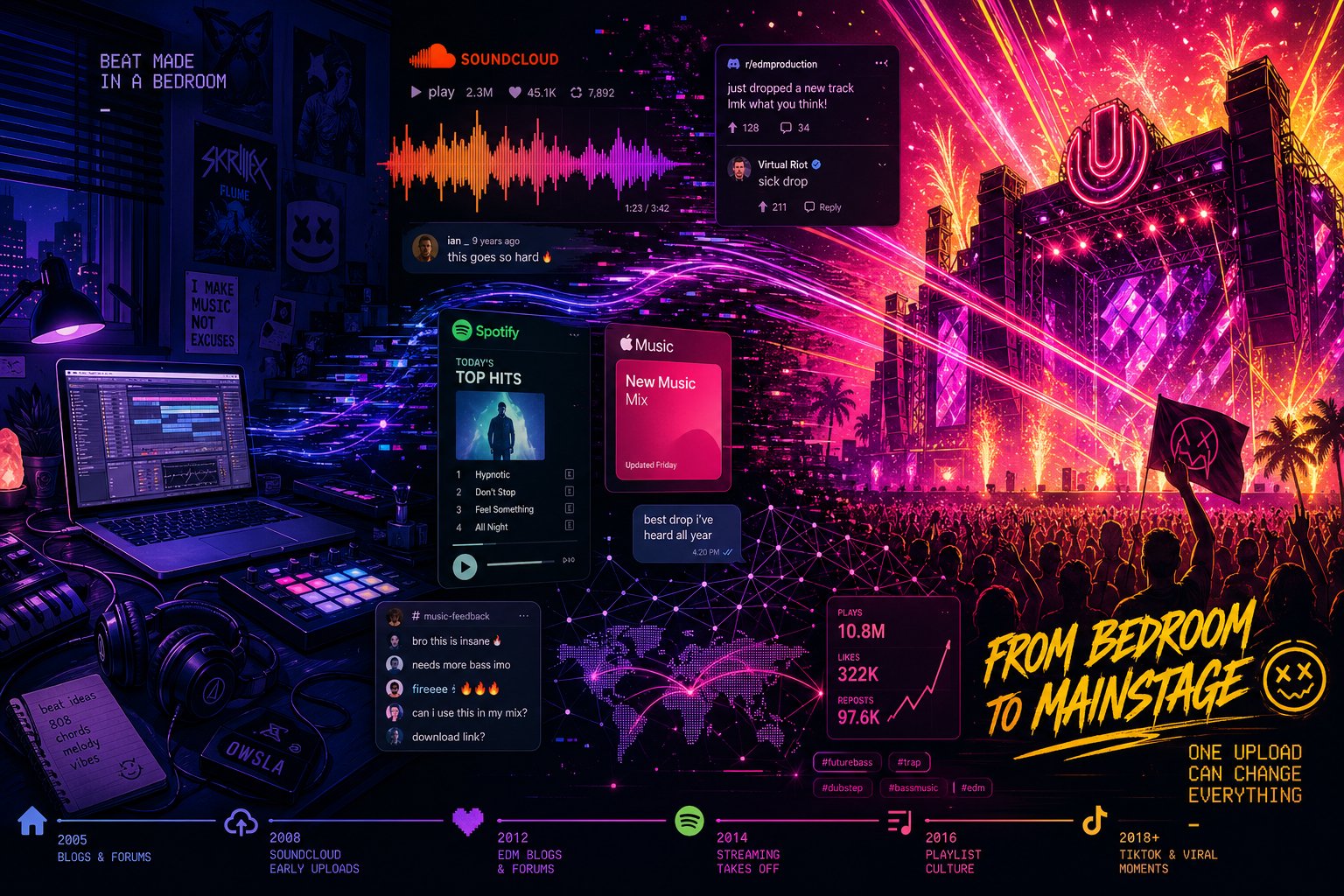
How Hyperpop Evolved From Internet Experiment to Global Movement
Every genre has an origin myth. Hyperpop's just happens to start in a London bedroom with a producer who thought pop music wasn't weird enough.
PC Music and the Foundations of a New Sound
In 2013, A. G. Cook launched PC Music, a record label and art collective that operated more like a conceptual experiment than a traditional imprint. The roster, including Hannah Diamond, Danny L Harle, and GFOTY, released singles that sounded like pop beamed in from an uncanny valley: familiar melodies warped through heavy processing, synthetic textures, and an almost satirical glossiness. These weren't tracks designed for radio. They were released through Bandcamp, SoundCloud, and small digital channels, reaching listeners who were already hunting for something stranger than the mainstream offered.
SOPHIE emerged alongside this wave and quickly became its most radical voice. Tracks like "BIPP" (2013) proved that extreme sound design, the kind built from crunching plastic textures and liquid bass, could still be danceable and emotionally resonant. SOPHIE's production philosophy treated every sonic element as malleable, something to be sculpted rather than simply arranged. That idea became foundational DNA for everything that followed.
From SoundCloud Underground to the Spotify Playlist Era
For years, this music existed without a unifying label. You'd find it scattered across SoundCloud pages, niche blogs, and Discord servers. Then, in the summer of 2019, Spotify editor Lizzy Szabo and data scientist Glenn McDonald gave the sound a name. The "hyperpop" editorial playlist was built initially to contextualize the growing buzz around 100 gecs, whose debut album 1000 gecs had compressed pop, dubstep, ska, and screamo into something genuinely unprecedented. The playlist retroactively grouped years of disparate experimentation under one searchable term, and suddenly a scene had a front door.
The timing was almost too perfect. When the pandemic locked the world indoors in early 2020, bedroom producers flooded the scene. Artists like glaive, osquinn, and ericdoa uploaded their first tracks and found audiences within weeks. A quick Google search for "hyperpop" went from returning near-zero results to surfacing thousands of playlists, explainer videos, and Reddit threads. The genre resonated globally, known as ハイパーポップ in Japanese music communities and هایپرپاپ in Persian-speaking circles, proof that internet-native music doesn't respect borders.
Mainstream Absorption and the Post-Hyperpop Landscape
By 2021, the underground and the mainstream were openly borrowing from each other. Charli XCX carried PC Music aesthetics into festival headlining sets. 100 gecs released a remix featuring Fall Out Boy that charted on Billboard's Alternative Songs. Producers with roots in the scene started getting calls from major-label pop acts. Hyperpop wasn't just a playlist anymore. It was a production language leaking into everything.
The table below maps this arc in a way you can scan at a glance:
| Era | Key Characteristics | Notable Artists |
|---|---|---|
| Proto-Hyperpop (2013-2018) | Conceptual pop, synthetic textures, deconstructed song structures, small-scale digital releases | A. G. Cook, SOPHIE, Hannah Diamond, Danny L Harle |
| The Naming Era (2019) | Spotify playlist codifies the scene, genre-smashing maximalism, chaotic energy | 100 gecs, Dorian Electra, umru, fraxiom |
| Pandemic Explosion (2020-2021) | Bedroom production boom, TikTok virality, emo-adjacent melodic hooks, rapid community growth | glaive, osquinn, ericdoa, ElyOtto, midwxst |
| Mainstream Crossover and Beyond (2022-present) | Production techniques absorbed into chart pop, playlist influence wanes, aesthetic spreads everywhere | Charli XCX, Caroline Polachek, underscores, 2hollis |
What this timeline reveals is a pattern: each era didn't replace the last so much as build on it. The conceptual experiments of PC Music gave 100 gecs a sonic vocabulary. The Spotify playlist gave bedroom producers an audience. And the pandemic gave everyone the time and isolation to push the sound further than anyone expected.
The real question, though, is what those earliest tracks actually sounded like, and why they still feel like blueprints for everything the genre became.
Proto-Hyperpop Songs That Laid the Foundation
Decades before anyone typed "what is hyperpop" into a search bar, artists were already bending pop into shapes it was never designed to hold. These tracks didn't carry the label, but they carried the instinct: synthetic textures pushed past comfort, vocals processed beyond recognition, and song structures that treated the rulebook like a suggestion.
The Tracks That Predicted Hyperpop Before It Had a Name
Understanding hyper pop means tracing its DNA backward. SOPHIE's debut singles and the early PC Music catalog are the obvious starting points, but the roots stretch further. As NPR's World Cafe documented in a feature commemorating the tenth anniversary of SOPHIE's PRODUCT, the genre's precursors span decades and defy easy categorization. What connects them isn't a shared tempo or production tool. It's a shared attitude: pop music as raw material, meant to be warped.
Here are the essential proto-hyperpop songs in chronological order, each one a blueprint for what the genre would become:
- Paul McCartney - "Temporary Secretary" (1980) - McCartney experimenting with a sequencer, layering squelching synthesized arpeggios under a robotic vocal delivery. The result is an "uncanny valley" take on pop that mirrors the synthetic textures SOPHIE would later perfect.
- Nitzer Ebb - "Let Your Body Learn" (1987) - A minimalist fusion of punk, industrial, and techno that pulses with frantic energy. Hyperpop acts would spend decades pushing this exact kind of aggressive electronic distortion further.
- Bjork - "Pluto" (1997) - A chaotic deep cut from Homogenic, fueled by themes of destruction and rebirth. Its spirit of radical self-transformation connects directly to SOPHIE's later explorations of identity and perception.
- Vengaboys - "We Like To Party!" (1998) - Faceless European producers engineering some of the campiest, most cartoonish pop ever recorded. If hyperpop songs are sugar overdoses by design, this track was an early prototype of that philosophy.
- Aaliyah - "What If" (2001) - A Timbaland-led production that pits rubbery beats against distorted guitar riffs, creating a weirdly synthetic R&B that hyperpop would eventually pull from. Sound design as songwriting, years ahead of its time.
- Clipse - "Grindin'" (2002) - SOPHIE herself cited this track as formative. Those jagged, impossibly crisp Neptunes beats are a direct ancestor of the percussive extremes that define the genre.
- Gwen Stefani - "Bubble Pop Electric" (2004) - Coquettish vocals, a playful Andre 3000 cameo, and a flurry of popping bubble sound effects. Every ingredient for a hyper pop masterpiece, assembled before the recipe had a name.
- M.I.A. - "XXXO" (2010) - Three minutes of glitchy, glossy, noisy pop that was deeply misunderstood on release. In retrospect, it was a clarion call. The following year, SOPHIE began uploading the demos that would become PRODUCT.
- SOPHIE - "BIPP" (2013) - The track that made the underground pay attention. Gloopy, popping-candy textures under vocals with J-Pop finesse, proving extreme sound design could still be emotionally direct and danceable.
- QT - "Hey QT" (2014) - The collaborative brainchild of SOPHIE, A. G. Cook, and Hayden Dunham. A fictional pop star promoting a fictional energy drink, loaded with sugar your ears were warned about. It blurred the line between marketing and art so thoroughly that the distinction stopped mattering.
How Early Pioneers Connected to the Modern Scene
These aren't just historical curiosities. You'll notice direct throughlines from this list to the top 10 hyperpop artists working today. McCartney's sequencer experiments echo in the synthetic maximalism of 100 gecs. Clipse's percussive minimalism lives in Dylan Brady's blown-out trap productions. M.I.A.'s glossy noise predicted the exact frequency that artists like osquinn and Alice Gas would later inhabit. And SOPHIE's "BIPP" remains the Rosetta Stone, the track that taught a generation of producers that pop could be sculpted from pure texture rather than conventional melody.
The PC Music collective that Cook built around these ideas functioned less like a label and more like an open-source creative network, one where aliases, conceptual characters, and collaborative experimentation were the norm. That ethos, music as communal play rather than individual product, became the cultural backbone of everything hyperpop would grow into.
Knowing where the sound came from, though, only sharpens the question of what happened when it reached full volume. The tracks from hyperpop's peak creative period didn't just inherit these ideas. They detonated them.
The Songs That Defined Hyperpop at Its Creative Peak
Between 2019 and 2022, the sound that had been simmering in SoundCloud uploads and PC Music experiments reached a full boil. The Spotify playlist gave the scene a name. The pandemic gave it an audience with nowhere else to go. And the tracks that emerged during this window didn't just represent hyperpop. They became the hyper pop examples people pointed to when trying to explain the genre to a confused friend.
What made this era so creatively dense wasn't a single sound. It was the sheer range of approaches that still somehow felt connected, a shared commitment to treating pop as a sandbox rather than a formula. The following tracks are arranged not as a ranked list but as a recommended listening sequence, one that traces the genre's peak arc from chaotic debut to mainstream absorption.
Songs That Defined the Hyperpop Sound
Each of these selections earned its place not just through cultural impact but through specific production decisions that pushed the genre's boundaries. Imagine pressing play on the first track and letting the rest unfold like chapters in a story about pop music losing its mind in the best possible way.
- 100 gecs - "money machine" (2019) - The track that forced the conversation. Dylan Brady and Laura Les built this around a pitched-up vocal hook so aggressively processed it sounds like a ringtone gaining sentience. Underneath, the production slams between trap hi-hats, ska-punk guitar stabs, and a bass drop that belongs in a dubstep set. The genius is structural: every element that shouldn't coexist does, and the song dares you to call it a mess while you're already humming the chorus. This was the moment the Spotify playlist had something undeniable to rally around.
- Dorian Electra - "Gentleman" / "M'Lady" (2019) - Where 100 gecs weaponized chaos, Dorian Electra weaponized concept. These companion tracks from Flamboyant use pitch-shifted vocals and crunchy synth textures to satirize gender performance, flipping between hyper-masculine and hyper-feminine archetypes within the same sonic palette. The production choices aren't decorative. They're the argument itself, proving that vocal manipulation could carry ideological weight.
- SOPHIE - "Immaterial" (2018) - Technically released just before the playlist era, this track from OIL OF EVERY PEARL'S UN-INSIDES became the spiritual anthem of the peak period. A cascading, euphoric synth line carries a lyric about transcending physical form: "I could be anything I want." The vocal is layered, multiplied, and pitched into a choir of selves. It's a production masterclass in using maximalism to express liberation rather than just volume.
- glaive - "astrid" (2020) - A 16-year-old bedroom producer from rural North Carolina uploaded this and became one of the most popular hyperpop artists of the pandemic wave almost overnight. The track pairs emo-adjacent lyrics about teenage heartbreak with a glittering, bitcrushed instrumental that sounds like a video game soundtrack melting. What makes it quintessentially peak-era is the emotional contrast: genuinely vulnerable songwriting delivered through production so synthetic it shouldn't feel intimate, yet somehow does.
- AG Cook - "Lifeline" (2020) - The architect of PC Music stepped out as a solo artist and delivered a seven-minute track that cycles through at least four distinct movements, from ambient intro to euphoric trance breakdown. Cook's production philosophy, that pop can be endlessly reconfigured in real time, is laid bare here. It's less a song and more a demonstration of what happens when you refuse to commit to a single genre for longer than ninety seconds.
- umru & Fraxiom - "Thos Moser" (2020) - A track that became a meme and a manifesto simultaneously. Fraxiom's rapid-fire, irreverent vocal delivery rides over umru's production, which sounds like someone feeding a pop song through a paper shredder and reassembling the strips at random. The humor is the point. It captures the scene's refusal to take itself seriously even while pushing genuine sonic boundaries.
- ElyOtto - "SugarCrash!" (2020) - This track went viral on TikTok and introduced millions of listeners to the genre's sound without them necessarily knowing what they were hearing. The pitched-up vocal, the emo lyrical content, the sparkling yet distorted production: it's a textbook entry point. Its massive reach proved that these aesthetics could connect far beyond the niche, a bridge between the underground and the scroll-happy mainstream.
- Charli XCX - "Good Ones" (2021) - A deliberate pivot. As NPR documented, Charli described her album Crash as an experiment in "playing the game," asking what would happen if she leaned fully into a mainstream pop persona. "Good Ones" is the opening move: a synth-pop track that strips back the abrasive experimentation of her earlier work while retaining the melodic instincts sharpened by years of maximalist production. It clocks in at barely over two minutes, designed for maximum replay.
- Petal Supply (feat. umru, Himera & trndytrndy) - "1" (2021) - A 10-plus minute track that unfolds like a prog-rock journey through the metasphere. Petal Supply's original demo was remixed by each featured artist, then sequenced into a single continuous piece rather than split across an EP. NPR's Otis Hart called it "a Voltron unlike anything I've ever heard before." It represents the peak era's most ambitious structural experiment, proof that the genre could sustain long-form composition, not just two-minute sugar rushes.
What unified these tracks wasn't a shared tempo, vocal style, or production template. It was a shared conviction that pop music's rules exist specifically to be rewritten, and that the rewriting itself is the art.
Charli XCX and the Bridge to the Mainstream
No artist embodies the tension between hyperpop's underground roots and mainstream ambition more visibly than Charli XCX. Her trajectory is essentially the genre's trajectory, compressed into one discography.
The 2016 EP Vroom Vroom, produced by SOPHIE, was the pivot point. It traded the radio-friendly pop of "Boom Clap" for abrasive, industrial-tinged production that alienated casual listeners and electrified the underground. The mixtapes Number 1 Angel and Pop 2 followed, pulling in collaborators from across the PC Music orbit and establishing Charli as the scene's most high-profile ambassador. When asked whether she feels more alive playing "Vroom Vroom" or "Boom Clap," she told NPR: "Obviously 'Vroom Vroom.' You don't even need the gun."
Then came how i'm feeling now (2020), recorded during lockdown with direct fan input, an album that distilled her sound to its bare essentials while keeping the raw, cutting-edge creativity at the center. It's the record most fans point to as her definitive statement within the scene. Tracks like "claws" and "anthems" are 하이퍼 팝 in its purest form: sugary hooks, blown-out bass, and a sense that the whole thing could fly apart at any second.
The shift to Crash (2022) was deliberate and provocative. Charli leaned into interpolations, worked with an A&R for the first time in a decade, and embraced what she openly called "selling out" as a form of performance art. "I think now that hyperpop has become hyperpop, a genre where people can bracket a lot of artists with familiar sounds in one group, it feels less exciting to me to play within that space," she explained to NPR. "I need to find what's next for me." The album bobs through four decades of chart-topping sounds, from gated reverb to disco revival, but the melodic instincts forged in her experimental years are audible in every track. Even when she's "playing the game," the fingerprints are unmistakable.
That restlessness, the refusal to stay in one lane even after helping define it, is what made Charli the bridge. She proved that the aesthetics born in bedroom studios and Discord servers could scale to festival stages and Billboard charts without losing their edge entirely. Whether you spell it hyperpop or hyperpip or simply call it the future of pop, her discography is the clearest map of how the sound traveled from the margins to the center.
Production techniques and sonic innovation tell one part of the story. But the genre's creative peak was inseparable from something deeper: the communities and identities that shaped it from the inside out.
The Cultural Identity at the Heart of Popular Hyperpop Songs
Pitch-shifting isn't just a production trick in hyperpop. For many of the artists who built this scene, it's a way of hearing yourself for the first time.
Hyperpop as a Space for Queer and Trans Expression
The genre's roster reads like a roll call of trans and queer visionaries: SOPHIE, Laura Les, Fraxiom, underscores, Jane Remover, Arca, Dorian Electra. That concentration isn't coincidental. A Rutgers University thesis examining hyperpop as a "trans genre of alternative world making" argues that the movement functions as a space where gender becomes "a space of possibilities beyond that of the rigid Western gender binary." The music's core tools, vocal manipulation, synthetic textures, the outright rejection of "natural" sound, map directly onto the experience of reshaping identity in real time.
Think about what pitch-shifting actually does. It detaches a voice from the body that produced it. For trans artists navigating dysphoria, that technology isn't aesthetic window dressing. It's liberation. When Laura Les screams into a mic and pitches her voice into a desperate digital shriek, as writer Tara observes, that's "a tangible manifestation of dysphoria and the pain of navigating a body that capitalism and patriarchy don't know what to do with." SOPHIE's entire production philosophy, sculpting sound into forms that don't exist in nature, mirrored her own journey of self-creation. When she sang "I can be anything I want" on "Immaterial," the lyric and the production were saying the same thing.
Even the genre's signature irony serves a protective function. Sincerity, especially for marginalized artists, invites vulnerability. Vulnerability invites violence. The layers of absurdity and humor in so many popular hyperpop songs aren't deflections from meaning. They're shields that let genuine emotion leak through safely, carefully, like a fragile secret tested before it's fully shared.
The DIY Internet Ethos That Powered the Scene
Hyperpop's cultural politics didn't emerge in a vacuum. They were enabled by infrastructure. The genre grew on platforms where the barrier to entry was a laptop and an internet connection: SoundCloud, Bandcamp, Discord servers, and net-labels like Zoom Lens and Deskpop that prioritized experimentation over commercial viability. No A&R gatekeepers. No studio budgets. No industry pipelines filtering out anyone who didn't fit a marketable mold.
That accessibility mattered enormously. Traditional music industry structures have historically excluded queer and trans artists, artists of color, and anyone without geographic proximity to a major label hub. Hyperpop's internet-native model flattened those barriers. A teenager in rural North Carolina could upload a track and find a global audience by morning. A trans woman in the Midwest could build a creative identity through a screen name and a DAW before ever stepping into a physical venue. The scene's founding net-labels, from PC Music to Hyperpop Records to Rora, functioned less like businesses and more like online communities where collaboration, not competition, was the default mode.
This is why you can't separate the sound from the culture. The maximalism, the distortion, the refusal to sound "normal," these aren't just aesthetic choices. They're political ones, made by people for whom "normal" was never an option and never the goal.
Hyperpop's sonic excess and its cultural politics aren't parallel stories. They're the same story, told through pitch-shifted vocals and bedroom-produced beats by artists who found freedom in the very tools that let them reimagine themselves.
That reimagining didn't stay underground forever. The same production techniques that gave marginalized artists a voice began showing up in places no one expected: mainstream pop charts, major-label releases, and the playlists of artists who'd never set foot in a Discord server. The question became not whether hyperpop would influence the mainstream, but how much of its identity would survive the crossing.
How Hyperpop Music Reshaped Mainstream Pop From the Inside
The crossing happened faster than anyone predicted. Production techniques that once lived exclusively on SoundCloud pages and niche Discord servers started surfacing in songs with millions of streams, major-label budgets, and festival billing. The aesthetic didn't arrive with a press release. It leaked in through the cracks, one glitched vocal and one distorted 808 at a time.
How Hyperpop Production Entered the Charts
The pipeline worked in two directions. First, artists who had built their reputations inside the scene carried those aesthetics outward. Charli XCX is the most visible example. Her trajectory from the PC Music-adjacent Vroom Vroom EP through how i'm feeling now and into the chart-dominating Brat traces a direct line from underground experimentation to mainstream cultural event. Brat fuses decades of influence, from rave synths to electroclash grooves to indie-sleaze energy, all filtered through the maximalist production instincts she sharpened during her years deep in the scene. As one critic noted, the album mashes up 40 years of music history, "the 80s filtered through rave filtered through indie filtered through hyperpop, the references multiplying geometrically." Collaborators like A. G. Cook and Hudson Mohawke helped realize that vision, but the sonic DNA is unmistakable.
Caroline Polachek followed a parallel path. Her solo work, particularly the album Desire, I Want to Turn Into You, threads pitch-bent vocals and synthetic textures through art-pop songwriting that owes a clear debt to SOPHIE's production philosophy. Neither artist markets herself as a hyperpop act, yet both carry the movement's fingerprints into spaces where millions of listeners encounter them without ever searching for the genre by name.
The second pipeline ran through producers. umru, one of the scene's most prolific beatmakers, worked with Charli XCX, Dorian Electra, and Slayyyter before his production style began influencing how major-label sessions approached vocal processing and sound design. Danny L Harle, another PC Music alumnus, co-produced tracks for Dua Lipa. These collaborations didn't announce themselves as hyperpop crossovers. They simply introduced techniques, aggressive compression, layered pitch-shifting, controlled digital distortion, into pop contexts where they quietly became normal.
The Mainstream Artists Who Absorbed Hyperpop's DNA
Here's where it gets interesting. Listen closely to mainstream pop released after 2020 and you'll hear hyperpop examples everywhere, even in songs that would never land on a genre playlist. Billie Eilish's vocal processing on tracks like "Therefore I Am" uses the same kind of intimate, digitally manipulated close-mic technique that SOPHIE pioneered. Rico Nasty's collaboration with 100 gecs on "Ringtone" was a direct crossover, but her broader catalog also absorbed the genre's abrasive energy. As she told Billboard, "It was the first time I heard someone's music that made me feel the way my music did. There's something about their stuff that just has no rules."
Even hyperpop bands and acts adjacent to the scene influenced artists who'd never describe themselves that way. The pitched-up vocal hooks that ElyOtto's "SugarCrash!" sent viral on TikTok became a production shorthand across the platform, showing up in tracks by creators who had no idea where the technique originated. The table below maps specific production signatures from the underground to their mainstream adoptions, making the influence concrete:
| Hyperpop Production Technique | Mainstream Pop Songs That Adopted It |
|---|---|
| Extreme pitch-shifted vocals (pioneered by SOPHIE, Laura Les) | Billie Eilish - "Therefore I Am"; Doja Cat - "Get Into It (Yuh)" |
| Distorted, blown-out 808 bass (100 gecs, Dylan Brady productions) | Rico Nasty - "OHFR?"; Playboi Carti - Whole Lotta Red era tracks |
| Maximalist synth layering and controlled clipping (A. G. Cook, PC Music) | Charli XCX - Brat; Caroline Polachek - "Welcome to My Island" |
| Genre-smashing within a single track (100 gecs, Dorian Electra) | Rina Sawayama - "XS"; Grimes - "Player of Games" |
| Glitchy, bitcrushed textures and digital artifacts (osquinn, glaive) | Olivia Rodrigo - "brutal" (intro distortion); Halsey - If I Can't Have Love, I Want Power |
| Nightcore-influenced tempo and vocal speed (ericdoa, midwxst) | PinkPantheress - "Break It Off"; Ice Spice - "In Ha Mood" (sped-up vocal samples) |
What this table reveals isn't imitation. It's absorption. The mainstream didn't adopt hyperpop as a genre. It absorbed its toolkit, cherry-picking techniques that made songs feel more textured, more immediate, more internet-native. The Spotify editorial playlist that once defined the scene was retired in 2023, but by then the aesthetic had already dissolved into the water supply of contemporary pop production. You don't need to search for the genre anymore. You just need to listen.
That diffusion raises a practical question for anyone who's been following along: if these sounds are everywhere now, how do you actually navigate the original catalog? With so many tracks spanning so many moods and sub-styles, the genre rewards a more intentional approach to discovery than a simple alphabetical scroll.
Essential Hyperpop Songs for Every Mood and Moment
Scrolling through a hyperpop wiki or playlist can feel like staring at a wall of noise. Hundreds of tracks, dozens of hyper pop artists, and no obvious entry point unless you already know what you're looking for. The genre's range is its greatest strength and its biggest barrier to newcomers. A track-by-track chronology helps you understand the history, but it doesn't answer the question most listeners actually have: what should I play right now?
The answer depends entirely on what you're after. A high-energy workout track and a melancholic late-night listen both live under the same umbrella, but they serve completely different purposes. The discovery matrix below sorts essential tracks by vibe so you can skip the guesswork and go straight to the sound that fits your moment.
Hyperpop Songs Sorted by Mood and Energy
| Mood / Vibe | Recommended Tracks | Why It Fits |
|---|---|---|
| High-energy chaos | 100 gecs - "money machine"; umru & Fraxiom - "Thos Moser"; Alice Gas - "No Limits" | Breakneck tempos, abrasive production, and vocals that sound like they're being launched from a cannon. Pure adrenaline. |
| Melancholic / emotional | glaive - "astrid"; osquinn - "i don't want that many friends in the first place"; SOPHIE - "Immaterial" | Vulnerable lyrics wrapped in synthetic textures. The contrast between fragile emotion and digital production is the whole point. |
| Experimental / avant-garde | AG Cook - "Lifeline"; Petal Supply - "1"; Jane Remover - "TURN UP OR DIE" | Long-form structures, genre-hopping within a single track, and production that treats the song as a living organism. For listeners who want to be challenged. |
| Accessible entry points | ElyOtto - "SugarCrash!"; Charli XCX - "claws"; ericdoa - "sad4whattt" | Catchy hooks and familiar pop instincts with just enough distortion to feel fresh. Start here if the genre is new to you. |
| Dark / industrial | SOPHIE - "Ponyboy"; Dorian Electra - "Gentleman"; Arca - "Nonbinary" | Heavier textures, confrontational energy, and production that leans into discomfort. The genre's punk-adjacent edge. |
| Euphoric / uplifting | Hannah Diamond - "Reflections"; Danny L Harle - "Super Natural"; Charli XCX - "anthems" | Bright synths, soaring melodies, and a rush of serotonin. The bubblegum side of the spectrum, cranked to eleven. |
You'll notice some tracks could fit multiple categories. That's the nature of the genre: a single hyperpop album can swing from euphoria to despair within three songs. The categories above aren't rigid boxes. They're starting coordinates for exploration.
Building Your Own Hyperpop Playlist
Once you've sampled across moods, the next step is sequencing your own listening experience. A great playlist isn't just a collection of tracks you like. It's a journey with pacing, contrast, and momentum. Here are a few principles that work especially well for this genre:
- Open with an accessible track to ease listeners in before escalating intensity. Something like "SugarCrash!" or "claws" sets the tone without overwhelming.
- Alternate between high-energy and emotional tracks. Three chaotic bangers in a row creates fatigue. A melancholic breather between them lets each hit harder.
- Vary the sub-styles. Follow a glitchy, rap-influenced track with something from the bubblegum side, then pivot to an experimental deep cut. The genre's diversity is the playlist's secret weapon.
- Use longer, more experimental tracks as centerpieces rather than openers. A seven-minute AG Cook odyssey works beautifully as a mid-playlist reset, not as the first thing someone hears.
- Close with something that lingers. An emotional track or a slow-building experimental piece gives the playlist a sense of resolution rather than just stopping.
The beauty of this approach is that it mirrors how the best hyper pop artists structure their own releases, balancing sensory overload with moments of genuine intimacy. Every standout hyperpop album, from 1000 gecs to how i'm feeling now, follows this same push-and-pull dynamic.
And if the process of curating and sequencing sparks something more ambitious, like actually wanting to create your own hyperpop-influenced track, the barrier has never been lower. Tools like MakeBestMusic's AI Song Generator let you input a genre reference or mood and generate an original, royalty-free track in seconds. It's a natural next step for anyone who's moved past passive listening and wants to experiment with the DIY production ethos that made the scene possible in the first place, no cracked copy of FL Studio required.
Curating a playlist is one way to engage with the genre's present. But the more interesting question might be what happens next. The Spotify playlist that gave hyperpop its name has faded, the founding artists have scattered into new directions, and the sound itself has splintered into a dozen micro-movements. Whether that means the genre is dying or simply mutating depends on where you look.
What Comes After Hyperpop and Where the Genre Goes Next
The Spotify editorial playlist that gave the hyper pop genre its name was quietly retired in 2023. The founding artists have scattered. SOPHIE passed away in 2021. 100 gecs went quiet after their second album. Charli XCX pivoted into the cultural supernova of Brat. If you're asking "what is hyperpop music in 2025?", the honest answer is: it depends on who you ask, and most of them will disagree with each other.
Has Hyperpop Been Absorbed Into the Mainstream
Writer Kieran Press-Reynolds, one of the genre's most thoughtful chroniclers, argued in Pitchfork that the "pop" in hyperpop proved a total bust: "The charts are smothered instead in country, trap that sounds stuck in the 2010s, and soft, zamboni-smooth pop." It's a fair read of the surface. No hyperpop song has topped the Hot 100. No digicore act has headlined Coachella. By the metrics the mainstream uses to measure success, the genre didn't conquer anything.
But that framing sets the bar in the wrong place. Hyperpop was never trying to dominate the charts. It rewired the dimensions of what pop music can sound like without ever compromising its community values. The production techniques documented earlier in this article, the pitch-shifting, the maximalist layering, the controlled digital distortion, are now standard tools in sessions across every major label. The influence is everywhere. That's a different kind of victory, quieter but arguably more lasting than any single chart position could deliver.
The New Wave of Artists Carrying Hyperpop Forward
The scene didn't die. It splintered, and the fragments are thriving.
Jane Remover is the clearest proof. The 21-year-old New Jersey artist joined Discord servers as a fan and gamer before becoming one of digicore's central figures. Their 2021 EP Teen Week (released under the alias dltzk) is a seminal project for the subgenre, flitting from mutated Eurodance to leveled-up drum 'n' bass to alien mumble-pop. Their latest album, Revengeseekerz, detonates the overdriven trap subgenre from the inside, drawing a line between hyperpop and hip-hop that critics have long overlooked. As NPR noted, the album crams so much into its 50 minutes, from Pokemon battle announcers to Guitar Hero samples to self-referential callbacks to earlier digicore work, that it feels like a final evolutionary statement for the movement.
Then there's 2hollis, who represents the opposite lesson drawn from the same influences. Where Jane Remover chose extremity, 2hollis chose sleekness. His album star leans into techno and trance-like pop, with songs that could pass as floor-fillers despite their wonky construction. He's explicitly rejected the digicore label, yet his music embodies the A. G. Cook principle of bedroom recordings that pass as hyper-professional. Put the two artists side by side and you can hear exactly what makes music within the hyperpop orbit so hard to classify, and so resistant to death.
Beyond these two, the genre's open-source DNA keeps mutating. Digicore, glitchcore, hyperflip, dariacore: each offshoot takes a different slice of the original aesthetic and runs with it. In Asia, artists like 4s4ki in Japan, Bloodz Boi in China, and Ena Mori in the Philippines are fusing hyperpop production with local musical traditions, proving the sound translates across languages and cultures. The internet-native model that built the scene in the first place, Discord servers, SoundCloud uploads, collaborative production across time zones, ensures that no single gatekeeper can declare it over. As Laura Les of 100 gecs once put it, she didn't want to be bigger than music. She just wanted to be music. That impulse hasn't gone anywhere.
From Listener to Creator in the Post-Hyperpop Era
Here's the thing about a genre built on bedroom production and free software: the invitation to participate was always part of the point. The earliest PC Music releases were made on laptops. The pandemic-era wave was powered by teenagers with cracked copies of FL Studio and YouTube tutorials. The barrier to experimenting with these sounds has never been lower, and it keeps dropping.
If you've followed this hyperpop playlist journey from proto-tracks to peak-era anthems to the current wave of micro-movements, the natural next step isn't just listening more. It's making something. Tools like MakeBestMusic's AI Song Generator let anyone input a mood, genre reference, or sonic idea and generate an original royalty-free track instantly, embodying the same democratized, experimental ethos that made hyperpop possible in the first place. You don't need a label deal, a studio, or even years of production experience. You just need curiosity and a willingness to treat pop as a playground, the same ingredients that launched every artist discussed in this article.
Hyperpop's lasting legacy isn't a sound. It's a permission slip: proof that pop music belongs to whoever is weird enough, restless enough, and brave enough to remake it in their own image.
The genre's name may fade. The playlist is already gone. But the instinct it codified, that pop is raw material meant to be stretched, shattered, and rebuilt by anyone with a laptop and an idea, is permanent. The network, as NPR's Sheldon Pearce wrote, will never truly go dark.
