


What Makes Irish Folk Songs a Living Tradition
You already know more Irish folk songs than you think. Ever hummed along to "Danny Boy" at a wedding? Belted out "Wild Rover" at a pub? Walked past a busker playing "Molly Malone" and felt something tug at you, even if you couldn't name why? These aren't just popular irish songs that happen to sound old. They're part of an oral tradition stretching back centuries, carried from generation to generation not in textbooks but in voices, living rooms, and crowded bars.
Irish folk songs are, at their core, stories set to melody. They grew out of a culture where singing was how you remembered your history, mourned your dead, mocked your enemies, and told your neighbors you loved them. The tradition is rooted in communal identity and shaped by over two thousand years of social upheaval, migration, and resilience. As Ireland's National Inventory of Intangible Cultural Heritage describes it, this music is "intrinsically rooted in Ireland's past, its political and social changes, its multiple senses of place, and the evolution of identities."
"There are as many reasons to sing folk songs as there are songs and people who sing them." — Kara O'Brien, University of Limerick
Why These Songs Still Resonate Across Generations
So what keeps these irish songs alive when the events they describe happened hundreds of years ago? The secret is emotional universality. A famine ballad isn't just about hunger in the 1840s. It's about loss, injustice, and longing for home — feelings that don't expire. As RTÉ Brainstorm put it, folk songs endure because they "combine a personal narrative with a universal emotional core, which remains as relatable today as when it was written." Each generation finds its own reflection in the lyrics, which is exactly why the tradition keeps breathing.
More Than Music — A Cultural Inheritance
Irish folk isn't a museum exhibit. It's a living practice that still serves the same social functions it always has. These songs preserve oral history, recording events that official accounts often ignored. They gave voice to political resistance during centuries of colonial rule, when playing certain instruments or gathering to sing could be an act of defiance. For the millions who emigrated, they became a lifeline to home — a way to carry Ireland in your pocket when you couldn't carry anything else. And in the pub session, they remain the glue of community bonding, turning a room of strangers into a chorus.
If you've ever wondered what music do irish people listen to when they want to feel connected to something deeper than a playlist algorithm, the answer often circles back here. This article goes beyond a simple list of titles. In the sections ahead, you'll trace the historical eras that shaped these songs, discover the instruments that give them their unmistakable sound, explore regional singing styles most guides overlook, and understand how the tradition traveled the globe. By the end, you won't just know which irish folk songs matter — you'll understand why they refuse to fade.
From Ancient Harps to Rebel Ballads
Every traditional irish song carries a timestamp, even if it's hidden beneath the melody. The genre didn't appear fully formed — it evolved alongside the island's most defining moments. Understanding that timeline turns a collection of tunes into a living narrative of survival, defiance, and longing.
Here's how the major eras shaped the irish traditional music songs we still sing today:
- The Bardic Era (pre-1600s) — Gaelic court poets and harpists lay the foundation
- The Penal and Colonial Period (1600s-1700s) — Music goes underground as Gaelic culture is suppressed
- Famine, Rebellion, and Emigration (1790s-1890s) — Songs become acts of resistance and remembrance
- The Revival Era (1950s-1970s) — Irish folk reaches global audiences through recordings and television
- The Modern Tradition (1980s-present) — New artists reinterpret old songs of ireland for contemporary listeners
Pre-1800 Roots and the Bardic Tradition
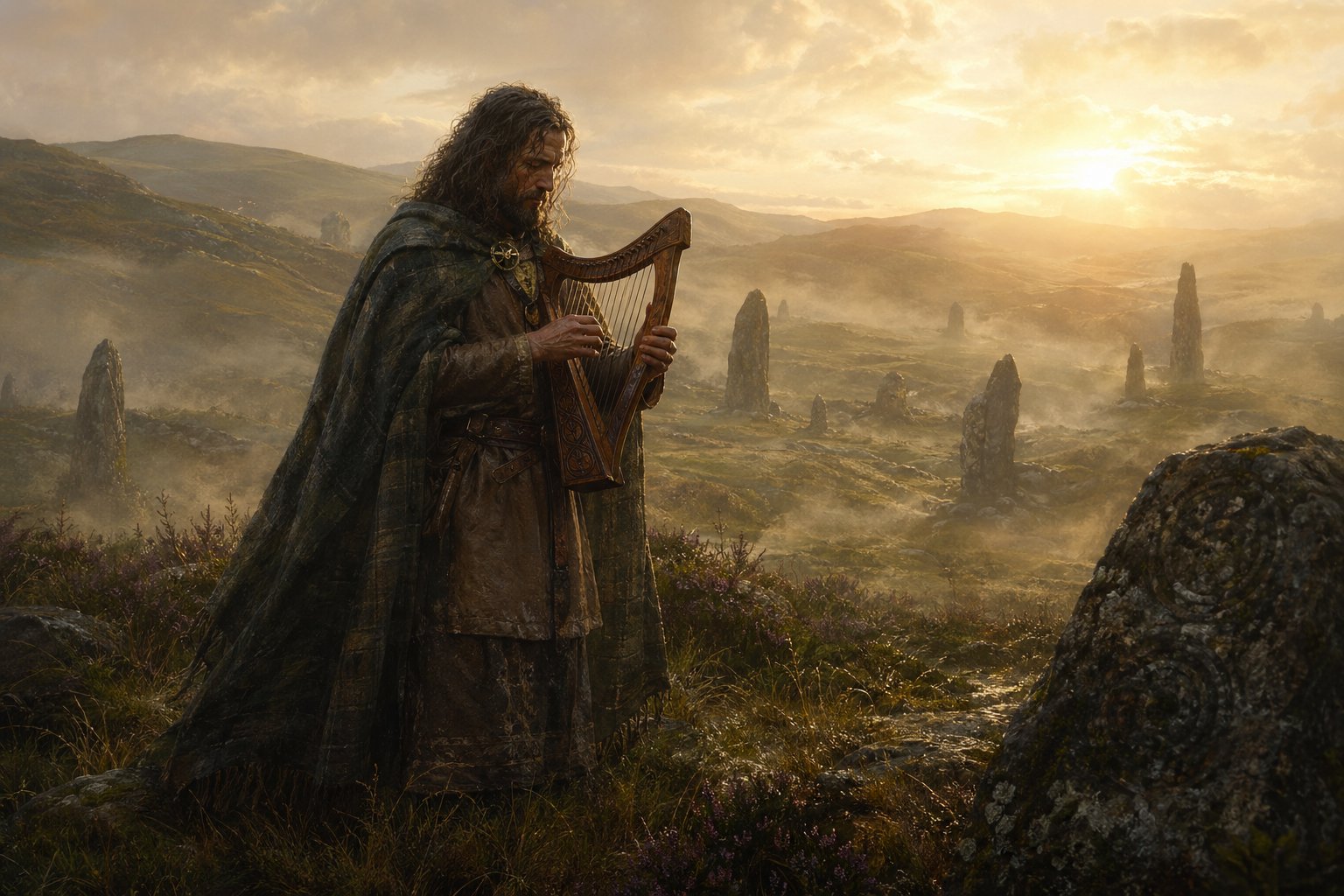
Ireland's musical roots stretch back roughly 2,500 years to the Celtic era. The Gaelic Celts who came to dominate the island brought with them musical influences absorbed from regions as far-flung as Iberia and Egypt. In their oral culture, music and poetry weren't entertainment — they were how you preserved information across generations.
Imagine a society with no printing press, no written archives for most people. Highly trained poets and musicians known as bards served in clan courts, functioning as historians, advisors, and even political weapons. A bard could make or destroy a chieftain's reputation with a single verse. The harp was their instrument of choice, and it became so central to Irish identity that it remains the national emblem to this day.
The bardic tradition mostly collapsed alongside the Gaelic aristocracy in the 1600s. Without courts to sustain them, bards became wandering musicians. The harpist Turlough O'Carolan, often called the last Irish bard, died in 1738 — but the melodic DNA he and his predecessors established still runs through every slow air played in a session tonight.
Famine, Rebellion, and Emigration Ballads
The late 18th and 19th centuries turned Irish folk music into something urgent. The 1798 Rebellion against British rule produced ballads like "The Wearing of the Green" and "Boolavogue" — songs that encoded political defiance in singable form. When gathering to protest was dangerous, gathering to sing was the next best thing.
Then came the Great Famine of the 1840s-1860s, and the music darkened. Every famine song that survived carries the weight of a million deaths and the displacement of millions more. Emigration ballads became their own genre, capturing the ache of people who left Ireland knowing they'd likely never return. The song "Kilkelly, Ireland" distills this pain with devastating clarity — it's based on actual letters sent from a father in County Mayo to his son in America between 1860 and 1892, each verse marking another loss, another year of distance. Few irish songs old or new hit quite as hard.
As one emigrant ballad puts it: "My feet are here on Broadway this blessed Harvest Morn, but oh, the ache that's in them for the spot where I was born." These weren't abstract sentiments. They were the lived reality of millions who carried Ireland's melodies to new continents.
The 20th-Century Revival and Beyond
By the mid-20th century, many of these songs risked fading into obscurity. That changed when a group of Irish brothers in New York accidentally launched a global movement. Paddy and Tom Clancy had come to America in 1951 to pursue acting, not music. But when they needed to raise money, they did what came naturally — they sang the old songs they'd learned as kids in County Tipperary. Joined by brother Liam and Tommy Makem, they appeared on the Ed Sullivan Show in March 1961, performing before 40 million viewers in their now-iconic Aran sweaters.
The impact was seismic. The Clancy Brothers and Tommy Makem earned a Grammy nomination, played Carnegie Hall, and performed for President Kennedy. As Irish author Frank McCourt wrote, "They were the first... not since John McCormack had Irish singers captured international attention." Bob Dylan, who spent time with the Clancys in early-1960s New York, later said, "Irish music has always been a great part of my life because I used to hang out with the Clancy Brothers. They influenced me tremendously."
The Dubliners songs followed in their wake, bringing a grittier, pub-rooted energy to the revival. Together, these groups opened the floodgates for every Irish folk act that came after — the Wolfe Tones, Planxty, De Dannan, and eventually The Pogues. What had been a local oral tradition was now an international phenomenon, and the old songs finally had the recorded legacy they deserved.
Yet recordings only capture part of the picture. The sound of these songs — that unmistakable blend of pipes, fiddle, and bodhrán — owes everything to a set of instruments as distinctive as the tradition itself.
Essential Instruments That Shape the Irish Folk Sound
Strip away the instruments and you still have a song. But you lose the thing that makes it sound unmistakably Irish. The character of traditional irish folk music lives in the interplay between a handful of instruments, each with a distinct personality and a specific job to do in a session. Knowing what they are — and how they work together — changes the way you hear every tune.
The Bodhrán, Tin Whistle, and Uilleann Pipes
The bodhrán is the rhythmic backbone. Picture a shallow, open-backed drum covered in goatskin, held upright and struck with a small wooden stick called a cipín. The player's free hand presses against the inside of the skin to control pitch and tone. That deep, pulsing heartbeat you hear underneath a rebel ballad or a lively reel? That's the bodhrán driving the whole room forward.
Then there's the tin whistle — sometimes called the penny whistle, and the gateway instrument for most beginners. It's cheap, portable, and deceptively simple: six holes on a metal tube. But don't let the form fool you. Good penny flute music demands rapid finger combinations at high speed, and skilled players produce ornamentation that rivals any classical woodwind. Whistles come in various keys, with D being the standard for irish folk music sessions.
The uilleann pipes sit at the opposite end of the spectrum. Unlike Scottish bagpipes, they're powered by bellows strapped to the player's elbow rather than by breath, which delivers a drier, more controlled sound. The word "uilleann" itself means "pipes of the elbow." A full set can cost several thousand dollars, and mastering one takes years. A good uilleann piper is rare — and usually the most respected musician in any room. This is the instrument that gives traditional celtic folk music its most haunting, unmistakable voice.
Fiddle, Concertina, and the Irish Harp
Here's a question that trips people up: what's the difference between a fiddle and a violin? Physically, nothing. The distinction is entirely about style. A violin plays classical music. A fiddle plays folk. And in Ireland, the fiddle is central to everything from fast-paced dance tunes to achingly slow airs. There are no frets to guide your fingers, which means novice fiddlers tend to sound rough — but the expressive freedom that comes with that difficulty is exactly what makes a great fiddler so prized in a session.
The concertina — a small, hexagonal squeezebox with buttons at both ends — fills a melodic role similar to the fiddle but with a distinctly reedy, clear tone. It's especially associated with the ireland folk traditions of County Clare and the west coast, where it became a staple of regional playing styles. If you're looking to play Irish music on a concertina, you'll want an Anglo model in the keys of C/G.
And then there's the harp. According to Irish mythology, the first harp belonged to the Dagda of the Tuatha dé Danann, who could make his audience weep, laugh, or fall asleep depending on how he played. The original Irish harps were small, carved from bogwood, and strung with wire rather than gut. Today the harp remains Ireland's national emblem — it appears on coins, passports, and the Guinness logo. Its role in irish traditional folk music is more symbolic than common in pub sessions, but its shimmering, plucked tones still define the genre's most reflective moments.
To give you a practical snapshot, here's how these core instruments compare:
| Instrument | Role in Folk Music | Typical Song Types | Difficulty Level |
|---|---|---|---|
| Bodhrán | Rhythmic backbone; drives tempo | Rebel ballads, reels, jigs | Beginner-friendly |
| Tin Whistle | Melodic lead; accessible entry point | Jigs, reels, slow airs | Easy to start, hard to master |
| Uilleann Pipes | Melodic lead; emotional depth | Slow airs, laments, marches | Very difficult |
| Fiddle | Melodic lead; highly expressive | Dance tunes, slow airs, reels | Difficult |
| Concertina | Melodic lead; clear, reedy tone | Jigs, polkas, regional tunes | Moderate |
| Irish Harp | Harmonic and melodic; symbolic | Slow airs, lullabies, classical pieces | Moderate to difficult |
Each of these instruments shapes a different emotional register. Together, they create the layered, breathing sound that makes a live session feel like nothing else. But instruments are only half the equation — the songs themselves carry just as much regional variation, from the unaccompanied sean-nós singing of Connemara to the ballad traditions of Ulster.
The Most Famous Irish Folk Songs Everyone Should Know
Instruments give the tradition its voice, but the songs themselves are where the stories live. If you've ever searched "what are the top 10 irish songs," you've probably seen the same handful of titles recycled without much explanation. Here's the difference: knowing a song's name is one thing. Knowing why it became iconic — and which version to listen to first — is what turns casual curiosity into genuine appreciation.
Timeless Ballads Everyone Should Know
These are the classic irish songs that have crossed oceans and outlived the eras that created them. Each one pairs a memorable melody with a story that still lands.
"Danny Boy" is probably the first title that comes to mind. Written by English songwriter Frederic Weatherly in 1913 and set to the ancient melody "Londonderry Air," it's a parent's farewell to a child leaving home — possibly for war, possibly for emigration. The ambiguity is part of its power. For a version that strips the song to its emotional core, start with Sinead O'Connor's raw, unadorned recording.
"The Fields of Athenry," written by Pete St. John, tells the story of a man imprisoned for stealing food during the Great Famine. His goodbye to his wife carries the weight of an entire nation's suffering. Paddy Reilly's version became the definitive recording, and you'll still hear it sung by thousands at rugby and football matches across Ireland — proof that great irish songs don't stay on the stage.
"Molly Malone" is Dublin's unofficial anthem. The tale of a fishmonger whose ghost still wheels her cart through the streets dates to the 18th or 19th century, and the "Alive, alive-oh!" chorus is one of the most recognizable in the tradition. The Dubliners deliver a warm, lived-in version that feels like it belongs in a crowded pub on a Saturday night.
"Wild Rover" is pure sing-along energy — a reformed drinker's vow to change his ways, set to a chorus that practically demands you bang the table. The Dubliners again own this one, though the Dropkick Murphys bring a punk-fueled intensity that works surprisingly well.
"Whiskey in the Jar" dates back to the 17th century and tells of a highwayman betrayed by his lover. It's one of the most popular irish songs ever recorded, with versions spanning centuries and genres. The Dubliners set the folk standard, Thin Lizzy turned it into a rock anthem in 1972, and Metallica's 1998 cover won a Grammy — introducing the song to millions who'd never heard a bodhrán in their lives.
Lively Jigs and Session Favorites
Ballads tell stories. Irish jigs get people moving. The difference isn't just tempo — it's social context. Ballads tend to quiet a room. Jigs and uptempo songs light it on fire.
"The Rocky Road to Dublin" is a breathless slip-jig about a young man's journey from County Galway to Dublin and onward to England. The lyrics tumble out at breakneck speed, and the melody — a popular slip-jig recorded by Petrie in the 19th century — demands nimble fingers from any musician brave enough to keep up. The Dubliners' version is the gold standard for energy.
"Finnegan's Wake" (not to be confused with Joyce's novel, though he borrowed the title) tells the comic tale of a man who falls off a ladder, is presumed dead, and wakes up at his own wake when whiskey splashes on his face. It's dark humor wrapped in a rollicking tune — perfectly Irish. The Clancy Brothers deliver it with the right mix of mischief and momentum.
"The Irish Rover" spins a tall tale about a fantastical ship loaded with absurd cargo. The Dubliners and The Pogues recorded a legendary duet version in 1987 that remains one of the most famous irish folk songs of the uptempo variety. And "I'll Tell Me Ma," sometimes called "The Belle of Belfast City," is a playground-style song with an infectious rhythm that makes it a staple at ceilidhs and family gatherings.
Hidden Gems Beyond the Classics
The popular irish folk songs get all the attention, but the tradition runs much deeper. "Raglan Road" started as a poem by Patrick Kavanagh in 1946, set to the traditional air "The Dawning of the Day." Luke Kelly's performance turned it into something transcendent — a meditation on unrequited love that ranks among the most beautiful recordings in the entire canon.
"Spancil Hill," written by emigrant Michael Considine about his longing for County Clare, is a dream sequence set to music. Christy Moore's version is the one to hear first. "The Parting Glass," dating to the early 17th century, is the song you sing at the end of the night — a gentle farewell that predates "Auld Lang Syne" and carries more emotional weight. Hozier's recent recording introduced it to a new generation.
And don't overlook "Black Velvet Band," the story of a man framed by a woman and transported to Tasmania. The Dubliners' lively rendition in the 1960s made it a global pub favorite. Or "The Star of the County Down," set to the folk melody "Dives and Lazarus" — Van Morrison and The Chieftains recorded a version that's pure warmth. Even the irish eyes song "When Irish Eyes Are Smiling," though written by Americans in 1912, has become so embedded in the tradition that it deserves a nod.
To help you navigate the range, here's a quick guide organized by mood and occasion:
- Reflective ballads for quiet evenings: "Danny Boy," "Raglan Road," "Spancil Hill," "The Parting Glass"
- Pub singalongs that bring the house together: "Wild Rover," "Molly Malone," "The Fields of Athenry," "Whiskey in the Jar"
- High-energy dance tunes and session starters: "The Rocky Road to Dublin," "The Irish Rover," "Finnegan's Wake," "I'll Tell Me Ma"
- Storytelling gems worth discovering: "Black Velvet Band," "The Star of the County Down," "The Foggy Dew," "The Galway Girl"
What connects all of these — from the oldest ballad to the newest session favorite — is that they weren't written to be listened to alone through earbuds. They were made for rooms full of people, shaped by the specific places and singing styles where they first took root.
Regional Singing Styles and the Art of Sean-Nós
Those specific places matter more than most guides let on. Ireland is a small island, but its irish song tradition fractures along regional lines in ways that can make a ballad from Donegal sound like it belongs to a different country than one from West Cork. Geography, dialect, and local history all left fingerprints on the music — and nowhere is that clearer than in the oldest vocal tradition on the island.
Connemara Sean-Nós and the Unaccompanied Voice
Sean-nós — literally "the old style" — is the most distinctive form of traditional irish folk singing you'll ever encounter. Imagine a singer standing alone in a quiet room. No guitar. No bodhrán. No accompaniment at all. Eyes closed, one hand gripping the hand of the person beside them, the other resting on the table. Then the voice begins — unhurried, deeply ornamented, bending and stretching each syllable across multiple notes in ways that shift from verse to verse. No two performances are ever identical.
As Comhaltas Ceoltóirí Éireann explains, sean-nós is performed primarily as a solo art form, where "the singer tells the story in the song by combining many vocal techniques, especially through the use of ornamentation and variation, in linking the melody to the text." One syllable might be sung across several notes, and those notes can change with every verse. The effect is hypnotic — less like a performance and more like a conversation between the singer and the song itself.
"Sean-nós does not necessarily refer to any musical terminology but to a way of life as experienced by our people who witnessed many forced changes to the old ways." — Tomás Ó Maoldomhnaigh, Comhaltas Ceoltóirí Éireann
These gaelic irish songs are rooted in the Gaeltacht regions where Irish is still spoken as a community language. Previous generations learned them at home, absorbing melodies and ornamentation by ear from parents and neighbors. That transmission method is part of what makes the tradition so personal — and so vulnerable. As the Journal of Music notes, despite periodic waves of academic concern about its survival, sean-nós singing shows no signs of terminal decline, with competitions like Corn Uí Riada and festivals continuing to draw passionate performers.
Ulster Ballads, Munster Airs, and Local Flavors
Three main styles of sean-nós correspond to the three surviving Gaeltacht areas, and the differences are striking even to a casual listener. The Donegal (Ulster) style has been heavily influenced by Scots Gaelic song, with less ornamentation and a steadier rhythmic pulse that gives it a more driving, narrative quality. Ulster's tradition leans toward storytelling ballads — long, detailed accounts of local events, rebellions, and emigrant farewells delivered with a directness that suits the region's character.
Connemara and Munster, by contrast, are both highly ornamented, but in different ways. Connemara singers tend toward grace notes and subtle melodic shifts familiar to traditional instrumentalists. Munster singers — from parts of Kerry, Cork, and Waterford — employ wider intervallic leaps between ornamented notes and a distinctive sharp intake of breath at unexpected points in the melody. Researcher Pádraig Ó Cearbhaill documented this Munster technique through recordings made by German phonetician Wilhelm Doegen between 1928 and 1931, capturing vocal details that even Seán Ó Riada once denied existed.
These regional distinctions survived in part because dedicated collectors and institutions fought to preserve them. Colm Ó Lochlainn's song collections documented Dublin and Leinster traditions that might otherwise have vanished. Comhaltas Ceoltóirí Éireann, founded in 1951, built a nationwide infrastructure of classes, competitions, and festivals — including the annual Fleadh Cheoil — that gave irish songs traditional performance spaces and kept regional styles visible to new generations. Early field collectors like Edward Bunting, George Petrie, and Patrick Weston Joyce laid the groundwork even earlier, transcribing thousands of folk songs from ireland that would otherwise exist only in fading memory.
What's remarkable is how these popular traditional irish songs and singing styles didn't just stay local. The same emigration waves that carried ballads across the Atlantic also carried regional vocal techniques, melodic patterns, and storytelling structures — seeding new musical traditions in places the original singers never imagined.
How Irish Folk Songs Shaped Music Around the World
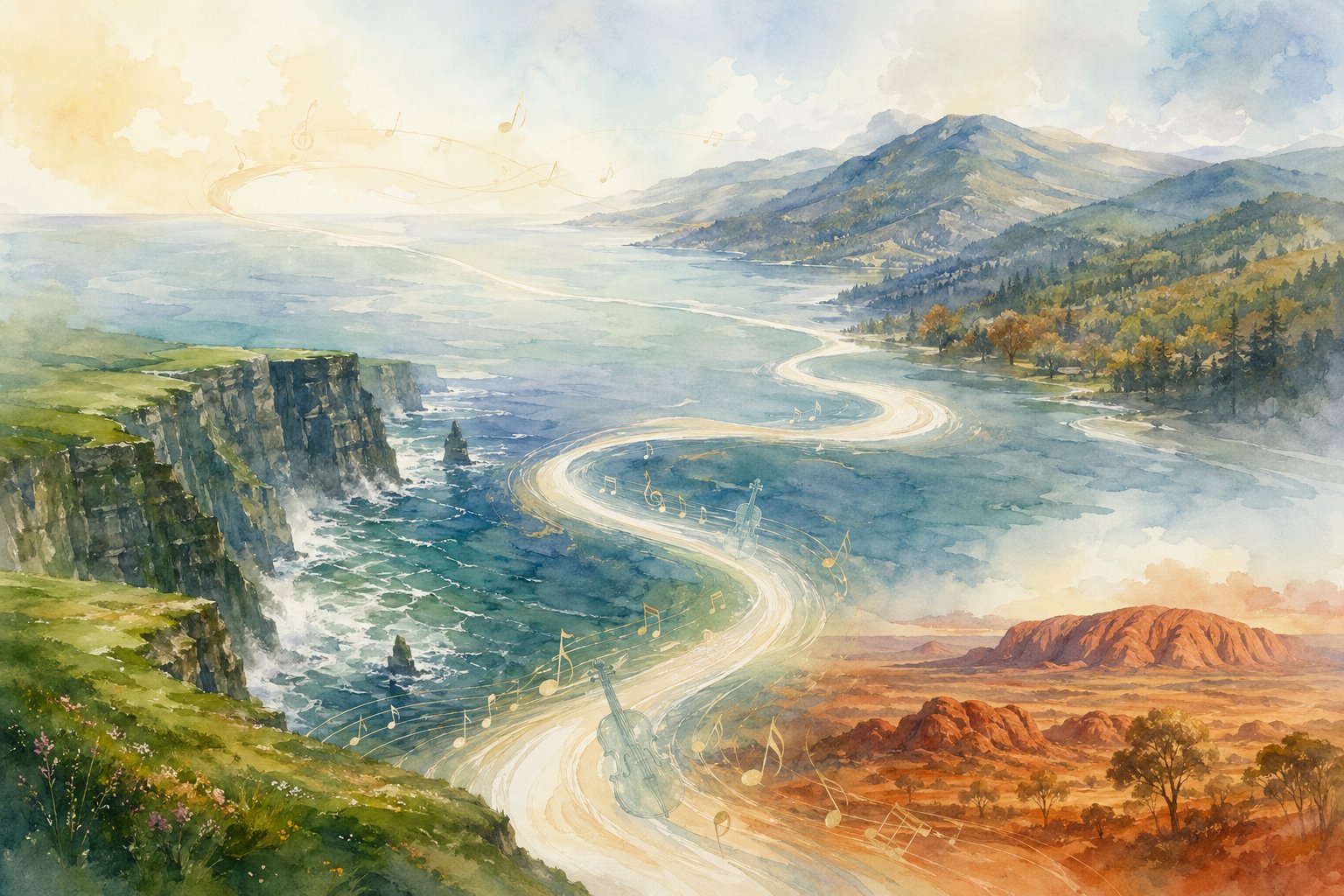
Those emigrant voices didn't just carry memories. They carried melodies, rhythms, and storytelling habits that quietly rewired the musical DNA of entire continents. Folk music from ireland didn't stop being Irish when it crossed an ocean — it adapted, blended, and gave birth to genres that millions of people listen to today without ever tracing the roots back.
From Ireland to Appalachia and the Australian Bush
The connection between Irish folk and American roots music runs deeper than most people realize. From Ulster Presbyterian emigration in the 18th century to the Appalachians and the Ozarks, waves of Irish settlers carried their ballads, fiddle tunes, and dance rhythms into the American backcountry. Once there, those traditions collided with Scottish, English, and eventually African American musical forms. The result? The foundations of what we now call bluegrass and early country music.
Think about it this way: the lonesome fiddle melody at the heart of an Appalachian murder ballad and the slow air played in a Donegal kitchen share a common ancestor. The narrative structure — a single voice telling a story of love, loss, or betrayal over a spare, modal melody — traveled intact from one landscape to another. Even the vocal ornamentation of sean-nós left traces in the high, lonesome singing style that defines old-time Appalachian music.
That cross-fertilization didn't stop at country. As History Ireland documents, Irish musical traditions blended with blues and jazz in cities like Boston, Chicago, and New York — a fusion that contributed to the eventual emergence of rock and roll. The irony? That American-born sound later circled back across the Atlantic, provoking what became known as the anti-jazz campaign in mid-20th-century Ireland.
On the other side of the world, a different kind of migration was planting the same seeds. Between 1791 and 1867, roughly 40,000 Irish convicts were transported to the eastern Australian colonies. Though they accounted for only about 12% of all transported convicts, their cultural impact was outsized. Irish convict musicians — fiddlers, pipers, bagpipe players, and dancing masters — provided music for celebrations, weddings, wakes, and everyday entertainment in public houses. Records from the era describe scenes of "Irish jigs, reels, and songs" keeping communities alive in the harshest conditions. Those tunes and dance forms fed directly into the Australian bush ballad tradition, where themes of exile, injustice, and defiant humor echo the same folk song the irish emigrants had been singing for generations.
The Irish Influence on Modern Folk and Rock
Fast-forward to the 1980s, and the thread picks up in a London squat. The Pogues — originally called Pogue Mahone, Irish Gaelic for "kiss my arse" — formed in 1982 with a mission to drag Irish folk into a musical world transformed by punk. Led by songwriter Shane MacGowan, they took traditional melodies and storytelling structures and injected them with raw, confrontational energy. Virtually no electric instruments. A minimalist drum kit. And lyrics steeped in the same Irish literary tradition that ran from Brendan Behan to Flann O'Brien.
The result was something genuinely new. Songs like "Fairytale of New York" — a duet with Kirsty MacColl exploring the shattered dreams of the Irish diaspora in America — became a Christmas standard and the band's most enduring work. Their 1987 collaboration with The Dubliners on "The Irish Rover" turned a tall-tale folk song into a global pub anthem, proving that celtic folk songs could thrive in the modern mainstream without losing their edge.
What made The Pogues matter beyond their own catalogue was the movement they sparked. By the mid-1990s, a wave of primarily American bands — Flogging Molly, Dropkick Murphys, and dozens of others — had built an entire "Celtic punk" scene on the template The Pogues established. Dropkick Murphys even brought MacGowan in as a guest vocalist on their 2001 album Sing Loud, Sing Proud. The genre spread globally, a musical echo of the Irish diaspora itself.
Meanwhile, Galway — an irish city popularized by song lyrics from Ed Sheeran's "Galway Girl" to Steve Earle's earlier song of the same name — became a symbol of how folk music ireland traditions could shape international perceptions of a place. Millions of tourists visit expecting the craic and the sessions those songs promised, and the city delivers.
The reach of irish popular music extends far beyond any single genre or era. Here are some of the global musical traditions that trace roots back to Irish folk:
- Appalachian folk and old-time music — fiddle tunes, ballad structures, and modal melodies carried by 18th-century Ulster emigrants
- American bluegrass and early country — evolved from the blending of Irish, Scottish, and English traditions in the rural South
- Australian bush ballads — shaped by Irish convict musicians and settlers who brought jigs, reels, and songs of exile
- Celtic punk — The Pogues-inspired fusion that spawned Flogging Molly, Dropkick Murphys, and a worldwide underground scene
- Folk-rock — from Steeleye Span and Planxty in the 1970s to modern acts like Hozier and Lankum, Irish melodic and lyrical DNA runs through the genre
- Newfoundland folk music — Irish and English settlers created a distinct tradition on Canada's east coast, where songs like "The Star of Logy Bay" echo their origins
- Cape Breton fiddle music — Scottish and Irish immigrants in Nova Scotia preserved and evolved fiddle styles that remain vibrant today
What ties all of these together is a pattern: Irish emigrants didn't just bring songs — they brought a way of making music. The communal session, the narrative ballad, the interplay between voice and instrument, the idea that music belongs to everyone in the room rather than just the performer on stage. That participatory spirit traveled as far as the people who carried it, and it's still the beating heart of the tradition back home — nowhere more alive than in the pub sessions where these songs are sung tonight.
The Pub Session Culture That Keeps Folk Songs Alive
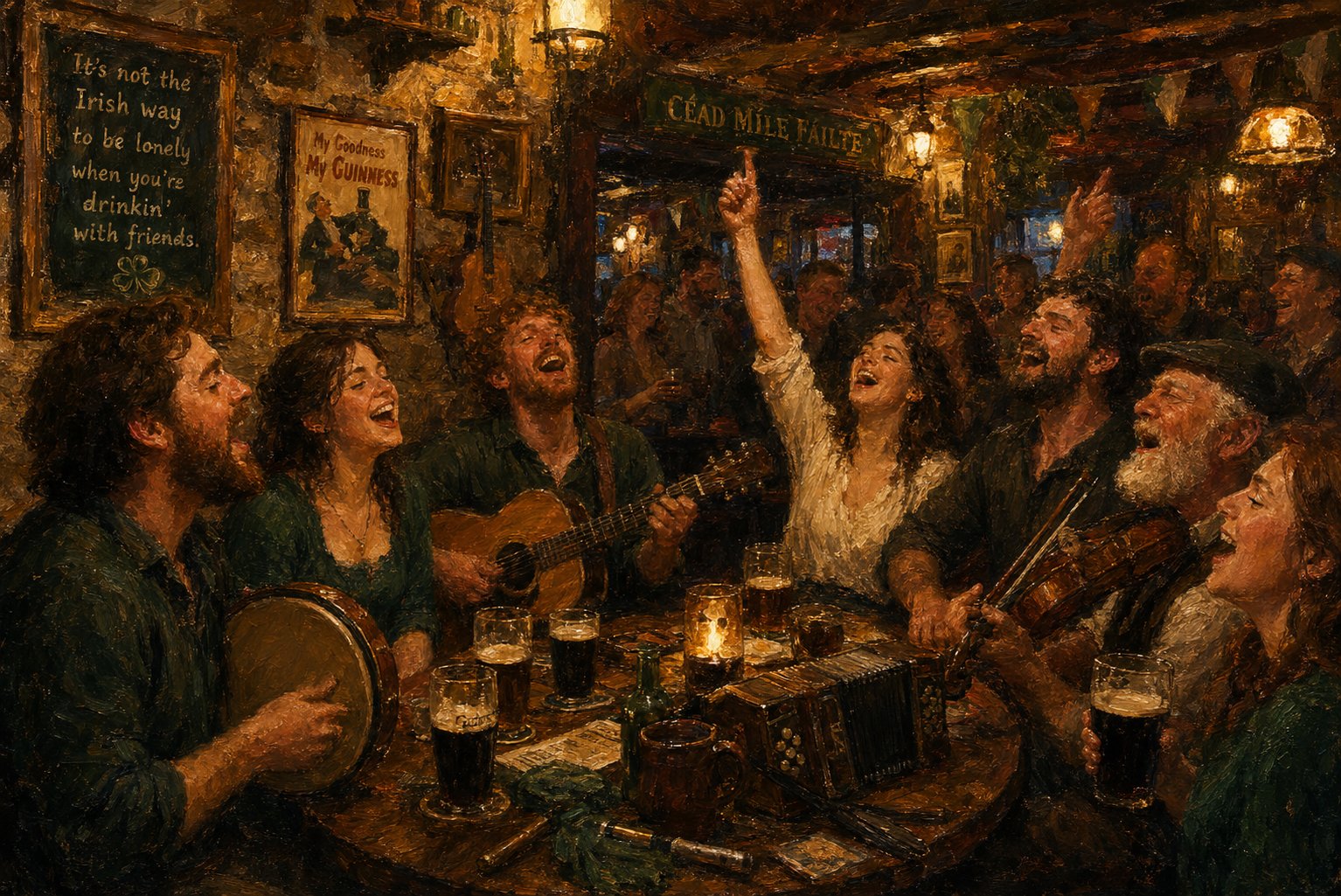
That participatory spirit didn't just survive the journey across oceans. Back in Ireland, it never left the room where it started. Walk into the right pub on the right night and you'll find it alive and breathing — a circle of musicians tucked into a corner, instruments out, pints within reach, playing tunes that have been passed around these same kinds of rooms for generations. This is the traditional irish pub music session, and it's where the entire tradition lives in real time.
Inside a Traditional Irish Music Session
Imagine a handful of musicians gathered in a loose circle, no stage, no microphones, no setlist. A fiddler starts a reel. A flute player picks it up a bar later. A concertina joins, then a bodhrán eases in underneath. Nobody announced the tune — they just knew it. As the Center for Irish Music describes it, a session is "a time and place where musicians and music-lovers come together to enjoy traditional Irish music in a social context," with musicians sitting in a circle while listeners gather around to chat, listen, and encourage.
Sessions typically grew out of kitchen gatherings in family homes — the old ceili houses where musicians would drop in, tunes would flow, and set dancers would take the floor. Today, pubs have largely replaced those kitchens, but the informal energy remains the same. And sessions aren't confined to scheduled events. They've been known to break out at airport departure gates, on delayed flights, and on street corners outside festival venues. Wherever a group of trad musicians gathers, the music tends to follow.
What separates an authentic session from a tourist-oriented performance is the absence of spectacle. No costumes, no choreography, no amplification. If you see a stage and microphones, you might enjoy the music, but you're watching a gig — not sitting in on a session. The real thing is casual, conversational, and driven by a shared repertoire rather than a star performer. A good irish folk band on stage can thrill a crowd, but a good session makes the crowd part of the music.
That said, sessions run on a set of unwritten rules, and knowing them matters. Here are the essentials, drawn from experienced session musicians:
- Ask before joining — introduce yourself and wait for an invitation rather than pulling up a chair and launching in
- Know the tunes before you play them — noodling along with wrong notes frustrates everyone around you
- Match the group's volume — you're part of a conversation, not delivering a solo
- Don't interrupt a set — tunes are played in groups of three or four, and the person who started the first tune chooses the next
- Respect the hierarchy — if a more experienced musician is present, defer to their lead and treat the session as a chance to listen and learn
- Never clap along — this one surprises visitors, but rhythmic clapping over the music is considered disruptive, not supportive
- Don't call a tune a "song" — songs have lyrics, tunes don't, and mixing them up marks you as a newcomer instantly
If you're a beginner, don't let the etiquette scare you off. Many pubs and cultural centers now host slow sessions specifically designed for less experienced players. These take tunes at a gentler pace, welcome mistakes, and create a safe space to build confidence before stepping into a faster circle. Organizations like Comhaltas Ceoltoiri Eireann run branches worldwide that offer exactly this kind of welcoming entry point.
Singalong Culture and the Songs That Bring People Together
Sessions aren't only for instrumentalists. Singing is woven into the fabric of the evening, and the best sessions shift naturally between instrumental sets and vocal turns. A musician might set down the fiddle and offer a song. The room quiets. And when the chorus comes around, everyone joins in — not because they're told to, but because the song demands it.
This is what makes irish sing along songs so powerful. They're designed for participation. The melodies are simple enough to follow on a first listen, the choruses repeat with slight variations, and the emotional arc — whether joyful or heartbreaking — pulls the whole room into a shared experience. You don't need a trained voice. You just need to be willing.
Some songs reliably turn any pub into a chorus. Here are the fun irish songs and beloved ballads most likely to get an entire room singing, along with when they tend to surface during a session:
- "Wild Rover" — the ultimate table-banger, usually arrives mid-session when the energy peaks and everyone's loosened up
- "The Fields of Athenry" — the emotional anchor, often sung later in the evening when the mood deepens
- "Molly Malone" — the crowd-pleaser that works early or late, with its irresistible "Alive, alive-oh!" chorus
- "The Rattlin' Bog" — a cumulative song that builds in speed and chaos, perfect for raising the roof mid-session
- "Black Velvet Band" — a storytelling favorite with a chorus that's impossible not to join, typically landing among the upbeat irish songs in the first half
- "Dirty Old Town" — Ewan MacColl's classic, adopted wholeheartedly by Irish sessions, often appearing when someone pulls out a harmonica
- "Whiskey in the Jar" — a singalong staple that can surface at any point and instantly unites the room
- "The Irish Rover" — a tall-tale anthem that builds energy and usually signals the session is hitting full stride
- "The Parting Glass" — the traditional closer, sung at the end of the night as a gentle farewell
What's beautiful about this culture is its democracy. A session doesn't belong to the best musician in the room. It belongs to everyone present. The Irish phrase ar scath a cheile a mhairimid — "we live in each other's shadow" — captures the spirit perfectly. You play for the group, you sing for the group, and the group carries you when your voice cracks or your fingers slip. That mutual generosity is what makes irish songs for a sing along feel fundamentally different from karaoke or a concert. It's not performance. It's communion.
And that communal energy isn't locked behind a pub door in Galway or Dublin. The same session culture thrives in Irish communities from Boston to Brisbane, and modern tools are making it easier than ever to find your way in — whether you want to listen, learn, or create something new.
Discovering and Creating Irish Folk Music Today
You don't need to live near a pub session in Doolin to immerse yourself in the tradition. Streaming platforms, curated playlists, and a growing wave of creative tools have made it easier than ever to go from casual listener to active participant — no plane ticket required.
Building Your Perfect Irish Folk Playlist
The trick to a great irish music playlist isn't cramming in every famous title you can find. It's organizing by feel. Think about what you actually want the music to do for you, then build around that intention.
Start with mood. A playlist of reflective ballads — "Danny Boy," "Raglan Road," "Spancil Hill" — creates a completely different atmosphere than one loaded with session-ready jigs like "The Rocky Road to Dublin" and "Finnegan's Wake." Mixing both without a plan gives you emotional whiplash. Separate them, and each playlist becomes something you'll actually return to.
Era is another useful filter. A collection of irish classics from the 1960s revival — The Dubliners, The Clancy Brothers, Planxty — sounds and feels distinct from modern interpretations by Lankum or Ye Vagabonds. Listening chronologically lets you hear how the tradition evolved, which deepens your appreciation for both the old and the new.
Then there's occasion. Looking for the best st patrick's day songs? Build a playlist that moves from rousing singalongs to sentimental closers, mirroring the arc of an actual evening out. Planning music st patrick's day gatherings practically demands a mix of upbeat crowd-pleasers and a few slower numbers to give the room a chance to breathe. For quiet evenings or long drives, lean into the slow airs and unaccompanied vocals that define classic irish music at its most intimate. Spotify, Apple Music, and YouTube all offer algorithmically generated folk playlists, but the best ones are hand-curated — search for playlists built by Irish music communities or cultural organizations for a more authentic selection of popular irish music.
Turning Inspiration into Original Irish-Style Songs
Listening is where most people start. But here's what's changed: you no longer have to stop there. The same technology that puts thousands of irish folk music songs at your fingertips now lets you create original music inspired by the tradition — even if you've never picked up a tin whistle.
AI-powered music tools have opened a door that didn't exist a few years ago. Instead of needing years of instrumental training or studio access, you can select a genre like Irish folk, choose a mood — nostalgic, celebratory, bittersweet — and generate a royalty-free original track in seconds. It's not a replacement for learning an instrument or sitting in on a session. It's a bridge between appreciation and creation, a way to take the inspiration this music sparks and turn it into something tangible.
Whether you want to deepen your connection to the tradition or just get started, here are practical ways to engage with Irish folk music right now:
- Create an original Irish-inspired track using MakeBestMusic's AI Song Generator — pick an Irish folk style, set a mood, and produce a royalty-free song you can actually use
- Attend a local session — check Comhaltas Ceoltóirí Éireann for branches and events near you, including beginner-friendly slow sessions
- Learn a tin whistle tune — it's the most accessible entry point into playing traditional music, and quality whistles cost under twenty dollars
- Build mood-based playlists on your streaming platform of choice, separating ballads from jigs and session tunes
- Watch live session recordings on YouTube to absorb the etiquette, repertoire, and energy before attending in person
- Explore archives from RTÉ, the Irish Traditional Music Archive, and Comhaltas for field recordings and historical performances
The beauty of this tradition is that it was never meant to be passively consumed. From the bardic poets who composed for their clans to the emigrants who sang in tenement kitchens, Irish folk has always been participatory. The tools have changed — from harps to streaming apps to AI generators — but the impulse is the same: hear something that moves you, and make it your own.
Why the Tradition Lives On and How to Join It
That impulse — hear something, make it yours — is exactly why this tradition has outlasted empires, famines, and oceans. Every irish folk song that survives today does so because someone cared enough to sing it again.
Why Irish Folk Songs Will Never Fade
Consider what you've traced through this article: a bardic tradition stretching back millennia, rebellion ballads that encoded resistance in melody, regional singing styles so distinct they function as vocal fingerprints, and a global diaspora that seeded new genres from Appalachia to the Australian bush. The best irish folk songs endure not because they're preserved in amber but because they keep finding new lungs.
That's happening right now. As The Week reports, Irish trad is resonating fiercely with young audiences who "roar out the lyrics" in packed pubs. Acts like Lankum, The Mary Wallopers, and Kingfishr are connecting a new generation with traditional sounds while reshaping them for the present. Button accordionist Mairtin O'Connor told The Independent that folk music is "very much music of human interaction, celebration and commiseration" — the opposite of isolating technology. In a screen-saturated world, that human warmth is precisely what draws people back.
The common irish songs everyone knows — "Wild Rover," "The Fields of Athenry," "Molly Malone" — aren't relics. They're living proof that a good irish song outlives the moment that created it. And the tradition keeps expanding: from sean-nos revivals to Celtic punk to AI-generated compositions, every generation finds its own way in.
Your Next Step into the Tradition
You don't need permission to participate. The whole point of irish songs folk culture is that it belongs to whoever shows up. Here's where to start: listen to the famous traditional irish songs mentioned throughout this guide and let them lead you deeper. Attend a session — even just to listen. Pick up a tin whistle and learn one tune. Build a playlist that matches your mood. Or try creating something original with a tool like MakeBestMusic's AI Song Generator, where you can turn the inspiration into a track of your own. The entry point matters less than the willingness to step through it.
"It's very inclusive, egalitarian, and everyone gets the chance to play it." — Jason O'Rourke, traditional concertina player, speaking to the BBC
That inclusivity is the tradition's greatest strength. From a bardic court in ancient Ireland to a pub session in Boston to a bedroom producer experimenting with folk melodies at midnight — the thread is unbroken. The songs are waiting. All you have to do is sing along.
