


Is AI Music Copyrighted?
You typed a prompt, an AI tool generated a full track, and now you want to know: is ai music copyrighted? The short answer is no — not if the music was fully generated by AI without meaningful human creative input. Under current U.S. law, copyright protection requires a human author. Music that an AI system composes autonomously, regardless of how impressive it sounds, does not qualify.
That said, the complete picture has more layers. Whether AI music can be copyrighted depends entirely on how much creative control a human exercised during the process. Think of it as a spectrum rather than a binary yes or no.
The Direct Answer to AI Music Copyright
The U.S. Copyright Office affirms that copyright protection extends to AI outputs only "where a human author has determined sufficient expressive elements." The mere provision of prompts does not satisfy the human authorship requirement.
This position, reinforced in the Copyright Office's January 2025 report on AI copyrightability, draws a firm line. If an AI system determines the expressive elements of a musical work — the melody, harmony, rhythm, arrangement, and instrumentation — then no copyright exists, regardless of who clicked "generate."
Why the Answer Depends on Human Involvement
AI music copyright falls into three distinct tiers based on human involvement. Here's where your work likely lands:
- Fully AI-generated (no copyright): You enter a text prompt like "upbeat jazz track, 90 BPM" and the AI produces a finished piece. The system made all expressive decisions. No copyright protection applies.
- AI-assisted with human creativity (potentially copyrightable): You use AI to generate raw material, then substantially arrange, modify, compose over, or restructure the output with your own creative choices. Copyright may protect the human-authored elements.
- Human-created using AI tools (copyrightable): You compose original melodies, write lyrics, and design arrangements yourself, using AI only for assistive tasks like mixing suggestions or sound design refinement. Your work retains full copyright eligibility.
The test most creators fail? They assume that writing a clever prompt or selecting their favorite output from several AI generations counts as authorship. It does not. The Congressional Research Service confirms that prompts "essentially function as instructions that convey unprotectible ideas" and do not give users creative control over how the AI processes them into a final output.
So can AI music be copyrighted at all? Yes — but only when a human's creative expression is genuinely embedded in the result. The closer your workflow sits to the bottom of that tier list, the stronger your claim. The question isn't whether you used AI. It's whether you authored the music in a meaningful, expressive sense.
Understanding exactly where that line falls — what counts as "sufficient human authorship" versus what doesn't — requires a closer look at how the Copyright Office evaluates creative input in practice.
What Meaningful Human Authorship Looks Like in Music
You know human authorship is required. But what does that actually mean when you're sitting in front of a DAW or an AI music tool? The U.S. Copyright Office uses the phrase "meaningful human authorship" — and in the context of music, that phrase carries very specific weight. It's not about effort or time spent. It's about whether you made expressive creative decisions that shaped the final work.
What Counts as Human Creative Input in AI Music
Imagine you generate 50 tracks using an AI tool, carefully listen to each one, select three, then splice sections together, rewrite a melody line over the top, adjust the harmonic progression, and add your own vocal or instrumental performance. That workflow involves genuine creative expression — you're making choices about what sounds good, what fits, and how musical elements relate to each other. Those are the kinds of decisions the Copyright Office considers protectable.
The USCO's 2025 report draws a clear distinction between mechanical processes and expressive choices. It specifically notes that AI tools allowing "a user to control the selection and placement of individual creative elements" — such as tools that permit musicians to modify recordings or editors to arrange material — can support a copyright claim. The key factor: you must determine the expressive elements, not the machine.
Activities that likely meet the human authorship threshold:
- Composing original melodies or lyrics, then using AI for accompaniment or production assistance
- Selecting and creatively arranging AI-generated clips into an original structure with intentional pacing, contrast, and narrative arc
- Inputting your own musical performance (a recorded guitar riff, a vocal melody) into an AI tool that embellishes or harmonizes around it
- Making specific harmonic, rhythmic, or timbral modifications to AI output that reflect personal artistic judgment
- Writing complete lyrics and directing their musical setting with detailed creative control over phrasing and dynamics
Where the Copyright Office Draws the Line
Here's where most creators get tripped up. Effort alone doesn't create ownership. You might spend hours crafting the perfect prompt, regenerating outputs dozens of times, and curating your favorite result. That feels like creative work — and it is work — but the Copyright Office has been explicit: prompts "may reflect a user's mental conception or idea, but they do not control the way that idea is expressed." Even highly detailed prompts function as instructions, not authorship.
Activities that likely do not meet the threshold:
- Writing a detailed text prompt describing mood, genre, tempo, and instrumentation, then accepting the AI's output
- Generating multiple outputs and selecting your favorite without modifying it
- Using a seed value or style parameter to refine consistency across generations
- Applying basic mastering presets or volume normalization to an otherwise untouched AI track
- Choosing between AI-suggested variations without adding your own expressive material
The USCO explicitly rejected the argument that iterative prompting — refining prompts across multiple attempts — qualifies as authorship. Their reasoning: this amounts to a "sweat of the brow" claim, and copyright law has never protected mere labor. Each AI output remains the system's interpretation of instructions, not the user's expression.
So do you own lyrics from an AI tool like Claude or any other language model? Only if you substantially shaped their final form through your own creative decisions — rewriting lines, restructuring stanzas, or weaving them into an original composition you control. Simply accepting generated lyrics at face value leaves you without a strong claim, because the rules on work being framed as input rather than output still apply. The machine generated the expression; you merely prompted it.
The practical takeaway: the more specific and creative your human decisions — choosing particular melodic intervals, designing chord voicings, crafting arrangement dynamics, writing original lyrical content — the stronger your position. Do you own an auto copyright on things you make with AI? Not automatically. Copyright attaches only when your creative fingerprint is genuinely present in what listeners hear.
These principles come from rulings and guidance involving visual art and text. But how exactly did those legal precedents get established — and how directly do they apply to music? The answer lies in a handful of landmark cases that are shaping the framework for every AI-generated creative work.
Legal Precedents That Define AI Music Rights
Every rule about AI music copyright traces back to a handful of courtroom decisions and agency rulings — none of which actually involved music. They involved a digital painting, a graphic novel, and a string of lawsuits over AI training data. Yet these cases set the boundaries that every AI music creator now operates within. Understanding them gives you a clear picture of where the law stands and where it's headed.
Thaler v. Perlmutter and the Non-Human Author Rule
This is the case that settled the foundational question. Computer scientist Stephen Thaler developed a generative AI system called the "Creativity Machine" and filed a copyright application for an image it produced — listing the AI itself as the sole author. The U.S. Copyright Office refused registration. Thaler sued, lost at the district court level, lost again at the D.C. Circuit Court of Appeals in March 2025, and was ultimately denied review by the U.S. Supreme Court in March 2026.
The ruling in Thaler v. Perlmutter was unequivocal: a non-human machine cannot be an author under the Copyright Act. The appeals court noted that the statutory language throughout the Act "collectively identify an 'author' as a human being. Machines do not have property, traditional human lifespans, family members, domiciles, nationalities... or signatures." The court also rejected the argument that granting copyright to machine-authored works would benefit the public, reasoning that copyright law's primary purpose is to incentivize human creativity.
One critical detail: Thaler explicitly disclaimed any human creative input. He stated the work was "autonomously created by a computer algorithm." Because of that framing, the court never addressed how much human involvement might be enough to qualify an AI-assisted work for protection. That question remains open — but the baseline is locked in. Purely AI-generated output receives no copyright, period.
Zarya of the Dawn and Partial Copyright Protection
If Thaler drew the floor, the Zarya of the Dawn decision sketched out what a middle ground looks like. In 2023, artist Kris Kashtanova registered a graphic novel that combined human-written text with images generated using Midjourney. The Copyright Office initially granted full protection, then reversed itself upon learning how the images were created.
The outcome was a split decision. The Copyright Office granted protection for the text (entirely human-written) and the selection and arrangement of images within the book's layout — both reflect human creative choices. However, it denied protection for the individual AI-generated images themselves, finding too much "distance" between Kashtanova's text prompts and Midjourney's visual output. The Office likened using the AI to hiring an artist whose work a patron could not claim as their own.
For music creators, this case carries a direct lesson. If you compose original lyrics and arrange AI-generated instrumental sections into a cohesive piece, the human-authored elements (lyrics, arrangement structure, sequencing choices) may qualify for protection — even if the individual AI-generated audio clips do not. The copyright follows your creative fingerprint, not the AI's output.
How Courts Are Building the Legal Framework
Beyond these two landmark decisions, a wave of ai copyright lawsuit news today 2025 and into 2026 has continued expanding the legal framework. While most of these cases focus on whether training AI on copyrighted works constitutes infringement (the input side), their rulings reinforce the same human authorship principles that govern output ownership.
| Case / Ruling | Date | Key Takeaway |
|---|---|---|
| Thaler v. Perlmutter (District Court) | August 2023 | Human authorship is a "bedrock requirement" of copyright; AI cannot be listed as author |
| Zarya of the Dawn (USCO Guidance) | February 2023 | Human-authored elements in AI-assisted works can receive partial copyright; AI-generated images alone cannot |
| Thaler v. Perlmutter (D.C. Circuit Appeal) | March 2025 | Affirmed: the Copyright Act requires a human author; machines are categorically excluded |
| USCO Report on AI Copyrightability | January 2025 | Prompts do not constitute authorship; human must determine "sufficient expressive elements" |
| Bartz v. Anthropic (N.D. Cal.) | June 2025 | AI training on copyrighted works can be fair use; storing pirated copies is not — reinforces that copyright protects human expression |
| Kadrey v. Meta (N.D. Cal.) | June 2025 | LLM training is fair use regardless of source legitimacy; courts split on market harm analysis |
| Thaler v. Perlmutter (Supreme Court cert denied) | March 2026 | Final confirmation: non-human authorship is not copyrightable under U.S. law |
What's notable about the copyright ai training lawsuit news today is that cases like Bartz v. Anthropic and Kadrey v. Meta — both decided in mid-2025 — dealt with whether AI companies can legally consume copyrighted works for training. But their reasoning also reinforces a principle that cuts across all AI output: copyright exists to protect human creative expression, and the outputs of a machine trained on human works don't inherit that protection automatically. The Bartz court called AI training "transformative — spectacularly so," precisely because the AI doesn't reproduce the original works. It learns patterns. That same logic explains why AI-generated music isn't copyrightable: the system produces something new, but no human authored it.
Here's the critical gap in copyright law news that music creators should understand: no court has yet issued a definitive ruling specifically about AI-generated music. Every precedent listed above involves visual art, text, or training data disputes. Music sits in a legally analogous but untested position. Courts will almost certainly apply the same human authorship framework when an AI music case eventually arrives — the principles are jurisdiction-wide, not medium-specific — but until that happens, the space remains legally uncertain.
That uncertainty creates a practical question most creators don't think to ask. Even if formal copyright registration isn't available for your AI-generated track, do you have any legal protections at all? The answer often lies not in copyright law itself, but in the terms of service you agreed to when you signed up for the platform.
Copyright Registration vs. Platform Terms of Service
Many creators assume that "owning" their AI-generated music means one thing. In reality, two entirely different systems of protection exist — and most people conflate them. Federal copyright registration and platform Terms of Service (ToS) rights operate on separate legal tracks, offer different levels of protection, and break down in very different ways when disputes arise. Understanding which one you actually have changes how you plan, distribute, and defend your work.
Copyright Registration vs. Platform Licensing Rights
Copyright registration is government-recognized ownership. When you register a work with the U.S. Copyright Office, you gain a legal presumption of authorship, the ability to sue infringers in federal court, and access to statutory damages up to $150,000 per infringed work. It's the strongest form of IP protection available for creative works. But as we've established, purely AI-generated music cannot receive this registration because it fails the human authorship requirement.
Platform licensing rights work differently. When you create an account on an AI music generator, you agree to that platform's terms of service — a legally binding contract that defines what you can do with the outputs. These ToS agreements often grant users commercial usage rights, sometimes exclusive ownership of generated files, and permission to distribute the music across other platforms. Courts generally treat ToS as enforceable contracts even if users haven't read them.
Here's the key distinction: platform rights are contractual, not proprietary. They give you permission to use the output commercially — but they don't give you the legal standing to stop someone else from using something similar. If another user on the same platform generates a nearly identical track, you likely have no legal remedy unless the platform's ToS specifically addresses that scenario.
| Protection Type | Copyright Registration | Platform ToS Rights |
|---|---|---|
| Legal basis | Federal statute (Copyright Act) | Contract law (Terms of Service agreement) |
| Ownership recognition | Government-certified presumption of authorship | Contractual permission to use output |
| Ability to sue for infringement | Yes — federal court jurisdiction | Limited to breach of contract claims |
| Statutory damages available | Up to $150,000 per work (willful infringement) | No — limited to actual contractual damages |
| Attorney's fees recoverable | Yes, at court's discretion | Only if ToS explicitly provides for it |
| Protection against third parties | Enforceable against anyone worldwide | Only enforceable between you and the platform |
| Exclusivity | Automatic exclusive rights to reproduce, distribute, perform | Varies by platform — often non-exclusive |
| Transferability | Fully transferable, licensable, inheritable | Usually restricted by platform terms |
| Duration | Life of author + 70 years | Subject to platform policy changes at any time |
What Platform Rights Actually Protect You From
Platform ToS rights aren't worthless — they're just narrower than most creators realize. A solid ToS agreement protects you in specific, commercially relevant ways. If a platform grants you full commercial rights to your generated tracks, you can legally monetize that music on YouTube, Spotify, in podcasts, and in client projects. The platform won't claim royalties or issue takedown notices against your use. That's genuinely valuable for anyone leveraging ai for work in content production.
What ToS rights won't do is give you the power to prevent someone else from creating or using something similar. As legal analysts at Romano Law note, the distinction between a licensing agreement breach and a copyright infringement claim carries significant consequences for available remedies. If someone violates the terms of a license, the dispute typically falls under contract law — meaning you recover actual damages, not the enhanced statutory damages available in copyright cases. Without formal copyright registration, you're limited to that weaker contractual track even if someone directly copies your output.
There's another vulnerability most creators overlook: platforms can change their terms at any time. A service might grant you full commercial ownership today and revise that policy next quarter. History shows this happens regularly. Photo-sharing platform Twitpic sparked controversy in 2011 when a ToS revision appeared to claim ownership of user content — an issue resolved only after public backlash. For creators building a catalog of AI-generated music, this instability means your rights exist at the platform's discretion, not as a permanent legal entitlement.
The practical takeaway? If you're using AI music tools for commercial projects — background tracks for videos, podcast intros, game soundtracks — platform ToS rights are often sufficient for day-to-day use. You can monetize, distribute, and build a business around that music. But if someone copies your track and you need to enforce exclusivity, the absence of copyright registration leaves you in a significantly weaker position. You're relying on contract claims rather than the full weight of federal IP law.
For creators who primarily need ai for work — producing content at scale, scoring client projects, or building a library of usable tracks — understanding this distinction helps set realistic expectations. You have commercial rights. You likely don't have ironclad legal ownership.
This raises an obvious follow-up: what exactly do the major AI music platforms promise in their terms? The answer varies dramatically from one service to the next, and the details determine what you can actually do with the music you generate.
How AI Music Platforms Handle Ownership
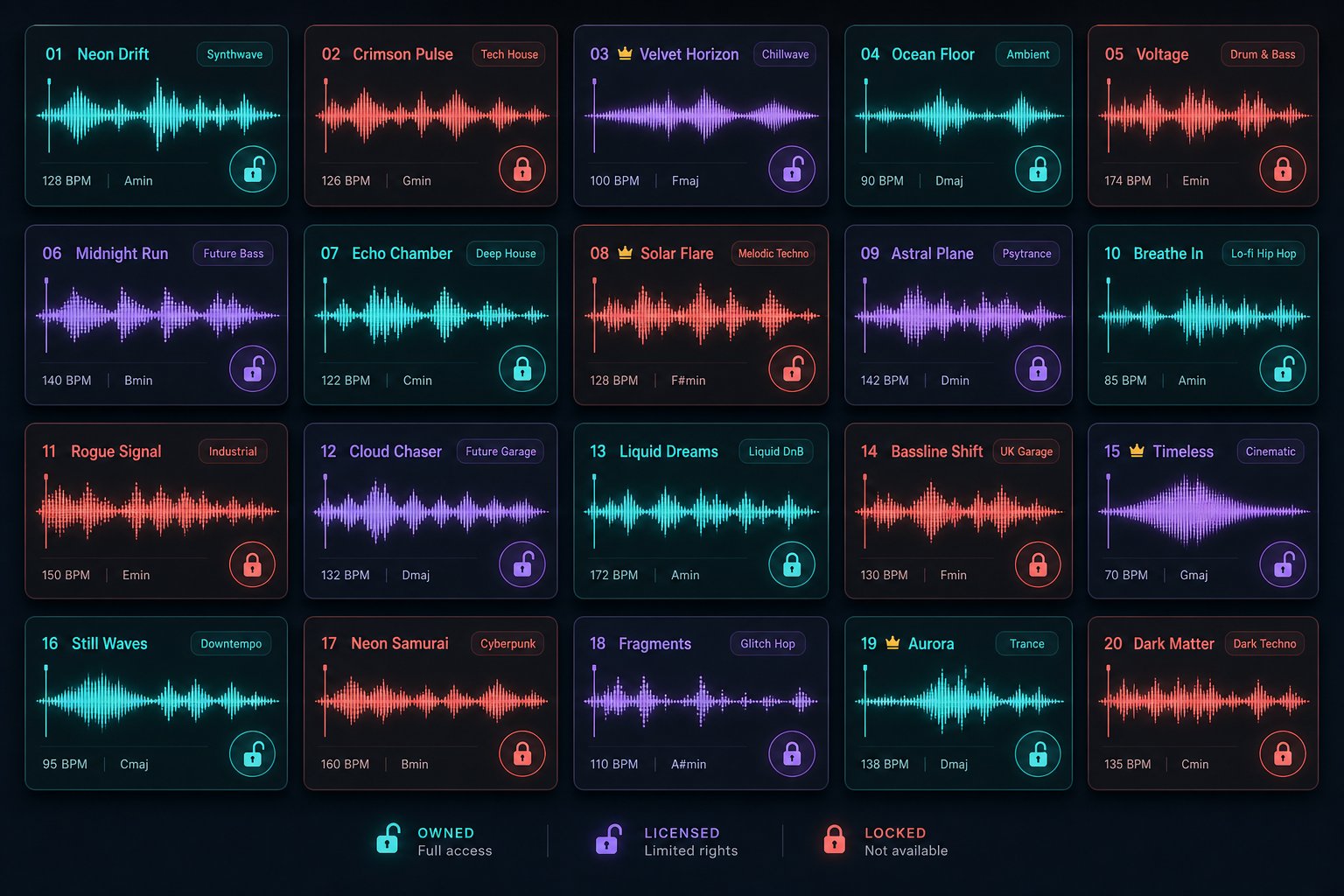
Not all AI music generators treat your outputs the same way. One platform might hand you full commercial rights the moment you hit generate. Another might lock commercial use behind a paid tier — or retain partial ownership of everything you create. If you're evaluating the top ai platforms for lyrics and writing music, these differences matter more than audio quality or feature sets when your goal is monetization.
The gap between what each platform promises can determine whether you're free to distribute a track on Spotify, license it for a commercial, or even claim it as your own on social media. Here's how the major players stack up.
Ownership Policies Across Major AI Music Platforms
Each platform structures its ToS differently, and the details often hide in fine print that most users never read. Some platforms grant you ownership of the generated audio file. Others grant you a license to use it commercially — a subtle but legally meaningful distinction. Ownership means the platform has no residual claim. A license means they retain underlying rights and grant you permission to use the output under specific conditions.
Here's a breakdown based on current terms:
| Platform | Ownership of Outputs | Commercial Use Allowed | Exclusivity | Revenue Sharing |
|---|---|---|---|---|
| Suno | User owns outputs on paid plans; platform retains rights on free tier | Yes (Pro at $10/mo and Premier at $30/mo only) | Non-exclusive — other users may generate similar outputs | None — user keeps all revenue |
| Boomy | Platform retains co-ownership; user gets commercial license | Yes (built-in distribution from $9.99/mo) | Non-exclusive | Revenue split through Boomy's distribution system |
| AIVA | Full copyright ownership on Pro plan ($49/mo); platform retains rights on lower tiers | Yes (Pro tier only for unrestricted commercial use) | Non-exclusive on Standard; exclusive ownership on Pro | None on Pro — user owns outright |
| Soundraw | Royalty-free license to user; platform retains underlying rights | Yes (all paid plans, from $19.99/mo) | Non-exclusive — cannot sell on mainstream audio platforms | None — flat subscription fee covers usage |
| Udio | Currently suspended — no downloads available | No (following October 2025 settlement with Universal Music Group) | N/A | N/A — transitioning to licensed model expected 2026 |
A few things jump out immediately. Suno's terms draw one of the cleanest lines in the industry: free-tier users get zero commercial rights, but paid subscribers own their outputs and can distribute them to streaming platforms without restriction. Those rights persist even after cancellation for tracks created during an active subscription.
Boomy takes a different approach. The platform integrates distribution directly — you can push tracks to Spotify, Apple Music, and TikTok without leaving the app. But that convenience comes with a trade-off. Boomy operates a revenue-sharing model and retains co-ownership of generated content, which means you're building a catalog on their terms rather than independently.
AIVA stands out among ai artists and AI composition tools because its Pro tier explicitly transfers full copyright ownership to the user. That's rare. On AIVA's lower tiers, the platform retains the copyright and grants you a license — similar to how stock music libraries operate. The price jump from Standard ($15/month) to Pro ($49/month) reflects the legal value of that ownership transfer.
Soundraw's model is especially relevant for video creators and podcasters. All paid subscribers get royalty-free commercial rights — meaning you can use generated tracks in monetized YouTube videos, ads, and client work. However, Soundraw explicitly restricts reselling the music itself on streaming audio platforms. You can use it as background music, but you can't release it as a standalone single.
Udio's situation illustrates the risk of platform dependency. Following its October 2025 settlement with Universal Music Group, downloads were suspended entirely. Users who created music on the platform can no longer export it. A new licensed model is expected in 2026, but anyone who built a workflow around Udio lost access overnight.
What Rights You Actually Get as a User
Here's where the interaction between platform policies and actual copyright law gets interesting — and confusing. A platform like Suno can grant you commercial rights to a generated track. You can monetize it, distribute it, and build revenue around it. But that same track may not qualify for formal copyright registration because no human authored its expressive elements. You have commercial rights without legal ownership in the traditional sense.
Think of it this way: the platform's ToS gives you a green light to use the music commercially. Copyright law determines whether you can stop someone else from using something identical. These are two different questions with two different answers.
This distinction creates practical scenarios that surprise many creators:
- You release an AI-generated track on Spotify through Boomy's distribution. Another Boomy user generates a nearly identical track and releases it too. You likely have no legal basis to demand removal — because neither of you holds a copyright.
- You generate instrumental beds on Soundraw for a client's ad campaign. The client can use them freely under your license. But if a competitor creates something strikingly similar using the same tool, neither you nor your client can claim infringement.
- You compose original lyrics, record your own vocals, and use AIVA Pro to generate orchestral backing. The lyrics and vocal performance are copyrightable. The AI-generated orchestration may not be — but AIVA's Pro terms still grant you full ownership of the audio file itself.
For platforms like Boomy and Suno that focus on complete song generation, the gap between platform rights and copyright protection is widest. For tools like AIVA that position themselves as compositional assistants — where users often bring more creative input — the gap narrows because the human contribution is more substantial.
One more thing worth emphasizing: platform policies change. Udio's overnight suspension of downloads is the most dramatic recent example, but subtler changes happen constantly. Pricing tiers shift. Commercial rights get restructured. Revenue splits are renegotiated. If you're building a music library or a content business around any of these tools, document your subscription status and the ToS version in effect when you created each track. That documentation is your only proof of what rights you were granted at the time of creation.
These platform-level protections exist within the legal framework of one country. But music distribution is global. A track you release in the U.S. reaches listeners in London, Tokyo, and Berlin — jurisdictions where entirely different rules govern whether AI-generated music receives any legal protection at all.
International Copyright Rules for AI Music
A track generated in New York, streamed in London, and licensed for a commercial in Tokyo passes through three entirely different legal systems — each with its own answer to whether AI music receives protection. If you distribute music globally (and streaming makes that almost unavoidable), your copyright status can shift depending on where the listener presses play.
US Copyright Office Position on AI-Generated Works
The United States maintains the strictest human authorship standard of any major jurisdiction. The Copyright Office has consistently refused registration for works lacking human creative input, and the courts have backed that stance through Thaler v. Perlmutter all the way to the Supreme Court's cert denial in March 2026. For AI music specifically, reg USA copyright law requires that a human determine the expressive elements — melody, harmony, arrangement, lyrics — before protection applies. Prompts don't count. Curation doesn't count. Only genuine creative authorship does.
This position leaves fully AI-generated music in a legal no-man's-land within the U.S. You can still use it commercially through platform licenses, but you cannot register it, enforce exclusivity, or access statutory damages if someone copies it.
UK and EU Frameworks for AI Music
The UK takes a strikingly different approach. Section 9(3) of the Copyright, Designs and Patents Act 1988 (CDPA) explicitly addresses "computer-generated works" — defined as works "generated by a computer in circumstances such that there is no human author." Under this provision, copyright belongs to "the person by whom the arrangements necessary for the creation of the work are undertaken." In practice, that could mean the person who configured the AI tool, selected its parameters, or initiated generation.
This makes the UK one of the few jurisdictions where fully AI-generated music could theoretically receive copyright protection — lasting 50 years from creation, though without moral rights. However, there's a catch. UK courts have rarely applied Section 9(3), and the provision has received almost no judicial interpretation in the context of modern generative AI. The UK government's 2024 statement even suggested the provision might be repealed unless a strong case for retention is made. So while the statutory language appears favorable, its practical reliability remains uncertain.
The EU takes yet another angle. The EU AI Act's Article 50 introduces transparency obligations requiring providers of generative AI systems to mark outputs in machine-readable formats and ensure they're detectable as AI-generated. These rules, applying from August 2026, focus on labeling and disclosure rather than copyrightability. The EU hasn't directly addressed whether AI outputs qualify for copyright protection — that question remains governed by individual member states' laws, most of which require an "author's own intellectual creation" involving human creative choices. The net result: most EU countries likely deny copyright to fully AI-generated works, though the legal landscape is still developing as generative ai updates continue to reshape the regulatory conversation.
Much of the EU's attention has focused on training data rather than outputs. Developments around web scraping legal news december 2025 highlighted ongoing tensions between rights holders and AI developers over the EU's opt-out text and data mining framework under the Digital Single Market Directive — a debate that shapes how AI models are built but doesn't directly grant copyright to their outputs.
How Japan and Other Jurisdictions Differ
Japan occupies a unique position. Its Copyright Act (Article 30-4) has permitted broad use of copyrighted works for machine learning since 2018 — one of the most permissive training data frameworks globally. But this permissiveness applies to the input side. On the output side, Japan still applies copyright infringement standards to AI-generated works, meaning generated content that reproduces substantial portions of existing works remains infringing. Whether purely AI-generated content (that doesn't copy existing works) qualifies for original copyright protection is less clearly resolved, though Japan's framework generally requires human creative expression for copyright to arise.
The practical effect: Japan encourages AI development by removing barriers to training while still maintaining protections against outputs that plagiarize existing human works. For music creators, this means AI-generated tracks can be created freely using Japanese-based tools, but claiming original copyright over those outputs isn't guaranteed.
| Country / Region | Copyright Possible for AI Output | Human Authorship Required | Special Provisions | Current Status |
|---|---|---|---|---|
| United States | No (fully AI-generated) | Yes — strict requirement | Partial protection for human-authored elements in AI-assisted works | Settled by case law through 2026; no legislative reform pending |
| United Kingdom | Possibly yes (under Section 9(3) CDPA) | No — legal fiction assigns authorship | Copyright granted to person making "arrangements necessary" for creation; 50-year term; no moral rights | Under government review; possible repeal discussed in 2024 consultation |
| European Union | Likely no (most member states) | Yes — "author's own intellectual creation" | AI Act imposes transparency/labeling obligations on AI-generated content (Article 50, effective August 2026) | Evolving; copyright 2025 and 2026 guidance still developing at member-state level |
| Japan | Unclear — case-by-case | Generally yes | Article 30-4 permits broad TDM for AI training; infringement standards still apply to outputs | No legislative changes pending; non-binding JCO paper discusses future guidelines |
What does this mean practically? Imagine you generate a track using an AI tool and release it globally. In the UK, you might have a statutory copyright claim under Section 9(3) as the person who arranged for its creation. In the U.S., that same track has no copyright protection. In the EU, your obligations center on labeling and transparency rather than ownership. In Japan, you're free to create but can't necessarily claim original copyright.
This patchwork creates real headaches for ai copyright updates and enforcement. You could theoretically hold protection in one jurisdiction and have zero rights in another — for the same exact file. For creators distributing through global streaming platforms, this means your legal position varies by territory, and enforcing any rights internationally requires navigating multiple legal systems with conflicting rules.
Discussions around ai regulation news today december 5 2025 underscored just how fragmented the global response remains. No international treaty or harmonization effort currently addresses AI-generated works specifically, leaving creators to navigate jurisdiction by jurisdiction.
The bottom line: if you're releasing AI music internationally, don't assume your home country's rules travel with you. The safest approach is to either add enough human creative input to satisfy the strictest standard (the U.S. human authorship requirement) or rely on platform-granted commercial rights rather than copyright claims. Either strategy gives you a consistent foundation regardless of where your listeners are.
Knowing the legal landscape across borders is useful context — but most creators need something more specific. They want to know what these rules mean for their actual workflow: uploading to YouTube, distributing on Spotify, selling a track to a client, or scoring a podcast episode.
Practical Guide by Use Case and Creator Type
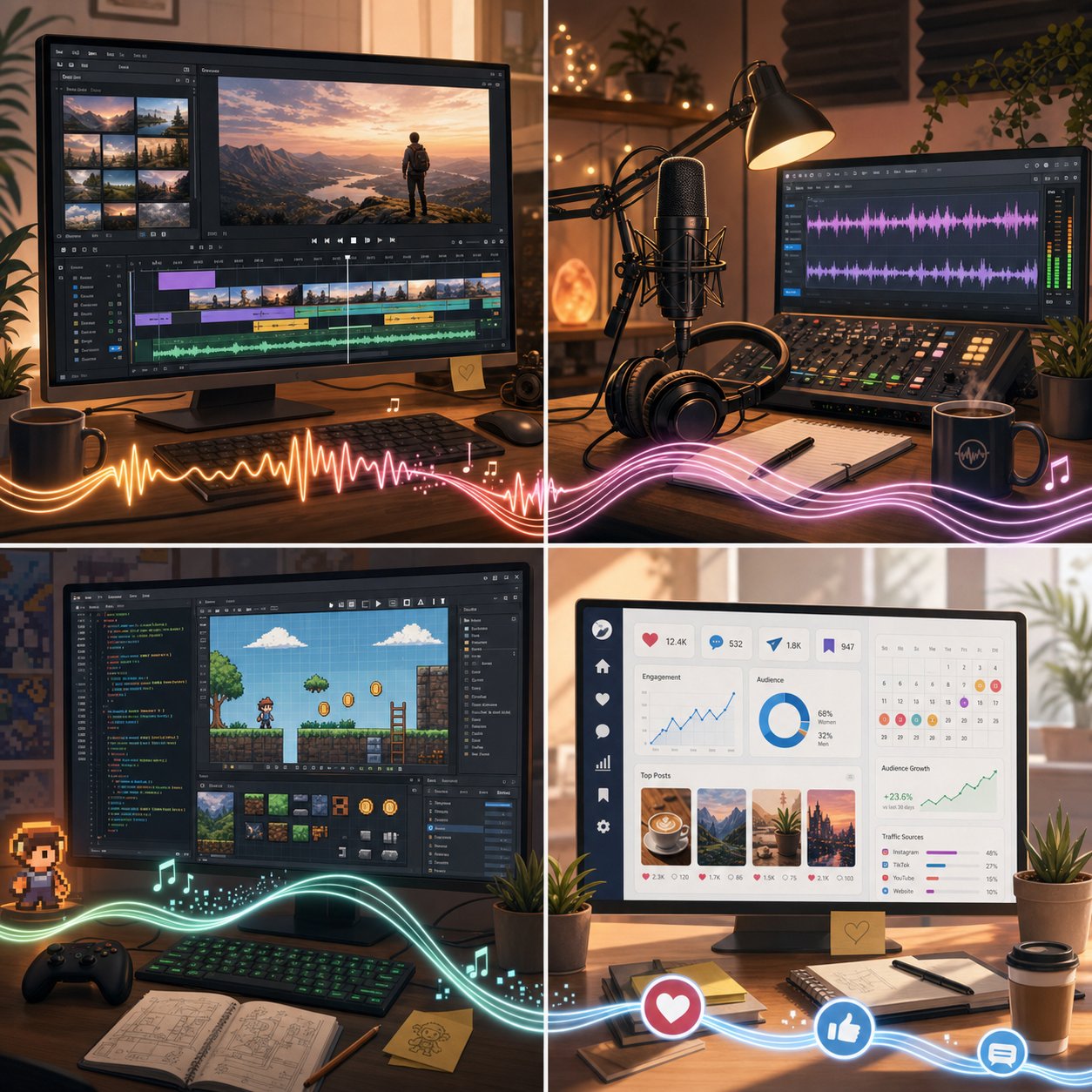
Legal frameworks and platform policies only matter insofar as they affect what you're actually trying to do. Whether you're scoring a YouTube video, pushing a track to Spotify, licensing music for a client project, or adding ambiance to a podcast, each scenario carries different copyright implications and different practical risks. The rules don't change — but how they hit you depends entirely on your use case.
Using AI Music in Videos and Social Content
This is the most common scenario. You need background music for a YouTube video, a TikTok post, an Instagram Reel, or a branded piece of content. You don't plan to sell the music itself — you just need something that fits the mood without triggering a copyright claim or costing you ad revenue.
The good news: for background music in video content, the copyright question is largely a non-issue if you use the right tools. Platforms like YouTube don't require you to hold a formal copyright over your background music — they require you to have legitimate usage rights. A platform-granted commercial license from an AI music tool satisfies that requirement, even if the track itself isn't copyrightable.
Where creators run into trouble is Content ID. YouTube's automated fingerprinting system scans uploaded audio against a database of registered tracks. If your AI-generated music closely resembles something already registered — or if someone else registers a similar AI output with Content ID before you do — you'll face a claim. And because AI-generated music can't be copyrighted, you may lack the legal standing to dispute it effectively.
YouTube's altered content policy requires disclosure when AI-generated content could mislead viewers into thinking it depicts real people or events. For original AI instrumentals and production — the kind most video creators use — no disclosure is required. Voice cloning of real artists, deepfake music videos, and AI recreations of real events do require disclosure.
Monetization remains available for AI music with human creative direction. YouTube's July 2025 policy update added quality requirements, but the key distinction is straightforward: content with genuine creative input stays monetizable. Mass-produced, fully automated uploads without curation face demonetization.
Actionable steps for video creators:
- Use AI music tools that explicitly grant commercial rights in their ToS — confirm this before uploading
- Download and save your license documentation alongside every track you use
- Avoid generating music that imitates specific artists, as this triggers both Content ID matches and policy violations
- Add the "altered or synthetic content" label when using AI vocals or recreating real people — skip it for original AI instrumentals
- Monitor your videos for unexpected claims in the first 48 hours after upload, when Content ID scans are most active
- Consider layering AI-generated beds with your own sound design or narration to strengthen your creative contribution
For social content creators who just need a vibe — something like on the river beats by ai or a lo-fi study track to sit beneath a talking-head video — the practical risk is minimal as long as your source platform grants commercial rights and you're not imitating recognizable artists.
Distributing AI-Generated Tracks on Streaming Platforms
This is where the stakes change. Can you publish a song written by AI to Spotify, Apple Music, or other streaming services? Technically, yes — but the landscape has tightened considerably.
Distributors like DistroKid, CD Baby, and TuneCore serve as the gateway between independent creators and streaming platforms. Most don't explicitly ban AI-generated music, but their terms typically require you to hold necessary rights to the content you upload. If your AI music tool grants you commercial distribution rights (as Suno's paid tiers do), you satisfy that requirement contractually — even without formal copyright.
The bigger challenge is platform-level enforcement. Spotify removed over 75 million spammy tracks in the 12 months preceding its September 2025 policy update and introduced a new spam filter specifically targeting mass-upload tactics common with AI-generated content. The platform reports receiving thousands of AI-generated tracks daily. Getting your music onto Spotify is possible; keeping it there — and visible — requires passing quality and legitimacy thresholds that are actively evolving.
Spotify's new framework supports AI disclosure through industry-standard DDEX credits, rolling out in beta since April 2026. This system lets artists indicate where and how AI played a role in a track's creation — covering vocals, instrumentation, or post-production. Crucially, disclosure doesn't trigger penalties or down-ranking. It's a transparency mechanism, not a punishment.
Actionable steps for streaming distribution:
- Use a paid tier on your AI music platform that explicitly grants distribution rights — free tiers typically restrict commercial use
- Choose a distributor that doesn't prohibit AI-generated content in its terms (check their FAQ or creator documentation)
- Avoid mass-uploading dozens of AI tracks simultaneously — this pattern triggers spam detection on Spotify and other platforms
- Disclose AI usage through available crediting systems when your distributor supports it
- Add human creative elements — original lyrics, vocal performance, arrangement decisions — to strengthen both your copyright position and your standing with platform algorithms
- Never clone or imitate a real artist's voice without documented permission; both Spotify and YouTube enforce impersonation policies aggressively
The cost for music copyrights album ai is effectively zero for registration (if you qualify) — the U.S. Copyright Office charges $65-$85 per online registration. But remember: you only qualify if human-authored elements are present. A fully AI-generated album has no path to registration regardless of what you pay. The real cost is the creative labor of adding enough human authorship to cross the threshold.
Selling or Licensing AI Music Commercially
Selling AI music to clients — for ads, corporate videos, apps, or film — introduces a different layer of risk. When a client pays for music, they typically expect exclusivity, clear ownership, and legal defensibility if a dispute arises. AI-generated music struggles on all three fronts.
The exclusivity problem is fundamental. Because AI music tools are non-exclusive by nature — any user could generate a strikingly similar output — you cannot guarantee a client that their track is unique. A competitor could use the same tool with a similar prompt and arrive at something nearly identical. Without copyright, neither party can claim infringement against the other.
That said, licensing AI music for commercial projects isn't illegal or impractical. It's a question of managing expectations and disclosing limitations. Many clients care more about having clear usage rights than about formal copyright registration. If your AI tool's ToS grants you commercial licensing rights, you can pass those rights to a client through a well-drafted agreement. The client gets permission to use the track; they just don't get the kind of ironclad exclusivity that traditionally copyrighted music provides.
Actionable steps for commercial licensing:
- Disclose to clients that AI-generated portions of the music may not be copyrightable — transparency builds trust and protects you from liability
- Use AI tools whose ToS explicitly allow sublicensing or commercial transfer of usage rights
- Add substantial human creative input (original composition, arrangement, performance) to strengthen the copyright claim on the final delivered product
- Draft licensing agreements that clearly define what rights you're transferring — usage rights versus copyright ownership are different things
- Keep documentation of your creative process, platform subscription status, and the ToS version in effect at time of creation
- For high-value projects, consider using AI only as an assistive tool while composing the core parts of music yourself — this maximizes both copyright protection and client confidence
Imagine a client asks you to produce ambient music for a meditation app — something atmospheric, perhaps in the vein of on the river beats by ai or similar nature-inspired soundscapes. If you generate the base textures with AI but compose the melodic themes yourself, record live field recordings, and arrange the final mix with intentional creative decisions about dynamics and pacing, you've built a product with both commercial usability and meaningful copyright protection on the human-authored elements.
Using AI Music in Games, Podcasts, and Apps
Game developers, podcasters, and app creators share a common need: they want music that works, doesn't cost a fortune, and won't create legal problems down the road. For these use cases, royalty-free AI-generated music from platforms that grant clear commercial rights is often the most practical path — even without formal copyright registration.
Why? Because these creators rarely need to enforce exclusivity. A podcast intro doesn't need to be copyright-registered to serve its purpose. A game's background soundtrack doesn't require you to sue infringers. What matters is that you have documented permission to use the music commercially and that no one can issue a valid takedown against your use.
Podcasters face an additional consideration: RSS distribution means your audio appears on Apple Podcasts, Spotify, Google Podcasts, and dozens of smaller platforms simultaneously. Each platform has its own content policies. Using music with clear, documented commercial rights insulates you across all of them without needing to check each platform's specific rules.
For game developers, the copyright music ai news to watch involves how platforms like Steam, the App Store, and Google Play handle AI-generated assets. None currently prohibit AI music in games, but disclosure requirements are emerging. Documenting your music's provenance — where it came from, what rights you hold, and how it was generated — protects you against future policy shifts.
Actionable steps for games, podcasts, and apps:
- Prioritize AI music platforms that provide explicit royalty-free commercial licenses covering the specific use case (games, podcasts, apps)
- Save license receipts, ToS snapshots, and generation records for every track used in a shipped product
- For games with substantial music needs, consider mixing AI-generated ambient beds with human-composed theme music — the human-composed tracks carry copyright protection and serve as your signature sound
- Check whether your AI music platform's ToS restricts use in specific media (some platforms prohibit use in games or interactive products)
- For podcast music, verify that your license covers distribution across all podcast platforms, not just a single service
Across all these use cases, one pattern emerges consistently: the safest path isn't about navigating copyright ambiguity — it's about sidestepping it entirely. For creators who need reliable, legally clean music without the overhead of copyright registration or the risk of disputed ownership, royalty-free solutions designed specifically for commercial use offer a cleaner foundation than trying to claim ownership over something the law doesn't recognize as yours.
Free AI Music Tools That Bypass Copyright Concerns
Here's the thing most creators eventually realize after researching whether AI music is copyrightable: the question itself might not matter for their workflow. If you're a video producer who needs a background track, a podcaster looking for an intro, or a game developer filling out a soundtrack — you don't actually need to own the copyright. You need clear, documented permission to use the music commercially without anyone issuing a takedown or claiming your revenue.
That's exactly what royalty-free AI music generators provide. They sidestep the entire copyright debate by granting you usage rights through their license terms, regardless of whether the output qualifies for formal copyright registration. The legal ambiguity around AI authorship? It stops being your problem.
Why Royalty-Free AI Music Solves the Copyright Problem
A common misconception trips up creators searching for a music ai creator without copyright restrictions reddit threads can't seem to resolve: people confuse "royalty-free" with "public domain" and "copyright-free." These are three distinct concepts, and mixing them up leads to exactly the kind of claims and takedowns you're trying to avoid.
As RouteNote's licensing guide explains, royalty-free music is still protected by copyright (or in the case of AI music, by contractual license terms) — but you pay once (or access it through a free tier) and owe no ongoing royalties for continued use. Public domain music has no owner at all — the rights have expired or been explicitly relinquished. Creative Commons sits somewhere in between, with various license types imposing different conditions like attribution or non-commercial restrictions.
Here's why the distinction matters for AI-generated music specifically:
- Public domain: No restrictions, but verification is difficult. Many tracks labeled "public domain" online are actually copyrighted recordings of public domain compositions — a trap that catches creators constantly.
- Creative Commons: Conditions vary wildly by license type. Miss an attribution requirement or use a non-commercial track in a monetized video, and you face a legitimate infringement claim.
- Royalty-free AI music: The platform grants you explicit commercial usage rights through its ToS. You don't need to verify expired copyrights or parse license subtypes. The terms are clear, the permission is documented, and ongoing royalties don't apply.
For AI-generated music, royalty-free licensing is uniquely well-suited because it doesn't depend on copyright ownership at all. The platform isn't transferring a copyright to you — it's granting you contractual permission to use the output commercially. That contractual right holds up regardless of whether the underlying audio is formally copyrightable. The legal uncertainty around AI authorship becomes irrelevant to your day-to-day use.
Free Tools That Grant Clear Commercial Rights
Not every free AI music tool gives you commercial rights. Some restrict monetization to paid tiers. Others retain co-ownership or limit where you can use outputs. The tools worth your attention are those that provide royalty-free commercial licenses at no cost — eliminating both the copyright question and the price barrier simultaneously.
Recommended approaches for creators who need legally clean music without the overhead:
- MakeBestMusic's Free Music Generator — provides royalty-free music you can use in videos, social content, games, podcasts, and other commercial projects without worrying about copyright ownership disputes. No subscription required for commercial use, which removes the most common friction point for creators who just need a track that works and won't trigger claims.
- Mubert — generates seamless loops and ambient tracks well-suited for background use. Free personal use tier available; commercial licensing requires a Pro subscription. Strongest in electronic and ambient genres where its real-time generation approach excels.
- Suno (Free Tier for non-commercial use) — produces impressive full songs with vocals, but commercial rights require a paid plan starting at $10/month. Useful for prototyping ideas before committing to a paid tier.
- Soundraw — offers customizable AI instrumentals with clear royalty-free commercial licensing on all paid plans. The drag-and-drop arrangement interface gives you more control over structure, which also strengthens any potential copyright claim on the arrangement itself.
The pattern across these tools is consistent: the ones that offer free commercial rights (like MakeBestMusic's generator) are particularly valuable because they eliminate both the legal uncertainty and the financial barrier. You generate a track, confirm the license covers your use case, and move on with your project.
For creators spending time in forums looking for a free ai hub that handles music generation — this is the practical answer. You don't need to resolve the broader AI copyright debate. You need a tool whose terms explicitly say "yes, you can use this commercially" and mean it.
Services like Rightsify and Loudme.ai also operate in this space, offering AI-generated music libraries with commercial licensing structures. Each varies in pricing model, audio quality, and genre coverage — so your choice depends on what you're producing and how much control you need over the final sound.
The core insight remains the same regardless of which tool you pick: royalty-free AI music generators transform an unresolved legal question into a solved practical problem. You're not claiming copyright. You're not navigating the human authorship threshold. You're operating under a clear license that grants commercial usage rights — and for most creator workflows, that's all you actually need.
But what about creators who do want to claim copyright? Those building a long-term catalog, licensing to clients, or seeking the full legal protections that come with registered ownership? For them, the path forward requires specific documentation habits and workflow strategies designed to maximize human authorship — and a clear sense of when to pursue copyright versus when to lean on royalty-free alternatives instead.
Steps to Protect Your AI-Assisted Music
If you want to do more than just use AI music — if you want to own it — the path runs through documentation, workflow design, and honest assessment of where your creative contribution actually lives. Knowing how to copyright ai music starts with understanding that the Copyright Office doesn't care how hard you worked. It cares whether your creative fingerprint is perceptible in the final result.
Document Your Human Creative Contributions
The strongest copyright claims don't just exist in the finished audio — they're backed by a paper trail. Registration guidance from legal practitioners emphasizes that creators should capture contributor data, tool disclosures, and timestamps while the project context is still fresh, not after a dispute forces them to reconstruct what happened.
- Log every human creative decision as you make it. Record which melodies you composed, which lyrics you wrote, which arrangement choices you made, and which sections you substantially edited. Screenshots, session files, and timestamped exports all serve as evidence.
- Identify what the AI generated versus what you authored. Separate your stems. Keep the raw AI output in one folder and your modified versions in another. This makes the "before and after" obvious to anyone reviewing your claim.
- Record the specific AI tools used and what they contributed. Note the platform, the prompts you entered, and which parts of the output you accepted, rejected, or transformed. This documentation directly maps to what the Copyright Office needs in the Limitation of Claim fields.
- Save the ToS version in effect at the time of creation. Platform policies change. A PDF snapshot of the terms under which you generated the music protects you if those terms are later revised.
Think of this documentation as your authorship receipt. If you ever need to prove — to the Copyright Office, a court, or a client — that human creative expression lives in the work, these records make your case concrete rather than speculative.
Workflow Strategies to Strengthen Copyright Claims
Can you copyright ai music? Yes — if your workflow builds enough human authorship into the final product. The USCO's framework recognizes four categories of protectable contribution: using AI as a creative tool while you determine expressive output, supplying original human-authored material that remains perceptible in the result, and modifying or arranging AI output in a sufficiently creative way. Structure your process to hit at least one of these categories clearly.
- Compose core elements yourself first. Write your own melody, lyrics, or chord progression before involving AI. Feed that human-authored material into the tool as an expressive input. As long as it remains perceptible in the output, you hold a claim over that portion.
- Use AI for production assistance, not composition. Let the AI handle reverb suggestions, drum patterns, or harmonic fills — while you make the structural and melodic decisions. The more the AI functions like a mixing assistant rather than a co-writer, the cleaner your claim.
- Substantially modify AI outputs before finalizing. Don't accept generated material as-is. Re-record sections, rewrite melodies, restructure arrangements, and layer your own performances. Legal guidance from Fisher Phillips notes that employees (and by extension, independent creators) should "actively shape, edit, and refine the output to reflect their unique contributions" — going beyond merely inputting prompts.
- Register using the Standard Application on eCO. AI-assisted works require the Standard Application (not Single Application) because you need access to the Limitation of Claim fields. Describe your human-authored contributions in the "Author Created" field — original lyrics, vocal melody, arrangement, performance — and disclaim AI-generated portions in the "Material Excluded" field.
- Frame claims around expression, not effort. The Copyright Office doesn't reward hours spent prompting. Describe what you composed, arranged, performed, and creatively decided — not how many generations you sorted through. The claim should make clear which expressive elements came from you.
The music copyright ai news to watch involves the SURYAST decision, which rejected a claim where the human's original input was transformed beyond recognition by the AI. The lesson: if your creative contribution isn't audible in the final track, the claim fails regardless of how much you contributed at the start. Keep your authorship perceptible.
When to Use Royalty-Free Alternatives Instead
Here's the honest assessment most guides won't give you: not every project justifies the overhead of building a copyright claim. If you're producing background music for social content, scoring a podcast, or filling out a game soundtrack with ambient beds, the time spent documenting human authorship and filing registrations may not match the commercial value at stake.
Consider the royalty-free path when:
- You need music quickly and don't plan to license it to third parties
- The track serves a supporting role (background, ambiance, transitions) rather than being the primary product
- You're producing at volume — dozens of tracks per month — where individual registration isn't practical
- The legal uncertainty isn't worth the risk for your specific use case
For these scenarios, tools like MakeBestMusic's Free Music Generator offer a straightforward alternative that eliminates copyright ambiguity entirely. You generate royalty-free music with clear commercial rights for videos, podcasts, games, and social content — no registration required, no ownership disputes, no documentation overhead. The license handles everything.
This is a rapidly evolving legal area. The ai music copyright news today looks different from six months ago, and it will look different again next year as courts hear their first cases specifically involving AI-generated music. For creators who want maximum protection, the workflow strategies above position you as strongly as current law allows. For everyone else — the ones who just need music that works without legal friction — royalty-free generators remain the cleanest path forward.
