


The AI Revolution Reshaping Every Corner of Music
Imagine a world where a text prompt produces a radio-ready track in seconds, where algorithms decide what 600 million streaming subscribers hear next, and where courtrooms wrestle with whether a machine can own a copyright. You don't have to imagine it. That world is here.
The relationship between AI and the music industry has shifted from novelty experiment to structural force. Over 60% of music creators now use AI tools in some part of their workflow, from songwriting through mastering. More than 30% of new uploads to platforms like Deezer are AI-generated. Whether you're an independent artist, a major-label executive, or a casual listener, these changes touch every interaction you have with music.
What Artificial Intelligence Means for Music Today
Artificial intelligence in music refers to the use of machine learning models, generative AI systems, and recommendation algorithms to compose, produce, distribute, and personalize musical content. These technologies analyze vast datasets of existing music to recognize patterns in melody, harmony, rhythm, and arrangement, then apply those patterns to create new outputs or make predictions about listener preferences.
This matters because music and artificial intelligence are no longer separate conversations. AI tools are embedded in the creative process, the business pipeline, and the listening experience simultaneously. For artists, they represent both a powerful collaborator and a potential competitor. For labels, they reshape economics. For listeners, they quietly curate nearly every song that reaches their ears.
The Full Value Chain Under Transformation
AI in the music industry isn't confined to a single stage of how songs get made and heard. It touches the entire lifecycle, from the first spark of a melody to the royalty check that follows a billion streams. Here are the key areas under transformation:
- Creation - generative composition, lyric writing, and melody generation
- Production - automated mixing, mastering, and stem separation
- Distribution - AI-powered upload filtering and metadata tagging
- Marketing - algorithmic audience targeting and content optimization
- Consumption - recommendation engines and personalized playlists
- Monetization - royalty tracking, licensing automation, and fraud detection
Each of these areas carries its own opportunities, risks, and unresolved questions. The sections ahead unpack them one by one, starting with how we got here and where the technology stands right now.
A Timeline of AI Milestones in Music
The story of music and AI didn't start with a viral deepfake or a text-to-song generator. It started with dice. In 1787, Mozart designed his "Musikalisches Wurfelspiel," a game where rolling dice determined the sequence of pre-composed musical phrases. Simple, yes, but it planted a seed: what if rules and chance could compose music instead of human intuition alone?
From Early Experiments to Mainstream Adoption
That seed took nearly two centuries to sprout into anything resembling modern AI. Here's how the timeline unfolded:
In 1957, Lejaren Hiller and Leonard Isaacson produced the Illiac Suite, widely considered the first piece of music composed by a computer. Using the ILLIAC I at the University of Illinois, they programmed algorithms to generate a string quartet. It sounded academic, even awkward, but it proved machines could follow compositional logic.
Through the 1960s and 1970s, composers like Iannis Xenakis applied probability theory to create "stochastic music," while researchers like Gottfried Michael Koenig built systems for generating complex musical structures. These weren't consumer products. They were proofs of concept, confined to university labs and avant-garde concert halls.
The real shift came with neural networks. In the 1980s, David Cope's "Experiments in Musical Intelligence" analyzed the style of classical composers and generated new pieces in their voice. By the 2010s, deep learning pushed this further, allowing models to grasp nuance in rhythm, timbre, and arrangement rather than just following rigid rules.
Then came the moment that put AI music restoration on the global stage. In 2023, The Beatles released "Now And Then", a track that had been in production limbo for decades because John Lennon's original demo was trapped under piano noise and television audio on a degraded cassette tape. Producer Giles Martin used machine learning to isolate Lennon's vocals from the background interference, something that was physically impossible with earlier technology. Paul McCartney added new elements, Ringo Starr re-recorded drums, and a song written in the late 1970s finally reached the world. It wasn't AI composing music. It was AI making lost music recoverable.
That distinction matters, but it didn't slow down what came next. Generative AI music news today centers on platforms that produce entire songs from a text prompt. Adoption has accelerated at a pace few predicted. A Ditto Music study found that 60% of artists now use AI tools somewhere in their workflow. The jump from experimental curiosity to daily creative utility happened in roughly three years.
Where We Are Now and What Is Still Emerging
Not all AI applications in music sit at the same stage of maturity. Some are so embedded in daily workflows that you barely notice them. Others are still finding their footing, generating as much controversy as excitement. The table below separates what's established from what's still taking shape:
| Established AI Applications | Description | Emerging AI Applications | Description |
|---|---|---|---|
| Recommendation Algorithms | Power playlists and discovery on Spotify, Apple Music, and YouTube Music using listening behavior data | Full Generative Composition | End-to-end song creation from text or style prompts, producing vocals, instruments, and arrangement |
| Auto-Mastering Services | AI-driven mastering tools like LANDR and iZotope that analyze and optimize audio for release | AI Virtual Performers | Synthetic artists with generated personas, voices, and visual identities performing original material |
| Stem Separation | Isolating individual instruments or vocals from mixed tracks for remixing, sampling, or restoration | Real-Time Live Audio Processing | AI adjusting mix, effects, and acoustics dynamically during live performances based on venue and audience |
| Metadata Tagging and Classification | Automatically categorizing tracks by mood, genre, tempo, and instrumentation for licensing and search | Emotionally Adaptive Music | Systems that compose or modify music in real time based on listener biometrics or contextual input |
| Plagiarism and Copyright Detection | Scanning new uploads against existing catalogs to flag potential infringement | AI-Driven Music Contract Negotiation | Automated analysis of deal terms, royalty splits, and market comparables to assist in negotiations |
The established column represents technology that's already baked into how the industry operates. You interact with recommendation algorithms every time you open a streaming app. Auto-mastering has become a default step for independent releases. Stem separation made The Beatles' "Now And Then" possible and now powers countless remix and sample workflows.
The emerging column is where ai music updates tend to focus, because these applications are still contested. Full generative composition raises immediate questions about authorship and copyright. AI virtual performers challenge assumptions about what an "artist" even is. Real-time live processing could redefine concert production but remains largely in prototype stages.
What separates today from five years ago isn't just capability. It's speed of adoption and proximity to the mainstream. The tools are no longer confined to research labs or niche startups. They sit inside the DAWs, streaming platforms, and marketing dashboards that professionals and hobbyists use daily. Understanding how these systems actually generate music, from training data to finished output, reveals both their creative potential and their limitations.
How AI Actually Creates and Produces Music
So how does AI make music? You type a few words into a prompt box, hit generate, and a fully produced track appears seconds later. It feels like magic. But behind the curtain, it's math, patterns, and an enormous amount of training data working together in a structured pipeline. The process is more assembly than artistry, and understanding it helps separate realistic expectations from hype.
How Machine Learning Models Understand Sound
Imagine showing a student thousands of jazz standards, pop hits, and classical symphonies, then asking them to write a new piece. They'd draw on everything they absorbed: which chord progressions feel tense, which rhythms create energy, how melodies rise and fall. Machine learning in music works on the same principle, just at a scale no human could match.
AI music models are trained on datasets containing tens of thousands to hundreds of thousands of hours of audio. Google's MusicLM trained on 280,000 hours. Meta's MusicGen used 20,000 hours of licensed tracks. Stability AI's Stable Audio drew from 800,000 tracks. These datasets span genres, tempos, instrumentation styles, and production eras, giving the model a broad palette of musical knowledge to reference.
But raw audio files are too large and complex to feed directly into neural networks. The system first converts sound into compressed mathematical representations:
- Mel spectrograms - visual maps of frequency content over time, modeled on how human ears perceive pitch
- Neural audio codecs - learned compression algorithms like Meta's EnCodec that reduce audio to tiny discrete token sequences while preserving perceptual quality
- Latent embeddings - continuous vector representations that capture high-level musical features like mood, genre texture, and harmonic movement
Through these representations, the model identifies recurring elements: which notes typically follow each other in a blues progression, how a kick drum relates to a bassline in electronic music, what makes a vocal melody feel melancholic versus uplifting. Music theory ai principles like tension and resolution, rhythmic syncopation, and harmonic function aren't explicitly programmed. They're inferred from the statistical relationships the model discovers across its training data.
The result is a system that doesn't understand music the way a composer does. It has no emotional experience of sound. What it has is an extraordinarily detailed statistical map of how musical elements relate to each other across millions of examples.
From Text Prompts to Finished Tracks
When you type something like "melancholic cello solo in a cathedral" or "upbeat lo-fi hip-hop with vinyl crackle," how do ai music generators work their way from those words to actual audio?
Two dominant architectures power most generation today. Transformer models, the same family behind large language models like GPT, treat audio as a sequence of tokens and predict what comes next. They excel at long-range musical coherence, understanding how a chord in the opening bars should relate to a melody thirty seconds later. Diffusion models take a different approach: they start with pure random noise and progressively remove it through learned denoising steps until a clean audio signal or spectrogram emerges. They produce rich, detailed audio textures but require significant compute power.
Regardless of architecture, the generation pipeline follows a consistent sequence:
- Input encoding - Your text prompt is converted into a conditioning vector using a language model. This vector captures the semantic meaning of your request: the mood, instruments, tempo, and genre you described. For audio-to-audio generation, a reference clip is encoded instead.
- Pattern matching and latent generation - The model generates a sequence of latent codes or tokens conditioned on your input vector. It draws on all the statistical relationships it learned during training to produce a compressed, abstract representation of music that fits your description.
- Composition and structure - The system builds temporal coherence by predicting how musical elements develop over time. Transformers do this autoregressively, generating token after token. Diffusion models refine the entire piece simultaneously through iterative denoising.
- Audio synthesis and decoding - A decoder network converts the abstract representation back into an audible waveform. Neural vocoders like HiFi-GAN or codec decoders reconstruct the final audio signal from compressed codes, filling in the fine-grained detail of actual sound.
- Post-processing - The raw output undergoes loudness normalization, high-frequency correction, stereo widening, and artifact cleanup to bring it closer to production-ready quality.
The specificity of your prompt directly affects the output. Vague inputs like "happy music" produce generic results because the conditioning vector doesn't narrow the model's options enough. Detailed prompts with specific instruments, tempo markers, and production descriptors yield more targeted results because they constrain the probability space the model works within.
AI does not truly create music. It recombines learned patterns from its training data in statistically novel ways, producing outputs that sound original but are fundamentally assemblages of existing musical knowledge rather than expressions of lived experience or artistic intent.
This distinction carries real weight. The generation process is powerful, fast, and increasingly convincing. But it's pattern recombination at scale, not creative expression. That gap between statistical output and human artistry shapes everything from how these tools fit into professional workflows to whether courts will grant their outputs copyright protection.
AI Music Tools and How They Differ
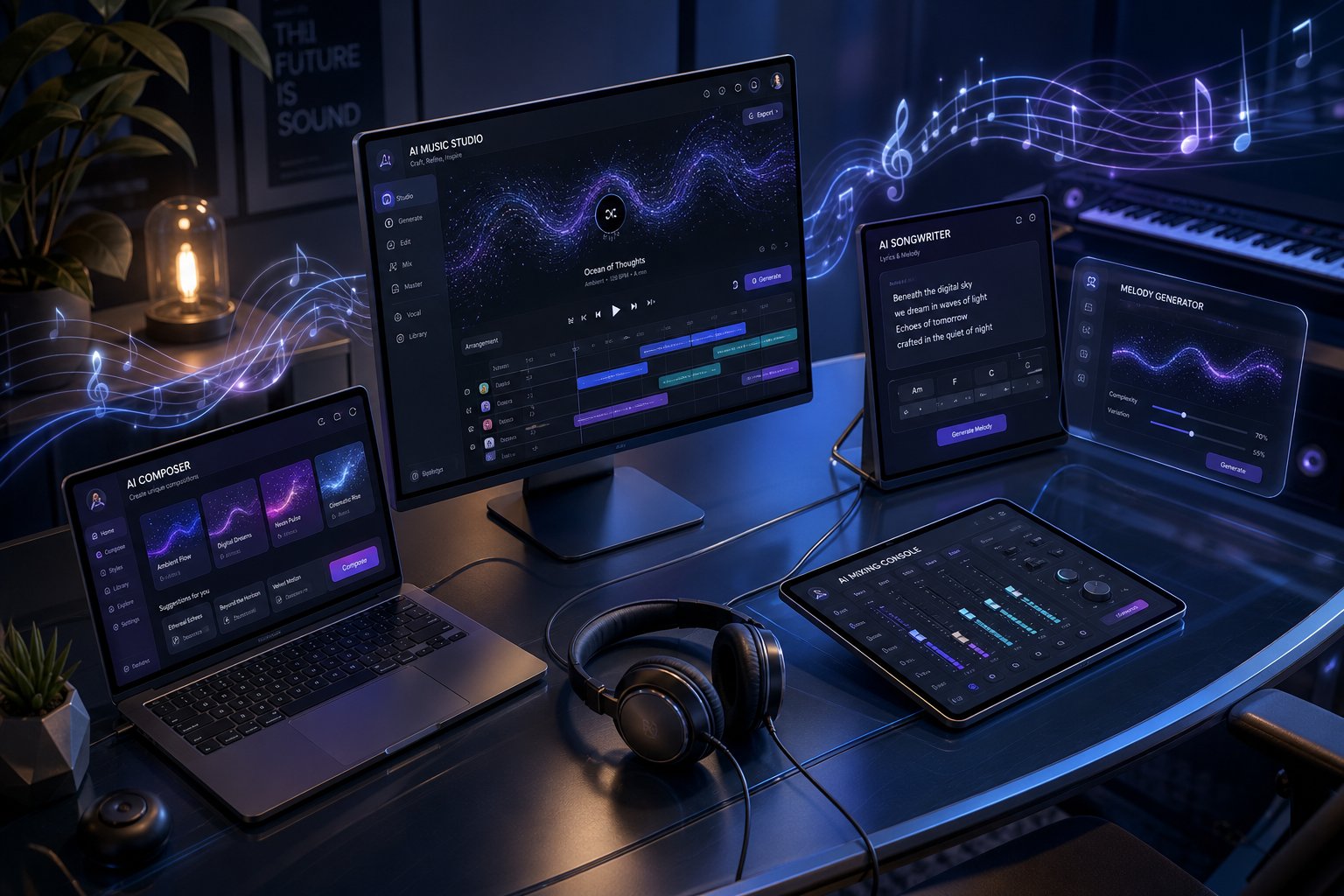
Understanding how AI generates music is one thing. Picking the right tool for your specific needs is another challenge entirely. The market has exploded with platforms that all promise to turn your ideas into finished tracks, but they vary dramatically in output quality, creative control, target audience, and licensing terms. Think of it like choosing between a full recording studio and a pocket synthesizer. Both make music, but the workflows and results couldn't be more different.
Whether you want to add a background of a music performance on AI for a video project, write a complete ai song in 2025, or just sketch out melodies for later refinement, the platform you choose shapes what you get back. Some tools function like a ChatGPT for music, accepting natural language prompts and delivering full compositions. Others prioritize granular control over every bar and instrument.
Generative Composition Platforms Compared
The table below breaks down the leading AI music generators by what they actually do best, who they serve, and how their outputs stack up. Rather than star ratings, this focuses on practical distinctions that affect your workflow:
| Platform | Primary Use Case | Output Quality | Target User | Commercial Rights |
|---|---|---|---|---|
| MakeBestMusic | Prompt-to-song with custom lyrics and style inputs | Full vocal tracks with arrangement; radio-friendly quality | Creators wanting complete songs from ideas quickly | Available on paid plans |
| Suno AI | Full vocal song generation across genres | Realistic vocals with solid arrangement; occasionally flat drums | Beginners and pop/rock songwriters | Commercial use on paid plans ($10+/mo) |
| Udio | High-fidelity songs with tight lyric flow and mix polish | Near-studio quality; excellent vocal clarity and instrumental separation | Producers seeking radio-ready demos | Commercial use on paid plans ($12+/mo) |
| AIVA | Orchestral, cinematic, and classical composition | Professional symphonic quality; trained on 20,000+ classical scores | Film composers, game developers, audiovisual producers | Full copyright on Pro plan ($49/mo) |
| Soundraw | Customizable instrumental background music | Clean production; editable song structures post-generation | Video creators, podcasters, advertisers | Royalty-free on all paid tiers |
| Boomy | Ultra-fast generation with direct streaming distribution | Adequate for casual projects; less polished than competitors | Complete beginners wanting to publish immediately | Revenue sharing through built-in distribution |
Each platform occupies a distinct niche. Suno and Udio compete head-to-head for vocal song generation, with Udio generally edging ahead on mix quality and lyric coherence while Suno offers slightly more expressive vocal phrasing. AIVA stands apart entirely. It was the first AI officially recognized as a composer by SACEM in France, and its orchestral output reflects that pedigree. Soundraw's strength is post-generation editing, letting you rearrange sections, extend or shorten passages, and fine-tune structure after the initial output. Boomy trades quality for speed and accessibility, generating tracks in under 30 seconds and piping them directly to Spotify or Apple Music.
Choosing the Right Tool for Your Workflow
The best platform depends on what you're actually trying to accomplish. Here's how to match your goal to the right tool:
Quick ideation and experimentation. If you want to test whether a lyric concept or style direction has potential, platforms that accept natural language prompts and return complete songs in under two minutes give you the fastest feedback loop. MakeBestMusic works well here because you can turn your ideas into music with AI by feeding it lyrics and style preferences without needing technical audio knowledge.
Professional production and DAW integration. Producers who need stems, MIDI exports, or granular section control should look at Udio or AIVA. Both export in formats that slot directly into Logic Pro, Ableton, or FL Studio for further human refinement. Udio's stem separation and section-by-section editing make it a strong choice for hybrid workflows where AI drafts and humans polish.
Instrumental scoring for media. Video editors, podcasters, and game developers who need background music without vocals benefit most from Soundraw or AIVA. Soundraw's royalty-free licensing and structure editor are built specifically for syncing music to visual timelines. AIVA handles the heavier cinematic work where orchestral depth matters.
Commercial licensing clarity. This is where many creators stumble. Free tiers almost universally prohibit commercial use. If you're monetizing content on YouTube, selling beats, or scoring client projects, verify that your plan explicitly grants commercial rights. AIVA's Pro tier and Soundraw's paid plans offer the clearest terms, while Suno and Udio require at least mid-tier subscriptions for commercial freedom.
No single platform dominates every use case. The smartest approach is to test two or three tools with the same creative brief and compare results directly. You'll quickly discover which one speaks your creative language and which just adds friction to your process.
How Production Workflows Have Changed Before and After AI
Knowing which tools exist is useful, but the real story is what happens inside a session when you actually use them. AI in music production hasn't just added new buttons to click. It has restructured how time gets spent, which tasks require human attention, and how quickly a rough idea can become a finished piece. The differences become clear when you walk through specific production stages side by side.
Songwriting and Composition Workflows Transformed
Picture a traditional songwriting session. You sit with a guitar or piano, searching for a chord progression that fits the emotion you're chasing. Maybe you cycle through the same four or five patterns you always default to. You hum melodies, record voice memos, scrap half of them, and slowly piece together a verse structure over hours or days. Lyrics come in fragments. Arrangements stay vague until you book session musicians or spend weeks programming parts yourself.
An AI-assisted session looks fundamentally different. You still start with a creative impulse, a mood, a lyric fragment, a melodic idea. But the bottleneck shifts. Instead of spending an hour stuck on a bridge chord, you feed your existing progression into an AI chord progression generator and receive dozens of harmonic alternatives in seconds. Some are predictable. A few are genuinely surprising, suggesting transitions you wouldn't have found intuitively.
Melody generation works similarly. You hum a rough vocal idea into a tool, and the system returns fully orchestrated variations with different instruments, tempos, and arrangements. For lyric co-writing, AI suggests rhyme schemes, alternative phrasings, or entirely new verses that match your existing tone. None of these outputs are final. They're starting points, raw material that you shape, reject, or combine based on your artistic judgment.
The difference isn't that AI writes the song for you. It's that the ratio of time spent searching versus time spent deciding flips dramatically. Traditional sessions are dominated by exploration. AI-assisted sessions are dominated by curation. You still make every meaningful creative choice, but you make them from a wider pool of options, faster.
Mixing and Mastering in the AI Era
If songwriting benefited from AI's ability to generate options, mixing and mastering benefit from something different: AI's ability to handle technically demanding, repetitive tasks that previously required expensive expertise or hours of manual adjustment.
Take stem separation. Before AI, isolating a vocal from a mixed track required access to the original multitrack session. If you only had a stereo mixdown, extracting clean stems was essentially impossible without artifacts. Tools like LALAL.AI and Moises now separate mixed audio into individual layers, vocals, drums, bass, and instruments, with quality that rivals professional stems in many cases. What took hours of manual work now takes minutes of processing.
AI mastering follows the same pattern. Services like LANDR and iZotope's Ozone Mastering Assistant analyze your track's frequency balance, dynamics, and loudness, then apply a mastering chain targeting your specified LUFS level. For independent releases and demos, they produce consistently acceptable results without a $200-per-track mastering engineer. High-stakes commercial releases still benefit from human ears, but the baseline quality floor has risen dramatically for everyone else.
Intelligent EQ and mixing assistants like iZotope Neutron handle gain staging and suggest frequency adjustments as starting points. The key phrase there is starting points. These tools get you roughly 70% of the way to a polished mix quickly, leaving the remaining creative decisions, the ones that give a track its character, to you.
Here's how to use AI in music production mapped against the traditional approach, with realistic time estimates for common tasks:
| Production Task | Traditional Workflow | Time (Traditional) | AI-Assisted Workflow | Time (AI-Assisted) | Estimated Savings |
|---|---|---|---|---|---|
| Mastering a track | Send to mastering engineer; wait for revisions | 2-5 days | AI mastering with LUFS targeting and real-time preview | 5-15 minutes | ~95% |
| Stem separation | Requires original multitrack session or manual re-recording | Hours to impossible | AI isolation from stereo mixdown | 2-5 minutes | ~98% |
| Creating a demo arrangement | Program each instrument manually in DAW or hire session players | 4-8 hours | Generate instrumental variations from melody input, then refine | 30-60 minutes | ~85% |
| Mixing (rough balance) | Manual gain staging, EQ, and compression per track | 2-4 hours | AI mix assistant for initial balance, then human adjustment | 30-45 minutes | ~75% |
| Finding matching samples | Browse libraries manually by tag and audition one by one | 30-60 minutes | AI similarity search from reference sound | 2-3 minutes | ~95% |
| Vocal backing creation | Record additional takes or hire backing vocalists | Hours + cost | AI voice transformation generates harmonies from single recording | 10-20 minutes | ~80% |
These numbers aren't hypothetical. They reflect what working producers report when integrating artificial intelligence for music production into daily sessions. The savings compound. A solo bedroom producer who previously needed a week to move from rough idea to polished demo can now reach the same point in an afternoon.
But speed alone isn't the full picture. AI and music production work best in a specific relationship, one where the technology handles execution while the human retains creative authority.
AI excels at repetitive technical tasks like gain staging, frequency balancing, and stem isolation. Humans retain what matters most: deciding which chord serves the emotion, where the arrangement should breathe, and what the song actually means. The division is labor, not artistry.
This division of labor has a broader economic consequence. When professional-quality production becomes accessible to anyone with a laptop and an internet connection, the bottleneck shifts from technical capability to distribution, discovery, and monetization. And that's exactly where the next wave of AI disruption is hitting hardest.
Streaming Algorithms and Licensing in an AI-Saturated Market
Accessible production tools are only half the equation. Once a track exists, it needs to reach listeners and generate revenue. Distribution and monetization have become the new frontlines of AI disruption, and the numbers paint a striking picture of how quickly the landscape is shifting.
AI-Generated Music Flooding Streaming Platforms
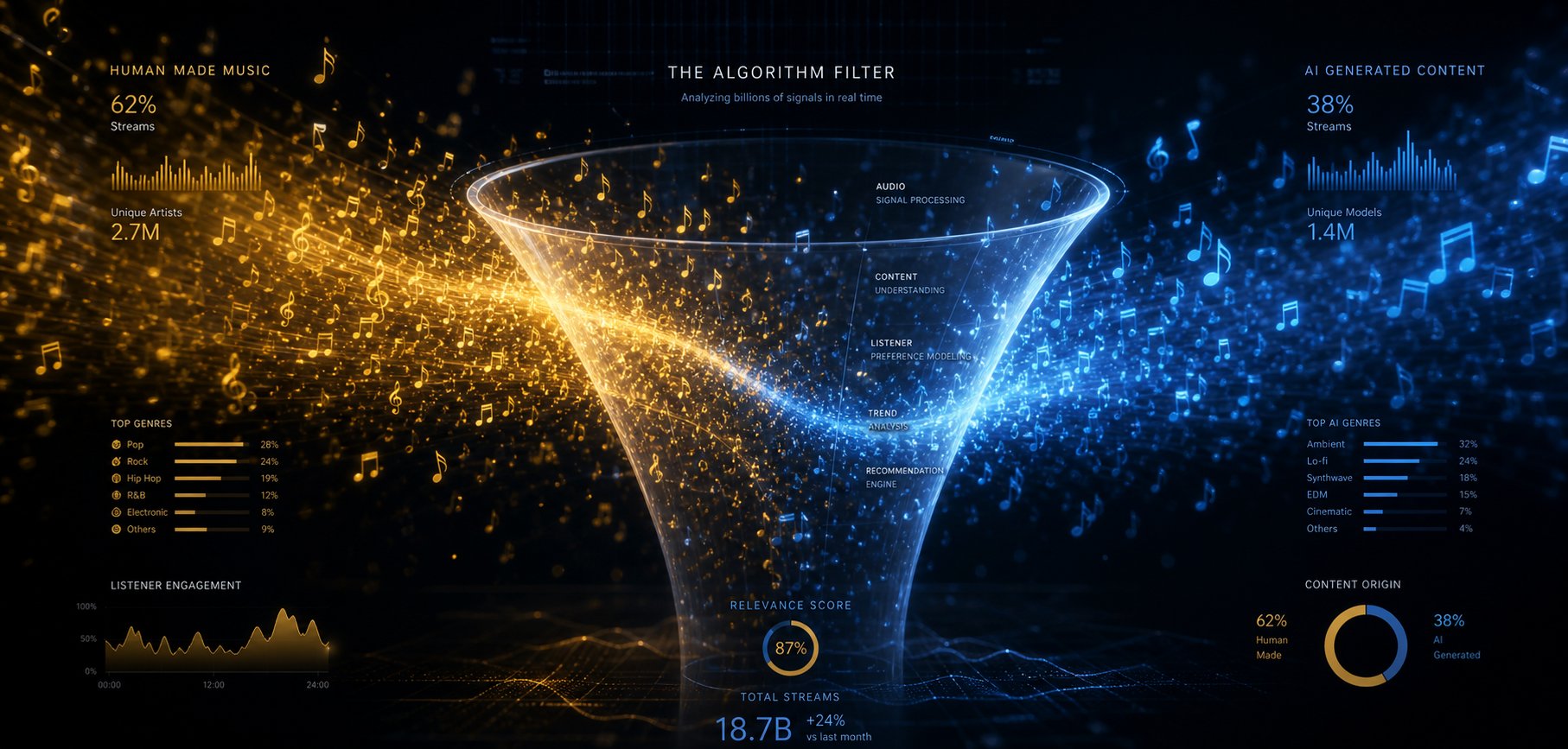
Here's a stat that puts the scale in perspective: Deezer reported that approximately 44% of daily uploads to its platform are now AI-generated tracks. That's not a typo. Nearly half of all new music arriving on a major streaming service every single day was made by machines rather than humans.
The economic impact on human artists is direct and measurable. Most major streaming services, including Spotify and Apple Music, operate on a pro rata royalty model. Your payout depends on your share of total streams across the entire platform. When millions of AI-generated tracks enter the pool, each one siphoning even a handful of plays, the denominator grows while legitimate artists' slice shrinks. As Beatdapp Co-CEO Morgan Hayduk estimates, every percentage point of market share diverted to fraudulent or AI-generated content represents hundreds of millions of dollars pulled from the finite royalty pool. The impact on ai music royalties isn't theoretical. It's happening with every upload.
The fraud dimension makes this worse. Bad actors use AI song generators to flood platforms with thousands of low-effort tracks, then employ bot networks to stream each one just enough to generate payments without triggering detection. The case of Michael Smith, a North Carolina musician who allegedly extracted over $10 million in fraudulent royalties using hundreds of thousands of AI-generated songs and automated streaming bots, illustrates the scale of the problem.
Platforms are responding, but unevenly. Deezer implemented an AI detection tool to label synthetic content and introduced an artist-centric remuneration model that caps individual accounts at 1,000 royalty-generating streams per month to combat bot activity. Spotify has begun exploring derivative works licensing frameworks. Several ai music production companies are pursuing stock audio human-made certification initiatives to let listeners distinguish human-created music from synthetic content. These steps are meaningful, but adoption across the industry remains inconsistent.
Recommendation algorithms add another layer of complexity. These systems decide what appears in your Discover Weekly, your radio stations, and your homepage. When AI-generated tracks flood a platform, they can skew recommendation data, making it harder for emerging human artists to surface. As Warner Music Group's David Sandler noted, streaming fraud "is impacting artists you've never heard of because we don't have a chance to bring them to market." Every dollar spent fighting fraud is a dollar not spent discovering new talent.
Listeners, meanwhile, are pushing back. A Luminate study found that overall comfort with AI-generated music dropped from -13% to -20% net negative between May and November 2025, with Gen Z and Gen Alpha leading the decline. Despite the flood of AI content being uploaded, it accounts for less than 3% of actual streams on Deezer, and a majority of those are deemed fraudulent. People aren't choosing to listen to this content. They're having their royalty pools diluted by it.
The Licensing and Royalties Question
Beyond streaming economics, AI is reshaping how music gets licensed for use in other media. If you've ever needed background music for a YouTube video, a podcast intro, or an advertising spot, you've navigated the world of sync licensing. AI has fundamentally altered the economics of that market.
Royalty-free AI music libraries have emerged as direct competitors to traditional stock music services. Where a human-composed stock track might cost $50 to $500 per license, AI-generated alternatives offer unlimited downloads on flat monthly subscriptions. For content creators producing daily videos or weekly podcasts, the cost difference is enormous. Traditional stock music companies that built their catalogs over decades are watching their pricing models collapse under the weight of infinite, cheap AI alternatives.
The impact on licensing extends across every content vertical where music meets media:
- Sync licensing for film and TV - AI tools generate custom scores matching specific scene timings and emotional arcs, reducing reliance on expensive sync deals
- Background music for video content - YouTube creators and social media producers use AI-generated tracks to avoid copyright strikes entirely
- Advertising jingles - Brands generate on-brand sonic identities through AI rather than commissioning composers, cutting production timelines from weeks to hours
- Game soundtracks - Adaptive AI music systems create dynamic scores that respond to gameplay in real time, replacing static looped compositions
- Podcast intros and transitions - Hosts generate custom theme music matching their show's tone without music licensing expertise or budget
Ownership questions compound the mess. When you generate a track using an AI platform, who owns it? The answer varies by platform and jurisdiction. The Universal Music-Udio licensing deal signaled that major labels are willing to license their catalogs for AI training under defined terms, creating a potential framework for compensating artists whose work informed AI outputs. But the broader ecosystem remains unsettled. Each AI-generated composition could involve multiple layers of rights: the underlying recordings used for training, the compositions those recordings contain, the user's creative input, and even the AI model itself.
On the operations side, music contract software with automated royalty calculation features is becoming essential as deal structures grow more complex. When a single AI-assisted track might involve human lyrics, machine-generated instrumentation, a sample cleared from a training dataset, and distribution across twelve platforms with different payout models, manual royalty accounting simply can't keep up. Companies like Reprtoir are building tools to handle these layered calculations, tracking splits across human and AI contributions within the same release.
The licensing landscape is, frankly, a mess. But it's a mess being actively sorted through precedent-setting deals, platform policy changes, and emerging technology standards. What remains unresolved is the deeper legal and ethical framework that will ultimately determine who profits, who's protected, and who gets left behind as AI-generated music becomes a permanent part of the industry's output.
Legal Battles and Ethical Crossroads for AI Music
Unresolved licensing questions are uncomfortable. Unresolved lawsuits are expensive. The legal system is now the arena where the technical challenges and ethical issues in AI music generation are being fought out in real time, with billions of dollars and the livelihoods of working musicians hanging on decisions that courts have never had to make before. The speed of AI development has outpaced the law, and the resulting gap is being filled by litigation, regulation, and heated debate about what music even means when a machine can produce it.
Copyright Lawsuits and Emerging Legal Precedent
The central legal question is deceptively simple: can AI companies train their models on copyrighted music without permission? The answer is being written right now, case by case.
In June 2024, the RIAA filed twin lawsuits on behalf of Universal Music Group, Sony Music, and Warner Records against Suno and Udio, the two dominant AI music generation platforms. The claims alleged direct copyright infringement and DMCA circumvention, seeking up to $150,000 per infringed work. These weren't symbolic gestures. They were existential challenges to the business model underlying generative AI music.
What happened next revealed how quickly the landscape shifts. Warner Music Group settled with both Suno and Udio by late 2025, forming licensing partnerships rather than pursuing damages. Universal settled with Udio in October 2025, including a joint AI music platform launching in 2026 with opt-in artist compensation. Sony Music, however, continues to litigate against both companies. The pattern is telling: settlements are structured around ongoing licensing revenue, not one-time payouts. The industry is pricing AI music as a long-term revenue stream rather than a problem to punish.
A September 2025 amended complaint in the Suno case added a damaging allegation: that Suno obtained training data by stream-ripping YouTube, circumventing its rolling cipher DRM. This added DMCA Section 1201 claims on top of the copyright infringement claims, materially increasing legal exposure. The lesson for AI companies is becoming unambiguous. Courts have consistently ruled against defendants who trained on pirated or improperly obtained data, while fair use arguments remain viable for legitimately acquired material.
Europe is moving even faster. GEMA, Germany's music rights collecting society, sued both Suno and OpenAI. In November 2025, a Munich court ruled in GEMA's favor against OpenAI in the first worldwide copyright ruling against the company, granting an injunction over unauthorized reproduction of song lyrics. A ruling in the GEMA v. Suno case is scheduled for mid-2026.
Voice cloning adds another legal dimension. Audiobook narrators Karissa Vacker and Mark Boyett settled a case against ElevenLabs over unauthorized voice misappropriation. Scarlett Johansson's 2024 objection to OpenAI's "Sky" voice, which resembled her own, never became a formal lawsuit but generated enormous public attention around performer rights. Voice rights litigation lags behind music rights cases by roughly 12 to 18 months, meaning a wave of new cases is expected through 2026 and 2027.
Then there's the copyrightability question itself. Will AI take over the music industry's creative output if machines can't own what they produce? Current U.S. Copyright Office guidance says no. Works generated entirely by AI without meaningful human creative input aren't eligible for copyright registration. This creates a paradox: the more you rely on AI, the less legal protection you may have over the result. Hybrid works involving substantial human authorship remain copyrightable, but drawing that line in practice is anything but straightforward.
Industry certification is emerging as a market-driven response alongside litigation. Nashville-based Humanable, launched in September 2024, offers artists a way to certify their music as human-made. Co-founder Lili McGrady likens it to a "certified organic" label for produce. Artists sign an affidavit for each song confirming it was created without generative AI. The goal is to give consumers a clear signal and protect human creators' royalty streams as AI-generated content floods platforms.
Ethical Debates and the Artist Perspective
Legal rulings set boundaries. Ethics shape how people feel about those boundaries. And the negative effects of AI in the music industry hit differently depending on where you sit in the value chain.
For many working musicians, the threat isn't abstract. Nashville producer A.B. Eastwood described to the Nashville Banner the first time a collaborator suggested running an unfinished song through Suno mid-session: "It felt like cheating." His concern isn't just financial. It's creative. Getting stuck during songwriting, he argues, forces you into unexpected territory. AI short-circuits that struggle, and with it, the serendipity that produces genuinely original work.
He's not alone. Artists including Billie Eilish, Pearl Jam, and Nicki Minaj have publicly called on AI developers to stop training models on unlicensed music, arguing that it floods the market with synthetic content and dilutes earnings for original creators. Humanable's McGrady puts a number on the risk: a conservative estimate of 24% of royalties from human creators lost to AI music and streaming fraud within two years, representing over $5 billion annually.
On the other side, artists like Grimes have embraced AI by open-sourcing their vocal models and inviting anyone to create songs using their voice, splitting royalties on resulting works. Some producers view AI as the most powerful creative amplifier since the synthesizer, a tool that handles tedious technical work and expands the palette of sounds available to a solo creator with limited resources. The divide often falls along economic lines: well-established artists with existing catalogs tend to feel more threatened, while emerging creators with limited budgets see AI as a leveler.
Voice cloning sits at the sharpest ethical edge. When an AI platform replicates a singer's vocal timbre without consent, it raises questions that go beyond copyright into identity and personhood. A voice isn't just intellectual property. It's a physical characteristic, as unique as a fingerprint. Using it without permission feels viscerally different from sampling a chord progression, even if existing law hasn't always recognized that distinction clearly.
The debate over training data is equally charged. AI models trained on copyrighted catalogs essentially distill the collective creative output of thousands of artists into a system that can then compete with those same artists for listeners and licensing revenue. As Georgetown's Daryl Lim argues, the tension between innovation and creators' rights requires balancing legislation, data scarcity, and varied global governance approaches. No single framework has solved this yet.
The core ethical principle is straightforward: creators deserve consent before their work trains AI systems and attribution when those systems produce outputs informed by their contributions. Technology that bypasses both isn't innovation. It's extraction.
Regulatory proposals are taking shape across multiple jurisdictions. Here are the major ai music regulation news items currently in play:
- The NO FAKES Act (U.S.) - Federal legislation establishing voice and likeness rights against unauthorized AI replication, with civil remedies for performers
- Generative AI Copyright Disclosure Act (U.S.) - Would mandate AI companies disclose all copyrighted works used in training data before public release and during significant model updates
- Tennessee ELVIS Act - State-level law targeting deepfakes and AI-driven impersonations, providing both civil and criminal remedies while preserving First Amendment exceptions
- EU AI Act enforcement (beginning August 2026) - Requires transparency on training data for all AI systems, with rights-focused "opt-out" mechanisms allowing copyright owners to remove works from text and data mining
- GEMA and collecting society licensing frameworks (EU) - Push for mandatory collective licensing agreements between AI developers and rights organizations
- China's generative content regulations - The earliest comprehensive ruleset worldwide for AI-generated content, mandating legal training data acquisition and intellectual property compliance
These proposals reflect three distinct governance philosophies. The U.S. takes a market-driven approach where private companies set de facto standards through practice and litigation. The EU pursues a rights-focused model with explicit opt-out mechanisms. China favors state-driven regulation with comprehensive mandates. None has achieved global consensus, and the fragmentation creates uncertainty for platforms operating across borders.
The Trump administration's executive order directing a uniform federal AI policy framework adds complexity in the U.S., potentially preempting state-level protections like the ELVIS Act. A split among Republicans on tech regulation suggests this won't resolve cleanly along partisan lines.
Where does this leave working musicians? In a genuinely uncertain position. The legal framework is being built in real time, with settlements and rulings arriving faster than legislation. The ethical consensus is forming unevenly, with some artists embracing AI and others organizing against it. What's clear is that the outcome won't be binary. AI isn't going to disappear from music, and it isn't going to replace human artists entirely. The question is what protections, compensation structures, and creative norms emerge from this period of rapid negotiation. For independent artists navigating this landscape with smaller budgets and less institutional support, the practical question becomes more immediate: how do you actually use these tools to your advantage while the rules are still being written?
A Practical Guide for Independent Artists Embracing AI
Legal uncertainty doesn't mean creative paralysis. While courts and legislatures work through ownership frameworks, independent artists are already using AI to close the resource gap between a bedroom setup and a funded studio. The ai impact on music industry economics is real, but so are the opportunities for solo creators willing to experiment. You don't need to wait for the rules to solidify before you start benefiting from what's available right now.
Practical Ways Independent Artists Can Use AI Today
The benefits of ai in music aren't limited to major labels with R&D budgets. A solo artist with a laptop and a creative impulse can apply these tools across nearly every stage of the music-making process. Here are the most actionable applications, ranked by how immediately useful they are for someone working alone:
- Generating demos from rough ideas - Hum a melody or type a lyric concept into a generative platform, and you'll have a fully arranged demo in minutes. This lets you evaluate whether an idea has legs before investing hours in manual production.
- Creating backing tracks and instrumentals - Need a jazz trio accompaniment for a vocal demo? A lo-fi beat for a spoken-word piece? AI generates contextually appropriate instrumentals that serve as foundations for further refinement or stand on their own for live performance practice.
- Experimenting with arrangement variations - Feed a finished verse into a tool and generate five different arrangement directions: stripped acoustic, full band, electronic, orchestral, ambient. In a traditional workflow, each variation would take hours. AI delivers them in seconds, helping you find the right sonic direction faster.
- Producing cover art and visual assets - Image generation tools create album artwork, social media graphics, and promotional visuals that match your music's aesthetic without hiring a designer for every single release.
- Automating social media content - AI tools generate captions, suggest posting schedules, create short video clips from longer tracks, and even produce audiogram animations, keeping your online presence active while you focus on writing.
- Handling distribution metadata - AI-powered taggers automatically classify your tracks by mood, genre, tempo, and instrumentation, improving discoverability on streaming platforms and sync licensing marketplaces.
Each of these applications addresses a specific bottleneck that historically required either money or specialized skills to overcome. The impact of ai on music industry accessibility is most visible here, at the independent level, where a single person can now handle tasks that previously demanded a team. Will ai get better at helping with making music? Based on the trajectory from even two years ago to now, the answer is unambiguously yes. Tools that produced awkward, robotic output in 2023 now deliver results that pass casual listening tests. That improvement curve shows no signs of flattening.
Getting Started With AI Music Creation
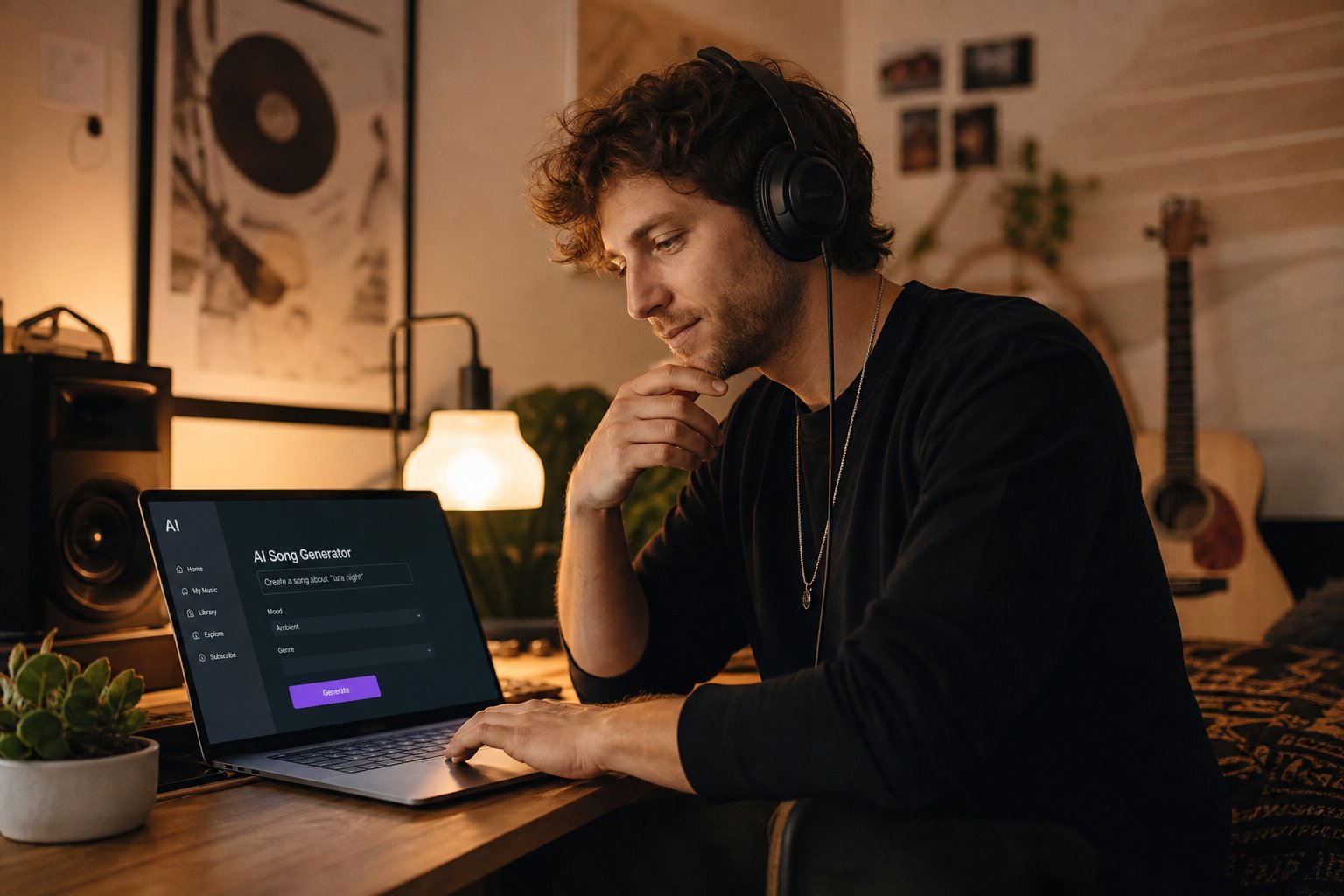
If you've read this far and feel curious but overwhelmed, here's the simplest possible starting path: pick one tool, give it one idea, and evaluate the result. That's it. No complex setup, no subscription commitment, no technical prerequisite.
Start with whatever you already have. A lyric fragment in your notes app. A genre direction you've been wanting to explore. A mood you can describe in a sentence. Feed that into a prompt-based generator and listen to what comes back. The output won't be your finished masterpiece, and it shouldn't be. Treat it as a creative mirror that reflects your idea back in a form you can react to. Does it feel right? Wrong? Close but not quite? Each reaction teaches you something about your own artistic preferences that would have taken much longer to surface through traditional experimentation alone.
A practical first step is to create your first AI-generated song by entering lyrics or a style description and hearing a complete track built from your input. The value isn't in the raw output. It's in how quickly you move from abstract idea to concrete sound, giving you something tangible to iterate on, rearrange, or use as a reference point for your own production.
The future of music belongs to artists who treat AI as a collaborator rather than a threat or a crutch. The most effective approach combines human taste, emotional intent, and lived experience with AI's speed, breadth, and tireless willingness to generate options. You bring meaning. It brings volume and velocity. Together, you cover more creative ground than either could alone.
Iteration is the real skill here. Your first prompt will likely produce something generic. Your tenth will be sharper because you'll have learned how the system interprets language, which descriptions yield which textures, and where your own creative preferences clash with algorithmic defaults. That feedback loop, prompt, listen, refine, repeat, is how you develop fluency with these tools. It mirrors how music in the future will likely be made across the entire industry: human vision directing machine execution in increasingly tight creative cycles.
You don't need permission to start. The tools are live, many offer free tiers, and the learning curve rewards curiosity more than technical knowledge. The artists who experiment with AI music generation today are building fluency that will compound as the technology improves. Whether you use AI for 5% of your process or 50%, the point is the same: understand what it can do, decide what you want it to do, and keep the creative decisions where they belong, with you.
