

The Most Devoted Rock and Roll Subculture You Have Never Heard Of
Imagine a group of men who have spent decades greasing their pompadours, hand-embroidering leather jackets with kanji, and mastering every hip swivel Elvis ever threw at a camera. They are not in Memphis. They are not in Nashville. They are in Tokyo, and they have preserved a mid-century American art form with more devotion than most Americans ever showed it.
That is the cultural paradox at the heart of Japanese rockabilly. While the original movement faded in the United States by the early 1960s, a community of Japanese enthusiasts picked it up, polished it, and refused to let it go. What they built is not a costume party or a weekend hobby. It is a living subculture with its own history, heroes, and uncertain future.
More Than a Yoyogi Park Photo Op
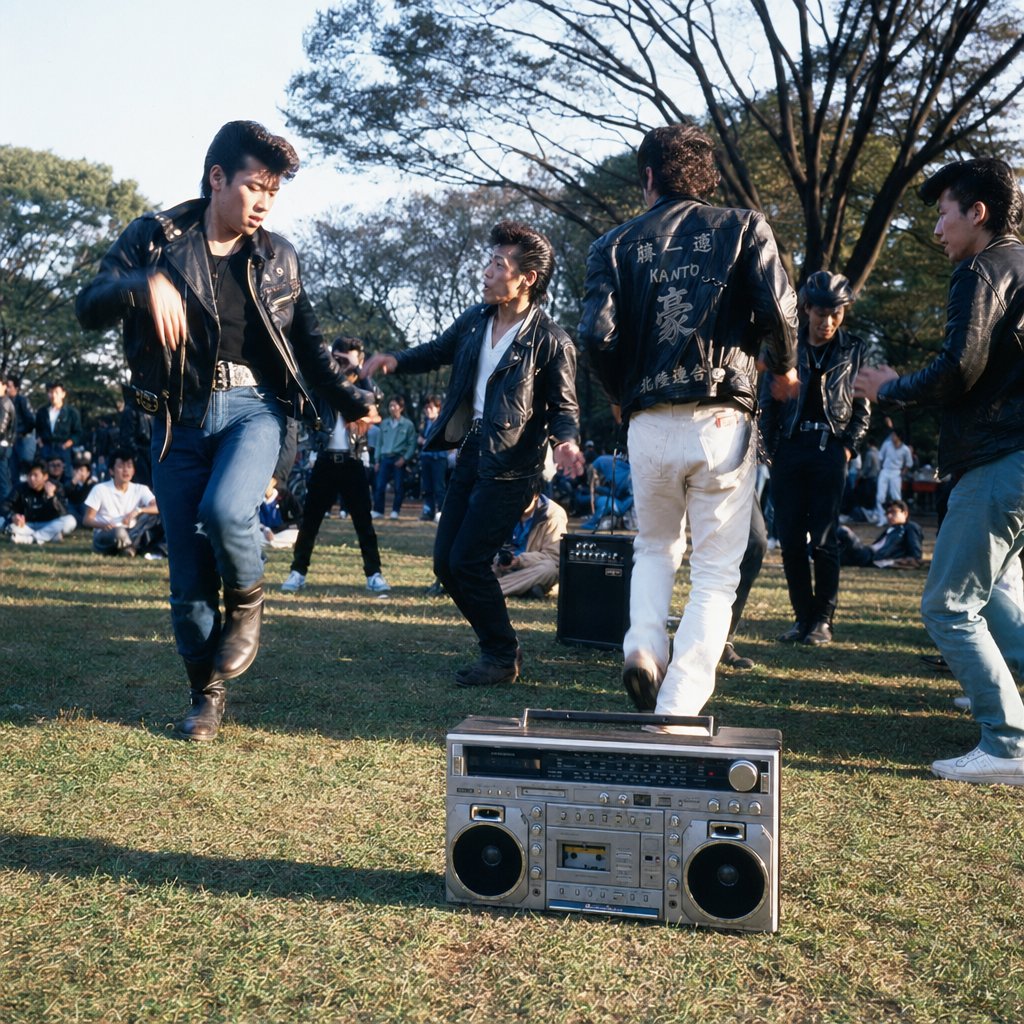
Most people encounter this scene through a viral clip or a travel blog snapshot of dancers in a Tokyo park. That surface-level framing misses the point entirely. As Remitly's cultural reporting puts it:
Japanese rockabilly isn't imitation for entertainment. It's a serious cultural practice rooted in respect and dedication. Participants aren't mocking 1950s America — they're honoring it.
This is a decades-deep movement encompassing music, fashion, dance, and social identity. Participants approach the rockabilly style with the same discipline Japan brings to tea ceremony or martial arts. Their leather jackets feature intricate embroidery blending Tokyo en kanji script with American iconography. Their record collections number in the thousands. Their commitment is archival.
Defining Japanese Rockabilly Beyond the Surface
So what separates this from generic rockabilly revivalism? Context. American rockabilly was born from racial music fusion and working-class rebellion. The Japanese version emerged from something different: postwar Western cultural fascination, a hunger for vintage americana, and a quiet revolt against social conformity in one of the world's most collectivist societies.
Think of it alongside other examples of japan americana done with obsessive precision, like Japanese selvedge denim or Tokyo jazz kissaten. The japan 50s cultural absorption that followed the war created fertile ground, but what grew from it was distinctly Japanese: a blend of aesthetic perfectionism and communal devotion that turned a borrowed genre into something entirely its own.
The question worth asking is not why this subculture exists. It is how it got here, who built it, and whether it can survive the generation that gave it life.
How American Rock and Roll Crossed the Pacific
Every cultural transplant needs a carrier. For rockabilly, the carriers were American soldiers, radio waves, and vinyl records that traveled thousands of miles before landing in the hands of teenagers who had never set foot outside Japan.
Postwar Japan and the American Cultural Flood
After General Douglas MacArthur's forces landed at Atsugi in August 1945, American culture poured into Japan at an unprecedented pace. The Armed Forces Radio Service (AFRS) deployed mobile broadcasting vans from Yokohama within weeks of the surrender, and by the early 1950s, the Far East Network (FEN) operated eleven stations across Japan. These stations pumped out American pop, country, and rock and roll eighteen hours a day. For Japanese youth tuning in, it was like catching sunlight in japanese winter — sudden, warm, and impossible to ignore.
U.S. military bases scattered across the country became informal cultural exchange points. Imported records by Elvis Presley, Eddie Cochran, and Gene Vincent circulated through base towns. By 1955, Chiemi Eri had already covered "Rock Around the Clock" for Japanese audiences, and the floodgates were open. The Nichigeki Western Carnival, launched in 1958, gave the movement its first real stage. Stars like Keijiro Yamashita, Masaki Hiraou, and Mickey Curtis — known collectively as the "Three Rockabilly Men" — drew screaming fans and paper streamers in scenes that mirrored Beatlemania years before the Beatles existed.
Why Rockabilly Resonated With Japanese Youth
Japan's rapid postwar Westernization created fertile ground, but rockabilly fashion and attitude offered something deeper than novelty. The greased hair, the leather, the swagger — these carried a retro logo of rebellion that spoke to young people chafing under rigid social expectations. The Group Sounds movement of the mid-1960s, with its British Invasion-influenced bands, expanded the appetite for Western rock. Yet rockabilly held a distinct appeal: it was rawer, louder, and more physically expressive than anything Japanese pop culture had produced.
This same restless energy would later fuel japanese punk bands in the late 1970s and 1980s. But where punk tore things apart, rockabilly built a world — complete with its own dress code, dance vocabulary, and social hierarchy.
From American Rebellion to Japanese Devotion
Here is the philosophical split that matters. In the American South, rockabilly was born from the collision of Black rhythm and blues with white country music. It was class rebellion with racial undertones, raw and unpolished by design. The Japanese version carried none of that specific history. Instead, it grew from aesthetic fascination — the same cultural impulse that produced world-class Japanese whisky, selvedge denim, and jazz kissaten where bartenders handle vinyl with white gloves.
American rockabilly said "I don't care what you think." Japanese rockabilly said "I will master what you created." That distinction shaped everything that followed — from the bands that formed to the shop in Harajuku that would turn a scattered interest into a full-blown cultural movement.
A Decade-by-Decade Timeline of Japanese Rockabilly
That shift from rebellion to devotion did not happen overnight. It unfolded across seven decades, each one adding a new layer to the subculture's identity. Tracing the full arc reveals how a scattered fascination with American records became a complete japan lifestyle movement — one with its own fashion, music, rituals, and social codes.
Here is the timeline no one bothers to lay out in full.
| Decade | Key Events | Notable Figures | Cultural Significance |
|---|---|---|---|
| 1950s-60s | Chiemi Eri covers "Rock Around the Clock" (1955); Nichigeki Western Carnival launches (1958-1977); rock and roll and rockabilly arrive via Armed Forces Radio and military bases | Keijiro Yamashita, Masaki Hiraou, Mickey Curtis ("Three Rockabilly Men"), Michiko Hamamura | First wave of 1950s japanese youth culture built around Western rock; genres remain blurred by record labels |
| 1970s | Carol forms (1972-1975); The Cools form (1977); Cream Soda shop opens in Harajuku; "oldies" revival sweeps Japan | Eikichi Yazawa (Carol), Cream Soda founder Yamazaki Shinichi | Rockabilly gains a distinct Japanese identity separate from generic rock; leather-and-pompadour aesthetic solidifies |
| 1980s | Black Cats tour the U.S. with the Go-Go's; Yoyogi Park dancing scene explodes; Hillbilly Bops blend punk energy with rockabilly; Magic forms in Shibuya | Black Cats, Hillbilly Bops, Magic | Peak era — the subculture becomes a visible, organized movement with fashion, music, and choreographed dance all firing at once |
| 1990s-2000s | Hillbilly Bops reform (2004); Vincents open for the Stray Cats; Peppermint Jam and Blue Angel keep the circuit alive | Tsuyoshi Kawakami (Vincents), Akiko Urae (Blue Angel), The Mackshow | The scene plateaus — dedicated but no longer growing; core community solidifies around live houses and weekend gatherings |
| 2010s-Present | Viral videos bring global attention to Yoyogi Park dancers; social media introduces the subculture to younger audiences worldwide | Tokyo Rockabilly Club, The 50 Kaitenz | An aging but passionate community maintains the tradition; international curiosity rises as domestic recruitment slows |
The Arrival and Early Imitation Era
The 1950s and 1960s were pure absorption. Japanese teenagers heard American rock and roll on the radio, bought imported records when they could afford them, and showed up at the Nichigeki Western Carnival to watch local performers channel the energy of Elvis and Carl Perkins. The dances in the 1950's were tame by later standards — screaming fans and paper streamers — but for postwar youth, this was electric. Labels did not even bother separating rock and roll from rockabilly on their releases. Everything Western and guitar-driven got lumped together, and nobody complained as long as the records sold.
The Western Carnival ran for 56 shows across nearly two decades, roughly tracking rockabilly's original rise and fall. When it ended in 1977, the first chapter closed. But the seeds were already germinating into something new.
The Cream Soda Explosion and Peak Years
The 1970s brought reinvention. Carol, fronted by the magnetic Eikichi Yazawa, dressed in head-to-toe black leather and performed with motorcycles onstage. They lasted only three years, but their impact was seismic. The Cools picked up the torch in 1977 and never put it down. Meanwhile, Yamazaki Shinichi opened Cream Soda in Harajuku, creating the physical hub that would connect fashion, music, and community into a single ecosystem.
The 1980s were the peak. Black Cats added the ducktail hairstyle that became the subculture's visual signature and gained international exposure touring with the Go-Go's. The Hillbilly Bops injected punk aggression. Magic laid down stand-up bass grooves in Shibuya clubs. And in Yoyogi Park, groups of men in towering pompadours began the choreographed sunday dancing rituals that would eventually draw cameras from around the world. Japanese men fashion within the scene reached its most theatrical — every detail of the look was codified, from the height of the hair to the cut of the jeans.
Plateau and Preservation in the Modern Era
By the 1990s, the subculture had stopped expanding and started preserving. Bands like the Vincents and Peppermint Jam kept the sound alive in tokyo drawing rooms and live houses, but the audience was largely the same people who had been there since the 1980s. Blue Angel's Akiko Urae proved women still held ground in a male-dominated scene. The Mackshow kept releasing records. The Hillbilly Bops even reformed in 2004, proving that growing older did not mean growing quiet.
Today, the community is smaller but fiercely committed. Viral clips of Yoyogi Park dancers have introduced the subculture to millions who had never heard of it, creating a strange new dynamic: global fascination rising just as the domestic base ages out. Whether that international attention translates into fresh energy — or simply more tourists with cameras — depends largely on the institutions that built this world in the first place. And no institution mattered more than a single shop in Harajuku.
Cream Soda and the Man Who Built a Subculture
Every subculture needs a gathering point — a place where scattered individuals realize they are part of something larger. For Japanese rockabilly, that place was a shop in Harajuku called Cream Soda, and the man behind it was Yamazaki Shinichi.
Yamazaki Shinichi and the Birth of Cream Soda
Yamazaki, known affectionately as "Yamachan" within the scene, opened Cream Soda in the early 1970s during the same oldies revival that produced Carol and The Cools. On the surface, it was a vintage clothing store. Walk inside, and you found something closer to a shrine. Racks of leather jackets hung alongside imported American records. Pomade tins sat next to band flyers. The shop's iconic pink dragon logo — a playful fusion of 1960s japan hot rod art and Japanese graphic sensibility — became the unofficial crest of an entire movement.
What made Yamazaki different from other vintage dealers was ambition. He was not selling clothes. He was selling a complete identity. Every item in the store reinforced a specific vision of 1950s rockabilly fashion filtered through Japanese precision: the leather had to drape a certain way, the jeans had to cuff at the right height, the boots had to carry the right silhouette. If you walked into Cream Soda unsure of what tokyo style as a man in the rockabilly world looked like, you walked out with a full blueprint.
A Shop That Became a Cultural Movement
Cream Soda's real power was connective. Yamazaki sponsored bands, hosted events, and turned the shop into a social hub where musicians met dancers, where newcomers found mentors, and where the subculture's unwritten rules got passed down face to face. He understood that fashion without music is cosplay, and music without community is just noise. So he wired them together.
The shop's influence radiated outward in ways that reshaped Tokyo's cultural geography. The Yoyogi Park dancing scene — the one that would eventually draw cameras from every continent — grew directly from the community Cream Soda cultivated. Regulars who gathered at the shop on weekdays took their energy to the park on Sundays, turning a patch of concrete near the Harajuku entrance into an open-air stage. The choreographed routines, the towering pompadours, the matching gang jackets — all of it traced back to the aesthetic template Yamazaki had built.
What Cream Soda created was not a brand in the modern marketing sense. It was an ecosystem. The shop gave Japanese rockabilly its visual language, its social infrastructure, and its sense of belonging. Daigo "Johnny" Yamashita, one of the scene's most visible figures today, counts the band Carol — a group deeply intertwined with the Cream Soda orbit — among his earliest inspirations. That lineage runs through nearly every active practitioner in the scene.
Yamazaki proved that a subculture does not sustain itself on passion alone. It needs a physical center of gravity, a place where the look, the sound, and the people converge. Cream Soda was that center for decades. But the aesthetic it codified — leather, pomade, stand-up bass, and an almost religious reverence for the 1950s — only told half the story. The other half lived in the music itself, and in the bands that gave the movement its heartbeat.
The Music and Musicians Behind the Movement
Leather jackets and pompadours get the photographs, but strip away the visual spectacle and you still find a beating pulse underneath: the music. Japanese rockabilly produced bands that filled stadiums, launched solo careers of staggering longevity, and built a music genre from tokyo's smoky basement clubs into something that rivaled mainstream Japanese rock. Yet most coverage of the subculture barely mentions a single song. That gap is worth closing.
The Bands That Shaped the Sound
No conversation about the music starts anywhere but with Carol. Formed in 1972 by Eikichi Yazawa — a kid from postwar Hiroshima who rode a night train to Yokosuka with a guitar and 50,000 yen — Carol fused the swagger of the Rolling Stones with the greased-leather energy of 50s 60s rock and roll. Yazawa played bass and sang lead while Johnny Okura handled rhythm guitar, and together they wrote hits like "Namida no Teddy Boy" and "Funky Monkey Baby" that became anthems for an entire generation. Carol lasted only three years before internal friction tore them apart in 1975, but Yazawa went on to become one of Japan's biggest rock stars, holding the record for the most Top 10 albums on the Oricon chart with 46 and performing at the Nippon Budokan over 100 times.
Carol opened the door. The bands that followed walked through it with their own rockabilly styles and attitude.
- The Cools (1977-present) — Picked up where Carol left off, blending rockabilly grit with a polished live show that kept them touring for decades. They became the reliable backbone of the scene when flashier acts burned out.
- Black Cats (1980s) — Defined the ducktail-and-creepers visual template and gained rare international exposure touring the U.S. with the Go-Go's. Their sound leaned closer to American neo-rockabilly acts like the Stray Cats, tight and punchy with prominent stand-up bass.
- Magic (1980s, Shibuya) — A Shibuya-based outfit that kept the stand-up bass front and center, delivering a rawer, club-ready sound that thrived in intimate venues rather than arenas.
- Hillbilly Bops (1980s, reformed 2004) — Injected punk velocity into the rockabilly framework, creating a hybrid energy that attracted fans from both camps. Their reformation proved the music still had pull decades later.
- The Mackshow (2000s-present) — Carried the torch into the new millennium with a sound faithful to classic rockabilly but sharpened by modern production. They remain one of the few acts still actively releasing records.
- The 50 Kaitenz and Peachy Keen (contemporary) — Part of a newer wave blending rockabilly with psychobilly and punk influences, pushing boundaries while respecting the roots.
What Japanese Rockabilly Actually Sounds Like
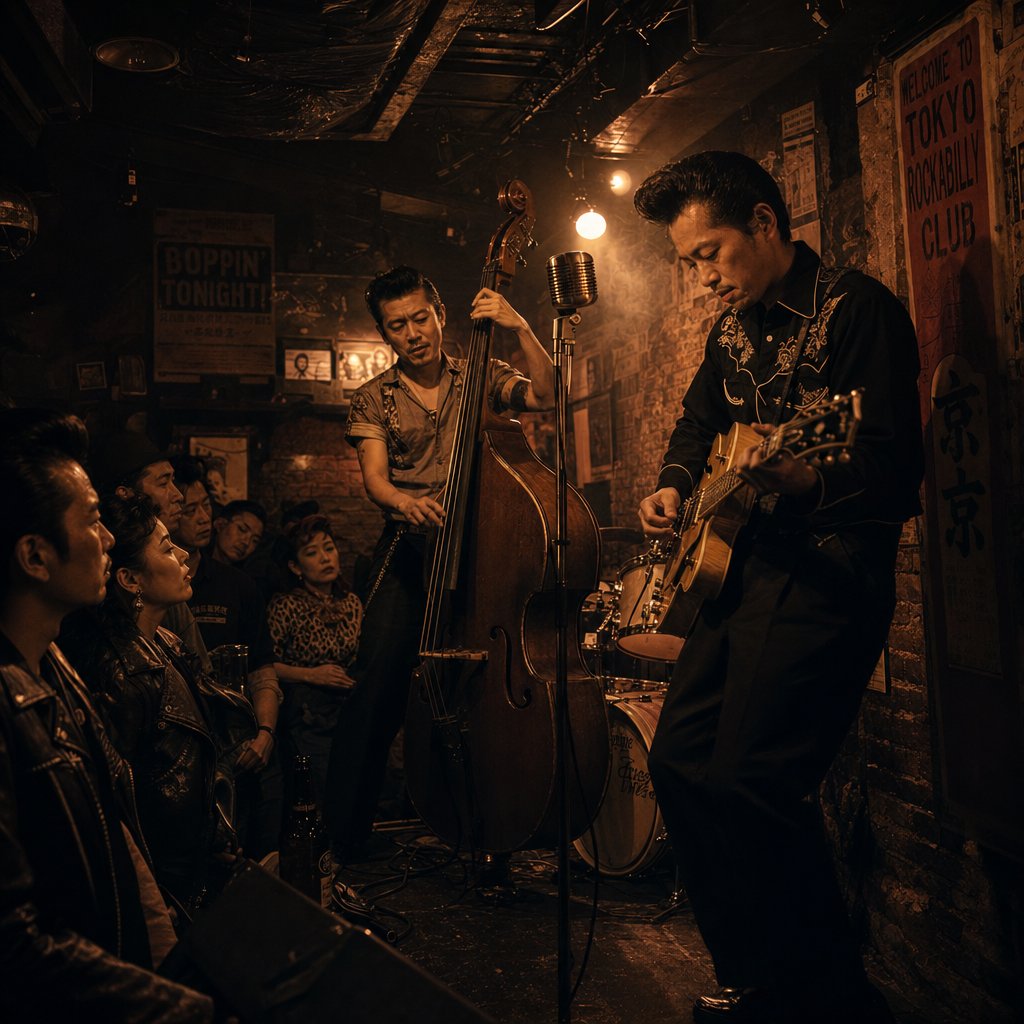
Close your eyes at a Tokyo rockabilly show and you will hear three things immediately: the percussive slap of an upright bass, the twang of a hollow-body guitar run through a tube amp, and a drum kit stripped to its essentials — snare, kick, maybe a single cymbal. The instrumentation mirrors classic American rockabilly almost note for note. The difference lives in the details.
Vocals are delivered in Japanese, but the phrasing follows American melodic structures — the hiccupping vocal breaks of Eddie Cochran, the growl of Gene Vincent. The effect is striking: familiar musical DNA wrapped in an entirely different language. Production choices lean deliberately retro. Even bands recording in the 1980s and 1990s favored analog warmth over digital clarity, chasing a sound that felt like it could have come off a Sun Records pressing.
The evolution tells its own story. In the 1960s, Japanese acts performed faithful covers of American hits, sometimes phonetically singing English lyrics they barely understood. By the time Carol arrived in the early 1970s, original Japanese compositions had taken over. Yazawa and Okura wrote their own songs from the start, layering Japanese lyrics over chord progressions rooted in 50s 60s rock and roll. By the 1980s, bands like Black Cats and Magic were producing music that sounded nothing like imitation — it was a fully realized rockabilly look japan had made its own, translated into sound.
Live Houses and the Tokyo Circuit
Yoyogi Park gets the cameras, but the music lived in tokyos network of live houses — small, sweat-soaked venues where bands played to crowds of fifty or a hundred people who knew every word. Clubs in Shibuya, Shinjuku, and Shimokitazawa formed an informal circuit. A band could play three or four shows a week across different neighborhoods, building a following one room at a time.
These venues functioned as community infrastructure. You did not just watch a show — you met the bassist after the set, traded records with the guy next to you, and heard about the next gig from a flyer stapled to the wall. The live house circuit gave the subculture a musical heartbeat independent of the park performances, ensuring the sound kept evolving even when the dancing stayed frozen in time.
That tension — between a sound that kept moving and a visual culture that stayed deliberately still — shaped more than just the music. It defined the entire way the subculture presented itself to the outside world, from the height of the pompadour to the cut of the jeans.
Rockabilly Fashion and the Art of Standing Out in Japan
The music kept evolving in basement clubs, but the look? The look was the manifesto. In a country where blending in is practically a civic virtue, choosing to walk down a Tokyo street with a two-foot pompadour and a leather jacket covered in hand-embroidered dragons is not a fashion choice. It is a declaration of war against conformity.
Rockabilly fashion in Japan is the most visually arresting element of the subculture, and it is also the most misunderstood. Outsiders see costumes. Participants see identity. Every cuffed jean, every polished creeper shoe, every hour spent sculpting hair with pomade carries the weight of a deliberate decision: I will not disappear into the crowd.
The Pompadour and the Leather Jacket
Start with the hair, because everyone does. The pompadour is the signature of the rockabilly guy style worldwide, but Japanese practitioners take it to architectural extremes. Where an American greaser in the 1950s might have coaxed his hair into a modest wave, a Tokyo Roller builds a gravity-defying structure that can reach absurd heights, sculpted with industrial-strength pomade and sometimes reinforced with hairspray and sheer willpower. The style, often paired with sharp sideburns, is maintained with a precision rooted in Japanese techniques for styling and hair care that goes far beyond what the original music artists of the 50s ever attempted with their own quiffs.
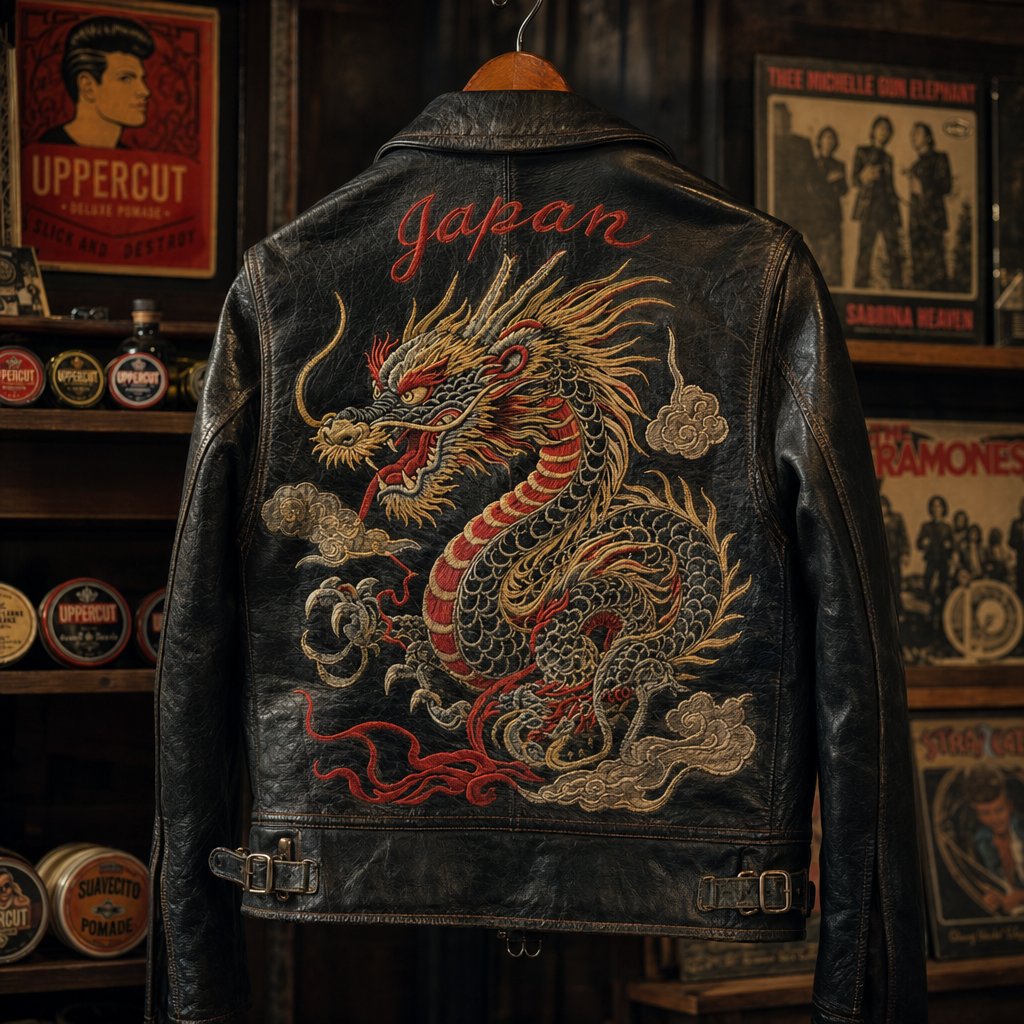
Then comes the leather. The classic biker jacket is the second pillar of the 1950s rockabilly style, but in rockabilly japan, it gets elevated to an art form. Japanese craftsmanship — the concept of monozukuri — transforms a standard motorcycle jacket into something closer to wearable sculpture. Custom-made motifs like dragons, tigers, or samurai figures get embroidered onto the back panels, blending American rebel iconography with Japan's own visual heritage. Contrasting thread colors, meticulous stitching, and hand-finished details set these jackets apart from anything you would find in a Western vintage shop.
The full men's wardrobe follows a strict visual code:
- Pompadour or ducktail hairstyle, sculpted with pomade and maintained with obsessive care
- Leather biker jacket, often custom-embroidered with Japanese motifs
- Cuffed selvedge denim jeans — Japanese raw denim, woven on traditional shuttle looms, is the preferred fabric
- Creeper shoes or engineer boots with a heavy sole
- Vintage-inspired sunglasses, bandanas, and slick cufflinks for individual flair
- Chain wallets and silver accessories to complete the silhouette
What makes this more than cosplay is the sourcing. Japanese denim is globally renowned for its quality, and rockabilly devotees insist on the real thing — raw selvedge fabric that ages and fades uniquely to the wearer. The jacket leather gets chosen for weight and grain. Even the pomade brands matter. Every element is curated with the same intensity a sommelier brings to a wine list.
From Bosozoku Biker to Rockabilly Rebel
You cannot understand the fashion without understanding where a significant chunk of its DNA came from: the bosozoku. Japan's infamous motorcycle gangs, the speed tribes, emerged from the same postwar disillusionment that made rock and roll appealing in the first place. Their predecessors, the Kaminari-zoku (Thunder Tribe) of the 1950s, were former soldiers and restless youth who channeled frustration into loud motorcycles and louder attitudes. By the 1970s, bosozoku had developed their own elaborate visual identity: embroidered jumpsuits called tokko-fuku, sarashi bandage wraps, hachimaki headbands, and — crucially — the pompadour hairstyle borrowed directly from American rockabilly culture.
The overlap was not accidental. Both subcultures drew from the same well of rebellion against Japan's corporate conformism. Both favored leather, loud engines, and a working-class swagger that mainstream society found threatening. The bosozoku pompadour, with its absurd height symbolizing arrogance and defiance, fed directly into the rockabilly scene's own hair obsession. Members drifted between the two worlds. A young man who rode with a bosozoku gang on Saturday night might show up at Yoyogi Park on Sunday morning with the same pompadour, swapping his tokko-fuku for a leather jacket and creepers.
This pipeline created a distinctly Japanese hybrid that no American rockabilly revivalist could replicate. The bosozoku contributed militaristic toughness, gang loyalty structures, and a visual maximalism rooted in Japanese history. Rockabilly contributed the music, the dance, and the specific American nostalgia. The fusion produced something that looked like the 1950s but felt like postwar Tokyo — a subculture that could only exist at the intersection of these two rebellious traditions.
Fashion as Rebellion Against Conformity
Foreigners sometimes ask can americans live in japan and blend in seamlessly. The honest answer is that standing out in Japanese society — whether you are foreign or local — carries real social weight. Japan's cultural emphasis on wa (harmony) and collective identity means that visible nonconformity is not just noticed, it is felt. Wearing a towering pompadour to a society that rewards invisibility is a deliberate provocation, a quiet refusal to participate in the unspoken agreement that everyone should look roughly the same.
That is what makes the fashion political, even when the wearers would never use that word. The Rollers at Yoyogi Park are not staging a protest. They are not issuing manifestos. They are simply showing up every Sunday in full leather and denim, hair sculpted to impossible heights, and dancing like the rest of the world does not exist. In a conformist society, that persistence is the protest.
Women in the scene carry their own version of this rebellion. While men dominate the visual spotlight, female rockabilly enthusiasts have carved out a distinct space that blends 1950s pin-up aesthetics with Japanese sensibility:
- Victory rolls or vintage-styled updos, often with bold hair accessories
- High-waisted skirts and poodle skirts with petticoats
- Bold polka-dot dresses and fitted tops
- Dramatic eyeliner and red lipstick in the classic pin-up tradition
- Saddle shoes or kitten heels to complete the silhouette
As Nanika Japan notes, female dancers bring dynamic energy to the performances, proving the subculture is not bound by gender roles but thrives on shared devotion to the culture. Groups of synchronized female dancers match their male counterparts move for move, shattering any assumption that this is a boys-only club.
The fashion, ultimately, is the most visible layer of something deeper. It is the uniform of a parallel society — one that exists inside Japan but refuses to play by its rules. And that refusal connects rockabilly to a broader web of Japanese subcultures that have been pushing back against conformity for decades, each in their own way, each borrowing from the others.
Japanese Rockabilly Among Japan's Rebel Subcultures
That broader web is more tangled than it looks from the outside. Rockabilly did not rebel in a vacuum. It shared streets, members, and attitude with at least three other Japanese subcultures that were all, in their own way, telling mainstream society the same thing: we would rather walk tall than blend in.
Bosozoku, Yankii, and Visual Kei Connections
The previous chapter traced the bosozoku-to-rockabilly pipeline through fashion. But the connections run deeper and wider when you map the full landscape of Japan's postwar rebel movements. Bosozoku brought the motorcycles and the gang loyalty. Yankii — the bleached-hair, school-skipping delinquent youth culture that peaked during the 1980s subculture boom — brought the working-class defiance and the attitude that "to rebel against the established order is cool." Visual kei, born from the same decade, borrowed rockabilly's theatrical self-presentation and cranked it into something entirely new: gender-bending glam rock with elaborate costumes and makeup that made a pompadour look understated by comparison.
These movements did not just coexist. They cross-pollinated. A yankii kid in Fukuoka might ride with a bosozoku gang on weekends, listen to rockabilly records at home, and eventually discover X Japan on late-night television. The rock and roll jeans for men that defined the rockabilly wardrobe shared rack space with the embroidered tokko-fuku jumpsuits of bosozoku crews in the same Harajuku shops. Visual kei bands like X Japan took the performative intensity of rockabilly stage presence — the hair, the swagger, the refusal to look ordinary — and filtered it through heavy metal and glam rock into something Japan exported worldwide.
Here is how these four movements compare across their defining characteristics:
| Subculture | Peak Era | Fashion | Music | Rebellion Style |
|---|---|---|---|---|
| Japanese Rockabilly | 1980s | Pompadours, leather jackets, cuffed denim, creeper shoes | Stand-up bass-driven rock and roll rooted in 1950s American rockabilly | Aesthetic devotion — preserving a parallel identity through meticulous style |
| Bosozoku | 1970s-1980s | Embroidered tokko-fuku jumpsuits, sarashi wraps, hachimaki headbands, pompadours | No specific genre; loud exhaust pipes served as the soundtrack | Physical confrontation — illegal street racing, territorial displays, noise as defiance |
| Yankii | 1980s-1990s | Bleached or permed hair, shaved brows, loud colors, embroidered jackets with gang slogans | No unified genre; associated with pop and enka karaoke culture | Social deviance — skipping school, fighting, rejecting academic and career expectations |
| Visual Kei | 1980s-1990s | Elaborate makeup, dyed hair, gender-fluid costumes, platform boots | Heavy metal, glam rock, and punk fused with theatrical performance | Aesthetic transgression — dismantling gender norms through extreme visual presentation |
What the table reveals is a shared DNA beneath very different surfaces. Every one of these movements emerged from postwar Japan's tension between rapid modernization and rigid social conformity. Every one used visible style as its primary weapon. And every one drew, directly or indirectly, from Western cultural forms that Japan absorbed and then remade.
Subculture vs Counterculture in Japan
Here is where the Western lens fails. In the United States or Britain, subcultures like punk or hip-hop often positioned themselves as countercultures — movements actively opposing mainstream values, seeking to tear down or replace existing structures. Japanese rockabilly, along with its sibling movements, operates differently. Current subcultural theory emphasizes that these groups are not rigidly opposed to dominant culture but are "inseparably entwined" with it, forming identities that exist within the mainstream rather than against it.
Think of it this way: a yankii teenager in 1980s Japan was not trying to overthrow society. He was carving out a space where the rules of school, career, and appearance did not apply — at least for a few hours. A rockabilly dancer at Yoyogi Park is not protesting Japanese corporate culture. He is building a parallel world where devotion to a 1950s American aesthetic gives him an identity that the salaryman track never could. The distinction matters. Subculture in Japan is less about destruction and more about construction — building a pocket of meaning inside a system that leaves little room for individual expression.
This is why these movements borrowed so freely from each other. They were not competing ideologies. They were different rooms in the same house of nonconformity, each offering a different flavor of the same fundamental need: to be seen as something other than what society expected. The rockabilly devotee, the bosozoku rider, the yankii delinquent, and the visual kei guitarist all understood that in a culture where "the nail that sticks out gets hammered down," choosing to stick out anyway is the rebellion itself.
That shared understanding also explains why these subcultures aged the way they did. Yankii culture got commodified into a mainstream media stereotype. Visual kei spawned a global fan movement. Bosozoku faded as police crackdowns and demographic shifts thinned their ranks. Rockabilly, though, chose a different path — one of almost archival preservation, holding its ground while the world moved on. Whether that commitment to staying exactly the same is a strength or a vulnerability depends entirely on who picks up the torch next.
The Future of Japanese Rockabilly and Who Carries the Torch
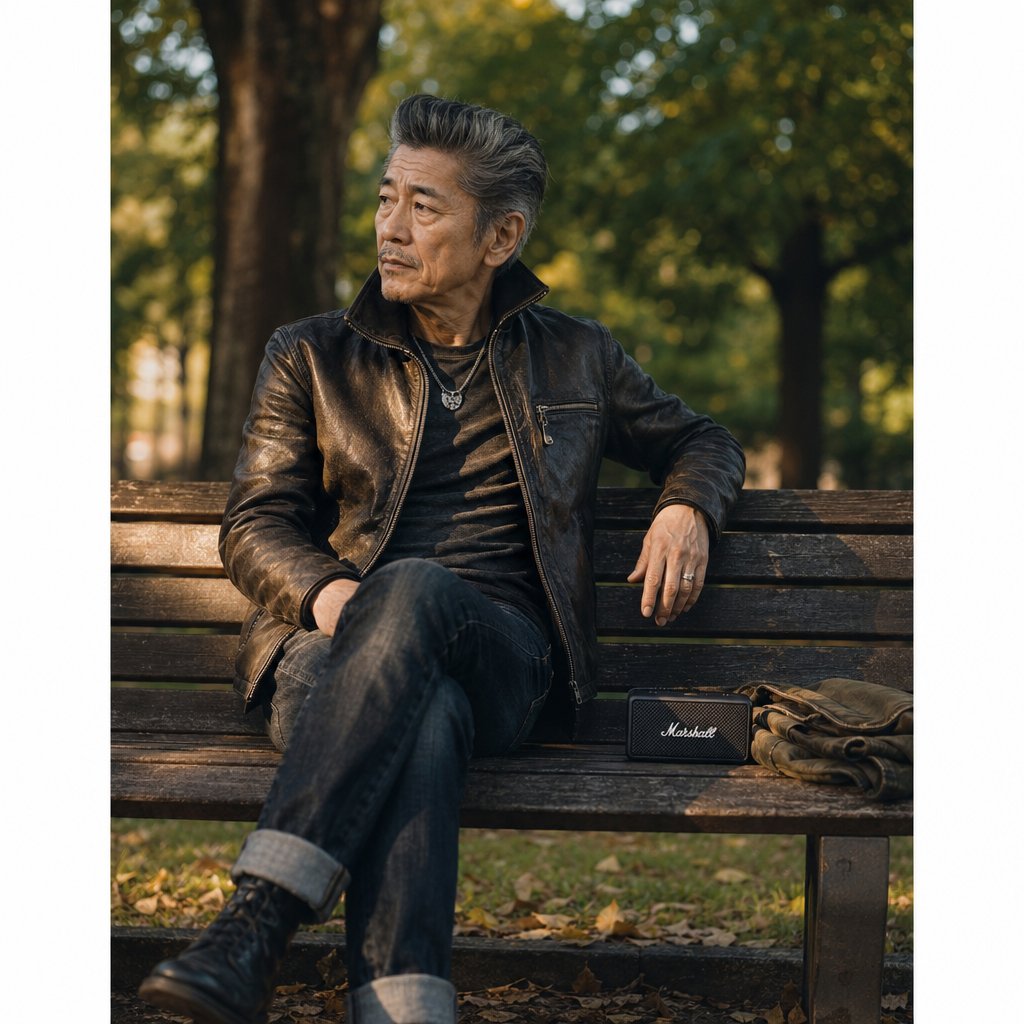
Commitment to staying the same is a powerful thing — until the people doing the staying start to age out. That is the quiet crisis facing the subculture today. The pompadours still rise every Sunday in Yoyogi Park, but the men beneath them are graying. The question nobody in the scene wants to answer is simple: who comes next?
An Aging Subculture Facing an Uncertain Tomorrow
Walk up to the southeastern corner of Yoyogi Park on any given Sunday and you will notice something the viral clips rarely show. The dancers are mostly in their fifties and sixties. Yokogao Magazine's reporting on The Strangers paints a clear picture: founding member Jess has led the group for over thirty years, and veteran dancer Haruo — nicknamed "the dancing jukebox" for his collection of roughly 100,000 rock and roll tapes — recently turned sixty. Younger members who joined in high school drifted away once college and careers took over. Only a handful earned the group's "golden billboard" jacket patch, a symbol of respect that requires six months of dedicated Sunday attendance to receive.
The Strangers are not unique in this. Across the scene, the core participants are the same people who discovered the rockabilly styl during its 1980s peak. They have families. They work six days a week. Sunday is the day they live for. But the pipeline of new recruits has slowed to a trickle.
Preservation vs Evolution
Here is the tension at the heart of it all. Japanese rockabilly practitioners have maintained an almost museum-quality fidelity to what was popular in the 1950s — the music, the 1950s japanese fashion, the choreography. That devotion is the subculture's greatest asset and its most obvious vulnerability. By refusing to evolve, the community preserved something remarkable. But preservation without recruitment is just a slow fade.
Sometimes traditions survive stronger abroad than in their place of origin. American rockabilly has largely faded, but in Tokyo, it thrives with intensity and purpose.
That observation from Remitly's cultural coverage captures the paradox perfectly. The scene thrives — but within a shrinking circle. The discipline that makes it extraordinary also makes it intimidating to newcomers. You cannot just show up and dance. You learn the moves, earn your place, and prove your commitment over months. In a generation that values exploration over singular devotion, that barrier is real.
Signs of Revival and Global Discovery
And yet, the story is not all decline. Social media has done something no amount of Sunday dancing could: it put the subculture in front of millions of people who had never heard of it. Viral clips of Yoyogi Park performances rack up views across platforms, and the comment sections fill with viewers stunned that this world exists. International tourists now seek out the dancers deliberately, turning a local ritual into a global curiosity.
More importantly, visitors have reported younger dancers learning the moves alongside the veterans, suggesting the tradition has not completely lost its pull on new generations. The global rockabilly revival — festivals in the U.K., Europe, and the American South drawing thousands — has created a wider ecosystem of interest that feeds back into Tokyo. Japanese bands like The 50 Kaitenz and Peachy Keen blend classic rockabilly with psychobilly and punk influences, offering a sound that might speak to younger ears without abandoning the roots.
So is Japanese rockabilly a living subculture or a beautiful anachronism? The honest answer is that it is both — and the ratio between those two things shifts a little more each year. The veterans will keep dancing as long as their legs carry them. Whether anyone steps into their creeper shoes after that depends on something no amount of pomade can fix: whether the next generation finds in this world the same sense of identity and belonging that pulled their predecessors in decades ago.
For anyone who wants to find out firsthand — or simply hear what this world sounds like — the doors are still open. You just have to know where to look.
How to Experience Japanese Rockabilly for Yourself
The doors are open, but knowing where to look makes all the difference. Whether you can book a flight to Tokyo or you are sitting at home curious about the sound, there are real ways to connect with this subculture beyond watching a thirty-second clip on your phone.
Experience the Culture Firsthand in Tokyo
Yoyogi Park on a Sunday afternoon remains the front door. Head to the southeastern entrance near Harajuku Station, and by early afternoon you will find the dancers setting up speakers, cracking open beers, and warming up their moves. No ticket, no reservation — just show up and watch. Bring respect, not just a camera. These are not performers hired for your entertainment. They are people living a tradition they have maintained for decades.
Beyond the park, Tokyo's record stores are a goldmine for anyone chasing the sound. Disk Union in Shinjuku and Shimokitazawa stocks deep bins of used vinyl organized by genre, and their meticulous grading system means you know exactly what condition you are buying. Tower Records in Shibuya — nine floors of music in a country where the chain still thrives — carries both new pressings and vintage finds. For something more intimate, the independent shops scattered across Shimokitazawa reward patient digging with rare Japanese pressings you will not find anywhere else. And if japan fashion men is what drew you in, Harajuku's vintage shops still carry the leather, denim, and 1950 rockabilly fashion that define the look.
Explore and Create the Rockabilly Sound
Curious about the music itself? The genre's DNA is surprisingly accessible: slap bass, twangy hollow-body guitar, and driving rhythms built on popular songs from 1950s America, all filtered through Japanese sensibility. You do not need to master stand-up bass to explore it.
- Visit Yoyogi Park on a Sunday to witness the dancing and hear the music live in its natural setting.
- Dig through Tokyo's record stores — Disk Union, Tower Records Shibuya, and Shimokitazawa's independent shops — for original Japanese rockabilly vinyl.
- Stream essential acts like Carol, Black Cats, The Mackshow, and Hillbilly Bops to hear how the sound evolved from faithful covers to original Japanese compositions.
- Follow online communities and social media accounts dedicated to the scene for event updates, rare footage, and connections with active members worldwide.
- Experiment with the sound yourself using tools like MakeBestMusic's AI Song Generator — type in a style prompt like "Japanese rockabilly" or "1950s Tokyo rock and roll" and generate an original track to hear how the genre's elements translate into new compositions.
- Attend international rockabilly festivals in the U.K., Europe, or the American South, where the global revival community keeps the spirit alive far from Yoyogi Park.
Japanese rockabilly is not a subculture vs counterculture debate or a museum exhibit. It is a living tradition held together by people who decided that devotion to a sound and a look was worth a lifetime of Sundays. Whether you experience it through a park visit, a vinyl find, or a track you create yourself, you are touching something real — a culture that crossed an ocean, took root in foreign soil, and refused to die.
