

What a Lyric Maker Actually Is
A lyric maker is two things at once: a person who writes song lyrics and a category of software tools designed to assist in lyric creation. Whether you are learning how to write a song from scratch or searching for an AI-powered generator to spark ideas, the term covers both sides of the same craft. That distinction matters, because the skills that make a great human songwriter overlap heavily with the principles that make a digital tool actually useful.
Lyric Maker as a Craft and as a Tool
Songwriting as a specialized discipline has deep roots. In the early twentieth century, professional writers worked out of Tin Pan Alley offices on 28th Street in New York City, composing hits for Broadway shows, Hollywood films, and girl groups. These writers were distinct from the performers — they crafted lyrics and melodies that others interpreted. The notion that artists could or should write their own material only shifted in the mid-1960s, driven largely by the Beatles and their contemporaries.
Fast forward through decades of studio innovation, from the vocal microphone making lyrical nuance matter more, to synthesizers and drum machines reshaping song structure in the 1980s, to streaming platforms shortening songs and front-loading hooks. Each technological leap changed what lyrics needed to do. Today, bedroom producers pull up a dark trap lyrics maker or search for the 1000 miles lyrics to study phrasing, all from the same laptop where they record. The craft and the tools have merged into a single creative workflow.
Who This Guide Is For
If you have ever stared at a blank page and felt like every line you write sounds forced, you are in the right place. Maybe you have been humming melodies but cannot pin down words that feel right. Maybe you have typed cool about it lyrics into a search bar just to study how someone else pulled it off. That impulse — to learn by examining what works — is exactly where good songwriting starts.
This guide is a craft-first resource. It treats AI tools as one part of a larger process, not a shortcut that replaces understanding. Whether you write every word by hand or use a generator to break through creative blocks, the fundamentals stay the same.
The best lyric makers, human or AI-assisted, succeed because they understand the same foundational principles: structure, rhythm, emotional specificity, and singability.
Those principles are exactly where poetry and songwriting split apart — and that difference changes everything about how you approach the blank page.
Why Song Lyrics Are Not Just Poetry
Read a poem silently and you control the pace. You can pause, reread a line, let an image settle. A listener hearing your lyrics for the first time gets none of that luxury. As songwriter Marty Dodson puts it, poems are visual pieces while song lyrics are auditory works — the singer controls the speed, and a line that shines on paper may cause confusion in real time. That single difference reshapes every choice a lyric maker faces.
What Works on Paper vs. What Works When Sung
Poetry often rewards density and ambiguity. Lyrics reward clarity and repetition. Think about choruses — you would never repeat the same stanza four times in a poem, but a chorus exists precisely because repetition anchors the listener and invites them to sing along. Rhyme works differently too. In poetry, it is optional. In songwriting, rhyme acts as a memory hook that tells the audience where they are in the structure and what is coming next.
Singability goes even deeper than structure. Musicologist Joe Bennett illustrates this by comparing the word "calling" to "quickest" — the open vowel in "calling" lets a singer's voice soar, while the tight consonants in "quickest" choke the melody. Research into hit lyrics across genres, from panda lyrics in hip-hop to gentle lullaby lyrics, consistently shows that monosyllabic words dominate. The Beatles' "We Can Work It Out" opens with 18 words, 17 of them monosyllables. Simplicity on the page becomes power in the air.
Rhythm, Breath, and Melodic Phrasing
Lyrics have to leave physical room for music to happen — pauses between phrases, held notes on key vowels, melodic runs that stretch a single syllable across several beats. Overwriting is one of the most common beginner mistakes. You pack a line with clever words, then discover the singer has no space to breathe or the melody has nowhere to move. Even if you are using a generator name rap tool or a rhythm randomizer to experiment with flow, the principle holds: fewer words, placed with intention, almost always hit harder than a crowded line.
Great phrasing mimics natural speech. When a melody rises on the same syllable you would naturally stress in conversation, the lyric feels effortless. When it fights the natural rhythm, the listener feels the friction instantly — even if they cannot name why. Speak your lines out loud before you ever set them to music. If a phrase trips your tongue, it will trip a singer's voice too.
Lyrics are half of a conversation with melody — writing them in isolation, without considering how they will be sung, limits their impact before a single note is played.
Understanding this conversation between words and music is the starting point. The next question is structural: how do rhyme schemes, syllable counts, and song architecture turn raw phrases into something that actually feels like a song?
Songwriting Fundamentals Every Lyric Maker Needs
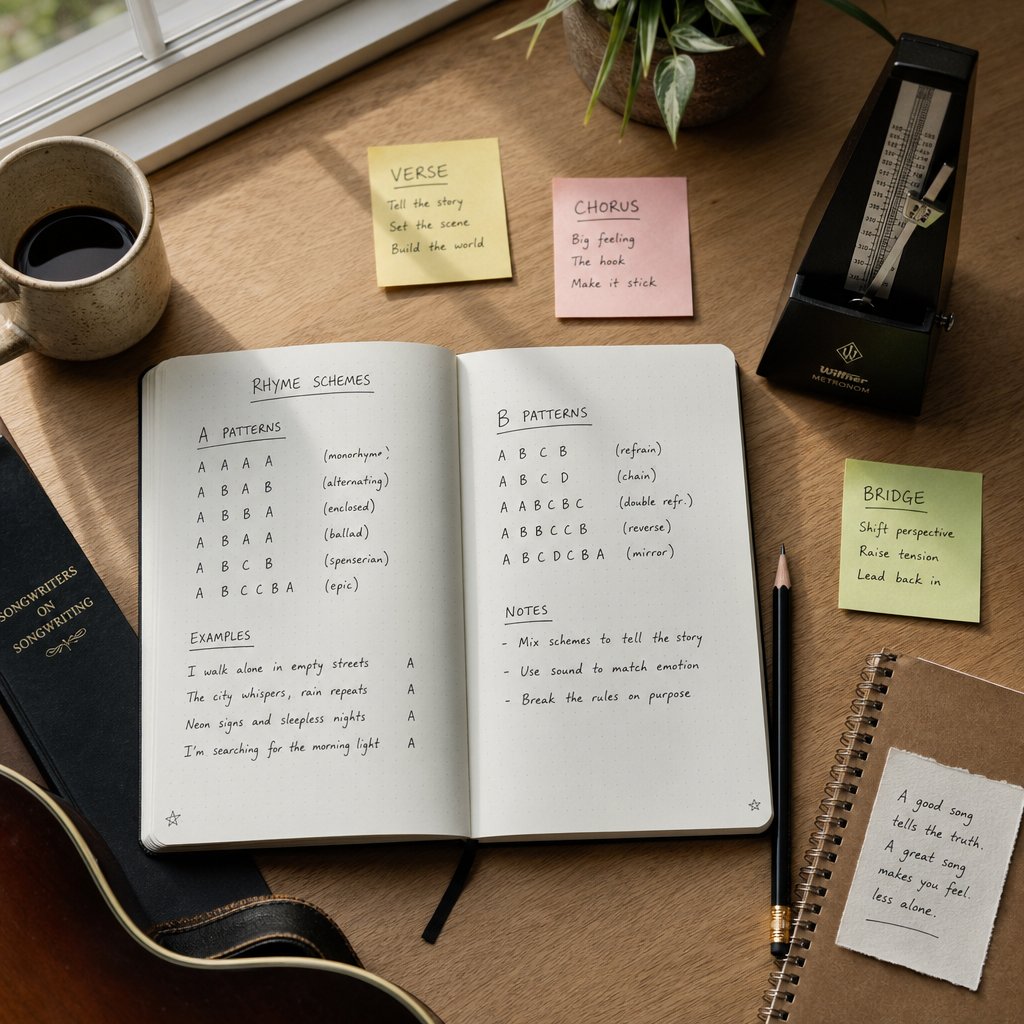
Rhyme, rhythm, and structure are the invisible scaffolding behind every song that sticks in your head. You might not consciously notice why the beat it lyrics feel so locked in, or why a random song generator sometimes produces something surprisingly catchy — but the answer almost always traces back to these fundamentals. Mastering them is what separates someone who writes lines from a true lyric maker who builds songs.
Rhyme Schemes and Why They Matter
A rhyme scheme is the pattern of end sounds across your lines, labeled with letters. Each letter represents a sound — lines that share a letter share a rhyme. The scheme you choose directly shapes how your lyrics feel to a listener, controlling momentum, tension, and resolution.
Here is how the most common patterns break down:
- AABB (couplets) — Lines 1 and 2 rhyme, lines 3 and 4 rhyme. Every pair resolves quickly, creating a punchy, driving feel. Rap verses lean on this heavily because it generates momentum. The risk? Predictability. If every couplet lands with the same thud, the lyrics start to feel mechanical.
- ABAB (alternating) — Lines 1 and 3 rhyme, lines 2 and 4 rhyme. The rhyme does not resolve for two lines, which builds a small amount of tension before paying off. Country, rock, and folk songwriting rely on this pattern because it supports storytelling without feeling rushed.
- ABCB (half-rhyme pattern) — Only lines 2 and 4 rhyme. This is the most forgiving scheme for narrative writing. It keeps lyrics grounded in natural speech, which is why so many ballads and story-songs use it. If you have ever searched for lirik give it away or studied talk dirty to me lyrics, you will notice how conversational phrasing often maps to this looser structure.
- Internal rhyme — Sounds echo within a single line rather than at the end. Think of it as a hidden layer of texture. A verse with only end rhymes feels flat compared to one where internal sounds weave across lines. Rap writers stack internal rhymes, assonance chains, and consonance patterns simultaneously — that density is part of what makes the writing feel athletic.
- Slant rhyme (near rhyme) — Similar but not identical sounds, like "home" and "bones." Slant rhyme gives you the feel of rhyme without the rigidity. Listeners register the sonic relationship without needing an exact match, which is why it sounds modern and unexpected. It also rescues you from the trap of bending your meaning just to land on a perfect rhyme.
Different schemes create different emotional textures. AABB feels resolved and confident. ABCB feels like someone talking to you. Slant rhyme feels restless and contemporary — you will hear it across everything from wifiskeleton songs to mainstream pop. The key insight from experienced songwriters is that rhyme should serve the song, not the other way around. The moment you twist your meaning to land on a word just because it rhymes, the scheme is working against you.
Syllable Count, Meter, and Flow
Imagine two lines in a verse. One has six syllables, the next has fourteen. Even with a great melody, that imbalance creates an awkward lurch — the singer either rushes through the long line or stretches the short one unnaturally. Consistent syllable counts across corresponding lines are what give lyrics their singability. Most contemporary songs fall between six and ten syllables per line, a range that supports natural phrasing and vocal comfort.
Genre shifts that range. Hip-hop and rap often push to ten to thirteen syllables per line, demanding rhythmic precision to avoid overcrowding. Folk and punk tend toward six to eight, keeping things accessible and rhythmically simple. When you study lil tecca dark thoughts lyrics or any dense rap verse, you will notice the syllable count is high but the stressed syllables still land on the beat — that is meter doing its work beneath the surface.
Meter refers to the pattern of stressed and unstressed syllables. In natural English speech, you already stress certain syllables without thinking about it. When those natural stresses align with the musical beat, the lyric feels effortless. When they clash, the listener feels friction even if they cannot name it. And here is where it gets interesting: intentionally breaking meter on a single word or phrase creates emphasis. A sudden extra syllable or a stress that lands off-beat draws the ear like a spotlight. The best lyric makers use this deliberately, not accidentally.
Structure ties all of this together. Different song forms create different emotional journeys, and knowing which one fits your song saves you from writing in circles. Here is a comparison of the most common frameworks:
| Structure | Pattern | Typical Genre Usage | Emotional Arc |
|---|---|---|---|
| Verse-Chorus-Verse-Chorus-Bridge-Chorus | ABABCB | Pop, R&B, rock, country | Builds narrative tension through verses, releases it in choruses, then shifts perspective in the bridge before a final emotional payoff |
| AABA | Verse-Verse-Bridge-Verse | Jazz standards, classic pop, Broadway | Establishes a strong melodic theme, departs briefly for contrast, then returns with deeper resonance |
| Verse-Prechorus-Chorus | A-PC-B (repeated) | Modern pop, indie, alternative | Uses the prechorus to build anticipation and smooth the intensity ramp from verse to chorus |
| Verse-Chorus (ABAB) | ABAB | Punk, folk, hip-hop | Simple oscillation between two contrasting sections; relies on lyrical variation in verses to sustain interest |
The ABABCB form dominates modern commercial music for a reason — it balances familiarity with surprise. But simpler structures like ABAB work just as well when the writing is strong. The structure is a container, not a formula. Pick the one that serves the emotional story you are telling.
Building an Emotional Arc
Structure is not just about sections on a page. It is narrative architecture. Each part of a song has a job in the emotional journey, and understanding those roles is what separates a collection of decent lines from an actual song.
Verses build tension. They carry the story, the details, the specific images that ground the listener in a situation. Each verse should advance the narrative or deepen the emotional stakes — if your second verse says the same thing as your first in slightly different words, you are treading water.
Choruses release that tension. They distill the emotional core into something repeatable and singable. The best choruses feel like the thing you have been waiting to say out loud. Musically, they are typically louder, fuller in arrangement, and use a larger melodic range than the verses.
Bridges shift perspective. They are the moment in the song where something turns — a realization, a contradiction, a new angle on the same emotion. A bridge that simply restates the verse or chorus in different words is a missed opportunity. The strongest bridges change the harmonic structure, alter the rhythmic feel, or introduce a lyrical idea that reframes everything the listener has heard so far.
When these three elements work together — verses that escalate, choruses that pay off, bridges that pivot — the song creates an arc that pulls the listener through from first line to last. That arc is what makes someone hit replay instead of skip, whether they are listening to a scenecore track or a country ballad.
These structural fundamentals apply universally, but the way you deploy them shifts dramatically depending on genre. Rap, pop, country, and folk each have their own conventions around rhyme density, hook style, and storytelling approach — and knowing those conventions is what lets you meet or deliberately break listener expectations.
Genre-Specific Lyric Conventions That Shape Great Songs
Every genre carries its own unwritten rulebook — expectations around rhyme density, storytelling, hook style, and theme that listeners absorb long before they can articulate them. A lyric maker who ignores these conventions is not being original; they are just confusing their audience. Understanding genre-specific patterns lets you either meet those expectations or subvert them on purpose, which is a very different thing than breaking rules you never learned.
How Rap, Pop, Country, and Folk Lyrics Differ
Genre shapes lyrics at every level, from how many rhymes you pack into a bar to whether your chorus tells a story or repeats a single phrase. A text analysis of Billboard hits from 1990 to 2021 found that R&B/hip-hop songs collectively contain more than twice as many words as country songs, even though both genres often share a verse-chorus structure. Rapping simply allows more words per measure than singing, and that density difference ripples through every other lyric choice.
Here is how the major genres compare across the dimensions that matter most when you sit down to write:
| Genre | Typical Structure | Rhyme Density | Common Themes | Storytelling Approach | Hook Style |
|---|---|---|---|---|---|
| Rap / Hip-Hop | Verse-hook-verse-hook-bridge-hook | Very high — stacked internal rhymes, multisyllabic chains, assonance | Braggadocio, narrative, social commentary, wordplay | First-person perspective, cinematic detail, rapid scene shifts | Short, rhythmic, often a repeated phrase or melodic chant |
| Pop | Verse-prechorus-chorus (repeated), often with a bridge | Moderate — end rhymes dominate, clarity over complexity | Love, heartbreak, empowerment, universal emotions | Emotional arc over narrative; feelings matter more than plot | Melodic, singable, designed for instant recall |
| Country | Verse-chorus-verse-chorus-bridge-chorus | Moderate — clean ABAB or ABCB patterns | Small-town life, love, loss, trucks, whiskey, family | Concrete storytelling with specific imagery and settings | Lyric-driven, often a clever turn of phrase or title payoff |
| Folk | Strophic (repeated verse) or verse-chorus | Low to moderate — conversational phrasing takes priority | Social issues, personal narrative, nature, journeys | Long-form narrative arcs, character-driven, linear progression | Refrain-based, communal, sometimes call-and-response |
| R&B | Verse-prechorus-chorus, often with ad-libs and vocal runs | Moderate — vowel-heavy lines that support melisma | Intimacy, desire, vulnerability, relationships | Sensory and emotional, present-tense, immersive mood | Melodic and vocal-performance-driven, often with ad-lib variations |
Notice how the same word — "hook" — means something different depending on genre. In rap, hook lyrics tend to be short, punchy, and rhythmically locked to the beat. In pop, the hook is a melodic earworm. In country, it is often a clever title line that recontextualizes with each chorus. If you have ever searched for a drill lyrics generator, you already sense that subgenres carry their own micro-conventions too — drill favors sliding hi-hats, minor keys, and blunt declarative lines that would feel out of place in a folk ballad.
Matching Your Lyrics to Genre Expectations
Genre conventions are not rules carved in stone. They are listener expectations — patterns your audience has internalized through thousands of hours of listening. As music researchers note, the emotional tone of a song, its instrumentation, and its tempo all steer genre perception, but lyrics are the element listeners consciously engage with. Meeting those expectations builds trust. Subverting them deliberately creates surprise. Ignoring them accidentally creates confusion.
Some genre-specific forms are worth studying on their own. Blues lyrics follow a distinctive AAB pattern: the first line states an idea, the second line repeats it (sometimes with slight variation), and the third line resolves or twists it. The Open University's analysis of blues structure highlights how this repetition is not laziness — it builds emotional weight through insistence, giving the singer room for expressive vocal variation on each pass. Blind Lemon Jefferson's "Hangman's Blues" uses this AAB form across every verse, and the repeated lines land harder each time precisely because the listener already knows the words.
Sea shanties use call-and-response, where a lead singer delivers a line and the group answers. That structural pattern is built for communal singing — it is functional music designed to synchronize physical labor. You will find echoes of it in gospel, in stadium rock anthems, and in any song where the audience is meant to sing back.
Freestyle and written hooks differ structurally too. A freestyle prioritizes rhythmic flow and in-the-moment wordplay, often sacrificing narrative coherence for sonic density. A written hook, by contrast, is engineered for memorability — every syllable is deliberate. If you have ever looked up sad lyrics of songs to understand why certain lines stick with you, the answer is almost always that the hook was crafted with genre-appropriate precision, not improvised.
Even searching for something as niche as a heavy metal song lyrics generator reveals how deeply genre shapes expectations. Metal lyrics lean on power imagery, minor-key phrasing, and rhythmic aggression that would feel absurd in a folk context. The words to lava song from a Disney film operate under completely different conventions — warmth, simplicity, open vowels for singability. Neither approach is better. They are just built for different listeners and different emotional jobs.
Knowing these conventions does not lock you into a formula. It gives you a map. You can follow it, take a detour, or chart an entirely new route — but you will always know where you are relative to what your listener expects. That awareness is what makes someone a stronger lyric maker regardless of whether they write every word by hand or use tools to generate starting points.
Genre tells you what your audience expects. Craft tells you how to deliver it — or how to surprise them. And the sharpest craft tool in any songwriter's kit is not structure or rhyme scheme but the quality of the language itself: metaphor, sensory detail, and the kind of emotional specificity that turns a decent lyric into one people tattoo on their arms.

Writing Techniques That Make Lyrics Hit Harder
Consider two ways to express loneliness. You could write "I feel so alone." Or you could write "your coffee's still warm on the counter." The first line states an emotion. The second one shows a specific, physical detail that lets the listener feel that emotion on their own. That gap between telling and showing is where forgettable lyrics become unforgettable ones — and it is the single most important craft skill any lyric maker can develop.
Metaphor, Sensory Language, and Concrete Detail
Strong lyrics trade in pictures, not declarations. Songwriter and educator Andrea Stolpe breaks lyric imagery into two categories: detail and imagery. Detail is literal and scene-setting — who, where, when. Imagery is figurative and symbolic, using comparisons that hold layers of meaning. Both are tools for emotional compression, and the best writers move fluidly between them.
Think about how Pharrell does not say "I'm happy." He says "I'm a hot air balloon that could go to space." That is metaphor doing the heavy lifting — a single image that communicates joy, weightlessness, and boundless energy all at once. Simile works the same way. When you compare a feeling to something tangible, you give the listener a handle to grab onto. Abstract emotions slip through the mind. Concrete images stick.
Sensory language deepens the effect. Sensory writing engages sight, sound, touch, taste, and smell to make a lyric feel lived-in rather than observed from a distance. Compare "she felt desperate and cold" to "she sat slumped against the kitchen cupboards, metal hinges stabbing into her back, hot tears streaking down her cheek." The first tells you what to feel. The second puts you in the room. Whether you are studying rod wave lyrics for their raw emotional weight or analyzing the song talk dirty to me lyrics for its swagger, the lines that land hardest almost always anchor themselves in something you can see, hear, or physically feel.
Showing versus telling is the principle underneath all of this. "She slammed the door and the pictures shook" communicates anger more powerfully than "she was angry" ever could. The action implies the emotion and trusts the listener to complete the circuit. That trust is what separates professional-grade writing from first-draft instincts — and it applies equally whether you are crafting lines by hand or refining output from a rap lyric generator.
Emotional Specificity Over Vagueness
Here is the paradox that trips up most beginners: the most universal lyrics are the most specific. You might think that keeping things vague — "I miss you," "my heart is broken" — makes a song relatable to more people. The opposite is true. Listeners project their own experiences onto precise details far more easily than onto generic sentiments. A line about a specific kitchen counter, a particular song on the radio, a coat that still smells like someone — those details become containers for the listener's own memories.
Kris Kristofferson opens "Sunday Morning Coming Down" with "I woke up Sunday morning with no way to hold my head that didn't hurt, and the beer I had for breakfast wasn't bad, so I had one more for dessert." Nothing about that is vague. It is one man
Common Lyric-Writing Mistakes and How to Fix Them
Knowing what makes lyrics powerful is only half the equation. You also need to recognize what weakens them — and these pitfalls show up everywhere, from first drafts scribbled in notebooks to output generated by AI tools. The mistakes below are not rare slip-ups. They are patterns that BMI workshop instructor Jason Blume has identified across more than 8,000 songs reviewed over nearly two decades of teaching. Whether you are working from songwriting prompts or freestyling over a beat, these are the traps that keep lyrics stuck at "pretty good" instead of great.
Forced Rhymes That Sacrifice Meaning
This is the most common beginner mistake, and it is easy to spot once you know what to look for: a line that exists only because it rhymes with the line before it. The meaning bends, the image blurs, and the listener feels something is off even if they cannot name why. As Blume explains in his BMI rhyming guide, conveying meaning and emotion is far more important than landing a perfect rhyme. The moment a rhyme is driving your content instead of your content driving the rhyme, you have lost the thread.
The escape route? Slant rhyme and near-rhyme. Pairing "home" with "stone" or "all" with "soul" gives you the sonic echo of rhyme without forcing your lyrics into contortions. Listeners register the relationship between those sounds subconsciously — they do not need an exact match to feel satisfied. You will hear slant rhyme across everything from pluggnb tracks to indie folk, and it almost always sounds more natural than a forced perfect rhyme. If you find yourself twisting a line just to land on a word, rearrange the sentence so it ends on a word that is easier to rhyme, or let the near-rhyme carry the weight.
Overused Imagery and Abstract Choruses
Fire and desire. Heart and apart. Rain and pain. If you have written any of these pairings, you are in good company — and that is exactly the problem. The Nashville Songwriters Association International flags cliche and predictable rhymes as one of the top mistakes their membership team encounters. When a listener can predict your next line before you deliver it, you have lost them. The same applies to AI-generated lyrics, which tend to default to the most statistically common pairings unless you steer them away.
Audit your lyrics with a simple test: could this line appear in any song without changing the meaning? If yes, it is not doing enough work. A chorus that says "you set my heart on fire" anchors the listener to nothing specific. But swap in a single concrete detail — a place, an object, a sensory moment — and the chorus suddenly belongs to your song and no one else's. You might study the lyrics of lava song from a Disney film or pull up the beat it lyrics lyrics to see how even massive pop hits ground their hooks in something tangible rather than abstract.
Structural Pitfalls
Blume calls it the redundant second verse — and it is one of the fastest ways to lose a listener. If your second verse essentially restates your first verse in different words, the song stalls. Each verse needs to advance the story or deepen the emotional stakes. His fix is straightforward: ask yourself "then what happened?" or "what else happened?" and let the answer become your next verse.
Bridges carry a similar risk. A bridge that simply rephrases the chorus without shifting perspective is a wasted opportunity. The whole point of a bridge is to turn the song — introduce a realization, a contradiction, a new angle that reframes everything before it. If your bridge could swap places with a verse and nobody would notice, it needs a rewrite.
Then there is the trap of writing lyrics that look impressive on paper but are impossible to sing naturally. NSAI's membership team emphasizes that if a lyric does not sound like something a person would actually say, listeners sense it immediately. Overly clever phrasing, unnatural word order, syllable clusters that choke the melody — these problems show up whether you are writing rap tex by hand, experimenting with a song title generator, or even exploring niche aesthetics you found after a late-night google hyperpop search. Read every line aloud. If it trips your tongue or sounds like something no human would say in conversation, simplify it.
Here is a quick-reference list of red flags to watch for during revision:
- Any line that exists primarily to complete a rhyme rather than advance meaning
- Cliche image pairings that could belong to thousands of other songs
- A second verse that restates the first verse without new information or narrative progression
- A bridge that echoes the chorus instead of shifting perspective or introducing a turn
- Lines with awkward syllable clusters, unnatural stress patterns, or phrases that require too much breath — use a tempo tapper or metronome to test phrasing against a beat
- Abstract choruses with no concrete image to anchor the listener emotionally
- Word order rearranged for the sake of rhyme that no one would use in natural speech
Catching these issues in revision is far easier than avoiding them in a first draft. The goal is not to write perfectly on the first pass — it is to develop the editorial eye that spots where a lyric is settling for "good enough" instead of reaching for something genuinely surprising. That same editorial instinct becomes even more critical when you start working with AI tools, where the raw output needs a human ear to separate the usable from the generic.
Comparing Every Approach to Making Lyrics
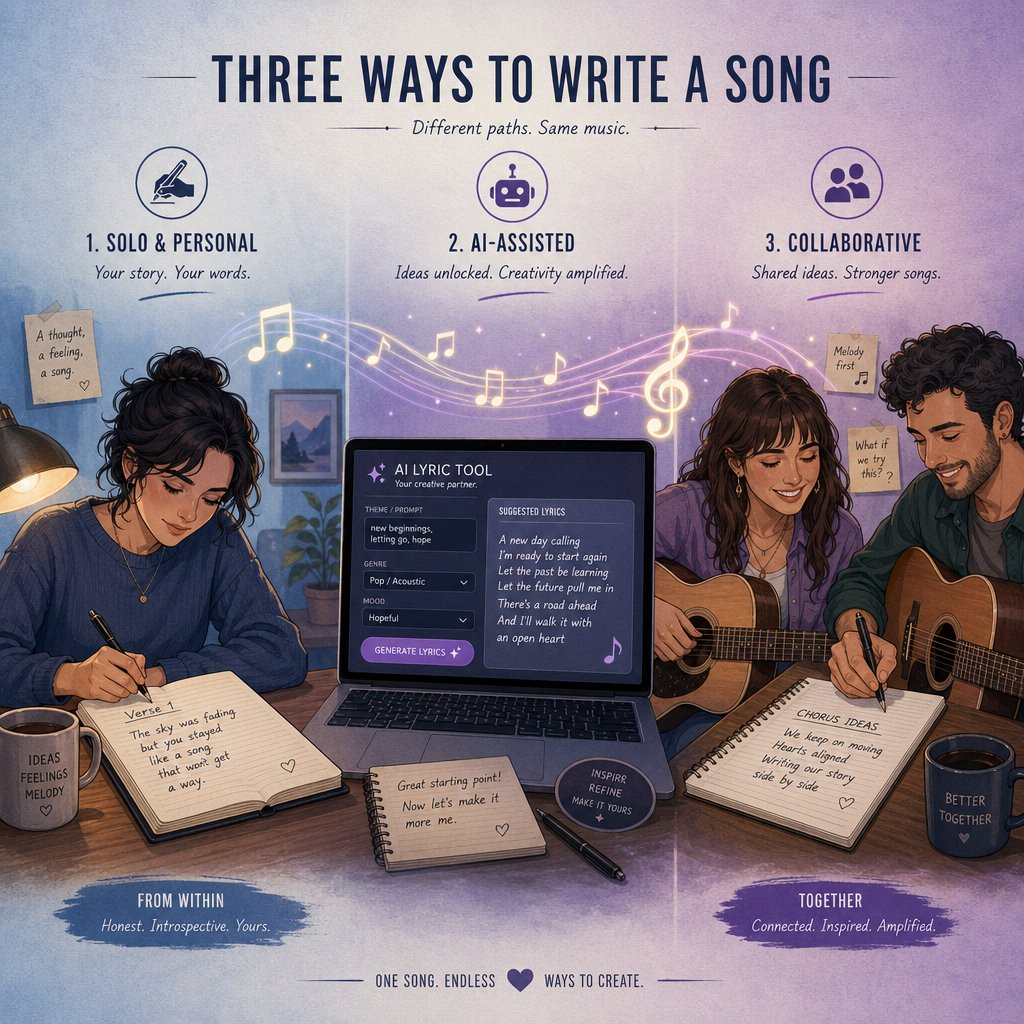
An editorial eye helps you spot weak lines — but it does not solve the problem of generating those lines in the first place. Every lyric maker eventually settles into a workflow, and that workflow usually falls into one of four broad approaches. Each has real strengths and real trade-offs, and understanding them side by side helps you pick the right method for where you are right now.
Writing from Scratch vs. Using Templates vs. AI Generators
Some writers stare at a blank page and love it. Others need a structural scaffold. Others want a machine to throw the first punch so they can counterpunch with their own voice. And plenty of hit songs — from the lirik crazy in love sessions to countless Nashville writing rooms — came from two or more people bouncing ideas off each other in real time. None of these approaches is inherently better. They solve different problems.
| Approach | Best For | Creative Control | Speed | Learning Value | Limitations |
|---|---|---|---|---|---|
| AI lyric generators (e.g., MakeBestMusic's Lyrics Generator) | Beginners needing a starting point; experienced writers breaking through blocks | Moderate — you guide themes, moods, and keywords, then shape the output | Very fast — usable drafts in seconds | Moderate — teaches structure by example, but craft skills develop through revision | Output needs human editing for emotional specificity and originality; quality depends on input quality |
| Writing from scratch | Experienced writers with strong craft foundations; anyone learning how to write a songtext deeply | Total — every word is yours | Slow — blank-page paralysis is real | Very high — forces you to internalize structure, rhyme, and phrasing | Time-intensive; easy to get stuck; no external input to challenge your habits |
| Structured templates and frameworks | Intermediate writers who understand basics but need organizational scaffolding | High — you fill in the framework with your own language | Moderate — structure is pre-built, but you still write every line | High — reinforces song architecture and section roles | Can feel formulaic if you rely on the same template repeatedly |
| Collaborative co-writing | Writers at any level who want diverse perspectives and real-time feedback | Shared — compromise is part of the process | Variable — depends on chemistry and scheduling | Very high — exposure to different styles, techniques, and instincts | Requires finding compatible partners; Musicians Institute notes that creative differences need active management |
You will notice that no single row wins every column. That is the point. A rapper name generator or an artist name generator might help with branding, but it will not write your verses. Similarly, an AI tool can hand you a draft in seconds, but it cannot feel what you feel. Each approach covers a gap the others leave open.
Combining Approaches for the Best Results
The most effective lyric makers rarely commit to just one method. A common workflow looks like this: start with an AI generator to break through blank-page paralysis, restructure the output using a template framework to tighten the emotional arc, then refine every line manually using the craft techniques covered earlier. Some writers reverse the order — they draft by hand, hit a wall, and then feed their theme into a tool like MakeBestMusic's Lyrics Generator to see how it interprets the same mood and keywords. The result is not a replacement for their voice but a second perspective that shakes loose new directions.
Collaborative co-writing layers on top of any of these. You might bring an AI-generated draft into a session the way you would bring a rough demo — not as a finished product but as a conversation starter. Research from Musicians Institute highlights that collaboration works best when roles are clear and both parties stay open to rewriting. The same principle applies when your co-writer is a piece of software: let it suggest, then decide what stays and what gets cut.
If you have ever typed help me lyrics into a search bar at 2 a.m. or scrolled through it will rain lirik looking for inspiration, you already understand the instinct behind this blended approach. You were not looking for someone to write your song. You were looking for a spark — a phrase, a structure, an angle you had not considered. AI tools formalize that instinct into a repeatable step in your process.
The real question is not which approach to choose. It is how well you use whichever output you get — and that depends entirely on how specific and intentional your inputs are when working with any tool.
Getting Better Results from AI Lyric Tools
Typing "sad song about love" into an AI lyric tool and expecting something usable is like walking into a recording studio and saying "make it sound good." You will get something back, but it will be generic, vague, and indistinguishable from a thousand other outputs. The gap between mediocre AI lyrics and genuinely useful drafts almost always comes down to one thing: the quality of what you put in.
Why Your Inputs Determine Your Output Quality
AI lyric generators work by pattern-matching against massive datasets of existing language. Harvard's HUIT research on prompting confirms the principle directly: generic prompts produce generic results, while specific, contextual inputs dramatically improve output quality. This applies whether you are learning how to write song lyrics with AI assistance or just trying to break through a creative block.
The difference is specificity at every level. Mood is not just "sad" — it is "quiet regret after a long relationship, the kind where nobody yelled but something still broke." Theme is not just "love" — it is "reconnecting with someone after years apart at a place you both used to go." Style is not just "rap" — it is the genre conventions you studied earlier: rhyme density, syllable count, hook structure. People often ask is google ai studio good at lyrics for songs, and the honest answer for any AI tool is the same: it is exactly as good as the instructions it receives.
Even niche use cases follow this rule. Writing lyrics for video games, for instance, requires specifying the emotional context of the scene, the character's perspective, and whether the track is ambient background or a cinematic set piece. Without that context, the AI defaults to the most statistically average output it can produce.
A Framework for Writing Better Prompts
Instead of guessing, use a repeatable structure every time you sit down with an AI tool. Prompt engineering guides for AI music recommend starting broad and layering in specifics — the same principle applies to lyric generation. Here is a step-by-step framework:
- Define the emotional core in one sentence — not a genre label, but the feeling itself. "The relief and terror of finally leaving a situation you stayed in too long" gives the AI far more to work with than "breakup song."
- Choose a specific narrative situation — who is speaking, where are they, what just happened? A lyric about standing in an empty apartment hits differently than one about driving away.
- Specify genre and structural preferences — verse-chorus-bridge, AABB rhyme scheme, eight-syllable lines. The conventions from earlier sections become direct instructions here.
- Include key images or phrases you want incorporated — a particular object, a sensory detail, even rhyming words with face or any other sound you want the tool to build around.
- Indicate rhyme scheme preference — perfect rhyme, slant rhyme, internal rhyme. This single detail steers the entire tonal quality of the output.
A tool like MakeBestMusic's Lyrics Generator is a natural fit for this framework because its interface already accepts themes, moods, and keywords as separate inputs. You are not typing a single sentence into a chat box and hoping for the best — you are feeding structured creative direction into a system designed to use it. The lyrics it generates become raw material: a first draft you then refine using the craft techniques covered throughout this article, from sensory specificity to singability testing.
That refinement step is where the real skill lives. Knowing how to write lyrics is ultimately about knowing how to evaluate them — which lines earn their place, which ones settle for "good enough," and when the whole thing is finally done. That editorial judgment deserves its own framework.
Your Lyric Self-Editing Checklist
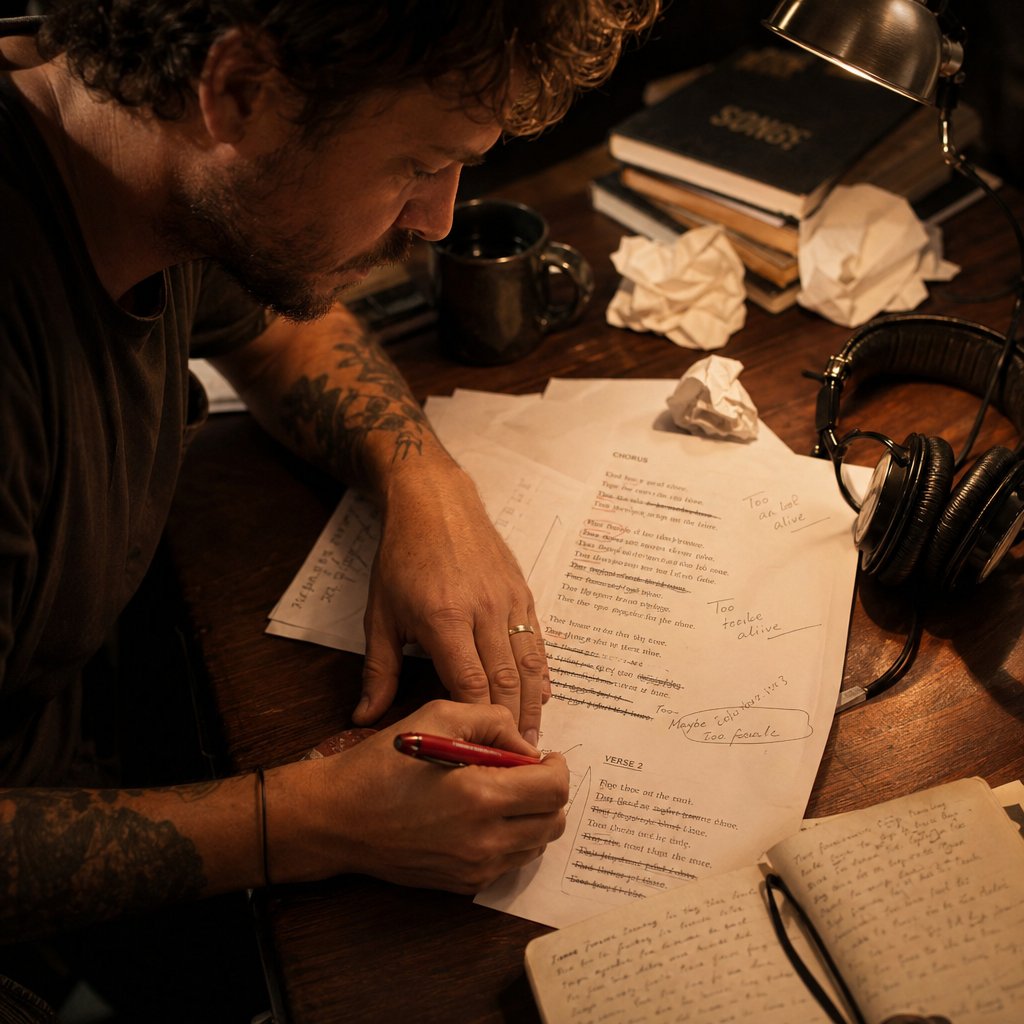
Generating a draft — by hand, through collaboration, or with a tool — is only the midpoint. The real work is deciding what stays, what gets cut, and when the lyric is actually finished. Most writers either revise endlessly or ship too early, and both habits cost you songs. What you need is a repeatable framework that takes the guesswork out of revision.
The Five-Point Lyric Revision Test
Run every draft through these five filters before you call it done. Whether you wrote every syllable yourself, pulled freestyle lyrics from a late-night session, or used a tool to generatelyrics as a starting point, the same standards apply.
- Clarity — Can a first-time listener follow the emotional thread without the music? Strip away the melody in your head and read the words cold. If the narrative or feeling gets lost, the lyric is leaning on music that does not exist yet. Even something as straightforward as the pokemon theme tune lyrics works because the emotional throughline is unmistakable on the page alone.
- Originality — Flag every line that could appear in any song without changing its meaning. Those are placeholders, not lyrics. Replace them with something only your song could say. Search for pop out lyrics carti or dirty water lyrics and notice how the lines that stick are the ones too specific to belong anywhere else.
- Singability — Read every line aloud at tempo. Listen for awkward consonant clusters, unnatural stress patterns, or phrases that leave no room to breathe. If a line trips your tongue, it will trip a singer's voice. This catches problems no screen review ever will.
- Emotional resonance — Does each section serve the arc? Verses should build tension, choruses should release it, and the bridge should shift perspective. If a verse treads water or a bridge just restates the chorus, cut or rewrite it. Every section needs to earn its place.
- Structural coherence — Zoom out and check the whole shape. Do the verses escalate? Does the chorus pay off the setup? Does the bridge actually turn the song? A lyric can pass the first four tests line by line and still feel flat if the architecture does not hold together as a single journey.
When to Stop Editing
Revision has diminishing returns, and songwriter educator Songwriter Theory puts it plainly: songwriters tend to fall into one of two camps — those who are overly picky and never let go, or those who could benefit from a bit more patience refining an okay song into a great one. Knowing which camp you belong to is half the battle.
A practical signal that you are done: your edits start trading sideways instead of moving up. When you swap one word for another of equal quality, or rewrite a line only to circle back to the original, you have hit the point of diminishing returns. Ship it. Write the next one. The craft skills you built on this song carry forward into every song after it — whether you are writing lyrics to someone to lava for a personal project or chasing something entirely new.
The goal of any lyric maker — human or AI-assisted — is not a perfect lyric but an honest one that connects with a listener.
Perfection is a trap. Connection is the job. Run your checklist, trust your ear, and let the song go.
