


What Is a Melody and Why Does It Matter
You hear a handful of notes drifting from a passing car, and suddenly you're ten years old again. That's melody at work. But what is a melody, really, once you strip away the nostalgia and look at the mechanics?
The Core Melody Definition in Music
If you want to define melody in music, start here: it is the linear sequence of musical tones perceived as a single coherent line, shaped by the rise and fall of pitch and organized in rhythm. Think of it as a horizontal thread of notes — one after another, not stacked on top of each other like a chord. That horizontal quality is what separates melody from harmony or texture.
A melody is a succession of pitches in rhythm, perceived as a single, expressive musical line — the part of a song you can hum, sing, or whistle from memory.
That definition covers both the textbook precision and the plain-language reality. When someone asks "whats a melody?" they usually mean the part of a song that sticks. And they're right. Melody is the element most listeners latch onto first, even if they can't name a single chord underneath it.
Why Melody Matters More Than You Think
So what does melody mean for the way we actually experience music? It's the primary carrier of emotion and memorability. Research published in PMC found that after hearing unfamiliar melodies just twice, adults recognized them over a week later — and even seven-year-olds formed lasting memories of those tunes. Melody, in other words, writes itself into your brain faster and deeper than almost any other musical element.
It also works differently depending on where and how you listen. A definition melody scholars use in a Western conservatory doesn't fully capture what melody means inside an Indian raga or a hip-hop verse built on pitched vocal inflection. What is melody in a Gregorian chant versus a pop hook? The core idea — a sequence of pitches heard as one line — holds, but the rules, the shapes, and the emotional goals shift dramatically across genres and cultures.
This article unpacks all of that. Whether you came here for a quick answer or want to understand why certain note sequences haunt you for years, you're in the right place.
The Origin and Evolution of Melody Through Music History
The word itself has a story worth telling. If you look up the melody name meaning, you'll land in Ancient Greece — and the answer is more interesting than most dictionaries let on.
From Ancient Greece to Modern Pop Hooks
The English word melody traveled a long road: from Greek meloidia (a combination of melos, meaning song, and aoide, meaning singing) through Late Latin melodia and Old French melodie before arriving in Middle English in the 13th century. Here's the surprising part — the original melodic meaning had nothing to do with a sequence of notes on paper. It referred to the act of singing itself, the making of song. Voice and tune were inseparable. The melody English speakers use today as a technical music term started life as something far more human and physical.
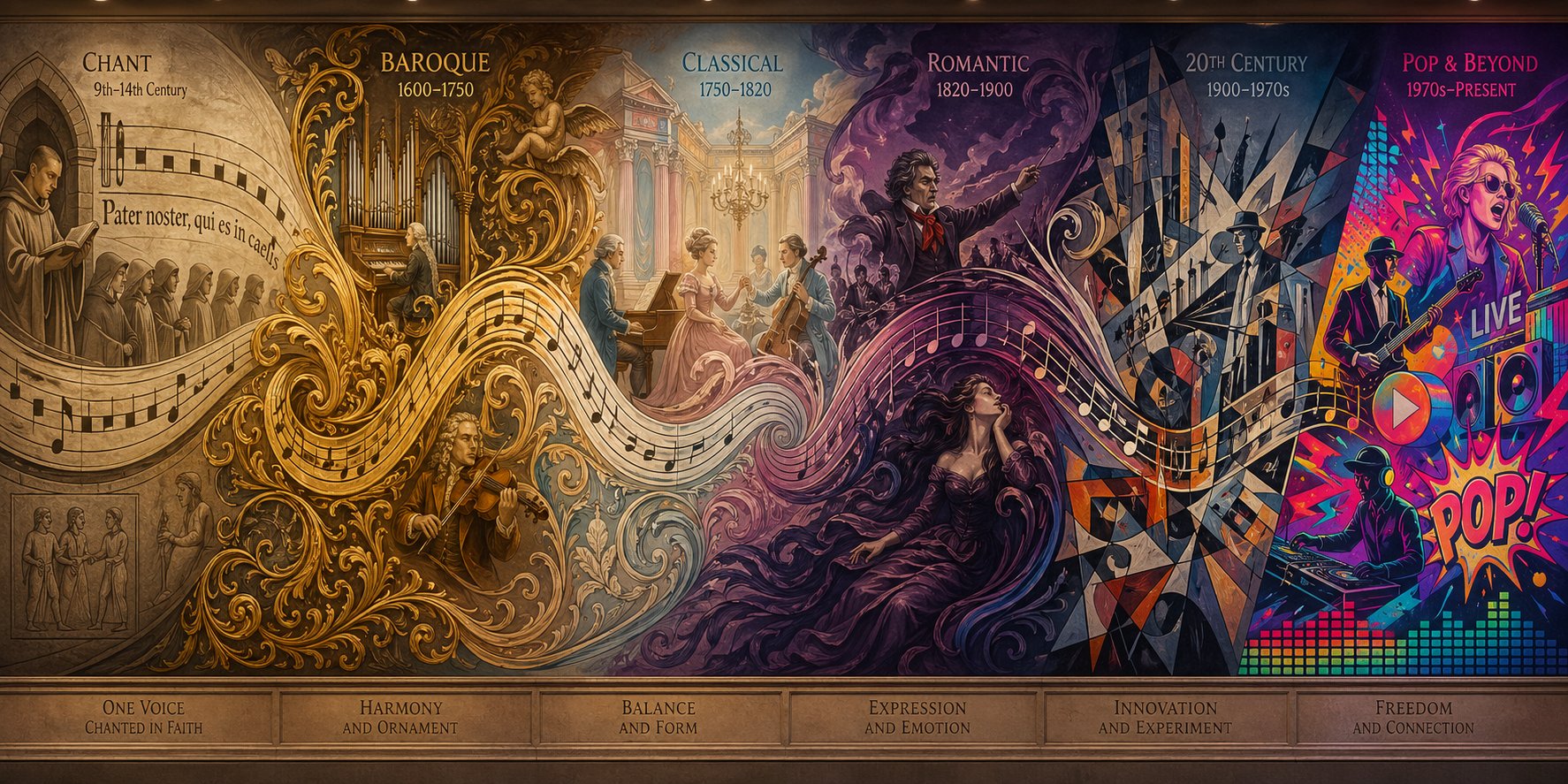
Over the centuries, that meaning narrowed. What counts as "melodic" — and even what people mean when they use the word "melodically" — has been reshaped by every major shift in Western music. Imagine how different each era's idea of a memorable melodic line actually sounded:
| Era | Melodic Style | Recognizable Example |
|---|---|---|
| Medieval (c. 500–1400) | Monophonic, modal, speech-driven rhythm | The hymn Veni, veni, Emmanuel — a single vocal line with balanced rise and fall, no harmony underneath |
| Baroque (c. 1600–1750) | One melodic voice among equals in counterpoint | A Bach fugue subject — a short melodic idea passed between voices, never quite finishing before the next voice enters |
| Classical (c. 1750–1820) | Melody as the star, supported by clear harmonic accompaniment | The opening horn theme of Schubert's "Great" Symphony No. 9 — a self-contained, singable eight-bar tune |
| Romantic (c. 1820–1900) | Long, lyrical, emotionally expansive lines | Bellini's "Casta Diva" from Norma — a soaring vocal phrase that stretches syllables into expressive arcs |
| 20th Century | Melody deconstructed, atonal, fragmented | Schoenberg's serial compositions — melodic lines built from tone rows rather than tonal resolution |
| Modern Pop & Hip-Hop | Hook-driven, repetitive, earworm-focused | A pop chorus designed for instant recall — short, catchy, and built around a narrow vocal range |
Notice the arc. Melody went from being inseparable from the voice, to one thread in a polyphonic weave, to the undisputed star of the show, to something composers deliberately pulled apart — and then pop music glued it back together as a hook.
How the Definition Has Shifted Over Time
This history reshapes how we understand the meaning of melodic itself. When Haydn called melody "the charm of music, and that which is most difficult to produce," he meant something specific: a balanced, self-contained tune that satisfies the ear. Schoenberg, working a century and a half later, longed for people to "know my tunes and whistle them" — yet his compositional method deliberately avoided the tonal resolution Haydn took for granted. The melodically meaning of "tuneful" had fractured.
That fracture kept widening. Hip-hop producers redefined melody through pitched vocal inflection and sampled loops, proving a melodic line doesn't need to follow classical rules to stick in your head. In Spanish-speaking music communities, the melody significado carries similar weight — melodía still points to the singable, memorable thread — but the sounds filling that role now range from Auto-Tuned rap verses to reggaeton hooks built on synthesized patterns.
What ties all these eras together is a single thread: melody is whatever the ear follows as a coherent line. The rules around that line keep changing, but the listener's instinct to track it doesn't.
That instinct raises a practical question — if melody is the line we follow, how exactly does it differ from the other elements surrounding it?
Melody vs Harmony vs Rhythm
Music never hands you its elements on separate plates. When you listen to a song, melody, harmony, rhythm, and counterpoint arrive tangled together — and that's exactly why so many people struggle to tell them apart. If you've ever wondered "what is music melody, and how is it different from everything else I'm hearing?" a side-by-side breakdown makes the answer click fast.
Melody vs Harmony vs Rhythm at a Glance
Each of these four elements operates along a different axis of the musical experience. The table below separates them across the dimensions that matter most:
| Element | Definition | Direction | Function | Plain-Language Example |
|---|---|---|---|---|
| Melody | A sequence of single pitches arranged in rhythm, perceived as one expressive line | Horizontal — notes move forward in time, one after another | Carries the identity and emotion of a piece; the part you hum | The vocal line you sing along to in a pop chorus |
| Harmony | Two or more notes sounding simultaneously to create chords and tonal context | Vertical — notes are stacked at the same moment in time | Adds depth, mood, and emotional color beneath or around the melody | The guitar chords strummed underneath a singer's voice |
| Rhythm | The pattern of sounds and silences arranged over time, giving music its pulse and momentum | Temporal — governs when sounds occur and how long they last | Provides structure, energy, and forward motion | The drum pattern that makes you tap your foot or nod your head |
| Counterpoint | The practice of arranging multiple melodic lines to sound pleasing when played at the same time | Horizontal and vertical simultaneously — independent lines interact | Creates complexity and conversation between melodies | Two vocal parts weaving around each other in a Bach fugue |
Notice the key distinction: melody moves horizontally, harmony stacks vertically, rhythm controls the time axis, and counterpoint lives in the intersection of horizontal lines meeting vertically. That's why a single piece of melodic music can contain all four at once without any of them losing their identity.
How These Elements Work Together
Imagine you're watching a film. The melody is the storyline — the thread you follow from scene to scene. Harmony is the mood lighting — it doesn't tell you what happens, but it shapes how every moment feels. Rhythm is the pace of the narrative — quick cuts for tension, slow pans for reflection. And counterpoint? That's a second storyline running alongside the first, sometimes echoing it, sometimes pulling in a completely different direction.
In practice, what is melody in music without these companions? A bare, unaccompanied line — possible, but rare. Music melody almost always rides on a rhythmic foundation. Every note in a melodic phrase lands at a specific point in time, with a specific duration. Change the rhythm beneath the same pitches and you get an entirely different feel, even though the notes haven't moved. Harmony, meanwhile, colors the melody's emotional meaning. The same ascending phrase can sound triumphant over a major chord or tense and unresolved over a diminished one.
There's one more distinction worth untangling — one that dictionary entries tend to gloss over. People often use "melody" and "tune" interchangeably, but they aren't quite the same thing. A tune implies a complete, self-contained melodic idea — something with a clear beginning, middle, and end that you could whistle start to finish. Melody, on the other hand, is broader. It can refer to any pitched sequence, including fragments, motifs, or incomplete phrases. A two-note hook is a melody. A four-bar riff is a melody. Neither is necessarily a tune. When someone asks "what is a music melody?" the answer covers everything from a full singable theme to the briefest pitched gesture — and that range is exactly what makes the concept so flexible across genres.
Flexibility, though, raises a follow-up question. If melody can take so many shapes, what are the specific types — and how do you tell them apart?
Types of Melody Every Musician Should Recognize
Not all melodies move the same way. Some climb steadily upward, others leap across wide intervals like a conversation full of surprises. Recognizing these patterns is the first step toward understanding what is a melody in a song at a structural level — and it gives you a vocabulary that works whether you're analyzing a Beethoven symphony or a pop chorus.
Conjunct, Disjunct, and Other Melody Types
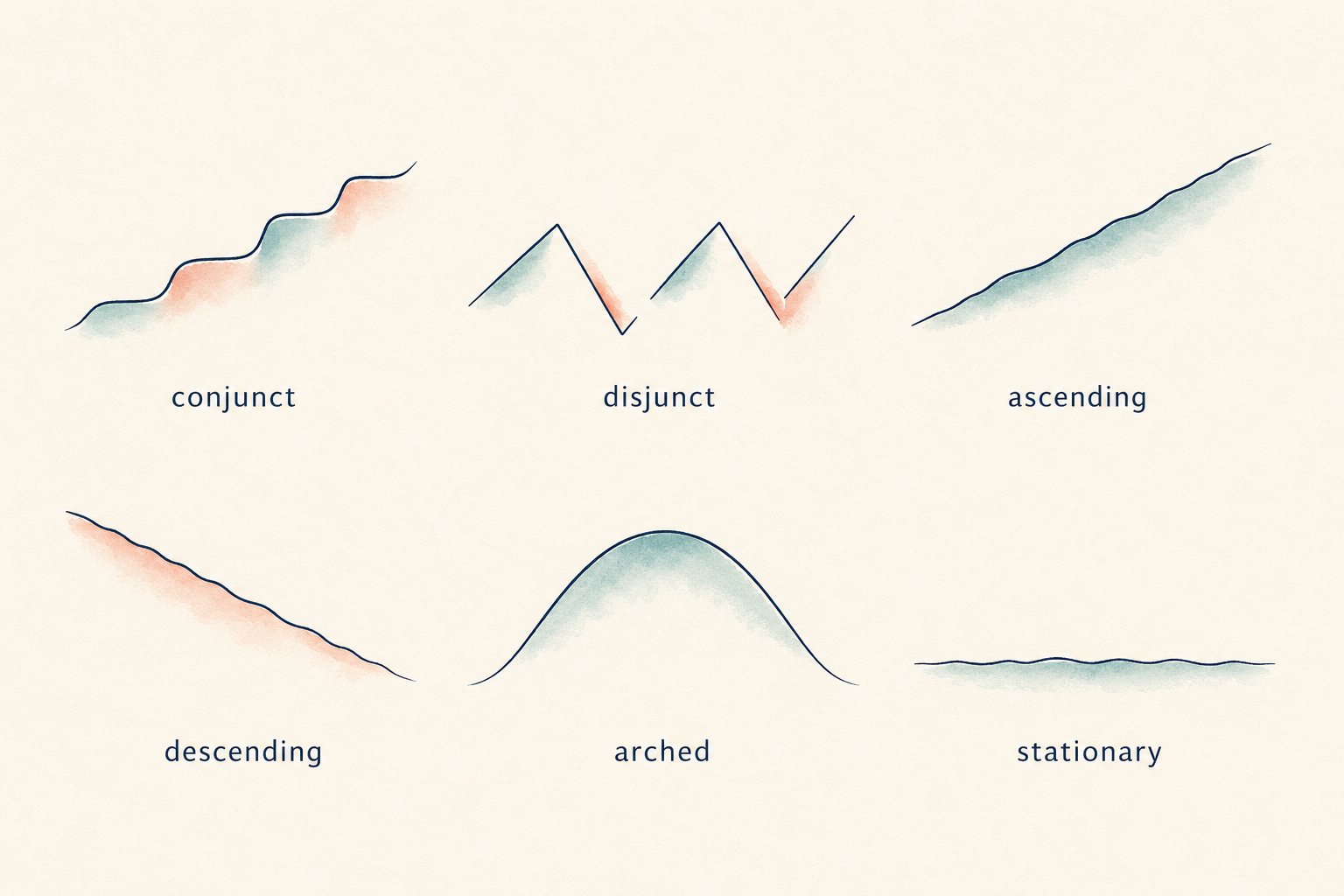
The melodic definition of each type comes down to how notes move in relation to one another — by small steps, large leaps, or somewhere in between. Here are the six core types you'll encounter across melody songs in every genre:
- Conjunct (stepwise motion) — The melody moves from one note to the nearest adjacent note, creating a smooth, flowing line. As Berklee Online explains, most vocal melodies rely on conjunct motion because it's the most natural and comfortable to sing. Beethoven's "Ode to Joy" is a classic example — the theme glides gently up and down the scale with almost no skips, which is exactly why nearly anyone can hum it.
- Disjunct (leaping intervals) — The melody jumps between notes that are far apart, producing a more dramatic, angular sound. Think of Mariah Carey's "Emotions," where the vocal line rapidly shifts from one pitch to another across wide intervals. Disjunct melodies are harder to sing but often more memorable because those leaps grab your attention.
- Ascending — The overall direction of the melody moves upward in pitch over time, building energy and tension. The opening of Richard Strauss's Don Juan surges upward with a sense of momentum that mirrors the character's restless ambition.
- Descending — The melody trends downward, often creating a feeling of resolution, calm, or melancholy. "Fly Me to the Moon" features a descending harmonic minor passage that gives the melody its signature wistful elegance.
- Arched (rises then falls) — The melody climbs to a peak and then descends, forming a smooth arc. "Yesterday" by The Beatles follows this shape — the vocal line ascends through the verse before gently falling back, mirroring the reflective mood of the lyrics.
- Stationary (hovering around one pitch) — The melody stays close to a single note, relying on rhythm and delivery for interest rather than pitch movement. Katy Perry's chorus in "Never Really Over" more or less revolves around the same pitch, yet the staccato delivery and contrast with the verses keep it compelling.
Most melodic songs don't stick to one type exclusively. A verse might use conjunct motion to feel conversational, then the chorus leaps into disjunct territory for emotional impact. That mix is part of what makes the melody of a song feel dynamic rather than predictable.
Understanding Melodic Contour and Phrase Structure
Knowing the types is useful, but the real analytical power comes from a handful of music theory terms that tie them together. You don't need a conservatory degree to use these — just clear definitions and a willingness to listen closely.
Melodic contour is the overall shape of a melody's rise and fall. Picture drawing a line that follows the pitch of each note: does it arch upward, dip down, zigzag, or stay flat? That line is the contour. As Study.com puts it, contour is the sequence of movements between a melody's individual notes — and it's one of the most useful properties for identifying why one melody feels different from another. John Williams' "Leia's Theme" from Star Wars, for instance, uses a wide-ranging contour with all four types of melodic motion (step up, step down, leap up, leap down) packed into just the first two bars, which is a big part of why it sounds so expressive.
Phrase structure is how a melody divides into musical sentences. Just like spoken language has clauses and pauses, a melodic phrase usually encompasses a complete musical statement and comes to some point of resolution — rhythmically, tonally, or both. Short phrases often group together to form longer ones, much like sentences build into paragraphs.
Tessitura refers to the range where most of a melody's notes sit — not the absolute highest or lowest note, but the zone the melody lives in most of the time. A melody with a high tessitura feels bright and intense; a low tessitura feels warm and grounded.
Cadence is how a melodic phrase ends. Some cadences feel final and resolved, like a period at the end of a sentence. Others feel open and unfinished, like a question mark — pulling you forward into the next phrase.
Together, these four concepts give you a reusable framework for describing what is the melody of a song in precise, meaningful terms. You can apply them to any piece of music, in any genre, and walk away with a clear picture of how that melody works. The melodies meaning something to you emotionally is one thing — being able to articulate why they work is another level entirely.
That "why" goes deeper than shape and structure, though. Some melodies don't just work — they refuse to leave your head. The question is what separates a melody you forget in seconds from one that loops in your brain for days.
What Makes a Melody Memorable
You've probably experienced it: a few notes from a song you haven't heard in years suddenly surface in your mind, fully intact, playing on repeat. What is that melody doing differently from the thousands of others your brain quietly discarded? The answer lies in a specific set of psychological and structural principles that operate across every genre — from a Beethoven theme to a pop chorus.
The Science Behind Melodic Memorability
Sticky melodies aren't accidents. They share a handful of traits that make them easy for the brain to encode, store, and retrieve:
- Repetition with variation — The melody repeats a phrase but changes one element each time — a slightly different rhythm, a single altered note, an unexpected syncopation. Pure repetition gets boring. Pure novelty is hard to follow. The sweet spot is a pattern your brain can predict almost perfectly, with just enough surprise to keep attention locked in.
- Mostly stepwise motion with occasional leaps — Great melodies follow stepwise lines punctuated by a few well-placed leaps. The steps feel natural and singable; the leaps create moments of drama that stand out from the surrounding motion.
- Rhythmic interest and syncopation — A melodic melody isn't just about pitch. Placing notes slightly off the expected beat — syncopation — gives a phrase a sense of momentum and groove that flat, on-the-beat phrasing can't match.
- Balanced phrase length — In Western music, phrases of four or eight bars dominate because they align with how listeners naturally group time. Shorter phrases feel incomplete; longer ones lose the thread.
- Resolution to a tonal center — The melody eventually "comes home" to a note that feels stable and final. That sense of arrival is what gives a phrase its satisfying close — and what makes you want to hear it again.
These principles aren't genre-specific. A film score leitmotif and a three-note jingle both leverage the same cognitive machinery. The melody that sticks is the one that balances familiarity with surprise, giving your brain just enough structure to hold onto.
Contour, Intervals, and the Earworm Effect
A large-scale study published by the American Psychological Association analyzed thousands of reported earworms and found that the stickiest songs share a common melodic contour — typically a rise-then-fall pattern, the same arch shape heard in "Twinkle, Twinkle Little Star." The opening riff of Maroon 5's "Moves Like Jagger," one of the top-named earworms in the study, follows exactly this contour. Familiar shapes give the brain a template it already knows how to process, which is why arch-shaped melodies tend to lodge themselves so deeply.
Interval structure matters just as much. The research found that earworm melodies contain unusual intervals — unexpected leaps or more repeated notes than the average pop song — layered on top of that common contour. Think of the instrumental break in "My Sharona" by The Knack: the melody's interval pattern deviates just enough from expectation to grab attention without becoming hard to follow.
There's also a vocal dimension. Research from the University of Montreal found that people recognize sung melodies significantly better than instrumental ones — even melodies sung without any melody lyrics, just a series of "la la la." The researchers concluded that a melodic voice is inherently more engaging to the human brain, likely because voices are biological, communicative signals we're wired to track. Singability, in other words, isn't just a nice quality in a melody — it's a memory multiplier.
The melodies that haunt you longest are the ones you could sing back — because the act of imagining yourself singing them is exactly what locks them into memory.
This is why the melody in a song you love often outlasts every other element. You may forget the chord progression, the production style, even the lyrics — but the melodic line persists, sometimes for decades. It's not magic. It's contour, intervals, and the human voice working together inside a structure your brain was built to remember.
These memorability principles hold remarkably steady within Western pop and classical traditions. But melody doesn't obey a single set of rules worldwide — and the way it functions shifts dramatically when you cross genre and cultural boundaries.
How Melody Works Across Genres and Cultures
Ask "what is the melody of music?" in five different rooms and you'll get five different answers — not because anyone is wrong, but because melody reshapes itself to fit the genre it lives in. The melody music definition that works for a pop chorus barely applies to a jazz solo, and it falls apart entirely when you step outside the Western tradition. That flexibility is the concept's greatest strength.
Melody in Pop, Jazz, Hip-Hop, Electronic, and Film
Each genre hands melody a different job description. Here's how the role shifts:
Pop treats melody as king. Hooks are short, repetitive, and built within a narrow vocal range so that anyone can sing along. The chorus is where the melodic peak lands — a burst of energy designed for instant emotional connection. As Gilbert School of Music notes, pop melodies are structured around catchy phrases and predictable patterns that transcend language barriers, which is exactly why a pop earworm can circle the globe in a week.
Jazz flips the script. A jazz performance typically opens with a clear melodic statement called the "head," then the musicians depart from it — improvising new lines over the underlying chord changes in real time. The melody becomes a launchpad, not a destination. Every performance of the same piece sounds different because the improvised melodic lines reflect the player's mood, skill, and spontaneous choices.
Hip-hop redefined what melody even sounds like. Traditionally rooted in rhythm and lyrics, the genre has increasingly woven melodic elements into its DNA through pitched vocal inflection, sung hooks, and sampled loops. Producers layer orchestrations and unconventional samples to create melodic textures that enhance the storytelling without overshadowing the lyrical focus. The result is a melody definition music theorists didn't anticipate — one where the line between rapping and singing blurs deliberately.
Electronic music builds melody from synthesized leads and arpeggiated sequences — rapid, repeating note patterns generated by software. These melodies are often looped and layered, designed to build tension before a climactic "drop." The repetition makes them infectious; the production tools make them sonically limitless.
Film scoring uses melody as a storytelling device through leitmotifs — short melodic ideas tied to a specific character, place, or emotion. When you hear a particular phrase and immediately picture a character on screen, that's a leitmotif doing its work. The melody carries narrative meaning beyond the notes themselves.
Melody Beyond the West — Raga, Maqam, and Pentatonic Traditions
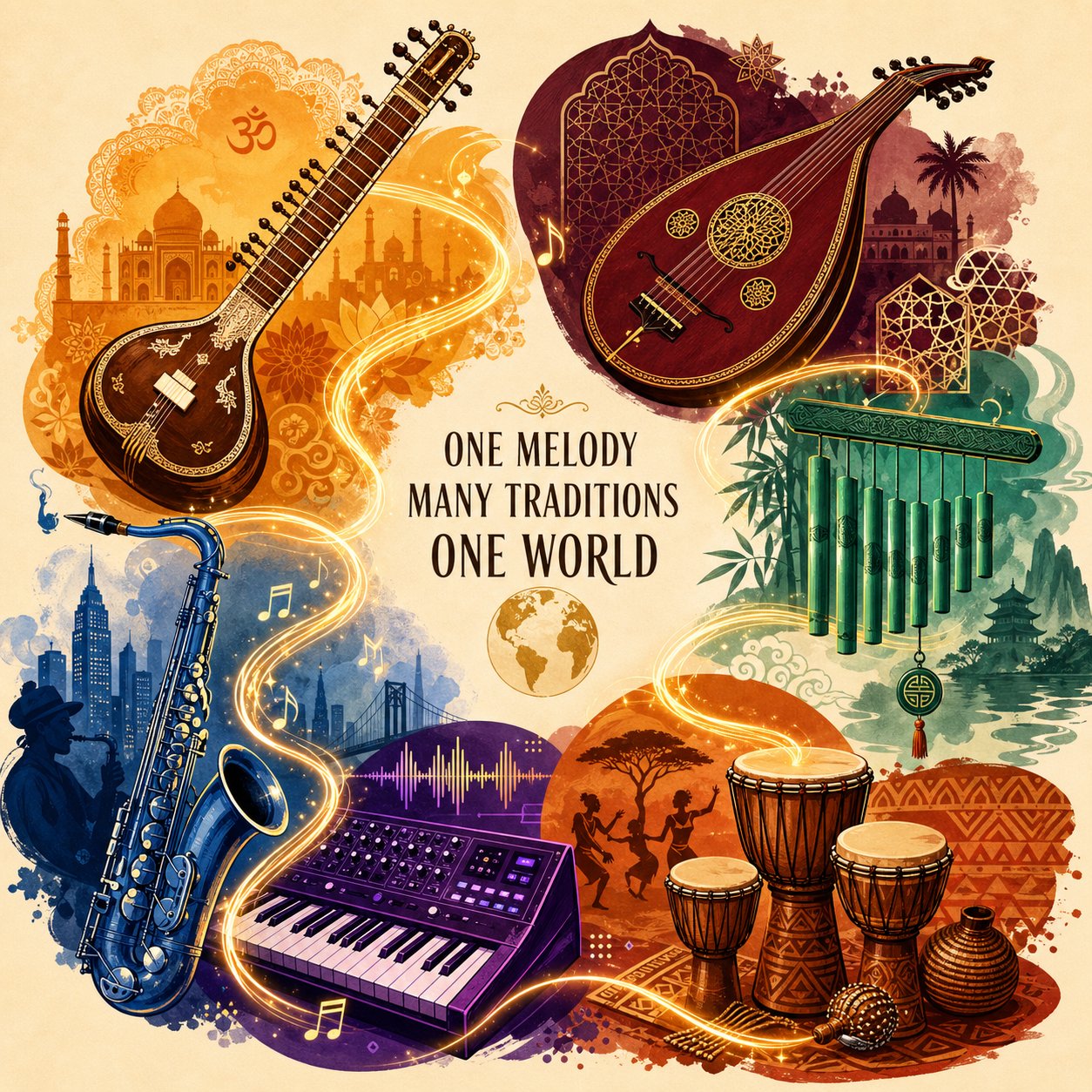
The melody of music definition most people learn is rooted in European theory — scales, keys, tonal resolution. But step outside that framework and you'll find traditions where melody operates under entirely different logic. A computational analysis of 8,200 field recordings from 137 countries published in PLOS One found that sub-Saharan African nations had the most distinctive melodic outliers globally, with Zimbabwe's mbira-based music ranking as the most unique melodic tradition in the dataset. Melodious music, it turns out, doesn't follow one blueprint.
- Indian classical raga — A raga is not a scale. It's a complete musical personality that specifies which notes to use, how to move between them (different patterns ascending versus descending), which notes to emphasize, characteristic phrases that define its identity, and even the time of day it should be performed. Where a Western scale gives you raw materials, a raga gives you the materials plus detailed instructions for emotional delivery.
- Arabic and Turkish maqam — Maqam systems use microtonal intervals — quarter tones and three-quarter tones that fall between the keys of a piano. These aren't imprecisions; they're intentionally and precisely placed pitches that create emotional textures Western equal temperament simply cannot produce. Each maqam carries a distinct mood: Maqam Rast suggests joy and groundedness, while Maqam Hijaz evokes longing.
- East Asian pentatonic traditions — Built on five-note scales rather than seven, these melodic systems produce a sound that feels open and spacious. The pentatonic framework appears across Chinese, Japanese, Korean, and Southeast Asian music, each culture shaping it with distinct ornamentation and phrasing conventions.
- West African call-and-response — Melody here is communal and conversational. A lead singer or instrument states a melodic phrase, and a group answers with a complementary line. The melody isn't a solo act — it's a dialogue, built for participation rather than passive listening.
When you define melody music broadly enough to include all of these traditions, the Western textbook version starts to look like one dialect in a much larger language. The melody meaning music carries in Mumbai, Istanbul, or Accra is shaped by tuning systems, cultural rules, and performance contexts that European theory never accounted for.
All of these genres and traditions use melody — but they also generate a cloud of related terms that people frequently mix up. Motif, hook, riff, theme, leitmotif — each one connects to melody differently, and the distinctions matter more than most glossaries let on.
Related Terms Explained
People use these words interchangeably all the time — motif, hook, riff, theme — as if they all mean the same thing. They don't. Each one describes a different slice of melodic material, and knowing the distinctions sharpens how you talk about music, write about it, and create it. If you've ever searched a melody thesaurus looking for the right word and come away more confused, this section is for you.
Motif, Theme, Hook, Riff, Lick, and Leitmotif
These six terms sit on a spectrum from the smallest melodic fragment to the most narratively loaded one. The table below maps each term against its definition, its relationship to melody, and a well-known example you can verify by ear:
| Term | Definition | Relationship to Melody | Well-Known Example |
|---|---|---|---|
| Motif | The shortest recognizable melodic idea — often just a few notes or a rhythmic cell | A building block within a melody; motifs provide cohesion by recurring and transforming throughout a piece | The four-note "da-da-da-dum" opening of Beethoven's Symphony No. 5 — three short notes followed by one long note that drives the entire work |
| Theme | A complete melodic statement that anchors a composition or a section of one | A fully formed melody that serves as the main identity of a piece; longer and more self-contained than a motif | The main theme of John Williams' Star Wars — a sweeping, recognizable line that represents the saga's heroic spirit |
| Hook | The catchiest melodic fragment in a song, designed for instant recall | A melody's most memorable moment — the part that gets stuck in your head and often defines the song commercially | The opening vocal phrase of Carly Rae Jepsen's "Call Me Maybe" — short, bright, and almost impossible to forget after one listen |
| Riff | A repeated melodic-rhythmic pattern, usually instrumental | A looping melodic idea that provides rhythmic and harmonic foundation; often the backbone of rock and blues songs | The guitar riff opening "Smoke on the Water" by Deep Purple — a repeating pattern that is the song's identity |
| Lick | A short melodic phrase used during improvisation | A pre-learned melodic fragment a musician inserts into a solo; less compositional, more conversational | A blues guitarist bending a quick pentatonic phrase between vocal lines — a stock melodic gesture pulled from muscle memory |
| Leitmotif | A melody associated with a specific character, place, or idea in opera or film | A melody that carries narrative meaning beyond its notes — it tells you who or what is present in the story | The Imperial March from Star Wars — every time Darth Vader appears, those ominous notes announce him before the camera does |
Notice the pattern: motif is the seed, theme is the full flower, hook is the petal everyone remembers, riff is the root that repeats, lick is a clipping traded between players, and leitmotif is a flower planted inside a story. They're all melody — just different sizes and functions of it.
Melody Synonyms and Related Vocabulary
Beyond these technical terms, you'll run into a cluster of everyday words used as synonyms for melody. If you've ever browsed the Merriam-Webster thesaurus entry for melody, you've seen a long list — but not all of those words are truly interchangeable. Here's where the subtle differences land:
- Tune — The closest synonym for melody, but slightly narrower. A tune implies a complete, singable, self-contained melodic idea. Every tune is a melody; not every melody is a tune (a two-note motif, for instance, isn't one).
- Air — An older, more literary word for a simple, song-like melody. You'll encounter it in folk music and classical vocal writing. It carries a lighter, more delicate connotation than "melody."
- Strain — Refers to a passage or section of melody within a larger piece. When someone says "the opening strains of the national anthem," they mean the first melodic phrases — not the whole thing.
- Line — A musician's shorthand for a melodic sequence, especially in jazz and classical contexts. "Play the line" means follow the horizontal pitch sequence.
- Theme — As covered above, this doubles as both a synonym and a more specific term. In casual conversation it works as another word for melody; in analysis, it means the principal melodic idea of a composition.
One question that comes up in vocabulary searches is whether there's a true melody antonym. Strictly speaking, there isn't a single opposite — but "noise" (unpitched, unorganized sound) and "silence" come closest conceptually. Some musicians point to "drone" — a sustained, unchanging pitch — as the functional opposite, since melody requires movement and a drone deliberately avoids it.
Having the right vocabulary is one thing. Knowing how to use it — how to look at any melody and describe exactly what it's doing — is where passive knowledge turns into a practical skill.
How to Describe a Melody Like a Music Pro
Most people can tell you whether they like a melody. Far fewer can tell you why. The gap between feeling something and articulating it is where conversations about music stall — and where songwriters, students, and reviewers lose precision. Learning how to describe a melody in music comes down to having a repeatable process and the right words that describe melody with clarity.
A Reusable Framework for Describing Any Melody
Next time you hear a melodic line you want to analyze — in a song, a film score, a jazz solo — run it through these five steps. They work for any genre, any era, any tradition:
- Identify the contour. Does the melody rise, fall, arch, or stay level? Trace the pitch movement with your finger in the air if it helps. The shape you draw is the contour — and it's the single fastest way to characterize how a melody moves.
- Assess the motion. Is the movement mostly conjunct (stepwise, smooth) or disjunct (leaping, angular)? A mix of both is common, so note where the leaps happen — they're usually the moments that grab attention.
- Note the range and tessitura. How wide is the distance between the lowest and highest notes? And where does the melody spend most of its time? A melody with a narrow range and low tessitura feels intimate; a wide range with a high tessitura feels dramatic and exposed.
- Describe the rhythm and phrasing. Are the phrases long and flowing, or short and punchy? Is the rhythm steady and predictable, or does syncopation push notes off the expected beat? Rhythm shapes how a melody feels just as much as pitch shapes how it sounds.
- Characterize the mood. This is where descriptive adjectives do the heavy lifting. Don't just say "it sounds nice" — say it sounds wistful, buoyant, restless, or brooding. Precision here is what separates a casual listener from someone who can communicate about music effectively.
To make that fifth step easier, here's a curated set of words that describe melody organized by category:
- Contour words: ascending, descending, arched, undulating, angular, stepwise, leaping, static
- Mood words: haunting, lyrical, plaintive, buoyant, soaring, brooding, tender, exuberant, melancholic, triumphant
- Technical terms: conjunct, disjunct, chromatic, diatonic, syncopated, legato, staccato, ornamented, pentatonic, modal
When someone asks "what does melodic mean?" they're often reaching for this exact vocabulary without knowing it exists. To define melodic is to describe music that has a clear, expressive, singable quality — and the definition melodic carries shifts depending on which of these descriptors you pair with it. A "melodic" jazz solo and a "melodic" pop hook share the label but sound nothing alike, because the contour, motion, and mood behind each one are completely different.
Putting Description Into Practice
Pick a melody you know well — a favorite chorus, a film theme, a lullaby from childhood. Run it through the five steps above. You'll notice that even familiar music reveals new details when you listen with a framework instead of just an emotional reaction. How do you describe melody in a way that someone else can picture it without hearing it? You name the shape, the motion, the range, the rhythm, and the feeling. That combination is specific enough to distinguish one melody from thousands of others.
This kind of precise description is valuable whether you're a songwriter pitching an idea to a collaborator, a music student writing an analysis, or a reviewer trying to capture why a particular track works. It turns a vague impression into a communicable insight — and that's a skill worth practicing.
If you want to go beyond analyzing existing melodies and start experimenting with structures yourself, tools like MakeBestMusic's Melody Maker let you generate melodies and hear how different contours, intervals, and phrase lengths actually sound. It's a hands-on way to turn this framework from passive theory into active exploration — test conjunct versus disjunct motion, try an arched contour against a descending one, and build an intuitive feel for how each choice changes the character of a melodic line.
Describing melody precisely is one thing. Building one from scratch — applying these same principles as a creator rather than an analyst — is the natural next step.

From Theory to Practice
Everything covered so far — contour, motion types, phrase structure, memorability principles — answers the question "what is a melody in music?" from the outside looking in. Creating one flips the perspective. You're no longer asking what the melody is; you're deciding what it will be. And the good news is that the same concepts that help you analyze a melody also serve as a blueprint for writing one.
Core Principles for Writing Your Own Melodies
You don't need years of formal training to write something compelling. What you need is a clear starting point and a few guardrails. These principles, drawn from the structural and psychological patterns explored throughout this article, give you both:
- Start with a simple contour shape. Sketch the rise and fall of your melody before worrying about specific notes. An arch — up, peak, down — is the most naturally satisfying shape, but a gradual ascent or a descending line works too. The shape gives your melody direction from the first note.
- Use mostly stepwise motion with occasional leaps. As composer John Proulx recommends, construct your contour primarily with 2nd and 3rd intervals, reserving leaps of a 4th or more for moments of emphasis. Most melodic leaps resolve in the opposite direction via stepwise motion — leap up, then step down — which keeps the line singable.
- Build in repetition with variation. Repeat your opening phrase, but change one thing: shift a note, alter the rhythm, extend the ending. This is how a short idea grows into a full melody without losing coherence. Beginner songwriters often underestimate the structural unity that repetition provides — without it, successive ideas sound random and unrelated.
- Keep phrases singable and balanced. Aim for a range of roughly an octave to an octave-and-a-half, and structure your phrases in 2-bar or 4-bar units. If you can hum it comfortably, a listener can remember it. That's the melody meaning in music at its most practical — a line the human voice can follow.
- Resolve to a tonal center. End your melody on or near the "home note" of your key. That sense of arrival is what makes a phrase feel complete rather than abandoned. As a general rule, approach the final note by step — either from the note just above or just below — for the smoothest landing.
These five principles won't write the melody for you, but they'll keep you from the two most common traps: melodies that wander aimlessly and melodies that repeat without evolving. Understanding what a melody is structurally — its contour, motion, phrasing, and resolution — is the foundation. Experimentation is where real learning happens.
Tools That Help You Explore Melodic Ideas
Reading about conjunct motion and arch contours is one thing. Hearing the difference they make is another. This is where melody generation tools become genuinely useful — not as a replacement for creativity, but as a sandbox for testing ideas quickly.
MakeBestMusic's Melody Maker is a practical resource for exactly this kind of exploration. It lets you generate melodies, adjust their structures, and hear how the theory concepts from this article play out in real sound. Curious what is this melody going to sound like with disjunct leaps instead of smooth steps? Generate both versions and compare. Want to test whether an arched contour really feels more memorable than a descending one? You can hear the answer in seconds rather than guessing on paper.
The tool works as a low-barrier entry point for turning passive knowledge into active songwriting ideas. You can experiment with different contour shapes, phrase lengths, and interval patterns — then drag the results into your own creative process and reshape them. It's especially useful if you're still building confidence, because it gives you raw melodic material to react to rather than forcing you to generate everything from a blank page.
What are melody writing skills, really, if not the ability to hear possibilities and choose between them? Whether you use a generation tool, an instrument, or just your voice humming into a phone, the process is the same: propose a line, evaluate it against the principles above, and refine. What is melody songs are built from? Exactly this cycle — idea, judgment, revision — repeated until something clicks.
Melody is both an art and a learnable craft. The definition gives you the concept. The history gives you context. The theory gives you tools. But what is the melody you haven't written yet? That's the question only experimentation can answer — and there's never been a better time to start.
