

What Does Monophonic Mean and Why It Matters
You have probably seen the word monophonic pop up in a music theory class, a synth product listing, or an old stereo manual and wondered whether it means the same thing in each case. The short answer: yes, at its core, it always does.
What Monophonic Actually Means
Monophonic describes any music, instrument, or audio signal consisting of a single melodic line or voice without accompaniment or harmony.
That one-sentence monophonic meaning covers a surprising amount of ground. A monk chanting a Gregorian melody alone in a cathedral? Monophonic. A Minimoog firing off a bass line one note at a time? Also monophonic. A single-channel audio recording played through a PA speaker? Same word, same root idea.
The Cambridge Dictionary defines the term in two distinct senses: first, producing or consisting of a single note or melody; second, recording or playing sound as a single signal. Both senses trace back to the concept of one voice doing all the work.
People often confuse monophony with terms like homophonic or polyphonic. The difference is straightforward. Monophonic texture in music means a single unaccompanied line. Homophonic means one melody supported by chords. Polyphonic means multiple independent melodies happening at once. If you can hum the entire piece in one breath without missing a part, you are likely hearing monophonic sound in its purest form.
Why One Word Spans So Many Contexts
The reason a single term works across music theory classrooms, synthesizer studios, and audio engineering labs comes down to its Greek DNA. "Monos" means single, "phone" means voice. That pairing is flexible enough to describe a medieval chant, a hardware synth's voice architecture, and a mono audio channel all at once.
This article unpacks every major context where the term applies, from its ancient linguistic roots and centuries of musical history to the specific synthesizers that made "monophonic" a selling point. Whether you are a student sorting out texture types, a producer shopping for your first analog synth, or just curious after a late-night search, you will find the full picture here.
The Greek Origins Behind the Word Monophonic
That Greek DNA mentioned above is worth pulling apart, because once you see how the word is built, the monophonic definition practically memorizes itself.
Greek Roots of Monophony
The term combines two ancient Greek elements: monos, meaning "single" or "alone," and phōnē, meaning "sound" or "voice." Etymonline traces phōnē further back to the Proto-Indo-European root *bha-, "to speak, tell, say." So at its most literal level, monophonic means "one voice speaking."
Here is where it gets interesting. That same root system generates every major musical texture term you will encounter. Swap out the prefix, and the meaning shifts:
- Mono- (single) + phōnē = monophonic — one melodic line
- Poly- (many) + phōnē = polyphonic — multiple independent lines
- Homo- (same) + phōnē = homophonic — voices moving in the same rhythm
- Hetero- (different) + phōnē = heterophonic — simultaneous variations of one melody
When someone asks what is monophonic versus polyphonic vs monophonic's other cousins, the Greek prefixes give you the answer before you even open a textbook. One voice, many voices, same rhythm, different takes. The language does the heavy lifting.
How the Term Entered Western Music Vocabulary
Ancient Greek musical practice was overwhelmingly single-voiced. Melodies were performed one line at a time, and the concept was so default it barely needed a name. The vocabulary traveled through medieval Latin scholarship, where church scholars used Greek-derived terms to categorize the sacred chant traditions they were preserving and codifying.
The English word monophony appeared in print around 1890, coined as the clear counterpart to polyphony, which had entered English in 1864. The adjective monophonic followed in music contexts by 1885, describing compositions where one voice-part predominates. Then, in 1958, the word took on a second life entirely when it was coined as the opposite of stereophonic in audio engineering.
A few decades later, synthesizer manufacturers borrowed the same term again to describe instruments that produce only one note at a time. An ancient Greek concept, filtered through medieval church music and Victorian-era musicology, suddenly appeared on spec sheets for electronic keyboards. That layered history is exactly why the word shows up in so many different conversations today — and why each of those conversations deserves its own closer look.

A Brief History of Monophonic Music Across Cultures
Knowing where a word comes from is one thing. Hearing it echo across three thousand years of music is something else entirely. The single-voice tradition did not stay frozen in ancient Greece — it traveled through sacred rituals, royal courts, and folk gatherings on nearly every continent, shaping how people made music long before anyone thought to layer voices on top of each other.
Ancient and Sacred Monophonic Traditions
The oldest surviving piece of notated music, the Seikilos epitaph from around the first or second century CE, is a single melodic line carved into a tombstone in what is now Turkey. No harmony, no accompaniment — just one voice preserved in stone. That fragment captures the default mode of ancient Greek music: melody existed on its own terms.
Fast forward to the early medieval Western church, and you find the tradition that most people picture when they hear the monophony definition in a classroom. Gregorian chant — a single unaccompanied vocal melody sung by monks in unison — became the dominant musical form across Italy, Ireland, Spain, and France. Even when dozens of voices filled a cathedral, they all sang the same line at the same pitch or at the octave, keeping the texture purely monophonic. Composers like Hildegard of Bingen pushed the expressive boundaries of this form, writing hymns such as "O Viridissima Virga" that proved a single melodic line could carry extraordinary emotional depth.
These sacred traditions were not unique to Europe. The Islamic call to prayer, or adhan, follows a single unaccompanied vocal line. Indian raga alapana unfolds as a solo melodic exploration over a drone. Japanese shakuhachi repertoire features a lone bamboo flute tracing meditative phrases. Across cultures, the impulse was the same: one voice, given all the space it needs.
Troubadours and Secular Monophonic Song
By the eleventh century, the single-voice tradition stepped outside the church walls. Troubadours in southern France and trouveres in the north composed the first major body of European secular song — poems about chivalry and courtly love set to melody. Guilhem IX, the seventh count of Poitiers and the earliest known troubadour, was writing monophonic songs as early as the 1070s.
Manuscripts of roughly 300 troubadour and 1,400 trouvere songs survive, all notated as single-line melodies without written-out accompaniment. Performers likely improvised percussion or doubled the tune with fiddles and pipes, but the composed core remained one voice. The tradition spread quickly, inspiring the Minnesanger in Germany and the trovadorismo in the Iberian Peninsula. When you compare monophonic vs polyphonic writing from this era, the contrast is stark: polyphonic organum was developing in cathedrals at the same time, yet secular song stayed resolutely single-voiced for centuries.
Monophonic Texture in Modern and Popular Music
Imagine the opening seconds of a film score — a solo trumpet playing a slow, unaccompanied melody over a black screen. That is monophonic texture alive and well in modern media. You will also hear it in the a cappella vocal intro of a pop ballad before the band kicks in, or in a folk singer's unaccompanied first verse designed to pull you in close.
Call-and-response patterns in gospel and West African vocal traditions offer another example. When an entire congregation sings the same line back to a leader in unison, the texture stays monophonic regardless of how many voices are involved — the polyphonic definition requires independent melodic lines, and unison singing does not qualify. Even heterophony, where singers slightly ornament the same melody in real time, sits closer to monophony than to true polyphony.
These modern examples matter because they show that single-voice writing is not a relic. It is a deliberate choice — one that clears harmonic clutter and puts every melodic interval under a spotlight. That quality of focused, unadorned expression is exactly what drew synthesizer designers to borrow the same term for an entirely different kind of instrument.
Monophonic vs Polyphonic vs Homophonic vs Heterophonic
That focused, single-voice quality is easier to appreciate when you can hear how it differs from the other three musical textures. Most music theory resources toss around these terms without giving you a quick way to tell them apart. Here is that quick way.
Defining the Four Musical Textures
To define monophonic in the simplest terms: it is a single unaccompanied melody. One line, no harmony, no chords underneath. Whether one person sings it or a hundred sing it in unison, the texture stays the same.
The other three textures add layers in different ways:
- Homophonic — one melody supported by chordal accompaniment. Think of a singer strumming a guitar. The melody leads, and everything else fills in the harmony beneath it.
- Polyphonic — two or more independent melodic lines happening at the same time. To define polyphonic clearly, picture a round like "Row, Row, Row Your Boat" where each voice enters at a different point and carries its own version of the melody simultaneously.
- Heterophonic — multiple performers playing variations of the same melody at once. The result sounds like slightly different versions of one tune layered on top of each other, common in Middle Eastern and East Asian folk traditions.
The simplest way to identify any musical texture: count the independent melodic lines and check whether harmony is present.
Side-by-Side Texture Comparison
When you are trying to pin down the monophonic meaning in music versus its relatives, a direct comparison helps more than paragraphs of explanation. The table below lines up all four textures across the dimensions that matter most.
| Texture | Melodic Lines | Harmony Present? | Historical Example | Modern Usage |
|---|---|---|---|---|
| Monophonic | One | No | Gregorian chant, Seikilos epitaph | A cappella solo intros, unaccompanied flute in film scores |
| Homophonic | One (with chordal support) | Yes | Bach chorales, hymn arrangements | Pop vocals over guitar chords, most contemporary songs |
| Polyphonic | Two or more (independent) | Often, but not required | Palestrina masses, Bach fugues and inventions | Jazz improvisation, contrapuntal film scoring |
| Heterophonic | One (with simultaneous variations) | No (incidental only) | Middle Eastern ensemble music, Javanese gamelan | Folk jam sessions, Debussy-influenced orchestral passages |
Notice how monophonic texture sits at one end of the spectrum — the most stripped-down option — while polyphony sits at the other, layering independent voices into something dense and complex. Homophony and heterophony fall between those poles, each adding a different kind of depth to a single core melody.
How to Identify Each Texture by Ear
Reading definitions is useful, but polyphonic perception meaning really clicks when you train your ears. Next time you listen to a piece of music, run through these steps:
- Listen for the melody. Can you identify one clear melodic line? If that line is all you hear — no chords, no second melody, no accompaniment — the texture is monophonic.
- Check for harmonic support. If chords or a bass line back up that single melody, you are hearing homophony. The melody leads, and everything else follows its rhythm.
- Count independent melodies. If you hear two or more distinct tunes weaving around each other at the same time, that is polyphony. Try humming along with just one line — if you lose track of the others, multiple independent voices are at work.
- Listen for melodic "blurring." If several performers seem to play the same tune but with slight rhythmic or ornamental differences, creating a shimmering, slightly out-of-sync effect, you are hearing heterophony.
A practical test: play any song and pause it at different moments. The texture can shift within a single track. A pop song might open with a monophonic vocal line, move into homophony when the band enters, and briefly touch polyphony during an instrumental bridge. Recognizing those shifts is what separates casual listening from truly hearing what the music is doing.
These four categories describe how melodies and harmonies interact in acoustic and composed music. But what happens when the constraint of "one voice" is not a compositional choice but a hardware limitation built into the instrument itself?
Monophonic Synthesis and the Synths That Defined It
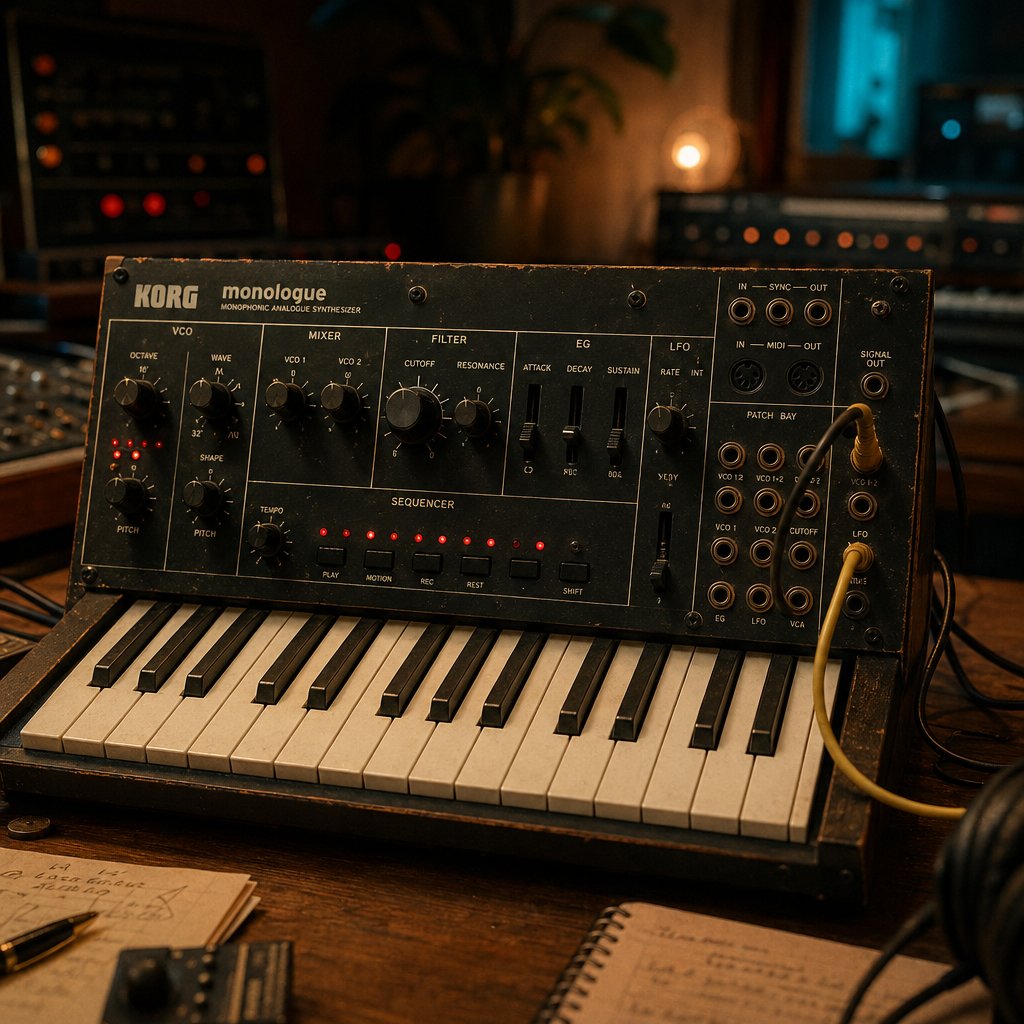
In music theory, the difference between homophony vs monophony is a compositional choice — a songwriter decides how many independent voices to use. In synthesizer design, that choice is made by the hardware itself. A monophonic synthesizer can only produce one note at a time, no matter how many keys you press. It is not a limitation born from laziness. It is an architecture with a sound and character all its own.
What Makes a Synthesizer Monophonic
Picture the signal path inside a mono synth: one or more oscillators (often tuned together or slightly detuned for thickness) feed into a single filter, which feeds into a single amplifier, shaped by a single envelope. That entire chain exists once. Press a key, and this one voice activates. Press a second key while holding the first, and the synth has to make a decision — because it only has one voice to give.
This is the core distinction. If you have ever wondered what is polyphonic in music hardware terms, the answer is straightforward: a polyphonic synth duplicates that entire voice path — oscillators, filter, amplifier, envelope — for every simultaneous note it can play. A four-voice poly has four complete signal chains. A mono synth has exactly one. That single path is why mono bass lines sound so fat: all the oscillator energy is focused on a single note with zero compromise.
Voice Priority and Note Allocation Modes
So what happens when you press two keys at once on a one-voice instrument? The synth follows a built-in rule called note priority, and the mode it uses shapes your playing technique more than you might expect.
There are three common schemes, detailed extensively by Sound On Sound:
- Last-note priority — the most recent key pressed always takes over. This is the most intuitive mode and the one most modern mono synths default to.
- Low-note priority — the lowest held key wins. The Minimoog uses this system. It rewards clean technique: hold a low note too long, and the next higher note will not speak until you release it.
- High-note priority — the highest held key wins. Common on Japanese synths like the Roland SH-09, Korg MS-20, and Yamaha CS-series. It lets higher notes cut through immediately, which suits fast lead playing.
These are not just technical footnotes. Low-note priority on a Minimoog, for example, enables a classic soloing trick: hold a bass note with your left hand, play a melody with your right, and every time you lift a finger the pitch drops back to that held root. Add a touch of portamento — where the pitch slides smoothly between notes — and you get expressive swoops that are impossible on a polyphonic instrument. Portamento works naturally here because there is only ever one voice gliding from one pitch to the next.
Iconic Monophonic Synthesizers
A handful of instruments turned these single-voice constraints into some of the most recognizable sounds in recorded music:
- Minimoog Model D — three oscillators, a legendary four-pole ladder filter, and the warm, heavy tone that set the standard for every mono synth that followed. Released in 1971, it remains the reference point for analog bass and lead sounds.
- Roland TB-303 — originally a bass accompaniment box, its squelchy, resonant filter became the backbone of acid house in the late 1980s. Entire genres owe their existence to this one-note-at-a-time machine.
- Roland SH-101 — a slider-based interface with a built-in sequencer and arpeggiator that made it a staple of early techno and synth-pop. Simple, hands-on, and unmistakably '80s.
- Sequential Circuits Pro-One — essentially a single-voice distillation of the Prophet-5, with deep modulation routing that gave players extensive expressive control from just two oscillators.
- Arturia MiniBrute — a modern entry that proved the mono format still has commercial and creative life, pairing a raw Steiner-Parker filter with an all-analog signal path at an accessible price.
What connects every instrument on that list is a shared design philosophy: do one thing at a time, and do it with total commitment. The question of what is a homophonic texture — melody plus chordal support — does not even arise here, because these machines were never built to play chords. They were built to deliver a single voice with as much weight and expression as possible. And that deliberate narrowness is exactly what pushed the word "monophonic" out of music theory textbooks and onto studio gear lists worldwide.
Monophonic Beyond Music Theory
Studio gear lists were not the last stop. The same word made the jump into everyday consumer technology — twice — and both times it carried the exact same core meaning.
Monophonic Audio and Mono Sound Reproduction
In audio engineering, monophonic (usually shortened to "mono") describes a single-channel sound signal. Everything you hear — vocals, instruments, effects — is combined into one stream and played back through one output path. Sonos defines it neatly: mono means "one sound," tracing straight back to the same Greek roots that give us the musical texture term.
Stereophonic audio, by contrast, splits the signal into two channels — left and right — creating a wider soundstage where individual elements can occupy different positions. When you listen to a stereo mix on headphones, the guitar might sit slightly left while the piano leans right. In mono, everything collapses to a single point.
So why would anyone choose that? Plenty of real-world situations actually favor it:
- AM radio — broadcasts in mono for maximum signal clarity over long distances
- Telephone systems — voice calls transmit a single audio channel by design
- Public address systems — airports, train stations, and retail spaces use mono so the message sounds consistent regardless of where you are standing
- Podcast production — many producers mix in mono to guarantee compatibility across every playback device
- Club sound systems — mono ensures even bass distribution across a dance floor, avoiding the dead spots that stereo panning can create
A single-line texture is known as monophonic in a music theory classroom, and a single-channel signal is called mono in an audio booth. Different fields, identical logic. If you strip away the jargon, both describe one stream doing all the work.
Monophonic Ringtones and Early Mobile Culture
There is one more context where millions of people encountered the word without ever opening a textbook: their phones. In the early 1990s, the first digital mobile ringtones were monophonic — capable of playing only one note at a time. The phone's basic tone generator would step through a melody note by note, producing a thin, beepy version of a pop song or nursery rhyme. It was, in the strictest musical sense, monophonic music — a single unaccompanied line, just rendered by a piezoelectric buzzer instead of a human voice.
By the mid-to-late 1990s, polyphonic ringtones arrived, playing multiple notes simultaneously and sounding closer to actual music. The marketing language mapped directly onto the texture terms from music theory: "polyphonic" meant the phone could handle chords and layered parts, while "monophonic" meant one note, one voice, one line. Consumers who had never studied the homophonic music definition or wondered what is homophony were suddenly navigating these Greek-rooted categories just to pick a ringtone.
The progression continued into the early 2000s with MP3 ringtones — actual recorded audio files — making the monophonic-to-polyphonic distinction obsolete on newer handsets. But for a brief window, music theory vocabulary became consumer electronics vocabulary, and the word "monophonic" lived in the pockets of millions of people worldwide.
That crossover between academic terminology and mass-market technology highlights something worth sitting with: the concept of "one voice" is not just historically rich — it is creatively powerful. And as it turns out, many modern producers choose monophonic constraints on purpose, not because the gear forces them to, but because the limitations themselves unlock something.

Creative Advantages of Monophonic Constraints
Limitations that unlock something — that phrase sounds like a contradiction until you have spent an afternoon with a one-voice synthesizer and walked away with a bass line you never would have written on a keyboard that lets you play ten notes at once. Producers, composers, and sound designers keep reaching for monophonic instruments not despite the restriction but because of it. The reasons are both sonic and psychological, and they apply whether you are programming acid sequences in a DAW or sketching a vocal melody on a napkin.
Why Producers Still Choose Monophonic Instruments
Start with the sound itself. When a synth has only one voice, every oscillator in the signal chain fires on a single note. There is no energy split across a chord, no polyphonic voice-stealing, no compromise. The result is a tone that feels physically heavier — thick bass sounds, grizzled acid lines, and even percussive textures that polyphonic instruments struggle to match at the same visceral level. Manufacturers of mono synths can focus their entire design budget on refining one voice circuit, which often produces a more coherent and characterful instrument than a poly synth trying to tick every box.
Then there are the expressive techniques that only work naturally in a single-voice context. Portamento and glide — where pitch slides smoothly from one note to the next — sound musical and intentional on a mono synth because there is always exactly one voice making the journey. On a polyphonic instrument, glide behavior gets complicated fast: which voice slides to which note? Legato phrasing follows the same logic. Overlapping two notes on a mono synth does not retrigger the envelope; instead, the pitch transitions while the amplitude stays smooth, giving lead lines that singing, vocal-like quality heard across funk, electronic music, and jazz fusion.
In practical terms, certain roles in a mix almost always benefit from a monophonic music definition of "one note at a time":
- Bass lines — low frequencies compete with each other when stacked, so a single focused note cuts through a mix far more cleanly than a bass chord
- Lead solos — a mono synth forces you to think like a singer or a horn player, choosing each note with intention rather than falling back on chord shapes
- Acid sequences — the TB-303 and its descendants thrive on single-note patterns where filter sweeps and accent slides do the heavy lifting
- Sound effects and percussive hits — pitch sweeps, laser zaps, and tuned kicks all rely on one voice moving through a dramatic arc
There is also a less obvious advantage that experienced producers talk about often: creative pressure. When you cannot play chords, you stop thinking in chords. You start listening to rhythm, timbre, and interval relationships in a way that a full keyboard simply does not demand. The constraint strips away your safety net and forces decisions that tend to be bolder and more distinctive. As one synthesis guide puts it, some musicians believe the best bass and lead sounds come from instruments designed and optimized for exactly that — and nothing else.
Constraints do not limit creativity. They redirect it. A single voice with nowhere to hide makes every note a commitment.
Applying Monophonic Thinking to Melody Writing
This principle extends well beyond hardware synths. Understanding monophonic texture in music changes how you approach melody writing at a fundamental level, regardless of what instrument you play or what software you use.
When you strip a composition down to one voice, every choice gets magnified. The interval between two consecutive notes carries more emotional weight because there is no chord underneath to soften or recontextualize it. A leap of a minor seventh feels dramatic. A stepwise descent feels inevitable. Rhythmic placement matters more too — a note landing slightly ahead of the beat creates urgency, while one that sits behind it feels relaxed. None of these nuances disappear in a fuller arrangement, but they are easier to hear and refine when you work with a single line first.
Songwriters across genres use this approach instinctively. A strong pop hook almost always works as a standalone melody before any production is layered on top. Jazz improvisers practice single-line phrases for years before worrying about comping chords. Film composers often sketch a theme as a bare monophonic line to test whether it carries emotional meaning on its own — if it does not survive without harmony, it probably is not strong enough to anchor a score.
You can apply the same thinking right now. Hum a melody without any accompaniment. Does it hold your attention? Does each interval feel purposeful? If you want to take that experiment further, tools like MakeBestMusic's Melody Maker let you generate single-line melodic ideas, adjust their structure, and hear how different interval and rhythm choices shape the emotional arc — all within a monophonic framework. It is a practical way to turn the concepts from this article into actual songwriting material, one voice at a time.
Whether you are programming a Minimoog bass line or drafting a vocal hook on your phone, the underlying lesson is the same. Polyphony gives you options. Monophony gives you focus. And focus, more often than not, is where the strongest musical ideas live.
Putting Monophonic Knowledge Into Practice
Focus is where the strongest ideas live — and it is also the thread that ties every meaning of "monophonic" together. Whether you are trying to define monophony in a music theory exam, shopping for a single-voice synthesizer, explaining mono audio to a podcast client, or just remembering why your old Nokia could only beep one note at a time, the concept never changes. One voice. One line. One channel. The Greek roots said it thousands of years ago, and every modern application still agrees.
The Common Thread Across Every Meaning
This article covered Gregorian monks singing in unison, troubadours composing courtly love songs, Minimoogs delivering heavyweight bass, mono PA systems filling airport terminals, and polyphonic ringtones replacing their single-note predecessors. Along the way, you learned what is polyphonic, how homophony in music differs from a bare melodic line, and why heterophonic textures blur the edges of a single tune. Every one of those concepts gains clarity when you anchor it against the simplest texture of all. Monophonic is not just a vocabulary word — it is the baseline that makes every other texture meaningful by contrast.
Where to Go From Here
Knowing the theory is a solid start. Applying it is where things get interesting. Here are three steps you can take right now, no matter your background:
- Train your ears. Pick any song in your library and pause it at different moments. Use the listening steps from the texture comparison section to identify whether each passage is monophonic, homophonic, polyphonic, or heterophonic. Even a polyphonic music library full of layered orchestral tracks will contain single-voice moments if you listen closely enough.
- Write a single-line melody from scratch. Hum something without chords, record it on your phone, and evaluate whether each interval earns its place. If you want a more structured starting point, MakeBestMusic's Melody Maker lets you generate monophonic melodic ideas, tweak their structure, and hear how small changes reshape the emotional arc — a hands-on way to turn everything you have read here into real songwriting material.
- Impose the constraint on purpose. Next time you sit down to produce or compose, start with only one voice. No pads, no chords, no layering. Let the melody prove itself alone before you build anything around it. If it holds your attention unaccompanied, it will hold up even better once the rest of the arrangement arrives.
One voice has carried music from ancient stone inscriptions to modern dance floors. It shaped sacred chant, defined analog synthesis, and quietly powers the mono signal in your earbuds right now. The concept is simple. The impact is not. Go make something with it.
