

What Samba Music Really Is and Why It Matters
Imagine a deep bass drum thumping like a second heartbeat in your chest. Layered over it, a dozen percussion instruments lock together in a rolling, syncopated groove that pulls your body forward before your brain catches up. Voices rise in call-and-response, trading verses with a chorus that swells from a crowd of thousands. That's samba music — and it hits you in the bones long before you can explain why.
Samba is a Brazilian musical genre and cultural tradition rooted in Afro-Brazilian identity, defined by its syncopated rhythms in 2/4 time, polyrhythmic percussion, call-and-response vocal structure, and deep ties to community celebration and resistance.
Defining Samba Beyond the Stereotype
Most people outside Brazil hear "samba" and picture feathered costumes and Carnival floats. That's a bit like reducing jazz to a New Orleans parade — technically connected, but missing the full picture. At its core, this genre is a living expression of Afro-Brazilian heritage, born from the rhythmic traditions enslaved West Africans carried across the Atlantic. Its 2/4 time signature gives it a driving pulse, while syncopation — accents landing just off the expected beat — creates that irresistible forward pull. Add polyrhythmic layers and call-and-response singing inherited from African ceremony, and you get something far richer than background party music.
It's also worth clearing up a common mix-up. Bossa nova, the smooth, jazz-inflected sound of the late 1950s, actually grew out of samba by stripping its percussion back and adding complex harmonies. Salsa, on the other hand, is rooted in Cuban son and developed primarily in New York's Puerto Rican communities — a completely different lineage. Confusing the three is like mistaking chemistry experiments for cooking: related ingredients, very different processes.
Why Samba Is More Than Carnival Music
Samba functions as a social glue in Brazilian life. It soundtracks neighborhood gatherings the way a night routine anchors the end of your day — it's consistent, communal, and deeply personal. Samba schools operate year-round as cultural institutions in favela communities, preserving traditions and providing social support that extends well beyond music. You don't need to know how to build a PC to appreciate how individual parts combine into something greater than the sum — and that's exactly how samba's interlocking rhythms work. Each drum pattern is simple alone, but together they create a complexity that has shaped global music for over a century.
Understanding what makes this genre tick, though, means tracing it back to its source — the specific African rhythmic traditions that crossed the ocean and took root in Brazilian soil.
From African Roots to the Streets of Rio
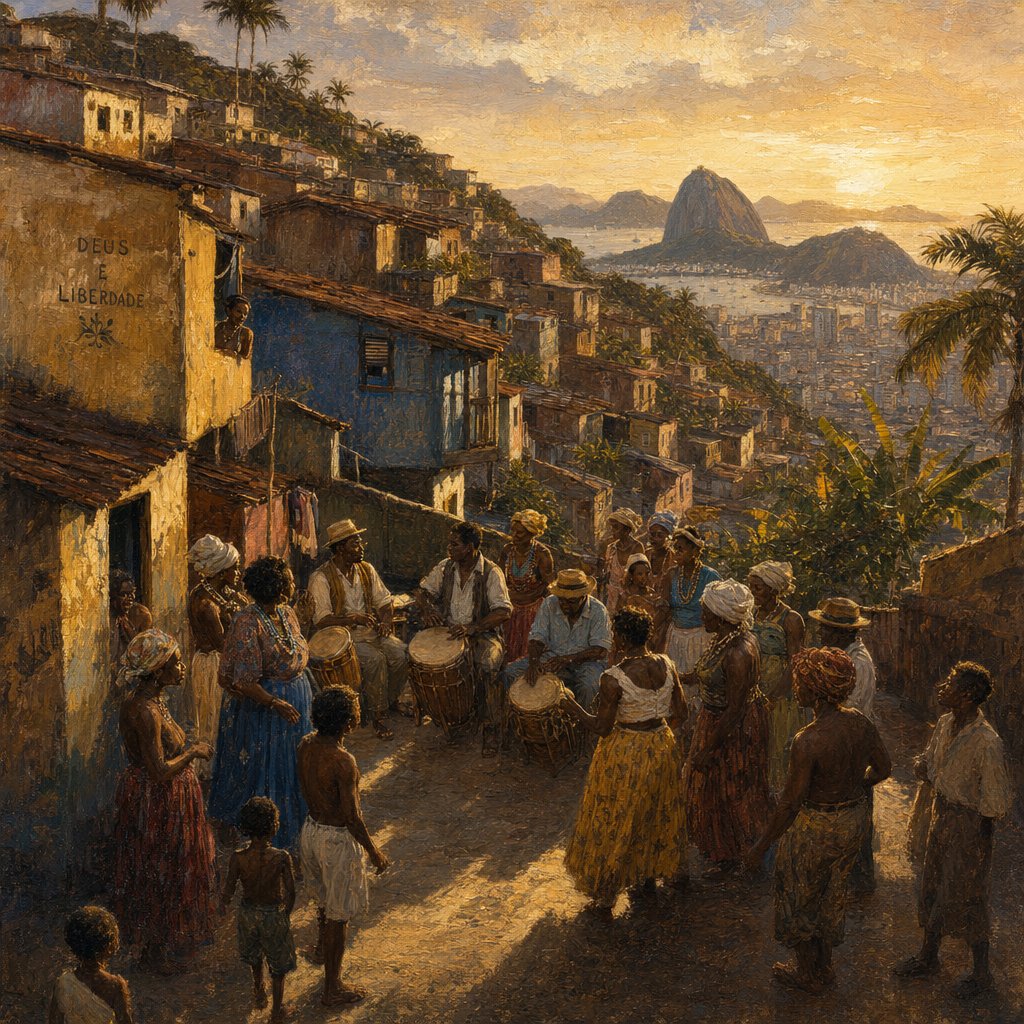
Those rhythmic traditions didn't arrive in Brazil by accident. They were carried in the bodies and memories of enslaved people, torn from their homelands across West and Central Africa over more than three centuries. The statistics fundamentals alone are staggering: Portuguese colonial authorities forcibly transported an estimated 6 million Africans to Brazil between the 1500s and the 1850s. That figure represents roughly 40% of all enslaved people brought to the Americas — compared to about 10% received by the United States. The sheer scale of this forced migration meant that Brazil absorbed an extraordinary concentration of African cultural traditions, and those traditions refused to disappear.
African Rhythmic Traditions That Became Samba
The enslaved population came from diverse societies, each carrying distinct musical DNA. Yoruba and Fon peoples from present-day Nigeria and Benin brought complex polyrhythmic drumming tied to spiritual worship. Bantu-speaking peoples from the Kongo-Angola region contributed the dance form called semba — widely considered the direct linguistic ancestor of the word "samba" — along with rhythmic patterns that would become the genre's backbone. Ewe and Ashanti traditions from the Gold Coast added yet another layer of percussive sophistication.
But here's the critical piece: Brazilian slaveholders banned African religious practice outright, fearing that gatherings would spark rebellion. So the enslaved population adapted. Within the rituals of candomblé, African deities were disguised as Catholic saints, and sacred drumming was woven into what appeared to outsiders as harmless song and dance. These ceremonies became the hidden greenhouse where African rhythm survived and evolved — a way to how to start a conversation with the divine while avoiding the master's whip.
From Bahia's Recôncavo to Rio's Favelas
The earliest recognizable form of the genre — samba de roda — emerged in Bahia's Recôncavo region during the 1860s. Participants formed a circle to sing, clap, and dance, with one person stepping into the center before calling the next with an umbigada (a bump of the belly). It was communal, improvisational, and deeply tied to candomblé worship — think of it as the root system from which every other form of samba eventually grew.
After abolition in 1888, thousands of formerly enslaved Bahians migrated to Rio de Janeiro, settling in neighborhoods like Saúde and Gamboa — an area later called "Pequena África" (Little Africa). As the city's elite pushed modernization projects that demolished traditional housing, Afro-Brazilian communities were forced up into the morros — the hillside favelas. Much like landscaping ideas that reshape terrain into something new, these displaced communities reshaped Rio's cultural geography, turning the hills into incubators for a new urban sound. Matriarchs known as the Tias Baianas, especially the legendary Tia Ciata, opened their homes as safe spaces where musicians could gather, improvise, and refine what was becoming samba carioca.
The breakthrough came on November 27, 1916, when Donga and Mauro de Almeida registered "Pelo Telefone" at Brazil's National Library. Released the following year, it became the first commercially recorded samba and proved that the music of the marginalized could reach a mass audience.
Samba's Transformation Into National Identity
Commercial success didn't mean acceptance. Throughout the 1920s, police routinely confiscated percussion instruments and arrested musicians under vagrancy laws designed to suppress Afro-Brazilian culture. The 1890 Penal Code's Article 399 gave authorities broad power to target anyone associated with the genre — playing a pandeiro on the street could land you in jail.
The turning point arrived with Getúlio Vargas, who seized power in 1930 and recognized samba's potential to unify a fractured nation. His government promoted the idea of "racial democracy" and positioned the genre as proof of a harmonious Brazilian identity. By 1935, samba schools were formally integrated into Rio's official Carnival program — but at a cost. Schools had to register with police, adopt approved themes celebrating national heroes, and trade spontaneous expression for state-sanctioned structure. What had been a grassroots craft ideas born in backyards and hillside gatherings was now a tool of statecraft, its rebellious edges carefully filed down for mainstream consumption.
That tension — between the raw, community-driven soul of the genre and the polished version packaged for national pride — has never fully resolved. And it echoes in every element of how the music itself is built, starting with the specific rhythmic architecture that makes samba sound like nothing else on earth.
The Musical DNA That Makes Samba Irresistible
That rhythmic architecture isn't built on complexity for its own sake. Strip samba down to its bones and you'll find a handful of simple principles working together — each one easy to grasp on its own, but stacked into something that makes standing still feel almost impossible.
The Heartbeat of the Surdo
Everything starts with the surdo, a large bass drum that functions exactly like a heartbeat. Place your hand on your chest: that steady boom... boom... boom is what the surdo provides. Samba lives in 2/4 time, meaning each measure contains just two beats — a quick, repeating cycle that feels closer to a pulse than a count. The surdo section actually splits this pulse between multiple drums: one marks beat one, another answers on beat two, and a third "cuts" between them with syncopated fills. Imagine a zipper — the teeth on each side mesh perfectly, creating a single locked groove from two separate parts. That interlocking bass pulse is the foundation everything else rides on.
Sounds complex? It's really not — at least not individually. You don't need to understand delta math to feel the logic. Each surdo part on its own is as simple as clapping on the downbeat. The magic only appears when they combine.
Syncopation and Polyrhythm in Plain Language
If the surdo is the heartbeat, syncopation is the swing. In most Western pop music, accents land right where you expect them — on the strong beats. Samba flips that. Accents fall between the beats, in the gaps and offbeats, creating a sensation of being pulled forward. Research into highly syncopated music suggests this is precisely why it triggers such a strong physical response — your body tries to "resolve" the rhythmic tension by moving.
Polyrhythm takes this further. Picture the gears inside a clock: each gear turns at a different speed, but they all interlock to keep time. In a samba ensemble, the surdo lays down the bass pulse, a snare drum called the caixa rolls a constant stream of sixteenth notes over it, and smaller instruments like the tamborim and agogô float syncopated patterns on top. Each layer is rhythmically simple — you could teach any single part in minutes. But stacked together, they produce a polyrhythmic wall of sound that feels three-dimensional, much like how geometry formulas describe flat shapes yet combine to model complex structures.
Then there's call-and-response, the vocal engine inherited directly from West African ceremony. A lead singer throws out a verse — a story, a provocation, a joke — and the chorus answers. It's conversational, spontaneous, and deeply communal. Even in a crowd of strangers, call-and-response turns listeners into participants. You might recognize the same dynamic in ensemble scenes from Denzel Washington movies, where dialogue volleys back and forth to build tension — samba does the same thing, except the tension resolves into groove rather than drama.
Here's a quick summary of the core elements that give samba its unmistakable feel:
- 2/4 time signature — a tight, two-beat cycle that keeps the pulse compact and driving
- Surdo heartbeat — interlocking bass drums that anchor the rhythm like a human pulse
- Syncopation — accents placed off the beat, creating forward momentum and physical urgency
- Polyrhythm — multiple percussion layers interlocking like gears, simple alone but complex together
- Call-and-response — vocal exchanges between lead and chorus that turn performance into communal conversation
These five elements are the genome of the genre. But DNA only tells half the story — the other half lives in the specific instruments that bring these principles to life, each one carved out for a distinct role inside the bateria.
Inside the Bateria
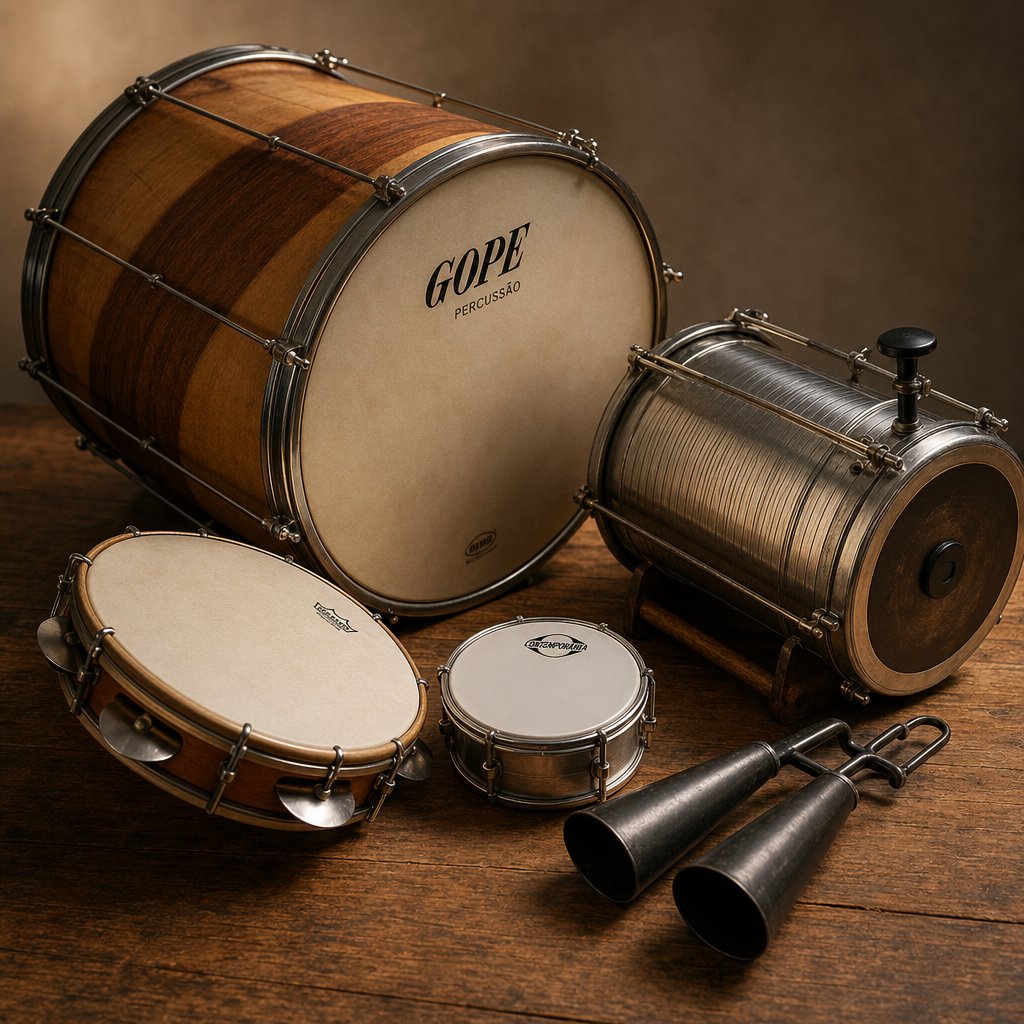
A samba bateria — the percussion ensemble at the genre's core — works like a living organism. Every instrument has a job, a voice, and a specific place in the mix. Remove one and the whole texture shifts. The word bateria itself comes from the Portuguese for "drum kit," which tells you everything about the genre's priorities: rhythm isn't accompaniment here — it's the main event. Think of it less like a band backing a singer and more like a dinner ideas brainstorm where every ingredient matters equally to the final dish.
Percussion That Drives the Rhythm
The surdo is the anchor. This large bass drum produces a deep, resonant boom that you feel in your ribcage before you consciously hear it. A full bateria typically uses three surdo sizes: the marcacao (largest, providing the fundamental bass pulse), the respondor (mid-sized, answering on the offbeat like a floor tom), and the cutador (smallest, filling gaps with syncopated accents). Together, they create the interlocking heartbeat described in the previous section — simple individually, powerful as a unit. Shells come in aluminum for projection or wood for warmth.
Sitting on top of that bass foundation, the tamborim delivers sharp, high-pitched patterns that cut through the ensemble like a blade. Don't confuse it with a tambourine — it's a small frame drum with no jingles, played with a flexible stick. The signature virado technique involves flipping the drum mid-pattern to extend note sustain, producing that characteristic "singing" quality you'll recognize instantly in any Carnival recording.
The repinique is the leader's instrument — the running point of the entire ensemble. Its high-pitched, cutting tone signals breaks, transitions, and tempo changes to the rest of the bateria. Traditionally played with a single wooden stick, modern lightweight versions allow players to use one hand and one stick for a wider range of accents. Interestingly, the repinique didn't become a standard bateria instrument until the late 1950s, making it one of the ensemble's newer additions.
The agogo adds metallic shimmer. This double cowbell — two narrow bells tuned to different pitches and mounted on a handle — plays repeating rhythmic patterns that weave between the drums like a bright thread through dark fabric. The cuica, meanwhile, is one of the most unusual instruments in any musical tradition. A friction drum with a thin stick attached beneath the drumhead, it produces an eerie, almost human moaning sound when the player pulls and pushes the stick while pressing the head. It's the voice you can't quite place in a samba recording — somewhere between a laugh and a cry.
The pandeiro — Brazil's answer to the tambourine — rounds out the percussion section with extraordinary versatility. Its metal jingles produce a drier, warmer tone than a standard tambourine, and skilled players use fingers, thumbs, and palms to coax an entire drum kit's worth of sounds from a single instrument. A great pandeiro player can carry a samba groove alone, much like how a single gardening tips guide can cover everything from soil prep to harvest.
Melodic and Harmonic Instruments of Samba
Percussion dominates, but it doesn't work in isolation. The cavaquinho — a small, four-stringed instrument with a guitar-shaped body and metal strings — provides the harmonic foundation that ties melody to rhythm. Integral to Brazilian music culture for generations, the cavaquinho delivers bright, high-frequency chords and rapid strumming patterns that give samba its melodic sparkle. Its role is so central that Carnival performances virtually always feature a cavaquinho player in the lineup. With 17 to 19 frets on a traditional build, it offers a surprisingly wide range despite its compact size — proof that scale doesn't determine impact, the same way a block breaker game packs intense action into a simple concept.
Here's a structured overview of each instrument's contribution to the ensemble:
| Instrument | Sound Description | Role in Bateria | Origin |
|---|---|---|---|
| Surdo | Deep, resonant bass boom | Anchors the rhythm as the fundamental pulse; three sizes cover bass, response, and fills | Afro-Brazilian; evolved from African bass drumming traditions |
| Tamborim | Sharp, high-pitched crack with singing sustain | Plays intricate syncopated patterns that define the samba groove | Brazilian development from small frame drum traditions |
| Repinique | Loud, cutting high-pitched tone | Leads the ensemble; signals breaks, transitions, and tempo changes | Added to bateria in the late 1950s; Brazilian innovation |
| Agogo | Bright, metallic double-pitched ring | Provides repeating melodic-rhythmic accents between drum layers | West African Yoruba bell traditions |
| Cuica | Eerie moaning or laughing voice-like tone | Adds expressive, vocal-quality texture and emotional color | Central African friction drum traditions (Bantu origin) |
| Pandeiro | Warm, dry jingle with versatile tonal range | Fills rhythmic gaps; capable of carrying a full groove solo | Adapted from Portuguese tambourine, Africanized in Brazil |
| Cavaquinho | Bright, sparkling chords with rapid strumming | Provides harmonic foundation and melodic framework | Portuguese origin (brought to Brazil during colonization) |
Each of these instruments is a specialist — loyal to one job, like a great Pyrenees guarding a flock with calm, unwavering focus. Pull any single voice out of the mix and the texture thins. Put them all together and you get the richest percussive tapestry in popular music, a sound so layered that no two listens reveal exactly the same details. It's the kind of ensemble where basketball zero codes of individual ego apply — no one instrument showboats, because the groove only works when everyone locks in.
That collective discipline becomes even more fascinating when you realize these instruments don't just produce one style. Depending on which voices lead, which patterns dominate, and how the tempo shifts, the same bateria can power radically different subgenres — each with its own history, feel, and cultural meaning.
A Listener's Guide to Samba Subgenres
Saying you listen to samba is a bit like saying you watch basketball. Are we talking about the fast-break chaos of illinois basketball or a slow half-court grind? The label covers an enormous range. Over more than a century of evolution, the genre has branched into distinct subgenres — each shaped by a specific time, place, and community. Knowing the difference is the fastest way to find the version that speaks to you.
From Samba de Roda to Samba-Reggae
Samba de roda is where it all begins. Rooted in Bahia's Reconcavo region during the mid-1800s, this is the circle-dance form tied directly to candomble ceremony. Participants clap, sing, and take turns dancing in the center of a ring. The tempo is moderate, the instrumentation is stripped back — hand drums, clapping, a viola (small guitar) — and the energy is communal rather than performative. Think of it as the acoustic campfire version of everything that came after. UNESCO recognized it as Intangible Cultural Heritage for good reason: without samba de roda, none of the other subgenres exist.
Samba-cancao swings the mood in the opposite direction. Emerging during Brazil's golden age of radio between the 1930s and 1950s, this slower, romantic ballad form drew heavy influence from the bolero. The percussion steps back, strings and piano step forward, and the lyrics dwell on heartbreak and longing — what Brazilians call dor-de-cotovelo (elbow pain, their poetic term for lovesickness). Elizeth Cardoso, Maysa, and Orlando Silva defined the style with deeply felt vocal performances that could make the woman in the yard next door stop hanging laundry just to listen.
Partido alto is the improvisers' arena. Built around a fixed refrain, two or more singers trade improvised verses — often as a competitive challenge. The rhythm is mid-tempo and swinging, driven by pandeiro and surdo, but the real spotlight falls on lyrical wit. Legendary partideiros like Aniceto and Marquinho China are among the most respected figures in the genre precisely because their skill can't be rehearsed. Every performance is a one-time event.
Samba-enredo is the sound most outsiders associate with Carnival. These are the anthems composed specifically for the annual parade competitions, performed by massive baterias of 200-plus drummers. The style emerged in the late 1940s with lyrics originally celebrating official Brazilian history, though themes have since expanded to include Afro-Brazilian identity, social commentary, and even corporate sponsorships. The tempo runs fast — sometimes breathlessly so — and the energy is designed to carry thousands of dancers through a 90-minute parade. If samba de roda is a campfire, samba-enredo is a stadium.
Pagode started as a word meaning simply "party with music." In the 1970s and 1980s, informal jam sessions at Rio's Cacique de Ramos community center gave the term a specific musical identity. Artists like Arlindo Cruz and Almir Guineto shaped a warmer, more intimate sound featuring the banjo (a Brazilian adaptation, not the American instrument), tantan, and repique de mao. By the 1990s, a more pop-oriented wave led by groups like Raca Negra and So Pra Contrariar brought pagode to mainstream radio — the kind of easy-listening groove you could enjoy in the time it takes to set a 20 minute timer and unwind after work.
Samba-reggae was born in Salvador, Bahia, during the 1980s inside the blocos afro — Afro-Brazilian Carnival groups like Olodum and Ile Aiye. It fuses samba's polyrhythmic percussion with reggae's offbeat pulse and a slower, heavier groove. The result is massive, hypnotic, and deeply political — a deliberate reclaiming of African identity within Brazilian culture. If you've heard the drumming on Paul Simon's The Rhythm of the Saints, you've heard samba-reggae's influence reaching across borders.
Samba-rock emerged from Sao Paulo in the late 1950s and early 1960s, blending samba's rhythmic base with funk, soul, and rock guitar. Jorge Ben Jor became its most visible champion, especially after switching to electric guitar and creating a sound that made dance floors move in a completely new way. The style also developed its own partner dance, characterized by spins and close footwork set to a groove that splits the difference between James Brown and a Rio roda de samba.
How Each Subgenre Sounds and Where It Came From
With seven distinct branches to keep track of, a side-by-side comparison helps clarify what makes each one unique:
| Subgenre | Era of Origin | Tempo / Feel | Key Instruments | Cultural Context | Representative Artists |
|---|---|---|---|---|---|
| Samba de Roda | Mid-1800s (Bahia) | Moderate; circular, communal | Hand drums, palmas (clapping), viola | Candomble ceremony and Afro-Bahian community gatherings | Dona Edith do Prato, Grupo de Samba de Roda Suerdieck |
| Samba-Cancao | 1930s-1950s | Slow; romantic, melancholic | Piano, strings, light percussion | Brazil's radio golden age; bolero influence | Elizeth Cardoso, Maysa, Orlando Silva |
| Partido Alto | Early 1900s (formalized mid-century) | Mid-tempo; swinging, conversational | Pandeiro, surdo, cavaquinho | Improvisational gatherings; lyrical competition | Aniceto do Imperio, Marquinho China, Bezerra da Silva |
| Samba-Enredo | Late 1940s (Rio) | Fast; explosive, anthemic | Full bateria (200+ drummers), cavaquinho, brass | Carnival parade competitions by escolas de samba | Mangueira, Portela, Beija-Flor (school composers) |
| Pagode | 1970s-1980s (Rio) | Relaxed; warm, party-oriented | Banjo (Brazilian), tantan, repique de mao, cavaquinho | Informal backyard jam sessions; Cacique de Ramos | Arlindo Cruz, Zeca Pagodinho, Raca Negra |
| Samba-Reggae | 1980s (Salvador, Bahia) | Slower; heavy, hypnotic | Surdos, repiniques, timbau | Blocos afro; Afro-Brazilian political identity movement | Olodum, Ile Aiye, Daniela Mercury |
| Samba-Rock | Late 1950s-1960s (Sao Paulo) | Mid-tempo; groovy, funk-inflected | Electric guitar, bass, drums, cavaquinho | Sao Paulo dance halls; fusion with soul and rock | Jorge Ben Jor, Ed Lincoln, Seu Jorge |
What stands out across this map is how each subgenre responds to a specific cultural moment. Samba-cancao answered the emotional needs of a radio-listening middle class. Samba-reggae gave voice to a political awakening. Pagode turned backyards into concert halls. The rhythmic DNA stays consistent — that 2/4 pulse, the syncopation, the call-and-response — but the expression shifts dramatically depending on who's playing, where, and why.
These subgenres didn't emerge in a vacuum, though. Behind each branch stands a specific artist or group of artists who bent the tradition in a new direction — voices whose individual stories reveal as much about samba's evolution as any musical analysis can.
The Artists Who Shaped Samba's Story
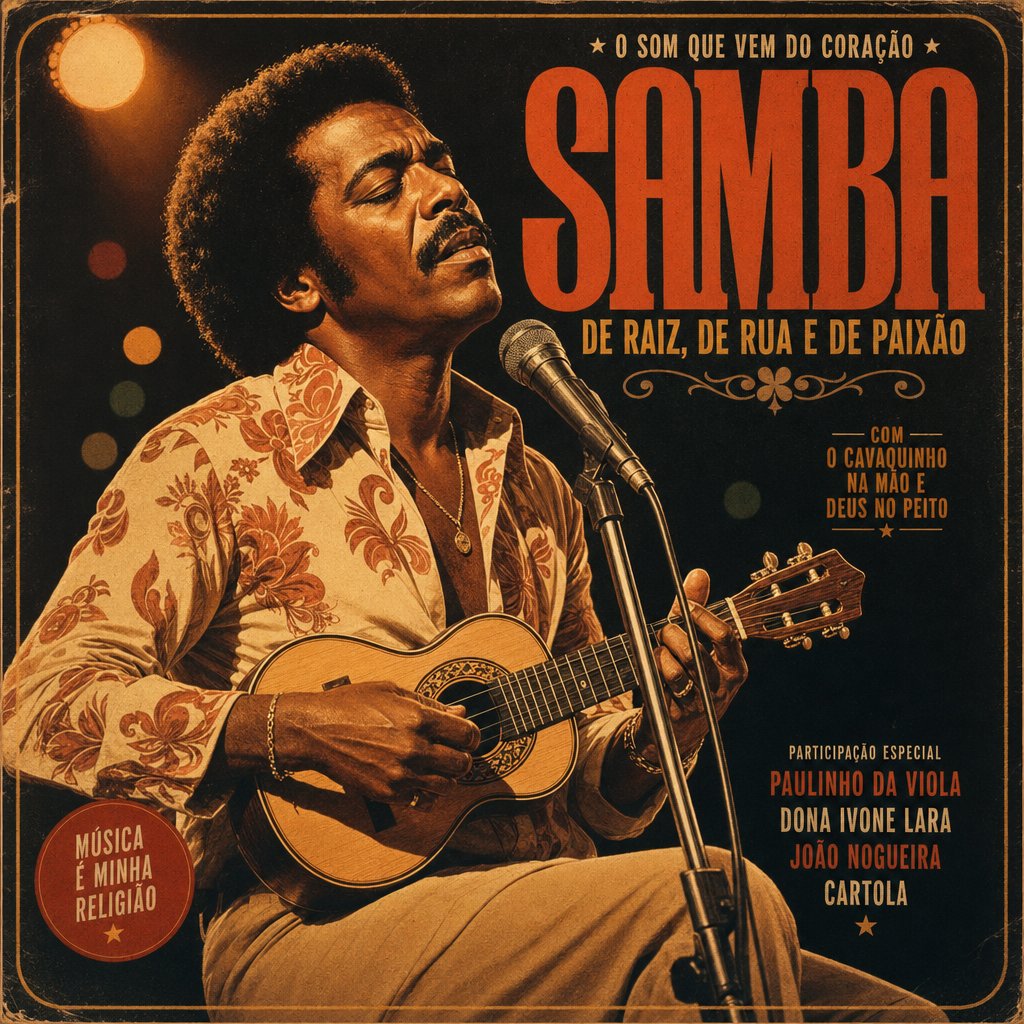
Every subgenre needed a voice — someone who could take a rhythmic idea and turn it into something that moved an entire generation. Samba's history isn't just a story of beats and instruments. It's a story of people who bent the tradition, broke barriers, and sometimes paid a steep personal price to keep the music alive.
Pioneers Who Built the Foundation
Cartola (Angenor de Oliveira, 1908-1980) was the poet laureate of the morros. A founding member of Estacao Primeira de Mangueira — one of Rio's most storied samba schools — he wrote lyrics of such quiet beauty that they elevated the genre from street party music to genuine literature. Songs like "As Rosas Nao Falam" carry the weight of someone who knew how to surf between joy and melancholy in a single verse. Cartola spent decades in obscurity, working odd jobs after falling out of the music scene, before being rediscovered in the 1960s. His comeback proved that great samba doesn't expire.
Noel Rosa (1910-1937) did something no one before him had managed: he made samba respectable to Rio's middle class without stripping away its soul. A prolific composer who left more than 250 songs before dying of tuberculosis at just 26, Rosa was a chronicler of daily life — bar conversations, neighborhood gossip, romantic disasters. His hit "Conversa de Botequim" remains a standard nearly a century later. Rosa accumulated collaborators the way other people collect friends — partnering with Cartola, Ismael Silva, and Braguinha — and his witty, literate lyrics showed that you didn't need to know how to sing opera to say something profound. He proved samba could be intellectual without being pretentious, bridging the gap between the hillside favelas and the city's drawing rooms.
Voices That Carried Samba Forward
Dona Ivone Lara shattered one of the genre's most stubborn ceilings. In 1965, she became the first woman to sign a samba-enredo for a major Rio de Janeiro parade, composing "Os Cinco Bailes da Historia do Rio" for Imperio Serrano. In a male-dominated space where women were expected to dance but not compose, Ivone didn't just participate — she led. Her legacy opened a door that artists like Ludmilla and Anitta continue to walk through today.
Clara Nunes and Beth Carvalho carried the genre into mainstream Brazilian consciousness during the 1970s and 1980s. Nunes blended samba with Afro-Brazilian religious themes and became one of the first female artists to sell over 100,000 records in Brazil — her performances were a do a barrel roll of energy, spirituality, and raw vocal power. Carvalho, nicknamed the "Godmother of Samba," championed pagode before it had a name, personally discovering talents like Zeca Pagodinho and bringing backyard jam sessions to national television.
Paulinho da Viola became the genre's quiet guardian, dedicating his career to preserving traditional forms — particularly partido alto and the older Portela school repertoire — at a time when commercial pressures pushed toward pop simplification. Bezerra da Silva, by contrast, gave voice to the favela with unflinching honesty, singing about police violence, poverty, and survival in lyrics that mainstream Brazil preferred to ignore. His black sambas carried the raw truth of communities that the genre's polished Carnival image often concealed. And Zeca Pagodinho, the beloved voice of modern pagode, turned informal charm into an art form — his relaxed delivery and gift for melody made him a household name while keeping the backyard spirit of the tradition intact.
Here's a chronological timeline of these landmark contributions:
- 1920s-1930s — Cartola co-founds Mangueira and begins writing the poetic lyrics that will define samba's literary voice
- 1930-1937 — Noel Rosa composes over 250 songs, bringing samba to middle-class audiences and establishing the genre's chronicler tradition
- 1965 — Dona Ivone Lara becomes the first woman to have a samba-enredo accepted by a top escola de samba
- 1970s — Clara Nunes fuses samba with Afro-Brazilian spirituality and becomes a record-breaking star; Paulinho da Viola champions traditional forms
- 1970s-1980s — Beth Carvalho discovers pagode talent and brings the subgenre to national attention
- 1980s-1990s — Bezerra da Silva gives unfiltered voice to favela life; Zeca Pagodinho rises as pagode's most beloved performer
What connects these artists isn't style — Cartola's gentle poetry and Bezerra's gritty street reports could hardly sound more different. The thread is commitment. Each one treated samba not as a career vehicle but as a living tradition worth protecting, challenging, or expanding. Rio may be the bossa nova birthplace that most tourists recognize, but it was these voices that kept the deeper, older tradition breathing beneath the surface — a tradition whose influence, it turns out, reaches far beyond Brazil's borders.
Samba's Global Influence and Lasting Legacy
That influence didn't stay contained within Brazil's borders. The same rhythmic DNA that powered Cartola's poetry and Bezerra's street dispatches quietly reshaped how the rest of the world heard, played, and thought about popular music — a ripple effect that's still expanding.
How Samba Gave Birth to Bossa Nova
Rio de Janeiro is widely recognized as the birthplace of bossa nova, but the genre didn't appear from nowhere. In the late 1950s, guitarist Joao Gilberto took samba's rhythmic skeleton and did something radical: he stripped away the massive percussion, softened the vocal delivery to a near-whisper, and layered cool jazz harmonies underneath. Working alongside composer Antonio Carlos "Tom" Jobim and poet Vinicius de Moraes, Gilberto created what Brazilians called the "new trend" — a brazilian genre that's an offshoot of samba, refined for intimate rooms rather than street parades.
The sound crossed the Atlantic fast. American guitarist Charlie Byrd heard bossa nova firsthand during a visit to Brazil and brought it home to Washington, DC, where he and saxophonist Stan Getz recorded Jazz Samba in 1962. The album hit No. 1 on the US pop charts and spent 70 weeks in the rankings. A year later, "The Girl from Ipanema" — featuring Astrud Gilberto's wispy vocals over Getz's tenor sax — reached No. 5 on the US singles chart and became one of the most recorded songs in history. Suddenly, Dizzy Gillespie, Quincy Jones, Cannonball Adderley, and even Frank Sinatra were recording Brazilian material. Bossa nova had built a global bridge, and the traffic flowed both ways — international audiences who fell for the softer sound eventually traced it back to the rawer, percussive tradition it came from.
Samba's Fingerprints on Global Music
Bossa nova was just the first export. Samba-reggae, born in Salvador's blocos afro, fed directly into the world music boom of the late 1980s and 1990s — Paul Simon's The Rhythm of the Saints brought Olodum's massive drum sound to millions of listeners who'd never heard of Bahia. Those polyrhythmic patterns also resonated with West African musicians exploring Afrobeat, creating a transatlantic conversation between rhythmic cousins separated by centuries.
In contemporary music, the lineage runs deeper than most listeners realize. Brazilian funk — baile funk — carries samba's percussive DNA into electronic production, and it's gone global. Artists like Anitta have projected the sound to international audiences, while producers like Tropkillaz have placed Brazilian rhythmic elements into tracks for K-pop acts, hip-hop collaborations with Major Lazer and Marshmello, and electronic sets worldwide. When Cardi B and Megan Thee Stallion performed a funk-inflected version of "W.A.P." at the Grammys, the rhythmic thread traced all the way back to the same Afro-Brazilian pulse that powered the first rodas de samba. You could scan the world flags of dozens of nations and find samba's rhythmic fingerprints somewhere in their popular music.
Samba is arguably the most influential musical tradition in the Western hemisphere — a single rhythmic root system that produced bossa nova, shaped global jazz, fed into funk and electronic music, and continues to generate new genres more than a century after it first emerged from Brazil's Afro-descendant communities.
UNESCO formalized what musicians already knew when it designated samba de roda as Intangible Cultural Heritage in 2005 — an acknowledgment that this tradition belongs not just to Brazil but to humanity. The Argentine zambas, despite sharing a similar name, follow a completely different musical path rooted in folk waltz traditions, which only underscores how distinctly Afro-Brazilian samba's identity really is.
Recognition and influence, though, don't guarantee preservation. The real question isn't whether samba shaped the past — it clearly did — but whether the tradition can keep evolving without losing the communal, grassroots spirit that made it matter in the first place.
Samba Today and Where the Genre Is Heading
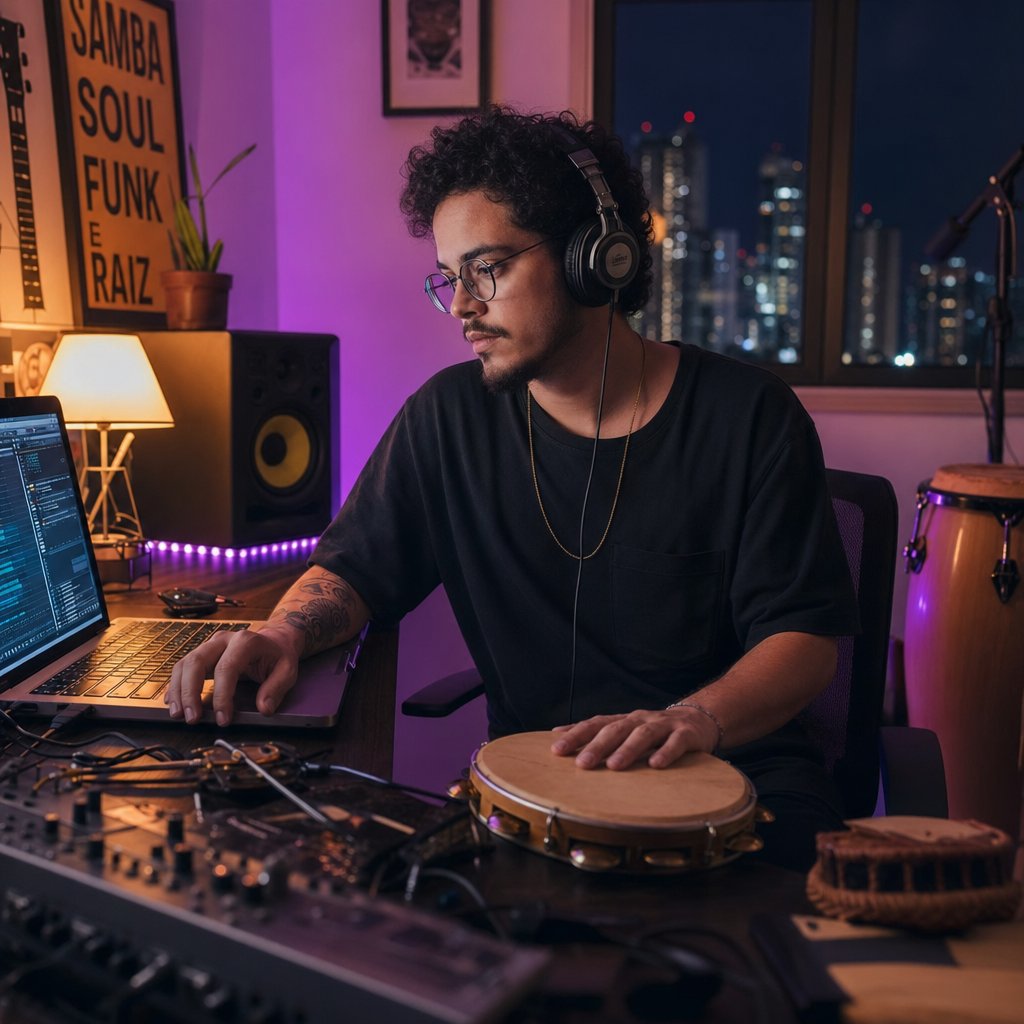
That spirit isn't just surviving — it's shapeshifting. A younger generation of Brazilian artists is treating samba not as a museum exhibit but as raw material, folding it into hip-hop beats, electronic production, and R&B vocal stylings while keeping the rhythmic core intact. Artists like Diogo Nogueira carry the pagode lineage forward with modern polish, while producers in Sao Paulo's underground scene chop surdo patterns into trap beats the same way a DJ might sample a jazz break. The samba meaning these artists inherit — community, resistance, joy — stays constant even as the sonic packaging changes. It's evolution, not replacement.
How Young Artists Are Evolving the Tradition
This tension between preservation and experimentation runs deep. Purists argue that blending samba with electronic production dilutes its identity. Innovators counter that the genre has always absorbed outside influences — from bolero to funk to reggae — and that refusing to evolve is what actually kills a tradition. Both sides have a point. The healthiest version of this debate plays out in the rodas de samba still happening in backyards across Rio, where a teenager might follow a Cartola classic with an original verse over a beat made on a laptop. Brazilian music has always been a conversation between generations, and that conversation is louder than ever.
Escolas de Samba as Living Community Institutions
What most outsiders miss entirely is that escolas de samba operate year-round — not just during Carnival season. These organizations function as social anchors in favela communities, running music education programs, youth mentorship, healthcare outreach, and cultural preservation efforts 365 days a year. Imagine a community center, music school, and social club fused into one institution, and you'll get close. For many residents, the escola is the most stable support structure in their neighborhood — the place where kids learn to play repinique the way other kids learn how to do a pullup in gym class, through repetition, community, and pride. The gold sambas that win Carnival competitions represent just the visible tip of this year-round investment in people.
From Listening to Creating Samba-Inspired Music
Digital platforms have blown the doors open. Streaming services like Spotify and YouTube give global listeners instant access to everything from rare samba de roda recordings to last week's pagode release — no plane ticket required. Curated playlists and algorithm-driven recommendations mean someone searching for smiling friends in a playlist can stumble into a Cartola deep cut and fall down the rabbit hole. This accessibility has expanded the genre's audience far beyond Portuguese-speaking communities, turning casual listeners into devoted fans who'd never have discovered the tradition otherwise.
The next leap is even more hands-on. AI-powered music tools now let anyone experiment with samba rhythms without years of percussion training — you describe a mood, pick a style, and get an original composition back. MakeBestMusic's AI Song Generator does exactly this, turning a samba-inspired idea into a royalty-free original track in seconds. It's not a substitute for learning how to drive a manual car through the genre's full complexity, but it bridges the gap between passive listening and active creation. For someone curious about how syncopation and polyrhythm actually feel when you're building a track rather than just hearing one, that kind of tool turns appreciation into understanding.
The genre's future, then, isn't a single path. It's a branching network — traditional rodas coexisting with AI-generated experiments, Carnival anthems streaming alongside bedroom productions, and community institutions holding the center while the edges keep expanding. That diversity is exactly what's kept samba alive for over a century, and it's what makes the question of where to actually start listening more relevant — and more answerable — than ever.
Where to Start Your Samba Music Journey
With over a century of recordings, seven major subgenres, and dozens of legendary artists, diving into samba music can feel like standing at the edge of an ocean. The trick is picking the shore that matches your taste and wading in from there.
Pick Your Entry Point by Taste
You don't need a roadmap of the entire genre — just a single track that clicks. Here's where to start based on what you already enjoy:
- You want raw Carnival energy — Start with samba-enredo recordings from Mangueira or Beija-Flor. Search "sambas-enredo" on Spotify for annual compilation albums that capture the full bateria experience. This is the sound of 200 drummers and thousands of voices — pure adrenaline tied to afro brazilian dance at its most spectacular.
- You prefer something mellow and poetic — Cartola's self-titled 1976 album is one of the most beautiful records in any language. Quiet guitar, gentle vocals, and lyrics that land like poetry. If you connect with singer-songwriters, this is your door.
- You're here for the party — Zeca Pagodinho's catalog is the definition of warmth and good company. Try "Deixa a Vida Me Levar" and let pagode's backyard spirit do the rest.
- You like fusion and experimentation — Jorge Ben Jor's A Tabua de Esmeralda blends samba-rock with funk and psychedelia. For something heavier, Olodum's samba-reggae recordings from Salvador hit with hypnotic force.
- You're coming from jazz — Use bossa nova as your bridge. Start with Joao Gilberto's Chega de Saudade, then trace the rhythm backward into the fuller percussion of traditional samba. The connection becomes obvious within a few tracks.
Most streaming platforms now carry curated playlists labeled "Samba Classics," "Pagode Hits," or "Roda de Samba" — search sambasamba or browse Brazilian genre categories and you'll find entry points organized by mood and era. These playlists are a low-commitment way to sample widely before committing to a deep dive.
From Listener to Creator
Listening is where appreciation starts, but creating is where understanding deepens. When you try building a track around syncopation and a surdo pulse — even a rough one — you feel the architecture from the inside. MakeBestMusic's AI Song Generator makes that experiment accessible: describe a samba mood or style, and it generates an original royalty-free composition you can study, remix, or simply enjoy. It won't replace learning pandeiro from a mestre in Rio, but it turns curiosity into hands-on exploration without a steep learning curve.
Wherever you enter — through a Cartola ballad, a Carnival anthem, or an AI-generated experiment — you're stepping into one of the richest musical traditions on the planet. Samba music isn't a single destination. It's a gateway to Brazil's entire musical universe: MPB, tropicalia, forró, maracatu, and dozens of regional styles that all share roots in the same Afro-Brazilian soil. Start with one song. The rest will find you.
