

What Is Syncopation in Music and What Does It Really Mean
Syncopation is a rhythmic technique in which emphasis is placed on normally weak or off-beats, creating a sense of surprise and forward momentum in music.
That single-sentence syncopation definition captures the core idea, but there's a lot more going on beneath the surface. Pronounced sin-kuh-PAY-shun, the word traces back to Medieval Latin syncopatio, with its earliest recorded English usage appearing around 1597. At its root, it carries the idea of cutting short or interrupting something expected, which is exactly what syncopated rhythm does to a regular pulse.
The Simple Syncopation Definition
Imagine you're clapping along to a song on beats 1, 2, 3, and 4. In a standard pattern, the strongest accents land right on those beats, especially 1 and 3. Syncopation flips that expectation. It places stress where your ear doesn't predict it, on the spaces between beats or on beats that are normally weak. The result is a rhythmic pattern that pulls against the steady pulse instead of sitting neatly on top of it.
A side-by-side comparison makes this easier to see:
| Pattern | Beat 1 | & | Beat 2 | & | Beat 3 | & | Beat 4 | & |
|---|---|---|---|---|---|---|---|---|
| Standard 4/4 | X | . | X | . | X | . | X | . |
| Syncopated | X | . | . | X | . | X | X | . |
In the syncopated row, notice how accents shift to the "&" positions between beats 2 and 3. That displacement is what gives the rhythm its characteristic tug and energy.
Why This Definition Matters for Musicians and Listeners
Syncopation isn't a niche concept reserved for jazz drummers or music theory classrooms. It lives in virtually every genre you listen to, from funk bass lines and reggae guitar chops to pop vocal melodies and electronic hi-hat patterns. When you understand what syncopation actually is, you start hearing rhythm differently. Patterns that once just "felt good" suddenly reveal their inner mechanics, and that awareness changes how you listen, play, and create.
Whether you're a beginner picking up your first instrument or an intermediate player looking to sharpen your rhythmic vocabulary, this guide is built to be your universal, instrument-agnostic reference. No drum kit required.
Of course, knowing the definition is just the starting point. Syncopation comes in several distinct varieties, each with its own rhythmic personality and musical function.
The Main Types of Syncopation Every Musician Should Know
Most people who ask "what is syncopation" expect a single answer. In reality, syncopation is a family of rhythmic techniques, each one displacing accents in a different way. Some shift notes to the spaces between beats. Others erase strong beats entirely or blur the meter with equal-length notes. Knowing which type you're hearing, or playing, gives you far more control over the rhythmic feel of any piece of music.
Off-Beat Syncopation and Anticipated Bass
Off-beat syncopation is the most common variety. It accents the "and" between numbered beats, the eighth-note subdivisions that fall in the gaps of a steady 1-2-3-4 pulse. Reggae's signature guitar skank is a textbook example: the chord lands squarely on every "&," leaving the downbeats empty and giving the groove its laid-back swagger.
Anticipated bass, sometimes called anticipation syncopation, works a little differently. Instead of accenting the space between beats, it pulls a note forward so it arrives just before the expected downbeat. You'll hear this constantly in pop choruses, where the vocal or chord change lands on the "& of 4" rather than waiting for beat 1 of the next bar. The effect is subtle but powerful: it injects a burst of forward energy right before the phrase resolves.
Here's how both patterns look on a beat grid in 4/4 time:
| Pattern | 1 | & | 2 | & | 3 | & | 4 | & |
|---|---|---|---|---|---|---|---|---|
| Off-Beat | . | X | . | X | . | X | . | X |
| Anticipated Bass | X | . | X | . | X | . | . | X |
In the off-beat row, every accent sits between the numbered beats. In the anticipated bass row, the final accent shifts from beat 4 to the "&" just before it, pulling the listener's ear into the next measure early.
Suspension, Missed-Beat, and Even-Note Syncopation
Suspension syncopation holds a note that begins on a weak beat across a strong beat, "suspending" the expected accent in midair. The strong beat still passes, but because the note is already ringing rather than freshly struck, the ear registers tension instead of resolution. Renaissance composers like Palestrina used this technique extensively in vocal polyphony, and it remains a staple in R&B vocal phrasing and legato piano lines today.
Missed-beat syncopation takes a more dramatic approach. It replaces an expected strong beat with silence, a rest where the accent should be. That gap creates a momentary freefall, like the pause at the top of a roller coaster before the drop. Reggae and dub music lean heavily on this device, often called "drop-one" because the drummer leaves beat 1 completely empty, letting the off-beat instruments carry the groove.
Even-note syncopation is the most deceptive of the three. Here, notes of equal duration are played in a way that obscures which beats are strong and which are weak. Because every note has the same length, the listener's internal sense of meter starts to drift. Jazz pianist Thelonious Monk was a master of this approach. In tracks like "Straight, No Chaser," his comping patterns use even eighth notes with accents shifted to off-beats, creating a jagged, unpredictable rhythmic contour while the underlying structure stays steady.
Hemiola and Cross-Rhythm Patterns
Hemiola is a specific syncopation device where a duple feel is imposed over a triple meter, or vice versa. Picture counting in three: "ONE two three, ONE two three." A hemiola regroups those same six pulses into two: "ONE two, ONE two, ONE two." The notes don't change, but the perceived grouping shifts from 3+3 to 2+2+2, creating a momentary tilt in the listener's sense of time. Leonard Bernstein's "America" from West Side Story is one of the most recognizable examples, alternating between 6/8 and 3/4 to produce that infectious, dance-driven energy.
Cross-rhythm patterns extend this idea further. Rather than a brief metric shift, cross-rhythms layer two contrasting pulse groupings simultaneously, like a three-against-two pattern where one hand claps triplets while the other claps duples. West African drumming ensembles have built entire musical traditions around these interlocking cross-rhythmic textures, and the technique surfaces in everything from Afro-Cuban clave patterns to modern electronic production.
So when someone asks what is syncopation music really built on, the answer is rarely just one of these types. Most grooves that make you move combine several varieties at once. Here's a quick-reference summary of every type covered:
- Off-Beat Syncopation - accents land on the "&" subdivisions between numbered beats
- Anticipated Bass - a note arrives slightly before the expected downbeat, pulling the phrase forward
- Suspension Syncopation - a note held from a weak beat sustains across a strong beat, creating tension
- Missed-Beat Syncopation - an expected strong beat is replaced with a rest, producing a rhythmic gap
- Even-Note Syncopation - equal-length notes obscure the meter, making strong and weak beats ambiguous
- Hemiola - a temporary regrouping that imposes a duple feel over triple meter or vice versa
- Cross-Rhythm - two or more contrasting pulse groupings layered simultaneously
Every one of these types appears across all instruments, not just drums or piano. Vocalists use suspension and anticipation constantly. Guitarists lean on off-beat accents. Bass players drive entire genres with missed-beat and anticipated patterns. Syncopated rhythms are instrument-agnostic by nature, which is exactly what makes them so universal.
These categories help you define syncopation with precision, but rhythm doesn't exist in a vacuum. Each type emerged from specific musical cultures and historical moments, shaped by the people and traditions that needed it most.
How Syncopation Evolved Through Centuries of Music History
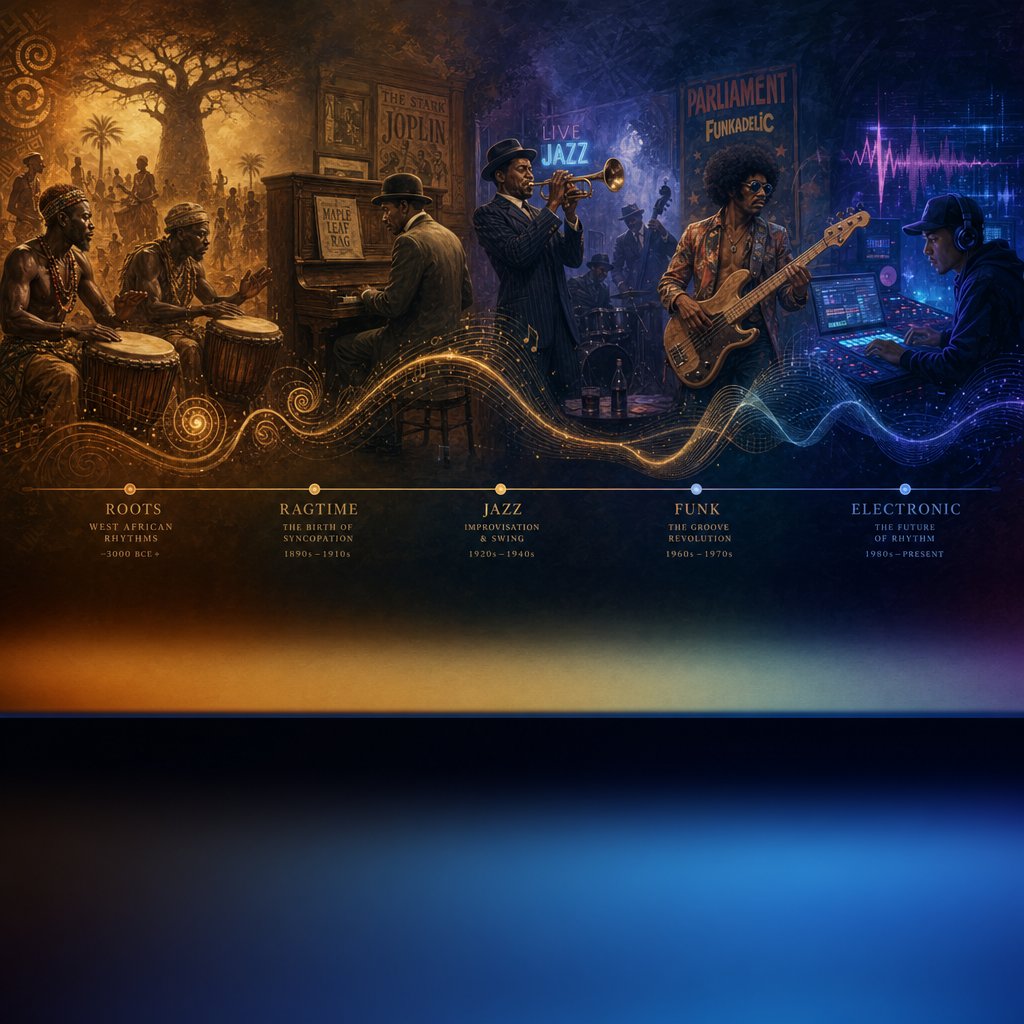
Every syncopated rhythm you hear today carries DNA from somewhere older. The story of how off-beat emphasis traveled across oceans, mutated through genres, and became the rhythmic backbone of modern music is one of the most fascinating threads in music history, and it starts in West Africa.
West African Roots and the Rhythmic Foundation
In West and Central African musical traditions, off-beat emphasis wasn't a stylistic choice. It was the foundation. Community music-making centered on polyrhythmic structures, the layering of contrasting rhythms where multiple drummers interlocked patterns that stressed different subdivisions of the pulse simultaneously. Dance was inseparable from this music, and the hierarchy of rhythm over melody meant that rhythmic complexity wasn't decoration. It was the point.
When enslaved Africans were brought to the Americas, they carried these rhythmic sensibilities with them. Even as legislation in the 1800s banned drums and other "loud" instruments, the impulse toward off-beat accents, call and response, and layered rhythmic textures survived. It adapted, migrating into hand claps, vocal patterns, homemade instruments, and eventually European instruments played in a distinctly African style. That survival seeded the rhythmic foundation for nearly every popular Western genre that followed.
From Ragtime and Jazz to Funk, Reggae, and Beyond
By the 1880s, those African-rooted rhythms had fused with European harmony and form to produce ragtime, the first widely popular genre where syncopated rhythm defined the style itself. Theorist Earl Stewart noted that in ragtime piano, the left hand plays a steady, non-syncopated bass on the beat while the melody is highly syncopated and moves at twice the speed of the harmony. That layering of straight and displaced rhythms is what gave ragtime its "ragged time" feel, and it's the same principle that powered everything that came after.
Jazz took the concept further. Swing-era big bands like Count Basie's orchestra built entire arrangements around syncopated horn accents over a walking bass. Bebop musicians in the 1940s pushed rhythmic displacement into more complex territory, scattering accents across unexpected subdivisions at breakneck tempos. Funk flipped the script again. Artists like James Brown locked the band onto a heavy beat "one" while filling the spaces around it with syncopated bass lines, guitar scratches, and ghost notes on the snare. Reggae stripped things down to the essentials: the off-beat skank guitar became the genre's defining signature, an entire rhythmic identity built on accenting every "&" while leaving the downbeats bare. Hip-hop, born in the late 1970s, sampled the most syncopated drum breaks it could find, particularly funk breakbeats, and looped them into entirely new rhythmic frameworks.
Any complete syncopation music definition has to account for this lineage. The technique didn't appear in a textbook first. It was lived, danced, and played into existence across generations.
Syncopation in Modern Electronic and Pop Music
The thread didn't stop with hip-hop. EDM producers routinely program syncopated hi-hats and off-grid percussion hits to inject human-feeling groove into quantized electronic tracks. Modern pop songwriting leans heavily on syncopated vocal rhythms, where singers land phrases between beats rather than squarely on them, a technique that owes as much to R&B phrasing as it does to the African traditions that started it all.
Here's a condensed timeline showing how the syncopated rhythm evolved across eras:
| Era | Genre | Signature Syncopation Technique |
|---|---|---|
| Pre-1800s | West African Drumming | Polyrhythmic layering with off-beat emphasis across interlocking parts |
| 1880s-1910s | Ragtime | Syncopated right-hand melody over steady left-hand bass |
| 1920s-1940s | Jazz (Swing/Bebop) | Swing eighth notes, rhythmic displacement, syncopated horn accents |
| 1960s-1970s | Funk | Heavy "one" with syncopated fills, ghost notes, and bass displacement |
| 1960s-1970s | Reggae | Off-beat skank guitar on every "&," empty downbeats |
| 1970s-1990s | Hip-Hop | Sampled and looped syncopated breakbeats, displaced snare hits |
| 2000s-Present | EDM / Pop | Syncopated hi-hats, off-grid percussion, displaced vocal phrasing |
What connects every row in that table is a single idea: the deliberate placement of emphasis where the listener doesn't expect it. The instruments changed, the tempos shifted, and the production tools evolved from hand drums to DAWs, but the rhythmic principle remained constant. To define syncopation music across any era is to describe the same creative impulse expressed through different cultural lenses.
Knowing where syncopation comes from is one thing. Hearing it in real time, as a listener without any musical training, is a different skill entirely, and it's more intuitive than you might think.
How to Hear and Recognize Syncopated Rhythms as a Listener
You don't need to read sheet music or know a single chord name to identify syncopation. You just need your hands and a little attention. The simplest syncopation def boils down to accents landing where you don't expect them, and your body already knows how to detect that. Here's how to make that instinct conscious.
Clap the Downbeat and Listen for Tension
Pick any song and start clapping a steady four-beat pulse along with it: 1, 2, 3, 4. Keep your claps locked to the main beats, even and unwavering. Then shift your focus away from your hands and toward the music. Where are the loudest notes, the sharpest accents, the moments that grab your ear? If those accents consistently land between your claps, in the gaps rather than on the beats, you're hearing syncopation.
Clap a steady 1-2-3-4 pulse along with any song. When the musical accents consistently fall between your claps rather than on them, that is syncopation.
This technique works because syncopation is defined by its relationship to a steady pulse. Without that reference point, off-beat accents have nothing to push against. Your claps provide the grid; the music reveals where it departs from it. Try it with a few different tracks and you'll start noticing the pattern within seconds.
What Syncopation Feels Like in Your Body
Once you tune in, you'll notice something physical. Syncopated rhythms create a pull, a tug that makes your head nod, your shoulders dip, or your hips shift without any conscious decision. That sensation is rhythmic tension. The music sets up an expectation with its underlying pulse, then places the accent somewhere your body didn't predict. Your nervous system fills the gap with movement, leaning into the space between what it expected and what it heard. When the pattern eventually realigns with the downbeat, that tension releases, and the cycle starts again. It's this loop of anticipation and resolution that makes syncopation feel so alive.
Understanding what is syncopation in music becomes much easier when you listen for it in songs you already know. These tracks make the effect immediately obvious:
- "Superstition" by Stevie Wonder - the clavinet riff is built almost entirely on off-beat sixteenth notes, pulling against the steady kick drum
- "One Love" by Bob Marley - the organ and guitar accent beats 2 and 4 while beat 1 stays empty, a textbook reggae off-beat groove
- "Uptown Funk" by Bruno Mars - layered syncopated patterns across bass, horns, and vocals create an interlocking funk groove that's impossible to sit still through
- "So What" by Miles Davis - the bass line enters with a syncopated call-and-response figure that defines the entire track's cool, displaced feel
Put on any of these songs, clap your steady pulse, and pay attention to where the accents land relative to your hands. That gap between your clap and the musical accent is the music definition of syncopation made physical. The more you practice this kind of active listening, the faster your ear learns to pick out syncopated patterns in everything from a pop chorus to a film score.
Hearing syncopation is the first step. The next question is how different genres use it, because the way a jazz pianist displaces rhythm is a world apart from how a reggae guitarist or an EDM producer does the same thing.
Syncopation Across Genres From Jazz to Electronic Music
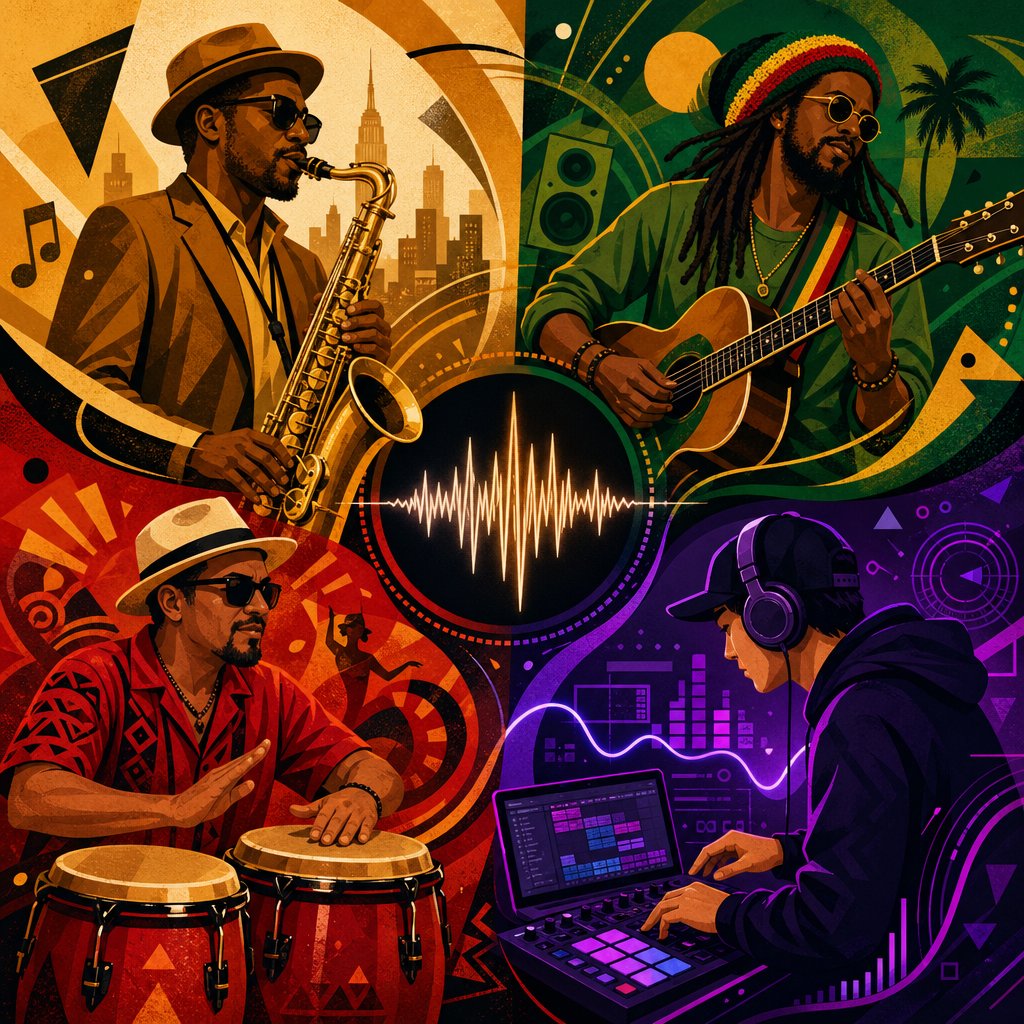
Every genre has its own rhythmic fingerprint, and syncopation is the ink. The way musicians syncopate music in a jazz trio sounds nothing like how a reggae band or an EDM producer does it, yet the underlying principle is identical: place the accent where the listener doesn't expect it. What changes is which beats get displaced, how often, and how central that displacement is to the genre's identity. Here's how syncopation meaning shifts from one style to the next.
Syncopation in Jazz, Funk, and R&B
Jazz lives and breathes syncopation. Swing eighth notes, the genre's rhythmic signature, are themselves a form of constant displacement. Instead of playing two even eighth notes per beat, jazz musicians stretch the first note long and compress the second short, creating a lilting, forward-leaning pulse that never quite sits on the grid. Bebop took this further. Players like Charlie Parker and Dizzy Gillespie scattered accents across unexpected subdivisions at blistering tempos, turning rhythmic displacement into a virtuosic art form. Listen to Parker's "Confirmation" and you'll hear melodic phrases that land everywhere except where a straight-ahead pulse would predict.
Funk treats syncopation as architecture. The genre emerged in the mid-1960s as one of the first styles of music to place more emphasis on rhythm than melody and harmony, and that emphasis lives in the interplay between bass and drums. James Brown's drummer Clyde Stubblefield built the legendary groove on "Funky Drummer" around ghost notes, those barely audible snare taps between the backbeats that fill the rhythmic spaces with texture. David Garibaldi of Tower of Power pushed funk drumming into linear territory, where no two limbs play at the same time, creating intricate syncopated patterns that lock with the bass line like interlocking gears. The definition of syncopation music in funk is inseparable from this bass-and-drum conversation: the kick anchors the "one" while everything else dances around it.
R&B takes a subtler approach. The grooves underneath are often steady and smooth, built on even subdivisions and predictable chord changes. The syncopation lives in the voice. Singers like Erykah Badu and D'Angelo phrase their melodies between the beats, stretching syllables across bar lines and landing key words on off-beat subdivisions. Neo-soul, in particular, features a relaxed, laid-back feel where the drums provide a chilled-out foundation and the vocal rhythm floats freely above it. The result is a groove that feels effortless but is rhythmically sophisticated.
Syncopation in Reggae, Latin, and Hip-Hop
Reggae might be the purest example of a genre defined by a single syncopation technique. The off-beat guitar chop, known as the skank, accents every "&" while leaving the downbeats completely empty. That one rhythmic choice gives reggae its unmistakable laid-back sway. Pair it with the "one-drop" drum pattern, where the kick drum skips beat 1 entirely and lands on beats 2 and 3, and you get a groove built almost entirely on displaced accents. Bob Marley's "Stir It Up" is a masterclass in this approach: the guitar, organ, and drums all avoid the downbeat, creating a rhythmic pocket that feels like it's floating.
Latin music formalizes syncopation into a structural framework: the clave. The son clave, the most common pattern, distributes five accents unevenly across two bars, creating a rhythmic tension that every other instrument in the ensemble responds to. Whether it's the 3-2 or 2-3 orientation, the clave acts as an organizing principle, a syncopated skeleton that the entire arrangement hangs on. Tito Puente's "Oye Como Va" rides a clave-based groove where the organ riff, bass line, and percussion all interlock around that asymmetric five-note pattern. Latin music is percussion-heavy by nature, and the clave ensures that all those layers of congas, timbales, and bongos syncopate in a coordinated, not chaotic, way.
Hip-hop inherited its syncopation from the genres it sampled. Boom-bap production, the sound of golden-era East Coast rap, was built on looped breakbeats pulled from funk and soul records, patterns that were already heavily syncopated. The snare hit on boom-bap tracks often lands slightly behind the beat or on an unexpected subdivision, giving the groove a head-nodding drag. Trap flipped the formula. Instead of sampling acoustic drums, trap producers program rapid-fire hi-hats at thirty-second-note subdivisions with irregular accent patterns, creating a jittery, syncopated texture over a half-time kick-and-snare framework. In both cases, the displaced snare hit is the engine. Whether it's the dusty sample on A Tribe Called Quest's "Can I Kick It?" or the booming 808 on Future's "March Madness," hip-hop's rhythmic identity is rooted in where the snare doesn't land on the expected beat.
Syncopation in Classical, Rock, and Electronic Music
Classical music uses syncopation more sparingly, but when it appears, the effect is striking. Beethoven was particularly fond of sforzando markings, sudden loud accents placed on weak beats that jolt the listener out of a predictable metric flow. The opening of his Symphony No. 3 ("Eroica") features displaced accents that destabilize the 3/4 meter, and his late string quartets push rhythmic displacement into territory that wouldn't sound out of place in twentieth-century music. These aren't decorative flourishes. They're structural disruptions that reshape how the listener perceives the phrase.
Rock's relationship with syncopation is more foundational than most listeners realize. The backbeat, that snare hit on beats 2 and 4 that defines virtually every rock song, is itself a form of syncopation. In a standard 4/4 meter, beats 1 and 3 are the "strong" beats. By hammering the snare on 2 and 4, rock drumming permanently shifts the accent to the weak beats. It's so ubiquitous that it doesn't feel syncopated anymore, but compare it to a march or a waltz and the displacement becomes obvious. Led Zeppelin's John Bonham took this further, layering additional syncopated kick drum patterns underneath the backbeat on tracks like "Good Times Bad Times."
Electronic music uses syncopation as a production tool. EDM producers program syncopated hi-hat patterns, off-grid percussion hits, and displaced melodic stabs to inject groove into quantized, machine-perfect tracks. House music runs on a four-on-the-floor kick at 120-130 BPM, but the syncopated elements layered on top, the open hi-hats on upbeats, the clap that arrives a sixteenth note early, are what separate a static loop from a track that moves a dance floor. Drum and bass pushes this even further, chopping breakbeats into rapid syncopated fragments at 160-180 BPM. The classical-electronic fusion trend has even brought syncopated production techniques to remixes of Beethoven and Mozart, proving that the impulse to syncopate music crosses every stylistic boundary.
Here's a genre-by-genre reference showing each style's signature syncopation technique alongside a recognizable example:
| Genre | Typical Syncopation Technique | Real Song Example |
|---|---|---|
| Jazz | Swing eighth notes and rhythmic displacement of melodic accents | "Take Five" by Dave Brubeck Quartet |
| Funk | Ghost notes on snare, syncopated bass-and-drum interplay | "Funky Drummer" by James Brown |
| R&B / Neo-Soul | Syncopated vocal phrasing over steady grooves | "On & On" by Erykah Badu |
| Reggae | Off-beat skank guitar with one-drop drum pattern | "Stir It Up" by Bob Marley |
| Latin | Clave-based rhythmic framework organizing all instruments | "Oye Como Va" by Tito Puente |
| Hip-Hop | Displaced snare hits over looped or programmed breakbeats | "Can I Kick It?" by A Tribe Called Quest |
| Classical | Sforzando accents on weak beats, metric displacement | Symphony No. 3 "Eroica" by Beethoven |
| Rock | Backbeat snare on beats 2 and 4, syncopated kick patterns | "Good Times Bad Times" by Led Zeppelin |
| Electronic / EDM | Syncopated hi-hats, off-grid percussion, displaced melodic stabs | "Get Lucky" by Daft Punk |
Some genres are so deeply shaped by syncopation that removing it would erase their identity entirely. Others use it as seasoning rather than structure. Here's a ranking based on how prominently syncopation defines each genre's rhythmic character:
- Funk - syncopation is the genre's reason for existing; rhythm dominates melody and harmony
- Reggae - the off-beat skank and one-drop pattern make syncopation the defining sonic trait
- Latin - clave patterns build the entire rhythmic architecture around structured syncopation
- Jazz - swing feel and rhythmic displacement are central, though improvisation adds variability
- Hip-Hop - displaced snare and sampled breakbeats drive the groove, though some subgenres are more straight
- R&B / Neo-Soul - syncopation lives primarily in the vocal layer over relatively steady instrumental grooves
- Electronic / EDM - syncopated elements add groove to quantized frameworks, but the four-on-the-floor kick stays straight
- Rock - the backbeat is syncopated by definition, but most rock rhythms feel metrically stable
- Classical - syncopation appears as a deliberate compositional device rather than a pervasive rhythmic feel
What's revealing about this ranking is that the genres where syncopation runs deepest, funk, reggae, Latin, and jazz, are also the genres most directly connected to African rhythmic traditions. That's not a coincidence. It's a through-line that stretches back centuries. But with all these genres using syncopation in different ways, it's easy to confuse the technique with other rhythmic concepts that sound similar but work very differently under the hood.
Syncopation vs. Polyrhythm, Swing, and Rubato Explained
Syncopation gets tangled up with other rhythmic concepts all the time, and the confusion makes sense. Polyrhythms, swing, and rubato all mess with your expectations of where notes land. But each one manipulates a different element of rhythm. If you want to define syncopation in music with real precision, you need to know where it ends and these other techniques begin.
Syncopation vs. Polyrhythm
Syncopation shifts accents within a single meter. The time signature stays the same; only the emphasis moves. A syncopated pattern in 4/4 is still 4/4. You're hearing displaced accents, not a different meter.
Polyrhythm is fundamentally different. It layers two or more distinct rhythmic groupings that imply different meters simultaneously. A 3-against-4 polyrhythm, for example, places three evenly spaced notes in the same time span as four, creating two competing pulses that align only at the start and end of the cycle. Your brain has to track two grids at once rather than hearing displaced accents on a single grid.
Here's the practical distinction: if you clap a steady 1-2-3-4 and the music accents the "&" between beats, that's syncopation. If you clap 1-2-3-4 and another instrument is clearly cycling in groups of three at a different rate, that's polyrhythm. As Sweetwater's rhythmic concepts guide puts it, polyrhythm creates the feeling that different meters are being played together, while syncopation emphasizes the weaker beats within a single meter.
One important nuance: not every off-beat note is syncopated. Context and listener expectation matter. In reggae, the off-beat guitar skank is syncopation because the listener's ear still references a steady 4/4 pulse. But in a West African drum ensemble where off-beat patterns are the norm rather than the exception, the same rhythmic placement might function as the primary pulse rather than a displacement of it. Syncopation in music depends on a shared expectation of where the strong beats "should" be.
Syncopation vs. Swing and Rubato
Swing is a rhythmic feel, not an accent shift. When musicians swing, they play pairs of eighth notes with unequal duration, stretching the first note long and compressing the second short. That long-short pattern creates a lilting, bouncing groove. Swing can contain syncopation, and often does, but the two aren't the same thing. You can play a perfectly syncopated rhythm with straight, even eighth notes, and you can swing a melody without displacing a single accent. Swing changes note duration; syncopation changes where the emphasis falls.
Rubato is even further removed. It's a deliberate stretching or compressing of tempo for expressive purposes, common in Romantic-era piano music and ballad singing. A pianist playing Chopin might slow down through a phrase's emotional peak and speed up through a transition. The syncopation meaning in music is about accent placement against a steady pulse. Rubato abandons that steady pulse entirely. Where syncopation creates tension by pushing against a fixed rhythmic grid, rubato dissolves the grid itself.
Syncopation moves the accent. Swing changes the duration. Rubato bends the tempo. Polyrhythm layers the meter. They can coexist, but they are not the same thing.
This comparison table breaks down exactly what each technique alters:
| Concept | Definition | What Changes | Example |
|---|---|---|---|
| Syncopation | Emphasis placed on normally weak or off-beats within a single meter | Accent placement | Funk bass hitting the "&" of beat 3 in 4/4 |
| Polyrhythm | Two or more distinct rhythmic groupings layered simultaneously | Meter (multiple pulses coexist) | 3 evenly spaced notes against 4 in the same time span |
| Swing | Pairs of notes played with unequal long-short duration | Note duration | Jazz ride cymbal pattern with a triplet-based lilt |
| Rubato | Flexible tempo manipulation for expressive purposes | Tempo | A Chopin nocturne slowing through an emotional climax |
These four concepts can overlap in a single performance. A jazz soloist might swing their eighth notes, syncopate their melodic accents, imply a polyrhythmic grouping against the rhythm section, and use rubato at the end of a phrase. But understanding what each one does independently is what separates a musician who feels rhythm from one who truly understands it. And that understanding raises a deeper question: why does syncopation, specifically, feel so good? The answer has less to do with music theory and more to do with how your brain processes rhythmic surprise.
Why Syncopation Creates Groove and Makes You Want to Move
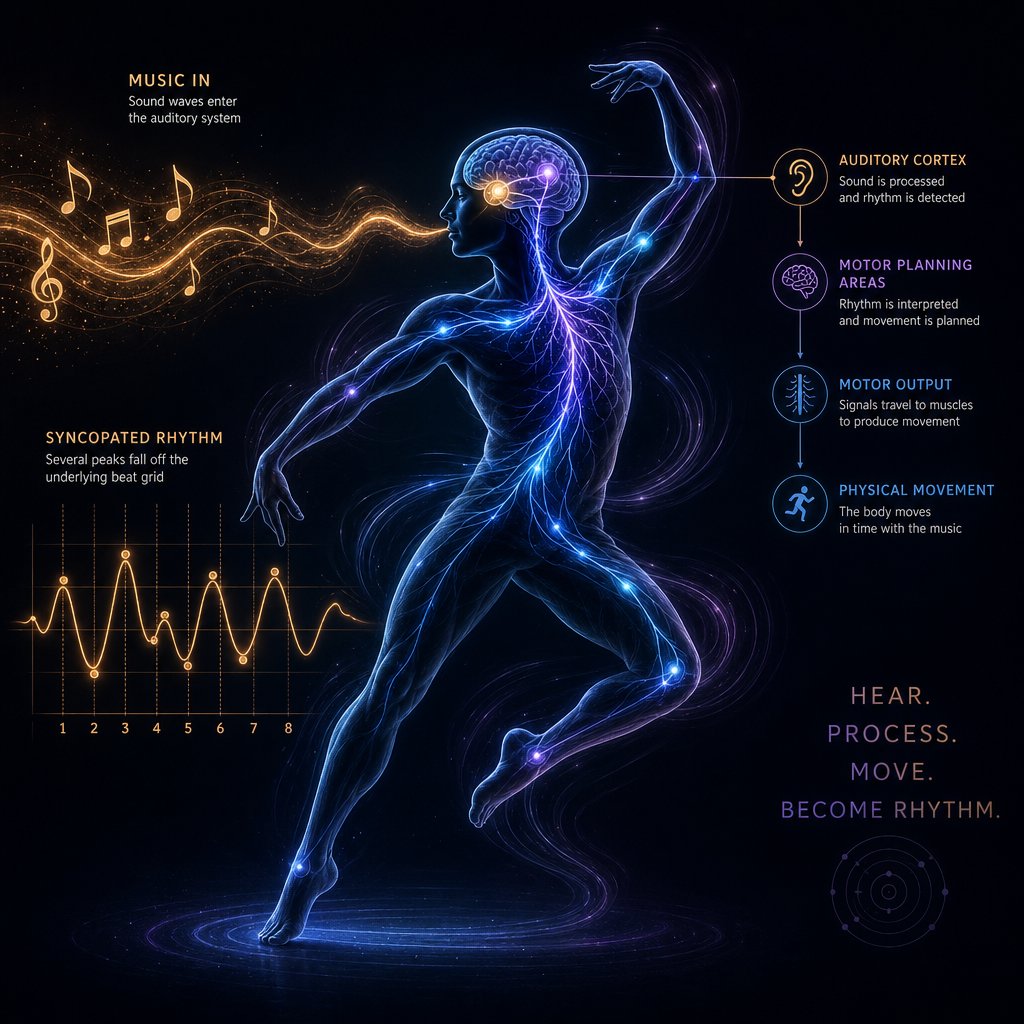
Your foot starts tapping before you decide to tap it. Your head nods before you realize you're nodding. That involuntary physical response to a syncopation rhythm isn't random. It's your brain doing something remarkable beneath the surface, and neuroscience is finally catching up to what dancers and musicians have felt for centuries.
How Your Brain Processes Rhythmic Surprise
When you listen to music, your brain doesn't passively receive sound. It actively predicts what comes next. Every beat you hear reinforces an internal model of the rhythm's pattern, and your auditory system generates expectations about where the next accent will land. Neuroscientists call this predictive coding, a framework where the brain constantly compares its predictions against incoming sensory data. When a note lands exactly where expected, the prediction is confirmed and the brain moves on. When a note lands somewhere unexpected, the mismatch generates what researchers call a prediction error, a neural signal that flags the surprise.
Syncopation is a prediction-error machine. By placing accents on weak beats or between beats, it systematically violates the metric expectations your brain has built. But here's the key: not all prediction errors feel the same. A small, structured violation, the kind produced by a medium degree of syncopation, triggers a pleasurable response. Research published in Science Advances found that a moderate level of syncopation triggered the strongest desire to move, while neither highly predictable nor highly unpredictable rhythms had the same effect. In other words, your brain enjoys being mildly wrong about where the beat lands. Too much predictability is boring. Too much surprise is chaotic. The sweet spot in between is where groove lives.
This inverted U-shaped relationship between syncopation and pleasure has been demonstrated empirically across multiple studies. When participants rated funk drum-breaks with varying degrees of syncopation, intermediate levels consistently elicited the most desire to move and the highest pleasure ratings. The syncopated definition of "groovy" turns out to have a neurological basis: it's the point where rhythmic complexity is high enough to engage your predictive system but structured enough that your brain can still extract the underlying beat.
The Connection Between Syncopation and the Urge to Dance
So your brain detects the mismatch. What happens next? This is where the body enters the picture. Researchers at the University of Osaka found that when participants tapped along to syncopated rhythms, their brains showed enhanced neural entrainment to beat-related frequencies and larger prediction-error responses compared to passive listening. The act of moving didn't just accompany the music. It actively sharpened the brain's rhythmic processing, reducing sensory uncertainty by physically reinforcing the meter that syncopation disrupts.
Think of it this way: syncopation creates a gap between where your brain expects the accent and where it actually lands. Your body fills that gap with movement. The tap of a foot on the downbeat, the nod of a head on the backbeat, these aren't just reactions to the music. They're your nervous system's attempt to anchor the pulse that the syncopated pattern keeps pulling away from. Researchers have described this as the body "becoming the beat," physically manifesting the metric framework that the music itself leaves incomplete.
This is exactly why funk, reggae, and dance music, the genres where syncopation runs deepest, are also the most physically engaging. They don't just invite movement. They create a neurological need for it. Cognitive neuroscientist Benjamin Morillon's research showed that the brain's dorsal auditory pathway, the region connecting auditory processing to motor areas, is where syncopated melody gets translated into the basic beat. The impulse to dance likely arises in this pathway and is then passed to motor areas as a movement signal.
Syncopation is the engine of groove. It generates just enough rhythmic surprise to engage your brain's predictive system while leaving enough structure for your body to fill in the gaps with movement.
Given how deeply the definition of syncopation connects to both brain science and physical movement, it's worth clearing up a few persistent misconceptions that limit how people think about this technique:
- Syncopation is not limited to drums or percussion. Vocal melodies, bass lines, piano comping, guitar riffs, and even harmonic rhythm (the rate at which chords change) can all be syncopated. Any sound source that places emphasis on weak or off-beats is participating in syncopation.
- Not every off-beat note is syncopated. Context matters. A note on an off-beat only counts as syncopation when the listener perceives a steady metric framework that the accent pushes against. Without that reference pulse, there's no expectation to violate.
- Syncopation exists in harmonic rhythm too. When a chord change lands on the "&" of beat 4 instead of beat 1, that's harmonic syncopation. It affects the sense of forward motion in a song just as powerfully as a displaced snare hit, even though no single note is accented differently.
- More syncopation doesn't always mean more groove. The research consistently shows an inverted U-curve. You can define syncopated patterns that are so complex they destroy the listener's sense of meter entirely, and when that happens, the groove disappears along with it.
Understanding why syncopation moves you is one thing. Having a practical reference for the most common syncopated patterns, something you can clap through, practice, and internalize, is the next step toward making this knowledge physical.
A Syncopation Cheat Sheet for Common Rhythm Patterns
Theory is useful. A pattern you can clap right now is better. The syncopations covered throughout this article all share the same DNA, accents landing where your ear doesn't predict them, but they show up in specific, repeatable shapes. This cheat sheet collects the most common ones into a single reference you can bookmark, print, or pull up at a practice session.
Common Syncopation Patterns in 4/4 Time
Each row in the table below represents one bar of 4/4 time divided into sixteenth-note subdivisions: 1 e & a 2 e & a 3 e & a 4 e & a. An X marks an accented note. A . marks a rest or unaccented position. Reading left to right, you're moving through the bar exactly as it would unfold in real time.
| Pattern Name | 1 | e | & | a | 2 | e | & | a | 3 | e | & | a | 4 | e | & | a | Common Genre |
|---|---|---|---|---|---|---|---|---|---|---|---|---|---|---|---|---|---|
| Off-Beat Eighth Note | . | . | X | . | . | . | X | . | . | . | X | . | . | . | X | . | Reggae |
| Anticipated Downbeat | X | . | . | . | X | . | . | . | X | . | . | . | . | . | X | . | Pop / Rock |
| And-of-Two Accent | X | . | . | . | . | . | X | . | X | . | . | . | X | . | . | . | Jazz |
| Missed-Beat Pattern | . | . | . | . | X | . | . | . | . | . | X | . | X | . | . | . | Dub / Reggae |
| Sixteenth-Note Displacement | X | . | X | . | . | . | X | X | . | . | X | . | X | . | . | . | Funk / R&B |
A few things to notice. The off-beat eighth note pattern places every accent on the "&" and leaves all numbered beats silent, which is the definition of syncopated rhythm in its purest form. The anticipated downbeat shifts the last accent from beat 4 to the "&" of 4, pulling the listener's ear into the next bar early. The and-of-two accent isolates a single off-beat displacement on the "&" of beat 2, a subtle move that jazz comping pianists use constantly. The missed-beat pattern drops beat 1 entirely, creating that floating, gravity-free sensation you hear in dub. And the sixteenth-note displacement scatters accents across the "a" and "&" subdivisions, producing the tight, interlocking feel that defines funk guitar and bass.
These five patterns cover the vast majority of syncopations you'll encounter in popular music. The accent definition in music is simply a note played with greater emphasis than its neighbors, and in every grid above, the X positions are where that emphasis lands against the listener's expectation of a straight pulse.
How to Read and Practice These Patterns
Reading the grid is straightforward: each column is one sixteenth-note subdivision, and you move through all sixteen positions at a steady tempo. Clap or tap the X positions and stay silent on the dots. Start slowly, around 60 BPM, so your internal clock has time to lock in before speed enters the equation. A metronome or drum loop is essential here. As the TrueFire syncopation guide emphasizes, syncopation only works against a steady beat, so if your pulse wavers, the displaced accents will sound random rather than groovy.
Once you can read the grid, here's a step-by-step sequence for building these patterns into your playing:
- Clap a completely straight pattern first: accent every numbered beat (1, 2, 3, 4) with nothing in between. This establishes your internal pulse and gives the syncopations something to push against.
- Pick one pattern from the table and add a single syncopated accent, just one X on an off-beat position, while keeping the rest of your straight pattern intact. Feel how that one displaced note changes the entire character of the rhythm.
- Gradually remove the straight-beat accents and add more off-beat ones until you're clapping the full pattern as written. Notice the tension increase with each displacement.
- Combine two patterns by alternating them across consecutive bars, one bar of the off-beat eighth note followed by one bar of the anticipated downbeat, for example. This trains your ear and hands to shift between different syncopated feels on the fly.
These grids work for any instrument. Vocalists can sing a single pitch on the X positions. Guitarists can strum a muted chord. Keyboard players can tap a single note. Bass players can pluck an open string. Drummers can use a practice pad. The rhythmic pattern is the same regardless of what produces the sound, which is why a cheat sheet like this is more versatile than any instrument-specific exercise book. Bookmark it, practice one pattern a day, and you'll internalize the most common syncopated shapes faster than you'd expect.
Having these patterns under your fingers is one thing. Weaving them into original music, where they interact with melody, harmony, and lyrics, is where syncopation stops being an exercise and starts becoming a creative tool.
Applying Syncopation in Your Own Songwriting and Music
Clapping patterns from a cheat sheet builds your internal clock. Writing a melody that uses those patterns builds your musicianship. The gap between knowing what is a syncopated rhythm and actually creating one in your own music is smaller than you think, and closing it starts with a single displaced note.
Start Simple and Build Rhythmic Complexity
You don't need to rewrite an entire song to hear syncopation transform your music. Take any straight melody or chord progression you've already written, something that sits squarely on the beats, and move just one note per phrase to an off-beat position. That single shift acts like a rhythm changer for the whole line. A melody that felt flat and predictable suddenly breathes, leans forward, and pulls the listener's ear toward the next phrase.
Think of it as seasoning. One displaced accent adds flavor without overwhelming the dish. Two or three start to define the groove. Here's a simple process to try right now:
- Write or play a melody using only straight rhythms, every note landing squarely on a numbered beat (1, 2, 3, or 4). Keep it simple: four to eight notes is plenty.
- Identify the strongest downbeat in the phrase, usually beat 1 of the most important bar. This is your anchor. Leave it where it is.
- Pick one other note and shift it to the "&" just before its original beat. Play the phrase again and listen to how that single displacement changes the feel. That's syncopation at work, and it's one of the clearest syncopation examples you can create with your own hands.
Once that feels natural, try shifting a second note. Then a third. You'll notice a tipping point where the phrase stops feeling like a straight melody with a twist and starts feeling like a groove, a syncopated synonym for "alive." That tipping point is different for every phrase, and finding it is part of the creative process.
Tools and Resources for Practicing Syncopation in Songwriting
Reading about displaced accents only gets you so far. The real learning happens when you hear your own ideas played back with syncopated timing and can adjust in real time. If you don't have a DAW setup or aren't comfortable with notation software, MakeBestMusic's Melody Maker offers a hands-on environment where you can experiment with rhythm, dynamics, and melodic structure directly. It's a practical sandbox for testing what is a syncopated rhythm in the context of actual songwriting, letting you drag notes off the beat, hear the result instantly, and refine your feel without any technical barriers.
Whatever tool you use, the approach stays the same: start with a straight idea, displace one element at a time, and listen critically to how each shift changes the groove. Record your experiments so you can compare versions side by side. Over time, you'll develop an instinct for where syncopation serves the song and where it clutters it.
Understanding syncopation is valuable. Applying it in your own music, hearing your melodies come alive with displaced accents and off-beat energy, is where the real learning happens.
Syncopation has always been a living technique, shaped by the people who play it rather than the textbooks that describe it. The best way to join that tradition is to stop reading and start writing. Pick up your instrument, open a blank project, and move one note off the beat. That's where it begins.
