

What Makes Praise and Worship Music Upbeat
Ask ten worship leaders what "upbeat" means and you'll get ten different answers. Some point to tempo. Others talk about feel. A few just say, "You know it when you hear it." That vagueness is exactly why so many high-energy sets miss the mark. So let's get specific.
Upbeat praise and worship is congregational music typically at 120+ BPM characterized by driving rhythm, celebratory lyrics, and high-energy instrumentation designed to invite physical and vocal participation.
That definition isn't arbitrary. It's built on measurable musical characteristics that separate a song people clap along to from one that draws them inward. Understanding those characteristics is a bit like learning how to make coffee well — the ingredients matter less than knowing the ratios and timing behind them.
Tempo, Rhythm, and Energy Characteristics
Tempo is the easiest starting point. Songs below 85 BPM generally feel reflective or meditative — think pads, sustained chords, and space between phrases. The 85-115 BPM range sits in mid-tempo territory: groovy, swaying, but not quite driving. Once you cross 120 BPM, the energy shifts. The body wants to move. Hands come up. Feet start tapping.
But BPM alone doesn't make a song feel upbeat. Rhythmic characteristics carry just as much weight. A strong backbeat — that snare hitting beats two and four — creates the driving pulse congregations instinctively lock into. Add syncopation, eighth-note strumming on acoustic guitar, a four-on-the-floor kick pattern, and percussive keyboard comping, and you've built a rhythmic engine that pulls people in. Electric guitar prominence, handclaps, and layered percussion push the energy even further. The lyrics matter too: upbeat praise tends toward celebratory, declarative, outward-focused language — proclamations about who God is rather than introspective prayers.
How Upbeat Praise Differs from Reflective Worship
Here's where it gets nuanced. As Birgitta Johnson's research highlights, praise and worship music isn't strictly defined by tempo — it's about lyrical focus and congregational accessibility. Still, energy level creates a functional distinction worth understanding. Celebratory praise songs are outward and communal. They declare God's greatness, invite the room to respond together, and thrive on volume and movement. Reflective worship songs, even when they carry moderate tempo, turn inward — drawing individuals into personal meditation and intimacy with God.
Think of it this way: you wouldn't set a 5 minute timer and rush through a moment of quiet reflection, and you wouldn't slow-walk a victory anthem. Each serves a different role in the congregational experience. Upbeat praise gathers the room. Reflective worship deepens it. The best sets use both — but knowing which is which starts with recognizing the musical DNA behind the energy.
That musical DNA, though, doesn't exist in a vacuum. It's rooted in something much older than modern worship bands and click tracks.

The Biblical Foundation for Joyful Praise
Some worship leaders quietly worry that high-energy praise is spiritually shallow — all emotion, no substance. That concern is understandable, but Scripture tells a very different story. Energetic, physical, loud celebration before God isn't a modern invention. It's one of the oldest commands in the Bible.
Scriptural Commands for Joyful and Exuberant Praise
The Psalms don't whisper about praise. They shout. Psalm 100:1 opens with a command that leaves no room for timidity: "Make a joyful noise unto the Lord, all the earth." Psalm 149:3 goes further, calling God's people to "praise His name with dancing." And then there's Psalm 150 — a crescendo of instrumentation and energy that Westminster Seminary California describes as the culminating psalm of the entire Psalter, where the word "praise" appears thirteen times in just six verses. Trumpets, lyres, tambourines, cymbals, dancing — the psalmist marshals every instrument available and ends with a universal call: "Let everything that has breath praise the Lord."
The New Testament carries this forward. Colossians 3:16 instructs believers to sing "psalms and hymns and spiritual songs, with thankfulness in your hearts to God" — a communal, expressive act directed at the whole church, not just the worship team. And in 2 Samuel 6, David danced before the Lord "with all his might" as the ark entered Jerusalem, setting aside his royal robes in an act of humble, exuberant celebration. When his wife criticized him for it, God sided with David.
Here are key passages every worship leader should keep close:
- Psalm 100:1 — A direct command to make a joyful noise, not a quiet one.
- Psalm 149:3 — Praise with dancing and tambourine, connecting physical movement to worship.
- Psalm 150:1-6 — The full orchestra of praise, calling for every instrument and every breath to glorify God.
- 2 Samuel 6:14 — David's uninhibited dancing as a model of wholehearted celebration.
- Colossians 3:16 — Singing as a communal practice of mutual edification and thankfulness.
Why Energetic Worship Matters for Congregational Life
Theology aside, there's a practical reality here. When a room full of people sings and claps and moves together, something shifts. Self-consciousness drops. The person in the third row who normally mouths the words starts singing out. Community forms in real time — not through a program or a small group curriculum, but through shared physical and vocal expression.
As The Gospel Coalition India notes, congregational singing transforms people "from consumers to conduits of the gospel, promoting mutual edification." That transformation happens most naturally when the energy in the room gives people permission to participate fully. Upbeat praise and worship creates that permission. It builds momentum the way assembling something complex does — much like learning how to build a pc, each component matters, but it's the combination working together that produces the result. Every voice added, every hand raised, every foot tapping builds shared spiritual momentum that a single voice or instrument can't generate alone.
This isn't limited to one tradition. Contemporary churches lean into driving band arrangements. Charismatic congregations embrace spontaneous movement and vocal expression. Blended services weave hymn energy with modern instrumentation. Even more traditional settings find room for joyful, full-throated singing. The style varies, but the scriptural principle stays constant: God's people are called to praise Him with enthusiasm, not obligation. It shouldn't feel like the last item on a night routine checklist — it should feel like the thing you've been waiting to do all week.
The biblical case is clear. The real question is which songs actually deliver on that energy — and how you organize them so the whole set lands, not just the opener.
Upbeat Praise Songs Organized by Style and Energy
A flat list of fast songs doesn't help you build a set. What you actually need is a way to match the right song to the right context — your team's size, your congregation's familiarity, and the energy level you're targeting. Think of it less like browsing coloring books at random and more like sorting tools by the job they're built for.
To make comparisons quick, every recommendation below uses a simple 1-5 energy scale: 1 is gently upbeat, 5 is full-throttle celebration. This gives you a shared vocabulary with your team when planning — much more useful than vague terms like "medium fast" or "pretty energetic."
Congregational Anthems Everyone Can Sing
These are the songs where the whole room locks in from the first chorus. Simple melodies, repetitive hooks, and vocal ranges that don't punish anyone sitting in the alto section. The goal here is maximum participation with minimal learning curve.
"House Of The Lord" by Phil Wickham is the gold standard — "There's joy in the house of the Lord" lands every single time, and most congregations already know it. "Glorious Day" by Passion and Kristian Stanfill works similarly: the chorus builds to a resurrection declaration that lifts the room, and acoustic guitar can carry the verse even without a full band. "This Is Amazing Grace" has been in rotation for years because the melody never gets old and the lyric is pure gospel declaration. And "Great Things" rounds out this category with a testimony-driven chorus that fills any room regardless of size.
What makes these anthems work isn't complexity — it's accessibility. They're how to start a conversation between the stage and the seats. The congregation doesn't need three weeks of repetition to join in. They're singing by the second line.
Band-Driven Energy Songs for Full Production
Some songs need a full band to deliver their intended impact. Strip them down too far and the energy collapses. These tracks demand drums that hit hard, bass that drives, and electric guitar that cuts through the mix.
"Praise" by Elevation Worship is the clearest example — Brandon Lake's energy is undeniable, and the arrangement is aggressive in the best way. "I Thank God" by Maverick City Music brings gospel fire that requires a confident rhythm section to lock in the groove. "You Are Good" by Israel Houghton is one of the most musically demanding upbeat worship songs in the modern catalog — syncopated drums, funky bass, colorful keys — but when your team nails it, the result is electric. "That's My King" by CeCe Winans carries deep gospel roots and benefits enormously from horns or at least a full rhythm section that can replicate that celebratory feel.
A word of caution: a band-driven song played poorly does more damage than a simpler song played well. Be honest about your team's skill level before programming these into your set.
Acoustic-Friendly Upbeat Picks
Not every church has a seven-piece band, and not every Sunday calls for full production. These songs maintain their energy even when stripped to guitar or piano and vocals — making them ideal for smaller teams, midweek gatherings, or church plants still building their roster.
"Build My Life" by Pat Barrett sits at the intersection of energy and intimacy — acoustic guitar and keys carry most of the weight, with the full band layering in only for the final build. "Battle Belongs" by Phil Wickham anchors its verse on acoustic guitar, and even a smaller team can pull it off with confidence. "Take You At Your Word" by Cody Carnes builds momentum through dynamics rather than sheer volume, making it forgiving for leaner arrangements. "Glorious Day" also crosses into this category — it's one of those rare songs that scales up or down without losing its core energy.
Youth-oriented picks like "WASHED" and "GOODBYE YESTERDAY" by Elevation Rhythm resonate with younger demographics through modern production and pop-influenced hooks. And for churches running blended services, reimagined hymn arrangements — think "Amazing Grace (My Chains Are Gone)" or up-tempo settings of "Come Thou Fount" — bridge generational gaps while keeping the energy high. Understanding these groupings isn't about memorizing statistics fundamentals; it's about pattern recognition that makes your planning faster and your sets stronger.
| Song | Category | Energy Level (1-5) | Best Arrangement | Congregation Accessibility |
|---|---|---|---|---|
| House Of The Lord | Congregational Anthem | 4 | Full band or acoustic-led | High — singable on first listen |
| Glorious Day | Congregational Anthem | 4 | Scales from acoustic to full band | High — widely known |
| This Is Amazing Grace | Congregational Anthem | 4 | Any band size | High — years of familiarity |
| Praise | Band-Driven | 5 | Full band with click track | Medium — chorus is easy, verses need repetition |
| I Thank God | Band-Driven | 5 | Full band, strong rhythm section | High — simple, shout-able chorus |
| You Are Good | Band-Driven | 5 | Full band with gospel chops | Medium — rhythmically complex |
| Build My Life | Acoustic-Friendly | 3 | Keys and acoustic guitar | High — prayer-like melody |
| Battle Belongs | Acoustic-Friendly | 4 | Acoustic-led, optional full band | High — declarative and repetitive |
| WASHED | Youth Favorite | 4 | Full band, modern production | Medium — newer, pop-influenced |
| Amazing Grace (My Chains Are Gone) | Upbeat Hymn Arrangement | 3 | Any configuration | High — universally known melody |
Categories give you a starting point. But even the perfect song choice falls apart if the key forces your congregation into a vocal range they can't reach — and that's a problem far more common than most worship leaders realize.
Choosing the Right Keys and Vocal Ranges
You picked the perfect song. The band rehearsed it well. The energy should be through the roof. But half the room goes quiet during the chorus. What happened? Chances are, the key is too high. It's one of the most common — and most overlooked — reasons upbeat praise and worship falls flat on Sunday morning.
Recorded worship albums are built for professional vocalists in studio environments. They're not mixed-congregation singalongs. When a worship leader pulls a song straight from the album key without evaluating the vocal range, they're essentially asking average singers to perform like trained soloists. The result isn't energy — it's silence.
The Congregational Vocal Range Sweet Spot
Imagine a room full of mixed voices — men and women, teens and seniors, trained singers and people who only sing in the car. What range can most of them actually hit with confidence? Worship leader and educator Mark Cole calls it the "Rule of D": congregations sing loudest and most comfortably when the melody stays within roughly Bb to D. For women, that translates to Bb3 up to D5. For men singing an octave lower, Bb2 up to D4. Push above that ceiling and participation drops fast.
The Worship Zone reinforces this point: when men and women sing a melody an octave apart, the best key is almost always a compromise — men sit a few semitones below their ideal and women a few above. The larger a song's melodic range, the harder that compromise becomes. A song spanning only seven semitones, like "Here I Am To Worship," fits almost any congregation. A song spanning twelve or more semitones? That's where people start dropping out. It's not a lack of enthusiasm — it's a lack of accessible notes.
Upbeat songs are especially vulnerable here. High-energy recordings tend to push melodies into the upper register for emotional impact, which works great for the artist but punishes the average congregant. You wouldn't browse landscaping ideas and then plant tropical species in a northern climate just because they looked great in the catalog. The same logic applies: match the key to the environment, not the recording.
How to Transpose Without Losing Energy
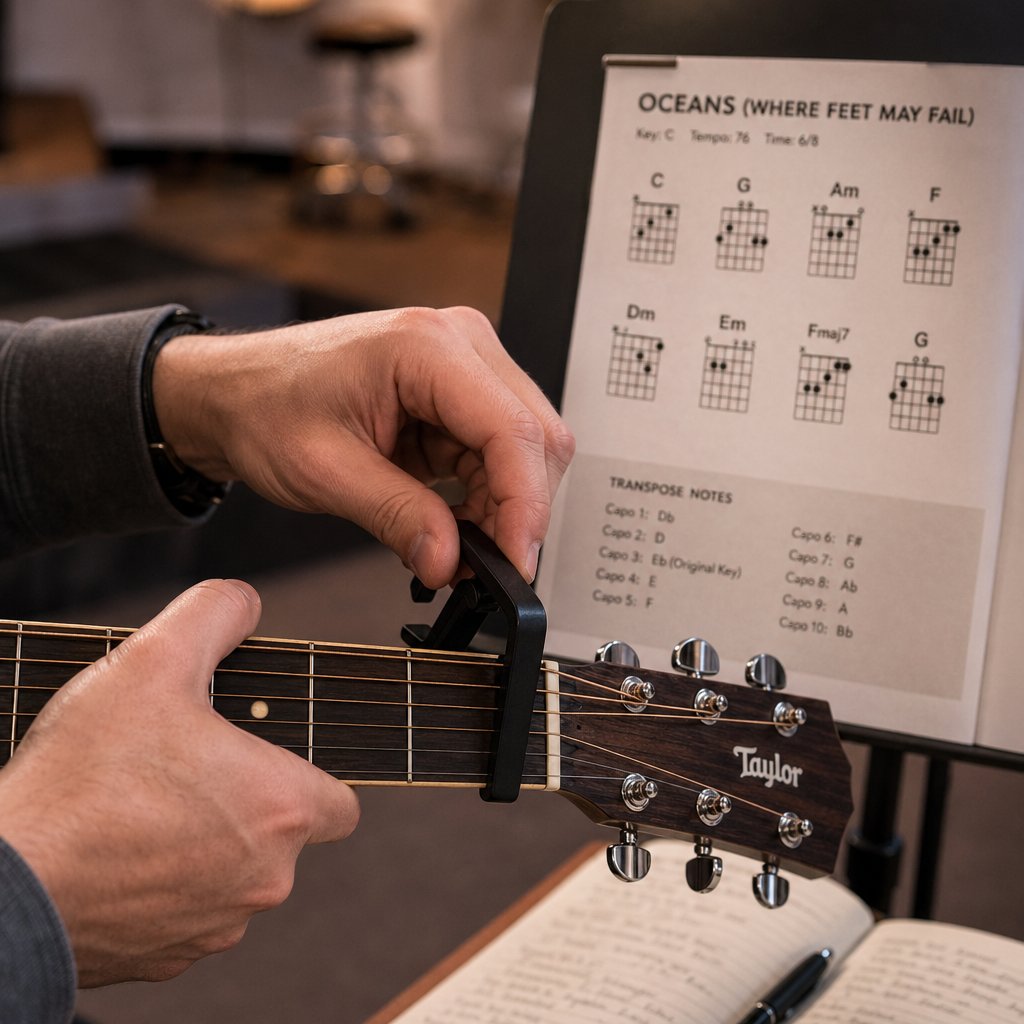
Transposing down a step or two solves the range problem, but it can introduce a new one. Drop too far and the song loses its brightness. The key of G major on acoustic guitar feels open and resonant. Drop that same song to E and the voicings get darker, the strumming feels heavier, and the upbeat character fades. The trick is finding the key that keeps the melody singable while preserving the harmonic brightness that makes the song feel alive.
For acoustic guitar players, a capo is your best friend. Dropping a song from B to A? Put a capo on the second fret and play in G shapes — you keep the bright, open chord voicings that drive energy. Keyboard players have more flexibility since transposition doesn't change the tonal color of the instrument the same way, but they should still pay attention to how chord inversions and voicings shift in lower registers. Muddy left-hand voicings in a lower key can sap the rhythmic punch right out of a song — not exactly the yummly, satisfying result you're after.
Here are popular upbeat worship songs that benefit from being brought down, along with suggested congregation-friendly keys:
- "Praise" (Elevation Worship) — Recorded in B; try A or Ab for mixed congregations.
- "House Of The Lord" (Phil Wickham) — Recorded in E; try D to keep the melody in the sweet spot.
- "I Thank God" (Maverick City Music) — Recorded in Ab; try G or F# to ease the chorus peak.
- "Battle Belongs" (Phil Wickham) — Recorded in A; try G, especially for acoustic-led settings.
- "Glorious Day" (Passion) — Recorded in Bb; try Ab or G to bring the bridge within reach.
- "Great Things" (Phil Wickham) — Recorded in A; try G for a more accessible top note.
A practical habit: before finalizing any song for your set, sing through the highest and lowest notes of the melody in your chosen key. If you strain, your congregation will too. Tools like SongSelect let you transpose lead sheets instantly and hear the melody in the new key — use that feature before rehearsal, not during it.
Getting the key right ensures your congregation can actually sing the songs you've chosen. But individual song keys are only one piece of the puzzle — how those songs flow together across an entire set determines whether the energy builds or collapses midway through.
Building an Energy Arc for Your Worship Set
You've picked great songs in singable keys. Each one works on its own. But string them together without a plan and the set feels like a playlist on shuffle — individual moments that never build into something bigger. The difference between a collection of songs and a worship experience comes down to one thing: your energy arc.
An energy arc is the intentional rise and fall of intensity across your entire set. Think of it like learning how to build a campfire. You don't throw the biggest log on first and hope it catches. You start with kindling, build heat, let the flames grow, and then manage the burn so it sustains. A worship set works the same way — every song is fuel placed at the right moment to shape the overall trajectory.
Opening with the Right Energy Level
You have two basic options for launching your set, and the right choice depends on your congregation's culture.
The first is the energy ramp. You open with a mid-tempo song — something around 100-110 BPM — and build toward your highest-energy moment by song two or three. This approach works well for congregations that need a minute to settle in. People are still finding seats, putting down coffee cups, shifting out of lobby-conversation mode. A ramp gives them a runway.
The second is the cold open. You hit full intensity from beat one. No warm-up, no easing in — the band launches and the room has to decide immediately whether they're in or out. This works best with younger congregations, youth services, or any context where people arrive expecting energy. Bryan Boliver at Churchfront advocates starting with upbeat, energetic songs and gradually transitioning to slower, more reflective worship — a descending BPM approach that mirrors the natural movement from corporate celebration to personal response.
Neither approach is universally better. A cold open at an 8:00 AM traditional service might feel jarring. An energy ramp at a college ministry gathering might feel sluggish. Read your room.
Transitioning from Upbeat Praise to Reflective Worship
The hardest moment in any set isn't the opener or the closer — it's the pivot. That spot where you shift from high-energy praise into something slower and more intimate. Get it wrong and the congregation feels whiplash. Get it right and the shift feels like exhaling after holding your breath.
Several practical techniques make this pivot smooth rather than abrupt:
Keyboard pads as sonic glue. Worship Guitar Academy recommends having your keyboardist sustain a pad chord — ideally the first chord of the next song — while the rest of the band fades out. This fills the gap between energy levels without dead air. If the keys are related, the pad can start quietly under the final chorus and swell as the band drops away. For unrelated keys, a brief full stop followed by the pad in the new key works better than forcing a smooth connection that sounds dissonant.
Dynamic drops. Instead of ending the upbeat song at full volume and starting the slow song from silence, bring the band down during the final chorus of the fast song. Pull the electric guitar out. Let the drums switch to a lighter pattern. By the time the song ends, you're already halfway to the energy level of the next one.
Single instrument bridges. One musician — acoustic guitar, piano, or even a vocal melody — carries the transition alone. This creates a natural breath in the set, like a paragraph break in a story. The congregation instinctively recognizes the shift and adjusts with you. It's far more effective than a hard stop followed by an awkward 15 minute timer of silence while the band regroups — even a few seconds of dead air can break the atmosphere you've built.
Spoken word or Scripture. A brief, prepared line from the worship leader — a verse, a prayer, a single sentence of redirection — gives the congregation permission to shift gears emotionally. As WorshipIdeas.com emphasizes, every moment in the set should be intentional, including silence. If you include a pause, make it meaningful rather than accidental.
Planning a Complete Energy Arc
Mapping your arc before selecting final songs prevents the most common sequencing mistakes. Here's a step-by-step process for a typical 4-6 song set:
- Define your destination. Decide where you want the congregation to land emotionally and spiritually by the end of the set. Work backward from there. Are you building toward a reflective communion moment? A celebratory sending? The destination shapes every decision that follows.
- Choose your anchor song. This is the emotional and theological centerpiece of your set — the song everything else orbits around. Churchfront's six-step framework builds the entire set outward from this anchor. It doesn't have to be the loudest song; it has to be the most important one.
- Plot energy levels for each slot. Using the 1-5 scale from earlier, assign a target energy level to each position in your set. A typical Sunday morning arc might look like: 4 → 5 → 3 → 2 → 1 → 3. A youth service might run: 5 → 5 → 4 → 2 → 4. Write these numbers down before you ever pick a song title.
- Assign songs to slots based on energy match. Pull from your categorized library — congregational anthems for the high-energy slots, acoustic-friendly picks for the valleys, band-driven tracks where you need maximum intensity. Check that each song's key works with its neighbors to avoid jarring transitions.
- Plan every transition explicitly. Don't leave the space between songs to chance. Decide whether you'll use a pad, a count-off, a single instrument intro, or a spoken moment. Write it into your chart. Rehearse it. As the reference materials consistently emphasize, transitions are where sets succeed or fall apart — they deserve as much preparation as the songs themselves.
- Rehearse the arc, not just the songs. Run through the entire set in order at least once, including transitions. Your team needs to feel the flow as a complete experience. Individual song rehearsal is necessary, but it's like practicing turns without ever driving the full course — you won't know if the set works until you play it end to end.
The energy arc isn't a rigid formula. Some weeks you'll do a barrel roll and flip the expected pattern because the Spirit leads somewhere unplanned. That's fine. The arc is a framework, not a cage. But having a deliberate plan means your spontaneous moments happen against a backdrop of intentional structure — and that's what separates a set that carries a room from one that loses it halfway through.
A well-mapped arc tells you where each song belongs. The next challenge is making those songs actually work with the team you have — whether that's a solo acoustic leader or a full eight-piece band.
Adapting Upbeat Songs for Any Team Size
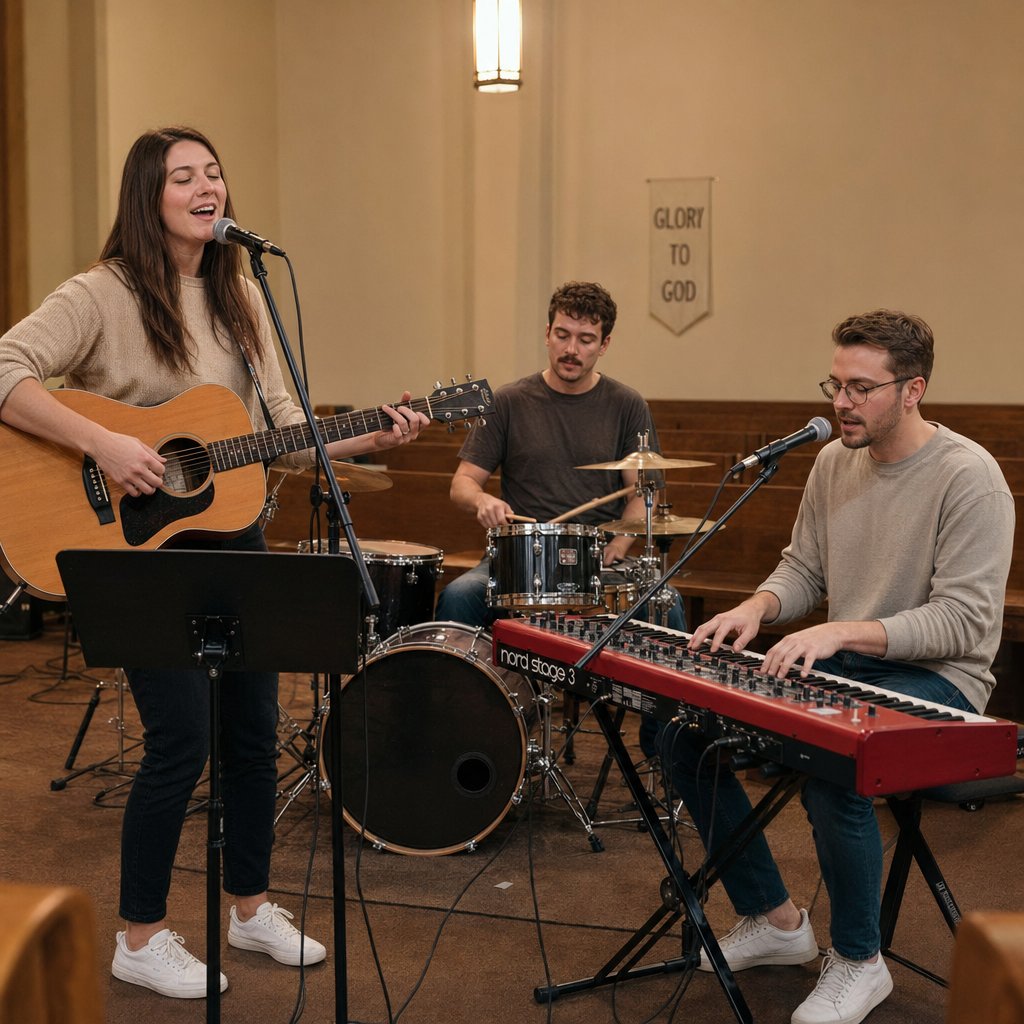
A great energy arc on paper means nothing if your team can't execute it. And here's the uncomfortable truth: most upbeat praise and worship songs are arranged for a full band with studio-quality production. If you're leading solo with an acoustic guitar or working with a three-piece team on a Sunday morning, the album version isn't your blueprint — it's your obstacle. The real skill is knowing how to reshape a song's arrangement so it delivers energy regardless of who's on stage.
Solo Acoustic Leader Strategies
Leading upbeat worship alone feels a lot like learning how to surf — you're responsible for balance, momentum, and timing all at once, with no one else to lean on. The good news? A single voice and instrument can absolutely drive high-energy praise. The key is strumming patterns and vocal dynamics working together.
A driving downstroke eighth-note strum on acoustic guitar creates rhythmic urgency that mimics a full rhythm section. Percussive muting between strums — that "chk" sound against the strings — adds a snare-like backbeat your congregation can lock into. On keys, rhythmic octave patterns in the right hand and a strong root-fifth pulse in the left hand generate forward motion without needing a drummer.
Vocal dynamics carry even more weight when you're solo. As Worship Vocalist emphasizes, singing at one volume the entire song makes it sound one-dimensional and is actually tiring for the listener's ear. Start verses with a lighter, textured tone and push into a full, clear voice on the chorus. That contrast alone creates the sense of build and release that keeps a congregation engaged.
Backing tracks and loops are a game-changer for solo leaders. Platforms like Loop Community offer lite and enhancement tracks specifically designed for worship leaders with minimal band members. A simple drum loop and bass pad underneath your acoustic guitar transforms the sonic landscape without adding a single musician. Songs like "Build My Life" and "Battle Belongs" translate beautifully to this setup because their energy comes from lyric and melody, not production density.
Small Team Arrangements That Sound Full
A three-piece team — typically a vocalist/guitarist, a keyboardist, and a drummer — can sound remarkably full if each player covers the right sonic territory. The mistake most small teams make is doubling up on the same frequency range instead of spreading out. Two instruments playing the same rhythmic pattern in the same register doesn't sound bigger. It sounds muddier.
Here's the running point to remember: each player owns a specific role. The drummer is your energy engine — for upbeat songs, a confident drummer matters more than any other single addition. A strong kick and snare pattern with hi-hat drive gives the congregation something physical to respond to. The keyboardist fills the harmonic middle, playing sustained pads or rhythmic comping depending on the section. And the acoustic guitar or lead instrument handles the top end — bright chord voicings, percussive strumming, and melodic fills between vocal phrases.
WorshipIdeas.com highlights that small bands unlock hidden potential by embracing space rather than trying to fill every gap. A three-piece playing with intentional dynamics — dropping to just keys and voice for a verse, then bringing the full team back for the chorus — creates contrast that a wall of constant sound never achieves. Songs like "This Is Amazing Grace" and "Glorious Day" work especially well here because their arrangements naturally breathe, giving a small team room to create impact without overplaying.
Full Band Dynamics and Arrangement Tips
Having more musicians should mean more options, not more noise. The biggest trap full bands fall into with upbeat praise is playing everything at full intensity from start to finish. When every instrument is at ten for the entire song, there's nowhere left to go — and the congregation's ears fatigue fast. It's like browsing an aldi weekly ad where every single item is marked "SPECIAL" — when everything screams for attention, nothing stands out.
The fix is dynamic arrangement. Worship Vocalist puts it simply: the basic principle of dynamics is adding something that wasn't there, or taking away something that was. For a full band, that means planning who plays where. Maybe the electric guitar sits out during verse one and enters on the chorus. Maybe the drummer drops to just a kick and hi-hat for the bridge before the full kit crashes back in. These planned absences create the peaks and valleys that make upbeat songs feel alive rather than exhausting.
Breakdowns are especially powerful. Pull the entire band out for two bars — let the congregation sing a cappella or with just a single instrument — then bring everyone back at full force. That moment of contrast hits harder than any amount of sustained volume. Songs like "Praise" by Elevation Worship and "I Thank God" by Maverick City Music are built for this kind of arrangement, with natural breakdown points written into their structure. Even a 10 minute timer spent mapping out who drops where during rehearsal pays massive dividends on Sunday.
| Team Size | Key Instruments | Energy Techniques | Songs That Work Best |
|---|---|---|---|
| Solo Leader | Acoustic guitar or keys, backing tracks/loops | Percussive strumming, vocal dynamics, loop layers, octave jumps | Build My Life, Battle Belongs, Glorious Day, Amazing Grace (My Chains Are Gone) |
| Small Team (3-piece) | Drums, keys, acoustic guitar/vocals | Instrument drops, section contrast, spread frequency roles, intentional space | This Is Amazing Grace, Glorious Day, House Of The Lord, Great Things |
| Full Band (5+) | Drums, bass, electric guitar, keys, acoustic guitar, vocals | Planned breakdowns, dynamic builds, instrument entrances/exits, a cappella moments | Praise, I Thank God, You Are Good, WASHED, That's My King |
Whatever your team size, the principle stays the same: energy comes from contrast, not volume. A solo leader who masters vocal dynamics will outperform a full band playing at one level. A three-piece that owns their sonic roles will sound fuller than a six-piece stepping on each other's frequencies. And a full band that plans its arrangement with the discipline of basketball zero codes — every player knowing exactly when to execute — will deliver the kind of upbeat worship that moves a room.
Knowing how to adapt songs for your team gets you through rehearsal. The real test is putting it all together into a complete setlist that works for your specific worship context — and that's where ready-made templates save hours of planning.
Sample Setlists for Every Worship Context
Templates aren't cheating — they're starting points. The best worship leaders don't reinvent the wheel every week. They work from proven frameworks and adjust based on their congregation, their team, and what the Spirit is doing in their community. What follows are three ready-to-adapt setlists built around the energy arc principles, song categories, and key recommendations covered earlier. Think of them the way you'd think about learning how to ski: you study the technique first, then adapt it to the terrain in front of you.
These aren't rigid prescriptions. Your church isn't my church. But if you've ever stared at a blank Planning Center screen on a Tuesday afternoon wondering where to start, these will get you moving.
Youth Service Setlist with High Energy Throughout
Youth services thrive on momentum. Younger congregations arrive expecting energy, and a slow build can feel like stalling. This set uses a cold open at full intensity, sustains it through three songs, drops briefly for a reflective moment, then closes with a final burst. The arc runs 5 → 5 → 4 → 2 → 4 — like an illinois basketball fast break that pauses only long enough to reset before pushing again.
- "Praise" by Elevation Worship — Energy: 5 — Key: A — Cold open. Full band from beat one. This song announces that worship has started whether you're ready or not. The chorus is simple enough for first-time visitors to grab onto by the second pass.
Transition: Band holds the last chord and the drummer shifts to a driving hi-hat pattern as the keys introduce the next song's riff.
- "I Thank God" by Maverick City Music & UPPERROOM — Energy: 5 — Key: G — Keeps the intensity locked in. The gospel groove gives the room permission to move, clap, and shout. Place it second so the congregation is already warmed up for its call-and-response moments.
Transition: Drums drop to kick only. Bass holds a single note. Worship leader speaks a brief line of gratitude over the groove before the next song kicks in.
- "House Of The Lord" by Phil Wickham — Energy: 4 — Key: D — Slightly lower intensity but still driving. The "there's joy" chorus is universally singable and gives the room a collective anthem moment before the set shifts gears.
Transition: Band fades out completely. Keys sustain a pad in the new key. Worship leader reads a single verse of Scripture — Psalm 63:1 works well here — as the room settles.
- "Build My Life" by Pat Barrett — Energy: 2 — Key: G — The one reflective moment. Strip it to keys and vocal only for the first verse. Let the room breathe. Youth need these moments too, even if they don't know it yet.
Transition: As the final chorus builds, the drummer counts in and the full band re-enters for a seamless launch into the closer.
- "Might Get Loud" by Elevation Worship — Energy: 4 — Key: A — Sends the room out with energy and joy. The lyric is playful and bold, which fits the youth context perfectly. End on a high note so the energy carries into the message.
Sunday Morning Setlist with a Balanced Arc
Sunday mornings serve a wider demographic — families, older members, new visitors, regulars. The energy arc needs to welcome everyone in, build to a peak, descend into genuine reflection, and close with a sense of purpose. This set follows a classic 4 → 5 → 3 → 1 → 3 shape. Worship Leader Magazine describes this as framing worship as a journey rather than a random playlist — invitation, reflection, and response woven into a single cohesive experience.
- "Great Things" by Phil Wickham — Energy: 4 — Key: G — Opens with testimony. The verse melody sits in a comfortable range and the chorus lifts naturally. It's familiar enough that most congregations sing confidently from the first line, which sets the tone for participation.
Transition: The band sustains the final chord and the electric guitar plays a melodic fill that echoes the next song's intro riff.
- "This Is Amazing Grace" by Phil Wickham — Energy: 5 — Key: G — The energy peak. Keeping it in the same key as the opener eliminates any transition friction. The bridge builds to a moment where the whole room is declaring the gospel together — this is your anchor song.
Transition: Electric guitar and drums drop out. Acoustic guitar continues a gentle strum as the worship leader lowers their vocal intensity, guiding the room into a quieter posture.
- "Way Maker" by Sinach — Energy: 3 — Key: D — Mid-tempo bridge between celebration and reflection. The repetitive chorus lets people close their eyes and sing from memory. As WorshipChords.com notes, the repetition here is a feature — it allows people to worship without looking at a screen.
Transition: Band fades to keys-only pad. A brief moment of silence — five seconds is enough — before the next song begins with a single piano line.
- "Lord I Need You" by Matt Maher — Energy: 1 — Key: G — The valley. Piano and vocal only for the first verse. This is where personal response happens — confession, surrender, gratitude. Don't rush it. Let the congregation sit in the lyric.
Transition: The band gently re-enters during the final chorus, building just enough momentum to carry into the closing song without jarring the atmosphere.
- "Glorious Day" by Passion — Energy: 3 — Key: Ab — Closes with resurrection hope. Not full-throttle, but forward-moving and declarative. It sends the congregation into the sermon with confidence rather than lingering heaviness. The energy says: we've been honest with God, and now we stand in what He's done.
Small Group Setlist for Intimate but Joyful Worship
Small groups, home churches, and midweek gatherings don't need a full production to experience powerful upbeat praise and worship. They need songs that breathe in a living room — melodies that carry without amplification and lyrics that feel like conversation rather than performance. This set assumes a solo acoustic leader or a two-piece at most, and follows a gentle 3 → 3 → 2 → 1 arc. It's less about building to a peak and more about creating a warm, participatory atmosphere — the way you'd hang a picture in a room, placing it where it naturally draws the eye without overwhelming the space.
- "Good Good Father" by Chris Tomlin — Energy: 3 — Key: G — WorshipChords.com points out this song was born in a small house church setting before it ever hit a stadium. Its waltz feel and tender repetition make it the ideal acoustic opener. People lean in rather than pull back.
Transition: Let the final strum ring out. No rush. A simple "let's keep singing" from the leader is all you need.
- "Battle Belongs" by Phil Wickham — Energy: 3 — Key: G — Maintains gentle energy with a declarative edge. The verse works beautifully with fingerpicking, and the chorus invites the group to sing out together. It's upbeat without being loud — exactly what a small room needs.
Transition: Slow the strumming pattern on the last chorus and let the final line hang. Begin the next song's intro almost as a continuation of the same musical thought.
- "King Of My Heart" by Bethel Music — Energy: 2 — Key: G — The heartbeat rhythm of this song works perfectly in an acoustic setting. It shifts the room from declaration to personal devotion without losing warmth. Encourage the group to sing the "You are good" bridge as a shared prayer.
Transition: No musical bridge needed. Simply let the last chord fade and begin the final song after a breath of silence.
- "Give Me Jesus" (UPPERROOM arrangement) — Energy: 1 — Key: E — Closes with the simplest possible prayer. In a small room with no production to hide behind, this song strips worship down to its essence. Voices become the primary instrument, which is exactly the point.
Notice that all three setlists share a common principle: every song earns its position. Nothing is placed randomly. The youth set prioritizes sustained intensity with one strategic valley. The Sunday morning set traces a full emotional journey. The small group set creates warmth and intimacy without sacrificing joy. Each one is a framework you can customize — swap songs, shift keys, adjust the arc to fit your people.
Ready-made templates get you 80% of the way there. The remaining 20% — the part that makes a setlist truly yours — comes from knowing how to evaluate whether a specific song actually fits your congregation's culture, skill level, and worship tradition.
Selecting and Creating the Perfect Upbeat Worship Songs
A setlist template gives you structure. But the songs you plug into that structure still need to pass a basic test: do they actually work for your people? Not every upbeat worship song fits every congregation, and the difference between a set that connects and one that falls flat often comes down to honest evaluation before rehearsal ever starts.
Evaluating Songs for Your Specific Congregation
Choosing upbeat christian songs isn't like picking tracks for a personal playlist. You're selecting music that an entire room of mixed voices, ages, and musical backgrounds needs to engage with — physically and spiritually. The evaluation process doesn't need to be complicated, but it does need to be intentional.
Run every potential song through this checklist before it earns a spot in your set:
- Singability — Does the melody stay within the congregational sweet spot (Bb to D)? Are the rhythms intuitive enough that people can follow without a learning curve? A song people can't sing confidently isn't upbeat — it's alienating. Knowing how to sing a melody on first listen is the baseline for congregational music.
- Arrangement demands — Can your team actually pull this off? A song that requires five instrumentalists doesn't belong in a three-piece set, no matter how good it sounds on the album.
- Theological alignment — Do the lyrics reflect your church's doctrinal convictions? As Joyce Borger of the CRC Network emphasizes, every song we sing forms our understanding of God — choosing carelessly has consequences that outlast the Sunday service.
- Cultural fit — A gospel-rooted track that thrives in a charismatic setting may feel foreign in a traditional Reformed service, and vice versa. Match the style to your worship tradition, not to what's trending on CCLI charts.
- Freshness balance — OnStage's worship planning guide recommends introducing one new song at a time and repeating it for three to four weeks. Too many unfamiliar upbeat worship songs in a single set turns participation into spectating. Pair new additions with proven favorites so the congregation always has something to anchor to.
- Lyric density — Wordy verses with rapid syllable changes trip people up, especially at higher tempos. Simpler phrasing in the chorus matters more than poetic complexity when the goal is a room full of voices.
This kind of evaluation is a skill you build over time — like learning how to drive a manual car, the mechanics feel clunky at first, but eventually the process becomes instinctive. You'll start hearing a new release and immediately knowing whether it fits your context before you even pull up the chord chart.
Creating Original Upbeat Worship Music with AI Tools
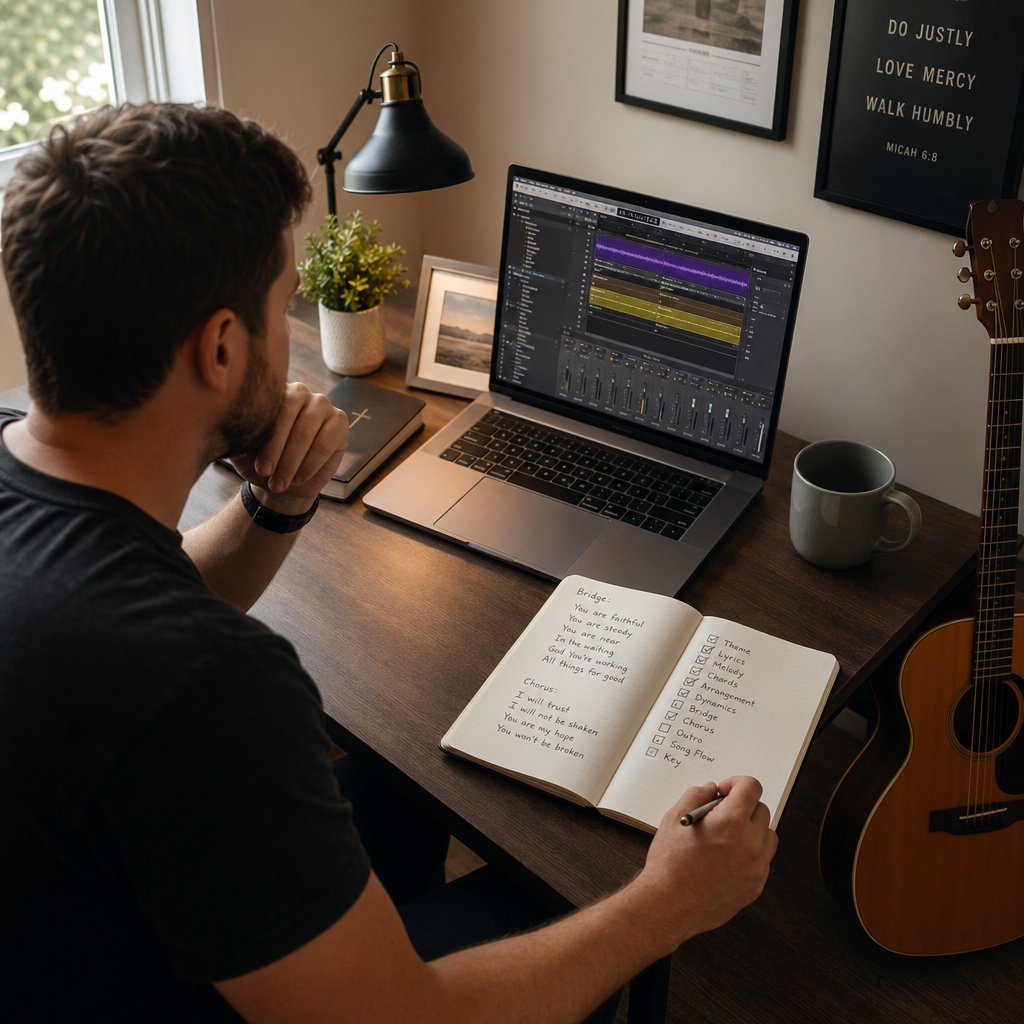
Sometimes the right song for your congregation simply doesn't exist yet. Maybe your church has a unique blend of traditions. Maybe you need something that matches a specific sermon series theme at a specific energy level. Or maybe the available catalog just doesn't capture the voice of your community the way original music could.
This is where AI-powered music creation has become genuinely useful for worship leaders. Rather than replacing the creative process, these tools accelerate it — letting you generate melodic ideas, full arrangements, and even vocal demos based on the style, tempo, and mood you specify. MakeBestMusic's AI Song Generator is a practical starting point for worship teams exploring this space. You can define a genre (contemporary worship, gospel, acoustic praise), set a BPM range, and input lyrical themes rooted in Scripture — then receive a complete song draft you can refine, rearrange, and make your own. For churches that want original upbeat christian songs tailored to their congregation's sound rather than pulling exclusively from mainstream catalogs, it's a resource worth exploring.
AI tools don't replace the spiritual discernment behind song selection — they expand what's possible. A worship leader who knows how to do a pullup on the evaluation checklist above and also has the ability to generate custom material sits in a uniquely powerful position: they're no longer limited to what's already been published. They can create worship music that fits their people like it was written for them — because it was.
