

Why 1980s Country Songs Still Hit Different
Picture Nashville, 1983. On one side of Music Row, producers are layering string sections and synthesizers over a country vocal, chasing the pop-crossover dollar that the Urban Cowboy craze promised. On the other side, a young Texan in a cowboy hat is cutting a record so traditional it sounds like a time capsule from a honky-tonk jukebox. Neither side knows it yet, but this tug-of-war between rhinestone-studded pop gloss and steel-guitar grit is about to reshape the genre permanently.
1980s country songs didn't unfold as a neat decade of hits. They played out more like a dramatic three-act story: a commercial boom that nearly drowned the genre's identity, a grassroots rebellion that pulled it back from the edge, and a wave of new voices that carried it into a golden era. From the Urban Cowboy frenzy to the neotraditional revival led by 80 country music artists like George Strait and Randy Travis, this decade was a battle for the soul of country music, and the outcome still echoes through every Nashville studio today.
A Decade of Tension Between Pop Gloss and Honky-Tonk Grit
"I Was Country When Country Wasn't Cool." — Barbara Mandrell, with George Jones, capturing the identity crisis of a genre caught between its roots and its commercial ambitions.
That single lyric tells you everything about the era's central conflict. As the Grand Ole Opry's own retrospective notes, crossover was commonplace heading into the 1980s, even among artists who longed for the authenticity that seemed to have gone missing. Hollywood wanted country. Pop radio wanted country. But the question nobody could answer was simple: which version of country did they actually want?
What Makes 1980s Country Songs Worth Revisiting
So why do these tracks still land so hard decades later? Three reasons stand out. First, the storytelling craft. 80s country music prioritized narrative in a way that modern production sometimes buries under layers of studio polish. Songs told complete stories with real emotional stakes. Second, the vocal authenticity. Whether it was George Jones wringing every ounce of heartbreak from a ballad or Reba McEntire channeling raw defiance, these voices carried a lived-in quality that's impossible to fake. Third, the cultural snapshot. These 80s country songs captured rural and working-class America during the Reagan era with an honesty that still resonates with listeners who crave substance over spectacle.
You'll find something here regardless of where you're coming from. If you're a modern country fan tracing the roots of artists like Cody Johnson, the neotraditional movement is your origin story. If you crossed over from classic rock, the outlaw twilight years and Dwight Yoakam's Bakersfield punk energy will feel like home. And if you're a traditional purist hunting for deep cuts, the decade's unsung songwriters and session players have a wealth of material waiting for you.
The story of 80s country isn't just about nostalgia. It's about a genre that nearly lost itself, then fought its way back to something real. That fight started with a movie, a mechanical bull, and a whole lot of sequins.
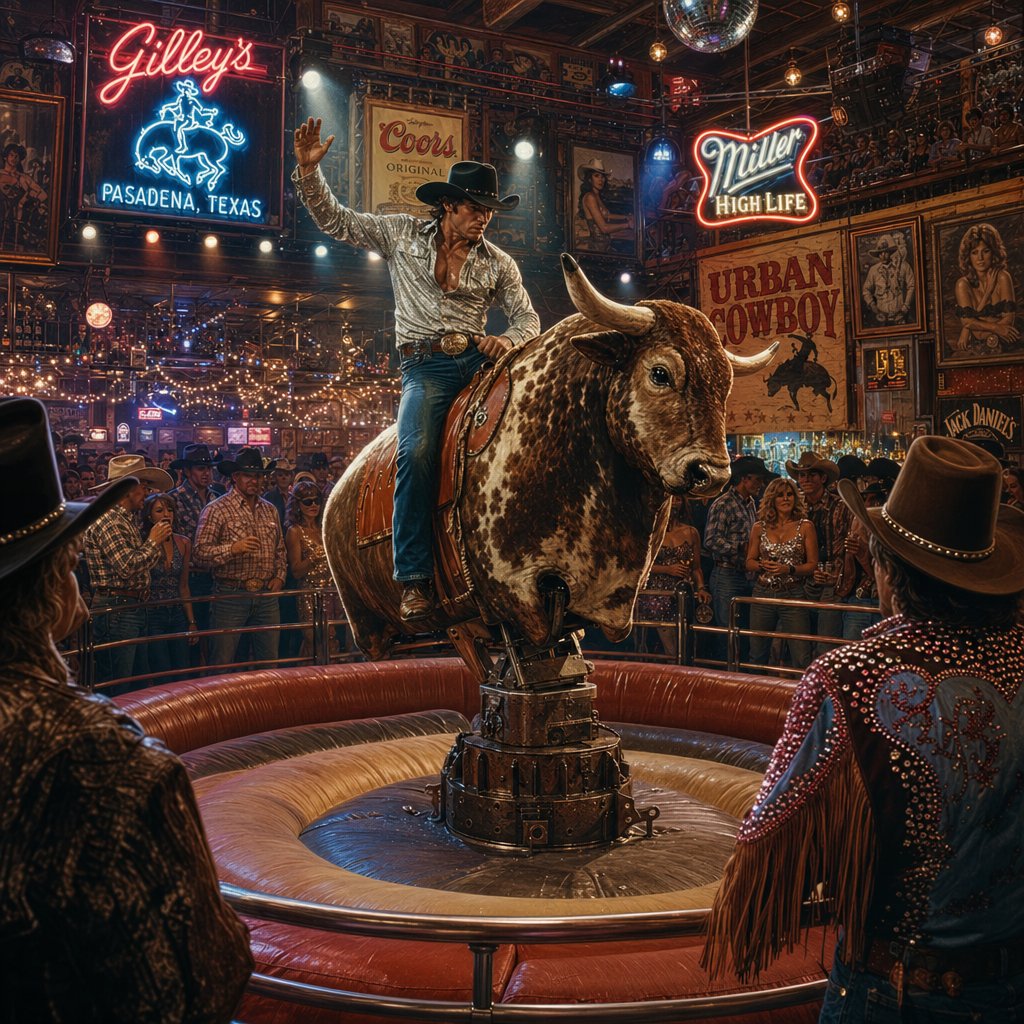
The Urban Cowboy Boom and Nashville's Identity Crisis
When John Travolta swaggered onto a mechanical bull in the 1980 film Urban Cowboy, he didn't just launch a box-office hit. He detonated a cultural bomb inside Nashville. The movie, set in a massive honky-tonk club in Pasadena, Texas, turned country music into a mainstream fashion statement overnight, and Music Row scrambled to cash in. The soundtrack alone generated five Top 10 country singles, including Johnny Lee's "Lookin' for Love" and Anne Murray's "Could I Have This Dance," all of which crossed over to the pop charts. Suddenly, every label in town wanted that polished, radio-friendly sound, and the race to replicate it reshaped how 1980s country songs were made.
How Urban Cowboy Turned Nashville Into a Pop Factory
The consequences hit fast. Country radio stations surged in number as new audiences flooded in, but the music being made for them barely resembled the genre's roots. Producers layered strings, softened edges, and chased crossover dollars with an almost mechanical urgency. Pop-leaning acts like Sylvia, whose "Nobody" climbed to No. 15 on the pop charts in 1982, became the template. Meanwhile, established eighties country singers who had built careers on authenticity found themselves squeezed out. Artists like Merle Haggard and George Jones, voices that had defined the genre for decades, watched their radio play shrink as programmers favored slicker material.
Country artists in the 80s faced an impossible choice: adapt to the pop formula or risk irrelevance. As Country Radio Hall of Fame member Joel Raab put it, the Urban Cowboy sound "was a moment" rather than a sustainable trend. Some artists chased it anyway and "made these really bad pop-sounding records in the early to mid-'80s." The CMA Awards reflected the confusion, with crossover-friendly acts dominating categories that had traditionally honored hardcore country talent. Even the question of what counted as country became a flashpoint, echoing debates that would resurface across 80s 90s country music and beyond.
The Commercial Hangover and Nashville's Course Correction
"Country records are getting plenty of radio play, but they all sound alike and nobody's buying them." — Bobby Bare, in a 1985 New York Times report on Nashville's decline.
By 1984, the crossover audience had moved on. MTV superstars like Michael Jackson, Prince, and Madonna dominated the cultural conversation, and the casual fans who had bought cowboy hats after watching Travolta simply found their next trend. What they left behind was a genre in freefall. A front-page New York Times piece in September 1985 painted a grim picture: audiences dwindling, record sales plummeting, and a Nashville Sound that critics called as dated as the ukulele. Tammy Wynette warned that country artists would need to "band together and try to turn this thing around" or face extinction.
Yet some of the crossover tracks from this era deserve more credit than purists give them. Songs like Eddie Rabbitt's "I Love a Rainy Night," Crystal Gayle's "Don't It Make My Brown Eyes Blue," and Conway Twitty's "I Couldn't Leave You If I Tried" were undeniably pop-influenced, but they carried genuine vocal warmth and melodic craft that still hold up. The problem was never individual songs. It was an entire industry losing its identity by chasing a trend instead of trusting its own instincts.
That commercial hangover, painful as it was, created the exact conditions for a correction. Nashville needed artists willing to strip away the gloss and bet their careers on the sound that had built the genre in the first place. By the mid-1980s, a handful of them were already walking through the door.
The Neotraditional Revival That Saved Country Music
The artists who walked through that door didn't arrive with a manifesto or a marketing plan. They showed up with fiddles, steel guitars, and a stubborn belief that country music didn't need pop packaging to sell. What followed between roughly 1986 and 1989 was the most consequential artistic correction in Nashville history, a movement that proved the genre's traditional DNA wasn't a liability but its greatest commercial asset.
George Strait and the Quiet Revolution of Real Country
Before the neotraditional wave crested, one Texan had already been laying its foundation for years. George Strait's debut single "Unwound" hit the charts in 1981, and from the start, his approach was a quiet act of rebellion. No synthesizers. No string sections. Just Western swing influences, honky-tonk arrangements, and a baritone voice that sounded like it belonged in a dancehall, not a pop studio. In a Nashville obsessed with crossover, Strait simply refused to play along.
The results spoke for themselves. Strait amassed seven number-one albums during the 1980s, with landmark singles like "Fool Hearted Memory," "Amarillo by Morning," and "Ocean Front Property" becoming some of the most well known country songs of the era. He won CMA Entertainer of the Year in both 1989 and 1990, and his total of 57 career number-one hits eventually broke Conway Twitty's all-time record. Among 80s country artists, Strait was the proof of concept: you could stay traditional and still dominate commercially.
What made him so effective wasn't flash. It was consistency. While other artists chased trends and reinvented themselves every album cycle, Strait delivered the same honest, danceable country record after record. That reliability built a fanbase so loyal it carried him across four decades and over 68.5 million albums sold in the United States alone.
Randy Travis, Dwight Yoakam, and the New Traditionalist Wave
If Strait laid the groundwork, the Class of 1986 kicked the door wide open. That year produced three of the finest debut country albums ever made: Randy Travis's Storms of Life, Dwight Yoakam's Guitars, Cadillacs, Etc., Etc., and Steve Earle's Guitar Town. Each record attacked Nashville's pop obsession from a different angle, and together they signaled that 1980s country music had found its backbone again.
Travis's impact was seismic. Storms of Life became the first debut country album to be certified platinum, eventually selling over four million copies. His breakthrough single "On the Other Hand," written by Paul Overstreet and Don Schlitz, reached number one in July 1986 after an initial release had stalled outside the Top 60. The song earned ACM Song of the Year honors, and Travis swept nearly every major award that followed. As Country Universe noted, "this young, handsome guy showing up and singing traditional music, then proceeding to sell millions of records without any crossover airplay" changed everything. Nashville could produce its own superstars without catering to the pop market.
Yoakam took a completely different path to the same destination. Rooted in the Bakersfield sound of Buck Owens and Merle Haggard, his twang-heavy, stripped-down recordings were so far from the Nashville mainstream that he initially built his audience playing Los Angeles punk clubs alongside bands like X and the Blasters. That crossover appeal, punk audiences and country purists finding common ground in raw honesty, made him one of the most fascinating 80s country artists of the decade. Guitars, Cadillacs, Etc., Etc. went platinum and proved that good eighties music didn't have to fit neatly into any single audience's expectations.
Ricky Skaggs had actually arrived before either of them. A bluegrass prodigy who had played with Ralph Stanley as a teenager, Skaggs did the seemingly impossible: he became a multi-platinum recording artist playing bluegrass-rooted country, proving label executives wrong about what listeners really wanted. His commercial success in the early 1980s helped pave the way for every neotraditionalist who followed, including his childhood friend Keith Whitley.
Whitley's story remains one of country music's most heartbreaking chapters. His rich, emotive baritone produced masterpieces like "Don't Close Your Eyes" and "When You Say Nothing at All," songs that rank among the finest the decade produced. His death from alcohol poisoning in May 1989, at just 33 years old, cut short a career that many believed was destined to rival Travis's. The depth of feeling in his recordings, that ability to make every lyric sound like a confession, still sets a standard that few vocalists have matched.
Why the Neotraditional Movement Mattered Beyond Music
Imagine you're a Nashville executive in 1987, staring at sales figures that contradict everything the industry believed just three years earlier. Traditional-sounding records are outselling pop-country crossovers. Debut albums are going platinum without a single pop radio spin. The audience that supposedly wanted slick production is buying fiddle-and-steel arrangements by the millions. The neotraditional movement didn't just save country music's sound. It demolished the assumption that authenticity and commercial success were mutually exclusive.
That philosophical shift rippled far beyond the 1980s. It gave Nashville the confidence to greenlight traditional-leaning artists throughout the next decade and established a creative template that 80s country bands and solo acts alike could build on. Without Strait's quiet consistency, Travis's platinum debut, and Yoakam's genre-bending credibility, the 1990s country explosion simply doesn't happen.
| Artist | Breakthrough Album | Signature Song | Stylistic Influence |
|---|---|---|---|
| George Strait | Strait Country (1981) | "Amarillo by Morning" | Western swing, honky-tonk |
| Randy Travis | Storms of Life (1986) | "On the Other Hand" | Classic country, Nashville Sound |
| Dwight Yoakam | Guitars, Cadillacs, Etc., Etc. (1986) | "Guitars, Cadillacs" | Bakersfield sound, rockabilly |
| Ricky Skaggs | Waitin' for the Sun to Shine (1981) | "Highway 40 Blues" | Bluegrass, traditional country |
| Keith Whitley | Don't Close Your Eyes (1988) | "Don't Close Your Eyes" | Traditional country, Appalachian roots |
These five artists didn't just record great songs. They collectively rewired Nashville's understanding of its own audience, proving that the genre's roots weren't a relic to be polished over but a foundation strong enough to build an empire on. The question that remained was who else would step up to carry that foundation forward, and the answer involved a new generation of male voices already sharpening their sound on the edges of the movement.
Male Country Singers Who Defined the Decade
The neotraditional movement gave Nashville its creative compass back, but it didn't operate in a vacuum. A broader cast of male country singers from the 80's shaped the decade's sound, some by carrying decades of credibility into a new era, others by arriving just in time to light the fuse on what came next.
Legends Who Carried the Torch Through the Decade
George Jones entered the 1980s with the single greatest career revival in country history. "He Stopped Loving Her Today," released in 1980, became his first number-one hit in six years and is widely considered the best country song ever written. That track alone reignited a career that had been overshadowed by personal turmoil, and Jones stayed defiantly traditional throughout the decade while pop-crossover pressure swirled around him. His voice, that aching baritone dripping with lived-in heartbreak, became the benchmark against which every male vocalist in Nashville measured himself.
Merle Haggard navigated the era differently. Already a titan with 38 career number-one country hits stretching back to 1966, Haggard kept recording sharp, uncompromising material like "Big City" and his duet with Willie Nelson, "Pancho and Lefty," which hit number one in 1983. He didn't chase trends. He simply outlasted them.
Nelson, meanwhile, leaned into eclectic collaboration with a restlessness that defied easy categorization. His Stardust album logged a full ten years on the Billboard charts by 1988, a record at the time. He co-founded the Highwaymen supergroup with Johnny Cash, Waylon Jennings, and Kris Kristofferson, whose self-titled single topped the country chart in 1985. Nelson also spearheaded Farm Aid, turning his cultural influence into direct action for struggling rural communities.
Hank Williams Jr. carved out territory nobody else wanted. Fusing Southern rock swagger with country storytelling, he turned tracks like "All My Rowdy Friends Are Coming Over Tonight" and "Born to Boogie" into 80s songs everyone knows, even outside the genre's core audience. His Monday Night Football theme earned four Emmy Awards and made his voice one of the most recognized in American pop culture. Among 1980s country singers, Hank Jr. proved that country could rock without abandoning its identity.
Rising Stars and Hat Acts Who Redefined the Genre
The decade's final year produced a wave of debuts so concentrated that the industry coined a term for it: the Class of '89. Clint Black arrived first, releasing Killin' Time in May 1989. The album spent 31 weeks atop the Country Albums chart, and his single "A Better Man" became the number-one Billboard Year-End Country Song of 1989, the first time an artist had claimed that honor with a debut single in 35 years.
Garth Brooks followed closely. After Capitol Records initially turned him down, he signed with the label in June 1988 and released his self-titled debut in April 1989. "If Tomorrow Never Comes" became his first chart-topper by December, hinting at the stadium-filling phenomenon he'd become. Alan Jackson rounded out the class, signing his first record deal in June 1989 and setting the stage for a career built on songwriter's craftsmanship and unwavering traditional values.
Critics dubbed these newcomers "hat acts," a term that was partly dismissive and partly accurate. The cowboy hat became a visual shorthand for traditional musical values, a deliberate contrast to the pop-polished image that had dominated earlier in the decade. What the label missed was that the hats weren't a gimmick. They were a statement of intent, connecting these country singers in the 80's to the Western and honky-tonk traditions that the Urban Cowboy era had nearly buried.
- George Strait — Launched the neotraditional movement and set the all-time record for number-one country hits, redefining commercial expectations for traditional sound.
- Randy Travis — His platinum debut Storms of Life proved traditional country could outsell pop-crossover, reshaping Nashville's entire business model.
- George Jones — "He Stopped Loving Her Today" revived his career and gave the decade its artistic gold standard for vocal performance.
- Hank Williams Jr. — Fused Southern rock with country and became a mainstream cultural force through music, television, and sheer personality.
- Merle Haggard — Maintained uncompromising artistic integrity across the decade while mentoring the Bakersfield-influenced sound Yoakam would carry forward.
- Willie Nelson — Expanded country's collaborative reach through the Highwaymen, Farm Aid, and genre-defying recordings that kept the outlaw spirit alive.
- Garth Brooks — His late-decade debut signaled the coming commercial earthquake, blending traditional songcraft with arena-rock showmanship.
- Clint Black — Delivered the most dominant debut of 1989, bridging traditional country values with a contemporary polish that defined the hat-act era.
- Keith Whitley — His emotionally devastating vocal performances set a standard for sincerity that influenced every male country vocalist who followed.
- Alan Jackson — Emerged as the quintessential songwriter's artist, carrying neotraditional principles into the next decade with quiet authority.
These men didn't just record hits. They collectively defined what it meant to be a male country artist during a decade of upheaval, each navigating the tension between tradition and evolution in his own way. Their influence, though, only tells half the story. The women and duos working alongside them were fighting their own battles for recognition, often against even steeper odds.
Female Country Stars and Duos Who Broke Through
Those steeper odds were real. Country music in the 80s was overwhelmingly a boys' club, with male artists dominating radio playlists, award nominations, and label budgets. The women who broke through didn't just compete with their male counterparts. They had to outwork them, outsing them, and often reinvent themselves mid-career to earn the same level of industry support. The ones who succeeded left marks on the decade every bit as deep as Strait or Travis.
Reba McEntire and the Evolution of the Country Queen
Reba McEntire spent the first half of the 1980s building credibility the hard way. Her 1982 album Unlimited produced back-to-back number-one singles with "Can't Even Get the Blues" and "You're the First Time I've Thought About Leaving," and her 1984 single "How Blue" was a twanging, two-stepping honky-tonk hit that felt rooted in the Merle Haggard tradition she loved. She was talented, consistent, and still searching for the song that would change everything.
It arrived almost by accident. Producer Jimmy Bowen, who had signed McEntire to MCA Nashville, pushed her toward a ballad called "Whoever's in New England" that was inspired by Barry Manilow's "Weekend in New England." McEntire thought the song was too pop for her and recorded the vocal in 30 minutes at the end of a session, nearly as a throwaway. Bowen heard something different. He believed her performance was powerful enough to bridge the gap between country and pop, and he was right.
"Whoever's in New England" became McEntire's fifth Hot Country Songs chart-topper, but the album of the same name became her first platinum-selling record. She co-hosted the 1986 CMA Awards and won both Entertainer of the Year and Female Vocalist of the Year that night, plus a Grammy for Best Female Country Vocal Performance. The accompanying music video, filmed in Boston rather than Nashville, was a career first that helped her compete for airtime alongside mainstream pop clips. That single pivot, from traditional roots to emotionally sophisticated balladry, transformed McEntire from a respected 80's country music artist into the decade's most commercially successful female country singer.
The Judds, Emmylou Harris, and Voices That Broke the Mold
While McEntire was rewriting her career, a mother-daughter duo from Kentucky was rewriting the rules for country 80's harmony. Naomi and Wynonna Judd signed with RCA in 1983 and proceeded to dominate the duo category for the rest of the decade, winning CMA Vocal Duo of the Year every year from 1985 through 1991. Their sound was deceptively simple: acoustic-driven arrangements, tight family harmonies, and songs that felt handmade in an era of studio overproduction. "Why Not Me," their 1984 breakthrough, became a number-one hit and a statement of purpose. It asked the question every traditional-leaning artist was thinking, and the audience answered by buying millions of records.
Emmylou Harris operated on a different plane entirely. Already an established force by the time the decade began, she spent the 1980s pushing boundaries that most Nashville artists wouldn't touch. Her 1985 album The Ballad of Sally Rose was a concept record, a rarity in country music, and her 1987 collaboration Trio with Dolly Parton and Linda Ronstadt went platinum and won a Grammy. Harris bridged country, folk, and rock with a restless artistic curiosity that made her impossible to categorize and essential to the genre's creative evolution.
Parton herself had a complicated relationship with 1980s country purists. Her crossover into pop and film, including the massive success of 9 to 5 and The Best Little Whorehouse in Texas, made her one of the most famous women in America but drew criticism from traditionalists who felt she had abandoned the genre. The truth was more nuanced. Parton's pop success expanded country's cultural footprint in ways that benefited every artist on this list, and her vocal talent never wavered regardless of the production surrounding it.
Patsy Cline, who had died in a 1963 plane crash, cast a long shadow over every female vocalist of the decade. Her emotional phrasing and ability to inhabit a lyric became the template that artists from McEntire to Patty Loveless to Kathy Mattea measured themselves against. Among 80 country singers, the women of this era carried Cline's legacy forward while carving out identities entirely their own.
Groups and Bands That Expanded Country's Boundaries
The story of 1980s country isn't complete without the ensembles that proved the genre could thrive beyond solo acts. Alabama was the most dominant group in country history during this period, winning CMA Entertainer of the Year three consecutive times from 1982 to 1984 and racking up 21 number-one singles across the decade. Their blend of country, rock, and pop created a template for band-driven country that hadn't existed at that commercial scale before.
The Statler Brothers, inducted into the Country Music Hall of Fame in 2008, scored 18 Top Ten singles during the 1980s alone, including three number-one hits penned by member Jimmy Fortune: "Elizabeth," "My Only Love," and "Too Much on My Heart." Their gospel-rooted quartet harmonies kept alive one of country's oldest traditions while maintaining one of the genre's top-grossing road shows for over 30 years. Highway 101, fronted by Paulette Carlson, added a female-led band dynamic that was rare for the era, landing four number-one hits between 1987 and 1989.
- Reba McEntire — Transformed from traditional honky-tonk singer to the decade's top-selling female country artist, winning CMA Entertainer of the Year in 1986.
- The Judds (Naomi and Wynonna) — Dominated the duo category with acoustic-driven harmonies and six consecutive CMA Vocal Duo of the Year wins.
- Emmylou Harris — Pushed genre boundaries through concept albums, the platinum Trio collaboration, and a fearless blending of country, folk, and rock.
- Dolly Parton — Expanded country's mainstream visibility through film and pop crossover while maintaining her vocal identity.
- Rosanne Cash — Brought literary songwriting and a progressive sensibility to country with hits like "Seven Year Ache" and her landmark King's Record Shop album.
- Alabama — Won three consecutive CMA Entertainer of the Year awards and proved that band-format country could dominate commercially.
- The Statler Brothers — Scored 18 Top Ten hits in the 1980s and preserved country's gospel-quartet tradition at the highest commercial level.
- Highway 101 — Delivered a female-fronted band sound that earned four number-one hits in the late 1980s.
- Patty Loveless — Emerged as a powerful traditional voice in the late decade, bridging Appalachian roots with mainstream Nashville appeal.
- Kathy Mattea — Brought folk-influenced storytelling to country radio, winning CMA Female Vocalist of the Year in 1989 and 1990.
These artists and groups collectively shattered the notion that country's creative energy belonged to any single gender or format. They wrote the songs, sold the records, and won the awards in a decade that tested every artist's ability to stay true while staying relevant. What they recorded, though, is only part of the picture. The full scope of the decade's music reveals itself when you stop sorting by artist and start sorting by sound.
The Best 80s Country Songs Organized by Subgenre
Sorting by sound instead of popularity changes how you experience the decade. Most lists rank 1980s country songs from one to fifty and call it a day, but that approach flattens a decade defined by its stylistic diversity. A neotraditional honky-tonk anthem and a synth-laced pop crossover hit aren't competing for the same emotional space, so why force them into the same ranking? The tracks below are organized by the subgenre they belong to, giving you distinct listening paths based on what actually moves you.
Neotraditional and Honky-Tonk Essentials
This is where the decade's artistic rebellion lives. George Strait's "Amarillo by Morning" never reached number one, peaking at number four in 1983, yet it became one of his most iconic recordings. The fiddle-backed ode to a rodeo cowboy's freedom captured everything the neotraditional movement stood for: unadorned storytelling, real instrumentation, and a vocal delivery that trusted the song to do the work. His "The Chair," penned by Hank Cochran and Dean Dillon, took a different approach entirely, building an entire narrative around a flirtatious bar conversation that Holler called one of the most lustrous gems in Strait's catalogue.
Randy Travis's "On the Other Hand" reinvented the cheating song by making the narrator neither villain nor hero but a man wrestling with his own conscience. Dwight Yoakam's "Guitars, Cadillacs" brought Bakersfield twang back with a rockabilly edge that made it feel dangerous and fun simultaneously. Keith Whitley's "When You Say Nothing at All," at barely over 200 words, proved that restraint could be devastating. And Ricky Skaggs's "Country Boy" was a breakneck bluegrass showcase that reminded everyone how deep the genre's instrumental roots ran.
Pop-Crossover and Countrypolitan Hits
Dismissing the pop side of the decade means ignoring some genuinely great recordings. Kenny Rogers and Dolly Parton's "Islands in the Stream," written by the Bee Gees, topped both country and pop charts in 1983 and remains a karaoke staple worldwide. Eddie Rabbitt's "I Love a Rainy Night" crossed over to number one on the Billboard Hot 100, Hot Country Singles, and Adult Contemporary charts simultaneously, a rare triple crown that reflected his effortless appeal. Among 1980 country singers navigating the crossover landscape, Rabbitt's smooth vocals and pop instincts made him one of the era's most versatile performers.
Ronnie Milsap's "Smoky Mountain Rain" was pure countrypolitan storytelling, layered with lush strings and a persistent beat that carried it to number one on the country chart and number 24 on the Hot 100. Johnny Lee's "Lookin' for Love," born directly from the Urban Cowboy soundtrack, became a crossover sensation and remains Lee's biggest career hit. Even Sylvia's "Nobody," with its squelchy bassline and girl-group backing vocals, earned a Grammy nomination and turned her into a global pop star. These tracks were the commercial engine of early-80s country, and several female country singers of the 1980s, including Crystal Gayle and Juice Newton, thrived in this polished lane.
Country Ballads and Love Songs That Endure
When you're building a list of best 80s songs that still gut-punch listeners decades later, the ballads dominate. George Jones's "He Stopped Loving Her Today" technically arrived in 1980, but its emotional aftershock defined the entire decade. Bobby Braddock and Curly Putman's lyrics about a man who loves a woman until the day he dies would have been devastating in anyone's hands, but Jones's octave-defying vocal interpretation turned it into what many consider the greatest country recording ever made.
Randy Travis's "Forever and Ever, Amen" became the decade's definitive love song after Paul Overstreet and Don Schlitz wrote it in a matter of days. It spent three weeks at number one and swept the CMA, ACM, and Grammy Awards. Keith Whitley's "Don't Close Your Eyes" carried a similar emotional weight, its pleading vocal performance made all the more poignant by his death just months after its release. Vince Gill's "When I Call Your Name," featuring Patty Loveless on harmonies, closed out the decade with a heartbreak ballad so spare and devastating it needed barely a hundred unique words to land.
Outlaw Twilight and Early Alt-Country
The outlaw movement that Waylon Jennings and Willie Nelson had ignited in the 1970s didn't die in the 1980s. It evolved. Nelson's cover of "Always on My Mind" won three Grammys in 1982, proving his interpretive genius could thrive in any era. His duet with Ray Charles on "Seven Spanish Angels" blended country and soul into a murder ballad that hit number one in 1984. The Highwaymen, the supergroup uniting Nelson, Cash, Jennings, and Kristofferson, released their self-titled single in 1985, a reincarnation epic that gave each legend a verse and a character.
Steve Earle pushed the outlaw ethos into entirely new territory. His 1986 debut Guitar Town topped the Billboard Country Albums chart and earned two Grammy nominations, blending country themes with rock energy in a way that anticipated the Americana movement. "Copperhead Road," released in 1988, fused heavy metal riffs with traditional bluegrass-indebted storytelling about a Vietnam veteran turned moonshiner. The Tennessee General Assembly eventually recognized it as an official state song. Lucinda Williams's "Passionate Kisses," from her 1989 self-titled album, became a jangly alt-country feminist anthem that helped define the roots music movement. Among country music bands of the 80's and the solo acts orbiting their edges, these artists proved that country's rebellious streak was alive, well, and heading somewhere entirely new.
| Song Title | Artist | Subgenre | Why It Matters |
|---|---|---|---|
| "Amarillo by Morning" | George Strait | Neotraditional | Fiddle-driven anthem that became the movement's emotional centerpiece despite never reaching number one |
| "On the Other Hand" | Randy Travis | Neotraditional | Reinvented the cheating song with moral complexity; Travis's first chart-topper after a failed initial release |
| "Guitars, Cadillacs" | Dwight Yoakam | Neotraditional | Bakersfield-meets-rockabilly debut that bridged punk and country audiences |
| "When You Say Nothing at All" | Keith Whitley | Neotraditional | Platinum-certified love song that proved restraint could be more powerful than spectacle |
| "Country Boy" | Ricky Skaggs | Neotraditional | Breakneck bluegrass showcase highlighting unmatched instrumental virtuosity |
| "Islands in the Stream" | Kenny Rogers and Dolly Parton | Pop-Crossover | Bee Gees-penned duet that topped country and pop charts and became a cultural touchstone |
| "I Love a Rainy Night" | Eddie Rabbitt | Pop-Crossover | Rare triple-chart number one across country, pop, and Adult Contemporary |
| "Smoky Mountain Rain" | Ronnie Milsap | Countrypolitan | Lush, string-laden story song that defined early-80s Nashville production at its finest |
| "Nobody" | Sylvia | Pop-Crossover | Grammy-nominated crossover smash that spent 20 weeks on the Billboard Hot 100 |
| "He Stopped Loving Her Today" | George Jones | Country Ballad | Widely regarded as the greatest country song ever recorded; Grammy Hall of Fame inductee |
| "Forever and Ever, Amen" | Randy Travis | Country Ballad | Swept CMA, ACM, and Grammy Awards; the decade's definitive country love song |
| "Don't Close Your Eyes" | Keith Whitley | Country Ballad | Emotionally devastating performance made iconic by Whitley's tragic early death |
| "When I Call Your Name" | Vince Gill | Country Ballad | Sparse heartbreak masterpiece featuring Patty Loveless harmonies; peaked at number two |
| "Always on My Mind" | Willie Nelson | Outlaw Twilight | Three-time Grammy winner that proved Nelson's interpretive genius transcended genre |
| "Highwayman" | The Highwaymen | Outlaw Twilight | Supergroup debut uniting Nelson, Cash, Jennings, and Kristofferson in a reincarnation epic |
| "Guitar Town" | Steve Earle | Early Alt-Country | Chart-topping debut that spearheaded the bridge from neotraditional to Americana |
| "Copperhead Road" | Steve Earle | Early Alt-Country | Heavy metal meets bluegrass storytelling; recognized as an official Tennessee state song |
| "Passionate Kisses" | Lucinda Williams | Early Alt-Country | Jangly feminist anthem credited as a key release in the development of Americana |
These tracks represent four distinct listening experiences within a single decade, each shaped by different artistic philosophies and audience expectations. Taken together, they reveal just how wide the creative spectrum of 80s country music singers really was. The songs themselves, though, didn't materialize out of thin air. Behind every one of these recordings stood producers, songwriters, and session musicians whose names rarely made the album covers but whose fingerprints shaped every note.
Nashville's Unsung Architects
Fingerprints are the right word. Every iconic vocal performance, every fiddle-and-steel arrangement that defined the decade passed through the hands of producers, songwriters, and session players who rarely got the spotlight. You can name the country music stars of the 80s who sang the hits. The deeper question is who actually built them.
The Producers Who Shaped Nashville's Sound
No single figure disrupted Music Row's old guard more than Jimmy Bowen. A former pop producer who had worked with Frank Sinatra and Dean Martin, Bowen arrived in Nashville and immediately started shaking things up. He championed digital recording technology at a time when most studios still relied on analog tape, and he pushed an artist-empowerment philosophy that gave performers unprecedented control over their own sessions. That approach directly shaped Reba McEntire's mid-decade transformation and helped George Strait maintain his uncompromising traditional sound. Bowen's fingerprints are on dozens of platinum records, and his insistence that the artist, not the label, should drive creative decisions rewired how Nashville did business.
Tony Brown took a different path to similar influence. As a staff producer at MCA Records, Brown bridged the label's roster from traditional to progressive, working with country male singers of the 80s like Steve Earle and Vince Gill while also nurturing Lyle Lovett's genre-defying debut. His ear for talent that didn't fit neatly into existing categories made MCA the most artistically adventurous major label in Nashville during the decade's second half.
Harold Shedd, meanwhile, bet his career on a band format that Nashville executives considered commercially unviable. His production of Alabama's early records, including the breakthrough Mountain Music, helped the group become the best-selling country act of the decade and proved that ensemble-driven country could dominate radio. Without Shedd's willingness to champion an unconventional act, the template for country bands might have taken years longer to develop.
Songwriters and Session Musicians Behind the Hits
The production booth was only half the equation. Nashville's songwriting community operated as a parallel creative engine, and the 1980s were its golden era of behind-the-scenes craftsmanship. Harlan Howard, writer of "I Fall to Pieces" and "Heartaches by the Number," was already a legend by the time the decade began, but his influence permeated the era's approach to lyrical economy. Every line earned its place. Every word carried weight. That philosophy became the unwritten standard for male country singers of the 80's and the writers who supplied their material.
Dean Dillon quietly became one of the decade's most consequential songwriters through his partnership with George Strait. He penned "The Chair," "Nobody in His Right Mind Would've Left Her," "Ocean Front Property," and "Tennessee Whiskey," among others. Don Schlitz and Paul Overstreet co-wrote both "Forever and Ever, Amen" and "When You Say Nothing at All," two of the decade's most enduring ballads. Max D. Barnes contributed "Who's Gonna Fill Their Shoes" for George Jones and accumulated 42 songwriter awards across his career. And Bob McDill, one of Nashville's most prolific yet underrecognized talents, penned hits across multiple decades with a storytelling precision that set the bar for narrative country songwriting.
Behind all of them sat Nashville's session musicians, the instrumentalists who could walk into a studio, hear a rough demo once, and build a full arrangement on the spot. Music Row's collaborative ecosystem had been refined over decades, dating back to the "Nashville Cats" era when players like Norbert Putnam logged over 600 sessions in a single year. By the 1980s, that system was a well-oiled machine. Fiddle players, steel guitarists, and rhythm sections moved between sessions for 80s country music artists of every stripe, carrying stylistic DNA from one recording to the next and giving the decade's output a cohesive sonic identity even across wildly different subgenres.
- Jimmy Bowen — Produced records for Reba McEntire (Whoever's in New England), George Strait (Ocean Front Property), and Hank Williams Jr.; pioneered digital recording and artist-driven sessions in Nashville.
- Tony Brown — Guided MCA's roster through Steve Earle (Guitar Town), Vince Gill (When I Call Your Name), and Lyle Lovett's debut; bridged traditional and progressive country.
- Harold Shedd — Produced Alabama's record-breaking run including Mountain Music and The Closer You Get; proved band-format country was commercially viable.
- Kyle Lehning — Produced Randy Travis's Storms of Life and Always & Forever, crafting the stripped-back sound that defined the neotraditional movement's commercial peak.
- Jim Ed Norman — Headed Warner Bros. Nashville and produced records for Hank Williams Jr. and Crystal Gayle, navigating both traditional and crossover markets.
These producers and writers didn't just support the decade's stars. They created the conditions that allowed traditional country to thrive commercially again, building the infrastructure that carried the genre from its mid-80s crisis into its late-decade resurgence. The music they shaped wasn't made for a single moment, either. Its influence stretched well beyond the final track listings of the 1980s, seeding the ground for a commercial explosion that nobody in Nashville fully saw coming.
How 80s Country Ignited the 90s Mainstream Explosion
That commercial explosion arrived faster than anyone predicted. The producers, songwriters, and session musicians who rebuilt Nashville's creative infrastructure during the mid-1980s didn't just rescue a struggling genre. They unknowingly assembled the launchpad for the biggest commercial era in country music history. Every platinum debut, every stadium tour, every crossover smash of the 1990s traces its DNA directly back to the neotraditional correction and the 80s country stars who proved authenticity could sell.
The Class of '89 and the Bridge to a New Era
The late-decade debuts of Garth Brooks, Clint Black, and Alan Jackson weren't random breakthroughs. They were the direct product of a decade spent recalibrating what country music could be. Strait and Travis had already demonstrated that traditional-leaning records could go multi-platinum. The Class of '89 took that proof of concept and scaled it to a level Nashville had never imagined.
The impact was immediate and measurable. As The Tennessean documented, these arrivals didn't just influence chart positions. They shaped entire careers that followed. Blake Shelton chose his first guitar after watching Garth Brooks play one on TV. A seven-year-old Chris Young bellowed Alan Jackson's "Don't Rock the Jukebox" through grocery store aisles so his mother could find him. Dierks Bentley is convinced Clint Black's first five singles topped radio airplay charts because of how often he called Phoenix stations to request them. Country singers 1980s audiences had championed became the blueprint for a generation that would turn the genre into a billion-dollar industry.
Brooks alone reshaped the commercial ceiling. His self-titled 1989 debut sold modestly at first, but by the time No Fences arrived in 1990, he was selling records at a pace that rivaled pop and rock superstars. That trajectory was only possible because eighties country had already rebuilt the audience's trust in traditional-rooted music. Without Strait's quiet consistency proving the market existed, without Travis's platinum debut rewriting Nashville's business model, Brooks would have debuted into the same hostile landscape that buried so many artists earlier in the decade.
How 80s Country DNA Lives in Modern Nashville
The lines connecting country singers 80's fans loved to the artists dominating today are shorter than you might think. The Recording Academy noted a "massive resurgence" in traditional country, significant enough to warrant a brand-new Best Traditional Country Album category at the GRAMMYs. The inaugural nominees, including Charley Crockett, Margo Price, and Zach Top, all draw explicitly from the neotraditional playbook that Strait and Skaggs wrote in the 1980s.
Zach Top's trajectory is especially telling. His debut album Cold Beer & Country Music revives the fiddle-forward, twang-heavy sound of late-80s Nashville, and his follow-up Ain't In It For My Health earned him an ACM New Male Artist of the Year win. "I think Nashville lost some of its soul in the last decade or two," Top told GRAMMY.com. "People want soul." That sentiment could have come from any neotraditionalist in 1986.
The parallels extend beyond sound. The pop-crossover tension that defined eighties country mirrors today's debates about genre boundaries almost exactly. Bro-country's commercial peak in the 2010s triggered the same kind of traditionalist backlash that the Urban Cowboy hangover produced, and artists like Cody Johnson, Tyler Childers, and the wave of neo-traditionalists The Boot has profiled are playing the same role Strait and Travis played four decades ago: proving that the genre's roots aren't a limitation but a competitive advantage.
"Traditional country music is more about the song, people writing from the heart and telling great stories rather than pandering to a commercial audience." — Randall King, carrying the neotraditional philosophy into a new generation.
The songwriting craft that defined the decade, that insistence on narrative economy and emotional honesty, remains the gold standard. When modern artists talk about writing "real" country music, they're describing the values that country singers 1980s audiences demanded and that Nashville nearly abandoned before the neotraditional movement pulled it back. The 80s didn't just produce great records. They established the philosophical framework that country music returns to every time it drifts too far from its center.
That framework isn't just for professionals, either. The distinctive elements of the era, from fiddle-and-steel arrangements to twang-forward storytelling, continue to inspire listeners who want to do more than just hear the sound. They want to engage with it, explore it, and in some cases, create something of their own.
Your Gateway to Rediscovering the 80s Country Sound
Engaging with the era starts with knowing where to drop the needle. The decade produced so many 80's country songs across so many subgenres that diving in without a roadmap can feel overwhelming. The trick is matching your existing taste to the right entry point, because the artists and tracks that hook you will be different depending on what you already love.
Your Listening Roadmap Based on What You Already Love
Think about the music that already moves you. Are you a modern country fan who grew up on Luke Combs and Cody Johnson? A classic rock listener who wandered into country through outlaw records? Or a traditionalist who thinks the genre peaked before drum machines showed up? Each path leads to a different corner of 80 country music, and each corner is worth exploring on its own terms.
| Listener Type | Recommended Starting Artists | Key Songs |
|---|---|---|
| Modern country fans tracing roots | George Strait, Randy Travis, Alan Jackson | "Amarillo by Morning," "Forever and Ever, Amen," "Here in the Real World" |
| Classic rock and crossover listeners | Dwight Yoakam, Steve Earle, Hank Williams Jr. | "Guitars, Cadillacs," "Copperhead Road," "All My Rowdy Friends Are Coming Over Tonight" |
| Traditional country purists | Ricky Skaggs, George Jones, The Judds | "Highway 40 Blues," "He Stopped Loving Her Today," "Why Not Me" |
If you're coming from the modern side, Strait and Travis are your origin story. Their neotraditional recordings are the direct ancestors of what artists like Zach Top and Randall King are doing right now. Classic rock fans will find Yoakam's Bakersfield punk energy and Earle's genre-smashing debut Guitar Town immediately familiar. And purists looking for deep cuts should start with country stars from the 80s like Skaggs and Jones, then branch into 80s country groups like the Statler Brothers and Highway 101 for ensemble-driven material that kept the genre's oldest traditions alive.
Any of these paths will eventually lead you to the others. That's the beauty of the decade. A top 10 songs in 80s playlist could include a polished Kenny Rogers duet, a stripped-back Keith Whitley ballad, and a Steve Earle rocker, and all three would feel like they belong together because they share the same commitment to storytelling and vocal honesty.
Bringing the 80s Country Sound Into Your Own Music
Listening is one thing. But the distinctive elements of 80 country, the fiddle-and-steel arrangements, the narrative songwriting, the twang-forward vocals, have a way of making people want to do more than just hit replay. They want to create something that channels that same feeling, whether for a personal project, a podcast intro, a short film, or just the satisfaction of hearing an original track that sounds like it could have come off a 1987 jukebox.
That impulse is easier to act on than it used to be. Tools like MakeBestMusic's AI Song Generator let you specify a genre, era, or mood and generate an original royalty-free track in seconds. You could type in something like "80s neotraditional country ballad" or "honky-tonk love song with fiddle and steel guitar" and get a fully produced track that captures the sonic DNA of the decade. It's a practical way to bridge the gap between appreciating the era and actively experimenting with its sound, whether you're a content creator looking for authentic background music or a songwriter sketching out ideas in a style you love.
The 1980s nearly killed Nashville's identity, then handed it back stronger than ever. The songs, the artists, and the creative philosophy that emerged from that decade didn't just save a genre. They built the foundation that country music still stands on. The best way to honor that legacy isn't just to listen. It's to keep the sound alive.
