


What AI Generated Rap Lyrics Are and Why They Matter
You type a few words into a tool, hit generate, and seconds later you're staring at a full verse. It rhymes. It has structure. It even sounds like something you'd hear on a track. But something feels off. The bars land flat. The voice behind them belongs to no one. That gap between technically passable and genuinely compelling is where most people get stuck with AI generated rap lyrics, and it's exactly what this guide exists to close.
Before you can fix what's broken, you need to understand what you're actually working with.
What Are AI Generated Rap Lyrics
AI generated rap lyrics are verses, hooks, and song sections produced by artificial intelligence models trained on massive datasets of existing rap music, poetry, and natural language patterns. These models learn rhyme schemes, rhythmic cadence, slang usage, and thematic structures from millions of lines of text, then use statistical probability to generate new lyrical content based on user prompts.
Think of it this way: the AI never lived a single bar it writes. It studied how rap sounds on the page, identified recurring patterns across thousands of songs, and learned to predict which words, rhymes, and phrases are statistically likely to follow one another. The output mimics the architecture of rap without carrying the lived experience that gives great lyrics their weight.
That distinction matters more than most people realize. Every rap lyrics generator and ai rap lyrics generator on the market produces output based on the same fundamental principle: pattern replication, not creative intent. Understanding that principle is the first step toward using these tools effectively rather than blindly accepting whatever they spit out.
Why Rap and AI Make a Fascinating Combination
Rap is arguably the most linguistically demanding genre in popular music. A computational study of 3,814 hip-hop songs spanning four decades found a 34.2% increase in rhyme density over the study period, with Midwest artists reaching 3.04 rhymes per line. Vocabulary diversity jumped 23.7%, and multi-syllabic rhyme usage surged by 232.5% between the 1980s and the 2010s. These aren't simple song lyrics. They're dense, layered language constructions that blend wordplay, cultural references, regional slang, rhythmic precision, and personal storytelling into a single art form.
That complexity is precisely what makes ai rap such an interesting challenge. An AI can learn that lines typically rhyme in AABB or ABAB patterns. It can mimic triplet flows or approximate boom-bap cadence. What it struggles with is the cultural specificity, the double meanings rooted in real-world knowledge, and the authentic voice that separates forgettable bars from memorable ones.
The people searching for information on this topic aren't a single group, either. You might be an aspiring rapper looking to break through writer's block, a content creator who needs ai rap lyrics for a video project, a music producer exploring new workflows, or simply a hobbyist curious about where technology meets culture. Yet almost every existing resource online is a product landing page designed to sell a tool, not to actually teach you how rap works or how to get better results from these generators.
This guide takes a different approach. Instead of pushing buttons and hoping for magic, you'll learn the craft knowledge behind rap songwriting, understand why AI output fails in specific and predictable ways, and walk away with practical techniques for transforming raw generated text into something worth performing. The technology is powerful. But the real skill lives in what you do after the AI finishes writing.
How AI Actually Generates Rap Lyrics Behind the Scenes
Knowing that AI replicates patterns rather than creating from lived experience raises an obvious follow-up: what does that replication process actually look like? Most people interact with a rap generator the same way they'd use a search engine. Type something in, get something back. But what happens between the input and the output determines everything about the quality of those bars, and understanding that process gives you a real edge in shaping better results.
You don't need a computer science degree to grasp this. The core mechanics are surprisingly intuitive once you strip away the jargon.
Large Language Models and Pattern Recognition
Every modern ai rap lyric generator runs on some version of a large language model, or LLM. Picture an enormously well-read student who has consumed millions of pages of text: rap lyrics, poetry, novels, articles, social media posts, and virtually every other form of written language available on the internet. That student never truly understands what any of it means. Instead, they become incredibly skilled at recognizing which words tend to appear together, which phrases follow other phrases, and which structural patterns show up repeatedly.
That's essentially what an LLM does. During a training phase, the model processes massive text corpora and builds a statistical map of language. It learns, for example, that after the word "grind" in a rap context, words like "shine," "mine," "time," and "line" frequently appear nearby. It picks up on multisyllabic rhyme patterns, noticing that phrases like "criminal mind" and "subliminal rhyme" share a rhythmic and phonetic relationship. It identifies internal rhymes buried within bars, end rhymes that cap off couplets, and slant rhymes that bend vowel sounds for effect.
The critical distinction here is probability, not comprehension. When a rap ai generator produces a line, it's selecting the statistically most likely sequence of words that fits the pattern it was asked to follow. As developer Dimitri Glazkov documented while building AI lyric-writing systems, even well-constructed models tend to be "uncreative and lazy" out of the box, producing output that feels average because the model defaults to the most common, most predictable word choices. The rhymes are technically correct. The metaphors are technically present. But the result reads like a composite of every rap song ever written rather than something with a distinct voice.
This is also why output from different tools often sounds eerily similar. Most rap generator lyrics tools draw from overlapping training data, so they converge on the same cliches, the same imagery, and the same safe word choices. Glazkov noted specific telltale patterns in AI-generated lyrics: an overreliance on words like "whispers," "neon lights," "symphony," and "embrace" that appear across models like a fingerprint of statistical averaging.
How AI Learns Rhyme Schemes and Flow
Rhyme and rhythm are the backbone of rap, and they're also where the technical challenge gets interesting for AI. A rap word generator doesn't just need to find words that rhyme. It needs to place those rhymes within specific structural patterns while maintaining a consistent syllable count and rhythmic cadence across every bar.
Imagine you're asking the model to write in an AABB pattern, where each pair of consecutive lines shares an end rhyme. The model has seen this structure millions of times in its training data, so it can replicate it with reasonable accuracy. ABAB patterns, where alternating lines rhyme, add a layer of complexity because the model needs to hold a rhyme "in memory" across an intervening line. More advanced schemes like ABBA, or bars packed with internal rhymes, push the model further because they demand tracking multiple phonetic threads simultaneously.
Research from Seoul National University highlights a specific weakness in this process: syllable count control. Their study found that ChatGPT 3.5 could only produce lyrics with the correct number of lines about 38% of the time when given specific structural constraints, while GPT-4 managed roughly 57%. Even among successful outputs, the syllable count accuracy remained poor. This matters enormously for rap because flow depends on precise syllable placement. A bar with one too many syllables throws off the entire rhythmic delivery.
Here are the key technical elements that AI attempts to replicate when generating rap lyrics:
- Rhyme patterns — end rhymes (AABB, ABAB, ABBA), internal rhymes, slant rhymes, and multisyllabic rhyme chains
- Syllable counting — matching the number of syllables per bar to maintain consistent rhythmic flow
- Thematic coherence — keeping verses focused on a central subject rather than drifting between unrelated ideas
- Slang and vocabulary usage — incorporating genre-appropriate language, though often defaulting to common or outdated terms
- Structural formatting — organizing output into recognizable song sections like verses, hooks, and bridges
Some of these elements, particularly basic rhyme patterns and structural formatting, fall well within what current models handle competently. A freestyle lyrics generator can produce a 16-bar verse with end rhymes that technically scan. Others, especially syllable precision and sustained thematic coherence, remain significant weak points. The model might nail the rhyme scheme in a given bar but stuff it with an extra syllable that makes the line impossible to deliver naturally. Or it might maintain a theme for four bars, then drift into a completely different subject because the statistical pull of a rhyme word overrides the narrative logic.
Understanding these mechanics isn't just academic. It's directly practical. When you recognize that your rap ai generator is essentially a pattern-matching engine optimizing for statistical probability, you stop expecting it to deliver finished art. Instead, you start treating it as what it actually is: a powerful first-draft machine whose output improves dramatically when guided by someone who understands how rap is actually built. And that structural knowledge, the anatomy of a rap song itself, is where the real leverage begins.
The Anatomy of a Rap Song Every Creator Should Know
A pattern-matching engine can only be as good as the patterns it's mimicking. So if you want to evaluate whether an AI's output is any good, or fix it when it's not, you need to understand the structure it's attempting to replicate. Surprisingly, most people generating rap lyrics with AI have never broken down how a rap song is actually built. They judge the output by feel alone, which is like reviewing architectural blueprints without knowing what a load-bearing wall is.
This section gives you the structural vocabulary. Once you have it, every piece of AI-generated output becomes something you can diagnose, edit, and improve with precision rather than guesswork.
Verses Hooks and Bridges Explained
Every rap song is assembled from a handful of distinct sections, each serving a specific purpose. Think of them as building blocks. Rearrange them and you change the entire feel of the track. Here's what each one does:
The verse is the narrative engine. This is where the rapper delivers the core message, tells a story, builds an argument, or showcases technical skill. A standard verse rap section runs 16 bars, though 8-bar and 12-bar verses are common depending on the tempo and style. According to Raptology's structural breakdown, the verse typically contains the most detailed writing in the song, carrying the lyrical weight that distinguishes one track from another.
The hook (or chorus) is the anchor. Usually 4 to 8 bars, it's the most memorable and repeatable part of the song. A great hook sticks in your head after a single listen. It's typically simpler than the verse, more melodic, and designed for repetition. When you catch yourself humming rap song lyrics hours after listening, you're almost always replaying the hook.
The bridge adds contrast. It breaks the verse-hook cycle by introducing a shift in melody, energy, rhythm, or mood. Not every rap song uses one, but when placed well, a bridge makes the final hook hit harder because the listener's ear has been reset.
Then there are the supporting elements. The intro sets the mood before the main content begins, often through a beat build-up, ad-libs, or a spoken phrase. Ad-libs are the vocal textures layered throughout, the "yeah," "uh," "let's go" that add personality and energy. The outro closes the track, sometimes fading out, sometimes delivering a final statement.
A standard arrangement looks something like this: Intro, Hook, Verse 1, Hook, Verse 2, Hook, Bridge, Hook, Outro. But as Raptology notes, there's no single correct structure. Some tracks lead with the hook to grab attention immediately, which is increasingly common in the streaming era. Others, particularly storytelling records, may stack multiple verses before introducing the chorus at all.
Here's how the most common format breaks down:
| Section | Typical Length (in Bars) | Purpose / Function |
|---|---|---|
| Intro | 2 - 4 | Sets mood and atmosphere before the main content begins |
| Hook / Chorus | 4 - 8 | The catchiest, most memorable and repeatable section |
| Verse | 8 - 16 | Delivers the core narrative, message, or lyrical performance |
| Bridge | 4 - 8 | Provides contrast in melody, energy, or mood before the final hook |
| Outro | 2 - 4 | Closes the song with fading vocals, ad-libs, or a final statement |
Why does this matter for AI? Because when you ask a tool to generate rapping lyrics without specifying which section you need, it has no idea whether you want a dense 16-bar verse or a catchy 4-bar hook. The structural requirements for each section are fundamentally different. A verse needs narrative depth and lyrical density. A hook needs simplicity and memorability. A bridge needs tonal contrast. Knowing these distinctions lets you give the AI a much clearer target, and it lets you immediately spot when the output doesn't fit the section you intended.
Understanding Bars Rhyme Schemes and Flow Patterns
Imagine someone hands you a sheet of rap songs words and asks if they're any good. Where do you even start? You start with the bar.
A bar is a single line of rap, measured across four beats. In standard 4/4 time, which covers the vast majority of hip-hop, one bar equals one measure of music. When rappers talk about "spitting 16 bars," they mean delivering 16 lines, each fitting within that four-beat framework. The number of syllables packed into those four beats determines density and speed. Fewer syllables create a laid-back, spacious feel. More syllables create rapid, aggressive delivery. As Cole Mize Studios explains, syllable count is the most obvious factor in how a bar gets filled, but sustained words, stressed syllables, and intentional pauses all shape the final delivery.
Rhyme schemes are the patterns that connect bars together. Every rap lyric uses some variation of these foundational patterns, and understanding them is essential for evaluating AI output:
- AABB (Couplet Rhyme) — Each pair of consecutive lines shares an end rhyme. Line 1 rhymes with Line 2, Line 3 rhymes with Line 4. This is the most common scheme in hip-hop because the payoff comes fast. The listener waits only one bar for the rhyme to resolve. Example pattern: cat/hat, grind/mine.
- ABAB (Alternating Rhyme) — Line 1 rhymes with Line 3, Line 2 rhymes with Line 4. This delays resolution and creates a more interlocking, narrative-driven feel. As RhymeFlux's rhyme scheme guide notes, ABAB earns its keep on storytelling verses because you get more space to expand a thought before closing the rhyme.
- ABBA (Enclosed Rhyme) — The first and fourth lines rhyme, and the second and third lines rhyme with each other in the middle. This creates a symmetrical, almost musical feel. Less common in modern rap, but powerful when a verse needs to feel wrapped up rather than pushing forward.
- Internal and Multisyllabic Rhymes — These are the techniques that separate basic bars from elite-level writing. Internal rhymes sit inside the line rather than only at the end, doubling the density. Multisyllabic rhymes match entire vowel sequences across two or more syllables, like "top notch" and "stop watch." This is where the technical layers live, and it's precisely where AI tends to fall short.
Then there's flow, the rhythmic delivery pattern that brings words to rap off the page and into performance. Flow is how syllables dance across the beat. Two rappers can read the same rap lyrics and sound completely different because their flow, the way they place emphasis, stretch words, compress phrases, and time their pauses, transforms identical text into distinct performances.
Syllable count and stress patterns are the mechanical foundation of flow. Cole Mize describes three elements that fill every bar: the syllables themselves, sustained or stressed words that need extra room, and intentional breaths or pauses. A bar might hold 8 syllables delivered evenly, or 14 syllables compressed into a rapid-fire triplet pattern. The choice depends on the beat's tempo, the emotional intensity, and the rapper's personal style.
This is where AI-generated output most frequently breaks down. A model can produce words to rap that rhyme correctly and follow a recognizable scheme. But it cannot hear whether those words actually fit within the rhythmic pocket of a specific beat. It doesn't know that a particular line has one syllable too many to deliver without stumbling, or that a stressed word falls on a weak beat and destroys the natural cadence. That kind of judgment requires a human ear, and it's exactly the kind of editing skill that transforms decent AI output into something genuinely performable.
With this structural foundation in place, the obvious next question becomes practical: how do you communicate all of this to an AI tool in the first place? The answer lives in your prompts, and the difference between a vague request and a well-crafted one is staggering.
Prompt Engineering That Produces Better AI Rap Output
You now know the building blocks of a rap song: verses, hooks, bridges, bars, rhyme schemes, and flow. You understand that AI is a pattern-matching engine predicting statistically likely word sequences. Here's where those two pieces of knowledge converge into something genuinely useful: the prompt. Your prompt is the steering wheel. It determines whether a rap lyric generator hands you a forgettable pile of cliches or a rough draft worth refining.
The problem? Almost nobody talks about this. Every rap lyrics maker on the internet gives you a text box and a button. None of them explain that what you type into that box is the single biggest factor in whether you get usable output or garbage. That gap ends here.
Crafting Effective Prompts for AI Rap Tools
The core principle is simple: the more specific and structured your prompt, the better your AI generated rap lyrics. Vague inputs produce vague output. This isn't a theory. It's how language models work at a fundamental level. When you type something generic, the model has too much statistical room to wander, so it defaults to the most common, most average patterns in its training data. When you constrain the model with detailed instructions, you narrow the probability space and force it toward more specific, more interesting word choices.
Think about the difference between telling a session musician "play something" versus handing them a chart with tempo, key, mood, and arrangement notes. The second approach produces dramatically better results because the musician knows exactly what you need. AI works the same way.
There are six key variables that shape your output quality, and every strong prompt addresses most of them:
- Topic or subject matter — What is the verse actually about? "Hustle" is vague. "Working a night shift and recording in a closet studio at 5 AM" is specific.
- Mood and tone — Is this aggressive, introspective, celebratory, melancholic, defiant? Mood shapes vocabulary, cadence, and imagery.
- Rhyme scheme preference — Do you want couplet rhymes (AABB), alternating rhymes (ABAB), or dense internal and multisyllabic patterns?
- Flow style and syllable density — Laid-back with space between words, or rapid-fire with syllables packed into every beat?
- Subgenre or style reference — Trap, boom bap, drill, conscious rap, or storytelling? Each has distinct conventions the AI can lean on.
- Structural needs — Are you asking for a 16-bar verse, a 4-bar hook, a bridge, or a complete song layout?
When you want to generate a rap that actually sounds like something a specific artist would write, reference artists work as stylistic shorthand. Saying "in the storytelling style of Nas" or "with the triplet flow of Migos" gives the model a much tighter pattern to follow than saying "make it sound cool." Just keep it to one or two references. Stack five artist names together and you'll get a confused blend that sounds like none of them.
Here's a step-by-step approach for building prompts that consistently produce better results from any online rap lyrics maker or rap maker tool:
- Define your topic with concrete specifics. Don't just say "success." Say "clawing your way out of a small town where nobody believed you'd make it." Concrete details give the AI raw material for vivid imagery instead of generic boasts.
- Specify your mood and tone. Use two descriptors for nuance: "defiant but exhausted," "celebratory with an edge of paranoia," "nostalgic and slightly bitter." As the ImagineArt prompting guide notes, combining two mood words creates reliably more distinct results than a single adjective.
- Choose a rhyme scheme. Tell the tool whether you want AABB couplets for punchy delivery, ABAB for narrative flow, or heavy internal rhymes for lyrical density. If you skip this, the model defaults to whatever pattern is most common in its training data, which usually means simple end rhymes.
- Set a subgenre or style reference. "Boom bap with dense wordplay" produces fundamentally different output than "trap with melodic hooks." The subgenre tells the AI which corner of its training data to draw from.
- Indicate structural needs. Specify whether you need a verse, hook, bridge, or full song. Include bar count if it matters: "Write a 16-bar verse" gives the model a clear boundary that prevents it from rambling or cutting short.
Each of these steps narrows the AI's probability space. Together, they transform a coin flip into a targeted creative brief.
Common Prompt Mistakes That Produce Generic Bars
Ever typed "give me rap lyrics" or "write me a rap about being the best" and gotten back something that sounds like it could have been written by anyone, about anything, for no one in particular? That's not a flaw in the AI. That's a flaw in the input.
The single most common mistake is treating the prompt like a casual request instead of a creative brief. Prompts like "write me a rap" are the equivalent of walking into a recording studio and telling the engineer "make it sound good." There's no direction, no constraints, and no specificity for the model to latch onto. The AI fills every gap with averages, and averages in rap sound like every generic freestyle you've ever scrolled past.
Three specific types of prompt failures come up repeatedly:
Missing perspective. First person versus third-person narrative completely changes how a verse reads. "I walked through the flames" carries personal weight. "He walked through the flames" creates storytelling distance. If you don't specify, the model will switch perspectives mid-verse without realizing it, which breaks the entire voice of the piece.
No concrete imagery. AI defaults to abstract language when it doesn't have specific details to work with. You'll get lines about "rising to the top" and "shining like a star" instead of vivid, scene-specific imagery. The fix is feeding the AI the same kind of details a great songwriter would use: locations, sensory details, specific objects, and real-world scenarios that ground the lyrics in something tangible.
Zero emotional stakes. A prompt about "being successful" gives the AI no tension to work with. A prompt about "proving wrong the teacher who said you'd end up in prison" gives it conflict, emotion, and narrative direction. Stakes are what make listeners care, and they're what make AI output feel like it's about something rather than about nothing.
The difference between a weak and strong prompt isn't subtle. It's the difference between forgettable filler and a usable first draft. Here's how that contrast looks in practice:
| Weak Prompt | Strong Prompt | Output Quality Difference |
|---|---|---|
| "Write me a rap about money" | "Write a 16-bar verse in first person, aggressive trap style, AABB rhyme scheme, about counting cash in a parked car at 2 AM after years of being broke, defiant tone with underlying paranoia" | The weak prompt produces generic flexing cliches. The strong prompt generates scene-specific imagery with emotional layers and a consistent voice throughout the verse. |
| "Give me a rap about love" | "Write an 8-bar hook, introspective boom bap style, ABAB rhyme scheme, about missing someone who left without saying goodbye, nostalgic and slightly bitter, reference specific moments like empty kitchen tables and unanswered phone calls" | The weak prompt defaults to surface-level romance tropes. The strong prompt produces grounded, emotionally specific lyrics with concrete imagery the listener can visualize. |
| "Write a diss track" | "Write a 16-bar verse, fast-paced aggressive flow, dense internal rhymes, dismantling someone who talks big on social media but has never performed live, mocking tone that stays witty rather than crude" | The weak prompt generates random insults with no coherent angle. The strong prompt produces a focused attack with a clear narrative thread and consistent tonal control. |
| "Rap about the streets" | "Write a 12-bar storytelling verse, drill style, first person, describing a specific night walking home through a neighborhood where every block has a different story, vivid sensory details, cold and observational tone" | The weak prompt recycles every street-rap cliche in the training data. The strong prompt generates a cinematic, detail-rich narrative rooted in a specific time and place. |
Notice the pattern. Every strong prompt does the same five things: it specifies structure (bar count and section type), sets a subgenre, declares a rhyme scheme, establishes emotional stakes, and feeds the AI concrete details to work with. Every weak prompt skips all five. The results speak for themselves.
Prompt quality is a skill, and like any skill in a rap song creator workflow, it improves with practice. Start by writing prompts that are at least three sentences long. Include at least one specific image or scenario. Name the section type and rhyme scheme. These small additions take seconds but dramatically shift the quality of what comes back.
The prompt gets you a better starting point. But even the best-prompted output still carries the DNA of its training data, which means it tends to default toward certain styles, themes, and patterns. How those defaults play out across different rap subgenres reveals a whole new layer of strengths and weaknesses worth understanding.
How AI Handles Different Rap Subgenres and Styles
Default tendencies in AI output aren't random. They're a direct reflection of what dominates the training data. And in rap, the training data is overwhelmingly skewed toward mainstream, commercially successful styles. That means when you ask an AI to write freestyle rap lyrics in a specific subgenre, the output quality swings wildly depending on which style you're targeting. Some subgenres practically write themselves through AI tools. Others fall apart almost immediately.
Understanding why requires knowing what makes each subgenre distinct in the first place. Rap isn't one style. It's a sprawling family of styles, each with its own lyrical DNA, thematic priorities, and rhythmic conventions. An AI that handles trap hooks competently might completely botch a boom-bap storytelling verse, not because it's broken, but because the two styles demand fundamentally different things from a language model.
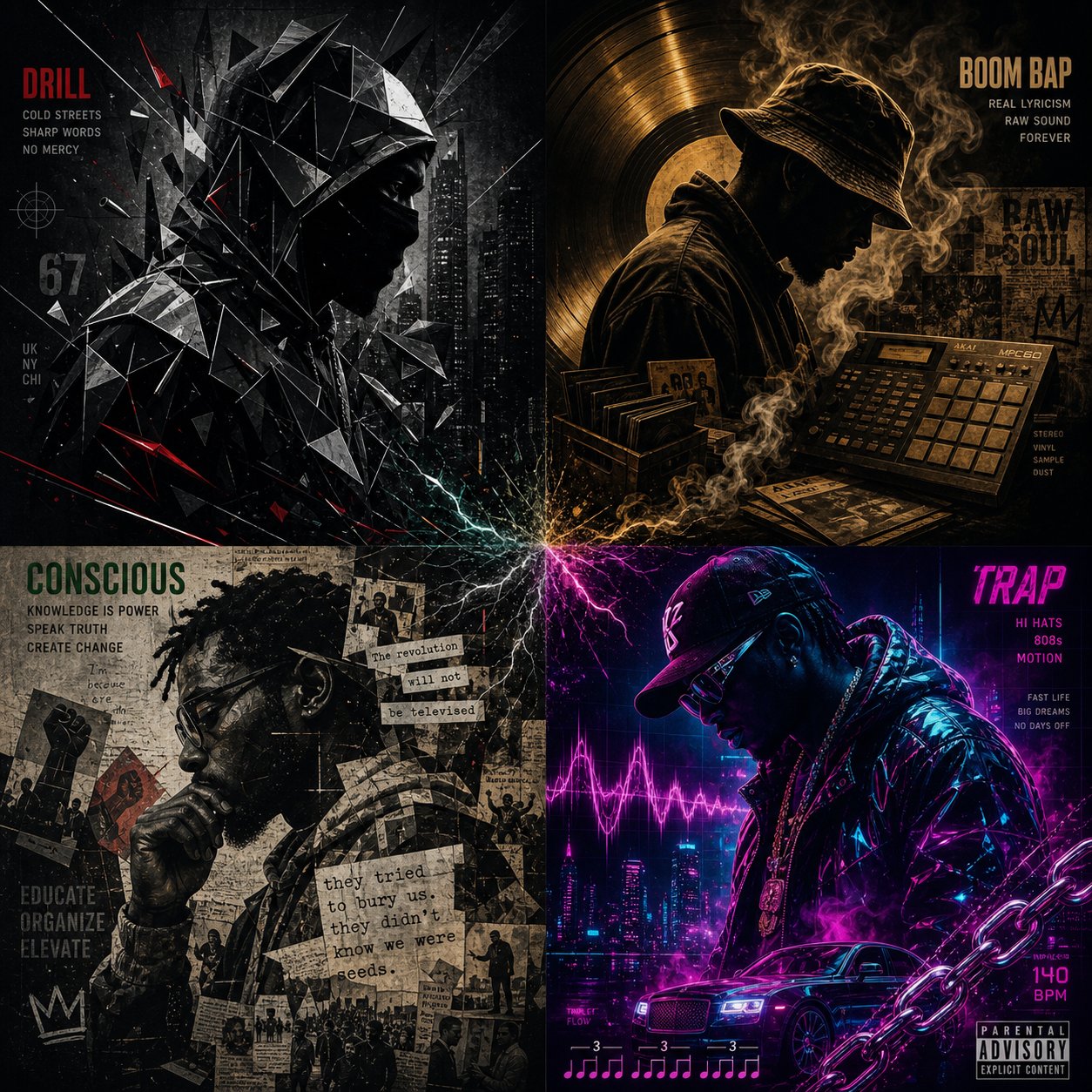
Trap Drill Boom Bap and Conscious Rap Styles
Every rap subgenre carries a unique fingerprint. The vocabulary, the cadence, the subject matter, even the sentence structure shifts from one style to the next. If you've ever used a freestyle generator or a freestyle rap generator and gotten output that felt generically "rappish" without sounding like any particular style, it's because the tool blended features from multiple subgenres into a flattened composite. Knowing what each style actually sounds like on the page helps you prompt more precisely and edit more effectively.
Here's how the major subgenres break down in terms of their lyrical characteristics, and how AI typically performs with each:
| Subgenre | Key Lyrical Traits | Common Themes | How AI Typically Handles It |
|---|---|---|---|
| Trap | Repetitive hooks, heavy ad-libs, triplet flow patterns, melodic cadence, simpler vocabulary density per bar | Braggadocio, wealth, nightlife, hustle, flexing | Relatively well. Trap's formulaic hook structures and repetitive phrasing align closely with pattern replication. AI can produce passable trap hooks with minimal prompting. |
| Drill | Aggressive monotone delivery, sliding cadence influenced by hi-hat patterns, raw and unfiltered language, short punchy bars | Street narratives, violence, territorial pride, gang culture, survival | Poorly. Drill depends on hyper-local slang, geographic specificity, and cultural references that shift rapidly. AI output tends to sound like a sanitized imitation that misses the raw, neighborhood-specific edge. |
| Boom Bap | High lyrical density, complex multisyllabic rhymes, layered wordplay, extended metaphors, emphasis on verbal dexterity | Street wisdom, personal reflection, social commentary, lyrical competition | Mixed. AI can mimic the structural density but struggles with the sustained cleverness and layered double meanings that define elite boom-bap writing. |
| Conscious Rap | Metaphor-heavy writing, message-driven content, socially aware vocabulary, deliberate pacing for emphasis | Racial justice, systemic inequality, education, community empowerment, self-awareness | Poorly. Genuine perspective and lived conviction can't be statistically generated. AI-produced conscious rap tends to read like a Wikipedia summary set to rhyme rather than a passionate call to action. |
| Mumble Rap | Melody-forward delivery, simpler vocabulary, rhythmic repetition, elongated vowels, prioritizes vibe over verbal precision | Partying, drugs, lifestyle, atmosphere over narrative | Reasonably well. The style's emphasis on rhythm and melody over lyrical complexity plays to AI's pattern-matching strengths. Output captures the cadence effectively even if it lacks genuine personality. |
| Storytelling Rap | Narrative arcs with beginning, middle, and end, character development, chronological structure, dialogue and scene-setting | Personal history, cautionary tales, fictional narratives, neighborhood stories, coming-of-age accounts | Very poorly. Sustaining a coherent narrative across 16+ bars requires tracking characters, plot progression, and emotional escalation. AI frequently loses the thread after 4-6 bars, introducing contradictions or abandoning the story entirely. |
Notice a pattern in that rightmost column. The more a subgenre depends on structural repetition and formulaic elements, the better AI handles it. The more it depends on genuine perspective, sustained narrative logic, or culturally embedded knowledge, the worse AI performs. This isn't a coincidence. It's a direct consequence of how language models work: they excel at replicating surface-level patterns and struggle with the deeper layers of meaning, intent, and lived context that separate good lyrics from great ones.
Gangster rap lyrics, for instance, occupy an interesting middle ground. The vocabulary and themes are well-represented in training data because the subgenre has been commercially dominant for decades. AI can produce bars that sound thematically appropriate on the surface. But as Soundraw's genre breakdown emphasizes, gangsta rap's power comes from offering "unfiltered perspectives on life in America's inner cities" rooted in real social and economic conditions. An AI can mimic the vocabulary of that perspective. It cannot carry its weight.
Where AI Excels and Struggles Across Styles
Imagine two tests. In the first, you ask an AI to write a catchy 4-bar trap hook about money. In the second, you ask it to write a 16-bar storytelling verse about a specific night that changed someone's life. The trap hook will likely come back usable, maybe even good. The storytelling verse will almost certainly fall apart somewhere around bar eight.
The reason is structural. Trap hooks rely on repetition, simple vocabulary, rhythmic catchiness, and a narrow emotional register. These are exactly the features that pattern replication handles well. The AI has seen thousands of hooks built on this template, so the statistical average it produces actually sounds close to the real thing. A dark trap lyrics maker feature, for example, can lean on the well-established conventions of ominous melodies and aggressive ad-lib patterns because those conventions are consistent and predictable.
Storytelling rap demands the opposite. Every bar needs to push a narrative forward. Characters introduced in bar two need to still be present and consistent in bar fourteen. Emotional intensity needs to build, not just exist. The ending needs to connect back to the beginning in a way that feels intentional. Language models have no concept of narrative architecture. They predict the next likely word given the previous words, which means each bar is generated in a forward-only cascade with no awareness of where the story is supposed to land. The result reads like a series of loosely related scenes rather than a cohesive story.
Conscious rap presents a different kind of failure. The model can produce lines that reference social justice, inequality, or empowerment. But those lines tend to feel hollow because genuine conscious rap requires a point of view, a real argument being made by a real person who has thought deeply about the issue. Research published in the Transactions of the International Society for Music Information Retrieval explains this dynamic at a technical level: generative models rely on language as a "semantic bridge" for meaning, but language itself is insufficient for capturing the full depth of human experience and intent. The study argues that forcing creative output through linguistic prediction inevitably "filters it through pre-existing criteria and epistemic frames, diminishing its richness and complexity." In rap terms, that means AI can produce the words of conviction without the conviction itself.
Drill faces yet another obstacle: temporal and geographic specificity. Drill slang evolves block by block and month by month. A term that's current in South London drill might be outdated in Chicago drill, and both might be irrelevant to Brooklyn drill. AI training data captures a snapshot of language that may already be stale by the time you generate output. What you get sounds like drill from two years ago, written by someone who learned the style from a playlist rather than from the neighborhood. The hyper-local authenticity that makes drill compelling simply can't be replicated by a model trained on aggregated, decontextualized text.
If you're building a freestyle rap words list to practice improvisation or sketching bars across different styles, understanding these strengths and weaknesses saves you from fighting the tool. Use AI confidently for trap hooks, melodic chorus drafts, and braggadocio verses where surface-level energy matters more than depth. Approach it cautiously for boom-bap wordplay, where you'll need to manually upgrade the cleverness. And treat it purely as a structural scaffold for storytelling, conscious, and drill content, expecting to rewrite substantially.
The subgenre question ultimately circles back to a bigger issue: even when AI gets the style right, something still feels off. That something is the authenticity gap, the space between technically competent output and freestyle lyrics that actually move a listener. Understanding exactly where and why that gap opens up is the key to closing it.
Limitations and Common Failures of AI Rap Generators
Style-specific weaknesses are revealing, but they point toward a deeper problem that cuts across every subgenre: even when the structure is right, the syllables land on beat, and the rap lyrics rhyme correctly, something essential is missing. You can feel it instantly. The bars scan. The scheme holds. And yet the verse reads like it was written by someone who studied rap from the outside without ever living inside it. That hollow center is the single most important limitation of AI-generated output, and it's worth examining honestly because every tool on the market would rather you didn't notice.
Generic Bars and the Authenticity Problem
Here's the most common failure mode: AI produces lyrics that are technically competent and emotionally empty. The rhymes work. The structure is clean. But the verse says nothing that sticks. It's the lyrical equivalent of stock photography — polished, professional, and completely devoid of a point of view.
Why does this happen? Because compelling rap is built on lived experience. The best verses draw from personal pain, specific triumphs, neighborhood stories, family dynamics, and emotions that were actually felt by a real person. When Kendrick Lamar writes about Compton, those bars carry the weight of a specific life lived in a specific place. When an AI writes about "the streets," it's averaging every street reference in its training data into a flattened, anonymous composite that belongs to nowhere and no one.
AI has no childhood. No heartbreak. No moment of standing on a corner at midnight wondering whether the next year would be different. It cannot draw on genuine emotion because it has never experienced any. What it can do is identify that lines about struggle, ambition, and overcoming adversity appear frequently in rap, and then produce statistically average versions of those themes. The result reads like a summary of what rap is about rather than an actual expression of anything.
Then there's the "same-ness" problem. A data analysis comparing 60,000 AI-generated songs from Suno with 40,000 human-written lyrics from Genius exposed this pattern in sharp detail. The AI side of the word cloud was dominated by terms like "whispers of," "neon lights," "gentle," "softly," and "laughter" — words so overused across AI outputs that experienced users recognize them instantly as telltale fingerprints of machine-generated text. The human rap lyrics side, by contrast, was packed with slang, ad-libs like "ayy" and "huh," and the raw, unfiltered vocabulary that actual rappers use.
This convergence isn't coincidental. Most AI rap tools rely on the same underlying language models, or at minimum, models trained on heavily overlapping datasets. Feed similar data into similar architectures and you get similar output. It doesn't matter whether you're using Tool A or Tool B — if both are built on the same foundation, they'll produce random rap lyrics that sound interchangeable. One researcher described the phenomenon as a "homogenization" of output, where AI algorithms trained on existing music create a regression toward the statistical mean, flattening the wild stylistic diversity of hip-hop into a narrow, safe, and deeply boring center.
For anyone treating a random rap generator as a finished-product machine, this is a dealbreaker. For anyone treating it as a drafting tool that requires heavy human editing, it's simply the starting condition you need to account for.
Cultural Tone-Deafness and Wordplay Limitations
Authenticity issues go deeper than missing personal experience. AI also struggles with the cultural layer that makes rap feel alive — the slang, the references, the unspoken knowledge that separates an insider from a tourist.
Consider regional slang. Hip-hop language evolves at a pace that no training dataset can keep up with. A term that's current in Atlanta trap this month might have been coined three weeks ago on a mixtape that hasn't been transcribed into any text corpus. Drill slang shifts block by block. Bay Area hyphy vocabulary sounds nothing like Houston chopped-and-screwed terminology. AI models are trained on historical snapshots of language, which means the slang they produce often feels slightly outdated or geographically misplaced — close enough to fool someone unfamiliar with the culture, but immediately obvious to anyone who actually lives in it.
Double entendres present an even harder challenge. Great rap wordplay operates on multiple levels simultaneously. A single bar might carry a surface meaning, a sexual innuendo, a reference to a specific cultural event, and a callback to an earlier verse — all at once. This kind of layered construction requires real-world knowledge, intentional ambiguity, and an understanding of how different audiences will interpret the same words differently. AI can produce basic puns, matching two meanings of a single word, but it rarely achieves the multi-layered bars that distinguish elite rhyme rap lyrics from average ones. The model doesn't know what's happening in the world right now, doesn't understand geographic inside jokes, and can't deliberately plant a meaning it intends for only part of its audience to catch.
The call-and-response tradition in hip-hop is another blind spot. Rap has always been a communal art form. Bars are written with the expectation of a crowd reaction, an ad-lib response, a DJ rewind. When you write lyrics to rap in front of a live audience, you build in pause points, punchline setups, and moments designed for crowd participation. AI generates text as a continuous stream with no awareness of performance dynamics. It doesn't know where the crowd would erupt, where the beat should drop out for emphasis, or where a pause would hit harder than another syllable.
And then there's the nursery rhyme effect. As AudioCipher's analysis of popular AI lyric generators found, many tools produce output that reads more like children's verse than hip-hop. One generator produced the line "Got a story in your mind but the words are hard to find? Let AI be your guide with creativity by your side." The simple end rhymes, the sing-song cadence, the total absence of edge — it's the kind of output that makes you wonder whether the model has ever encountered actual rap rhymes lyrics or only processed a sanitized, heavily filtered version of the genre.
This sanitization isn't accidental. OpenAI and other providers heavily censor their models to minimize offensive output, which creates a fundamental tension with a genre that has always been raw, confrontational, and deliberately provocative. The result is lyrics that feel like rap performed by someone who's been told to keep it clean for a corporate event — technically on-genre but stripped of everything that gives the genre its power.
Here are the most common failures you'll encounter when evaluating AI-generated rap output:
- Surface-level metaphors — AI reaches for the most statistically common comparisons ("heart of a lion," "rising like a phoenix") rather than crafting original imagery. These metaphors feel recycled because they literally are: they're the average of every metaphor in the training data.
- Anachronistic or misplaced slang — Terms that were current five years ago, or slang from the wrong region or subgenre, appear where contemporary or locally specific language should be. The output sounds like someone learned rap vocabulary from a textbook published in 2019.
- Forced rhymes that sacrifice meaning — When the model prioritizes completing a rhyme scheme over saying something coherent, you get bars where the last word clearly exists only because it rhymes, not because it belongs. The line technically works phonetically but collapses under the slightest semantic scrutiny.
- Lack of narrative continuity across verses — Verse one might establish a character or scenario that verse two completely abandons. The model treats each section as a semi-independent generation task rather than a chapter in a continuous story.
- Inability to maintain a consistent persona or voice — The tone shifts unpredictably between bars. A verse might open with hard-edged street language, pivot to introspective vulnerability in bar four, then swing into motivational-poster optimism by bar eight — not as an intentional artistic choice, but because the model has no concept of character consistency.
- Cliche stacking — Rather than developing a single idea with depth, AI tends to pile up multiple overused phrases in rapid succession. "Grinding every day, shining in the rain, hustling through the pain, never gonna change" — each phrase is a separate cliche, and together they communicate nothing specific.
- Emotional flatness — Even when the subject matter is heavy, the delivery stays at the same intensity level throughout. There's no build, no release, no moment where the emotion peaks and catches the listener off guard. AI writes at one emotional altitude and stays there.
None of these failures mean the tools are useless. They mean the tools produce first drafts with specific, predictable weaknesses — and once you know what those weaknesses are, you can fix them. Someone looking for easy rap lyrics freestyle material to riff on will find genuine value in AI output, as long as they understand it's a starting sketch rather than a finished painting.
The real question isn't whether AI output has problems. It clearly does. The real question is what the editing process looks like when you sit down to transform that flawed draft into something that sounds like it was written by a human being who actually has something to say.
Editing and Humanizing AI Lyrics Into Authentic Bars
Every limitation covered above — the hollow emotional center, the cliche stacking, the drifting persona — shares something in common: none of them are fatal if you treat AI output as raw material rather than a finished product. The real craft of learning how to write rap lyrics with AI doesn't live in the generation step. It lives in the editing step. That's where a forgettable block of text becomes something worth performing.
Yet almost no resource online explains what that editing process actually looks like. Every tool hands you a verse and implicitly suggests you're done. You're not. You're just starting. The techniques below are what separate someone who pastes AI output into a notes app from someone who knows how to make a rap song that sounds like it came from a real human being with a real story to tell.
Techniques for Adding Personal Voice and Authentic Storytelling
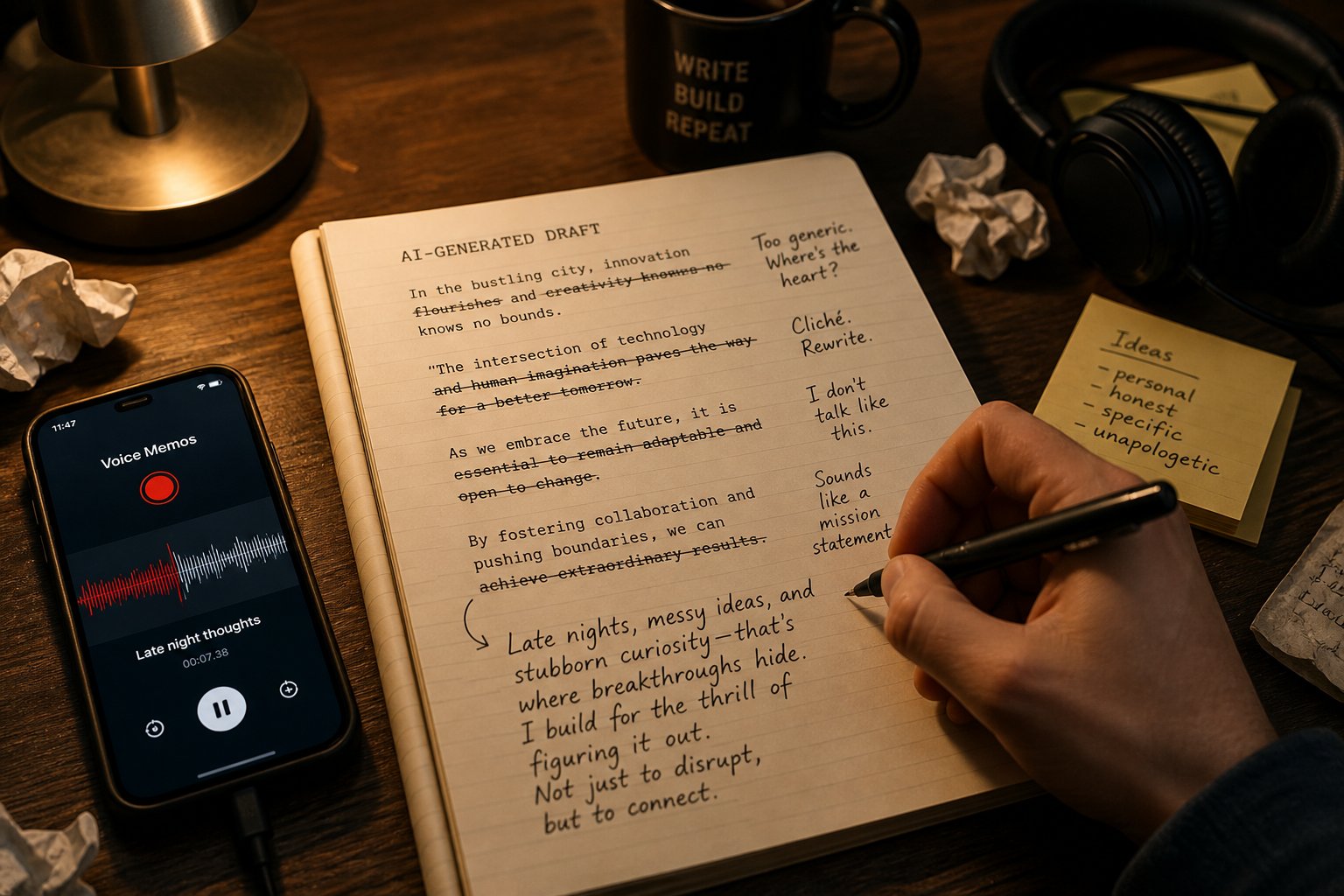
The most effective framework for editing AI-generated bars is what experienced producers and creators call the skeleton method. The concept is straightforward: treat the AI's output as a structural skeleton — rhythm, rhyme scheme, topic flow, bar count — and then rewrite the actual words while preserving that framework. You're keeping the bones and replacing the skin.
Why does this work? Because AI is genuinely competent at structure. It can lay out a 16-bar verse with a consistent AABB scheme, maintain a topic across multiple bars, and hit a rhythmic cadence that roughly fits a beat. What it can't do is fill that structure with anything personal, vivid, or emotionally honest. That's your job. The skeleton method lets you skip the hardest part of starting from scratch — staring at a blank page — while still doing the creative work that makes lyrics feel authentic.
Here are the specific editing moves that transform generic AI output into something with a real voice:
- Replace generic references with personal details. If the AI wrote "came up from nothing," swap it for something specific to your life: "came up sharing a twin bed with my brother in a room that smelled like cigarette smoke." Specificity is the single fastest way to inject authenticity. As Jack Righteous's guide on humanizing AI lyrics emphasizes, the techniques that matter most involve layering in personal emotion and lived detail that no model can fabricate.
- Swap cliche metaphors with original imagery. "Heart of a lion" becomes "chest tight like a fist that won't open." "Rising to the top" becomes "climbing fire escapes because the elevator's been broken since '09." Every cliche you replace with an original image makes the verse sound less like a composite and more like a person.
- Adjust syllable counts to match your natural speaking rhythm. Read each bar out loud. If you stumble, the syllable count is wrong for your delivery style. Cut words that create awkward clusters. Add a breath where the line feels rushed. As Cole Mize Studios recommends, periodically rapping the bars you've already written helps you catch rhythmic clashes before they pile up across an entire verse.
- Inject your own slang and vocal personality. If you say "bet" instead of "okay," use it. If your crew has a phrase nobody else uses, put it in. The words you naturally reach for in conversation are the words that make your bars sound like yours.
- Lock in a consistent persona. Decide before you start editing: who is speaking in this verse? What do they want? What are they afraid of? Every line should sound like the same person wrote it. If the AI drifts from aggressive to sentimental between bars, pick one lane and rewrite the outliers to match.
Every rap writer who has successfully integrated AI into their workflow uses some version of this approach. The AI handles the architectural labor. The human handles everything that makes the architecture worth entering.
Before and After Examples of Refined AI Lyrics
Understanding these techniques in the abstract is useful. Seeing how they transform actual output makes them stick. Imagine a raw AI-generated verse prompted with "write a 16-bar verse about growing up poor, introspective tone, AABB rhyme scheme." The AI might return something like this:
Growing up we never had a lot / But I kept dreaming and I never stopped / Had to hustle every single day / Working hard to find a better way
Technically, the rhyme scheme holds. The topic stays consistent. But every single line is a cliche you've heard a thousand times. There's no person behind these words. No scene. No specific moment that makes a listener think, "that's real."
Now apply the skeleton method. Keep the AABB structure, the four-beat rhythm per bar, and the general topic of childhood poverty. Rewrite everything else:
Four of us in a studio apartment, no AC / Mama ironing church clothes watching Judge Judy on the TV / Dollar-menu dinners five nights, maybe six / Trading basketball cards on the stoop cause we couldn't afford flicks
Same structure. Same rhyme scheme. Same topic. Completely different impact. The edited version has a setting you can picture, details that feel lived-in, and a voice that belongs to a specific person rather than a statistical average. The generic boast "I kept dreaming" got replaced with a concrete scene. The vague "hustle every single day" became dollar-menu dinners and basketball cards on a stoop — imagery so specific it forces the listener to see it.
This is the core principle worth internalizing:
AI provides the architecture. The human provides the soul. The best AI-assisted lyrics are built on machine-generated scaffolding that has been gutted and rebuilt with personal truth, original imagery, and a voice no algorithm could predict.
The same transformation applies to every section of a song. A generic AI hook like "We on top and we never gonna fall" becomes "Still here, screen cracked, landlord calling" when you apply the same principles — swap the cliche for a detail, swap the abstraction for a scene, swap the anonymous voice for yours.
Beyond content edits, tightening rhythm is the final polish that makes lyrics performance-ready. Three techniques make the biggest difference:
- Read every bar out loud, on beat. If you have the instrumental, play it. If not, use a metronome set to your target tempo. Your mouth will catch problems your eyes miss. A bar that reads smoothly on screen might have a syllable cluster that's impossible to deliver without sounding rushed or choppy.
- Record rough delivery attempts. You don't need a studio. A voice memo on your phone is enough. Play it back and listen for bars where your delivery stumbles, loses energy, or sounds forced. Those are the bars that need syllable adjustments. When you create a rap song using AI as your starting point, these rough recordings become your most valuable editing tool because they reveal the gap between what looks right on paper and what actually works in performance.
- Cut syllables that disrupt natural flow. If a bar has 14 syllables but your natural cadence wants 11, something has to go. Trim filler words — "really," "just," "very" — that add syllables without adding meaning. Swap multi-syllable words for punchy monosyllabic ones where the rhythm calls for impact. Every syllable should earn its place.
This is where knowing how to make a rap translates directly into knowing how to fix AI output. The editing process isn't a chore tacked onto the end of generation. It's the creative act itself. The AI gave you clay. Shaping it into something worth hearing — something that carries your cadence, your stories, your personality — is the actual work of writing. Anyone learning how to write a rap song with AI assistance should spend twice as long editing as they spent prompting. That ratio is where artistry lives.
Mastering the edit transforms any AI tool from a gimmick into a genuine workflow accelerator. But not all tools give you the same quality of raw material to work with, and the differences between platforms matter more than most people realize.
AI Rap Tools and Approaches Worth Exploring
Raw material quality varies from tool to tool, and the reason isn't just about which AI model sits under the hood. It's about approach. The landscape of AI rap generation has splintered into fundamentally different categories, each built around a different philosophy of what a user actually needs. Some tools focus entirely on text output. Others try to take you from a blank idea to a finished audio track in one session. Others split the process into modular pieces — one generator for verses, another for hooks, another for battle bars.
Choosing the wrong category for your workflow is like buying a hammer when you needed a screwdriver. Both are tools. Neither substitutes for the other. The framework below helps you figure out which approach actually matches how you create, so you stop wasting time on platforms built for someone else's process.
Types of AI Rap Generation Tools Available
Every ai rap generator on the market falls into one of three broad categories. Understanding these categories before you start evaluating individual tools saves you from the trial-and-error spiral that eats hours of creative time.
All-in-one workflow platforms combine lyric generation with beat creation, vocal synthesis, and sometimes even mixing and export. These are designed for users who want to move from concept to finished track without jumping between apps. The tradeoff is that breadth sometimes comes at the cost of depth in any single feature, but for creators who value speed and integration, this approach eliminates friction.
Modular tools break the process into specialized generators. You might find one feature dedicated to verse writing, another to hooks, another to diss tracks or battle bars. This approach lets you target exactly the section you need without wading through features you don't. The downside is a fragmented workflow — you're assembling pieces from different generators and stitching them together yourself.
Text-focused generators produce pure lyric output with no audio component. These prioritize writing quality, rhyme control, and structural precision. They're ideal for rap writers who already have beats and production handled and just need help on the lyrical side. The limitation is obvious: you get words on a screen, and everything else — delivery, recording, production — happens elsewhere.
Here's how these approaches compare side by side:
| Approach | Best For | Strengths | Limitations |
|---|---|---|---|
| All-in-One Workflow (MakeBestMusic AI Rap Generator) | Rappers, lyricists, beatmakers, and social creators who want lyrics, flows, hooks, and beats generated in a single platform | Integrated workflow from lyrics to finished audio; covers multiple creation stages without switching tools; supports diverse user types from serious artists to content creators | Breadth of features may require learning curve; users who only need text output might not use every capability |
| Modular Tools (e.g., FreshBots, ToolSnak) | Users who need specific section types — a verse here, a hook there, a battle bar for practice | Targeted output for specific needs; often simple interfaces; some offer customization for rhyme and syllable settings | Fragmented workflow requiring multiple tools; output quality varies between section types; no audio integration |
| Text-Focused Generators (e.g., DeepBeat, Word.Studio) | Writers and lyricists who handle production separately and need pure lyrical output | Focused on writing quality; some offer rhyme-specific controls; lightweight and fast | No beat or vocal generation; limited structural control in many cases; output often requires heavy editing |
The category you choose should reflect your actual creative process, not marketing promises. If you're a rapper who records over beats you already have, a text-focused rap line generator might be all you need. If you're a content creator building short-form videos and you need a complete track quickly, an all-in-one rap song generator saves significant time by handling lyrics, flow, and production in a single environment. If you're a lyricist who works section by section — drafting hooks separately from verses — modular tools give you that surgical precision.
What you'll notice across the market is that most tools cluster in the modular and text-only categories. Platforms like DeepBeat have been around for years, offering free rap lyrics generator functionality that analyzes existing lyrics and combines them with user input. FreshBots lets you customize rhymes, syllable counts, and lyrical settings. Word.Studio generates bars from themes and keywords. These are useful tools, but they stop at text. The gap between generating lyrics on one platform and producing a track on another is where creative momentum dies for a lot of users.
That's precisely why all-in-one platforms like MakeBestMusic's AI Rap Generator have gained traction. When an ai rap song generator handles lyrics, flows, hooks, and beats within a single interface, you eliminate the export-import-reformat cycle that turns a 20-minute creative session into a two-hour technical project. For beatmakers who want to hear how generated lyrics sit on a produced track, or social creators who need content-ready audio fast, that integration isn't a luxury — it's the core value proposition.
What to Look for in an AI Rap Lyrics Generator
Regardless of which category appeals to you, certain evaluation criteria separate genuinely useful tools from flashy interfaces that produce mediocre output. Before committing time to any online rap lyrics generator, run it through this checklist:
- Subgenre support — Can the tool generate output styled to specific subgenres like trap, drill, boom bap, or conscious rap? Or does it default to one generic "rap" mode? As the subgenre chapter demonstrated, style-specific prompting dramatically affects quality. A tool that can't distinguish between subgenres will flatten every output into the same mainstream composite.
- Rhyme scheme control — Does the tool let you specify AABB, ABAB, internal rhymes, or multisyllabic patterns? Or does it pick the scheme for you? Tools that give you rhyme control let you match the output to your artistic intent rather than accepting whatever the algorithm defaults to.
- Structural options — Can you request specific sections: a 16-bar verse, a 4-bar hook, a bridge, a full song layout? A rap song lyrics generator that only outputs undifferentiated blocks of text forces you to manually parse and restructure everything, which defeats the purpose of using a generator in the first place.
- Output length flexibility — Some tools cap output at 8 bars. Others generate full multi-verse songs. Make sure the tool's output range matches your needs. If you're writing a complete track, a tool that maxes out at a single verse will leave you running the generator repeatedly and trying to stitch disconnected sections together.
- Customization depth — Beyond topic and genre, can you specify mood, perspective, syllable density, or reference artists? The prompt engineering principles from earlier in this guide only work if the tool actually accepts that level of input. A rap generator ai that only takes a single text box limits your ability to shape the output.
- Complementary features — Does the tool support beat generation, vocal synthesis, or audio export? If your workflow extends beyond lyric drafting into production, integrated features save significant time. This is where all-in-one platforms like MakeBestMusic distinguish themselves from text-only generators — the ability to move from words to a produced track without leaving the platform.
One practical tip: test any tool with the same prompt before committing. Write a detailed, structured prompt using the techniques from earlier in this guide — specific topic, mood, rhyme scheme, bar count, subgenre — and run it through two or three different platforms. Compare the output side by side. You'll quickly see which tool responds to specificity and which one ignores your instructions and produces the same generic bars regardless of input.
Also consider how the tool handles iteration. Can you refine the output, request revisions, or regenerate specific sections without starting over? The best creative workflows involve multiple passes. A tool that treats every generation as a one-shot event forces you to start from zero each time, while platforms designed for iterative refinement let you build toward a usable draft through progressive improvement.
Choosing the right tool matters, but it's worth keeping perspective: even the best rap song generator is only as good as what you do with its output. The editing techniques from the previous section apply no matter which platform you choose. Tools provide raw material. Your voice, your story, and your editorial judgment are what turn that material into art. And that creative equation — human plus machine — raises questions that go well beyond which button to click.

The Ethics and Future of AI in Hip-Hop Culture
The human-plus-machine equation isn't just a workflow question. It's a cultural one. Hip-hop was born in the Bronx from block parties, breakbeats, and the voices of communities that mainstream culture ignored. It's a genre rooted in personal expression, marginalized perspectives, and storytelling that carries genuine weight because a real person lived every word. So when an ai rapper generates bars trained on that cultural legacy, a tension emerges that no prompt engineering guide or tool comparison can resolve on its own: can AI-generated lyrics carry the cultural weight of a genre built on authenticity?
The answer is complicated. And it deserves more honest exploration than the industry has given it so far.
Authenticity Originality and the Culture Question
Hip-hop has always had a complicated relationship with technology. DJ Kool Herc built the genre's foundation by looping breakbeats on two turntables — using machines to create something no machine had produced before. Producers like J Dilla transformed the Akai MPC into an instrument as expressive as any guitar. As cultural critic Nettrice Gaskins traces, the lineage runs from Jamaican sound systems through sampling culture to today's generative AI tools — each era raising the same fundamental question about ownership and attribution in new forms.
But there's a critical difference between a producer chopping a soul sample and an ai rapper generator synthesizing lyrics from millions of uncredited sources. Sampling, even at its most aggressive, involves a human making deliberate creative choices about what to borrow, how to transform it, and what new meaning to layer on top. An AI model ingests everything indiscriminately. It doesn't choose. It averages.
That distinction matters deeply within hip-hop culture, where credibility is currency. Rapper and producer will.i.am acknowledged this tension directly in an interview with Music Tech, comparing AI training to the sampling debates of earlier decades: "They did train on, you know, the entire library that humans have made and that people should be paid for." He draws a parallel to how jazz musicians once questioned hip-hop producers for sampling their work — but also insists that the developers who build these algorithms are creating their own form of art. It's a nuanced position, and one that reflects the split running through the hip-hop community right now.
On one side, you have artists who view any AI involvement in rap as fundamentally incompatible with the genre's ethos. Their argument is simple: if you didn't live it, you can't write it, and a machine has lived nothing. On the other side, pragmatic creators see AI as the latest in a long line of tools — no different in principle from drum machines, Auto-Tune, or DAWs — that expand what's possible without replacing what's essential.
Then there's the legal dimension. The U.S. Copyright Office ruled in January 2025 that AI-generated work can be copyrighted, but only when it "embodies meaningful human authorship." If an AI tool alone generates lyrics based solely on a prompt without further human creative intervention, that output falls into the public domain — meaning anyone can use it and nobody owns it. This ruling has massive implications for rapping ai workflows. If you use AI output as a first draft and substantially rewrite it with your own voice, details, and editorial choices, the result qualifies for copyright protection. If you paste raw AI output into a track and call it yours, you may own nothing.
Projects like Lupe Fiasco's Endless LUP — a 24/7 AI-powered FM radio station trained on his rapping style, developed in partnership with MIT — illustrate how established ai rappers are experimenting at the boundary. Fiasco built in ethical guardrails: every AI-generated song plays once and is permanently deleted, the station only broadcasts at specific times and locations, and the music is never sold or uploaded to streaming platforms. It's a deliberate attempt to explore AI creativity without displacing human artistry or commercializing machine-generated output. Whether that framework satisfies the broader hip-hop community remains an open and actively debated question.
Using AI as a Creative Partner Not a Replacement
Everything in this guide points toward a single practical conclusion: AI works best when it handles the parts of creation that don't require a soul, and humans handle the parts that do.
Think of the spectrum of AI involvement. At the lightest end, someone might use an ai rap maker to generate random word combinations for freestyle practice — a digital version of pulling slips of paper from a hat to spark improvisation. A step further, a songwriter stuck on a verse might prompt the tool for structural ideas, scanning the output not for usable lines but for rhyme patterns or topic angles they hadn't considered. At the heaviest end, a producer drafts full verses through AI and then spends an hour gutting and rebuilding them with personal details, original imagery, and a consistent voice.
None of these approaches are cheating. All of them require human judgment, taste, and creative labor to produce anything worth hearing. The ai rapper voice generator free tools available today can approximate the sound of a verse. They cannot approximate the meaning behind one. That gap is where your artistry lives, and no model is closing it anytime soon.
As Dark Horse Institute's analysis of AI in songwriting concludes, the technology excels at idea generation, structural scaffolding, and overcoming the blank-page paralysis that stalls even experienced writers. It falls short wherever genuine emotional depth, consistent perspective, and cultural specificity are required. The most productive stance isn't resistance or blind adoption — it's collaboration, with clear-eyed awareness of what the machine contributes and what only you can bring.
The most effective use of AI in rap combines technological capability with human creativity, lived experience, and authentic voice. The machine generates the scaffold. The human fills it with truth. Neither alone produces great art — but together, they give creators a starting point that would have taken hours to build from scratch.
Tools like MakeBestMusic's AI Rap Generator serve exactly this collaborative vision — giving rappers and creators a starting point they can build on with their own voice and story, rather than positioning AI as a replacement for the human at the center of the music. That distinction matters. A tool designed to support your process is fundamentally different from a tool that claims to replace it.
Hip-hop has survived every technological disruption thrown at it — turntables, samplers, drum machines, digital production, Auto-Tune, streaming algorithms — by absorbing the technology and bending it to serve human expression. AI is the latest chapter in that story, not the final one. The artists who thrive won't be the ones who refuse the tool or surrender to it. They'll be the ones who pick it up, understand its limits, and use it to say something only they could say.
Your bars. Your story. Your voice. The AI just helps you get there faster.
