

What AI Music Generation Actually Means
Can AI generate music? Yes, and the range of what it produces has grown far beyond simple loops or MIDI patterns. Modern AI systems compose melodies, arrange full instrumentation, generate human-sounding vocals, write lyrics, and deliver mastered audio — all from a short text prompt or a reference track. Whether you need a 15-second jingle or a three-minute song with verses, choruses, and a bridge, these tools can handle it.
AI music generation is the process of using machine learning models trained on large datasets of recorded music to create original compositions — including melodies, harmonies, lyrics, and fully produced audio — with minimal or no human performance input.
That definition covers a wide spectrum. On one end, you have prompt-to-song generators where you type something like "upbeat indie pop with female vocals" and receive a finished track in seconds. On the other end, there are AI-assisted tools that suggest chord progressions, generate accompaniment layers, or handle mixing and mastering while you stay in creative control. In between sits style transfer, where a reference track guides the AI's output toward a specific sound or genre. If you have ever wondered how do you make a song without years of production training, these platforms offer a real answer.
What Does AI Music Generation Mean
It helps to separate this from simpler audio tasks. AI music generation is not the same as applying a filter to an existing recording, trimming a sample, or using a song genre finder to tag tracks in a library. These models learn statistical patterns in rhythm, harmony, instrumentation, and song structure from massive music datasets. When prompted, they predict what sounds should come next based on those learned patterns and produce entirely new audio. Think of it as a system that has internalized thousands of compositional decisions and can replicate that decision-making process on demand — generating everything from the drum pattern to the vocal melody.
The technology spans several distinct approaches. Prompt-based generators like Suno or Boomy deliver one-click songs. Algorithmic loop platforms such as AIVA or Mubert create endless background soundtracks. Multitrack DAWs with AI features offer composition suggestions inside a familiar production workflow. Voice synthesis tools clone or create singing voices. Even mastering services now use AI to polish a final mix. Each type uses different underlying models, but they all fall under the umbrella of AI-generated music.
Why This Question Matters Now
The market for generative AI in music was valued at $642.8 million in 2024 and is projected to reach $3 billion by 2030, growing at a compound annual rate of 29.5%. That trajectory reflects real adoption — content creators looking for affordable background tracks, businesses needing custom jingles, independent artists using AI as a songwriting partner, and producers exploring new creative workflows.
The tools have also become remarkably accessible. You no longer need studio equipment or music theory knowledge to makesong ideas real. Platforms like Producer.AI and similar services let anyone describe a mood, pick a genre, and walk away with usable audio. For professionals, the benefits of ai in music extend to faster iteration, lower production costs, and the ability to prototype ideas before committing studio time. Even tasks like brainstorming an album name generator or sorting tracks by style have been folded into AI-powered creative suites.
This article breaks down how the technology works, where it excels, where it falls short, and what you need to know before putting AI-generated music into a real project. The goal is practical clarity — not hype, not fear — so you can decide where these tools fit into your workflow.
How AI Music Generation Evolved Over Decades
The idea of machines composing music did not appear overnight with the latest wave of AI apps. It stretches back more than two centuries — from Mozart rolling dice to arrange pre-written phrases into minuets, to researchers feeding punch cards into room-sized computers. Understanding this timeline puts today's prompt-to-song tools in perspective: they are the latest chapter in a long story of humans trying to encode creativity into systems.
Early Algorithmic Composition and Rule-Based Systems
The earliest formal experiment most historians point to is Mozart's Musikalisches Würfelspiel (Musical Dice Game) from 1787 — a system that let players roll dice to sequence pre-composed musical phrases into new minuets. It was simple, but it proved a concept: rules plus randomness could produce coherent composer music without a human making every decision in real time.
Fast forward to the mid-20th century. In 1957, Lejaren Hiller and Leonard Isaacson used the ILLIAC I computer at the University of Illinois to create the Illiac Suite — widely considered the first piece of music composed by a computer. The system followed strict counterpoint rules programmed by the researchers, generating a string quartet note by note. Around the same time, Iannis Xenakis applied probability theory and stochastic processes to composition, treating a musical canvas as something that could be shaped by mathematics rather than intuition alone.
By the 1980s and 1990s, David Cope's Experiments in Musical Intelligence (EMI) pushed the boundary further. EMI could analyze the style of classical composers — Bach, Mozart, Chopin — and generate new pieces that mimicked their patterns convincingly enough to fool listeners in blind tests. Still, these systems relied on explicit rules and pattern-matching. They could remix existing conventions, but they could not learn open-ended musical concepts the way a human student absorbs lessons over years of practice. Every output was essentially built from an endless music scratch of predefined logic, constrained by whatever the programmer had anticipated.
The Deep Learning Revolution in Music
Everything changed when neural networks entered the picture. Instead of hand-coding rules about harmony and rhythm, researchers began training models on large datasets of actual music — letting the algorithms discover patterns on their own. Imagine giving a student access to thousands of songs and saying "figure out what makes these work" rather than handing them a textbook. That shift from rule-following to pattern-learning is what separates modern AI music from its predecessors.
Google's Magenta project explored how recurrent neural networks and later transformer architectures could generate piano performances and multi-instrument compositions. Tools like Chrome Music Lab songs and the Chrome Song Maker introduced casual users to interactive, browser-based music creation powered by machine learning — making the technology tangible for anyone with a web browser.
Then in 2019, OpenAI released MuseNet, a deep neural network that could generate four-minute compositions with up to ten different instruments, blending styles from country to Mozart to the Beatles. MuseNet used the same transformer architecture behind GPT-2, trained on hundreds of thousands of MIDI files. It was not explicitly programmed with music theory — it discovered harmony, rhythm, and structure by learning to predict the next token in a sequence. The model's 72-layer Sparse Transformer with full attention over 4,096 tokens allowed it to maintain long-term coherence, remembering themes and returning to them across minutes of audio.
More recent research, including a 2025 comparative study on deep learning for music generation, has evaluated multiple transformer-based approaches side by side — from visual transformers repurposed as language models to GPT-based generators — finding that large-scale transformer architectures consistently produce the most aesthetically pleasing results. The endless music scratch of earlier rule-based systems gave way to models that genuinely learn what sounds good.
Here is a condensed timeline of the key milestones that brought us from dice games to deep learning:
- 1787 — Mozart's Musical Dice Game demonstrates rule-based random composition.
- 1957 — Hiller and Isaacson produce the Illiac Suite, the first computer-composed piece.
- 1950s–1960s — Xenakis applies stochastic mathematics to orchestral composition.
- 1981–1990s — David Cope's EMI analyzes and replicates classical composer styles.
- 2016 — Google launches Magenta, exploring neural network music generation.
- 2019 — OpenAI's MuseNet generates multi-instrument, multi-style compositions using transformers.
- 2022–2025 — Diffusion models and large-scale transformers enable near-professional text-to-music generation in tools accessible to non-musicians.
Each step built on the last. Rule-based systems proved machines could follow musical logic. Statistical models showed they could learn patterns from data. Transformer architectures demonstrated they could maintain structure, blend styles, and produce output that sounds intentional rather than random. The question shifted from "can AI generate music at all" to "how close can it get to what a skilled human would produce" — and that is exactly what the underlying technology now aims to answer.
How AI Models Turn Prompts Into Music
Knowing that AI music evolved from dice games to deep learning is useful context — but what actually happens when you type "chill lo-fi beat with soft piano" into a generator and hit create? The process is more elegant than most people expect, and you do not need an engineering degree to understand it.
Transformer Models and Diffusion Approaches
Two dominant architectures power most modern AI music tools. Think of them as two very different creative strategies for arriving at the same goal: original audio that sounds like a human made it.
The first is the transformer model — the same family of architecture behind ChatGPT. When applied to music, a transformer learns sequential patterns: given everything that has played so far, it predicts what sound should come next. Token by token, it builds a composition the way a language model builds a sentence. Meta's MusicGen uses exactly this approach, generating sequences of compressed audio tokens that the model has learned to arrange into coherent melodies, chord progressions, and rhythms. Transformers excel at musical structure — they remember a theme introduced 30 seconds ago and bring it back for a chorus, keeping the piece feeling intentional over time.
The second is the diffusion model, borrowed from the image generation world. Imagine starting with a canvas of pure static noise, then gradually removing that noise step by step until a clear spectrogram — essentially a visual map of sound — emerges. Stability AI's Stable Audio takes this path, using latent diffusion to synthesize high-fidelity stereo audio at 44.1 kHz. Diffusion models tend to produce richer timbral quality and more natural-sounding textures, making them strong at generating beats by ai that feel polished and full.
Which approach wins? It depends on what you need. Transformers handle long-range coherence and melodic logic better. Diffusion models deliver superior audio fidelity and tonal richness. Some cutting-edge systems combine both — a transformer sketches the structural plan while a diffusion model refines the sonic detail. The AudioX framework, for example, uses a unified Diffusion Transformer architecture that processes text, audio, video, and image inputs to generate music, demonstrating how these two paths are converging into hybrid systems.
From Text Prompt to Finished Track
Regardless of which architecture sits under the hood, the user-facing workflow follows a consistent pipeline. Here is what happens between your prompt and the playable audio file:
Step 1: You provide input. This could be a text description ("upbeat electronic dance with heavy bass"), a set of lyrics, a reference melody you hum, or even a style tag. Some platforms let you upload song and ai will make a drum beat or full arrangement from that starting point.
Step 2: The system interprets musical intent. A text encoder — often a pretrained language model like T5 or a CLAP (Contrastive Language-Audio Pretraining) encoder — converts your prompt into a numerical representation the music model understands. This embedding captures genre, mood, tempo, instrumentation, and energy level as mathematical vectors that steer generation.
Step 3: The model generates audio in compressed form. For transformer-based systems, this means producing a sequence of audio tokens — compressed representations where roughly 50 tokens can encode an entire second of CD-quality sound. That is a nearly 1,000x compression from the raw 44,100 samples per second in standard audio. For diffusion systems, the model iteratively denoises a latent representation until a clean spectrogram forms.
Step 4: A decoder converts the output to a waveform. Transformer outputs pass through a neural audio codec decoder (like Meta's EnCodec) that expands tokens back into full-resolution audio. Diffusion outputs pass through a vocoder or autoencoder decoder that transforms the spectrogram into playable sound waves. Either way, you get a WAV or MP3 file ready for use.
Some advanced systems add extra layers to this pipeline. Vocals, instrumentation, and mixing can be handled as separate generation passes — one model writes the melody, another synthesizes the singing voice, and a third handles vocal mixing ai free of the artifacts that plagued earlier attempts. This modular approach is also what powers song mashup maker tools and generator covers, where existing tracks get reinterpreted through AI-driven vocal and instrumental resynthesis.
For creators interested in basic song production from a scratch track ai, the practical takeaway is straightforward: describe what you want, and the system handles composition, arrangement, and production in one pass. Tools that support creating piano arrangement from audio ai free let you feed in a rough recording and receive a fully orchestrated version — no manual transcription required.
Here are the main model architectures you will encounter across platforms, each with distinct strengths:
- Transformers (Autoregressive) — Predict audio tokens sequentially; excel at melodic coherence, song structure, and long-form composition. Used by MusicGen and MuseNet.
- Diffusion Models — Refine noise into audio iteratively; produce high-fidelity, rich-textured output with strong timbral quality. Used by Stable Audio and AudioX.
- GANs (Generative Adversarial Networks) — Pit a generator against a discriminator to produce realistic audio; fast inference but harder to train stably. Used in some real-time synthesis tools.
- RNNs (Recurrent Neural Networks) — Process sequences with memory of prior steps; effective for shorter compositions but struggle with long-range dependencies. Largely superseded by transformers in newer systems.
The technical details matter less than the practical result: these architectures have reached a point where a text prompt genuinely translates into listenable, structured music. The real question is not whether the technology works — it clearly does — but how well the output holds up when you need it to carry emotional weight, fit a specific creative vision, or stand alongside human-produced tracks in a professional context.
What AI Does Well and Where It Still Struggles
The architectures are impressive. The output is real audio you can drop into a timeline. But "listenable" and "good enough for your project" are two different standards. So where does AI-generated music genuinely deliver, and where does it still fall flat? The honest answer depends heavily on genre, format, and what you are asking the music to do.
Genres and Formats Where AI Shines
AI performs best when the target is structurally predictable and emotionally straightforward. Think about the genres built on repetition, clear patterns, and mood consistency — those are where algorithms thrive.
Short-form content is the sweet spot. Loops, jingles, podcast intros, and 30-second background beds sound polished and purposeful because the model does not need to sustain coherence over time. A 20-second lo-fi hip-hop loop or an ambient pad for a meditation app? AI nails that consistently.
Popular genres with rigid structures also play to AI's strengths. Pop, EDM, trap, and lo-fi hip-hop follow well-established formulas — verse-chorus-verse, four-on-the-floor kicks, sidechain compression patterns. Models trained on thousands of these tracks reproduce the conventions convincingly. AI rap beats, in particular, have reached a level where producers use them as starting points for real sessions. The rhythmic grid and tonal palette of ai rap production lend themselves well to algorithmic generation because the genre rewards pattern consistency.
Instrumental and mood-based music rounds out the list. Cinematic underscore, corporate background tracks, ambient soundscapes, and study beats all benefit from AI's ability to maintain a consistent emotional texture without needing narrative arc or lyrical storytelling. A 2025 MIT Media Lab study found that AI-generated tracks excel at fitting a brief — atmospheric, cinematic, corporate — with predictable, usable results.
Current Weaknesses and Where Humans Still Win
Here is where transparency matters. Can ai make better music than humans? Not yet — and the gaps are specific enough to identify clearly.
Long-form coherence breaks down. Most AI generators produce convincing output for 60 to 90 seconds. Push past three or four minutes and you will notice sections that feel disconnected, themes that never return, or energy curves that plateau instead of building. The model loses the thread because it lacks genuine compositional intent.
Emotional nuance remains shallow. A 2024 PLOS One study monitoring heart rate and skin conductance found that human compositions scored consistently higher for expressiveness, authenticity, and memorability. Participants described AI music as "technically correct" but "emotionally flat." The words to describe music that listeners associate with great songs — haunting, tender, defiant, bittersweet — rarely apply to AI output without significant human refinement.
Repetition is a persistent problem. Research on 10,000 AI-generated tracks found that over 70% shared nearly identical chord progressions. The output sounds polished but rarely surprises. If you are searching for the top ai for lyrics for songs, you will find that AI can rhyme and maintain meter, but it struggles to produce lines with genuine narrative weight or the kind of wordplay behind the best rap lyrics. Questions like "is google ai studio good at lyrics for songs" come up frequently in creator forums, and the consensus is the same: functional, but not inspired.
Complex genre conventions expose the limits. Progressive rock with shifting time signatures, classical symphonies requiring thematic development across movements, jazz improvisation that responds to harmonic tension in real time — these demand the kind of intentional, adaptive decision-making that current models cannot replicate. AI song writing tools work best when the genre has clear guardrails; remove those guardrails and the output drifts.
Originality remains elusive. Because models learn by predicting the most statistically likely next sound, they gravitate toward the average of their training data. The result is competent but derivative — music that sounds like everything and nothing at the same time.
Here is how these strengths and weaknesses break down across the dimensions that matter most for real projects:
| Category | AI Strengths | AI Weaknesses |
|---|---|---|
| Melody | Generates catchy, genre-appropriate hooks quickly | Melodies often feel generic; lacks memorable signature phrases |
| Lyrics | Maintains rhyme, meter, and basic thematic consistency | Shallow storytelling; lacks metaphor, irony, and emotional specificity |
| Arrangement | Produces clean, well-balanced mixes with appropriate instrumentation | Arrangements rarely evolve dynamically; transitions can feel abrupt or mechanical |
| Emotional Depth | Matches mood descriptors (happy, sad, energetic) reliably | Cannot convey complex or layered emotions; output feels one-dimensional |
| Originality | Combines influences from training data into novel combinations | Gravitates toward statistical averages; rarely produces genuinely surprising ideas |
| Long-Form Structure | Handles 60-90 second pieces with solid coherence | Loses thematic thread beyond 3-4 minutes; sections feel disconnected |
| Genre Accuracy | Excels at pop, EDM, lo-fi, ambient, and trap conventions | Struggles with progressive, classical, jazz, and experimental genres |
None of this means AI music is unusable — far from it. For the right application, it delivers professional-quality results faster and cheaper than any alternative. The key is matching the tool to the task. A background track for a product demo? AI handles that beautifully. A lead single meant to connect with listeners on an emotional level? You still need a human in the driver's seat.
That distinction — between music that fills a functional role and music that carries creative intent — is exactly what separates AI-assisted workflows from fully autonomous generation. And understanding where you sit on that spectrum determines which tools actually serve your needs.
AI-Assisted Composition vs. Fully Autonomous Generation
Functional background music and emotionally driven songwriting demand very different levels of human involvement. Yet most discussions about AI music lump every tool into a single category, as if a chord suggestion plugin and a one-click song generator are doing the same thing. They are not. The spectrum between human-led and machine-led creation is wide, and where you land on it shapes everything — from creative satisfaction to output quality.
AI as a Creative Partner and Idea Starter
On one side of the spectrum, AI acts as a collaborator rather than a replacement. These tools keep you in the driver's seat. You make the decisions; the AI handles the heavy lifting on specific subtasks.
Imagine you are trying to figure out how do you write a song but you are stuck on the second verse. An AI-assisted tool might suggest three chord progressions that fit your key and mood, generate a bass line that complements your melody, or offer rhythmic variations you had not considered. You pick what works, discard what does not, and the final piece still reflects your creative intent.
This category includes song idea generator tools that spark starting points when inspiration runs dry, AI-powered plugins that harmonize a melody you hum into your phone, and arrangement assistants that flesh out a sparse demo into a full production. An ai rhyme finder can help you work through lyric options without breaking your flow. The common thread: you initiate, you direct, and you refine. The AI accelerates the process but never takes the wheel entirely.
Research supports the value of this approach. A 2026 study published in Frontiers in Psychology found that creators who maintained active involvement in the composition process — making frequent decisions, contributing ideas, and shaping the output — reported significantly higher psychological ownership and sense of agency over the final work. When the AI handled only local tasks like suggesting continuations or generating motifs, participants still felt the music was genuinely theirs.
Fully Autonomous Text-to-Song Generation
On the opposite end, fully autonomous systems take a text prompt and deliver a complete song — vocals, instrumentation, arrangement, mixing — with no further input required. You type "melancholic indie folk with acoustic guitar and male vocals about leaving home" and receive a finished track in under a minute.
The appeal is obvious: speed and accessibility. If you have ever wondered how can you make a song without knowing music theory, playing an instrument, or owning a DAW, these tools provide a genuine answer. They handle every step from how to write a song lyrics to how to compose a melody to final production — all from a single sentence.
The tradeoff is equally clear. That same Frontiers in Psychology study showed that high-automation conditions — where the AI generated complete output with minimal human intervention — significantly reduced creators' sense of ownership and agency. Participants described feeling more like selectors than creators. The music was technically competent, but it did not feel like theirs. For experts especially, the decline was steep: trained musicians experienced a more pronounced loss of creative connection when the system handled everything autonomously.
Fully autonomous generation works well for specific scenarios: you need a quick background track for a social media post, a placeholder for a video edit, or a demo to communicate a vibe to a collaborator. It is less suited for projects where the music needs to carry personal meaning or artistic identity. The system can write the song, but it cannot imbue it with your perspective.
Finding Your Place on the Spectrum
Neither approach is universally better. The right choice depends on your goals, your skills, and how much the final output needs to feel like yours. Here is a practical breakdown:
- You have musical training and want to maintain creative control — Use AI-assisted tools for specific subtasks (chord suggestions, arrangement ideas, mixing assistance) while keeping compositional decisions in your hands.
- You are a content creator who needs background music fast — Fully autonomous generation delivers usable tracks in seconds without requiring any musical knowledge.
- You are learning how to write a song lyrics or compose melodies — AI-assisted tools work as teaching partners, showing you options and helping you understand why certain choices work.
- You need a demo to pitch an idea to a team or client — Autonomous generation creates a quick reference track that communicates mood and direction without investing production hours.
- You are building a personal brand or artist identity — Stay on the assisted side of the spectrum so the output reflects your voice, not a statistical average of training data.
- You want to explore genres outside your expertise — Use autonomous tools to hear what a style sounds like, then switch to assisted tools to develop your own version with intentional choices.
The psychological dimension matters more than most creators realize. That sense of ownership — the feeling that you made this — is not just an emotional preference. It affects how confidently you share the work, how you talk about it, and whether it represents you authentically. High automation trades that ownership for convenience. Low automation preserves it at the cost of time and effort.
Most working creators end up somewhere in the middle: using autonomous generation for ideation and rough drafts, then switching to assisted tools for refinement and final decisions. The key is being intentional about which mode you are in and why. Knowing how the platforms themselves compare — their features, licensing terms, and ideal use cases — makes that choice much easier to act on.
Comparing the Leading AI Music Platforms
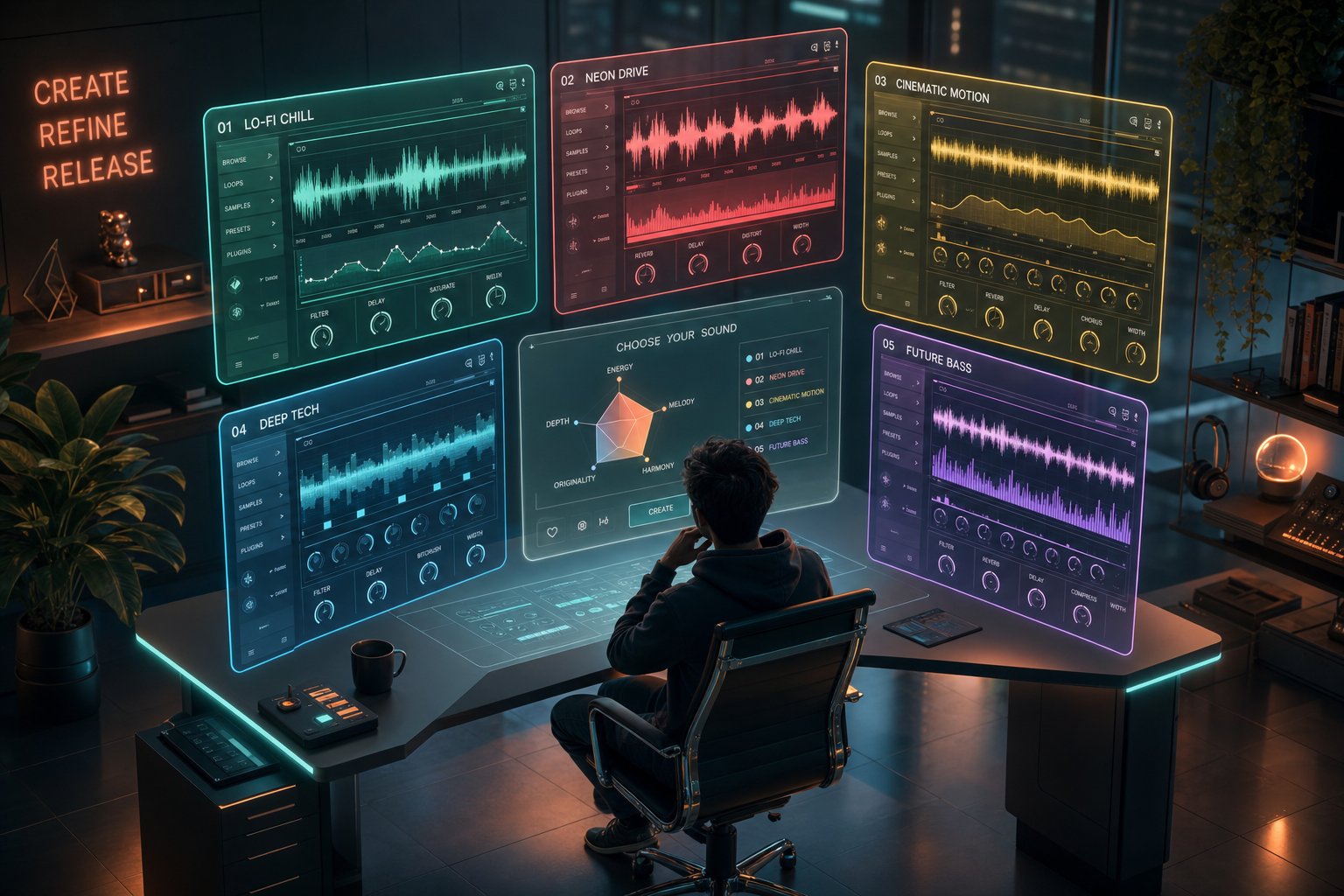
Knowing where you sit on the assisted-versus-autonomous spectrum is one thing. Picking the actual platform that matches your workflow is another. The landscape of best music making apps for AI-generated audio has expanded rapidly, and each tool occupies a slightly different niche. Some prioritize vocal realism, others focus on customization depth, and a few specialize in specific genres. Here is an honest breakdown of the major players — what they do well, where they fall short, and what the licensing fine print actually says.
Major Platforms and Their Strengths
MakeBestMusic focuses on turning text prompts, lyrics, and style descriptions into complete songs quickly. If you want to go from an idea to a finished track with vocals and instrumentation in a single step, it handles that workflow cleanly. The interface is straightforward — describe your song, add lyrics if you have them, choose a style direction, and generate. It is a strong option for creators who want prompt-to-song simplicity without a steep learning curve. The tradeoff: less granular control over individual arrangement elements compared to DAW-integrated tools.
Suno has established itself as the dominant suno ai music maker for vocal song generation. It produces surprisingly realistic singing across genres, generates roughly seven million songs per day according to its own data, and offers an intuitive prompt-based interface. As a suno ai song creator, it excels at pop, rock, and hip-hop — genres where its vocal model sounds most natural. The free tier is generous for experimentation but bars commercial use entirely.
AIVA is the go-to aiva ai music generator for orchestral and cinematic composition. Trained on over 20,000 classical scores from Bach to Beethoven, it produces film-quality symphonic pieces and was the first AI officially recognized as a composer by France's SACEM. It does not generate vocals, which limits its appeal for songwriters, but for scoring and instrumental work it remains unmatched in depth.
Soundraw AI takes a parameter-driven approach rather than text prompts. You select mood, genre, instruments, and tempo using sliders, then customize the generated track section by section. Artists like French Montana and Trippie Redd have used the platform publicly. It focuses exclusively on instrumental music — no vocals — making it ideal for video creators and podcasters who need clean background tracks.
Boomy targets absolute beginners with the fastest path from zero to published song. Generate a track in under 30 seconds, then distribute directly to Spotify, Apple Music, and Deezer through built-in integration. Audio quality sits below competitors like Suno, but the simplicity and distribution pipeline make it appealing for hobbyists exploring AI music creation for the first time.
Licensing Terms and Commercial Use Rights
Licensing is where many creators get tripped up. A platform might produce great audio, but if the terms restrict how you use it commercially, the output loses practical value. Here is what you need to know:
Free tiers almost never grant commercial rights. Suno's Basic plan, AIVA's free tier, and most other no-cost options explicitly prohibit monetization. If you plan to use AI music in a YouTube video, podcast, or client project, a paid subscription is non-negotiable.
"Commercial rights" does not always mean "copyright ownership." Even with paid plans, AI-generated music may not qualify for copyright protection in jurisdictions requiring human authorship. You can monetize the content, but you may not be able to legally prevent others from copying it. AIVA's Pro plan at $49/month is one of the few that explicitly transfers full copyright ownership to the user.
Platform stability matters. Udio suspended downloads following its October 2025 settlement with Universal Music Group. Users who relied on the platform for commercial output lost access overnight. This is a real risk — always download your files promptly and diversify across song tools rather than depending on a single service.
Choosing the Right Tool for Your Needs
The best music creation apps for your situation depend entirely on what you are building. Here is a quick match:
| Platform | Best For | Vocal Generation | Commercial Rights | Starting Price |
|---|---|---|---|---|
| MakeBestMusic | Prompt-to-song with lyrics and vocals | Yes | Yes (paid plans) | Free tier available |
| Suno | High-volume vocal song creation | Yes | Yes (Pro $10/mo+) | $10/mo |
| AIVA | Orchestral scoring and film music | No | Full ownership (Pro $49/mo) | $15/mo |
| Soundraw | Customizable instrumental background music | No | Yes (all paid tiers) | ~$17/mo |
| Boomy | Beginners wanting instant distribution | Limited | Yes (paid tiers) | $14.99/mo |
| Mubert | Real-time generative loops and streaming | No | Yes (Pro $39/mo) | $14/mo |
A few practical guidelines: if you need complete songs with vocals and want minimal friction, MakeBestMusic and Suno are your strongest options. If you are scoring video or film, AIVA gives you the compositional depth that pop-focused generators cannot match. If you need royalty-free instrumental tracks with section-by-section editing control, Soundraw AI delivers that workflow better than anyone. And if you are just curious — wanting to hear what AI can do before committing money — most platforms offer free tiers that let you generate a handful of tracks to evaluate quality firsthand.
No single platform dominates every use case. The smartest approach is testing two or three against your actual project needs, paying attention to output quality in your specific genre, and reading the licensing terms before anything goes live. The technology is capable enough that the differentiator is rarely raw audio quality — it is workflow fit, rights clarity, and how well the tool matches the level of control you want.
Of course, choosing a platform is only half the equation. The legal landscape surrounding AI-generated music — who owns it, who can claim it, and what happens when training data ethics collide with copyright law — determines whether your output is actually safe to use commercially.
Copyright, Ownership, and Legal Realities of AI Music
Platform comparison tables and feature lists are useful, but they sidestep the question that actually determines whether AI-generated music is safe to use in a real project: who owns it? The legal answer is less straightforward than any product page wants you to believe. Copyright law, training data ethics, and active litigation are all reshaping the rules in real time — and creators who ignore this landscape risk building on a foundation that could shift beneath them.
Who Owns AI-Generated Music
Here is the core principle. The US Copyright Office's January 2025 report on AI and copyright stated clearly that prompts alone do not provide sufficient human control to make users the authors of AI-generated output. In practical terms: if your entire creative contribution is typing a text description and clicking generate, the resulting music cannot be copyrighted. You do not own it in any legally enforceable sense. It effectively enters the public domain the moment it is created.
This is not a technicality buried in legal footnotes. It is the foundational rule that everything else builds on. Writing a detailed, clever prompt — even a brilliantly specific one — does not constitute authorship because you are describing what you want, not controlling how the system expresses it. The AI makes the creative decisions about melody, harmony, arrangement, and production. Under current US law, that means no human authorship exists in the output.
What does qualify for protection? The Copyright Office draws a clear line between AI-generated and AI-assisted works:
- Human-written lyrics — If you write the words yourself and use AI to generate the instrumental or vocal performance, your lyrics remain copyrightable regardless of how the music was produced.
- Melodies you compose — A melody you hum, play, or notate is your creative work even if AI later arranges or produces around it.
- Substantial modification — Taking AI output and significantly restructuring, layering, editing, or adding new elements can create copyrightable expression in the modified version. Trimming a track or adjusting volume is not enough. Rearranging sections, adding recorded parts, and making meaningful compositional decisions likely is.
- AI as a processing tool — Using AI to master a track you produced, enhance your vocal recording, or generate variations on a melody you composed keeps your underlying creative work protected.
The distinction comes down to whether AI functions as a tool executing your vision or as a substitute for your creativity. Use it to realize ideas you direct, and your work retains protection. Delegate the creative vision itself to the machine, and protection disappears.
Platform terms of service add another layer of complexity. Suno's updated terms state that "Suno is ultimately responsible for the output itself" and that users "generally are not considered the owner of the songs." That is a significant departure from earlier, more permissive language. If you are building a catalog of AI music on any platform, you need to read your current terms carefully — "ownership" in marketing copy and ownership in legal reality are often very different things.
Training Data Ethics and Ongoing Lawsuits
The ownership question does not exist in isolation. It connects directly to a larger ethical and legal battle: were the AI models trained on copyrighted music without permission?
In June 2024, all three major labels — Universal, Sony, and Warner — launched coordinated lawsuits against Suno and Udio through the Recording Industry Association of America, accusing the platforms of "mass infringement of copyrighted sound recordings on an almost unimaginable scale." Suno admitted to using copyrighted music for training and argued it constitutes fair use — a defense that remains untested in this context.
Since then, the landscape has shifted through a mix of settlements and ongoing litigation. Warner Music Group settled with both Suno and Udio in November 2025, establishing licensing partnerships for future model training. Universal settled with Udio in October 2025. But Sony has not settled with either platform, and the UMG v. Suno fair use ruling — expected in summer 2026 — could set a major precedent for whether training on copyrighted music is legally permissible.
Internationally, Germany's performing rights organization GEMA won a ruling against OpenAI and has an active lawsuit against Suno. The UK government scrapped plans that would have allowed AI companies to train on copyrighted material without permission, with Culture Secretary Liz Kendall confirming that "copyright material cannot be used for AI development and training without permission." Over 10,000 consultation submissions opposed the opt-out approach, with 95% saying AI companies should secure licenses first.
Why does this matter for you as a creator looking to download song for youtube or produce a custom song? Because if the platforms generating your music were trained on unlicensed material, the legal provenance of that output is uncertain. Some platforms — like AIVA, which trains exclusively on public domain classical scores — avoid this issue entirely. Others sit squarely in the crossfire. For anyone needing royalty free podcast intro music or royalty free jazz music for commercial projects, understanding the training data behind your chosen platform is not optional — it is a risk management decision.
Practical Guidance for Creators
The legal framework is being built in real time. Courts, legislators, and platforms are all making decisions that will define the rules for years to come. In the meantime, here is what you can do to protect yourself:
- Write your own lyrics. This is the single easiest way to establish copyrightable human authorship in an AI-assisted track. Human-written lyrics paired with AI-generated music create a work where at least the lyrical component is legally protectable.
- Make substantive creative decisions beyond prompting. Arrange sections, layer multiple generations, add your own recorded elements, restructure and edit. The more creative labor you contribute beyond describing what you want, the stronger your copyright claim.
- Understand the difference between royalty-free and copyright-free. Royalty-free means you pay once (or use for free under a license) and owe no ongoing royalties. It does not mean the work has no copyright owner. Copyright-free means no one owns it — which is the default state of purely AI-generated output under current US law. These are not interchangeable terms, and confusing them can lead to costly mistakes.
- Keep records of your creative process. Save project files, prompt iterations, revision history, and notes on modifications you made. If you ever need to demonstrate human authorship, documentation of your creative decisions is invaluable.
- Read platform licensing terms before publishing. Terms change. Suno's shifted significantly after December 2025. What was permitted last quarter may not be permitted now. Check whether your plan grants commercial rights, whether the platform claims any ownership stake, and what happens to your content if the service shuts down.
- Diversify your sources. Do not build an entire song stock library on a single platform. If that platform faces legal action, changes terms, or suspends access — as Udio did following its settlement — your entire catalog becomes inaccessible overnight.
The creators best positioned going forward are those who use AI to amplify their own creativity rather than replace it. That approach is not just better for legal protection — it tends to produce better music too.
Streaming platforms are also tightening policies. Spotify has removed over 75 million tracks classified as spammy, many of them low-effort AI generations. Deezer uses detection technology to identify and deprioritize fully AI-generated content, reporting roughly 60,000 such tracks uploaded daily. YouTube blocks monetization for "factory-made" AI content lacking meaningful human creative input. Even if copyright law does not restrict your use, platform policies increasingly do.
The legal picture is complex, but the practical takeaway is simple: the more human creativity you invest in the process, the safer your position — legally, commercially, and on distribution platforms. Treat AI as a collaborator, not a replacement, and you sidestep most of the risks that purely prompt-generated music carries.
Legal clarity matters most when the music leaves your hard drive and enters the real world. The next question is equally practical: once you understand the rules, what are the actual use cases where AI-generated music delivers genuine value in a project?
Practical Use Cases for AI-Generated Music
Legal frameworks and platform comparisons give you the knowledge to make safe decisions. But knowledge without application is just trivia. The real payoff comes when you match AI music generation to a specific project need — one where the speed, cost, and quality tradeoffs actually work in your favor. Here is where creators, businesses, and hobbyists are putting these tools to productive use right now.
Content Creation and Social Media
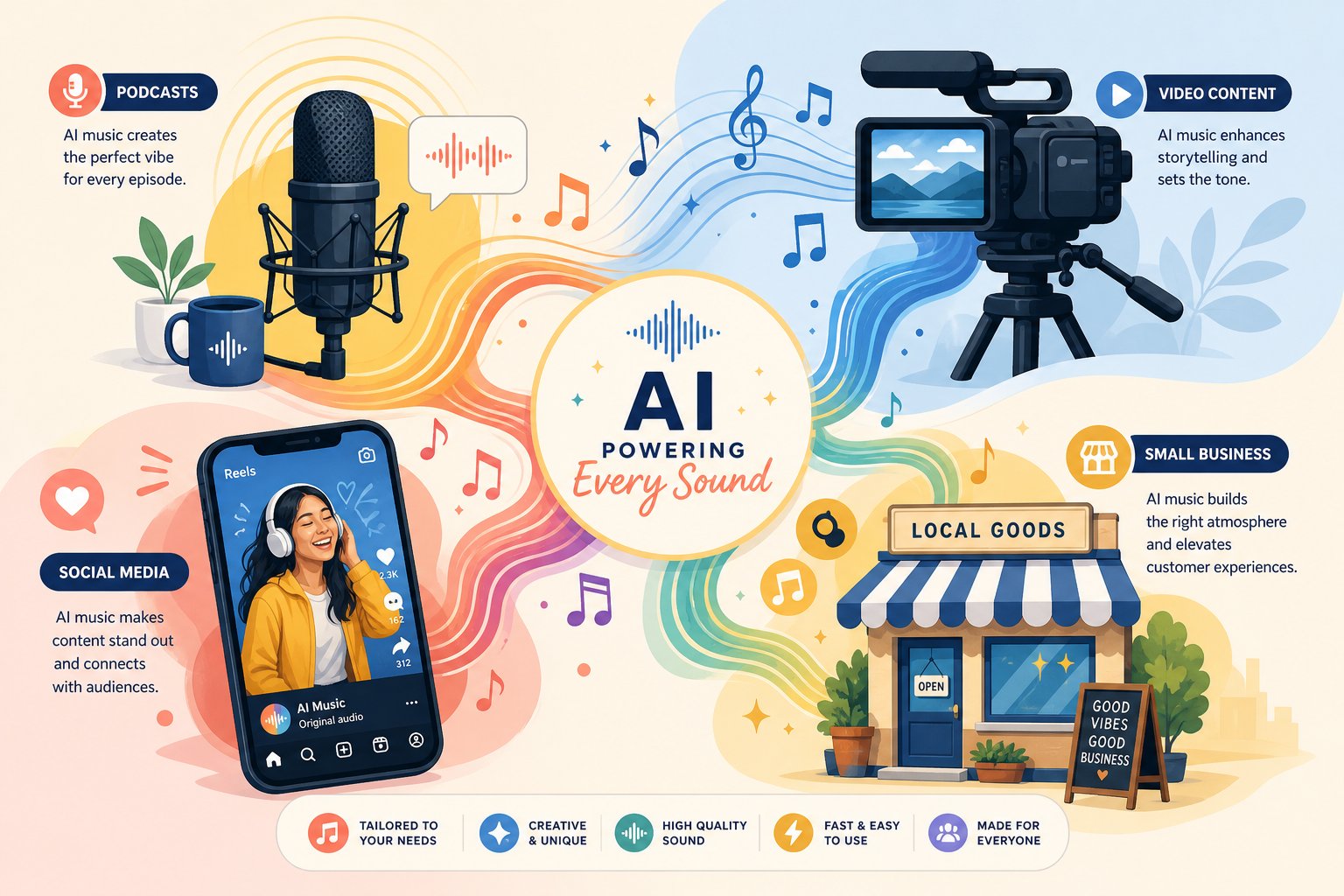
YouTubers, podcasters, and short-form video creators face a persistent problem: they need original audio constantly, but licensing stock music is expensive and generic libraries sound like everyone else's channel. AI solves this by letting you produce your own music tailored to each piece of content.
The workflow is simple. Describe the mood and energy you need — "upbeat acoustic intro, 15 seconds, warm and inviting" — and receive a unique track in under a minute. No copyright claims, no royalty negotiations, no digging through thousands of stock tracks hoping to find something that fits. Podcasters generate custom theme music songs that become part of their brand identity. Video editors create transitions and background beds that match their pacing exactly. Creators exploring an ai music video for a channel intro can pair generated audio with visual tools — and with a free ai music video generator, even the visual side becomes accessible without a production budget.
For creators who want top prompts for music videos or social content, the key is specificity. "Cinematic orchestral build, 30 seconds, starts quiet and peaks at the 20-second mark" produces far better results than "epic music." The more precisely you describe what the audio needs to do within your content, the more usable the output becomes.
Business and Commercial Applications
Commercial audio has traditionally been expensive and slow. A custom commercial jingle from a production house might cost thousands of dollars and take weeks of back-and-forth. AI compresses that timeline to minutes and the budget to a monthly subscription.
AI music for advertising has matured significantly — brands now use it to generate adaptive soundtracks that shift intensity based on ad placement, create consistent sonic branding across campaigns, and produce culturally nuanced variations for different markets without hiring separate composers for each region. The speed advantage is particularly valuable for A/B testing: generate five different business background music options for a corporate video, test audience response, and iterate in hours rather than weeks.
Beyond advertising, practical commercial applications include:
- E-learning and training videos — Consistent, non-distracting background audio that maintains engagement without competing with narration.
- Game development — Adaptive loops and ambient soundscapes that respond to gameplay states, generated at a fraction of traditional scoring costs.
- App and product UX — Notification sounds, onboarding audio, and in-app soundscapes that reinforce brand identity.
- Retail and hospitality — Dynamic playlists generated to match seasonal promotions or time-of-day energy shifts.
The common thread across these use cases: the music serves a functional role where speed, customization, and cost efficiency matter more than deep emotional artistry. That is exactly where AI delivers its strongest return.
Personal Projects and Creative Exploration
Not every use case is commercial. Some of the most satisfying applications are personal — a personalized song for a wedding, a birthday track that references inside jokes, or a lullaby written for a newborn. These projects would have required hiring a musician in the past. AI makes them accessible to anyone who can describe what they want.
For hobbyists curious about music creation, AI tools function as both playground and teacher. You learn how chord progressions work by hearing different options generated from your descriptions. You develop an ear for arrangement by comparing outputs across genres. You start to understand why certain instrumentation choices create specific emotional effects — all without needing years of formal training.
If you are ready to experiment, MakeBestMusic's AI Music Generator offers a direct path from idea to finished song. Type a prompt describing your vision, paste in lyrics if you have them, select a style direction, and generate a complete track with vocals and instrumentation. It is a practical way to experience the prompt-to-song workflow firsthand — whether you are creating a personalized song for someone you care about or simply exploring what AI can do with your musical ideas.
Here is a quick reference matching common scenarios to the approach that works best:
- YouTube channel intro or outro — Generate a short, branded theme track using a specific mood and tempo description.
- Podcast background music — Create low-energy instrumental beds that sit beneath speech without competing for attention.
- Product demo or explainer video — Use business background music prompts focused on clarity and professionalism.
- Social media ad campaign — Generate multiple commercial jingle variations and A/B test for engagement.
- Wedding or anniversary gift — Write personal lyrics and let AI compose a personalized song around them.
- Game prototype or indie project — Produce adaptive loops and ambient layers without a dedicated audio budget.
- Learning music composition — Use AI as a feedback tool, generating examples of different styles to train your ear.
The pattern across all these scenarios is consistent: AI music generation delivers the most value when you have a clear functional need, a defined context for the audio, and realistic expectations about what the output will sound like. It is not a magic button that replaces musical artistry — it is a production tool that removes barriers between an idea and a usable result. The creators getting the most from it are those who treat it that way: as one capability in a larger creative toolkit, applied deliberately to the tasks where it genuinely saves time and money without sacrificing quality that matters.
These use cases represent where AI music stands today. But the technology is not standing still — models are improving in coherence, emotional range, and creative flexibility with each generation. Understanding the trajectory helps you decide whether to adopt now or wait for the next leap forward.
The Road Ahead for AI Music Creation
The tools available today already handle use cases that seemed impossible three years ago. So will ai get better at helping with making music? Every signal points to yes — and the improvements are coming faster than most creators expect.
What Current Development Trends Suggest
The most immediate gains are in long-form coherence and emotional expression — the two areas where AI still falls short. Models are learning to maintain thematic threads across five-minute compositions, build tension and release more naturally, and respond to nuanced prompts that describe feeling rather than just genre. Generation speeds have improved roughly 10x since 2023, with studio-grade output now arriving in 30 seconds rather than five minutes.
Multimodal generation is expanding too. Systems that pair music with video, adapt soundtracks to on-screen action in real time, and generate synchronized audio-visual experiences are moving from research labs into usable products. Real-time collaboration features — where AI responds to a performer's live input like a jam session partner — are already functional in early platforms. Tools like Suno Canvas hint at where interactive composition is heading: less one-shot generation, more iterative creative dialogue between human and machine.
On the production side, a free ai music finalizer that handles mastering at near-professional quality is no longer aspirational — it exists. The best apps for music production are increasingly integrating AI directly into traditional DAW workflows, letting producers generate stems, suggest arrangements, and polish mixes without leaving their existing tools.
The Evolving Relationship Between AI and Human Musicians
The replacement narrative is fading. Stability AI's analysis of hundreds of professional musical works found that artists prioritize creative control — using AI for specific elements like harmonic progressions or drum patterns, then manually arranging and layering those outputs with traditional instruments. The relationship looks less like automation and more like a new instrument to learn.
Carnegie Mellon research reinforces this: AI-assisted music was judged less creative than purely human compositions, but researchers noted that using AI for ideation — exploring possibilities, then developing the best ideas further — could produce results better than either approach alone. As CMU's Chris Donahue put it, "it's still human intentionality driving those systems that is going to continue to be the focus of the foreground of the human music experience."
For anyone wondering how to create songs, how to make your own song, or how do you make your own music in this evolving landscape, the answer is increasingly: start with your ideas, use AI to expand what is possible, and keep your creative judgment at the center. The technology handles production. You handle meaning.
The future of music is not AI or human — it is human creativity moving at the speed of AI, with tools that remove technical barriers while preserving the intentionality that makes music matter.
AI can generate music. It is getting remarkably good at it. But the most compelling results — the ones you would actually put in a project and feel proud of — still come from human creativity enhanced by AI capabilities, not replaced by them. That balance is not a limitation of the technology. It is the point.
