

Yes, AI Can Produce Music
Can AI produce music? The short answer is yes. The technology has matured to a point where outputs range from serviceable background loops to surprisingly polished full-length compositions complete with vocals, instrumentation, and production. AI-generated artists have already landed on Billboard charts, and AI tracks have accumulated millions of streams on major platforms. The intersection of music and artificial intelligence is no longer theoretical - it is producing real, listenable songs every day.
But "can" and "should" are different questions. That distinction matters, and this article will walk you through how the technology works, where it excels, where it falls short, and how to decide if ai in music production fits your creative workflow.
What AI Music Production Actually Means
AI music production refers to using machine learning models trained on vast libraries of musical data to generate melodies, harmonies, rhythms, arrangements, and even vocals. You provide inputs - a text prompt describing genre and mood, specific lyrics, tempo preferences, or instrumentation choices - and the model outputs a complete piece of audio. Think of it as a system that has absorbed thousands of songs and learned the patterns that make music work: how chords resolve, how verses transition to choruses, how different instruments interact within a mix.
This is not a simple loop randomizer. Modern ai composed music comes from deep learning architectures that understand musical structure at a sophisticated level, producing tracks that genuinely surprise even experienced producers with their coherence and quality.
Why This Question Matters Now
The landscape is shifting fast. Carnegie Mellon University research found that while AI-assisted music generation is advancing rapidly, human listeners still perceive differences - rating AI compositions as less creative than human-made pieces. The study revealed that AI-generated melodies tended to be slower, use fewer notes, and score lower on creativity assessments from listeners.
AI music tools are breaking history in music AI development by lowering the barrier for people with limited musical training to create full compositions - but the technology is still derivative in ways that trained human composers are not.
So how many ai musicians are there? The numbers are staggering. Platforms like Suno alone report over two million active users, and streaming services estimate that 44% of daily uploads now contain AI-generated content. The benefits of ai in music are real - speed, accessibility, cost reduction - but so are the gaps. Understanding both sides is what separates informed creators from those chasing hype.
The pages ahead break down exactly how these systems generate audio, what quality levels you can realistically expect, and which use cases genuinely benefit from the technology today.
How AI Music Generation Actually Works Under the Hood
Understanding how does ai music work does not require a computer science degree. At a conceptual level, these systems learn patterns from enormous collections of music and then use those patterns to generate something new. The mechanics fall into a few core approaches, each with distinct strengths.
Transformer Models and Pattern Learning
Imagine reading thousands of novels until you intuitively know how sentences flow, how paragraphs build tension, and how chapters resolve. Transformer models do something similar with music. They process sequences of musical events - notes, chords, rhythms, rests - and learn what typically comes next in a given context.
The Music Transformer architecture, originally proposed by Huang et al. in 2018, uses a decoder-only transformer trained on tokenized MIDI data. The model converts piano performances into sequences of tokens representing note-on events, note-off events, time shifts, and velocity changes. It then learns the statistical relationships between these tokens across thousands of compositions from datasets like Maestro, which contains professional piano performances. A relative attention mechanism helps the model understand positional relationships between notes - grasping that a chord resolution four beats away matters differently than one twelve bars away.
This is essentially how music theory ai gets encoded into a neural network. The model never reads a textbook on harmony, but after processing enough Bach, Chopin, and Debussy, it learns voice-leading principles, tension-release patterns, and rhythmic conventions purely from data. Music notation ai systems often build on this same transformer backbone, generating symbolic representations that can be rendered into sheet music or audio.
From Text Prompts to Finished Audio
Transformers handle the symbolic side well, but producing actual audio waveforms requires a different approach. This is where diffusion models enter the picture. As explained in a technical breakdown by audio ML researcher Christopher Landschoot, diffusion works by training a model to progressively add noise to audio until it becomes pure static, then reversing that process. Once the model masters the noising steps, it can start from random noise and denoise it step by step into coherent sound - a melody, a drum pattern, or a full mix.
The key insight: because the denoising process is probabilistic, the model does not reproduce exact copies of training data. It generates audio that lives in the same sonic region as what it learned from, but with novel characteristics. This is how artificial intelligence for music production simulates creativity rather than simply copying existing songs.
Modern platforms combine these approaches. A transformer might handle composition structure and ai music prediction - deciding which chord follows which, how a verse evolves into a chorus - while a diffusion model renders the final audio with realistic timbre and production quality. Text prompts act as conditioning signals, steering both systems toward the genre, mood, tempo, and instrumentation you specify.
Training Data and How Models Learn Musical Patterns
Every AI music system starts with data. The training pipeline typically follows these stages:
- Data collection - Gathering audio waveforms, isolated stems, MIDI files, and metadata tags covering genre, tempo, mood, and instrumentation.
- Preprocessing - Converting raw audio into formats the model can process, whether tokenized MIDI sequences or spectral representations like mel spectrograms.
- Feature extraction - Identifying recurring elements such as chord progressions, rhythmic motifs, tonal relationships, and structural patterns across genres.
- Model training - Running deep neural networks through millions of iterations, adjusting internal weights until the model reliably generates musically coherent output.
- Evaluation and tuning - Comparing generated music against target quality benchmarks and refining accuracy.
The breadth of training data determines what a model can produce. A system trained primarily on pop and electronic music will struggle with jazz improvisation or classical counterpoint. Some users exploring creating piano arrangement from audio ai free tools discover this limitation quickly - the output quality correlates directly with how well the training data represents the style you are requesting.
When you type a prompt like "melancholic indie folk with fingerpicked acoustic guitar and soft female vocals at 90 BPM," every word narrows the model's output space. Genre tells it which harmonic and structural patterns to favor. Mood shapes dynamics and minor/major tonality choices. Instrumentation constrains timbre. Tempo sets rhythmic density. The more specific your input, the more focused and coherent the result - a principle that becomes critical when you start evaluating whether these outputs actually meet professional standards.
How Good Is AI-Generated Music Compared to Human Composition
Specificity in prompts improves output, but how good is that output really? Can ai make better music than humans, or does it just produce passable imitations? The honest answer depends on which dimension of quality you measure.
A Carnegie Mellon University study found that human listeners still rate AI-generated compositions lower on creativity assessments. AI melodies tended to be slower, use fewer notes, and follow more predictable paths. Yet a biometric study published in PLOS One revealed something surprising: emotional valence did not differ significantly between AI-generated and human-composed music when paired with video. Listeners felt similar emotions regardless of who - or what - created the soundtrack. The gap is real, but it is more nuanced than a simple "human good, AI bad" framing.
Where AI Music Excels Right Now
AI thrives in contexts where consistency, speed, and functional adequacy matter more than artistic depth. Background music for video content, ambient soundscapes, short-form loops, and genre-adherent tracks with clean production are all areas where the technology performs remarkably well. If you browse ai generated music reddit threads, you will find creators genuinely impressed by outputs in pop, lo-fi, electronic, and cinematic styles - genres with well-defined structural conventions that models learn efficiently from training data.
Production quality in these outputs can be surprisingly polished. Some generators deliver mixes with balanced frequency spectrums, appropriate stereo imaging, and competent mastering. For functional music needs - podcast beds, social media clips, product demos - the quality often exceeds what a non-musician could achieve independently.
Quality Gaps That Still Exist
The weaknesses emerge when you push beyond functional toward artistic. Here is where AI consistently falls short:
| Quality Dimension | AI Capability | Key Limitation |
|---|---|---|
| Arrangement Complexity | Moderate | Tends toward simpler, repetitive structures; lacks developmental arcs across sections |
| Emotional Dynamics | Limited | Struggles with tension-and-release, climactic builds, and subtle dynamic shifts that experienced composers master |
| Mixing and Production | Strong | Some generators introduce audio artifacts or glitchy transitions; others produce clean results comparable to stock music libraries |
| Lyrical Coherence | Limited | AI-written lyrics often lack narrative consistency, meaningful metaphor, and authentic emotional voice |
| Genre Versatility | Moderate | Pop and electronic fare well; jazz improvisation, classical counterpoint, and folk authenticity remain weak |
The PLOS One research reinforces one critical finding: human-composed music was perceived as significantly more familiar to listeners. In Western musical composition, established conventions create a sense of recognition and comfort. AI-generated content often produces what researchers describe as an "uncanny" aesthetic - technically competent but subtly off in ways that register subconsciously. Listeners needed greater cognitive effort to process AI soundtracks, as indicated by wider pupil dilation during exposure.
Ai song writing tools face the steepest challenge in lyrics. Narrative consistency across verses, coherent metaphorical threads, and emotional specificity grounded in lived experience remain largely beyond current models. Do artists use ai to write songs? Some do - but typically as a brainstorming starting point rather than a finished product, editing heavily to inject personal voice and storytelling logic.
The Trajectory of Improvement
Will ai get better at helping with making music? The trajectory strongly suggests yes. Between 2024 and now, generation quality has improved dramatically. Models that produced obviously robotic output two years ago now generate tracks that pass casual listening tests. The PLOS One researchers noted that their AI generator (Stable Audio) upgraded significantly even during their study period, producing noticeably higher quality after a model update.
Famous musicians using ai in their workflows - from production assistants to melody ideation tools - signal that the technology is earning credibility among professionals who understand music at the deepest level. Over 60% of creators now report using AI tools for arranging, and 65% use them for mixing or mastering tasks, according to an OC&C Strategy Consultants report.
The quality gap is narrowing on a curve, not a line. Each model generation closes ground faster than the last. For creators evaluating the technology today, the practical question is not whether AI music is perfect - it is whether it is good enough for your specific use case. And that answer varies enormously depending on what you need the music to do.
Real-World Use Cases Where AI Music Delivers Value
Quality gaps matter less when the music serves a specific functional purpose. A podcast intro does not need the emotional complexity of a film score. A TikTok background track does not need the developmental arc of a symphony. The real question becomes: where does the current quality level match the actual requirements of the task?
The answer covers more ground than most people expect. Here is where AI-generated music is already delivering genuine, practical value across industries and creative workflows.
Content Creator Applications
Content creators face a persistent audio problem. You need royalty free podcast intro music that sounds professional and branded, but hiring a composer for a 15-second clip can cost $200 to $500. You need fresh background tracks for weekly YouTube uploads, but stock libraries recycle the same songs across thousands of channels. You need audio that matches your editing pace, not a pre-made track you have to cut around.
AI generation solves these friction points directly. A study referenced by Hypebot found that 87% of music producers already use AI in some part of their creative process - and that adoption is now spreading rapidly to content creators and marketers who simply need good audio fast.
Social media platforms reward original audio particularly well. TikTok's algorithm treats original sounds differently from licensed tracks - when you upload a video with unique audio, that sound becomes discoverable on its own. Other creators can reuse it, creating a viral loop that drives traffic back to you. Instagram Reels follows a similar pattern, favoring creators who pair strong visuals with unique audio over those relying on overused popular tracks.
The quality level you should expect here: clean, genre-appropriate tracks that work well as background or mood-setting audio. Think polished enough to sound professional but not necessarily complex enough to stand on its own as a featured song. For short-form content, that is exactly the right fit. You can even create music video with ai by pairing generated tracks with AI video tools - a workflow that barely existed two years ago but is increasingly common among solo creators scaling their output.
Business and Commercial Background Music
Every business that interacts with customers through audio has a music need. Hold music. Retail ambiance. Corporate training videos. Product demos. Conference presentations. Trade show booths. These are all contexts where silence feels awkward and licensed music creates legal complexity.
AI-generated business background music fits these scenarios naturally for several reasons:
- Hold music and phone systems - Short, loopable tracks with neutral energy that avoid irritating callers. AI excels at generating inoffensive, pleasant audio in any mood. Expected quality: fully professional, comparable to stock library options.
- Retail and hospitality ambiance - Extended ambient soundscapes for stores, restaurants, and lobbies. AI can produce hours of non-repetitive background audio tailored to brand mood. Expected quality: strong, especially in ambient and electronic styles.
- Corporate video and presentations - Upbeat or cinematic underscore for internal communications, onboarding videos, and investor decks. Expected quality: clean production that matches or exceeds typical stock music.
- Commercial jingle creation - Short, catchy branded audio for ads and social campaigns. AI produces serviceable jingles quickly, though truly memorable hooks still benefit from human refinement. Expected quality: moderate to strong depending on genre.
- Advertising and product demos - Background tracks for A/B testing across multiple ad variations without paying per-track licensing. Expected quality: high, especially for digital ad formats.
The business case is straightforward. As Artlist's business analysis notes, traditional music production involves hiring teams, scheduling sessions, and navigating complex licensing. AI lets businesses generate custom soundtracks in minutes with full commercial rights - a dramatic cost reduction for startups, growing brands, and lean marketing teams. When content cycles demand fresh assets weekly and performance marketers test new variations constantly, speed becomes a competitive advantage.
Game Development and Interactive Media
Imagine you are an indie developer building a narrative exploration game. You need ambient music for a forest biome, tension-building loops for combat encounters, and a calm melodic theme for your main menu. Traditionally, that soundtrack budget alone could run into thousands of dollars - often more than small studios can justify.
AI music generation is transforming indie game audio. Soundverse reports that by 2026, the gap between AAA game audio and indie production quality has narrowed dramatically thanks to AI-generated music. The technology aligns particularly well with game development workflows because of several key advantages:
- Adaptive soundtracks - AI can generate variations of a theme at different intensity levels, allowing games to shift music dynamically based on player actions. Expected quality: strong for electronic and orchestral genres common in games.
- Scalable variation - Need 20 versions of a medieval tavern theme to prevent listener fatigue? AI generates consistent variations instantly without requiring a composer to write each one manually.
- Loop-ready output - Many generators produce seamless loops specifically optimized for game engine integration, exporting in formats compatible with Unity or Unreal.
- Rapid prototyping - Developers can test musical moods against gameplay before committing to final audio direction, iterating quickly without production delays.
- Procedural generation - Modern AI tools support music that evolves in real time within game logic, creating dynamic sound beds that respond to exploration, combat, or narrative triggers.
The expected quality level for game audio is genuinely impressive. Electronic, ambient, and cinematic orchestral tracks - the bread and butter of game soundtracks - fall squarely within AI's strongest genres. Indie developers get results that would have required a professional composer and production budget just a few years ago.
Film Scoring, Personalized Gifts, and Emerging Applications
Beyond the core use cases, AI music is finding its way into less obvious but equally valuable applications:
- Film and video temp tracks - Directors and editors use AI-generated tracks during editing to establish mood before commissioning final scores. For low-budget productions, the temp track sometimes becomes the final track. Expected quality: moderate to strong for underscore; less convincing for featured musical moments.
- Personalized song gifts - Custom songs for birthdays, weddings, anniversaries, and proposals. You provide lyrics about the recipient, choose a style, and receive a unique personalized song that did not exist before. Expected quality: the novelty and personal relevance outweigh minor production imperfections - recipients care about the gesture more than mix perfection.
- AI music video production - Creators pairing generated audio with AI-generated visuals to produce complete ai music video content from scratch. The entire pipeline from concept to finished video can now run through generative tools.
- Educational and therapeutic uses - Custom audio for meditation apps, language learning platforms, and therapeutic environments where mood-specific music enhances the user experience.
- Event and live streaming - DJs and streamers using AI to generate unique transition tracks, bumper music, and ambient fills that avoid DMCA strikes entirely.
The through-line across all these applications is the same: AI music delivers the most value when the context prizes speed, customization, and cost efficiency over deep artistic originality. A custom song for your partner's birthday does not need to compete with a Grammy-winning ballad. A podcast intro does not need the sophistication of a film score. The technology works because it meets functional requirements cleanly - and for millions of creators and businesses, functional excellence is exactly what the job demands.
The natural follow-up question: which tools actually deliver on these promises, and how do their approaches differ? The platform landscape is fragmented, with generators optimized for very different use cases and quality targets.
Leading AI Music Platforms and What Sets Them Apart
The platform landscape has expanded rapidly, and choosing between the best ai tools for music depends heavily on what you actually need. Some generators produce complete vocal tracks from a single sentence. Others focus on instrumental composition for film and games. A few prioritize ease-of-use over depth. Here is how the major players compare across input method, output type, and ideal user.
| Platform | Input Method | Best For | Output Type | Key Strength |
|---|---|---|---|---|
| MakeBestMusic | Text prompts, custom lyrics, style selection | Creators wanting complete songs from prompts and lyrics quickly | Full songs with vocals | Fast prompt-to-song workflow with lyrics and style control |
| Suno | Text prompts, custom lyrics, personas | Full song creation with expressive vocals | Complete songs with vocals and instrumentals | v5 model quality, Suno Studio DAW-style editing |
| Udio | Text prompts, lyrics, style references | Precise song refinement and instrumental detail | High-fidelity songs up to 48 kHz | Inpainting tool for fixing specific sections without regenerating |
| AIVA | Text prompts, MIDI upload, style presets | Cinematic and classical composition | Instrumentals with MIDI and stem export | Structured compositions with intro, build-up, climax, and resolution |
| Soundraw | Parameter selection (mood, genre, tempo, instruments) | Customizable royalty-free background music | Instrumental tracks with stem export | Song Structure Editor for rearranging sections like building blocks |
| Boomy | Genre selection, one-click generation | Quick song creation for streaming distribution | Full songs across multiple genres | Direct publishing to Spotify and other streaming platforms |
Full-Song Generators With Vocals
If your goal is a complete track with singing, lyrics, and production, the field narrows to a handful of serious options. MakeBestMusic's AI Music Generator takes a streamlined approach - you feed it a prompt describing your desired style, paste in lyrics or let the system generate them, and receive a finished song. The workflow moves from idea to complete audio quickly, which makes it a practical starting point for creators who want results without a learning curve.
The suno ai song creator remains one of the most popular options in this category. SoundGuys reports that Suno's v5 model delivers noticeably better sound quality and lyric coherence than earlier versions, with lyrics that actually fit the rhythm rather than floating over it. The platform also launched Suno Studio - sometimes called suno canvas by the community - which adds in-browser editing capabilities closer to a lightweight DAW. You can remix sections, adjust track layers, and export stems on paid tiers.
Udio takes a more production-oriented approach. Its timeline-style editing, inpainting tool for fixing specific sections, and high-fidelity audio output at 48 kHz make it the stronger choice for anyone willing to spend time refining rather than just generating. Vocal quality is capable, but where Udio really shines is arrangement clarity and instrumental layering.
Specialized and Niche Platforms
Not every project needs vocals. The aiva ai music generator behaves more like a digital composer assistant than a one-click song maker. Its Lyra foundation model generates structured pieces with recognizable sections - intro, development, climax - making it ideal for film scoring, game soundtracks, and cinematic content. AIVA also exports MIDI files and multi-track stems, so you can continue editing inside professional DAWs like Logic Pro or Ableton Live. Over 250 musical styles are available, from classical orchestral to modern electronic.
Soundraw ai skips text prompts entirely. Instead, you select parameters - mood, genre, instruments, tempo, track length - and the system generates customizable instrumental tracks. The Song Structure Editor lets you rearrange sections like building blocks, and a real-time audio mixer lets you adjust individual elements on the fly. It is particularly well-suited for content creators who need reliable background music at scale.
Boomy occupies the opposite end of the complexity spectrum. Pick a style, click a button, and you have a song in seconds. The real differentiator is distribution - Boomy lets you publish directly to Spotify and earn royalties, making it attractive for anyone who wants to experiment with releasing AI-generated tracks to streaming platforms.
Choosing the Right Tool for Your Needs
The best music creation apps for your workflow depend on three factors: what you need the music for, how much control you want over the output, and whether you need vocals.
- Need a complete song with vocals fast? Start with MakeBestMusic or Suno. Both turn prompts and lyrics into finished tracks without requiring production knowledge.
- Want fine-grained editing and refinement? Udio's inpainting and timeline tools or Suno Studio give you post-generation control that pure prompt-based tools do not.
- Creating cinematic or classical compositions? AIVA's structured composition engine and MIDI export make it the clear choice for scoring work.
- Need royalty-free background instrumentals? Soundraw's parameter-based generation and stem export fit content creator workflows perfectly.
- Just want to experiment and distribute quickly? Boomy's zero-effort approach gets you from nothing to a song on Spotify in minutes.
One important note on commercial rights: both Suno and Udio settled copyright lawsuits with major labels in late 2025. SoundGuys flagged that Suno's commercial rights only apply to songs created while actively subscribed - upgrading after the fact will not grant retroactive ownership. Always check current licensing terms before using any platform for commercial projects.
Choosing a platform is only half the equation. The quality of your output depends just as much on how you communicate with the tool - and that comes down to the prompts you write.
How to Write Better Prompts for Higher Quality AI Music
The difference between a mediocre AI track and one you would actually use comes down to how you communicate with the generator. Typing "make me a cool song" is like telling a session musician to "play something good" - technically an instruction, but one that leaves every meaningful creative decision to chance. How can you make a song that sounds intentional and polished? You learn to prompt like a producer.
Anatomy of an Effective Music Prompt
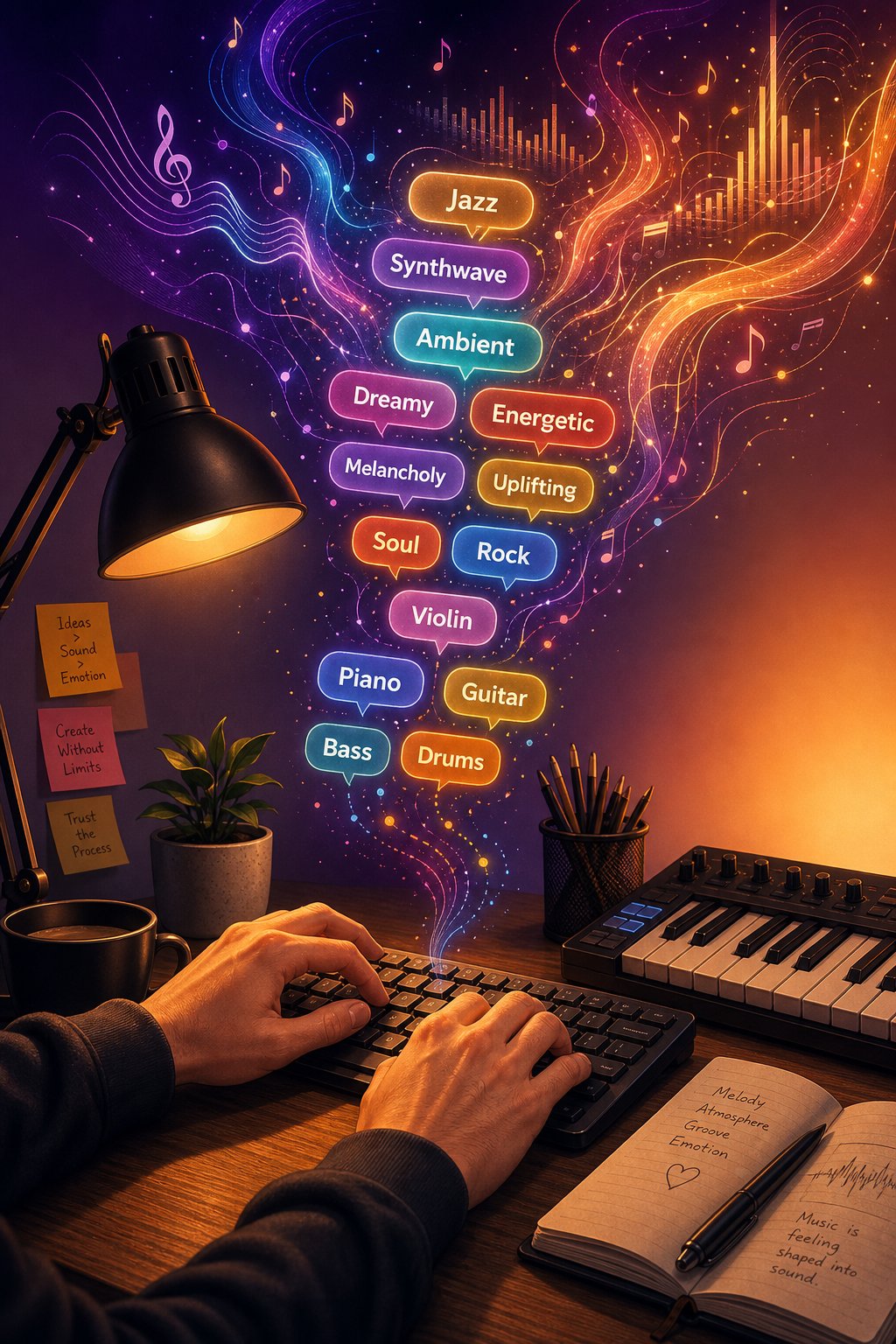
A well-structured prompt follows a consistent formula: genre and vibe, instrumentation, tempo and energy, then emotional context or stylistic reference. Think of each element as a filter that narrows the AI's output space toward exactly what you hear in your head.
Here is a step-by-step framework for building prompts that consistently produce stronger results:
- Start with genre and subgenre - Be specific. "90s boom-bap with jazz samples" outperforms "hip hop" every time. The subgenre tells the model which harmonic patterns, drum textures, and arrangement conventions to draw from.
- Define the mood and emotional tone - Use concrete emotional descriptors: "melancholic," "nostalgic," "euphoric," "restless." These words shape dynamics, minor or major tonality, and vocal delivery style.
- Specify instrumentation - Name the instruments you want featured. "Prominent nylon-string acoustic guitar" is far more useful than "guitar." Include background textures too: "ethereal synth pads," "brushed drums," "walking bassline."
- Set energy level and tempo - You do not need an exact BPM, though it helps. Descriptive pacing works too: "a sluggish, dragging rhythm" or "a driving, up-tempo beat." Energy words like "building intensity" or "sparse and intimate" guide dynamic range.
- Add structural or reference context - Mention intended use ("for a podcast intro," "loopable 60-second segment") or stylistic influences ("in the style of early Radiohead"). This anchors the generation in a recognizable sonic world.
Compare the difference in specificity:
Poor prompt: "A chill song for studying." Strong prompt: "A dreamy lo-fi hip hop beat featuring a crackling vinyl texture, a muted Fender Rhodes progression, and a slow, relaxing drum groove at 80 BPM."
The second prompt leaves almost nothing to chance. Every word serves as a constraint that moves the output closer to a usable result. This is how effective song writing applications and generators produce tracks that feel intentional rather than random.
Common Prompt Mistakes and How to Fix Them
Three patterns consistently produce disappointing results, regardless of which platform you use:
- Being too vague - "Make something good" or "a nice beat" gives the model almost no useful information. You are asking a system trained on millions of songs to pick from its entire knowledge base with no direction. Fix: always include at least genre, mood, and one instrumentation detail.
- Conflicting instructions - Writing "calm ballad" and "high energy dance" in the same prompt confuses the model because these descriptors pull in opposite directions. Suno's composition guide specifically flags contradictory style tags as a top mistake. Fix: read your prompt aloud and ask whether a human musician could satisfy all the requirements simultaneously.
- Over-constraining - Listing 15 specific requirements (exact BPM, key signature, time signature, seven named instruments, three structural sections, vocal style, mix characteristics) often creates conflicts the model cannot resolve. Fix: provide 4-6 strong descriptors and leave room for the AI to fill gaps creatively. You can always regenerate with adjustments.
If you want to write the song rather than just generate random output, treating each prompt as a creative brief - clear enough to guide, open enough to surprise - is the sweet spot. Some users even treat AI tools as a song idea generator or song topic generator, writing multiple prompts rapidly to explore directions before committing to one.
Using Lyrics and Style References Together
When you feed custom lyrics into a generator, you fundamentally change the creation process. The model uses your lyric content, emotional tone, and rhythmic cadence to determine melody direction, arrangement density, and vocal performance style. As the SunoMV composition guide explains, lyric quality is the single biggest lever on output quality - more impactful than any style tag.
Practical tips for lyrics that improve generation:
- Keep lines to 8-12 words - Longer lines force the AI to either rush the melody or lose breathing room. Short, rhythmic lines produce more natural vocal phrasing.
- Make choruses repetitive and rhyming - AI models rely on textual repetition and rhyme patterns to identify and elevate the chorus section. Concentrate emotional essence here rather than advancing the narrative.
- Use blank lines strategically - Blank lines between lyric sections signal the AI to insert instrumental fills or pauses, controlling rhythmic density.
- Avoid stage directions in lyrics - Text like "(music fades)" or "(repeat twice)" will be sung as literal words. Keep non-singing instructions in your style description instead.
Style descriptors interact with lyrics to shape the final output. A lyric about heartbreak paired with the style tag "upbeat synth-pop, bright female vocals, 120 BPM" creates an interesting tension - think Robyn's "Dancing On My Own." The same lyrics with "slow acoustic ballad, raw male vocals, 70 BPM" produce something entirely different. This interplay between text and style is where creative control lives.
Some creators wonder whether they can upload song and ai will make a drum beat or arrangement from existing audio. While a few tools support audio input for reference or stem separation, most generators work primarily from text and lyrics. The top ai for lyrics for songs remains your own writing - specific, rhythmic, emotionally clear - paired with precise style descriptors that tell the model exactly which sonic world to inhabit.
Prompt mastery gets you further than most people expect. But even perfect prompts cannot overcome fundamental limitations in what the technology itself can do - and understanding those boundaries prevents frustration when outputs fall short of expectations.
Honest Limitations of AI Music You Should Know About
Great prompts push AI output significantly closer to usable. But no amount of prompt refinement eliminates the technology's fundamental constraints. If you are evaluating AI music for any project where quality genuinely matters, you need a clear-eyed view of what these systems still cannot do well - and why.
These are not temporary bugs that the next software update will fix. Several limitations stem from how music ai models are architecturally designed, what their training data can and cannot teach them, and the inherent difference between pattern replication and genuine creative intent.
Technical Artifacts and Audio Quality Issues
Listen closely to AI-generated audio - especially in the higher frequency range - and you will often notice subtle but persistent sonic issues. These are not random glitches. Research from a 2025 study analyzing commercial generators like Suno and Udio mathematically proved that deconvolution modules used in generative model architectures produce systematic frequency artifacts: small but distinctive spectral peaks that manifest as a faint hissing noise or metallic sheen in the audio. The researchers demonstrated this effect is inherent to the model architecture itself - not a consequence of training data or model weights - meaning better training alone will not eliminate it.
In practical terms, these artifacts show up as:
- Unnatural vocal timbre - AI-generated singing voices often carry a subtle synthetic quality, especially in sustained notes and vocal transitions. Consonants can blur, breaths sound mechanical, and vibrato patterns repeat with machine-like regularity.
- Glitchy transitions between sections - The shift from verse to chorus or chorus to bridge frequently introduces momentary audio inconsistencies: a brief tonal mismatch, an abrupt change in reverb character, or a rhythmic hiccup where sections join.
- High-frequency hiss and spectral anomalies - The deconvolution artifacts create pitched noise in the upper frequency spectrum. Casual listeners on phone speakers may not notice, but on quality headphones or studio monitors, the effect becomes audible.
- Compression and mastering inconsistencies - Dynamic range can shift unpredictably between sections, with some passages sounding over-compressed while others feel thin by comparison.
The same research found that these artifacts are so consistent and architecture-dependent that a simple linear detection model could identify AI-generated music with over 99% accuracy. That level of detectability tells you something important: the audio fingerprint of AI generation is currently baked into the output at a structural level.
Structural and Creative Limitations
Technical artifacts are audible flaws. Structural limitations are compositional ones - problems with how AI organizes musical ideas over time. These are harder to detect in a 30-second clip but become obvious across a full song.
- Repetitive structures without developmental arcs - AI tends to repeat verse-chorus patterns without meaningful evolution. A human songwriter builds tension across a song: the second chorus hits harder than the first, the bridge introduces a new emotional angle, the final chorus resolves with a variation that rewards the listener's patience. AI rarely achieves this kind of narrative architecture.
- Genre constraints and uneven performance - AI producing pop, lo-fi, or electronic tracks delivers strong results because these genres rely on repetitive structures and well-defined production conventions that appear extensively in training data. Jazz improvisation, classical counterpoint, authentic folk finger-picking, and complex progressive rock fare much worse. The models have less data to learn from and the musical logic in these genres rewards unpredictability - the opposite of what pattern-matching systems excel at.
- Inability to innovate beyond training data - Every note an AI generates is statistically derived from patterns in existing music. It can recombine known elements in novel ways, but it cannot invent a genuinely new harmonic language, create a rhythmic feel that has never existed, or break conventions in ways that carry artistic meaning. An MIT Media Lab study of 10,000 AI-generated tracks found that over 70% shared nearly identical chord progressions - a striking illustration of how these systems gravitate toward the statistical center of their training distribution.
- Long-form coherence - AI assisted music production works best in short segments. Ask a generator to create a five-minute song with a coherent thematic arc, and the result typically wanders: motifs introduced early get abandoned, key changes lack narrative justification, and the emotional journey feels random rather than intentional.
These structural problems explain why ai producing content works beautifully for 30-second social media clips but falls apart when you need a three-minute song that rewards repeated listening.
What Human Musicians Still Do Better
The deepest limitation is not technical at all. It is experiential. Research published in 2025 explored what researchers call the "uncanny valley" of AI music - technically correct compositions that lack what listeners describe as soul. The study found that while AI-generated pop music did not trigger negative bias from listeners, the emotional engagement remained "relatively shallow or exploratory" compared to deeper aesthetic experiences.
What makes this gap so persistent? Human musicians bring elements that no model can replicate from training data:
- Lived emotional experience informing creative choices - A songwriter who has gone through heartbreak writes differently than one who has only read about it. That specificity - the exact feeling of a 3 AM realization, the weight of words left unsaid - translates into musical choices that carry authentic emotional information. AI generates emotion by averaging what sadness sounds like across thousands of songs. Humans generate it from one specific moment that no one else has lived.
- Cultural context and intentional meaning - Music does not exist in a vacuum. A minor chord in a protest song carries different weight than the same chord in a lullaby. Human composers understand cultural signifiers, social context, and audience expectations in ways that inform every choice from lyric content to production style.
- Intentional rule-breaking - The most memorable moments in music often violate conventions on purpose. An unexpected key change, an unresolved chord, a silence where a beat should land - these choices work precisely because they defy expectations. AI optimizes for statistical likelihood, which is the opposite of meaningful surprise.
- Collaborative energy and performance nuance - When musicians play together, micro-timing variations, dynamic interplay, and spontaneous decisions create a feel that rigid quantization cannot reproduce. The slight rush of a drummer into a chorus, the way a bassist locks with a kick drum pattern through shared musical intuition - these interactions produce an artificial intelligence soundtrack that is, paradoxically, the one thing artificial intelligence cannot generate.
None of this means AI music is worthless. It means the technology occupies a specific band of the quality spectrum - strong for functional applications, limited for deeply personal or artistically ambitious work. The gap between "technically competent" and "emotionally moving" is precisely where human creativity remains irreplaceable.
Understanding these boundaries also raises a practical question that matters for anyone planning to use AI-generated tracks commercially: if the technology has clear fingerprints and the legal landscape is still evolving, what are the actual rules around ownership, licensing, and commercial use?
Legal and Copyright Realities of AI-Produced Music
The technical fingerprints of AI generation are one thing. The legal fingerprints are another - and for anyone planning to release, monetize, or commercially distribute AI-generated tracks, understanding copyright ownership is not optional. The rules here are more defined than most creators realize, but they hinge on a single critical distinction.
Copyright and Ownership of AI-Generated Songs
Can you copyright ai music? The answer depends on how much human creativity went into it. The U.S. Copyright Office has been issuing guidance on this question since 2023, with Part 2 of its AI report - published January 2025 - directly addressing copyrightability. The core principle is straightforward:
Copyright protection requires human authorship. Purely AI-generated works created without meaningful human creative input cannot be copyrighted under U.S. law.
This does not mean all AI music is unprotectable. The distinction sits between two modes of creation. When you use AI as a tool - writing original lyrics, crafting detailed prompts, selecting from multiple outputs, editing arrangements, and making intentional creative decisions throughout the process - your contributions can qualify for protection. You are the author; the AI is the instrument. This is conceptually no different from using a synthesizer or auto-tune.
Fully autonomous generation tells a different story. If you click a button, accept the first output with zero modification, and contributed nothing beyond selecting "generate" - that output likely has no copyright protection. The Copyright Laws analysis confirms this position: U.S. copyright law requires human authorship as a threshold condition, and purely machine-generated works fall outside that boundary.
The practical implication is clear. The more creative input you provide - custom lyrics, curated selections, post-generation edits, arrangement decisions - the stronger your ownership claim. Document your process. Keep records of prompts, iterations, and edits. This paper trail becomes your evidence of human authorship if ownership is ever challenged.
Commercial Licensing and Platform Terms
Copyright law sets the floor, but platform terms determine what you can actually do with generated tracks. Each service structures commercial rights differently, and the details matter more than most users realize - especially for anyone planning to download song for YouTube monetization or distribute to streaming platforms.
The licensing landscape breaks down roughly like this:
- Free tiers - Most platforms retain shared rights or restrict commercial use entirely. Suno's free tier does not permit commercial use. Others require attribution. Assume free means personal use only unless terms explicitly state otherwise.
- Paid subscriptions - Pro tiers on platforms like Suno and AIVA grant full commercial rights and copyright transfer. However, these rights typically only apply to songs created while actively subscribed - upgrading later does not retroactively cover previous generations.
- Royalty-sharing models - Udio's partnership with Universal Music Group introduced a hybrid approach where commercial use is permitted but revenue splits with contributing artists whose work informed the training data.
The ai music industry is still standardizing these terms, which means platform policies change frequently. Before using any AI-generated track commercially - in ads, client work, streaming releases, or video content - verify your current subscription tier grants the rights you need. Read the terms of service, not just the marketing page.
Regulatory Developments and Industry Response
The legal framework around ai and the music industry is evolving on multiple fronts simultaneously. The U.S. Copyright Office released Part 3 of its AI report in May 2025, addressing the use of copyrighted materials in AI training - a question that strikes at the foundation of how these models learn. The central tension: AI systems trained on thousands of existing songs may be reproducing learned patterns from copyrighted works, and artists whose music informed those training datasets never consented to that use.
The impact of ai on music industry economics is driving urgent responses from major stakeholders. The Recording Industry Association of America has lobbied for legislation requiring AI companies to disclose training data sources and obtain artist consent. Multiple lawsuits filed against AI music companies - including cases against Suno and Udio that settled in late 2025 - established early precedents around training data liability. These settlements included licensing agreements with major labels, signaling a shift toward negotiated frameworks rather than outright prohibition.
Music recognition ai technology is also playing a role in enforcement. Platforms and labels are developing detection systems that identify AI-generated content in uploads, partly to enforce copyright claims and partly to ensure transparency about how music was created. As detection improves, the expectation of disclosure grows stronger.
For creators navigating this landscape today, the practical checklist before commercial use is short but non-negotiable:
- Confirm your platform subscription grants commercial rights for your intended use
- Document your creative contributions to strengthen copyright claims
- Check whether attribution is required under your license tier
- Verify that platform terms have not changed since you last reviewed them
- Consider registering important works with the Copyright Office ($45-65 filing fee) for legal presumption of ownership
The ai impact on music industry regulation will continue shifting as courts resolve pending cases and legislatures respond to industry pressure. The trajectory points toward clearer rules, more standardized licensing, and growing recognition that AI-assisted creation - where humans direct and refine the output - deserves protection. Creators who document their process and use properly licensed tools are positioning themselves on solid legal ground, even as the broader framework continues to crystallize.
Legal clarity removes one barrier. The remaining question is purely practical: how do you actually get started, and what does a productive first session with AI music generation look like?
Your Next Steps for Creating AI-Generated Music
You have read about the technology, the quality benchmarks, the platforms, and the legal landscape. None of that tells you as much as ten minutes of hands-on experimentation. The best way to answer "how do i make a song with AI" is to make one - right now, today.
Getting Started as a Complete Beginner
If you have never touched a music tool in your life, that is perfectly fine. How do you create your own music when you cannot play an instrument or read notation? You describe what you want in words, and the AI handles everything else. No theory knowledge required. No equipment beyond the device you are reading this on.
Here is a recommended workflow for your first session:
- Pick a single use case - Decide what the song is for before you generate anything. A podcast intro, a birthday gift, a background track for a video, or just pure curiosity. Purpose focuses your prompt.
- Write a specific prompt - Combine genre, mood, instrumentation, and tempo. Something like: "Warm acoustic folk with fingerpicked guitar and soft male vocals, reflective mood, 90 BPM."
- Generate 3-5 variations - Never judge the technology by a single output. Each generation is different, and your third or fourth attempt often surprises you.
- Adjust and iterate - If the results feel too fast, add "slow" or "laid-back." If the instrumentation is wrong, name what you want more specifically. Each tweak teaches you how the system responds.
- Download your favorite - Save the best version. Listen on headphones. Decide if it meets your needs or if you want to refine further.
That entire process takes under fifteen minutes. If you want to try it immediately, MakeBestMusic's AI Music Generator lets you turn prompts, lyrics, and style ideas into complete songs quickly - a practical starting point for anyone ready to move from reading about AI music to actually creating it.
Next Steps for Content Creators and Professionals
For creators who already know how to make a song conceptually but need faster output, the path looks different. Start by generating tracks for a real project - a video you are editing this week, a client deliverable, or a content series that needs consistent audio branding. Test whether the output quality holds up in context, not just in isolation.
Professionals considering basic song production from a scratch track ai should treat these tools as workflow accelerators rather than replacements. Use AI to prototype musical directions quickly, then refine the best outputs with your own edits and creative judgment. How do you make a song that feels genuinely yours? You stay in the loop - directing, selecting, and shaping - rather than accepting whatever the machine produces first.
Whether you are figuring out how to make your own song for the first time or integrating AI into an existing production pipeline, the technology rewards experimentation. How to create songs has never had a lower barrier to entry. The tools are ready. Your first prompt is the only thing between curiosity and a finished track.
